Econlib

The Library

Other Sites

Front Page arrow Titles (by Subject) arrow LIB. I. - The English Works, vol. X (Iliad and Odyssey)

Return to Title Page for The English Works, vol. X (Iliad and Odyssey)

Search this Title:

Also in the Library:

Subject Area: Literature
Collection: Banned Books
Topic: Epic Literature

LIB. I. - Homer, The English Works, vol. X (Iliad and Odyssey) [1839]

Edition used:

The English Works of Thomas Hobbes of Malmesbury; Now First Collected and Edited by Sir William Molesworth, Bart., (London: Bohn, 1839-45). 11 vols. Vol. 10.

Part of: The English Works of Thomas Hobbes, 11 vols.

About Liberty Fund:

Liberty Fund, Inc. is a private, educational foundation established to encourage the study of the ideal of a society of free and responsible individuals.


LIB. I.

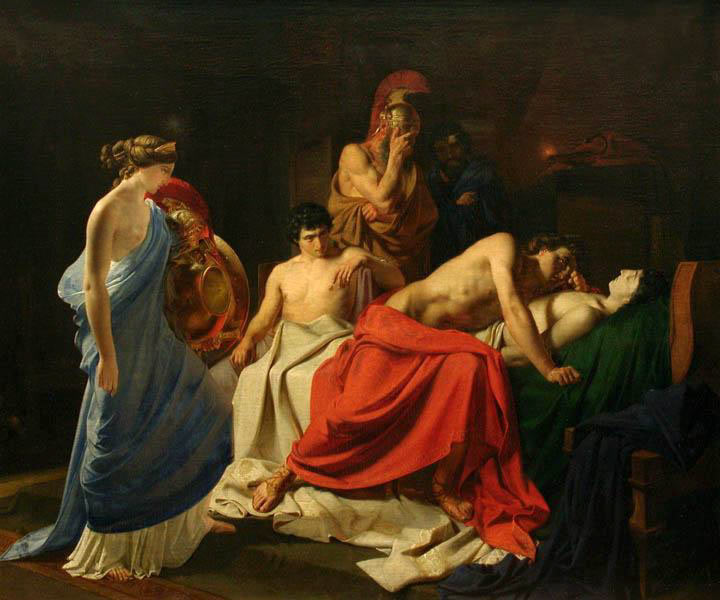
    The discontent and secession of Achilles.

  • O goddess sing what woe the discontent
  • Of Thetis’ son brought to the Greeks; what souls
  • Of heroes down to Erebus it sent,
  • Leaving their bodies unto dogs and fowls;
  • 5Whilst the two princes of the army strove,
  • King Agamemnon and Achilles stout.
  • That so it should be was the will of Jove,
  • But who was he that made them first fall out?
  • Apollo; who incensed by the wrong
  • 10To his priest Chryses by Atrides done,
  • Sent a great pestilence the Greeks among;
  • Apace they died, and remedy was none.
  • For Chryses came unto the Argive fleet,
  • With treasure great his daughter to redeem;
  • 15And having in his hands the ensigns meet,
  • That did the priestly dignity beseem,
  • A golden sceptre and a crown of bays,
  • Unto the princes all made his request;
  • But to the two Atrides chiefly prays,
  • 20Who of the Argive army were the best.
  • O sons of Atreus, may the Gods grant you
  • A safe return from Troy with victory;
  • And you on me compassion may shew,
  • Receive these gifts and set my daughter free;
  • 25And have respect to Jove’s and Leto’s son.
  • To this the princes all gave their consent,
  • Except King Agamemnon. He alone,
  • And with sharp language from the fleet him sent;
  • Old man, said he, let me not see you here
  • 30Now staying, or returning back again,
  • For fear the golden sceptre which you bear,
  • And chaplet hanging on it, prove but vain.
  • Your daughter shall to Argos go far hence,
  • And make my bed, and labour at the loom,
  • 35And take heed you no farther me incense,
  • Lest you return not safely to your home.
  • Frighted with this, away the old man went;
  • And often as he walked on the sand,
  • His prayers to Apollo up he sent.
  • 40Hear me, Apollo, with thy bow in hand,
  • That honour’d art in Tenedos and Chryse,
  • And unto whom Cylla great honour bears,
  • If thou accepted hast my sacrifice,
  • Pay th’ Argives with thy arrows for my tears.
  • 45His prayer was granted by the deity;
  • Who with his silver bow and arrows keen,
  • Descended from Olympus silently
  • In likeness of the sable night unseen.
  • His bow and quiver both behind him hang,
  • 50The arrows chink as often as he jogs,
  • And as he shot the bow was heard to twang,
  • And first his arrows flew at mules and dogs.
  • But when the plague into the army came,
  • Perpetual was the fire of funerals;
  • 55And so nine days continued the same.
  • Achilles on the tenth for counsel calls;
  • And Juno ’twas that put it in his head,
  • Who for the Argive army was afraid:
  • The lords to counsel being gathered,
  • 60Up stood Achilles, and thus to them said,
  • We must, I think, Atrides, run from hence,
  • Since war and plague consume us both at once,
  • Let’s think on how to stay the pestilence,
  • Or else at Troy resolve to leave our bones.
  • 65Let’s with some priest or prophet here advise,
  • That knows the pleasure of the gods above,
  • Or some that at expounding dreams are wise,
  • For also dreams descend on men from Jove:
  • That we may from him know Apollo’s mind,
  • 70If we for sacrifice be in arrear,
  • Or if he will for lambs and goats be kind,
  • And to destroy us from henceforth forbear.
  • Achilles then sat down, and Chalchas rose,
  • That was of great renown for augury,
  • 75And any thing was able to disclose,
  • That had been, is, or should hereafter be;
  • And guided had the Greeks to Ilium;
  • Achilles, said he, since you me command
  • To tell you why this plague is on us come,
  • 80Swear you will save me both with word and hand.
  • Of all the Greeks it will offend the best;
  • Who though his anger for awhile he smother,
  • Will not, I fear, long time contented rest,
  • But will revenged be some time or other.
  • 85Chalchas, replied Achilles, do not fear,
  • But what the god has told you bring to light:
  • By Phœbus, not a man shall hurt you here,
  • As long as I enjoy my life and sight;
  • Though Agamemnon be the man you dread,
  • 90Who is of all the army most obeyed.
  • The prophet by these words encouraged,
  • Said what before to say he was afraid.
  • ’Tis not neglect of vow or sacrifice
  • That doth the God Apollo thus displease;
  • 95But that we do his priest so much despise,
  • As not his child for ransom to release.
  • And more, till she be to her father sent,
  • And with a hecatomb, and ransomless,
  • The anger of the god will not relent,
  • 100Nor will the sickness ’mongst the people cease.
  • This said, he sat. The king look’d furiously,
  • And anger flaming stood upon his eyes,
  • While many black thoughts on his heart did lie;
  • And to the prophet Chalchas thus replies:
  • 105Unlucky prophet, that didst never yet
  • Good fortune prophecy to me, but ill,
  • And ever with a mind against me set
  • Inventest prophecies to cross my will;
  • And now again you fain would have it thought,
  • 110Because I would not let Chryseis go,
  • The gifts refusing which her father brought,
  • Therefore this plague was sent amongst us now.
  • With Clytemnestra she may well contend,
  • For person, or for beauty, or for art;
  • 115Yet so, to send her home I do intend,
  • For of our loss I bear the greatest part.
  • But you must then some prize for me provide;
  • Shall no man unrewarded go but I?
  • This said, Achilles to the king replied,
  • 120Atrides, that on booty have your eye,
  • You know divided is, or sold the prey
  • Which never can resumed be again.
  • But send her home. When we shall have sack’d Troy,
  • Your loss shall be repaid with triple gain.
  • 125No, said Atrides, that I never meant;
  • D’ye think ’tis fit that you your shares retain?
  • And only mine unto the God be sent,
  • That unrewarded none but I remain?
  • I thought it reason th’ Argives should collect
  • 130Amongst themselves the value (how they list)
  • And give it me before they did expect
  • This prize of mine should be by me dismist.
  • If they’ll do that, ’tis well. If not, I’ll go
  • To your, or Ajax, or Ulysses’ tent,
  • 135And take his prize, and right myself will so,
  • Wherewith I think he will not be content.
  • But since there’s time enough to speak of this,
  • Let’s ready make a ship with able rowers,
  • And th’ hecatomb, to go with fair Chryseis,
  • 140And, to direct, one of the counsellors;
  • Ajax, Idomeneus, Ulysses, or
  • Yourself may go, Achilles, if you please,
  • And do the business you are pleading for,
  • And, if you can, th’ offended God appease.
  • 145O impudence! Achilles then replied,
  • What other of th’ Achæans willingly,
  • Will, when you only for yourself provide,
  • Go where you bid, or fight with th’ enemy?
  • Against the Trojans I no quarrel have.
  • 150In Pthia plund’ring they were never seen,
  • Nor ever thence my kine or horses drave,
  • Nor could; the sea and great hills are between.
  • Only for yours and Menelaus’ sake,
  • To honour gain for you we came to Troy,
  • 155Whereof no notice, dogs-head, now you take,
  • But threaten me my prize to take away;
  • Which by my labour I have dearly bought,
  • And by th’ Achæans given me has been.
  • And when the city Troy we shall have got,
  • 160Your share will great, mine little be therein.
  • For though my part be greatest in the pain,
  • Yet when unto division we come,
  • You will expect the greatest part o’ th’ gain,
  • And that with little I go weary home.
  • 165Then farewell Troy. To sea I’ll go again,
  • And back to Pthia. Then it will be seen
  • When you without me shall at Troy remain,
  • What honour and what riches you shall win.
  • Go when you will, said Agamemnon, fly,
  • 170I’ll not entreat you for my sake to stay.
  • When you are gone more honour’d shall be I,
  • Nor Jove, I hope, will with you go away.
  • In you I shall but lose an enemy
  • That only loves to quarrel and to fight.
  • 175The Gods have given you strength I not deny.
  • Go ’mongst your myrmidons and use your might.
  • I care not for you, nor your anger fear,
  • For after I have sent away Chryseis,
  • And satisfi’d the God, I’ll not forbear
  • 180To fetch away from you the fair Briseis,
  • And that by force. For I would have you see
  • How much to mine inferior is your might,
  • And others fear t’ oppose themselves to me.
  • This swell’d Achilles’ choler to the height,
  • 185And made him study what to do were best,
  • To draw his sword and Agamemnon kill,
  • Or take some time his anger to digest.
  • His sword was drawn, yet doubtful was his will.
  • But Juno, that of both of them took care,
  • 190Sent Pallas down, who coming stood behind
  • Achilles, and laid hold upon his hair.
  • Whereat Achilles wond’ring in his mind,
  • Turn’d back, and by the terror of her eyes
  • Knew her; but by none else perceiv’d was she.
  • 195Come you, said he, to see the injuries
  • That are by Agamemnon done to me?
  • So great, O Goddess Pallas, is his pride,
  • As I believe it cost him will his life.
  • I hither came, Athena then reply’d,
  • 200To put an end to this unlucky strife.
  • From heaven I hither was by Juno sent,
  • That loves you both, and of you both takes care,
  • Drawing of swords and bloodshed to prevent.
  • But as for evil words you need not spare.
  • 205For the wrong done you he shall trebly pay
  • Another time. Hold then. Your sword forbear.
  • I must then, said Achilles, you obey,
  • Tho’ wrong’d. Who hears not Gods, the Gods not hear.
  • This said, his mighty sword again he sheath’d,
  • 210And Pallas up unto Olympus flew.
  • Achilles still nothing but choler breath’d,
  • And Agamemnon thus revil’d anew.
  • Dog’s-face, and drunkard, coward that thou art,
  • That hat’st to lead the people out to fight;
  • 215Nor yet to lie in ambush hast the heart,
  • And painfully watch in the field all night.
  • But thou to take from other men their due,
  • Safe lying in the camp, more pleasure hast.
  • But fools they are that ruled are by you,
  • 220Or else this injury had been your last.
  • But this I’ll say, and with an oath make good.
  • (Now by this sceptre, which hath left behind
  • The stock whereon it once grew in the wood,
  • And never more shall have nor leaf nor rind,
  • 225And by Achæan princes now is borne
  • By whom Jove’s laws to th’ people carried be.)
  • You hear now what a great oath I have sworn:
  • If ere the Acheans shall have need of me,
  • And Agamemnon cannot them relieve,
  • 230When Hector fills the field with bodies slain,
  • And Agamemnon only for them grieve,
  • They my assistance wish for shall in vain.
  • This said, Achilles threw the sceptre down
  • That stuck all over was with nails of gold;
  • 325And Nestor rose, of Pyle that wore the crown,
  • Wise and sweet orator and captain old.
  • His words like honey dropped from his tongue.
  • Two ages he in battle honour gain’d.
  • For all that while he youthful was and strong,
  • 240And with the third age now in Pyle he reign’d.
  • What grief t’ Achæa coming is, said he,
  • O Gods, what joy to Priam and his seed,
  • How glad will all the Trojans be to see
  • You two, that all the rest in pow’r exceed,
  • 245With your own hands shed one another’s blood!
  • I elder am, do then as I advise.
  • For I conversed have with men as good,
  • That yet my counsel never did despise.
  • Perithous and Dryas were great men,
  • 250And Polyphemus and Exadius,
  • Such as for strength I ne’er shall see again;
  • And so were Cæneus, and Theseus,
  • The strongest of mankind were these, and slew
  • The strongest of wild beasts that haunt the wood.
  • 255These strong men I convers’d withal and knew;
  • And with them also I did what I could.
  • With these no other could contend in fight.
  • Yet they from Pyle thought fit to call me forth
  • Far off; nor ever did my counsel slight.
  • 260Think not therefore my counsel nothing worth.
  • Atrides take not from him, though you can,
  • The damsel which the Greeks have given him.
  • Forbear the king, Pelides. For the man
  • Whom Jove hath crown’d is made of Jove a limb.
  • 265Though you be strong, and on a Goddess got,
  • Atrides is before you in command.
  • Atrides, be but you to peace once brought,
  • T’ appease Achilles I will take in hand,
  • Who is (while we are lying here) our wall.
  • 270To this Atrides answered again,
  • I nothing can deny of this at all.
  • But he amongst us thinks he ought to reign,
  • And give the law to all as he thinks fit.
  • But I am certain that shall never be.
  • 275He well can fight; the Gods have granted it,
  • But they ne’er taught him words of infamy.
  • Then interrupting him, Achilles said,
  • I were a wretch and nothing worth indeed,
  • If I whatever you command obey’d.
  • 280I will no more to what you say take heed.
  • But this I tell you, if you take away
  • The damsel which is mine by your own gift,
  • I do not mean for that to make a fray
  • Amongst the Greeks, or once my hand to lift.
  • 285Fetch her yourself, Atrides, but take heed
  • Against my will you nothing else take there.
  • Try; that th’ Achæans may see how you speed,
  • And how your black blood shall run down my spear.
  • Thus in disorder the assembly ends.
  • 290Achilles to his own ships took his way,
  • Patroclus with him and his other friends.
  • And Agamemnon then without delay
  • Launched a bark, and in go row’rs twice ten.
  • Aboard the maid and th’ hecatomb they lay.
  • 295Ulysses went commander of the men.
  • And swiftly then the ship cuts out her way.
  • And then Atrides th’ army purifi’d,
  • And threw into the sea the purgament.
  • Then sacrific’d o’ th’ sands by the sea side
  • 300A hecatomb. To heaven up went the scent,
  • And busy were the people. But the king
  • Still on his quarrel with Achilles thought,
  • And how Briseis from his tent to bring.
  • For what he threaten’d he had not forgot.
  • 305But sent Talthybius and Eurybates
  • T’ Achilles’ tent to fetch Briseis thence.
  • (Two public servants of the king were these,
  • Ordained to carry his commandments.)
  • If he refuse, said he, to let her go,
  • 310I’ll thither go myself with greater force
  • And take her thence, whether he will or no.
  • Which, angry as he is, will vex him worse.
  • The messengers, though not well pleased, went
  • Unto the fleet o’ th’ Myrmidons, and there
  • 315They found Achilles sitting by his tent.
  • Well pleas’d he was not. And they silent were,
  • And stood still, struck with fear and reverence.
  • Achilles seeing that, spake first, and said,
  • Come near. To me you have done no offence.
  • 320Go you, Patroclus, and lead forth the maid,
  • And give her to these men, that they may be
  • To Gods and men, and to th’ unbridled man,
  • My witnesses, when they have need of me
  • To save th’ Achæans, which he never can.
  • 325For what can he devise of any worth?
  • Or how can he the Greeks in battle save?
  • This said, Patroclus led Briseis forth,
  • And to Atrides’ messengers her gave.
  • She with them went, though much against her heart.
  • 330Achilles from his friends went off and pray’d.
  • And sitting with his face to the sea apart
  • Weeping, unto his mother Thetis said,
  • Mother, though Jove have given me so small
  • A time of life, I could contented be,
  • 335Had I not been dishonoured withal,
  • And forc’d to bear such open injury.
  • Thetis in the inmost closets of the deep,
  • Sat with the old God Nereus, and heard.
  • And not enduring long to hear him weep,
  • 340Above the sea like to a mist appear’d,
  • And by him sat, and strok’d his head, and said,
  • Why weep you, child? What is’t that grieves you so?
  • Tell me, speak out. Of what are you afraid?
  • Come, whatsoever ’tis let me it know.
  • 345Mother, said he, ’tis not to you unknown,
  • When we took Thebe, and had brought away
  • The captives and the riches of the town,
  • Chryseis fell t’ Atrides for his prey.
  • And how her father Chryses came to th’ fleet
  • 350With ransom great his daughter to redeem,
  • And having in his hands the ensigns meet
  • Which did his priestly dignity beseem,
  • A golden sceptre and a crown of bays,
  • Unto the princes all made his request.
  • 355But to the two Atrides chiefly prays,
  • Who of the Argive army were the best.
  • O sons of Atreus, may the Gods grant you
  • A safe return from Troy with victory;
  • And you on me compassion may shew,
  • 360Receive these gifts, and set my daughter free;
  • And have respect to Jove’s and Leto’s son.
  • To this the princes all gave their consent,
  • Except King Agamemnon. He alone,
  • And with sharp language from the fleet him sent.
  • 365Away the old man goes, and as he went,
  • Against the Greeks he to Apollo pray’d;
  • Who heard him, and the plague amongst them sent,
  • Which daily multitudes of them destroy’d.
  • Of which the prophet, being ask’d the cause,
  • 370Said, ’twas for th’ injury to Chryses done.
  • I mov’d to send her back. Then angry was
  • Atrides, though beside Atrides, none.
  • And though he too has sent her now away,
  • Yet what he threaten’d he has brought to pass.
  • 375His officers from me have forc’d my prey,
  • And Agamemnon now Briseis has.
  • And now, if ever, let me have your aid,
  • If you have holpen Jove with word or deed;
  • (For in my father’s house you oft have said,
  • 380That heretofore you stood him in great stead,
  • When other Gods to bind him had decreed,
  • Juno and Neptune, Pallas and the rest,
  • You to him came and from his bonds him freed.
  • For up you fetch’d Briareus, the best
  • 385Of Titans all, whom men Ægæon call,
  • The gods Briareus, with a hundred hands,
  • And set him next to Jove. No God at all
  • Then durst to Jupiter approach with bonds);
  • Put Jove in mind of this, and him intreat
  • 390The Trojan hands to fortify in fight,
  • And to repel the Greeks with slaughter great,
  • That in their goodly king they may delight,
  • And Agamemnon count what he hath won
  • By doing such dishonour to the best
  • 395Of th’ Argives, and that has such service done.
  • Ay me, said Thetis, would you could here rest
  • Unhurt, ungriev’d. For I have born you to
  • Short life. And not far from you is your fate.
  • And grievous ’tis to be dishonour’d too.
  • 400But I to Jove will all you say relate
  • When I go to Olympus. Till then stay,
  • And angry though you are, from war forbear.
  • To blackmoor-land the Gods went yesterday,
  • And twelve days hence again they will be there.
  • 405This said, the Goddess went away, and left
  • Her son Achilles with his anger striving,
  • For that he had been of his prize bereft.
  • And then Ulysses at the port arriving
  • Of Chryse, first his sails he furl’d, and stow’d
  • 410Them on the deck together with the mast;
  • And with their oars their ship ashore they row’d,
  • And out their anchors threw; and ty’d her fast.
  • And on the beach the men descending laid
  • The victims in good order on the sand.
  • 415When this was done, they disembark’d the maid.
  • And then Ulysses took her by the hand,
  • And brought her to the altar, where the priest
  • Her father stood, and to him spake, and said,
  • O Chryses, see, Atrides hath dismiss’d
  • 420Your daughter, and this hecatomb hath paid.
  • By Agamemnon we are hither sent
  • The same to offer, and t’ Apollo pray,
  • That he accept it will, and be content
  • The sickness from the Greeks to take away.
  • 425This said, he put Chryseis to his hand,
  • And he with great contentment her receiv’d.
  • Then all with salt and barley ready stand,
  • And Chryses pray’d with hands to heaven upheav’d.
  • Hear me, Apollo, with the silver bow,
  • 430That dost in Tenedos and Cylla reign,
  • And heardst my pray’r against the Greeks; hear now,
  • And from them send the pestilence again.
  • When Chryses had thus to Apollo pray’d,
  • Then pray’d they all; and salt and barley threw
  • 435Upon the victims; which they kill’d and flay’d.
  • But from the altar first they them withdrew.
  • And then the thighs cut off they alit in twain,
  • And round about they cover them with fat,
  • And one part on the other laid again.
  • 440The priest himself came when they had done that,
  • And burnt them on a fire of cloven wood;
  • And as they burning were pour’d on black wine.
  • Young men with spits five-branched by them stood.
  • When burnt the thighs were for the pow’r divine,
  • 445And entrails eaten, the rest cut in joints
  • Before the fire they roasted skilfully,
  • Pierced through with the spits that had five points;
  • And took it up when roasted thoroughly.
  • When ended was their work, began the feast;
  • 450Where nothing wanting was of what was good.
  • And having thirst and hunger dispossest,
  • And filled with sweet wine the temp’rers stood.
  • Then round the cups were borne; and all day long
  • Sitting they celebrated Phœbus’ might,
  • 455And magnifi’d his goodness in sweet song,
  • And he in his own praises took delight.
  • But when the sun had borne away his light,
  • Upon the sands they laid them down to sleep.
  • And when again Aurora came in sight,
  • 460Again they launch their ship into the deep.
  • A good fore-wind Apollo with them sent.
  • Then with her breast the ship the water tore
  • (Which by her down on both sides roaring went)
  • And soon arrived at the Trojan shore.
  • 465And there they drew her up again to land,
  • And ev’ry man went which way he thought best.
  • Achilles yet not able to command
  • The anger that still boiled in his breast,
  • No longer would the Greeks at council meet,
  • 470Nor with them any more to battle come;
  • But sullen sat before his tent and fleet,
  • Wishing to see the Argives beaten home.
  • Twelve times the sun had risen now and set,
  • The Gods t’ Olympus all returned were;
  • 475Thetis her son’s complaints did not forget,
  • But up she carried them to Jupiter.
  • Upon the highest top alone sat he
  • Of the great many-headed hill, and laid
  • One hand on’s breast, th’ other on his knee.
  • 480And in that posture thus unto him said,
  • O father Jove, if for you I have done
  • Service at any time by word or deed,
  • Repay it now I pray you to my son,
  • Whom Agamemnon hath dishonoured.
  • 485Short time the Fates have given him to life.
  • Atrides taken from him hath his prey.
  • Now victory unto the Trojans give
  • Till Agamemnon for his fault shall pay.
  • Thus prayed she. But Jove made no reply.
  • 490Nor took she off her hands; but pray’d anew;
  • O Jove, my prayer grant me, or deny,
  • That I may know what power I have in you.
  • Then Jove much grieved, spake to her, and said,
  • ’Twixt me and Juno ’twill a quarrel make.
  • 495For she before the Gods will me upbraid,
  • When she shall know the Trojans’ part I take.
  • But go, lest she observe what you do here.
  • I’ll give a nod to all that you have spoken,
  • That you may safely trust to and not fear.
  • 500A nod from me is an unfailing token.
  • This said, with his black brows he to her nodded,
  • Wherewith displayed were his locks divine;
  • Olympus shook at stirring of his Godhead;
  • And Thetis from it jump’d into the brine,
  • 505And Jupiter unto his house went down.
  • The Gods arose and waited on him thither:
  • But unto Juno it was not unknown
  • That he and Thetis had conferr’d together,
  • Who presently to Jove her husband went,
  • 510And angry him rebuk’d with language keen.
  • You that still in my absence tricks invent,
  • What God hath with you now in counsel been?
  • Though unto me you hate to tell your mind.
  • Juno, said Jove, you must not hope to hear
  • 515All whatsoe’er it be, I have design’d.
  • But what I mean shall come unto the ear
  • Of all the Gods, you first of all shall know.
  • But what from all together I shall hide
  • Ask me no more, I will not tell you, though
  • 520My wife you be. Juno then thus repli’d.
  • Harsh Chronides, what words of yours are these!
  • To ask you questions I’ll henceforth forbear,
  • And quietly let you do what you please.
  • But one thing I must tell you that I fear.
  • 525Thetis, I fear, has gotten your consent,
  • For her son’s sake the Argives to oppress.
  • Suspect you can, said Jove, but not prevent,
  • Which doth but give me cause to love you less.
  • Though it be true, ’twas I would have it so.
  • 530Therefore sit still and do as I would have you.
  • Lest when my mighty hands about you go,
  • Nor all the other Gods in heav’n shall save you.
  • Then Juno silent sat with grief and fear;
  • And all the Gods i’ th’ house of Jove did grieve.
  • 535But Vulcan, the renoun’d artificer,
  • Stood up his mother Juno to relieve.
  • O what will this come to at last, said he,
  • If you for mortals thus shall be at odds!
  • The tumult than the cheer will greater be.
  • 540What pleasure can this be unto the Gods?
  • And though my mother wiser be than I,
  • Yet thus much I’ll not doubt her to advise,
  • That with my father’s will she would comply,
  • That no such quarrel may hereafter rise.
  • 545For by the roots he can the world pluck up.
  • Therefore I pray you mother speak him fair;
  • He’ll soon be pleas’d. Then filled he a cup
  • Of nectar sweet, and bore it to her chair;
  • And to her said, mother, I pray you hold,
  • 550And do no more my father’s choler move.
  • If you be beaten I shall but behold,
  • And grieve I am not strong enough for Jove.
  • I would have helpt you once, when by the foot
  • He threw me down to Lemnos from the sky.
  • 555All the day long I was a falling to’t,
  • Where more than half dead taken up was I.
  • And there by th’ Sincians I was taken up.
  • When Vulcan had his history told out,
  • His mother on him smil’d, and took the cup,
  • 560And to the Gods he nectar bore about.
  • And then the Gods laught all at once outright
  • To see the lame and sooty Vulcan skink.
  • And all the day from morning unto night
  • Ambrosia they eat, and nectar drink.
  • 565Apollo played, and alternately
  • The Muses to him sung. When night was come,
  • Then gently Sleep solicited each eye,
  • And to his house each God departed home.
  • And Jupiter went up unto the bed
  • 570Where he at other times was wont to lie
  • When sleep came on him, and laid down his head
  • To take repose; and Juno lay him by.