EconlibThe LibraryOther Sites |
Front Page Titles (by Subject) 8: Scotland and the Puritan Revolution - The Crisis of the Seventeenth Century
Return to Title Page for The Crisis of the Seventeenth CenturyThe Online Library of LibertyA project of Liberty Fund, Inc.Search this Title:Also in the Library:
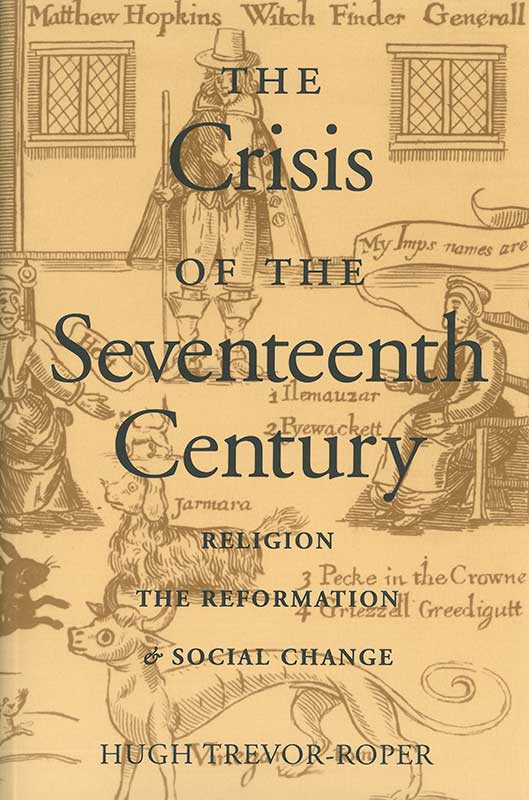
8: Scotland and the Puritan Revolution - Hugh Trevor-Roper, The Crisis of the Seventeenth Century [1967]Edition used:The Crisis of the Seventeenth Century: Religion, the Reformation and Social Change (Indianapolis: Liberty Fund, 2001).
About Liberty Fund:Liberty Fund, Inc. is a private, educational foundation established to encourage the study of the ideal of a society of free and responsible individuals. Copyright information:The copyright to this edition, in both print and electronic forms, is held by Liberty Fund, Inc. Fair use statement:This material is put online to further the educational goals of Liberty Fund, Inc. Unless otherwise stated in the Copyright Information section above, this material may be used freely for educational and academic purposes. It may not be used in any way for profit.
8Scotland and the Puritan RevolutionBetween the union of the crowns in 1603 and the union of the parliaments in 1707, the relations of England and Scotland were thoroughly unhappy. Unequal in strength, different in history, the two countries had enough similarity to force them together and yet enough diversity to make their contact always explosive. Moreover, each feared the other. To some Scots—to the “beggarly blue-caps” who streamed down to the golden Court of James I and set up dynasties in the north on the unearned profits of England—the union of crowns was a great gain; but to Scotland in general it was a great loss: the King of Scotland became an absentee captured by a foreign establishment, and able, if he wished, to use foreign resources against the liberties of his native country. For the same reason, England too had its apprehensions. The resources of Scotland might be slight, but they were not negligible. In internal English affairs they might give a narrow but decisive margin of superiority to the Crown over its opponents—as they afterwards did to its opponents over the Crown. From the earliest days of the union of crowns, the profoundest of English statesmen, Francis Bacon, foresaw that a revolution in England might well begin in Scotland.1 A generation later, it did. The English Puritan Revolution, at every stage, was affected by Scottish affairs. Without Scotland it could not have begun; having begun, without Scotland it might have been over in a year. But again and again—in 1641, in 1643, in 1648, in 1651—Scotland reanimated the flames in which England was being consumed. Thereafter, when the revolution had triumphed in England, Scotland paid the price: the revolution was carried to it. The uneasy half-union of 1603 was completed, as even James I had not wished to complete it then, but as the statesmen of Queen Anne would be obliged to complete it afterwards, by a full union of parliaments. Indeed, the union of 1652 was far closer than that of 1707: for it was a union of Church and law as well. Moreover, I shall suggest, it entailed a social revolution in Scotland such as would not occur in fact till after 1745. Only it did not last. Within a few years all crumbled; yet another army set out from Scotland and ended by restoring, with the monarchy, the old half-union of 1603. With that restoration the last age of Scotland’s independence, the darkest age in its history, began. The character and effect of Scottish intervention in the English Revolution is well known. Everyone knows how the Scots were driven into revolt by Charles I’s Act of Revocation and Archbishop Laud’s liturgy; how the leaders of the Puritan opposition in England enlisted them as allies; how, thanks to that alliance, they were able to force Charles I to call a parliament and to prevent him from dissolving it; how Charles I, in the summer of 1641, by a personal visit to Scotland, sought and failed to reverse that alliance; how the English Parliament in 1643 renewed it, and brought a Scottish army, for the second time, into England; how Charles I, in reply, sought once again to raise up a rival party and a rival army in Scotland, and this time nearly succeeded; how the Marquis of Montrose, in his career of triumph, offered to lay all England as well as all Scotland at the feet of the king; but how, in fact, after his disaster at Philiphaugh and the surrender of the king not to his English but to his Scottish subjects, the Scottish Covenanters, in 1646, sought to impose their terms on both the king and the Parliament of England; how they were disillusioned and returned to Scotland, selling their king (as the royalists maintained) for £400,000 to the revolutionary English party which was to cut off his head; how the Scottish parties then sought, in vain, by yet other invasions of England, to stay or reverse the revolution: to snatch Charles I from the scaffold or to impose Charles II as a “covenanted king” on the throne; how Oliver Cromwell destroyed the first attempt at Preston, the second at Dunbar and Worcester; how all Scottish parties were thereafter pulverized by the victors, the Hamiltons executed, Argyll driven back to obscurity in Inveraray, the Committee of Estates rounded up, the General Assembly dissolved, and the whole country reduced to obedience, and blessed with order and tranquillity, for the remaining lifetime of the Protector. All this is well known. Every English historian admits it. And yet, how many problems are left out of this summary! Even as we recite the facts, the questions force themselves upon us. For why did the Scots intervene so constantly, and at such cost, in English affairs? What springs of action prompted them again and again, in the 1640s, to impose a new pattern on a reluctant English society? And what was the nature of the revolution which, in the 1650s, was imposed on Scottish society by England? English historians, who have worked so intensively on the Puritan Revolution in the last half-century, have seldom asked these questions. To them, as to the English Independents of the time, the Scottish forces were “a mere mercenary army,” which king and Parliament in turn summoned to their aid in their purely English struggle. They do not see them as the expression of social forces in Scotland. Indeed, they hardly look at the social forces of Scotland. Scotland, to them, is not an intelligible society responding to intelligible social forces. Like seventeenth-century visitors to Scotland, they tend to dismiss it as a barbarous country populated only by doltish peasants manipulated, for their own factious ends, by ambitious noblemen and fanatical ministers. And equally, they see the Union of 1652 as a mere military occupation, imposed, for the sake of order, on an exhausted land. Even Scottish historians have hardly sought to fill this gap. As far as published work is concerned, the sociology of seventeenth-century Scotland remains a blank. Into such a blank it is rash for a foreigner to intrude, and in this essay I shall only offer, with prudent caution, some general suggestions. They concern the two problems which I have outlined above: the attempt of the Scots to impose Presbyterianism on England in the 1640s and the attempt of the English Puritans to carry through a social revolution in Scotland in the 1650s. But fundamental to both these problems, and to the failure of both attempts, is the pre-existing difference between the two societies: a difference which was masked, even at the time, by superficial similarities, but which was in reality profound: so profound that it made the attempt of the Scots to impose their own form of Presbyterianism on England futile, even absurd, and the attempt of the English to reform Scottish society in the 1650s premature and hopeless except under continuing force. For in fact, behind all similarities, England and Scotland were poles apart. Consider the century before 1640, the century (some would say) whose new strains, in England, gradually built up the pressures leading to revolution. In that century both England and Scotland had rejected the Roman supremacy. To that extent they were similar. But after that similarity, what a difference! In England population, trade, wealth had constantly increased. New industries had grown up and found new markets in a richer, more sophisticated lay society at home. The economic growth of England had been extraordinary and had created, however unequally, a new comfort and a new culture. But in Scotland there had been no such growth. There was little trade, little industry, no increase of population. Always poor and backward, it now seemed, by contrast, poorer and more backward still. That contrast is vividly illustrated by the comments of those who crossed the Tweed, in either direction. We read the accounts of English travellers in Scotland. Their inns, cries Sir William Brereton, are worse than a jakes; and he breaks into a sustained cry of incredulous disgust at that dismal, dirty, waste and treeless land. Then we turn to the Scottish travellers in England. “Their inns,” exclaims Robert Baillie, “are like palaces”; and Alexander Brodie of Brodie, goggling at all the wicked fancies and earthly delights of London, reminds us of a bedouin of the desert blinking in the bazaar of Cairo or Damascus.2 Nor was the contrast merely one of material progress. Material progress brings its strains. In England there had been a remarkable centralization, both of population and of wealth, in the twin cities of London and Westminster. There the new industrial wealth was centred, there the swollen bureaucracy of government, the Court so resented by the “country,” was rooted. The population of London, in that century, had been quadrupled. Behind the political errors of the statesmen and churchmen in the 1630s, these inescapable social facts provided the solid substance of discontent. The “country,” starved and drained (as it felt) by a monopolist City and an anachronistic, parasitic Court, was determined to assert its rights; and it felt able to do so because the same century had bred up an educated lay estate, independent of Church and government, and organized in a powerful institution: Parliament. From all these new forces, and new strains, Scotland was exempt. In Scotland, as there was no inflation, so there was no pressure; nor was there any such concentration either of commerce or of government. Edinburgh was, as it would long remain, destitute of mercantile spirit. There was no Court. While the other princes of western Europe had built up bureaucracies round the throne, the kings of Scotland had been the playthings of great, incorrigible feudatories from whom they had finally fled to England. Without merchants, without “officers,” Scotland lacked altogether the new class of educated laymen on which the greatness of Tudor England had been built. For practical purposes its educated middle class consisted of lawyers and clergy, the two pillars of conservatism which the laity of England sought to reform. Consequently it lacked also their institutions. The Scottish Parliament was as feeble as the Castilian Cortes. It was because it represented so little that the country acquiesced, in 1707, in its ultimate migration to London. Finally, there was a third difference. Scotland had already had a religious revolution. By an irony which seems also a law of history, the new religion of Calvinism, like Marxism today, had triumphed not in the mature society which had bred it, but in underdeveloped countries where the organs of resistance to it were also undeveloped. And because it had triumphed in backward countries, it had adapted itself to the circumstances of such countries. It had become dictatorial, priestly, theocratic. In England, in the reign of Edward VI, the Calvinist clergy (John Knox among them) had sought to determine the nature of the Reformation. They had failed and, in the reign of Mary, had been forced to flee abroad. On the accession of Elizabeth, they had returned eager for the power which seemed to await them. But the self-confident laity of England had soon reduced them to order. Only in moments of crisis—as in 1588—did the organized Calvinist clergy seem temporarily to represent the English people. But in Scotland, where there was no such laity, the Calvinist clergy had established their hold on society. They saw themselves as the educated élite which would impose a new doctrine, a new Church, a new morality on an indifferent people, and drag them upwards. And the laity of Scotland, recognizing its own weakness, accepted them, largely, as such. Kings and courtiers might dislike these insufferable dominies. Individual Scotsmen of culture might prefer the more tolerant, more civilized clergy of the Anglican Church. But those who wished to mobilize the people in Scotland had to use the tribunes of the people; and by 1640 those tribunes were the most highly organized force in Scottish life. If the Scottish Parliament, the organ of the Scottish laity, was a poor thing, the General Assembly, the organization of its clergy, was not. In times of crisis it could be, like the lay Parliament of England, the voice of the nation. Thus between England and Scotland there was, by 1640, an immense social gulf, which the preceding century had widened. Beneath their common Protestantism and common language, concealed by their common opposition to the same threat, their whole structure differed. Because it had not shared the expansion of England, Scotland was exempt from the strains of growth. Because it had experienced a more radical religious reformation, it no longer felt certain ancient pressures. And because there was little or no independent, educated laity, the Calvinist clericalism, which in England or France might have been a transitory stage, in Scotland (as in New England) became a conservative tyranny. These different social facts entailed a radical difference of ideas. English Puritanism, though articulated by its clergy, was essentially a lay movement. It was also radical, looking forward to complete the half-reformation of the Tudors by a full emancipation of the laity. Scottish Presbyterianism, though sustained by its laity, was essentially clerical. It was also conservative, seeking not to go forward, to a lay society, but to secure, against the new, creeping episcopalianism of the Stuarts, the clerical reformation which had already been won. In 1640 this was a very real problem: it imposed on the Scots the need of a new, forward policy. The policy of the Scottish Kirk in the 1640s was the natural result of its conservatism and its weakness. In this it did not differ from the other Calvinist societies of Europe. Everywhere, in 1640, established Calvinism was on the defensive. Having triumphed in weak and backward countries it had automatically exposed their weakness. For Calvinism, by then, had been rejected by all the military monarchies of Europe. Catholic, Lutheran and Anglican alike regarded it as a revolutionary doctrine and hoped, openly or secretly, to see it ultimately stamped out in the few, obscure corners where it still throve. The King of Spain longed to crush it in Holland; the Duke of Savoy dreamed of the destruction of Geneva; the French monarchy would not long tolerate the “republic” of La Rochelle; the King of England planned to undermine the Kirk of Scotland. Everywhere Calvinist rulers knew that their society was in danger from powerful neighbours, and to protect it they had, perforce, to adopt one of two policies. Either they must attenuate their Calvinism in order to secure the patronage of non-Calvinist princes, the enemies of their enemies, or, if such patronage were unattainable, they must fall back on themselves, call up their most radical preachers, appeal to the Calvinist International, and, in self-defence, carry the revolution abroad. In the sixteenth century the former policy was adopted by the Dutch, who needed the support of England and France; it was also adopted by the Scots, who sheltered under the wing of that useful, though Anglican neighbour, Queen Elizabeth. The latter was adopted by the Calvinists of the Palatinate and Bohemia in 1618–20; it was also, increasingly, adopted by the Scots when the successors of Queen Elizabeth, who were also their own kings, turned against them and left them isolated in the world. At first, it was not necessary to adopt it in all its rigour. The Scottish Kirk, in 1638, might be threatened by the Crown of England and Scotland, but the errors of Charles I had given it powerful allies in both countries. The king might think that he had divided the classes in Scotland. He might suppose that by his “innocent Act of Revocation” he had freed the gentry from their “clientele and dependence” on the great lords. Many of the Scottish lairds, he claimed, had thanked him for their emancipation from that “intolerable bondage.”3 But in fact, as so often, he was wrong. Noble patronage was not broken; the gentry were not rendered independent; and by 1638 the former, as patrons, and the latter, as ruling elders, formed the strength of the National Covenant. Moreover, looking abroad, the architects of that Covenant could see, or thought they could see, a similar alliance of classes in England, all equally determined, with them, to bring the crown to reason. Thanks to this internal solidarity and to these external allies, the Scottish Covenanters were able to overthrow the new episcopacy which had been planted among them and “restore” the Kirk to its purest form. Undoubtedly it was a great victory. But how long would it last? When the Scottish leaders looked about them, they had to admit that it had been a very close thing, the result of a remarkably favourable conjuncture such as could never be predicted, could hardly be expected to last, and might never recur. And of course, in changed circumstances, it might easily be reversed. Obviously, while the favourable conjuncture lasted, they must do whatever was necessary to make their victory permanent. And after the experience of the last generation they knew what was necessary. They must export their revolution. Theoretically the Scotch Kirk might co-exist with “moderate episcopacy” in England. It had done so in the previous century. But that was when Queen Elizabeth had reigned in England, and the two kingdoms had been separate. King Charles and the union of crowns had changed all that. And anyway, how long would “moderate episcopacy” remain moderate? Episcopacy had been “moderate” in Elizabethan England and in Jacobean Scotland; but insensibly it had been transformed, as it could be transformed again. So the Scots leaders were clear. In England, as in Scotland, episcopacy must be rooted out. There must be no compromise, no return to the Elizabethan system. Only one form of Church-government in England was compatible with the permanence of Presbyterianism in Scotland: England must become Presbyterian too. The full-blown, bishopless, clerical Calvinism of 1639 must be accepted, in toto, by the stronger kingdom. Moreover, thought the Scots, it could easily be done. There was no need of compulsion, hardly even of pressure. As they looked at England they saw only the resemblances, never the differences. Admittedly England was much richer and more powerful than Scotland, but the social and political structure, to their eyes, seemed exactly the same. Was not the parliamentary opposition, which had triumphed, there too bound together by noble patronage, inspired by “Calvinian” clergy, made solid by the gentry? Was there not a general outcry against the bishops? And did not the English, in that triumphant winter of 1640–41, looking back on the immediate causes of their triumph, “all everywhere profess” that, under God, they owed “their religion, liberties, parliaments and all they have” to the victorious army of their brethren the Scots? What wonder if, in the exaltation of the moment, with Charles I’s policy in ruins, Strafford and Laud in the Tower, and the citizens of London submitting monster petitions for the abolition of episcopacy, the ever-complacent Scottish clergy overlooked the great social gulf which really separated the two countries, and supposed that “the Scots discipline” could be established in England by a mere hint from them, the experts, the teachers and the saviours of England? So, that winter, four Scottish clergymen set out from Edinburgh to guide the grateful English towards the true doctrine and perfect system of Presbytery. It was a planned operation: each had his set task. One was to bring down “his little Grace” the Archbishop of Canterbury and the whole episcopal system; one was to destroy the Anglican ceremonies which accompanied it; the third was to define the Presbyterian system; the fourth to dish the sectaries who might have other ideas, of “the New England way”; and all four were to preach by turns to the Scots commissioners and all else who would come to hear the saving gospel from the north. The main advocate of Presbytery among these four evangelists was Alexander Henderson, the framer of the National Covenant. The alternating hammers of ceremonies and sectaries were George Gillespie and Robert Blair. The confident grave-digger of Anglicanism was the voluble, invaluable letter-writer, that incomparable Scotch dominie, so learned, so acute, so factual, so complacent, so unshakably omniscient, so infallibly wrong, Robert Baillie A.M. (Glasweg), regent of Glasgow University and minister of Kilwinning, Ayrshire. The four clergymen set to work. They preached, they wrote, they lobbied; and always they saw the end of their labours just round the corner. Baillie’s letters home are a continual purr of complacency. Of course, he admitted, the poor benighted English could not leap all at once up to the Scotch level; but he found them eminently teachable; and though his arms, as he said, were “full of my old friend, his little Grace,” he was always ready to open his mouth too, to teach them. (Indeed, Baillie admitted that he opened his mouth “somewhat to his own contentment” and that it “weighted his mind” to keep it shut.) So on one occasion, he preached for an hour on God’s singular mercies to the Scots, whereupon (he said) “many tears of compassion and joy did fall from the eyes of the English.” Everywhere, he observed, there was not only a crying need, but also a general desire for Presbytery. There might be a few separatists, pursuing “the New England way,” but “the far greatest part are for our discipline”; and anyway, it would be easy to use the separatists in the work of demolition and then discard them. Once the “rubbish” of Anglicanism was swept away, it would be easy to “build a new house”: the house of the Lord according to John Calvin, John Knox and Andrew Melville. In May 1641, when the English Parliament signed the “Protestation” of solidarity against Strafford, it was, Baillie confidently declared, “in substance, our Scottish Covenant.” So Scot to Scot smugly blew his tribal trumpet; but the walls of the episcopal Jericho were strangely slow in falling. First there were excuses: the matter, said the English, must be deferred “till first we have gotten Canterbury down.” The Scots took up the challenge. Baillie threw himself at “his little Grace,” prepared to give him “the last stroke,” and looked eagerly forward to his “funeral”; but somehow nothing happened. To hasten the matter, all four ministers wrote pamphlets, which, they felt, were “much called for”: in particular, Alexander Henderson himself wrote “a little quick paper” against English bishops, giving “very good reasons for their removal out of the Church.” The result was most unfortunate. The king, who had just publicly declared his faith in episcopacy, was “so inflamed as he was never before in his time for any other business.” He told the Scots that, by such interference, they had forfeited their privileges; the English reformers maintained a prudent silence; and even “divers of our true friends” (lamented Baillie) “did think us too rash.” Internal English affairs, the Scots were told, were an English matter: they should mind their own business. Thereupon, to Baillie’s dismay, the House of Lords set up a committee to reform episcopacy: an infamous “trick,” to “caulk the rotten hulk of episcopacy” and set it afloat again. The Scotch lay commissioners interposed discretion and, according to their instructions, submitted papers requesting a conformity of Church-government as a special means of preserving peace between the two kingdoms; but it made no difference. It was with difficulty that the English Parliament was prevented from telling them, too, to mind their own business. In the end they were simply told that the two Houses had already considered the reform of Church-government in England, and would proceed along their own lines “in due time, as shall best conduce to the glory of God and peace of the Church.”4 So that was that. In the summer of 1641 the Scots were finally paid off and sent home. Pym had used them and dismissed them, just as he had used and then dismissed the Irish Catholic enemies of Strafford. Both had secured their immediate aims: Strafford was dead, and the king, that summer, ratified the Scottish revolution. But neither had obtained the long-term guarantees which they sought: there was to be no recognition of Catholicism in Ireland, and the Scottish revolution was not to be exported to England. And indeed, Pym could reply, why should it be? The English Church was the affair of Englishmen. The Scots had indeed been very useful, but they had been serving their own interest; they had been well paid; and they should be satisfied with what they had got: they had helped to restore, in England, that Elizabethan system which had protected the rear of the young Kirk of Scotland, and would do so still. So, in England, on 7 September, all the church bells were rung, to give thanks to God for a peace with Scotland, the departure of the Scots, and the basis laid for a purely English Church reformation. Unfortunately history did not stop there. Those who call in foreign aid cannot complain if their enemies do so too. Charles I had not accepted the English reformation of 1641: and if the Scots and the Irish thought themselves double-crossed, why should he not exploit their resentment? In a year much had happened in Scotland; the unity of the Covenant was dissolving as the ambitions of Argyll showed through it. Much had happened in Ireland too since the great unifier of discontent, Strafford, had fallen. So in both Scotland and Ireland the king sought new allies to continue the struggle. In Scotland he failed: his personal presence there only served, in Clarendon’s words, to make “a perfect deed of gift of that kingdom” to the Covenanting Party. But in Ireland the troubled waters yielded better fishing, and before long a train of events had begun which led insensibly to civil war in England, and thereby once again brought the English Parliament and the Scotch General Assembly together. ![]() >Roger Boyle, Lord Broghill, 1st Earl of Orrery As soon as civil war appeared imminent, the English Parliament approached the General Assembly: would their brethren the Scots stand by the English Houses in their just struggle? But this time the Scots were not going to be double-crossed, as in 1641. Once bitten is twice shy, and they were resolved to have legal guarantees before they gave any help. The essential condition of help, they replied, was “uniformity of Kirk government.” Prelacy must be “plucked up root and branch” in England, and Presbyterian government “by assemblies, higher and lower, in their strong and beautiful subordination” must be substituted for it. The English Parliament was prepared to renounce episcopacy, at least on paper; it was prepared to utter pious general formulas; but it absolutely refused to give any guarantee of Presbyterianism. It preferred to fight the king alone. At that time it thought it could win quickly. A little later, it had doubts, and applied again to the Scots. But still it said nothing about Presbyterianism. Baillie waxed sardonic about the strange “oversight.” “It was a wonder,” he wrote, “if they desired any help, that they denied to use better means for its obtaining.” It was not till the summer of 1643, when the parliamentary cause seemed hopeless—when the king was preparing for the final onslaught, and the radicals in Parliament were in revolt—that Pym decided to seek a Scotch alliance even, if necessary, on Scotch terms. And those terms had not changed. They never would change. The Scots themselves, by 1643, were thoroughly apprehensive. They were almost as eager for an alliance as the English. But even so, they would stand out for the old price. As Baillie wrote, “the English were for a civil league”—mutual assistance without reference to religion—“we for a religious Covenant”: a binding covenant of exact religious conformity. Such was the origin of the Solemn League and Covenant. How hard the English fought against the Scotch condition, the Covenant, we know. Every phrase which alluded to it was contested in both Houses. All the verbal subtlety of Vane was needed to find a formula which could both mean and not mean it: mean it for the Scots, not mean it for the English. All the mental reservations of Cromwell were needed to slip out of that formula when it had been accepted. Pym himself, in his last recorded speech, pleaded sheer necessity as its only justification. Nevertheless, it was accepted; and because the name was accepted, the Scots, those incorrigible nominalists, supposed that the thing was accepted too. In December 1643 Robert Baillie, now a professor and more self-assured than ever, set out once again with his colleagues to London, confident, in spite of all past experience, that this time the cat was in the bag. All that was needed was to keep it there. And this now seemed easy. If only a “well-chosen committee,” packed with Scots, were established in London, “they would soon get the guiding of all the affairs both of this state and church.” So the Scots set to work again. Their aim was constant and clear: “to abolish the great idol of England, the Service Book, and to erect in all the parts of worship a full conformity to Scotland.” From the start there was to be no compromise. They refused to hear even Pym’s funeral sermon, delivered by the pope of English “Presbyterianism,” Stephen Marshall, “for funeral sermons we must have away, with the rest.” In the Assembly of Divines as in Parliament “we doubt not to carry all clearly according to our mind.” By adjuration from Scotland, reinforced by the Calvinists of France and Switzerland, all deviation from the true doctrine was to be forbidden; schismatics “and the mother and foster of all, the Independency of congregations” were to be suppressed; all suggestions of toleration were to be crushed. The English Parliament had double-crossed the Scotch General Assembly once. It must not do so again. Nor (thought the Scots) could it do so again. It was committed now by a greater need and chained in redoubtable syllables of assent. Alas, even the most pedantic, professorial syllables cannot alter historic, social facts. In spite of the Covenant, in spite of Marston Moor, in spite of much ink and much breath, facts remained facts, and before many months had passed Baillie’s letters became, once again, a series of anguished ejaculations. It was not only that Vane and St. John, “our former friends,” the framers of the alliance, who owed all (said Baillie) to the Scots, had turned against them. Vane and St. John, it soon transpired, were acknowledged Independents. Even the professed English “Presbyterians,” even Denzil Holles, their lay leader, even Stephen Marshall, their religious oracle, were no better. England, exclaimed Baillie, in a moment of truth, even parliamentary England, was either “fully episcopal” or “much episcopal”; Presbytery, to the English, was “a monster”; and the only hope of establishing “the Scots discipline” south of the Tweed was by means not of sermons or pamphlets, committees or advice, but of “our army at Newcastle.” “If by any means we would get these our regiments, which are called near thirty, to 16,000 marching men,” then “by the blessing of God, in a short time, we might ruin both the malignant party and the sectaries.” Already, before the king was defeated, the Scots were thinking of a military conquest of England. Vain hope! It was not the Scottish army that was to decide the English civil war. It is true, when the first war was over, an English party called the “Presbyterians” was in power. It is true, this party confirmed the abolition of episcopacy, putting the bishops’ lands up for sale. It is true, the name and form of Presbyterianism were accepted to fill the void. But why were the bishops’ lands sold? To raise money to get rid of the Scots who, once again, as in 1641, had served their turn and were to be sent home. And what was the Presbyterianism which was set up in the place of episcopacy? Was it “full conformity with the Kirk of Scotland”? Certainly not. It was, as Baillie himself lamented, “a lame erastian Presbytery” in which all the essentials of the Scottish system—the divine right of ruling elders, the judicial independence of the Church, its “strong and beautiful” internal structure, its formidable power of excommunication—had been sacrificed not only to the “sectaries” in Parliament and “the sottish negligence of the ministers and gentry in the shires,” but also to the stubborn refusal of the so-called “Presbyterians” themselves. For in fact—whatever compliance they made for the sake of Scottish help—the English “Presbyterians” were not Presbyterians. Perhaps no label has caused such political and historical confusion as the label “Presbyterian” attached to an English political party. Because of that label, seventeenth-century Scottish clergymen built up impossible hopes and modern historians have tied themselves in unnecessary knots. Why, asked the former, did the English “Presbyterians” not carry out the terms of the Solemn League and Covenant? Why, ask the latter, did the English “Presbyterians,” whose Scottish brethren clung to their Church through thick and thin, become Independents in the 1650s and Anglicans in the 1660s? The answer to these questions is simple. Except for a few clergymen, tempted by clerical power, there were no English Presbyterians. Whatever history may call them, whatever events sometimes forced them to appear, the Englishmen who attempted to stabilize the revolution in 1646 were, as they had been in 1641, as they would be in 1660, “moderate Anglicans,” believers, under whatever name, in a temperate, lay-controlled, Elizabethan episcopacy. If we look at the men, if we look at their policy, always making allowances for circumstances, this is clear enough. Clarendon, going through the list of the “great contrivers,” all of whom he had known, marvels to think of the damage done by these men, nearly all of whom, on examination, turned out to be so “well-affected” to the Anglican Church. John Pym himself, to his dying day, extolled “moderate episcopacy” as the ideal Church system, and the words in which he nevertheless urged his fellow “rebels” to swallow the Solemn League and Covenant show that he was addressing men who shared those ideals. Whatever words they might utter in the heat of the moment, whatever measures might be forced upon them by the necessity of war-finance or the mounting passions of civil war, those men would always have gladly settled for the system which divided them least. They might abolish episcopacy on paper, but all through the first civil war they took care not to abolish it irreversibly in fact. Even when, at long last, under Scottish pressure, the fatal step was taken and the bishops’ lands were put up for sale, the consequences were not accepted. The English “Presbyterians,” having got rid of the Scots and their absurd demands, were prepared to settle for a three-year probationary period which, as everyone knew, would be a half-way house to the restoration of episcopacy. Even the “Presbyterian” Lord Mayor of London of the time could afterwards be praised by a “Presbyterian” minister of the time, for his constant fidelity to the episcopal Church of England.5 And as a matter of fact, those who became Independents were not very different in this. In 1647 when it was their turn to offer terms to the king, they offered to restore “moderate episcopacy.” Oliver Cromwell himself, once the violent years were over, sought to reunite the Anglican clergy in his Puritan Church6 and gave a state funeral, with the Anglican liturgy, in Westminster Abbey, to the great figurehead of moderate episcopacy, Archbishop Ussher. For “moderate episcopacy” meant laicized episcopacy. Whatever form of Church structure (that is, of social structure) the English Puritans were prepared to accept, the one essential ingredient was laicization. If they could not have “moderate episcopacy,” the next best thing might be called “Presbyterianism.” It might borrow Presbyterian features. But essentially it would be Independency: a decentralized, laicized, Protestant Church. To the Scots ministers this fact was never clear. Provincial, complacent men, accustomed to pontificate from their pulpits, tenacious of the dogma and discipline which had served them at home, inured to the nominalism of the Schools and accustomed to the docility of their flocks, they never dreamed that similarity of words could conceal such divergence of meaning. So they alternated between absurd confidence and righteous indignation. At one time—in 1646, when Montrose had been defeated in Scotland and the king in England, and the English “Presbyterians” had won control in the English Parliament—they would be triumphant. Total victory, it seemed, was theirs. In that year the General Assembly ordained that all Scotsmen who had been in arms with Montrose, or had dealt with him, or drunk his health, should be excluded from communion till they had made public confession of their sins; and the Commissioners of the Church insisted that, in all future treaties, they should be consulted as to the lawfulness of the terms. Meanwhile, at Newcastle, the Scots were demanding that the king accept the Covenant himself and enforce it in all England, and Baillie was confidently distributing the Church patronage of England among his friends. There was Mr. Lee, for instance, “a very able and deserving man,” and very hot against Independency. Now was the time, Baillie instructed the English Parliament, to reward his merits: “the deanery of Christ Church is his due.” But England, unlike Scotland, refused to accept these peremptory clerical commands; Mr. Lee was not made Dean of Christ Church; and before long Baillie would be expressing bitter, petulant disappointment. The “Presbyterians” in Parliament, he found, would not do his bidding: the “Presbyterian” aldermen were really “malignants” at heart; even the “Presbyterian” ministers turned out to be either royalists or Independents. When Cromwell, with his “army of sectaries,” overthrew the English “Presbyterians,” who would have thought that half the “Presbyterians”—including Stephen Marshall himself—would have supported him? It was all most bewildering. It only showed, to Baillie, that almost everyone in England was extremely wicked, and that “no people had so much need of a Presbytery.”7 So the Scottish intervention of 1643 proved, in the end, as vain as that of 1640. Each time the Scots had done their work; each time they had insisted on the same terms; each time they had been paid off in cash only. They had not exported their revolution. They had not done so because, between England and Scotland, there was a social difference which made Presbyterianism, in their sense, impossible; and by insisting on the impossible, by dragging the heirs of Pym further towards “the Scots model” than they would willingly go, they had ended by provoking a revolution and placing in power a party which was determined to have no more to do with them, but would settle England on an English model only: a model which, in the Church, might be laicized episcopacy—that is “moderate Anglicanism”—or might be laicized non-episcopacy—that is Independency—but would not be Presbyterianism. The importance of the Scottish failure in England can hardly be overestimated. Not only did it precipitate a revolution in England: it also, by its repercussions, opened the way to disaster in Scotland. From the moment of the Cromwellian revolution of 1647, the unity of the Scottish classes, forged in 1638, collapsed. After 1647 the Scots politicians, the “Engagers,” recognized that the Presbyterianism of the Kirk could not be imposed on England. As far as religion was concerned, they would gladly have taken Scotland out of English politics. They would have settled for Presbyterianism at home and an allied, though not identical, Protestantism in England, as in the days of Queen Elizabeth. If they did in fact invade England in 1648, that was no longer to impose the Covenant: it was because the King of Scotland needed to be rescued from his English subjects. It was yet another fatal consequence of the union of crowns. On the other hand the Kirk still clung to its old policy. It opposed the invasion of 1648, not because it had given up a policy of coercion, but simply because this particular invasion was not consecrated by the old purpose. As Baillie wrote, “that Scotland at this time has a just cause of war against the sectarian army in England and their adherents, none of us do question”: the English, by failing to erect a full Presbyterianism, had broken the Solemn League and Covenant and the Scots had every right to enforce its terms. For these reasons, he and his friends were “most cordial for a war.” But this war of the Engagers was the wrong kind of war. At best it could only lead to “ane Erastian weak Presbytery with a toleration of Popery and episcopacy at court, and of divers sects elsewhere.” That was no reason for the Kirk to go to war.8 So the forward policy of the Scottish Calvinists, like that of the Palatine Calvinists, ended only in catastrophe. They did not export their revolution: they only created a counter-revolution against their interference, and, as a result, brought division and disaster to themselves. One by one the Scottish parties were defeated: the politicians at Preston, the zealots at Dunbar, the nationalists at Worcester. By the autumn of 1651 Scotland lay prostrate before the arms of revolutionary England. All its national organs were destroyed. The king had fled abroad; the Committee of Estates had been seized; the General Assembly, “the glory and strength of our church upon earth,” would soon be dissolved. Instead of the old Scottish revolution being forced upon England, the new English Revolution was about to be forced upon Scotland, now a part of the united, kingless Commonwealth of England, Scotland and Ireland. “Full conformity,” with a vengeance, had come. Thus we come to the second chapter of our story: the policy not of the Scottish Presbyterians in an England which they had fondly hoped to manage, but of the English Independents in a Scotland which they had effectively conquered and which, for nine years, they ruled at will. The rule of the English Commonwealth and Protectorate in Scotland is often regarded as a mere military operation. Certainly Scotland was governed, like England, by the sword. Certainly the Scottish nation and the Scottish Church had been defeated and were not reconciled to their defeat. Certainly the parliamentary union was not a free or equal union: the Scottish, like the Irish, members of Cromwell’s parliaments were largely nominees of the English government. But it would be wrong to stop there, or suppose that the English government did nothing more positive in respect of Scotland than grant it freedom of trade, which it was too disorganized to use, and impose a welcome peace upon its Highland clans and Lowland factions. Within the English Revolution there was a positive social content, implied in the word “Commonwealth”; and this positive content it retained even when it was exported. Originally, of course, the English exported their revolution for the same reason which had impelled the Scots to export theirs: because it was insecure at home. As long as Charles II was accepted as King of Scots, as long as Catholic Ireland did not acknowledge the revolutionary government of England, that government did not feel safe against counter-revolution. Therefore Scotland and Ireland must accept the revolution too. But acceptance was not to be mere submission. It was to entail the same social content: Scotland and Ireland were to become “free commonwealths” too. In the midst of the fire and slaughter which they carried over Ireland, Cromwell’s soldiers believed that they were engaged on a great constructive work, “the forming and framing of a commonwealth out of a corrupt, rude mass.”9 In Scotland there was less need of fire and slaughter; the mass was less corrupt, less rude; but the object was the same and it was pursued in the same messianic spirit. “When once the light breaks forth in this kingdom,” wrote an English soldier in Scotland, “it will warm and heal apace, but the clouds must be broken first, the foundations of this old fabric must be shaken”; when that had been done, when Scotland had been “jussled up” to the level of the English Revolution, then “the poor, blind dead people shall see the light and feel the warmth of the sun (sweet liberty) to redeem them out of their present slavery.”10 A social revolution in Scotland comparable with that of England would be the basis of a stable union between the two countries, a natural defence not, this time, of the Scottish Kirk but of the English Commonwealth. What was the nature of the social revolution which Cromwell sought to export to Scotland? In England that revolution was not essentially radical, though it had needed radical methods for its achievement. Essentially it was a seizure of power in the state by the classes who had been accustomed to power in the country but who, under the Stuarts, had been, or had felt themselves, more and more excluded by a parasitic Court and its Church: in other words, by the laity, the gentry. In opposition these men had demanded, and now in power they sought to realize, a general policy of decentralization and laicization. The feudal taxes, the antique patronage which had sustained the Court and its peerage were to be abolished, together with the Court and the House of Peers: the Parliament was to be reduced to a parliament of gentry, and country gentry at that—the reduction of borough seats and the multiplication of county seats would achieve that purpose. Education was to be decentralized by the foundation of new local schools and colleges, and laicized by the reform of teaching and the adoption of new “Baconian” subjects. Religion was to be decentralized by the break-up of episcopal and capitular property, the redistribution of patronage, and the use of both for the “propagation of the Gospel” in remote, neglected areas. At the same time it was to be laicized by practical lay control and systematic toleration. Law was to be decentralized by breaking the monopoly of the London law courts and setting up “county registers” and “county judicatories,” and laicized by the simplification of procedure and language. The whole policy was summarized as “reformation of law and clergy.” Of course there were differences of interpretation. Some men interpreted the policy in a conservative, some in a radical, even a revolutionary, spirit. Oliver Cromwell himself interpreted it in a conservative spirit. He believed that the policy should and must be carried out by the gentry. But equally he insisted that its benefits must be enjoyed by those humbler allies whose voices, in the counties and more democratic boroughs, had carried the Puritan gentry into Parliament in 1640 and whose arms, in the New Model Army, had since carried them through radicalism into power. All his life Cromwell would never betray “the godly party”—that is, the country party in depth, the alliance of gentle and simple which alone could preserve the gains of revolution—and many of his apparent inconsistencies, from his surrender to the Agitators in 1647 to his rejection of the crown in 1657, are to be explained by this genuine resolve never to betray his followers or split the “godly party.” But if Cromwell was always determined to earn the support of his radical followers, equally he would never adopt their radical policy. To him, the radicalism to which he had sometimes surrendered had always been a tactical necessity. It had been an inconvenient necessity because it had split the united front of 1640, driving some men into royalism, some into “Presbyterianism,” some into Independency. Ultimately, Cromwell sought to restore that united front and, on the new basis of an England without Stuart kings, to continue the old reforming policy of 1640. The bigots of radicalism or republicanism might protest at his “reconciling” of royalists, “malignants,” “cavaliers”; but he did not care. To him radicalism, republicanism, had been stages only; and, anyway, the original aims of the English Parliament were often better represented by men who, after 1640, had become royalists, like Anthony Ashley Cooper or Lord Broghill or Sir Charles Wolseley, than by the doctrinaires of a now obsolete radicalism, like the Levellers or the Fifth Monarchy men, or of a fossil republicanism, like John Bradshaw or Sir Arthur Hesilrige or Thomas Scot. So, from his basis in the Army and in the “godly party,” whose vertical unity was his strength, Cromwell reached out horizontally to reunite the gentry whom war and revolution had divided, to find supporters among old “Presbyterians,” even among old royalists, and so to realize at last, in new circumstances, the old policy of decentralization and laicization, “reformation of law and clergy.” Such was Cromwell’s policy for England. If we wish to see the application of it we must not look at his parliaments, those sterile assemblies which (he complained) always cavilled at the admittedly questionable basis of his rule instead of making “good laws.” We must look at his direct administration. This we can do particularly in two periods: in the nine months between the setting up of the Protectorate in December 1653 and the meeting of his first protectoral Parliament in September 1654, the great period of rule by ordinance of the Protector and Council; and in the period between his two protectoral parliaments, from the summer of 1655 to the end of 1656, the period of rule by major-generals. And the same is true for Scotland. For in Scotland too he could legislate by ordinance; there too he had military commanders. And so, if we look, we can see the same policy applied in Scotland too: not systematically of course (even in England it could not be applied systematically), but in the intervals of financial and military distractions, and yet with sufficient constancy to show the same positive aims as in England. The parallel between Cromwell’s policy in Scotland and in England can be seen, first of all, in the character of his advisers. If we wish to see the continuity and consistency of his English policy, we can look at the group of civilians whom he kept around him. These men who were his ablest supporters in his nominated Parliament, the Barebones Parliament, and who continued with him in the Council of State of the Protectorate, are first found as a group, significantly enough, in that committee for the reform of the law which Cromwell personally forced the Rump Parliament to set up. Similarly, in Scotland, the nucleus of Cromwell’s closest advisers was formed by the three Scottish members of the joint commission for the administration of justice which the Rump, again undoubtedly under his pressure, set up in 1652. These three, with one addition, reappear as the nominated Scottish Members of the Barebones Parliament; and they continue as the Scottish members of the Scottish Council of State. In their common origin, as well as in their diverse past, these men illustrate both the consistent aim and the conciliatory method of Cromwell’s policy. The first three of these men, the commissioners for the administration of justice who, with four English colleagues, replaced the old Court of Session, were Sir William Lockhart of Lee, Sir James Hope of Hopetoun and Sir John Swinton of Swinton. If we may use such terms in Scotland, the first was a royalist, the second a Presbyterian, the third an Independent. Lockhart, from a servant of Charles I, an ally of Montrose, whose anti-clerical views he shared, was to become a firm “conservative” supporter of Cromwell, his best diplomatist, and a member, by marriage, of his family circle. The lands and offices with which he was rewarded in Scotland would draw sour comments from less yielding (or less tempted) compatriots. Hope was the son of Charles I’s greatest law officer—the man who had framed the Act of Revocation, but then become a strong Covenanter. He was an enterprising and successful manager of his property, which included profitable lead-mines in Lanarkshire, and he believed in the improvement of Scotland untrammelled by English politics. He and his brother even urged Charles II to accept the English Revolution and be content with his Scottish crown. To this the king replied that he would first see both brothers hanged at one end of a rope and Cromwell at the other, and he sent them both to prison. Hope continued to press his advice and service on Charles II, but after Worcester saw that reform would never be achieved through him, and became a Cromwellian. Pressed by Cromwell to attend the Barebones Parliament, he at first refused; he would, he said, “own” the English government and act under it in Scotland; but he would not “go out of Scotland or meddle in state affairs.” However, he was persuaded—although Cromwell afterwards regretted the persuasion. So Hope travelled up to London in the same coach with the third of “our triumvirs” among the judges, Sir John Swinton. Swinton was a Berwickshire laird of radical views: an extreme Covenanter who refused any compromise with the Stuarts. After Dunbar, he, like several other extremists, had seen that the old politics were useless and turned to Cromwell. For this he had been excommunicated by the Kirk and condemned to death by the Scottish Parliament; but such sentences had now lost their effect. Swinton accepted cordially the new situation and became, in Burnet’s words, “the man of all Scotland most trusted and employed by Cromwell.”11 These three were the original nucleus of Cromwell’s Scottish advisers. In 1653 they were joined by a fourth, Alexander Jaffray. Jaffray was provost of Aberdeen, a city and county which had never much relished the Covenant. In his youth he had studied the cloth industry in England and been educated (like many Scotsmen, including Sir James Hope) among the Huguenots of France. In 1649, and again in 1650, he had been one of the commissioners from the Scottish Parliament sent to Holland to impose the Covenant on Charles II. Afterwards he was ashamed of the hypocrisy and compulsion involved: “we did sinfully both entangle and engage the nation and ourselves and that poor young prince to whom we were sent, making him sign and swear a covenant which we knew from clear and demonstrable reasons that he hated in his heart.” Jaffray fought and was wounded at Dunbar, and after seeing “the dreadful appearance of God against us” there, and conversing, as a prisoner, with Cromwell and his chaplain, John Owen, he decided, like Swinton, that Presbyterianism was “not the only way of Christ.” He even ventured to say so in writing to the Rev. Andrew Cant, the Presbyterian oracle of Aberdeen. This caused a predictable explosion, whose blast lodged Jaffray in the arms of Cromwell.12 Another Scotsman whom Cromwell summoned to his Parliament in London was Alexander Brodie of Brodie in Nairnshire. Brodie had accompanied Jaffray to Holland and Jaffray now urged him to accept Cromwell’s invitation. But Brodie, a narrow, timorous spirit (“he is not a man of courage,” he wrote of himself, “but faint and feeble and unstedfast, wavering, unclear-sighted and impure”), after much introspection and a family conclave, accepted advice from the Lord that the Covenant was still binding and that he must “eschew and avoid employments under Cromwell.”13 These were the Scotsmen with whose aid Cromwell sought to carry the English social revolution, as he understood it, into Scotland: a revolution, there too, of “reformation of law and clergy.” And what did this mean in fact, in Scottish circumstances? First of all, it meant reducing the power of those who, in the civil wars, in Scotland as in England, had frustrated the expression and application of such a policy: that is, of the great lords, with their oppressive patronage, and the intolerant Kirk, with its monopoly of the pulpit. It was the union of these two forces which had first launched the National Covenant and so made the English Revolution possible; but by now the same forces were the main obstacle to the progress of that revolution in their own land, and as such they must be broken. The English Commonwealth was determined to set up in Scotland, as in England, a gentry-republic, where all land was free of feudal burdens, where the patronage of the nobility was destroyed and where the Church had no coercive power over the laity. “Free the poor commoners,” was the cry of hopeful Scots after the battle of Worcester, “and make as little use as can be either of the great men or clergy.”14 The English Parliament did not need to be told. From the beginning, from the first proposal of union in the winter of 1651, this policy had been announced. “Forasmuch as the Parliament are satisfied,” ran the opening declaration of its purpose, “that many of the people of Scotland who were vassals or tenants to, and had dependence on, the noblemen and gentry (the chief actors in these invasions and wars against England) were by their influence drawn into . . . the same evils,” such persons who now put themselves under the protection of the Commonwealth were to be “set free from their former dependencies and bondage-services” and to live as tenants, freeholders and heritors, “delivered (through God’s goodness) from their former slaveries, vassalage and oppressions.” Thereupon the Republic declared the abolition of all jurisdictions other than those derived from Parliament. All feudal tenures and all heritable jurisdictions were cancelled. “Justice,” wrote a newswriter in the summer of 1652, “was wont to be open and free for none formerly but great men; but now it flows equally to all; which will in short time make them sensible from what bondage they are delivered.”15 The Long Parliament declared; it was Cromwell who executed. In April 1654, in that first happy period of freedom from Parliament, so rich in legislation, the Protector’s Council issued the Ordinance of Union abolishing, among other things, all feudal lordships, heritable jurisdictions, military services and wardship and all forfeitures and escheats except to the Lord Protector. Over two years later the ordinance was converted into an Act by the second Parliament of the Protectorate, and the Cromwellians who knew Scotland foretold a new era of peace when “all these unjust powers”—“the greatest hindrance to the execution of our laws” as James VI had called them—would be abolished “and justice will flow in an equal channel.” From now on, they said, the great landlords would have to exchange patronage for wealth: instead of demanding from their tenants slavish personal attendance, they could demand improved economic rents, and so “nobles and gentles,” as well as their tenants, “will be much happier than before.”16 Hardly less formidable than the despotism of the great nobles was the despotism of the Church. The English Puritans had no intention of breaking the established Church of Scotland. They would accept it, just as they would have accepted the established episcopal Church of England, just as they had accepted the Presbyterian Church system which the events of the civil war had imposed on England—but on the same conditions. Just as English episcopacy was to be “moderate,” and English “Presbyterianism” “Erastian,” so Scottish Presbyterianism must be mitigated by lay claims. The power of the Church courts must be broken; the clergy must be under the civil law; the right of excommunication, which the English “Presbyterian” Parliament had absolutely refused to accept from its Scottish mentors, must now be reduced in Scotland; and there must be a large toleration. What Baillie had most feared from the restoration of the uncovenanted Stuarts in 1648—“ane weak Erastian Presbytery” with a large toleration beside it—was now to be set up by the republic. On this point, the republic was quite explicit. In its first declaration, it merely stated that it would promote the preaching of the Gospel in Scotland and advance the power of true religion and holiness, without defining who should be the preachers or what was true; but when its commissioners arrived in Edinburgh, they introduced, into this vagueness, an alarming clarity. Ministers, they said, whose consciences obliged them to wait on God according to the order of the Scottish Churches were to be protected and encouraged in their peaceable exercise of the same; but so also were others who “not being satisfied in conscience to use that form, shall serve and worship God in other Gospel way.” That “great Diana of the Independents,” a toleration, was to be established in Scotland.17 To break the power of great lords and established clergy was a negative act. The positive policy of the Commonwealth consisted in building up, in the vacuum thus created, a constructive reformation on the English model. We must now turn to examine this positive policy: a policy of reformation, as in England, of law and clergy. The reform of Scottish law was to take place in two stages. First, there was to be a restoration of law and order, which had collapsed at the time of Dunbar, and which every Scottish county petitioned the conqueror to restore. That was done, and done effectively. But the Commonwealth intended to go further than that. It intended to assimilate the law of Scotland to that of England and thereby not only to make the union complete, but also to effect in Scotland that same decentralization of justice and simplification of law which was one of the most constant demands of the English country party and one of the greatest ambitions of Cromwell himself. In the earliest instructions given to the English commissioners sent to Scotland at the end of 1651, this aim is made clear. In order that the Scottish people may have right and justice duly administered to them, the commissioners were told to see the civil law of England put into execution “as near as the constitution and use of the people there and the present affairs will permit.” For this purpose the commissioners could set up courts at will and appoint as law-officers both Englishmen and Scots.18 Within a few months, the English Council of State itself set up, to replace the old, hated Scottish Court of Session, a mixed board of four English and three Scottish “commissioners for the administration of justice.” This was the board on which Lockhart, Hope and Swinton—“our three complying gentlemen,” as Baillie called them—took their seats. Thereafter the particular reforms began. Legal fees, as in England, were regulated. The use of Latin in legal documents, as in England, was abolished. Legal language and procedure, as in England, were made easier. These were all measures of simplification. Decentralization was represented by the restoration, by ordinance, of local courts-baron to try petty cases (but with provision, here too, against heritable jurisdictions), and by the sending of English justices on circuit through the country; also by the establishment, in 1655, of justices of the peace on the English model. These had been instituted before, by James VI, but it was only under the Protectorate, with the abolition of “the regal power of their lairds of manors,” that they began to “take some life.” Finally, there were significant changes in the substance of the law. The severity of the law against debtors was mitigated, as in England. Church censures were frustrated. The burning of witches, that favourite sport of the Scotch clergy and judges, was interrupted. The Scottish diarists, who record with such lubricious relish the constant public executions for buggery, bestiality and sorcery, are forced sadly to admit that the English not only pulled down the stools of repentance in the churches but also gave to supposed witches “liberty to go home again upon caution.” They were, as Baillie complained, “too sparing” in such matters; they even made inconvenient inquiries into the tortures which had made the poor women confess.19 It was at the end of 1655 that the aims of the administration of justice in Cromwellian Scotland were most fully formulated. We can see them in the Protector’s instructions to his Council in Edinburgh, and in that Council’s instructions to the new J.P.s. We can also see them in the reports which the President of the Council sent home. Among instructions for raising men for West India expedition, and securing the country, Cromwell insisted that justice be restored and extended throughout Scotland, that vagabondage be controlled, that the endowment of hospitals be investigated and their rents strictly applied, and that every parish maintain its poor, so that none go begging. The instructions to the J.P.s defined these functions in detail, and the President of the Council himself set an example by regulating Heriot’s Hospital in Edinburgh, reducing the cost by £600 p.a., and putting it “in as good a way for the end it was erected as ever.” This policy is of a piece with the policy applied in England in the same months by the major-generals: it shows that Cromwell sought to enforce the same social policy in both countries—that the Puritan Revolution was, in his eyes, indivisible. That the policy was successful is shown by the testimony even of Presbyterians, lawyers and patriots from John Nicoll to Sir Walter Scott.20 There remained the reformation of the clergy. Here, far more than in England, the problem was to find, encourage and train liberal ministers. The existing ministers were divided by politics into “Remonstrants” or “Protesters” on one hand—men who refused any compromise with the Stuarts—and “General Resolutioners” on the other, who (with the General Assembly, while it lasted) were prepared to believe that Charles II could be a “covenanted king.” But whatever their differences, the majority of both parties were rigid and intolerant Presbyterians, and the four universities of Scotland, where they were trained, were crusted cells of orthodoxy. The English Commonwealth was determined not only to “laicize” the established Church, but also, as in England, to “propagate the Gospel” in undeveloped areas. For both purposes it needed to capture control of the universities; and so, from the beginning, it instructed its commissioners not only to promote preaching and secure maintenance for sound ministers, but also “to visit and reform the several universities, colleges, and schools of learning in Scotland,” to alter, abolish and replace statutes, and to purge and appoint professors. These powers, confirmed afterwards to the Council of State in Scotland, opened the way to a fierce struggle. It began in Glasgow, the very citadel of the National Covenant, where (happily for us) the voluble Robert Baillie was virulently recording the changes which he vainly resisted.21 The key figure in the struggle for Glasgow was Patrick Gillespie, the brother of that George Gillespie who had been one of the four commissioners sent to England in the 1640s. Patrick Gillespie had originally been the leader of the Remonstrants, but now he was the leader of that minority among the Remonstrants whose hatred and distrust of the Stuarts drove them, in spite of their doctrinal purism, to welcome the English conquest. His position was thus the same as that of Sir John Swinton. In both capacities, both as a Remonstrant and as an anglophil, Gillespie was hated by Baillie and the other Resolutioners in Glasgow. Already, in the spring of 1651, Baillie and his party saw the danger ahead. There were vacant places to be filled in the University, and it was essential to fill them with sound Resolutioners. So the Resolutioners appealed to Charles II and to the Scottish Parliament to send visitors who would support them in making the appointments. But events moved too quickly. Within a few months Charles II and the Scottish Parliament would be scattered; the new English authorities would intervene; and the opportunity of the Resolutioners was lost. Baillie could only wring his hands and wail at the successful “impudence” of Gillespie who, thanks to this backing and the support of the local Remonstrants, in defiance of the rights of electors, soon got himself nominated principal of the university “for the poisoning of our seminary.” Once in power Gillespie never ceased to outrage his rivals. He introduced other professors—“young men,” Baillie protested, of no learning or character, teachers of recondite heresies and blasphemous opinions; he interfered in other universities; he exerted the patronage of the university to stuff schismatic clergy into every position; he manufactured straw votes to consolidate his power; and, worst of all, he was so favoured by the English that he could never be defeated. In vain the General Assembly had deposed him: the General Assembly it was which perished. In vain the town council of Glasgow denounced him for neglect of duty and misappropriation of funds: his “good friend,” Cromwell’s other great ally in Scotland, Sir John Swinton, having shuffled off his own excommunication (“a strange enormity”), soon silenced such complaints. In the end Gillespie, by means of “his own silly creatures,” got Cromwell’s English Secretary of State, John Thurloe, made chancellor of the university and himself vice-chancellor—and then passed his office on to a creature “to be sure of a new vote.” And in any crisis, he would sweep off to London, with outward pomp, live there in “a high, vain and sumptuous manner,” beyond any bishop in Scotland, walk ostentatiously with Major-General Lambert, preach publicly before the Protector in an elegant velvet cassock, be closeted with him in Whitehall, and then return to Edinburgh in triumph, in a coach followed by twenty-five horsemen, with increased powers, an enlarged salary, and a huge bill for expenses to be met by the University of Glasgow. The first of Gillespie’s ominous visits to London took place in 1653 and lasted eleven months. When he returned, he brought with him a formidable document, which once again showed the unity of policy in the two countries. It was an ordinance “for the better support of the universities of Scotland and encouragement of public preachers there”; and it set up, among other things, a body of commissioners comparable with the English “triers” or “approvers,” whose agreement was necessary before any minister could be presented to any living, and who had power to provide “out of the treasury of vacant stipends, or otherwise, as they shall think fit, a competent maintenance for such ministers who have gathered congregations in Scotland.” These commissioners, of course, had been nominated by, and included, Gillespie and his friends; and the ordinance, at which the established clergy were “very much displeased,” was known as “Mr. Gillespie’s charter.”22 Gillespie did not go alone to London. Cromwell invited with him five other clergymen; and although three of them refused to go (they belonged to the majority who would have no truck with the “sectaries”), two did. One of these two was John Menzies, professor of divinity at Marischal College, Aberdeen, whose excommunication by the Aberdeen synod had been stopped by the English garrison.23 Through him, and through John Row, the intruded Independent principal of King’s College, Cromwell’s influence penetrated Aberdeen. There, according to Baillie, “all in both colleges”—with the exception of the formidable Andrew Cant—“have avowedly gone over to Independency and Separatism”; and from “Aberdeen’s nest,” “the apostates of Aberdeen,” Gillespie fetched new professors and new votes to increase his power in Glasgow. At the same time Edinburgh was also won over. While Gillespie was being imposed on Glasgow, the town council of Edinburgh was instructed to “call,” as principal of their university, a completely anglicized Scotsman who, suspiciously enough, had just returned from a visit to London, Robert Leighton. Like the Glasgow professors, the Edinburgh ministers tried to dissent. They said that “they were not satisfied with the manner of the call.” They dissented in vain: Leighton was appointed. Only St. Andrews, the university of Andrew Melville, held out; but, as Baillie wrote to a friend there, “see to your colleges as you may: they are fully masters of Glasgow, Aberdeen, and almost of Edinburgh.”24 It is easy, reading Baillie’s letters, to see the struggle for the Scottish universities as merely an attempt to intrude English puppets, Protesters against Resolutioners in the bitter struggles of the Kirk. But when we look below the surface, we see a far more deliberate policy. The Cromwellian intruders were not mere political creatures. They were not orthodox Protesters—they were very different, for instance, from those fanatics of the Covenant James Guthrie and Sir Archibald Johnston of Wariston. They were men who had come to believe that the Church of Scotland must admit the laity, not merely into the formal structure of the Church, as “ruling elders,” more clerical than the clergy,25 but as an independent influence. To Resolutioners like Baillie, as to orthodox Protesters like Guthrie and Wariston, such an idea was anathema. To them the structure of the Church was sacred, and to preserve it the laity must be firmly kept in place. It must not become like the English laity, “very fickle and hard to be keeped by their ministers.” Baillie himself was a great inquisitor. He would have burnt books if he could—“I am one of those,” he wrote, “who would gladly consent to the burning of many thousand volumes of unprofitable writers”; and we know what kind of books he would have burnt: the “insolent absurdity” of John Selden, the great advocate of lay sense in religion; the “tridentine popery” of Hugo Grotius; and the trash of that “very ignorant atheist,” that “fatuous heretic,” Descartes. To him the intellectual fare of his flock must be as uniform, as monotonous and as unpalatable as their unvarying daily diet of salt-beef and oatmeal. But the new Cromwellian churchmen were very different. Robert Leighton was a mystic who detested religious formalism, believed in toleration and was accused of the usual heresies in consequence. He had already revolted against the intolerance of the Church courts when he accepted the rule of Edinburgh University. Behind Baillie’s bitter phrases we can see that the “ignorant young men” whom Gillespie brought to Glasgow were similarly impatient of the old intolerance and formalism. Such, for instance, was Andrew Gray, fetched from St. Andrews and ordained in Glasgow “over the belly of the town’s protestation.” Gray disgusted Baillie by his “new guise of preaching, which Mr. Hew Binning and Mr. Robert Leighton began.” Instead of “exponing and dividing a text,” and “raising doctrines and uses,” this young man, said Baillie, “runs out in a discourse on some common head, in a high, romancing, unscriptural style, tickling the ear for the present, and moving the affections in some, but leaving . . . little or nought to the memory and understanding.” The formidable list of heresies of which Baillie accused Richard Robertson, another of Gillespie’s supporters in Glasgow, points the same way.26 Having installed such men in positions of authority, and empowered them to “plant and dis-plant” ministers and teachers, Cromwell strengthened them in material ways. By “Gillespie’s charter” he granted to the universities of Glasgow and Aberdeen a number of Church lands from the dissolved Scottish bishoprics (granted, but not conveyed, by Charles I in 1641), and added 200 marks sterling p.a. from the local customs for the support of students in theology and philosophy. When the “charter” was published in Scotland, Robert Leighton was sorry that he too had not been in London, with Gillespie and Menzies; so he hurried to repair the omission. Cromwell agreed to grant a like bounty to Edinburgh, and ordered the clause to be drawn; but afterwards, as Leighton reminded him, “you did not think the time fitting for its insertion, as Parliament was sitting”—that tiresome English Parliament which always blocked the patriarchal administration of the Protector. Nevertheless, Leighton persevered, and in 1657, by another personal visit, obtained “after Mr. Gillespie’s example, some £200 sterling to the college out of some Church-lands; which in my mind,” adds Baillie sourly, “will be as soon obtained as the flim-flams of Mr. Gillespie’s gifts.”27 Apart from endowments Cromwell made gifts to Glasgow University for its building programme. In 1633 Charles I had promised, but not paid, £200. Cromwell paid it.28 Monck and the English officers in the north also subscribed to the building funds of Aberdeen. With this support, the new principals of both universities set to work. John Row at Aberdeen built “Cromwell’s Tower”; at Glasgow even Baillie had to admire the “gallant buildings” which the hated principal raised “as good as alone” with “very great care, industry and dexterity”—though of course he grumbled at the daily din of masons, wrights, carters and smiths, questioned Gillespie’s “strange ways of getting money for it,” and afterwards worked himself into tantrums at the “vanity and prodigality” of those “vainglorious buildings.” At Edinburgh, Cromwell went further: in 1656 he issued a patent setting up a College of Physicians with wide powers: a real contribution to lay studies. Like so many of Cromwell’s reforms, it had abortive precedents: James VI and Charles I had projected such a college, but done nothing practical; and like all Cromwell’s constructive work, it foundered at his death; but like Durham University and the Royal Society, the Edinburgh Medical School owes something to the attempts of Oliver Cromwell.29 The Cromwellian reform of the universities was incidentally a reform of education, but it was primarily a means of evangelizing the country. Once the basis had been established, the work went ahead. Loud and many were the complaints of Baillie as he watched the working out of “Gillespie’s charter.” Gillespie, he complained, had seized the purse; no minister could get any stipend unless he satisfied the new Independent triers: when a handful of Remonstrants or Independents called a man “he gets a kirk and a stipend; but whom the Presbytery and well near the whole congregation calls and admits, he must preach in the fields, or in a barn, without stipend. So a sectary is planted in Kilbride, another in Lenzie . . .”30 But it was not only in Kilbride and Lenzie that the Cromwellian government hoped to “plant” ministers. Ultimately the wild Highlands, beyond the settled organization of the Kirk, must be evangelized. The need was there. The whole Highlands and Islands, the government was told, “are all atheists, but their inclination is to popery.” From Orkney and Shetland came complaints of vacant livings and school-endowments swallowed up by the gentry. The power of the Kirk, so formidable and so exclusive in the Lowlands, did not reach to those waste lands. “I have not yet met with any grandees of the Presbytery,” a royalist agent wrote from Thurso; “they keep in the warmer and fatter pastures, sending out their colonies of the younger fry to the leaner and more remote quarters.” But the opportunity was there too. “A very precious people who seek the face of God” was reported from Sutherland and “divers other parts beyond Inverness,” and another evangelist wrote that some of the Highlanders, though often “as brutish as heathens,” listened to the new gospel “with great attention and groanings, and seeming affection for it.” “To get the Highlands planted with ministers,” one of the English commissioners declared, was “the only way to bring them to civility.” At present, however, the Highlands were hardly attainable: the source of disorderly royalist risings, they were held in awe only by Cromwell’s forts; and as in Wales, it was unorthodox missionaries who accepted the challenge. In 1657 George Fox crossed into Scotland, and saw the same opportunities which the Anabaptist preachers had previously seen in Wales: “as soon as ever my horse set his foot on Scottish ground, the infinite sparks of life sparkled about me, and . . . I saw the seed of the seedsman Christ.”31 Destruction of “feudal” power and introduction of English law, reformed and simplified as in England; vigorous local administration of poor law and poor relief; destruction of clerical tyranny and liberalization of the established Church by the infusion of lay influence in and alongside it; reform of education, endowment of universities, competent maintenance for the new, liberal ministers, and evangelization of the neglected parts of the country—such was the Puritan ideal for the Scotland which had been “incorporated” in the new Commonwealth. But how was such a programme to be applied? Where, in Scotland, was a party to be found which would carry through such a work? The Scots had failed to carry out their social revolution in England because, in spite of solemn covenants and identical names, there was, in the social structure of England, no basis for a “Presbyterian” party in their sense of the word. Would the English, having conquered Scotland, find in that very different society, not merely individuals like Lockhart, Swinton or Gillespie, but a party prepared to realize their ideal? By definition it must be an anti-aristocratic, anti-clerical party, and its basis should be found, as in England, in the independent laity, and particularly among their leaders, the educated gentry. At first it seemed possible. The Scottish gentry might have disappointed Charles I by supporting the Covenant, but they had soon resented the tyranny of the Church. In 1644 it was among the mutinous laity that Montrose, that former Covenanter who cared not for presbyters and present royalist who cared not for bishops, had found his followers. In 1648 it was the laity in the Scottish Parliament who had insisted, against the General Assembly, on fulfilling the “Engagement” and going to the rescue of an uncovenanted king. In both those adventures they had failed. After Preston, as after Philiphaugh, the clerical tyranny had been sharpened; but so had the resentment of the laity; and when the zealots were finally crushed at Dunbar, there were some Scotsmen who were disillusioned and others who had long sighed for release. Foremost among those who had sighed for release were the old royalists; and indeed, once their own hopes were dashed at Worcester, they were the first to accept, even to welcome, English rule. It was “those gentlemen whom they call malignants” who, in 1651, were found to be “most free to serve the English interest.” “I find the old royalists generally throughout the country tendering their devoir,” wrote an English agent in 1652, and he added that the “fiery kirkists cannot digest a thought of the loss of their infinite power and prerogative.” Already, before the union was settled, the royalists were said to have done “more real and visible services than the whole generation of Presbyterians” would ever do. Cromwell, with his eagerness to restore the old alliance of 1640, welcomed this ex-royalist support, which he found from some of the most distinguished of Scottish laymen. Apart from Sir William Lockhart, he drew towards him Sir Thomas Urquhart, the translator of Rabelais; Sir John Scot of Scotstarvet, the publisher (with Cromwell’s aid) of the first maps of Scotland; and Sir Alexander Irvine of Drum, who was delighted to be able to defy the local presbytery, and the dreadful Andrew Cant himself, by appealing to the English commander. In vain the presbytery thundered excommunications; in vain it declared that any appeal from spiritual to secular tribunals was “Erastianism,” “contrary to our Covenant and liberties of this Kirk.” “I altogether decline their judicature,” declared the unabashed knight, “as not being established by the Commonwealth of England,” and having secured the support of General Monck against “the fury of a superstitious clergy,” he wrote genially to his persecutors begging them not to trouble him with any “more such papers, that are but undigested rhapsodies of confused nonsense.” Both Irvine and Urquhart explicitly declared—indeed, it was one of the charges against Irvine—what so many Englishmen had already shown, that there was more natural sympathy between a royalist and an Independent than between either and a Scotch presbyter.32 Royalist support might be welcome to Cromwell, in Scotland as in England; but it could hardly be the basis of republican policy. For that he looked elsewhere, and since the Presbyterian laity were inarticulate, he had to look to the parties in the Kirk. There the majority party, the party of the General Resolutioners, was hostile on all counts: both in religion, since it was the party of the General Assembly which Cromwell dissolved, and in politics, since it was the party of Charles II, whom he had beaten. Their rivals, the Remonstrants, might be the extremists of the Kirk, but their primitive Presbyterian purity was at least counter-balanced by their hatred of Charles II. It was the Remonstrants, in their previous incarnation as the whiggamore zealots, whom Cromwell had, in effect, put into power after the defeat of the Engagers in 1648, and it was in their broken ranks, after Dunbar, that he discovered his first converts, including Gillespie, Menzies and their companion in London, John Livingstone. Unfortunately, these converted Remonstrants were a minority of a minority; the majority of their party listened to the last-ditch, anti-Stuart, anti-Independent fanaticism of Johnston of Wariston and the hysterical trumpet-blasts of James Guthrie: men whom the Cromwellian rulers of Scotland regarded as “Fifth-Monarchy Presbyterians,” the irreconcilable foes of all government. It soon became clear that a wider basis must be found if Cromwell’s policy in Scotland was to rest on a Scottish party. Moreover, it also became clear that Cromwell’s personal allies in Scotland, estimable though they might be in themselves, were not a reliable bloc. In the summer of 1653 Lockhart, Swinton, Hope and Jaffray had all come south to sit in the Barebones Parliament. The Barebones Parliament did not concern itself much with Scottish affairs; but the Scottish members played a decisive part in the crisis which caused its dissolution. In the last division of that Parliament, when the radicals, to Cromwell’s indignation, obtained a majority of two votes for the abolition of tithes, it was noted that “the English in this vote were equal, and the Scots did cast it.” For although Lockhart voted with the “conservatives,” Hope, Swinton and Jaffray all voted with the “radicals.” What their motives were, whether English or Scottish, we do not know; but Cromwell evidently distinguished between Swinton and Jaffray, whom he continued to trust, and Hope whom, like the radical leaders, he never forgave. Next year Hope was dropped from the commission for the administration of justice and never again employed. The reason afterwards given was that he “had not so well conducted himself to His Highness at the dissolution of the Little Parliament” and his post was offered to Jaffray (who refused). In future, Cromwell did not rely much on parliaments: he relied on administrators. It became the task of his president of the Council in Scotland to create there a party through which the Protector could realize his ideals: a party which must rest on a wider basis than a few royalists who used the republic against the Kirk, the minority of a radical minority within the Kirk, and a few officials who went dangerously wrong in Parliament.33 Fortunately, by 1655, the president was fit for the task. In that year Cromwell sent to Edinburgh his ablest political adviser, another ex-royalist, the man who would nearly save the English Revolution by making the Protector king: Lord Broghill. In his new post, Broghill used all his political skill and personal charm to make the Cromwellian settlement work. Beginning on the narrow basis of Gillespie and his friends, he sought to win over to them the most reasonable of the Resolutioners. But he soon gave this up as “hopeless.” The spirit of party, he wrote, dominated the clergy, and any sign of reconciliation between “the honestest sort of public resolutioners and remonstrators” only caused such men to be disowned by their followers, who were determined to “have that thread of distinction run through all their work.” Finally, he decided to shift his basis altogether. Since it was impossible to gain either of the two parties as a whole, he proposed to woo the Resolutioners, who at least were the larger and more united party, and then, having purged those of them whose laxity might be “scandalous to conscientious Christians,” to join to them “Mr. Gillespie, Mr. Livingstone and their friends.” Thus a party would be gained of “the most sober, most honest and most godly of this nation”; the Stuarts would lose the support of the Scotch ministers, “whose power over the people has been such that hardly has ever anything been done without them, and all that has been done has been with or by them”; and Scotland might enjoy the same kind of moderate Presbyterianism as England might have accepted in 1647 and might still accept in 1657. For when the Scots had failed to unite the two countries under a rigid clericalism, and the English had failed to unite them under a godly Independency, might not a “lame erastian Presbytery,” in the end, prove to be the form which would divide them least?34 Broghill obtained Cromwell’s sanction; he wooed the Resolutioners; he ended Gillespie’s monopoly over appointments by securing an amendment to his “charter”: from now on, it was agreed, any minister could be appointed, and enjoy his stipend, if he undertook to live peaceably under the present government. Broghill even persuaded the ministers, by private treaty with the leading Resolutioners—“by his courtesies more than his threats,” as Baillie wrote—to cease praying publicly for Charles II. Before long, he forecast, the Stuarts would be forgotten; every minister in Scotland would have obliged himself, “under his own hand, freely,” to own the government, “and being engaged themselves, they will in interest, if for nothing else, engage the people.” On that Erastian basis the social revolution could go forward. “If we manage these things well,” Broghill wrote, “the two parties in Scotland, viz. Remonstrants and Public Resolutioners, shall both court us, as too long we have courted them.” And indeed, this is exactly what happened. Alarmed by Broghill’s favour to the Resolutioners, the Remonstrants sent emissaries up to London to lobby the Protector; but their rivals had an emissary too, who appeared with a letter of personal recommendation from Broghill, and was briefed, as Baillie wrote, “to mar the Protesters’ designs and further ours.” This emissary of the Resolutioners was Baillie’s friend—his candidate for the principalship of Glasgow University if Gillespie should die—“that very worthy, pious, wise and diligent young man, Mr. Sharp.”35 ![]() >The Union of Britain, 1641 If ever there was a chance of saving the revolution, in Scotland as in England, Broghill was the man who might have saved it. A “lame, erastian Presbytery” in both countries, with a large measure of toleration, under a reconstructed parliamentary monarchy of the house of Cromwell—such, it seems, was his ideal. And he was hastening towards it. On going to Scotland, he had stipulated that he should not stay there more than a year. In that year he secured notable results. “If men of my Lord Broghill’s parts and temper be long among us,” wrote Baillie, “they will make the present government more beloved than some men wish.” Then Broghill passed over to Ireland and organized his patronage there so well that at the next Parliament he had a solid Anglo-Irish party ready to support his plans for Cromwell’s kingship. And yet, as we know, all foundered. Shortness of time and the opposition of the Army frustrated him in England. In Scotland there was also another fatal flaw. Just as the Scottish party in England, which seemed so strong in 1646, was found in fact to have no real basis, so the English party in Scotland, which Broghill nursed into being in 1656, lacked real solidity. In spite of everything, the only solid organization in Scotland remained that of the Kirk: the Kirk which, widely hated though it was, nevertheless, in the universal defeat, remained the one reuniting focus of national feeling.36 We can see this at many levels. In the Church half the Scottish triers refused to act. They declared that Gillespie’s charter was an encroachment by the state on the jurisdiction of the Church courts, and ministers had to be intruded by the English soldiers. In the law there was the same reluctance. The Scottish commissioners resisted the legal reforms and the Council, who at first had wanted Scotch judges, since they alone understood their system, ended by recommending English judges, who alone were reliable. Scottish justices of the peace also refused office as “a manifest encroachment on the liberties of the Kirk,” contrary to the Solemn League and Covenant, and incompatible with Malachi ii. 10. On the other hand the Kirk parties grew confident. Broghill thought that he was using the Resolutioners to laicize Scotland, but the Resolutioners assumed that, through this favour, they would reassert the old clericalism in England. As usual, Baillie is the perfect barometer. As soon as Broghill turned from the Remonstrants to the Resolutioners, Baillie was back at his old trade, lecturing his English brethren and rebuking them for the timidity of their ambitions. Why, he asked, had they only “a show of a Presbytery and Synod”? “Why want you a General Assembly? Why have ye no power at all to execute ecclesiastic jurisdiction?” He was not going to be content with a “lame, erastian Presbytery,” even in England, let alone in Scotland. It was with some reason that Monck, unlike Broghill, continued to believe—until he too was disillusioned—that, for Cromwell’s purposes, the Remonstrants were “better to be trusted than . . . the General Resolution men.”37 So Broghill’s policy quickly crumbled against the social facts of Scottish life. Cromwellian policy depended on the existence of a self-conscious, independent laity with gentry leadership. It was this class which had broken the Scottish attempt to impose Presbyterianism on England; it was the absence of such a class that rendered futile the English attempt to laicize Scotland. For where is the Scottish laity, the equivalent of that vocal, powerful estate of the realm which, in England, was transforming politics, religion, education? We read the private diaries which should reveal it, and what do we find? Here is Sir Thomas Hope of Craighall, that great lawyer, constantly making vows to the Lord and recording his superstitious dreams. Here is Sir Archibald Johnston of Wariston exuding page after page of rhapsodical bigotry. Here is Alexander Brodie of Brodie recording the remarkable providences of the Lord towards him, lamenting, occasionally, his own sins, such as impure thoughts in church and a “sinful affection” (very rare in Scotland) for planting trees, and, more regularly, the sins of others, the “gross inbreaking of idolatry, blasphemy, superstition, heresy and all manner of wickedness,” denouncing Quakers and Jews, transcribing the scandalous activities of witches, and deploring “the corrupt and dangerous principle of toleration and liberty.” Here is Andrew Hay of Craignethan, regularly recording, along with the weather, his freedom (or not) from temptation, calculating the days to the last Trump, nosing out witches, prying into cases of fornication, and reading, with unctuous relish, the dismal ends of heretics, whoremongers, apostates, atheists, witches and Quakers.38 Here are John Lamont of Newton, gloating over the fate of Montrose and a long list of “witches, adulterers, buggers, incestuous persons and such as had lain with beasts,” and John Nicoll, who, to an equal curiosity and zeal in these interesting matters, and a particular hatred of Lockhart, Swinton and Gillespie, adds a devout conviction that a great storm in the neighbourhood was caused by the wrath of God at a new tax of a halfpenny per pint of beer in Edinburgh.39 All these were educated men. They read Greek, Hebrew, Latin, Italian; some of them had studied abroad; but they had no independent lay attitude, and reading their diaries we see why neither the ruling elders nor the Parliament of Scotland had any laicizing influence on the Church. Nor were the Scottish merchants any better than the gentry. Monck regarded the burghs as “generally the most faithful people to us of any people in this nation.” They were, he said, “the very first that owned us and have ever since lived peaceably under us, and whose interest is most agreeable to ours, by reason of their trade and traffic.” For that reason he urged that their taxes should be kept down and their privileges kept up. But there is a difference between peaceable life and positive support, and it is clear that if the burghs gave the English no trouble, being “impoverished through want of trade and the late troubles,” they equally gave no constructive help. In fact, Monck’s defence of the burghs was elicited by Cromwell’s proposal to interfere with their liberties in order to gain some support by putting the Remonstrant minority in power in Glasgow—clear evidence that the Resolutioners who actually represented them, and who persecuted Principal Gillespie, were unsatisfactory. Scottish trade was too slight and static to sustain a dynamic policy, and the royal burghs which controlled it were timid oligarchies. A glance at the eight or nine members whom they returned to Cromwell’s parliaments sufficiently shows their lack of independence. Most of those members are English officers or officials: the burghs would accept anyone who would pay his own expenses. In 1656 only one of the burgh members was a known Scottish merchant, Sir Alexander Wedderburn of Dundee; and he had been a royalist.40 But perhaps the most striking evidence of the contrast between the social claims of England and Scotland is provided by the petitions of their counties. All through the civil war the English counties sent up petitions to Parliament. Sometimes these petitions were organized by gentry in grand juries or other meetings, sometimes by radical propagandists; but whatever particular interest may colour them, they represented local forces, and their positive demands were, in one form or another, for that decentralization and laicization summarized as “reformation of law and clergy.” In Scotland there was no such initiative in petitioning;41 but in 1652 the English government invited the shires and burghs to assent to the proposed union and express their particular desires. And what was the result?42 Meetings dominated by “fiery kirkists” protested against the “vast and boundless toleration” of all sorts of errors and heresies whose extirpation was a duty imposed by the Solemn League and Covenant; they repudiated the Erastian subjection of the Church to the magistrate; then, after the natural demands for freedom from cess or confiscation, reduction of the army of occupation and release of prisoners of war, a few positive requests were made: “that those who enjoy heritable privileges . . . may be protected and established in them”; “that gentlemen’s houses be exempted from quartering and that their gardens, parks or orchards and other policies may be protected from destruction”; and, above all, “that the people of this land may be governed by our own law, though the power of administration be derived from the parliament of the Commonwealth of England.” From the outer fringes of the country, where the Kirk was not yet firmly planted, a faint voice might seem to welcome the union for the social change it might chance to bring;43 from the lower classes in the cities an even fainter voice might have been enlisted;44 but from the men of substance in settled, historic Scotland the answer was firm: no reformation of law or clergy. So the necessary basis for Cromwell’s policy in Scotland was lacking. As an independent estate the laity simply did not exist. In that poor and backward country the organized Calvinist Church was the only institution which could rise, and raise others, out of ignorance and squalor. As such, it claimed a monopoly of salvation. It also claimed the right to crush down all those deviationists who, by individual effort or foreign example, sought to rise or to raise men higher. And in that society, aided by the fact of defeat and the destruction of national organs, it made good its claim. Monck himself, in a moment of despair, recognized its success when he declared, in 1657, that the only hope of Scottish support was in a drastic reduction of taxes, “and then, in case they be not quiet, I think it were just reason to plant it with English”—in other words, to treat it like Ireland where also, in the ruin of all other organs, the Church had become the engine of nationality. The clergy might no longer pray openly for the king, but it was vain to hope, said Monck, that they would observe the day of thanksgiving for the Protector’s narrow escape from assassination. “This people generally,” he wrote, a few months before Cromwell’s death, “are in as fit a temper for rising as ever I knew since I came into Scotland.”45 Scotland did not rise. Whatever its temper, it was physically apathetic, and all knew it. Its force was spent, and it simply waited on events. But as soon as the events had happened, and Monck, marching out of Scotland, had restored the Stuarts, all the Cromwellian reforms in that country were swept away. In this at least Scotland was not like Ireland. The hereditary jurisdictions returned. Cromwellian justice was denounced, even by those who had lately extolled it, as “iniquity and oppression over a poor, distracted land.” The Independent preachers and professors disappeared from Kirk and college. Robert Baillie himself replaced Gillespie at Glasgow, and being nominated by the king, forgot his former zeal for the rights of electors. Even if Presbytery did not recover its monopoly, at least the infamous doctrine of toleration was no more heard. And to signalize the victory of religion and justice, Kirk and Parliament were happily united in the greatest of all Scottish witch-hunts. As a Scottish historian writes, the number of victims can be explained only on the assumption that nine years of English mildness had left a heavy backlog of candidates to be despatched. The holocaust of 1661 was the reply of Scottish society to the English attempt at “laicization.”46 Meanwhile what of the Scottish Cromwellians? They had rejected the established Kirk parties and sought, by serving the usurper, to import a new form of society for which Scotland itself supplied no base. Now they were scattered. Some, indeed, though not the best of them, navigated the change. John Menzies was one of them. It was “dangerous to slip a buckle,” said this timorous Independent, and put his neck back |

Titles (by Subject) 
