Econlib

The Library

Other Sites

Front Page arrow Titles (by Subject) arrow ESSAY VIII: OF TAXES - Essays Moral, Political, Literary (LF ed.)

Return to Title Page for Essays Moral, Political, Literary (LF ed.)

Search this Title:

Also in the Library:

Subject Area: Economics
Subject Area: Political Theory
Subject Area: History
Subject Area: Philosophy
Subject Area: Religion
Collection: Books Published by Liberty Fund
Collection: Classics of Liberty
Topic: Progress
Order this book from Liberty Fund

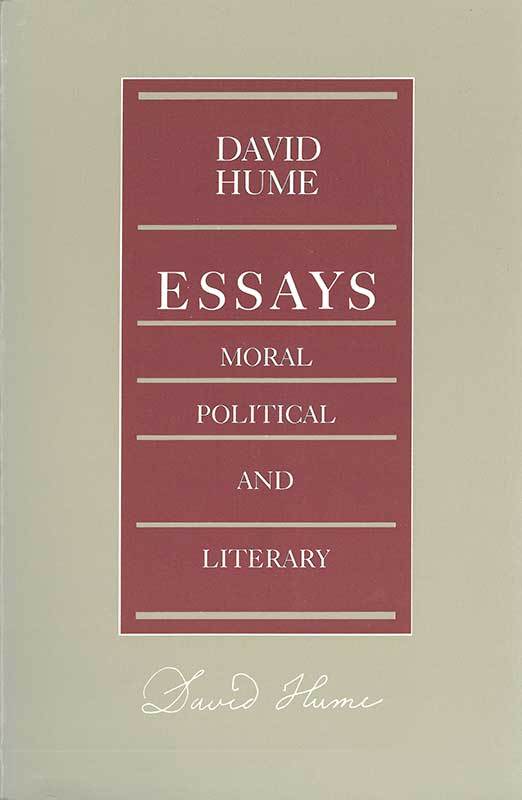
ESSAY VIII: OF TAXES - David Hume, Essays Moral, Political, Literary (LF ed.) [1777]

Edition used:

Essays Moral, Political, Literary, edited and with a Foreword, Notes, and Glossary by Eugene F. Miller, with an appendix of variant readings from the 1889 edition by T.H. Green and T.H. Grose, revised edition (Indianapolis: Liberty Fund 1987).

About Liberty Fund:

Liberty Fund, Inc. is a private, educational foundation established to encourage the study of the ideal of a society of free and responsible individuals.


ESSAY VIII

OF TAXES

There is a prevailing maxim,a among some reasoners, that every new tax creates a new ability in the subject to bear it, and that each encrease of public burdens encreases proportionably the industry of the people. This maxim is of such a nature as is most likely to be abused; and is so much the more dangerous, as its truth cannot be altogether denied: but it must be owned, when kept within certain bounds, to have some foundation in reason and experience.1

When a tax is laid upon commodities, which are consumed by the common people, the necessary consequence may seem to be, either that the poor must retrench something from their way of living, or raise their wages, so as to make the burden of the tax fall entirely upon the rich. But there is a third consequence, which often follows upon taxes, namely, that the poor encrease their industry, perform more work, and live as well as before, without demanding more for their labour. Where taxes are moderate, are laid on gradually, and affect not the necessaries of life, this consequence naturally follows; and it is certain, that such difficulties often serve to excite the industry of a people, and render them more opulent and laborious, than others, who enjoy the greatest advantages. For we may observe, as a parallel instance, that the most commercial nations have not always possessed the greatest extent of fertile land; but, on the contrary, that they have laboured under many natural disadvantages. Tyre, Athens, Carthage, Rhodes, Genoa, Venice, Holland, are strong examples to this purpose. And in all history, we find only three instances of large and fertile countries, which have possessed much trade; the Netherlands, England, and France. The two former seem to have been allured by the advantages of their maritime situation, and the necessity they lay under of frequenting foreign ports, in order to procure what their own climate refused them. And as to France, trade has come late into that kingdom, and seems to have been the effect of reflection and observation in an ingenious and enterprizing people, who remarked the riches acquired by such of the neighbouring nations as cultivated navigation and commerce.

The places mentioned by Cicero,2 as possessed of the greatest commerce in his time, are Alexandria, Colchus, Tyre, Sidon, Andros, Cyprus, Pamphylia, Lycia, Rhodes, Chios, Byzantium, Lesbos, Smyrna, Miletum, Coos. All these, except Alexandria, were either small islands, or narrow territories. And that city owed its trade entirely to the happiness of its situation.

Since therefore some natural necessities or disadvantages may be thought favourable to industry, why may not artificial burdens have the same effect? Sir William Temple,3 we may observe, ascribes the industry of the Dutch entirely to necessity, proceeding from their natural disadvantages; and illustrates his doctrine by a striking comparison with Ireland; “where,” says he, “by the largeness and plenty of the soil, and scarcity of people, all things necessary to life are so cheap, that an industrious man, by two days labour, may gain enough to feed him the rest of the week. Which I take to be a very plain ground of the laziness attributed to the people. For men naturally prefer ease before labour, and will not take pains if they can live idle; though when, by necessity, they have been inured to it, they cannot leave it, being grown a custom necessary to their health, and to their very entertainment. Nor perhaps is the change harder, from constant ease to labour, than from constant labour to ease.” After which the author proceeds to confirm his doctrine, by enumerating, as above, the places where trade has most flourished, in ancient and modern times; and which are commonly observed to be such narrow confined territories, as beget a necessity for industry.b

The best taxes are such as are levied upon consumptions,4 especially those of luxury; because such taxes are least felt by the people. They seem, in some measure, voluntary; since a man may chuse how far he will use the commodity which is taxed: They are paid gradually and insensibly:c They naturally produce sobriety and frugality, if judiciously imposed: And being confounded with the natural price of the commodity, they are scarcely perceived by the consumers. Their only disadvantage is, that they are expensive in the levying.

Taxes upon possessions are levied without expence; but have every other disadvantage. Most states, however, are obliged to have recourse to them, in order to supply the deficiencies of the other.

But the most pernicious of all taxes are the arbitrary.5 They are commonly converted, by their management, into punishments on industry; and also, by their unavoidable inequality, are more grievous, than by the real burden which they impose. It is surprising, therefore, to see them have place among any civilized people.

In general, all poll-taxes,6 even when not arbitrary, which they commonly are, may be esteemed dangerous: Because it is so easy for the sovereign to add a little more, and a little more, to the sum demanded, that these taxes are apt to become altogether oppressive and intolerable. On the other hand, a duty upon commodities checks itself; and a prince will soon find, that an encrease of the impost is no encrease of his revenue. It is not easy, therefore, for a people to be altogether ruined by such taxes.

Historians inform us, that one of the chief causes of the destruction of the Roman state, was the alteration, which Constantine introduced into the finances, by substituting an universal poll-tax, in lieu of almost all the tithes, customs, and excises, which formerly composed the revenue of the empire.7 The people, in all the provinces, were so grinded and oppressed by the publicans, that they were glad to take refuge under the conquering arms of the barbarians; whose dominion, as they had fewer necessities and less art, was found preferable to the refined tyranny of the Romans.

d It is an opinion, zealously promoted by some political writers, that, since all taxes, as they pretend, fall ultimately upon land, it were better to lay them originally there, and abolish every duty upon consumptions. But it is denied, that all taxes fall ultimately upon land. If a duty be laid upon any commodity, consumed by an artisan, he has two obvious expedients for paying it; he may retrench somewhat of his expence, or he may encrease his labour. Both these resources are more easy and natural, than that of heightening his wages. We see, that, in years of scarcity, the weaver either consumes less or labours more, or employs both these expedients of frugality and industry, by which he is enabled to reach the end of the year. It is but just, that he should subject himself to the same hardships, if they deserve the name, for the sake of the publick, which gives him protection. By what contrivance can he raise the price of his labour? The manufacturer who employs him, will not give him more: Neither can he, because the merchant, who exports the cloth, cannot raise its price, being limited by the price which it yields in foreign markets. Every man, to be sure, is desirous of pushing off from himself the burden of any tax, which is imposed, and of laying it upon others: But as every man has the same inclination, and is upon the defensive; no set of men can be supposed to prevail altogether in this contest. And why the landed gentleman should be the victim of the whole, and should not be able to defend himself, as well as others are, I cannot readily imagine. All tradesmen, indeed, would willingly prey upon him, and divide him among them, if they could: But this inclination they always have, though no taxes were levied; and the same methods, by which he guards against the imposition of tradesmen before taxes, will serve him afterwards, and make them share the burden with him. e They must be very heavy taxes, indeed, and very injudiciously levied, which the artizan will not, of himself, be enabled to pay, by superior industry and frugality, without raising the price of his labour.

I shall conclude this subject with observing, that we have, with regard to taxes, an instance of what frequently happens in political institutions, that the consequences of things are diametrically opposite to what we should expect on the first appearance. It is regarded as a fundamental maxim of the Turkish government, that the Grand Signior, though absolute master of the lives and fortunes of each individual, has no authority to impose a new tax; and every Ottoman prince, who has made such an attempt, either has been obliged to retract, or has found the fatal effects of his perseverance. One would imagine, that this prejudice or established opinion were the firmest barrier in the world against oppression; yet it is certain, that its effect is quite contrary. The emperor, having no regular method of encreasing his revenue, must allow all the bashaws and governors to oppress and abuse the subjects: And these he squeezes after their return from their government. Whereas, if he could impose a new tax, like our European princes, his interest would so far be united with that of his people, that he would immediately feel the bad effects of these disorderly levies of money, and would find, that a pound, raised by a general imposition, would have less pernicious effects, than a shilling taken in so unequal and arbitrary a manner.

[1. ][The “maxim” that Hume considers here was commonly held by the mercantilist writers and by others between 1660 and 1750. See Edwin R. A. Seligman, The Shifting and Incidence of Taxation, 5th ed., rev. (New York, Columbia University Press, 1927), pp. 25–30, 46–62. Hume finds it to be partly correct, in that workers can be expected to absorb moderate taxes on commodities by increasing their industry rather than by retrenching consumption or by increasing wages. Since people are often more industrious and opulent where there are “natural disadvantages” of soil and climate to overcome, we may expect that “artificial burdens,” such as judicious taxes, will likewise be favorable to industry. Yet Hume qualifies the argument by refusing to apply it to taxes on “the necessaries of life” and by warning that a people can be ruined by exorbitant or inappropriate taxes (see paragraph 2 in note b of the variant readings for this essay). Later in the essay, Hume opposes the view that all taxes are ultimately shifted to land. John Locke had taken this view, and he may be the “celebrated writer” that Hume refers to in earlier versions of this essay (see the passage in note d of the variant readings). Locke’s theory of the shifting of all taxes to land was revived in the eighteenth century by the school of French economists known as the “Physiocrats” (see Seligman, pp. 125–142). Hume debated the issue with one of the leading Physiocrats, Anne-Robert Jacques Turgot, in correspondence during 1766 and 1767. For the significance of Hume’s views on taxation, see Rotwein, David Hume: Writings on Economics, pp. lxxxi–lxxxiii.]

[2. ]Epist. ad Att. lib. ix. ep. ii. [Letters to Atticus 9.9 in the Loeb edition.]

[3. ]Account of the Netherlands, chap. 6.

[4. ][Hume has in mind excise taxes on consumable commodities produced domestically and customs duties on commodities that are imported.]

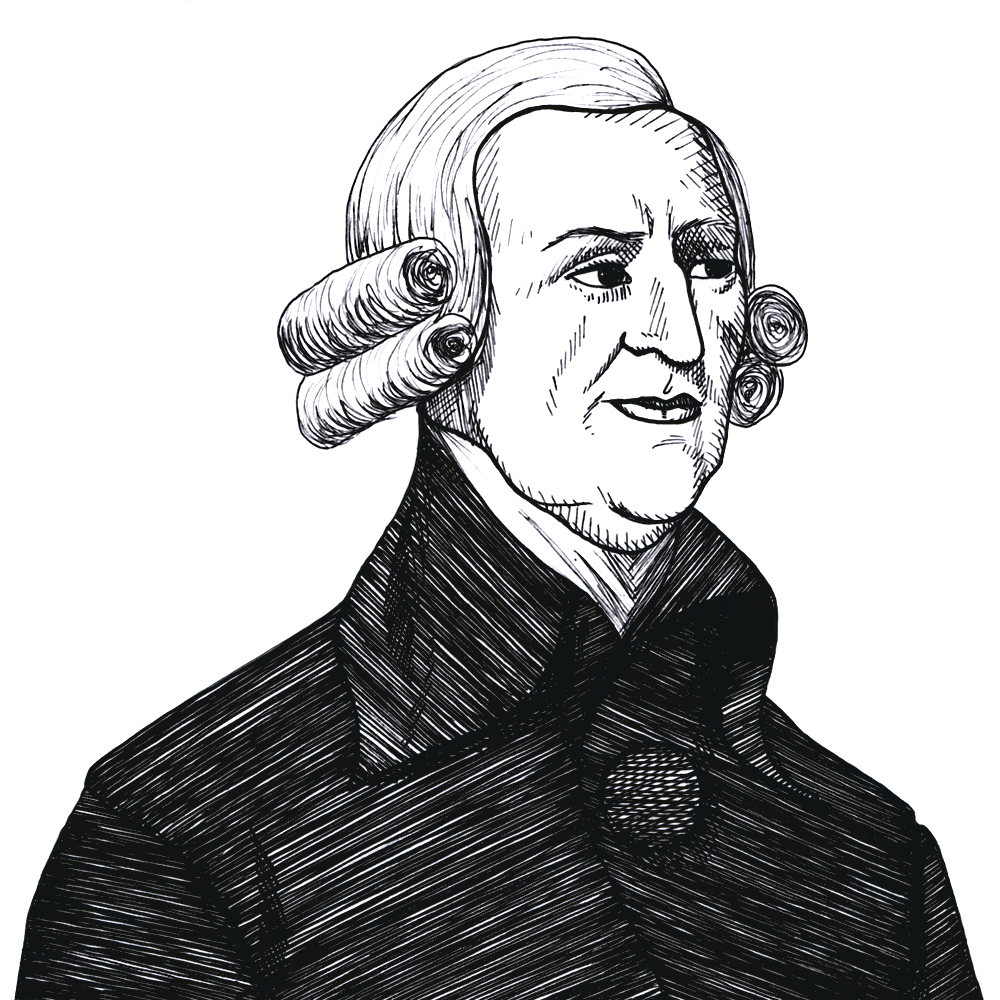
[5. ][See Adam Smith, The Wealth of Nations, bk. 5, chap. 2, pt. 2: “The tax which each individual is bound to pay ought to be certain, and not arbitrary. The time of payment, the manner of payment, the quantity to be paid, ought all to be clear and plain to the contributor, and to every other person. Where it is otherwise, every person subject to the tax is put more or less in the power of the tax-gatherer, who can either aggravate the tax upon any obnoxious contributor, or extort, by the terror of such aggravation, some present or perquisite to himself. The uncertainty of taxation encourages the insolence and favours the corruption of an order of men who are naturally unpopular, even where they are neither insolent nor corrupt. The certainty of what each individual ought to pay is, in taxation, a matter of so great importance, that a very considerable degree of inequality, it appears, I believe, from the experience of all nations, is not near so great an evil as a very small degree of uncertainty.”]

[6. ][A poll tax (or capitation or head tax) was a tax levied upon each citizen of a community, regardless of the amount of his income or property.]

[7. ][Constantine (“the Great”) was emperor from ad 306 to 337. Initially he shared power, but after 324 he was the sole ruler of a united empire. In The Decline and Fall of the Roman Empire, chap. 17, Edward Gibbon gives an account of Constantine’s taxation policy and its consequences, drawing on the historians to whom Hume alludes.]

[a]Editions H to P read: Among those whom in this country we call ways and means men, and who are denominated Financiers and Maltotiers in France.

[b]Editions H to P insert as follows: ’Tis always observed, in years of scarcity, if it be not extreme, that the poor labour more, and really live better, than in years of great plenty, when they indulge themselves in idleness and riot. I have been told, by a considerable manufacturer, that in the year 1740, when bread and provisions of all kinds were very dear, his workmen not only made a shift to live, but paid debts, which they had contracted in former years, that were much more favourable and abundant.1

This doctrine, therefore, with regard to taxes, may be admitted in some degree: But beware of the abuse. Exorbitant taxes, like extreme necessity, destroy industry, by producing despair; and even before they reach this pitch, they raise the wages of the labourer and manufacturer, and heighten the price of all commodities. An attentive disinterested legislature, will observe the point when the emolument ceases, and the prejudice begins: But as the contrary character is much more common, ’tis to be feared that taxes, all over Europe, are multiplying to such a degree, as will intirely crush all art and industry; tho’, perhaps, their first increase, together with other circumstances, might have contributed to the growth of these advantages.

[c]This clause was first added in Edition Q.

[d]Editions H to P omit the opening sentences as far as “foreign markets,” and read instead of them: There is a prevailing opinion, that all taxes, however levied, fall upon the land at last. Such an opinion may be useful in Britain, by checking the landed gentlemen, in whose hands our legislature is chiefly lodged, and making them preserve great regard for trade and industry. But I must confess, that this principle, tho’ first advanced by a celebrated writer, has so little appearance of reason, that, were it not for his authority, it had never been received by any body.

[e]The concluding sentence is not in Editions H to O.—Ed. P. reads in its place: No labour in any commodities, that are exported, can be very considerably raised in the price, without losing the foreign market; and as some part of almost every manufactory is exported, this circumstance keeps the price of most species of labour nearly the same after the imposition of taxes. I may add, that it has this effect upon the whole: For were any kind of labour paid beyond its proportion, all hands would flock to it, and would soon sink it to a level with the rest.

[b]Editions H to P insert as follows: ’Tis always observed, in years of scarcity, if it be not extreme, that the poor labour more, and really live better, than in years of great plenty, when they indulge themselves in idleness and riot. I have been told, by a considerable manufacturer, that in the year 1740, when bread and provisions of all kinds were very dear, his workmen not only made a shift to live, but paid debts, which they had contracted in former years, that were much more favourable and abundant.1

This doctrine, therefore, with regard to taxes, may be admitted in some degree: But beware of the abuse. Exorbitant taxes, like extreme necessity, destroy industry, by producing despair; and even before they reach this pitch, they raise the wages of the labourer and manufacturer, and heighten the price of all commodities. An attentive disinterested legislature, will observe the point when the emolument ceases, and the prejudice begins: But as the contrary character is much more common, ’tis to be feared that taxes, all over Europe, are multiplying to such a degree, as will intirely crush all art and industry; tho’, perhaps, their first increase, together with other circumstances, might have contributed to the growth of these advantages.

[1. ]To this purpose see also Essay I. at the end. [The reference is to “Of Commerce,” where Hume argues that the harsher climate of the temperate zone, as contrasted to the torrid zone, has been a great spur to industry and invention.]