Econlib

The Library

Other Sites

Front Page arrow Titles (by Subject) arrow EDITOR'S NOTE - Essays Moral, Political, Literary (LF ed.)

Return to Title Page for Essays Moral, Political, Literary (LF ed.)

Search this Title:

Also in the Library:

Subject Area: Economics
Subject Area: Political Theory
Subject Area: History
Subject Area: Philosophy
Subject Area: Religion
Collection: Books Published by Liberty Fund
Collection: Classics of Liberty
Topic: Progress
Order this book from Liberty Fund

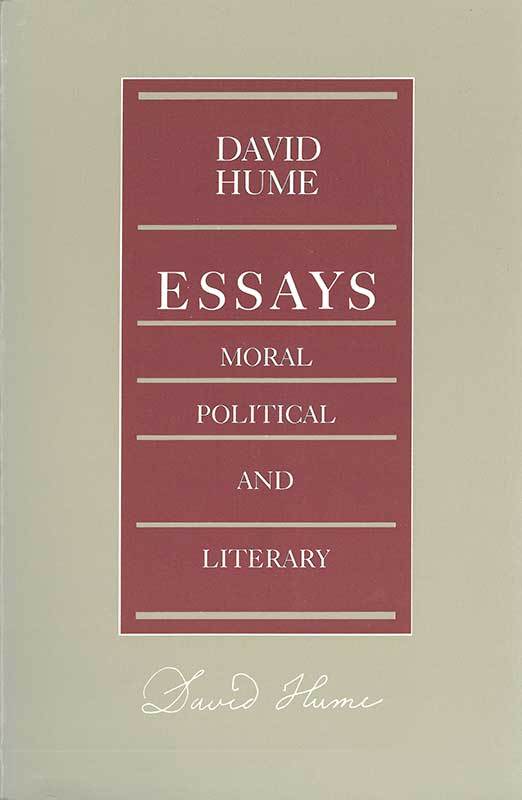
EDITOR’S NOTE - David Hume, Essays Moral, Political, Literary (LF ed.) [1777]

Edition used:

Essays Moral, Political, Literary, edited and with a Foreword, Notes, and Glossary by Eugene F. Miller, with an appendix of variant readings from the 1889 edition by T.H. Green and T.H. Grose, revised edition (Indianapolis: Liberty Fund 1987).

About Liberty Fund:

Liberty Fund, Inc. is a private, educational foundation established to encourage the study of the ideal of a society of free and responsible individuals.


EDITOR’S NOTE

This new edition of Hume’s Essays, Moral, Political, and Literary is based on the edition of 1777. The 1777 edition is the copy-text of choice, for, while it appeared posthumously, it contains Hume’s latest corrections. It was the text used by T. H. Green and T. H. Grose for the version of the Essays that is included in their edition of The Philosophical Works of David Hume. Because of initial difficulties in obtaining a photocopy of the 1777 edition, Green and Grose’s text was used as editor’s copy for the current project. Both the editor’s copy and the compositor’s reading proofs were then corrected against a photocopy of the 1777 edition obtained from the Huntington Library, San Marino, California. The present edition contains material that was not in the 1777 edition of the Essays: Hume’s My own Life, Adam Smith’s Letter to William Strahan, and the essays that were either withdrawn by Hume prior to the 1777 edition or suppressed by him during his lifetime. Unless otherwise noted, these materials are reprinted here as they appear in Green and Grose and, unlike the Essays proper, have not been corrected against the appropriate earlier editions.

Textual Notations

Three types of notational symbols appear in the present text.

A. Superscript Numerals. A superscript arabic numeral indicates a footnote. The editor’s notes are enclosed in brackets to distinguish them from Hume’s own notes. Information that I have added to Hume’s footnotes is also bracketed.

A reader of the Essays cannot fail to be impressed by the breadth of Hume’s learning. In the Essays, Hume ranges far beyond the great works of philosophy into every area of scholarship. One finds abundant evidence of his reading in the Greek and Latin classics as well as of his familiarity with the literary works of the important English, French, Italian, and Spanish authors. The essays reflect Hume’s intimate knowledge not only of the history of Great Britain but also of the entire sweep of European history. He knew the important treatises on natural science, and he investigated the modern writings on political economy.

Hume intended for his essays to have a wide audience, but since he presupposed that his readers would have a broad knowledge of literature, history, and contemporary affairs, his footnotes are quite sparse and sketchy by today’s standards. He often refers to persons or events without explaining who or what they are. He frequently quotes in languages other than English, and often he fails to identify an author or the work from which he is quoting. He sometimes misquotes his sources or gives misleading citations. No doubt the informed eighteenth-century reader could have filled in many of these lacunae, but such background knowledge can no longer be presupposed.

My footnotes and supplements are meant to provide some of the information that today’s reader may need to understand Hume’s Essays. Since it is hoped that this edition will be useful to beginning students and general readers, I have tended to prefer fullness in these annotations, even though much is included that will be known to specialists in one area or another of eighteenth-century studies. First, I have identified persons, places, and events to which Hume refers. Second, I have provided translations of foreign-language passages in those instances where Hume himself fails to translate them or give a close English paraphrase. Translations of Greek and Latin authors have been drawn from the appropriate volumes in the Loeb Classical Library, which is published in the United States by Harvard University Press (Cambridge, Mass.) and in Great Britain by William Heinemann Ltd. (London). Third, I have given citations for the many quotations or references that Hume leaves uncited. Moreover, I have supplemented Hume’s own sparse citations to identify authors, give dates of an author’s birth and death or else the date when a work was published, provide full titles of sources cited, and specify as closely as possible the location in a work where quotations or references can be found. For the sake of uniformity, classical citations are given to the Loeb editions. Since these often divide or arrange materials differently from the editions used by Hume, the Loeb citations will not always agree with Hume’s. Finally, I have added explanatory notes that refer to Hume’s other writings when this helps to clarify the argument of an essay.

B. Superscript Circles. A small superscript circle by a word indicates that the meaning of that word is specified in the Glossary. This symbol is used at the word’s first occurrence in the Essays and usually is not repeated unless the word is used later with a different meaning. One encounters quite a large number of words in Hume’s Essays that either have become obscure in their meaning or have come to have quite different meanings from the one that Hume intends. I have found Samuel Johnson’s Dictionary of the English Language, which was first published in 1755 and revised frequently thereafter, to be immensely helpful in locating eighteenth-century meanings. Specifically, I used the eleventh, corrected and revised, edition (London: 1816; 2 vols.) in preparing the Glossary. Words are glossed sequentially rather than alphabetically, because their meanings are often related closely to the contexts in which they appear. In those cases where Johnson’s Dictionary proved inadequate, I have consulted The Oxford English Dictionary (Oxford: Clarendon Press, 1961; 12 vols.).

C. Superscript Lowercase Letters. A superscript lowercase letter indicates a variant reading in some earlier edition or editions of Hume’s Essays. These variants are collected at the end of this volume. As has been noted, Hume’s Essays went through numerous editions in his lifetime, and Hume worked painstakingly to prepare them for the press. Besides adding many new essays and deleting some old ones, Hume often made changes in the essays that he carried over from previous editions. Some of these changes are only stylistic, but others reflect substantive alterations in Hume’s views.

While I have tried to provide a text and notations that are free of error, I am painfully aware of Hume’s warning that perfection is unlikely in things undertaken by man. I shall welcome suggestions for the improvement of this edition of Hume’s Essays, addressed to me at the Department of Political Science, University of Georgia, Athens, Ga., 30602, U.S.A.

Acknowledgments

I am indebted to many for assistance in the preparation of this edition of Hume’s Essays, Moral, Political, and Literary. Facsimiles of the title and half-title pages of the 1777 edition of the Essays are reproduced by permission of the Huntington Library, San Marino, California. The Huntington Library also provided the photocopy of the 1777 edition that was used in correcting the Green and Grose text. Mr. Thomas V. Lange, Assistant Curator of the Huntington Library, was especially helpful in answering several queries. Passages from various editions in the Loeb Classical Library are reprinted by permission of Harvard University Press. Colleagues at the University of Georgia who provided assistance include Richard A. LaFleur, James C. Anderson, Edward E. Best, Robert I. Curtis, Timothy N. Gantz, and Nancy F. Rubin of the Department of Classics; Francis Assaf, Vanni Bartolozzi, and Maria Cocco of the Department of Romance Languages; Lee B. Kennett, Linda J. Piper, and Kirk Willis of the Department of History; and Rodney Baine of the Department of English. Professors LaFleur, Rubin, and Piper were willing, on numerous occasions, to help me with points of translation or historical detail. My research assistant, Myrna Nichols, shared in some of the editorial tasks. When I found it necessary to consult scholars at other universities, the following responded generously: Allan Bloom of the University of Chicago; J. W. Johnson of the University of Rochester; David M. Levy of George Mason University; Arthur F. Stocker of the University of Virginia; William B. Todd of the University of Texas; Frank W. Walbank of Cambridge University; and Thomas G. West of the University of Dallas. My wife, Eva Miller, has been helpful in more ways than I can possibly enumerate. The responsibility for such errors as might have entered in the editorial process is, of course, mine alone and not that of anyone whose help I have acknowledged.

At a late stage in the editorial process, it became apparent that the appropriate copy-text for Hume’s suppressed essays, “Of Suicide” and “Of the Immortality of the Soul,” would be the proof-copy of these essays, with marginal corrections in Hume’s own hand, that is in the possession of the National Library of Scotland. I am grateful to the Trustees of the National Library of Scotland for permission to reprint the text of this proof-copy, with Hume’s corrections, and to Thomas I. Rae, Keeper of Manuscripts, for his timely assistance in obtaining the necessary photocopy.

My work on this edition of Hume’s Essays has served as a strong reminder that scholarship requires the support of institutions as well as individuals. My research on Hume has been aided and encouraged in many ways by the University of Georgia, especially by its libraries, which are directed by David Bishop, by the Franklin College of Arts and Sciences, whose Dean is W. Jackson Payne, and by the Department of Political Science, which has been headed during the period of this research by Loren P. Beth and Frank J. Thompson. The Committee on Social Thought at the University of Chicago is a second institution to which I am deeply indebted. Many years ago, while a doctoral student under the Committee, I first studied Hume’s writings in research that was guided by Friedrich A. Hayek, Leo Strauss, and Joseph Cropsey. The Committee on Social Thought, more than any academic program that I know of, has sought to recover the unity and comprehensiveness of human knowledge that was lost after Hume’s time, with the division of learning into departments or disciplines. Finally, I owe a great debt to Liberty Fund for its willingness to sponsor a new edition of Hume’s Essays and to entrust me with its preparation. Liberty Fund’s founder, Pierre F. Goodrich, maintained that a free society depends on free inquiry and that free inquiry depends, in turn, on the availability of reliable editions or translations of the great books, among which he included Hume’s essays.

E.F.M.

  • Athens, Georgia