Econlib

The Library

Other Sites

Front Page arrow Titles (by Subject) arrow Chapter 6: Of the Use of Sabbatical Institutions - The Principles of Moral and Political Philosophy

Return to Title Page for The Principles of Moral and Political Philosophy

Search this Title:

Also in the Library:

Subject Area: Political Theory
Subject Area: Philosophy
Collection: Books Published by Liberty Fund
Topic: Property
Order this book from Liberty Fund

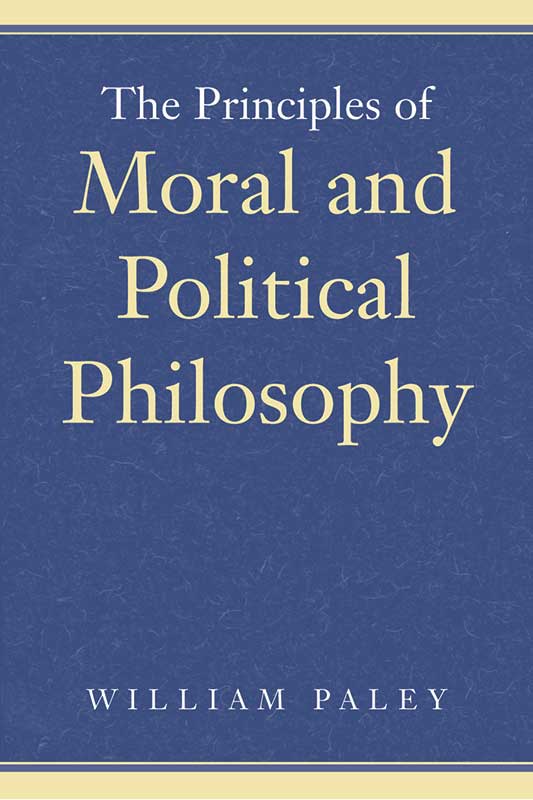
Chapter 6: Of the Use of Sabbatical Institutions - William Paley, The Principles of Moral and Political Philosophy [1785]

Edition used:

The Principles of Moral and Political Philosophy, Foreword by D.L. Le Mahieu (Indianapolis: Liberty Fund, 2002).

About Liberty Fund:

Liberty Fund, Inc. is a private, educational foundation established to encourage the study of the ideal of a society of free and responsible individuals.


Chapter 6

Of the Use of Sabbatical Institutions

An assembly cannot be collected, unless the time of assembling be fixed and known beforehand: and if the design of the assembly require that it be holden frequently, it is easiest that it should return at stated intervals. This produces a necessity of appropriating set seasons to the social offices of religion. It is also highly convenient that the same seasons be observed throughout the country, that all may be employed, or all at leisure, together; for if the recess from worldly occupation be not general, one man’s business will perpetually interfere with another man’s devotion; the buyer will be calling at the shop when the seller is gone to church. This part, therefore, of the religious distinction of seasons, namely, a general intermission of labour and business during times previously set apart for the exercise of public worship, is founded in the reasons which make public worship itself a duty. But the celebration of divine service never occupies the whole day. What remains, therefore, of Sunday, beside the part of it employed at church, must be considered as a mere rest from the ordinary occupations of civil life: and he who would defend the institution, as it is required by law to be observed in Christian countries, unless he can produce a command for a Christian sabbath, must point out the uses of it in that view.

First, then, that interval of relaxation which Sunday affords to the laborious part of mankind contributes greatly to the comfort and satisfaction of their lives, both as it refreshes them for the time, and as it relieves their six days’ labour by the prospect of a day of rest always approaching; which could not be said of casual indulgences of leisure and rest, even were they more frequent than there is reason to expect they would be if left to the discretion or humanity of interested task-masters. To this difference it may be added, that holidays which come seldom and unexpected, are unprovided, when they do come, with any duty or employment; and the manner of spending them being regulated by no public decency or established usage, they are commonly consumed in rude, if not criminal pastimes, in stupid sloth, or brutish intemperance. Whoever considers how much sabbatical institutions conduce, in this respect, to the happiness and civilization of the labouring classes of mankind, and reflects how great a majority of the human species these classes compose, will acknowledge the utility, whatever he may believe of the origin, of this distinction; and will consequently perceive it to be every man’s duty to uphold the observation of Sunday when once established, let the establishment have proceeded from whom or from what authority it will.

Nor is there any thing lost to the community by the intermission of public industry one day in the week. For, in countries tolerably advanced in population and the arts of civil life, there is always enough of human labour, and to spare. The difficulty is not so much to procure, as to employ it. The addition of the seventh day’s labour to that of the other six, would have no other effect than to reduce the price. The labourer himself, who deserved and suffered most by the change, would gain nothing.

2. Sunday, by suspending many public diversions, and the ordinary rotation of employment, leaves to men of all ranks and professions sufficient leisure, and not more than what is sufficient, both for the external offices of Christianity, and the retired, but equally necessary duties of religious meditation and inquiry. It is true, that many do not convert their leisure to this purpose; but it is of moment, and is all which a public constitution can effect, that to every one be allowed the opportunity.

3. They, whose humanity embraces the whole sensitive creation, will esteem it no inconsiderable recommendation of a weekly return of public rest, that it affords a respite to the toil of brutes. Nor can we omit to recount this among the uses which the Divine Founder of the Jewish sabbath expressly appointed a law of the institution.

We admit, that none of these reasons show why Sunday should be preferred to any other day in the week, or one day in seven to one day in six, or eight: but these points, which in their nature are of arbitrary determination, being established to our hands, our obligation applies to the subsisting establishment, so long as we confess that some such institution is necessary, and are neither able nor attempt to substitute any other in its place.