Econlib

The Library

Other Sites

Front Page arrow Titles (by Subject) arrow Chapter 3: Suicide - The Principles of Moral and Political Philosophy

Return to Title Page for The Principles of Moral and Political Philosophy

Search this Title:

Also in the Library:

Subject Area: Political Theory
Subject Area: Philosophy
Collection: Books Published by Liberty Fund
Topic: Property
Order this book from Liberty Fund

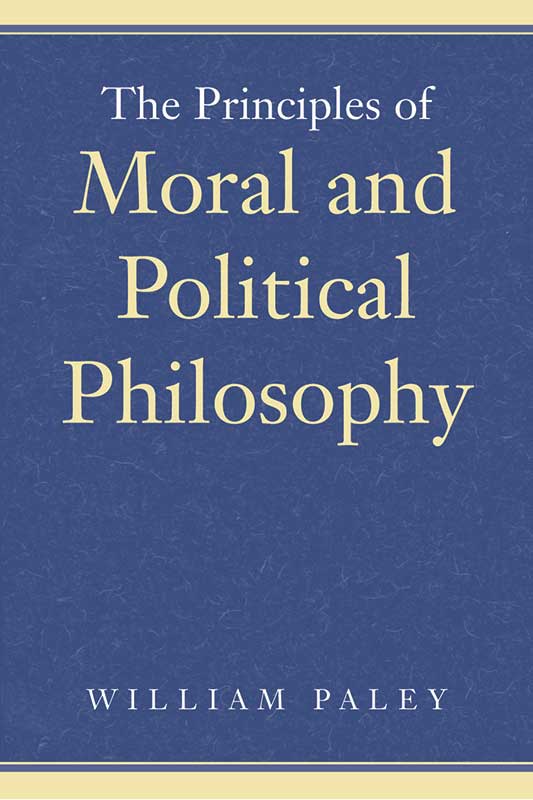
Chapter 3: Suicide - William Paley, The Principles of Moral and Political Philosophy [1785]

Edition used:

The Principles of Moral and Political Philosophy, Foreword by D.L. Le Mahieu (Indianapolis: Liberty Fund, 2002).

About Liberty Fund:

Liberty Fund, Inc. is a private, educational foundation established to encourage the study of the ideal of a society of free and responsible individuals.


Chapter 3

Suicide

There is no subject in morality in which the consideration of general consequences is more necessary than in this of Suicide. Particular and extreme cases of suicide may be imagined, and may arise, of which it would be difficult to assign the particular mischief, or from that consideration alone to demonstrate the guilt; and these cases have been the chief occasion of confusion and doubtfulness in the question: albeit this is no more than what is sometimes true of the most acknowledged vices. I could propose many possible cases even of murder, which, if they were detached from the general rule, and governed by their own particular consequences alone, it would be no easy undertaking to prove criminal.

The true question in this argument is no other than this: May every man who chooses to destroy his life, innocently do so? Limit and distinguish the subject as you can, it will come at last to this question.

For, shall we say, that we are then at liberty to commit suicide when we find our continuance in life become useless to mankind? Any one who pleases, may make himself useless; and melancholy minds are prone to think themselves useless, when they really are not so. Suppose a law were promulgated, allowing each private person to destroy every man he met, whose longer continuance in the world he judged to be useless; who would not condemn the latitude of such a rule? who does not perceive that it amounts to a permission to commit murder at pleasure? A similar rule, regulating the rights over our own lives, would be capable of the same extension. Beside which, no one is useless for the purpose of this plea, but he who has lost every capacity and opportunity of being useful, together with the possibility of recovering any degree of either; which is a state of such complete destitution and despair, as cannot, I believe, be predicated of any man living.

Or rather, shall we say that to depart voluntarily out of life, is lawful for those alone who leave none to lament their death? If this consideration is to be taken into the account at all, the subject of debate will be, not whether there are any to sorrow for us, but whether their sorrow for our death will exceed that which we should suffer by continuing to live. Now this is a comparison of things so indeterminate in their nature, capable of so different a judgement, and concerning which the judgement will differ so much according to the state of the spirits, or the pressure of any present anxiety, that it would vary little, in hypochondriacal constitutions, from an unqualified licence to commit suicide, whenever the distresses which men felt, or fancied, rose high enough to overcome the pain and dread of death. Men are never tempted to destroy themselves but when under the oppression of some grievous uneasiness: the restrictions of the rule therefore ought to apply to these cases. But what effect can we look for from a rule which proposes to weigh our pain against that of another; the misery that is felt, against that which is only conceived; and in so corrupt a balance as the party’s own distempered imagination?

In like manner, whatever other rule you assign, it will ultimately bring us to an indiscriminate toleration of suicide, in all cases in which there is danger of its being committed. It remains, therefore, to inquire what would be the effect of such a toleration: evidently, the loss of many lives to the community, of which some might be useful or important; the affliction of many families, and the consternation of all: for mankind must live in continual alarm for the fate of their friends and dearest relations, when the restraints of religion and morality are withdrawn; when every disgust which is powerful enough to tempt men to suicide, shall be deemed sufficient to justify it; and when the follies and vices, as well as the inevitable calamities, of human life, so often make existence a burthen.

A second consideration, and perfectly distinct from the former, is this: by continuing in the world, and in the exercise of those virtues which remain within our power, we retain the opportunity of meliorating our condition in a future state. This argument, it is true, does not in strictness prove suicide to be a crime; but if it supply a motive to dissuade us from committing it, it amounts to much the same thing. Now there is no condition in human life which is not capable of some virtue, active or passive. Even piety and resignation under the sufferings to which we are called, testify a trust and acquiescence in the Divine counsels, more acceptable, perhaps, than the most prostrate devotion; afford an edifying example to all who observe them; and may hope for a recompense among the most arduous of human virtues. These qualities are always in the power of the miserable; indeed of none but the miserable.

The two considerations above stated belong to all cases of suicide whatever. Beside which general reasons, each case will be aggravated by its own proper and particular consequences; by the duties that are deserted; by the claims that are defrauded; by the loss, affliction, or disgrace, which our death, or the manner of it, causes our family, kindred, or friends; by the occasion we give to many to suspect the sincerity of our moral and religious professions, and, together with ours, those of all others; by the reproach we draw upon our order, calling, or sect; in a word, by a great variety of evil consequences attending upon peculiar situations, with some or other of which every actual case of suicide is chargeable.

I refrain from the common topics of “deserting our post,” “throwing up our trust,” “rushing uncalled into the presence of our Maker,” with some others of the same sort, not because they are common (for that rather affords a presumption in their favour), but because I do not perceive in them much argument to which an answer may not easily be given.

Hitherto we have pursued upon the subject the light of nature alone; taking however into the account, the expectation of a future existence, without which our reasoning upon this, as indeed all reasoning upon moral questions, is vain: we proceed to inquire, whether any thing is to be met with in Scripture, which may add to the probability of the conclusions we have been endeavouring to support. And here I acknowledge, that there is to be found neither any express determination of the question, nor sufficient evidence to prove that the case of suicide was in the contemplation of the law which prohibited murder. Any inference, therefore, which we deduce from Scripture, can be sustained only by construction and implication: that is to say, although they who were authorised to instruct mankind, have not decided a question which never, so far as appears to us, came before them; yet I think, they have left enough to constitute a presumption how they would have decided it, had it been proposed or thought of.

What occurs to this purpose, is contained in the following observations:

1. Human life is spoken of as a term assigned or prescribed to us: “Let us run with patience the race that is set before us.”—“I have finished my course.”—“That I may finish my course with joy.”—“Ye have need of patience, that, after ye have done the will of God, ye might receive the promise.”—These expressions appear to me inconsistent with the opinion, that we are at liberty to determine the duration of our lives for ourselves. If this were the case, with what propriety could life be called a race that is set before us; or, which is the same thing, “our course”; that is, the course set out or appointed to us? The remaining quotation is equally strong: “That, after ye have done the will of God, ye might receive the promise.” The most natural meaning that can be given to the words, “after ye have done the will of God,” is, after ye have discharged the duties of life so long as God is pleased to continue you in it. According to which interpretation, the text militates strongly against suicide: and they who reject this paraphrase, will please to propose a better.

2. There is not one quality which Christ and his apostles inculcate upon their followers so often, or so earnestly, as that of patience under affliction. Now this virtue would have been in a great measure superseded, and the exhortations to it might have been spared, if the disciples of his religion had been at liberty to quit the world as soon as they grew weary of the ill usage which they received in it. When the evils of life pressed sore, they were to look forward to a “far more exceeding and eternal weight of glory”; they were to receive them, “as chastenings of the Lord,” as intimations of his care and love: by these and the like reflections they were to support and improve themselves under their sufferings; but not a hint has any where escaped of seeking relief in a voluntary death. The following text in particular strongly combats all impatience of distress, of which the greatest is that which prompts to acts of suicide: “Consider Him that endured such contradiction of sinners against himself, lest ye be wearied and faint in your minds.” I would offer my comment upon this passage, in these two queries: first, Whether a Christian convert, who had been impelled by the continuance and urgency of his sufferings to destroy his own life, would not have been thought by the author of this text “to have been weary,” to have “fainted in his mind,” to have fallen off from that example which is here proposed to the meditation of Christians in distress? And yet, secondly, Whether such an act would not have been attended with all the circumstances of mitigation which can excuse or extenuate suicide at this day?

3. The conduct of the apostles, and of the Christians of the apostolic age, affords no obscure indication of their sentiments upon this point. They lived, we are sure, in a confirmed persuasion of the existence, as well as of the happiness, of a future state. They experienced in this world every extremity of external injury and distress. To die, was gain. The change which death brought with it was, in their expectation, infinitely beneficial. Yet it never, that we can find, entered into the intention of one of them to hasten this change by an act of suicide; from which it is difficult to say what motive could have so universally withheld them, except an apprehension of some unlawfulness in the expedient.

Having stated what we have been able to collect in opposition to the lawfulness of suicide, by way of direct proof, it seems unnecessary to open a separate controversy with all the arguments which are made use of to defend it; which would only lead us into a repetition of what has been offered already. The following argument, however, being somewhat more artificial and imposing than the rest, as well as distinct from the general consideration of the subject, cannot so properly be passed over. If we deny to the individual a right over his own life, it seems impossible, it is said, to reconcile with the law of nature that right which the state claims and exercises over the lives of its subjects, when it ordains or inflicts capital punishments. For this right, like all other just authority in the state, can only be derived from the compact and virtual consent of the citizens which compose the state; and it seems self-evident, if any principle in morality be so, that no one, by his consent, can transfer to another a right which he does not possess himself. It will be equally difficult to account for the power of the state to commit its subjects to the dangers of war, and to expose their lives without scruple in the field of battle; especially in offensive hostilities, in which the privileges of self-defence cannot be pleaded with any appearance of truth: and still more difficult to explain, how in such, or in any circumstances, prodigality of life can be a virtue, if the preservation of it be a duty of our nature.

This whole reasoning sets out from one error, namely, that the state acquires its right over the life of the subject from the subject’s own consent, as a part of what originally and personally belonged to himself, and which he has made over to his governors. The truth is, the state derives this right neither from the consent of the subject, nor through the medium of that consent; but, as I may say, immediately from the donation of the Deity. Finding that such a power in the sovereign of the community is expedient, if not necessary, for the community itself, it is justly presumed to be the will of God, that the sovereign should possess and exercise it. It is this presumption which constitutes the right; it is the same indeed which constitutes every other: and if there were the like reasons to authorise the presumption in the case of private persons, suicide would be as justifiable as war, or capital executions. But until it can be shown that the power over human life may be converted to the same advantage in the hands of individuals over their own, as in those of the state over the lives of its subjects, and that it may be intrusted with equal safety to both, there is no room for arguing, from the existence of such a right in the latter, to the toleration of it in the former.

Book V

Duties Towards God