EconlibThe LibraryOther Sites |
Front Page Titles (by Subject) Chapter 11: The Duty of Children - The Principles of Moral and Political Philosophy
Return to Title Page for The Principles of Moral and Political PhilosophyThe Online Library of LibertyA project of Liberty Fund, Inc.Search this Title:Also in the Library:
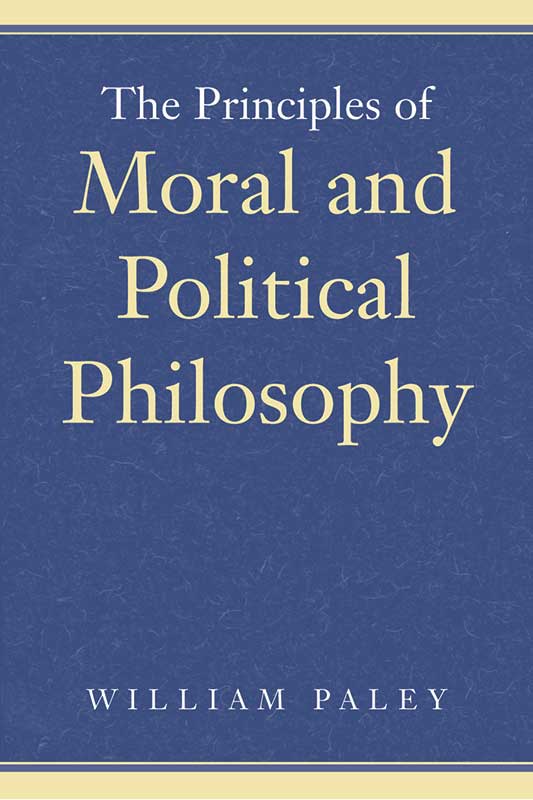
Chapter 11: The Duty of Children - William Paley, The Principles of Moral and Political Philosophy [1785]Edition used:The Principles of Moral and Political Philosophy, Foreword by D.L. Le Mahieu (Indianapolis: Liberty Fund, 2002).
About Liberty Fund:Liberty Fund, Inc. is a private, educational foundation established to encourage the study of the ideal of a society of free and responsible individuals. Copyright information:The copyright to this edition, in both print and electronic forms, is held by Liberty Fund, Inc. Fair use statement:This material is put online to further the educational goals of Liberty Fund, Inc. Unless otherwise stated in the Copyright Information section above, this material may be used freely for educational and academic purposes. It may not be used in any way for profit.
Chapter 11The Duty of ChildrenThe Duty of Children may be considered, I. During childhood. II. After they have attained to manhood, but continue in their father’s family. III. After they have attained to manhood, and have left their father’s family. I. During childhood. Children must be supposed to have attained to some degree of discretion before they are capable of any duty. There is an interval of eight or nine years between the dawning and the maturity of reason, in which it is necessary to subject the inclination of children to many restraints, and direct their application to many employments, of the tendency and use of which they cannot judge; for which cause, the submission of children during this period must be ready and implicit, with an exception, however, of any manifest crime which may be commanded them. II. After they have attained to manhood, but continue in their father’s family. If children, when they are grown up, voluntarily continue members of their father’s family, they are bound, beside the general duty of gratitude to their parents, to observe such regulations of the family as the father shall appoint; contribute their labour to its support, if required; and confine themselves to such expenses as he shall allow. The obligation would be the same, if they were admitted into any other family, or received support from any other hand. III. After they have attained to manhood, and have left their father’s family. In this state of the relation, the duty to parents is simply the duty of gratitude; not different in kind, from that which we owe to any other benefactor; in degree, just so much exceeding other obligations, by how much a parent has been a greater benefactor than any other friend. The services and attentions, by which filial gratitude may be testified, can be comprised within no enumeration. It will show itself in compliances with the will of the parents, however contrary to the child’s own taste or judgement, provided it be neither criminal, nor totally inconsistent with his happiness; in a constant endeavour to promote their enjoyments, prevent their wishes, and soften their anxieties, in small matters as well as in great; in assisting them in their business; in contributing to their support, ease, or better accommodation, when their circumstances require it; in affording them our company, in preference to more amusing engagements; in waiting upon their sickness or decrepitude; in bearing with the infirmities of their health or temper, with the peevishness and complaints, the unfashionable, negligent, austere manners, and offensive habits, which often attend upon advanced years: for where must old age find indulgence, if it do not meet with it in the piety and partiality of children? The most serious contentions between parents and their children are those commonly which relate to marriage, or to the choice of a profession. A parent has, in no case, a right to destroy his child’s happiness. If it be true, therefore, that there exist such personal and exclusive attachments between individuals of different sexes, that the possession of a particular man or woman in marriage be really necessary for the child’s happiness; or, if it be true, that an aversion to a particular profession may be involuntary and unconquerable; then it will follow, that parents, where this is the case, ought not to urge their authority, and that the child is not bound to obey it. The point is, to discover how far, in any particular instance, this is the case. Whether the fondness of lovers ever continues with such intensity, and so long, that the success of their desires constitutes, or the disappointment affects, any considerable portion of their happiness, compared with that of their whole life, it is difficult to determine: but there can be no difficulty in pronouncing, that not one half of those attachments, which young people conceive with so much haste and passion, are of this sort. I believe it also to be true, that there are few aversions to a profession, which resolution, perseverance, activity in going about the duty of it, and, above all, despair of changing, will not subdue: yet there are some such. Wherefore, a child who respects his parents’ judgement, and is, as he ought to be, tender of their happiness, owes, at least, so much deference to their will, as to try fairly and faithfully, in one case, whether time and absence will not cool an affection which they disapprove; and, in the other, whether a longer continuance in the profession which they have chosen for him may not reconcile him to it. The whole depends upon the experiment being made on the child’s part with sincerity, and not merely with a design of compassing his purpose at last, by means of a simulated and temporary compliance. It is the nature of love and hatred, and of all violent affections, to delude the mind with a persuasion that we shall always continue to feel them as we feel them at present; we cannot conceive that they will either change or cease. Experience of similar or greater changes in ourselves, or a habit of giving credit to what our parents, or tutors, or books, teach us, may control this persuasion, otherwise it renders youth very untractable: for they see clearly and truly that it is impossible they should be happy under the circumstances proposed to them, in their present state of mind. After a sincere but ineffectual endeavour, by the child, to accommodate his inclination to his parent’s pleasure, he ought not to suffer in his parent’s affection, or in his fortunes. The parent, when he has reasonable proof of this, should acquiesce; at all events, the child is then at liberty to provide for his own happiness. Parents have no right to urge their children upon marriages to which they are averse: nor ought, in any shape, to resent the children’s disobedience to such commands. This is a different case from opposing a match of inclination, because the child’s misery is a much more probable consequence; it being easier to live without a person that we love, than with one whom we hate. Add to this, that compulsion in marriage necessarily leads to prevarication; as the reluctant party promises an affection, which neither exists, nor is expected to take place: and parental, like all human authority, ceases at the point where obedience becomes criminal. In the above-mentioned, and in all contests between parents and children, it is the parent’s duty to represent to the child the consequences of his conduct; and it will be found his best policy to represent them with fidelity. It is usual for parents to exaggerate these descriptions beyond probability, and by exaggeration to lose all credit with their children; thus, in a great measure, defeating their own end. Parents are forbidden to interfere, where a trust is reposed personally in the son; and where, consequently, the son was expected, and by virtue of that expectation is obliged, to pursue his own judgement, and not that of any other: as is the case with judicial magistrates in the execution of their office; with members of the legislature in their votes; with electors, where preference is to be given to certain prescribed qualifications. The son may assist his own judgement by the advice of his father, or of any one whom he chooses to consult: but his own judgement, whether it proceed upon knowledge or authority, ought finally to determine his conduct. The duty of children to their parents was thought worthy to be made the subject of one of the Ten Commandments; and, as such, is recognised by Christ, together with the rest of the moral precepts of the Decalogue, in various places of the Gospel. The same divine Teacher’s sentiments concerning the relief of indigent parents, appear sufficiently from that manly and deserved indignation with which he reprehended the wretched casuistry of the Jewish expositors, who, under the name of a tradition, had contrived a method of evading this duty, by converting, or pretending to convert, to the treasury of the temple, so much of their property as their distressed parent might be entitled by their law to demand. Agreeably to this law of Nature and Christianity, children are, by the law of England, bound to support, as well their immediate parents, as their grandfather and grandmother, or remoter ancestors, who stand in need of support. Obedience to parents is enjoined by St. Paul to the Ephesians: “Children, obey your parents in the Lord, for this is right”; and to the Colossians: “Children, obey your parents in all things, for this is well-pleasing unto the Lord.”* By the Jewish law, disobedience to parents was in some extreme cases capital: Deut. xxi. 18. Book IVDuties to OurselvesThis division of the subject is retained merely for the sake of method, by which the writer and the reader are equally assisted. To the subject itself it imports nothing; for, the obligation of all duties being fundamentally the same, it matters little under what class or title any of them are considered. In strictness, there are few duties or crimes which terminate in a man’s self; and so far as others are affected by their operation, they have been treated of in some article of the preceding book. We have reserved, however, to this head the rights of self-defence; also the consideration of drunkenness and suicide, as offences against that care of our faculties, and preservation of our persons, which we account duties, and call duties to ourselves. Chapter 1The Rights of Self-DefenceIt has been asserted, that in a state of nature we might lawfully defend the most insignificant right, provided it were a perfect determinate right, by any extremities which the obstinacy of the aggressor rendered necessary. Of this I doubt; because I doubt whether the general rule be worth sustaining at such an expense; and because, apart from the general consequence of yielding to the attempt, it cannot be contended to be for the augmentation of human happiness, that one man should lose his life, or a limb, rather than another a pennyworth of his property. Nevertheless, perfect rights can only be distinguished by their value; and it is impossible to ascertain the value at which the liberty of using extreme violence begins. The person attacked, must balance, as well as he can, between the general consequence of yielding, and the particular effect of resistance. However, this right, if it exist in a state of nature, is suspended by the establishment of civil society: because thereby other remedies are provided against attacks upon our property, and because it is necessary to the peace and safety of the community, that the prevention, punishment, and redress of injuries, be adjusted by public laws. Moreover, as the individual is assisted in the recovery of his right, or of a compensation for his right, by the public strength, it is no less equitable than expedient, that he should submit to public arbitration the kind, as well as the measure, of the satisfaction which he is to obtain. There is one case in which all extremities are justifiable; namely, when our life is assaulted, and it becomes necessary for our preservation to kill the assailant. This is evident in a state of nature; unless it can be shown, that we are bound to prefer the aggressor’s life to our own, that is to say, to love our enemy better than ourselves, which can never be a debt of justice, nor any where appears to be a duty of charity. Nor is the case altered by our living in civil society; because, by the supposition, the laws of society cannot interpose to protect us, nor, by the nature of the case, compel restitution. This liberty is restrained to cases in which no other probable means of preserving our life remain, as flight, calling for assistance, disarming the adversary, &c. The rule holds, whether the danger proceed from a voluntary attack, as by an enemy, robber, or assassin; or from an involuntary one, as by a madman, or person sinking in the water, and dragging us after him; or where two persons are reduced to a situation in which one or both of them must perish; as in a shipwreck, where two seize upon a plank, which will support only one: although, to say the truth, these extreme cases, which happen seldom, and hardly, when they do happen, admit of moral agency, are scarcely worth mentioning, much less discussing at length. The instance which approaches the nearest to the preservation of life, and which seems to justify the same extremities, is the defence of chastity. In all other cases, it appears to me the safest to consider the taking away of life as authorized by the law of the land; and the person who takes it away, as in the situation of a minister or executioner of the law. In which view, homicide, in England, is justifiable: 1. To prevent the commission of a crime, which, when committed, would be punishable with death. Thus, it is lawful to shoot a highwayman, or one attempting to break into a house by night; but not so if the attempt be made in the day-time: which particular distinction, by a consent of legislation that is remarkable, obtained also in the Jewish law, as well as in the laws both of Greece and Rome. 2. In necessary endeavours to carry the law into execution, as in suppressing riots, apprehending malefactors, preventing escapes, &c. I do not know that the law holds forth its authority to any cases besides those which fall within one or other of the above descriptions; or, that, after the exception of immediate danger to life or chastity, the destruction of a human being can be innocent without that authority. The rights of war are not here taken into the account. Chapter 2DrunkennessDrunkenness is either actual or habitual; just as it is one thing to be drunk, and another to be a drunkard. What we shall deliver upon the subject must principally be understood of a habit of intemperance; although part of the guilt and danger described, may be applicable to casual excesses; and all of it, in a certain degree, forasmuch as every habit is only a repetition of single instances. The mischief of drunkenness, from which we are to compute the guilt of it, consists in the following bad effects: 1. It betrays most constitutions either to extravagances of anger, or sins of lewdness. 2. It disqualifies men for the duties of their station, both by the temporary disorder of their faculties, and at length by a constant incapacity and stupefaction. 3. It is attended with expenses, which can often be ill spared. 4. It is sure to occasion uneasiness to the family of the drunkard. 5. It shortens life. To these consequences of drunkenness must be added the peculiar danger and mischief of the example. Drunkenness is a social festive vice; apt, beyond any vice that can be mentioned, to draw in others by the example. The drinker collects his circle; the circle naturally spreads; of those who are drawn within it, many become the corrupters and centres of sets and circles of their own; every one countenancing, and perhaps emulating the rest, till a whole neighbourhood be infected from the contagion of a single example. This account is confirmed by what we often observe of drunkenness, that it is a local vice; found to prevail in certain countries, in certain districts of a country, or in particular towns, without any reason to be given for the fashion, but that it had been introduced by some popular examples. With this observation upon the spreading quality of drunkenness, let us connect a remark which belongs to the several evil effects above recited. The consequences of a vice, like the symptoms of a disease, though they be all enumerated in the description, seldom all meet in the same subject. In the instance under consideration, the age and temperature of one drunkard may have little to fear from inflammations of lust or anger; the fortune of a second may not be injured by the expense; a third may have no family to be disquieted by his irregularities; and a fourth may possess a constitution fortified against the poison of strong liquors. But if, as we always ought to do, we comprehend within the consequences of our conduct the mischief and tendency of the example, the above circumstances, however fortunate for the individual, will be found to vary the guilt of his intemperance less, probably, than he supposes. The moralist may expostulate with him thus: Although the waste of time and of money be of small importance to you, it may be of the utmost to some one or other whom your society corrupts. Repeated or long-continued excesses, which hurt not your health, may be fatal to your companion. Although you have neither wife, nor child, nor parent, to lament your absence from home, or expect your return to it with terror; other families, in which husbands and fathers have been invited to share in your ebriety, or encouraged to imitate it, may justly lay their misery or ruin at your door. This will hold good whether the person seduced be seduced immediately by you, or the vice be propagated from you to him through several intermediate examples. All these considerations it is necessary to assemble, to judge truly of a vice which usually meets with milder names and more indulgence than it deserves. I omit those outrages upon one another, and upon the peace and safety of the neighbourhood, in which drunken revels often end; and also those deleterious and maniacal effects which strong liquors produce upon particular constitutions; because, in general propositions concerning drunkenness, no consequences should be included, but what are constant enough to be generally expected. Drunkenness is repeatedly forbidden by Saint Paul: “Be not drunk with wine, wherein is excess.” “Let us walk honestly as in the day, not in rioting and drunkenness.” “Be not deceived: neither fornicators, nor drunkards, nor revilers, nor extortioners, shall inherit the kingdom of God.” Eph. v. 18; Rom. xiii. 13; 1 Cor. vi. 9, 10. The same apostle likewise condemns drunkenness, as peculiarly inconsistent with the Christian profession: “They that be drunken, are drunken in the night: but let us, who are of the day, be sober.” 1 Thess. v. 7, 8. We are not concerned with the argument; the words amount to a prohibition of drunkenness, and the authority is conclusive. It is a question of some importance, how far drunkenness is an excuse for the crimes which the drunken person commits. In the solution of this question, we will first suppose the drunken person to be altogether deprived of moral agency, that is to say, of all reflection and foresight. In this condition, it is evident that he is no more capable of guilt than a madman; although, like him, he may be extremely mischievous. The only guilt with which he is chargeable, was incurred at the time when he voluntarily brought himself into this situation. And as every man is responsible for the consequences which he foresaw, or might have foreseen, and for no other, this guilt will be in proportion to the probability of such consequences ensuing. From which principle results the following rule, viz. that the guilt of any action in a drunken man bears the same proportion to the guilt of the like action in a sober man, that the probability of its being the consequence of drunkenness bears to absolute certainty. By virtue of this rule, those vices which are the known effects of drunkenness, either in general, or upon particular constitutions, are in all, or in men of such constitutions, nearly as criminal as if committed with all their faculties and senses about them. If the privation of reason be only partial, the guilt will be of a mixed nature. For so much of his self-government as the drunkard retains, he is as responsible then as at any other time. He is entitled to no abatement beyond the strict proportion in which his moral faculties are impaired. Now I call the guilt of the crime, if a sober man had committed it, the whole guilt. A person in the condition we describe, incurs part of this at the instant of perpetration; and by bringing himself into such a condition, he incurred that fraction of the remaining part, which the danger of this consequence was of an integral certainty. For the sake of illustration, we are at liberty to suppose, that a man loses half his moral faculties by drunkenness; this leaving him but half his responsibility, he incurs, when he commits the action, half of the whole guilt. We will also suppose that it was known beforehand, that it was an even chance, or half a certainty, that this crime would follow his getting drunk. This makes him chargeable with half of the remainder; so that altogether, he is responsible in three fourths of the guilt which a sober man would have incurred by the same action. I do not mean that any real case can be reduced to numbers, or the calculation be ever made with arithmetical precision; but these are the principles, and this the rule by which our general admeasurement of the guilt of such offences should be regulated. The appetite for intoxicating liquors appears to me to be almost always acquired. One proof of which is, that it is apt to return only at particular times and places: as after dinner, in the evening, on the market-day, at the market-town, in such a company, at such a tavern. And this may be the reason that, if a habit of drunkenness be ever overcome, it is upon some change of place, situation, company, or profession. A man sunk deep in a habit of drunkenness will, upon such occasions as these, when he finds himself loosened from the associations which held him fast, sometimes make a plunge, and get out. In a matter of so great importance, it is well worth while, where it is in any degree practicable, to change our habitation and society, for the sake of the experiment. Habits of drunkenness commonly take their rise either from a fondness for, and connexion with, some company, or some companion, already addicted to this practice; which affords an almost irresistible invitation to take a share in the indulgences which those about us are enjoying with so much apparent relish and delight; or from want of regular employment, which is sure to let in many superfluous cravings and customs, and often this amongst the rest; or, lastly, from grief, or fatigue, both which strongly solicit that relief which inebriating liquors administer, and also furnish a specious excuse for complying with the inclination. But the habit, when once set in, is continued by different motives from those to which it owes its origin. Persons addicted to excessive drinking suffer, in the intervals of sobriety, and near the return of their accustomed indulgence, a faintness and oppression circa praecordia, which it exceeds the ordinary patience of human nature to endure. This is usually relieved for a short time by a repetition of the same excess; and to this relief, as to the removal of every long-continued pain, they who have once experienced it, are urged almost beyond the power of resistance. This is not all: as the liquor loses its stimulus, the dose must be increased, to reach the same pitch of elevation or ease; which increase proportionably accelerates the progress of all the maladies that drunkenness brings on. Whoever reflects upon the violence of the craving in the advanced stages of the habit, and the fatal termination to which the gratification of it leads, will, the moment he perceives in himself the first symptoms of a growing inclination to intemperance, collect his resolution to this point; or (what perhaps he will find his best security) arm himself with some peremptory rule, as to the times and quantity of his indulgences. I own myself a friend to the laying down of rules to ourselves of this sort, and rigidly abiding by them. They may be exclaimed against as stiff, but they are often salutary. Indefinite resolutions of abstemiousness are apt to yield to extraordinary occasions; and extraordinary occasions to occur perpetually. Whereas, the stricter the rule is, the more tenacious we grow of it; and many a man will abstain rather than break his rule, who would not easily be brought to exercise the same mortification from higher motives. Not to mention, that when our rule is once known, we are provided with an answer to every importunity. There is a difference, no doubt, between convivial intemperance, and that solitary sottishness which waits neither for company nor invitation. But the one, I am afraid, commonly ends in the other: and this last in the basest degradation to which the faculties and dignity of human nature can be reduced. Chapter 3SuicideThere is no subject in morality in which the consideration of general consequences is more necessary than in this of Suicide. Particular and extreme cases of suicide may be imagined, and may arise, of which it would be difficult to assign the particular mischief, or from that consideration alone to demonstrate the guilt; and these cases have been the chief occasion of confusion and doubtfulness in the question: albeit this is no more than what is sometimes true of the most acknowledged vices. I could propose many possible cases even of murder, which, if they were detached from the general rule, and governed by their own particular consequences alone, it would be no easy undertaking to prove criminal. The true question in this argument is no other than this: May every man who chooses to destroy his life, innocently do so? Limit and distinguish the subject as you can, it will come at last to this question. For, shall we say, that we are then at liberty to commit suicide when we find our continuance in life become useless to mankind? Any one who pleases, may make himself useless; and melancholy minds are prone to think themselves useless, when they really are not so. Suppose a law were promulgated, allowing each private person to destroy every man he met, whose longer continuance in the world he judged to be useless; who would not condemn the latitude of such a rule? who does not perceive that it amounts to a permission to commit murder at pleasure? A similar rule, regulating the rights over our own lives, would be capable of the same extension. Beside which, no one is useless for the purpose of this plea, but he who has lost every capacity and opportunity of being useful, together with the possibility of recovering any degree of either; which is a state of such complete destitution and despair, as cannot, I believe, be predicated of any man living. Or rather, shall we say that to depart voluntarily out of life, is lawful for those alone who leave none to lament their death? If this consideration is to be taken into the account at all, the subject of debate will be, not whether there are any to sorrow for us, but whether their sorrow for our death will exceed that which we should suffer by continuing to live. Now this is a comparison of things so indeterminate in their nature, capable of so different a judgement, and concerning which the judgement will differ so much according to the state of the spirits, or the pressure of any present anxiety, that it would vary little, in hypochondriacal constitutions, from an unqualified licence to commit suicide, whenever the distresses which men felt, or fancied, rose high enough to overcome the pain and dread of death. Men are never tempted to destroy themselves but when under the oppression of some grievous uneasiness: the restrictions of the rule therefore ought to apply to these cases. But what effect can we look for from a rule which proposes to weigh our pain against that of another; the misery that is felt, against that which is only conceived; and in so corrupt a balance as the party’s own distempered imagination? In like manner, whatever other rule you assign, it will ultimately bring us to an indiscriminate toleration of suicide, in all cases in which there is danger of its being committed. It remains, therefore, to inquire what would be the effect of such a toleration: evidently, the loss of many lives to the community, of which some might be useful or important; the affliction of many families, and the consternation of all: for mankind must live in continual alarm for the fate of their friends and dearest relations, when the restraints of religion and morality are withdrawn; when every disgust which is powerful enough to tempt men to suicide, shall be deemed sufficient to justify it; and when the follies and vices, as well as the inevitable calamities, of human life, so often make existence a burthen. A second consideration, and perfectly distinct from the former, is this: by continuing in the world, and in the exercise of those virtues which remain within our power, we retain the opportunity of meliorating our condition in a future state. This argument, it is true, does not in strictness prove suicide to be a crime; but if it supply a motive to dissuade us from committing it, it amounts to much the same thing. Now there is no condition in human life which is not capable of some virtue, active or passive. Even piety and resignation under the sufferings to which we are called, testify a trust and acquiescence in the Divine counsels, more acceptable, perhaps, than the most prostrate devotion; afford an edifying example to all who observe them; and may hope for a recompense among the most arduous of human virtues. These qualities are always in the power of the miserable; indeed of none but the miserable. The two considerations above stated belong to all cases of suicide whatever. Beside which general reasons, each case will be aggravated by its own proper and particular consequences; by the duties that are deserted; by the claims that are defrauded; by the loss, affliction, or disgrace, which our death, or the manner of it, causes our family, kindred, or friends; by the occasion we give to many to suspect the sincerity of our moral and religious professions, and, together with ours, those of all others; by the reproach we draw upon our order, calling, or sect; in a word, by a great variety of evil consequences attending upon peculiar situations, with some or other of which every actual case of suicide is chargeable. I refrain from the common topics of “deserting our post,” “throwing up our trust,” “rushing uncalled into the presence of our Maker,” with some others of the same sort, not because they are common (for that rather affords a presumption in their favour), but because I do not perceive in them much argument to which an answer may not easily be given. Hitherto we have pursued upon the subject the light of nature alone; taking however into the account, the expectation of a future existence, without which our reasoning upon this, as indeed all reasoning upon moral questions, is vain: we proceed to inquire, whether any thing is to be met with in Scripture, which may add to the probability of the conclusions we have been endeavouring to support. And here I acknowledge, that there is to be found neither any express determination of the question, nor sufficient evidence to prove that the case of suicide was in the contemplation of the law which prohibited murder. Any inference, therefore, which we deduce from Scripture, can be sustained only by construction and implication: that is to say, although they who were authorised to instruct mankind, have not decided a question which never, so far as appears to us, came before them; yet I think, they have left enough to constitute a presumption how they would have decided it, had it been proposed or thought of. What occurs to this purpose, is contained in the following observations: 1. Human life is spoken of as a term assigned or prescribed to us: “Let us run with patience the race that is set before us.”—“I have finished my course.”—“That I may finish my course with joy.”—“Ye have need of patience, that, after ye have done the will of God, ye might receive the promise.”—These expressions appear to me inconsistent with the opinion, that we are at liberty to determine the duration of our lives for ourselves. If this were the case, with what propriety could life be called a race that is set before us; or, which is the same thing, “our course”; that is, the course set out or appointed to us? The remaining quotation is equally strong: “That, after ye have done the will of God, ye might receive the promise.” The most natural meaning that can be given to the words, “after ye have done the will of God,” is, after ye have discharged the duties of life so long as God is pleased to continue you in it. According to which interpretation, the text militates strongly against suicide: and they who reject this paraphrase, will please to propose a better. 2. There is not one quality which Christ and his apostles inculcate upon their followers so often, or so earnestly, as that of patience under affliction. Now this virtue would have been in a great measure superseded, and the exhortations to it might have been spared, if the disciples of his religion had been at liberty to quit the world as soon as they grew weary of the ill usage which they received in it. When the evils of life pressed sore, they were to look forward to a “far more exceeding and eternal weight of glory”; they were to receive them, “as chastenings of the Lord,” as intimations of his care and love: by these and the like reflections they were to support and improve themselves under their sufferings; but not a hint has any where escaped of seeking relief in a voluntary death. The following text in particular strongly combats all impatience of distress, of which the greatest is that which prompts to acts of suicide: “Consider Him that endured such contradiction of sinners against himself, lest ye be wearied and faint in your minds.” I would offer my comment upon this passage, in these two queries: first, Whether a Christian convert, who had been impelled by the continuance and urgency of his sufferings to destroy his own life, would not have been thought by the author of this text “to have been weary,” to have “fainted in his mind,” to have fallen off from that example which is here proposed to the meditation of Christians in distress? And yet, secondly, Whether such an act would not have been attended with all the circumstances of mitigation which can excuse or extenuate suicide at this day? 3. The conduct of the apostles, and of the Christians of the apostolic age, affords no obscure indication of their sentiments upon this point. They lived, we are sure, in a confirmed persuasion of the existence, as well as of the happiness, of a future state. They experienced in this world every extremity of external injury and distress. To die, was gain. The change which death brought with it was, in their expectation, infinitely beneficial. Yet it never, that we can find, entered into the intention of one of them to hasten this change by an act of suicide; from which it is difficult to say what motive could have so universally withheld them, except an apprehension of some unlawfulness in the expedient. Having stated what we have been able to collect in opposition to the lawfulness of suicide, by way of direct proof, it seems unnecessary to open a separate controversy with all the arguments which are made use of to defend it; which would only lead us into a repetition of what has been offered already. The following argument, however, being somewhat more artificial and imposing than the rest, as well as distinct from the general consideration of the subject, cannot so properly be passed over. If we deny to the individual a right over his own life, it seems impossible, it is said, to reconcile with the law of nature that right which the state claims and exercises over the lives of its subjects, when it ordains or inflicts capital punishments. For this right, like all other just authority in the state, can only be derived from the compact and virtual consent of the citizens which compose the state; and it seems self-evident, if any principle in morality be so, that no one, by his consent, can transfer to another a right which he does not possess himself. It will be equally difficult to account for the power of the state to commit its subjects to the dangers of war, and to expose their lives without scruple in the field of battle; especially in offensive hostilities, in which the privileges of self-defence cannot be pleaded with any appearance of truth: and still more difficult to explain, how in such, or in any circumstances, prodigality of life can be a virtue, if the preservation of it be a duty of our nature. This whole reasoning sets out from one error, namely, that the state acquires its right over the life of the subject from the subject’s own consent, as a part of what originally and personally belonged to himself, and which he has made over to his governors. The truth is, the state derives this right neither from the consent of the subject, nor through the medium of that consent; but, as I may say, immediately from the donation of the Deity. Finding that such a power in the sovereign of the community is expedient, if not necessary, for the community itself, it is justly presumed to be the will of God, that the sovereign should possess and exercise it. It is this presumption which constitutes the right; it is the same indeed which constitutes every other: and if there were the like reasons to authorise the presumption in the case of private persons, suicide would be as justifiable as war, or capital executions. But until it can be shown that the power over human life may be converted to the same advantage in the hands of individuals over their own, as in those of the state over the lives of its subjects, and that it may be intrusted with equal safety to both, there is no room for arguing, from the existence of such a right in the latter, to the toleration of it in the former. Book VDuties Towards GodChapter 1Division of These DutiesIn one sense, every duty is a duty towards God, since it is his will which makes it a duty: but there are some duties of which God is the object, as well as the author; and these are peculiarly, and in a more appropriated sense, called duties towards God. That silent piety, which consists in a habit of tracing out the Creator’s wisdom and goodness in the objects around us, or in the history of his dispensations; of referring the blessings we enjoy to his bounty, and of resorting in our distresses to his succour; may possibly be more acceptable to the Deity than any visible expressions of devotion whatever. Yet these latter (which, although they may be excelled, are not superseded, by the former) compose the only part of the subject which admits of direction or disquisition from a moralist. Our duty towards God, so far as it is external, is divided into worship and reverence. God is the immediate object of both; and the difference between them is, that the one consists in action, the other in forbearance. When we go to church on the Lord’s day, led thither by a sense of duty towards God, we perform an act of worship: when, from the same motive, we rest in a journey upon that day, we discharge a duty of reverence. Divine worship is made up of adoration, thanksgiving, and prayer. But, as what we have to offer concerning the two former may be observed of prayer, we shall make that the title of the following chapters, and the direct subject of our consideration. Chapter 2Of the Duty and of the Efficacy of Prayer, so far as the Same Appear from the Light of NatureWhen one man desires to obtain any thing of another, he betakes himself to entreaty; and this may be observed of mankind in all ages and countries of the world. Now what is universal, may be called natural; and it seems probable that God, as our supreme governor, should expect that towards himself, which, by a natural impulse, or by the irresistible order of our constitution, he has prompted us to pay to every other being on whom we depend. The same may be said of thanksgiving. Prayer likewise is necessary to keep up in the minds of mankind a sense of God’s agency in the universe, and of their own dependency upon him. Yet, after all, the duty of prayer depends upon its efficacy: for I confess myself unable to conceive, how any man can pray, or be obliged to pray, who expects nothing from his prayers; but who is persuaded, at the time he utters his request, that it cannot possibly produce the smallest impression upon the being to whom it is addressed, or advantage to himself. Now the efficacy of prayer imports that we obtain something in consequence of praying, which we should not have received without prayer; against all expectation of which, the following objection has been often and seriously alleged: “If it be most agreeable to perfect wisdom and justice that we should receive what we desire, God, as perfectly wise and just, will give it to us without asking; if it be not agreeable to these attributes of his nature, our entreaties cannot move him to give it us, and it were impious to expect that they should.” In fewer words, thus: “If what we request be fit for us, we shall have it without praying; if it be not fit for us, we cannot obtain it by praying.” This objection admits but of one answer, namely, that it may be agreeable to perfect wisdom to grant that to our prayers, which it would not have been agreeable to the same wisdom to have given us without praying for. But what virtue, you will ask, is there in prayer, which should make a favour consistent with wisdom, which would not have been so without it? To this question, which contains the whole difficulty attending the subject, the following possibilities are offered in reply: 1. A favour granted to prayer may be more apt, on that very account, to produce good effects upon the person obliged. It may hold in the Divine bounty, what experience has raised into a proverb in the collation of human benefits, that what is obtained without asking, is oftentimes received without gratitude. 2. It may be consistent with the wisdom of the Deity to withhold his favours till they be asked for, as an expedient to encourage devotion in his rational creation, in order thereby to keep up and circulate a knowledge and sense of their dependency upon him. 3. Prayer has a natural tendency to amend the petitioner himself; and thus to bring him within the rules which the wisdom of the Deity has prescribed to the dispensation of his favours. If these, or any other assignable suppositions, serve to remove the apparent repugnancy between the success of prayer and the character of the Deity, it is enough; for the question with the petitioner is not from which, out of many motives, God may grant his petition, or in what particular manner he is moved by the supplications of his creatures; but whether it be consistent with his nature to be moved at all, and whether there be any conceivable motive which may dispose the Divine Will to grant the petitioner what he wants, in consequence of his praying for it. It is sufficient for the petitioner, that he gain his end. It is not necessary to devotion, perhaps not very consistent with it, that the circuit of causes, by which his prayers prevail, should be known to the petitioner, much less that they should be present to his imagination at the time. All that is necessary is, that there be no impossibility apprehended in the matter. Thus much must be conceded to the objection: that prayer cannot reasonably be offered to God with all the same views, with which we oftentimes address our entreaties to men (views which are not commonly or easily separated from it), viz. to inform them of our wants and desires; to tease them out by importunity; to work upon their indolence or compassion, in order to persuade them to do what they ought to have done before, or ought not to do at all. But suppose there existed a prince, who was known by his subjects to act, of his own accord, always and invariably for the best; the situation of a petitioner, who solicited a favour or pardon from such a prince, would sufficiently resemble ours: and the question with him, as with us, would be, whether, the character of the prince being considered, there remained any chance that he should obtain from him by prayer, what he would not have received without it. I do not conceive that the character of such a prince would necessarily exclude the effect of his subject’s prayers; for when that prince reflected that the earnestness and humility of the supplication had generated in the suppliant a frame of mind, upon which the pardon or favour asked would produce a permanent and active sense of gratitude; that the granting of it to prayer would put others upon praying to him, and by that means preserve the love and submission of his subjects, upon which love and submission their own happiness, as well as his glory, depended; that, beside that the memory of the particular kindness would be heightened and prolonged by the anxiety with which it had been sued for, prayer had in other respects so disposed and prepared the mind of the petitioner, as to render capable of future services him who before was unqualified for any: might not that prince, I say, although he proceeded upon no other considerations than the strict rectitude and expediency of the measure, grant a favour or pardon to this man, which he did not grant to another, who was too proud, too lazy, or too busy, too indifferent whether he received it or not, or too insensible of the sovereign’s absolute power to give or to withhold it, ever to ask for it? or even to the philosopher, who, from an opinion of the fruitlessness of all addresses to a prince of the character which he had formed to himself, refused in his own example, and discouraged in others, all outward returns of gratitude, acknowledgements of duty, or application to the sovereign’s mercy or bounty; the disuse of which (seeing affections do not long subsist which are never expressed) was followed by a decay of loyalty and zeal amongst his subjects, and threatened to end in a forgetfulness of his rights, and a contempt of his authority? These, together with other assignable considerations, and some perhaps inscrutable, and even inconceivable, by the persons upon whom his will was to be exercised, might pass in the mind of the prince, and move his counsels; whilst nothing, in the mean time, dwelt in the petitioner’s thoughts, but a sense of his own grief and wants; of the power and goodness from which alone he was to look for relief; and of his obligation to endeavour, by future obedience, to render that person propitious to his happiness, in whose hands, and at the disposal of whose mercy, he found himself to be. The objection to prayer supposes, that a perfectly wise being must necessarily be inexorable: but where is the proof, that inexorability is any part of perfect wisdom; especially of that wisdom which is explained to consist in bringing about the most beneficial ends by the wisest means? The objection likewise assumes another principle, which is attended with considerable difficulty and obscurity, namely, that upon every occasion there is one, and only one, mode of acting for the best; and that the Divine Will is necessarily determined and confined to that mode: both which positions presume a knowledge of universal nature, much beyond what we are capable of attaining. Indeed, when we apply to the Divine Nature such expressions as these, “God must always do what is right,” “God cannot, from the moral perfection and necessity of his nature, act otherwise than for the best,” we ought to apply them with much indeterminateness and reserve; or rather, we ought to confess, that there is something in the subject out of the reach of our apprehension; for, in our apprehension, to be under a necessity of acting according to any rule, is inconsistent with free agency; and it makes no difference which we can understand, whether the necessity be internal or external, or that the rule is the rule of perfect rectitude. But efficacy is ascribed to prayer without the proof, we are told, which can alone in such a subject produce conviction—the confirmation of experience. Concerning the appeal to experience, I shall content myself with this remark, that if prayer were suffered to disturb the order of second causes appointed in the universe, too much, or to produce its effects with the same regularity that they do, it would introduce a change into human affairs, which in some important respects would be evidently for the worse. Who, for example, would labour, if his necessities could be supplied with equal certainty by prayer? How few would contain within any bounds of moderation those passions and pleasures, which at present are checked only by disease, or the dread of it, if prayer would infallibly restore health? In short, if the efficacy of prayer were so constant and observable as to be relied upon beforehand, it is easy to foresee that the conduct of mankind would, in proportion to that reliance, become careless and disorderly. It is possible, in the nature of things, that our prayers may, in many instances, be efficacious, and yet our experience of their efficacy be dubious and obscure. Therefore, if the light of nature instruct us by any other arguments to hope for effect from prayer; still more, if the Scriptures authorise these hopes by promises of acceptance; it seems not a sufficient reason for calling in question the reality of such effects, that our observations of them are ambiguous; especially since it appears probable, that this very ambiguity is necessary to the happiness and safety of human life. But some, whose objections do not exclude all prayer, are offended with the mode of prayer in use amongst us, and with many of the subjects which are almost universally introduced into public worship, and recommended to private devotion. To pray for particular favours by name, is to dictate, it has been said, to Divine wisdom and goodness: to intercede for others, especially for whole nations and empires, is still worse; it is to presume that we possess such an interest with the Deity, as to be able, by our applications, to bend the most important of his counsels; and that the happiness of others, and even the prosperity of communities, is to depend upon this interest, and upon our choice. Now, how unequal soever our knowledge of the Divine oeconomy may be to the solution of this difficulty, which requires perhaps a comprehension of the entire plan, and of all the ends of God’s moral government, to explain satisfactorily, we can understand one thing concerning it: that it is, after all, nothing more than the making of one man the instrument of happiness and misery to another; which is perfectly of a piece with the course and order that obtain, and which we must believe were intended to obtain, in human affairs. Why may we not be assisted by the prayers of other men, who are beholden for our support to their labour? Why may not our happiness be made in some cases to depend upon the intercession, as it certainly does in many upon the good offices, of our neighbours? The happiness and misery of great numbers we see oftentimes at the disposal of one man’s choice, or liable to be much affected by his conduct: what greater difficulty is there in supposing, that the prayers of an individual may avert a calamity from multitudes, or be accepted to the benefit of whole communities? Chapter 3Of the Duty and Efficacy of Prayer as Represented in ScriptureThe reader will have observed, that the reflections stated in the preceding chapter, whatever truth and weight they may be allowed to contain, rise many of them no higher than to negative arguments in favour of the propriety of addressing prayer to God. To prove that the efficacy of prayers is not inconsistent with the attributes of the Deity, does not prove that prayers are actually efficacious: and in the want of that unequivocal testimony, which experience alone could afford to this point (but which we do not possess, and have seen good reason why we are not to expect), the light of nature leaves us to controverted probabilities, drawn from the impulse by which mankind have been almost universally prompted to devotion, and from some beneficial purposes, which, it is conceived, may be better answered by the audience of prayer than by any other mode of communicating the same blessings. The revelations which we deem authentic, completely supply this defect of natural religion. They require prayer to God as a duty; and they contain positive assurance of its efficacy and acceptance. We could have no reasonable motive for the exercise of prayer, without believing that it may avail to the relief of our wants. This belief can only be founded, either in a sensible experience of the effect of prayer, or in promises of acceptance signified by Divine authority. Our knowledge would have come to us in the former way, less capable indeed of doubt, but subjected to the abuses and inconveniences briefly described above; in the latter way, that is, by authorised significations of God’s general disposition to hear and answer the devout supplications of his creatures, we are encouraged to pray, but not to place such a dependence upon prayer as might relax other obligations, or confound the order of events and of human expectations. The Scriptures not only affirm the propriety of prayer in general, but furnish precepts or examples which justify some topics and some modes of prayer that have been thought exceptionable. And as the whole subject rests so much upon the foundation of Scripture, I shall put down at length texts applicable to the five following heads: to the duty and efficacy of prayer in general; of prayer for particular favours by name; for public national blessings; of intercession for others; of the repetition of unsuccessful prayers. 1. Texts enjoining prayer in general: “Ask, and it shall be given you; seek, and ye shall find—If ye, being evil, know how to give good gifts unto your children, how much more shall your Father, which is in heaven, give good things to them that ask him?”—“Watch ye, therefore, and pray always, that ye may be accounted worthy to escape all those things that shall come to pass, and to stand before the Son of man.”—“Serving the Lord, rejoicing in hope, patient in tribulation, continuing instant in prayer.”—“Be careful for nothing, but in every thing, by prayer and supplication, with thanksgiving, let your requests be made known unto God.”—“I will, therefore, that men pray every where, lifting up holy hands without wrath and doubting.”—“Pray without ceasing.” Matt. vii. 7. 11; Luke xxi. 36; Rom. xii. 12; Philipp. iv. 6; 1 Thess. v. 17; 1 Tim. ii. 8. Add to these, that Christ’s reproof of the ostentation and prolixity of pharisaical prayers, and his recommendation to his disciples, of retirement and simplicity in theirs, together with his dictating a particular form of prayer, all presuppose prayer to be an acceptable and availing service. 2. Examples of prayer for particular favours by name: “For this thing” (to wit, some bodily infirmity, which he calls ‘a thorn given him in the flesh’) “I besought the Lord thrice, that it might depart from me.”—“Night and day praying exceedingly, that we might see your face, and perfect that which is lacking in your faith.” 2 Cor. xii. 8; 1 Thess. iii. 10. 3. Directions to pray for national or public blessings: “Pray for the peace of Jerusalem.”—“Ask ye of the Lord rain, in the time of the latter rain; so the Lord shall make bright clouds, and give them showers of rain, to every one grass in the field.”—“I exhort, therefore, that first of all, supplications, prayers, intercessions, and giving of thanks, be made for all men; for kings, and for all that are in authority, that we may lead a quiet and peaceable life, in all godliness and honesty; for this is good and acceptable in the sight of God our Saviour.” Psalm cxxii. 6; Zech. x. 1; 1 Tim. ii. 1, 2, 3. 4. Examples of intercession, and exhortations to intercede for others: “And Moses besought the Lord his God, and said, Lord, why doth thy wrath wax hot against thy people? Remember Abraham, Isaac, and Israel, thy servants. And the Lord repented of the evil which he thought to do unto his people.”—“Peter, therefore, was kept in prison, but prayer was made without ceasing of the church unto God for him.” “For God is my witness, that without ceasing I make mention of you always in my prayers.”—“Now I beseech you, brethren, for the Lord Jesus Christ’s sake, and for the love of the Spirit, that ye strive together with me, in your prayers for me.”—“Confess your faults one to another, and pray one for another, that ye may be healed: the effectual fervent prayer of a righteous man availeth much.” Exod. xxxii. 11; Acts xii. 5; Rom. i. 9, xv. 30; James v. 16. 5. Declarations and examples authorising the repetition of unsuccessful prayer: “And he spake a parable unto them, to this end, that men ought always to pray, and not to faint.”—“And he left them, and went away again, and prayed the third time, saying the same words.”—“For this thing I besought the Lord thrice, that it might depart from me.” Luke xviii. 1; Matt. xxvi. 44; 2 Cor. xii. 8.* Chapter 4Of Private Prayer, Family Prayer, and Public WorshipConcerning these three descriptions of devotion, it is first of all to be observed, that each has its separate and peculiar use; and therefore, that the exercise of one species of worship, however regular it be, does not supersede, or dispense with, the obligation of either of the other two. I. Private Prayer is recommended for the sake of the following advantages: Private wants cannot always be made the subject of public prayer: but whatever reason there is for praying at all, there is the same for making the sore and grief of each man’s own heart the business of his application to God. This must be the office of private exercises of devotion, being imperfectly, if at all, practicable in any other. Private prayer is generally more devout and earnest than the share we are capable of taking in joint acts of worship; because it affords leisure and opportunity for the circumstantial recollection of those personal wants, by the remembrance and ideas of which the warmth and earnestness of prayer are chiefly excited. Private prayer, in proportion as it is usually accompanied with more actual thought and reflection of the petitioner’s own, has a greater tendency than other modes of devotion to revive and fasten upon the mind the general impressions of religion. Solitude powerfully assists this effect. When a man finds himself alone in communication with his Creator, his imagination becomes filled with a conflux of awful ideas concerning the universal agency, and invisible presence, of that Being; concerning what is likely to become of himself; and of the superlative importance of providing for the happiness of his future existence, by endeavours to please him who is the arbiter of his destiny: reflections which, whenever they gain admittance, for a season overwhelm all others; and leave, when they depart, a solemnity upon the thoughts, that will seldom fail, in some degree, to affect the conduct of life. Private prayer, thus recommended by its own propriety, and by advantages not attainable in any form of religious communion, receives a superior sanction from the authority and example of Christ; “When thou prayest, enter into thy closet; and when thou hast shut the door, pray to thy Father, which is in secret; and thy Father, which seeth in secret, shall reward thee openly.”—“And when he had sent the multitudes away, he went up into a mountain apart to pray.” Matt. vi. 6: xiv. 23. II. Family Prayer. The peculiar use of family piety consists in its influence upon servants, and the young members of a family, who want sufficient seriousness and reflection to retire of their own accord to the exercise of private devotion, and whose attention you cannot easily command in public worship. The example also and authority of a father and master act in this way with the greatest force; for his private prayers, to which his children and servants are not witnesses, act not at all upon them as examples; and his attendance upon public worship they will readily impute to fashion, to a care to preserve appearances, to a concern for decency and character, and to many motives besides a sense of duty to God. Add to this, that forms of public worship, in proportion as they are more comprehensive, are always less interesting, than family prayers; and that the ardour of devotion is better supported, and the sympathy more easily propagated, through a small assembly, connected by the affections of domestic society, than in the presence of a mixed congregation. III. Public Worship. If the worship of God be a duty of religion, public worship is a necessary institution; forasmuch as, without it, the greater part of mankind would exercise no religious worship at all. These assemblies afford also, at the same time, opportunities for moral and religious instruction to those who otherwise would receive none. In all protestant, and in most Christian countries, the elements of natural religion, and the important parts of the Evangelic history, are familiar to the lowest of the people. This competent degree and general diffusion of religious knowledge amongst all orders of Christians, which will appear a great thing when compared with the intellectual condition of barbarous nations, can fairly, I think, be ascribed to no other cause than the regular establishment of assemblies for divine worship; in which, either portions of Scripture are recited and explained, or the principles of Christian erudition are so constantly taught in sermons, incorporated with liturgies, or expressed in extempore prayer, as to imprint, by the very repetition, some knowledge and memory of these subjects upon the most unqualified and careless hearer. The two reasons above stated bind all the members of a community to uphold public worship by their presence and example, although the helps and opportunities which it affords may not be necessary to the devotion or edification of all; and to some may be useless: for it is easily foreseen, how soon religious assemblies would fall into contempt and disuse, if that class of mankind who are above seeking instruction in them, and want not that their own piety should be assisted by either forms or society in devotion, were to withdraw their attendance; especially when it is considered, that all who please are at liberty to rank themselves of this class. This argument meets the only serious apology that can be made for the absenting of ourselves from public worship. “Surely (some will say) I may be excused from going to church, so long as I pray at home: and have no reason to doubt that my prayers are as acceptable and efficacious in my closet, as in a cathedral; still less can I think myself obliged to sit out a tedious sermon, in order to hear what is known already, what is better learnt from books, or suggested by meditation.” They, whose qualifications and habits best supply to themselves all the effect of public ordinances, will be the last to prefer this excuse, when they advert to the general consequence of setting up such an exemption, as well as when they consider the turn which is sure to be given in the neighbourhood to their absence from public worship. You stay from church, to employ the sabbath at home in exercises and studies suited to its proper business: your next neighbour stays from church to spend the seventh day less religiously than he passed any of the six, in a sleepy, stupid rest, or at some rendezvous of drunkenness and debauchery, and yet thinks that he is only imitating you, because you both agree in not going to church. The same consideration should over-rule many small scruples concerning the rigorous propriety of some things, which may be contained in the forms, or admitted into the administration, of the public worship of our communion: for it seems impossible that even “two or three should be gathered together” in any act of social worship, if each one require from the rest an implicit submission to his objections, and if no man will attend upon a religious service which in any point contradicts his opinion of truth, or falls short of his ideas of perfection. Beside the direct necessity of public worship to the greater part of every Christian community (supposing worship at all to be a Christian duty), there are other valuable advantages growing out of the use of religious assemblies, without being designed in the institution, or thought of by the individuals who compose them. 1. Joining in prayer and praises to their common Creator and Governor, has a sensible tendency to unite mankind together, and to cherish and enlarge the generous affections. So many pathetic reflections are awakened by every exercise of social devotion, that most men, I believe, carry away from public worship a better temper towards the rest of mankind, than they brought with them. Sprung from the same extraction, preparing together for the period of all worldly distinctions, reminded of their mutual infirmities and common dependency, imploring and receiving support and supplies from the same great source of power and bounty, having all one interest to secure, one Lord to serve, one judgement, the supreme object to all of their hopes and fears, to look towards; it is hardly possible, in this position, to behold mankind as strangers, competitors, or enemies; or not to regard them as children of the same family, assembled before their common parent, and with some portion of the tenderness which belongs to the most endearing of our domestic relations. It is not to be expected, that any single effect of this kind should be considerable or lasting; but the frequent return of such sentiments as the presence of a devout congregation naturally suggests, will gradually melt down the ruggedness of many unkind passions, and may generate in time a permanent and productive benevolence. 2. Assemblies for the purpose of divine worship, placing men under impressions by which they are taught to consider their relation to the Deity, and to contemplate those around them with a view to that relation, force upon their thoughts the natural equality of the human species, and thereby promote humility and condescension in the highest orders of the community, and inspire the lowest with a sense of their rights. The distinctions of civil life are almost always insisted upon too much, and urged too far. Whatever, therefore, conduces to restore the level, by qualifying the dispositions which grow out of great elevation or depression of rank, improves the character on both sides. Now things are made to appear little, by being placed beside what is great. In which manner, superiorities, that occupy the whole field of imagination, will vanish or shrink to their proper diminutiveness, when compared with the distance by which even the highest of men are removed from the Supreme Being; and this comparison is naturally introduced by all acts of joint worship. If ever the poor man holds up his head, it is at church: if ever the rich man views him with respect, it is there: and both will be the better, and the public profited, the oftener they meet in a situation, in which the consciousness of dignity in the one is tempered and mitigated, and the spirit of the other erected and confirmed. We recommend nothing adverse to subordinations which are established and necessary: but then it should be remembered, that subordination itself is an evil, being an evil to the subordinate, who are the majority, and therefore ought not to be carried a tittle beyond what the greater good, the peaceable government of the community, requires. The public worship of Christians is a duty of Divine appointment. “Where two or three,” says Christ, “are gathered together in my name, there am I in the midst of them.”* This invitation will want nothing of the force of a command with those who respect the person and authority from which it proceeds. Again, in the Epistle to the Hebrews; “not forsaking the assembling of ourselves together, as the manner of some is”:† which reproof seems as applicable to the desertion of our public worship at this day, as to the forsaking the religious assemblies of Christians in the age of the apostle. Independently of these passages of Scripture, a disciple of Christianity will hardly think himself at liberty to dispute a practice set on foot by the inspired preachers of his religion, coeval with its institution, and retained by every sect into which it has been since divided. Chapter 5Of Forms of Prayer in Public WorshipLiturgies, or preconcerted forms of public devotion, being neither enjoined in Scripture, nor forbidden, there can be no good reason for either receiving or rejecting them, but that of expediency; which expediency is to be gathered from a comparison of the advantages and disadvantages attending upon this mode of worship, with those which usually accompany extemporary prayer. The advantages of a liturgy are these: I. That it prevents absurd, extravagant, or impious addresses to God, which, in an order of men so numerous as the sacerdotal, the folly and enthusiasm of many must always be in danger of producing, where the conduct of the public worship is intrusted, without restraint or assistance, to the discretion and abilities of the officiating minister. II. That it prevents the confusion of extemporary prayer, in which the congregation being ignorant of each petition before they hear it, and having little or no time to join in it after they have heard it, are confounded between their attention to the minister and to their own devotion. The devotion of the hearer is necessarily suspended, until a petition be concluded; and before he can assent to it, or properly adopt it, that is, before he can address the same request to God for himself, and from himself, his attention is called off to keep pace with what succeeds. Add to this, that the mind of the hearer is held in continual expectation, and detained from its proper business, by the very novelty with which it is gratified. A congregation may be pleased and affected with the prayers and devotion of their minister, without joining in them; in like manner as an audience oftentimes are with the representation of devotion upon the stage, who, nevertheless, come away without being conscious of having exercised any act of devotion themselves. Joint prayer, which amongst all denominations of Christians is the declared design of “coming together,” is prayer in which all join; and not that which one alone in the congregation conceives and delivers, and of which the rest are merely hearers. This objection seems fundamental, and holds even where the minister’s office is discharged with every possible advantage and accomplishment. The labouring recollection, and embarrassed or tumultuous delivery, of many extempore speakers, form an additional objection to this mode of public worship: for these imperfections are very general, and give great pain to the serious part of a congregation, as well as afford a profane diversion to the levity of the other part. These advantages of a liturgy are connected with two principal inconveniences: first, that forms of prayer composed in one age become unfit for another, by the unavoidable change of language, circumstances, and opinions: secondly, that the perpetual repetition of the same form of words produces weariness and inattentiveness in the congregation. However, both these inconveniences are in their nature vincible. Occasional revisions of a liturgy may obviate the first, and devotion will supply a remedy for the second: or they may both subsist in a considerable degree, and yet be outweighed by the objections which are inseparable from extemporary prayer. The Lord’s Prayer is a precedent, as well as a pattern, for forms of prayer. Our Lord appears, if not to have prescribed, at least to have authorised, the use of fixed forms, when he complied with the request of the disciple, who said unto him, “Lord, teach us to pray, as John also taught his disciples.” Luke xi. 1. The properties required in a public liturgy are, that it be compendious; that it express just conceptions of the Divine Attributes; that it recite such wants as a congregation are likely to feel, and no other; and that it contain as few controverted propositions as possible. I. That it be compendious. It were no difficult task to contract the liturgies of most churches into half their present compass, and yet retain every distinct petition, as well as the substance of every sentiment which can be found in them. But brevity may be studied too much. The composer of a liturgy must not sit down to his work with the hope, that the devotion of the congregation will be uniformly sustained throughout, or that every part will be attended to by every hearer. If this could be depended upon, a very short service would be sufficient for every purpose that can be answered or designed by social worship; but seeing the attention of most men is apt to wander and return at intervals, and by starts, he will admit a certain degree of amplification and repetition, of diversity of expression upon the same subject, and variety of phrase and form with little addition to the sense, to the end that the attention, which has been slumbering or absent during one part of the service, may be excited and recalled by another; and the assembly kept together until it may reasonably be presumed, that the most heedless and inadvertent have performed some act of devotion, and the most desultory attention been caught by some part or other of the public service. On the other hand, the too great length of church-services is more unfavourable to piety, than almost any fault of composition can be. It begets, in many, an early and unconquerable dislike to the public worship of their country or communion. They come to church seldom; and enter the doors, when they do come, under the apprehension of a tedious attendance, which they prepare for at first, or soon after relieve, by composing themselves to a drowsy forgetfulness of the place and duty, or by sending abroad their thoughts in search of more amusing occupation. Although there may be some few of a disposition not to be wearied with religious exercises; yet, where a ritual is prolix, and the celebration of divine service long, no effect is in general to be looked for, but that indolence will find in it an excuse, and piety be disconcerted by impatience. The length and repetitions complained of in our liturgy are not so much the fault of the compilers, as the effect of uniting into one service what was originally, but with very little regard to the conveniency of the people, distributed into three. Notwithstanding that dread of innovations in religion, which seems to have become the panic of the age, few, I should suppose, would be displeased with such omissions, abridgements, or change in the arrangement, as the combination of separate services must necessarily require, even supposing each to have been faultless in itself. If, together with these alterations, the Epistles and Gospels, and Collects which precede them, were composed and selected with more regard to unity of subject and design; and the Psalms and Lessons either left to the choice of the minister, or better accommodated to the capacity of the audience, and the edification of modern life; the church of England would be in possession of a liturgy, in which those who assent to her doctrines would have little to blame, and the most dissatisfied must acknowledge many beauties. The style throughout is excellent; calm, without coldness; and, though every where sedate, oftentimes affecting. The pauses in the service are disposed at proper intervals. The transitions from one office of devotion to another, from confession to prayer, from prayer to thanksgiving, from thanksgiving to “hearing of the word,” are contrived like scenes in the drama, to supply the mind with a succession of diversified engagements. As much variety is introduced also in the form of praying, as this kind of composition seems capable of admitting. The prayer at one time is continued; at another, broken by responses, or cast into short alternate ejaculations: and sometimes the congregation is called upon to take its share in the service, by being left to complete a sentence which the minister had begun. The enumeration of human wants and sufferings in the Litany, is almost complete. A Christian petitioner can have few things to ask of God, or to deprecate, which he will not find there expressed, and for the most part with inimitable tenderness and simplicity. II. That it express just conceptions of the Divine Attributes. This is an article in which no care can be too great. The popular notions of God are formed, in a great measure, from the accounts which the people receive of his nature and character in their religious assemblies. An error here becomes the error of multitudes: and as it is a subject in which almost every opinion leads the way to some practical consequence, the purity or depravation of public manners will be affected, amongst other causes, by the truth or corruption of the public forms of worship. III. That it recite such wants as the congregation are likely to feel, and no other. Of forms of prayer which offend not egregiously against truth and decency, that has the most merit, which is best calculated to keep alive the devotion of the assembly. It were to be wished, therefore, that every part of a liturgy were personally applicable to every individual in the congregation; and that nothing were introduced to interrupt the passion, or damp the flame, which it is not easy to rekindle. Upon this principle, the state prayers in our liturgy should be fewer and shorter. Whatever may be pretended, the congregation do not feel that concern in the subject of these prayers, which must be felt, ere ever prayers be made to God with earnestness. The state style likewise seems unseasonably introduced into these prayers, as ill according with that annihilation of human greatness, of which every act that carries the mind to God, presents the idea. IV. That it contain as few controverted propositions as possible. We allow to each church the truth of its peculiar tenets, and all the importance which zeal can ascribe to them. We dispute not here the right or the expediency of framing creeds, or of imposing subscriptions. But why should every position which a church maintains, be woven with so much industry into her forms of public worship? Some are offended, and some are excluded; this is an evil of itself, at least to them: and what advantage or satisfaction can be derived to the rest, from the separation of their brethren, it is difficult to imagine; unless it were a duty to publish our system of polemic divinity, under the name of making confession of our faith, every time we worship God; or a sin to agree in religious exercises with those from whom we differ in some religious opinions. Indeed, where one man thinks it his duty constantly to worship a being, whom another cannot, with the assent of his conscience, permit himself to worship at all, there seems to be no place for comprehension, or any expedient left but a quiet secession. All other differences may be compromised by silence. If sects and schisms be an evil, they are as much to be avoided by one side as the other. If sectaries are blamed for taking unnecessary offence, established churches are no less culpable for unnecessarily giving it; they are bound at least to produce a command, or a reason of equivalent utility, for shutting out any from their communion, by mixing with divine worship doctrines which, whether true or false, are unconnected in their nature with devotion. Chapter 6Of the Use of Sabbatical InstitutionsAn assembly cannot be collected, unless the time of assembling be fixed and known beforehand: and if the design of the assembly require that it be holden frequently, it is easiest that it should return at stated intervals. This produces a necessity of appropriating set seasons to the social offices of religion. It is also highly convenient that the same seasons be observed throughout the country, that all may be employed, or all at leisure, together; for if the recess from worldly occupation be not general, one man’s business will perpetually interfere with another man’s devotion; the buyer will be calling at the shop when the seller is gone to church. This part, therefore, of the religious distinction of seasons, namely, a general intermission of labour and business during times previously set apart for the exercise of public worship, is founded in the reasons which make public worship itself a duty. But the celebration of divine service never occupies the whole day. What remains, therefore, of Sunday, beside the part of it employed at church, must be considered as a mere rest from the ordinary occupations of civil life: and he who would defend the institution, as it is required by law to be observed in Christian countries, unless he can produce a command for a Christian sabbath, must point out the uses of it in that view. First, then, that interval of relaxation which Sunday affords to the laborious part of mankind contributes greatly to the comfort and satisfaction of their lives, both as it refreshes them for the time, and as it relieves their six days’ labour by the prospect of a day of rest always approaching; which could not be said of casual indulgences of leisure and rest, even were they more frequent than there is reason to expect they would be if left to the discretion or humanity of interested task-masters. To this difference it may be added, that holidays which come seldom and unexpected, are unprovided, when they do come, with any duty or employment; and the manner of spending them being regulated by no public decency or established usage, they are commonly consumed in rude, if not criminal pastimes, in stupid sloth, or brutish intemperance. Whoever considers how much sabbatical institutions conduce, in this respect, to the happiness and civilization of the labouring classes of mankind, and reflects how great a majority of the human species these classes compose, will acknowledge the utility, whatever he may believe of the origin, of this distinction; and will consequently perceive it to be every man’s duty to uphold the observation of Sunday when once established, let the establishment have proceeded from whom or from what authority it will. Nor is there any thing lost to the community by the intermission of public industry one day in the week. For, in countries tolerably advanced in population and the arts of civil life, there is always enough of human labour, and to spare. The difficulty is not so much to procure, as to employ it. The addition of the seventh day’s labour to that of the other six, would have no other effect than to reduce the price. The labourer himself, who deserved and suffered most by the change, would gain nothing. 2. Sunday, by suspending many public diversions, and the ordinary rotation of employment, leaves to men of all ranks and professions sufficient leisure, and not more than what is sufficient, both for the external offices of Christianity, and the retired, but equally necessary duties of religious meditation and inquiry. It is true, that many do not convert their leisure to this purpose; but it is of moment, and is all which a public constitution can effect, that to every one be allowed the opportunity. 3. They, whose humanity embraces the whole sensitive creation, will esteem it no inconsiderable recommendation of a weekly return of public rest, that it affords a respite to the toil of brutes. Nor can we omit to recount this among the uses which the Divine Founder of the Jewish sabbath expressly appointed a law of the institution. We admit, that none of these reasons show why Sunday should be preferred to any other day in the week, or one day in seven to one day in six, or eight: but these points, which in their nature are of arbitrary determination, being established to our hands, our obligation applies to the subsisting establishment, so long as we confess that some such institution is necessary, and are neither able nor attempt to substitute any other in its place. Chapter 7Of the Scripture Account of Sabbatical InstitutionsThe subject, so far as it makes any part of Christian morality, is contained in two questions: I. Whether the command, by which the Jewish sabbath was instituted, extends to Christians? II. Whether any new command was delivered by Christ; or any other day substituted in the place of the Jewish sabbath by the authority or example of his apostles? In treating of the first question, it will be necessary to collect the accounts which are preserved of the institution in the Jewish history: for the seeing these accounts together, and in one point of view, will be the best preparation for the discussing or judging of any arguments on one side or the other. In the second chapter of Genesis, the historian, having concluded his account of the six days’ creation, proceeds thus: “And on the seventh day God ended his work which he had made; and he rested on the seventh day from all his work which he had made; and God blessed the seventh day and sanctified it, because that in it he had rested from all his work which God created and made.” After this, we hear no more of the sabbath, or of the seventh day, as in any manner distinguished from the other six, until the history brings us down to the sojourning of the Jews in the wilderness, when the following remarkable passage occurs. Upon the complaint of the people for want of food, God was pleased to provide for their relief by a miraculous supply of manna, which was found every morning upon the ground about the camp: “and they gathered it every morning, every man according to his eating; and when the sun waxed hot, it melted: and it came to pass, that on the sixth day they gathered twice as much bread, two omers for one man; and all the rulers of the congregation came and told Moses: and he said unto them, This is that which the Lord hath said, To-morrow is the rest of the holy sabbath unto the Lord: bake that which ye will bake to-day, and seethe that ye will seethe; and that which remaineth over, lay up for you, to be kept until the morning. And they laid it up till the morning, as Moses bade; and it did not stink [as it had done before, when some of them left it till the morning], neither was there any worm therein. And Moses said, Eat that to-day: for to-day is a sabbath unto the Lord; to-day ye shall not find it in the field. Six days ye shall gather it, but on the seventh day, which is the sabbath, in it there shall be none. And it came to pass, that there went out some of the people on the seventh day for to gather, and they found none. And the Lord said unto Moses, How long refuse ye to keep my commandments and my laws? See, for that the Lord hath given you the sabbath, therefore he giveth you on the sixth day the bread of two days: abide ye every man in his place: let no man go out of his place on the seventh day. So the people rested on the seventh day.” Exodus xvi. Not long after this, the sabbath, as is well known, was established with great solemnity, in the fourth commandment. Now, in my opinion, the transaction in the wilderness above recited, was the first actual institution of the sabbath. For if the sabbath had been instituted at the time of the creation, as the words in Genesis may seem at first sight to import; and if it had been observed all along from that time to the departure of the Jews out of Egypt, a period of about two thousand five hundred years; it appears unaccountable that no mention of it, no occasion of even the obscurest allusion to it, should occur, either in the general history of the world before the call of Abraham, which contains, we admit, only a few memoirs of its early ages, and those extremely abridged; or, which is more to be wondered at, in that of the lives of the first three Jewish patriarchs, which, in many parts of the account, is sufficiently circumstantial and domestic. Nor is there, in the passage above quoted from the sixteenth chapter of Exodus, any intimation that the sabbath, when appointed to be observed, was only the revival of an ancient institution, which had been neglected, forgotten, or suspended; nor is any such neglect imputed either to the inhabitants of the old world, or to any pa |

Titles (by Subject)