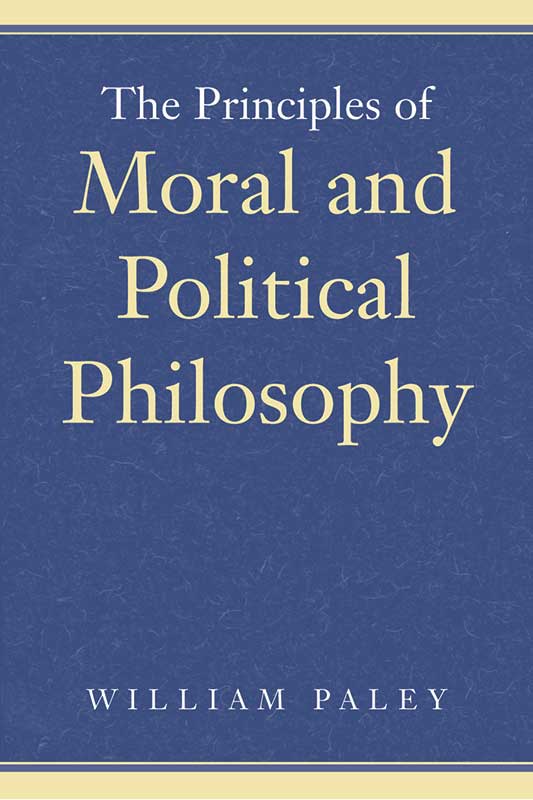
Chapter 11: Gratitude - William Paley, The Principles of Moral and Political Philosophy [1785]
Edition used:
The Principles of Moral and Political Philosophy, Foreword by D.L. Le Mahieu (Indianapolis: Liberty Fund, 2002).
About Liberty Fund:
Liberty Fund, Inc. is a private, educational foundation established to encourage the study of the ideal of a society of free and responsible individuals.
Copyright information:
The copyright to this edition, in both print and electronic forms, is held by Liberty Fund, Inc.
Fair use statement:
This material is put online to further the educational goals of Liberty Fund, Inc. Unless otherwise stated in the Copyright Information section above, this material may be used freely for educational and academic purposes. It may not be used in any way for profit.
Chapter 11
Gratitude
Examples of ingratitude check and discourage voluntary beneficence; and in this, the mischief of ingratitude consists. Nor is the mischief small; for after all is done that can be done, towards providing for the public happiness, by prescribing rules of justice, and enforcing the observation of them by penalties or compulsion, much must be left to those offices of kindness, which men remain at liberty to exert or withhold. Now not only the choice of the objects, but the quantity and even the existence of this sort of kindness in the world, depends, in a great measure, upon the return which it receives: and this is a consideration of general importance.
A second reason for cultivating a grateful temper in ourselves, is the following: The same principle, which is touched with the kindness of a human benefactor, is capable of being affected by the divine goodness, and of becoming, under the influence of that affection, a source of the purest and most exalted virtue. The love of God is the sublimest gratitude. It is a mistake, therefore, to imagine, that this virtue is omitted in the Christian Scriptures; for every precept which commands us “to love God, because he first loved us,” presupposes the principle of gratitude, and directs it to its proper object.
It is impossible to particularise the several expressions of gratitude, inasmuch as they vary with the character and situation of the benefactor, and with the opportunities of the person obliged; which variety admits of no bounds.
It may be observed, however, that gratitude can never oblige a man to do what is wrong, and what by consequence he is previously obliged not to do. It is no ingratitude to refuse to do, what we cannot reconcile to any apprehensions of our duty; but it is ingratitude and hypocrisy together, to pretend this reason, when it is not the real one: and the frequency of such pretences has brought this apology for non-compliance with the will of a benefactor into unmerited disgrace.
It has long been accounted a violation of delicacy and generosity to upbraid men with the favours they have received: but it argues a total destitution of both these qualities, as well as of moral probity, to take advantage of that ascendency which the conferring of benefits justly creates, to draw or drive those whom we have obliged into mean or dishonest compliances.