Econlib

The Library

Other Sites

Front Page arrow Titles (by Subject) arrow Chapter 8: Revenge - The Principles of Moral and Political Philosophy

Return to Title Page for The Principles of Moral and Political Philosophy

Search this Title:

Also in the Library:

Subject Area: Political Theory
Subject Area: Philosophy
Collection: Books Published by Liberty Fund
Topic: Property
Order this book from Liberty Fund

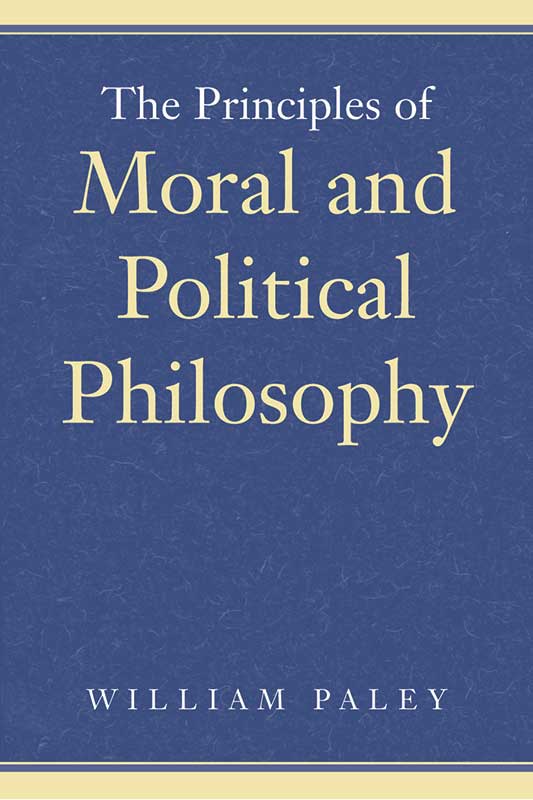
Chapter 8: Revenge - William Paley, The Principles of Moral and Political Philosophy [1785]

Edition used:

The Principles of Moral and Political Philosophy, Foreword by D.L. Le Mahieu (Indianapolis: Liberty Fund, 2002).

About Liberty Fund:

Liberty Fund, Inc. is a private, educational foundation established to encourage the study of the ideal of a society of free and responsible individuals.


Chapter 8

Revenge

All pain occasioned to another in consequence of an offence or injury received from him, further than what is calculated to procure reparation, or promote the just ends of punishment, is so much revenge.

There can be no difficulty in knowing when we occasion pain to another; nor much in distinguishing whether we do so, with a view only to the ends of punishment, or from revenge; for, in the one case we proceed with reluctance, in the other with pleasure.

It is highly probable from the light of nature, that a passion, which seeks its gratification immediately and expressly in giving pain, is disagreeable to the benevolent will and counsels of the Creator. Other passions and pleasures may, and often do, produce pain to some one: but then pain is not, as it is here, the object of the passion, and the direct cause of the pleasure. This probability is converted into certainty, if we give credit to the authority which dictated the several passages of the Christian Scriptures that condemn revenge, or, what is the same thing, which enjoin forgiveness.

We will set down the principal of these passages; and endeavour to collect from them, what conduct upon the whole is allowed towards an enemy, and what is forbidden.

“If ye forgive men their trespasses, your heavenly Father will also forgive you; but if ye forgive not men their trespasses, neither will your Father forgive your trespasses.”—“And his lord was wroth, and delivered him to the tormentors, till he should pay all that was due unto him: so likewise shall my heavenly Father do also unto you, if ye from your hearts forgive not every one his brother their trespasses.”—“Put on bowels of mercy, kindness, humbleness of mind, meekness, long-suffering; forbearing one another, forgiving one another, if any man have a quarrel against any, even as Christ forgave you, so also do ye.”—“Be patient towards all men; see that none render evil for evil to any man.”—“Avenge not yourselves, but rather give place unto wrath: for it is written, Vengeance is mine; I will repay, saith the Lord. Therefore, if thine enemy hunger, feed him; if he thirst, give him drink: for, in so doing, thou shalt heap coals of fire on his head. Be not overcome of evil, but overcome evil with good.”*

I think it evident, from some of these passages taken separately, and still more so from all of them together, that revenge, as described in the beginning of this chapter, is forbidden in every degree, under all forms, and upon every occasion. We are likewise forbidden to refuse to an enemy even the most imperfect right: “if he hunger, feed him; if he thirst, give him drink”; which are examples of imperfect rights. If one who has offended us solicit from us a vote to which his qualifications entitle him, we may not refuse it from motives of resentment, or the remembrance of what we have suffered at his hands. His right, and our obligation which follows the right, are not altered by his enmity to us, or by ours to him.

On the other hand, I do not conceive that these prohibitions were intended to interfere with the punishment or prosecution of public offenders. In the eighteenth chapter of St. Matthew, our Saviour tells his disciples; “If thy brother who has trespassed against thee neglect to hear the church, let him be unto thee as an heathen man, and a publican.” Immediately after this, when St. Peter asked him, “How oft shall my brother sin against me, and I forgive him? till seven times?” Christ replied, “I say not unto thee until seven times, but until seventy times seven”; that is, as often as he repeats the offence. From these two adjoining passages compared together, we are authorised to conclude that the forgiveness of an enemy is not inconsistent with the proceeding against him as a public offender; and that the discipline established in religious or civil societies, for the restraint or punishment of criminals, ought to be upholden.

If the magistrate be not tied down with these prohibitions from the execution of his office, neither is the prosecutor; for the office of the prosecutor is as necessary as that of the magistrate.

Nor, by parity of reason, are private persons withholden from the correction of vice, when it is in their power to exercise it; provided they be assured that it is the guilt which provokes them, and not the injury; and that their motives are pure from all mixture and every particle of that spirit which delights and triumphs in the humiliation of an adversary.

Thus it is no breach of Christian charity, to withdraw our company or civility when the same tends to discountenance any vicious practice. This is one branch of that extrajudicial discipline, which supplies the defects and the remissness of law; and is expressly authorised by St. Paul (1 Cor. v. 11.); “But now I have written unto you not to keep company, if any man that is called a brother be a fornicator, or covetous, or an idolater, or a railer, or a drunkard, or an extortioner; with such an one, no not to eat.” The use of this association against vice continues to be experienced in one remarkable instance, and might be extended with good effect to others. The confederacy amongst women of character, to exclude from their society kept-mistresses and prostitutes, contributes more perhaps to discourage that condition of life, and prevents greater numbers from entering into it, than all the considerations of prudence and religion put together.

We are likewise allowed to practise so much caution as not to put ourselves in the way of injury, or invite the repetition of it. If a servant or tradesman has cheated us, we are not bound to trust him again; for this is to encourage him in his dishonest practices, which is doing him much harm.

Where a benefit can be conferred only upon one or few, and the choice of the person upon whom it is conferred is a proper object of favour, we are at liberty to prefer those who have not offended us to those who have; the contrary being nowhere required.

Christ, who, as hath been well demonstrated,* estimated virtues by their solid utility, and not by their fashion or popularity, prefers this of the forgiveness of injuries to every other. He enjoins it oftener; with more earnestness; under a greater variety of forms; and with this weighty and peculiar circumstance, that the forgiveness of others is the condition upon which alone we are to expect, or even ask, from God, forgiveness for ourselves. And this preference is justified by the superior importance of the virtue itself. The feuds and animosities in families and between neighbours, which disturb the intercourse of human life, and collectively compose half the misery of it, have their foundation in the want of a forgiving temper; and can never cease, but by the exercise of this virtue, on one side, or on both.

[* ]Matt. vi. 14, 15: xviii. 34, 35. Col. iii. 12, 13. 1 Thess. v. 14, 15. Rom. xii. 19, 20, 21.

[]See also Exodus, xxiii. 4. “If thou meet thine enemy’s ox, or his ass, going astray, thou shalt surely bring it back to him again; if thou see the ass of him that hateth thee, lying under his burden, and wouldest forbear to help him, thou shalt surely help with him.”

[* ]See a View of the Internal Evidence of the Christian Religion.