Econlib

The Library

Other Sites

Front Page arrow Titles (by Subject) arrow Chapter 9: Of Right - The Principles of Moral and Political Philosophy

Return to Title Page for The Principles of Moral and Political Philosophy

Search this Title:

Also in the Library:

Subject Area: Political Theory
Subject Area: Philosophy
Collection: Books Published by Liberty Fund
Topic: Property
Order this book from Liberty Fund

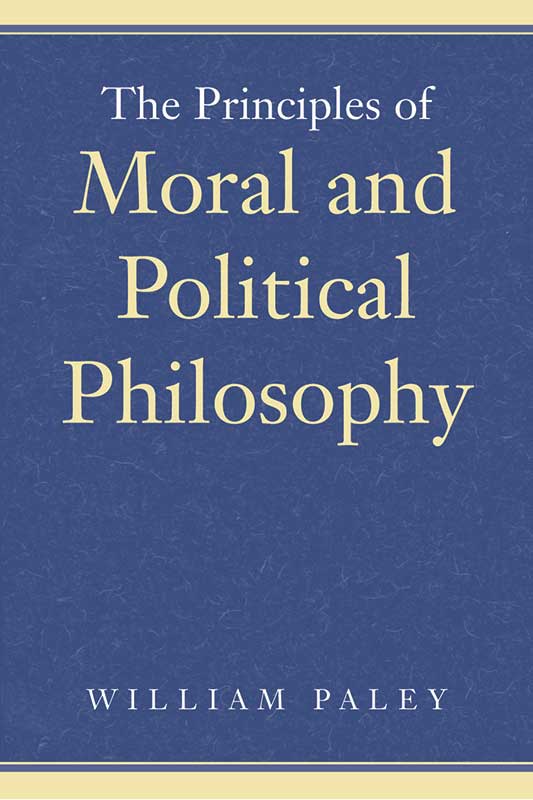
Chapter 9: Of Right - William Paley, The Principles of Moral and Political Philosophy [1785]

Edition used:

The Principles of Moral and Political Philosophy, Foreword by D.L. Le Mahieu (Indianapolis: Liberty Fund, 2002).

About Liberty Fund:

Liberty Fund, Inc. is a private, educational foundation established to encourage the study of the ideal of a society of free and responsible individuals.


Chapter 9

Of Right

Right and obligation are reciprocal; that is, wherever there is a right in one person, there is a corresponding obligation upon others. If one man has a “right” to an estate; others are “obliged” to abstain from it—If parents have a “right” to reverence from their children; children are “obliged” to reverence their parents—and so in all other instances.

Now, because moral obligation depends, as we have seen, upon the will of God; right, which is correlative to it, must depend upon the same. Right therefore signifies, consistency with the will of God.

But if the Divine will determine the distinction of right and wrong, what else is it but an identical proposition, to say of God, that he acts right? or how is it possible to conceive even that he should act wrong? Yet these assertions are intelligible and significant. The case is this: By virtue of the two principles, that God wills the happiness of his creatures, and that the will of God is the measure of right and wrong, we arrive at certain conclusions; which conclusions become rules; and we soon learn to pronounce actions right or wrong, according as they agree or disagree with our rules, without looking any further: and when the habit is once established of stopping at the rules, we can go back and compare with these rules even the Divine conduct itself; and yet it may be true (only not observed by us at the time) that the rules themselves are deduced from the Divine will.

Right is a quality of persons or of actions.

Of persons; as when we say, such a one has a “right” to this estate; parents have a “right” to reverence from their children; the king to allegiance from his subjects; masters have a “right” to their servants’ labour; a man has not a “right” over his own life.

Of actions; as in such expressions as the following: it is “right” to punish murder with death; his behaviour on that occasion was “right”; it is not “right” to send an unfortunate debtor to gaol; he did or acted “right,” who gave up his place, rather than vote against his judgement.

In this latter set of expressions, you may substitute the definition of right above given, for the term itself: e.g. it is “consistent with the will of God” to punish murder with death; his behaviour on that occasion was “consistent with the will of God”; it is not “consistent with the will of God” to send an unfortunate debtor to gaol; he did, or acted, “consistently with the will of God,” who gave up his place rather than vote against his judgement.

In the former set, you must vary the construction a little, when you introduce the definition instead of the term. Such a one has a “right” to this estate, that is, it is “consistent with the will of God” that such a one should have it; parents have a “right” to reverence from their children, that is, it is “consistent with the will of God” that children should reverence their parents; and the same of the rest.