Econlib

The Library

Other Sites

Front Page arrow Titles (by Subject) arrow Chapter 5: The Divine Benevolence - The Principles of Moral and Political Philosophy

Return to Title Page for The Principles of Moral and Political Philosophy

Search this Title:

Also in the Library:

Subject Area: Political Theory
Subject Area: Philosophy
Collection: Books Published by Liberty Fund
Topic: Property
Order this book from Liberty Fund

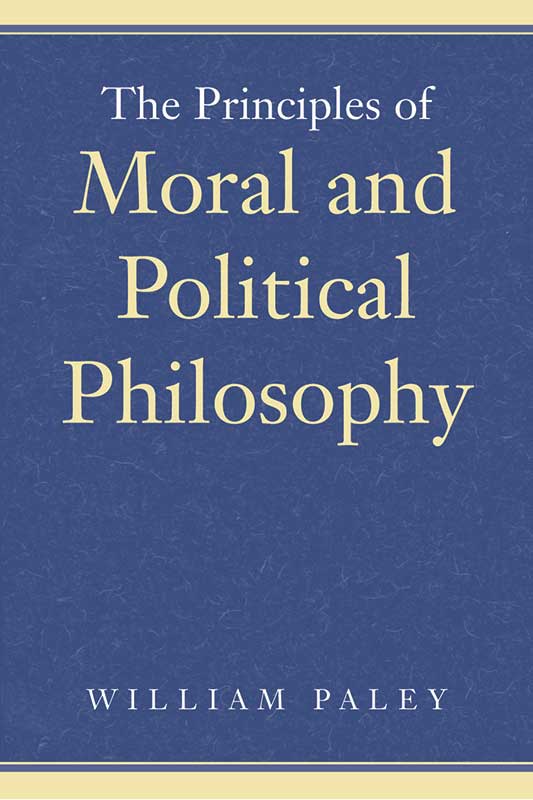
Chapter 5: The Divine Benevolence - William Paley, The Principles of Moral and Political Philosophy [1785]

Edition used:

The Principles of Moral and Political Philosophy, Foreword by D.L. Le Mahieu (Indianapolis: Liberty Fund, 2002).

About Liberty Fund:

Liberty Fund, Inc. is a private, educational foundation established to encourage the study of the ideal of a society of free and responsible individuals.


Chapter 5

The Divine Benevolence

When God created the human species, either he wished their happiness, or he wished their misery, or he was indifferent and unconcerned about both.

If he had wished our misery, he might have made sure of his purpose, by forming our senses to be so many sores and pains to us, as they are now instruments of gratification and enjoyment: or by placing us amidst objects so ill-suited to our perceptions, as to have continually offended us, instead of ministering to our refreshment and delight. He might have made, for example, every thing we tasted, bitter; every thing we saw, loathsome; every thing we touched, a sting; every smell a stench; and every sound a discord.

If he had been indifferent about our happiness or misery, we must impute to our good fortune (as all design by this supposition is excluded) both the capacity of our senses to receive pleasure, and the supply of external objects fitted to produce it. But either of these (and still more both of them) being too much to be attributed to accident, nothing remains but the first supposition, that God, when he created the human species, wished their happiness; and made for them the provision which he has made, with that view, and for that purpose.

The same argument may be proposed in different terms, thus: Contrivance proves design: and the predominant tendency of the contrivance indicates the disposition of the designer. The world abounds with contrivances: and all the contrivances which we are acquainted with, are directed to beneficial purposes. Evil, no doubt, exists; but is never, that we can perceive, the object of contrivance. Teeth are contrived to eat, not to ache; their aching now and then, is incidental to the contrivance, perhaps inseparable from it: or even, if you will, let it be called a defect in the contrivance; but it is not the object of it. This is a distinction which well deserves to be attended to. In describing implements of husbandry, you would hardly say of the sickle, that it is made to cut the reaper’s fingers, though, from the construction of the instrument, and the manner of using it, this mischief often happens. But if you had occasion to describe instruments of torture or execution, This engine, you would say, is to extend the sinews; this to dislocate the joints; this to break the bones; this to scorch the soles of the feet. Here, pain and misery are the very objects of the contrivance. Now, nothing of this sort is to be found in the works of nature. We never discover a train of contrivance to bring about an evil purpose. No anatomist ever discovered a system of organization calculated to produce pain and disease; or, in explaining the parts of the human body, ever said, This is to irritate; this to inflame; this duct is to convey the gravel to the kidneys; this gland to secrete the humour which forms the gout: if by chance he come at a part of which he knows not the use, the most he can say is, that it is useless: no one ever suspects that it is put there to incommode, to annoy, or to torment. Since then God hath called forth his consummate wisdom to contrive and provide for our happiness, and the world appears to have been constituted with this design at first; so long as this constitution is upholden by him, we must in reason suppose the same design to continue.

The contemplation of universal nature rather bewilders the mind than affects it. There is always a bright spot in the prospect, upon which the eye rests; a single example, perhaps, by which each man finds himself more convinced than by all others put together. I seem, for my own part, to see the benevolence of the Deity more clearly in the pleasures of very young children, than in any thing in the world. The pleasures of grown persons may be reckoned partly of their own procuring; especially if there has been any industry, or contrivance, or pursuit, to come at them; or if they are founded, like music, painting, &c. upon any qualification of their own acquiring. But the pleasures of a healthy infant are so manifestly provided for it by another, and the benevolence of the provision is so unquestionable, that every child I see at its sport, affords to my mind a kind of sensible evidence of the finger of God, and of the disposition which directs it.

But the example, which strikes each man most strongly, is the true example for him: and hardly two minds hit upon the same; which shows the abundance of such examples about us.

We conclude, therefore, that God wills and wishes the happiness of his creatures. And this conclusion being once established, we are at liberty to go on with the rule built upon it, namely, “that the method of coming at the will of God, concerning any action, by the light of nature, is to inquire into the tendency of that action to promote or diminish the general happiness.”