Econlib

The Library

Other Sites

Front Page arrow Titles (by Subject) arrow Preface - The Principles of Moral and Political Philosophy

Return to Title Page for The Principles of Moral and Political Philosophy

Search this Title:

Also in the Library:

Subject Area: Political Theory
Subject Area: Philosophy
Collection: Books Published by Liberty Fund
Topic: Property
Order this book from Liberty Fund

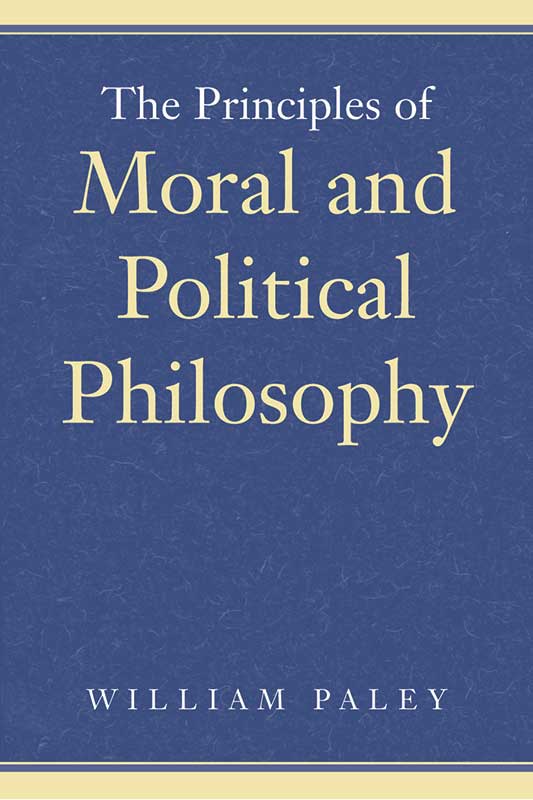
Preface - William Paley, The Principles of Moral and Political Philosophy [1785]

Edition used:

The Principles of Moral and Political Philosophy, Foreword by D.L. Le Mahieu (Indianapolis: Liberty Fund, 2002).

About Liberty Fund:

Liberty Fund, Inc. is a private, educational foundation established to encourage the study of the ideal of a society of free and responsible individuals.


Preface

IN THE treatises that I have met with upon the subject of morals, I appear to myself to have remarked the following imperfections—either that the principle was erroneous, or that it was indistinctly explained, or that the rules deduced from it were not sufficiently adapted to real life and to actual situations. The writings of Grotius, and the larger work of Puffendorff, are of too forensic a cast, too much mixed up with civil law and with the jurisprudence of Germany, to answer precisely the design of a system of ethics—the direction of private consciences in the general conduct of human life. Perhaps, indeed, they are not to be regarded as institutes of morality calculated to instruct an individual in his duty, so much as a species of law-books and law-authorities, suited to the practice of those courts of justice, whose decisions are regulated by general principles of natural equity, in conjunction with the maxims of the Roman code; of which kind, I understand, there are many upon the Continent. To which may be added, concerning both these authors, that they are more occupied in describing the rights and usages of independent communities than is necessary in a work which professes not to adjust the correspondence of nations, but to delineate the offices of domestic life. The profusion also of classical quotations with which many of their pages abound seems to me a fault from which it will not be easy to excuse them. If these extracts be intended as decorations of style, the composition is overloaded with ornaments of one kind. To any thing more than ornament they can make no claim. To propose them as serious arguments, gravely to attempt to establish or fortify a moral duty by the testimony of a Greek or Roman poet, is to trifle with the attention of the reader, or rather to take it off from all just principles of reasoning in morals.

Of our own writers in this branch of philosophy, I find none that I think perfectly free from the three objections which I have stated. There is likewise a fourth property observable almost in all of them, namely, that they divide too much the law of Nature from the precepts of Revelation; some authors industriously declining the mention of Scripture authorities, as belonging to a different province; and others reserving them for a separate volume: which appears to me much the same defect, as if a commentator on the laws of England should content himself with stating upon each head the common law of the land, without taking any notice of acts of parliament; or should choose to give his readers the common law in one book, and the statute law in another. “When the obligations of morality are taught,” says a pious and celebrated writer, “let the sanctions of Christianity never be forgotten; by which it will be shown that they give strength and lustre to each other: religion will appear to be the voice of reason, and morality will be the will of God.”*

The manner also in which modern writers have treated of subjects of morality is, in my judgement, liable to much exception. It has become of late a fashion to deliver moral institutes in strings or series of detached propositions, without subjoining a continued argument or regular dissertation to any of them. This sententious apophthegmatising style, by crowding propositions and paragraphs too fast upon the mind, and by carrying the eye of the reader from subject to subject in too quick a succession, gains not a sufficient hold upon the attention to leave either the memory furnished, or the understanding satisfied. However useful a syllabus of topics or a series of propositions may be in the hands of a lecturer, or as a guide to a student, who is supposed to consult other books, or to institute upon each subject researches of his own, the method is by no means convenient for ordinary readers; because few readers are such thinkers as to want only a hint to set their thoughts at work upon; or such as will pause and tarry at every proposition, till they have traced out its dependency, proof, relation, and consequences, before they permit themselves to step on to another. A respectable writer of this class* has comprised his doctrine of slavery in the three following propositions:

“No one is born a slave; because every one is born with all his original rights.”

“No one can become a slave; because no one from being a person can, in the language of the Roman law, become a thing, or subject of property.”

“The supposed property of the master in the slave, therefore, is matter of usurpation, not of right.”

It may be possible to deduce from these few adages such a theory of the primitive rights of human nature, as will evince the illegality of slavery: but surely an author requires too much of his reader, when he expects him to make these deductions for himself; or to supply, perhaps from some remote chapter of the same treatise, the several proofs and explanations which are necessary to render the meaning and truth of these assertions intelligible.

There is a fault, the opposite of this, which some moralists who have adopted a different, and I think a better plan of composition, have not always been careful to avoid; namely, the dwelling upon verbal and elementary distinctions, with a labour and prolixity proportioned much more to the subtlety of the question than to its value and importance in the prosecution of the subject. A writer upon the law of nature, whose explications in every part of philosophy, though always diffuse, are often very successful, has employed three long sections in endeavouring to prove that “permissions are not laws.” The discussion of this controversy, however essential it might be to dialectic precision, was certainly not necessary to the progress of a work designed to describe the duties and obligations of civil life. The reader becomes impatient when he is detained by disquisitions which have no other object than the settling of terms and phrases; and, what is worse, they for whose use such books are chiefly intended will not be persuaded to read them at all.

I am led to propose these strictures, not by any propensity to depreciate the labours of my predecessors, much less to invite a comparison between the merits of their performances and my own; but solely by the consideration, that when a writer offers a book to the public, upon a subject on which the public are already in possession of many others, he is bound by a kind of literary justice to inform his readers, distinctly and specifically, what it is he professes to supply and what he expects to improve. The imperfections above enumerated are those which I have endeavoured to avoid or remedy. Of the execution, the reader must judge: but this was the design.

Concerning the principle of morals it would be premature to speak: but concerning the manner of unfolding and explaining that principle, I have somewhat which I wish to be remarked. An experience of nine years in the office of a public tutor in one of the universities, and in that department of education to which these chapters relate, afforded me frequent occasions to observe, that in discoursing to young minds upon topics of morality, it required much more pains to make them perceive the difficulty than to understand the solution; that, unless the subject was so drawn up to a point as to exhibit the full force of an objection, or the exact place of a doubt, before any explanation was entered upon—in other words, unless some curiosity was excited before it was attempted to be satisfied, the labour of the teacher was lost. When information was not desired, it was seldom, I found, retained. I have made this observation my guide in the following work: that is, upon each occasion I have endeavoured, before I suffered myself to proceed in the disquisition, to put the reader in complete possession of the question; and to do it in the way that I thought most likely to stir up his own doubts and solicitude about it.

In pursuing the principle of morals through the detail of cases to which it is applicable, I have had in view to accommodate both the choice of the subjects and the manner of handling them to the situations which arise in the life of an inhabitant of this country in these times. This is the thing that I think to be principally wanting in former treatises; and perhaps the chief advantage which will be found in mine. I have examined no doubts, I have discussed no obscurities, I have encountered no errors, I have adverted to no controversies, but what I have seen actually to exist. If some of the questions treated of appear to a more instructed reader minute or puerile, I desire such reader to be assured that I have found them occasions of difficulty to young minds; and what I have observed in young minds, I should expect to meet with in all who approach these subjects for the first time. Upon each article of human duty, I have combined with the conclusion of reason the declarations of Scripture, when they are to be had, as of co-ordinate authority, and as both terminating in the same sanctions.

In the manner of the work, I have endeavoured so to attemper the opposite plans above animadverted upon, as that the reader may not accuse me either of too much haste, or too much delay. I have bestowed upon each subject enough of dissertation to give a body and substance to the chapter in which it is treated of, as well as coherence and perspicuity: on the other hand, I have seldom, I hope, exercised the patience of the reader by the length and prolixity of my essays, or disappointed that patience at last by the tenuity and unimportance of the conclusion.

There are two particulars in the following work, for which it may be thought necessary that I should offer some excuse. The first of which is, that I have scarcely ever referred to any other book; or mentioned the name of the author whose thoughts, and sometimes, possibly, whose very expressions, I have adopted. My method of writing has constantly been this; to extract what I could from my own stores and my own reflections in the first place; to put down that, and afterwards to consult upon each subject such readings as fell in my way; which order, I am convinced, is the only one whereby any person can keep his thoughts from sliding into other men’s trains. The effect of such a plan upon the production itself will be, that, whilst some parts in matter or manner may be new, others will be little else than a repetition of the old. I make no pretensions to perfect originality: I claim to be something more than a mere compiler. Much, no doubt, is borrowed; but the fact is, that the notes for this work having been prepared for some years, and such things having been from time to time inserted in them as appeared to me worth preserving, and such insertions made commonly without the name of the author from whom they were taken, I should, at this time, have found a difficulty in recovering those names with sufficient exactness to be able to render to every man his own. Nor, to speak the truth, did it appear to me worth while to repeat the search merely for this purpose. When authorities are relied upon, names must be produced: when a discovery has been made in science, it may be unjust to borrow the invention without acknowledging the author. But in an argumentative treatise, and upon a subject which allows no place for discovery or invention, properly so called; and in which all that can belong to a writer is his mode of reasoning, or his judgement of probabilities; I should have thought it superfluous, had it been easier to me than it was, to have interrupted my text, or crowded my margin, with references to every author whose sentiments I have made use of. There is, however, one work to which I owe so much, that it would be ungrateful not to confess the obligation: I mean the writings of the late Abraham Tucker, Esq. part of which were published by himself, and the remainder since his death, under the title of “The Light of Nature pursued, by Edward Search, Esq.” I have found in this writer more original thinking and observation upon the several subjects that he has taken in hand than in any other, not to say, than in all others put together. His talent also for illustration is unrivalled. But his thoughts are diffused through a long, various, and irregular work. I shall account it no mean praise, if I have been sometimes able to dispose into method, to collect into heads and articles, or to exhibit in more compact and tangible masses, what, in that otherwise excellent performance, is spread over too much surface.

The next circumstance for which some apology may be expected is the joining of moral and political philosophy together, or the addition of a book of politics to a system of ethics. Against this objection, if it be made one, I might defend myself by the example of many approved writers, who have treated de officiis hominis et civis, or, as some choose to express it, “of the rights and obligations of man, in his individual and social capacity,” in the same book. I might allege, also, that the part a member of the commonwealth shall take in political contentions, the vote he shall give, the counsels he shall approve, the support he shall afford, or the opposition he shall make, to any system of public measures—is as much a question of personal duty, as much concerns the conscience of the individual who deliberates, as the determination of any doubt which relates to the conduct of private life: that consequently political philosophy is, properly speaking, a continuation of moral philosophy; or rather indeed a part of it, supposing moral philosophy to have for its aim the information of the human conscience in every deliberation that is likely to come before it. I might avail myself of these excuses, if I wanted them; but the vindication upon which I rely is the following: In stating the principle of morals, the reader will observe that I have employed some industry in explaining the theory, and showing the necessity of general rules; without the full and constant consideration of which, I am persuaded that no system of moral philosophy can be satisfactory or consistent. This foundation being laid, or rather this habit being formed, the discussion of political subjects, to which, more than to almost any other, general rules are applicable, became clear and easy. Whereas, had these topics been assigned to a distinct work, it would have been necessary to have repeated the same rudiments, to have established over again the same principles, as those which we had already exemplified, and rendered familiar to the reader, in the former parts of this. In a word, if there appear to any one too great a diversity, or too wide a distance, between the subjects treated of in the course of the present volume, let him be reminded, that the doctrine of general rules pervades and connects the whole.

It may not be improper, however, to admonish the reader, that, under the name of politics, he is not to look for those occasional controversies, which the occurrences of the present day, or any temporary situation of public affairs, may excite; and most of which, if not beneath the dignity, it is beside the purpose, of a philosophical institution to advert to. He will perceive that the several disquisitions are framed with a reference to the condition of this country, and of this government: but it seemed to me to belong to the design of a work like the following, not so much to discuss each altercated point with the particularity of a political pamphlet upon the subject, as to deliver those universal principles, and to exhibit that mode and train of reasoning in politics, by the due application of which every man might be enabled to attain to just conclusions of his own. I am not ignorant of an objection that has been advanced against all abstract speculations concerning the origin, principle, or limitation of civil authority; namely, that such speculations possess little or no influence upon the conduct either of the state or of the subject, of the governors or the governed; nor are attended with any useful consequences to either: that in times of tranquillity they are not wanted; in times of confusion they are never heard. This representation, however, in my opinion, is not just. Times of tumult, it is true, are not the times to learn; but the choice which men make of their side and party, in the most critical occasions of the commonwealth, may nevertheless depend upon the lessons they have received, the books they have read, and the opinions they have imbibed, in seasons of leisure and quietness. Some judicious persons, who were present at Geneva during the troubles which lately convulsed that city, thought they perceived, in the contentions there carrying on, the operation of that political theory, which the writings of Rousseau, and the unbounded esteem in which these writings are holden by his countrymen, had diffused amongst the people. Throughout the political disputes that have within these few years taken place in Great Britain, in her sister-kingdom, and in her foreign dependencies, it was impossible not to observe in the language of party, in the resolutions of public meetings, in debate, in conversation, in the general strain of those fugitive and diurnal addresses to the public which such occasions call forth, the prevalency of those ideas of civil authority which are displayed in the works of Mr. Locke. The credit of that great name, the courage and liberality of his principles, the skill and clearness with which his arguments are proposed, no less than the weight of the arguments themselves, have given a reputation and currency to his opinions, of which I am persuaded, in any unsettled state of public affairs, the influence would be felt. As this is not a place for examining the truth or tendency of these doctrines, I would not be understood by what I have said to express any judgement concerning either. I mean only to remark, that such doctrines are not without effect; and that it is of practical importance to have the principles from which the obligations of social union, and the extent of civil obedience, are derived, rightly explained, and well understood. Indeed, as far as I have observed, in political, beyond all other subjects, where men are without some fundamental and scientific principles to resort to, they are liable to have their understandings played upon by cant phrases and unmeaning terms, of which every party in every country possesses a vocabulary. We appear astonished when we see the multitude led away by sounds; but we should remember that, if sounds work miracles, it is always upon ignorance. The influence of names is in exact proportion to the want of knowledge.

These are the observations with which I have judged it expedient to prepare the attention of my reader. Concerning the personal motives which engaged me in the following attempt, it is not necessary that I say much; the nature of my academical situation, a great deal of leisure since my retirement from it, the recommendation of an honoured and excellent friend, the authority of the venerable prelate to whom these labours are inscribed, the not perceiving in what way I could employ my time or talents better, and my disapprobation, in literary men, of that fastidious indolence which sits still because it disdains to do little, were the considerations that directed my thoughts to this design. Nor have I repented of the undertaking. Whatever be the fate or reception of this work, it owes its author nothing. In sickness and in health I have found in it that which can alone alleviate the one, or give enjoyment to the other—occupation and engagement.

[* ]Preface to “The Preceptor,” by Dr. Johnson.

[* ]Dr. Ferguson, author of “Institutes of Moral Philosophy”; 1767.

[]Dr. Rutherforth, author of “Institutes of Natural Law.”