EconlibThe LibraryOther Sites |
Front Page Titles (by Subject) XXV - Politica
Return to Title Page for PoliticaThe Online Library of LibertyA project of Liberty Fund, Inc.Search this Title:Also in the Library:
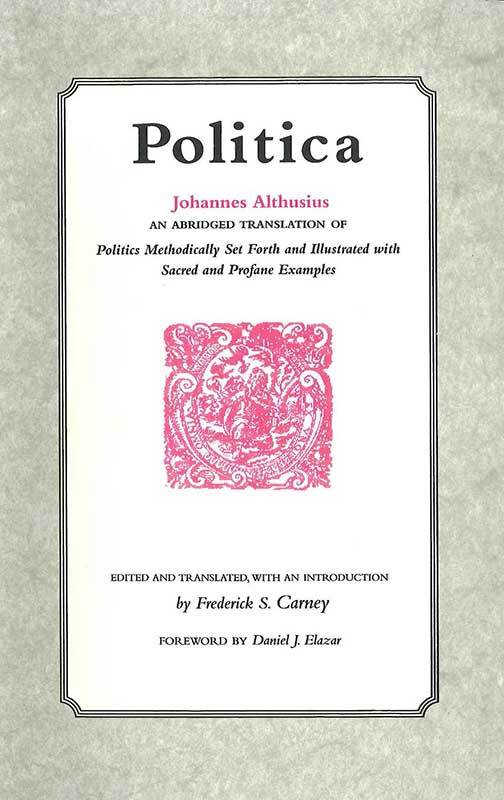
XXV - Johannes Althusius, Politica [1614]Edition used:Politica. An Abridged Translation of Politics Methodically Set Forth and Illustrated with Sacred and Profane Examples, ed. and Trans. Frederick S. Carney. Foreword by Daniel J. Elazar (Indianapolis: 1995 Liberty Fund).
About Liberty Fund:Liberty Fund, Inc. is a private, educational foundation established to encourage the study of the ideal of a society of free and responsible individuals. Copyright information:The copyright to this edition, in both print and electronic forms, is held by Liberty Fund, Inc. Fair use statement:This material is put online to further the educational goals of Liberty Fund, Inc. Unless otherwise stated in the Copyright Information section above, this material may be used freely for educational and academic purposes. It may not be used in any way for profit.
XXV§ 1This completes the discussion of benevolence, the first aspect of the acquired and extrinsic attitude toward imperium. We turn now to the second aspect of an acquired authority, which is reverence. A reverent attitude toward the magistrate derives from imperium and a favorable opinion about the magistrate’s exercise of authority. Giovanni Botero, however, distinguishes between reverence and authority.56 Respect for authority, Lipsius says, is a reverent opinion of the supreme magistrate and his position that has been received and impressed on the minds of subjects and aliens by the magistrate’s administration of the realm. … 57§ 3This respect for authority is composed of the admiration and fear that arise from the ruler’s form of imperium, his greatness, and his moral qualities. The form of imperium ought to be austere, constant, and well managed if respect for authority is to be obtained. … § 15The greatness of the ruling magistrate, who doubtless has sufficient resources available for conserving what he has and securing others, should be a means for obtaining firm respect for authority that is both straightforward and befitting a king.58§ 16This greatness is conferred by wealth, arms, counsel, treaties, and the success of his ventures. … § 24Through his life and moral qualities, too, the magistrate may acquire respect for his authority, as Lipsius says.59 This maybe accomplished through inward and outward strengths, especially those that are contrary to the weaknesses toward which rulers are most easily impelled because of their ruling power: licence, flatterers, and other irritations. § 25The inward strengths consist of piety, foresight, courage, fidelity, modesty, temperance, self-restraint, and self-confidence. … 60 [56 ] [Botero’s point, which is not explained by Althusius, is that reverence (reverentia) resides in the people, but the means of producing reverence, namely authority (auctoritas), resides in the magistrate. Henceforth Althusius will follow Botero and speak not of reverence but of authority, by which he will mean, however, not what Botero means by auctoritas, but something much closer to reverentia, namely, respect for authority. Therefore, in this chapter the word has been translated as “respect for authority,” except where Botero’s or some other special use would seem to be intended. Botero’s point is made in one of the supplements of Practical Politics, that is, in Book I of “The Authority of the Prince.” George A. Moore, Botero’s translator, entitles this supplement “The Reputation of the Prince.” ] [57 ] [ Politicorum sive civilis doctrinae, VI, 8.] [58 ] Nebuchadnezzar excelled in this greatness. Daniel 5:19 f. [59 ]Politicorum sive civilis doctrinae, IV, 9. [60 ] [Outward strengths are discussed, oddly enough, as the second part of modesty, and include dignity, urbanity, and facility in speech, and discipline and refinement in body. After discussing these inward and outward strengths that produce respect for authority, Althusius then turns to contempt for authority, which is the result of corrupt forms of the magistrate’s imperium, the failure of his ventures, and unfortunate moral qualities.] |

Titles (by Subject)