EconlibThe LibraryOther Sites |
Front Page Titles (by Subject) XI - Politica
Return to Title Page for PoliticaThe Online Library of LibertyA project of Liberty Fund, Inc.Search this Title:Also in the Library:
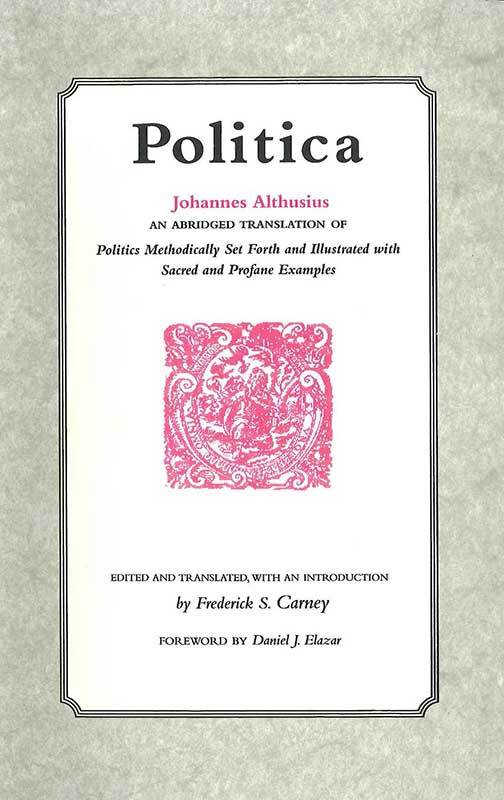
XI - Johannes Althusius, Politica [1614]Edition used:Politica. An Abridged Translation of Politics Methodically Set Forth and Illustrated with Sacred and Profane Examples, ed. and Trans. Frederick S. Carney. Foreword by Daniel J. Elazar (Indianapolis: 1995 Liberty Fund).
About Liberty Fund:Liberty Fund, Inc. is a private, educational foundation established to encourage the study of the ideal of a society of free and responsible individuals. Copyright information:The copyright to this edition, in both print and electronic forms, is held by Liberty Fund, Inc. Fair use statement:This material is put online to further the educational goals of Liberty Fund, Inc. Unless otherwise stated in the Copyright Information section above, this material may be used freely for educational and academic purposes. It may not be used in any way for profit.
XI§ 1Special and secular right of sovereignty indicates and prescribes the particular means for meeting the needs and wants of all symbiotes of this association, for promoting advantages for them, and for avoiding disadvantages. For as each member of the body was created and constituted for its duty, and yet each and every member has the same end, namely the conservation of the whole body, so each of us has been ordained to his proper and individual role in life, but nevertheless all of us to the glory of God and the welfare of our neighbor. § 2This special right should be equitable, good, useful, and adapted to place, time, and persons. Whence it is called civil law (jus civile),23 and is said to be peculiar to each polity.24 § 3This special right is twofold. The first part is devoted to the arrangement established for procuring the material necessities of life.25 It informs the procedure for communicating advantages and upholding responsibilities in those things that have been agreed upon in the universal association for the supply of necessities and supports. § 4This part of the special right of the realm consists in (1) commercial regulations, (2) a monetary system, (3) a common language, (4) public duties in the realm, and (5) privileges and the conferring of titles of nobility.26 § 5First, the right and responsibility for regulating public commerce, contracts, and business on land and water belongs to the universal association. The free use and exercise of these functions in the territory of the realm depends upon permission, prescription, and current laws. It is called public trade. … § 7Without commerce we cannot live conveniently in this social life. For there are many things we need and without which no man can live with comfort. We can also be underprivileged in many things that are for our good, even to the extent of great inconvenience to us. Just as the human body cannot be healthy without the mutual communication of offices performed by its members, so the body of the commonwealth cannot be healthy without commerce. The necessity and utility of this life have therefore contrived a plan and procedure for exchanging goods, so that you can give and communicate to another what he needs and of which he cannot be deprived, any more than can you, without discomfort, and on the other hand receive from him what is necessary and useful to yourself. Indeed, peace and concord are often acquired through commercial pursuits. “They asked for peace because their country was nourished from the country of the king.” 27 … § 13The second right is of money or the right of striking and engraving coins, which is established in material publicly selected by the supreme magistrate with the approval of the people or realm. … § 14For if there is no fixed valuation of gold, silver, and money among men and neighboring peoples, commercial activity cannot be maintained. It follows that an uncertain monetary system throws everything into disorder, and makes intercourse and commerce with other peoples difficult. … § 16The third right is the maintenance of a language, and of the same idiom of it, in the territory. The use of speech is truly necessary for men in social life, for without it no society can endure, nor can the communion of right. … § 17The fourth right is the power and responsibility for assigning and distributing duties that arise in the universal association. § 18A duty is an oflice imposed upon a citizen or inhabitant in a territory of the realm that he bears for the benefit of the associated body by its agreement and permission. … Such duties are of two types: real and personal. § 20A double necessity is imposed upon the citizen, namely, to contribute things for the utility of the commonwealth,28 and to provide services for rightly administering and conserving the commonwealth.29 … § 23Real duties are performed by the payment and collection of a tax. They accompany the possession of things, and are levied with reference to these things in relation to their value. Thus the inhabitant, after a declaration and appraisal of his possessions, pays something from them that is turned over to the use of the commonwealth. … 30 [23 ] [the positive law of a commonwealth, which may vary in part from commonwealth to commonwealth, as distinguished from divine law (jus divinum), natural law (jus naturale), and the law of nations (jus gentium), each of which is general and binding upon all commonwealths.] [24 ] Digest I, 1, 6. [25 ] The second part pertains to the protection of the universal association. The first part is found in Chapters XI–XV; the second part in Chapters XVI–XVII.] [26 ] [The first, second, and third are discussed in Chapter XI, the fourth in Chapters XI–XIV, and the fifth in Chapter XV.] [27 ] Acts 12:20. See also Chronicles 2 and 19. [28 ] [real duties: Chapters XI–XIII.] [29 ] [personal duties: Chapter XIV.] [30 ] [One of the conditions Althusius says should be observed in levying taxes is that they be imposed upon “those things that can harm the poor people less,” and upon “those less necessary things that are not used for the everyday necessities of life.” ] |

Titles (by Subject)