EconlibThe LibraryOther Sites |
Front Page Titles (by Subject) VIII - Politica
Return to Title Page for PoliticaThe Online Library of LibertyA project of Liberty Fund, Inc.Search this Title:Also in the Library:
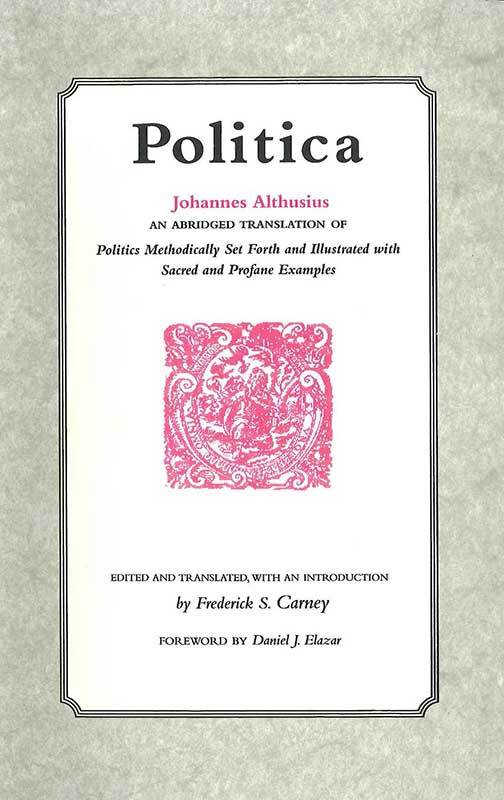
VIII - Johannes Althusius, Politica [1614]Edition used:Politica. An Abridged Translation of Politics Methodically Set Forth and Illustrated with Sacred and Profane Examples, ed. and Trans. Frederick S. Carney. Foreword by Daniel J. Elazar (Indianapolis: 1995 Liberty Fund).
About Liberty Fund:Liberty Fund, Inc. is a private, educational foundation established to encourage the study of the ideal of a society of free and responsible individuals. Copyright information:The copyright to this edition, in both print and electronic forms, is held by Liberty Fund, Inc. Fair use statement:This material is put online to further the educational goals of Liberty Fund, Inc. Unless otherwise stated in the Copyright Information section above, this material may be used freely for educational and academic purposes. It may not be used in any way for profit.
VIII§ 1The administration of provincial right is the process by which the employment and practice of provincial right, both general and special, is appropriately directed to the welfare of the province. Whence this right relates entirely to good ordering and arranging, and has in mind a structure of proper practice and discipline. The administration of this right involves two parts. One part pertains to the members of the province, and the other to its head or president. § 2The members of the province are its orders and estates, as they are called, or larger collegia.7 The provincials have been distributed in these orders and estates according to the class and diversity of life they have organized in keeping with their profession, vocation, and activity. Therefore, when ecclesiastical and civil functions of the province are under consideration, each estate or order can center its attention upon the operation of the provincial right and business among men of its own class, provided it does not usurp and exercise the ordinary jurisdiction. In Germany they are called die Stende der Landschaft . § 3The reason for these estates is that they are necessary and useful to the province, as Jethro, the father-in-law of Moses, declares.8 For no one can be sufficient and equal to the task of administering such various, diverse, and extensive public business of a province unless in part of the burden he avails himself of skilled, wise, and brave persons from each class of men. … Indeed, by this arrangement certain traces of liberty are retained by the provincials, for each and all see themselves admitted to the administration of public matters. Whence love, benevolence, and common concern are fostered among the provincials when all know that a precise care is exercised for individuals and groups in each class of life, and that their requests for the procurement of necessary and useful things for social life, and for the avoidance of inconvenience and harm, will be heard, and remedies will be sought, even to the extent of aid against those who are more powerful or who disturb the public peace. § 4The provincial order or estate maybe either sacred and ecclesiastical, or secular and civil. In Germany they are known as der Geistliche und Weltliche Stand.9§ 5These orders, together with the provincial head, represent the entire province. All weightier matters are guided by their counsel, and the welfare of the commonwealth is entrusted to them. They admonish the head of the province when he errs, correct the abuse of his power, and punish his seducers and base flatterers. § 6A collegium of pious, learned, and most weighty men from the collegia of provincial clergymen, elected and commissioned by common consent, represents the sacred and ecclesiastical order.10 Entrusted to this collegium is the examination and care of doctrine, of public reverence and divine worship, of schools, of ecclesiastical goods, and of the poor. Indeed, the care of all ecclesiastical business and of the holy life in the entire province is entrusted to it in order that all the saints may unite for a common ministry, and constitute one mystical body. …Whence these ecclesiastical colleagues are called bishops, inspectors, rectors, and leaders of provincial ecclesiastical matters. … § 7The care of religion and divine worship obligates these inspectors to inquire and discover whether the doctrine of God and of our salvation is rightly and publicly taught in the entire province and the parts thereof, and whether God is truly, sincerely, freely, and publicly worshipped according to his Word by everyone in the entire province. At opportune times, they are obligated to remove corruptions, idolatries, superstitions, atheisms, heresies, and seeds of schism, that nothing in any way detrimental to pure religion may be undertaken, and that the life of the church and the functions of religion may be administered well. § 8Because the ecclesiastical order of the province cannot properly discharge and fulfill this office entrusted to it throughout the province without the aid and ministry of others, its first responsibility is therefore to divide the province into districts and to require that each district have a well-constituted presbytery. … § 9A district is a union of many neighboring villages, towns, and cities of the same province for the purpose of maintaining the public expression of divine worship. § 10It is a communion separated from others in spiritual matters. The presbytery is a collegium of pious and weighty men elected by the district. It is entrusted by the district church with the care and administration of ecclesiastical things and functions. It represents the district, and presides over it in the communion of spiritual and temporal things necessary for building up and conserving the church. It administers and provides these things in the Lord without usurping lordship for the clergy. … 11 § 12The presbytery, or ecclesiastical senate, contains two kinds of men. The first are pastors or ministers of the word to whose labors in preaching and teaching are entrusted the ministry of reconciliation. The second are presbyters and deacons to whom is assigned the administration of ecclesiastical things—that is, the administration of things other than the word and sacraments—for holding the saints together, for the work of the ministry, and for building up the body of Christ. In other places, however, all those serving the church in general are called presbyters. § 13Pastors and ministers of the Word are chiefly concerned with those things that pertain to bringing forth and sustaining faith in Christ, that is, to administering the Word, prayers, and sacraments in the body of the faithful. § 14Upon the presbyters rests especially the care of those things that have been instituted for arousing repentance in the brethren and for conserving discipline. Therefore, together with bishops, who are properly called presbyters, they preside over the censorship of morals. Their office is also to observe that ministers perform their duties, and to disclose errors, schisms, scandals, and public necessities to the ministers for the purpose of producing prayers and repentance.§ 15 Deacons are superintendents who dispense alms on behalf of the church, and carry out its responsibility to the poor. They especially handle those things that pertain to charity, and bear the responsibility for ecclesiastical goods. § 16Collectively, the ministers, presbyters, and deacons, or the entire collegium and presbytery, care for and manage the things that pertain to the communion of the saints throughout the entire district. These things are (1) the defense and promotion of the truth of the heavenly doctrine; (2) the calling of ministers of the Word; (3) the censorship of morals; (4) schools for children and youth; (5) the integrity of rituals and ceremonies in the church of God; (6) structure and good order; (7) the manner and time of holding meetings; (8) the prayers, exhortations, and sacraments of the church; (9) the evidence of reformation, as well as the punishment that brings about, cultivates, and preserves holiness and peace; and (10) the diaconate and the administration of alms. Concerning these things of the church, the ministers, presbyters and deacons come together, deliberate, and decide among themselves in their own meeting. For the exercise and discharge of this task, the presbytery receives from God the power of the keys by which the kingdom of heaven opens and closes. … § 18Three steps are to be considered in the election of the minister; nomination, approval, and confirmation. § 19The presbytery nominates a person to be a minister whom orthodox pastors of the church have examined, both for sound and orthodox doctrine and for adequate erudition in the sacred writings, and have judged fit and qualified for teaching the people. Their judgment is based on a twofold examination that involves, first, questions and responses and, then, a public discourse by the candidate. § 20The approval of the minister belongs to the membership of the church. Before the candidate is approved, it investigates and examines his life. “Let them first be investigated” according to the qualities and gifts the Apostle Paul recommends for such a ministry, “and then let them serve.” 12§ 21When these steps have been completed, the presbytery presents the candidate to the appointed magistrate. If the magistrate rejects the candidate for just reasons, the presbytery proceeds with a new election. If he approves, a proclamation is made at public worship on the Lord’s Day in which all are admonished that, if they know anything against the life or doctrine of the candidate, they disclose it within a prescribed time to someone in the magistracy or presbytery. Those who remain silent and do not contradict this call to the ministry are understood to be consenting to the things that come to pass. If a church by a majority vote objects, the presbytery then proceeds to a new election. The confirmation of the one who has been called, examined in doctrine and life, and approved for the ministry is carried out in the following manner. On the Lord’s Day the one who has been called is brought before the entire church after public worship. The church acknowledges his calling and ministry, and in its presence he is reminded of the parts of his office. Then prayers are publicly offered for him by the church. Confirmation in former times was concluded by the external sign of the imposition of hands, and is so considered today in certain places. Calvin demonstrates that the primitive church elected its clerical ministers, and brought those who were to be confirmed to the magistrate, who ordered the acts of the presbytery to be established and made firm by his own authority.13 In some churches the minister thus confirmed afterwards takes an oath to the magistrate that he will faithfully and diligently perform the office laid upon him. The church of Geneva and other reformed churches observe this form for the calling of a minister. § 22The same form is to be followed in calling presbyters and deacons, except that they are not publicly brought before the church, nor examined by it.14 § 23In the censorship of morals and discipline that pertains to the presbyterial collegium, individual presbyters inquire about the doctrine, morals, and character of the individual members of the church. All are guardians or protectors of the laws of Christ to others and do everything with a spirit of gentleness and charity that they judge to be proper for the correction of individuals and the good of the entire church. By this means the lives of individuals may respond to the Christian profession, and scandals may be prevented or removed. Thus the name of God is not injuriously heard among others because of the wicked lives of Christians. To the contrary, upon hearing our pious and upright conversation they may praise and glorify God. § 24This ecclesiastical censorship and discipline entrusted to the presbytery is called the power of the keys. … The visitation of the parish and its churches relates to this censorship. Persons commissioned by the magistrate from the presbytery visit individual churches of the province at fixed times and, holding an inquiry, examine whether the pastor of the church employs any new kind of teaching contrary to the orthodox doctrine, whether he teaches in an edifying manner, whether he performs his office correctly, and whether he lives an honest life. Upon returning from their visitation, those so commissioned report to the magistrate everything that needs correction and demands a remedy from him. … § 27The ministers of the church preside alternately over this collegium or presbytery for sacred prayers, good counsels, and salutary admonitions.15 Those who preside propose matters to the collegium, request, collect, and announce decisions of their fellow ministers and presbyterial colleagues, inquire and respond in the name of the collegium, govern every action by its authority, and carry out what is decreed by common counsel, no less than occurs in secular collegia.16 Whence those who so guide are called governors. § 28Decisions are reached in the deliberations of the presbytery not by the judgments of the majority, but by those judgments that agree with the Word of God. Therefore, votes are not so much counted as weighed and examined with the Word of God as a touchstone and norm. … § 31It is evident from selected passages of scripture that the care and administration of ecclesiastical things and functions belong not to the secular magistrate, but to the collegium of these presbyters. … 17§ 32To this administration even the magistrate is subject with respect to warnings, censures, and other things necessary for the welfare of the soul.18 Therefore, the guidance of the ministerium, and obedience to it, are commended to each and every person. Sacred and secular duties are distinct, and ought not to be confused. For each demands the whole man. § 33Many districts of an extensive and populous city, or of a province, together with their presbyteries, constitute a diocese with its assembly of many churches. The more serious controversies and questions concerning doctrine and church matters that cannot be decided by a presbytery are referred to this assembly for decision. § 34The one who presides over a diocese is called a bishop or inspector. The other ministers of the same diocese hold him responsible for the faithful performance of his office. The inspector of more than one diocese is called a co-bishop. § 35Some of these dioceses are larger, some smaller, depending upon the size of the province and the density of population. The presiding officers and co-bishops of many dioceses constitute the collegium of the ecclesiastical order, as we have said, over which he who presides is called an archbishop or general superintendent of the province. § 36An assembly from all districts of the province constitutes a provincial synod. § 37The ecclesiastical order of the province will observe, investigate, and examine all dioceses therein, and all districts of every diocese, that they do their duty. This will be accomplished by means of organized visitations three, four, or more times each year, or as often as needed. § 38In these visitations the ecclesiastical order will institute an inquiry and examination, first, concerning the doctrine and life of the presbyters and, then, concerning anything else that may require correction. And it will request the aid of the magistrate, whose duty it will call forth in these matters and who will have deputies for this purpose, that remedies may be sought for those circumstances needing correction, and that nothing may be lacking for the true worship of God nor remain as an impediment thereto. … § 40The secular order of the province is assigned, with the consent of the provincial members, the responsibility for the body, food, clothing, and other things that pertain to this life. It observes whether there is any need for remedy, aid, or amendment in political matters relating to the second table of the Decalogue. It does this in order that advantages to the province may be provided, and disadvantages to the provincial members avoided. In Germany it is called der Weltliche Stand. This secular and political order is twofold. It includes the nobility (ordo nobilitatis) and the commons (ordo plebeius), the latter of which embraces the inhabitants both of cities and of country villages. Whence there are three secular estates: the nobility (status nobilitatis), the burghers (status civitatum), and the agrarians (status agrariorum). In Germany they are called der Ritterstand, der Stättestand, und der Hausmansoder Baurenstand. Some provinces do not recognize the third order of agrarians.19 Most Belgian provinces—Holland, Zeeland, West Friesland, North Brabant, and Groningen—have two estates or orders, the nobility and the burghers. Nor do they recognize the ecclesiastical order. But I would consider the diversity of affairs to require the experience in their duties of agrarians, so that this order should be recognized. § 41The order of the nobility is constituted principally for defense, for repelling and driving force and violence away from the province. whence in Germany it is called der Wehrstand. … § 45The order of burghers and agrarians is constituted principally for the adequate procurement of those things necessary and useful to civil life in the province. Whence in Germany it is called der Nehrstand. … § 47And their occupations are of three kinds. First are merchants and businessmen, then farmers and herders, and finally craftsmen and mechanics. … § 48As the ecclesiastical order of the province will bring forth pious, learned, wise, and good men, so the political and secular order of the nobility will be concerned to bring forth for the province strong, militant, and brave men who are ready with arms and counsel, and are experienced in military matters. So also the order of burghers and agrarians—the commons—will strive to produce and bring forth for the fatherland merchants, farmers, and workmen who are skilled, industrious and distinguished. By the service, labor, and industry of these orders, self-sufficiency can be obtained in association and symbiosis. … § 50The prefect of these sacred and secular provincial orders is the superior to whom is entrusted the administration of the province and of provincial matters. He receives his trust from the realm under which the province exists, and of which it is a member. He may be called a dynast, eparch, satrap, governor, president, rector, or moderator of the province. …Today in many places in Europe such prefects are called counts, and are designated by the name of the province entrusted to them, or of the principal fortress or metropolis of the province. Such are the counts of Nassau, Friesland, Schwartzenberg, Hanover, Mansfield, Oldenburg, and many others. In difficult matters involving the entire province, namely, of war, peace, imposition of taxes, publication of general law and decrees, and other such things, the prefect can do nothing without the consent and agreement of the provincial orders. … § 51Whenever two or more provinces are entrusted to the administration of one person, he is usually called a duke, prince, marquis, or landgrave. … Sometimes such an administration or prefecture is entrusted to a metropolis of the province. This is the case with Nuremberg, Strassburg, Antwerp, Danzig, Groningen, Bremen, Ulm, Augsburg, Aachen, Lübeck, Franfurt, and many other cities. Today any city that has a distinct and separate rule and territory is said to be a province. § 52The reason for establishing this head is necessity and utility to the province. For the public business of the various and differing orders of the province cannot be administered and governed conveniently and beneficially let alone consistently and for any length of time, by many persons, much less by all, because of discord, dissension, and difference of opinions. Therefore, it is necessary that some director and governor be established who can hold the others, both orders and individuals, to their duties. “Where there is no governor the people perishes.” 20 And the subjects are “as sheep without a pastor.” 21 Whence the Apostle Paul says that the magistrate is ordained for the good and advantage of his subjects. … 22 § 53Even though these heads, prefects, and rectors of provinces recognize the supreme magistrate of the realm as their superior, from whom their administration and power are conceded, nevertheless they have rights of sovereignty in their territory, and stand in the place of the supreme prince. They prevail as much in their territory as does the emperor or supreme magistrate in the realm, except for superiority, pre-eminence, and certain other things specifcally reserved to the supreme magistrate who does the constituting. Such is the common judgment of jurists.23 The head of the province therefore has the right of superiority and regal privileges in his territory, but without prejudice to the universal jurisdiction that the supreme prince has. This supreme and universal jurisdiction is itself the form and substantial essence of the sovereignty of the king, which the king by himself cannot abdicate. § 54The rights of universal superiority and pre-eminence are indeed to be reserved in such a concession to the one who grants the concession. Thus the duke or head of a province differs in power and authority from his constituter.24§ 55 For the constituter is greater than the one constituted, and has general power in all provinces and in the whole realm. The one constituted, on the other hand, is less than the constituter, and has special power limited by the constituter to the province. He holds his position in the place of and by the favor of his constituter, and if he becomes consumed by his own power, he can be deprived of his position by his constituter. … § 56The duty of the provincial head is, first, to exercise diligent watch and care over sacred and secular provincial affairs, and to provide that they be lifted up and directed to the glory of God and to the welfare of the entire province and the members thereof. … § 61His duty, secondly, is rightly to administer justice to individual persons, with the power and the right of inflicting penalties of life, body, goods, and reputation, and of rewarding those who do good. … § 63His duty, thirdly, is to inquire concerning those things that need correction or support, to understand the state of his province, and to hear the complaints of orders and individual subjects. § 64When these things are known to him, he announces a provincial convocation to the orders of the province, and proposes to this convocation matters to be deliberated and reflected upon that he considers to be of concern to the province. Especially does he do this when assessments or taxes are to be imposed on subjects. § 65After these matters have been decided, either unanimously or by majority vote of the orders, he confirms the decisions, gives authority and the force of binding law to them, commands their execution, and then dismisses the convocation. … § 66Each order of the province has one vote, although very frequently there may be many delegates representing each order and serving as agents thereof according to the mandate and commission of their principals, to whom they must render an account of the things they have done upon returning home. Therefore, each order constitutes a member order of the provincial collegium in which questions proposed by the head are examined and decided.25 In deliberations each order examines a proposed question separately in its own chamber, and its deputies agree among themselves concerning their decision. When the allotted time has expired and all orders of the province are assembled together in a common chamber, they communicate with each other the decision they have made. § 67The head of the province, and his accompanying officials and advisers in the provincial convocation, should not impede or impinge upon free decisions. They are not above the orders, and do not dominate them in the convocation. After requesting and hearing the decisions of all orders, the head adds his own also, and brings any dissenting orders into harmony with the others, if this can be done.26 § 68The power of deciding those things that have been proposed by the head of the province is not in the control of any particular order, or of orders individually, but of all orders together. This power belongs to all orders collectively, not to individual orders, and in a collegium that meets together as a whole, not in separate collegia of individual orders. For this reason, one order without another cannot decide upon those things that pertain to all as a whole, as we have already said concerning decisions and decrees of colleagues and senators27 and as we will later discuss more fully.28§ 69But if one order does not come to the announced convocation, it loses the right of deliberating and deciding upon the proposed questions; and the things that are decided by those present, and confirmed by the head of the province, are directed to be carried out with reference to it, no less than if it were present and consented to them.29§ 70When, however, there are differing votes, opinions, and judgments of the colleagues or orders present, the decision may be made according to the judgments of the more numerous or larger part in the things that concern all orders together, but not in those that concern them separately. … 30 § 88Today heads of provinces in German policy are of two kinds. Some are subject to the emperor or caesar immediately, others mediately. … § 91The first kind of head is required to render an account of his administration directly to the emperor or supreme magistrate of the empire. If under the appearance of duty, he is cruelly misusing his power over subjects, or is practicing tyranny, the emperor can remove him and deprive him of his conceded jurisdiction.31 The second kind of head is required to render an account of his administration to his prince, by whom he is judged and punished if he is treating his provincial subjects tyrannically or cruelly. § 92Wherefore, if the head of such a province does not protect his subjects in time of need, or refuses to support them, they can submit themselves to another.32 IXPolitical Sovereignty and Ecclesiastical Communication§ 1Now that we have discussed particular and minor public associations, we turn to the universal1 and major public association. In this association many cities and provinces obligate themselves to hold, organize, use, and defend, through their common energies and expenditures, the right of the realm (jus regni)2 in the mutual communication of things and services. § 2For without these supports, and the right of communication, a pious and just life cannot be established, fostered, and preserved in universal social life. § 3Whence this mixed society, constituted partly from private, natural, necessary, and voluntary societies, partly from public societies, is called a universal association. It is a polity in the fullest sense, an imperium, realm, commonwealth, and people united in one body by the agreement of many symbiotic associations and particular bodies, and brought together under one right. For families, cities, and provinces existed by nature prior to realms, and gave birth to them. Many writers distinguish between a realm (regnum) and a commonwealth (republica), relating the former to a monarchical king and the latter to polyarchical optimates.3 But in my judgment this distinction is not a good one. § 4For ownership of a realm belongs to the people, and administration of it to the king. Thus Cicero, as cited by Augustine, says “a commonwealth is the weal of the people, although it may be well and justly ruled either by a king, by a few optimates, or by the whole people.” 4 Indeed, any polity whatever, including a city, can be called a commonwealth, such as the Athenian, Spartan, Hebrew, and Roman commonwealths, of which many have not been without their kings. … § 5We will discuss, first, the members of a realm and, then, its right. The members of a realm, or of this universal symbiotic association, are not, I say, individual men, families, or collegia, as in a private or a particular public association. Instead, members are many cities, provinces, and regions agreeing among themselves on a single body constituted by mutual union and communication. Individual persons from these group members are called natives, inhabitants of the realm, and sons and daughters of the realm. They are to be distinguished from foreigners and strangers, who have no claim upon the right or the realm. It can be said that individual citizens, families, and collegia are not members of a realm just as boards, nails, and pegs are not considered parts of a ship, nor rocks, beams, and cement parts of a house. On the other hand, cities, urban communities, and provinces are members of a realm, just as prow, stern, and keel are members of a ship, and roof, walls, and floor are essential parts of a house. … § 7The bond of this body and association is consensus, together with trust extended and accepted among the members of the commonwealth. The bond is, in other words, a tacit or expressed promise to communicate things, mutual services, aid, counsel and the same common laws (jura) to the extent that the utility and necessity of universal social life in a realm shall require. Even the reluctant are compelled to comply with this communication. However, this does not prevent separate provinces of the same realm from using different special laws. Plato rightly said that this trust is the foundation of human society, while lack of trust is its plague, and that trust is the bond of concord among the different members of a commonwealth. For the promise of so many different men and orders has as its purpose that the diverse actions of the individual parts be referred to the utility and communion of one commonwealth, and that inferiors be held together with superiors by a certain fairness in the law (jus). … § 9The more populous the association, the safer and more fortunate it is. Therefore the depopulation of a city and realm is understood to be among the more severe punishments. It is useful and necessary to have an abundance of citizens both in time of war and in time of peace. In time of war a large number can better restrain and hold out against external force. A small number is more easily and quickly diminished and ruined by a baneful misfortune. … In time of peace a large number of people augments the public treasury by their taxes, tolls, fines, business, commerce, and goods. … § 10On the other hand, a commonwealth or region overflowing with an excess of people is not free from disadvantages, and is exposed to many corruptions. For by such an excess of men all things are more easily consumed and exhausted, a great scarcity of things develops, and poverty occurs. Nor can so many be ruled easily and well. Nor can concord, good order, and proper discipline be preserved as easily among many persons. They overflow with sycophants, with wealth and corruption, until wealth is preferred among them to virtue, bribes to justice, timidity to courage, and evil to good. Just as iron by its nature produces rust by which it is gradually corroded, and just as ripe fruit produces worms by which it is gradually consumed, so also large, populous, and mighty imperia 5 manifest many corruptions by which they are gradually worn down. Experience testifies that might leads to over-confidence, over-confidence to folly, folly to contempt, contempt to the weakening of authority, and so to the loss of imperium. Might also leads to wealth, wealth to the pursuit of sensual pleasures, and so to everything corrupt. When the might of a commonwealth grows, fortitude and virtue decline. Thus the Roman imperium was in its highest state of authority and dignity under Augustus. Under Tiberius, however, the pursuit of sensual pleasures began, and virtue was stilled by lust. Under Caligula, Claudius, and Nero virtue was utterly destroyed. For a while, first under Vespasian and then under Trajan and Anthony Pius, virtue again came forth, and with it came imperial grandeur. However, soon afterwards under Domitian, who followed Vespasian and Titus, and under Commodus, who followed Trajan and Anthony Pius, virtue once more gave way, and with it the imperial glory. § 11From these considerations one may conclude that a commonwealth of medium size is best and steadiest. Such a commonwealth can resist external force, and is not dominated by the corruptions I have discussed. It also labors less under misguided affections, commotions, avarice, and ambition. As it is forced to be suspicious of the might of its neighbors, so it also is forced to be more cautious. The Roman commonwealth is an example. When it was of medium size, it was free from many corruptions. When it grew to a great size, however, with greater might and a larger population, as in the time of Marius, Sulla, Pompey, and Julius Caesar, it abounded with corruptions so much that it was thrown into great calamities. But the Venetian commonwealth, because it remains of medium size and vigorously resists willful corruptions by the severity of its laws, has endured for the longest time, as one was also able to say of the city of Sparta. § 12Such are the members of the realm. Its right is the means by which the members, in order to establish good order and the supplying of provisions throughout the territory of the realm, are associated and bound to each other as one people in one body and under one head.6§ 13This right of the realm (jus regni) is also called the right of sovereignty (jus majestatis).7 It is, in other words, the right of a major state or power as contrasted with the right that is attributed to a city or a province. … § 15What we call this right of the realm has as its purpose good order, proper discipline, and the supplying of provisions in the universal association. Towards these purposes it directs the actions of each and all of its members, and prescribes appropriate duties for them. Therefore, the universal power of ruling (potestas imperandi universalis) is called that which recognizes no ally, nor any superior or equal to itself. And this supreme right of universal jurisdiction is the form and substantial essence of sovereignty (majestas) or, as we have called it, of a major state. When this right is taken away sovereignty perishes. … § 16The people, or the associated members of the realm, have the power (potestas) of establishing this right of the realm and of binding themselves to it. So Vásquez demonstrates from Bartolus and other authorities.8 And in this power of disposing, prescribing, ordaining, administering, and constituting everything necessary and useful for the universal association is contained the bond, soul, and vital spirit of the realm, and its autonomy, greatness, size, and authority. Without this power no realm or universal symbiotic life can exist. § 17Therefore, as long as this right thrives in the realm and rules the political body, so long does the realm live and prosper. But if this right is taken away, the entire symbiotic life perishes, or becomes a band of robbers and a gang of evil men, or disintegrates into many different realms or provinces. § 18This right of the realm, or right of sovereignty, does not belong to individual members, but to all members joined together and to the entire associated body of the realm. For as universal association can be constituted not by one member, but by all the members together, so the right is said to be the property not of individual members, but of the members jointly. Therefore, “what is owed to the whole (universitas) is not owed to individuals, and what the whole owes individuals do not owe.” 9 Whence it follows that the use and ownership of this right belong neither to one person nor to individual members, but to the members of the realm jointly. By their common consent, they are able to establish and set in order matters pertaining to it. And what they have once set in order is to be maintained and followed, unless something else pleases the common will.10 For as the whole body is related to the individual citizens, and can rule, restrain, and direct each member, so the people rules each citizen.11 § 19This power of the realm (potestas regni), or of the associated bodies, is always one power and never many just as one soul and not many rules in the physical body. The administrators of this power can be many, so that individuals can each take on a share of the function of governing, but not the plenitude of power. And these individuals are not themselves in control of the supreme power. Instead they all jointly acknowledge such a power in the consent and concord of the associated bodies. Whence jurists have declared the rights of sovereignty and of the realm (jura majestatis et regni) to be indivisible, incommunicable, and interconnected, so that whoever holds one holds them all.12 Otherwise two superior entities would be established in one imperium. But a superior entity can have no equal or greater superior. And imperium and obedience cannot be mingled. These rights can, however, be lawfully delegated, so that in their administration someone other than their owner may perform the duties of a supreme magistrate. § 20Bodin disagrees with our judgment by which supreme power is attributed to the realm or universal association. He says that the right of sovereignty, which we have called the right of the realm, is a supreme and perpetual power limited neither by law (lex) nor by time.13 I recognize neither of these two attributes of the right of sovereignty, in the sense Bodin intends them, as genuine. For this right of sovereignty is not the supreme power; neither is it perpetual or above law. § 21It is not supreme because all human power acknowledges divine and natural law (lex divina et naturalis) as superior. Note the argument of Romans 13: the minister of God is for your good. If he is the minister of God, he can do nothing contrary to the commandment given by his Lord.14 Indeed, an absolute and supreme power standing above all laws is called tyrannical. Bartolus says, “great is Caesar, but greater is the truth.” 15 Augustine says, “when justice is taken away, what are realms except great bands of robbers?” 16 On this point, however, not even Bodin disagrees with us. For he does not release the power he calls supreme from the imperium of divine and natural law (jus divinum et naturale ).17 Our question, therefore, concerns civil law and right (civilis lex et jus). Should he who is said to have supreme power subordinate his imperium and high office to civil law as well? Bodin says no, and many others agree with him. In the judgment of these men there is supreme power above civil law and not limited by it. This is a judgment I would not hold. To liberate power from civil law is to release it to a certain degree from the bonds of natural and divine law (lex naturalis et divina). For there is no civil law, nor can there be any, in which something of natural and divine immutable equity has not been mixed. If it departs entirely from the judgment of natural and divine law (jus naturale et divinum), it is not to be called law (lex). It is entirely unworthy of this name, and can obligate no one against natural and divine equity. Therefore, if a general civil law enacted by a prince is fair and just, who can free him from the obligations of this very law? On the contrary, it should be the judgment of the supreme legislator that whatever we wish men to do to us, we should do those things to them.18 But insofar as this civil law departs in certain respects from natural equity, I will grant that he who has supreme power, and does not recognize any superior except God, together with natural equity and justice, is not bound by this law, especially in applying punishment to himself.19 § 22If law (lex), and freedom from law by a supreme power, are accepted in this sense, I concede to the judgment of Bodin, Petrus Gregorius, Cujas, Doneau, Duaren, and other jurists. But by no means can this supreme power be attributed to a king or optimates, as Bodin most ardently endeavors to defend. Rather it is to be attributed rightfully only to the body of a universal association, namely, to a commonwealth or realm, and as belonging to it. From this body, after God, every legitimate power flows to those we call kings or optimates. Therefore, the king, prince, and optimates recognize this associated body as their superior, by which they are constituted, removed, exiled, and deprived of authority. … § 23For however great is the power that is conceded to another, it is always less than the power of the one who makes the concession, and in it the pre-eminence and superiority of the conceded is understood to be reserved. Whence it is shown that the king does not have a supreme and perpetual power above the law, and consequently neither are the rights of sovereignty his own property, although he may have the administration and exercise of them by concession from the associated body. And only so far are the rights of sovereignty ceded and handed over to another that they never become his own property. § 24Bodin defends the opposite position by distinguishing between the sovereignty of the realm and of the ruler.20 But if sovereignty is therefore twofold, of the realm and of the king, as Bodin says, I ask which is greater and superior to the other? It cannot be denied that the greater is that which constitutes the other and is immortal in its foundation, and that this is the people. Nor can it be denied that the lesser is that which appears as one person, and dies with him. The king represents the people not the people the king, as we explain later.21 And greater is the power and strength of many than of one. Whence the supreme monarch is required to give an account of his administration, is not permitted for his own pleasure to alienate or diminish the provinces, cities, or towns of his realm, and can even be deposed. … § 25We must now define this supreme power. We attribute it by right of sovereignty to the associated political body, which claims it for itself alone. In our judgment, it is derived from the purpose and scope of the universal association, namely, from the utility and necessity of human social life. According to this position, therefore, the nature and character of imperium and power will be that they regard and care for the genuine utility and advantage of subjects. Vásquez demonstrates this when he says that there is no power for evil, but only for good, none for doing harm or for ruling in the interest of pleasure or self-aggrandizement, but only for considering and supporting the genuine utility of subjects.22 Whence Augustine says that to rule is nothing other than to serve the utility of others, as parents rule their children, and a man his wife.23 … § 27Universal power is called pre-eminent, primary, and supreme not because it is above law or absolute, but in respect to particular and special subordinate power that depends upon it, arises and flows from it, returns in time to it, and is furthermore bound to definite places. Such is the power that is given to universal administrators, and to special heads of provinces as their deputies, delegates, administrators, procurators, and ministers. All have only the use and exercise of power for the benefit of others, not the ownership of it. § 28This right of the realm (jus regni) is twofold. It pertains both to the welfare of the soul and to the care of the body. Religion, by recognizing and worshiping God, seeks the welfare of the soul. The care of this life seeks the welfare of the body. Prayers are to be poured forth “for kings and all who are in high positions, that under them we may lead a peaceful and quiet life in all piety and respectfulness.” 24 We are trained “to renounce all impiety and worldly desires, and to live temperately, justly, and piously in the present world.” 25 We should live temperately toward ourselves, justly toward our neighbor, and piously toward God. Piety is to be understood according to the first table of the Decalogue, and justice according to the second. Polybius says that the desirable and stable condition of a commonwealth is one in which holy and blameless life is lived in private, and justice and clemency flourish in public.26 § 29Each part of this right of the realm about which we have spoken consists of universal symbiotic communion27 and of its administration. We will first discuss this universal communion,28 and later its administration.29§ 30Universal symbiotic communion is the process by which the members of a realm or universal association communicate everything necessary and useful to it, and remove and do away with everything to the contrary. And therefore this right of the realm pertaining to symbiosis and communion can be described as living lawfully, as nourishing life, and as sharing something in common. § 31Universal symbiotic communion is both ecclesiastical and secular. Corresponding to the former are religion and piety, which pertain to the welfare and eternal life of the soul, the entire first table of the Decalogue. Corresponding to the latter is justice, which concerns the use of the body and of this life, and the rendering to each his due, the second table of the Decalogue. In the former, everything is to be referred immediately to the glory of God; in the latter, to the utility and welfare of the people associated in one body. § 32These are the two foundations of every good association. Whenever a turning away from them has begun, the happiness of a realm or universal association is diminished. … § 33Ecclesiastical communion of the realm30 is the process by which those means that pertain to the public organizing and conserving of the kingdom of Christ (regnum Christi) are established, undertaken, and communicated according to his will throughout the territory of this universal association. This is done to the eternal glory of God and for the welfare of the realm. § 34Whence the ecclesiastical and sacerdotal right of sovereignty of the realm is called the business of Jehovah. Within the boundaries of the realm, this right guides the enjoyment of a pious life by which we acknowledge and worship God in the present world. … § 35This sacerdotal or ecclesiastical right is properly instituted in the territory of the realm when the same public and uncorrupted worship of God is established, practiced, and conserved according to the will of God in the individual cities and provinces or members of the realm, and when the general care of it is expressed by the universal association. § 36This care is expressed, first and foremost, by the public introduction, establishment, and conservation of religion and uncorrupted worship of God, as they are approved by sacred writings, in the territory of the realm, and in all the cities and provinces thereof. “Seek first the kingdom of God.” 31 “For the fear of the Lord is the beginning of understanding.” 32 All members, both individually and collectively, are obligated to the profession of this religion and divine worship. … § 37The true and pure religion and worship of God are to be established not by a majority of the citizens, nor by the weight or vote of men, but by the Word of God alone, according to their agreement with faith. § 38Public schools provide for the conserving of true religion and the passing of it on to later generations, for informing the life and customs of citizens, and for acquiring knowledge of the liberal arts. Schools are to be opened in the cities and provinces of the commonwealth in order that professors and instructors of liberal arts may publicly teach, that they may distribute prizes and honors for merit, and that they may confer upon their scholars the insignia of the master, the licentiate, and the doctor. In these schools the seeds of piety and virtue are adroitly poured into the youth from sacred writings and the more human liberal arts, so that good citizens may go forth as pious, manly, just and temperate persons. … § 39Moreover, these schools are the custodians of the keys of science and doctrine, by which the resolution of all doubt is sought and the way of salvation is disclosed. Whatever the quality of rulers and citizens the school produces, of such is the commonwealth and church constituted. … § 41Also pertaining to the conservation of religion, of divine worship, and of the church is their defense against all disturbers and scorners. Whence arises the right and power of restoring the uncorrupted worship of God, of expelling from the territory those alien to uncorrupted religion, and of compelling the citizens and inhabitants of the realm, by public ordinances and even by external force, to worship God. … On the other hand, the worshipers of the true God are to be defended and protected in the realm, even if they are few in number and there are many who profess another religion. … § 42Nevertheless, a schism should not be made, nor a separation from the church be granted, merely because of some error, sacramental reason, or other cause, provided the foundation of the true religion is retained and other human opinions merely added to it. … “Welcome the man who is weak in faith.” 33 The Apostle Paul recognized as brothers those who came close to idolatry, profaned the supper of the Lord, and erred concerning the resurrection.34 “If you bite and devour one another, watch out that you are not in turn consumed by one another.” 35 Christ suffered disciples who were weak, sinful, crude, inexperienced, and erratic.36 The Gospel collects in its net not only good fishes, but others also.37 It further advises that tares not be rooted out from good seeds.38 “In a great house there are vessels of gold and of clay, and some perform with honor and others with dishonor.” 39 The church is likened to a granary in which there are both grain and chaff,40 to a banquet in which both good and evil feast together,41 to the ten virgins,42 and to a sheepfold in which there are both sheep and goats.43 § 43Moderation should be observed, as Benedict Aretius says. The problem is to be handled in one way for authors of schisms and those who have openly separated themselves, and in another way for those who have been misled by a jealous piety and a certain simple ardor. It is indeed handled very badly when we demand a decision on all opinions in even the most minute matters, and, unless this decision is subscribed to in all particulars, we give way to thunderbolts, factions, sects, curses, even to prisons and deaths. For no mode of thought has ever come forth as so perfect that the judgment of all learned men would subscribe to it. Aretius concludes that if the principal articles of faith are preserved, nothing should stand in the way of disagreement on opinions in other Christian matters.44 § 44To be sure, persons are not to be suffered who are openly and publicly atheists, who take action against the magistrate, who promote unnecessary wars, who support shameful acts in public, and who deny, break, or call into doubt the articles necessary for salvation. § 45It is not permitted that everyone should be free to enjoy his religion in total opposition to the Christian faith. For as God is one, so there is one formula for rightly worshiping him, which he has set forth for us, and outside of which it is not possible to please him. There is no communion of light with darkness, of Christ with Satan. And if Jehovah is your God, why do you not follow him? God wills that violators of orthodox religion be severely punished. He makes the magistrate the defender of his cause, and commends to him the protection and defense of the pious. … For this kind of liberty fights with faith and renders it uncertain. Many faiths, and many diverse churches, introduce idolatry and impiety. Moreover, diversity destroys unity. “Whoever is not with me is against me.” 45 To what extent a magistrate in good conscience can tolerate men who stray from true religion in his realm will be discussed later.46 X–XVIISecular Communication[7 ] [ majora collegia: as distinguished from minora collegia. See ] [8 ] Exodus 18: 17–25. [ “Moses’ father-in-law said to him, ‘What you are doing is not good. You and the people with you will wear yourselves out, for the thing is too heavy for you; you are not able to perform it alone. Listen now to my voice; I will give you counsel, and God be with you! … Choose able men from all the people, such as fear God, men who are trustworthy and who hate a bribe; and place such men over the people as rulers of thousands, of hundreds, of fifties, and of tens. And let them judge the people at all times; every great matter they shall bring to you, but any small matter they shall decide themselves; so it will be easier for you, and they will bear the burden with you. If you do this, and God so commands you, then you will be able to endure, and all this people also will go to their place in peace!’ ” R.S.V.] See also Deuteronomy 1:13-18; II Chronicles 19; Numbers 11. [9 ] Also see II Chronicles 19:5–11, where Jehoshaphat appointed some prefects for civil matters and others for ecclesiastical matters. [10 ] [The ensuing discussion of the ecclesiastical order draws especially upon John Calvin, Institutes of the Christian Religion, and “Draft Ecclesiastical Ordinances”; Franciscus Junius, Commentarii and Ecclesiastica; Wilhelm Zepper, De politia ecclesiastica; Benedict Aretius, Problemata theologica; Jerome Zanchius, De redemption; and Novel CXXIII.] [11 ] [Althusius says that the Apostle Paul called the presbytery a senate, that Christ called it a church “because it represents the whole church,” that the Jews in the Old Testament named it a synagogue, and that in his own times it was often called a consistory.] [12 ] I Timothy 3:10; Titus 1:5–9. [13 ]Institutes of the Christian Religion, IV, 3, 15; IV, 4, 12–14. [14 ] For the formula of the oath, see John Calvin, “Draft Ecclesiastical Ordinances.” [15 ] “We beseech you, brethren, to respect those who labor among you and preside over you in the Lord and admonish you, and to esteem them very highly in love because of their work.” I Thessalonians 5:12 f. [16 ] Calvin illustrates this by examples from the primitive church. Institutes of the Christian Religion, IV, 4, 2. [17 ] Acts 18:14–16; Deuteronomy 17:8–13; 21:5; 30:9; John 18:36; Ephesians 1; 5; I Corinthians 12; 15; II Chronicles 19:5–7; 26:7; Exodus 29:1, 44; 30:7; Matthew 9:13; Micah 1; Jeremiah 1; Novel CXXIII. [Althusius several times includes this Roman law novel (“De diversis capitibus ecclesiastics”) in listings of scriptural passages.] [18 ] II Samuel 12; 24; I Kings 13; 16; 21; II Kings 1; 20:19; 21; II Chronicles 16; 20; Ezekiel 3; Luke 10:16; I Thessalonians 5:12; Hebrews 13:17. [19 ] [In this instance, and in several instances henceforth, Althusius uses the term “order” when, according to the above distinction, he intends the connotation of “estate.” ] [20 ] Proverbs 11:14. [21 ] Numbers 27:17. [22 ] Romans 13:1–7. [23 ] Joachim Mynsinger, Centuriae, cent. 6, obs. 99; Diego Covarruvias, Practicarum quaestionium, 4, 1 f.; Marc Antony Peregrinus, De jure fisci, I, tit. 3, num. 75 f.; Henry Rosenthal, De feudis, I, 5, 11 ff.; Ulrich Zasius, Responsorum, I, cons. 1; Roland a Valle, Consiliorum, I, cons. 29, num. 26; Matthew Wesenbeck, Consilia, cons. 40, num. 44; cons. 27, num. 28; Andreas Gail, De pace publica, I, 6, 19; Practicarum observationum, II, obs. 57, 7 f. [24 ] Henry Rosenthal adds that an emperor cannot constitute an equal to himself. De feudis, I, 5, 10. [25 ] Examples in the provinces of Holland, Zeeland, and Friesland are to be found in Emmanuel Meteren, A General History of the Netherlands, XIV and XX; and Ubbo Emmius, De jure et agro Groningae. See also Josias Simler, De republica Helvetiorum. [26 ] For a discussion of whether the head can obstruct a decree if he alone dissents, see Chapter XXXIII. [27 ] Chapters IV and V [on the collegium and the city]. [28 ] Chapter XXXIII [on councils of the realm]. [29 ] Bodin says, however, that in matters of great weight and moment it is not enough for all to be called, but two-thirds must be present at the session, even if not all agree. The Commonweale, III, 7. [30 ] [Here follows a lengthy discussion of orders and estates, also called tribes, in ancient Israel and Rome. Althusius draws especially upon the historian Carlo Sigonio’s De republica Hebraicorum and De antiquo jure Italiae. ] [31 ] For further information, see Fernando Vásquez, Illustrium controversiarum, I, 8, 17 f.; Joachim Mynsinger, Centuriae, cent. 5, obs. 8; Nicolas Boerius, Decisiones, dec. 304; Andreas Gail, Practicarum observationum, I, obs. 17. [32 ] [Althusius refers to the following jurists in support of this position: Jerome Gigas, De crimine laesae majestatis, I, quest. 56; Jacob Thomingius, Consilia, cons. 13, num. 43 f.; Felino Sandeo, Commentaria (Decretals II, 26, 12); Tiberius Decianus, Tradatus criminalis, VII, 49, 27 f.; Matthew Wesenberg, Consilia, cons. 48, num. 23; Andrea Alciati, Commentarii (Code I, 2, 5); Joachim Mynsinger, Centuriae, cent. 6, obs. 2; Alberico Gentili, De jure belli, I, 23; Marianus Socinus, Consilia, cons. 39; Paul Castro, Commentaria (Digest I, 1, 5).] [1 ] [ universalis: inclusive of all other associations within a given large area, and recognizing no superior to itself sovereign in its own territory.] [2 ] [fundamental law of the realm.] [3 ] [ optimates: the chief men of the realm; those who hold the more powerful offices. In some realms optimates are not merely nobles, but also leading burghers or their representatives.] [4 ] Cicero, The Republic, III, 27; Augustine, The City of God, II, 21. A more accurate reference in Cicero for this notation is in I, 26 of the same work. The precise quotation used by Althusius, however, is found in the Augustine reference.] [5 ] [ imperium (pl. imperia): sometimes empire, sometimes rule, and sometimes both empire and rule. In the universal public association, it very often means empire, as it does here. However, in smaller associations, both private and public, the word means merely rule. Throughout this translation the word has usually been rendered “imperium” in order to convey Althusius’ understanding of the centrality and continuity of the principle of rule in all associations.] [6 ] “Then Samuel proclaimed the right of the realm (jus regni) among the people, and wrote it in a certain book.” I Samuel 10:25. [7 ] [In the equivalent chapter (VI) of the edition of 1603, Althusius limited the right of sovereignty to the power of administration, which he placed under the fundamental right or law of the realm. Here, of course, it is identified with this right or law. Sovereignty henceforth pertains to the people and their constitution, not merely to the chief administrator and his actions.] [8 ] Fernando Vásquez Illustrium controversiarum, I, 47; Bartolus, Commentarii (Digest I, 1, 9; I, 4, 1; I, 1, 5; XII, 6, 64); Conrad Lancellot, Templum omnium judicum, I, 2; Paul Castro, Commentaria (Digest I, 1, 5). [9 ] Digest III, 4, 7, 1. [10 ]See Francis Hotman, De antiquo jure regni Gallici, I, 19 and 23; Fernando Vásquez, Illustrium controversiarum, I, 47. [11 ] However, Vásquez wrongly rejects this comparison. [12 ] Roland a Valle, Consiliorum, I, cons. 1, num. 138; Marc Antony Natta, Consilia, cons. 636 and 640; Charles Dumoulin, Consuetudines Parisienses, tit. 1, art 8, glos 4, num. 16 f.; Diego Covarruvias, Practicarum quaestionium, 4. [13 ]The Commonweale, I, 8. Jacob Bornitius further develops his idea of sovereignty in De majestate politica, I. [14 ]See also Deuteronomy 17:18–20; Joshua 1:7 f.; Psalm 119. [15 ]Commentarii (Digest IV, 4, 38). [16 ]The City of God, IV, 4. [17 ] [Althusius seems to make no distinction between lex divina et naturalis and jus divinum et naturale. ] [18 ] Matthew 7:12; Luke 6:31. [19 ] Jacob Bornitius, however, would indiscriminately subordinate the prince to civil law to the extent that such law can be analogically accommodated to him. De majestate politica, I, 10. [20 ]The Commonweale, I, 7 and 8. [21 ] Chapters XVIII and XIX. [22 ]Illustrium controversiarum, I, 26 and 45. [23 ]The City of God, XIX, 15. [XIX, 14 in the Modern Library edition.] [24 ] Timothy 2:2. [25 ] Titus 2:12. [26 ]Histories, VI, 47. [27 ] [ communio: communication; sharing.] [28 ] The rest of this chapter and the whole of Chapters X-XVII.] [29 ] Chapter XVIII and following. [30 ] [The rest of this chapter is devoted to ecclesiastical communion, and Chapter XXVII to secular communion. Ecclesiastical matters will be discussed again in Chapter XXVIII, but therein as an element of administration, not as part of the discussion of communion. Note also that Althusius uses “communication” and “communion” interchangeably] [31 ] Matthew 6:33. [32 ] Psalm 111:10. [33 ] Romans 14:1. [34 ] Corinthians 8:9 f.; 11:20 ff.; 15:12 ff. [35 ] Galatians 5:15, [36 ]See Zachary Ursinus, Dispositiones, II, in fine; Benedict Aretius, Problemata theologica, I, loc. 9 and 58 f. [37 ] Matthew 13:47. [38 ] [Matthew 13:29.] [39 ] II Timothy 2:20. [40 ] Matthew 3:12. [41 ] Matthew 22:1 ff.; Luke 14:16 ff. [42 ] Matthew 25:1 f. [43 ] Matthew 25:32 f. [44 ]Problemata theologica, I, loc. 58. [45 ] Luke 11:23. [46 ] Chapter XXVIII. |

Titles (by Subject)