EconlibThe LibraryOther Sites |
Front Page Titles (by Subject) VII - Politica
Return to Title Page for PoliticaThe Online Library of LibertyA project of Liberty Fund, Inc.Search this Title:Also in the Library:
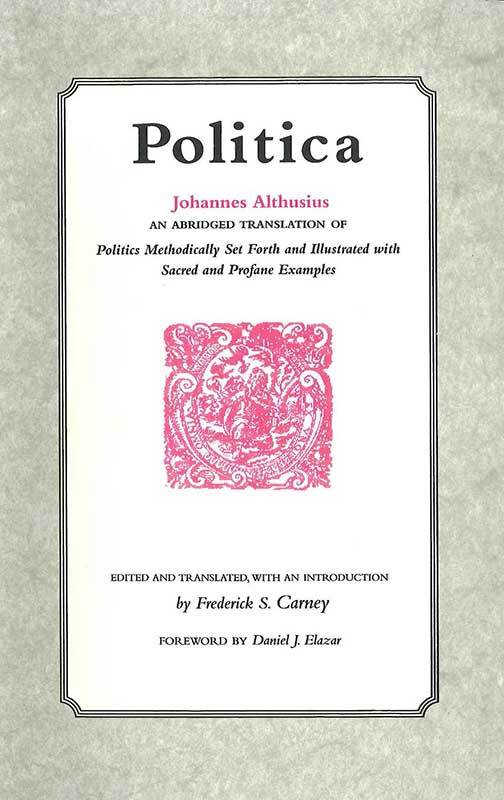
VII - Johannes Althusius, Politica [1614]Edition used:Politica. An Abridged Translation of Politics Methodically Set Forth and Illustrated with Sacred and Profane Examples, ed. and Trans. Frederick S. Carney. Foreword by Daniel J. Elazar (Indianapolis: 1995 Liberty Fund).
About Liberty Fund:Liberty Fund, Inc. is a private, educational foundation established to encourage the study of the ideal of a society of free and responsible individuals. Copyright information:The copyright to this edition, in both print and electronic forms, is held by Liberty Fund, Inc. Fair use statement:This material is put online to further the educational goals of Liberty Fund, Inc. Unless otherwise stated in the Copyright Information section above, this material may be used freely for educational and academic purposes. It may not be used in any way for profit.
VII§ 1We have completed the discussion of the community. We turn now to the province,1 which contains within its territory many villages, towns, outposts, and cities united under the communion and administration of one right (jus).2 It is also called a region, district, diocese, or community. § 2I identify the territory of a province as whatever is encompassed by the limits or boundaries within which its rights (jura)3 are exercised. … § 3Two matters are to be discussed. The first is the communion of provincial right, and the second is the administration of it. These two matters contain the entire political doctrine of the province. The communion of right is the process whereby everything that nourishes and conserves a pious and just life among the provincial symbiotes is procured by individuals and province alike for the need and use of the province. This is done through the offering and communication of functions and goods. … § 4The functions of the provincial symbiotes are either holy or civil. Holy functions concern those that are necessary for living and cultivating a pious life in the provincial association and symbiosis. § 5A pious life requires a correct understanding of God and a sincere worship of him. § 6A correct understanding of God is obtained from sacred scripture and from articles of faith. “This is eternal life, that they know thee the only true God, and Jesus Christ whom thou hast sent.” 4 A correct worship of God is derived from those rules and examples of the divine word that declare and illustrate love toward God and charity toward men. § 7True and correct worship of God is either private or public. Private and internal worship consists of the expression of confidence, adoration, and thankfulness, the first precept of the Decalogue. Private and external worship consists of rites and actions that revere God, the second precept, or of words that do the same, the third precept. Public worship of God consists of holy observance of the Sabbath by corporate public celebration, the fourth precept. § 8Civil functions are those that maintain a just life in the provincial association and symbiosis. Whence they include everything that pertains to the exercise of social life. The symbiote is expected to perform those duties of love by which he renders to each his due, and does not do to his fellow symbiote what he does not wish done to himself.5 Rather he loves him as himself, and abstains from evil. § 9The duties of justice to the neighbor are either special or general. Special duties are those that bind superiors and inferiors together, so that the symbiote truly attributes honor and eminence by word and deed to whomever they are due, and abstains from all mean opinion of such persons, the fifth precept of the Decalogue. § 10General duties are those every symbiote is obligated to perform toward every other symbiote. They consist of defending and preserving from all injury the lives of one’s neighbor and oneself, the sixth precept; of guarding by thought, word, and deed one’s own chastity and that of the fellow symbiote, without any lewdness or fornication, the seventh precept; of defending and preserving the resources and goods of the fellow symbiote, and of not stealing, injuring, or reducing them, the eighth precept; of defending and preserving one’s own reputation and that of one’s neighbor, and of not neglecting them in any manner, the ninth precept; and of avoiding a concupiscent disposition toward those things that belong to our neighbor, and of seeking instead satisfaction and pleasure in those things that are ours and tend to the glory of God, the tenth precept. § 11The practice of provincial political justice is twofold. First, individual symbiotes manifest and communicate the duties of love reciprocally among themselves, according to special means, person, place, and other circumstances. Second, the provincials as a group and as individual inhabitants of the province uphold and communicate the duties of both tables of the Decalogue for the sake of the welfare of the provincial association. The former are the private and special practice among the provincials, and the latter are the public and general practice. § 12These latter general duties are performed by the common consent of the provincial symbiotes. They are (1) the executive functions and occupations necessary and useful to the provincial association; (2) the distribution of punishments and rewards by which discipline is preserved in the province; (3) the provision for provincial security; (4) the mutual defense of the provincials against force and violence, the avoidance of inconveniences, and the provision for support, help, and counsel; (5) the collection and distribution of monies for public needs and uses of the province; (6) the support of commercial activity; (7) the use of the same language and money; and (8) the care of public goods of the province. … 6 [1 ] [This discussion of the province as a distinct type of association is missing in the first edition of 1603. In that edition there are only four types of association (family collegium, city, and commonwealth), and the province is considered for the most part to be an administrative unit of the commonwealth.] [2 ] [legal order.] [3 ] [laws.] [4 ] John 17:3. [5 ] [ Institutes I, 1, 3: Digest I, 1, 10, 1; Matthew 7:12; Luke 6:31.] [6 ] [Here follows a long discussion of executive functions and occupations, after which there is a brief restatement of the seven other general public duties. Especially noteworthy is the observation that “the female sex does not bar one from office when the function is suitable to the sex.” Althusius acknowledges, however, that the following writers disagree with him: Petrus Gregorius, De republica, VII, 11; Lambert Daneau, Politices christianae, VI, 3; Melchior Junius, Politicarum quaestionum, I, quest. 13; Justus Lipsius, Politicorum sive civilis doctrinae, II, 3; Jean Bodin, The Commonweale, VI, 5. Also to be noted is his suggestion that the best persons for high office in the province are to be found among the middle class, “for these persons do not aspire after what is alien, nor are they envious of the goods of others.” ] |

Titles (by Subject)