EconlibThe LibraryOther Sites |
Front Page Titles (by Subject) Section Two: Arguments Against the Protecting Duty Summarized Through an Analysis of Its Major Consequences - Tyranny Unmasked
Return to Title Page for Tyranny UnmaskedThe Online Library of LibertyA project of Liberty Fund, Inc.Search this Title:Also in the Library:
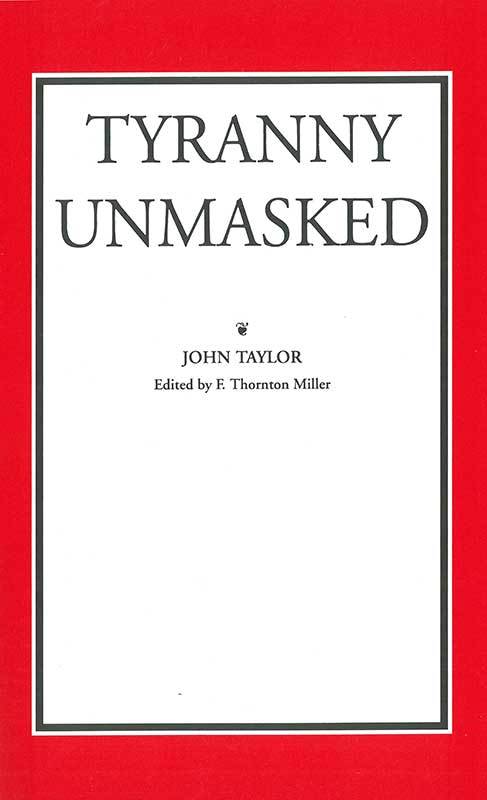
Section Two: Arguments Against the Protecting Duty Summarized Through an Analysis of Its Major Consequences - John Taylor, Tyranny Unmasked [1822]Edition used:Tyranny Unmasked, ed. F.Thornton Miller (Indianapolis: Liberty Fund, 1992).
About Liberty Fund:Liberty Fund, Inc. is a private, educational foundation established to encourage the study of the ideal of a society of free and responsible individuals. Copyright information:The copyright to this edition, in both print and electronic forms, is held by Liberty Fund, Inc. Fair use statement:This material is put online to further the educational goals of Liberty Fund, Inc. Unless otherwise stated in the Copyright Information section above, this material may be used freely for educational and academic purposes. It may not be used in any way for profit.
Section TwoArguments Against the Protecting Duty Summarized Through an Analysis of Its Major Consequences1.Protecting Duties Are UnconstitutionalTo make them constitutional, the Committee have adopted the present fashionable mode of construction, which considers the constitution as a lump of fine gold, a small portion of which is so malleable, as to cover the whole mass. By this golden rule for manufacturing the constitution, a particular power given to the Federal Government, may be made to cover all the rights reserved to the people and the States; a limited jurisdiction given to the Federal Courts, is made to cover all the State Courts; and a legislative power over ten miles square, is malleated over the whole of the United States, as a single guinea may be beaten out, so as to cover a whole house. Unfortunately, this political manufacture being encouraged by allowing bounties paid in power and money, these bounties have engaged successive factories in the occupation; and, from the sedition law, for controlling the use of our tongues, down to the protecting-duty law for controlling the use of our hands, it has been cultivated with successful pertinacity. Why should some tongues and hands be oiled with power and money, and others rusted with penalties and taxes? The protestation of the Committee against constructive limitations of power, applies with equal force against its constructive extension. No, says the new system of construction. Power has the double privilege of being exempted from any constructive limitation, and also of extending itself by construction. If an article in the constitution does not verbally reach the end in view, it may be wire drawn up to it by construction; but if it does verbally reach it, then it is to be construed as if the constitution had contained no other words, and is by no means to be explained or controlled by other articles, or by the primary principles of the instrument. Accordingly, the Committee pin the question on the power of Congress to regulate commerce as if it was isolated; and exclude the consideration of all the limitations in the same instrument, intended to prevent Congress from exercising an unlimited power of transferring property from State to State, from the nation to exclusive privileges, from class to class, and from individuals to individuals. And what has been done, without regarding what ought to have been done, is considered as affording precedents sufficient to confer these unconstitutional powers. Thus they render several particular articles, and the true intention of the constitution inefficacious and nugatory. Of what value is the prohibition to impose a tax or duty on articles to be exported from any State, if Congress can impair or destroy this right of exportation, for the sake of enriching a local class of capitalists; of what value is the prohibition to bestow preferences and implicit partialities by a regulation of commerce or by modes of revenue, if Congress can establish preferences which shall make States tributary to States, the whole nation to capitalists, classes to classes, and individuals to individuals? Waving a verbalizing mode of discussion—the resource of imposition, and the detestation of common sense, we need only recollect that the intention and end of the constitution was to “secure the blessings of liberty to ourselves and our posterity.” Can any construction, by which Congress may destroy the liberty of ourselves and our posterity, be true? Yes, say the Committee, it may be true, because “it is extremely difficult to point out the rate of duty when revenue ceases, and protection becomes to be the ruling object; to define the line which shall limit the constitutional powers of Congress.” Does it follow that these powers have no limits? Yes, say the Committee: and to prove it, they echo the following terrifying words of the supreme court. “A power to tax, involves a power to destroy.” And thus these echoes between Congress and the court are considered as the only constitutional limitations. This repercussion is the only security against Federal usurpations. “A power to tax, involves a power to destroy.” This echo has destroyed the right of taxation reserved to the States, and extended ten miles square to the size of the United States. “Congress has a right to regulate the conduct and interest of individuals,” because it is necessary for the sake of political economy. An echo from the court, can also establish this boundless power, and complete the catastrophe of the drama. Here, then, a combination of powers is asserted by these self-created guardians of the constitution, which expunges all the limitations thought by its framers necessary to preserve a free form of government. “The only security against this combination of limitation-destroying powers,” say the Committee, still echoing the supreme court, “is the structure of the Federal Government.” But neither the court nor the Committee have ventured openly to inform us, whether it lies in the whole structure, or only in some portion of it. Do they consider the State Governments as component parts of this structure, enabled to resist its threatened destruction; or do they believe the Federal Government to be compounded only of Congress and the supreme court. Whether they admit or reject the State Governments as balancing or checking portions of the structure, they allow that a security against destruction is deposited somewhere; and if the destroyer himself is tacitly meant, it may still be useful to entreat this angel of death not to destroy the securities for a free government, because it is extremely difficult to define his powers. The difficulty may place the honorable men and real patriots in Congress, in a nice and delicate situation; but, however hard it may be to split straws for the purpose of defining the exact line which limits their powers, it does not follow that they ought to demolish pillars. Some lines are so very visible, that they may be clearly seen. That of changing the principles of the constitutional structure, by a legislative reconstruction of a society by monopolies and exclusive privileges, is one of these. Will this reconstruction “secure the blessings of liberty to ourselves and our posterity?” Will it be the same structure created for this primary end? If not, how can it be constitutional to hammer it out of any particular article? Another of these destroying powers, when construed without any regard to the real design of the constitution, may be found in the right of borrowing and appropriating money. If Congress should borrow and give to capitalists, its might be verbally constitutional, but substantially it would be taxing the nation for their benefit, and not for the general welfare. Commercial restrictions which beget the necessity of borrowing, for the purpose of giving them bounties, amount to the same thing. If Congress cannot find a line which prohibits it from borrowing and appropriating money to monopolies and exclusive privileges, I do not see why they may not create a king, since the maintenance of one man at the public expense will undoubtedly accord better with the principles of political economy, than the maintenance of such combinations. The Committee have borrowed, from mere declaimers, an argument, which, if reiteration could make truth, would be forcible indeed. They say “that manufactures which, in all other countries are cherished as the most valuable offspring of human industry, have become with us a spurious progeny, born with a constitutional malediction, to struggle under legal disabilities. The constitution designates no national interest in preference to another, but throws all alike on the discretion of Congress.” How are such assertions to be treated? Must I take off my hat, make a bow, and say “all this is very true?” Or ought I honestly to reply, “not a word of all this is true, except that the constitution designates no national interest in preference to another?” Had they substituted agriculture for manufactures, their assertions would have been diametrically different. Had they called that the most valuable offspring of human industry; had they asserted that it was treated as if it was under a constitutional malediction, and that it had to struggle with legal disabilities, they could not have been contradicted. To struggle with foreign industry is common to both occupations, and no legal disability to either. But the capitalists add insult to injury to roar out, whilst they are lashing agriculture and commerce with legal restrictions, like Sancho lashing the trees, that they are themselves receiving the blows they inflict. As the constitution designates no national interest in preference to another, it could not have designed that such preferences should be established by legislation, and a species of despotism created which it has carefully avoided and utterly neglected to provide for. But lest the forbearance of the constitution to recognise preferences of some national interests, should be considered as a constitutional rejection of that tyrannical policy, the Committee have supplied the omission, by gratuitously allowing it to have invested Congress with a power, which it forbears to exercise. “It throws,” say the Committee, “all national interests, on the discretion of Congress.” Thus undefined legal preferences of national interests rejected by the constitution, are entrusted to Congress; that body may legislate without limitation, their own discretion excepted, in creating them; and, by extending its power of legislation to objects excluded from the constitution as inconsistent with the principles of liberty and justice, the Committee have proved that the laws for bestowing lucrative preferences upon a capitalist interest to a great amount, are constitutional, however unjust or tyrannical. But under the sweeping doctrine “that the constitution throws all national interests on the discretion of Congress,” what becomes of the interests reserved to the States or the people? Are not these national interests? What becomes of all the interests intended to be secured beyond the reach of Congress by limitations and restrictions? What becomes of the declared intention of securing liberty by these precautions? What becomes of the security of property? What a foolish and useless labour does this doctrine charge the convention with undergoing? According to it, all that was necessary was to form a Congress, and to add one line, saying “that all national interests should depend on the discretion of that body.” As this assertion is thought necessary by the Committee to prove the constitutionality of the protecting-duty monopoly, its constitutionality and the assertion must stand or fall together. It places the question on its true ground. Will a power in Congress to manage all national interests and distribute preferences among them according to its discretion, preserve the Union, or secure liberty? Is it constitutional because the supreme court declares it to be so? Was Algernon Sydney constitutionally put to death, because it was done by a supreme court? Is the constitution subject to a similar jurisdiction, without the chance for reprieve, except from the prosecuting power? Whether it can be fairly so construed as to lay its limitations, its design and its life, at the feet of “a discretion in Congress,” is the ground upon which this point is to be decided. 2.Manufactures Are Injurious to Morals, and Produce PauperismThis the Committee deny: and, to sustain their denial, reject the evidence of the great foreign factories, and rely on that of the Waltham factory, consisting of two hundred and sixty persons. I shall not attempt to prove that this little experiment is less to be relied on, than those made on a great scale, nor to overhaul the fact and opinions coinciding in the conclusion, that these factories degrade human nature. But leaving to the Committee all their arithmetick for estimating the thefts of the poor, it is yet necessary to remind them, that in wandering through its mazes, they have entirely overlooked political immorality, by which vices more pernicious to society are produced, and which also causes many of those peccadillos, admitted by them, and allowed by me to be bad enough. Laws for creating exclusive privileges and monopolies corrupt governments, interests, and individuals; and substitute patronage, adulation, and favour, for industry, as the road to wealth. If it be true, as the Committee believe, that the preferences and partialities of such laws, will not produce a correspondent impoverishment, which will reach the poor and deteriorate their morals; yet it cannot be denied that they will reach the rich, and corrupt the morals of the best informed, and of the officers of the government; in which three classes reside, the power and the influence, by which the morality and the liberty of nations are sustained or destroyed. As to pauperism, the Committee quaintly contend, that it is not produced by hard labour. Daily wages earned by hard labour, do not prevent it. One of these general assertions balances the other, and they unite in showing how little is proved by either; and neither can diminish the force of the fact, that pauperism and crimes are more frequently produced by hard labour for daily wages, than from any other source; because it usually expends the wages of today in the subsistence of today, and is too improvident to lay up a defence against the occurrence of disability, or the temptations of necessity. In a pamphlet lately published at Philadelphia, in defence of the system proposed by the Committee, we are informed that the poor list of the city of New-York has risen to fifteen thousand persons; being about an eighth of the whole population. We have also learned from State documents, that its prisons are crowded with felons and debtors. We have seen it too published in the newspapers, that one hundred and eleven persons were last year sentenced to death in four counties of England. In England the gallows groans, or ships are laden with convicts. In New-York the penitentiary overflows with them. In both, the prisons abound with debtors. And in both the proportion of paupers is about one person in eight. In England, fictitious capital, legal privileges, factories, and monopolies are abundant. At New-York they are probably more abundant, than in any other part of the United States. I have said that a partial accumulation of fictitious or legal capital in any one State, at the national expense, would not promote the general happiness or wealth of the people, even of that State. If the proofs of the assertion in England lie too far off to be seen, that at home is visible. If a local and individual accumulation of capital united with factories, will diffuse honesty and wealth within the sphere of its influence, why do we see most crimes, most debtors, and most pauperism, wherever this policy is most prevalent? May it not therefore be possible that this policy itself generates the crimes and pauperism by which it is attended? At least we must discern, that by whatever names exclusive privileges call themselves; however earnestly they assert that they are not monopolies, and only honest encouragers of industry, that they are not chafferers for selfish acquisitions, but pleaders for general good; that far from causing crimes, they are political moralists; and that far, also, from causing pauperism, they make people work harder than they could otherwise be made to do; that yet they are constantly attended by phenomena, which very plainly contradict all these professions. Bonaparte as devoutly declared, that he was not a military despot, but a patriotick consul. Political economists in Europe, and especially in England, have forborne to consider the effect of political immorality upon national prosperity, or its influence in begetting both individual pauperism and crimes, because they could only build their systems upon the foundation of governments so thoroughly corrupted, that they despaired of producing a reformation by a true system of political economy and could only seek for inadequate alleviations of evils, necessarily caused by the firm establishment of the system of patronage, monopoly, and exclusive privileges. Compelled into a reverence for these abuses, they have kept at an awful distance from adversaries so dangerous and unconquerable, and contented themselves with attempting only to soften their baleful influence upon human happiness by temporary expedients. In these endeavors, though they have exhibited great ingenuity, they have been unsuccessful; and, as the causes remain, the effects follow in spite of their wisdom and philanthropy. Here, we are yet able to apply the axe to the causes themselves, which in other countries have generated bad morals and grinding poverty, in spite of fine soils and good climates. 3.No Further Protection NecessaryIf the proposition had been differently stated, it would have exhibited the question in plainer language. Suppose it had been objected, that further protection was not wanted. The Committee might have replied with truth, that the capitalists did want more money. The objection means that the capitalists do not need more money, and the Committee state that they already have more than they know what to do with, but that they want more still. From these facts, the plain question is, whether the nation, though reduced itself to pecuniary distress, ought to give more money to the capitalists because they want it, although they have already more than they can use. The first reason for doing so urged by the Committee is, that if a factory occupied in a single manufacture, should ask Congress for further protection, or a further bounty, it would be a partial monopoly, and justify the objection, that protecting duties tend to create a privileged order of great capitalists, supported at the expense of the nation; but that if Congress grant to all factories the same favour, that it will not be a monopoly, nor tend to create a privileged order of great capitalists, but only be a general and equal protection of national industry. Thus they have reduced the point to a plain matter of fact. They say that a bounty to one factory would be a partial monopoly, and would create a privileged order of great capitalists, which would be unjustifiable; but that a bounty to all the factories is not a monopoly and will not create such an objectionable order. One bishop would be a hierarchy, but an hundred bishops would be religious freedom. I had thought that separate social interests, like separate nations, were individual with respect to each other. It would seem to common sense, if one privileged factory would suffice to create a dangerous exclusive interest, that a hundred factories combined by a common bounty, would create an exclusive interest an hundred-fold more dangerous. If each received its bounty by separate laws, each law would create an unjustifiable monopoly say the Committee, because they would be uncombined by law, however they might be united by interest; but if all these factories are combined both by one law, and a common interest, then the combination changes the whole mass from a monopoly into a protector of national industry, and will not produce a privileged order of great capitalists. Whether there are more or fewer factories than one hundred in the United States, it is excessively wide of truth, and excessively humiliating to all occupations, to apply to them exclusively the phrase “national industry.” By doing so, the Committee have taken a substratum for their system, to be found in no other treatise which has ever appeared, and which is crushed by the weight of the plainest fact imaginable. In the old systems of political economy, land, labour and corn, have been considered as comprising the chief sources or items of national industry, and have been selected as the measures of national prosperity. But the Committee, in the face of every body's knowledge to the contrary, assert that the whole mass of national industry, is concentrated in a few factories, and that of course a bounty to them is a general and equal protection to national industry. If the fact was so, the bounty would be inert. Paid by national industry to national industry, it would only be the case of a man's giving money to himself. Their idea, however, is, that these factories, though by no means constituting national industry, will afford general and equal protection to national industry. It is borrowed from the old idea of protection for allegiance, being only protection for bounties. One man pretended to protect a nation, if that nation would bountifully make over to him its liberty and property. One hundred factories offer to protect all the numerous branches of national industry, if the nation will be equally bountiful to them. I know not which is most to be coveted, the protection of a monarch, or of a pecuniary aristocracy. Writers upon political economy, as far as I recollect, have wholly neglected to recommend either. All of them consider branches of industry as separate and distinct; and allow, that some may be oppressed by exclusive privileges or bounties to others, because they must pay whatever these others receive from partial laws; and none assert that factories and agriculture are one and indivisible. The Committee subscribe to the same opinion in admitting that one factory endowed with a bounty would operate unjustly upon other national interests. In England, agriculture and factories are considered as interests so clearly distinct, that two violent and contending parties have been created and kept alive by bounties and monopolies occasionally given to each. Neither of these contending interests have ever asserted, that bounties to one, were bounties to the other; and the difficulty has been, to adjust the compensation for the injury sustained by one, from partialities to the other. At this very time the manufacturers are complaining of the corn monopoly, which, though created to encourage the most important branch of industry among men, and in England particularly, is fraudulent and oppressive upon all other branches of national industry, and protects them, just as they are protected here by our factory monopoly; by enriching itself at their expense. The English landlords have never had the assurance to assert, that their corn monopoly made bread cheaper to consumers. It has been tried much longer than our factory monopoly, and instead of making bread cheaper, has increased rents and enriched landlords at the expense of bread consumers. Our factories have asserted, that their monopoly would make manufactures cheaper. But after a considerable trial, its effects are found to correspond with those of other monopolies. It has only enriched capitalists and impoverished other occupations. The Committee admit that our moneyed capitals have increased even more rapidly than English rents; that they have grown up to an exuberance which cannot find employment. The English landlords do not complain of an exuberance of rents, nor crave an extension of their monopoly for its employment. The enormous growth of individual capitals, and the pecuniary depression of all other interests do not sustain the hope of the Committee, that a factory monopoly will be “a general and equal protection of national industry.” Whence came the redundant capitals allowed by the Committee to exist? If from commerce, it must have been highly lucrative; if from a system of internal legislation, that must have been excessively partial. Had commerce begotten this redundant capital, a correspondent prosperity of agriculture or other occupations must have been visible, unless it can be proved that a lucrative commerce will impoverish a nation. The Committee, by urging a balance of trade as the cause of national prosperity, have admitted that commerce is the instrument by which it is to be obtained; and by admitting the existence of redundant capitals in the hands of individuals with a concurrent national distress, it follows, either that these redundant capitals have been brought in by a favorable commerce, or bestowed by partial laws. Under the first supposition, there exists no reason for endeavoring to make so lucrative a commerce better by home monopoly, under the second, there is still less reason for increasing the national distress, to add to the accumulations of individual capitals. But the Committee have endeavored to blend the mercantile and capitalist occupations, so as to conceal the distinctions by which their very different effects are produced. They assert, that the protection afforded to commerce has enabled merchants to acquire princely fortunes, and leaving us to imagine that this protection is a bounty to merchants, infer that they are uncharitable in opposing bounties to factory owners, since they receive them. It is strange that the heat of controversy should have elicited an assertion, that protection to commerce was a bounty to merchants, when the benefits arising from it must so evidently be reaped chiefly by the owners and consumers of the commodities which it is the occupation of merchants to exchange. But the Committee had forgotten that the commercial and capitalist occupations are essentially different. The business of one is to exchange property, of the other to transfer it. One coincides with the good soul of money, in regulating these exchanges by free will; the other combines with its bad soul, by using it to promote transfers without equivalents. If the legislature should lay a duty upon imported commodities to be paid to merchants, then, and then only, would the two occupations produce the same effects, because it would be similar to the excise paid to capitalists, collected for them by restrictions and prohibitions. There are no such bounties given to merchants, and therefore the mercantile occupation, instead of inflicting general penury to promote partial wealth, has the effect of diffusing general prosperity by cheapening human comforts. It is in fact one of those occupations by which nations are enabled to exist under the property-transferring policy in its several forms. Had the capitalists requested Congress to increase the extravagance of government, in order to extend and protect the system of borrowing, for the purpose of giving employment to their exuberant wealth, they might as justly have charged the mercantile body with injustice for opposing the application, as in the present case. The same charge has been frequently urged against the farmers, and admits of the same answer. In both cases it results in the following doctrine, considered in its favorable aspect. Merchants and agriculturists are made rich by free industry and fair exchanges, but this operation is too slow for capitalists, and therefore it is ungenerous in the two first classes to oppose the enrichment of the third by monopolies, without exposing it to the toils which the two must undergo or remain poor. All advertisements for recommending quack physick either to the body natural or body politick, are exposed to detection, because they are suggested by the same design. The Committee have represented the mercantile occupation as creating princely fortunes, but they have not said that these fortunes have been obtained by means of legal transfers of property, nor informed us by what operation so lucrative a commerce can impoverish the rest of the community. Other capitalist writers have filled pamphlets with computations to magnify agricultural wealth; but none have attributed this supposed wealth to a property-transferring monopoly. What an enigma is here exhibited. Merchants and agriculturists are wonderfully rich, yet a country in which these classes constitute a great majority is in terrible distress. At one time these doctors say that the superabundant blood of agriculture and commerce ought to be drawn off; at another, that they are expiring for want of blood, but that bleeding is still necessary. We are assured as usual by these doctors, that the same physick will cure both emptiness and repletion; that it is equally good for the most opposite complaints, and equally beneficial whether merchants and farmers are rich or poor. They were indeed pretty well and tolerably rich, whilst they forbore to swallow bolus after bolus compounded of commercial restrictions, prohibitions, embargoes, exclusive privileges, and monopolies; and have become sicker or poorer the more these drugs have been administered to them. But what of that? The Committee say, “we risk much by acting on the belief that the English nation does not understand its interest; and protection should end then, only after securing employment for all.” These declarations are appalling. The drug recommended is that which the people of England are forced to swallow by a corrupt government, and we are desired to take it until employment is secured for all, which has never been effected by it. The reason given for it is curious. Commerce and agriculture are informed that they are sick, to induce them to take the physick; and that they are rich, to induce them to pay the doctors. If they should agree to pay a vast annual tax to the capitalists, until their prescriptions shall secure employment for all, especially for growing capitals, there are two tolerably strong reasons that the tax will last for ever. One, that the proposed object is an impossibility; the other, that the capitalists would never effect it by their prescriptions if they could, because they would thereby lose their fees. Employment must be nurtured by free exchanges, like commerce, or it flags. Commercial action and reaction constitute its food. Take away one and the other languishes. A nation deprived of the excitements arising from commercial reverberations, loses the creator of employment, as well as of civilization, knowledge, and comforts; and recedes towards savageness. Even with the aid of these excitements, employment for all can never be established. The fluctuations caused by war, seasons, fashions, and the wonderful catalogue of human passions, will reach employment and prevent that permanency no where to be found; but these fluctuations left to be met by free industry, are themselves excitements of genius and talents, and awaken exertions into life. Which generate most employment, all the inducements which propel the mind and body to make the utmost efforts they can, or the protecting-duty system which destroys most of them? 4.The Increase of Duties Will Lead to SmugglingAnd it might have been added, that it will inculcate an opinion, that smuggling is a virtue; and that the smuggler, if not an actual, is at least a comparative patriot. How an impartial casuist might determine the degrees of immorality between the two cases of pilfering industry, to enrich capitalists, or of supplying it by pilfering the pilferers, with necessaries and comforts at a cheaper rate than it could otherwise procure them, I shall not enquire; and only suggest that the parties interested will never believe themselves to be less moral than the capitalists, in uniting to defeat a monopoly operating upon themselves. The smuggler does not pilfer industry, but buys and sells under the check of free will, and the consumer only retains his own property by buying cheaper than the monopoly will sell to him; yet they both commit the crime of evading an oppressive and fraudulent law. If the enhancement of price is moderate, and is only produced by the fair object of revenue, both the parties will view it in a different light; nor will the temptation be of the same extent, as when it is magnified by the avarice of exclusive privileges. We need not go with the Committee in search of affidavits, to determine whether smuggling and high duties are allied; we need not call upon the casuist to decide whether the tempter or the tempted is most wicked; and we need not look for truth either in a cup of tea, or in the Isle of Man, though it is somewhat larger than the teacup; when it has been ascertained by unchangeable principles. Some people will for ever believe that there is no immorality in eluding oppression; others will for ever be tempted by pecuniary acquisition to pardon their consciences, especially if they can get a law to sear them; and commercial restrictions will for ever multiply smugglers and watchers of smugglers. I know not which of these occupations will do most harm. It often happens that not a single case of smuggling can be proved, whilst a country abounds with interpolated commodities, and the treasury announces its extent, by an enormous defalcation. What but intemperate zeal could deny the inseparable association of smuggling with the system advocated by the Committee; and who can consider it as at all important, whether the tax imposed upon his industry goes into the pockets of the smuggler, the capitalist, or the watchers of smugglers? 5.A Tax on the Many, a Bounty to the FewThis objection, the Committee admits “would be conclusive if true; that a permanent tax to encourage manufactures would be radically wrong; but that disclaiming the word bounties, as wholly inapplicable to any part of the bill, they are willing to test it by the principles of its active and intelligent opponents.” On the next page, however, they observe “if there were no manufactories, and government could build them up by imposing duties on foreign fabricks, such duties would not be a tax on the farmer, but an efficient bounty, by giving a value to his otherwise useless products.” The first suggestion they use in support of these assertions, is exactly of that character employed in pleading a cause. It is an extract from the report of a Boston Committee, admitting that in some cases, an argument may be found in favour of encouraging particular employments by bounties and taxes. Upon this admission the Committee have seized, as an acknowledgment that bounties to exclusive privileges, constitute a wise and just policy. But it may have happened that the admission itself came from an exclusive privilege. Some capitalists, contented with the existing protecting-duty monopoly, or fearful of pushing it further lest it should burst, are opposed to its augmentation. When the policy of bounties, monopolies, and exclusive privileges is introduced, those deriving emolument from any item of it, may find an interest in opposing another, but they will never contend that the policy itself is bad, and ought to be abandoned. Neither the landlord nor capitalist-interest in England, will admit that the system of bounties and exclusive privileges is radically vicious, though each will contend that its antagonist gets too much, and itself too little by it. Of what value can the authority of either, asserting that a system is good by which both get money, be to an enquirer who is considering whether it is also good for a nation? Such admissions are a vice in the system itself, because they are purchased concessions, not for disclosing truth to advance the public good, but for concealing it to enrich combinations. However the family of exclusive interests may quarrel among themselves, yet they will unite when the whole craft is in danger; and even when at variance, they will be careful to advance arguments in favour of the principle which sustains their common interest. Leaving, therefore, this extract from the report of the Boston Committee, as proving nothing, let us proceed to the words of the Congressional Committee, and consider what they prove. The frequent occurrence of contradictions in their report, bewilders the understanding and perplexes the subject. They say “bounties are wholly foreign to their bill, and yet to build up manufactories by duties on foreign fabricks, would be an efficient bounty to the farmer.” To build up these factories, by such duties, is the avowed object of the bill; and, when thus created, they will be bounties to farmers, the very fact upon which the Committee and its other advocates have rested its defence. And the same Committee deny “that the word bounty is applicable to any part of the bill; contend that the bill bestows an efficient bounty on farmers; and admit that a permanent tax to encourage manufactures, would be radically wrong.” An advocate for the freedom and happiness of a nation, will not become the partisan of a particular interest. Why are the Committee, after having candidly admitted that a permanent tax for the protection of manufactures must be radically wrong, instantly converted into advocates for an efficient bounty to farmers? Having disclaimed the hateful term bounty, they instantly resume it in favour of farmers, whilst they renounce the propriety of thus endowing manufactures, although equally meritorious. If duties paid by the consumers of foreign fabricks to build factories would be no tax on the farmer, yet the efficient bounty thence accruing to him must be a tax on somebody; unless indeed the new discovery of the Committee, that such duties paid to support government are not taxes, which must be the case if they are not taxes when imposed to build factories; can obliterate all the received ideas of taxation. Bounty certainly implies a payer as well as a receiver, and when it is bestowed by a government, it implies taxation on the people, considerably exceeding its amount, on account of the misfortunes to which public money is exposed, and the expenses of collection. As the proposed bounty to farmers could only be paid by some kind of tax, and the Committee assert that it would be wrong also thus to encourage manufactures, it follows that it would be wrong also thus to encourage farmers. If a permanent bounty could not exist without its accomplice, a permanent tax, then the bounty promised to farmers, as resulting from building factories, distant as it is, must vanish the instant it arrives, or inflict on some interest the reprobated permanent tax. With the factories the case is very different. These are to be built by taxes on foreign fabricks, which must, inevitably, fall on consumers of the substituted domestick fabricks; but the farmers, far from paying any portion of them, are to be reimbursed by an efficient bounty. If so, the tax paid for building the factories, would be more glaringly unequal and oppressive, as other occupations and professions will pay all the tax, whilst the farmers will receive all the efficient bounty. But this whimsical mode of reasoning is gotten over, and the admission of the Committee, that the protection of manufactures by a tax on the community, is wrong, virtually retracted by the magical influence of the word “permanent.” A tax on the many to raise a bounty for the few, is allowed by the Committee to be radically wrong, if the tax is permanent. It is impossible to find a better argument in favour of abuses, because it will fit all. The conciliating candour of acknowledging a policy to be bad if permanent, is a solicitation of confidence in the assurance that it is good, if temporary. Few things in this fluctuating world are less permanent than the promises of statesmen and the calculations of financiers; and the nation which submits to exclusive privileges, bounties, monopolies, and other abuses, because they are told they will not be permanent, instead of obtaining felicity like ancient wiseacres, by bestowing their temporary property on priests, will obtain the most permanent political machine we know of; a machine invariably constructed by temporary abuses, namely, a bad government. “A permanent tax to encourage manufactures would be radically wrong, but the word bounties is inapplicable to any part of their bill, and to build up factories by duties on foreign fabricks, is good policy.” There is some difficulty in simplifying this confusion of ideas. Would a permanent tax be radically wrong only because it was permanent, and a temporary tax be right only because it was temporary? A radical imposition must be made so by some principle, and not by the duration of the imposition. If a permanent tax to encourage manufactures would be radically wrong, it can only arise from the injustice inflicted on other occupations, by conferring an exclusive benefit on one at their expense. But whatever may be the principle which convinced the Committee that such a permanent tax would be radically wrong, the same principle must pronounce a temporary tax for the same partial purpose, to be also radically wrong. The temporary tax for the encouragement of manufactures is denied to be a bounty, by the assertion that the word bounties is inapplicable to any part of the bill. Why would the tax be radically wrong if permanent? Undoubtedly because it would be a permanent bounty. If the tax, being permanent, would be a permanent bounty and radically wrong, the same tax, though temporary, must be a temporary bounty, and equally wrong. A tax may be imposed for two objects; one to sustain a government, the other to enrich individuals. The idea of a bounty cannot be severed from the latter object, and the Committee labour against language and an indissoluble affinity, to prove that a tax not imposed for the use of government, but to encourage manufactures, does not imply a bounty. A feeble attempt, if such was the design, is made to find a subterfuge from conclusions so inevitable, by speaking of building factories with duties on foreign fabricks. Not a cent of such duties has gone or can go towards their fabrication. All the duties received on foreign importations go into the treasury, and are applicable to public uses, and the enhanced prices obtained on domestick fabricks from domestick consumers, by diminishing the amount of duties produced from foreign fabricks, are the architects of factories, and constitute the bounties to capitalists. A great curiosity of the discrimination between good and evil, attempted by the words permanent and temporary, consists in its being addressed to temporary beings. Build factories for capitalists, because it is only a temporary radical wrong, and you will be reimbursed by what man can never get in this world; a permanent good. Why not build houses for farmers and professional men, because it may permanently foster agriculture and science? The consolation, that abuses may be only temporary, is ingeniously used to inflict them; and the sound principle, that temporary abuses are an introduction of durable evils, is to be abandoned. Factories are now to be built by bounties to capitalists, in order by and by to bestow efficient bounties on farmers. One abuse is proposed as a remedy for another, and these two occupations are to be provided for by successive bounties, radically wrong if permanent, but right if temporary. No compensation is even suggested for the others which share in the taxes to raise these bounties. Indeed this omission is of no consequence, for if these factories should deliver manufactures from the grasp of their own monopoly, the farmers could never obtain the alluring bait of an efficient bounty in their turn, unless corn and their other products had ceased to be exported; and could only hope to be reinstated upon the ground of free and fair exchanges. The promise of future compensation for present wealth is the cunning offer made by the capitalists to the farmers. Build factories and give bounties to us now, and we will restore to you the blessing of free exchanges the moment we can no longer extort from you an enhanced price for our fabricks. Such is the basis of their arguments, and such the boon by which they are endeavouring to bribe the farmers, without paying any respect to other occupations. Is there any man in his senses who would make such a bargain with another man? No day of payment is prescribed. No security for performance is proposed. After all other interests have enriched the capitalist interest, it may break its promise, cease even to manufacture, and retain the wealth acquired by its bounties. Suppose lawyers and doctors could persuade the nation to build palaces for them, and buy their law and physick at double prices, under a promise that when these employments were overdone, it should get their physick and law cheap. What speculations can be equal to these? Vast estates are purchased by a promise, and no obligation to pay any thing for them is incurred. Indeed no payment can ever be made for them, except a restoration of free exchanges and fair competition, suspended to bestow them. The utmost compensation to be expected is that of taking off the suspension. Why then put it on? To take away a social right, in order to restore the same social right, is worse than nothing, by the amount of the intermediate loss incurred by the suspension. Whilst the business of building factories is made lucrative by bounties, the capitalists will pursue it; when it ceases to be so, they will give it up. If other occupations should escape from their toils and become profitable, by receiving either patronage or justice, the capitalists will transfer their wealth from the worn out, to the new patronage, or at worst, employ it in free and fair exchanges upon equal ground with other wealth. Money emigrates without difficulty from one exclusive privilege, or from one occupation to another; it is neither nailed to the soil, nor to a factory; it follows the scent of profit; and the cry of capitalists upon the track of exclusive privileges, like hounds in pursuit of game, grows louder as the scent grows stronger. A nation when caught does not indeed lose its life, but it loses the precious castor which is the object of the chase. The policy of transferring property by law, is only a series of speculations, like a series of monarchical successions, inflicting, it is true, temporary evils only, but which always last as long as we live. It is the system for keeping the birds in its hand, and sending the mass of a nation to look for them in the bush. The Committee, however, deny that it is a tax on the many or bounty to the few, and admit that if it was, it would be radically wrong. They only defend this denial, and elude the admission, by the use of the words permanent and temporary. The objection does not assert that which could not be foreseen, namely, that protecting duties were a permanent tax on the many and a permanent bounty to the few, and the Committee feebly deny, that which is quite visible, namely, that they are a temporary tax on the many and a temporary bounty to the few. They admit the truth of the objection by seeking for a refuge from it under the word permanent; and if all monopolies, exclusive privileges, bounties, and political abuses, are by nature temporary; if they beget successors, like other tyrants; if the bad principles, by which they are defended, are permanent; this vail is too thin to hide the fact stated in the objection, or to make that conceded to be radically wrong, according to permanent principles, radically right, because of a hopeless possibility that it may be only temporary. The Committee have asserted “that there is no instance of an increase in the price of any articles, the high duties on which have secured our market to our own manufactures.” Nothing is more easy than for the capitalists to make out accounts favorable to themselves. Who would lose a cause, if he could garble the evidence, much less if he could fabricate it? Nails and a few other articles are selected to prove the assertion. But how could its truth be established, except by the expelled test, competition? Prices may have fallen in other countries below those paid here, but it cannot be ascertained, except by the rejected test. It is therefore quite safe to make the assertion, when the means of detection are excluded. Yet for still greater safety it is equivocal. The price of articles secured against competition has not risen. This may be nominally true, and substantially false. The value of money has doubled, and if the prices of the selected articles remain undiminished, they are substantially doubled also, so as to acquire a great enhancement from being protected against foreign competition, if the same foreign articles have been reduced in price by the appreciation of money. If, however, protection against competition does not enhance domestick prices, then there is no reason for protecting duties. To establish the fact that it does not, the Committee have selected two or three articles, and left us to infer a general rule, generally false, from these meagre exceptions. Our situation would have been unexampled, if we had not possessed some internal manufactures, the prices of which would not be enhanced by protecting duties, or the exclusion of competition; but these furnish no evidence applicable to manufactures, the prices of which will be enhanced by this exclusion. To blend them, in order to misapply evidence furnished by the class of manufacturers, placed by domestick facilities beyond the influence of competition, to that class exposed to it for want of these facilities, is evidently incorrect. I could furnish the Committee with many articles, more conclusively establishing the fact they assert, than those they have selected. The price of flour has not been increased by a monopoly of that manufacture and the absence of competition. But would the low price of that article prove, that a monopoly would not enhance the prices of other articles? In like manner a selection of any other articles, the prices of which have not risen, from causes distinct from protecting duties, is insufficient to prove that such duties do not enhance prices, and a mode of reasoning entirely delusive. It is quite the case of one party making up the evidence for both. The Committee observe that “it is not easily conceived, that duties, short of prohibitory, can easily operate as a bounty to manufactures.” Having previously asserted that duties amounting to a prohibition do not enhance prices, and now that duties short of a prohibition do not operate as a bounty, they come to the conclusion, necessary, as they imagine, to sustain their policy, that no duties whatsoever will have any such effect. If their assertions are true, then these duties will be wholly inoperative, except for producing expense, and extending patronage; if false, it follows that they are taxes on the many for the benefit of a few, and whether true or false, the assertions suggest the conclusion, either that there is no reason for commercial restrictions or prohibitions, or that they are founded in a principle allowed to be radically wrong. “Our best statesmen,” say the Committee, “have laid it down as a maxim, that domestick competition will always tend to the reduction of price. It is not, therefore, without some surprise, that it should be so generally alleged by opponents of protecting duties, that they are a tax on the many, to enrich a few. If the price of the article advances with the duty, it still leaves the same profit to the importer.” It is with no less surprise that I see a principle, directly adverse to monopoly, applied to its justification by the following mode of reasoning. All wise men agree, that competition will reduce prices, and therefore an exclusion of competition will reduce prices. As the Committee had previously endeavored to make temporary evils good, by the instrumentality of the word permanent, they now endeavour to make competition a bad thing for the reduction of prices, by the instrumentality of the word domestick. But is not the competition between foreign and domestick commodities, wholly domestick? Will not the reduction of prices by competition be graduated by the extent of competition? How an enormous diminution of domestick competition can reduce prices, is inconceivable to me. The Committee, to prove that such will be the case, have imagined that the effect of protecting duties to capitalists, is the same as the effect of revenue duties to importers. Whatever are the revenue duties, the profit of the importers remains the same. I do not understand the observations they have deduced from this fact, but the difference between the cases is not so abstruse. In one case there is no monopoly; of the other, it is the basis. In one case the increased price occasioned by revenue duties goes to the support of government; in the other, the increased price produced by expelling competition, goes to enrich capitalists; one is a tax on the many for public benefit; the other a tax on the many for private emolument; one case is a transfer of property necessary for maintaining society; the other a transfer of property contrary to one of the ends of society. As to competition between importers, it is not affected by duties, because they all pay the same; but competition between commodities is destroyed, if so many of them are driven out of the market, as to enable the holders of the residue to enhance their prices by taking advantage of a scarcity. I cannot discern how two cases so clearly distinct, can be confounded, to make an exclusive privilege or a partial monopoly, bear the least resemblance to duties paid by importers. Confining the idea of competition to a rivalry between domestick factories, its great benefit, a reduction of prices is not to be expected. We cannot get manufactures cheaper by bribing capitalists, because these bribes are themselves an enhancement of price paid by the nation. If the factories should foolishly lose the bribes by a competition among themselves, yet a cheapness beyond that to be derived from keeping the whole field of competition open, could not be produced, because they would export their wares, if they should sell higher in foreign countries than at home. Thus the proposed policy consists of a tedious, heavy tax, to be paid to capitalists by excluding the domestick competition, begotten by the admission of foreign commodities, to enable them to carry on a war against natural laws, the utmost success of which cannot produce a degree of cheapness beyond that which would have existed, if competition had not been suspended, and no such tax had been paid. Let us even imagine with the Committee, that these factories will be so many little nations, as incapable of being combined into one interest by an Amphictyonic council, as the little nations of Greece; and that they will be inspired with a spirit of rivalship, instead of combination, by the view of getting money and also with a disinterested spirit of patriotism which scorns money, and intends only to make us independent of any nations but themselves. Yet even this wild supposition, could not enable these very small nations to create a competition among themselves, as operative in reducing prices, as a competition among all the trading nations of the world, added to their own, in supplying our wants. Independent of local and natural advantages possessed by the great nations, the vast difference in the number of competitors, would have an influence in the reduction of prices, exactly similar to the constant effect of plenty and scarcity; and carry the benefit of cheapness in articles of consumption, as far as possible, because the great disunited nations could not mould themselves into one combination, and carry on their operations against our pockets in concert, as may possibly be done by our little factory nations. If, then, it is the opinion of our best and greatest statesmen, that competition will reduce prices (to discern which common sense is as competent as these sages) the same sagacity will also discern, that the effect must depend on the plenty or scarcity of this competition. How, then, can an unprejudiced understanding, which admits that cheapness is a benefit only to be obtained by competition, contend also, that by contracting or destroying the remedy against the evil of dearness, and creating an artificial scarcity of competition, that it will not be melted down into a settled domestick monopoly, and produce effects exactly the reverse of those contemplated by able statesmen. 6.A Restrictive SystemThe Committee, as usual, make new data for new doctrines. They say, the same measures may acquire a good or bad character, as they may be called a system of revenue or restriction. Impost, as a means of taxing the consumption of the country, for the support of government; prohibition, for the purpose of creating and maturing the subjects of an excise, are fiscal measures. Taking England as an example, and asking ourselves by what other means she could, from a small population, extract as large a revenue as would keep in operation the immense machinery of her mighty empire, we must admire it as a masterly effort of human policy. With less than double our number, she meets an expenditure 50,000,000£ by the receipts of her treasury. Her corn-laws revenue, and commercial systems, tend to the same great object. The former is the basis of the land and income tax; the latter of excise and customs. That is, the English policy throughout, is contrived for effecting only the end of taxation. I have met with many persons as wise, honourable, and worthy, as the gentlemen who composed the Committee probably are (for I have not the pleasure of an acquaintance with them) who have eulogized the English system almost as highly as the Committee have repeatedly done, but yet much as I admired the men, I could not concur with them. Our opinions are moulded by so many different circumstances, not to be traced even by the party himself, that it is impossible for one individual, to carry back those of another up to their sources. Favourite projects, local views, popular temptations, or a love of distinction, may sometimes mould even the opinions delivered in grave and patriotick legislative bodies; but the Committee have vindicated themselves against the suspicion of any such inferiour motives, by avowing their affection for those charming features of the English policy, which have enabled the government to expend fifty millions of sterling pounds annually. An enormous revenue extracted from a small population, by means of corn laws, commercial restrictions, land tax, income tax, excise and customs, is the mistress whom they adore, as a masterly effort of human policy. In my eyes, this beauty of theirs, appears to be a painted courtezan, who corrupts and plunders her admirers; and though we cannot account for different tastes, that especially called love, it seems impossible to discern even a probability that the United States will gain an addition of present or future happiness, by divorcing the healthy and chaste country girl whom they first espoused, and of whose integrity and frugal management they boasted for thirty years, to marry a second-hand town lady, so diseased and ulcerated, that the English people are heartily willing to part with her. The Committee, indeed, blinded by love, like a zealous and deluded cully, have selected a feature of their mistress, so beautiful as in their opinion to hide all her sores; and are transported by her enormous extravagance and taxation, as a masterly effort of human policy. One man often loathes what another loves. In my view, this is the most hateful feature of her whole countenance. Yet the taste of the Committee is not original. It is that of all the European and oppressive governments in the world. Taxation is, they believe, the end of government; and they concur with a distinguished American statesman in believing, that governments have occasion for all the people can pay. Hence, the system of the Committee is, to discipline the people of the United States into a patient sufferance of this doctrine. The Committee have not only suppressed the disgust of the European people, for the mistress adored by their governments, but, in the phrenzy of their adoration, they have lavished upon her contradictory eulogies. To amaze us the more with the masterly policy of enormous expenditure and taxation, they tell us that the latter is extracted from a small population, not double of our own. Yet they tell us also, that the British empire is a mighty one. Is it true that this mighty empire contains only the population described? I had thought that the British Asiatic possessions alone, contained more than double our population, independent of other populous dependencies. Or is it true that these provinces contribute nothing towards British revenue? I had thought that Britain considered them as her best cows, and milked them with care and skill. If a man worshipped the devil, in commenting on his religion, I would give the devil his due, but not more than his due. I would not flatter him because he was powerful. Do not the Committee flatter the British government by attributing to it the masterly policy of drawing fifty millions sterling from a population not double of ours? Or was the compliment exaggerated to increase the censure upon our own, for being so unskillful in expenditure and taxation. I shall hereafter endeavor to show, that it does not deserve the reproach, and that it has been no mean adept in this masterly policy. However this may be, the parallel plainly proposes an object of emulation. If to draw two hundred millions of dollars annually from a population not twice as numerous as ours, is a masterly policy, the Committee insinuate that our governments are dishonoured, unless they draw above one hundred millions from a population more than half as numerous, by adopting the same policy. But in borrowing the English exclusive-privileges, bounties, monopolies and extravagance, to rival them in taxation, we must borrow also their provinces, or fail in the competition. These are made to feed their exclusive-privilege bounties and extravagance, but the same devourers here, must be fed by domestick labour only. Reforming the comparison by these considerations, our governments in a combined view, can hardly be convicted of less sagacity than the British, in the masterly policy of transferring property from productive to unproductive labour. Is it benevolence or tyranny to fleece the people of all they can pay? If it may be called a masterly policy, who are entitled to the compliment, the payers or receivers; the ingenious inventors, or the foolish sufferers? Caesar, Cromwell, and Bonaparte may also be called masterly politicians, but the eulogy to them, is a censure upon the nations they enslaved. What can be more disgraceful to the understanding of a nation, than a recommendation to submit to an oppressive system, that it may compliment its oppressors with the epithet masterly? Let exclusive privileges and governmental extravagance take your property by a masterly policy, as conquerors do by a masterly army, and it will make you a great nation, and turn you into a mighty empire. The term is an unlucky one, and the Committee, conscious that the people were not quite ripe for creating these rich British masters, have formally renounced a predilection for foreign opinions. They only recommend the essential principles of foreign tyrannies in the strongest terms, and propose their adoption for domestick use because they constitute a masterly policy. National defence is the usual pretext for the policy of fleecing the people. Even contiguous governments might maintain a comparative degree of strength as well by frugality, as by extravagance and oppressive taxation. These are so far from being suggested by national defence, that taxation, however enormous, is uniformly swallowed by individual avarice, and nothing is laid by, even in times of peace, to meet the dangers, as a precaution against which it is pretended to be inflicted. The treasure extorted beyond the line of honest frugality, is uniformly diverted from the end of defending, to that of transferring property. What is still worse, the pretext of defending nations by oppressive taxation, defeats its object by its means. It weakens nations by indisposing the inhabitants of a country to defend it. And why should they, if this masterly policy already takes from them as much as they can pay? No conqueror or tyrant can take more. Common sense sees no difference between tyrants; and patriotism is neutralized and torpid, when victory promises no good. In our case, nature having exploded the usual pretext for oppressive taxation, drawn from the contiguity of tyrannies, a new one is ingeniously invented. It is said that though we have no neighbors to conquer us, yet we ought to subject ourselves to this masterly policy of extravagance, exclusive privileges, and excessive taxation, to preserve our independence against the dismal aggression of selling us comforts cheap, and the pernicious abuse of buying or not, according to our own judgments. I have overlooked the first answer given by the Committee to the objection. They have endeavored to make it a mere question of terms. Protecting duties, they say, are not restrictive; they are only a system of revenue. “As an impost, they are a tax for the support of the government; as prohibitory, they are only a fiscal measure for the purpose of creating and maturing the subjects of an excise.” The conclusion is, that no commercial restrictions at all can exist, provided they are called a system of revenue; and having obtained this conclusion by a change of words which cannot change the nature of things, they instantly contend that such restrictions are necessary for creating and maturing the subjects of an excise, preparatory to the introduction of the English masterly system of human policy. A very few definitions would settle the whole debate. If we could only ascertain what monopolies, exclusive privileges, commercial restrictions, and protecting duties were, it would be easy to understand the subject. If they are shadows, or if each is a Proteus, they cannot be seized by any argument. A scarcity, for instance, artificially produced, by which people are enabled to obtain higher prices than they could otherwise have done, has hitherto been considered as a monopoly. Those to whom this monopoly is given, have hitherto been considered as receiving an exclusive privilege. And protecting duties have hitherto been thought clearly distinct from an impost for the support of government; because, if the government receives an impost, domestick manufactures are not protected against the competition of foreign, however their price maybe enhanced by it. For want of definitions the Committee seem to me to have made a hot-bed, by mingling up a confusion of terms, and sown in it the seeds of oppression and tyranny. 7.Destroy RevenueThis objection, like several others, is mis-stated. It means that protecting duties impair the productiveness of revenue duties, and not that they will destroy other sources of revenue; and that the very consequence will ensue which the Committee think so desirable, namely, a resort to unlimited excises and other internal taxes, in order to supply the deficiency. This consequence is the evil deprecated by the objection, and the Committee admit that it will ensue, and justify it as a blessing, because it will enable us to rival the masterly policy, by which Britain is enabled to extract an enormous revenue from a few people. They rest their preference of excises over duties upon a single comparison, from which they deduce an equality between them in that one respect, and exclude from their consideration every sound argument disclosing the disparities between the two modes of taxation. They suppose that the preference of duties to excises, rests solely on the notion, that one mode is less compulsive and more avoidable than the other; and contend, because both are avoidable by submitting to privations, that the two modes are perfectly equal in this problematical or humble merit. It might be contended that even this imperfect test chosen by the Committee, is insufficient to establish an equality so destitute of importance, because it is evidently easier to forbear the use of foreign luxuries than domestick necessaries; but waving this undoubted fact, it is sufficient to recollect that the comparison is wholly delusive. Neither duties nor excises are avoidable; if they were, they could not be relied upon for revenue. Both will operate as a general tax, and if some evasions by particular subterfuges may be practised under both modes of taxation, these confer no benefit upon those who pay the tax. The Committee admit that excises, at least, are a compulsory mode of taxation, by contending that they may be relied upon for a revenue. But let us enquire if other comparisons, more substantial, between the two modes of taxation, do not exist. The collection of duties is less expensive than the collection of excises; therefore the people must pay a larger sum by one mode than the other, to place the same amount in the treasury. To provide objects for excises to operate upon, bounties to an enormous extent must be paid to capitalists; thus the amount paid by the people, compared with what the treasury will receive, may possibly be doubled. Excises are keys to every lock, and penetrate like foul air into every recess; duties leave our homes unviolated, and our quiet undisturbed by the eternal intrusions of vulgar officers hunting for penalties or bribes. Duties are liable to the limitations of the importation, which cannot long exceed the demand; of an ability to pay which is the only lasting source of demand; and of the check arising from a certain degree of moderation to make them productive; excises are liable to no such limitations, and may be pushed to any extent. Duties fall chiefly on the rich, and on those who are most able to pay, because these classes are the chief purchasers of imported commodities, and the poor chiefly subsist on home products; excises will reach the poor in a multitude of consumption beyond the reach of duties, and increase pauperism. Duties preserve a rule of taxation, between the States, fair and just, corresponding with the inhibition to tax exports, and unlikely to generate local dissatisfactions; by excises, irregularities may be created by a majority in Congress sufficient to shake or dissolve the Union. Yet the Committee say, “had the word impost been applied to domestick articles, and excise to foreign, the popularity of the two modes of taxation would have been transposed, for their operation on the people is the same.” Transpose the names horse and rat, and their qualities would also be transposed. The rat, when called a horse, would become a useful labourer to supply the family with necessaries; and the horse, when called a rat, would gnaw our clothes, steal our food, infest our houses, and produce a great expense in cats, not to prevent, but to assist his depredations. In this, and many other instances throughout the report, the Committee have reasoned upon the ground that words make or change the qualities of things; and, having previously gotten rid of monopolies, and exclusive privileges by calling them regulations of commerce, they now propose in the same way to convert excises into imposts. Is it possible that the universal opinion of mankind, that excises are the most troublesome and oppressive mode of taxation, has been imbibed, not from an experience of their qualities, but from the sound of their names? There was a dog once in this State, famous for following and taking thieves. Upon one occasion, a thief and an innocent person were made to change clothes, and mingle with the crowd, into which the dog was sent to search for the thief. When he came to the clothes on the innocent man, he growled, but discovering his mistake, left him, continued his search, found, and seized the thief, though concealed in the borrowed dress. Do the Committee think that men are less sagacious than this dog? The impolicy of borrowing, and the inability of the land owners to pay taxes, are two other arguments urged by the Committee in favour of excises, if not more profound, at least more conciliating. The national aversion to borrowing is courted by one, and its aversion to a land tax, by the other. Our system of revenue, they truly say, is at present composed of duties and loans, and they propose to exchange it for a system of excises. They ought in justice to have said for one of excises and loans; for two bad modes of providing revenue, instead of the best which can probably be devised. I summon all experience to testify, whether the mode of obtaining revenue by excises, has diminished or extended the mode of obtaining it by loans. Has the masterly effort of human policy in England had this effect? The reason why it has not, is plain. That policy is a system for transferring property, in which borrowing is an efficacious item; and an increase of taxes by excises is a mode of making it more productive to the gainers, and oppressive to the losers of the property transferred. By adopting it, we shall also adopt its effects, among which the additional funds it furnishes for borrowing, is most prominent. Land holders must not be taxed, say the Committee, because the depression of agricultural produce forbids it; and it would be equally repugnant to the wishes of the legislature and the interest of the nation. They are too poor to pay a land tax, and yet rich enough to pay excises, sufficient to maintain and increase our present system of extravagance. How are they to pay these excises? With money. How are they to get this money? By the same depressed prices. These are not only to pay more than they now do to government, in order to prevent a recurrence to loans, but also more than they now do to capitalists, in order to create objects for excises to operate upon. Excises, like all other taxes, must chiefly fall on land and labour in the United States for some centuries; I might say for ever; and a suggestion to land owners that this mode of taxation will be a favour to them, is therefore evidently only soothing or cajoling. Whiskey itself, the example exhibited by the Committee, does not prove that excises will relieve the poor land owners from taxation. A tax upon it, reaches the grain of which it is made, the land which produces the grain, and the labour which cultivates the land. The example, however, affords other testimony. Let those who remember how many officers were necessary to enforce this small excise, compute the number which will be necessary to enforce a general excise; and let the land owners recollect that they must chiefly pay this expense, in addition to the excises upon their consumption; and then determine, whether the sympathy for their inability to pay taxes, expressed by the Committee, is genuine or delusive. “The important question,” say the Committee, “presents itself. Will the proposed changes be beneficial to the revenue, or is it necessary for its preservation and increase? The revenue from the customs has rapidly decreased. Consumption diminishes with the increase of population. A reduction of duties will not increase the revenue. When the expenses of a government exceed its income, there must be a responsibility somewhere.” Loss to the revenue is, throughout the report, the great evil to be deprecated, and gain to the revenue, the great good coveted. Far from apprehending that the treasury will be starved by an excise, I agree that it must be fattened because it can feed upon every thing; and that the patronage of the Federal government will be vastly increased also, by the multiplication of tax gatherers, and the bounties to capitalists. But ought the liberty and happiness of the people to be overlooked, in the ardent pursuit of these jewels, however brilliant they may appear to those eyes fixed upon the object of getting money for themselves; and ought we not to pause upon being told, that the agriculturists are too poor to bear a land tax, and yet that their taxes ought to be increased to enrich the treasury, extend patronage, and pay bounties? This is said to be necessary, because consumption, and consequently the customs, have diminished as population has increased. Are there no artificial causes for this phenomenon? Must not our ill-judged tariff, and other commercial restrictions be among them? The responsibility must lie somewhere. Can it be found anywhere but in bad laws? New laws must be the true causes of new effects. But the Committee, overlooking this truth, have ascribed our past prosperity solely to wars between foreign nations. If we could compare the losses we sustained from armed robbers, with the profits we reaped from these wars, it might be problematical on which side the balance would lie; but these enormous losses are suppressed to deprive our former republican policy of all its laurels, and to hide the visage of that which scowls more and more upon our prosperity, as it gradually supplants its rival. During the long experience which the United States had of the policy decried by the Committee, they found it good in periods of peace, as well as in those of foreign wars, and that it should now fail, must be owing to causes which did not then exist. Foreign commercial restrictions and prohibitions existed during these periods to a greater extent than now, but they could not prevent our prosperity and therefore no causes, but those of a domestick nature, can account for the gradual disappearance of the national prosperity then our elevation, now our regret. Do not the facts stated by the Committee, point directly to these causes? Why have consumptions diminished? Because the protecting-duty tariff has increased. Why have duties diminished? Because this tariff and other property-transferring measures, have diverted the profits of labour from being expended in consumption, by which the public treasury would have been supplied, to enrich the treasuries of capitalists. Why are agricultural products so excessively depressed? Because of the expulsion of foreign commodities by the existing tariff, which would have enhanced the value of domestick products by multiplying exchanges. To these internal regulations, add our imitations of English extravagance, in the expenses of government, and both the causes and the remedies we are in search of must be very easily discovered. Restore our renowned republican frugality, reform our tariff for the object of revenue only, and suppress exclusive privileges; and our treasuries will no longer be empty, government will not be obliged to plunge the nation deeper and deeper into debt, taxation will be light, and the national happiness, gradually lost, will be recovered by a reoccupation of the principles gradually deserted. The Committee have disclosed one great cause of the decrease of consumption in proportion to population, by reminding us of the fact, that capital has increased in a few hands up to a redundancy. The same policy which begets this enormous transfer of profits or property, must beget a correspondent diminution of consumption, by depriving labour of that portion of its income applicable to consumption, and transferring it to the employment of accumulating capitals in other hands. Reversing the principle of a fertilizing irrigation, it collects the streamlets into a few lakes, and drowns many a fertile vale. These reservoirs of capital, drawn from the small profits of labour, and unfruitful to the treasury, can only have been created by legal mechanism. If the system for transferring property by banking, protecting duties, bounties, and political extravagance, has not done the deed, what has? Have foreign commercial restrictions, always existing, suddenly bethought themselves of inflicting upon us the two evils of exuberant, and empty purses? Why should they have operated so partially as to have enriched a sect of capitalists, and impoverished the rest of the nation? Why should this sect be encumbered with wealth by peace, and the people be reduced to poverty? Can the cessation of foreign wars have been the cause of both these effects? But if the accumulation of wealth in a few hands was not caused by foreign wars, it clearly follows that it is caused by domestick regulations; that this accumulation, and not peace, is the cause of that distress in which the capitalists do not participate, though exposed equally with other people to the cessation of foreign wars; and that it is this artificial accumulation which has diminished consumption, impoverished both the treasury and the people, and suspended the improvements of agriculture. Can it be denied, that the more of their profits are expended by the great body of the nation which subsists by agriculture, the more of them will be employed in obtaining the comforts of consumption, and in aiding the revenue; and that the more of these profits are taken from this great body of consumers, and taxpayers, and applied to the interest, bounties, and dividends which have created our exuberant capitals, the less can be applied to the other objects. But instead of removing the causes of the disease, the Committee propose to increase them. The impost being crippled, by diverting the profits of labour from procuring the comforts of consumption, to the accumulation of artificial capitals, they propose to bestow more bounties upon this accumulation. The tariff having produced less and less in proportion to population, as it has been raised and raised, the Committee assert that it would not again become productive, by being lowered, and that it ought to be raised yet higher. If they had asserted that the same productiveness of the customs, experienced when the duties were low, could not be expected so long as an infinitely greater amount of the profits of labour, were diverted from consumption to accumulations, they would have been right. It would then follow that a diminution of the duties and a restoration of profits to the object of consumptions, united, would certainly increase the revenue; and on the other hand, that both an increase of duties, and also an increase of the policy of transferring profits to pecuniary accumulations, will diminish it. The Committee, therefore, had no design to assist the revenue, by increasing the rates of the tariff; and indeed they fairly acknowledge, that their object is still further to diminish the profits of labour, applicable to consumption, by transferring more of them to capitalists, that they may be able to prepare objects for an excise. The Committee have justly observed, that taxation, either by excises or imposts, must fall on consumptions. To consider them with an eye to this equality only, is a concession which grants all that could be asked, and more than the excise system can reasonably expect. From this position it is obvious, that the system of augmenting capital, by diminishing the portion of income applicable to consumption, will cripple an excise, just as it has crippled the impost mode of taxation. Now as the policy of transferring property, coupled with imposts, has almost famished both the treasury and the nation, whilst it has created an exuberant capital in a few hands; it is but a dreary kind of comfort to be told, that the same policy, coupled with excises, also a tax upon consumptions, will fatten both. But the Committee go further, and say, that the transition to excises must cost us anew augmentation of capital, by monopolies of indefinite duration, to enable these monopolies to fabricate commodities for excises to operate upon; and as the bounties paid under these monopolies will still further reduce the profits of labour applicable to consumption, these excises must be applied to articles of the first necessity, and must be made more oppressive, in order to extort from necessaries, what could not be gotten from superfluities by the impost mode of taxation, when coupled with a monopoly, diminishing consumptions. Upon this ground, the project of the Committee promises less than nothing. A change in the mere name of a tax, which is still collected through the medium of consumption, would leave us substantially where we were; but the payment of a great and indefinite bounty to capitalists, for this difference between names, and the additional expenses of collection, would make the remedy worse than the disease. One plan to relieve both the nation and the treasury, consists of frugality, free exchanges, free trade, and an abandonment of the policy of creating capitalists by exclusive privileges, bounties, and monopolies; general excises, and an increase of public expenditure, united with these universal instruments of tyranny, constitute the other. We have only to ask ourselves two questions. Which of these plans would be preferred by a patriot, and which by a capitalist? Am I a patriot, or capitalist? 8.Ruin CommerceThe phraseology adopted by the Committee in stating objections to the protecting-duty policy, is that resorted to at the bar, in stating the objections of an adversary. They are put in a hyperbolical dress, to exaggerate them into an aspect of absurdity. Comparative injury, and not absolute ruin or destruction, constitutes the true question as to the impression likely to be made, on revenue, commerce, and agriculture, by the policy of the Committee or its adversary. To understand the objection, we must consider what commerce is. Avoiding as much as possible the previous remarks applicable to its definition, it is necessary to remind the reader, that whether foreign or domestick, it ought to be an instrument for facilitating exchanges, and not for accumulating redundant capitals in a few hands by arbitrary and partial laws. Commercial accumulations flowing from extraordinary skill or industry, are merely means used by commerce, for effecting its beneficial intention; but using it as an instrument for transferring property, without suffering free will to compute compensations, destroys this essential principle for exciting its efforts, and extending its benefits. One item of the policy of the Committee, is to destroy the end of commerce, for facilitating foreign exchanges, by exporting without importing; another, to substitute for this destruction a domestick commerce, not for promoting fair exchanges, but for effecting a great and lasting transfer of property. They imagine that foreign commerce will not be injured, by restricting it in an extensive degree, to exportation; and that domestick commerce will be encouraged by disemboweling it of its essential principle, and converting it into an instrument for effecting unequal exchanges, to enrich monopolists. Whether this novel system of political economy, will impair or nourish commerce, either foreign or domestick, or whether it has been the true cause of the evil days upon which we are fallen, may be illustrated by a further consideration of the nature of money. Currency, however fabricated, regulates value; and value, if left free, regulates currency, when it is used to facilitate exchanges; but when it is used to transfer property without compensation, it becomes an instrument in the hands of legislation, for fostering local and personal avarice. Domestick commerce, carried on by the instrumentality of currency, presents itself in two characters; that consisting of exchanges of value for value, settled by the medium of money with the consent of the exchangers; and that consisting of exchanging a less value for a greater, enforced by legal compulsion. The intrinsic value of the same commodities, never alters, but their prices are liable to fluctuations from their scarcity or plenty, whether occasioned by casualties, by the laws of nature, by improvements in fabrication, or by laws for transferring property. The value is of course liable to the same fluctuations. But if demand and supply are left free, these fluctuations, except the last, are encouragers of commerce, and money is a medium by which they are moderated, and reduced to an equilibrium, if not with exactness, at least with the fidelity of competition. In cases, however, of a legal enhancement of price, money is deprived of its equalizing utility, and is prohibited from diffusing this equilibrium of values, so evidently just, and so highly beneficial to mankind, both by invigorating their exertions, and extending their comforts. When wheat sold at six pence a bushel, both the raiser and consumer were in the same relative situation as when it sold at two dollars, if the fair equalizer of values was unbiassed by legal privileges; but if these were used, either to raise or lower the price of wheat, one of the exchangers of property was defrauded. Hence it appears, that relative, and not actual prices, constitute justice between occupations, and that the honest office of money is to adjust these relative prices. Whether the actual prices are high or low, the equalizing power of money, if exercised upon free exchanges, prevents any general calamity, and moderates to a great extent individual inconveniences. But laws for depriving money of its equalizing power, establish permanent inequalities of value between occupations, and create those very calamities; to prevent or moderate which, is the most valuable quality of money. The capacity of money to produce an equilibrium of values, operates between nations as well as occupations. The existing peace has diminished prices throughout the commercial world; but as money and commerce will equalize values, neither nations nor individuals sustain any injury from that circumstance. But if a nation shall prohibit itself from sharing in this universal diminution of prices, by crippling its own commerce; and shall moreover enhance by law the commodities for one occupation, whilst the prices of others remain depressed, all the individuals deprived of the compensation to be derived only from the capacity of commerce and money to equalize values, must be considerably impoverished. The government then undertakes to settle prices between occupations and individuals, and it loses sight of relative values, to destroy which is the only design of its interposition. By expelling foreign commodities, the United States are prevented from reaping any benefit from the universal fall of prices; and also deprived of the advantages of exchanging their own by the scale of relative values, which money soon establishes between nations; and by enhancing the prices of domestick manufactures, the relative values of domestick products are also destroyed, and the equilibrium which prevents a general fall of prices from producing any general or partial distress, is overturned; so that they cannot derive any compensations from the principle of relative values, or from commerce, either foreign or domestick. On the contrary, if these relative values were suffered to have an unobstructed operation, individuals would have the means of compensation in their own hands, and self-interest invariably finds it in some part of the commercial world, when not prohibited by governments from exercising its acuteness and industry. If pecuniary income remains as high as it was when prices were double to what they now are, its real value is doubled, and a double portion of the profits or property of productive labour, absorbed by unproductive. It is by the branch of domestick commerce (if it can be called commerce) for the purpose of transferring property from productive to unproductive employments, that nations are oppressed and enslaved; and I do not recollect a single instance in the whole history of mankind, of a nation oppressed or enslaved, by leaving relative values to be settled by money and commerce. It is said to be necessary to establish this enslaving branch of domestick commerce, to counteract the teasings of foreign restrictions, which cannot enslave us. So far as these foreign restrictions counteract the power of money and commerce to equalize values, they resemble our domestick restrictions for the same purpose; except that the latter are infinitely more effectual, because the former are dissimilar, and the number of disunited nations enables a free commerce to shun, and often to benefit by them. But the relative capacities of foreign and domestick commercial restrictions to enslave nations, by means of a power in the government to regulate values, usurped from commerce and money, is very different. The nature of a domestick commerce for transferring property, may be demonstrated by a few facts. In the time of Washington, wheat was worth two dollars, and the prices of labour and other property were equivalent. Then the Federal Government received three millions annually. For the sake of round numbers, let us suppose the price of wheat to be now one dollar, and the receipt of the Federal Government twenty-five millions. It is obvious that one dollar represents as much property as two did then, and that though the same equilibrium of value may remain in free exchanges; yet that the equilibrium in the commerce between productive and unproductive employment, or between industry and income, is excessively altered. Tyranny or oppressive taxation, is graduated by this equilibrium. For the same services, or nearly so, rendered by an indispensable species of unproductive labour, which then cost us three millions worth of property, we are now paying fifty millions worth of property. If we come nearer the fact by supposing the average price of wheat to be now seventy-five cents, and other property to be reduced to a relative value, productive labour is paying seventy-two and a half millions annually, for the same government which then cost it only three, estimated in property. The increased expenses of the State governments, have also contributed considerably towards augmenting the oppression arising from the property-transferring branch of domestick commerce. The difference between the amount of contributions to unnecessary, unproductive employments, in the time of Washington, and the existing amount, is still greater. If labour then paid to the infant policy of exclusive privileges even as much as three millions annually, and is now paying more than ten to banking alone, these ten by the same scale are now transferring twenty or twenty-five millions worth of its property instead of three. In the time of Washington, duties were chiefly confined to the object of revenue; now, they are extended to that of enriching capitalists. If these capitalists gain ten millions by this branch of property-transferring domestick commerce, labour is losing twenty or twenty-five millions more beyond what it then lost. It results from the estimate, especially if we include the State governments, that above twenty times more property is transferred annually from industry to unproductive occupations, than was transferred thirty years ago, being the difference between its losing six, or an hundred and twenty-five millions annually. The Committee say that foreign commerce ought to be diminished, in order to encourage and extend this property-transferring domestick commerce. If a European government, between one and two centuries past, when wheat was at one third of its present price, had in thirty years increased the contributions of labour to unproductive employments, twenty-fold, the effect would have been such as is felt here, from our excessive cultivation of the same kind of domestick commerce, and the appreciation of money. If the contributions of industry to unproductive occupations happen to be doubled or trebled by the appreciation of money, I see no remedy for the unforeseen calamity, but a reduction of these contributions to what they substantially were when imposed. What legislature would propose a great and sudden augmentation of taxation, when the value of money was uncommonly high, and the price of products uncommonly low? There is some strange defect in the structure of society, if such an augmentation can be made without any legislative act at all. It is still stranger that the Committee should think of legislating exactly like this invisible tyrant; of whose pernicious laws they are complaining; by proposing to augment the contributions of industry to unproductive occupations, further than his unconscionable conscience has gone. Some irresistible power has substantially doubled or trebled our taxes and contributions to exclusive privileges, without the consent, and contrary to the wishes of our representatives; and instead of advising them to resist this evil spirit, the Committee propose that they should become his accomplice by increasing taxes and bounties, because the means of paying them have greatly diminished. It is this policy only which causes peace to aggravate the distresses of nations, by making the domestick commerce for transferring property, infinitely more lucrative to unproductive occupations, and more oppressive to industry. The extravagances of war and the appreciation of currency, created capitals, bearing with less weight upon industry, whilst the prices of property were high; and the appreciation of currency, by depressing the prices of commodities, has correspondendy increased the value of income. The Committee propose to increase capital and income like war, and to enhance their value like peace, by restrictions on foreign commerce, and domestick exclusive privileges. To justify this scheme for a domestick commerce, they have repeatedly urged the argument uniformly resorted to by every contrivance for transferring property. Whatever local or individual injuries it may produce, they contend that it will beget national prosperity. For this doctrine, they might have referred to English authorities and examples, more conclusively applicable than any they have quoted. Many English writers, and among others the venerable Adam Smith6 himself, justify the enrichment of Britain by the wealth drawn from her provinces, by the assertion, that the provinces are integral portions of the British empire; and that the trade between them and the mother country, is therefore to be considered as of a domestick character, and ought to be managed so as to promote the prosperity of the empire. Whether this doctrine is to be ascribed to the partiality of British writers for Britain, or to the design of deluding the provinces into an opinion, that the British monopoly of their commerce was no local injury; whether it was suggested by an ardour for local popularity, conviction, or avarice, it furnishes a parallel of the question we are considering. Admitting it to be true that the commerce between Britain and her provinces ought to be considered as domestick, because they constitute a portion of the British empire, it does not follow that these provinces sustain no injury from the domestick restrictions and monopolies to which their commerce is exposed. These regulations make use of the transferring capacity of money, by inflicting on the provinces a legal necessity of selling cheaper to Britain, and buying dearer of her, than they would do if she was checked by competitors. This double compulsion to buy of Britain and to sell to Britain, creates a domestick commerce, governed partly by the good, and partly by the bad soul of money. So far as the relative value of commodities prevails, its good soul predominates; but whatever is gained by Britain from the provinces beyond this relative value, by means of her monopoly, is bestowed by the bad soul of money, and is an acquisition of property without compensation. The United States, whilst portions of the British empire, constantly felt, and often urged, the great losses they sustained from the restrictions and monopolies of domestick commerce; and Britain as constantly felt the wealth she gained by them, and justified her acquisitions by the same argument now used by the Committee, namely, that these restrictions and monopolies contributed to the national prosperity. Neither side could convince the other, although the colonies, awed by power, would have made considerable sacrifices of their opinion, to obtain only partial alleviations of an oppression, of which they were quite sensible. For the sake of peace, they only contended that Britain ought not to compel them by law to buy, nor to collect in the colonies a tax for nurturing the property-transferring policy, which she had established between them and herself. But Britain, enamoured with this property-transferring domestick commerce, as our capitalists now are; and protesting that she was wholly uninfluenced by avarice, and only influenced by the national prosperity, as the capitalists now protest; continued to increase her restrictions and monopolies, as the capitalists have done, and are still striving to do. The parties therefore went to war to settle a question, which we are trying to settle by reason, as the colonies attempted to do, before that war commenced. Let the capitalists or factories stand for Britain, and all the other occupations for the colonies, and very little difference between the two cases will appear. If domestick commercial restrictions could transfer property from the colonies to Britain, they may transfer it from these occupations to capitalists. If they were fraudulent and oppressive, though inflicted by the British Parliament, either as a regulation of domestick commerce, or a system of revenue, they may be also fraudulent and oppressive, though inflicted by an American Congress, also as a regulation of domestick commerce, or as a system of revenue. If such relations transferred great wealth from British colonies to British capitalists, they will also transfer great wealth from American States to American capitalists, wherever they may be located. If a compulsion upon the colonies to purchase necessaries of Britain, was impoverishing to the purchasers; a compulsion upon States and occupations to purchase necessaries of capitalists, must be equally impoverishing on the purchasers. Are not cargoes of internal manufactures, attended by a prohibition against competition, equivalent to cargoes of tea and British commodities, forced upon the colonies without being attended by competition? Will strong and free States be insensible to the oppression of this property-transferring policy, which was seen and resisted by weak and dependent provinces? The similitude of these cases cannot be evaded by the subterfuge of a difference between foreign and domestick commerce. They are both domestick, subject to the same principles, and made to transfer property by the same regulations. Domestick restrictions and monopolies, more effectually transfer property than foreign, because they can be more effectually enforced; and therefore these instruments are more extensively fraudulent and oppressive in domestick than in foreign commerce, and are infinitely more able to establish domestick tyranny, whilst it is quite uncertain whether they can obtain any species of profitable trade. There is no difference between a contiguity by land or by water, sufficient to make the policy of transferring property foul and oppressive upon British colonies, but fair and beneficial when applied to free States. Britain may, indeed, plead as she feels, that the oceans which separate her from her provinces, render them only half social; and that therefore she is justifiable in using restrictions and monopolies to cheat them of half their property in exchanging hers for it; but the capitalists cannot contend for an addition of fifty per centum to the price of their wares, because the imposition operates upon a sort of half-breed or mongrel citizenship, having only a right to half justice. The moral difference of representation, far from justifying the fraud, is the strongest argument against it. These States, when colonies, possessed a representation for internal purposes, and strenuously contended, that this representation was a provision against colonial oppression by commercial regulations, made by the British Parliament. Can it be possible, that this moral plea, deduced from colonial representation, could have been sounder than the same plea deduced from State representation, even if the latter had no auxiliaries? But are not the original sovereignties of the States, the reservation of internal rights of sovereignty, and limitations of the federal constitution, to prevent Congress from making some States tributary to others, powerful auxiliaries to the argument deduced from representation? Was not representation both State and Federal, instituted to prevent fraudulent transfers of property from State to State, and from the people, to exclusive privileges and legal combinations? If representation does wrong, the possibility of which is contemplated by every free government, some mode of correction is necessary. We have provided two; election, and a division of representation between the Federal and State governments, assigned to each distinct and independent powers, and divided the moral rights of representation, that one species may check the wrongs of the other. Had an accommodation with Britain taken place upon the ground of a representation in her parliament, and conferring upon it the same rights conferred on Congress, reserving to the colonies their local representations for internal purposes, could it have been fairly so construed, as to have rendered these local representations perfectly inefficient, and to have empowered the parliament, in virtue of a right to regulate the commerce between the colonies, to make one tributary to another, or the colonists generally, tributary to a sect of capitalists? An argument applicable to the point of constitutionality, has been postponed to this place, because it is also applicable to the point of representation. The constitution empowers Congress “to regulate commerce with foreign nations, and among the several States, and with the Indian tribes.” Under this authority it has undertaken to regulate internal exchanges between individuals, and to destroy the freedom of exchanges, by conferring monopolies upon some individuals operating upon other individuals. Foreign nations, States, and Indian tribes, are united in one article, and intended to be affected in one mode. Did this article empower Congress to make one Indian tribe tributary to another to build factories in one tribe, in order to provide objects for an excise, and to destroy the freedom of exchanges between the individuals composing the tribes? Did it give to Congress the same power as to foreign nations? If foreign and internal exchanges, were not intended by the article to be regulated by Congress, neither were State internal exchanges between individuals intended to be regulated by Congress, because the power being equivalent as to each, the construction must also be equivalent and the absurdity of a construction as to two of the cases placed on the same ground, demonstrates the character of the same construction as to the third. National and not individual regulations of commerce, between States as expressed, and not between individuals, were therefore meant; and the representation in Congress, is only a national representation of this national object, and not a representation of the freedom of internal exchanges between State individuals, any more than the British Parliament was, or would have been, had the proposed accommodation taken place. The monopoly of domestick commerce outstrips that established by the British Parliament. The colonies were left at liberty to trade with Britain and her dependencies. This created a competition infinitely more extensive and effectual than that confined to our few factories. If the inferior British restrictions crippled our commerce, will not restrictions more general, cripple it also? The British restrictions left the British portion of the world open to colonial commerce; the protecting-duty policy prohibits or restricts our commerce with the whole world, and opens it with a few monopolies. The Committee do not deny that foreign commerce will be wounded by this policy. On the contrary, they admit that such has been, and will be, the case, by urging its decay as an argument in favour of a monopolized domestick commerce. From the numberless intimate connections between foreign and domestic commerce, one is selected as a proof that the wounds inflicted on the former, will reach the latter. Our coasting trade is greatly fostered, if not sustained, by foreign commerce. Heavy products are carried to a few large cities, from whence they are exported, and the returns pursue the same route. If foreign importations are prohibited or diminished, and factories scattered sufficiently through the States to become markets for culinary goods, it must diminish or render unnecessary this coasting trade. But if this should not happen, and these factories should be so partially located, as to make some coasting trade necessary, yet the insufficiency of their manufactures to meet the demand, and the diminution of exchanges, must greatly impair it. Either the vaunted coasting trade, or the vaunted neighborhood markets, or both, mu |

Titles (by Subject)