EconlibThe LibraryOther Sites |
Front Page Titles (by Subject) Tyranny Unmasked - Tyranny Unmasked
Return to Title Page for Tyranny UnmaskedThe Online Library of LibertyA project of Liberty Fund, Inc.Search this Title:Also in the Library:
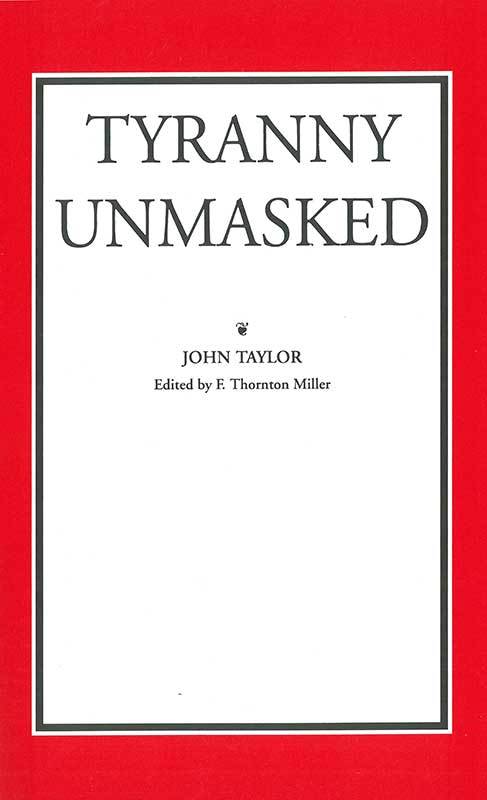
Tyranny Unmasked - John Taylor, Tyranny Unmasked [1822]Edition used:Tyranny Unmasked, ed. F.Thornton Miller (Indianapolis: Liberty Fund, 1992).
About Liberty Fund:Liberty Fund, Inc. is a private, educational foundation established to encourage the study of the ideal of a society of free and responsible individuals. Copyright information:The copyright to this edition, in both print and electronic forms, is held by Liberty Fund, Inc. Fair use statement:This material is put online to further the educational goals of Liberty Fund, Inc. Unless otherwise stated in the Copyright Information section above, this material may be used freely for educational and academic purposes. It may not be used in any way for profit.
Tyranny UnmaskedSection OneUnmasking the Protecting-Tariff Policy and Its Advocates from Many PerspectivesGood maxims are often worshipped with pretended devotion, and clothed with the splendors of eloquence, when their subversion is meditated; like white heifers whose horns were tipped with gold, and adorned with ribbons, preparatory to their being sacrificed. The report of the Committee of Manufactures dated the 15th day of January, 1821, commences with the usual zeal which precedes innovation, and with the common eulogy of principles intended to be violated. It is like a road smoothly paved at the beginning, but terminating in rocks and precipices. It embraces a great scope of information, condenses the arguments in favour of the advocated system, and is embellished by a style, only assailable by the simplicity of truth. It is the ultimate Thule upon which the disciples of the doctrine for restricting the liberty of property, have taken their stand; and if they can be dislodged from their last fortress, no other place of refuge will remain. If the general welfare is the object of this report, it courts an examination; and if ambition, avarice, or prejudice, lurks under a painted exterior, the same welfare demands their detection: for, though the Committee is dead, its ghost may haunt us hereafter. The Committee state— That at the end of thirty years our debt is increased $20,000,000; that our revenue is inadequate to our expenditure in a time of peace; that the national domain is impaired, and $20,000,000 of its proceeds expended; that $35,000,000 have been drawn from the people by internal taxation, and $341,000,000 by impost, and yet the public treasury is dependent on loans; that there is no national interest which is in a healthful thriving condition; that it is not a common occurrence in peace, that the people and the government should reciprocally call on each other to relieve their distresses; that the government has been too unwise to profit by experience, especially the experience of other nations; that its policy has been adopted for war and not for peace; that other nations shun our principles of political economy and profit; that the Cortes of Spain are establishing commercial restrictions; that history does not furnish another instance of a nation relying on the importation of goods as the main and almost exclusive source of revenue; that in every other nation agriculture, manufactures, and commerce, have been deemed intimately connected, each necessary to the growth and wealth of each other, but in ours there is said to exist an hostility between them; that the true economy of individuals is to earn more than they expend, yet this is said to be bad policy for a nation; that if the debts of the country were deducted from the value of property, the nation is poorer than in 1790; that our exports have not increased in proportion to our population; that the exportation of cotton has indeed prodigiously increased, but that to sixteen States it affords no profits, except by carrying and consumption; that it furnishes no foreign market for other productions; that the currency has been reduced in three years from $110,000,000 to $45,000,000; that no calamity has visited the country, and that in the last five years of exuberant plenty, our fat kine has become lean; that an overflowing treasury indicates national prosperity; that the causes of this distress cannot be in the people, and must be in the government; that revenue cannot be permanent whilst consumption is in a consumption; that there should be no system of restriction, but one of reciprocity that this is a free trade; that this reciprocal system of restriction has aided our commerce; that year succeeds year and our troubles increase; that no other remedy for them has been offered but an extension of the restrictive system, which the Committee propose as a forlorn hope; that the means of consumption must be in the hands of our own people, and under the control of our own government; that the flood of importations has deprived currency of its occupation; that there is more specie in the United States than at any former period, but it is not currency, because it is unemployed; that the importation of foreign goods was never so great, as when our embarrassments were produced; that the importer's ledger ought to settle the question; that in the cases of bankruptcy foreign creditors appear; that we have only the miserable and ruinous circulation of a currency for remittance to foreign nations; that they hold the coin and we hear it jingle; that the excess of exports over imports is the rate of profit; that we flourished in war and are depressed in peace, because manufactures then flourished and are now depressed; that there is an animating currency where they still flourish, and scarce any where they do not, except in the cotton-growing States; that the people are groaning under a restrictive system of bounties, premiums, privileges and monopolies imposed by foreign nations; that commerce is exporting not importing, and by reversing her employment she is expatriated; that they have no predilections for foreign opinions, and are less desirous to force facts to conform to reasoning, than to apply reasoning to facts; and that they trace the true principles of political economy to the conduct and the interest of the individuals who compose the nation. Excluding rhetorical flourishes with which the report, inspired by a furor dogmaticus, or a zeal for truth abounds, I have literally extracted the plain assertions upon which its conclusion is founded. In examining the medley of truth, error, and inconsistencies, from which the Committee have drawn their inferences, the alternative is to use language sufficiently strong to express my convictions, and to convey my meaning without reserve; or smoothed like treachery towards the cause I am advocating. Wherever plain truth is considered as indecorous, or it is thought necessary to mingle adulation with reasoning, a nation has prepared its mind for the catastrophe of sycophancy; yet decency as well as firmness is a duty; and freedom of opinion may, I hope, be exercised, without violating the obligations of civility. The leading facts from which the Committee have extracted their conclusion, are unquestionably true. In thirty years the people have paid in taxes $376,000,000; the public debt has increased $20,000,000, and the public lands have produced the same amount. The Federal treasury, having received $416,000,000 in thirty years, is bankrupt, and the people are distressed. The Committee have likened national to domestick economy, and the comparison is correct. A government, like an individual is embarrassed or ruined, by expenses beyond its income. It cannot export its patronage, its exclusive privileges, and its extravagance, to foreign nations, and bring back foreign cargoes of frugality and equal laws for home consumption. The Committee have reprobated the importation of foreign necessaries, but they have quite overlooked the effects of our having largely imported a catalogue of foreign political manufactures, which are the luxuries of governments, and infinitely more injurious to nations, than the luxuries which individuals import and consume. Let our governments surrender these dear foreign political luxuries, and we shall no longer feel the distress of buying cheap foreign manufactures. Suppose an individual to have purchased an estate for one hundred millions—about the price of our independence; to have spent $376,000,000 of its profits in thirty years, to have sold and spent $20,000,000 worth of the land itself, to have added $20,000,000 to his debts, and finding his affairs very much embarrassed by this process, to have asked in his distress, the counsel of his friends. His agricultural friend advises him to diminish his expenses and to forbear to run in debt. His mercantile friend, to supply his tenants with necessaries at the cheapest rate, that they may be able to pay their rents; his factory-capitalist friend, to give him a bounty for making spinners and weavers of these tenants; and stockjobbing1 friend, to continue his extravagances by the aid of borrowing. What would domestick economy, the honest referee of the question, chosen by the Committee, say to these counsels? Would she prefer the speculations of pecuniary craft upon the credulity of our landlord, to the sound common sense of tillage? Would she prefer the arithmetick of the stockjobber, to that of the merchant? Whence is the money to come according to the united advice of the stockjobber and speculator to pay usury to one and bounties to the other; and also to feed the landlord's extravagance, and discharge his debts? Some of his tenants who pay rents are to be transferred to factory-capitalists, who are to receive bounties and to pay no rents. His stockjobbers must have interest and premiums. His remaining tenants will be rendered less able to pay their rents, by having to support these two combinations. He cannot draw money from foreign countries to sustain his extravagance, by manufactures, because theirs must be cheaper than his own for some centuries after he is dead. Would any landlord of common sense, who had considerably diminished his debts, and enjoyed great prosperity previously to his taking the factory-speculators and stockjobbers into his service, shut his eyes upon his own experience, and persevere in surrendering his own understanding to their counsels? It is, in fact by too much proficiency in the art of political spinning and weaving, and not by too little patronage of capitalists, that our prosperity has been lost. By spinning legislative into judicial powers; by spinning federal into local powers; and by spinning exclusive privileges out of representations created for securing equal rights, the oppressive results stated by the Committee have been produced. We can spin out debates about economy, so as to make economy itself an instrument of waste. We can weave legislative and judicial powers into one web, to exhaust time, and increase the income of the workmen. We can weave law and judgment into more durable stuff than constitutions. Our parties have not been deficient in shooting the political shuttle for weaving republican threads, into a web compounded of extravagance, patronage, heavy taxation, exclusive privileges and consolidation. They are weaving a co-ordinate, into a sovereign and absolute power. They have woven the people out of four hundred and sixteen millions in thirty years. Considering that Washington's administration worked well with three or four millions, that Adams' worked ill with ten, that Jefferson's worked admirably with six; and when this revenue was increased by commerce, accounted for the surplus by paying a large portion of the public debt, and a part of the purchase money of Louisiana; a republican party must work by very different rules, which requires twenty-five millions in time of peace for carrying on its trade. The true manufacturing system proposed by the Committee, is to extend this species of trade. It offers more money to avarice, and even urges the enormous expense already endured, as an argument for aggravating the distresses it has already produced. But the estimate of the Committee, high as it is, excludes the great sums of money out of which the people are worked by unnecessary State expenditures, and by the machinery of banking and protecting duties. These items included, and at least the enormous annual draft of sixty millions is now taken from them in the existing appreciated money. Compare this deduction from the profits of labour, with the deductions in the times of Washington, Adams, and Jefferson, and consider how it happens that both the people and the treasury are famished. Can it have resulted from any other cause, but some new political system, by which the old one has been overturned? The remedy proposed for these wonderful and seemingly inconsistent misfortunes, is no less wonderful than the misfortunes themselves. They have been caused, say the Committee, by the want of wisdom in the government, and they propose to mend the workmanship of political jacks by mechanical jinnies; and to finish the web for conveying the nation to suitors for money, instead of imitating the conduct of the wise Penelope. Let us, say the Committee, persevere in the wise imitations by our foolish government, of other nations, by which they have acquired; hear reader!—by which these envied other nations have acquired—wealth and happiness. The prosperity of European nations, is reiterated to provoke our envy, and urged as an argument to convince our reason. Yet it is only a palpable evasion, and a delusive bait. The delusion lies in substituting the word “nations” for “governments,” and the bait, in varnishing over the miseries of European nations, with the wealth of privileged classes, in order to hide the hook intended to be swallowed. “The interest of nations!” What government except our own is so constituted, as to enable a nation to pursue its own interest? If there be any such, it is time for us to adopt it, admitting the truth of the Committee's assertion, that our government has not been guided by the national interest. If no European nations are able to compel their governments to pursue the national interest, it is a naked sophistry to assume, that they have done, what they could not do. The fact is, that all the European governments are so constituted, as to be completely able to sacrifice the national interest to their own. Have we forgotten human nature? When did such an absolute power chasten governments of avarice, and convert their administrators into patriots? We ought to have had the phenomena pointed out to us, before we were desired to believe, that a political miracle had been worked in Europe, sufficient to induce us to resign our faith. Look steadfastly at these supposed martyrs to patriotism; these self-denying political mummeries; these immolaters of avarice and ambition upon the altar of national interest. The admired government of England is compounded of a noble order; of an unequal place-hunting and place-holding representation, ready to sell their votes bought of rotten boroughs; and of an hereditary George. The government of Spain, said by the Committee to be particularly worthy of our imitation, is compounded of an equally infected representation, and an hereditary Ferdinand. That of France is of the same complexion. Ethics informs us that human nature is guided by self-interest. History proclaims in every page that governments exhibit conclusive proofs of this truth. Is it probable, that in the management of commerce (the best fund for their self-gratification) the European governments have forgotten themselves, and remembered only the interest of the nation? If not, an inference from what is false, must be defeated by an inference from what is true, and the argument becomes a syllogism. Governments able to do so, uniformly sacrifice the national interest to their own; the European governments possess this ability; therefore they have regulated commerce with a view to advance their own interest, and not the interest of the nation. The recommended imitation is of course perfidious in exhibiting to our view European nations, actuated by national interest, instead of European governments, actuated by an insatiable lust of power and money; and in suggesting that the recommended measures are imitations of the measures of wise nations instead of oppressive governments. If we pursue these measures, whatever may be the western motives, the eastern consequences must be produced. Form is the shadow, but measures are the substance of governments; and by copying the measures of the English government, we adopt its substance. There is none which has co-extensively fostered avarice at the expense of the people, or managed commerce both foreign and domestick more successfully for this end. The Committee endeavour to allure us into this English mode of acquiring happiness, by a splendid picture of the English government; and that government can only compel the people to be as happy as the Committee propose to make us, by a great mercenary army. This wise nation must either be very foolish in compelling the government to force them to be happy by the sword, or this patriotick government must be very tyrannical, in saddling the people with a heavy unnecessary expense. The English nation, besides being awed by an army, is bribed to approve of the measures which constitute the system of their government, by the annual contributions of sixty millions of people in Asia, of vast continental and insular possessions in America, of a large territory in Africa, and of money-yielding possessions in Europe. But rich tributes from the four quarters of the globe, cannot prevent a frightful degree of pauperism, nor reimburse the people for the distresses inflicted upon them by commercial restrictions. The reason is, that these are so contrived as to destroy all the good which commerce could have produced for the mass of the people, by making it merely an instrument for taxing them, and for intercepting all the wealth and tribute it brings in, to convey both into the pockets of the government, and of the exclusively privileged allies it has created. But admitting the tributes of the English territories to be palliations of their system for regulating commerce, why should we be induced to believe their drug sweet without any such saccharine ingredients, when the English people themselves evidently abhor it. They flee to their own fleeced colonies, and even to the United States, less blessed, or less cursed, by commercial restrictions and exclusive privileges, to escape from this policy the effect of which is, that the labours of above sixty millions of tributaries cannot enable twelve millions of Englishmen, inhabiting the finest island in the world, and unequalled in industry, perseverance, and ingenuity, to subsist comfortably. Reasoning deduced from mismatching things to be compared, must be eminently erroneous. We ought to chasten the argument by a parallel between things of a similar nature; by comparing governments with governments, and nations with nations. An absence of similitude precludes the possibility of imitation. A free nation is not like an European government, nor an European government like a free nation. The wealth and splendour of a government, is seldom or never the wealth and splendour of a nation. Even our government cannot be likened to the British government, because it has not the foreign possessions, the tributes of which enable the British government to persevere in its system of extravagance, bounties, exclusive privileges, and oppressive taxation. The British nation would yet rebel against this system of their government if they could do so successfully; we may prevent the introduction of the same system into this country without rebellion, if we will. If the Committee are to be understood literally, as advising an imitation of the British nation, they counsel us to abandon a system which that nation would overturn except for mercenary armies. If they speak figuratively, and mean the government when they use the term “nation,” they recommend an imitation of the British government by our government. The example of the British government is undoubtedly the best which has ever appeared for extracting money from the people; and commercial restrictions, both upon foreign and domestick commerce, are its most effectual means for accomplishing this object. No equal mode of enriching the party of government, and impoverishing the party of people, has ever been discovered. By classing the objects to be compared correctly, and confronting things of the same nature with each other, we get rid of the confusion produced by mismatching them; and discern that the Committee, as advocates on the side of government, reason soundly in recommending an imitation of the system adopted by the British government; because it must be admitted that no other example can be adduced, by which a government can extract as much money from the people. It would certainly exalt our government up to the British standard, and as certainly humiliate our people far below the British people, because we do not possess the foreign auxiliaries, by which they are hardly able to exist under the system recommended for our imitation. But the Committee have endeavored to forestall this argument by asserting “that an overflowing treasury” (the end they have in view) “indicates national prosperity.” This is the chorus of all the songs uttered by those who receive such overflowing. But what painter has drawn Liberty as a mogul almost suffocated with money and jewels; or with an overflowing treasury in her lap, and scattering money and exclusive privileges with her hands? Would not a Sciolist have been ashamed of such a picture, and a Reynolds or a West have viewed it with contempt? Upon this egregious political heresy the committee have founded their system. It is a species of political irrigation which exsiccates a nation to overflow a government and exclusive privileges. Louis the fourteenth, when he bribed Charles the second and other princes, had an overflowing treasury; yet the English, with a treasury insufficient to supply the extravagancies of Charles, were happier than the French. The richest treasury in Europe was at that time united with the most miserable people, instead of being an indication of their happiness and prosperity. The Swiss Cantons are remarkable for the poverty of their treasuries, and the happiness of their people. The severity of their climate and sterility of their soil, are both compensated by the frugality of their governments; and two great natural evils are more than countervailed by one political blessing. If a poor country is made happy by this cardinal political virtue, what would be its effects in a rich one? The Committee are fond of comparisons. Let them compare the situation of Switzerland; a rugged country under a severe climate; with that of their neighbors the French and Italians, favoured with fine soils and genial latitudes. All writers unite in declaring that the happiness of the Swiss far exceeds theirs. It exists under governments aristocratical or democratical, because of the absence of those paraphernalia by which rich treasuries are surrounded. Does this comparison prove that we ought to abandon the principles by which a barren country is converted into a paradise, and adopt those by which the finest countries in the world are converted into purgatories for purging men, not of their sins, but of their money? An overflowing treasury in imperial Rome, impoverished the provinces, fed an aristocracy, corrupted the empire, and enslaved the first portion of the earth. That of the great Mogul, starved the people, enriched privileged orders, was a prize for Persia, and finally for England. Russia is a country of a soil and climate resembling Switzerland, associated with a rich treasury; and the government is a tyranny. The whole world proves that there is no fellowship between overflowing treasuries and the happiness of the people; and that there is an invariable concurrency between such treasuries and their oppression. They are the strongest evidence in a civilized nation of a tyrannical government. But need we travel abroad in search of this evidence? Have we not at home a proof that national distress grows so inevitably with the growth of treasuries, as to render even peace and plenty unable to withstand their blighting effects? Our short financial history faithfully recorded by the Committee, leads us from treasuries of republican frugality, to those of aristocratical opulence. If the great annual amount now drawn from the people by our governments and exclusive privileges, does not constitute an overflowing treasury, what sum of money will deserve that appellation? Have we experienced a concurrency between the happiness of the people and an overflowing treasury? The Committee have informed us that it does not exist in our case, and yet they advise us more ardently to pursue this heretical phantom. No, it is not a phantom: it is a real political Colossus, erected to overshadow and reduce to dwarfs, the comforts of the people, and the people themselves. Is not the confederation of European kings or governments, a treasonable plot against the happiness of nations? Is it not the essence of this plot to obtain overflowing treasuries, and to foster exclusive privileges, for the special purpose of sustaining the oppressions of governments? Would not our adoption of the same policy, be a tacit accession to this nefarious conspiracy? If our republican party, consumed by the rays of power, has died a natural death, may we not still hope that a new phenix will arise from its ashes, and again excite the admiration of the world by the beautiful plumage of frugality and equal laws, for increasing individual happiness; instead of towering above the people, in the European turban composed of exclusive privileges, extravagance, oppressive taxation, and an overflowing treasury. The Committee say, “that in every other nation agriculture, manufactures and commerce, have been deemed intimately connected, but in ours there is said to exist an hostility between them.” To remove an evil, we must previously discover how it has been produced. Enmities among men are produced by a clashing of interests, and the intention of republican governments is not to promote, but to prevent this clashing, by a just and equal distribution of civil or legal rights. If artificial enmities are superadded to natural, their true intention is defeated; and the very evil is aggravated, they are intended to correct. Such is the policy which has arrayed class against class in Europe, and marshaled all its nations into domestic combinations, envenomed against each other by an ardour to get or to keep the patronage of their governments. These patrons make their clients pay the enormous fees they covet. As no government can patronize one class but at the expense of others, partialities to its clients beget mutual fears, hopes, and hatreds, and bring grist to those who grind them for toll. Even brothers, whom nature makes friends, are converted into enemies by parental partialities. Will the partialities of a government between different classes promote the harmony and happiness of society? Is not their discord the universal consequence of the fraudulent power assumed by governments, of allotting to classes and individuals indigence or wealth, according to their own pleasure? Has not the English parliament been fatigued for centuries with eternal petitions, remonstrances, and lamentations from the artificial combinations it has created, or the natural classes it has favoured or oppressed, soliciting partialities, and deploring their pernicious effects? Does not the English press at this time, teem with complaints by the manufacturers, of the corn laws? What has produced our existing enmities? Are our agricultural, manufacturing, and commercial enmities; our slave-holding and non slaveholding enmity; our banking and anti-banking enmity; our pension and bounty enmity; the enmity between frugality and extravagance; and our Federal and State enmities, natural or artificial? Do they not all proceed from an imitation of the European policy deduced from the claim of a sovereign or despotic power in governments to distribute exclusive privileges, local partialities and private property, by their own absolute will and supremacy? What then is the remedy for these crying evils? To remove or to increase their cause. The policy by which they are produced, caused for ages religious as well as civil enmities. A patronage of religious classes is yet attended in other countries with mutual hatred. Here, the removal of the cause, is proved to be the best remedy for the evil. If civil enmities, like religious, have every where attended legal partialities, the remedy is before our eyes. It is in vain to preach conciliation, if a policy, which inevitably begets division and hatred is adhered to. The justice of leaving wealth to be distributed by industry, is a sound sponsor for social harmony whilst the injustice of compelling one class to work for another, as naturally excites rapacity and indignation, and is equally a sponsor for hostility. The Committee inform us “that the true economy of individuals, is to earn more than they expend, yet this is said to be bad policy for a nation.” The first assertion is universally known to be true; but the second is gratuitously and unfairly attributed to their adversaries, to discredit the very principle by which only the first assertion can be realized, namely, that industry should be free to save as well as to earn. Yet the two assertions combined are not devoid of edification. To get more than we spend is undoubtedly a thrifty maxim, applicable to governments and classes, as well as to nations and individuals. The Committee have illustrated its truth, by stating that the Federal government has received a very large sum of money, but that by expending more, it is reduced to the necessity of borrowing. True economy, say the Committee, consists in spending less than we get; and in lieu of this true economy, they recommend a project for making the treasury overflow by internal taxation. Yet overflowing of treasuries will increase public expenditures and taxation. Compare then the thrifty maxim applauded by the Committee, with their conclusion, and consider whether it will confirm or refute it. The government has spent more than it received; the maxim recommends an expenditure of less; and from these facts the Committee have extracted their policy for making the treasury richer, the expenditures of the government greater, the agricultural class which chiefly supplies these expenditures, poorer; and for enabling the capitalist class, which supplies none of these expenditures, to milk all other classes, which milk they sell, but never give to governments. Apply the maxim to classes. The Committee endeavor to persuade the agricultural class, that it is false as to that class, by asserting that it will be impoverished by buying cheap, and of course expending less; and that it will be enriched by buying dear, and of course expending more. There would be wonderful ingenuity in convincing both the spendthrift, and the receiver of the spoil, that the first lost nothing, and the second gained nothing. Yet the Committee have undertaken to perform both these exploits, by endeavouring to prove that the agricultural class, far from losing any thing will be a gainer; and that the capitalist class, far from gaining any thing, must in the end sell cheaper than foreigners, and also buy dearer of the agricultural class. But, however strong the arguments of the Committee may be to prove both of these assertions, the capitalists obstinately persist in disbelieving them, and fatuitously contend for a bounty, designed only as a bait for the snare intended to overwhelm them with the double ruin of selling cheap and buying dear. The Committee have been more successful with the agricultural class than with these calculating gentlemen. A spendthrift is more convincible than one of your thrifty cautious people. If his character is compounded of vanity, ignorance, and generosity, he is exposed to flattery, cunning, and ambiguity; and the liberality of his mind is only frozen by the poverty resulting from his indiscretion. A portion of the agricultural class have credited the prophecy of a future cheapness of manufactures, and a future dearness of eatables, to be produced by violating the very maxim of thrift; whilst the capitalists unanimously disbelieve it, and eagerly prefer a bird in the hand. As to the mercantile, sea-faring, and professional classes, they have no products to carry to the visionary markets so alluring to some of the agriculturists; and being weak and defenseless, not even a prospective bonus is offered to them. The mechanical class, as I shall hereafter show, is treated still worse: only that class, strong enough to do itself justice, is complimented with being deceived. The temptation held out to the government and its satellites is proportioned to the power and perspicacity of this formidable class. More taxes, an overflowing treasury, and of course more power, to be immediately received, is offered to this class. The agricultural class is told—“you are rich, liberal, worthy, honest fellows, almost noblemen; assent to our project suggested by a great Italian artist, who either taught governments to oppress mankind, or mankind to detect the stratagems of ambition and avarice. Generous as you are, will you refuse to create a family of capitalists for the national good, by only paying double prices for your dainties and necessaries, when you will be reimbursed profusely by the pleasures of the imagination?” The argument addressed to the capitalists is short and solid. “You are to pay nothing for our project. It will double the price of your wares.” And they vociferate for it. That addressed to the government is the strongest of all, “our project will beget an overflowing treasury.” In this auction affair, the mercantile, mechanical, professional, and sea-faring classes are offered nothing at all, though they may remain in the vendue office, work as hard as they can, run about with errands, or make voyages in ballast. The Committee endeavour to hide the effects of their policy to classes and individuals, by kneading up all of them into one mass called a nation; and assuming it for a truth, that the chymist Self-Interestcannot divide it into parts. Having created this imaginary one and indivisible being, more valuable and wonderful than the philosopher's stone, they conclude that its interest must also be one and indivisible. But as this being needs a head, without which the hands and feet would not know what to do, the Committee have made one for it, of the Federal government. The members of their political being, are supposed, like those of the human body, to have no brains; and the head of course can only know what is best for them. Could they have come up to the petition of the model; could they have constructed a head, unable to hurt a member without hurting itself; to swell itself into a hydrocephalus, burdensome to the body; or to fatten some of its members by impoverishing others; the analogical argument might have been applicable to their imaginary political being. But until they can do this, a political head, able to advance its own power, to feed its own avarice, and to buy partizans with the property of individuals; will never resemble the heads which providence has been pleased to place on our shoulders. Why did God give brains to natural heads, if man could make a political head, better fitted to discern what will contribute to individual happiness? If a political head is better adapted for the attainment of this object, then the divine beneficence, instead of being the first of blessings, has only inflicted upon us the regret of having received a natural capacity to pursue our own good, which we are prevented from using by the interposition of political power. But, unfortunately for this policy, the artificial head must be composed of natural heads, which will retain the impressions with which they were born. They are impelled by the same self-love implanted in other heads, to pursue their own interest; and if they are invested with a power of controlling the capacity of other heads to do the same, they universally exert it for selfish ends. Slavery, either personal or political, consists only in the powers of some natural heads to dictate to others. Political liberty consists only in a government constituted to preserve, and not to defeat the natural capacity of providing for our own good. The States and the people, in constituting the Federal government, intended to reserve the use of their own heads. The States never designed to subject themselves to be partially taxed by the brains of other States; nor the people to surrender their own heads to the use of those which manage exclusive privileges. The Committee contend that a transfer of the rights and capacities of natural heads to privileged heads, is the best mode of enforcing that true economy, by which only individuals can flourish. Individual saving is admitted to be the only true political economy. Nothing else can produce national wealth or capital, nor generally enrich individuals. A political economy which takes away individual savings by exclusive privileges, might have been exemplified, could Nero have killed his mother by the hands of mercenaries before he was born. The comparison between individual and national economy is no sooner used, and the assertion that saving constitutes the former, than the doctrine is proposed to be violated. How can an individual save by being obliged to buy dear and sell cheap? Thus compelled, he ceases to be a model for any species of national economy, unless its object is to buy dear, and sell cheap also. In one view only will the comparison apply to the project of the Committee. Individuals are compelled to buy dear of capitalists, and to sell cheap to foreign nations, in consequence of prohibiting exchanges; and thus individual and national economy are placed nearly on the same ground. The Committee however imagine, that the destruction of individual economy will beget national economy. This would be a rare anomaly indeed. But it is to be effected, say the Committee, by means of internal taxation, an overflowing treasury, and buying what we want at double prices, until we bribe capitalists to sell cheap and to buy agricultural products dear. The evils of going to war with the true principles of economy, are only proposed to last, until these speculations shall succeed; for the design is not to establish false principles of economy permanently, but only to use them until they shall beget true principles. It is only intended to extract national thrift from individual unthrift. But it is clear to my understanding, that this cannot be effected in any mode whatsoever; though it is quite easy to extract the thrift of exclusive privileges, from the unthrift of individuals. A balance of trade is the chimerical price offered us for individual and national prosperity; those indissoluble twins, born only of individual industry. This balance itself is of the self-same parentage. In a competition for it between two nations, in one of which industry is invigorated by the freedom of buying as cheap, and selling as dear as she can; and, in the other, compelled to buy dear and to feed exclusive privileges; which competitor would gain the victory? But it is supposed that practice in this case is at war with theory. The Committee say, that our exports have not increased in proportion to our population, cotton excepted, which affords little or no profit to sixteen States, and furnishes no market for other productions. That our currency has been reduced in three years from $110,000,000 to $45,000,000. That no calamity has visited the country, and yet in the last five years of exuberant plenty, our fat kine has become lean. And that the causes of this distress cannot be in the people, and must be in the government. Neither theory nor practice disclosed these supposed symptoms of disagreement between the freedom of industry and national prosperity, for many years after we became independent; but now our exports, in proportion to population, have diminished, as taxes, exclusive privileges, and bounties have increased; or as the profits of industry applicable to its own use or consumption, have been curtailed; and yet the very causes of the deprecated consequences, are proposed to be aggravated. The first period of our political existence, was but little infected by taxation, exclusive privileges, and bounties, and the present has to struggle with a host of these machines. The first dispensed prosperity during many years of fluctuating fruitfulness; and the second, distress, during the last five years of exuberant plenty. Under the theory of leaving to industry as great a share of its profits as possible, practically enforced, the nation was prosperous; as this theory has been gradually violated, national distress has increased. But it is supposed that theory and practice, though they have traveled so many years together, have at length quarreled; and that the facts stated in the quotation are sufficient to prove it. On the contrary, these facts seem to me incontestably to establish the indissoluble connextions both between the freedom of industry and national prospering; and also between national distress and protecting duties, bounties, exclusive privileges, and heavy taxation. Our former policy produced national happiness; the present produces national misery. Is it merely accidental that these two pair of yoke-fellows have drawn so exactly together? The Committee suppose that they have been mismatched, though they have worked in conjunction, and that industry will work better harnessed with more protecting duties, bounties, exclusive privileges, and taxes, than when she was not impeded by such trammels. But, aware of the consequence of a fair combat between speculation and fact, they expunge the existing protecting duties, bounties, exclusive privileges, and heavy taxes, from the history of our existing distress; and, as ingeniously, ascribe all the benefits produced by the freedom of industry to use its own earnings for many years, to occasional wars between foreign nations. Thus they contrive to strip the question, both of the prosperity attending the first policy, and also of the distress which followed the second. By this management, the system which produced our prosperity is artfully put out of view, and also that which has produced our distresses; and to prevent a comparison between them, by the unerring evidence of their respective effects, a comparison is drawn between war and peace, for the purpose of ascribing all the good effects of the first policy, to war between foreign nations; and all the bad effects of that by which the first has been superseded, to the want of such a war. The result of this comparison, as admitted by the Committee, destroys their own argument. It is, that the existing policy, even when aided by peace and plenty, produces national distress. Our former policy is admitted to have been well calculated for producing national prosperity in time of war; our existing policy, for producing national distress in peace and plenty. One was then good for something, and the other worse than good for nothing, as it is not adapted for reaping advantages from foreign wars, and reaps distress from domestik peace and plenty. By getting rid, both of the merits of one and the vices of the other, and exhibiting both as virgin projects, which have hitherto produced no effects; since the effects of both are ascribed to foreign wars, or the absence of foreign wars; the Committee endeavour to free the question from the gripe of experience, and to bind it by the gossamer fibres of the imagination, and thus ingeniously avail themselves of our bias for the newly invented mode of construing constitutions; so pliant as to resist nothing, and yet so elastic, as to bound over all the restrictions of common sense. By such fanciful reasoning any facts, the freedom of industry, and local State rights, are all exposed to be manufactured into gratifications for avarice and ambition. But the Committee would have disclosed still more ingenuity, had they suppressed more facts, and advanced fewer opinions. In also ascribing our distresses to a dimunition of bank currency, and urging it as an evidence of bad policy, they ought to have foreseen that the history of this fact was understood by the nation. We know that the plethora of bank currency was caused by the expenses of the last war, and by the influence of the banking bubble to awaken fraudulent speculations; and not by manufactures. Public expenditures and knavish designs united to produce it, and this plethora, urged by the Committee as a proof of national prosperity, was in fact one cause of national and individual distress. It tempted governments to launch into an ocean of extravagance, and individuals into an ocean of speculation, from a fraudulent hope of an increased depreciation. It produced a great number of bubbles, under the denomination of internal improvements, having the effect of enriching projectors and undertakers, and impoverishing the people. The bursting of the banking tumor left behind the sores of public extravagance, foolish public contracts, excessive taxation, and great private debts; all of which it had generated; and these are proposed to be cured, by letting them run on, and promoting a gangrene, by the new bubble of granting an enormous bounty to another set of undertakers, called capitalists.2 The Committee say, “if the debts of the country were deducted from the value of property, the nation is poorer than in 1790.” What has caused these debts? Banking, borrowing, taxing, and protecting duties. They united to increase expenses and mortgage property. Why have the Committee, in deploring our debts, concealed their origin? During the revolutionary war, we experienced the effects of an abundant currency, united with exclusive internal manufactures. Necessity compelled us to push both to the utmost extent, and a general loathing of both experiments, induced us to resort to political frugality and a freedom of industry, and not to commercial restrictions, in search of a remedy for the national distress they had combined to produce. It was found in these principles, and was so sudden in its efficacy, that the public distresses speedily passed away like a dream. Another redundancy of paper currency, and another necessity to manufacture for ourselves, have combined to produce another state of national and individual distress, so severe as to render “our fat kine lean,” but we do not resort to the policy which worked so well in peace and plenty, after the first event of the same character; and the distress continues for want of those remedies, then so successful. The Committee say, “that the causes of this distress cannot be in the people, and must be in the government.” To remove the first distress, our governments used commerce, free industry, and frugality; and it was removed. Under the second, they adhere to commercial restrictions, exclusive privileges, and extravagance; and the distress continues. They admit the distress to have originated in the government and not in the people, “without either having been visited by any calamity”; but leave us to imagine the rare, if not the solitary, case in a time of peace and plenty, that it has not been caused by misdeeds, but by no deeds on the part of the government. It is utterly inconceivable how this taciturnity, this let-us-alone policy, could have so completely destroyed the usual effects of peace and plenty; but as the fact is, that our governments have been extremely loquacious in transferring its fruits from industry to idleness, there is no difficulty in discovering how they are lost. The system of commercial restrictions, bounties to bubbles, exclusive privileges, and excessive taxation, comprises the operative misdeeds which have caused the national distress, and solved the enigma, that plenty and distress are united. If the solution is true, the assertion of the Committee, so far as it supposes that the public distress has been produced by the neglect of deeds, is unfounded; and only correct in ascribing it, not to the people, but to the government. In the same operating system, we find the cause of the decrease of our exports in proportion to population. Industry is discouraged, both by the internal spoliations inflicted upon it by governments, and also by impairing the resource of a free commerce for alleviating its losses. It is deprived of the enhanced prices produced by exchanges for imported products, and of its best customers by driving them into rival markets. It is made heartless by being subjected to the mercy of monopolists at home, and by being told that its chance for getting out of their clutch is only “a forlorn hope.” In order to discredit the national benefits arising from the great increase in the exportation of cotton, the Committee have unwarily developed their principles, and displayed their design. “Cotton,” say they, “affords little or no profit to sixteen States, and furnishes no market to their productions.” And what is the inference? That cotton agriculturists shall be made by law to furnish a profit to other States, and be forced to become a market for monopolies. Thus the object of making some States tributary to others is confessed; and the factory markets so dazzling to some agriculturists, turn out to be an agricultural market for capitalists, in which they will have the exclusive power of regulating prices, or weights and measures. As the protecting duty system is designed to make agricultural States profitable to capitalist factories, it must of course make all agricultural individuals, wherever situated, profitable also to them. How can this avowed object be reconciled with the pretence, that this system will be profitable to agriculturists? Can States and individual both pay a tribute to factory monopolists, and also exact from them a greater tribute? Does not profit and loss require two parties? Thus the acknowledged intention of the protecting-duty system, is simply that of every legal fraud, however disguised, namely, to make some individuals profitable to others; and strictly accords with the tyrannical policy of making nations as profitable as possible to governments. But the assertion of the Committee, “that cotton affords little or no profit to sixteen States, and furnishes no market for other productions,” is so egregiously erroneous, that it could only have been hazarded to induce these sixteen States, to feel no sympathy for the cotton States. Supposing it to be true, it is the strongest argument imaginable, against the power and the justice of a legislation by these sixteen States, to settle a scale of internal profits to operate between the States. They constitute a majority in Congress; and are addressed by two arguments as little likely to make them legislate fairly and honestly, as can be imagined. One, that they derive no profit from the prosperity of the cotton States, whilst their industry is free; the other, that they may draw a profit from them by the factory monopoly. The assertion, however, is adverse to the known effect of the division of labour, to beget mutual markets. By creating additional skill and facility, it vastly increases necessaries, comforts, and luxuries; the exchange of which is the basis of political economy, and the sower of civilized societies. It would be superfluous to cite proofs of a fact, seen everywhere, except among savages. Will Alabama want nothing but cotton, should that State select this species of labour for its staple? Can she eat, drink, and ride her cotton? Can she manufacture it into tools, cheese, fish, rum, wine, sugar, and tea? Would it be beneficial to her to destroy the principle which produces perfection and success, by distracting her occupations? Do either the principles which recommend a division of labour, or soils, or climates, or habits, suggest the policy of making each State a jack of all trades? Is not Georgia a market for manufactures, and Rhode-Island a market for cotton, in consequence of the division of labour? If this division is highly beneficial to mankind throughout the civilized world, ought it to be impaired by making one species of labour tributary to another? In fact the profits arising from the extraordinary skill and industry of some States in raising cotton, are diffused through the States; but if such was not the case, it would not furnish an argument of more weight to justify the policy of making those States tributary to factories, than might be urged by sugar boilers to prove that the raisers of maple sugar ought to be tributary to them. The policy of making some divisions of labour tributary to others, after they have been adopted by States or individuals, is both fraudulent on account of the loss occasioned by a change of occupations; and also opens an endless field of contention and animosity. The division of agricultural labours is visibly imposed by nature to diffuse and equalize her blessings. Seas and rivers transfuse them throughout the world, and the geography of the United States is particularly impressed with characters for that purpose. Look at the Mississippi and its waters. Do we not read in this spacious map “here are to be mutual markets?” Are not such markets already established? The cotton country purchases horses, meat, and flour of the upper States, and these receive returns in comforts which they cannot raise. Can it be for the interest of these upper States, composing I suppose a portion of the sixteen said to derive no profit from cotton, to tax the cotton agriculturists to enrich capitalist factories, and thereby impair the markets provided by nature for themselves? If the cotton States suffer a diminution of profit, it will correspondently diminish the market of the upper States; and the evil will in some degree reach every State embraced by the waters of the Mississippi, as a punishment for their having endeavored to make a better scheme for themselves, than that formed by the Creator of the universe. As the Mississippi States are markets for and profitable to each other, so are the Atlantick. In the latter, also, a division of labour begets mutual markets, and mutual benefits resulting from that happy principle. South-Carolina and Georgia are markets for northern corn, flour, and manufactures; and the northern States are markets for rice and cotton. The eastern States are markets for the live stock of the western. It has been more beneficial to them to raise cotton, tobacco, and bread stuff, than live stock but as these occupations are rendered less profitable by commercial restrictions and factory monopolies, the loss will re-act upon the western States, by diminishing the capital applicable to this species of internal commerce, and compelling the eastern to raise articles, which they would otherwise buy. The division of labour, if left free, invigorates industry, increases skill, and diffuses general benefits. No State can be benefited by impairing this principle. A monopoly established to transfer the profits of labour from south to north, is a precedent for transferring such profits from the upper to the lower States on the Mississippi. In both cases the monopoly would be bestowed on rich capitalists, and be paid by poor industry. But it would not be so generally injurious to the whole Union, as the Atlantick monopoly at this time, because the effects of the latter spread far wider. “That free local occupations dictated by climates and soils, destroy markets and mutual profits”—said by capitalists to be both false and true, for a purpose not impenetrable; is the assertion, by which we are desired to be convinced of the wisdom and justice of giving an enormous bounty to these rich gentlemen. The free exchanges of local products with foreign nations, will not produce mutual profit or benefit to the exchangers of property, and therefore the principle, in that case, is false; but the free exchanges of local products between united States will produce mutual profit or benefit, and therefore the principle is true. But it is perfectly obvious that the profit or benefit, in both cases, arises from exclusive local facilities in the production of articles to be exchanged, and therefore that the principle must be true in both cases or in neither. It is admitted to be true in the latter by the profession of the protecting policy, that it intends ultimately to restore the principle of free exchanges, and only to destroy its effects at present. As to foreign nations it endeavors to get over the truth, as to the effects of free exchanges, by the fact, that they have by their laws obstructed the free exchanges by which this happy principle is able to diffuse the most mutual profit or benefit; and yet it proposes to create greater obstructions of the same character, by domestick laws, more capable of execution, liable to fewer checks, and operating more oppressively. Let us suppose that sixteen States shall be convinced by the Committee, that they derive no benefit or profit from the cotton States, and that they possess the power of getting from them as much of both as they please. What can be a greater degree of tyranny to the cotton States? Will it not cost them more to feed the avarice of sixteen States, than that of an individual tyrant? Has the tyranny of republics over provinces or districts, which they could make subservient to their own avarice, been uniformly more or less than the tyranny of single despots? Did not the tyranny of republican Rome, in pilfering the provinces, drive the people into the arms of a military chief. With equal truth or falsehood it may also be said, that sixteen States derive no profit or benefit from raising tobacco or rice, or from prosecuting the fishery by other States, and this majority in Congress have also the power of making these, and many other local employments, subservient to their avarice. Thus a general hostility would be created among all the local divisions of labour; and their capacity to diffuse mutual profit and comfort, would be defeated. But if this policy is wise and just, as applicable to each natural division of labour, because hardly one covers a majority of the people, it is still more forcible when applied to the artificial divisions of labour. These are more personal and local, than the former. They do not supply objects of consumption more necessary nor more universal than their comrades. Each of the artificial occupations embrace only a minority in every State. Supposing that cotton planters and other cultivators of local products, ought by law to be made profitable to a majority of States, ought not the capitalists to be made profitable to a majority of the people according to the same principle? Is it not infinitely more grossly violated by making these cotton planters profitable to an inconsiderable number of capitalists, than it would be by leaving them at liberty to make the most of their product by a freedom of exchange. Capitalists are undoubtedly more local, and will be guided by an interest more exclusive, than that national interest subservient to the natural divisions of labour. How then can the general good be advanced by sacrificing the interest of this vast majority to the purpose of enriching a very small minority; by inflicting a deep wound upon all the natural divisions of labour, for the purpose of bestowing a monopoly, operating upon and impoverishing the whole of them, to create a local and exclusive class of capitalists? Such a policy is equally unfavourable to the invigorating and perfecting principle of a division of labour, whether that division is natural or artificial; and if its violation will produce evil in one case, it must do so in the other. But a trespass upon the right of free exchange, belonging to natural divisions of labour, is more pernicious to the common good, than a trespass upon the same right belonging to artificial divisions of labour, because it makes more victims. The question is, Which will produce most general good? The enjoyment of this right by all divisions of labour, natural or artificial; or the subjection of all the rest to the avarice of one, the capitalists, if theirs may be considered as a laborious occupation. Recollect, reader, that republics can be avaricious, and then seriously consider the doctrine, that sixteen of these republics have a right, under the federal constitution, to make a few other republics subservient to their own profit. What power can be more tyrannical? Where are its limits? Under it, will any minority of States be free republics, or provinces dependent on a combination of sixteen. Let us advert to the nature of currency, in order to discern, how it is subservient to the mutual benefits diffused by a division of labour, and how it is made to destroy these benefits. It possesses two generick capacities; those of exchanging, and transferring, property. Under the first is comprised the intercourse between individuals; under the second, all payments made without receiving an equivalent in property, invariably computed in exchanges. If an individual sells his land to another, though he receives currency, he receives in fact an equivalent for his land in other property which the currency represents. But, when an individual pays money or currency to a government or to exclusive privileges, that portion of his property which the currency represents, is transferred without his receiving any equivalent in other property, and is to him an actual loss. In such payments for the support of a free government, he obtains an equivalent in social security, but not in property and even these expenditures, though highly beneficial to him, constitute a loss of property, sustained for the preservation of the residue. But when such payments are extorted to feed either an oppressive government or exclusive privileges, they degenerate into actual tyranny, and individuals receive no equivalent either in property or in liberty. Government has been called an evil, because it requires a transfer of property; but it only becomes a tyranny by aggravating this evil without necessity. As its degeneracy advances, more currency is required for the purpose of transferring more property from one individual to another, because in this operation it acts only periodically; annually, only for the most part in the case of governments, between the gainer and the loser of property; but more frequently, in the cases of the property, it transfers to exclusive privileges, so as to aggravate the deprivation. One portion of currency is employed in exercising its capacity of transferring property, and another in exercising its capacity of exchanging it. But as the latter portion passes with infinitely more rapidity from hand to hand in performing its occupation than the former, there is no need of an exuberant quantity of currency to fulfil this salutary end; nor can this pernicious exuberance long exist, because it must be limited by the extent of exchanges; by which the value of currency in circulation will either be raised by appreciation, or brought down by depreciation, to a level with the demand for carrying on exchanges, so as to correct the evils both of a deficiency or redundancy. Far different is the character of money or currency employed for the purpose of transferring property. Its quantity must be increased, as this occupation is increased; nor is it liable to the salutary restriction interwoven with its capacity of exchanging property, because these artificial transfers of it are subject to no limitation, so long as the people have any thing to lose. It is true that these occupations, though perfectly distinct, appear to run into each other, because currency, like Araspes the Persian, has two souls. Its capacity to exchange property is its good soul, and its capacity to transfer property, its bad one. When its good soul prevails, it dispenses justice; under the influence of its bad one, it becomes a violator of each man's spouse, private property. Will Congress be less magnanimous than a Cyrus? Will it encourage the adulterous or the chaste soul of currency? Even the money paid to the officers of government is a transfer of property, either transitory or permanent. So much as is used by the receiver for his current subsistence, is transitory as to himself; but the payer receives no equivalent in other property; and so much as augments the wealth of the receiver, is as permanently transferred as property can be. If a robber seizes the money of an individual, the loser receives but a poor equivalent for his loss, because the robber throws it into circulation, either in procuring subsistence, or by purchasing an estate. In like manner money paid to officers of government and to exclusive privileges is a transfer of property, having the same effects. In the case of exclusive privileges the similitude is exact, but not in the case of the officers of government, so far as exactions for their compensation are necessary for social order, of which the security of property constitutes an essential article. In this case also the similitude becomes exact, whenever these exactions exceed the legitimate object of sustaining a free government, and are gradually introducing an oppressive one. In fact, out of this distinction between the good and evil capacities of money, flow most or all of the phrases used to convey an idea, either of a good or a tyrannical government. It is the identical distinction which constitutes the contrast between our own and the European governments, and if it is lost, I should be glad to learn what will be the real value of a mere theoretical remnant. The distress of England at this juncture is at least equal to ours. It provokes a much greater degree of national disquietude. The distress of Ireland far exceeds ours. This foreign distress has not found a remedy in manufactures and exclusive privileges. To obtain it by the same policy, we must therefore push it further than the English have done. As the cause of the evils under which England and Ireland are groaning, cannot lie in a want of the advocated policy, it is only to be found in its existence. It undoubtedly lies in the encouragement given by the government to the bad soul of money. Its wicked capacity of transferring property is patronized by a multitude of laws, for enriching the officers of government, privileged combinations, projectors, pensioners, and sinecures, beyond the limits prescribed by social considerations. Thus the effects of the good soul of money are nearly suffocated, and the predominance of its bad soul dispenses the mischiefs to be expected from an evil spirit. If we cannot ascertain the extent in which we have cultivated the capacity of currency to transfer property, because it is impossible to discover how much has been transferred by its depreciation, we can yet compute it with considerable accuracy, so far as this capacity is exercised by taxation, State and Federal, by dividends paid to bankers, and by bounties paid to capitalists. These united cannot amount to less than sixty millions of dollars annually, and as this enormous sum of money transfers every year the property it represents, we need not wander any further in search of a cause for the public distress. As it represents and transfers twice, or perhaps thrice, as much property as it did a few years past, the distress which has awakened the compassion of the Committee, was unavoidable; but they propose to alleviate it by pushing still further the policy of transferring property. They say we have but forty-five millions of currency. If such be the fact, what must be the consequences of laws compelling these forty-five millions to transfer, annually, sixty millions worth of property, and also to perform the whole business of facilitating exchanges. The first duty being imperative, in its present magnitude, must chiefly employ the supposed quantity of currency, and leave but little of it to be employed in the second; so that the great increase in the efficacy of money or currency to transfer property, unites with the insufficiency of the amount applicable to facilitating exchanges, brought about by the enormous sum absorbed in its pernicious employment, to produce the present state of things. A permanent increase of currency can only be effected by employment for it in exchanging or transferring property, but its increase for one or the other object, produces very different consequences to a nation. When currency is increased by a demand for it to facilitate exchanges, it indicates national prosperity, but when it is increased for the purpose of transferring property, it is an infallible proof of fraud and oppression. The operations of currency in exchanging and transferring property are so interwoven, that it is easy to delude the people into an opinion, that the former and not the latter design is at the bottom of its legal augmentation; and debtors are bribed by a hope of depreciation, to mortgage the remnant of their property, with themselves and their posterity, to the property-transferring policy. When currency is increased, as in the case of banking, for the primary object of transferring property, a temporary depreciation ensues, which robs once by this means, and again by appreciation. Upon either alternation, however frequently they occur, injustice is perpetrated. But the effect of either between individuals is moderate and short lived, because the demand of currency to be employed in exchanges will regulate its value; and in making such exchanges it will be computed by its representative relation to property. An increase of currency, for the purpose of transferring property, contains no such internal remedy against the evils of excess. Governments and exclusive privileges increase their exactions at least comparatively, and usually take care that their compensations shall exceed a temporary depreciation. When it ceases, or appreciation happens, the transfer of property from the people to themselves, commenced by increasing currency under the pretext of facilitating exchanges, is aggravated without any new law; and the numerical acquisitions are doubled or trebled in value, merely by saying nothing. When wheat was worth two dollars a bushel, sixty millions of dollars would transfer property equal to thirty millions of bushels of wheat; but when wheat is reduced to one third of that price, the same sixty millions transfers property equal to one hundred and eighty millions of bushels. Is this chasm so wide and deep, that the national distress cannot be discerned in its bottom? The disciples of the capacity of currency for transferring property, are more ardent and skilled than those who are contented with its utility in exchanging it, because the cultivation of that capacity is their trade, in which they become perfect by practice; and because mankind have ever thought it very pleasant to get rich without industry. Hence a school appears in every country for teaching nations that taxation, stocks, and exclusive privileges, are the best guardians of their prosperity. This school is perpetually lecturing us in the newspapers and in pamphlets, with a success demonstrated in the present state of things, obtained by confounding the very different capacities of money to transfer and to exchange property; and by considering its abundance, whether created for either purpose, as equally an evidence of national prosperity. Thus it has deluded us into the error of coveting the abundance, without considering in which of its capacities it will operate. Yet in every instance, when a plentiful paper currency has been created for the purpose of transferring property, or has produced that effect, though created from considerations both honest and patriotic, evils in no degree dubious have been identified with it. The abundance of paper currency in England, far from being a dispenser of individual happiness, is a severe oppressor, because it is chiefly employed in transferring property. The abundance of our revolutionary currency, though created by patriotism, produced great distress, in its effect of transferring property. The late abundance of our bank currency caused great distress by transferring property. In all these cases we see clearly, that national distress uniformly occurs in proportion as property has been transferred. Yet the Committee propose to remove the existing national distress, proceeding from the enormous amount of property now annually transferred, by transferring still more property to capitalists, by producing an artificial demand for more currency to work in its transferring character, by increasing taxation, and by diminishing the business of its exchanging character, in excluding the importation of foreign commodities to a great extent. Suppose the importation of foreign commodities should be quite prohibited, that our revenue should be doubled, that our bounties, exclusive privileges, and public expenses should be also doubled, and that our currency should be increased up to a complete sufficiency for transferring an hundred and twenty millions worth of property annually; would this policy be an index of national prosperity, or recover the happiness of individuals? I cannot discern upon what principle the Committee have founded their computation as to the amount of our currency, nor even what they mean by the term; and yet accuracy in both respects is indispensable, before we can draw any correct conclusion from this amount. If they mean by the term “currency,” bank paper only, it is hardly possible that they could have obtained credible returns of its amount from all these institutions, unsubjected to compulsion, and influenced to secrecy by the strongest motives; and it would be equally incredible, that only forty-five millions of currency could perform the business of transferring annually sixty millions of property, and also of discharging so much of the business of facilitating exchanges, as our commercial restrictions have left for it. If they understand by the term “currency,” bank paper, metallick money, funded stock, and incorporated stock, all of which possess the capacities both of transferring and exchanging property, their computation is widely erroneous. If these capacities constitute currency, that of the United States is enormously redundant at this time, for the employment of exchanging property. It consists of funded stock for old debts and new loans, of the stock of the whole family of banks, of the stock of many other corporations, of all the specie in the country, and of all the bank notes in circulation. If at some antecedent juncture a larger amount of bank notes was in circulation, it was not associated with any thing like so large an amount of stock and specie as at present. We ought to estimate every species of circulating currency capable of transferring or exchanging property, to procure a sound foundation for an argument extracted from that source; and as these stocks possess such qualities, and are transferable for such purposes, our computation would be erroneous, should they be excluded. In the case of banks, their stock or shares constitute a portion of the circulating medium, as well as their notes; and perhaps we should not deviate far from the truth, by doubling their stock, to come at the total of banking currency, made up of the items of stock and notes. These items would, undoubtedly, far exceed one hundred millions of currency; funded stock, State and Federal, considerably exceeds another hundred millions; and the metallick currency in the country may be, probably, estimated at thirty millions. Our astonishment excited by the idea that we have only forty-five millions of currency, to transfer annually sixty millions of property, and also to perform the whole business of exchanges, now ceases; and we also discover, that an abundance of currency, far from being an evidence of national prosperity, may be the identical cause of national distress. Two hundred of our existing two hundred and thirty millions of currency, have been created or are calculated for the very purpose of transferring property; and, though this capital also performs some share of the business of exchanging it, yet this association of the good capacity of currency with its bad one, alleged as a proof of merit, is only a cloak of fraud. Under the pretext of facilitating exchanges, the bad capacity of currency has obtained the profits of labour to a ruinous amount. The metallick currency is incarcerated, to create a necessity for a transferring currency; and extravagance and borrowing is used to increase its quantity, to carry our lands and goods to capitalists. The more of these which are intended to be transferred, the more of the transferring currency becomes necessary to facilitate the conveyance; and it has at length grown up into a monster which eats faster than five successive years of uncommon fruitfulness could furnish food; and so impoverishing, that we must either direct against him the thunderbolt of common sense, or submit to his ravages in despair. If it was true, that this monster had diminished down to the weight of forty-five millions, there might be some hope of his becoming extinct; but, as the fact is that he has already exceeded that size four- or five-fold, it behooves those whose fruits he eats to look about them, when it is proposed to make him grow still larger. As an argument for replenishing his larder by another cut-and-come-again carcass, the Committee assert, “that we flourished in war and are depressed in peace, because manufactures then flourished and are now depressed; that there is an animating currency where they still flourish, and scarce any where they do not, except in the cotton-growing States.” Manufactures then, it seems, do actually flourish somewhere in the United States, their depression notwithstanding, so wonderfully as to reflect around their orbits an animating pecuniary halo, no where discernible around any agricultural sphere, that of cotton excepted. It seems strange that wealth should attend factories in spite of oppression, and that poverty should lay hold of agriculture, though fortified by commercial restrictions. An impartial judge, from these two facts asserted by the Committee, must conclude that agriculture had already given too much of her estate to her children in some fit of morbid fondness, and that one of them must think her in her dotage, who can tell her gravely “I am rich, you are poor, therefore make me richer.” Is not this the language of an ungrateful favourite, who thinks his beneficent parent an old fool, and fit only to work or starve. But it seems that one species of agriculture still presumes to vie with the factories in getting money. As this is the great merit by which the Committee sustain the claim of the factories to further bounties, one would think that the same merit ought to have attracted the same philanthropy to the cotton planters, because they also gain and circulate an animating currency where they flourish. But no; this solitary agricultural interloper in the trade of growing rich, is treated as a culprit, for doing that which acquires for a factory the character of patriotism. It yields no profit to sixteen States, and therefore it deserves no bounty like the factories, for making money. But this is not all. It is to be treated as all monopolists treat those who have the presumption to interfere with their privileges. The profits of raising cotton, far from recommending them as objects of bounty, are considered as a trespass upon the capitalists' privilege of exclusive accumulation; and even the prosperity of this last item of successful agriculture, is to be assailed for the benefit of our enormous pecuniary monopoly, because it is so local as to yield no profit to sixteen States. It is impossible to find a more lasting argument for transferring the profits of agriculture to capitalists, than that they are local. Even factories may be transplanted from place to place. Capitalists can follow their speculations. Travelling pedlars are ambulatory. And poor agriculture, being immoveably local, ought to be made subservient to the avarice of these pedestrians, under the notion that cotton planters can do no good to sixteen States. But cannot the cotton travel as well as the cloth made out of it? Cannot the money earned by cotton and tobacco planters make its escape from them? Whence came the enormous capitals accumulated in a few large northern towns, if it is true, that local agricultural profits do not promote the general prosperity? These assertions of the Committee, however, require a graver consideration, and are calculated to bring matters to light, of which they were either not aware, or did not perceive the force. It is freely admitted that currency is infinitely more plentiful in several States where factories flourish, than in those without them. It is even admitted that there is a local redundancy of it in a few hands, so very considerable at this juncture of its general scarcity, that it is seeking for borrowers; and that governments and individuals can obtain loans at a lower interest and premium than at any former period. If the factories produced this redundancy, they are already, almost suffocated with wealth, drawn to them by the property-transferring policy; and it cannot contribute to the general interest that a body of capitalists, already so rich that they know not how to employ their capitals, should, by an addition to this redundant capital, be bribed to use their influence for encouraging the extravagance of government, to obtain employment for their capitals by repeated loans. It is very important to consider how the enormous and local accumulation of redundant capital has been produced; because, if the diffusion of currency will dispense more national prosperity than its monopoly, the instrumentality of the factories towards effecting the latter cannot be a merit with the nation, however grateful it may be to their owners. Let us, therefore, take a glance at the process by which this has been gradually effected, that we may at least know by what road we have travelled to get where we are, and be able to determine, with our eyes open, whether we will proceed in the same track. The local redundancy of money, confined to a few persons, and factories, was originally produced, and has been subsequently increased, by using currency more to transfer, than to exchange property. This policy commenced with our first finding system. The sudden appreciation of revolutionary certificates above twenty-fold beyond the value at which they were bought, was a transfer of property by law, of about one hundred millions from the public to a few fortunate speculators. The local residence of Congress, the local expenditures of the war, and the local ingenuity of those who formed the finding project, had amassed these certificates in the north, and their conversion into national debt, not by the scale of value like the paper money, but numerically, suddenly created a great property-transferring capital or currency. In this acquisition, the majority in no State participated; it was bestowed on the initiated few, skilled in the secrets of legislation, and able to manage its stratagems for their own emolument. The effects of a transferring currency being thus tasted by a capitalist junto,3 and its wealth having invested it with legislative power, it of course adverted to banking as another item of the property-transferring policy. This second mode of transferring property settled in those districts where the first had provided a capital to give it efficacy. Thus the certificate capital was made to transfer property both by interest and dividends. The new project was imitated throughout the Union, most calamitously in States unprovided with the transferring capital created by the funding system; and whilst the people in those States wherein this capital resided, lost only the regular transfers of property caused by the banking and finding systems, those States wherein capital only existed partially or not at all, sustained a vast additional loss, by an unavoidable succession of frauds and bankruptcies. Every individual of all the States not enriched by this second deluge of property-transferring currency, contributed to the wealth of the few, who were so; but the western States which held a very small share of the artificial certificate capital, suffered most, and so sorely, that some of them have been searching for a remedy with great assiduity. Ohio struck at the root of the evil by endeavoring to repel the machine for transferring property from the people to capitalists, but she is told that this is both a wise and a constitutional operation, and that she must for ever submit to it. She has only an election it is said, between transferring the property of the people to the stockholders of the bank of the United States, or to stockholders of her own creation; but for want of the resident capital created by the funding system, and as she has no means of raising up an internal capitalist sect, she cannot avail herself of this poor right of election, and must remain tributary to the existing transferring capital, residing without the State. The late war was a third source for increasing the amount of property-transferring capital or currency. The loans, premiums, and expenditures, or the permanent profit made by the war, chiefly settled, where the existing property-transferring capital or currency chiefly resided; and became a great auxiliary to this monopolizing policy. The little war with France had previously given it some impulse. But the capitalists sect, not content with these several modes for transferring property from the great body of the people of every State to itself, and whetted by previous success, has ingeniously introduced two others for effecting this object. They still roll along this policy, although its accumulation, like that of a snow-ball, has already uncovered the humble herbage to many a pinching frost. By encouraging the extravagance of governments as a basis for loans, and by protecting-duty bounties, they have at length established the European system, by which employment for their redundant capital may be provided without limitation, and property may be transferred without end. The surplus beyond the prices which would be fixed by a freedom in exchanging property, gained by the owners of factories, transfers property without any equivalent, and goes in company with the other enumerated means, to the accumulation of a property-transferring capital, and not to the increase of a property-exchanging currency. It is an accumulation of the same character with that which creates capitalists in London, and pauperism in Britain; and transfers self-government from a nation to a combination between the governing and capitalist sects. The principle of this policy in all its modifications, consists in using currency or capital by legal contrivances, to effect the end of transferring property without an equivalent. If the assertion of the Committee, “that the local factories have created an animating currency around themselves,'' is true, it is an unanswerable argument against transferring to them more currency to be extracted from a suffering public by protecting duties. But the fact is, that our local and personal redundancies of money are not caused by the wares manufactured at these factories, but by the several enumerated modes for accumulating property-transferring capitals, among which the bounties given to factory owners is one of great effect. It is not accidental, but unavoidable, that these factories should fall into the hands of the capitalist sect, because old contrivances for transferring property both suggest and absorb new contrivances for the same end; and it is as evidently a mistake to imagine, that the factories have created a local redundancy of currency, which in truth created them, as that new loans caused old loans. This redundancy is notoriously caused by a current of wealth constantly flowing from all states, districts, and individuals, towards the places at which the attracting transferring capital resides; and by such currents individuals are fraudulently enriched, and the people fraudulently enslaved. Whether the animating currency said to reside near to factories arises from the lucrative nature of their employments, or whether it arises from the property-transferring policy, there seems to be no reason, either for giving bounties to factories which have been able to create an animating currency for themselves, or adding to the accumulation of capitals already partially created by laws, at the expense of the great body of the nation, languishing for want of an attracting capital, or an animating currency. The Committee say, “that we flourished in war, and are depressed in peace, because manufactures then flourished, and are now depressed”—depressed by drawing around them an animating currency. They had before asserted that the policy of the government was adapted for war and not for peace. However doubtful it may be what species of war they mean by the last assertion, it is obvious that the quotation refers to our own war with England. “We flourished in that war.” Who are We? Not the people of the States generally. They were loaded with taxes, deprived of commerce, and involved in debt. Those who really flourished by the war, can only be embraced by the assertion, and with these the Committee identify themselves. The families which flourished during the war, were the contracting and capitalist families; the latter by loans and premiums, and by selling the wares of their factories at a profit of fifty or an hundred per centum. Had the great family of the people flourished, they would not have hailed peace with transport. But we flourished in war, and are depressed in peace, say the Committee. And what is the remedy which we propose as a remedy for this depression? To revive in peace the property-transferring policy which operated so delightfully in war, that we may still flourish as we did then. Thus the Committee have made out their assertion “that the government was adapted for war and not for peace.” It is a consequence of war to transfer property, and this has been hitherto considered as one of its evils. No, say the Committee, it is a blessing: we flourished by it during the war, and therefore this effect of war ought to be still enforced in peace, that we may still flourish. The congruity of the policy of our government in war with the interest of these We, was an unavoidable national calamity, and when peace enables it to avoid this evil of war, the Committee in supposing that our government is not adapted for peace, only mean that they do not push the transferring policy quite as far as it was carried in war. The capitalist family very modestly come forward and say, “We got more property transferred to us in war than in peace, and demand that the difference should be made up to us by protecting duties.” Upon the same principle they ought to require the government to waste and to borrow. The Committee having previously eulogized an overflowing treasury (the chief feeder of the grand European policy of using currency to transfer property) observe, “that revenue cannot be permanent whilst consumption is in a consumption, and that the means of consumption must be in the hands of our own people, and under the control of our own government.” Consumption is in a consumption! A pun may be true as well as pretty, but we ought not to lose sight of its moral, in contemplating its smartness. Is this hectick natural or artificial? Have the people lost their appetites, or the power of gratifying them? How can they be gratified, except by exchanging the fruits of their own labours for the fruits of the labours of others? Has not currency superseded barter, and become the medium of such exchanges? If instead of being used for this purpose, by which consumption is both encouraged and supplied, it is used to accumulate wealth for capitalists, or any other separate interest ennobled or hierarchical, must not the consumption of the people be diminished? Suppose a law should pass for compelling the rest of a community to barter with a few capitalists hogs for hogs, or cattle for cattle, but forcing them to give two hogs, or two cows, for one. In this barter, the injustice would be seen by every one in his senses, because the case would be stripped of the obscurity produced by hiding the very same thing with the vizor of a transferring capital or currency. Compulsory exchanges of two measures of labour for one, between our capitalists or factory owners and the rest of the community, is the same case. The nation is not made richer by such exchanges of cattle and hogs, but their consumption is diminished, because those who give two hogs or cows for one, must eat less; and those who receive the two are not thereby enabled to eat double, and must of course accumulate stock instead of increasing consumption. Such fraudulent accumulations, in fact, make nations poorer by converting the profits of labour, the only fund for sustaining consumption, into a dead capital. They are like the iron chest of misers, which locks up, and robs money of its utility in promoting exchanges and consumptions. The annual sum, whatever may be its amount, transferred from industry to officers of government, to privileged corporations, and to receivers of bounties, beyond the expense of their individual subsistence, is transferred from the business of promoting consumption, to that of promoting accumulation. A robber might plead that he consumes some portion of what he seizes. A furious democracy, which invades private property, and scatters it among a multitude, might, with far more force, urge the plea of encouraging consumption, than our property-transferring policy. Is there any moral difference between effecting a transfer of property by violence, or by fictitious currencies or legal privileges, except that one must be transitory and the other may be permanent. It is curious to observe that mobs and aristocracies aim at the same object by the different instruments of force and fraud, and that though brothers in principle, they are converted into deadly foes by their contest for pillage. As the policy of transferring property has increased, the diminution of consumption has followed. I remember when fifty times as many families drank wholesome liquors as now do, and when it was quite common to give good wine to the poor as a medicine. Many, then able to practice a charity, often extending to the preservation of life, now need the same charity themselves; but it is almost abolished by the restrictive system. In the time of one of the Edwards, a law was made in England prohibiting the common people from eating the best meats, and confining them to the most ordinary. As they were brought down to the food next to dry bread, we are nearly reduced to the drink next to common water. Do such privations increase consumption? Pardon me ye whiskey drinkers! I do not mean to deprive you of an enjoyment as delicious when compared with water, as neck beef is when compared with cold bread, but only to assert that there is something tyrannical in “using a control of consumption” to deprive you of the liberty of comparing whiskey with wine. But, say the Committee, “the means of consumption must be in the hands of our own people, and under the control of our own government.” Never have I seen two more hostile positions coupled together. Of what value to the people are the means of consumption, if the government can control their use? One is almost a perfect idea of liberty, and the other of despotism. Can any power be more tyrannical than one which prescribes to its slaves what they shall eat, drink, or wear? Yes. A power to transfer from industry that portion of its profits by which the most agreeable gratifications can only be purchased, to the augmentation of another's capital. Before the last union, the means of consumption, and the liberty of applying those means, resided in the people of the States. Without the liberty of application, the possession of the means of consumption is entirely nugatory. Did the reservation to the States, or to the people, exclude a right essential to liberty? Certain rights were intended to be retained or surrendered to the Federal government; but it is now said to be so difficult to draw a line between these two classes of rights, that it is best to obliterate it entirely, by an unlimited power in Congress to control all our consumptions; and in virtue of this power to enable Congress to transfer our property to exclusive privileges. Is not this a cat, not of nine tails only, but of nine thousand, by which individuals and whole States, may be as well lashed as the maddest despotism can desire? And for what reason are we to bear this severe discipline? Truly, because it is inflicted by a government of our choice. But are high-minded Americans yet to learn, or can they be made to forget that every species of government, uncontrolled by constitutional checks, will become a despotism, and reduce their boasted liberties down to the standard of the rights of man (pardon me reader for using an obsolete phrase) as they exist in Europe. Governments have universally exercised a despotic control of consumptions, sometimes from humane, but chiefly from fraudulent motives. Laws for limiting the prices of consumable articles, unattended by the desire of transferring property are of the former description; and laws for controlling consumption, with the covert intention of transferring property, of the latter. But whether the motive by which such laws have been dictated has been good or bad, their effects have been uniformly tyrannical or pernicious. They have even sometimes created the famines they intended to prevent. The whole code of these laws is a commentary upon the policy of subjecting consumptions to the absolute control of governments, however constituted. When these laws design to provide the multitude with bread, they starve them; when they pretend to supply the multitude with money, they impoverish them. Let us look at a few of our own transferring laws. The bounties bestowed by the General and State governments upon supposed revolutionary officers and soldiers, may probably embrace ten thousand persons, and transfer property to the amount of three millions of dollars annually. This sum alone suffices to inflict upon us the additional transferring necessity of making loans. The bounties bestowed by the exclusive privilege of banking may embrace fewer persons, and transfer annually four times as much property. The manufacturers are said to amount, with their families, to half a million of persons. If the bounty supposed to be bestowed upon this number by controlling consumptions, should be equal to the pittance necessary to relieve an old soldier, it would be enormous; if it is only five millions, annually, it would yield only ten dollars to each person, a sum insufficient to influence their industry to any sensible extent. But the fact being that the bounty goes into the pockets of the officers of the supposed five hundred thousand manufacturers, it infuses only into them a corresponding portion of excitement. A capitalist would laugh at his share of the bounty, if he only received an equal share with his workmen. He would despise the pension of even a war-worn general. He pants for the rewards of a Wellington. Contemplate then an army of five hundred thousand manufacturers, commanded by fifty or an hundred capitalist generals, dividing the bounty arising from controlling consumptions among themselves, and you will see the controlling system as it operates. The military pension list dwindles into a feather compared with it. That dies daily; this daily grows. Russia has given to us a model of this policy. A hundred square miles of land, with all the people upon it, is sometimes given to a nobleman by the government, to enable him to work some mine for the public good. His privilege only operates over this limited space, and only enables him to control the consumptions of a few thousand people to enrich himself. The Federal government, far more bountiful than an imperial despot, extends the principle of controlling consumptions over millions of square miles and millions of people, for the public good also; but the noble capitalist is, undesignedly to be sure, enriched by it. The wages of the Russian boor, being barely necessary for his subsistence, instead of increasing, diminish his consumptions; he must regulate them by his scanty stock, and not by free industry. The profits of his master are applied to accumulation. Thus also our control over consumptions will neither increase consumptions nor the revenue. Should the army of five hundred thousand manufacturers each, unexpectedly, acquire some pittance of the bounty, it would only be the means of their consuming that which those who pay it would have otherwise consumed; but whatever portion of the bounty goes to enrich the generals of this army, correspondently diminishes both consumptions and revenue. Suppose that comfort and pleasure should both be excluded as ends of consumption, and revenue should be allowed to constitute all their value. A wise politician, though governed by this sole motive, would not have his head as well as his heart indurated, so as to diminish the enjoyments of his fellow creatures, merely to defeat his own object. As wants are the basis of consumption, he would discern at once, that obstacles to their gratification would diminish its capacity to produce revenue; and that fruition united with industry, was one of the best resources for taxation. Industry, unattended by fruition, soon flags. The comparison between the civilized and the savage man would demonstrate to him, that the multiplication of wants and enjoyments, and not their dimunition, was the ally of national wealth and an ability to pay taxes; and therefore if he only extends his views to common defence and national welfare, he will not exceed that nice limit to which revenue may be carried, without diminishing those gratifications which beget or invigorate the ability to pay. How, then, has it happened that a truth so obvious should have been so frequently violated by proscriptions to human wants, and controlling consumptions? It has entirely arisen from using the power of controlling consumptions to transfer property to exclusive privileges. When fair and honest revenue for genuine public purposes is the object of a government, it will compute how much tax the consumption will bear, without killing the want or gratification which is to pay it; but when the object is to transfer property from the public to exclusive privileges, by controlling consumptions, the computation is, not how much the revenue for public purposes may lose, but how much the exclusive privileges may gain. This latter design is obliged to admit that it will cripple revenue to-day, but then it promises to set its dislocated joints in future. It also exclaims, “that revenue cannot be permanent whilst consumption is in a consumption,” whilst it is innoculating revenue with a fatal hectick, by investing the government with the power of controlling consumptions, for the purpose of enriching an exclusive privilege. The tyranny of a power to control human gratifications; its peculiar capacity, if exercised by the Federal government, for begetting the most oppressive partialities, and destroying the rights reserved to the people or to the States; and its evident hostility to the object of revenue; suggested to the Committee a necessity for rebutting such formidable objections, by a verbal vindication of the freedom they are stabbing with a political poniard, deadly to a creature compounded of wants and sustained by consumptions. They say, “that there should be no system of restriction, but one of reciprocity. That this is a free trade. That this reciprocal system of restriction has aided our commerce. That year succeeds year, and our troubles increase.” In Russia, formerly, many articles of commerce were monopolized by the emperor; at present he contents himself with a monopoly of salt, brandy, saltpetre, and gunpowder; articles internally produced. As his monopolies were diminished, commerce flourished, and the prosperity of the country increased. He yet, however, extracts a very great revenue from the four articles of monopoly retained. Our protecting-duty monopoly, less moderate than the imperial, extends to an infinite number of articles, capable of producing a much larger income, than the four with which an absolute monarch is contented. But this income is given to capitalists, instead of being applied to public use like the Russian, and exhibits the pure policy unmingled with an extenuation, which has not been able to defend the Russian from the charge of despotism. In Russia, the government gets the whole profit of the monopoly; here the government cannot even divide the spoil with the capitalists. Supposing it to be true, “that restriction united with reciprocity begets a free trade,” as the Committee assert, must not the principle be as applicable to domestick as to foreign commerce? The former affects private property, individual happiness, and national prosperity, more deeply than the latter. If a violation of reciprocity between the United States and foreign nations may impoverish or enrich one of the parties, may not a violation of the same principle, as applicable to States or to particular interests, impoverish or enrich one of the parties also? Will not a restriction upon domestick commerce enrich factory owners, and correspondently impoverish those from whom this wealth is obtained? Between nations, it is said, that one restriction may balance or compensate for another; and upon this ground only, such restrictions are justified. Between States and domestick interests, the same policy must be justified upon the same ground, or be destitute of defence. Now, where is this compensating reciprocity to be found, in the regulation of domestick commerce by the protecting-duty restrictions, without which, in the opinion of the Committee, a free trade cannot exist? Is there any equivalent, reciprocal, domestik monopoly, bestowed upon the agricultural, commercial, or any other interest, except the banking? Yes, it is replied; we give you an invisible inoperative monopoly to compensate you for our visible and active one. Only learn to weigh smoke, and you will discover a fine paper system of reciprocity, in laws for prohibiting the importation of bread stuff, cotton, tobacco, or fish. To make this system completely reciprocal, upon paper, it only remains to prohibit the importation of land. But let us no further imagine that complete retributive justice may be accomplished. That monopolies can be so nicely balanced, as that the loss inflicted by one, will be reimbursed by the profit acquired from another; and that the system will eventuate in leaving private property exactly where it found it, without transferring a cent from States to capitalists, or from one individual to another. In short, that a perfect system of domestick reciprocity and compensation may be established by commercial domestick restrictions, and its equal and fair execution effected, so as to produce a domestick free trade by these reciprocal restrictions. What will the nation gain by it? All the States, all interests and all individuals, would only stand in the same relative situation, which they previously occupied, with a single exception, namely, the general loss incurred by a successful execution of the system itself, according to its fairest profession. There is no political system so expensive, and requiring so many public officers, as that of regulating domestik commerce by restrictions, monopolies and reciprocities, because it abounds with temptations to violate a multitude of laws; and because such violations are considered as self-defence by the sufferers, though they are called frauds by the monopolists. The total of this expense is an enormous sinecure, if the system honestly leaves property where it found it, as is promised by the doctrine of reciprocity and compensation; and is therefore a dead loss and a living oppression to the people. If this doctrine lies when it promises not to transfer private property, it is a swindler; if it speaks the truth when it promises to prevent this fraud by reciprocity and compensation, its whole effect is to expose nations to the torments and expense of being watched and controlled in all their dealings and gratifications, by an army of public officers. But suppose that this new idea of applying the doctrine of balances to private property, should turn out to be as fallacious as the old one of applying it to political power; and that some one monopoly should be able to absorb property, by its exclusive privileges, as the king of England absorbs power by his prerogatives, like the capitalists of the same country. Do the acquisitions of property now making by pensions, banking, borrowing, extravagance, and protecting duties, forbid such an apprehension? Where are the reciprocities and compensations for these transfers of property to be found? They are in fact always promised, but never found under any system of restriction and monopoly, applied to commerce, foreign or domestick; and such systems universally inflict upon nations the two misfortunes of having the property of individuals transferred to other individuals without an equivalent, and of being saddled with a heavy and lasting expense necessary to enforce the injustice. A system of adjusting by law the numerous balances of property, is a machine infinitely more complicated, than the system of political balances. Ours is already so much disordered, as to have called forth the utmost talents of project-menders. Various schemes for patching it up have been tried and failed. The inference is, that all legal machines for transferring property are incurably vicious, and that industry and talents are better regulators of it. Their introduction by funding and banking caused some dissatisfaction, but the pretexts were specious, and the oppression was at first light. As they have been multiplied, the oppression becomes heavier, and the dissatisfaction increases. But the Committee say, “that a reciprocal system of restriction has aided our commerce.” How? Why, they add “that year succeeds year and our |

Titles (by Subject)