Econlib

The Library

Other Sites

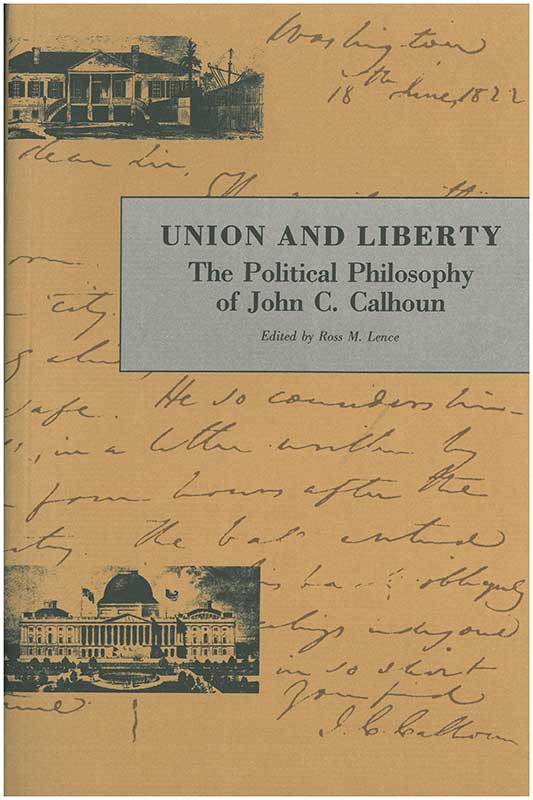
Front Page arrow Titles (by Subject) arrow SPEECH ON THE INTRODUCTION OF HIS RESOLUTIONS ON THE SLAVE QUESTION - Union and Liberty: The Political Philosophy of John C. Calhoun

Return to Title Page for Union and Liberty: The Political Philosophy of John C. Calhoun

Search this Title:

SPEECH ON THE INTRODUCTION OF HIS RESOLUTIONS ON THE SLAVE QUESTION - John C. Calhoun, Union and Liberty: The Political Philosophy of John C. Calhoun [1811]

Edition used:

Union and Liberty: The Political Philosophy of John C. Calhoun, ed. Ross M. Lence (Indianapolis: Liberty Fund, 1992).

About Liberty Fund:

Liberty Fund, Inc. is a private, educational foundation established to encourage the study of the ideal of a society of free and responsible individuals.


SPEECH ON THE INTRODUCTION OF HIS RESOLUTIONS ON THE SLAVE QUESTION

By the mid-1840s, tension over the issue of slavery had begun to consume the energies of the nation. Finding itself in the middle of a war with Mexico, the country could not long forestall the question of slavery in the new territories. The admission of Iowa threatened to tip the balance of power in the U.S. Senate between free and slave states. If that balance were lost, said Calhoun, the whole government would be turned over to the hands of the numerical majority— “a day that will not be far removed from political revolution, anarchy, civil war, and wide-spread disaster.”

This speech contains more than a mere discussion of the pragmatic difficulties of maintaining the delicate balance between the free and slave states. In anticipation of several of the critical elements of A Disquisition on Government, Calhoun offers a preliminary analysis of the tension between liberty of the community and individual liberty. He also advances his reasons for objecting to compromise founded upon the momentary whims of this or that majority in the Congress. Such compromise could no longer preserve the Union or offer any real security against an overbearing majority. What Calhoun saw as a pernicious form of compromise was quite different from his view of compromise within the framework of constitutional government argued for in the Disquisition and which forms the basis of his doctrine of the concurrent majority.

In increasingly ominous language, Calhoun warns that if recourse to fundamental, constitutional principles cannot resolve the crisis between the two great sections, then the parties to the compact may well have to consider extra-constitutional means to preserve and protect themselves.

Mr. Calhoun rose and said: Mr. President, I rise to offer a set of resolutions in reference to the various resolutions from the State legislatures upon the subject of what they call the extension of slavery, and the proviso attached to the House bill, called the Three Million Bill. What I propose before I send my resolutions to the table, is to make a few explanatory remarks.

Mr. President, it was solemnly asserted on this floor, some time ago, that all parties in the non-slaveholding States had come to a fixed and solemn determination upon two propositions. One was—that there should be no further admission of any States into this Union which permitted, by their constitutions, the existence of slavery; and the other was—that slavery shall not hereafter exist in any of the territories of the United States; the effect of which would be to give to the non-slaveholding States the monopoly of the public domain, to the entire exclusion of the slaveholding States. Since that declaration was made, Mr. President, we have had abundant proof that there was a satisfactory foundation for it. We have received already solemn resolutions passed by seven of the non-slaveholding States—one-half of the number already in the Union, Iowa not being counted—using the strongest possible language to that effect; and no doubt, in a short space of time, similar resolutions will be received from all of the non-slaveholding States. But we need not go beyond the walls of Congress. The subject has been agitated in the other House, and they have sent up a bill “prohibiting the extension of slavery” (using their own language) “to any territory which may be acquired by the United States hereafter.” At the same time, two resolutions which have been moved to extend the compromise line from the Rocky Mountains to the Pacific, during the present session, have been rejected by a decided majority.

Sir, there is no mistaking the signs of the times; and it is high time that the Southern States, the slaveholding States, should inquire what is now their relative strength in this Union, and what it will be if this determination should be carried into effect hereafter. Sir, already we are in a minority—I use the word “we” for brevity’s sake—already we are in a minority in the other House, in the electoral college, and I may say, in every department of this Government, except at present in the Senate of the United States—there for the present we have an equality. Of the twenty-eight States, fourteen are non-slaveholding and fourteen are slaveholding, counting Delaware, which is doubtful, as one of the non-slaveholding States. But this equality of strength exists only in the Senate. One of the clerks, at my request, has furnished me with a statement of what is the relative strength of the two descriptions of States, in the other House of Congress and in the electoral college. There are two hundred and twenty-eight representatives, including Iowa, which is already represented there. Of these, one hundred and thirty-eight are from non-slaveholding States, and ninety are from what are called the slave States—giving a majority, in the aggregate, to the former of forty-eight. In the electoral college there are one hundred and sixty-eight votes belonging to the non-slaveholding States, and one hundred and eighteen to the slaveholding, giving a majority of fifty to the non-slaveholding.

We, Mr. President, have at present only one position in the Government, by which we may make any resistance to this aggressive policy which has been declared against the South, or any other that the non-slaveholding States may choose to adopt. And this equality in this body is one of the most transient character. Already Iowa is a State; but owing to some domestic difficulties, is not yet represented in this body. When she appears here, there will be a addition of two Senators to the representatives here of the non-slaveholding States. Already Wisconsin has passed the initiatory stage, and will be here the next session. This will add two more, making a clear majority of four in this body on the side of the non-slaveholding States, who will thus be enabled to sway every branch of this Government at their will and pleasure. But, Sir, if this aggressive policy be followed—if the determination of the non-slaveholding States is to be adhered to hereafter, and we are to be entirely excluded from the territories which we already possess, or may possess—if this is to be the fixed policy of the Government, I ask, what will be our situation hereafter?

Sir, there is ample space for twelve or fifteen of the largest description of States in the territories belonging to the United States. Already a law is in course of passage through the other House creating one north of Wisconsin. There is ample room for another north of Iowa; and another north of that; and then that large region extending on this side of the Rocky Mountains, from 49 degrees down to the Texan line, which may be set down fairly as an area of twelve and a half degrees of latitude. That extended region of itself is susceptible of having six, seven, or eight large States. To this, add Oregon which extends from 49 to 42 degrees, which will give four more; and I make a very moderate calculation when I say that, in addition to Iowa and Wisconsin, twelve more States upon the territory already ours—without reference to any acquisitions from Mexico—may be, and will be, shortly added to these United States. How will we then stand? There will be but fourteen on the part of the South—we are to be fixed, limited, and forever—and twenty-eight on the part of the non-slaveholding States! Twenty-eight! Double our number! And with the same disproportion in the House and in the electoral college! The Government, Sir, will be entirely in the hands of the non-slaveholding States—overwhelmingly.

Sir, if this state of things is to go on; if this determination, so solemnly made, is to be persisted in—where shall we stand, as far as this Federal Government of ours is concerned? We shall be at the entire mercy of the non-slaveholding States. Can we look to their justice and regard for our interests? Now, I ask, can we rely on that? Ought we to trust our safety and prosperity to their mercy and sense of justice? These are the solemn questions which I put to all—this and the other side of the Chamber.

Sir, can we find any hope by looking to the past? If we are to look to that—I will not go into the details—we will see from the beginning of this Government to the present day, as far a pecuniary resources are concerned—as far as the disbursement of revenue is involved, it will be found that we have been a portion of the community which has substantially supported this Government without receiving any thing like a proportionate return. But why should I go beyond this very measure itself? Why go beyond this determination on the part of the non-slaveholding States—that there shall be no further addition to the slaveholding States—to prove what our condition will be?

Sir, what is the entire amount of this policy? I will not say that it is so designed. I will not say from what cause it originated. I will not say whether blind fanaticism on one side—whether a hostile feeling to slavery entertained by many not fanatical on the other, has produced it; or whether it has been the work of men, who, looking to political power, have considered the agitation of this question as the most effectual mode of obtaining the spoils of this Government. I look to the fact itself. It is a policy now openly avowed as one to be persisted in. It is a scheme, Mr. President, which aims to monopolize the powers of this Government and to obtain sole possession of its territories.

Now, I ask, is there any remedy? Does the Constitution afford any remedy? And if not, is there any hope? These, Mr. President, are solemn questions—not only to us, but, let me say to gentlemen from the non-slaveholding States: to them. Sir, the day that the balance between the two sections of the country—the slaveholding States and the non-slaveholding States—is destroyed, is a day that will not be far removed from political revolution, anarchy, civil war, and widespread disaster. The balance of this system is in the slaveholding States. They are the conservative portion—always have been the conservative portion—always will be the conservative portion; and with a due balance on their part may, for generations to come, uphold this glorious Union of ours. But if this scheme should be carried out—if we are to be reduced to a handful—if we are to become a mere ball to play the presidential game with—to count something in the Baltimore caucus—if this is to be the result—wo! wo! I say, to this Union!

Now, Sir, I put again the solemn question—Does the constitution afford any remedy? Is there any provision in it by which this aggressive policy (boldly avowed, as if perfectly consistent with our institutions and the safety and prosperity of the United States) may be confronted? Is this a policy consistent with the Constitution? No, Mr. President, no! It is, in all its features, daringly opposed to the constitution. What is it? Ours is a Federal Constitution. The States are its constituents, and not the people. The twenty-eight States—the twenty-nine States (including Iowa)—stand under this Government as twenty-nine individuals, or as twenty-nine millions of individuals would stand to a consolidated power! No, Sir; it was made for higher ends; it was so formed that every State, as a constituent member of this Union of ours, should enjoy all its advantages, natural and acquired, with greater security, and enjoy them more perfectly. The whole system is based on justice and equality—perfect equality between the members of this republic. Now, can that be consistent with equality which will make this public domain a monopoly on one side—which, in its consequences, would place the whole power in one section of the Union, to be wielded against the other sections? Is that equality?

How, then, do we stand in reference to this territorial question—this public domain of ours? Why, Sir, what is it? It is the common property of the States of this Union. They are called “the territories of the United States.” And what are the “United States” but the States united? Sir, these territories are the property of the States united; held jointly for their common use. And is it consistent with justice—is it consistent with equality, that any portion of the partners, outnumbering another portion, shall oust them of this common property of theirs—shall pass any law which shall proscribe the citizens of other portions of the Union from emigrating with their property to the territories of the United States? Would that be consistent—can it be consistent with the idea of a common property, held jointly for the common benefit of all? Would it be so considered in private life? Would it not be considered the most flagrant outrage in the world, one which any court of equity would restrain by injunction—which any court of law in the world would overrule?

Mr. President, not only is that proposition grossly inconsistent with the constitution, but the other, which undertakes to say that no State shall be admitted into this Union, which shall not prohibit by its constitution the existence of slaves, is equally a great outrage against the constitution of the United States. Sir, I hold it to be a fundamental principle of our political system that the people have a right to establish what government they may think proper for themselves; that every State about to become a member of this Union has a right to form its government as it pleases; and that, in order to be admitted there is but one qualification, and that is, that the Government shall be republican. There is no express provision to that effect, but it results from that important section which guarantees to every State in this Union a republican form of government. Now, Sir, what is proposed? It is proposed, from a vague, indefinite, erroneous, and most dangerous conception of private individual liberty, to overrule this great common liberty which a people have of framing their own constitution! Sir, the right of framing self-government on the part of individuals is not near so easily to be established by any course of reasoning, as the right of a community or State to self-government. And yet, Sir, there are men of such delicate feeling on the subject of liberty—men who cannot possibly bear what they call slavery in one section of the country—although not so much slavery, as an institution indispensable for the good of both races—men so squeamish on this point, that they are ready to strike down the higher right of a community to govern themselves, in order to maintain the absolute right of individuals in every possible condition to govern themselves!

Mr. President, the resolutions that I intend to offer present, in general terms, these great truths. I propose to present them to the Senate; I propose to have a vote upon them; and I trust there is no gentleman here who will refuse it. It is manly—it is right, that such a vote be given. It is due to our constituents that we should insist upon it; and I, as one, will insist upon it that the sense of this body shall be taken; the body which represents the States in their capacity as communities, and the members of which are to be their special guardians. It is due to them, Sir, that there should be a fair expression of what is the sense of this body. Upon that expression much depends. It is the only position we can take, that will uphold us with any thing like independence—which will give us any chance at all to maintain an equality in this Union, on those great principles to which I have referred. Overrule these principles, and we are nothing! Preserve them, and we will ever be a respectable portion of the Union.

Sir, here let me say a word as to the compromise line. I have always considered it as a great error—highly injurious to the South, because it surrendered, for mere temporary purposes, those high principles of the constitution upon which I think we ought to stand. I am against any compromise line. Yet I would have been willing to acquiesce in a continuation of the Missouri compromise, in order to preserve, under the present trying circumstances, the peace of the Union. One of the resolutions in the House, to that effect, was offered at my suggestion. I said to a friend there, “Let us not be disturbers of this Union. Abhorrent to my feelings as is that compromise line, let it be adhered to in good faith; and if the other portions of the Union are willing to stand by it, let us not refuse to stand by it. It has kept peace for some time, and, in the present circumstances, perhaps, it would be better to be continued as it is.” But it was voted down by a decided majority. It was renewed by a gentleman from a non-slaveholding State, and again voted down by a like majority.

I see my way in the constitution. I cannot in a compromise. A compromise is but an act of Congress. It may be overruled at any time. It gives us no security. But the constitution is stable. It is a rock. On it we can stand, and on it we can meet our friends from the non-slaveholding States. It is a firm and stable ground, on which we can better stand in opposition to fanaticism, than on the shifting sands of compromise.

Let us be done with compromises. Let us go back and stand upon the constitution!

Well, Sir, what if the decision of this body shall deny to us this high constitutional right, not the less clear because deduced from the entire body of the instrument, and the nature of the subject to which it relates, instead of being specially provided for? What then? I will not undertake to decide. It is a question for our constituents, the slaveholding States—a solemn and a great question. If the decision should be adverse, I trust and do believe that they will take under solemn consideration what they ought to do. I give no advice. It would be hazardous and dangerous for me to do so. But I may speak as an individual member of that section of the Union. Here I drew my first breath; there are all my hopes. There is my family and connections. I am a planter—a cotton-planter. I am a Southern man and a slaveholder—a kind and a merciful one, I trust—and none the worse for being a slaveholder. I say, for one, I would rather meet any extremity upon earth than give up one inch of our equality—one inch of what belongs to us as members of this great republic! What acknowledge inferiority! The surrender of life is nothing to sinking down into acknowledged inferiority!

I have examined this subject largely—widely. I think I see the future if we do not stand up as we ought. In my humble opinion, in that case, the condition of Ireland is prosperous and happy—the condition of Hindostan is prosperous and happy—the condition of Jamaica is prosperous and happy, to what the Southern States will be if they should not now stand up manfully in defence of their rights.

Mr. President, I desire that the resolutions which I now send to the table be read.

[The resolutions were read as follows:

Resolved, That the territories of the United States belong to the several States composing this Union, and are held by them as their joint and common property.

Resolved, That Congress, as the joint agent and representative of the States of this Union, has no right to make any law, or do any act whatever, that shall directly, or by its effects, make any discrimination between the States of this Union, by which any of them shall be deprived of its full and equal right in any territory of the United States, acquired or to be acquired.

Resolved, That the enactment of any law, which should directly, or by its effects, deprive the citizens of any of the States of this Union from emigrating, with their property, into any of the territories of the United States, will make such discrimination, and would, therefore, be a violation of the constitution and the rights of the States from which such citizens emigrated, and in derogation of that perfect equality which belongs to them as members of this Union—and would tend directly to subvert the Union itself.

Resolved, That it is a fundamental principle in our political creed, that a people, in forming a constitution, have the unconditional right to form and adopt the government which they may think best calculated to secure their liberty, prosperity, and happiness; and that, in conformity thereto, no other condition is imposed by the Federal Constitution on a State, in order to be admitted into this Union, except that its constitution shall be republican; and that the imposition of any other by Congress would not only be in violation of the constitution, but in direct conflict with the principle on which our political system rests.” ]

I move that the resolutions be printed. I shall move that they be taken up tomorrow; and I do trust that the Senate will give them early attention and an early vote upon the subject.