Econlib

The Library

Other Sites

Front Page arrow Titles (by Subject) arrow EDITOR'S NOTE - Union and Liberty: The Political Philosophy of John C. Calhoun

Return to Title Page for Union and Liberty: The Political Philosophy of John C. Calhoun

Search this Title:

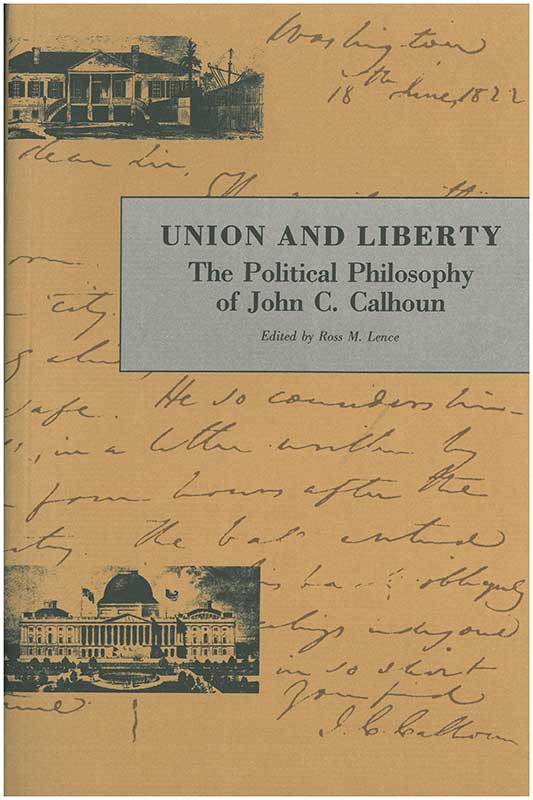
EDITOR’S NOTE - John C. Calhoun, Union and Liberty: The Political Philosophy of John C. Calhoun [1811]

Edition used:

Union and Liberty: The Political Philosophy of John C. Calhoun, ed. Ross M. Lence (Indianapolis: Liberty Fund, 1992).

About Liberty Fund:

Liberty Fund, Inc. is a private, educational foundation established to encourage the study of the ideal of a society of free and responsible individuals.


EDITOR’S NOTE

Many of the documents reprinted in this volume (including Calhoun’s A Discourse on the Constitution and Government of the United States) have not been available to the general reader since the initial publication of Richard K. Crallé ’s six-volume Works of John C. Calhoun in 1851–1856. For some fifty years following the publication of Crallé ’s Works, these volumes remained the only source of primary Calhoun materials. In 1900, Calhoun scholarship was renewed when J. Franklin Jameson published a selected edition of Calhoun’s correspondence as the fourth annum report of the Historical Manuscripts Commission under the title Correspondence of John C. Calhoun (Washington, D.C., 1900). A second volume of Calhoun’s correspondence appeared some thirty years later under the editorship of Chauncey S. Boucher and Robert P. Brooks entitled Correspondence Addressed to John C. Calhoun, 1837–1849: Sixteenth Report of the Historical Manuscripts Commission (Washington, D.C., 1930). Probably the most circulated of Calhoun’s works was his A Disquisition on Government, which appeared in two separate editions: John M. Anderson’s Calhoun: Basic Documents (Bald Eagle Press, 1952) and C. Gordon Post’s A Disquisition on Government and Selections from the Discourse (Bobbs-Merrill, 1953).

At the present time, the University of South Carolina is engaged in a massive effort to reproduce the entire corpus of Calhoun’s works. That collection, entitled The Papers of John C. Calhoun (Columbia, S.C., 1959–), under the able editorship of W. Edwin Hemphill, Robert L. Meriwether, and Clyde Wilson, is expected to take several more years to complete. To date, twenty volumes of Calhoun’s works have been published by the University of South Carolina Press, covering the period of Calhoun’s political life through December 1844. When that project is completed, it will represent the single most comprehensive source of Calhoun scholarship, bringing together literally thousands of documents and writings of John Calhoun.

Note on Sources

The primary source of Calhoun’s political essays, speeches, and letters that appear in this volume is the Works of John C. Calhoun (New York, 1851–1856), edited by Calhoun’s friend and confidant, Richard K. Crallé. Whenever possible, the text of Crallé has been carefully compared to other printed copies of the speeches and writings of Calhoun. The primary bases of comparison were the Annals of Congress (a report of the congressional proceedings of the 1st through 12th Congress compiled by Gales and Seaton from newspapers, magazines, and other sources), the Register of Debates (a direct report of the congressional proceedings from 1824 to 1837 published by Gales and Seaton), and The Congressional Globe (a report of the 23rd through 42nd Congress published by Blair and Rives; F. and J. Rives; F. and J. Rives and George A. Bailey).

There are many reasons for using Crallé ’s Works as the primary text, not the least of which is that Crallé had available to him many manuscripts which are no longer extant. Furthermore, a rigorous comparison of Crallé ’s text with contemporary reports of Calhoun’s remarks seems to confirm Crallé ’s claim in his advertisement to the first volume of his Works that in it is reprinted, with very few exceptions, “the Work ... as it came from the hands of the author.” In those few instances where Crallé seems to alter the text of Calhoun’s remarks, for whatever reason, the changes in the text were always minor. Upon reflection, I could find no justification for substituting my own interpretation of the passages in question for those of Crallé, and such a practice would deny Crallé ’s text its rightful place in the history of Calhoun scholarship.

Those familiar with the Annals of Congress, the Register of Debates, and The Congressional Globe (all forerunners of the Congressional Record, which first made its appearance on December 1, 1873) are cognizant of the enormous variance in both the style and language of the speeches reported. Indeed, that variance is evident in the two versions of Calhoun’s remarks in his “Speech on the Reception of Abolition Petitions” reprinted in this volume, and in the third-person presentation of some of his speeches. Much of the variance is due to editorial practices of the newspapers of the day, rather than to the vagaries of Calhoun’s speech and thought. Calhoun hardly ever reviewed or revised his remarks owing to the press of daily business, and he had almost no concern for questions of style per se.

Again, Crallé ’s remarks in his advertisement to the first volume of his Works are instructive:

In preparing the manuscripts for the press, the editor has sedulously endeavored to preserve, not only the peculiar modes of expression, but the very words of the author—without regard to ornaments of style or rules of criticism. They who knew him well, need not to be told that, to these, he paid but slight respect. Absorbed by his subject, and earnest in his efforts to present the truth to others, as it appeared to himself, he regarded neither the arts nor the ornaments of meretricious elocution. He wrote as he spoke, sometimes negligently, yet always plainly and forcibly, and it is due to his own character, as well as to the public expectation, that his views should be presented in the plain and simple garb in which he left them.

My general editorial procedure has been, in short, to keep as close as possible to the text of Crallé. Indeed, every effort has been made to be as nonintrusive as possible. Like Crallé, however, I have sometimes found it necessary to correct for minor typographical errors and punctuation, especially where a careful reading of the speeches as reported in other sources suggests that Calhoun intended a different emphasis to these remarks. In no instance have any changes been made without at least one or more primary documents to support such an alteration.

In the few cases where Crallé does not include the entire speech or address, another source was used:

  • The first two paragraphs of the Fort Hill Address are taken from Niles Weekly Register, Vol. XL, no. 25 (August 20, 1831).
  • The First Report of the Speech on the Reception of Abolition Petitions is taken from the Register of Debates, 24th Congress, 2nd Sess., Cols. 710-719.
  • The Edgefield Letter is taken from the Niles National Register, Vol. LIII, no. 14 (December 2, 1837), pp. 217–218.
  • The words Calhoun used when introducing Mr. Mason, who read the Speech on the Admission of California and the General State of the Union, are taken from The Congressional Globe, Washington, D.C., March 4, 1850, p. 541.

The reader will find within the text occasional commentary describing the reading of resolutions, remarks by other speakers, and other events that occurred during Calhoun’s speeches. These explanatory remarks, which often are in brackets, are contained in the version of the speech reproduced in this edition. (The one exception is the First Report on the Reception of Abolition Petitions, as indicated there.)

Acknowledgments

Among the greatest sins in the world must be those of pettiness and ingratitude. I sincerely hope that I am guilty of neither of these in the production of this volume. I would like to thank the late Professor Charles S. Hyneman, Distinguished Service Professor of Indiana University, who first brought John Calhoun to my attention. I still remember his advice to me so many years ago: “Son, if you want to understand America, you don’t want to miss this guy Calhoun.” I also would like to thank George Carey, Charles McCall, Michael and Caron Jackson, Bill Burrow, Dan Palazzolo, John Leech, and James Gladden, who in one way or another have provided the intellectual stimulation for this project. I am especially appreciative of the research support of Judy Bundy for her work on Calhoun, and of Glenn Gadbois, whose service in the last stages of this manuscript have been invaluable; the patience of countless unnamed students whose long-delayed papers have made it possible for me to find the needed time to work on this project; and last, but by no means least, the moral support of my best friend and mother, whose innumerable hours of cutting and pasting have finally come to fruition.