EconlibThe LibraryOther Sites |
Front Page Titles (by Subject) PART 4: Basic Constitutional Concepts: Federalism, Separation of Powers, and Rule of Law - Liberty, Order, and Justice: An Introduction to the Constitutional Principles of American Government
Return to Title Page for Liberty, Order, and Justice: An Introduction to the Constitutional Principles of American GovernmentThe Online Library of LibertyA project of Liberty Fund, Inc.Search this Title:Also in the Library:
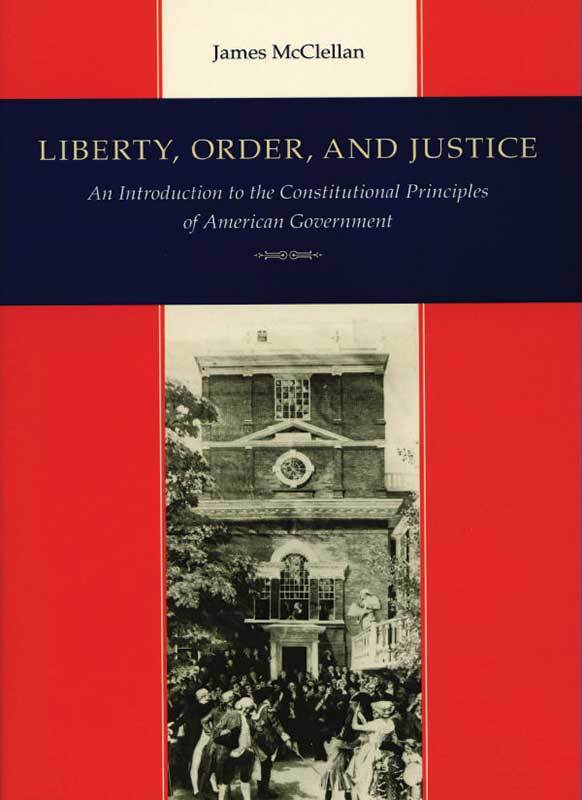
PART 4: Basic Constitutional Concepts: Federalism, Separation of Powers, and Rule of Law - James McClellan, Liberty, Order, and Justice: An Introduction to the Constitutional Principles of American Government [1989]Edition used:Liberty, Order, and Justice: An Introduction to the Constitutional Principles of American Government (3rd ed.) (Indianapolis: Liberty Fund, 2000).
About Liberty Fund:Liberty Fund, Inc. is a private, educational foundation established to encourage the study of the ideal of a society of free and responsible individuals. Copyright information:The copyright to this edition, in both print and electronic forms, is held by Liberty Fund, Inc. Fair use statement:This material is put online to further the educational goals of Liberty Fund, Inc. Unless otherwise stated in the Copyright Information section above, this material may be used freely for educational and academic purposes. It may not be used in any way for profit.
PART 4Basic Constitutional Concepts: Federalism, Separation of Powers, and Rule of LawPOINTS TO REMEMBER1. The American system of federalism divides political power between two levels of government. Those powers not delegated to the Federal government are reserved to the States. Article I of the Constitution specifies the delegated and implied powers of Congress, and also enumerates those powers that are prohibited to both Congress and the States. Some powers of Congress are exclusive; and others are concurrent, meaning they are shared with another branch or with the States. 2. The States have certain obligations to the Federal government and to each other, and the Federal government has certain obligations to the States. Most of these obligations that each owes the other are framed in Article IV of the Constitution. 3. Formal changes of the constitutional structure must be approved by three-fourths of the States through the amendment process, which is provided by Article V of the Constitution. Every amendment that has been added to the Constitution was proposed by a two-thirds vote of Congress. The States may initiate amendments but have never exercised this power. Congress decides whether the amendment shall be ratified by the State legislatures or by the States meeting in convention. All but the 21st Amendment have been ratified by the State legislatures. 4. The American system of separation of powers is not a pure separation of powers. Although the officeholders in each branch are separate and distinct, the functions overlap. This overlapping of functions forms an elaborate check and balance system, allowing each branch to check the encroachments of another. In this way the separation of powers is actually maintained. 5. The American constitutional system is based on rule of law, the Constitution itself being the supreme law. Thus in the United States, no man or government or branch of the government is above the law. If the Constitution is to be changed, only the people can change it—and then only by the amendment process. 6. Although the President is powerful and independent, and is charged with the duty of executing the laws, he is not above the law. Limitations on his power derive from the method by which he is elected by the electoral college and from the checks on his exercise of power by Congress and the Supreme Court. The Constitution of the United States provides a framework of political and legal institutions. Within this framework are certain general concepts or ideas about freedom and political order. Although they are not explicitly stated in the Constitution, they nevertheless provide the theoretical structure upon which the seven articles of the original document are built. An understanding of these unwritten concepts is essential to an understanding of the meaning and purpose of the Constitution. The first of these is the concept of federalism. The American federal union is neither a centralized political structure nor a mere league of independent States. The federal system of government embodied in the Constitution is designed to limit power by dividing it. The second is the concept of the separation of powers. This is intended to prevent a concentration and abuse of power by one branch over another. By separating the personnel and functions of government, the Constitution provides a mechanism that facilitates the achievement of Rule of Law. The third is the concept of the rule of law. This is sometimes expressed as “a government of laws and not of men.” All people who hold political authority are subject to the law of the land, and their public actions must conform to the Constitution and to certain principles of law. All three of these concepts restrain the Federal government’s powers. The Constitution, in short, set up a powerful general government; but it also established effective checks upon the exercise of power through a carefully designed system of constitutional devices. A.FederalismA federal system of government is one in which political authority is divided between a general or national government and regional (or “state”) governments. The general government carries on the military and diplomatic functions of the country and deals with many other matters of national concern. The state or regional governments carry on the public activities that most directly affect the citizens, such as police and fire protection. In a federal political structure, the state governments are not mere provincial agencies of a central government. For under federalism, the state or regional governments have their own constitutional powers that the general government must recognize and respect. On the other hand, the state governments in a federal system have less independence than do states that are members of a confederation or league. The governmental system of the United States is the earliest example of federalism in the modern sense of that word. Nowadays, when the word federalism is used throughout the world, it means a system like that of the United States, with political authority divided between two spheres of authority. The American federal system is an extremely complex pattern of interrelated processes simultaneously at work, a blend of independence and interdependence. Federalism may be defined as a system of government in which there are two levels of authority, national and state, operating side by side, with each level generally supreme within its sphere of power. K. C. Wheare, a noted British authority on federalism, defines the federal principle as a “method of dividing powers so that the general and regional governments are each, within a sphere, coordinate and independent,” and further, “that each government should be limited to its own sphere and, within that sphere, should be independent of the other.” To this we should add that federalism requires a written constitution. The reason is quite simple: there must be a fundamental law delineating the two spheres of authority, lest neither sphere will know the limit of its powers. If the central government acquires too much power, it may swallow up the weaker states, creating a unitary form of government. If, on the other hand, the state governments become too powerful, the union may be reduced to a league or confederation, or be abolished altogether. Now the Framers of America’s Constitution did not create a federal pattern of politics because they had read about something of the sort in an old book. No, American federalism resulted from circumstances in the United States in the year 1787 rather than an abstract theory. True, many of the Framers saw that a weak confederation, under the Articles, was an insufficient system of government. And they perceived that centralized or unitary government (then the pattern in nearly all European states) had its grave faults. But the primary reason why the Framers chose a federal system was that the federal arrangement was just what the American people wanted, and needed, in a very practical sense, in 1787. Federalism as a theory of government, in other words, emerged after the Framers wrote the Constitution. One alternative to federalism was simply to continue the arrangement established under the Articles of Confederation, and a good many Americans might have been content enough to do so. But this feeble confederation had major economic disadvantages and scarcely could defend itself against foreign enemies. The other alternative to federalism was a unitary, or centralized, form of government, with all real power concentrated in the nation’s capital. Turgot, Condorcet, and other French political thinkers of the 1780s were surprised and almost indignant that the Americans had not formed such a political structure when they won their independence from Britain. But the American people, having thrown off the central power of the King-in-Parliament, were not disposed to establish some new central authority to tell them what to do. Besides, the great majority of American citizens were warmly attached to their State and local governments. They feared that consolidation would diminish their local and personal freedoms. What the Framers agreed upon, then, was a satisfactory compromise between the people who desired a strong general government and the people who wanted to preserve State and local powers of decision. Under the federal arrangement—something new in human society, at least on so large a scale as in the United States—the several States were still called “sovereign,” as if there were no higher political power above them. But through the federal arrangement, there was created a general government with vastly superior powers. The Constitution allocated some powers to the Federal government, and guaranteed that all other political powers would be reserved to the States or to the people in those States. This division of powers, or “dual sovereignty,” though hotly debated during 1787–1788, was accepted by the States when they ratified the Constitution. Powers Delegated to CongressTo understand the federal system of government set up by the Constitution, we must look first at Article I, Sections 8, 9, and 10 of that document. Sections 8 and 9 assign some powers to the general government, and deny that general government other powers; Section 10 denies certain powers to the State governments. By these provisions, the Congress—that is, the Federal government—is authorized to “lay and collect taxes, duties, imposts, and excises, to pay the debts and provide for the common defense and general welfare of the United States; but all duties, imposts and excises shall be uniform throughout the United States.” Thus the new Constitution gave the National Government money-raising power that the government of the Articles of Confederation never had enjoyed. Many other powers were delegated by the States to Congress by the Constitution—powers that we now take for granted, but which in 1787 made many, and perhaps most, Americans very uneasy. As John Quincy Adams said in 1839, the Constitution “had been extorted from the grinding necessity of a reluctant nation.” Independent of Britain for only a few years, the citizens of the new Republic did not relish the notion of surrendering State sovereignty, even some of it, to a national government. Indeed, even some villages and townships thought of themselves as sovereign, free from any higher political authority. They resented the interference of even State governments. So it is not surprising that the powers given to Congress by Article I of the Constitution alarmed some of the men who had been foremost in the struggle against British rule. Section 8 of Article I also authorized the Congress to borrow money, regulate foreign and interstate trade, coin money, establish post offices and post roads, establish Federal courts, declare war, raise armies and build navies, put down rebellions, organize an armed militia within the States, and do all things “necessary and proper” to put into effect these and certain other specified powers. Today, nobody is surprised that the Federal government establishes rules for naturalization and bankruptcy, punishes counterfeiters, grants copyrights and patents. Yet until the Constitution was ratified in 1788, the government of the United States performed no such functions. Powers Denied to CongressThese great grants of power to the Congress had to be balanced by certain strong restraints on federal authority if the people of the thirteen States were to be persuaded to ratify the Constitution. So Section 9 of Article I sets definite limits on what Congress may do. The first-listed restraint, which seems odd to us today, is that Congress might not forbid the importation of slaves until 1808. This temporary provision is followed by guarantees of ancient rights and privileges derived from the British common law and constitution. The first of these is the privilege of habeas corpus, a Latin term meaning “you have the body.” A writ of habeas corpus is an order issued by a court to an arresting officer, directing him to bring a prisoner before the court. If confinement was improper, the judge will order his release. The writ of habeas corpus, one of the most ancient liberties inherited from England, is wholly procedural in character and defines no rights. But it offers persons charged with a crime one of their most important protections against illegal arrest and confinement, and serves as an important check on the illegal usurpation of power by the executive. The writ has been used in England and the United States to test the legality of virtually any confinement, including detention by military authorities. Under the Constitution, Congress may suspend this privilege in times of rebellion or invasion. During the Civil War, President Lincoln suspended the writ without Congressional authorization, and was much criticized for his action. The second guarantee is protection against bills of attainder. This is a legislative act designed to punish a particular individual without a jury trial. Congress can determine what conduct shall be considered a federal crime, but no one can be punished until after a jury trial. This guarantee is an important check on the illegal usurpation of power by the legislature. The prohibition was originally adopted in England to outlaw the practice of legislative punishment, whereby individuals could be condemned to death by a special act of Parliament. Legislative acts inflicting lesser punishments are called bills of “pains and penalties.” As interpreted by the Supreme Court, the prohibition against bills of attainder extends to all legislative acts, “no matter what their form, that apply either to named individuals or to easily ascertainable members of a group in such a way as to inflict punishment on them without a judicial trial.” The third guarantee, which is also a check on the legislature inherited from English law, is protection against ex post facto laws. These are retrospective or retroactive laws which impose criminal penalties for acts that were not illegal when they were performed. Over the years, the Supreme Court has interpreted the prohibition to include any law which operates to the disadvantage of an individual accused of a crime committed before the law was passed. This includes laws that change the punishment and inflict a greater penalty than the one affixed to the crime when it was committed, and laws that alter the rules of evidence so as to permit less or different evidence for a conviction than was required at the time the crime was committed. The ex post facto clause was apparently intended by the Framers to apply to retrospective laws devaluing property rights, but very early in our history the Supreme Court held in Calder v. Bull (1798) that the restriction applies only to criminal laws. Section 9 also forbids Congress to levy direct taxes unless in proportion to population; to tax exports; or to favor the ports or shipping of one State over the ports or shipping of another State. Federal officials are forbidden from drawing money from the Treasury except in accordance with Congress’s appropriation of funds. Finally, Section 9 forbids Congress to grant titles of nobility. Nor can anyone connected with the Federal administration accept gifts, or titles, or other favors from foreign governments without Congressional consent. Powers Denied to the StatesThe list of what State governments might not do under Section 10 was quite as specific as the longer list of prohibitions upon the Federal government. No State may make foreign alliances or treaties; license privately owned ships to prey upon enemy vessels (a power held under Section 8 by the Federal government); coin money or issue paper money, or otherwise impair the Federal government’s monopoly of money-issuing; pass bills of attainder or ex post facto laws; interfere with contractual obligations; or grant titles of nobility. Nor may any State’s legislature—unless granted the consent of Congress—tax exports or imports, except for incidental expenses of inspection; and even should Congress permit such export-import taxes, the money collected must go into the Federal treasury. Neither may any State, without the express consent of Congress, maintain troops or naval vessels, enter into an agreement with any other State or with a foreign power, or go to war unless actually invaded and in imminent danger. These limitations aside, the State governments could do much as they liked, so far as the Federal Constitution was concerned. It was up to the State constitutions to provide restraints upon political power at the State level, should the people of the States so choose. The Division of PowersThese provisions of Article I promptly produced certain beneficial and practical effects. They gave the new general government essential powers that were sorely lacking in the old Confederation government; and they curtailed certain powers formerly asserted by the State governments that sometimes had endangered the Union itself. Still more important, perhaps, in the long run, was Article I’s creation of an enduring federal design of government. That federal system contrived in 1787 still is functioning in the United States—even though the powers of the Federal government have since grown at the expense of the State governments. In effect, after 1788 the American nation would benefit from two coordinate governments, each with its own legislative, executive, and judicial branches. The general or Federal government would concern itself with matters of high national importance, chiefly diplomacy, the common defense, international and interstate commerce, issuing of money, management of the nation’s western territories, ensuring a republican form of government in all States, and performing other public functions that no State could undertake adequately in isolation. The State governments—thirteen of them to begin with, but soon several more—would carry on the administration of justice within their own boundaries, protecting people and property, maintaining the courts of law that dealt with most litigation, overseeing local governments, maintaining roads, transportation, and communications, and in general protecting the health, safety, and welfare of their citizens through the exercise of what is called “the state police powers.” Thus the State governments were in many ways independent of the Federal government. Ordinarily the actions of the Federal organization and the actions of the State governments would not conflict because they operated on different levels of public policy. Nevertheless, a good many American political leaders foresaw difficulties in the relationship between the national government and the States. For most Americans in our early republic, the idea of a national capital in some remote city seemed alien. Their hearts did not warm to it. There were marked differences among the States, and also between North and South, East and West—contrasting patterns of culture, economic activity, social institutions, customs, manners, speech. So we ought not to be surprised that many Americans’ first loyalty was to their State, rather than to the Federal union. The really surprising thing is that, despite this affection for one’s State and one’s local community, the people of the thirteen original States did assent, if reluctantly, to the federal structure set up by the new Constitution. Their assent was reluctant because many of them could perceive that the autonomy, or self-government, of the States must be diminished in a federal system. This was because the Federal government was authorized by the Constitution to operate directly upon the citizens of every State, in a number of ways, whether or not a State government might agree with Federal policies. That is, the Federal power must prevail over State power when the Federal government is exercising one of the enumerated powers specified in the Constitution, usually in Article I. Most enumerated powers are also called delegated powers because they originated in the States and were delegated or assigned by the States to the national government. In addition to enumerated powers, Congress also possesses under Article I, Section 8, by means of the “Necessary and Proper” Clause, certain implied powers. Article I, Section 8, Clause 18 provides that Congress shall have, in addition to the preceding enumerated powers, the power “to make all laws which shall be necessary and proper, for carrying into execution the foregoing powers, and all other powers vested by this Constitution in the Government of the United States, or in any Department or officer thereof.” Congress was given, for example, the enumerated power to regulate commerce among the States. Through the Necessary and Proper Clause, Congress therefore might regulate the shipment of goods from one State to another, if it could be demonstrated that this was a necessary and proper exercise of its power to regulate interstate commerce generally. The Necessary and Proper Clause, it may thus be seen, expands the enumerated powers of Congress, and for that reason is also referred to as the “elastic clause.” But the clause does not give Congress the implied power to make laws for any purpose whatever—only for the purpose of executing its enumerated powers and “all other powers vested by this Constitution in the Government of the United States or in any department or officer thereof,” meaning the President and the Federal courts. Congress’ implied powers, therefore, are not limited to the execution of its own enumerated powers. By virtue of this “all other powers” provision, Congress has the implied power to share in the responsibilities of other departments. It is under the authority of this provision, for example, that Congress passes laws to implement treaty obligations of the United States and to organize the Federal judicial system. Accordingly, the Necessary and Proper Clause confers important and far-reaching powers on Congress; and by giving Congress a voice in the affairs of the other branches, it also plays a key role in the check and balance system that will be examined later. It should also be noted that each house of Congress possesses additional powers that are not always clearly specified in the Constitution. These are powers inherited from the English Parliament and the early State legislatures, and thus are called “inherited” powers. Under certain circumstances, for example, each house can exclude persons from its membership. Other important inherited powers include the power to conduct investigations, to subpoena witnesses, and to judge the qualifications of members. Taken together, the powers of Congress may be classified as: (1) enumerated or delegated, as seen in Article I, Section 8; (2) implied, as seen again in Article I, Section 8; (3) prohibited, as seen in Article I, Section 9; and (4) inherited, as seen in Article I, Section 5. These powers can be further subdivided as exclusive and concurrent. An example of an exclusive power of Congress is the power to declare war. Thus the President cannot, on his own authority, declare war against another country, though he can, as Commander-in-Chief of the armed forces, participate with Congress in making war against a foreign enemy. The war-making power is, in fact, a concurrent power, one that Congress shares with the President. Congress also shares certain powers with the States. Its power to levy an income tax, for example, is a concurrent power because the States can also levy such a tax. All other powers are commonly called reserved or residual powers. These are the unspecified powers that the people or the States did not delegate or surrender to Congress or the general government, and reserved to themselves. This reservation of various powers to the States was reaffirmed in the Tenth Amendment to the Constitution, which provides that “The powers not delegated to the United States by the Constitution, nor prohibited by it to the States, are reserved to the States respectively, or the people.” The Tenth Amendment is a rule of interpretation not only for the Federal courts, but also for Congress and the President. At one point in our history, the reserved powers were often regarded as the exclusive powers of the States. As such, they served to limit the powers of the Federal government. Article I, Section 8, for example, empowers Congress “to regulate commerce among the several States,” suggesting, therefore, that local commerce, wholly within a single State, could not be regulated by the Federal government. The Supreme Court has rejected this interpretation, however, and the Tenth Amendment is no longer interpreted by the courts as a limitation on Federal power. Today, it usually makes no constitutional difference whether an act of Congress governs an institution or activity otherwise reserved to the States. For this reason, federalism has weakened over the years, and much power formerly controlled by the States has been shifted to the central government. This reallocation of power is known as the centralization or nationalization of power, a phenomenon that is praised by some and criticized by others. The Supremacy ClauseIn reviewing the relationship between the Federal and State governments, we should also note the significance of the “Supremacy Clause” of the Constitution. Article VI provides that, This Constitution, and the laws of the United States which shall be made in pursuance thereof; and all treaties made, or which shall be made, under the authority of the United States, shall be the supreme law of the land; and the judges in every State shall be bound thereby, any thing in the Constitution or laws of any State to the contrary notwithstanding. This key provision, rarely found in other constitutions, establishes the supremacy of the Constitution over all Federal laws, State constitutions, and State laws. It also establishes the supremacy of Federal laws and treaties over State constitutions and State laws, so long as they are made in pursuance of (in conformity with) the Constitution and are therefore constitutional. If an act of Congress is constitutional, and conflicts with a State constitution or law, the Federal law prevails. Thus, a provision of a State constitution or law, even if it conforms to the United States Constitution, may nevertheless be set aside if it conflicts with an act of Congress or a treaty. Within the field of its powers, the powers of the national government are supreme, and the State courts are bound to uphold this supremacy. Lodging so much power in the Federal government was viewed with suspicion by Samuel Adams of Massachusetts, by Patrick Henry of Virginia, and by many other American leaders. James Madison endeavored to assure such doubters that in truth the Constitution recognized and protected the sovereignty of the States in most matters. Writing in Federalist No. 45, while the States were debating ratification of the Constitution, Madison argued that the State governments would “enjoy an advantage” over the Federal government, commanding popular loyalty more than could Federal officials at the national capital. A State’s power, Madison pointed out, “extends to all objects which, in the ordinary course of affairs, concern the lives, liberties, and properties of the people, and the internal order, improvements, and prosperity of the State.” History has shown, however, that it is the Federal government, not the States, which dominates the American political system. National and State ObligationsUp to this point, we have discussed only the right of the Federal government to govern the affairs of the nation, and the right of the States to govern their own affairs. Our examination of federalism would be incomplete, however, if we failed to include a discussion of their obligations. Under the Constitution, the Federal government incurs certain obligations to the States; and the States in turn have obligations both to the Federal government and to each other. Many of these obligations are contained in Article IV of the Constitution. Obligations of the National Government to the StatesThis provision, sometimes known as “the federalism article,” requires the national government to guarantee a republican form of government to every State, to protect the States against invasion, and, upon request, to protect them against domestic violence. The term “republican government” is not defined in the Constitution, but the Framers meant a representative form of government, as distinguished from a direct democracy or monarchy. This guarantee shows the high regard the Framers had for representative government and their concern, almost a decade after the Revolution, that the people might again wish to be governed by a monarch. The Constitution of 1787 imposes no similar obligation on the States to establish a written constitution or a bill of rights, or to protect civil liberties, except those specified in Article I, Section 10. Federal involvement in civil liberties disputes between a State and its citizens did not commence until the adoption of the Thirteenth, Fourteenth, and Fifteenth Amendments (the “Reconstruction Amendments”) after the Civil War. Even then, the extent of Federal activity was limited primarily to protecting economic rights and the rights of the newly freed slaves. Not until the mid-twentieth century did the Federal government, principally through the courts, become embroiled in civil liberties disputes between a State and its citizens involving such rights as freedom of speech and religion. Ironically, the Supreme Court has never interpreted the meaning of “republican government” and has taken the position that it is up to Congress to decide whether a particular State government is “republican” in character. Nor has Congress offered a definitive interpretation; and the Guarantee Clause, as it is known, is largely dormant. Section 3 of Article IV places additional obligations upon the Federal government in the interest of State sovereignty. It provides that a new State cannot be created from a pre-existing State, from a combination of States, or from parts of States, unless the legislatures of the States concerned and also Congress give their consent. Five States—Vermont, Kentucky, Tennessee, Maine, and West Virginia—have been formed within the jurisdiction of other States and with the requisite consent. This provision also establishes what is called the “doctrine of equal footing,” the principle being that Congress may not discriminate against one or more States and must treat all States as equals. Broadly speaking, every new State is entitled to exercise all the powers of government which belonged to the original States of the Union, and it must be admitted to the Union on an equal footing. At the same time, Clause 2 of Section 3 makes it clear that Congress has the power to regulate or dispose of territories, public lands, or other property belonging to the United States government. No State can tax federally owned land within its borders, and Congress has full legislative power to govern the affairs of territories, including all subjects upon which a State legislature might act. Obligations of the States to the National GovernmentThe States’ obligations to the national government are found in a number of constitutional provisions. Under Article I, Section 4, the States are obliged to hold elections for Senators and Representatives, and to prescribe the time, places, and manner for such elections. Congress can alter such regulations, however, except as to the places of choosing Senators. Article II, Section 1, which confers the executive power, requires the States to participate in the election of the President. The States are required to select presidential electors, but are free to choose them in any manner the State legislature sees fit. In the early history of the United States, electors were sometimes elected by the legislatures, by the voters in certain districts, by the voters in the entire State, or by a combination of these methods. Today, however, all presidential electors are elected by the voters on a statewide ticket. These electors cast their ballots in the States; the ballots are then transmitted to Congress, where they are counted. Obligations of the States to Each OtherObligations that the States have to each other, also specified in Article IV, are numerous, however. Section 1, applying especially to State court decisions, contains the Full Faith and Credit Clause. This provision requires each State to honor and enforce the Court judgments of other States. The requirement is not absolute, however, and under certain conditions, notably in cases involving divorce, a State can refuse to give full faith and credit to another State’s court decree. Under Section 2 of Article IV, the States are prohibited under certain circumstances from discriminating against out-of-state citizens. Although as a general rule they must extend the same privileges and immunities to other citizens that they extend to their own, this provision has been interpreted to mean that the States are not required to give them special privileges, particularly regarding the use and enjoyment of State property. Thus a State is free under this clause to charge out-of-state residents a higher fee than that paid by State residents for fishing and hunting licenses, or for tuition at a State university. On the other hand, a State is prohibited from denying out-of-state citizens access to its courts. Section 2 of Article IV also provides for the extradition or return of fugitives. If a person commits a crime in one State and is caught in another, the State from which he fled may demand from the governor of the State which holds the fugitive that he be returned. In nearly all cases, escaped prisoners and fugitives charged with a crime are returned, but there is no judicial method of compelling extradition. State governors have on occasion refused to extradite on the ground that the fugitive might not receive a fair trial or has been rehabilitated. The other clause in Section 2 calling for the return of fugitive slaves was nullified by the Thirteenth Amendment, which abolished slavery. The Role of the States in the Amendment ProcessThis brings us finally to Article V, which prescribes the method for amending the Constitution. Here the States play a crucial role because no formal change of the Constitution is possible without their assent. The States have the right under Article V to initiate amendments and approve their adoption. An amendment can be proposed by a two-thirds vote of both houses of Congress or by a national convention called by Congress at the request of the legislatures of two-thirds of the States. Every amendment added thus far to the Constitution, however, was proposed by Congress. The Constitution asserts that, in the event the States call for a convention, Congress “shall” do so. But there is no way to force Congress to act, and it would seem in this instance—as in many others—that the Framers relied upon the good faith of Congress for the observance of this requirement. Once an amendment has been proposed, it must be ratified by the legislatures of three-fourths of the States or by a special convention of three-fourths of the States. Congress decides which method of ratification is to be used. Except for the Twenty-First Amendment, which repealed the Eighteenth, every amendment has been ratified by the State legislatures. From the foregoing discussion, it may be seen that the States occupy a commanding position respecting the amendment process. They have the final say on whether the Constitution shall be amended. In this respect, they exercise sovereignty over the nation. This not only affords them an opportunity to protect their interests, but also serves as an ultimate check on the powers of the Federal government. Some amendments, in fact, have nullified decisions of the Supreme Court. For these reasons Article V of the Constitution is regarded as the arch of federalism—the provision that strengthens the States and protects them from being swallowed up by the Federal government. The American republic is a democratic republic because it is based on government by the people. But the people govern through their States, not en masse. In this sense they share sovereignty with the States. The American republic is therefore both a democratic republic and a federal republic. The Federalism FactorUpon close examination, it will be seen that the entire Constitution is actually honeycombed with provisions designed to protect the residual sovereignty and interests of the States and to give them influence in the decision-making process at the national level. To measure the federalism factor, it is necessary not only to analyze the powers specifically granted and denied to the national government, but to be mindful of those that are by implication reserved to the States—to “read between the lines,” as the saying goes. Article III of the Constitution defines the judicial power of the United States, which extends to nine classes of cases and controversies under Section 2 of that Article. Those classes of cases that are not specified are, by implication, left for resolution by the State tribunals. Section 2, for example, states that the judicial power shall extend to controversies between citizens of different States, but it does not declare that it shall also extend to controversies between citizens of the same State, except in those instances where they are claiming lands under grants of different States. Thus if two citizens of Utah have a contract dispute, it is clear from Article III of the Constitution that the Federal courts have no authority to settle the controversy because the judicial power does not extend to controversies between citizens of the same State in cases involving contracts. As a general rule, then, private disputes between citizens of the same State are settled in the State courts, even though the Constitution is silent on this question. There are exceptions to this rule, one of the most notable being the Civil Rights Act of 1964. Under this major civil rights legislation, for example, a private dispute between the proprietor of a restaurant and a customer, involving the question of racial discrimination, may be taken to a Federal court because the Act prohibits “any restaurant” from denying a person “the full and equal enjoyment” of its “goods [and] services … on the ground of race, color, religion, or national origin.” The Act is based on the power of Congress to regulate commerce among the States and presumes that all restaurants are engaged in interstate commerce. The dispute is treated not as a private dispute but as a controversy between the United States and the proprietor. It may be tried in a Federal court because the Act gives Federal district courts jurisdiction over the case. The Federal judicial power extends to “controversies to which the United States shall be a party.” Conceivably, if not in actuality, Congress can overshadow or circumvent the reserved powers of the States through its delegated and implied powers. It may thus be seen that if carried to extreme a broad interpretation of Congress’s delegated powers could result in the virtual annihilation of the reserved powers of the States. Where the line separating Federal and State power should be drawn has been a source of constitutional controversy since the earliest days of the American Republic. This is because the powers of the Federal government are not spelled out in every particular and the powers of the States are not spelled out at all. For guidance in interpreting the constitutionality of Federal laws, members of the Supreme Court have understandably turned from time to time to the debates of the Federal and State ratifying conventions of 1787–1788, the essays in The Federalist, and other original sources in order to gain a better understanding of the Framers’ intentions. Although most provisions of the Constitution are clear and precise, and may be interpreted from the text itself, the nebulous, unwritten reserved powers of the States constitute a gray area of constitutional law that has always been a source of disagreement and debate in American law and politics. Article II of the Constitution, which establishes the office of the President and confers the executive power, represents another example of how the Framers wove federalism into the constitutional fabric. Although we do not ordinarily think of the executive branch as part of the federal design, it is nevertheless the case that the States play an important role in the election of the President. This is because of the Electoral College. The manner in which the President shall be elected is stipulated in Section 2 of Article II. It provides that each State shall decide for itself how it shall choose electors, and that it is entitled to a number of electors that is equal to the number of Representatives and Senators it sends to Congress. The electors of each State then meet in their respective States to name two candidates for the presidency, one of whom must be from a different State. Then, when all of the nominations from all of the States have been tallied, the candidate with a majority of the electoral votes is declared President and the runner-up is chosen Vice-President. In the case of a tie, the House of Representatives elects one of the two candidates as President; and in case no candidate has a majority, then the House of Representatives shall select the President from a list of the five candidates who have received the highest number of votes. If the House is called upon to elect the President, the votes are taken not by the individual, but by the States, with each State receiving one vote. This system lasted only until the election of 1800, when Thomas Jefferson and Aaron Burr each received the same number of electoral votes. It had been generally supposed that Burr really was a candidate for the vice presidency. But when he realized the possibility of being made President, Burr seized the opportunity—and was defeated only with difficulty. After that, the Twelfth Amendment (1804) eliminated the possibility of such a situation by specifying that the electors “shall name in their ballots the person voted for as President, and in distinct ballots the person voted for as Vice President.” The Electoral College itself, surviving the Twelfth Amendment, has endured to the present day, and the President must be chosen by the vote of each State, rather than by a national popular vote. This means that each State continues to choose a number of electors equivalent to the number of U.S. Senators and Representatives that that particular State sends to Congress. Usually, though not in all presidential elections, the national popular vote for candidates and the vote of the Electoral College would have the same result; but it remains theoretically possible, under peculiar circumstances, for a candidate to be chosen President by receiving a majority of Electoral College votes though a minority of the popular vote. Why so elaborate a scheme for choosing the President? Because the Framers desired to secure the independence of the President from both the Congress and the fickle mass of citizens. They wished to select for the presidency the ablest leader in the country—an individual who would not need to be subservient to the congressional majority in order to be elected, and at the same time would not need to be a demagogue, making extravagant promises to the voters in every State in order to get elected. The way to secure such an admirable President, they thought, was to have him chosen neither by Congress nor directly by the voters of the several States, but to select a few able and honest men in every State, make them electors, and have this small body of politically prudent people (the Electoral College) choose the best possible chief executive for the United States. Why did this plan fail to work? Because in the several States the voters demanded that candidates who wished to be chosen electors commit to a certain individual for President. Thus the would-be electors felt compelled to name their choice for the presidency—and presently found themselves pledged to vote for that particular man. So the Electoral College has never worked precisely as it was supposed to, and the names of the electors do not even appear on the ballot in presidential elections. It remains true that an elector could cast his vote as a member of the Electoral College for a presidential candidate other than the one to whom he had nominally pledged himself; however, that rarely happens. Most American voters today are probably unaware that the Electoral College still exists. From time to time, some members of Congress have argued that the Electoral College is outdated and should be abolished. Proposed amendments to the Constitution calling for the direct election of the President have repeatedly been rejected, however, and the Electoral College still enjoys wide support. Defenders of the Electoral College contend, in particular, that the present system strengthens federalism by making the States the crucial political units in the selection of the President. The direct-election proposals would change this by scuttling the nomination conventions that give State and local party leaders great influence in the nomination process, and by making State lines irrelevant in the general election. This in turn would encourage presidential candidates to ignore a broad cross-section of the country and the interests of States with small populations, and to direct their appeal to large industrial areas of the country—an invitation, the Electoral College defenders argue, to majority tyranny and a plebiscitary presidency unrestrained by the two-party system. Such arguments have been sufficiently persuasive to defeat the advocates of change, and the present consensus seems to be that the present system, though imperfect, is preferable to the proposed alternatives. Perhaps the most important point to be remembered, as the foregoing discussion of federalism illustrates, is that there is more to the Constitution than meets the eye. A reading of the text and wording of the document is merely the first step toward a thorough understanding of its meaning and purpose. This is especially true when we stop to consider the influence of the unwritten and often obscure federalism ingredient of the Constitution. But, as we shall presently see, it is also true of other “silences of the Constitution,” such as separation of powers and rule of law. It is impossible to understand the Constitution without first understanding the principles upon which it is built. The Advantages of FederalismWhat are the advantages of a federal system of government? Here are some that are commonly mentioned: (1) Federalism enables States or peoples who differ a good deal from one another or have different backgrounds to join together for common benefits, without some of the States or groups being required to obey unquestioningly whatever the largest State or group orders. In this sense, federalism protects minority rights—the rights of communities or whole regions to maintain their customs, their diversity and individuality, their self-rule. It was so with the Federal union of 1787–1788: South Carolina was not required by the Constitution to model itself on Massachusetts, and in turn Massachusetts did not have to adopt the ways of South Carolina. Yet those two very different political communities found it possible to cooperate through the federal republic of the United States on many matters, most of the time, for the following sixty-four years, without resorting to force. Federalism, then, is associated with “States’ Rights” and is regarded as an important means for the preservation of local self-government. (2) Federalism provides that States or regions can manage their own affairs, rather than being directed by a central autocracy or bureaucracy. A federal structure is particularly necessary to modern representative democracy, especially one so large as the United States. For unless there are political units on a humane scale that are not too big for citizens to understand or share in, “democracy” becomes a mere phrase. Genuine democracy requires that a good many people should participate in public concerns and be governed by representatives chosen from and accountable to the local community. People enjoy a sense of personal safety and security when they are governed by representatives drawn from their own community, who share their values, customs, and mores, and are accessible for consultation, advice, and assistance. It is easier to control a native son, living in the community, than a stranger residing in a distant city. If the United States were a unitary system of government, with all decisions made in Washington, it would be impossible for many Americans to take any part in public affairs and it would be difficult for public officials to understand local needs or to be restrained by the local population. The United States would then have, at best, what is called plebiscitary democracy—that is, rule by a single man or a narrow clique of administrators, endorsed perhaps by a national ballot at intervals, yet allowing the public no share in decisions beyond the opportunity to vote “yes” or “no” against the dominant regime. (And often, in such centralized systems, the voter is discouraged from voting anything but “yes.”) To put all this another way, a federal structure provides means for representative democracy to operate in both regional (State) and national affairs. For this reason, federalism is an important feature of political liberty. (3) In his famous work On Liberty, the nineteenth-century English political philosopher John Stuart Mill presented a powerful argument against centralized bureaucratic government that illustrates the advantages of federalism from another perspective. Federalism, he observed, encourages independence and self-reliance. Because of federalism, Americans are in every kind of civil business; let them be left without a government, every body of Americans is able to improvise one, and to carry on that or any other public business with a sufficient amount of intelligence, order, and decision. This is what every free people ought to be; and a people capable of this is certain to be free; it will never let itself be enslaved by any man or body of men because these are able to seize and pull the reins of the central administration. No bureaucracy can hope to make such a people as this do or undergo anything that they do not like. But where everything is done through bureaucracy, nothing to which the bureaucracy is really adverse can be done at all. No less significant, he concluded, is the fact that decentralized government releases the creative force and genius of a free people. The absorption of all the nation’s energy and ability into the central authority, said Mill, “is fatal, sooner or later, to the mental activity and progressiveness of the body itself.” It destroys self-reliance. Government must aid and stimulate individual exertion and development or it will stultify and retard a society. “No great thing can really be accomplished” if there is a monolithic government which “substitutes its own activity for theirs; when, instead of informing, advising, and upon occasion, denouncing, it makes them work in fetters or bids them stand aside and does their work instead of them. The worth of a state, in the long run, is the worth of the individuals composing it.” (4) Federalism makes it difficult for an unjust dictator or fanatical political party to seize power nationally and rule the whole country arbitrarily, having first taken the national capital (a process which has occurred repeatedly in centralized countries, among them France most conspicuously). With a federal political structure, obedience to all orders from a national capital is not automatic, and State or regional leaders can resist political revolutions or coups d’état through political means or perhaps through State militia (as Thomas Jefferson thought Virginia’s State militia might have occasion to resist the Federalist party in power at Washington). To gain dictatorial control over Germany in the 1930s, Adolf Hitler had first to destroy the federal structure of the Weimar Republic. Totalitarianism cannot succeed where federalism thrives. (5) Federalism allows States, regions, and localities to undertake reforms and experiments in political, economic, and social concerns without involving the whole country and all its resources in some project that, after all, may turn out unsatisfactorily. If it is true that “variety is the spice of life,” surely a nation is interesting and lively when it has some diversity and freedom of choice in its political methods. In America today, one State can plan some particular educational reform, another State can take a different approach to improving schools; and results can be compared and discussed. Or, different projects of unemployment relief, or experiments in making tax assessment more just, can be carried on in several States simultaneously and States can compete with one another in healthy fashion. In a unitary political structure, no place exists for innovation or experiment except the bureaucratic central administration of modern nation-states. Commonly that central administration is complacent about its own policies. Other good reasons for maintaining a federal political structure might be given readily enough. To some extent, the Framers of the Constitution were aware of these general or abstract reasons for preferring a federal plan to a central plan of national government. John Adams, Thomas Jefferson, James Madison, and James Monroe—who would become, respectively, the second, third, fourth, and fifth Presidents of the United States—all were champions of a federated pattern of politics, as against unitary power concentrated in a central administration. Such gentlemen—politicians who were acquainted with history and political theory—perceived the general arguments in favor of federalism. Foreign commentators who have closely examined the American political system have often shared these views, John Stuart Mill being only one of many examples. Alexis de Tocqueville, an astute French observer visiting the United States in the early 1830s, considered the American system of federalism unique and the greatest achievement of the Constitution. Yet he was a citizen of France, one of the most highly centralized countries of Europe. In his celebrated study of American government and society entitled Democracy in America (1832), Tocqueville came to the conclusion that the federal arrangement devised by the Framers was “the most favorable” form of government ever created to promote the “prosperity and freedom of man.” Half a century later, the distinguished British statesman and legal scholar James Bryce published The American Commonwealth (1888), a profound, comprehensive, and sympathetic analysis of American institutions that ranks with Tocqueville’s work as one of the great American political classics. Like Tocqueville, Lord Bryce was favorably impressed by American federalism, notwithstanding his personal allegiance to the unitary system of Great Britain. He found federalism particularly well adapted to American soil because it united the States without extinguishing their governments and local traditions, and also supplied “the best means of developing a new and vast country.” Moreover, he thought that the American system stimulated interest in local affairs, encouraged constructive experimentation in legislation and administration, and “relieved the national legislature of a part of that large mass of functions which might otherwise prove too heavy for it.” Echoing Tocqueville, Bryce equated federalism with freedom and surmised that it had made a valuable contribution to the welfare of the American people by preventing the rise of “despotic central government” in the United States. What was the secret of American federalism, and why had it succeeded while so many of man’s earlier attempts at confederation had failed? On this question, Tocqueville and Bryce were of one mind. What particularly impressed Tocqueville was the fact that the general government of the United States operated directly on individuals rather than on the States. “This constitution,” he explained, which may at first sight be confounded with the [con]federal constitutions which preceded it, rests upon a novel theory, which may be considered as a great invention in modern political science. Continuing, Tocqueville pointed out that in all previous confederations, the allied States had agreed to obey the laws passed by the general government, but had reserved to themselves the right to enforce them. Under the arrangement drafted in 1787, however, the new Federal government would exercise both the law making and law enforcement functions, thereby avoiding one of the major problems experienced under the Articles of Confederation—the reluctance and even the inability or refusal of some member States to enforce the laws and treaties of the central government. The durability of American federalism, according to Lord Bryce, should also be attributed to the fact that it tends to promote political stability. In framing a federal system, the architects of the Constitution faced an eternal dilemma: how to balance power between the central and state governments; or as Bryce put it colorfully in an astronomical metaphor: how “to keep the centrifugal and centripetal forces in equilibrium, so that neither the planet states shall fly off into space, nor the sun of the central government draw them into its consuming fires.” The advantage of the constitutional edifice built by the Framers is that it solved the problem by giving the national government a direct authority over all citizens, irrespective of the State governments, thereby safely leaving broad powers in the hands of State authorities. “And by placing the Constitution above both the national and State governments,” observed Bryce, “it has referred the arbitrament of disputes between them to an independent body [i.e., the Supreme Court], charged with the interpretation of the Constitution, a body which is to be deemed not so much a third authority in the government as a living voice of the Constitution, the unfolder of the mind of the people whose will stands expressed in that supreme instrument.” Tocqueville’s and Bryce’s praise of American federalism (and particularly of American local government) called the earnest attention of European and British scholars and public men to national federalism as an idea, a concept, a theory. And presently America’s pattern of federalism was emulated in very different countries—sometimes with modest success, sometimes with no success at all. However that may be, and whether or not federalism is a pattern for good government everywhere, certainly it was the best design for the new American Republic that can be imagined. The Future of FederalismThe practical operation of the principles of federalism and of separation of powers is diminished today from what most of the Framers desired. Because of the intense jealousy among the States, the deep emotional attachment of the people to their local communities and their States, and the popular belief that there could be no liberty without State sovereignty, it was thought by many Federalists in 1787 that the greatest threat to federalism was separatism, not consolidation. “It will always be far more easy for the State governments to encroach upon the national authorities,” predicted Hamilton in Federalist No. 17, “than for the national government to encroach upon the State authorities.” History, of course, has proved Hamilton wrong, and the trend since the early nineteenth century has been toward increased centralization, interrupted only by secession and the establishment of the Confederate States of America in the Civil War period from 1861 to 1865. Since the New Deal and the administration of President Franklin Roosevelt in the 1930s, the pace of centralization has quickened, more and more functions of government once reserved to the States have been assumed by Federal authorities, and both the States and their political subdivisions have lost considerable independence, power, and influence. Federalism, as understood by the Framers, recognizes that the authority of the national government extends to a few enumerated powers only, and that all powers not delegated by the States to the national government, nor denied to the States by the Constitution, are reserved to the States. As Madison explained in Federalist No. 45, The powers delegated by the proposed Constitution to the Federal government are few and defined. Those which are to remain in the State governments are numerous and indefinite. The former will be exercised principally on external objects, as war, peace, negotiation, and foreign commerce. … The powers reserved to the several States will extend to all the objects which, in the ordinary course of affairs, concern the lives, liberties and properties of the people; and the internal order, improvement, and prosperity of the State. This understanding of federalism was made explicit in the Constitution by the Tenth Amendment. Federalism, then, was viewed by the founding generation as a constitutionally based, structural theory of government designed to ensure political freedom and responsive, democratic government in a large and diverse society. How and why federalism has declined is the subject of many studies. It may be explained in large part by the transformation of the relationship between the national government and the States that occurred in the 1930s, when Congress, under the leadership of President Roosevelt, decided it was necessary, in response to the Great Depression, to expand its commerce power to establish welfare and public work programs, and to regulate agricultural production, the labor force, transportation, and many other activities that had previously been under State control. The Supreme Court’s new interpretation of Congress’s power to regulate commerce among the States allowed the Federal government to gain control of virtually the entire commercial life of the nation, including many aspects of intrastate commerce wholly within one State, and a wide variety of other activities local in nature and only indirectly related to commerce, such as wildlife protection, flood and watershed projects, mountain streams, housing, even civil rights. After 1937, the Supreme Court, in a series of landmark decisions reversing many earlier cases, adopted the view that Congress was free to use its commerce power to regulate any activity that, in one way or another, might “affect” commerce. The Tenth Amendment, said the Court in United States v. Darby (1941), does not limit the commerce power and “states but a truism that all is retained which has not been surrendered.” In only one case between 1937 and 1995 did the court strike down a Federal law under the commerce clause, and even that decision was subsequently overruled. In Garcia v. San Antonio Metropolitan Transit Authority (1985), the Supreme Court rejected the proposition that the Constitution places independent limits on Congress’s commerce power, holding that participation by the States in the national political process is the only protection against Federal encroachments on their reserved powers. This may not be very reassuring to the States. Before the adoption of the Seventeenth Amendment, members of the Senate were elected by the State legislatures. Now they are elected directly by the people. The effect of this amendment has been to weaken the influence of the States in the national political process. More recently, the Supreme Court has indicated that it may be moving away from the latitudinarian interpretation of the Commerce Clause it has followed during the last half century. Without reversing any earlier decisions, the Court ruled in United States v. Lopez (1995) that the power to regulate commerce among the States did not give Congress the authority to ban the mere possession of a firearm in a school zone. The Gun Free School Zones Act of 1990 exceeded Congress’s authority, said the Justices, because gun possession in itself did not necessarily affect interstate commerce. The Lopez case is the first instance since 1937 in which the Supreme Court has overturned a Federal statute on the ground that Congress exceeded its powers under the Commerce Clause. Similarly, in Printz v. United States (1997) the Court struck down a provision of the Brady Gun Control Act which forced local law enforcement officials to conduct background checks on potential gun purchasers. Citing New York v. United States (1992), which held that Congress cannot compel the States to enact or enforce a Federal regulatory program, the Court asserted that Congress may not circumvent that prohibition by enlisting State officials directly. “Our constitutional system of dual sovereignty,” said the Court, “is fundamentally incompatible with conscripting state and local officials to carry out federal programs.” Speaking for the majority of the judges, Justice Scalia agreed that, under the Supremacy and Full Faith and Credit clauses, State and local governments must comply with Federal laws, and that State judges are obliged to enforce Federal laws; but the Federal government may not coerce State and local authorities into implementing, by legislation or executive action, Federal regulatory programs. Scalia noted that, even under wartime conditions, President Woodrow Wilson was compelled to request the assistance of State governors in calling upon State officers to implement the militia draft in World War I. “The Framers,” concluded Scalia, “explicitly chose a constitution that confers upon Congress the power to regulate individuals, not States.” Whether the Lopez and Printz decisions represent the early stages of a constitutional revolution in American federalism, or just a temporary lapse of faith in the wisdom of earlier judicial rulings, remains to be seen. In addition, Congress’s spending power under Article I, section 8 to “provide for the general welfare” has had a substantial impact on the federal system. Federal spending in the form of payments to individuals, such as old-age support under Social Security, conditional grants to States (as with education and welfare), and direct financing of Federal projects such as the Tennessee Valley Authority, has undermined local autonomy by allowing Federal instead of locally elected officials to decide how money is to be spent. In some respects this has effectively transformed State and local governments into administrative units of the national government, contributing to the gradual erosion of the State’s control over its own cities and other political subdivisions. The expansive use of the spending power by Congress—especially the practice of conditioning eligibility for Federal grants on compliance with regulations having little or no relationship to the program being funded—has led to a major expansion of Federal power over State budget priorities and, in many instances, over State laws and constitutions. Litigation about the scope of the spending power has been rare, and in those instances where the Federal Judiciary has addressed the issue, the judges have generally declined to impose any constitutional limitations. Civil rights legislation under the Commerce Clause and the enforcement clauses of the Thirteenth, Fourteenth, and Fifteenth amendments, in conjunction with the “nationalization” of the Bill of Rights, has also contributed to the growth of Federal power at the expense of the States. As originally drafted, the Bill of Rights restricted only Congress and the Federal government. By exempting the States, it gave them exclusive jurisdiction over disputes between a State and one of its citizens regarding such matters as freedom of religion and the rights of the accused. These disputes were resolved in the State courts, in accordance with State laws and State constitutions. In recent years, however, the Supreme Court has taken command of these cases, holding that most provisions of the Bill of Rights apply to the States as well as Congress, and that such disputes must now be settled in Federal courts according to Federal standards. As a result of this development in the courts, there has been a massive transfer of power over civil liberties questions from the States to the general government. These are only some of the examples that might be offered to explain the decline of federalism. Technological advances making State regulation impractical, changing public attitudes about the proper role of the Federal government, the incessant demand for public services and assistance: these and many other factors have also contributed to the growth of “big government.” The President, Congress, and the Courts have all played significant roles in bringing about this state of affairs. Some observers view this development favorably, arguing that much of it was necessary because the States were either unable or unwilling to adapt to technological advances requiring uniform regulation and control, or were indifferent and even hostile to the demands of minorities, especially in the field of civil rights. Critics, on the other hand, assert that centralization has produced bureaucratic inefficiency and waste, brought on deficit spending, undermined independence and self-government, contributed to the problem of political apathy, and encouraged judicial excesses that deny citizens a say in their own affairs. Perhaps the most frequently voiced complaint is the allegation that the Federal courts have excluded the people and their elected representatives from the decision-making process by dictating public policy on the scope and meaning of individual liberty, particularly as it relates to the apprehension and treatment of criminal offenders, control and supervision of neighborhoods and schools, religion and the family, abortion, pornography, and a wide assortment of other social concerns. Whatever the merits of these arguments for and against the growth of centralization, federalism yet remains; and there seems to be no popular movement afoot to repudiate federalism, eradicate the States, or weaken the federal system further. Even in its weakened condition, federalism remains a basic principle of the American constitutional system. Because the Constitution does not precisely draw a line to indicate where national power ends and State power begins, the issue of States’ Rights will, it seems, continue to be a source of disagreement and debate in American public life. The difficulties associated with delineating two vaguely defined, overlapping spheres of power in the federal system are compounded by the fact that public figures are not always inclined to support the principles of federalism when they conflict with a desired program or policy; and by the tendency of the general public to favor or oppose particular policies without stopping to consider their constitutional impact on federalism. For this reason, the President, Congress, and the Courts, as well as the electorate, have not consistently supported federal principles. “Men of principle,” with a consistent record on constitutional matters, and men who are willing to take unpopular stands in defense of federalism and the Constitution, are often unappreciated or misunderstood by the public. This is unfortunate, but it surely holds true in any constitutional democracy. B.The Separation of PowersSince ancient times, statesmen and political thinkers have struggled with a fundamental problem that is common to all civil societies: how to structure a government that is powerful enough to govern but itself is sufficiently controlled so that it does not become destructive of the values it was intended to promote. “In framing a government which is to be administered by men over men,” observed Publius in Federalist No. 51, “the great difficulty lies in this: you must first enable the government to control the governed; and in the next place oblige it to control itself. A dependence on the people is, no doubt, the primary control of the government; but experience has taught mankind the necessity of auxiliary precautions.” The republican principle, in other words, should serve as the main pillar of the structure. A government based on consent, in which the people possess sufficient political liberty to control those who exercise political power, provides a barrier to despotism. Wise men that they were, the Framers understood, however, that we cannot rely solely and exclusively upon the people to control government or to protect the values of liberty, order, and justice. If we could, there would be no need for a constitution in the first place. Men are capable of both good and evil. This is because human beings are imperfect creatures, and it would be naive to think that all men are by nature good. “It may be a reflection on human nature,” Publius agreed, “that such [auxiliary] devices should be necessary to control the abuse of government. But what is government itself, but the greatest of all reflections on human nature? If men were angels, no government would be necessary. If angels were to govern men, neither external nor internal controls of government would be necessary.” From Christian teaching, the Framers had learned, then, that human nature is not to be trusted. Good laws and institutions are required to keep men from one another’s throats. Foremost among the “auxiliary precautions” Publius had in mind was the separation of powers. Whereas republicanism provides an external check on government, separation of powers supplies an internal or built-in form of restraint. Of all the theories of government that have been propounded to establish limited government, the doctrine of separation of powers has been the most influential and successful. It stands alongside that other great pillar of Western political thought—the concept of representative government—as the major support for constitutional government. The American doctrine of separation of powers consists of four elements: (1) the idea of three separate and independent branches of government—the legislature, the executive, and the judiciary; (2) the realization that government performs different kinds of functions, and the belief that there are unique functions appropriate to each branch; (3) the belief that the personnel of the branches of government should be kept distinct, no one person being able to be a member of more than one branch of government at the same time; and (4) the belief that the legislature may not alter the distribution by delegating its powers to the executive or the judicial branch. A separation of powers is a necessary prerequisite to limited constitutional government because a concentration of political power is inherently dangerous and will sooner or later lead to the abuse of power and to oppressive government. “The accumulation of all powers, legislative, executive, and judiciary, in the same hands, whether of one, a few, or many, and whether hereditary, self-appointed, or elective, may justly be pronounced the very definition of tyranny,” Publius wrote in Federalist No. 47. The separation of powers doctrine is also closely associated with rule of law, and may be said to be an indispensable means for its attainment. If any one body had the power to interpret and enforce its own laws, there would be no force, other than good will, to counteract the temptation to use the powers of government to provide exemptions from the operation of the law and establish special privileges and immunities for the ruling class or governing faction. The doctrine of the separation of powers may be traced back to the ancient world, where the concepts of governmental functions and theories of mixed and balanced government first appeared. Separation of powers, by itself, however, has never been a satisfactory safeguard against the usurpation and abuse of power, and even among the ancients it was realized that some form of checks and balances was necessary to prevent one branch from encroaching upon the powers of the others. The idea of internal checks, exercised by each branch over the others, first came to maturity in eighteenth-century England with the development of the “mixed and balanced” Constitution of Great Britain. The solution to the problem of political tyranny, thought the English, was to distribute the powers of government among monarchy (the crown), aristocracy (House of Lords), and democracy (House of Commons), so that each class would check the advances of the others, thereby producing a “mixed and balanced” government. The idea of a judicial power distinct from the executive, which complicated matters, was added to the equation and popularized by Montesquieu and Blackstone toward the end of the eighteenth century. The American achievement was to substitute a functionally divided system for the “mixed” system, replacing a class-based structure with one in which all the branches of government drew their authority from the people. This was first achieved in the revolutionary State constitutions adopted in 1776, that of Virginia being an example: “The legislature, executive and judiciary departments shall be separate and distinct, so that neither exercise the powers properly belonging to the other.” These first State constitutions also departed from the British model by requiring a complete separation of personnel as well as function, that of Virginia again being representative: “nor shall any person exercise the powers of more than one of them [branch] at the same time.” Working without any clear precedents or guidelines, and laboring under the erroneous assumption that an almost pure separation of powers would achieve the desired result of limited government, the framers of these first constitutions established powerful legislative bodies but failed to provide a check and balance system. It soon became apparent that this was a fatal omission. Throughout the country, the State legislatures became an embarrassment to republican government, not infrequently interfering with the operation of the courts, reducing governors to a condition of subservience, and violating the rights of property. Under the Virginia Constitution of 1776, “All the powers of government,” complained Thomas Jefferson, “legislative, executive, and judiciary, result to the legislative body.” His friend and colleague James Madison spoke for virtually the entire Federal Convention when he stated in Federalist No. 48: “a mere demarcation on parchment of the constitutional limits of the several departments is not a sufficient guard against those encroachments which lead to a tyrannical concentration of all the powers of government in the same hands.” Accordingly, the Framers enthusiastically embraced the separation of powers doctrine but incorporated a check and balance system into the machinery of government. This, together with the distinctly American system of federalism, rendered the Constitution truly unique. The credit for the checks and balances feature of the Constitution probably goes to a group of astute Massachusetts lawyers, however, for it was they, under the leadership of John Adams, who wrote the Massachusetts Constitution of 1780—the first to introduce the check and balance concept that later became a part of the United States Constitution. Checks and BalancesThe check and balance system is probably the most ingenious and carefully crafted feature of the American Constitution. Like the principle of federalism, it permeates the document. Here is what the Framers did in order to reconcile the principle of separation with the urgent need for a vigorous new government that would exercise some self-control: (1) They arranged that there should be some overlap of functions among the three major departments of government. In some ways, one department was allowed to touch upon the usual affairs of a different de |

Titles (by Subject)