EconlibThe LibraryOther Sites |
Front Page Titles (by Subject) PART 2: America's First Constitutions and Declarations of Rights - Liberty, Order, and Justice: An Introduction to the Constitutional Principles of American Government
Return to Title Page for Liberty, Order, and Justice: An Introduction to the Constitutional Principles of American GovernmentThe Online Library of LibertyA project of Liberty Fund, Inc.Search this Title:Also in the Library:
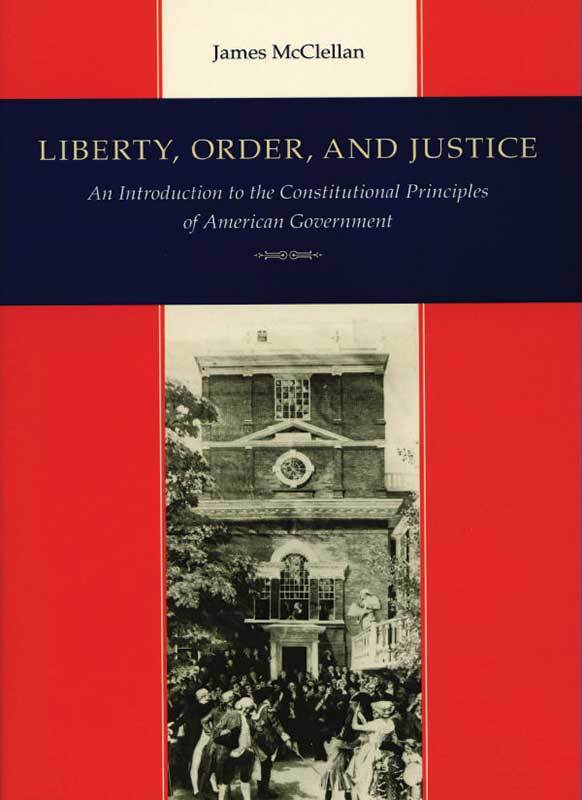
PART 2: America’s First Constitutions and Declarations of Rights - James McClellan, Liberty, Order, and Justice: An Introduction to the Constitutional Principles of American Government [1989]Edition used:Liberty, Order, and Justice: An Introduction to the Constitutional Principles of American Government (3rd ed.) (Indianapolis: Liberty Fund, 2000).
About Liberty Fund:Liberty Fund, Inc. is a private, educational foundation established to encourage the study of the ideal of a society of free and responsible individuals. Copyright information:The copyright to this edition, in both print and electronic forms, is held by Liberty Fund, Inc. Fair use statement:This material is put online to further the educational goals of Liberty Fund, Inc. Unless otherwise stated in the Copyright Information section above, this material may be used freely for educational and academic purposes. It may not be used in any way for profit.
PART 2America’s First Constitutions and Declarations of RightsPOINTS TO REMEMBER1. Beginning with the founding of Jamestown in 1607, Englishmen in the American colonies were entitled to the same rights as their countrymen at home. Not all inhabitants, including indentured servants and slaves, enjoyed these rights, however. As in England, there were also property qualifications for voting. The principles of republicanism and representative government were introduced into the colonies with the establishment of the Virginia House of Burgesses in 1619. 2. The Pilgrims who landed at Plymouth Rock in 1620, by virtue of their Mayflower Compact, brought a contractual theory of government to the colonies. This later served as the basis for popularly based constitutions. All of the colonies, however, carried on the constitutional and legal customs of Great Britain. The American colonists were familiar with the idea of a written constitution as a result of their experience with colonial charters, the Fundamental Orders of Connecticut (1639) being the most famous. 3. The colonists adopted the English theory of representation, which included the principle of geographical representation, or the representation of localities as well as people. The Americans modified the English system of representation, however, by introducing a residency requirement for elected representatives. The most significant colonial departure from the English system was the absence of an aristocratically based upper chamber. 4. Colonial assemblies enjoyed considerable but not complete independence. Their most important and decisive victory was their control of the purse strings. This gave them financial independence and eventually undermined British control of the colonies. 5. Local self-government, based on counties or townships, became firmly established in the colonial period, and helped to prepare the nation for the concept of federalism that triumphed in the Constitutional Convention of 1787. 6. In general, most American colonists enjoyed a great deal of religious liberty. There was some religious intolerance, however, even though colonial governments were more tolerant of dissenting or minority sects than were European governments. Freedom of speech was protected by British statutes and the common law, and the American press was also much freer than that of most of Europe. 7. The important turning point in Anglo-American relations was 1763, when the British adopted a bold new policy that sought to establish a new economic relationship between the colonies and the mother country. The Stamp Act, passed in 1763 for the purpose of raising revenue, met with the cry: “No taxation without representation.” It was the first in a series of parliamentary laws that led eventually to the American Revolution. 8. In the Declaration and Resolves of the First Continental Congress (1774), the colonists declared that, “by the immutable laws of nature, the principles of the English Constitution, and the several [colonial] charters,” they were “entitled to life, liberty and property [and] all the rights, liberties, and immunities of free and natural born subjects within the realm of England [and] to the common law of England.” Rejecting legislative supremacy, they asserted that the legislative authority of Parliament was limited by the higher law of the Constitution. In their Declaration of the Causes and Necessity of Taking up Arms (1775), the colonists listed their grievances against Parliament, declaring they were “resolved to die freemen rather than to live slaves.” 9. The Preamble of the Declaration of Independence is based on the theory that the American people are entitled to certain natural rights, including life, liberty, and the pursuit of happiness, and that all men are created equal. The main text of the document, on the other hand, asserts that the inhabitants of the colonies are entitled to various constitutional, common law, and charter rights. The claim that “all men are created equal” has received different interpretations, one being that the colonists were simply contending that the American people, as a nation, were entitled to the same rights as Englishmen. Later generations interpreted the equality language of the Declaration of Independence more broadly as a prohibition against slavery. 10. The most comprehensive statement of colonial rights and privileges made during the revolutionary period appeared in the Declaration of Rights of 1774, wherein the colonists identified nine different rights. In essence, however, the quarrel between Parliament and the Ameri can assemblies over rights was symptomatic of a more fundamental disagreement: the meaning of the English Constitution and of constitutional government. 11. The year 1776 marks the birth of constitutional government in the United States and in the world at large. This was the first time in the world’s history that a large group of communities—now independent and sovereign States—had begun the formation of their own governments under written constitutions. This was also the year in which the Articles of Confederation, our first national constitution, was written. 12. The principal figure in the drafting of the new State constitutions was John Adams, “the father of American constitutionalism.” His pamphlet, “Thoughts on Government,” was widely used as a source of understanding, and Adams was the chief architect of the Massachusetts Constitution of 1780. This was the best of the early State constitutions and the first to employ a check and balance system. 13. The first State constitutions contained a variety of flaws requiring subsequent correction. None was written by a constitutional convention or submitted to the people for approval. The first State constitution resting on a thoroughly republican base was the Massachusetts Constitution of 1780, which set the standard for the United States Constitution. It is still in force today and is the oldest constitution in the country. 14. In general, our first State constitutions contained three basic weaknesses: (a) They failed to provide for an adequate system of separation of powers; (b) all but the Constitution of New York failed to establish an independent executive; (c) all lacked a provision establishing the constitution as the supreme law. In addition, a number of State constitutions neglected to provide for their amendment. Nor did all of the early State constitutions contain a bill of rights. 15. The first draft of the Articles of Confederation was made in the summer of 1776. But the document was not submitted to the States for approval until the fall of 1777 and did not take effect until 1781. The three major sources of contention among the States were: (a) the western land claim of Virginia and other States; (b) the system of representation in Congress; and (c) the basis for determining how much each State should contribute to the national treasury. The most important issue in the writing of the Articles was the question of State sovereignty. This was resolved in favor of the States, Article II declaring that “Each State retains its sovereignty, freedom, and independence.” 16. The Articles of Confederation were little more than a treaty among sovereign States. The States granted certain of the same basic rights and privileges to citizens of other States as they granted to their own citizens. The government was exceedingly weak, however, consisting of a unicameral Congress that lacked the power even to regulate commerce or levy a tax. No provision was made for an executive or judiciary and the Confederation government was forced to rely upon the States for the enforcement of its laws. Because the unanimous vote of all of the States was required to amend the Articles, it was virtually impossible to change the document even when its faults were generally acknowledged. Only by circumventing Congress were the nation’s leaders able to reform the system and establish a new Constitution. Colonial GovernmentsThe seeds of liberty were planted on American soil in 1607, when the first English settlers landed in Virginia and founded Jamestown. They were not the first Englishmen to attempt to establish a colony in Virginia, but they were the first to win a permanent foothold. Lured by tales of great wealth, they were destined to suffer months and even years of hunger, fever, and death in a hostile wilderness. It was the destiny of their children and succeeding generations to develop the richest and most powerful colony in British America. The plan to colonize Virginia was not a part of any government scheme but an effort by London merchants to discover gold and silver, as the Spanish had done a century before in Mexico and farther south, and to explore for a northwest passage. The Virginia colony was thus established under the auspices of a private corporation known as the London Company, by virtue of a charter granted by James I. In the charter the King guaranteed that the colonists and any children born to them “shall have and enjoy all Liberties, Franchises, and Immunities … as if they had been abiding and born within this, our Realm of England.” In other words, Englishmen in the colonies were to enjoy the same rights granted to Englishmen at home—such as trial by jury and the right to be taxed by representatives of their own choosing. Freedom was actually planted in Virginia, then, even before the forebears of today’s Virginians first saw their land. Before long Virginians were not only defending their freedom but enlarging it to the point that they actually enjoyed more liberty than their British cousins in the mother country. Despite the hardships of the early years, Virginia became increasingly attractive to Englishmen at home because of the opportunities it presented for private ownership of land. Corporate ownership gave way to individual ownerships in the colony after 1618, when the London Company began paying dividends and increasing incentives by giving away land to its stockholders, to colonists who had served the company, and to individuals who would pay for an immigrant’s fare across the Atlantic. Even the poverty-stricken immigrants, who often came as indentured servants, had a powerful incentive to come to Virginia. An indentured servant was a person who signed an indenture, or contract, by which he agreed to sell his services in the colony for three to five years as a way of paying for the voyage from Europe. Having satisfied the terms of the agreement, he was then free to strike out on his own and become an independent landowner himself. During the years 1634–1704, about 1,500 to 2,000 indentured servants arrived annually. Governor William Berkeley reported in 1671 that there were some 13,000 in the colony, about thirteen percent of the population. Many became great landholders and leaders in Virginia government. Seven of the forty-four members of the colonial legislature in 1629 had been indentured servants just five years earlier. To a great extent, the aristocracy of colonial Virginia was composed of self-made men. Thomas Jefferson would later boast that Virginia had a “natural” aristocracy, which he viewed as superior to an aristocracy based on hereditary entitlement and special privilege. But Virginia denied no Englishman the opportunity to acquire property—and with it a substantial degree of individual freedom. In sharp contrast to Great Britain, landowners constituted the large majority of Virginia’s colonial population—eighty percent or more. The first Negroes—about twenty in number—came to Virginia in 1619 aboard a Dutch warship. They had been captured in a raid in the West Indies and were traded to the Virginians in exchange for supplies. They came not as slaves, however, but as indentured servants. By 1650, there were only 300 Negroes in Virginia, and most of these were freemen who had completed their periods of indentured service. One of the first to gain his freedom was Anthony Johnson, who ironically also became the first man in the colony to own slaves. It was not unusual, even as late as 1865, for free Negroes in Virginia to own Negro slaves, employing them often in places of business. The institution of slavery was not established in Virginia until 1662, when the legislature enacted a law requiring that all servants who were non-Christians should be held as slaves for life. By means of this statute, Virginia accepted slavery and made it legal. It was a fateful step that marked the introduction of slavery into the Southern colonies. Like a blight, it spread to the North as well, and soon became an accepted practice throughout the American colonies. The first slave-trading port on the continent was actually Boston. Two hundred years would pass before slavery was abolished in North America. The Negro was thus the last of the founding generation of Americans—our first immigrants—to taste the fruits of liberty that were originally cultivated in Tidewater Virginia. Slavery, of course, had existed since ancient times and was not limited to the American colonies or to the black race. It flourished in Greece and Rome and throughout medieval Europe and the Middle East. The Spanish introduced human bondage into the West Indies in 1502. The discovery of the New World created a heavy demand for labor, stimulating the slave trade. European traders and African chieftains developed a vast commercial system for the capture, sale, and transportation of slaves, and it is estimated that during the sixteenth, seventeenth, and eighteenth centuries at least fifteen million Africans were brought to the New World by the maritime powers of Europe. Although slavery was eradicated in the United States more than a century ago, it persists today, in other parts of the world—but in a far more brutal form and on an even larger scale. This is the system of forced labor that is characteristic of the modern totalitarian state. It consists not of individual ownership of human beings as a species of private property, but of government ownership by the state, usually in the form of the slave labor camp—what Alexander Solzhenitsyn, the Russian writer, has described as the Gulag Archipelago. It is estimated that during the reign of Joseph Stalin (1929–1956) there were twelve to twenty million people housed in Soviet camps during any one year. At about the same time the first Negroes were brought to the Virginia colony, there were two other important events that would later have an enormous impact on American political and constitutional development. In 1619, the House of Burgesses convened in a small church in Jamestown. This was the first representative assembly in the Western Hemisphere. It gave Virginians some measure of self-government almost from the outset and established the principle of republicanism not only for Virginia but also for her future sister colonies along the Atlantic Coast. One of the first steps taken by the assembly was to enact legislation prohibiting gambling, drunkenness, swearing, and idleness, and also requiring every colonist to attend church regularly. The second important event of this period was the landing of the Pilgrims at Plymouth, Massachusetts, in 1620. Almost all of the New England colonists were Puritans who had a religious as well as an economic interest in coming to the New World. They differed in outlook and behavior from their more orthodox Anglican neighbors situated in Jamestown, and brought with them a set of religious doctrines that anticipated the founding of what John Eliot called the Christian Commonwealth, or a blend of theocracy and pure democracy. Like the Jamestown colonists, they came to the rocky shores of New England under the auspices of the Virginia Company. The first inhabitants of Massachusetts were not simply Puritan Nonconformists but radical Separatists. Whereas the Nonconformists aimed to purify the Anglican church from within, the Separatists were determined to break away and worship as they pleased in their own congregations. Before leaving Europe, they had tried and failed to secure a guarantee of religious freedom from James I; but they learned “that he would … not molest them, provided they carried themselves peaceably.” By virtue of this historic concession on the part of the monarch, British America was opened to settlement by all dissenting Protestants. Before leaving ship, they entered into a solemn agreement for the formation of a government upon reaching land. This became the famous Mayflower Compact, by which “in the presence of God and one another” they agreed to “covenant and combine ourselves together into a civil Body Politick, for our better Ordering and Preservation” and to “enact, constitute, and frame such just and equal Laws, Ordinances, Acts, Constitutions, and Offices, from time to time, as shall be thought most meet and convenient for the general Good of the Colony; into which we promise all due Submission and Obedience.” What the founders of the Massachusetts Bay Colony agreed to, in other words, was to form a government for self-rule based on popular consent and rule of law. The Mayflower Compact was like the church covenant by which Separatists formed congregations, except that it bound its signers to observe the ordinances of a civil rather than a religious society, and professed allegiance to the King as well as God. It marks the introduction into the American colonies of a compact theory of government which would later serve as the basis for both popularly based State constitutions and the United States Constitution, the latter being viewed as a compact among the States as well as the people in the States. Generally speaking, the Puritans subscribed to the view that a covenant was the necessary basis for both the church and the state. These two classes of covenants were known respectively as the “church covenant” and the “plantation covenant”—and there was a close relation between the democratic method of forming a congregation or church and the democratic method of forming a state, both emphasizing the importance of the individual. In time, the early tendencies in New England toward aristocracy and theocracy disappeared and there was a democratization of its social and political institutions. Perhaps the most significant aspect of this democratic spirit was the emphasis on local self-government, which found expression in the New England town meeting. Puritan democracy, however, was reserved primarily for church members. The Puritans readily embraced English common law and the English constitutional tradition; and they accepted in principle equality of civil rights. But they did not endorse the idea of political equality, and they did not believe that all members of society should participate in the political process. In these respects the New England and Southern colonists shared similar political views. Although the Catholics in Maryland, the Quakers in Delaware and Pennsylvania, and the Dutch Reformed in New York and New Jersey introduced even more religious diversity into North America, they nevertheless followed the same path of political development as the New England and Southern Colonies. The middle colonies were more of a melting pot of religious and national groups than any other part of America. From the standpoint of their evolving political institutions in the colonial era, however, all of the colonies, despite their ethnic and religious and socioeconomic differences, tended to carry on the constitutional and legal customs of Great Britain, the absence of an hereditary aristocracy being one of the few conspicuous departures from the British model. In all of the colonies, whether royal, proprietary, or corporate, the colonial governments exhibited the same general pattern. In each colony there was eventually a governor and a bicameral legislature, as in England there was a king and a two-house Parliament. In all of the colonies except Rhode Island and Connecticut, the governor was appointed rather than elected. The upper chamber of the legislature consisted of the Governor’s Council, whose members, except in Massachusetts, Rhode Island, and Connecticut, were also appointed; and in the lower chamber the members were elected by the people. As in England, executive, legislative, and judicial functions were somewhat mixed, mainly because the Governor and his Council sat as the Supreme Court. There was nevertheless a rudimentary separation of powers between the governor and the assembly. The American colonists were familiar with the idea of a written constitution as a result of their experience with colonial charters, the Fundamental Orders of Connecticut (1639) being the most famous. Though the Mayflower Compact was the first political covenant, the Fundamental Orders were for all practical purposes the first modern written constitution. Until the time of the American Revolution, the colonists enjoyed the same civil liberties as native Englishmen. Like their English cousins, however, they did not have equal political rights, and the franchise was generally restricted throughout the colonies. The right to vote or hold office was limited by religious qualifications in some colonies, and by property qualifications everywhere. One important departure from the English theory of representation was the evolution during the colonial era of the principle of legislative residency. Whereas members of the House of Commons have traditionally been permitted to represent any constituency in the country, no matter where they happened to live, the colonists adopted the distinctively American custom of requiring assemblymen to be residents of the district they represented. This custom was not written into the Constitution, which provides merely that members of the House and Senate must be inhabitants of the State in which they are elected, but it has continued to be a part of the American political tradition at both the Federal and State levels down to the present. The idea behind this principle of representation is the belief that a local resident or “home town boy,” as the Americans say, is more likely to have a sympathetic understanding of the wants, needs, and interests of the people in a given community than an outsider. In sharp contrast to England, where the population is homogeneous and concentrated, the United States has always been more culturally diverse, even within a single State, with a population that is partly urban but is also significantly rural, scattered across vast expanses of territory that dwarf the British Isles. In such a society, the residency requirement helps to satisfy the need for familiarity and shared values between the representative and his constituents. An important feature of the English theory of representation that was continued in the colonies and in the Constitution of 1787 was the principle of geographical representation, which asserts the view that a legislator does not represent just people as such, but people in a broader cultural sense, including their localities and their way of life. It is reflected not only in the residency requirement that grew out of our colonial experience but also in the representational basis of Congress designed by the Framers. Thus the theory of representation embodied in the Constitution rejects absolute political equality and seeks instead to balance the population and geographical principles. The system of representation in the Senate, for example, gives each State the same number of Senators, irrespective of the size of the State’s population. Likewise, the House of Representatives, though apportioned on the basis of population, includes at least one Congressman from each State, irrespective of population. The principle of geographical representation has also served over the years as a check on overbearing majorities. It protects the minority rural population from the multitudes of city dwellers; it gives the small town or village a voice in the formulation of public policy; and it encourages a broad representation of different points of view. In recent years, however, the Supreme Court has taken a different view. In Gray v. Sanders (1963), the Court ruled that “The conception of political equality from the Declaration of Independence, to Lincoln’s Gettysburg Address, to the Fifteenth, Seventeenth, and Nineteenth Amendments, can mean only one thing—one person, one vote.” The Court has been divided on this issue, however, and the dissenters have contended that there is no evidence to support the Court’s new philosophy of political equality. According to Justice Frankfurter, it was “the basic English principle of apportioning representatives among the local governmental entities, towns or counties, rather than among units of approximately equal population,” that took root in the colonies; and Justice Harlan argued that the principle of “one person, one vote” has “never been the universally accepted political philosophy in England, the American colonies, or in the United States.” Although the deeply rooted tradition of geographical representation seemed to refute the historical accuracy of the Court’s assertion that the American political tradition of political equality meant absolute equality based on numbers alone, Chief Justice Warren insisted nevertheless in Reynolds v. Sims (1964) that “Citizens, not history or economic interests, cast votes. Considerations of area alone provide an insufficient justification for deviations from the equal-population principle. … [P]eople, not land or trees or pastures, vote.” The question, however, is not who votes, but who and what interests legislators are supposed to represent. Whatever the merits of the Supreme Court’s view of the matter, it seems clear that the principle of republicanism which the English settlers brought with them to North America was only modestly changed during the next century and a half of colonial government. In every colony, local units of government, whether townships and villages or cities and counties, were accorded representation, thereby perpetuating the English system of geographical representation. The only deviation was the addition of the residency requirement, which actually strengthened and reaffirmed the principle of geographical representation. The “one person, one vote” principle is of recent origin, and there is no evidence that it was adopted in any of the colonies—or indeed in any of the States that joined the Union after the Constitution was adopted. The most significant departure from the British example was the democratic class structure of colonial society, which gave rise to a new form of representative government in America and, as we shall later see, laid the foundation for a system of separation of powers that was radically different from that which existed in Great Britain. In no colony did a landed aristocracy, based on hereditary privilege, gain a foothold. Hence there were no upper chambers comparable to the House of Lords in any of the colonial assemblies. The system of representation adopted made no allowance for the representation of classes or political privilege, and in this sense rested on the principle of political equality. But it was not a complete equality, for the right to vote, as in England, was conditioned, as we noted earlier, on property ownership—and in some colonies on religious belief as well. Catholics, for example, were often excluded from the franchise; Anglicans were at a disadvantage in New England but dominated the southern colonies. These restrictions also applied in a number of colonies to individuals seeking public office. Political power thus rested in all of the colonies in the hands of the “freemen” or “freeholders,” that is, adult white males of some means. Because of the ready availability of cheap land everywhere, the suffrage was actually much broader than one might think, and it would be erroneous to assume that a small elite governed the colonies to the exclusion of the general population. Thus, the landed gentry of Virginia dominated public affairs, but it was open to any enterprising young man of diligence, ability, and good character. Men of education and wealth naturally played a leading role, however, as they do today. In the early period the great landowners and members of the clergy tended to be the leaders of colonial society and government; but as we approach the American Revolution, members of the legal profession, physicians, educators, merchants, and military leaders became increasingly conspicuous in representative assemblies. The members of the Federal Convention of 1787 resisted attempts to write property or religious qualifications for voting or holding office into the Constitution. Members of Congress, the President, the Judiciary, and presidential electors were not required to meet a property qualification, and religious tests were banned. In deference to States’ Rights, the States were left free to maintain property qualifications for the suffrage as they saw fit, and so the colonial practice of limiting the franchise to freeholders was continued into the nineteenth century. As the century progressed, however, pressure for universal suffrage increased and property qualifications were gradually eliminated in all of the States. With the adoption of the Fifteenth Amendment (1870), which extended the right to vote to Negroes, the exclusive power of the States to determine voter qualifications began to fade. This amendment was followed by the Nineteenth Amendment (1920) granting women the right to vote, and more recently by the Twenty-Fourth (1964) and Twenty-Sixth (1971) amendments eliminating the poll tax and extending the franchise to persons eighteen years of age. As a result of these amendments and various decisions of the Supreme Court, the principle of republicanism that originated in England and was carried across the Atlantic to the American colonies has changed substantially over the years, and representative government today is considerably different from what it was two hundred years ago. The basis of representation in State and Federal legislative assemblies has changed as a result of the “one person, one vote” decisions of the Supreme Court, and the main standards for voter qualification in elections, whether Federal, State, or local, are now set by the Federal government instead of the States. The degree to which these changes have contributed to the growth of liberty, order, and justice is a complex question. Although there is more political freedom in the United States than possibly any other country in the world, at least a third of the American electorate—and often as much as half—refuses to participate in the political process or exercise the right to vote. Ironically, political apathy seems to have increased with the expansion of the suffrage. The price of liberty, it has been said, is eternal vigilance. Can democratic government promote and protect liberty, order, and justice if half the population is failing to hold public officials accountable for their actions? Is there a lesson to be learned from the history of ancient Rome? Once a thriving republic, it fell to tyranny because the people had become more interested in “bread and circuses” than in safeguarding their political institutions. And how informed is the American electorate? Polls taken in recent years reveal an alarming degree of ignorance among the American people about the Constitution, national and international affairs, the record and achievements of their representatives, and of the political and economic forces that are actually controlling their lives and the destiny of the country. The greatest threat to liberty may well be when the people take liberty for granted and allow others to do their thinking and make their decisions for them. There are some who seem to prefer security to liberty. What is the solution? The establishment of voter qualification tests to determine an individual’s knowledge of the system, in the hope of encouraging a better informed electorate? Improved teaching of civics in the schools? These are difficult questions that offer no easy solutions. Yet it behooves us as a free people to reexamine and continually reinvigorate our political institutions; to be alert to the first transgressions before dangerous precedents are set; to jealously protect the fundamental principles which support our form of government and not to compromise them for the sake of convenience. It was this intense love of liberty that compelled the American patriots, pledging their lives, their personal freedom, and their fortunes, to take up arms against the British. Would the American people today make the same personal sacrifices as their forebears for the causes that led to the American Revolution? Relations with Great BritainIn retrospect, it would seem that the American colonies were destined to gain independence at some point in time; and in many ways they were already independent before the Revolution. From the day the first settlers landed, the colonies governed themselves in most matters. They had their own charters of government, which served as written constitutions of a sort, and their own provincial assemblies, which exercised a considerable degree of autonomy. The colonies were part of Britain’s vastly expanding empire, but the British empire was commercial in nature, not imperial. The King’s ministers were not interested in political control of the colonies for its own sake, for military purposes, or as a tax base. They viewed the colonies instead as a great commercial reservoir that contributed to the economic prosperity of the mother country by supplying England with raw materials and by providing markets for the sale of English-made goods. Consequently, neither Parliament nor the King’s ministers troubled themselves much with American affairs. They were content if the Thirteen Colonies continued to ship to Britain their tobacco, furs, dried fish, grain, and lumber, and the colonies were content to be ruled from Westminster so long as British regiments and British fleets defended America when wars arose with the French or the Spaniards, and so long as the colonies held the real political power in provincial assemblies. Thus the colonies enjoyed what Edmund Burke called the “salutary neglect” of London officialdom. The more the colonies were neglected politically by England, the more the colonists prospered. Because England had no real political interest in the colonies, especially in the seventeenth and early eighteenth centuries, colonial administration of the colonies was unplanned and haphazard. No single agency was ever given primary responsibility for the colonies until the very eve of the Revolution. By the early 1700s, there were six agencies of the British government, all located in London and out of touch with America, sharing responsibility for administering the colonies: the Board of Trade, The Privy Council, the Treasury and Customs Office, the Admiralty, the Secretary of State for the Southern Department, and, of course, Parliament. But the colonies were never overrun with meddlesome bureaucrats. Even though the Americans were subjects of George III in 1776, few of them saw many outward signs of British sovereignty. Only nine of the colonies had royal governors, and these grand figures stayed close to the colonial capitals, or else spent much of their time in England. Judges, though appointed by the Crown, were usually American-born. Uniformed British troops were at the frontiers, but not regularly in the settlements. The only fairly numerous body of officials of the British government were the revenue officers who collected port duties under the Navigation Acts, and they too were mostly American-born. In the eyes of the English, the colonies were technically mere corporations—subordinate to Parliament and without any inherent sovereignty. Colonial legislatures possessed only such privileges as the King chose to grant to them. British officials also insisted that the rights and powers won by Parliament in the Glorious Revolution of 1688 did not automatically extend to the colonial assemblies, and that the royal prerogative (inherent powers reserved by the Crown that were not surrendered to Parliament) was therefore more extensive over the American legislatures than over Parliament. Acting upon these assumptions, British officials repeatedly rejected requests from the colonies to create new legislative districts or to pass “triennial acts” providing for automatic meetings of the legislatures at regular intervals. They also refused to accept speakers chosen by the assemblies on an automatic basis. These were rights that Parliament had long enjoyed. The principal check on the colonial assemblies was the Board of Trade, which instructed the royal governors, controlled colonial patronage, assisted the Privy Council in appeals from the colonial courts, advised Parliament and the Crown on matters of colonial policy, and, most significantly, had the power to recommend approval or disallowance of colonial legislation, much like a court exercising judicial review. Between 1696 and 1774, some 400 acts of colonial legislatures were recommended for disallowance by the Board. Although this led to disputes from time to time, the colonists cheerfully acknowledged the right of the Board, as an agency of the King-in-Parliament, to carry out its advisory functions, and its legitimacy was never seriously questioned. Nor, for that matter, was the authority of the other agencies. The conflict between England and the colonies, as we shall see, centered mainly on Parliament and the scope of its powers. It was in the sphere of finance that the assemblies won their most important and decisive victory, and this proved to be the undoing of the British. Despite all of the theory repudiating the legal sovereignty of the colonial assemblies, these bodies in reality controlled the purse strings and in effect exercised a considerable amount of political sovereignty. The power to tax and spend rested in the hands of the colonial legislatures. Acting upon instructions from London, Royal governors repeatedly, but without success, demanded that the assemblies pass permanent revenue acts instead of annual appropriations. In New York, for example, the colonial assembly, patterning itself after the House of Commons, limited its appropriations to one year, stipulated in great detail how the money was to be spent, and refused to accept amendments to revenue bills. When Governor George Clinton tried to claim some authority over fiscal matters by the veto power, the assembly simply blocked all legislation and brought the Governor to his knees. Through the clever technique of appropriating the salaries of public officials by name and not by office, the colonial assemblies also effectively limited the governor’s power of appointment and removal. Even the local militia were under the control of the assemblies. Similar incidents occurred in Pennsylvania, Massachusetts, and the Carolinas. Between 1699 and 1766, the Virginia offices of treasurer and speaker of the House of Burgesses were always held by the same person, thereby giving the legislature not only control over fiscal policy but custody of the funds as well. In nearly all of the provinces money granted for special purposes, such as the payment of troops, was often lodged in the hands of commissioners named in an appropriation act. “He who pays the piper,” according to an old English proverb, “can call the tune.” The importance of local control of revenue and expenditures can hardly be overestimated. Governors were virtually helpless in many instances to support the royal prerogative or the wishes of the King’s ministers in the face of colonial assemblies that could specify the expenditures of every cent and withhold funds from any governmental function they pleased. This situation contributed substantially to the growth of colonial independence and the gradual decline of British power in America. In 1763, Patrick Henry defended the dominion of Virginia in an action at law called the Parson’s Cause. The case arose when clergymen of the Church of England—which was Virginia’s established church—brought suit against the commonwealth because Virginia’s Assembly in 1758 had passed a statute that temporarily reduced the salaries paid to clergymen. In England, the Privy Council had declared the law to be unconstitutional; a parson therefore had to file suit to obtain the funds he had been denied. Although the jury in the Parson’s Cause trial gave a verdict for the plaintiff, it awarded him only one penny in damages. The verdict was actually a victory, then, for the Assembly that had reduced the parsons’ salaries. Patrick Henry, whose eloquence had won over the jury, argued in the case that the British Crown, as represented by the Privy Council in England, had no power to set aside an act of the Virginia Assembly. This argument was clearly close to declaring that Virginia was politically independent of Britain. Twelve years later, of course, Henry ended his famous speech to the Virginia Assembly with the cry, “Give me liberty, or give me death!” It was by such audacious men that colonial assemblies were persuaded by 1775 to cast off the authority of Crown and Parliament. Local Government in the ColoniesIf the representative assemblies in every colony were the most powerful feature of the colonial constitutions, the American institutions of local government still had nearly as much influence on the development of the American political system that culminated in 1787. English local government was far more vigorous and popular than local government in France or in most of the rest of Europe during the eighteenth century; but American local government was still more active than the British forms, and attracted heartier public support. By 1763, the forms of American local government varied considerably from province to province, and even within provinces—or colonies. Along the wild western frontier, local government was democratic and informal, but highly effective—as it had need to be because of the frontier’s perils and the need for prompt cooperation among neighbors. At the other extreme, some towns along the Atlantic seaboard held charters of incorporation that conferred great powers upon municipal governments, much like the privileges held by venerable European cities. There were forms of county government throughout British North America, but the county system of local government was strongest in the South, and the “middle colonies” of New York and Pennsylvania. In Virginia, the political powers of the county were greater than they are today in any American county. Each Virginia county was controlled by a county court composed of the county’s several Justices of the Peace. Even the colony’s Assembly did not venture to interfere with the Justices’ authority. New Justices of the Peace were selected by the Governor from a list submitted by the county court itself, so that the court became self-perpetuating. These Justices of the Peace were appointed from the class of landowners that was still specified in law as gentlemen. They were paid neither salaries nor fees, but served at their own expense. Virtually independent of both Williamsburg (then Virginia’s capital) and London, these county courts amounted to a kind of federal system within Virginia, and also within other southern States that allocated large powers to counties. Thus county government became a preparation for the concept of federalism that triumphed in the Constitutional Convention of 1787. In New England—and later, in those States to the west that were settled primarily by New Englanders—the “township” system of local government was more important than the county organization, even though counties had their functions in New England, too. New England’s town meetings could be attended by almost anyone, although in 1763 not all local residents were entitled to vote at these meetings. Township officers were elected annually in those times, and that was another practice that tended to make township government democratic. New England’s town meetings had begun as formal gatherings of men in good standing with the Puritan or Congregational churches. By 1763, they had become civic institutions and there was no religious test for participation. Both county and township were political structures inherited from centuries of English experience. Yet in America these institutions took on a renewed vigor or were adapted to American circumstances. By the 1830s, for example, the French traveler Alexis de Tocqueville found the system of American local government—especially the township—a major reason for the successes of the American democracy. Earlier it was noted that representative government was Britain’s most important contribution to America’s Constitution. The British succeeded in conferring upon the colonies a truly representative system of provincial and local government. This made possible the establishment of liberty, order, and justice in the new nation. As Benjamin Franklin, John Dickinson, and a good many other leading men at the Constitutional Convention would recognize sadly even in 1787, it was a melancholy irony that the political patrimony bequeathed to America by Britain should itself be a major cause of Britain’s loss of her North American empire. Civil Liberties in the ColoniesAmong the civil liberties that are enumerated in the Bill of Rights of the American Constitution, those providing for the free exercise of religion, freedom of speech, and freedom of the press are noteworthy. It is instructive to examine the status of these freedoms in the Thirteen Colonies on the eve of the American Revolution. First, the free exercise of religion. In the seventeenth century, America was a refuge for fugitives from religious persecution, including Puritans, Quakers, and Catholics. But the persecuted, when they have opportunity, sometimes persecute in turn, and so it was in North America until religious hostilities diminished in the eighteenth century on both sides of the Atlantic. By 1763 the congeries of religious sects and denominations had learned tolerably well how to get along peaceably with one another. The Congregationalists of Massachusetts, for example, had found it necessary to permit Anglicans to settle among them in large numbers; the Quakers of Pennsylvania had come to terms with the Scotch-Irish Presbyterians of the western regions; Methodist preachers were evangelizing the backwoods and the frontier; the feeble Catholic minority in Maryland and New Jersey was tolerated; the handful of Jews were not even noticed; and the Deists, though as few in number as the Jews, had won over some eminent men, including Thomas Jefferson, Benjamin Franklin, and John Adams. Nine of the Thirteen Colonies had established churches in 1763: the Church of England in Virginia, Maryland, the Carolinas, Georgia, and the southern counties of New York; the Congregational Church in Connecticut, New Hampshire, and Massachusetts and its dependencies. “Establishment” of a church meant that it was a “preferred” sect that might enjoy certain economic privileges; it did not mean that other churches were banned. For the colonial governments were far more tolerant of dissenting churches than were European governments. Sometimes religious minorities were exempted from paying tithes (church taxes enforced by the public authority); sometimes members of congregations were permitted to pay their tithes directly to the church of their choice. Such liberality on the part of the state was unknown in much of Europe at the time. There was, nonetheless, discrimination against Roman Catholics, Jews, and even dissenting Protestants, particularly the Baptists, if they refused to comply with local laws that benefited a preferred sect. For example, colonial governors were instructed not to indulge Catholics in “liberty of conscience,” because Catholics were regarded as potentially subversive of the established state and church. On the eve of the Revolution, only in Pennsylvania could Catholic masses be celebrated publicly. The British government’s policies in 1763 that seemed to protect the French Catholics of Canada were especially frowned upon by New Englanders, New Yorkers, and other Americans who had hoped that British victory in the recent Seven Years’ War (French and Indian) would result in the subjugation and possible suppression of Catholicism in Canada. Eleven years later, when Parliament passed the generous Quebec Act, patriots in America denounced the legislation as one of the “Intolerable Acts” because it guaranteed religious freedom to the Quebec Catholics. Sometimes the more ardent advocates of civil rights angrily draw the line at a proposal for the civil rights of other people. All in all, though, Americans enjoyed the benefits of religious liberties—although some American leaders feared that fierce intolerance lay just beneath the surface of the religious calm. Nearly all Americans professed to be Christians, even if they sometimes were rather eccentric Christians. But not all Christians always observe the doctrine of brotherly love. Had it not been for the British Toleration Act of 1689, religious minorities in several of the Thirteen Colonies might have been driven away. Second, what of “the freedom of speech, or of the press”? By 1763, a score of newspapers were published in the Thirteen Colonies, though sometimes eleven of a paper’s twelve columns might be filled with advertisements. Two years after the British took Quebec from the French, there was little controversy within British North America. The only alarming news came from the region of the Great Lakes, where Chief Pontiac’s Indians were attacking British garrisons. Freedom of the press and of speech seemed well established. This had not been the case earlier in the eighteenth century, when printing and publication had required licenses from public authority in both Britain and America. In the early years of newspaper publication, before the average man had grown accustomed to newspapers, governments had feared (not without reason) the extent to which public opinion might be misled by libels and false reports printed in newspapers. But gradually controls upon the press on either side of the ocean had been relaxed, in part by court decisions, and, although some government power of licensing the press and of prior censorship remained in 1763, the American press was much freer than that of most of Europe. Freedom of speech was also protected by British statutes and by common law—short of speech that might encourage sedition, incite to riot, be slanderous, blasphemous, or obscene, or otherwise result in breaches of the peace. In 1763 there was no political dispute in America controversial enough to justify the breaking up of a public meeting by the guardians of the peace. Only two years later, however, in 1765, this era of good feeling came to a most abrupt and disastrous end. The cause of disruption was the Stamp Act that the British imposed upon the colonies as a means of raising sixty thousand pounds in annual taxes to help defray the costs of the war with Pontiac’s Indians on the northwestern frontier. (The British government expected to have to pay 350,000 pounds a year to maintain troops in North America.) Soon the famous cry “No taxation without representation” was heard from the Patriots. That the Stamp Act taxed newspapers and legal documents infuriated America’s newspaper publishers and lawyers—and these were powerful classes to offend. One consequence was a concerted attack by most of the American newspapers upon both Parliament and King George III—and attacks by mobs upon the printing houses of the few Tory (or pro-British) newspapers. Civil rights are sorely battered in time of war. Until the fighting ended in 1783, little freedom of speech or of the press was allowed, from New Hampshire to Georgia—except freedom of a sort for whichever side, Patriot or Loyalist, happened to be in control of a town or a region. Those two decades of violent interference with publication and public speaking were not forgotten when the first State constitutions were drafted. The Movement Toward IndependenceThe Americans prospered, as we have seen, under more than a century of British rule. They enjoyed a great deal of personal freedom and independence. It would therefore be a gross mistake to view the colonists as living in a repressive state or to suggest they were brutalized by English tyrants. There were disagreements, to be sure, but none so fundamental as to provoke a public uprising threatening the existence of government. Precisely how long this peaceful state of affairs might have lasted had the British continued to follow their “hands-off” policy toward the colonies is uncertain. In any event, 1763 marks an important turning point in Anglo-American relations, for this is the year when the mother country embarked upon a bold new course of action to increase revenue, tighten restrictions on colonial commerce, and require the Americans to assume a greater share of the imperial tax burden. In response to Parliament’s abrupt change of colonial policy, the Americans began to question the constitutional basis of parliamentary statutes designed to impose a new economic relationship between the colonies and England. Reaffirming and at the same time reinterpreting their ancient rights and privileges, they turned in the final stages of resistance to thoughts about the nature of free government. In the end, they came reluctantly to the conclusion that secession was their only recourse. It was thought in London that the new colonial policy was necessary because of economic conditions in England. British industry was rapidly advancing and manufacturers in the homeland were anxious to expand their markets and increase the flow of raw materials. Moreover, the Seven Years War between England and France, which ended in 1763, had left England in control of North America, but had also doubled the English national debt and greatly increased the tax burden of the English people. Already saddled with a system of monopoly that compelled them to purchase exclusively from England all the European articles they required, and to sell exclusively to England all their materials and productions, the Americans resisted these new reforms with increasing skill and determination. Their opposition laid the foundation for unification of the colonies, driving them reluctantly to the American War for Independence. The responsibility for inaugurating the new colonial policy was placed in the hands of George Grenville, who became Prime Minister in the spring of 1763. Although the menace of the French and Indians on the western frontier had abated, Grenville persuaded Parliament to pass the Sugar Act (1764) and the Stamp Act (1765) for the announced purpose of “defending, protecting, and securing” the colonies. Complaints against the increased duties on sugar shipped to the colonies were mild compared to the commotion stirred up by the Stamp Act; for one of the underlying purposes of the Stamp Act was to establish the right of Parliament to tax the colonies. The actual revenue accruing from the purchase of stamps on newspapers, playing cards, legal documents, and various business instruments was relatively insignificant. What aroused the ire of the Americans was the imposition of a new and mischievous principle: that of raising a tax in the colonies for the treasury of England. United in their opposition to the tax, the colonies, in their first effort at intercolonial union for resistance to British imperial authority, sent delegates to a Stamp Act Congress in New York which met on October 7, 1765. Representing nine colonies, the Congress drafted a bill of rights and a statement of colonial grievances based on the principle of “No Taxation Without Representation.” The Americans argued that Parliament had exceeded its authority in passing the Stamp Act because the colonies, not being represented in Parliament, could be taxed only by their own assemblies. Parliament wisely repealed the Stamp Act on March 17, 1766; but it refused to disavow its new claim to power, and with the repeal it appended a Declaratory Act affirming its right to legislate for the colonies in all matters. The Americans were so overjoyed by repeal that they overlooked the objectionable principle embodied in the Act. The British, as Americans soon realized, had changed their stance but not their position. In 1767, upon the recommendation of Charles Townshend, the new Chancellor of the Exchequer, a stubborn Parliament counterattacked with another series of statutes designed to implement the new colonial policy. Relying upon the transparent argument that Parliament, by repealing the Stamp Act, had renounced a direct taxation on the colonies but had reserved the right of indirect taxation, the supporters of the new plan imposed a duty on glass, tea, lead, and paper imported into the colonies. The American response was predictably hostile. No less objectionable to many colonials was a provision of the act authorizing courts to grant writs of assistance to enable British officials to search any house or ship suspected of harboring smuggled goods (James Otis had publicly opposed such writs as early as 1761, contending that they were unconstitutional). Other objectionable Townshend Acts included the establishment of a board of custom officials and an act suspending the New York assembly because it had failed to make satisfactory arrangements for the quartering of British troops stationed in the colony. The controversy over the Townshend Acts centered on questions of Parliament’s constitutional powers. Chief among the American opponents was the able lawyer John Dickinson, who maintained in his widely circulated Letters of a Farmer in Pennsylvania that the Townshend Acts contravened established English constitutional principles. Resistance also took the form of a boycott by the merchants and some southern planters against the importation of British goods; and in Boston a clash between seven soldiers and a mob of townspeople, which resulted in the death of four citizens in the so-called Boston Massacre, aroused the people of Massachusetts to a fever of agitation. Confronted with the fact that the Townshend Acts were a failure, both politically and economically, the ministry in London once again made a strategic withdrawal from the field of contention. The Townshend Duty Act was repealed in April 1770, except that the duty on tea was retained to save the principle that Parliament had the authority to tax the colonies. From that moment it was clear that the ministry, despite the folly of continuing the contest, was determined to subdue the colonies. Lord North, in fact, formally declared in Parliament that repeal of all the new taxes could not occur until the Americans were brought to the feet of Great Britain. By now the disposition to resistance had struck deep roots in every American colony. At first the Americans had only denied the right of Parliament to tax them; but the scope of their rebuttal had increased, by degrees. They began to question the authority of Parliament altogether. The brief hiatus following the partial repeal of the Duty Act was broken in 1773 when Parliament enacted the Tea Act. The purpose of this ill-considered statute was to shore up the crumbling financial structure of the East India Company, and to establish a precedent to support England’s right to tax the colonies. Neither objective was achieved. American resistance against the plan was immediate and strong, highlighted by the famous Boston Tea Party. Seemingly indifferent to the integrity of the Americans, who were waging a war of first principles and were not motivated simply by economic considerations, the English mistakenly believed that the colonials would acquiesce in the modest import duty under the Act because it permitted them to purchase tea at half the price paid in London. This miscalculation was compounded by British reprisals characterized by the colonials as the “Intolerable Acts,” which were passed by Parliament in 1774 to punish the obstreperous Bay Colony. The first of these, the Boston Port Act, closed the Boston harbor to nearly all trade until the citizens of Massachusetts paid the East India Company for the tea they had destroyed. The Massachusetts Government Act changed the colony’s royal charter by transforming the upper house of the assembly from an elective into an appointive body, and by restricting the right of self-government in the towns. Under the Administration of Justice Act, the Crown’s appointees in Massachusetts who were accused of capital offenses in the discharge of their official duties could be sent to England or other colonies for trial. A fourth measure, the Quartering of Troops Act, gave provincial governors the authority to requisition, with compensation to the owners, all inns, taverns, and unoccupied buildings needed for the proper housing of British troops stationed in the colonies. Not intended to be punitive, the Quebec Act, which among other things deprived Massachusetts, Connecticut, and Virginia of western land they claimed under the sea-to-sea clauses of their charters, was also regarded in America as one of the “Intolerable Acts.” In support of the Bostonians, the Virginia House of Burgesses passed a resolution designating June 1, 1774 (the day the Boston Port Act was scheduled to take effect) as a day of fasting and prayer. Governor John Dunmore viewed this as an act of defiance against the authority of the Crown and promptly dissolved the assembly. Earlier, in 1773, Virginia had taken the lead as the first colony to establish committees of correspondence on an intercolonial basis. These promoted cooperation among the colonies in a more continuous manner than had the Stamp Act Congress. The Virginia legislators now took the greatest step of all the colonies toward united action. Meeting on May 27, 1774, in a rump session at Raleigh Tavern in Williamsburg, the dismissed Burgesses issued a call to the other colonies to send delegates to a continental congress in order to consult upon the common grievance. A congress of some fifty-five deputies, representing every colony except Georgia, met in September and October of 1774 at Philadelphia and devised a plan of united action against the English government. In essence, the delegates reaffirmed the longstanding principle that each colony was substantially autonomous within the British empire; and to achieve that end they declared economic war on the mother country. The delegates unanimously resolved that Congress request all merchants in the several colonies to withhold the shipment of goods to Great Britain, and further agreed that after December 1, 1774, there would be no importation of goods from Great Britain, Ireland, or the West Indies unless American grievances were redressed. To enforce the ban on all commerce with the mother country, the Congress established a continental association of local communities; but a proposal to establish a central government of united colonies was rejected. The Declaration and Resolves of the First Continental Congress reveals the state of political thought of American colonial leaders at this stage of their quest for liberty. The Declaration was the product of the “Committee for States Rights, Grievances and Means of Redress” that was appointed on September 7, 1774, “to state the rights of the colonies in general, the several instances in which these rights are violated or infringed, and the means most proper to be pursued for obtaining a restoration of them.” The committee consisted of two delegates from each colony (except Georgia), and included Richard Henry Lee of Virginia, John Jay of New York, John Rutledge of South Carolina, Edmund Pendleton of Virginia, William Livingston of New York, Roger Sherman of Connecticut, Joseph Galloway of Pennsylvania, and the two Adamses from Massachusetts. A conciliatory tone of loyalty to the Crown, reflecting the conservatism of these reluctant rebels, pervades the document, despite the gravity of the charges it contains. Above all, the Declaration is a rudimentary statement of conflicting theories about the origin and nature of American freedom. In a single breath, the delegates affirmed their natural rights as men, their prescriptive rights as Englishmen, and their chartered rights as Americans. Thus they declared that, “by the immutable laws of nature, the principles of the English Constitution, and the several charters,” the American people were “entitled to life, liberty and property … all the rights, liberties, and immunities of free and natural born subjects within the realm of England … [and] to the common law of England.” These sweeping assertions, it must be emphasized, are more the result of efforts by the committee to accommodate the opposing views of its members than of intellectual confusion. As John Adams later noted in one of his lively accounts of the first Congress, one of the major “Points which labored the most [was] whether We should recur to the Law of Nature, as well as to the British Constitution and our American Charters and Grants.” Richard Henry Lee, for example, said he “Can’t see why We should not lay our rights upon the broadest Bottom, the Ground of Nature.” John Jay insisted that “It is necessary to recur to the Law of Nature.” John Rutledge, on the other hand—joined by Joseph Galloway and James Duane of New York—argued that “Our Claims I think are well founded on the British Constitution, and not on the Law of Nature.” Adams discloses that he “was very strenuous for retaining and insisting on it [the Law of Nature], as a resource to which We might be driven by Parliament,” and this is the view that ultimately prevailed. The rhetoric of the Declaration indicates that the members of the First Continental Congress earnestly believed that they were seeking merely a “restoration” of their established legal rights, and were not laying claim to new rights of a radical sort based on natural rights philosophy. Their assertion of rights based on the “law of nature,” in other words, was written in anticipation of Parliament’s rejection of their constitutional doctrines, more out of desperation than of solid conviction. Notwithstanding their reference to “the immutable laws of nature,” the focal points of their brief against Parliament were their established rights under the English Constitution, the common law, and their colonial charters. There were other fundamental issues, equally important in connection with American political and constitutional development, dividing the delegates. Adams recalled that a second point of major disagreement in the committee “was what authority we should concede to Parliament: Whether we should deny the Authority of Parliament in all Cases: Whether we should allow any Authority to it, in our internal Affairs: or whether we should allow it to regulate the trade of the Empire, with or without any restrictions.” Rejecting the principle of legislative supremacy, they declared that the legislative authority of Parliament was limited by the higher law of the Constitution. The Intolerable Acts, the law establishing the board of commissioners, and the exercise of legislative power in the colonies by appointed councils, in violation of the principle “that the constituent branches of the legislature be independent of each other,” were, said the delegates, “dangerous” and “unconstitutional.” Proclaiming the “right of the people to participate in their legislative councils,” the delegates finally agreed that Parliament could regulate the external commerce of the colonies but could not levy a tax on them. The Declaration also reveals an early commitment not only to representative government and a broadly based system of civil liberties, but also to bicameralism and, most significantly, to the overarching principle of the American Constitution—namely, that a constitution is a higher law, and legislative enactments in conflict with it are “unconstitutional” and unenforceable. Here in embryo, then, was the distinctly American doctrine of judicial review, the rule of interpretation adopted by the Supreme Court in the landmark decision of Marbury v. Madison (1803). The First Continental Congress, we may now observe, stands as an important milestone in American constitutional development. Here, for the first time, political leaders from throughout the colonies—many of whom would later serve in the Constitutional Convention of 1787—met for an extended period of time to discuss basic principles of constitutional government. For many, it was the first time they had met face-to-face, and it was the beginning of a long and close relationship among the Founding Fathers. In 1787 there were forty-one surviving members of the First Continental Congress. Ten were elected to the Constitutional Convention. Richard Henry Lee, Patrick Henry, and Richard Caswell refused to serve, but the remaining seven—John Dickinson, William Livingston, Thomas Mifflin, George Read, John Rutledge, Roger Sherman, and George Washington—signed the Constitution and supported its ratification. In addition, twenty of the surviving members of the First Congress were elected to the State ratifying conventions of 1787–1788; most of them supported adoption. On May 10, 1775, three weeks after the battles of Lexington and Concord, the Second Continental Congress met in Philadelphia to consider “the state of America” and prepare the nation for armed rebellion. One of the first orders of business was the selection of a commander-in-chief for the Continental army. A number of New Englanders favored Artemus Ward, who was in command of troops around Boston, but the southerners, fearful of New England’s imperial ambitions, successfully urged the unanimous election of George Washington. The Virginian reluctantly accepted, confiding to a friend that the “partiality of the Congress, added to some political motives, left me without choice.” While the delegates maneuvered to gain support for their States’ “favorite sons” in the debate over the selection of Washington’s generals, the bloody Battle of Bunker Hill was fought on June 17. News reached Philadelphia on June 22, the same day Congress elected eight brigadier generals and voted to issue $2 million in paper money. The next day Washington left to take command of the army in Massachusetts, and on June 23 a committee was appointed to draw up a declaration for Washington to read to the troops at Cambridge. The Declaration of the Causes and Necessity of Taking up Arms of July 6, 1775, is the product of that committee. Although probably all of the members of the Second Continental Congress were agreed that military resistance against Great Britain was necessary for the protection of American rights, they were far from unanimous with respect to the ends sought. One group of delegates, led by John Dickinson, favored reconciliation, still hoping that the Americans might remain in the British Empire. There were others, however, who agreed with the Lees of Virginia and the Adamses of Massachusetts that reconciliation was now hopeless. They too shied from the thought of independence, but favored a more aggressive stance against the mother country. The committee, consisting of Benjamin Franklin, John Jay, Robert Livingston, Thomas Jefferson, John Dickinson, and Thomas Johnson of Maryland, reflected these differing attitudes. Two versions of the declaration were considered, one offered by Jefferson and the other, more conciliatory in tone, by Dickinson. Largely the work of these two men, the final draft served as a compromise between these factions of the Congress, while at the same time pointing the way toward the Declaration of Independence. Considering the nature and extent of this protracted struggle for liberty, with American blood already spilled on the battlefield and a large-scale military conflict in the offing, the Declaration of the Causes and Necessity of Taking up Arms is a tribute to American moderation and restraint in the revolutionary period. Their quarrel was with Parliament, which, as they rightly complained, had ignored their earlier petitions. And instead of acting in a conciliatory manner, the Lords and Commoners seemed bent on “enslaving the colonies.” Appealing to world opinion, the Americans listed their grievances, which included unlawful usurpations of power rightfully belonging to the colonial assemblies, violations of such basic liberties as trial by jury, and invasions by British troops who “have butchered our countrymen,” committed arson, and “seized our ships.” They denied, however, any intention “of separating from Great Britain and establishing separate States.” In words written by Jefferson, they eloquently declared, “before God and the world,” that “the arms we have been compelled by our enemies to assume, we will, in defiance of every hazard, with unabating firmness and perseverance, employ for the preservation of our liberties; being with one mind resolved to die freemen rather than to live slaves.” As a stubborn Parliament was quick to learn, the Americans meant what they said. The Declaration of IndependenceProdded by Thomas Paine’s widely circulated pamphlet Common Sense, which passionately stated the case for permanent separation and convinced Americans at last that British officials were determined to subdue the colonies at any cost, the American people advanced step by step toward a final break. On July 4, 1776, they announced their decision to leave the empire. Although John Adams and Benjamin Franklin served on the committee that was charged with the responsibility of drafting a statement, the principal author of the Declaration of Independence was Thomas Jefferson. The document is divided into two parts. The first offered a philosophical justification for secession, based on the theory that all men are entitled to certain basic rights, that the purpose of government is to protect those rights, and that the people have the right to abolish that government if it fails to fulfill its obligations. “We hold these truths to be self-evident,” wrote Jefferson, that all men are created equal, that they are endowed by their Creator with certain unalienable Rights, that among these are life, liberty and the pursuit of Happiness. That to serve these rights, Governments are instituted among Men, deriving their just powers from the consent of the governed. That whenever any Form of Government becomes destructive of these ends, it is the right of the people to alter or abolish it. In the second part of the document, Jefferson presented a long list of grievances against the King and Parliament, including those contained in the 1774 Declaration, to demonstrate the many ways in which the government had endeavored to establish “an absolute Tyranny over those States.” The document ended with an appeal to God “for the rectitude of our intentions” and a solemn declaration that the thirteen colonies were now “Free and Independent States … absolved from all allegiance to the Crown.” Fifty-six delegates signed the document, asserting that “we mutually pledge to each other our Lives, our Fortunes and our sacred Honor” to defend the country at any cost. The Declaration of Independence is one of the most famous documents in the history of the world and from its inception has exerted a powerful influence on mankind. It has inspired revolutionary leaders abroad and has become such a basic ingredient of the American political tradition as to be regarded by some as almost part of the Constitution itself. Yet it has also been a source of profound disagreement, an object of continuing interest and debate, and in some respects an enigma. This may be attributed in large measure to the fact that the first part of the Declaration, the preamble, which has been the cause of these disputes, is obscured by vague and ambiguous language that is susceptible to different interpretations. As a result, there has always been some uncertainty about the exact origin and nature of the rights proclaimed. It is no small irony that Jefferson Davis, the President of the Confederacy, and Abraham Lincoln, President of the United States, both found support for their positions in the Declaration of Independence, Davis claiming that the Confederate States had a right to secede and declare their independence, and Lincoln asserting that slavery was incompatible with the principles of the Declaration. As we noted in our examination of the Declaration and Resolves of 1774, the colonists experienced difficulty and disagreement in deciding whether to base their rights on the laws of nature, the common law and the English constitution, or their colonial charters. In the end, they opted to muddle their way through the problem by claiming that Parliament had abridged their natural rights, their common law rights, and their chartered or prescriptive rights. This confusion or inability to agree among themselves was carried over to the Declaration of Independence two years later. Thus in the preamble of the document Jefferson presented an argument for the right of revolution and secession based on the philosophy of natural rights; but when he turned to an enumeration of rights that had been abridged, he mentioned only constitutional, common law, and charter rights. One right prominently mentioned, for example, is the right of trial by jury. This is a common law right, of course, that has never been regarded as universal in nature and is not even recognized under the Civil Law. Is the reference in the document to the “laws of nature” anything more than political rhetoric? What did the colonists mean when they asserted that “all men are created equal” and that they are endowed by their Creator with “certain” unalienable rights? Puzzled by these anomalies, later generations called upon Jefferson after he had retired to Monticello to clarify the meaning of the document. Disclaiming any originality of thought, and seeing no inconsistencies, Jefferson told one correspondent in 1825 that the purpose of the Declaration was “not to find out new principles, or new arguments never before thought of … but to place before mankind the common sense of the subject.” Jefferson was, in fact, accused of plagiarizing the views of others. The preamble of the Declaration of Independence bears a striking resemblance, for example, to the first part of the Virginia Bill of Rights, which George Mason wrote almost a month before the Declaration appeared. John Adams, who wrote the Declaration and Resolves of 1774, and the Resolution for Independence of May 1776, thought that the Declaration of Independence was founded on these two documents. On the other hand, Richard Henry Lee accused Jefferson of copying from Locke’s Second Treatise, and another charged that he had simply lifted the wording from one of James Otis’s pamphlets. Jefferson denied that he had relied on any single book or pamphlet, however, and insisted that the thoughts contained in the Declaration were derived from his general reading and knowledge of government and political philosophy. The Declaration of Independence, he said, “was intended to be an expression of the American mind. … All its authority rests then on the harmonizing sentiments of the day, whether expressed in conversations, in letters, printed essays or in the elementary books of public rights, as Aristotle, Cicero, Locke, Sidney &c.” But this explanation serves only to increase the confusion. Modern natural rights philosophy, as represented in the writings of Locke, is a rejection of classical political thought and the traditional natural law philosophy. Neither Aristotle nor Cicero subscribed to a natural rights theory, and Aristotle’s teaching on the origin of government is contrary to Locke’s Second Treatise. To understand the natural rights philosophy of the Declaration of Independence, it is essential that we pause to compare and contrast it with the natural law philosophy. We begin with Aristotle. According to Aristotle, man is by nature a political animal. It is his nature to live with others and to establish the family unit. This gives rise to groups of families and household communities, which unite for mutual protection and to satisfy human wants and needs. These in turn join together to create the city-state. This is the origin of civil society. Government, then, is natural to man. The study of history and anthropology, we should note, confirms Aristotle’s view. There is no evidence that mankind has ever lived in complete isolation. “A man alone,” it is said, “is either a saint or a devil,” and not of this world. Aristotle was part of what is called the natural law tradition in Western thought, which began with the ancient Greeks. The idea of natural law stems from the belief that there is a higher law governing political rulers and the affairs of mankind which emanates from God. This higher law, said Aristotle, is knowable through reason. St. Thomas Aquinas, the thirteenth-century theologian who adapted Aristotle’s teachings to Christian beliefs, wrote that revelation, that is, God’s word as revealed through scripture, supplemented reason as a source of understanding the natural law. What, in substance, is the natural law? By natural law we mean those principles which are inherent in man’s nature as a rational, moral, and social being, and which cannot be casually ignored. The term is confusing at first because it suggests the laws of physical nature, such as the laws of chemistry or physics. Natural law refers, however, not to physical but to human nature. We mean by this term not law which has been enacted, but the law which has been, or may be, discovered by man’s reason and experience. In essence, it is a syst |

Titles (by Subject)