Econlib

The Library

Other Sites

Front Page arrow Titles (by Subject) arrow The Education of the Founders - Liberty, Order, and Justice: An Introduction to the Constitutional Principles of American Government

Return to Title Page for Liberty, Order, and Justice: An Introduction to the Constitutional Principles of American Government

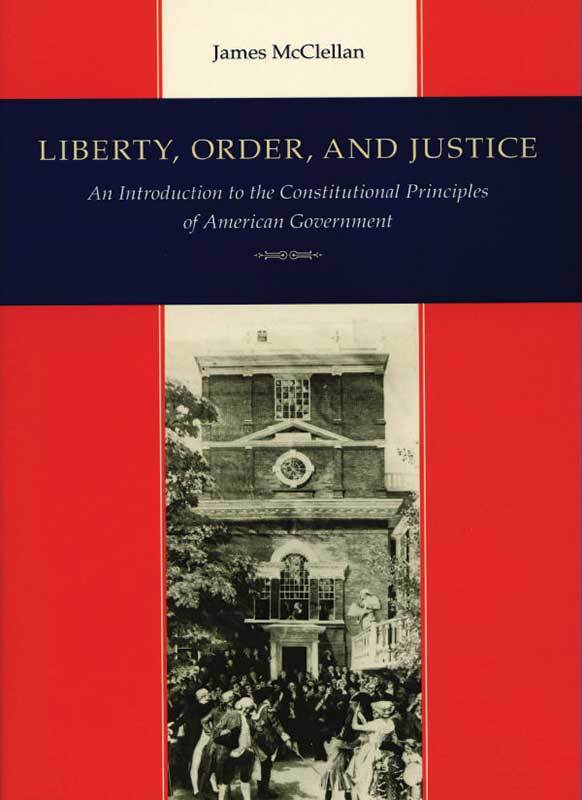
The Education of the Founders - James McClellan, Liberty, Order, and Justice: An Introduction to the Constitutional Principles of American Government [1989]

Edition used:

Liberty, Order, and Justice: An Introduction to the Constitutional Principles of American Government (3rd ed.) (Indianapolis: Liberty Fund, 2000).

About Liberty Fund:

Liberty Fund, Inc. is a private, educational foundation established to encourage the study of the ideal of a society of free and responsible individuals.


The Education of the Founders

American political leaders, it may be seen, drew upon a wide range of philosophers, historians, lawyers, and political thinkers in formulating their constitutional principles. This body of knowledge, combined with their solid grasp of British institutions, their experiences under colonial government and the new State constitutions, to say nothing of American writings on the subject of government, provided a wealth of information for drafting a new constitution. Indeed, the men of the founding generation seemed to love books as much as they loved liberty. We get a glimpse of these American values from the last will and testament of Josiah Quincy, a brilliant Boston lawyer who fought at the side of John Adams against British tyranny: “I leave to my son, when he shall have reached the age of fifteen, the works of Algernon Sidney, John Locke, Francis Bacon, Gordon’s Tacitus and Cato’s Letters. May the spirit of liberty rest upon him.”

A letter written by Thomas Jefferson in 1771, when he was twenty-eight years old, gives us yet a better insight into the kinds of books the educated class of Americans read and valued. Robert Skipwith, a friend of Jefferson’s, asked Jefferson to draw up a list of the books that a Virginia gentleman should have in his personal library. Jefferson obliged his friend with a lengthy list divided into numerous sections, including “Fine Arts” (including poetry, drama, art, and gardening), “Politics and Trade,” “Religion” (which included what we would call philosophy today), “Law,” “History,” and “Natural Philosophy and Natural History” (what we now call the sciences). Works on poetry and fiction, such as those of John Dryden, Alexander Pope, and Jonathan Swift, were included, he said, because “every thing is useful which contributes to fix us in the principles and practice of virtue.” Most of the basic works on Greek and Roman history—Tacitus, Livy, Sallust, and Plutarch—gave detailed accounts of the corruption in Roman politics. Works on English politics and political history focused on the constitutional conflicts of the seventeenth century, but included later works too—Locke, Sidney, Montesquieu, and Bolingbroke. Under religion Jefferson included the writings of Cicero, Seneca, Xenophon, Epictetus, and Hume. Blackstone’s Commentaries, Lord Kames’s Principles of Equity, and a law dictionary were the only entries under the heading “Law.” The Bible also appeared on the list, as did Samuel Johnson’s Dictionary and some of the writings of Edmund Burke and the Scottish economists Adam Smith and Sir James Steuart. Almost all of these works, in one degree or another, were read widely by the educated class of Americans who directed the affairs of the American Republic in the formative years. They provided American political leaders with a deep sense of history, an understanding of liberty and constitutional government, and a system of values, both personal and political, that are reflected in their political behavior and in the constitutions they drafted for their countrymen. No generation of political leaders has been better prepared or better educated for writing a constitution and assuming the reins of government than the Framers of the American Constitution.