EconlibThe LibraryOther Sites |
Front Page Titles (by Subject) PART 1: The Constitution's Deep Roots - Liberty, Order, and Justice: An Introduction to the Constitutional Principles of American Government
Return to Title Page for Liberty, Order, and Justice: An Introduction to the Constitutional Principles of American GovernmentThe Online Library of LibertyA project of Liberty Fund, Inc.Search this Title:Also in the Library:
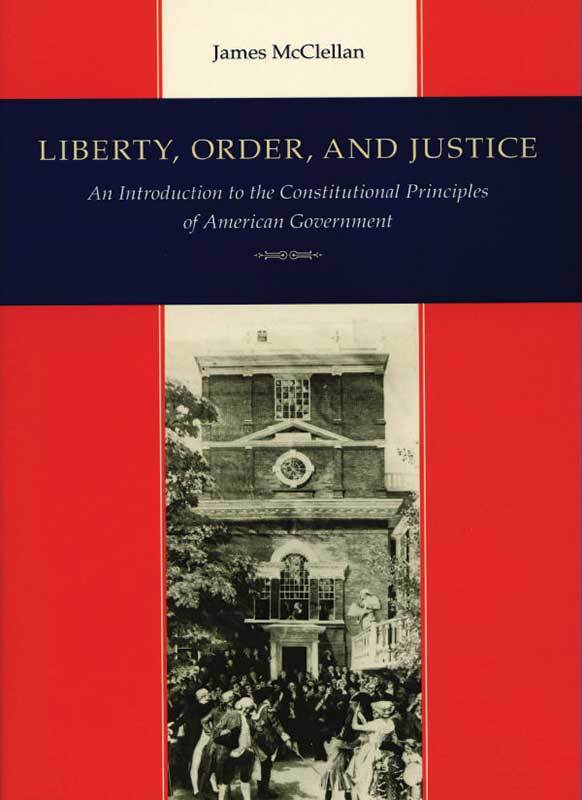
PART 1: The Constitution’s Deep Roots - James McClellan, Liberty, Order, and Justice: An Introduction to the Constitutional Principles of American Government [1989]Edition used:Liberty, Order, and Justice: An Introduction to the Constitutional Principles of American Government (3rd ed.) (Indianapolis: Liberty Fund, 2000).
About Liberty Fund:Liberty Fund, Inc. is a private, educational foundation established to encourage the study of the ideal of a society of free and responsible individuals. Copyright information:The copyright to this edition, in both print and electronic forms, is held by Liberty Fund, Inc. Fair use statement:This material is put online to further the educational goals of Liberty Fund, Inc. Unless otherwise stated in the Copyright Information section above, this material may be used freely for educational and academic purposes. It may not be used in any way for profit.
PART 1The Constitution’s Deep RootsPOINTS TO REMEMBER1. The American Constitution is an evolutionary rather than a revolutionary document. Though written in a revolutionary age, it embraces ideas and principles developed through trial and error that grew out of our colonial experience. Constitutional and legal development in England and the political history of the Greek and Roman republics also influenced the thinking of the Framers. 2. Three important political concepts drawn by the Americans from the Roman experience were the doctrines of republicanism, political virtue, and checks and balances. But it is the English Constitution, including the English charters of liberty and the English legal system, that had the greatest impact on American constitutional development. Representative government, a tradition of well-established civil liberties, and the heritage of the common law are three important political and legal institutions of England that Americans adopted in framing their own constitutions. Certain features of the English Constitution were rejected by the Americans, however, including the monarchy and the principle of legislative supremacy. The American Constitution therefore represents a blending of English and American constitutional traditions. 3. The Framers of the American Constitution had learned from ancient and from British history that republics, like other forms of government, are vulnerable to corruption, and that legislative bodies as well as courts of law can be just as much a threat to liberty as all-powerful monarchs. For this reason they did not place all their trust in any one branch of government, and they established checks on the powers of each. The Meaning of Constitutional GovernmentTwo centuries ago, fifty-five men met at Philadelphia to draw up a constitution for the United States of America. The thirteen States that once had been British colonies urgently needed a more reliable general government, a better common defense against foreign powers, a sounder currency, and other advantages that might be gained through establishing “a more perfect union” founded on a solemn agreement, or fundamental law, called a constitution. Today, the fundamental law of the United States of America still is that Constitution of 1787, a written document which is respected and obeyed almost as if it were a living thing. This book examines that Constitution, inquiring how it was developed, what its provisions mean, why it has functioned so well, and how it affects everybody’s life in America today. What do we mean by this word constitution? As a term of politics, constitution signifies a system of fundamental principles—a body of basic laws—for governing a state or country. A constitution is a design for a permanent political order. A constitution does its work through what is known as the rule of law: that is, people respect and obey laws, rather than follow their own whims or yield to the force of somebody else. Every country develops a constitution of some sort, because without a regular pattern of basic law, a people could not live together in peace. Lacking a tolerable constitution, they never would know personal safety, or protection of their property, or any reasonable freedom. Even savage tribes may be said to be governed by “constitutional” customs of a simple nature. The most widely admired of all constitutions is the United States Constitution. It was written in 1787 and took effect in 1789. It was, and is, rooted in the experience and the thought of many generations of people. This is a major reason why the American Constitution still flourishes in our day. Like some great tree, the Constitution of the United States is anchored and nurtured by roots that run deep into the soil of human experience. Those constitutional roots are the political institutions, the laws, the social customs, and the political and moral beliefs of earlier ages and other lands. Nowadays we tend to think of a constitution as a written document, but actually constitutions may be partly or even wholly unwritten. These unwritten constitutions are not based on a single document but are made up of old customs, conventions, statutes, charters, and habits in public affairs. The British Constitution is an example of this sort of basic body of laws. Until the Constitution of the United States was agreed upon in Philadelphia, all national constitutions were “unwritten” and informal. A few years after the American Constitution was drawn up, written constitutions were adopted in Poland and France. Even the American Constitution is not entirely set down upon paper, however. For it has been said that every country possesses two distinct constitutions that exist side by side. One of these is the formal written constitution of modern times; the other is the old “unwritten” one of political conventions, habits, and ways of living together in the civil social order that have developed among a people over many centuries. Thus, for instance, certain important features of America’s political structure are not even mentioned in the written Constitution of 1787. For example, what does the written Constitution of the United States say about political parties? The answer is—nothing. Yet political parties direct the course of our national affairs. What does our written Constitution say about the President’s cabinet, with its secretaries of state, of the treasury, agriculture, defense, education, and the like? The answer again is nothing; yet the President could not function without a cabinet. So it is possible to speak of a “visible” and an “invisible” constitution, and of a “written” and an “unwritten” constitution. In this book we are concerned principally with the written Constitution of the United States, although from time to time we will refer also to aspects of our basic political system that have not been set down in writing. A constitution is an effort to impose order for the achievement of certain ends. Those ends are often set forth in a preamble to the document, as in the American Constitution, which states that the “People of the United States” have established the Constitution “to form a more perfect union, establish justice, ensure domestic Tranquility, provide for the common defense, promote the general Welfare, and secure the Blessings of Liberty to ourselves and our Posterity.” Liberty, order, and justice, it may thus be seen, are the primary objectives of the American political system. They are probably the most important and all-embracing of the many goals we pursue as a nation. The significance of liberty, order, and justice is reflected in other constitutions as well. Thus the constitution of the Republic of Korea (1980) asserts that its purpose is “to consolidate national unity with justice,” “destroy all social vices and injustice,” “afford equal opportunities,” and “strengthen the basic free and democratic order.” Portugal’s constitution (1974) seeks to “safeguard the fundamental rights of citizens,” “secure the primacy of rule of law,” and build a “freer, more just” country. The constitution of Venezuela (1972) states that its purpose is to ensure “the freedom, peace, and stability of its institutions,” and to provide for “social justice” and support of “the democratic order.” Inspired by the nobility of purpose stated in the American Constitution, the preamble to Argentina’s constitution of 1853 claims that the fundamental law of this South American republic aims toward “ensuring justice, preserving the domestic peace, providing for the common defense, promoting the general welfare, [and] securing the blessings of liberty to ourselves, to our posterity. …” Liberty, order, and justice are all made possible by sound constitutions; but a constitution is only a “parchment barrier,” and even a well-conceived constitution will fall short of its goals if the people fail to support it. Many of the Framers of the American Constitution were of the opinion that constitutional government requires, above all, a “virtuous” citizenry if it is to endure. Certainly a constitution cannot last if it is willfully ignored, or if there is no common understanding among the citizens and their elected leaders as to what the achievement of liberty, order, and justice requires. What did the Framers mean, then, when they dedicated themselves and their fellow countrymen to the pursuit of these ideals? Let us briefly define these important terms as they have been traditionally understood: liberty (or freedom) means the absence of coercion or force, or the ability of an individual to be a thinking and valuing person and to carry out his own plans instead of being subject to the arbitrary will of another. Order means the arrangement of duties and rights in a society so that people may live together in peace and harmony. By ordered freedom we mean individual freedom that recognizes the need to limit freedom in some respects and rejects the notion that the individual should have absolute freedom to do as he or she pleases irrespective of the rights of others. Without the restraint of law and order, freedom cannot exist. Justice means the securing to persons of the things that rightfully belong to them, and the rewarding of persons according to what they have earned or deserve. Equality of opportunity and equality before the law are normally regarded as attributes of justice in a free society, as distinguished from equality of result or condition, which must be imposed by coercion. To understand liberty, order, and justice, think of their opposites: slavery, disorder, and injustice. The aim of a good constitution is to enable a society to have a high degree of liberty, order, and justice. No country has ever attained perfect freedom, order, and justice for everyone, and presumably no country ever will. This is because human beings and human societies are both very imperfect. The Framers of the Constitution of the United States did not expect to achieve perfection of either human nature or government. What they did expect was “to form a more perfect union” and to surpass the other nations of their era, and of earlier eras, in establishing a good political order. Over the centuries, constitutions have come into existence in a variety of ways. They have been decreed by a king; they have been proclaimed by conquerors and tyrants; they have been given to a people by religious prophets such as Moses, who gave the Ten Commandments and laws to the Israelites; they have been designed by a single wise man such as Solon, who gave a new constitution to the people of Athens in ancient Greece six centuries before Christ. Other constitutions have grown out of the decisions of judges and popular custom, such as the English “common law.” Or, constitutions can be agreed upon by a gathering called a convention. The constitutions that have been accepted willingly by the large majority of a people have generally been the constitutions which have endured the longest. But because people are restless and quarrelsome, few constitutions have lasted for very long. Nearly all of those that were adopted in Europe after the First World War had collapsed by the end of the Second World War a quarter of a century later; many of the newer constitutions proclaimed in Europe, Asia, and Africa not long after the Second World War ended in 1945 have already have been tossed aside or else do not really function anymore. There are today more than one hundred national constitutions in force throughout the world. Nearly all of them were written and adopted after the Second World War. The oldest and most respected constitution is the Constitution of England. It dates back to the beginning of the thirteenth century. Much of the written Constitution of the United States is derived from the “unwritten” English Constitution—or, to be more precise, from the English Constitution as it stood during the latter half of the eighteenth century. For England’s constitution developed and changed over the centuries. By 1774, when the American struggle for independence began, the fundamental laws of England were very different from what they had been in 1215, the year when King John accepted the constitutional document known as the Magna Charta. All good constitutions change over the years because the circumstances of a nation change. As the great parliamentary leader Edmund Burke put this in the eighteenth century, “Change is the means of our preservation.” But good constitutions also contain many provisions that are permanent. These are principles and rules of law that help prevent rash or hasty changes which might work mischief. Unlike the English Constitution, which can be changed by a mere statute of Parliament, the American Constitution can be formally changed only when a large majority of the people, through their States, approve an “amendment.” The American Constitution is like the English Constitution in another way. Both are based on the principle that liberty, order, and justice are difficult to achieve and must be preserved through fundamental laws that should be respected and not easily cast aside to serve a temporary expedient or to satisfy the whims of a transient majority that is here today and gone tomorrow. What is a good constitution supposed to accomplish besides protecting liberty, order, and justice? We may set down below four primary characteristics of a good constitution. First, a good constitution should provide for stability and continuity in the governing of a country. The subjects or citizens of a political state should be assured by their constitution that the administering of the laws and of major public policies will not change continuously from one day or year to another day or year. What was lawful yesterday must not suddenly be declared unlawful tomorrow unless through a formal amendment to the Constitution. People must be able to live their lives according to certain well-known rules. A good constitution also helps a country to achieve economic prosperity. When a country’s constitution does not guarantee stability and continuity, no man or woman can plan for the future. When we make decisions, it is important that we know with reasonable certainty what the consequences will be. Second, a constitution should restrain government from assuming powers that rightfully belong to other political entities or to families or individuals. This can be accomplished by limiting and dividing power. A wise constitution may allocate certain powers to a central government and other powers to regional or local governments; or it may assign certain functions and prerogatives to each of the major branches of government—the executive, the legislative, the judicial. Certainly a prudent constitution will provide safeguards against arbitrary and unjust actions by persons who hold power. Third, a constitution should establish a permanent arrangement that enables public officials and others with political authority to represent the people they govern. To put this another way, with a good constitutional order the people ought not to be ruled by a group or class of persons quite different from themselves who do not have at heart the best interests of the majority of the people. This does not necessarily mean that a constitutional government has to be totally democratic. It also does not mean that a good constitution must necessarily provide for “one man, one vote.” There have been decent constitutional systems that were monarchical, or aristocratic, or under which the right to vote was limited. Fourth, a good constitution holds public officials directly accountable to the people. This means that the governing class or public officials must be held responsible—under the constitution—for the actions they take while in public office. Under a truly constitutional government, no man or woman can be permitted to exercise arbitrary power—that is, to disregard laws or popular rights whenever it is thought convenient to do so. All officials must be held accountable to established authorities such as the courts of law, to the legislature, and to the voting public, and should not be allowed to exempt themselves from the laws they enact. Public officials should also be held accountable to fiscal inspectors, and should be subject to removal from office through impeachment for “high crimes or misdemeanors,” such as the abuse of power or the misuse of public funds. Various other characteristics of a sound constitutional system might be named. The four above are particularly important, however, and are now found in one form or another in the constitution of every country that enjoys a high degree of liberty, order, and justice. These characteristics of a good constitution help us to recognize what can and cannot be achieved through constitutions. A good constitution, in the first place, ought not to incorporate detailed regulations to cover every contingency. On the contrary, the constitution should be concerned with first principles of government; it should not be an endeavor to provide rules of administration for a multitude of concerns. The longer a constitution is, the fewer people will read it, and the harder it will become to distinguish its major provisions from details of relatively small importance. Respect for a constitution will be diminished if it becomes an entire code of laws dealing with every conceivable subject. Second, a written constitution ought not to conflict with the “invisible constitution” or long-established patterns of institutions, customs, and beliefs that have strongly influenced a country’s politics for many generations. A constitution invented by radicals, one deliberately designed to break down a people’s traditional ways, must meet with strong resistance or evasion. The framers of a constitution ought to understand the political traditions of their time and country. A good constitution, in other words, should conform to the character, habits, and mores of the people who will live under it. Because civilizations differ, a constitution that is suitable for one country may be unsuitable for another. It would be unrealistic, for example, to suppose that the entire American Constitution can be exported to foreign nations. A country without a strong democratic tradition of self-government and a well-educated population may also have difficulty preserving a constitution, particularly if that constitution presupposes a level of political understanding and maturity to which the people have not risen. For merely creating an idealistic paper constitution will not bring about substantial improvement in liberty, order, or justice. The “paper constitutions” of many new African states that were proclaimed during the 1950s and 1960s collapsed altogether within a very few years. Third, a good constitution should be neither easy to alter nor impossible to amend. This is because, on the one hand, a constitution is meant to be permanent and to assure a people that the political pattern of their country will not drastically change. On the other hand, the word permanent does not mean eternal. It is simply not possible for people who are living near the end of the twentieth century to draft an unalterable constitution for their great-grandchildren who will be living in a century to come. This is true because, in the course of a century or two centuries, there may occur significant political, economic, technological, military, or even physical changes in the circumstances of a nation. Therefore a good constitution must be elastic enough to allow for modification of certain of its provisions without the need to abolish the whole constitution. This understanding of what a constitution should do and cannot do is derived chiefly from the success of the Constitution of the United States. “The American Constitution is the most wonderful work ever struck off at a given time by the brain and purpose of man,” wrote William Gladstone, an English statesman, in 1878. That may seem to be extravagant praise. But surely no body of men has ever achieved a political result more ennobling and more enduring than that which the Framers of the Constitution produced in the summer of 1787. The following sections of this book explain the historic roots of the American Constitution, the events of the “Great Convention” of 1787, the major political principles of the Constitution, why the Bill of Rights was added to the original articles of the Constitution, the process of ratification, the meaning of the document’s important provisions, how they are to be interpreted, and how they may be changed. Presumably, nearly all the people who read this book will continue to live under the protection of the Constitution of the United States, so they may find it worthwhile to understand just what the Constitution does, and how it influences their lives, their family, their community, and their nation. The Lamp of ExperienceThe Articles of Confederation, America’s first national constitution, were hastily drafted in 1776 amidst the turmoil of the American Revolution. Because of disagreements among the States, ratification was slow in coming. In fact, the Articles did not actually go into effect until 1781. By 1787 there was widespread agreement throughout the country that the Articles had proved to be unsatisfactory and that it was therefore necessary to change them substantially, or possibly to abandon them altogether and write a new constitution. In the end, as we shall see, the latter view prevailed. The members of the Federal (or “Philadelphia”) Convention who met in Philadelphia in 1787 to “revise” the Articles soon came to the conclusion that the defects were so fundamental that a mere revision would not be practical. One delegate to the Federal Convention who argued strenuously for a new constitution, and then later led the fight for ratification of the one that was finally drafted, was Alexander Hamilton of New York. After the Convention completed its work on September 17, 1787, Hamilton, joined by John Jay of New York and James Madison of Virginia, wrote a series of essays called The Federalist. Written for New York newspapers, and later distributed in other States, the essays in The Federalist urged the people to support the new Constitution and attempted to explain why it was preferable to the Articles of Confederation. Seeking to present themselves as neutral observers, the authors of The Federalist concealed their identity and wrote under the name of “Publius.” Most other writers, whether favoring or opposing the Constitution, did the same. In New York, for example, one of the most effective critics of the new Constitution was an anonymous writer named “Brutus.” From New Hampshire to Georgia a great “war of pamphlets” erupted in the struggle over ratification of the Constitution. Those favoring adoption called themselves “Federalists,” and those opposing ratification were dubbed “Anti-Federalists.” From their very inception, the 85 essays in The Federalist, or what are commonly known as The Federalist Papers, were immediately recognized as superior to other writings on the Constitution produced during the ratification struggle. Taken together, they constituted a brilliant exposition of the entire Constitution—profound, insightful, and instructive. To this day, The Federalist is universally acknowledged as an American classic, as an indispensable source for an understanding and appreciation of the original meaning and purpose of almost every provision of the Constitution. To his lasting fame and credit, it was Alexander Hamilton who organized the collective effort to publish The Federalist and wrote most of the essays. Speaking for most of the delegates who attended the Philadelphia Convention, and certainly for many of his countrymen as well, Hamilton confronted the basic dilemma Americans faced in 1787. The Articles of Confederation, he wrote in Federalist No. 15, were an invitation to disaster. “We may indeed with propriety be said to have reached almost the last stage of national humiliation,” wrote Hamilton. Something must be done, he said, “to rescue us from impending anarchy.” The nation was steeped in debt to foreigners and its own citizens; valuable American territories were still in the possession of Great Britain; there were no troops or funds to repel invaders; access to the Mississippi River was impeded by Spain; commerce had declined to its lowest point. So great was “the imbecility of our government,” he complained, that foreign governments would not even deal with it. “The evils we experience,” Hamilton concluded, “do not proceed from minute or partial imperfections, but from fundamental errors in the structure of the building, which cannot be amended otherwise than by an alteration in the first principles and main pillars of the fabric.” It was on this basis that the Framers proceeded to construct a new framework of government, casting aside the Articles of Confederation and building a new edifice, from the ground up, on “first principles.” But they did not have to begin from scratch. Before we explore the meaning and substance of those “first principles,” and seek to discover how and why they were incorporated into the Constitution, it is essential that we first examine their origin and historical development. “Not to know what happened before one was born,” as we were reminded long ago by Cicero, the great Roman statesman, “is always to be a child.” American political leaders were hardly ignorant or contemptuous of the past. The Framers respected the wisdom of their ancestors, especially their religious learning. They had been reared on the King James version of the Bible, and at least half of them—being Episcopalians—were well acquainted with the Book of Common Prayer. They also respected the lessons of history and were strongly influenced by historical, legal, and constitutional precedents, both foreign and domestic. They had read a good deal of law and history. They knew something of political philosophy, that great body of learning that seeks to know and understand the first principles of government, and what it takes to establish good government and promote the common good or “general welfare.” But they were not alienated closet-philosophers trying to found a perfect society or utopian paradise, for they were keenly aware of man’s imperfections as well as his strengths. Almost to a man, the Framers were aware of the intricate process by which human beings had learned to live together, at least in some places and at certain times, in freedom, order, and justice. Those who forget the mistakes of the past, it has been said, are bound to repeat them. The Framers knew of the many mistakes that had been made in the governing of great nations. Above all, they knew the benefits enjoyed in a society in which the claims of authority and the claims of freedom were maintained in a healthy balance. “Power corrupts,” said Lord Acton, the nineteenth-century British political thinker, “and absolute power corrupts absolutely.” The men who wrote the American Constitution would have agreed, but they would have also added: “Yes, but absolute liberty can also corrupt a nation. There is no freedom in anarchy.” “I have but one lamp by which my feet are guided,” the fiery patriot leader Patrick Henry told his fellow planters of Virginia in 1775, “and that is the lamp of experience. I know of no way of judging the future but by the past.” The confidence and trust expressed by American political leaders in the political principles they applied in making the Constitution and evaluating its merits stemmed not from rootless theories and ideals divorced from experience and reality, but from the conviction that these principles were tried and true—the result of trial and error spanning centuries of political conflict. This was true of both Patrick Henry, the Anti-Federalist leader who opposed the Constitution, and Alexander Hamilton, the Federalist leader who favored it. What divided these gentlemen in 1787, as we shall later learn, was not so much a disagreement over first principles as a difference of opinion over whether those principles had been given proper weight and correctly adapted to the American situation. The Constitutions of AntiquityWhat had the Framers learned about the art of government in 1787? In the first place, it must be kept in mind that the leaders of the founding generation were steeped in classical learning. The study of Greek and Latin literature, and of the ancient world’s history and politics, loomed much larger in American education during the latter half of the eighteenth century than it does in American education today. Indeed, the classical past was a dynamic force in American public life well into the nineteenth century. The last President of the United States with a truly classical education was probably John Quincy Adams, the son of the second President, John Adams. John Quincy Adams even taught the classics at Harvard as a Professor of Rhetoric and Oratory and in 1810 published his lectures on this subject. His administration (1825–1829) marks a turning point respecting the classical influence, however, and after the Jacksonian era few Presidents have been well read in the classics. None was a classicist in the sense that the Adamses and Jefferson were, and certainly none was portrayed, like George Washington in a famous statue by Horateo Greenough, in the character of a Roman senator—nude to the waist, with uplifted arm, draped by a toga, pointing to the heavens. Few statesmen understood, as the Revolutionary and Federal generations had, that classical history had much to teach the nation. Perhaps the last conspicuous surviving remnants of America’s classical tradition in the first half of the nineteenth century were in architecture, which experienced a Greek revival, as seen in the construction and design of great plantation houses in the South; and in oratory, as witnessed in the great senatorial debates and public addresses by John Randolph of Roanoke, John C. Calhoun, Henry Clay, and the most celebrated Ciceronian orator Daniel Webster. Most of the Framers had read, in translation or in the original Greek and Latin, such ancient authors as Herodotus, Thucydides, Plato, Aristotle, Polybius, Cicero, Livy, and Plutarch—philosophers and historians who described the constitutions of the Greek and Roman civilizations. From their study, the American leaders of the War of Independence and the constitution-making era learned, by their own account, what political blunders of ancient times ought to be avoided by the republic of the United States. “History,” Thomas Jefferson wrote, “informs us what bad government is.” Perhaps he had the ancient republics in mind when he wrote those words. The Greek city-states of the sixth and fifth and fourth centuries before Christ never succeeded in developing enduring constitutions that would give them liberty, order, and justice. Civil war within those city-states was the rule rather than the exception, pitting class against class, family against family, faction against faction. And when half of those cities went to war against the other half, in the ruinous Peloponnesian struggle—during the last three decades of the fifth century—Greek civilization never wholly recovered from the disaster. Leading Americans carefully studied the old Greek constitutions. In his Defence of the Constitutions of Government of the United States (published in 1787, on the eve of America’s Great Convention), John Adams, for example, critically examined twelve ancient democratic republics, three ancient aristocratic republics, and three ancient monarchical republics. He found them all inferior to the political system of the new American republics in the several States that were formed after 1776. James Monroe, a hero of the American Revolution, a member of the Virginia Ratifying Convention of 1788, and later the fifth President of the United States, wrote descriptions of the ancient constitutions of Athens, Sparta, and Carthage—finding all of them seriously flawed and therefore not to be trusted by Americans. The authors of The Federalist, in their defense of the Constitution, often referred to “the turbulent democracies of ancient Greece” (Madison’s phrase) and to other ancient constitutions. In general, Hamilton, Madison, and Jay found the political systems of Greece and Rome, as Madison put it, “as unfit for the imitation, as they are repugnant to the genius of America.” Eighteenth-century Americans did respect Solon, the lawgiver of Athens in the sixth century But Solon’s good constitution for his native city had lasted only some thirty years before a tyrant seized power in Athens. Few American leaders were much influenced by Greek political thought; John Adams wrote that he had learned from Plato two things only, that husbandmen and artisans should not be exempted from military service, and that hiccoughing may cure sneezing. It is true that ancient Greek culture helped to shape education in America, but Greek constitutions had almost no influence in the shaping of the Constitution of the United States—except so far as Greek constitutional flaws suggested what the Framers at Philadelphia ought not to adopt. There is, nevertheless, much to learn about constitutions from reading Plato and Aristotle. Both of these ancient Greek philosophers wrote about monarchical, aristocratic, and democratic constitutions, about oligarchies and democracies, about tyrannies and kingships, about the origin and nature of government, and about the polity—that regime described by Aristotle as essentially a limited democracy blending the monarchical, aristocratic, and democratic elements of government, in which the greatest political power is exercised by landholders. This was the dream of Greek democracy, but it was not exactly the model the Americans wished to apply to the infant Republic of the United States. This was because Greek politics in ancient times was the politics primarily of “city-states”—compact in territory, very limited in population, and quite unlike the thirteen original States that formed the United States. Also, in the Greek democracies the entire body of male citizens was able to assemble in a forum to make public decisions of the gravest sort—sometimes foolish decisions with ghastly consequences. The United States in 1787, by comparison, was a vast expanse of territory in which there were few cities. Direct democracy of the Greek sort, where the people gathered to represent themselves, would not have been practical, or even possible, in the American republic. Indeed, the sheer size of the United States was almost overwhelming. From north to south the new nation spanned almost twelve hundred miles, and to the west—from the Atlantic Ocean to the Mississippi River—the distance was about six hundred miles. The Greek city-states were mere specks on the map in comparison with almost any of the American states, and England itself could have just about fit within the State of New York. Although there were fewer than four million inhabitants in the thirteen States, the United States in 1787 was already one of the largest nations in the Western world. The Roman Republic was taken much more seriously by leading Americans in the 1780s. American boys at any decent school in the eighteenth century studied the orations and the life of Marcus Tullius Cicero, the defender of the Roman Republic in its last years. And they read Plutarch’s Lives of the Most Noble Grecians and Romans, which taught them the characteristics and qualities of great statesmen. A classical education was considered essential for all young men, and the better academies for young women also provided classical learning. The vocabulary of American political culture also reflected the influence of America’s classical heritage. The English word constitution is derived from the Latin constitutio, meaning a collection of laws or ordinances made by a Roman emperor. Among other terms, president and federalism have roots in Roman history; and the Roman term Senate was applied by the Framers of the American Constitution to the more select house of the legislative branch of their federal government, although the method of selecting senators in America was to be very different from what it had been in Rome. Hamilton, Jay, and Madison, the authors of The Federalist, wrote in the name of Publius, a reference to Publius Valerius Publicola, the ancient Roman famous for his defense of the Roman Republic. Three important political concepts drawn by the Americans from the Roman experience were the doctrines of republicanism, political virtue, and checks and balances. Though theoretically a republic would be any form of government other than a monarchy, it was generally understood by Americans to mean a government in which the people were sovereign. In a small New England town they might rule directly, but on a larger scale the people would have to rule indirectly, through their freely chosen representatives. Advocacy of this form of government in the eighteenth century was a radical idea, and many European thinkers, having grown accustomed to monarchy, looked upon republicanism as a foolish and unworkable relic of the past. Republics might be suitable for a Greek city-state or Swiss canton, but they were too unstable for governing anything larger. The internal collapse of the Roman Republic under the weight of corruption and disorder, resulting in tyranny and the eventual destruction of the nation, seemed to prove the point. In fact, corruption had subverted and toppled almost every republic that had ever existed. American leaders nevertheless believed that republicanism offered the only hope for preserving liberty, and that republicanism could successfully be revived if the mistakes of the past were understood and not repeated. This goal was within reach, they thought, if a republic could be designed which encouraged public virtue, the animating principle of republican government, and discouraged corruption, the characteristic republican disease. Many of the books that Americans read—Charles Montesquieu’s Considerations on the Grandeur of the Romans and Their Decline, James Harrington’s Oceana (an imaginary commonwealth), the writings of Algernon Sidney, Thomas Gordon’s Cato’s Letters and his translations of Roman historians—emphasized the threat of corruption and provided object lessons on how it might be avoided. Above all, the Americans valued republican virtue, and the American leader who prized it the most was George Washington. In his own lifetime, Washington came to symbolize republican virtue. The story popularized by Parson Weems that Washington could not “tell a lie” when he was once accused of chopping down a cherry tree was a myth; and yet there was an element of truth in it, for Washington was a true public servant whose honesty and integrity were above reproach. Had he been a lesser man, hungry for power and glory, he might have exploited his enormous popularity among the American people to crown himself king or establish a military dictatorship, as Napoleon Bonaparte did in France. But Washington patterned his conduct in war and politics on that of Cincinnatus, the great Roman patriot and statesman who never sought power for himself, who answered Rome’s call when he was needed and returned to the plow when the crisis had passed. After the Revolution, Washington’s example, the general appeal of Cincinnatus, and the patriotic zeal of American revolutionary war leaders inspired the creation of the Society of the Cincinnati, an organization for officers of the Continental Army. Some politicians expressed concern when the Society first came into existence that it might be part of a military conspiracy to overthrow the government, but Washington’s well-known hostility toward such ideas soon put these fears to rest. The Society still exists as a living memorial to the patriotism of the American revolutionary soldier and as a continuing reminder that the spirit of republican virtue, as represented by the life and career of Cincinnatus, guided Washington and other American leaders in their struggle for freedom. For the delegates at Philadelphia, the most interesting feature of the Roman Republican constitution was its system of checks upon the power of men in public authority, and its balancing of power among different public offices. The Americans learned of these devices from the History by Polybius, a Greek statesman compelled to live long in Rome. The two Roman consuls, or executive; the Roman Senate, made up of rich and powerful men who had served in several important offices before being made senators; the Roman assembly, or gathering of the common people—these three bodies exercised separate powers. And the Roman constitution (an “unwritten” one) included other provisions for preventing any one class from putting down other classes, and for preserving the republican form of government. Praised by Polybius as the best constitution of his age, this Roman constitutional system was bound up with a beneficial body of civil law, and with “the high old Roman virtue”—the traditional Roman morality, calling for duty and courage. The actual forms of checks and balances that the Americans incorporated into their Constitution in 1787, however, were derived from English precedent and from American colonial experience, rather than directly from the Roman model. Instances from the history of the Roman Republic, nevertheless, were cited by the Framers and by other leading Americans of that time as reinforcement for the American concept of political checks and balances. The Americans’ vision of a great and growing republic, it may thus be seen, owed much to the annals of the Roman Republic. The Roman Republic failed because of long civil wars in the first century , and it was supplanted by the Roman Empire. This Roman experience, and the decadence that fell upon Roman civilization as the centuries passed, were much in the minds of American leaders near the end of the eighteenth century. The grim consequences of political centralization under the Roman Empire convinced many Framers that an American government should be federal rather than central—just as some delegates pointed to the Greeks’ disunity as a warning against leaving the American Republic a weak confederation. Besides, Roman struggles of class against class reminded Americans that they must seek to reconcile different classes and interests through their own constitutional structure. Thus Rome’s political and moral example was a cautionary lesson to Americans of the early Republic. Edward Gibbon’s great history The Decline and Fall of the Roman Empire had been published between 1776 and 1783, the period of the American Revolution, and its details were vivid in the minds of the delegates at Philadelphia. Yet it will not do to make too much of the influence of the Roman constitution upon the Constitution of the United States, two thousand years after Polybius wrote in praise of Roman character and institutions. The more immediate and practical examples of constitutional success were the British and the colonial political structures. The American Republic was joined with England and with her own colonial past by a continuity of culture that much exceeded the Americans’ link with old Rome, so distant and so remote in time. It was the aspiration of the delegates at Philadelphia in 1787 to reconcile the need for a strong federal government with the demand for State sovereignty, local autonomy, and personal liberty. They could not find in the history of the ancient world any model constitution that might achieve this purpose. In 1865, nine decades after the Great Convention at Philadelphia, Orestes Brownson—one of the more interesting of America’s political thinkers—would write in his book The American Republic that America’s mission under God was to realize the true idea of the political state or nation. America’s mission, Brownson believed, was to give flesh to that concept of the commonwealth “which secures at once the authority of the public and the freedom of the individual—the sovereignty of the people without social despotism, and individual freedom without anarchy. … The Greek and Roman republics asserted the state to the detriment of individual freedom; modern republics either do the same, or assert individual freedom to the detriment of the state. The American republic has been instituted by Providence to realize the freedom of each with advantage to the other.” Certainly such a high ambition, surpassing the political achievements of the ancient world, was the spirit of 1787 at Philadelphia. English Origins of America’s Constitution“The American Constitution is distinctively English,” wrote Sir Henry Maine in his book Popular Government (1885). Why should the Americans of 1787, so recently at war with Britain, have drawn up a constitution incorporating among its principal features institutions and principles long established in England? Because they, like their ancestors, were familiar with those British constitutional features and found them desirable; also because colonial charters and the constitutions of the Thirteen States had been framed on the British model, for the most part, and Americans had grown accustomed to their operation. Besides, the great majority of American citizens were British citizens who spoke English, read English books, enjoyed “the rights of Englishmen,” and participated in a culture basically English. There are, of course, a number of important differences between the English and American constitutions that should be understood. As we noted earlier, the English Constitution is not a “written” constitution. That is, it is not contained in any single document like the American Constitution of 1787. It consists, rather, of (1) certain charters and statutes that are regarded as part of the fundamental law, (2) principles derived from the common law, and (3) a great variety of political and legal customs and traditions. Statutes that enjoy a constitutional status are those which deal with the distribution and exercise of power, and those which guarantee certain freedoms. Three great political documents which are essentially compacts or agreements between the Crown and the Nation (the people and their representatives) stand out as prominent landmarks in English constitutional history. These are Magna Charta (1215), the Petition of Right (1628), and the Bill of Rights (1689), which constitute, in the words of the great parliamentary leader Lord Chatham, “the Bible of the English Constitution.” Many of the individual rights guaranteed in these documents, as we shall later observe, reappear in our first State constitutions, in our Federal Constitution, and in our Bill of Rights. The “law of the land” clause in Magna Charta, for example, which later came to be known as “due process of law,” will be found in the Fifth and Fourteenth amendments of the United States Constitution. Magna Charta is often regarded as the foundation of Anglo-American liberties, because it established the principle that all Englishmen, not just the Lords, are entitled to personal liberty, and that no man, including the King himself, is above the law. Another and actually more fundamental difference between the English and American constitutions concerns the question of sovereignty. Sovereignty signifies the highest governmental or legal authority. Under the English Constitution, legal sovereignty resides in Parliament. Parliament, in other words, is supreme, and its authority cannot be challenged by the Crown or the judiciary. There is no supreme court, as in the United States, which has the right to declare an act of Parliament unconstitutional. Parliament decides for itself whether its laws are constitutional. Throughout British history, and particularly during the American revolutionary period, certain statutes were challenged on the ground that they were “unconstitutional.” American political leaders, for example, claimed that the Stamp Act, imposing a tax, was “unconstitutional.” By this they meant that in their judgment the statute conflicted with basic English liberties and should be repealed. Their appeal was to Parliament, because the English courts did not have jurisdiction over such a claim. By contrast, sovereignty in the American constitutional system is in the Constitution itself, which is declared to be the supreme law of the land. If a party claims that a certain act of Congress is “unconstitutional,” not only may he seek to persuade Congress to repeal the statute, but also he may be able under certain conditions to take his case to court and obtain a judicial ruling on the question. The English and American political systems are also distinguishable on the basis of separation of powers. The English have a parliamentary system of government, whereas the Americans have a presidential system. Under both systems, the functions of government are separated into legislative, executive, and judicial branches, but there is no clear separation of personnel under a parliamentary system. The real executive in the English system is not the King but the cabinet, which is made up of the King’s ministers. Members of the Cabinet, however, also hold a seat in Parliament. The Prime Minister, for example, actually holds a seat in the House of Commons (the lower house) and is the leader of the majority party of that body. The President of the United States, on the other hand, is more independent of the legislature. He is elected by the nation at large, not by the members of Congress. He may actually be a member of a political party that is in opposition to the majority party in control of one or both houses of Congress. Unlike in the English system, members of the House of Representatives and Senate are forbidden by the Constitution from serving in the executive branch. How and why the Americans departed from the English example of separation of powers will be the subject of later discussion. In many other ways, however, the two constitutions are quite similar, and the British influence may readily be discerned. Congress and Parliament are bicameral legislatures, consisting of two houses. Members of the House of Commons, like those of the House of Representatives, are elected from single-member districts for relatively brief terms. A speaker presides over both chambers, though the speaker of the House of Commons is a neutral figure who does not vote or participate in the proceedings. Both houses are regarded as the “lower” houses and have many more members than the “upper” houses. Because they are subject to more frequent elections and represent a smaller constituency, the members of the House of Commons and the House of Representatives are also commonly regarded as “closer to the people.” The House of Lords has ceased to function as an independent body equal to the House of Commons, and nowadays is quite unlike the powerful United States Senate. In 1787, however, there were some similarities. Although the Senate was established to represent the several States rather than an American “nobility,” both the Senate and the House of Lords were regarded as smaller, more exclusive bodies that would serve as a moderating influence on the more populous lower houses. Both were free of direct popular control; many (but not all) members of the House of Lords held their seats by inheritance, and Senators were elected by the State legislatures rather than by the people. Bicameralism was thus favored in both England and America as a device for restraining the legislature. By representing different constituencies, with different interests, in two chambers instead of one, no single interest or single class, it was argued, would dominate the entire legislative branch. Likewise, the Federal judicial system adopted by the Framers in 1787 bore the stamp of the English Constitution. Under both constitutions, the judiciary has been established as an independent branch, largely though not completely free of legislative and executive control. The judges are appointed by the executive for unspecified terms, remain on the bench as long as they exercise “good behavior,” and may not be removed from office except by impeachment. Their salaries may not be reduced by the legislature while they serve. This strengthens their independence by preventing an angry legislature from attempting to influence the judicial process through manipulation of judicial salaries. In many other ways, American constitutionalism, written or unwritten, is rooted in British practices and customs. Almost without exception, all of the individual liberties, including political liberty and the right of property, that are guaranteed in the Federal and State constitutions may be traced to English precedents. Representative government, or what we call the republican tradition, is the bedrock of American constitutionalism. But it is a tradition inherited from Great Britain, and American revolutionary leaders generally regarded the right of representation as the most fundamental right they possessed. To be sure, a principal constitutional grievance of the colonists was the lack of American representation in Parliament—“taxation without representation.” The Growth of ParliamentIn contrast to the democracies of the ancient world or of the medieval and renaissance city-states of Italy, there arose in England, by stages, what we now call representative government, through the summoning of an assembly called Parliament. Various forms of representative government had developed in western Europe late in the Middle Ages and down to the late eighteenth century; but of these the English form, with its House of Lords and House of Commons that made up the Parliament, was the most successful and powerful. The origin of Parliament may be traced back to the King’s councils (Witans) under the Anglo-Saxons, who ruled England before the Norman invasion in 1066, but some historians prefer to mark the beginning in 1215. This was the year when the English barons compelled King John to grant them a great charter (Magna Charta), which bound the King to extend certain basic liberties to all “freemen.” A more precise point of origin, however, is the year 1295. On that date, King Edward I summoned what became known as the “Model Parliament” because it served as the model for all succeeding Parliaments. Here, for the first time, the right of all classes to be represented in Parliament was permanently established. The barons (the English nobility) and the Bishops and other high ranking members of the clergy joined together as the “Lords Temporal and Spiritual” to form the House of Lords. Two knights from every shire (county) and two burgesses from every town or borough were also summoned, and these freemen or “commoners” joined together to form the House of Commons. “What concerns all, should be approved by all.” These words appeared in the writs (written orders in the form of letters) sent out by Edward when he summoned the Model Parliament. Edward wanted to raise taxes, and taxation to support Edward’s wars concerned all. The Model Parliament granted him that monetary aid, and from this time forward it was understood that the King could not levy a tax without the approval of Parliament. Here too was the birth of the constitutional principle around which the Americans rallied five centuries later: “No Taxation Without Representation.” Gradually this “power of the purse” passed into the hands of members of the House of Commons. Under the American Constitution, as the English, the power to initiate tax revenue measures is considered to be so important that only the lower houses may propose money bills. “All bills for raising Revenue,” states Article I, Section 7 of the Constitution, “shall originate in the House of Representatives.” By the middle of the fifteenth century, something like real representative government had taken shape in England. In theory, at least, the law was supreme. The King was bound by oath to respect the laws; he could not change the laws or impose new taxes without Parliament’s consent. Through elections held in county courts and boroughs, the people of England chose individuals from their own number to represent them in the House of Commons, whose members were privileged against interference or even ordinary arrest. The power of impeachment prevented, or at least curbed, arbitrary acts or corrupt practices among the King’s servants. About the middle of the fifteenth century there was no real hostility between the House of Lords and the House of Commons. As the end of medieval times approached, England knew more of liberty, order, and justice than did any other country. The coming of the strong-willed Tudor sovereigns of England during the sixteenth century delayed for more than a hundred years the growth of Parliament’s powers. By manipulating elections or by threatening to use force, the Tudor kings and queens dominated their Parliaments, even if they respected the outward form of England’s Constitution. After James I became England’s first Stuart king at the beginning of the seventeenth century, the contest between kings and Parliament was resumed. This struggle led to civil war during the reign of Charles I (James’s son), and to the execution of the King himself by the triumphant forces of Parliament and the Puritan faction in the Church (1649). When the monarchy was restored under Charles II, an uneasy compromise was reached between the Royalists and the champions of Parliament. The accession to the throne of James II, a Catholic, brought on the opposition of the great landed proprietors of England and of most of the English people, who were overwhelmingly Protestant. In 1688 James was forced to flee abroad. He was succeeded as sovereign by the Protestant William III, from the Netherlands, the husband of James’s daughter, Mary. To secure the throne, William III was compelled to recognize the supremacy of Parliament. From 1689 forward, the royal influence over government in England tended to diminish, and the power of Parliament—that is, of the English form of representative government—tended to increase. In 1714, George, King of Hanover, came over from Germany to be enthroned as George I of England. Throughout the eighteenth century Britain was ruled by three Georges, of whom the first two were unfamiliar with English ways, so that political power inclined toward Parliament and parliamentary political parties. George III, hoping to rule as a “Patriot King,” tried to restore much of the royal authority, and in doing so he helped to bring on the American Revolution. The Challenge of Parliamentary SupremacyThough not always clearly perceived in England or in the colonies, the English Constitution, it may thus be seen, had changed much since the time of Charles I, and there were often conflicting precedents. The constitutional conflicts of the early seventeenth century centered around a struggle for power between the King and Parliament, whereas the American revolutionary struggle pitted the American colonists and their provincial assemblies against Parliament. The supremacy of the King had been displaced by the supremacy of Parliament, and it was a complicated and confusing task to sort out the arguments against one form of supremacy and apply them to the other. This much the colonists did know: that a legislature could be just as tyrannical as a king, and that in fact it was often more difficult to deal with an entire assembly of tyrants than with one. The reign of Oliver Cromwell following the execution of Charles I in 1649 plunged England into a state of despotic rule that far surpassed the excesses of the Stuart kings and taught the Anglo-Americans the hard lesson that unchecked power can lead to tyranny no matter who wields it. As we noted earlier, the Glorious Revolution of 1688–89 was an important turning point in English constitutional history. As a result of this bloodless revolt against the monarchy, Parliament became the real sovereign of Great Britain, and parliamentary supremacy became a permanent fixture of the English Constitution. The system adopted was, in effect, a limited or constitutional monarchy. England would thereafter be governed by Parliament and its leaders, or what the English call “the King-in-Parliament” in recognition of the monarch’s titular sovereignty. Parliamentary sovereignty was formally established in the famous Act of Settlement of 1701, which confirmed the right of Parliament to determine the line of succession to the throne. The English Constitution, it must be kept in mind, clings to the legal fiction that it is the “King (or Queen)-in-Parliament” that rules the nation, when in reality the monarch is little more than a figurehead. American revolutionary leaders understood this; and although the grievances against Great Britain enumerated in the American Declaration of Independence in 1776 are directed against King George III, almost everyone on both sides of the Atlantic understood that it was the supremacy of Parliament, speaking through its leaders (the “King’s Ministers”), that was actually being challenged. King George was no innocent bystander, to be sure, but the man in charge was Lord North, the Tory leader of the majority party in Parliament. During the eighteenth century, it should be noted, there were two political parties competing for power in Parliament, the Whigs and the Tories. These parties came into existence as a result of the constitutional and religious struggles of the seventeenth century, and by 1680 the names Whig and Tory were commonly used to designate respectively those members who opposed the Stuart claim that sovereignty resided exclusively in the Crown and those who supported it. The Whigs found support for their constitutional theories advocating a limited or constitutional monarchy in the writings of John Locke, whereas the Tories tended to rely on the works of Sir Robert Filmer, Thomas Hobbes, and the proponents of royal absolutism to support a doctrine of non-resistance that favored a strong monarchy. The Whigs emerged victorious in the Revolution of 1688 and were able to dominate Parliament until 1760. In 1763, a new Tory government began enacting “tax reform” legislation designed to tighten the control of the mother country over the American colonies and to increase revenue. These reforms, altering the constitutional relationship between Great Britain and the colonies and weakening the political rights of the colonists, led directly to the American Revolution. The King, the King’s friends, and some Whigs must share the blame with the Tories, however, in causing the colonial rebellion. There were many British who joined with the Americans and agreed with colonial leaders that Parliament had overstepped its bounds. Though a monarchist, the great English jurist and legal scholar Sir William Blackstone sided with the Americans in the great constitutional debate between the mother country and the colonies. So too did a number of Whigs in the House of Commons, especially the Irish statesman Edmund Burke, who became the most ardent champion of the American cause. Burke’s eloquent speeches were widely read in the American colonies, and his constitutional views had a powerful impact on the American mind. So popular was Burke in America that in 1771 the New York Assembly hired him to represent the colony and defend its interests as its London agent. As a result of his leadership in opposing the doctrines of the French Revolution, Burke would later become the principal architect of the conservative political tradition that came into being in the next century, and the founder of a political movement in Great Britain that led eventually to a major party realignment in which the Whigs and Tories were supplanted by the Liberal and Conservative parties. In his celebrated Speech on American Taxation (1774), Burke assailed the repressive tax measures enacted by Parliament in retaliation for the Boston Tea Party. The King’s ministers, he charged, had taken the principle of legislative supremacy beyond its constitutional limits. “Revert to your old principles,” he said, and seek peace with the Americans. “Leave America, if she has taxable matter in her, to tax herself.” If parliamentary sovereignty is not reconciled with freedom, he warned, the Americans “will cast your sovereignty in your face. Nobody will be argued into slavery.” More powerful yet was Burke’s Speech on Conciliation with the Colonies (1775), in which he pleaded for moderation and restraint and warned his colleagues that they had seriously underestimated the Americans’ love of liberty. “This fierce spirit of liberty,” he observed, “is stronger in the English colonies … than in any other people of the earth. … They are therefore not only devoted to liberty, but to liberty according to English ideas and on English principles.” They will not rest until they are given an “interest in the Constitution” and representation in Parliament on an equal basis with other British subjects. Equal representation, he reminded the House, is “the ancient constitutional policy of this kingdom,” and without it there can be no equity or justice in taxing the colonies. Blinded by power, believing they could crush the American insurgents, Lord North and his ministers, as well as most members of Parliament, ignored Burke and his small circle of Whig supporters. Within weeks, the first shots of the war were fired at Lexington and Concord. History, of course, proved Burke right, and as a piece of political and constitutional wisdom his famous Speech on Conciliation has endured down to our time. The Common Law TraditionMost of the delegates to the Philadelphia Convention, active in colonial affairs before the Revolution, understood not only the British government of the North American colonies, but also the British legal system; some had occupied public office before the Americans declared their independence. With few exceptions, the fifty-five delegates had paid close attention to the eighteenth-century Constitution of Britain and to English law; and about half of them had been judges or lawyers who were deeply read in Sir William Blackstone’s monumental treatise Commentaries on the Laws of England. A great compendium of learning on constitutional principles, the rights of Englishmen, and the laws of property, the Commentaries were based on Blackstone’s lectures at Oxford University. They soon became the bible of the legal profession. First published in 1765, the work was enormously popular among American lawyers, so much so that as many copies were sold in the colonies as in the mother country. American colonial leaders repeatedly drew from this timely and authoritative source in challenging the policies of the English government and drafting their own fundamental laws. The indictment of George III in the Declaration of Independence is amply supported by Blackstone’s description of the rights of Englishmen, and it was for these rights, among others, that the patriots were contending. Such terms in the American Constitution as “crimes and misdemeanors,” “ex post facto laws,” “judicial power,” “due process,” and “levying war” were used in the same sense in which Blackstone had employed them. In like manner, most of the early State constitutions drafted in 1776 were influenced by the Commentaries, and these in turn were copied in part by the newer States joining the Union. Thus the language of both the Federal and State constitutions in the United States cannot fully be understood without reference to the English common law. And Blackstone’s classic, which is still being reprinted today, has generally been accepted as the best exposition of that law. Prominent American lawyers such as James Iredell of North Carolina, who later served on the Supreme Court of the United States, and John Dickinson of Pennsylvania (and later Delaware), who received his legal training in England and was a delegate to the Federal Convention, were also acquainted with the judicial opinions and legal writings of Blackstone’s predecessor—the great Sir Edward Coke (pronounced Cook). Before Blackstone’s Commentaries appeared, English and American lawyers relied heavily upon Coke’s Reports and his four-volume Institutes of the Laws of England to learn the principles of the common law; and even after the Commentaries came into use, Coke’s writings were still thought necessary for a complete mastery of property law. What particularly interested American lawyers in the eighteenth century were Coke’s judicial opinions of the early seventeenth century, which supported the supremacy of the law, and his opposition to the King’s interference in judicial affairs in defense of the principle of an independent judiciary. Coke had challenged the claims and pretensions of the Stuart kings and had helped to prepare the way for the independence of both Parliament and the English courts. More than a century later, the Americans found Coke’s arguments useful in challenging the doctrines of legislative supremacy and the claims of Parliament respecting control and domination of colonial affairs. In Dr. Bonham’s Case (1610), for example, Coke asserted that the common law controlled even acts of Parliament—a dictum that would prove useful to James Otis of Massachusetts when he argued in the famous Writs of Assistance Case of 1761 that Parliament had no right to authorize British customs officials to issue general search warrants (without naming any persons). “An Act against the Constitution is void,” declared Otis. “An Act against natural equity is void. … [and the] Courts must pass such Acts into disuse.” Otis repeated this argument in his formal treatise Rights of the British Colonists Asserted and Proved (1764), which contended that parliamentary supremacy was limited by the English Constitution and “the laws of God,” and that taxation without representation was therefore unconstitutional. “There is no jewel in the world comparable to learning,” wrote Coke, and “no learning so excellent both for prince and subject as knowledge of laws; and no knowledge of any laws (I speak of human) so necessary for all [social classes] and for all causes concerning goods, lands, or life, as the common laws of England.” The common law that Coke so greatly admired had evolved over the centuries as a body of legal principles for determining the rights and duties of individuals respecting their personal security and property. It was judge-made law, developed not by parliamentary statutes or royal edicts of the King but by the King’s judges, through the accumulation of judicial decisions. The American system of property and contract law, to cite just two examples, may be traced back to general rules based on common sense, habit, and custom that gradually evolved in the English courts. Sir Matthew Hale, an eminent English judge of the seventeenth century, boasted that the common law was superior to other legal systems because it is “not the product of the wisdom of some one man, or society of men, in any one age; but of the wisdom, counsel, experience, and observation, of many ages of wise and observing men.” The different system of jurisprudence called civil law (or Roman law), on the other hand, is derived from legislative enactment. It was based originally upon the system of laws administered in the Roman Empire, particularly as set forth in the compilation of the Emperor Justinian 529. The jurisprudence of continental Europe, Latin America, and many other parts of the free world is based upon the civil law. The ecclesiastical and administrative courts of England, including the infamous Court of Star Chamber, also applied the civil law, which relied upon different rules of evidence and tried cases before a judge without a jury. The legal system of the State of Louisiana is also based in part on the civil law because of the influence of the French in that region before Louisiana became a part of the United States. In 1804 Napoleon Bonaparte, Emperor of France and military dictator over much of Europe, reduced the enormously complex and disorganized body of ancient civil law to a single written code. The Code Napoleon was widely copied or utilized and soon displaced the Justinian Code and other earlier codifications. It serves today as the modern expression of the civil law. The English common law runs all the way back to Anglo-Saxon days in England, but it did not begin to take shape until late in the twelfth century during the reign of Henry II. It passed into North America with the coming of the first English settlers to the New World, and over the centuries was incorporated into the American system of laws by legislation and judicial decisions. In England, the common law is an essential part of the English Constitution. In America, the common law is not mentioned in the written Constitution of 1787, but common law principles underlie much of our “invisible” or “unwritten” constitution. Some provisions of the Constitution, such as the one referring to “contract” in Article 1, Section 10, presume the existence of the common law and cannot be understood properly without reference to it. Although most of Anglo-American common law has been superseded by State constitutions and laws, it is still recognized in courts of law and may even serve as a rule of decision. This is more true in State courts than in those at the Federal level, because Federal courts are not courts of general or common law jurisdiction. At the time of the Constitutional Convention in Philadelphia, and for some forty years later, Americans debated whether England’s common law should remain effective in the United States. Opponents of the common law argued that the Revolution had terminated application of English legal concepts to America. In the period immediately following the American Revolution, there was much opposition to everything English, including the common law; and in the early nineteenth century some American lawyers favored legislative codification of the common law along the French model. Much of this opposition stemmed from the fact that American law reports and legal treatises were scarce, and it was difficult even for lawyers to know what the law was and what features of the English common law had been adapted to American circumstances. The impetus to abandon the common law collapsed in the early nineteenth century, however, when great American legal scholars and jurists such as Joseph Story and James Kent began publishing books on American law. Sir Francis Bacon, Coke’s great political rival, was another important English jurist and legal writer who had a great following in the American colonies. In addition to his famous Essays and philosophical works, Bacon published a number of books on the law, including Elements of the Common Law and Maxims of the Law. Among lawyers, Bacon was probably best known for his genius at stating the principles and philosophy of the law in concise, memorable, and quotable aphorisms, and for his efforts as Lord Chancellor to strengthen equity jurisprudence and check the power of the common law judges. Equity, or chancery as it is sometimes called, denotes fairness, and consists of a body of rules outside of the common law that are intended to produce justice. It begins where the law ends; it supplements the common law. Under the common law, for example, there could be no relief in the way of compensation for a wrong committed against an individual until the injury had actually occurred. This worked a hardship in some cases, however, if an individual was permitted to engage in dangerous activity or was in possession of hazardous property or material likely to produce injury. Equity courts in England, like ecclesiastical and administrative courts, were separate from the common law courts, and were empowered to grant relief where the courts of law were unable to give it or had made the law so technical that it failed to promote the “King’s justice.” Equity courts thus had the power to issue injunctions (orders forbidding a party to do some act) in order to prevent an injury from occurring. In some instances they were allowed, in effect, to circumvent rulings of the common law courts by providing remedies that the common law courts could not give. As Lord Chancellor under James I, Sir Francis Bacon presided over the equity courts as the “Keeper of the King’s Conscience.” In this role he frequently came into conflict with Sir Edward Coke, who headed up the common law courts. After the American colonies gained independence, most of the States, with the notable exception of New York, combined law and equity in one court, abolished separate courts of chancery, and extended the judicial power to both law and equity. The Framers modeled the Constitution along the same lines. Since 1789, when the first Judiciary Act was passed by Congress, Federal judges have thus been required to have some knowledge of Anglo-American equity law in order to carry out their duties. Because the equity power is not defined in the Constitution and tends to expand the power and jurisdiction of the Federal courts, it has played a significant role in the growth of judicial power, especially in recent times. Indeed, some Anti-Federalists warned that the fusion of law and equity in the Supreme Court might degenerate into arbitrary judicial discretion, allowing the judges to exceed their powers and ignore the law in the name of “justice.” The equity jurisprudence we inherited from England is limited by general rules, however, and it does not authorize the judges to rule as they please. Its proper application thus requires judicial self-restraint. It is noteworthy that the first great constitutional quarrel between the English and the Americans, prompted by the Stamp Act of 1765, was based on a claim that the statute violated both constitutional and common law rights. The Act provided a stamp tax on the issuance of college diplomas, licenses, commercial paper, deeds of property, leases, and land grants, and on sales of newspapers, pamphlets, and printed advertisements. Even sales of playing cards and dice were subjected to the tax. The Act further stipulated that prosecutions for violations of the law would be tried not at common law, as constitutional custom dictated, but in vice-admiralty courts. These were administrative courts which relied on the civil law and did not use juries. Lord North’s administration was persuaded that the Act would not be enforced in the regular courts of law because local juries would sympathize with colonial defendants. The Stamp Act was repealed before it could be enforced, but not before Americans loudly protested. Among the most cherished common law rights in both England and America was the right of trial by jury, which had traditionally provided an essential check on government and protected the rights of property and individual liberty. Trial without jury, Maryland legislators argued during the Stamp Act crisis, “renders the Subject insecure in his Liberty and Property.” The New York assembly asserted that trial by jury was “essential to the Safety” of the “Lives, Liberty, and Property” of British subjects, and the Virginia House of Burgesses echoed these sentiments, insisting that it was “the surest Support of Property.” Speaking for the citizens of Braintree, Massachusetts, John Adams declared that the Stamp Act was “unconstitutional” because “we have always understood it to be a grand and fundamental principle of the Constitution that no freeman should be subject to any tax to which he has not given his own consent, either in person or by proxy.” But, said Adams, “the most grievous innovation of all is the alarming extension of the power of courts of admiralty. In these courts, one judge presides alone. No juries have any concern there.” The denial of jury trials, he concluded, “is directly repugnant to the Great Charter itself; for, by that charter, ‘no freeman shall be taken, or imprisoned, or disseized of his freehold … but by the lawful judgment of his peers, or by the law of the land.’ ” Thus the Stamp Act, here at the outset of the constitutional struggle that led to the American Revolution and the Philadelphia Convention, threatened two basic constitutional rights—the right to be taxed only by consent and the right to trial by jury. More than any other law of Parliament, this Act eroded the colonists’ faith in British rule, and from this point on relations between the mother country and her rebellious colonies steadily deteriorated; and with each new statutory effort by Parliament to discipline and subdue the colonies came another assault on the common law and the constitution. Seeking not new rights but merely the preservation of those threatened or denied by a headstrong Parliament, the Americans slowly and reluctantly came to the conclusion that only by declaring their independence and establishing their own constitutions, laws, and bills of rights could they enjoy the constitutional and common law “rights of Englishmen.” The Republican Tradition and the Struggle for Constitutional LibertyIn responding to the radical policies and innovative constitutional doctrines of King George and his Tory ministers, the Americans were also much attracted to John Hampden and Algernon Sidney, whose names were virtually synonymous with constitutional liberty. Hampden was the leader of a local tax revolt that shook the foundati |

Titles (by Subject)