Econlib

The Library

Other Sites

Front Page arrow Titles (by Subject) arrow Preface - Liberty, Order, and Justice: An Introduction to the Constitutional Principles of American Government

Return to Title Page for Liberty, Order, and Justice: An Introduction to the Constitutional Principles of American Government

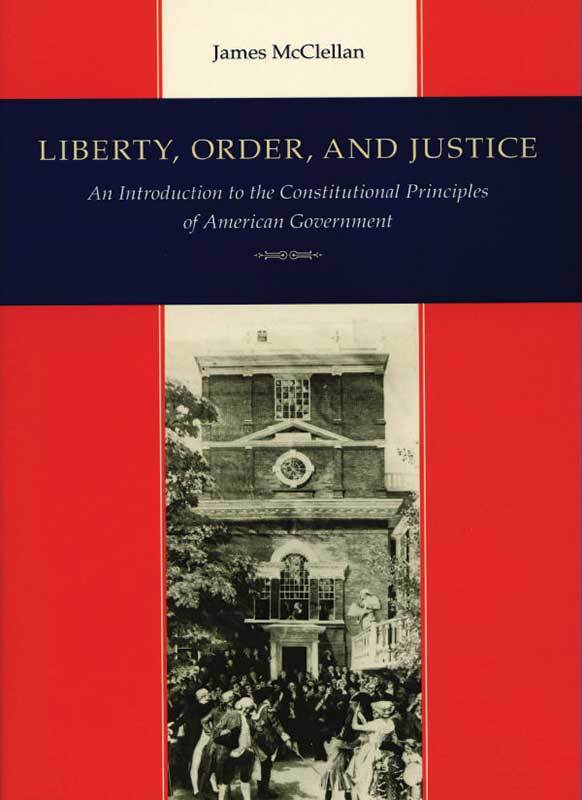
Preface - James McClellan, Liberty, Order, and Justice: An Introduction to the Constitutional Principles of American Government [1989]

Edition used:

Liberty, Order, and Justice: An Introduction to the Constitutional Principles of American Government (3rd ed.) (Indianapolis: Liberty Fund, 2000).

About Liberty Fund:

Liberty Fund, Inc. is a private, educational foundation established to encourage the study of the ideal of a society of free and responsible individuals.


Preface

Liberty, Order, and Justice represents a new and unique approach to the study of American government. It is based on the premise that in order to understand the dynamics of the American political system, the inquiring reader must first become familiar with the constitutional framework that shapes and controls the political process. In other words, the student of politics cannot fully understand what we call “the game of politics” unless that student first knows the rules of the game. This book, then, deals with the enduring principles and characteristics of the American political system, which serve as a guide for studying and understanding both the development of the American regime and its current operations.

The structure and behavior of our political parties provide a case in point. “Probably the most striking single characteristic of the Democratic and Republican parties,” observed Austin Ranney and Willmoore Kendall in their classic work on Democracy and the American Party System (1956), “is their decentralization.” This is what renders the American party system unique and distinguishes it from most parliamentary party organizations in the Western democracies. Except when they come together in a national convention every four years to nominate candidates for the offices of President and Vice President, neither the Democrat nor the Republican Party is in any meaningful way a national party. Each is really a coalition of State parties, and each State party is actually a confederation of semi-autonomous county and municipal parties, all having their own leadership, workers, and supporters. National conventions have little or no power, formal or actual, over State and local parties; and the numerous committees, caucuses, and officers that provide the formal structure of the Democrat and Republican parties are not, either in theory or practice, organized in a hierarchical or pyramidal arrangement with centripetal power flowing downward. No president or presidential candidate or central authority of any kind dictates policy or determines the makeup of the party’s leadership in the American political system.

It is little wonder, therefore, that both of our major political parties are also factionalized, often lacking any unity of thought or direction. They both have their liberal and conservative wings, and to the consternation of many seem unable much of the time to agree among themselves on policies or candidates, or to present a united front to the electorate. Ideological purity is surely not one of the chief attributes of American political parties. The same, of course, cannot be said of the highly disciplined parties of the parliamentary democracies, whose elected officials invariably follow “the party line” and rarely cross over to vote with the opposition.

What explains these peculiarities of the American party system? The answer, in large part, lies in the Constitution—a constitution that does not even mention political parties or acknowledge their existence. Yet it is the case that our political parties often look and behave as they do because of our constitutional system. More specifically, the peculiar structural and behavioral pattern of party politics in the United States may be traced directly to the ubiquitous principle of limited government that shapes, permeates, and protects every article of the Constitution. It was fear of power, especially concentrated power, that motivated the Framers to draft a constitution that limits power by fragmenting, dispersing, and counterbalancing it. One of the first foreign observers to understand all of this was James Bryce, a Scottish diplomat and scholar, who noted in his famous commentaries, The American Commonwealth (1888), that “the want of concentration of power in the legal government is reflected in the structure of the party system.”

At a more fundamental level, the Constitution reflects the intent of the Framers to make it difficult, if not impossible, for any single interest group, including one representing a popular majority, to gain absolute power over the whole nation and impose its will at the expense of other interests or groups. The political regime established by the Constitution is therefore decentralized, and nowhere in the system is there a single locus of concentrated power. Hence it is the federal structure of our Constitution, which divides power between the national and State governments, that best explains why each party is a loose confederation of State and local parties rather than a unitary organization of one central party. Federalism produces a highly decentralized political system encompassing a broad range of sectional, cultural, and economic differences. Our political parties, built upon a federal structure, are a reflection of that diversity.

A knowledge of the federal features of the Constitution, in other words, and an appreciation of how the federal principle influences the political process, give us greater insight into the programs and policies of our parties, while at the same time providing a standard by which to judge their compatibility with the constitutional design. Simply put, the enterprising student who wishes to acquire a solid understanding of the American party system is sure to fall woefully short of expectation if the student disregards or ignores the constitutional environment in which the parties function.

Liberty, Order, and Justice, it may thus be seen, attempts to prepare the reader for the study of American politics by focusing attention on the constitutional superstructure. In this regard, it is quite unlike other introductory texts. The book introduces not only the general design of the system but, more important, seeks to explain how and why it functions as it does. It deals with timeless principles that have shaped our political institutions and procedures—and will continue to do so as long as we live under the Constitution of 1787. The book does not attempt to cover the entire field of American political activity. There is little or no discussion of politics, parties, and pressure groups, current civil rights disputes, foreign or domestic policy, or State and local government. Nor is a considerable amount of attention given to the organization of the legislative, executive, and judicial branches and their special powers and procedures. The reader will not find in these pages, for example, the steps of the lawmaking process showing how a bill becomes a law. All of this is important to know in due course, but it is beyond the scope and purpose of this book.

The book’s purpose, rather, is to deepen our understanding and appreciation of the basic principles of the American political system. In particular, this book seeks to explain how and why the Constitution limits power, particularly through the uniquely American doctrines of federalism and separation of powers. The reader will also learn here the meaning and importance of constitutionalism and rule of law, and the general principles of constitutional interpretation that guide, or should guide, governmental officials when they examine and apply the law in the light of the Constitution.

Moreover, this book emphasizes the importance of knowing the origin and development of these basic principles. The American Constitution is original in many respects, but it is also a product of Western man’s endless quest for liberty, order, and justice. The founders of the American republic did not suddenly invent the American Constitution overnight. Learning from the mistakes of the past, they revised and applied constitutional concepts deeply rooted in America’s colonial past, the history of Great Britain, and the chronicles of the ancient world. By understanding the mistakes of the past, of course, we improve our chances of not repeating them in the future. There is no doubt that many of the changes that have been proposed over the years to amend or “reform” the American political system would never have been seriously considered had the reformers been aware that their “improvement” undermined the genius of the Constitution or had been tried before and had proved to be a failure. The inclusion in this book of numerous legal and historical documents will, it is hoped, help the reader comprehend the evolution of the American republic and the political experiences of our ancestors that ultimately produced the Constitution.

Above all, Liberty, Order, and Justice, as the subtitle suggests, stresses the value and importance of constitutional government. It rests on the age-old assumption that in order to achieve liberty, order, and justice, we must first establish limited constitutional government. The Framers of our Constitution understood well enough that political power can be a destructive as well as a creative force, and that our safety and welfare depend upon our ability to check and balance power. Too much political power can be as dangerous as too little, no matter how well intentioned the claim to power may be. Good government is not feeble government, but neither is it unlimited government. These distinctions are sometimes lost or forgotten by those who put their favorite political programs and policies ahead of the Constitution, and act as though the end justifies the means. These lessons and more, it is hoped, greet the reader who ventures forth to read this primer.

James McClellan

  • Goshen Farm
  • Cumberland, Virginia