Econlib

The Library

Other Sites

Front Page arrow Titles (by Subject) arrow 5: The Supreme Court, Judicial Review, and Federalist 78 - In Defense of the Constitution

Return to Title Page for In Defense of the Constitution

Search this Title:

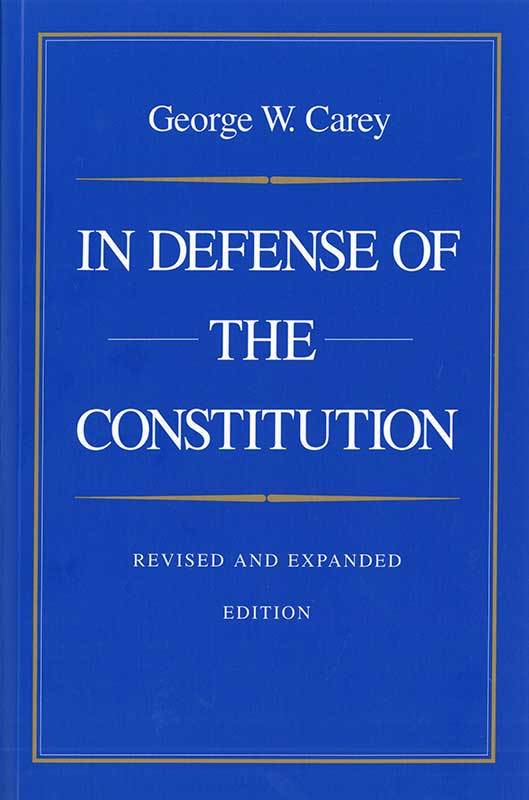
5: The Supreme Court, Judicial Review, and Federalist 78 - George W. Carey, In Defense of the Constitution [1989]

Edition used:

In Defense of the Constitution, revised and expanded edition, (Indianapolis: Liberty Fund, 1995).

About Liberty Fund:

Liberty Fund, Inc. is a private, educational foundation established to encourage the study of the ideal of a society of free and responsible individuals.


5

The Supreme Court, Judicial Review, and Federalist 78

INTRODUCTORY NOTE

We come at last to the principle of limited government, which, as I indicated at the outset, involves the belief that there are things that government ought not to do, that there are limits to the rightful authority of government. Of course, any contemporary discussion of this principle in the American context leads straightway to a description of the role and function of the Supreme Court and the Bill of Rights, a fact that merely reflects the extent to which the new constitutional morality has taken hold. As I indicated in my previous discussions of Federalist 10 and the principle of separation of powers, the Framers’ solutions to the problems of majority factions and tyranny were of a markedly different character. The full dimensions of this difference and its relationship to the new morality, however, can be most effectively presented at this point by way of introducing the following selection which deals with Hamilton’s defense of judicial review.

As a point of departure, I think it must be conceded that the “logic” of our Constitution calls for judicial review. Hamilton, in arguing “that the Constitution ought to be the standard of construction for the laws, and that wherever there is an evident opposition, the laws ought to give place to the Constitution,” points out that “this doctrine is not deducible from any circumstance peculiar to the plan of [the] convention, but from the general theory of a limited Constitution.” But should it fall to the courts to determine whether there is an “evident” conflict between the law and the Constitution? Again the answer seems clear enough: unless we are prepared to argue that the Congress should be the judge of the extent of its constitutional powers which would be tantamount to arguing for an unlimited constitution, the task must fall to the judiciary. Certainly, to borrow another argument from Hamilton, we should hardly expect “that the men who had infringed the Constitution in the character of legislators would be disposed to repair the breach in the character of judges” (81:417).

Be that as it may, what is important to note is that Hamilton was apparently quite sensitive to Brutus’s charges. He responds in part by noting that “there is not a syllable in the plan under consideration which directly empowers the national courts to construe the laws according to the spirit of the Constitution, or which gives them any greater latitude in this respect than may be claimed by the courts of every State” (81:416–17). He points out that Brutus’s argument can be employed against “every constitution that attempts to set bounds to the legislative discretion” (81:417). He regards the charge that the judiciary might encroach upon the legislative authority as without solid foundation: “Particular misconstructions and contraventions of the will of the legislature may now and then happen; but they can never be so extensive as to amount to an inconvenience, or in any sensible degree to affect the order of the political system.” This he “infers with certainty from the general nature of the judicial power, from the objects to which it relates, from the manner in which it is exercised, from its comparative weakness, and from its total incapacity to support its usurpations by force.” And, as if this were not enough, he adds that the power of impeachment and removal by itself provides “complete security” against such judicial encroachments (81:418).

Hamilton’s observations should make one wonder about certain commonplace assumptions regarding the role that the Framers wanted the courts to play. But, in my mind, the decisive factor, the one that above all casts doubts on the revisionists’ interpretation, is Hamilton’s opposition to a bill of rights. More precisely, it is the way in which he couches his rather strong objections to a bill of rights; for what seems clear is that Hamilton’s lines of argument, and his entire attitude towards rights, would have been substantially different if he had wanted the Court to assume a major, if not decisive, role. Without rights, this is to say, the Court is without the wherewithal to usurp the legislative power or to transform itself into the most powerful branch. So much, I believe, can be seen by asking what the status of the Court today would be without a bill of rights.

What Hamilton does say against a bill of rights is interesting not only from this perspective but also in providing us with an overview of the character of the regime established by the Constitution. Bills of rights, he observes, historically have been “stipulations between kings and their subjects, abridgements of prerogative in favor of privilege, reservations of rights not surrendered to the prince.” As such, he argues, “they have no application to constitutions, professedly founded upon the power of the people and executed by their immediate representatives and servants. Here, in strictness, the people surrender nothing; and as they retain everything they have no need of particular reservations.” And, in this vein, he insists that the ordination and establishment of the Constitution by “WE, THE PEOPLE ... is a better recognition of popular rights than volumes of those aphorisms which make the principal figure in several of our State bills of rights and which would sound much better in a treatise of ethics than in a constitution of government” (84:443).

Hamilton maintains, moreover, that a bill of rights, “in the sense and to the extent in which they are contended for” by the Antifederalists, would not only be “unnecessary,” but also might prove “dangerous.” And his argument here is not what we might expect, namely, that the enumeration of some rights would disparage those not enumerated. Rather, using “liberty of the press” for purposes of illustration, he believes that restrictions on government “would furnish, to men disposed to usurp, a plausible pretense, for claiming that power.” “They might,” he believes, “urge with a semblance of reason that the Constitution ought not to be charged with the absurdity of providing against the abuse of an authority which was not given, and that the provisions against restraining the liberty of the press afforded a clear implication that a power to prescribe proper regulations concerning it was intended to be vested in the national government” (84:444).

Nor was Hamilton unmindful of the difficulties associated in defining rights. “What,” he asks, “is the liberty of the press? Who can give it any definition which would not leave the utmost latitude for evasion?” Because any such definition is, in his judgment, “impracticable,” the security for the liberty of the press is not to be found in “whatever fine declarations may be inserted in any constitution respecting it": rather, he maintains, its preservation “depend[s] on public opinion, and on the general spirit of the people and of the government.” These, he continues, are the “only solid basis of all our rights” (84:444).

Now these are hardly the words of one who would look to the Court to protect property rights or, more importantly, of one who envisioned the Court playing a predominant role in our constitutional system. We should take care to note in this respect that his argument is based upon a fundamental proposition that there is a basic incompatibility between the notion of an expansive bill of rights and the principle of republicanism. Hence, he leaves no room—as well he might have, had he been so inclined—for a change of heart on the issue of rights. For instance, he might have taken a “wait and see” attitude on this matter that would not have foreclosed the future incorporation of those rights that, according to the revisionists, he presumably wanted to protect. That he did not do so is telling.

The nationalization of the Bill of Rights via the due process clause of the Fourteenth Amendment obviously involves all of the pitfalls to which Hamilton refers; even more so, if we regard the due process clause as in a class by itself because of its “indefiniteness,” which has allowed the courts to expand or contract it over the decades. Moreover, in this process, as the following essay will indicate, the Court has abandoned every single guideline that Hamilton set forth for the proper exercise of judicial review. Thus, it is no wonder that the Court stands at the center of so much controversy. Nor is it any wonder, given its potential to effectuate sweeping changes under the guise of protecting and advancing our constitutional rights, that the proponents of the new morality serve as its apologists.

THE SUPREME COURT, JUDICIAL REVIEW, AND FEDERALIST 78

The Supreme Court’s role, status, and power within our constitutional framework have been so thoroughly explored over the decades that it is futile to attempt a listing of the major books and articles dealing with this subject.1 And, one is left to ask, is there anything more to be said about the Court and the various stances individuals throughout our history have taken toward it, particularly with respect to the matter of judicial review? Our feeling is that (a) there is something new to say about the Court and its role in our system, and (b) a good deal of admittedly fine scholarship has tended to divert our attention from those questions we should be asking about the Court and its power of judicial review.

Judicial Review and the Framers’ Intent

Our first contention is that we have to clear away a good deal of the underbrush that inevitably surrounds discussions concerning the Court. Much of this so-called “underbrush” deals with the questions whether the Court is actually a weather vane of public morality or opinion; the “goodness” or “badness” of its decisions; the various philosophies justices have brought to the Court and expounded in their decisions; the impact of Court decisions (that is, whether we really get around to obeying certain of its decisions); or what the system would be like if the Court were divested of its presumed power to nullify state and national laws that contravene the basic laws as set forth in the Constitution. These and like concerns are, to be sure, important and bear upon the central questions of what direction the Court will take, the degree of confidence the population places in the Court’s decisions, and its general relationship to the other branches of our national government. And some of them are admittedly important because they involve us in fundamental partisan issues of the day or an era as, for example, Roosevelt’s court-packing proposal, the fights over the nominations of Carswell and Haynsworth, the movement to impeach Justice Douglas, the Southern resistance to the Court’s integration rulings, and the myriad of Warren Court decisions relating to the rights of the accused in criminal processes. While these disputes have tended to focus upon a number of considerations concerning the proper rule of the Court, they have, for the most part, only tangentially addressed themselves to the basic issues surrounding the Court and its powers. Perhaps this is to be accounted for by “shifting alliances” on partisan issues, where observers of the Court are one day its friends and the next its enemies. Underlying these controversies and the arguments of the adversaries, however, there seems to be an unarticulated premise, to wit, that the Court should exercise judicial review. The disputes, in other words, have been largely tactical in nature. There is ample room to question the motives of the participants in assuming the positions they do because in practically all such episodes political interests of the highest order were at stake. This point, we believe, is well known and hardly needs extensive documentation here.

Most serious scholars of the Court are well aware of this practice. As a result, it would seem they have tried to probe further into the basic question of whether the Supreme Court was ever intended to be involved in such disputes. More specifically, we have developed a growing body of scholarship that has attempted to determine whether judicial review was or was not intended to be vested with the Supreme Court by those who drafted the Constitution. The sheer bulk of such endeavors precludes detailed analysis here. Generally speaking, however, the focus of such inquiries concerning the intent of the Framers has been threefold:

1. What evidence exists to show that the state or colonial courts did invalidate legislative actions? To what extent can one say that this was an accepted practice and well understood by the people? Conversely, to what degree can such practices on the part of the Court be considered mere aberrations of such insignificant proportions that scarcely any heed was paid to them, and that, far from being a generally acknowledged power of the courts, they are to be viewed as deviations from the generally held views concerning judicial power?

2. What did the Framers of the Constitution think about judicial review? What do the proceedings at Philadelphia, transcribed in various notes, tell us about this issue? What did those who participated in the Convention privately think about the matter of judicial review as revealed by their correspondence with others?

3. What does the Constitution say, either expressly or implicitly, about the judicial powers? More exactly, does the Constitution logically require that the power of review be vested with the judiciary?

Two important observations are called for regarding these inquiries. First, one might well ask, what difference does it make what the intentions of the Framers were or what the people regarded as the proper function of the judiciary? Why try to settle the matter through the approaches outlined above? Why can’t we, the people of today, make these decisions for ourselves independent of reasoning about what the Constitution logically requires or what the Framers and their forebears might have believed? This question can best be answered by asking another: if it can be shown that judicial review was not intended or even considered and rejected, on what conceivable grounds can the Court claim this power? Moreover, how can the Court obligate those affected by its exercise of this power to obey its rulings? Of course, in asking such a question one is implicitly utilizing the contract framework and its corollary of consent (tacit or express) in determining the boundaries and nature of obligation. Is such an approach, we can ask, fair? Does it “stack” the cards one way or the other in the seemingly endless controversies surrounding the role and function of the Court? The answer to this must be an emphatic “no,” and for the following reasons:

1. The Constitution, after all is said and done, can be viewed as a contract of the most fundamental sort, specifying as it does the institutions and powers of government. As such it is a binding document until such time as it is changed through the prescribed processes. To argue otherwise would lead to philosophical mayhem.

2. The approach does allow for one to go beyond the Constitution, as many scholars have done, to adduce evidence concerning the customs, prevailing beliefs, and the like that form a backdrop for interpreting the Constitution and the “spirit” with which its provisions are to be interpreted and its institutions are to operate. This is to say that the Constitution itself on many fundamental issues cannot be read independent of the prevailing morality of the time, which, though not expressly articulated in the document, serves to give it a broader meaning, purpose, and moral framework. The contractual approach certainly makes allowances for the introduction of such an overarching morality, which can also lay claim to be of binding force.

3. The neutrality of the approach is attested by the fact that it has been used extensively by those whose views regarding the Court and its powers vary widely. The approach, in other words, provides one common ground for the disputants in the controversy.

4. The method is endemic to and well recognized in the judicial process itself, particularly in controversies of similar nature that inevitably arise concerning interpretation of key provisions of the Constitution.

5. To adopt another approach, for reasons that will be spelled out later, involves insurmountable difficulties that seem to defy rational resolution. Indeed, it is when one does depart from the contractual approach that debate about the Court takes on all the attributes of a circle-squaring expedition.

Having said this much, we turn to our second contention: the literature that has sought to determine whether the Court does possess the power of judicial review by studying precedents, the Convention, and the language of the Constitution (those areas cited above) has proved far from conclusive on this point. Most scholars who have approached the subject in the manner outlined above have, in fact, acknowledged as much. They do talk in terms of the preponderant weight of evidence, but they differ markedly on which side of the scales the preponderant weight does fall. This is true of almost every phase of their investigations. One would imagine, for example, that the matter of preconstitutional precedents of judicial review would lend conclusive weight for one side or the other in this dispute. This is far from the case. For example, Charles G. Haines, an exponent of the doctrine of judicial review, claimed that there were eleven decisions by state and colonial courts before 1787 in which the power of judicial review was asserted.2 This in itself is hardly convincing evidence that judicial review was widely practiced and accepted, but the analyses of these cases by William Crosskey3 and Brent Bozell,4 both opponents of judicial review of national legislation, narrow this number to just one. To cite another example, proponents of judicial review contend that by plain inference Articles III and VI of the Constitution grant the power of judicial review to the Court. Yet, not only has the inference been called into serious question, but also the opponents of judicial review contend that the issue, important as it is to an understanding of the national system, would hardly be left to inference; rather, it would have been spelled out in unambiguous terms.5 In sum, no matter where we look for evidence that would help us understand the nature of the contract in the sense we are speaking of it, the evidence is at best highly inconclusive. This is true of the Convention Debates, the Ratifying Conventions, the State Constitutions, and the utterances and writings of leading political figures of the time. We may surmise that this is one of the reasons much of the scholarship concerned with the Court seems to assume a stance pretty much as follows: “Judicial review whether intended or not is with us.” It then proceeds, as we have said, to study the Court from various angles that have nothing to do with the question of its legitimacy within the contractual framework we have outlined above.

To all of this the following should be noted: scholarship in this area, to quote Charles S. Hyneman, “has not laid to rest a widespread suspicion that our judges have taken upon themselves a role which the founders of our constitutional system did not intend them to have.” 6 Nor, might we add, is it likely that such a widespread suspicion will ever be laid to rest, for it is inconceivable that after so many decades of careful research any new evidence of sufficient magnitude and authority will be unearthed to settle the controversy. To be sure, old arguments will be rehashed periodically, and an added bit of evidence may be placed on one side of the scale or the other, but, as far as we can see, the question of intent and hence our obligations within our constitutional system as they relate to the judiciary will never be settled. With this in mind, we will approach the matter from another angle, which, one hopes, will put the matter of judicial review and the legitimacy of the Court’s powers in another perspective.

Federalist 78 and Judicial Reform

Virtually all the literature dealing with the foundations of judicial review touches at one point or another upon Federalist 78, because in this paper the power of judicial review over national legislation is unambiguously affirmed. To be sure, the essay is usually accorded only a lukewarm reception by the modern proponents of judicial activism, since its reasoning will not support the notion of judicial supremacy. Likewise, there is antipathy towards this essay on the part of some of those who are most critical of the modern Court, precisely because it does support the doctrine of judicial review that has been used as a stepping stone for judicial aggrandizement. Nevertheless, there is no denying that Federalist 78 clearly constitutes the most authoritative evidence we possess that the Framers intended judicial review. The Federalist in which it appears has been accorded quasi-constitutional status even by the courts; that is, it is looked upon, by both its friends and critics, as the best single source we have for understanding the Constitution and its basic principles as it emerged from the Philadelphia Convention. Beyond this, we know from other sources not only that the reasoning of this essay was well known, but also that its assumptions were widely shared. In this connection we cannot help but note the heavy reliance that Marshall in his Marbury decision places upon the mode of reasoning employed in this essay. Equally revealing is the fact that Marshall does not bring external evidence to bear in order to support the Court’s claim to the power of judicial review. In other words, for one reason or another, he ignores the evidence and other modes of inferential reasoning with which contemporary students wrestle. As Professor Charles Hyneman noted in this regard:

If, as seems an irresistible conclusion, Marshall was convinced that language in the Constitution did not establish a power of judicial review beyond need for further evidence, one would expect him to inquire next into the announced purposes of those who constructed that document. He gives us no report on the results of that inquiry. Neither in the Marbury opinion nor elsewhere does he tell us what was said about interpretation and enforcement of the Constitution in the Philadelphia convention or in the several state ratifying conventions. The journals of the drafting convention and the notes made by several members of that body on which we rely so heavily today had not been printed at the time of Marbury v. Madison. But Marshall may well have had access to much of this knowledge by word of mouth, and it is possible that he obtained by that route a great deal more knowledge about the intentions of the framers than has been available to later scholars. He certainly knew what was said in the Virginia ratifying convention about the fundamental character of the Constitution and about judicial power under the Constitution, for he was himself a member of that assembly.7

We can only conjecture that Marshall found such undertakings inconclusive and sought to plant the roots of judicial review on the strongest possible footing.

We are now prepared to turn our attention to Federalist 78 with an understanding of its critical role in the controversies surrounding judicial review and the power of the Court.

The essay begins by noting the provisions that have been made for the appointment of judges and their tenure or, as Hamilton put it, “to the manner of constituting it [the federal judiciary].” He writes:

The standard of good behavior for the continuance in office of the judicial magistracy, is certainly one of the most valuable of the modern improvements in the practice of government. In a monarchy it is an excellent barrier to the despotism of the prince; in a republic it is a no less excellent barrier to the encroachments and oppressions of the representative body. And it is the best expedient which can be devised in any government, to secure a steady, upright, and impartial administration of the laws (401).

The following two paragraphs clearly seem designed to allay fears that the judiciary, because of this independence, will pose any danger to the liberties of the people. We are told, among other things, “the judiciary from the nature of its functions, will always be the least dangerous to the political rights of the Constitution; because it will be least in a capacity to annoy or injure them.” More: unlike the executive who “holds the sword of the community,” and the legislature which “not only commands the purse, but prescribes the rules by which the duties and rights of every citizen are to be regulated,” the Courts do not have “FORCE nor WILL, but merely judgment; and must ultimately depend upon the aid of the executive arm even for efficacy of its judgments” (401–2).

Hamilton continues in the same vein in the next paragraph:

This simple view of the matter suggests several important consequences. It proves incontestably, that the judiciary is beyond comparison the weakest of the three departments of power; that it can never attack with success either of the other two; and that all possible care is requisite to enable it to defend itself against their attacks (402).

Beyond this, he writes:

though individual oppression may now and then proceed from the courts of justice, the general liberty of the people can never be endangered from that quarter; I mean so long as the judiciary remains truly distinct from both the legislature and the Executive (402).

What follows is a reaffirmation that the judicial branch should be as separate from the other branches as possible and constituted so as to resist their encroachments. In sum, the power of the judiciary is “next to nothing” compared with those of the coordinate branches; the people have nothing to fear from this quarter; and the judiciary, because it is so feeble, must be constituted to maintain its independence.

From this point to almost the end of the essay, Hamilton asserts and justifies the power of judicial review:

The complete independence of the courts of justice is particularly essential in a limited Constitution. By a limited Constitution, I understand one which contains certain specified exceptions to the legislative authority; such, for instance, as that it shall pass no bills of attainder, no ex post facto laws, and the like. Limitations of this kind can be preserved in practice no other way than through the medium of courts of justice, whose duty it must be to declare all acts contrary to the manifest tenor of the Constitution void. Without this, all the reservations of particular rights or privileges would amount to nothing (402).

Basic to Hamilton’s justification is what can be termed the “fundamental law” argument. In essence, this argument is very simple: the Constitution represents the fundamental law and all laws (ordinary legislative acts) that conflict with the fundamental law are null and void. This means explicitly that, “whenever a particular statute contravenes the Constitution, it will be the duty of the judicial tribunals to adhere to the latter and disregard the former” (404). Put another way, “the Constitution ought to be preferred to the statute, the intention of the people to the intention of their agents” (403).

There are, of course, as the above quotations indicate, crucial elements that must be added to this justification. First, it is within the special province of the judiciary to declare laws contrary to the Constitution void:

If it be said that the legislative body are themselves the constitutional judges of their own powers, and that the construction they put upon them is conclusive upon the other departments, it may be answered, that this cannot be the natural presumption, where it is not to be collected from any particular provisions in the Constitution. It is not otherwise to be supposed that the Constitution could intend to enable the representatives of the people to substitute their will to that of the constituents. It is far more rational to suppose that the courts were designed to be an intermediate body between the people and the legislature, in order, among other things, to keep the latter within the limits assigned to their authority. The interpretation of the laws is the proper and peculiar province of the courts (403).

Second, as intimated in the above passage, the Court in nullifying legislation does not “suppose a superiority of the judicial to the legislative power. It only supposes that the power of the people is superior to both” (403). And, third, as a corollary of this it must be assumed that the “real,” basic, or fundamental, will of the people is to be found in the Constitution. Thus,

Until the people have, by some solemn and authoritative act, annulled or changed the established form, it is binding upon themselves collectively as well as individually; and no presumption, or even knowledge, of their sentiments, can warrant their representatives in a departure from it, prior to such an act (405).

We have here in pretty much undiluted form Hamilton’s case for judicial review, a case that is probably the strongest both in terms of justifying judicial review and providing an unambiguous basis for maintaining that it possesses a contractual legitimacy that carries with it a corresponding obligation on the part of individuals and institutions to observe, honor, and obey. To put this latter point in other terms, if we accept Federalist 78 as part of our constitutional system, we have given our consent to judicial review to the degree and the extent it is contended for in this essay.

The Limits of Judicial Review

With this in mind, then, let us take another look at this essay with the following in mind: the fundamental law theory is based in part upon the proposition that the agencies it creates are subordinate to it and must operate within its confines. To quote Hamilton again: “To deny [this proposition] would be to affirm, that the deputy is greater than his principal; that the servant is above his master; that the representatives of the people are superior to the people themselves; that men acting by virtue of powers, may do not only what their powers do not authorize, but what they forbid” (403).

A perfectly logical and reasonable line of inquiry is this: the Court is also, by Hamilton’s line of reasoning, subordinate to the Constitution. There can be no question of this because the Court is as much a creature of the Constitution as the Presidency or Congress. What, then, would constitute an unconstitutional act on the part of the judiciary? Specifically, for our purposes, how can we tell when the courts have used their powers, particularly that of judicial review, unconstitutionally?

Hamilton in the following quote seems to recognize that the Court could act unconstitutionally, but he does not fully answer the question at hand:

It can be of no weight to say that the courts, on the pretence of a repugnancy, may substitute their own pleasure to the constitutional intentions of the legislature. This might as well happen in the case of two contradictory statutes; or it might as well happen in every adjudication upon any single statute. The courts must declare the sense of the law; and if they should be disposed to exercise WILL instead of JUDGMENT, the consequence would equally be the substitution of their pleasure to that of the legislative body. The observation, if it proved anything, would prove that there ought to be no judges distinct from that body (404).

From this passage it seems clear that the Court would be acting ultra vires when it uses its power of judicial review to thwart legitimate statutory law. But the key phrase here is that which differentiates WILL from JUDGMENT, and this particular passage tells us very little about how to make such a differentiation. We do know, for starters, this much: the exercise of WILL is within the province of the legislative body. This is consonant with Hamilton’s earlier statement in comparing the powers of the Court with those of the executive and legislative bodies—namely, the judiciary has “neither FORCE [the major constitutional power of the executive] nor WILL [the constitutional prerogative of the legislature], but merely judgment.” We are safe in concluding that in this context WILL connotes at least a choice among alternatives or goals with the concomitant capacity to achieve, implement, or move toward the attainment of the choice. JUDGMENT would seem to have a more passive connotation because implementation or attainment are not so closely associated with it. However, leaving aside active and passive connotations, both JUDGMENT and WILL do involve elements of choice. The exercise of WILL may or may not involve JUDGMENT but merely preference, volition, or desire. In this sense an act of WILL can, and often does, partake of arbitrariness, e.g., choosing among ninety-seven flavors of ice cream, all of which are equally attractive to the consumer. JUDGMENT, in contrast to WILL, is usually brought to bear in the context where the range of choice is far narrower; that is, normally upon a situation, act, or circumstance. JUDGMENT, moreover, is a considered opinion or decision that is the outgrowth of a ratiocinative process in which relevant factors (factors, that is, relevant to the decision in the particular instance) are juxtaposed, assigned priorities, and carefully weighed. Judgments, of course, may vary over an endless variety of matters so that we are inclined to call most judgments opinions; e.g., was Stan Musial a better baseball player than Ted Williams? In some cases, subsequent events may bear out judgments, so that we are entitled to label some judgments “good” and others “bad.”

While much more can be said about WILL and JUDGMENT, we have enough before us to explore Federalist 78 with an eye to determining what rules or standards the Court is bound to follow in the exercise of its JUDGMENT, particularly when it voids an act of the legislature. Such rules and standards, we hasten to add, are integral to Hamilton’s justification of judicial review, for without them there would be no guides for ascertaining when the Court is acting unconstitutionally, i.e., usurping the legitimate powers of the other branches. These guides and rules, we should also point out, are usually ignored in the literature dealing with judicial review.

First, we might be led to believe that judicial review should be exercised only when Congress violates specific constitutional prohibitions on its powers. The Court we are told should certainly nullify “bills of attainder” and “ ex post facto laws and the like.” However, in the very next sentence Hamilton seems to open the door for a more expansive role for the Court when he writes:

Limitations of this kind [bills of attainder, ex post facto laws, and the like] can be preserved in practice no other way than through the medium of courts of justice, whose duty it must be to declare all acts contrary to the manifest tenor of the Constitution void (402; emphasis added).

The word “tenor” would suggest that the Court can move into realms beyond the specific prohibitions. And later in the essay we find evidence that this might well be the case:

This independence of the judges is equally requisite to guard the Constitution and the rights of individuals from the effects of those ill humors, which the arts of designing men, or the influence of particular conjunctures, sometimes disseminate among the people themselves, and which, though they speedily give place to better information, and more deliberate reflection, have a tendency, in the meantime, to occasion dangerous innovations in the government, and serious oppressions of the minor party in the community. Though I trust the friends of the proposed Constitution will never concur with its enemies in questioning that fundamental principle of republican government which admits the right of the people to alter or abolish the established Constitution whenever they find it inconsistent with their happiness; yet it is not to be inferred from this principle that the representatives of the people, whenever a momentary inclination happens to lay hold of a majority of the constituents incompatible with the provisions in the existing Constitution would, on that account, be justifiable in a violation of those provisions (404–5).

Yet, even in this passage he sees fit to speak in terms of “momentary” inclinations “incompatible with the provisions in the existing Constitution.” And we must be careful not to overlook the use of the word “manifest” when used in connection with the word “tenor.” Manifest would certainly seem to mean obvious, clear, and undisputed, thus confining the scope of judicial review. Moreover, “manifest tenor” is used in association with the specific prohibitions placed upon Congress, all of which leads us to believe that the scope of judicial review should be narrow or, more accurately, the Court should nullify only obvious legislative violations of the Constitution.

Second, and very much supportive of this view of the matter, is the following passage taken from that section of the essay in which he justifies judicial review:

A constitution is, in fact, and must be regarded by the judges, as a fundamental law. It therefore belongs to them to ascertain its meaning as well as the meaning of any particular act proceeding from the legislative body. If there should happen to be an irreconcilable variance between the two, that which has the superior obligation and validity ought, of course, to be preferred (403).

The words “irreconcilable variance” are plain enough and certainly impose a very stringent obligation on the Court before it voids legislation. On this account we find little evidence to support the proposition that Hamilton was in effect bestowing upon the Court a position of supremacy among the three branches.

And a third major factor that bears upon the WILL-JUDGMENT dichotomy is the following: “To avoid an arbitrary discretion in the courts, it is indispensable that they should be bound down by strict rules and precedents which serve to define and point out their duty in every particular case that comes before them” (406). Here the words “indispensable,” “bound down,” and “strict rules and precedents” are abundantly clear in their meaning and provide still another measure that can be used for the determination whether the judiciary has abandoned JUDGMENT for WILL.

We submit, then, that Federalist 78, when read in its entirety (which means reading it with the problem of WILL and JUDGMENT in the back of our minds), amounts to a perfectly sensible statement with which few, if any, would seriously disagree, given the fact that we have a written charter of government. To note, as Hamilton does, the feebleness and weakness of the judiciary, the fact that it cannot take any “active resolution whatever,” that it is to be a passive institution exercising only JUDGMENT, that its powers extend to declaring acts of the legislature unconstitutional only when contrary to the “manifest tenor” of the Constitution (in the sense spelled out above), that it can only use this power when there is an “irreconcilable variance” between the statute and the Constitution, and, finally, that it is “indispensable” that it be “bound down by strict rules and precedents,” hardly lends support to the thesis that he sought to vest the judiciary with the kind and degree of powers that modern-day “judicial activists,” among others, impute to it. Put otherwise, we have noted that, if judicial review is indeed a part of the contract to which we have given our tacit consent, we must, perforce (as we have argued above) go to Federalist 78 to see the justification for it and to understand its scope as well as the obligations of the Court in exercising this power. When the terms of the contract are broken by the Court, our obligation to respect or obey its power of judicial review is severed, and the other branches of government, principally the Congress, are entitled, nay obliged, to use the constitutional means at their disposal to curb, regulate, and control the Court in such a manner as to compel conformance with the terms of the contract. This line of reasoning is but a corollary of the line of reasoning by which the courts lay claim to the power of judicial review. The Court is equally obliged as a creature of the Constitution not to overstep its bounds or exceed its constitutional authority. To argue otherwise would be to say that the Court endorses judicial supremacy.

The Extent of the Modern Problem

A mark of the times is that the foregoing analysis and approach, particularly among most constitutional scholars, seems quaint, antiquated, and overly simplistic. Nobody in his right mind, nowadays, believes that the Court only exercises JUDGMENT or that stare decisis is or should be considered a binding principle in litigation. Rather, the Court is looked upon not as the custodian of the Constitution in the sense Hamilton advocated, but more as our moral guardian who will lead us by the hand to the fulfillment of our most cherished ideals, which far more often than not turn out to be those of secular, materialistic liberalism. Critical analyses of the Court usually focus on whether it has moved too fast or too slow in reaching the destined goals in light of the opportunities that present themselves measured against the mood of the public. Mature scholars now find it worthwhile to study fastidiously the written and spoken words of the justices, usually in a vain attempt to squeeze some coherency out of their judicial theories and decisions. Intramural squabbles occur between those who advocate “judicial restraint” and “judicial activism.” 8 The legal “realists” —and that they are—have abandoned the idea that there is any such thing as judicial or legal reasoning or, more exactly, that judicial reasoning is what the judges reason. Those nominated for appointment to the Court, as recent history attests, are judged fit or not on the basis of their attitudes towards our most contemporary problems (along with, we might add, how many Harvard or Yale professors will support the nominee, which comes down to pretty much the same thing), a fact that confirms what we already know: the Court is as much a part of the purely political whirl as any other institution of our government.

Despite these confusing views of the Court and its role, one can detect in all of these contemporary disputes a sense of inevitability. If the people, as they are wont to do, drag their feet or protest too much about integration, prayer in the public schools, reapportionment, or like matters, the mood seems to prevail that the Court should “wait out” the storm before taking another quantum leap in the “proper” direction. How many times have we been told: “The Warren Court blazed a trail in the areas of civil rights and liberties. Subsequent Courts will have to consolidate these gains before moving ahead”?

What can account for this tangled situation and the direction the Court has taken and is taking? Perhaps the most important factor was the adoption of the Bill of Rights, which has served to provide a colorable pretext for the expansion of judicial powers. It may be that Hamilton envisioned this in Federalist 84, where he argued against the addition of any rights to the original constitution. But we do know now that Madison’s prophecy in the first Congress that the Bill of Rights would not alter the fundamental structure or nature of the original Constitution was wrong. And the Fourteenth Amendment with its “equal protection” and “due process” clauses, as we all know, has been used as a device by the Court to “nationalize” rights, a task the Court has taken on with fervor and relish.

But the expansion of judicial power could not have come about save for the transformation in the entire nature of our public discourse. People tend more and more to think in terms of rights, so much so that the situation has become outlandish. We hear now of the right to read rapidly, the right to die, the right to live, the right to have good teachers, the right to know, and so forth. Such a mode of thinking induces one to use rights as the basis for appeals to the judiciary for redress of grievances, real or imagined, a function that the Court willingly assumed. What is ironic is that Hamilton’s justification for judicial review served as the basis for legitimizing this assumption of power. But, in this process, soon forgotten were the restrictions and qualifications that were also an integral part of his argument. Totally arbitrary interpretations of virtually every right specified in the Constitution and chief clauses of the Fourteenth Amendment have time and again been used to invalidate state and national legislation, thereby jettisoning the “irreconcilable variance” rule. Motives and intentions were attributed to the drafters of the Bill of Rights and the Fourteenth Amendment to achieve the desired decisions and results. With this the “manifest tenor” injunction went out the window. The Court and its supporters began to harp on the familiar themes of “changing times” and “complex society” and the Court’s responsibility to meet the demands of the twentieth century. Thus the “strict precedent” admonition vanished.

Hamilton’s theory also served the judiciary in dismantling his very own proposition that the judiciary can take “no active resolution whatever.” His theory, whatever else one might say about it, does lend dignity and meaningful purpose to the judiciary. Banking on this, but seemingly oblivious to Hamilton’s restrictive injunctions, the Court gradually assumed its present status and power which are, to say the least, well beyond those envisioned by Hamilton. On more than one occasion we have seen frustrated Presidents on national television tell the American people in effect: “The Court has spoken and we must, whether we like it or not, obey the Constitution.” It is not at all uncommon to hear high-ranking administrators and congressmen, when faced with a particular difficulty, declare that “the matter will have to be settled by the courts.” In sum, the Court now has, particularly in the areas of integration and reapportionment, not only invalidated state legislation and state constitutional provisions, but set up standards with which they must comply. And, because of the new morality concerning the sanctity of the Court, there is no one, not even the President, to say it “nay.” To do so would probably create a political turmoil of immense proportions.

Our point is not the simple one: we confess that we are dismayed that the “manifest tenor” of the Constitution has been interpreted to mean that children can no longer say voluntary prayers in public schools because to allow such a practice we would vault over some allegoric “high wall”; that this manifest tenor dictates that the states cannot, even if a majority of their citizens so desire, base their legislatures on any other representational principles than “one man, one vote”; that somehow manifest tenor means that the life of the unborn begins at three months and one day; or that the Constitution manifestly dictates that children should be carted from one neighborhood to another in order to achieve the “proper” racial balance as determined by the courts.

No, we repeat, this is not our point. Rather, our point is that the Court has itself violated the manifest tenor of the Constitution and it has done so in these and like cases by failing to observe the injunctions that Hamilton set forth.

Yet, as we have said, the Hamiltonian theory may seem quaint and outdated. Its restoration, we fully realize, is now next to impossible. But at least it possesses the virtue and dignity of resting upon sound philosophic and moral grounds, characteristics notably lacking in the fatuous, but currently fashionable theories that strive to justify judicial usurpation of power in the name of democracy.

[1 ]An annotated bibliography of the leading and most salient works dealing with these matters is to be found in Charles S. Hyneman’s The Supreme Court on Trial (New York: Atherton Press, 1963).

[2 ]Among others see Charles G. Haines, The American Doctrine of Judicial Supremacy (New York: Russell and Russell, 1959), Ch. 4 and 5. Haines lists the major works of Thayer and Corwin that deal with these cases.

[3 ]William Crosskey, Politics and the Constitution in the History of the United States (Chicago: University of Chicago Press, 1953), II, Ch. 27.

[4 ]L. Brent Bozell, The Warren Revolution (New Rochelle, New York: Arlington House, 1966), 159–215.

[5 ]For a discussion of this see among others, Hyneman, Ch. 10; and Alexander Bickel, The Least Dangerous Branch (New Haven: Yale University Press, 1962), Ch. 1.

[6 ]Hyneman, 123.

[7 ]Hyneman, 100–101.

[8 ]That is, squabbles in the sense that both camps accept wide judicial powers but vary as to the wisdom of employing them in this or that case.