|
|
Front Page Titles (by Subject) medieval and scholastic - The Natural Law: A Study in Legal and Social History and Philosophy
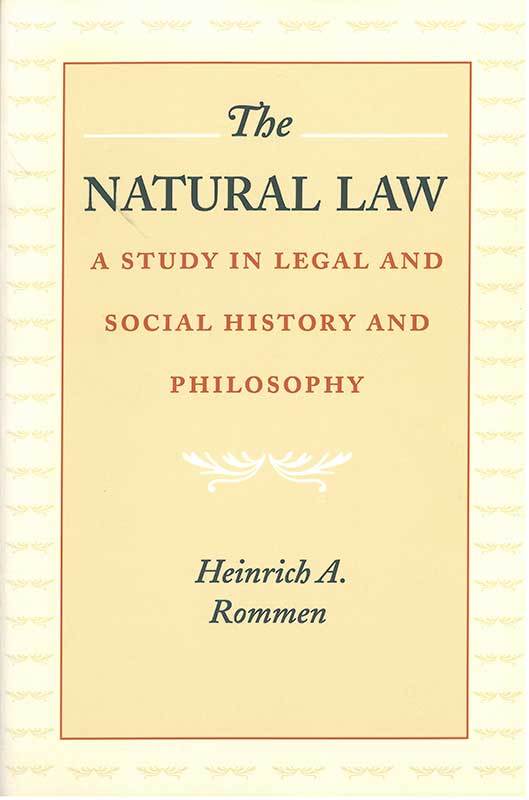
medieval and scholastic - Heinrich Rommen, The Natural Law: A Study in Legal and Social History and Philosophy [1936]Edition used:The Natural Law: A Study in Legal and Social History and Philosophy, trans. Thomas R. Hanley. Introduction and Bibliography by Russell Hittinger (Indianapolis: Liberty Fund 1998).
About Liberty Fund:Liberty Fund, Inc. is a private, educational foundation established to encourage the study of the ideal of a society of free and responsible individuals. Copyright information:The copyright to this edition, in both print and electronic forms, is held by Liberty Fund, Inc.
Fair use statement:
This material is put online to further the educational goals of Liberty Fund, Inc. Unless otherwise stated in the Copyright Information section above, this material may be used freely for educational and academic purposes. It may not be used in any way for profit.
medieval and scholastic
Today, the work of Thomas Aquinas is widely regarded as the preeminent example of medieval natural law theory. For general studies on Thomas Aquinas, see the books by Chenu and Torrell. By no means, however, is contemporary Thomism a united front. Adler, Brock, and Grisez provide three very different interpretations of Thomas’s natural law theory. The essays and books by Bourke, Davitt, Dewan, and McInerny treat various Thomistic themes and issues. While not being explications of Thomas’s texts, the books by Maritain, Simon, and Messner represent some of the best neo-scholastic work on natural law in Rommen’s generation. Murray’s influential collection of essays tries to reconcile the scholastic tradition with American institutions. Finally, the essay by Alasdair MacIntyre reflects upon the papal use of natural law in the recent encyclical Veritatis Splendor.
Historically, Thomas was only one tributary of medieval natural law thinking. Works by Berman, Gilby, Gratian (new edition by Thompson and Gordley), Kuttner, Pennington, Post, and Ullmann explore the political and jurisprudential themes that formed the institutional context and background of the philosophical and theological debates in the medieval schools. Works by Oakley, McDonnell, Gewirth, and Tuck examine the non-Thomistic channels of medieval natural law thinking, some of which proved very influential for the development of modern theories of law and rights.
- Adler, Mortimer. “A Question About Law.” In Essays in Thomism, ed. Robert E. Brennan, 207–36. New York: Sheed and Ward, 1942.
- Berman, Harold J. Law and Revolution: The Formation of the Western Legal Tradition. Cambridge: Harvard University Press, 1983.
- Bourke, Vernon. “The Background of Aquinas’ Synderesis Principle.” In Graceful Reason, ed. Lloyd Gerson. Toronto: Institute for Mediaeval Studies, 1983.
- ———. “The Synderesis Rule and Right Reason.” Monist 66 (1983): 71–82.
- Brock, Stephen L. “The Legal Character of Natural Law According to St. Thomas Aquinas.” Ph.D. diss. University of Toronto, 1988.
- Chenu, Marie-Dominique. Toward Understanding Saint Thomas. Trans. A. M. Landry and D. Hughes. Chicago: Henry Regnery, 1964.
- Davitt, Thomas E. The Nature of Law. St. Louis: B. Herder, 1951.
- Dewan, Lawrence. “St. Thomas, Our Natural Lights, and the Moral Order.” Angelicum 67 (1990): 285–308.
- Donagan, Alan. “The Scholastic Theory of Moral Law in the Modern World.” In Aquinas, ed. A. Kenny, 328–29. Notre Dame: University of Notre Dame Press, 1969.
- Gewirth, Alan. Marsilius of Padua: The Defender of Peace. Vol. 1 of Marsilius of Padua and Medieval Political Philosophy. New York: Columbia University Press, 1951.
- Gilby, Thomas. Between Community and Society: A Philosophy and Theology of the State. London: Longmans, Green and Co., 1953.
- ———. The Political Thought of Thomas Aquinas. Chicago: University of Chicago Press, 1958.
- Gratian. The Treatise on Laws (Decretum DD. 1–20), with the Ordinary Gloss. Trans. Augustine Thompson, O.P., and James Gordley Washington, D.C.: Catholic University of America Press, 1993.
- Grisez, Germain. “The First Principle of Practical Reason: A Commentary on the Summa Theologiae 94.2.” Natural Law Forum 10 (1965): 168–201.
- Kuttner, Stephen. “The Natural Law and Canon Law.” Proceedings of the University of Notre Dame Natural Law Institute 3 (1950): 85–116.
- MacIntyre, Alasdair. “How Can We Learn What Veritatis Splendor Has to Teach.” Thomist 58, no. 2 (1994): 171–94.
- Maritain, Jacques. La loi naturelle ou loi non écrite. Fribourg: Éditions universitaires Fribourg Suisse, 1986.
- McDonnell, K. “Does William of Ockham Have a Theory of Natural Law?” Franciscan Studies 34 (1974): 383–92.
- McInerny, Ralph. “The Basis and Purpose of Positive Law.” In Lex et Libertas, ed. L. J. Elders and K. Hedwig, 137–46. Vatican: Pontificia Accadmia Di S. Tommaso E Di Religione Cattolica, 1987.
- Messner, Johannes. Social Ethics: Natural Law in the Western World. Trans. J. J. Doherty. St. Louis: B. Herder, 1965.
- Murray, John Courtney. We Hold These Truths. New York: Sheed and Ward, 1960.
- Oakley, Francis. “Medieval Theories of Natural Law: William of Ockham and the Significance of the Voluntarist Tradition.” Natural Law Forum 6 (1961): 65–83.
- Pennington, K. The Prince and the Law. Berkeley: University of California Press, 1993.
- Post, Gaines. Studies in Medieval Legal Thought. Princeton: Princeton University Press, 1964.
- Simon, Yves R. Philosophy of Democratic Government. Chicago: University of Chicago Press, 1951.
- Torrell, Jean-Pierre. The Person and His Work. Vol. 1 of Saint Thomas Aquinas. Trans. Robert Royal. Washington, D.C.: Catholic University of America Press, 1996.
- Tuck, Richard. Natural Rights Theories. Cambridge: Cambridge University Press, 1979.
- Ullmann, Walter. Jurisprudence in the Middle Ages. London: Variorum Reprints, 1980.
|