Econlib

The Library

Other Sites

Front Page arrow Titles (by Subject) arrow CHAPTER XV: Conclusion - The Natural Law: A Study in Legal and Social History and Philosophy

Return to Title Page for The Natural Law: A Study in Legal and Social History and Philosophy

Search this Title:

Also in the Library:

Subject Area: Law
Collection: Books Published by Liberty Fund
Topic: Natural Law and Natural Rights
Topic: Property

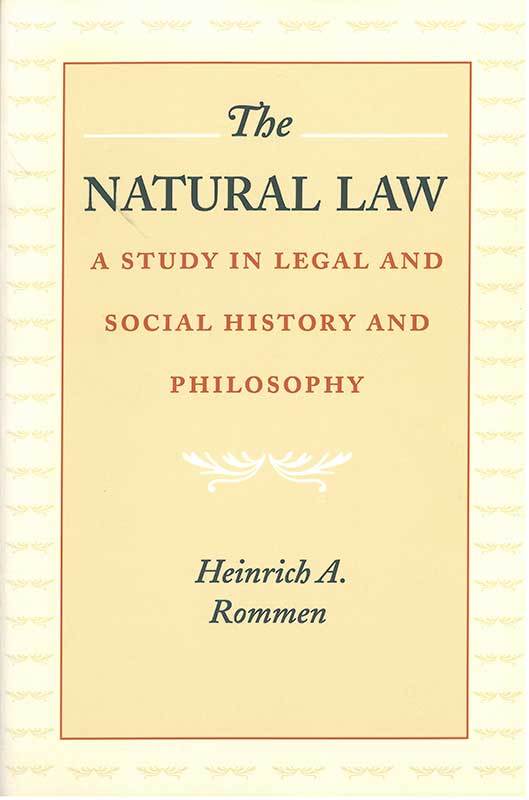
CHAPTER XV: Conclusion - Heinrich Rommen, The Natural Law: A Study in Legal and Social History and Philosophy [1936]

Edition used:

The Natural Law: A Study in Legal and Social History and Philosophy, trans. Thomas R. Hanley. Introduction and Bibliography by Russell Hittinger (Indianapolis: Liberty Fund 1998).

About Liberty Fund:

Liberty Fund, Inc. is a private, educational foundation established to encourage the study of the ideal of a society of free and responsible individuals.


CHAPTER XV

Conclusion

Modern totalitarianism with its depersonalization of man, with its debasement of man to the position of a particle of an amorphous mass which is molded and remolded in accordance with the shifting policy of the “Leader,” is of its very nature extremely voluntaristic. Voluntas facit legem: law is will. How seldom the theorists and practitioners of totalitarianism mention reason, and how frequently they glory in the triumph of the will! The will of the Leader or of the Commissar is not bound by or responsible to an objective body of moral values or an objective standard of morality revealed in the order of being and in human nature. The will is not bound by the objective, conventional meaning of words or by the relation of these to ideas and things. Ideas, as well as the words which express them, are mere tools for the will: they are to be remolded whenever this is expedient. Accordingly an appeal from decisions of this will to natural law, to intrinsic right, to justice and equity, to ideas, must appear as “treason” which stems from democratic decadence or from bourgeois prejudices. The defense against totalitarianism cannot plead greater efficiency, more economic productivity, which are the categories in which the totalitarian “social engineer” thinks. Such a defense must appeal to justice, to the rule of reason; it must plead in the name of the natural law and of the natural rights of human persons and their free associations. Natural law is not only an ideal for the positive law, for legislation to realize; it is also a critical norm for the existing positive law.

Natural law, however, is essentially a framework law, a skeleton law. It does not ordinarily give us a concrete norm directly applicable to action here and now in the involved situations of actual life. It does not, for instance, tell us which of the many possible forms of laws about property is right in the abstract. Neither the capitalistic nor the feudal system of property is imposed by the natural law. But it judges each and every existing system of property in terms of justice. Moreover, natural law does not condemn the wage contract as such or the socioeconomic order of which the wage contract is so important a part, but it makes clear that a social order in which the so-called iron law of wages rules the labor market violates justice and equity. Further, natural law does not proclaim that democracy as a form of government is the sole admissible mode of political organization; yet it does tell us that any form of government, even one that is decked out in the trappings of democracy, which does not recognize the fundamental rights of the person and of the family is tyrannical and may, therefore, rightly be resisted. Natural law, finally, does not say that the Security Council of the United Nations is, in its concrete form, good and efficient; but it does forbid the independence of a small nation to be sacrificed out of mere expediency for the sake of the “security” of a great power. This quality of the unvarying natural law, which elevates it above the changing historical positive law, which makes it both the ideal for lawmakers and the critical norm for existing laws, renders it possible for the natural law to govern the acquisition and exercise of political power itself.

Politics is and remains a part of the moral universe. For it is inexcusable to view politics merely as the technique or art of achieving and retaining social power for some selfish end through the skillful exploitation of human weaknesses, by deceit or by terrorist methods. Politics is rather the great architectonic art by which men build the institutions and protective forms of their individual and communal life for a more perfect realization of the good life. Its main function is to establish an order and unity of cooperation among free persons and free associations of persons in such a way that these, while they freely pursue their individual and group interests, are nevertheless so coordinated that they realize at the same time the common good under the rule of law. But the rule of law is the natural law which justifies the use of political power and before which power itself as well as resistance to arbitrary acts of those in authority must establish its legitimacy: through the natural law alone can we solve the crucial political problem of the legitimacy of power and the duty of free persons to obey. Thus the rule of law, the paramount law binding both the ruler and the ruled, necessarily implies the idea of natural law as the critical norm for the existing positive legal order and for the demand to change it, if it has become unjust. The hope of a peaceful change of the legal status quo within each nation as well as in the community of nations depends on the acceptance of such a higher law that measures both the legal rights of the status quo and the claims of those who would alter it; and it measures them because it is based on natural reason, in which all men participate. For the natural law, ultimately of divine origin but revealed in the very order of being, is but the rule of reason founded upon the rational and social nature of man. Veritas facit legem: law is truth.

“All men are born natural-law jurists.” This fact, which Bergbohm notes at the beginning of his great attack on the natural law, should surely have shown an unbiased person that the very essence of man as a moral, social being points to the nature of law. For all men are born natural-law jurists because in the human soul lies the ineradicable demand that the law must live in morality. All law must be just: only then can it obtain that power which primarily holds together and continually renews every community, and in particular every political community, the power to bind in conscience. But the proper function of the natural-law doctrine is precisely to show forth the connection between morality and law. Consequently it must, for the sake of the very existence of man and his concrete legally ordered communities, ever recur, and it does in fact always return whenever the genius of law seeks out its own foundations.

The foundation of law is justice. “Truth grants or refuses the highest crown to the products of positive legislation, and they draw from truth their true moral force” (Franz Brentano). But truth is conformity with reality. And just as the real and the true are one, so too the true and the just are ultimately one. Veritas facit legem. And in this profound sense of the unity of truth and justice the words, “And the truth shall make you free,”1 are applicable to the community of men under law. True freedom consists in being bound by justice.2

Select Bibliography

Because the subject of natural law touches at least five disciplines in the modern academy—law, philosophy, theology, politics, and history—the literature is extraordinarily diverse. The best single source is the American Journal of Jurisprudence (formerly the Natural Law Forum), which publishes articles, reviews, and bibliographies reflecting the entire spectrum of natural law themes and methods. See, for example, the recent bibliography by Schall.

  • Schall, James V. “The Natural Law Bibliography.” American Journal of Jurisprudence 40 (1995): 157–98.

[1.]John 8:32.

[2.]But the most important lesson of this entire study of the history and philosophy of the natural law may be succinctly stated in a paraphrase of a law of philosophical experience formulated by Etienne Gilson (The Unity of Philosophical Experience, p. 306): “The natural law always buries its undertakers.” Or, as Horace has expressed it (Epistles I, x, 24): Naturam expellas furca, tamen usque recurret. “You may drive out nature with a pitchfork, yet it will always return!”