EconlibThe LibraryOther Sites |
Front Page Titles (by Subject) PART TWO: Philosophy and Content of the Natural Law - The Natural Law: A Study in Legal and Social History and Philosophy
Return to Title Page for The Natural Law: A Study in Legal and Social History and PhilosophyThe Online Library of LibertyA project of Liberty Fund, Inc.Search this Title:Also in the Library:
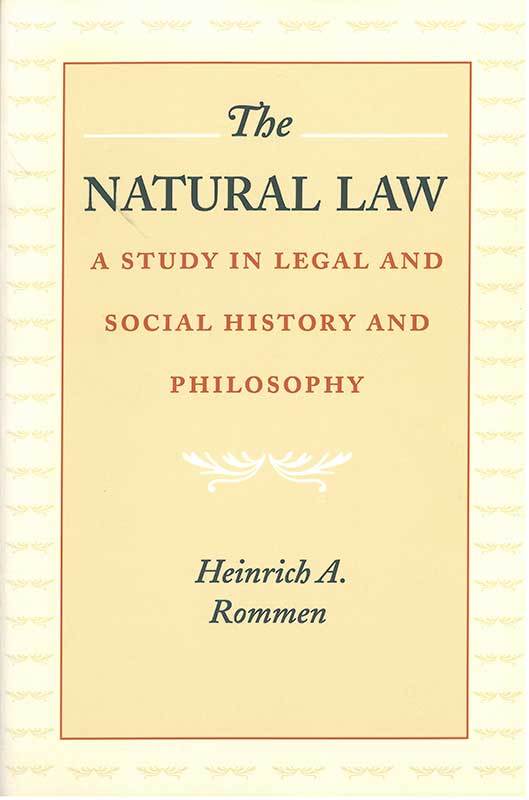
PART TWO: Philosophy and Content of the Natural Law - Heinrich Rommen, The Natural Law: A Study in Legal and Social History and Philosophy [1936]Edition used:The Natural Law: A Study in Legal and Social History and Philosophy, trans. Thomas R. Hanley. Introduction and Bibliography by Russell Hittinger (Indianapolis: Liberty Fund 1998).
About Liberty Fund:Liberty Fund, Inc. is a private, educational foundation established to encourage the study of the ideal of a society of free and responsible individuals. Copyright information:The copyright to this edition, in both print and electronic forms, is held by Liberty Fund, Inc. Fair use statement:This material is put online to further the educational goals of Liberty Fund, Inc. Unless otherwise stated in the Copyright Information section above, this material may be used freely for educational and academic purposes. It may not be used in any way for profit.
PART TWOPhilosophy and Content of the Natural LawCHAPTER VIIIBeing and OughtnessThe history of the natural-law idea shows that there are many ways of clothing any system of ideal law with the appeal of the natural or the rational. In periods when the positive law, grown rigid, is no longer the order of justice that people believe in, but rather a means in the struggle of the ruling class to maintain its social and political power which can no longer be justified in the name of the general welfare, revolutionary and reforming groups, unwilling or unable to appeal to the “good old law,” have to appeal to the natural law. On such occasions, however, the natural law all too readily appears as something impure, as almost inextricably entangled with juridical demands arising from the concrete sociological situation: demands whose bases are not solid from every point of view, whose support lies in passion rather than in reason. Yet one point history does make clear. The idea of natural law obtains general acceptance only in the periods when metaphysics, queen of the sciences, is dominant. It recedes or suffers an eclipse, on the other hand, when being (not taken here in Kelsen’s sense of mere existentiality or factuality) and oughtness, morality and law, are separated, when the essences of things and their ontological order are viewed as unknowable. The natural law, consequently, depends on the science of being, on metaphysics. Hence every attempt to establish the natural law must start from the fundamental relation of being and oughtness, of the real and the good. Since the establishment of the natural law further depends upon the doctrine of man’s nature, this human element has also to be studied, especially inasmuch as the question of the primacy of intellect or will in man is related to being and oughtness. In the next place, justness, or right as the object of justice, needs to be considered if we are to grasp the distinction between lex naturalis and ius naturale. A brief survey of the order of the sciences will thereafter be in place. Only then, finally, will it be worth while to go into the details of the natural law, in order to explain, from the theoretical side as well, the actual historical fact of the perpetual recurrence of the natural law.1 If moral philosophy and, in moral philosophy and with it, legal philosophy are to have a solid foundation, they must be a continuation of metaphysics. At least this is true of a natural system of ethics and jurisprudence, though not of a positivist one which is grounded only in a will as such. In this connection “being” does not denote simple existence, the imperfect form of being. It means essential being, the esse essentiae. Kelsen, who repeatedly asserts that oughtness has nothing to do with being, with the factual, and that the science of law must be constructed in a purely normological fashion, has not heeded this distinction which is basic for the metaphysics of realism. His rationalism, therefore, leads him to a theory of law devoid of contents and constructed apart from the factual, the existent. Yet since his atheistic relativism prevents him from acknowledging with Occam a supreme omnipotent will of God as the source of all norms, Kelsen’s rationalism ends by bringing him to the position that factual reality is indeed the ultimate, primordial norm, that is, the existence of the order of the civitas maxima, the factually existing world legal order. But this position is downright paradoxical in view of his ideal of a science of pure, normative law built upon the unbridgeable opposition between being and oughtness. Thus for Kelsen, precisely because he lacks Occam’s supreme will which lays down the positive norm, existence and oughtness ultimately coincide. Thus he arrives at an extreme empiricism. Had he had a metaphysics, the doctrine of essential being, he would have avoided this contradiction. For being and oughtness must in final analysis coincide. Or to express it differently, being and goodness, the ontological and deontological or moral orders must at bottom and ultimately be one. Accordingly, the first prerequisite of an unalterable, permanent, standard natural law is the possibility of a knowledge of being, of a knowledge of the essences of things; in other words, a realistic epistemology or theory of knowledge. For Pufendorf, Kant, and others, who have no realistic epistemology, not being but some impulse or other, a special property like sociality or a postulate of practical reason like freedom, is the source of oughtness, the principle of ethics and of natural law. Deductive reason is thereby freed from control by reality and consistently indulges in an increasingly hollow rationalism which, to be meaningful, borrows continually from the actual political and sociological ideals of the age. Natural law in the strict sense is therefore possible only on the basis of a true knowledge of the essences of things, for therein lies its ontological support. Thomistic philosophy lays the foundation of the natural law in the following manner: Man perceives individual things through the imagination and the senses, and he is thus able to apply the universal knowledge which is in the intellect to the particular thing; for, properly speaking, it is neither the intellect nor the senses that perceive: it is man who understands by means of both. The intellect alone does not understand; that is to say, objective reality or the things of the external world do not release in the soul ideas of things which are already innate. Nor do the senses alone perceive: it is not individual things alone that exist, and the concepts of essences, which the intellect forms in a quasi-authoritarian manner from motives of economy of thought, are not without foundation in reality, as both nominalism and sensism maintain. Again, it is not the intellect alone that understands, as rationalism pretended when it placed the conditions and the measure of knowledge in the intellect as subjective forms of the latter, and when it failed to make things or reality the measure and condition of knowledge. As a result, the deductive intellect, for which the essences in real things remain unknowable, can no longer control itself by reference to reality. But man understands by means of senses and intellect. Consequently, through intellectual activity he knows the essences from the things. Things in their reality, i.e., that which actually is, are the measure of knowledge. The entire domain of that which is (and is therefore knowable) in the context of the first principles and ultimate particulars constitutes the intellect’s field of investigation. The things themselves are the cause and measure of our knowledge. The speculative intellect is moved by the things themselves, and thus the things are its measure. The being of the thing is the measure of truth. We constantly meet with these and similar propositions in the writings of St. Thomas. It further follows that there is nothing in the intellect that has not first been in the senses.2 For the senses are the gateway through which things or reality pass, according to the mode of the intellect, into the latter’s immaterial possession. But the senses always portray only the particular. Phantasms, the images of things, transmitted by the senses constitute material for the intellect, and this material has to be transformed from sense perception into intellectual knowledge. Knowledge, however, is the apprehension of essences. A thing is not known through the senses, but through the intellect with the aid of the senses, since the intellect apprehends or takes into itself the thing in its essence, in that which it is. At first, then, the intellect is passive. Reality exists prior to the intellect. The mental image is a copy whose original is the real. This real, moreover, presupposes for its actuality only God the Creator, the first creative intellect, who as the All-actual and All-operative gives things their measure. But reality is independent of its being thought of or noticed by the finite intellect. It exists whether or not the finite intellect thinks of it. The human mind is at first passive, receptive, open. It is not, however, as though the intellect were affected by the senses and, looking into itself, perceives innate ideas released through sense impressions. Nor is it as though there were in the intellect a thought-mechanism which now in accordance with subjective conditions works the images into ideas, independently of the being of the thing represented. On the contrary, the human mind is able to understand only by remaining in contact with reality: by continually adjusting its knowledge to reality. For true cognition is the agreement of the thing as known with the object of knowledge, the thing itself. Or, according to the recent way of stating the matter, it is the agreement of the assertion expressed in the judgment with the actual reality, of the logical with ontological truth, of the intellectual equation with a real equality. Hence the great importance of experience, the incessant self-orientation toward reality which is the norm of thought. Continual experience of reality, not a sort of geometrical deduction from a principle, is the adequate method. This is all the more important, too, the farther thought wishes to proceed with its deduction. St. Thomas himself requires experience in particular for moral philosophy and the science of law. Not doctrine, but experience over a long period of time proves the goodness of a law. The difference between realism and an empiricism that glories in experience does not, consequently, lie in the preference of empiricism for experience (induction) whereas realism, so to say, prefers speculation (deduction). The difference consists rather in the fact that empiricism remains content with what is in the foreground, with actual reality, whereas realism, with its delight in knowledge, holds it to be both possible and necessary to push beyond the cheerfully affirmed actuality to that which is in the background, to the metaphysical, to the essences and their laws of being in the actual facts. The object of rational knowledge or cognition is therefore not the particular or the individual as such; this the senses lay hold of. The object of cognition, what judgments assert of the individual thing in the predicate, is what the thing is: the essence of the thing which lies hidden in the core of phenomena as an idea in every thing of the same kind; in a word, the form. The intellect does not attain to the core of the being by way of intuition, by the immediate contemplation of the being, but by way of abstraction. This brings us to the famous dispute over universals and to the distinction, basic for the possibility of all metaphysics, between essence (quiddity, whatness) and existence (haecceity, thisness). Sense perception grasps only the particularity of the existent being, of the individual thing, as, e.g., this man or this concrete state. But cognition is founded on the perception of the universal, of that which is in all things of the same kind as their quiddity or essence. The thing is that which the abstract concept of the thing, the object of intellectual knowledge, represents, signifies, means; and this object of intellectual knowledge is really in the thing. Being belongs to a nature, e.g., to the nature of a stone, in a twofold manner: existential being, so far as the nature is in this stone and that one, which it therefore possesses in the individual thing; and intentional or mental being, which the nature attains in the individual intellect, in mine and in yours, so far as it is thought of by us. But the nature becomes universal and hence representative of the essence, the quiddity of the thing, when it is abstracted, as St. Thomas says, ab utroque esse, when it is viewed apart from existence in things of the external world as well as from existence in the thought of some intellect. It is this nature, considered absolutely and in itself, which is predicated of all individuals as their quiddity, their form, their essence, their nature. The universals are not substances.3 They do not live in a heavenly region, nor does the soul, affected by sense impressions, remember them from its premundane sojourn in that region, as Plato held. Nor are they mere names or vocal utterances (flatus vocis) which, lacking a foundation in reality, were arbitrarily devised by human agreement for the purpose of bringing order into the welter and chaos of sense impressions; hence they are not arbitrary products of the human intellect or of the human will. Finally, neither are they types derived by a process of pure induction from individual things: certain uniformities which lead only to an empirically probable general validity, so far as our experience has gone. On this distinction rests that of existence and essence; upon it also is founded teleological thinking as well as the unity of being and oughtness in the metaphysical order. This essence in the thing is the measure of our knowing. It is the universal predicate in the judgment which establishes the truth of our knowledge. For a judgment does not say that the abstract concept in my mind is the thing, but that the objective content, which is independent of the mere fact that I am thinking of it, of the abstract concept is perceived by me in the individual. For example, a state in itself does not exist. Concrete states alone exist. But a social unit, a territorial corporation, I call a state because and so far as it is a realization of the idea “state.” Accordingly the intellect alone does not know, nor do the senses alone know, but man knows by means of both. To be sure, as has been stated, things as bearers of essence can be the measure of our knowledge only because they themselves in turn receive measure from the supreme creative intellect of God, who measures all things with wisdom. The divine reason by thinking creates the essence of things. The divine will brings them into existence either immediately as first cause or indirectly through secondary causes. This is basic for the possibility of the natural law, because it means that the essential forms are not dependent in their quiddity on the absolute will of the almighty Spirit, but only in their existence. The essential forms of things are unalterable because they are ideas of the immutable God. Occam’s question of whether God must be able to will that His rational creatures hate Him is the foundation for his moral positivism. Conversely, the doctrine of the immutability of the natural law, of the natural goodness of certain moral actions that follows from the nature of things, has meaning only if the unchangeableness of essences is acknowledged. These lines of thought are of importance because the principle that law is positively something pertaining to reason and not mere arbitrary will depends upon this realistic epistemology. This is also shown indirectly by the fact that the principle that law is arbitrary will (auctoritas facit legem, and other equivalent formulas) is founded upon a nominalist or purely empiricist theory of knowledge. The principle that being and truth coincide is a further consequence of the foregoing considerations. Intellect and reality stand in a threefold relationship to each other. From the viewpoint of the intellect we speak of knowing, of the thing, of the real, of being known, and the unity of both is called truth. To know a thing, however, means to apprehend or assimilate the essence of the thing or its form. In contrast to creatures which lack cognition, the intellect is capable of having, and even of becoming, the form of another (every created) thing. The knowing mind is in a certain manner everything. Knowledge is possession of forms. “The intellect in act is wholly, i.e., perfectly, the thing understood.”4 The attainment of the abstract concept, of the universal, whose content is the essence, is the function of the active intellect. The latter gathers from the real, which is given in the mental image of the sense impressions, the immaterial essential core, intelligible being itself, which however is identical with the natural being in the real. Hence a being, so far as it is intelligible, is also true. All that is is true, because it is knowable. But the essence (form) which constitutes the real thing in its being is also the end, the final cause, of the thing. The Aristotelian-Thomistic theory of knowledge starts essentially from the actual fact of motion, of self-change or of being changed, in short, from the attempt to comprehend becoming. Thence came the distinction between an inner, enduring core, the form, and a changeable element, the matter, that which is formed or molded in every material thing. The prototype of such thinking is the creative activity of the artist, who fashions the form out of the material or matter, as well as organic growth in the realm of animate nature, as in the case of plants: in seeds the incorporeal form, acting after the manner of an entelechy, unfolds itself in the matter. The form is not only the proximate efficient cause of the thing; it is also its end. All beings aim at, strive after, desire, their own perfection. But goodness is that which all things aim at, strive after, desire, since the essence of goodness consists in this, that it is in some way desirable. Therefore perfection and whatever leads to it are good.5 Becoming, the proper condition of all created being, is the way to perfection, to fullness of being. Hence the more perfectly a created being becomes its essence, and the more its thisness approaches its quiddity, the more does the essence overcome the imperfection in the existence. In God, the most perfect Being, essence and existence are consequently identical. God is pure Act; He is absolute, most perfect Being. The creature, however, is its quiddity in an imperfect manner only; yet it is intended to become this quiddity, to realize its idea. Becoming is the condition of the creature; being is the nature of God. The full realization of its nature, of the idea, is the end or goal of a thing, ever greater realization of the quiddity in existence. This holds true of inanimate nature, so far as it is moved from without, as the artist fashions more and more perfectly the form of the statue out of the material. But it also holds good of animate nature, which in the process of becoming realizes more and more perfectly the form which is germinally present in it. Whence the axioms: every being, as being, is good; being, truth, and goodness are convertible. Let us take an example or two. The so-called marriage that legally existed for a while in Soviet Russia was rejected by the more or less Christian West because it was not distinguishable from concubinage. But this position did not rest on a comparison of the Soviet view of marriage with the marriage law of the French Civil Code, or with the matrimonium of Roman law, or with the marriage legislation of Germany or of the Anglo-Saxon countries. It was based upon a measurement by the idea of marriage which is expressed and exemplified in the positive legal institutions of these codes. We speak of the imperfection of a piece of marriage legislation by measuring it against the idea of marriage. Moreover, in the history of marriage legislation we distinguish stages according as the positive, historical, legal forms realize the idea of marriage in a more or less perfect manner. Again, a territorial corporation or a tribe does not become a state by the fact that international bodies or other states recognize it, as though international recognition were constitutive of right. No; this recognition takes place, and the territorial corporation has a right to this recognition, because an actual case is present which realizes, however imperfectly, the idea of state; in this way a state can become known, and it thereupon has a right to formal recognition. The basis of the obligation to recognize this state lies in the degree in which the idea of state is realized. Incidentally, the school of comparative law leaves us unsatisfied because, for fear of natural law, which nevertheless makes its appearance, it avoids taking the final step to the nature, to the idea, of legal institutions. Its work thereby becomes interesting, instructive, informative. But it enters only the vestibule of the philosophy of law, where its skepticism detains it. The teleological conception, grounded in the metaphysics of being, is therefore the basis of the essential unity of being and oughtness, of being and goodness. The entire past had to be forgotten before the theory of pure law, the normological school, could maintain that being has nothing in common with oughtness. It was right when it was unwilling that empirical existence should be regarded as a root of oughtness. The factual cannot become right in virtue of mere factuality. There is no factuality of right. A basis of right exists only when in something factual an essential being is striving for realization. Right can never arise from a violation of right. Yet even laws of an illegitimate ruler can bind in conscience, not in virtue of the illegitimate power, but by reason of the actual fact of the common good realized through the laws, irrespective of their factual source, and so far as they realize it. The distinction between essence and existence would have preserved from its antimetaphysical formalism the theory of pure law, whose criticism of the thesis that the fact creates right is so effective. It would likewise have saved it from its ultimate relapse into the thesis of the factuality of right in the case of the civitas maxima or great society. The essence of a thing is the norm and the goal of its becoming. But the creature is always in the state of becoming or development, whether toward the goal, toward goodness, or away from the goal, toward evil, that is, toward the lack of being. But goodness is the final embodiment or realization of the essence in existence, of the tendency of the existent being toward its essence. The fullness of being is the goal. Every being (everything that is real) tends naturally to become its essence, to realize its idea. But that toward which a nature has always an essential bent is a good; for it is an inclination toward perfection. Every real thing moves toward its essence. The perfection of being is the end, the good, the essence. Fullness of being is the real in the repose of the goal of becoming, of self-movement, or of motion from without.6 Thus in the essence lies the norm, the end or goal is in the quiddity, and the good is the full being. Therefore all that is, so far as it is real being, is good. But since the good also ought to be, it follows that in the domain of metaphysics being and oughtness coincide. These ideas lead further to the conception of an order of reality, that is, according to the degree of being which things possess. This order rises from purely potential being which is not yet real through the stages of created actual being with a greater and greater content of being and with less and less mere potentiality. It mounts from the inanimate creation through the world of animate beings to the living rational being that is man as the norm of creation. It culminates in God, the most perfect Being, who is both infinitely superior to the whole of creation and essentially different from it. In God all distinctions between being and becoming, motion and immovableness, potency and act, essence and existence, become meaningless. For God is purest Being, purest Act, unmoved Mover of all things, and therefore most perfect Goodness, deepest Truth, ultimate Norm and highest End, in whom there is no distinction between essence and existence. Hence God as the supreme Good is also the goal of all created being, as indeed the latter is being solely in virtue of its participation in the divine Being, although merely in an improper, analogical sense. God is the final end of all human life and activity. His glory is the goal of creation. The world is order. The order of creatures according to the differentiation of their natures and their gradations proceeds from God’s wisdom. Chance is not the origin of things, nor is the world a chaos into which our intelligence had to bring order. The law of order corresponds to God’s wisdom, which first conceived it in idea prior to God’s will calling it into existence. This order is therefore an order in accordance with the essence of God. Whatever is real is an imperfect exemplification of the ideas of God which are embodied in things. Man recognizes this order as directed to one final end, to God Himself, who at one and the same time is origin and end of the order. For the rational creature endowed with free will, who cooperates in shaping the world, the order of being thus becomes an order of ends, culminating in the final and highest end, the glory of God.7 CHAPTER IXIntellect and WillThe order perceived by reflective thought is not, however, a rigid, static order of motionless things. It is not external compulsion, a clocklike mechanism which, once wound, runs according to mechanical laws. The order conforms to the natures of the things. It is indeed an order of necessity for inanimate as well as for living but irrational creatures. But it is an order of freedom, a moral order, for beings endowed with reason and free will. Therefore, so far as man perceives that he is a creature possessed of free will who is not subject to blind necessity but to the law of freedom, he also perceives that this order, in accordance with God’s will, ought to be. The ontological order becomes, in relation to man endowed with free will, the moral order. The order of being confronting the intelligence becomes the order of oughtness for the will. Since, therefore, from knowledge of the essences of things the order is perceived as established by God in conformity with His essence, this order necessarily appears to the will of the rational and free creature as likewise an order to be attained and preserved and as a norm of the finite will. But this order is naturally and really “given.” It is not projected by human reason, in keeping with subjective, regulative forms, into an external world which in itself is unrecognizable as order. It is objective order, independent both of our thought and of its being thought of here and now. In its essence this order is established by God’s wisdom; in its existence it has proceeded from God’s will. In its meaning and end it is again directed to God, the highest end. Teleologically also there is but the one order, because being is both true and good. The law of order, then, does not lie in the bare, positively promulgated will of God, but in the nature of things as God’s wisdom ordains them. The order of being can be a moral order only if its essential basis is God’s wisdom, only if in God the intellect is, humanly speaking, the nobler faculty. Otherwise we could never derive a norm from the essential order of the world, but solely from the revealed will of God. It has already been shown how in moral philosophy this thesis of the will as the nobler faculty led, and had to lead, through Duns Scotus to Occam, i.e., to the most one-sided moral positivism, for the doctrine of the will as the nobler faculty is itself the root of nominalism. But nominalism, directed only to the individual, particular thisness, to the existence which is related to the will, arrives in its extreme forms at the denial of the clear and distinct knowability of the essences of things, of the essence which is related to the intellect. The universals are but vocal utterances. Reality, since in its quiddity it is not unmistakably knowable for us, is likewise not the measure of our knowledge. The order of being cannot of itself become a norm of the will; the absolute, omnipotent will of the Supreme Being can alone become that. The entire doctrine of the eternal law and natural moral law is undermined by such a view. Just as the theory of will in municipal and international law cannot admit a law beyond the positive one (or, more precisely stated, beyond the factual will as a persisting act), so Occam, for instance, could not admit a morality that does not have its first, proximate, and sole norm in omnipotent will, in the absolute power of God. If, then, the idea of God and therewith the supreme personal will are lost to sight or rejected, nothing is left as the source of norms but the concrete will of the earthly lawmaker. Or, as in the case of Spinoza, the deep impulses of nature (here taken as contrasted with mind) are regarded as the natural norm. The biological as well as materialistic ethical systems and theories of law have here their roots. From this it follows that the doctrine of the priority of the intellect over the will in God as well as in man is a prerequisite of the possibility of a natural moral law and hence of the natural law in the narrower sense. It is significant that traditionalism is congenial both to the historical school of law and to the conservative thinking of Donoso Cortes, De Maistre, and A. von Haller, a consequence of the deep feeling against rationalism. The principles of morality, it appeared to them, are not to be discovered in being. They are a positive revelation, a primordial revelation, mysteriously handed down through the centuries and millennia in the hearts of men. The objective, the real, is the measure of knowledge. The order subsisting in reality is perceived by man. At first it is known in a speculative, purely intuitive way. Reason is thus for a long while absorbent, receptive. But man is not only pure reason; as a free agent and part of the order, he is himself called to realize it. As reason turns from pure, merely receptive knowledge, from the idea as end, to existent being, it becomes practical reason which is directed to doing and making. Being is perceived as oughtness; the idea is perceived as goal and norm of making and doing. Realistic metaphysics sets out from artistic activity as a model as it does also from self-consciousness, from man’s self-knowledge. Man does not act blindly. There are not two reasons in man. On the contrary, the rational soul, while it apprehends being as truth, directs the known truth to action. The position that the practical reason is the extension of the theoretical reason corresponds to the position that moral philosophy, the science of moral action, is an extension of metaphysics, the science of being. The speculative intellect becomes practical. First the theoretical reason knows, and the real exists prior to it. The known truth thereupon appears to practical reason as truth to be accomplished through the will.1 In this priority of the real or of being over knowing, and of knowledge over willing, lies the basis of the possibility of a natural moral law. The structure of moral action is built up from the knowledge, through the theoretical reason, of the idea as goal of the being by way of the recognition, through the practical reason, of this being as a good. This good is then proposed to the will as something to be striven for. Knowable being is the principle of oughtness. The supreme principle of oughtness is simply this: Become your essential being. For the rational, free nature of man this signifies: Act in accordance with reason; bring your essential being to completion; fulfill the order of being which you confront as a free creature.2 The order of all being has its principle in God: as order of essences in God’s essence, as created existing order in God’s will. The essences of things, as first creatively conceived by God’s intellect, are, once established, unalterable.3 This order of the world is the eternal law. The purposiveness of things, their continual pursuit of their ends, which reveals the order, points to the supreme Lawgiver. Accordingly the eternal law is nothing else than the exemplar of divine wisdom, as directing all actions (of rational creatures) and all movements (of irrational creatures) to their due end.4 Or as St. Augustine had defined it, “the eternal law is the divine order or will of God, which requires the preservation of natural order, and forbids the breach of it.”5 But order results from the steady pursuit of their ends on the part of the various natures, from the natural activities implanted in things by God in conformity with the natures of the things. “All things partake in some way of the eternal law, in so far as, namely, from its being imprinted on them, they derive their respective inclinations to their proper acts and ends.”6 But they participate in it in keeping with their natures: the unfree, irrational creatures in an unfree manner, blindly obeying the compulsion of their nature; the rational, free beings in the freedom of oughtness. The order of the world is an order of absolute necessity for unfree creatures, but it is an order of oughtness, a moral order, for rational and free beings. In the former case the eternal law is a law of necessity; in the latter, it is a moral law of freedom.7 The natural moral law is therefore the eternal law for rational, free beings. The ontological law becomes a moral law; the order of being becomes an order of oughtness. The natural moral law may be defined8 as “the light of reason inherent in us by nature, through which we perceive what we ought to do and avoid; or also: the knowledge, communicated to us by the Creator through nature, that we must strictly observe in our conduct the order which corresponds to our nature.”9 CHAPTER XThe Structure of the SciencesThe realistic theory of knowledge is the basis both of the unity of knowledge and of the internal coherence and organic structure of the sciences. Despite all distinctions of objects or ways of experiencing and looking at the one reality, and notwithstanding all the differences of methods, the sciences form an integrated system. Not only do they all rest upon metaphysics as the foundation of knowledge in general, but they also find their crowning in metaphysics as the philosophy of being, the science which affords the deepest knowledge concerning the principles and causes of being itself. The individual sciences deal with being from specific viewpoints. For instance, ethics deals with the norms which determine the deeds and actions of free persons, with the oughtness which springs from being; and physics treats of material things in their causal connection, their mode of existence, their motions. At the end of every science, moreover, there stands, not the value of the science for practical use, but its discharge into knowledge as such, the most profound impulse of the human spirit. Indeed, man is so dominated thereby that we must affirm that his deepest urge is to know as much as possible about everything. Wherefore Genesis has quite rightly designated pride, the desire to be like God (“You shall be as Gods, knowing good and evil”; 3:5), as the greatest sin. And the modern age merely betrays its shallow, vulgar, and unphilosophical mentality when it ascribes the temptation of the first human pair to concupiscence, as though sexual love itself were not at bottom a kind of impulse to know.1 Metaphysics is the logical foundation of all science. All science is a system of general, necessary judgments touching the existence or essence of their objects, and to that extent they constitute true and genuine knowledge. Thus jurisprudence is a systematic formulation of judgments about the general and particular positive institutions of the legal order: their existence, essence, sources, principles, normative coherence, validity in space and time. The history of law is a systematic exposition of judgments relating to legal arrangements that were formerly in force. International law is a system of judgments about the legal ordering of the community of states. But the formal element of every judgment is contained in the verb “to be”: jurisprudence is a normative science. Hence the science of being (of its forms, principles, and modes) is the basis of every other science. Being is universally “given” simultaneously with every act of knowledge: knowledge is true knowledge through its agreement with a being. Being, however, is reality differentiated according to act and potency, according as being is determined or is capable of determination. Being is reality before the intellect and truth in the intellect; it is goodness before the practical reason and in the will. Certain fundamental laws result from being: the principle of contradiction (nothing can both be and not be at the same time under the same respect), the principle of sufficient reason, the principle of causality. They are absolutely universal; they are always valid, even in regard to purely conceptual possible being, provided it is something conceivable by reason. Yet this does not mean that metaphysics as the first science must necessarily be also the first in time, as though the cultivation of other sciences were rendered possible only through it. It merely means that its essential principles first render science possible. In this way we positively hold in our secure, habitual possession the principles of contradiction, causality, and differentiation between being which determines and being which is capable of determination: and this possession is unconscious because it is continually experienced. These principles guide our entire thinking. They are valid for every object of knowledge, so far as it must possess a minimum of being in order to be apprehended or known at all. The first principles of theoretical reason are self-evident. Even an actual theoretical doubt about them proves their axiomatic validity: to doubt them is to affirm them in the very act of doubting. “Philosophy does not inquire about particular subjects in so far as each of them has some attribute or other, but speculates about being, in so far as each particular thing is. … Physics studies the attributes and the principles of the things that are, qua moving and not qua being (whereas the primary science … deals with these, only in so far as the underlying subjects are existent, and not in virtue of any other character).”2 The various kinds of being, participations of universal being by the many particular beings, particular reality in contrast to universal reality: all this conditions the diversity of the sciences. Nevertheless the different sciences are interconnected and they have a single object: that which is, and a more and more comprehensive and profound knowledge of it. How well and aptly, then, the creative spirit of all languages speaks of the craving for deep knowledge, for what lies beneath the surface, for the obscure that lies under and behind the clear and obvious! Realistic philosophy has no tendency to separate the sciences in place of distinguishing them; it has no tendency toward a fanatical excessive specialization. Just as the speculative intellect by extension becomes the practical intellect, so metaphysics becomes moral philosophy. That which is, so far as it is, also ought to be. The essences or natures of things ought likewise to be the goal of the development and active formation, through the secondary cause, of the existing organic thing as well as of the thing to be produced by art. And the order of the world, as it exists ideally in the natures of the things ordered, is for the free will an order that ought to be realized. Likewise the essential nature of rational and free man ought to be. Realize your essential nature: such is the primary norm of moral action, the perfecting of the idea of man. There are in man, however, as the slightest reflection makes plain, different modes of being. Man belongs to the corporeal world, to the world of sentient creatures, and to the world of rational, free, and social beings. To this complex reality correspond various sciences which concern themselves with man inasmuch as he belongs to these worlds. But as a rational, social being endowed with free will, he is the object of the sciences that are properly human: of psychology, as a rational being; of social philosophy, as a being that is essentially social; of sociology, as a being that exists in concrete social forms. Yet as a creature that shapes his own rational and social life and being in freedom and not through compulsion, man is the object of the moral sciences which lay down norms of action in the light of the idea or essential being of man. The first principle of ethics, that good is to be done and evil avoided, obtains its material content (the determination of what is good) from the essential being of the rational, free, and social nature of man. Thence result a natural social ethics, which also rests upon social philosophy, and, as part of it, a natural law, the natural law in the strict sense. When they were not treating of law in the narrower sense, the Scholastics and their successors frequently called their entire moral philosophy institutiones iuris naturalis. This served a good purpose: the unity of morality and law was thereby safeguarded. Moreover, law, through its inclusion in moral philosophy, was given its metaphysical basis. The science of law received its foundation, the philosophy of law its objects, and positive legal institutions their legitimation in the natural law, which in its turn rested upon social philosophy and hence upon the metaphysical doctrine of man. The oughtness or obligation of legal norms also obtained thereby a material foundation in the essential being of man’s social and rational nature. Thinkers thus escaped positivism, which believes that it has to acknowledge and recognize only a factual willing of the norm by a lawmaker who has force at his command. Positivism has always originated in philosophical skepticism, or it is a purely arbitrary short cut in the matter of determining the structure and interconnection of the sciences. It renounces inquiry into the reason of the norm. The essentially social nature of man means that his mode of being is social being, and that the idea of man is perfected in the community and its gradations. This is not a requirement of some impulse or other, but a reality which in ever increasing human experience shows itself as “given.” Social being, the necessary communities of the social animal, is the object of social philosophy. Social being is in reality. Therefore continual contact with reality and observation of social life are needed in order to be able to make assertions and form judgments about the nature of social being. Only then can we discern what is permanent amid the changing situations, amid the alterations of outward forms in the course of history. With regard to social science, then, social philosophy plays a role similar to that of metaphysics in respect to the sciences in general. It follows, consequently, that in this case also essential being becomes oughtness to the practical reason. In this case, too, essential being becomes the goal and norm of what is taking shape through the free activity of the human will. Social ethics and the philosophy of law are extensions of social metaphysics. As the mind by cognition draws out or abstracts the nature of social being from the social data, from reality, it discovers the first social ideas and principles. It does not itself construct them or postulate them from some abstract principle or other, such as freedom. There is a philosophy of law, a doctrine of juridical oughtness, to the extent that law and every legal order constitute a peculiar order of social oughtness, a coordination of the various social relations and connections among men from the loose and ephemeral to permanent and firmly established forms of community living, since there exists a legal form of social being. The philosophy of law cannot be detached from ethics, since it is part of the latter. Furthermore, to the extent that it exists, it is as oughtness and norm grounded in essential being, in the nature of social being. Its first principles and the further conclusions form the content of the natural law. The laws of being become norms of doing and acting for the creative will. The eternal law, the law of the world’s being, becomes the natural law in relation to the rational and free creature. Whatever necessarily appertains to the perfecting of a nature which is essentially social ought also to exist and to be realized by the will. What necessarily belongs thereto, no more, but also no less, is by nature right and moral. As social philosophy is distinguished from sociology, and social ethics from historical moral systems or codes of an epoch or class, the positive science of law is distinguished from the philosophy of law, and the positive law from the natural law. The natural law embraces the contents of both the science of law and the philosophy of law. As in metaphysics the first ideas of being in general are presupposed, so here the ideas of individual person, community, morality, and of law are “given” beforehand. “The individual legal experience depends for its clear comprehension upon the universally valid concept of law, not vice versa” (R. Stammler). Moreover, this concept of law is immediately present to us who grow up in the legal community of family and kindred-group, of professional group and village or town, and of the state with its officials, judges, and courts. This holds true even if only in the form of the general normative appurtenance of certain things, and in the form of the relation of certain persons and their action to us as individual equal or unequal members of the community. Indeed this concept of law is so present to our minds that, upon attaining the use of reason, we at once become immediately conscious of the basic juridical and moral principles and we apply them in practice. Such fundamental principles are: Good ought to be; what is mine ought to belong to me, what is yours, to you; no one may molest me in what is mine. It is precisely the same as in the case of cognition where we immediately possess the intuition of certain principles, such as the principle of contradiction. The science of law and the philosophy of law accordingly differ in their specific objects. The science of law views its objects, legal ordinances, from the precise standpoint of their positive validity and practical application in the administration of justice, their historical evolution, their logical coherence and consistent interpretation, and their positively established legal institutions. The philosophy of law, on the other hand, has for its object the necessary universal norms; and the legitimation of every positive legal ordinance implies an attempt to realize such norms. Hence its object is what has for centuries been known as ius naturale. For this reason, too, every attempt to philosophize about law bears willy-nilly a natural-law character. For without this going back to ultimate, necessary, and permanent norms, there exist only empirical generalizations, systems of legal types, genetico-historical explanations of the factual development of a legal institution (e.g., the loan), but not knowledge of the real grounds for the universally existing principle that what is borrowed ought to be returned. The essential nature of man, the idea of man as a rational, free, and social being is, as the normative goal, the principle of social ethics and of the natural law. The legitimation of all law must ultimately be a moral one. This is possible, however, only if the normative oughtness of practical reason is ultimately being perceived by the theoretical reason. The circle of the mind and the sciences is thus closed. The given reality and the ideal core in it, as measure of man’s knowledge and the object of theoretical reason, appear now to the practical reason, the extension of theoretical reason, as a valuable good and end, as a task to be realized. But the concrete realization does not get its legitimation from the will that does the realizing, but from the end or goal of the realization, the idea. Metaphysics is the presupposition and the crown of the philosophy of law, whose object is the natural law. CHAPTER XIThe Nature of LawIt may be said with some exaggeration that the era of individualism was the first to pursue a philosophy of right or rights (in the subjective sense), whereas the preceding age had rather developed a philosophy of law. That would be especially justifiable were one to conceive right more as a subjective permission and power to demand, and law as objective order and the basis of duties and rights. The suum would then be first, while the norm, through which the suum would be determined and guaranteed, would come later. The Christian doctrine of natural law, however, does not first posit the suum and the person, and only afterwards the law. But as the community is perceived simultaneously with the person, because it is “given” with the latter, so the norm which determines it is simultaneously posited with the suum. Man is continually viewed in an order that is simultaneously given, whose natural laws, arising from the nature of the essential order, require observance. Thus since thinkers did not set out from the isolated, abstract individual and did not begin by asking what are to be considered his inalienable rights, but always regarded man as a member of an order instituted by God and manifesting itself in man’s essential being, attention was paid more to the law, to right in the objective sense.1 Besides, whoever is of the opinion that law and morality may not be separated, and hence that positive law and moral law belong together, will be especially capable of appreciating this view. Laws have then an ethical aim or end. They are not merely a safeguard or protection of previously given rights. They have in addition the positive ethical function of making men better, more virtuous. But this implies that the positive law is inwardly connected with the object which the moral law has in view. ‡In St. Thomas Aquinas we find at first an entirely general concept of law. “Law is a rule and measure of acts, whereby man is induced to act or is restrained from acting.”2 This rule or law is an ought, not a blind necessity. It applies to creatures possessed of free will while it leaves their freedom intact. It is not physical compulsion. (Hence the laws established for the movements—motus, not actus—of irrational nature, the laws of nature in the present-day meaning of the phrase, are laws only in an improper sense.) Law is thus a norm for human actions which proceed from free will and are therefore actions of a being who is master of his deeds and omissions, of a being who is a person. But free will presupposes reason, in keeping with the priority of the latter. Consequently it pertains to the nature of human actions that they are somehow determined by reason and are in agreement with it. It is thus nature, and, more explicitly, rational nature, which provides the proximate criterion in passing a judgment of values on a specifically human (morally free) action. But reason, as practical reason, further regulates action since it apprehends the connections and relationships of ordered things among themselves and in relation to their end, because order arises through common direction to an end. Again, all action occurs for the sake of an end. Without purpose, action would be meaningless; without purpose, the will has nothing to strive for. But reason alone can grasp the appropriateness of the actions for attainment of the end; it alone can conceive the means and the series of intermediate ends that lead to achievement of the final end. This activity of reason, through its decision for or against a proposed course of action, precedes the will, the converting of the deliberation and the judgment into act. The content of every norm, therefore, as well as all that has in any way a normative character, is related to reason as essential nature and as principle of knowledge.3 It follows from the foregoing that law is “something pertaining to reason.”4 To the concept of law belongs “an ordinance of reason,”5 not (as it is occasionally thought) an ordinance for reason, although law is this too. For law does not speak to the blind will as such, but to the will guided and informed by reason. Man acts for an end. Hence every action has an immediate goal. It is evident, however, that the immediate end, e.g., writing, is subordinated as a means to a higher end, e.g., the communication of thoughts. Ever wider investigation brings to light an ultimate end, to which the subordinate ends are related as to a final cause. Their relation to the final end is that which is common to them all. It belongs to the nature of law to serve a supreme purpose that is ultimate in the respective order. The purpose or end is a creative element in law and right. The final end of all human action and at the same time the principle of such action is felicitas, happiness.6 But universality belongs to this end: it is the common good of all who strive for it. To that extent law is directed to the common good in the general sense, from which it receives the property of universality. Law is thus a general norm of reason which directs the actions of free man to the common good, not to a private or particular good.7 This may not be restricted to the general welfare of the state, although this is its foremost application, but holds good for every higher community with an end of its own, in particular for the Church and the international community, but also for the family and the larger kindred-group. To law pertains also a lawgiver. For a group of people, order among the individuals who compose it and their direction to the common end are essential. The group first receives its unity and concrete form, its sociological and juridical individuality, through the unity of order and through the end. However, the production of this unity and the enduring realization of the common good through the direction of the acting members to this goal presuppose one or more directors in the specific sense of that term. Chance or accident is not the creator of the community. For this reason the lawmaker pertains to the notion of law, which must be directed precisely to the general welfare. Consequently, too, he is the lawmaker upon whom devolves concretely the care for the common good, whether it be the corporate body itself, the people, or the constitutionally determined holder of the public authority. Furthermore, since law is the rule of action for rational and free beings, it has of necessity to be made known to them, that they may direct their actions in keeping with it. Promulgation likewise belongs to the nature of law. Accordingly law is a general rule of reason which is directed to the common good, emanates from public authority, and is duly promulgated.8 The will, too, is included therein. For the framing of a legal decree is just as essentially an act of the will, but only on the basis of a precedent rational weighing of the ends and means which concern the law. A rule that does not issue from the activity of reason, an arbitrary rule or an arbitrary decree, “would savor of lawlessness rather than of law,” says St. Thomas categorically.9 Law, then, is primarily not will, although it owes its positive concrete existence to a volitional act of the lawgiver. Materially considered, it has to be a rule of reason and for reason (in the one subject to the law). That is, only thereby can it obtain the decisive qualification of true law. For rational nature must be directed and guided in accord with reason, i.e., it must be in conformity with truth. That has been common intellectual property ever since the Greeks established the truth of the nomos: law is truth (veritas facit legem). Closely connected with this idea is the doctrine that the end or aim of law is to make those who are subject to it good.10 Law as a rational norm for the free activity of man must have at bottom this objective; it is not a mere safeguard against the antisocial impulses in man which menace the community. The dignity of the laws rests on this consideration. Wherever, as already among the Greeks, law had this ethical aim, law became something sublime and venerable. This idea corresponds likewise to the ethical character of the community, especially of the state. All law wishes to educate the members of the community. All true politics is education of the people. It has required the entire emptying and disparagement of the state at the hands of individualist liberalism to bring about the denial of the educative function of the law, and to assign to law merely a protective function in behalf of the autonomous, even morally self-sufficing, individual. Such is the nature of law. It is universal and holds good for all laws: for the moral law and the positive law, whether the latter is a statute of some corporative body or a law of state or Church. The natural moral law, too, bears the character of law. Indeed, as has already been mentioned, a heated controversy over this point took place among the Late Scholastics. It reached its climax in the dispute between Vasquez and Suarez. The argument turned on the nature of law: Is law an act of reason, or is it an act of the will? Vasquez was in agreement with tradition when he said that law is an act of the intellect on the basis of an act of the will. Materially, therefore, he regarded law as an act of the intellect; formally, as an act of the will. Therefore Vasquez was unwilling to characterize the natural law as law proper, simply because the law of nature as an intimation of that which is good in itself, i.e., in accord with reason, and of what is bad in itself, i.e., at variance with reason, contains no element of will. Some had on this account termed the natural law a lex indicans, in contradistinction to lex praecipiens. The idea that rational nature as such is the natural law, and that the latter has force even in the impossible hypothesis that there be no God, was carried forward by Arriaga and Grotius almost to the point of the autonomy of human reason. The contrary position was the Occamist doctrine that law is but an act of the will: hence the natural law is divine positive law, and the basis of the goodness and rightness of certain actions is not found in their conformity with nature, but in the absolute will of God, who is completely free to prescribe even the opposite course of action. That meant the dissolving of the concept of natural law. Therefore Suarez was at pains to point out that, as the light of natural reason indicates by way of judgment the inner agreement or internal contradiction of actions with rational nature, it likewise indicates in the very same act that this corresponds also to the will of God, the Author of nature.11 All law is first and foremost an act of reason. Even technically the deliberation precedes the decree. Yet law is also a decree of the will.12 The answer to the question about the nature of law is thus the answer to the question of the relationship between intellect and will. And the answer to this decides the question of whether a natural law is possible at all. The historical theories of the nature of law down to the present time cover the whole range of the antithesis: Law is reason—law is will. Besides, the nature of the law provides the basis for differentiating forms of government, and it renders philosophy of law possible or impossible. In the United States, the judge, in virtue of his right to review the law, inquires whether an act of the legislative body is unconstitutional. Actually, however, he examines whether the act is reasonable, and he disallows it if he finds it arbitrary. The judge, or the Federal Supreme Court, thus becomes in the United States the first chamber, wholly unprovided for in the Constitution, with absolute right of veto. The demand for a public consideration of the laws in parliament or congress, i.e., for the discussion of the reasonable grounds pro and con, is likewise understandable only on the basis of the view that law must be reason. Furthermore, paradoxical as it may sound, the same view underlay even the absolutism of a Louis XIV of France. For, as the latter passed not for a mere man but for a vicegerent of God, the reasonableness of a law which emanated from him was by inference a presumption of law and of right. The same is true of the enlightened despotism of the following century, which rested on the view that the ruler, because of his superior, enlightened reason, can manage the state to the advantage of the people. Only Occam’s positivism in moral philosophy and that of the closing nineteenth century in jurisprudence, by clinging to the principle that law is will, held fast to the theory of will. The unfruitfulness of this theory is at the same time the reason for its rejection. Law must be reason, too, for the sake of man’s dignity. The human person is not a means for the ruler’s use. Obedience, to be ethical, must be reasonable obedience. This requires a certain insight into the reasonable character and the purpose of the norm. Hence the lawgiver, precisely in those governments in which the laws do not originate in public deliberation, almost always adduces, generally in a detailed and solemn form, the motives of the law. Somewhat different is the question of whether the unreasonableness of a law or an actually deficient insight into its reasonableness exempts one from obedience. Here the Christian doctrine and individualist liberalism part company. The latter optimistically considers that the individual is always sagacious enough to have the requisite insight. In addition, it proceeds from a preconceived notion that the law, as a restriction of freedom, is rather a necessary evil than a means for making the citizen good. Lastly, it is filled with a distrust on principle toward the lawmaker, whether he is a single tyrant or a hundred tyrants, i.e., a parliamentary majority. The legislator should lay down only the formal rules of procedure. The individuals themselves determine the material content of law through their contracts, which, moreover, constitute the principal form of individualist jurisprudence. The Christian philosophy of law, however, absolutely demands the positive law. And if it declares reasonableness to be an essential note of the concept of law, it can still, with St. Thomas, characterize only the absolutely unreasonable law, i.e., one that is at variance with the natural law, as savoring of lawlessness rather than of law. But since order is a very great good, just as is the will of the state which realizes and preserves this order, so along with the demand, addressed to the lawmaker, for the reasonableness of laws goes a demand addressed to the subjects to preserve the great good of order even when a particular law cannot be entirely justified before the bar of reason. The continuance of any order at all, however mixed it may be with injustice and arbitrariness, is of greater value than the utter lack of order, than total disorder. The Christian philosophy of law can demand this because in its eyes the nature of the state is not exhausted in the legal order, although the state must be essentially a constitutional state: it must be in the law. But the state is more than that, for it does not live by law alone; it also lives by the acts of all the social virtues through which the idea of man is perfected. We have this antithesis: law is reason (veritas facit legem); law is will (auctoritas facit legem). The Christian philosophy of law holds that, although auctoritas alone can enact the law, veritas so pertains to the nature of law that law is quite as essentially reason, i.e., an act of the intellect; indeed, from the standpoint of the precedence of the intellect, law is primarily reason. For only then can human law feed on the eternal law and be truly a norm of rational nature. The dignity of law is founded on the fact that it is “an ordinance of reason for the common good,” that it is a “dictate of the practical reason.” As norm of human conduct, i.e., of rational behavior, law must be a reasonable norm. For the same reason, too, coercion cannot enter into the definition of law, even though, in contradistinction to moral law, physical enforceability is proper to the positive law of the state. “Hence compulsion is rather an element of wrong than of right, since the latter, so long as it functions normally, has no need at all of forcible execution” (F. von Martens). Coercion is the consequence of the dignity and necessity of the positive law. The rational end or goal of the positive law is the ethical legitimation of compulsion. The genius of legal reason cannot, therefore, rest content with self-denying positivism. It keeps returning to the natural law, to reason and truth in the law. CHAPTER XIIMorality and LawIt is a universal conviction of mankind that morality is a higher norm than the positive law. This conviction is so universal that lawmakers and judges continually appeal to morality; and every revolutionary relies upon a moral, higher law of justice in his opposition to the positive law. But morality itself must then be absolute; it must cause the order of values to be terminated and at the same time grounded in a supreme value and good (finis et principium). Morality bases its norms upon the hierarchy of being and of goods, which obtain their rank and proper value in their instrumental relationship to the highest good. The highest good is the Godhead, purest Being. God’s honor and glory, to which the whole of creation bears witness, are also its highest end. Therefore human morality consists in the preservation and execution of the order of being: in the perfecting and ennoblement of the unique godlike being not only in the domain of his altogether individual personality but also in the ever more perfect rightful development of communities, and this too from the first community, the family, up to the state and even up to mankind itself. This requires the more perfect development of the spheres within which human life unfolds: economics, labor, and technology quite as well as the arts and sciences. They are the great Benedicite of creation and of human culture as a whole. From the highest good they all receive due measure and their rightful place in the order of essential being. Hence it is an immoral state of affairs when economics, an instrumental department of life, becomes the dominant one: when the economic category of profit and utility is placed above man, that is, above sovereign and autonomous personal values, whether in the case of individuals or in that of national political communities. Therefore, ethics, the doctrine of absolute morality, ranks higher than the other normative sciences such as art, medicine, hygiene, politics, legal and social philosophy. But this does not signify any narrow-minded moralization of the spheres of human life and activity. For the laws of art, hygiene, and legal organization remain for all that specific, independent laws which result from the very being of these subjects. This truth is founded upon the confidence, derived from the philosophy of being, that the realization of the specific modes of being, e.g., biological being, is at the same time a fulfillment of morality. Morality calls for fidelity to the laws of biology, whose ultimate coincidence with morality is capable of easy and ever fresh demonstration. Every system of ethics which acknowledges a Deity distinguishes three orders of duties: duties toward God, toward one’s self, and toward ones’ fellow man. The Greeks, the Roman jurists influenced by Stoicism, the entire period of the Middle Ages, Pufendorf and Leibnitz, and Christian moral teaching down to the present day have all accepted this threefold division of duty.1 Without a doubt right is correlated with the third class of duties, with social ethics. There exists no right against oneself; the right to oneself means a right against others. Right or, to use a term familiar since Aristotle, justice (whose object is right)2 is “directed to another”:3 “it denotes essentially relation to another.”4 For justice “directs man in his relations with other men.”5 In relation to God and to oneself there exist moral duties, but no rights and legal duties in the proper sense. But the rest of the specifically social virtues are also directed to another: love of neighbor, friendship, liberality, charity, and gratitude. How is right or justice distinguished from these? The simplest answer is: By the fact that it is derived from, and is enforced by, the will of the state, the factual will of the lawful legislator. The state admits an action at law to obtain the fulfillment of certain duties and enforces the decision of the court. Since a duty arising from gratitude or friendship is not actionable, it is consequently an ethical duty. For the most part, as is well known, a lawsuit destroys friendship. Yet this positivist explanation is inadequate. It contradicts mankind’s conviction of right: all peoples distinguish between law and right. The English Parliament is in theory sovereign: it can, to quote an expression which has become almost proverbial, “do everything but make a woman a man, and a man a woman.”6 Yet even though it is held to be able to make the wife of A the wife of B, it can never declare adultery lawful (Lord Hale, 1701). A saying attributed to the eleventh-century writer, Wippo, corresponded to the old Germanic law: “The king must learn and hearken to the law, for to keep the law is to reign.”7 The Sachsenspiegel, an early thirteenth-century treatise on the law of the Saxons, expressly differentiates the natural law, as genuine and true law, from the positive law of the state. The proposition that law is a mere product of the factual legal will has long been flatly qualified as heresy. The contrast between legality and legitimacy, an altogether critical difference in political philosophy, would otherwise be but a play on words, and justice would be but an empty sound. Furthermore, there is assuredly a Church law (canon law) which, applicable concurrently with the law of the state on the strength of a concordat, is autonomous with respect to the state. Besides, the doctrine that the whole body of international law is derived solely from the will of states could not be upheld in view of the inherent injustice of the peace settlements of 1919 dictated in the suburbs of Paris. Since these treaties actually came into existence through consent on the part of the will of the states, their qualification as unjust must necessarily come from another source of law than the consent of the states. Lastly, is not the will of the state much more concerned with the ascertainment or finding of the law which is already in use among the members of the community than with the making of law? It would be much closer to the truth to say that right, as it were, antedates the law than to term the law of the state the sole source of right. A specious attempt to solve the problem has been the distinction between internal morality and external legality (Thomasius, Kant). Certainly the law is for the most part satisfied with the outward fulfillment of the legal norm—for the most part! Often, however, inner motives also come into question, especially in criminal law where premeditation or cold-bloodedness is more severely punished in cases that otherwise are objectively the same. The situation is similar also in private law, where good and bad faith or the actual will of the parties to a contract, which is surely something internal, is the decisive factor, and not purely and exclusively the external document containing the contract unless, of course, the higher principle of legal security and of ability to count upon the semblance of law decides the matter. That acting in fraudem legis, i.e., with the intent of evading the law, receives no legal protection, points to the same thing. Perhaps the supposition that the distinction mentioned above is explainable by the political conditions of the time is not far wrong. The restriction of law to external conduct may well have arisen from the need to limit absolutism in the interest of a sphere of freedom for the individual. “Grant liberty of thought,” the Marquis of Posa, in Schiller’s Don Carlos, adjures King Philip II of Spain.8 However, the limitation of morality to inner peace, to that which is internal, is wholly unsatisfactory. Ethics embraces the total activity of man, his inner and outward acts. Acts of obedience toward parents, of truthful speech, and of fidelity to one’s given word certainly do not lose their moral character merely because through their externalization they become legal acts. Since they are good in themselves, even without a law they are righteous actions; and their opposite is unrighteous, even though no positive norm explicitly lays this down. It is not difficult to believe that the same motive prevailed here as in the other case. The domain of law, in the concrete sense of absolutism, was to be restricted. Only external facts and circumstances were to fall under it. The state was to be able to enjoin security, external order; but, beyond this, nothing. It was to have no ethical function. It might in this way be possible to circumvent, in the interest of liberty, moral education at the hands of the police-state. ‡St. Thomas teaches that justice “directs man in his relations with other men” in a twofold manner: “first as regards his relations with individuals, secondly as regards his relations with others in general, in so far as a man who serves a community, serves all those who are included in that community.”9 All this is brought out in the age-old saying, “Give to everyone his own” (suum cuique). But that is termed a man’s own which is directed to him, which must be regarded as due or owed to him, from the standpoint of his essential idea. It is therefore that which must be left to him. The objectively and subjectively teleological or purposive character of things, goods, and actions, as the existential basis of persons, is, in the form of “being owed,” of being necessary and hence of being enforceable, the specific feature of law. Man has a natural legal dominion over external things because he can, in virtue of his reason and will, make use of external things to his own advantage. “One’s own” denotes not merely the physical tie, the causal connection, though it can also mean this, but rather the destination for the person. “To have a right means: there is something here that belongs to us, and the will of the state recognizes this and protects us” (R. von Jhering). “Mine,” however, presupposes an “I,” a person, i.e., a subject whose aims and end things serve and whose advantage is a goal of the actions of others, solely by reason of being a person. Right does not consider the inner, moral quality. The citizen does not owe obedience to the head of the state because of the latter’s interior moral goodness, but because he has charge of the common good. It is therefore profoundly significant when the legal reason sees only in the person a subject of right and confers legal personality upon groups of persons or associations which serve permanent human goals as bearers of rights and duties. The person exists for himself and for his own sake. He is the coordinating center of things and actions. The legal reason confers juridical freedom upon man and the human association in consequence of man’s psycho-ethical liberty, i.e., independence or autonomy. Here also being is the ultimate ground of one’s own, of a legal suum, and therefore of what ought to be done or respected by others. Hence to every right corresponds a duty. For the same reason, too, every man is legally competent. The person, the subject of right, can never by natural law become a thing, i.e., a mere means, either for another individual or for the community. That the Christian legal reason overcame slavery10 is one of the most important achievements in the history of culture.11 Love also embraces the other, but in the form of complete union, of two-in-oneness. Justice, however, embraces the other for the precise purpose of accentuating and maintaining the otherness. Separateness, the delimitation of spheres of control, the closing of the latter to others, is an essential trait of right; not fusion, but clear separation. Law gives man an absolutely private sphere, a fixed place of independence in respect to others as well as to the community. The “I” and the “you” appear before the law as separate equals, distinct first of all in themselves and only then related to each other. “Mine” and “thine” appear as the debitum juridicum, as clear, firm determinations in the same plane. Therefore my sphere of rights is separated from that of the other, and it forms the boundary of his legal competence and the goal of his duty, and vice versa. Not all of human activity falls under the law. Only what strikes the senses, only what is meant to be manifested, is matter for the law. It has been well said that “human law does not order this to be done for the sake of that, but simply that this be done,” and that “the purpose of the law does not fall under the law.” The possibility of applying force is thus a necessary consequence of the notion of law. With ethics law has in common the power to direct. But the power to compel pertains exclusively to law. Every act or omission which relates to another, so far as it can be enforced without intrinsic contradiction, is a legal matter. The juridical character of an act is evidenced by the perception and recognition that this possible use of force is not in conflict with the inner nature of the act in question. The actual employment of coercion, therefore, in no way alters the inner quality of the legal action. On the other hand, a moral decision obtained by force is inwardly voided as a moral action or decision by the very fact of compulsion. Gratitude and pietas impel a son to care for his feeble and aged father. If he fails to do so, the law uses its force to compel him. The son’s support of his father is then a fulfilling of a legal duty, but so long as the constraint is needed the moral law remains unfulfilled. In the sphere of law there is no place for an arbitrary decision. The legal order is essentially different from the order of love or friendship. As there is no such thing as forced love, friendship and love freely embrace the special quality of the friend or loved one: the core of his person as wholly unique, as this “you.” Law does not penetrate so deeply. It embraces the individual, i.e., a personal unity, only to the extent that he can be known by the legal mind, and then not in the uniqueness of his individual personality but in his universal nature as a person. Law presupposes a certain equality. That is the boundary of the order of justice. This leaves the inner core of the person free. Nay more, it affords him the prerequisites of free activity and guarantees such freedom. The legal order forms a network of rules around the person without regard for such individual qualities as peculiar and distinctive character traits: things and actions are thereby related to the person or are subjected to his control and competence. It compels one to cooperate or to refrain; but it likewise constrains the others to cooperate or to refrain. It erects and upholds the structure and organization of such social units as the state. It further regulates the activity, and confines within due bounds the unreasonable arbitrariness, of the holders of political power, and it turns this into moral power in the service of the general welfare. Here again, however, it is not a matter of the special, individual quality of the concrete person. The moral quality of a holder or organ of public authority does not enter into the question of his or its lawful position and of the legitimate exercise of his or its power. Catholic social philosophy was right in maintaining this view in opposition to all the sixteenth-century antimonarchists who wrote under the influence of Calvinist sectarianism. The moral necessity of living within the legal order coincides with man’s inner goal, namely, to become a moral person. Wherever law binds, absolute power is impossible. The law is an external, objective norm. My subjective right is attached solely to my quality as an independent being, a being with a goal that is altogether its own. Especially is it independent of the coming and going of my moral qualities. It guarantees the permanence of a community as well as of the individual person. The law is not an end in itself. It organizes the community for the sake of the latter’s essential goal, and it gives me my rights for the purpose of rendering socially possible the achievement of my innate end as man. Thence comes its power to coerce. But even though no enduring community can live without law—neither the family nor the state nor any association whatever—yet such communities do not live through the law but in the law. The married couple, the family, lives through love. Love grips the spouse in the uniqueness of his innermost being. The law touches merely his general quality as spouse. Wherever this is forgotten, wherever attempts are made to force into juridical categories each and every relation of man to man, the meaning of life is being lost. When in its panjurism, to coin a word, the natural-law doctrine of the Enlightenment sought to embrace everything with juridical categories and to explain the community as a mere product of legal conveyances, the great driving forces of society languished or became perverted. Formlessness was the final outcome in all departments of life. At least this was the case wherever the mere conservation of the existing order of things for the sake of the continued existence of society itself did not simply carry the day. The idea of the state dissolved when the state was made into a pure legal order. The idea of the family suffered an eclipse when people began to speak only of the right to self-enjoyment. The law cannot engender life, nor can it take the place of love. It can and should be but an inherently limited order that exists for the purpose of protecting life.12 In this connection one cannot fail to perceive the greatness of the philosophia perennis. It does not consist in linear thinking which, as fanaticism is accustomed to do, detaches a single notion from the ordered universe of ideas, thinks it completely through, and then becomes an ism of some sort. It is, as it were, spherical thinking. All essential ideas, which struggle with one another in their mutual interdependence, are beheld in a due and prudent equilibrium. Indeed fidelity to reality distinguishes this system of thought.13 This means that such thinking is a kind of second intellectual creation which imitates the original creation of God, the supreme Intellect, who has willed order by creating reality as a cosmos. Accordingly no prison of norms that are essentially alien to them is erected for the spirit and the irrational vital forces. These forces are first perceived in an intuitive, experiential act. (It should not be forgotten that St. Thomas, for instance, was at the same time a composer of hymns and a liturgist.) But reason thereupon constructs for the vital forces the forms in which they ought to function. It gives them the clear rational norm which is a reflection of its essential being. It gives them the rule, the framework wherein, in conformity with their nature, they can alone exist. For essential being and oughtness are correlative. The form, the law, is not life; it only guides the unruly vital forces (e.g., self-interest, the sex drive, the will to power, the acquisitive urge) in order that man can really live as man. This explains the necessity and importance of the clear, cool rationality of law as such. But it also explains why law is insufficient for complete human living, and why law is meant to be enforced. But law and morality are not separated. Of course, since it is the peculiar property of law to be enforceable, the boundary line of the distinction is a shifting one in history. It has shifted according as whether or not the fulfillment of definite moral duties was regarded by public opinion as necessary for the preservation of the concrete being of the community, and according as whether or not these duties were clothed in legal form. The Middle Ages were not intolerant out of mere narrow-mindedness, but by reason of the spiritual fullness of the uniform Christian culture. The heretic was not punished by the secular power because he had committed the moral sin of heresy. He was punished because in and with heresy he was doing harm to the internal stability of the community, to Christendom.14 Juridical or civil toleration, which must be carefully distinguished from dogmatic tolerance,15 had to be put into effect when the one Christian faith ceased to be a fact, when it had given way to differing creeds or denominations. Henceforth unity of faith could be looked upon as no longer necessary for political homogeneity. Whether or not disadvantageous legal effects are attached to illegitimate birth depends on whether the moral disqualification is viewed as necessary for the maintenance of the idea and institution of marriage and the family and hence as deserving of enforcement.16 ‡These very examples show forth the nature of law in its inner connection with morality. There is no law without morality. An immoral law is a contradiction in terms or simply a statement of fact, namely, that this positive legal norm conflicts with the moral law and hence can impose no obligation, though the state may have the physical power to enforce it. All law requires a moral foundation.17 The will to achieve an ever greater approximation of the positive law to the norms of morality is so deeply rooted in man that even the positive law is always referring to morality. Often enough the judge, as was already the case among the Romans with their doctrine of aequitas, is not content with a mechanical subsuming of particular instances under the general norm but allows equity to play its part. In extreme cases, however, he goes back to the will of the lawmaker, who is assumed to will only what is moral; or, if the literal meaning is impossible, he puts forward an independent interpretation of the meaning of the law, on the ground that the lawgiver could not have willed anything unjust. Yet all this does not exclude the fact that there is also a law on the periphery of law which is pure law without a materially moral character. Nor is every law necessarily a moral norm. Many police ordinances (e.g., traffic regulations), which serve merely a subordinate purpose of means to an end, exhibit no materially moral content. The same is true of the technical rules governing legal procedure or the organization of law courts. These norms bear such a technical, formal, and utilitarian character that the qualifications of moral or immoral cannot be applied to them. Questions touching a monarchical or democratic constitution, lay courts or a professional judiciary, collegiate or bureaucratic organization of offices, fall likewise into this category. Hence it is plain that these norms bear only an instrumental character in relation to the material law. The legislative process serves the law, not vice versa. It devolves, however, upon the idea of natural law, as part of the natural moral law, to verify the morality in the law. And the high professional ethos of the true judge and of every custodian of the law also evidences it. Ulpian has given immortal expression thereto. Speaking of those who apply themselves to the study of law, the art of knowing what is good and just, he wrote: “Anyone may properly call us the priests of this art, for we cultivate justice and profess to know what is good and equitable, dividing right from wrong, and distinguishing what is lawful from what is unlawful; desiring to make men good through fear of punishment, but also by the encouragement of reward; aiming (if I am not mistaken) at a true, and not a pretended philosophy.”18 CHAPTER XIIIThe Content of the Natural Law‡From a purely factual standpoint the history of the natural-law idea teaches one thing with the utmost clearness: the natural law is an imperishable possession of the human mind. In no period has it wholly died out. At least since the advent of Christianity, it has always had a home in the philosophia perennis whenever it appeared to be temporarily banished from the secular wisdom of the jurists. Even in jurisprudence it has never entirely lost its efficacy. No one has better established this fact than Bergbohm, who was tireless in uncovering traces of the natural law. He discovered natural law everywhere, even in the thinking of the strictest positivists of the late nineteenth century. Ironically enough, Bergbohm, who had set out to banish natural law once and for all from jurisprudence, lived to hear Joseph Kohler say of his formidable attack on the natural law that he had merely demonstrated the utter untenableness of legal positivism, i.e., the complete untenableness of the doctrine directly opposed to the natural law. Indeed, even in Bergbohm’s own lifetime a distinct revival of the natural-law doctrine was observable. But history teaches still another lesson. Whenever the sole possible foundation of the natural law vanished on account of doubts about metaphysics, not only did voluntarist ideas bring positivism to the fore, but rationalism itself discredited the natural law through its passion for deductions uncontrolled by being. For this abuse of deduction, together with the resultant absurdities, produced a skeptical attitude toward the idea of natural law. The natural law is not in the least some sort of rationalistically deduced, norm-abounding code of immediately evident or logically derived detailed rules that fits every concrete historical situation. And this statement holds equally good of the natural moral law, of which the natural law is but a part. Yet the natural law is also no purely ideal, regulative norm which hovers over the whole of history. It is no objective mind which, as pure form, may receive ever-changing contents from the real situation. Hence it is not a norm that would not in any strict sense be valid, would never have legal validity, but would leave binding force and reality to the positive law alone. The truth, like virtue according to the age-old Aristotelian-Thomistic axiom, lies in the mean. It lies midway between the excess of deductive rationalism and the self-denying defect of a practicalness that is held prisoner by purely external facts. St. Thomas points repeatedly to the fundamental importance of experience for the normative sciences themselves. “What pertains to moral science is known mostly through experience.”1 He unequivocally demands a long-continued study of positive legal ordinances and of customary law. Experience is far more necessary than a doctrinaire approach for those who would be experts in the normative sciences.2 A deep chasm exists between the treatises of the sixteenth and seventeenth centuries supported by tradition (e.g., De legibus De iustitia et de iure), as well as the nineteenth-century works which are products of the natural-law doctrine of the philosophia perennis (the Institutiones iuris naturalis), on the one hand, and, on the other, the comprehensive treatises of the individualist and rationalist schools of natural law compiled in the seventeenth and eighteenth centuries. Following the deductive method, these last regulate all legal spheres down to the minutest detail. Scarcely more than the formal decree of the legislator would be needed to transform them into codes of positive law. The difference is not to be explained by theological preoccupations, as though it were the part of prudence to restrict the norms in view of the inability of Old Testament exegesis to explain away certain singular actions of the patriarchs or recorded commands of God which are in seeming conflict with the natural law. But neither is it to be explained on the ground that the natural-law thinking of these theologians, in contrast to the deistic disregard of the positive divine law, had, for what might be called practical reasons, to be limited to a few norms in order to safeguard the positive law. The real reason for the difference lies elsewhere. There are but few natural-law norms whose intrinsic agreement with justice, with the essential being of human nature, is as self-evident as “Honor thy parents,” “Thou shalt not kill,” “Thou shalt not steal,” “Thou shalt not commit adultery,” “Thou shalt not perjure thyself or slander another.” Other norms can be obtained only by a thorough consideration of the various circumstances. But the same degree of evidence does not belong to these as belongs to the first principles. This explains not only the diversity of the positive laws according to peoples and times, but also the fact that primitive peoples (barbari) hold many things as lawful which are regarded by the legal reason of more mature and more advanced peoples as contrary to the natural law. Normative science definitely requires a more disciplined and more penetrating study, one which perpetually adjusts itself to the being and end of man and rests upon experience and comparison, than do the theoretical sciences.3 Since even St. Thomas had constantly emphasized the value of observation and experience for the normative sciences and especially for the science of law, and since he had expressly demanded extensive studies in comparative law4 for all who were to occupy themselves with moral science, it was more than a gesture in conformity with the spirit of the nineteenth century when Taparelli wished to construct his systematic exposition of the doctrine of natural law on the basis of experience. Indeed his labors were altogether in line with the whole tendency of the natural-law doctrine of the philosophia perennis. Consequently, too, the doctrine of the state of nature has had no importance for it, quite in contrast to the rationalist natural law whose foundation was precisely this state of nature (which for the most part was even viewed as historically existent). For the same reason a development in the doctrine of natural law is possible. This does not hold good in regard to the first principles of natural law, but it is quite true in the case of the further conclusions. Thus, for example, the institution of private property has, through the teaching of Leo XIII which was occasioned (but not determined) by the situation and problems of his time, without doubt marked a notable advance in its natural-law contents over many a conception of earlier centuries. The same must be said regarding the more exact determination of the relations between the individual and the state. In fact, many matters of a similar nature have received a fuller and more searching treatment in keeping with the growing complexity and maladjustments of contemporary society. Besides, the permanent necessity of the positive law rests on the fact that the positive law gives, in accordance with natural-law norms, its positive organization to the social order. For the social order grows out of historical contingencies: it takes shape in concrete decisions drawn from the unique historical situation in conformity with the special character of the individual people in its capacity as community of persons bound together and united under law. This reserve toward rationalist deductions provides the correct explanation of the fact that the natural law of the philosophia perennis could never be ousted by positivism, and that within this philosophical system legal positivists like Durandus and Occam have ever remained isolated instances. Furthermore, this same reserve constituted a protection against the danger of embellishing political aims with the dignity, inalienability, and eternity of natural law. Hence this natural law neither could disappear nor did it need to disappear when the political aims were achieved, in contrast to what befell the individualist natural law. On the other hand, this implies no increasingly hollow repetition of traditional, general, and therefore barren formulas. For the distribution of emphasis, conditioned by the dominant problems of the period, brought out of the wealth of inferences and deeper insights, which certainly were not always present to the minds of thinkers, an ever more thorough comprehension of the norms, their interrelations and applications. By natural law, for example, more than one form of state or government is legitimate. Yet a political ideal does exist, as acknowledged by every doctrine of natural law: the reign of the principle of subsidiarity5 and a sharing in the formation of the collective will that stresses the dignity of the person as well as of the sub-political communities which have proper ends of their own. That is to say, the political ideal peculiar to the natural law of the philosophia perennis includes a preference for the mixed form of government, and a repudiation of the attempt to turn the organized people into mere material for rulers or managers of absolutist states. “All should take some share in the government, for this form of constitution ensures peace among the people, commends itself to all, and is most enduring.”6 As self-evident principles, only two norms belong, properly speaking, to the content of the natural law in the narrow sense. These are: “What is just is to be done, and injustice is to be avoided,” and the age-old, venerable rule, “Give to everyone his own.” These norms of the practical reason are for the latter of the same fundamental importance as the self-evident, indemonstrable principles of the theoretical reason.7 Moreover, such primary norms of the practical reason, judgments of the primordial conscience, have the same certainty and evidence as the others. These norms, however, are not purely formal rules devoid of contents. For there exist no merel |

Titles (by Subject)