EconlibThe LibraryOther Sites |
Front Page Titles (by Subject) CHAPTER VI: The Victory of Positivism - The Natural Law: A Study in Legal and Social History and Philosophy
Return to Title Page for The Natural Law: A Study in Legal and Social History and PhilosophyThe Online Library of LibertyA project of Liberty Fund, Inc.Search this Title:Also in the Library:
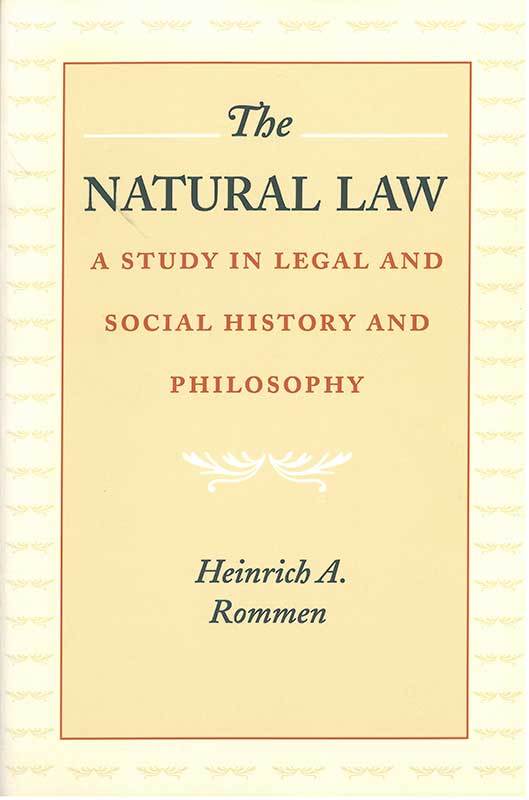
CHAPTER VI: The Victory of Positivism - Heinrich Rommen, The Natural Law: A Study in Legal and Social History and Philosophy [1936]Edition used:The Natural Law: A Study in Legal and Social History and Philosophy, trans. Thomas R. Hanley. Introduction and Bibliography by Russell Hittinger (Indianapolis: Liberty Fund 1998).
About Liberty Fund:Liberty Fund, Inc. is a private, educational foundation established to encourage the study of the ideal of a society of free and responsible individuals. Copyright information:The copyright to this edition, in both print and electronic forms, is held by Liberty Fund, Inc. Fair use statement:This material is put online to further the educational goals of Liberty Fund, Inc. Unless otherwise stated in the Copyright Information section above, this material may be used freely for educational and academic purposes. It may not be used in any way for profit.
CHAPTER VIThe Victory of PositivismThe attack of positivism proceeded from several quarters along an ever-widening and enveloping front. It came first from scientific empiricism, which was generally lacking in a sense of the normative. The conflict of ethics with sociology opened, so to speak, a second front. The third point of assault was the spread of philosophical and historical materialism. For, in the “overthrow of the titans” of German philosophy, even the power of German idealism after Schelling and Hegel had been broken, notwithstanding the efforts of the post-Kantians (Feuerbach, Marx). Empiricism, which dismisses metaphysics as epistemologically impossible (agnosticism), believed that, since it had won such great triumphs in the natural sciences, it is also the right method to follow in the so-called cultural sciences.1 It penetrated into legal philosophy in proportion as the historical school, which in this matter had acted somewhat as a forerunner, came more and more to adopt what amounted to Kant’s view of the connection of law with morality. According to K. Binding, for example, the sole way to true knowledge of the law is exact analysis of actually existing law, present and past. The philosophy of law should therefore not only rest upon mere external experience, but it should be restricted thereto. Every project of passing beyond it is rejected as metaphysics. Philosophy of law, however, means understanding the ultimate and highest principles of law: it means understanding the essence or nature of law, the source of its obligatory character, the essential and intrinsic difference between right and wrong, justice and injustice. ‡Experience teaches us nothing about all this. It merely tells us that such and such laws were enacted by the constitutional organs, that this or that rule was once recognized as law. But certainly all true understanding of law calls for something more. It demands to know just why in final analysis this law was right, and why this law could become binding in conscience. It is thus no wonder that empiricism led not only to relativism, but to skepticism as well. No right exists as an eternal idea. There are merely positive rights which are only to be known, not to be recognized. The ignoramus et ignorabimus (“We do not know and we shall never know”) of the natural scientists invades legal philosophy. The will of the state, the formal general will of the citizens, is the source and criterion of law. Sociology thereupon explains by the mechanism of environment, by the struggle of interests, the further question of why this particular norm is chosen by the will. Lastly, historical materialism reduces law to the level of a mere reflex of the modes of production and the class struggles, or to a line of demarcation between classes.2 To be fair, therefore, we must distinguish two forms of positivism: first, positivism as a consequence of an empiricist narrowing of reality, as a method; secondly, positivism as a philosophy of life, as a conception of the meaning of the universe and of man’s place in it, as a Weltanschauung. The crudest expression of this second form of positivism has been materialism, whether in its metaphysical (Feuerbach, Buechner, Haeckel) or historico-economic dress (Marx). Moreover, the second form of positivism has played by far the more important role. Positivism as a method was already present in the historical school of law. It developed with the victorious advance of scientism, of natural-science modes of thought.3 This approach to reality became the standard methodological pattern for all scientific thinking, as was once the case of deductive, mathematical rationalism which insisted on conceiving and handling ethics and law more geometrico. The essential feature of this view of reality is the prominence assigned to the empirical knowledge of individual things, and the restricting of the mental horizon to the empirical and the individual. Whatever else there may still be is ethics and not law, for it is not a law that is immediately experienced. This attitude held relatively little danger so long as moral philosophy itself did not become positivist. But when this occurred, there resulted from methodological positivism, which relegated the natural law to the background of ethics, either a world view that was frankly materialist or a self-denying skepticism which, with an almost ascetical self-restraint, merely gathered, compared, and verified. Or positivism simply referred to the newly emergent science of sociology what had hitherto been assigned to ethics; it tried thereby to rid itself of responsibility for answering the fateful question of the foundation of law. The jurisprudence of materialism must boil down to mere positivism. Materialism regards man as nothing more than a highly evolved animal; the soul is a mere concept, required by the law of parsimony, for the manifold functions of the brain: it is not an immaterial, immortal substance. In place of a personal God, materialism is a doctrine of impersonal eternal force or of perpetually recurrent changes of matter in accordance with the blind necessity of the laws of nature. There thus exists no free will, and hence no morality in the Platonic and Aristotelian sense, or in that of the Roman jurists, or in that of the entire Christian tradition. Right as idea and the order of justice are things, concepts, which have as little relation to reality as have God, immortality, and free will. Positive law alone exists, i.e., coercive law, for only what is actually enforced is law; and it is merely a creation of the state. Moreover, the state itself is not recognized as a moral collective person, as a moral phenomenon. It is rather a necessary product of the evolution of social forces or, as historical materialism declares, of the conditions of production. It is a natural product in the proper sense of the term. In this way it is, what it is in fact, merely a thing of the class that actually has the upper hand, the ruling class. The positive law, on the other hand, is “the boundary, fixed for the time being by the social groups struggling for power and influence in the state, of their authority and their influence” (Gumplowicz). This boundary is continually shifting; a common body of ethical and legal ideas is wanting. Here the law of the stronger holds sway. Callicles had spoken of this long before, and he as well as Spinoza had identified it with the natural law because they regarded nature as the antithesis of mind. Consequently there is no eternal justice, nor is there an unalterable moral law. The state is the creator of morality and law, but the state in turn is merely a product of the struggle of social classes and servant of the class that rules at any given time. Hence “the political order is the moral order for the time being, and the self-interest of the state [which is itself a product of naked power] is an element of morality. … All the highest goods that man possesses—freedom, property, family, personal rights—he owes to the state” (Gumplowicz). Law is thus not a genuine norm. It does not tell what ought to be, but is merely an indication of how far the power, the material and psychological power, of the ruling class extends. The law indicates what the sociological situation is. This is the extreme form of materialist jurisprudence. In this view, the law is neither reason nor will: it is but the line of demarcation of the relations of social power. Therefore real force, whether physical or psychical, is of necessity the essential note of law. Law is merely what is actually enforced, not what is enforceable. Jurisprudence is an inept expression, handed down from a metaphysico-theological age, for the materialist sociology of a purely experimental science that tells how the power pattern of the groups within a society stands at the moment in the struggle for the machinery of political control. ‡In contrast with this crassly materialist positivism stands a moderate form of positivism. The latter simply acknowledges the positive law as legally binding, and believes it possible to forgo a philosophy of law, i.e., to avoid the question of the basis of the binding character of law. Law is the will of the state that is expressly declared to be such, is enacted in conformity with constitutional provisions, and is then duly promulgated. Any further criterion, as, e.g., the inherent justice or the moral lawfulness of the action commanded by the positive law, is rejected as irrelevant for the sphere of law. The legal sphere is identified with the creation of law by the state, the carrying out of the law by the administration and the citizens, and the applying of the law by the judges. This is the position taken by the so-called theory of will, which has gained numerous adherents in political science and international law. It has found its strongest expression in the idea of the absolute sovereignty or the juristic personality of the state. Such sovereignty is even greater than that of the absolute monarch of the seventeenth and eighteenth centuries, who considered himself bound by the natural and divine law. Indeed, upon closer examination, the doctrine of sovereignty transfers states, after the manner of Hobbes, into a pure state of nature with its single rule of self-preservation. Thus international law is dependent at every moment upon its actual acceptance or rejection by the states, just as parliamentary majorities in states like England may in theory pass any measure whatever. Law is consequently no true norm or something pertaining to reason, but mere actual will in the psychological sense. It does not depend upon the essential being of things or upon the nature of the case, which L. von Baer, following here the Anglo-Saxon judicial tradition, designated as the basis of law. Such views can emanate from a tired agnosticism that admits no metaphysical foundation of law. They can also spring from a strong feeling against the rationalist deductions of the natural-law doctrine which prevailed in recent centuries. Often, too, they are the result of a hostility, stemming from a conservative outlook, toward the revolutionary components of the newer natural law. These components hold danger for the state, whose inspirational value and sublime dignity are held to need no further justification. Moreover, the reason for such views often lies in the typical attitude of the modern scientific mind: satisfaction with the mere ascertainment of what actually exists, industrious search for facts, idolatrous worship of the factual. On the other hand, many students of law are much concerned about the great blessing of legal certainty. These hold that even a poor law and its application are more conducive to the general welfare than the riddling of the positive law by appeals to natural law or moral principles. This contention is based on the importance of the secure expectation of the members of the community that they may count on a definite and, if need be, enforced mode of conduct on the part of the rest. They clinch this contention by pointing out that no uniformity of views and convictions concerning this higher law prevails either among the members of the community or on the bench or among jurists. With the exception of the group of agnostics, these jurists in no way deny the value of justice or the validity of the ethical norm. What the older writers termed natural law they regard as an ethical norm. But such norms, so far as these are not contained in the positive law, they exclude from “law.” In their eyes, law and justice, law and right, are not identical. The lawmaker, of course, should enact no unjust laws. Yet if he enacts a law of this kind, it is law in the true sense. One may not look upon it as non-binding from the viewpoint of a natural law, but only from the viewpoint of ethics. This matter, however, everyone must settle for himself with his own conscience. Legal dualism, the doctrine of a natural law functioning as real law concomitant with and superior to the positive law, is flatly repudiated. The ultimate basis of this moderate positivism was and is the paralyzing realization of the unsettled condition of philosophy in the nineteenth and early twentieth centuries. This was and is quite apparent even in moral philosophy, which itself was not long in becoming positivist. For so must we designate an ethics which holds with Friedrich Paulsen, for example, that morals or mores “are, like instincts, … purposive modes of behavior for solving the various problems of life,”4 or in the form of pragmatism identifies the good with what is useful and successful, and evil with what is detrimental and unsuccessful (biologism). This school of thought has been unable to find a distinction between a material, unalterable ethics and such positive, interested, historical moral codes as those of the nobility, the bourgeoisie, and the peasants. Thus, in the face of ethical relativism and the rejection of all metaphysics, it could see no other possibility than a self-denying positivism in law.5 The great speculative outburst of German idealism had given way to a purely formal criticism of knowledge, to which the contents of thought were a matter of indifference or which was even frankly skeptical about the possibility of attaining scientific knowledge of the content of ideas. Stahl’s work on the philosophy of law, which was representative of the thinking of the historical school of law, appeared in a final (fifth) edition in 1878, that of H. Ahrens, in a second (last) edition in 1860. Roeder’s work on the natural law appeared in a second (last) edition in the same year, 1860, and the already mentioned treatise of the Aristotelian Trendelenburg on the natural law based on ethics appeared in a final edition in 1866. It is likewise significant that, toward the close of the century, the compiling of the first volume, dealing with legal philosophy, in Holzendorf’s well-known Encyclopedia of Law was entrusted to A. Merkel, the first thoroughgoing positivist. The philosophy of law, the theoretical doctrine of the natural law, now became a general science of law, a nonmetaphysical science founded on generalization and comparison, in full agreement with the evolution in philosophy. Positivism, of course, could be no more permanently satisfying than could the historical school of law with its one-sided preference for customary law and the purely historical element in a science which has to do with oughtness, with norms. This external mark of the formal will of the lawmaker can by no means answer the perpetually arising question about the intrinsic difference between right and wrong. “Legal statutes must be measured by some standard or other to prove that they are justified”; moreover, “the doubt whether the existing law is in conformity with reason cannot be simply pushed aside” (R. Stammler). The existing law must also be one that ought to exist. The much-acclaimed consciousness of right is not a creator of law but an intimation that a legal fact is perceived and acknowledged as one that also ought to be. It is a continually recurring experience that, even when we are wholly disinterested in a matter, we keep trying to distinguish laws as good and bad according to their purpose, but as just and unjust laws in accordance with an intrinsic criterion. Yet that is possible only if this intrinsic criterion is the very basis for the qualification of right and wrong. Hence pure positivism has at no time been carried through in actual practice, even in the countries that make the judges wholly dependent on the formal law. It is simply repugnant to the notion of a true judge to be merely a subsuming automaton. Even the positive law has again and again had recourse to morality, to natural-law norms. This it does since the presupposition of positivism, that is, the lack of gaps in the statute law, is not verified. Moreover, not only do legal codes refer to the natural principles of law (e.g., Austrian General Civil Code, Code of Canon Law), but even the law itself refers to good faith and to good morals. In these references there is no thought at all of that which is merely proper, of that which passes at a given period for respectable or conforms to the mores of a certain class of society. Frequently in such cases it is far more a question of the conclusions and further inferences from the natural law as well as of applying them. Nor does it do any good to explain, in a spirit of unshakable loyalty to positivism, that the lawmaker has precisely willed all this. For such an explanation presupposes not the actual lawmaker but an ideal one, i.e., a lawmaker who wills what is just. “The individual experience of law is, when clearly grasped, dependent upon the universally valid concept of law, not vice versa. The concept of law cannot be derived from particular legal experiences (through induction or comparison), since these really become possible only through the former” (R. Stammler). Law exists prior to jurists and legal philosophers. They have not created law, but, inversely, law is the precondition of a legal profession and philosophy of law. We have recorded the victory of positivism. But this must not be taken to mean that positivism won a definitive and total victory on all intellectual, moral, and political fronts. The victory, such as it was, was the outcome of the eventual undermining of metaphysics and the progressive dilution of the Christian heritage at the hands of both Kantian criticism and empiricism. The immediate result of these trends of modern thought was an agnostic and skeptical relativism, whose mock heroism showed itself in an almost ascetic, disillusioned search for “facts” and whose contempt for the theological and metaphysical era was pretentious and likewise ridiculous. Wherever these presuppositions of positivism did not prevail, the idea of natural law continued to live its now hidden life. It is true that most university professors and most practical jurists, to say nothing of the popularizers of shifting scientific fashions, spoke of natural law as a dead letter. Yet the idea of natural law once more found refuge in the philosophia perennis which, as we have repeatedly pointed out, had been its home whenever it was exiled from the secular universities and law schools. And the idea, divested of its academic dress, went on living also in common sense, in the minds of ordinary men.6 Bergbohm, the Quixotic assailant of natural law, was forced to admit that all men are born natural-law jurists. How right he was! The spirit of skeptical agnosticism, which denies to the human mind access to transcendental truth and objective values and, doubting the inner logic of the universe, constructs subjective systems of thought, is more an attitude for the academic ivory tower or for the private study of one who enjoys economic security. In real life this attitude is untenable. When he acts, and does not merely turn things over in his mind, even the skeptic acts as if such a thing as natural law or objective justice existed, as the common sense of ordinary men and women has always implicitly held. And the reason is obvious. If anyone were to attempt to realize a strict and consistent positivism in the everyday life of society, his sole possible attitude would be an unbearable cynicism. When he becomes interested in problems of economic, social, or political reform, the avowed positivist frequently turns, in practice and as it were unconsciously, to the idea of natural law and to standards of unchanging justice. The “scientific mind” may skeptically deny the existence of the natural law, but the heart, in which, as St. Paul says,7 the natural law is recorded or inscribed, affirms it. It is easy to profess and proclaim positivism in a culture that is secure and is saturated with materialism. Positivism is the typical by-product of a solidly established, economically secure, and politically unendangered ruling class (beati possidentes). Yet man with his unquenchable thirst for justice cannot long be content with such an attitude. The hunger and thirst after justice are no less pressing than the ceaseless quest for truth. The idea of the natural law may thus be compared to the seed which, buried under the snow, sprouts forth as soon as the frigid and sterile winter of positivism yields to the unfailing spring of metaphysics. For the idea of natural law is immortal. [1.]See, in general, John Wellmuth, S.J., The Nature and Origins of Scientism. The Aquinas Lecture, 1944 (Milwaukee: Marquette University Press, 1944). [2.]For a brief but penetrating exposition and criticism of recent American schools of jurisprudence which pass for philosophies of law—sociological jurisprudence, economic determinism, and realism with its psychological, experimental or skeptical approaches—see Francis P. LeBuffe, S.J., and James V. Hayes, Jurisprudence (3rd ed. rev., New York: Fordham University Press, 1938), pp. 70–81. [3.]On scientism and on the proper relations between natural-science modes of thought and philosophy, see John Wellmuth, S.J., op. cit.; Jacques Maritain, The Degrees of Knowledge, trans. by Bernard Wall and Margot R. Adamson (New York: Charles Scribner’s Sons, 1938), chap. 1; Jacques Maritain, Scholasticism and Politics, trans. by Mortimer J. Adler (New York: Macmillan Co.), chap. 2. [4.]A System of Ethics, ed. and trans. by Frank Thilly (New York: Charles Scribner’s Sons, 1899), p. 346. Italics in the original. [5.]In regard to ethical relativism, see the remarkably forthright admissions, and no less remarkable confusions, of Friedrich Paulsen, op. cit., pp. 19–25, who reaches the following general conclusion (p. 25): “Every moral philosophy is, therefore, valid only for the sphere of civilization from which it springs, whether it is conscious of the fact or not.” Cf. Jacques Leclercq, Le fondement du droit et de la société (2nd ed., Namur: Maison d’Editions Ad. Wesmael-Charlier, 1933), pp. 25–43; Walter Farrell, O.P., A Companion to the Summa, Vol. II, chap. 21. [6.]On the important question of the relation between philosophy and common sense, cf. Jacques Maritain, An Introduction to Philosophy, chap. 8. [7.]Rom. 2:14–16. |

Titles (by Subject)