EconlibThe LibraryOther Sites |
Front Page Titles (by Subject) PART ONE: History of the Idea of Natural Law - The Natural Law: A Study in Legal and Social History and Philosophy
Return to Title Page for The Natural Law: A Study in Legal and Social History and PhilosophyThe Online Library of LibertyA project of Liberty Fund, Inc.Search this Title:Also in the Library:
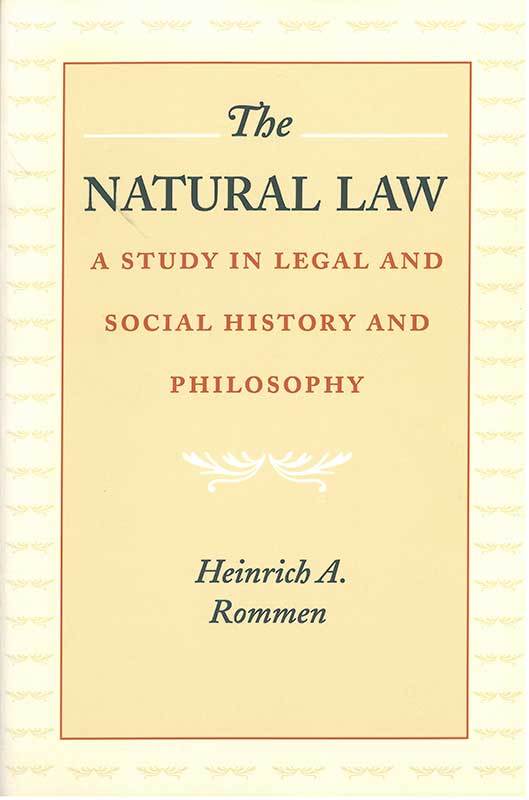
PART ONE: History of the Idea of Natural Law - Heinrich Rommen, The Natural Law: A Study in Legal and Social History and Philosophy [1936]Edition used:The Natural Law: A Study in Legal and Social History and Philosophy, trans. Thomas R. Hanley. Introduction and Bibliography by Russell Hittinger (Indianapolis: Liberty Fund 1998).
About Liberty Fund:Liberty Fund, Inc. is a private, educational foundation established to encourage the study of the ideal of a society of free and responsible individuals. Copyright information:The copyright to this edition, in both print and electronic forms, is held by Liberty Fund, Inc. Fair use statement:This material is put online to further the educational goals of Liberty Fund, Inc. Unless otherwise stated in the Copyright Information section above, this material may be used freely for educational and academic purposes. It may not be used in any way for profit.
PART ONEHistory of the Idea of Natural LawCHAPTER IThe Legacy of Greece and RomeThe doctrine of the natural law is as old as philosophy. Just as wonder,1 according to Aristotle, lies at the beginning of philosophy, so, too, is it found at the beginning of the doctrine of natural law. ‡In the early periods of all peoples the mores and laws, undifferentiated from the norms of religion, were looked upon as being exclusively of divine origin. The order according to which a people lives is a divinely instituted order, a holy order. This is true of the ancient Greeks, among whom all law was stamped with the seal of the divine. It likewise holds good for the early Germans: their law bore in the primitive period a distinctly sacred character. Nor is it any less true of the Roman people, whose legal genius enabled its law twice to become a world law.2 For among the Romans, too, law in the earliest times was divine law. Moreover, even the later period, when the Romans had already hit upon the distinction between strictly sacred law (fas) and profane law (ius), still afforded clear evidence of the sacred origin of Roman law: the pontifices remained the dispensers and custodians of the law until Roman legal reason emancipated itself from this secret law of the priests. This theological cast of all primitive law has two characteristics. Such law is essentially unchangeable through human ordinances, and it has everywhere the same force within the same cultural environment. The idea of a natural law can emerge only when men come to perceive that not all law is unalterable and unchanging divine law. It can emerge only when critical reason, looking back over history, notes the profound changes that have occurred in the realm of law and mores and becomes aware of the diversity of the legal and moral institutions of its own people in the course of its history; and when, furthermore, gazing beyond the confines of its own city-state or tribe, it notices the dissimilarity of the institutions of neighboring peoples. When, therefore, human reason wonderingly verifies this diversity, it first arrives at the distinction between divine and human law. But it soon has to grapple with the natural law, with the question of the moral basis of human laws. This is at the same time the problem of why laws are binding. How can laws bind the conscience of an individual? Wherein lies, properly speaking, the ethical foundation of the coercive power of the state’s legal and moral order? Closely connected with these problems is the question of the best laws or best state, a matter which from the time of Plato has engaged the attention of nearly all exponents of the great systems of natural law. Before long, however, a related idea made its appearance. This was the view that the tribal deities are not the ultimate form of the religious background of reality. For if an eternal, immutable law obliges men to obey particular laws, behind the popular images of tribal deities exists an eternal, all-wise Lawgiver who has the power to bind and to loose.3 It is quite understandable, then, that the philosophical conception of the natural law should have made its first appearance in the area of Western culture among the ancient Greeks. This dynamic people was endowed with a penetrating critical intelligence, with an early maturing consciousness of the individual mind, and with great power of political organization. Indeed, Western political philosophy likewise originated in this gifted people. It is a remarkable fact that at the very beginning of the Greek philosophy of law (or rather of the laws), and therewith of the natural law, a distinction came to light which has survived down to the present time, a distinction between two conceptions of the natural law. One is the idea of a revolutionary and individualistic natural law essentially bound up with the basic doctrine of the state of nature as well as with the concept of the state as a social unit which rests upon a free contract, is arbitrary and artificial, is determined by utility, and is not metaphysically necessary. The other is the idea of a natural law grounded in metaphysics that does not exist in a mythical state of nature before the “laws,” but lives and ought to live in them—a natural law which one would fain, though somewhat ineptly, style conservative. It is further significant that the notion of God as supreme Lawgiver is intimately connected with the latter conception. Both of these tendencies are already plainly visible in the first Sophists and in Heraclitus, the great forerunner of Plato. Heraclitus of Ephesus (cir. 536–470 b.c.) is famous for his thesis that “all things flow; nothing abides.” But this ceaseless changing of things led him directly to the idea of an eternal norm and harmony, which exists unchangeable amid the continual variation of phenomena. A fundamental law, a divine common logos, a universal reason holds sway: not chance, lawlessness, or irrational change. Natural occurrences are ruled by a reason that establishes order. Man’s nature as well as his ethical goal consists, then, in the subordination or conformity of individual and social life to the general law of the universe. This is the primordial norm of moral being and conduct. “Wisdom is the foremost virtue, and wisdom consists in speaking the truth, and in lending an ear to nature and acting according to her. Wisdom is common to all. … They who would speak with intelligence must hold fast to the (wisdom that is) common to all, as a city holds fast to its law, and even more strongly. For all human laws are fed by one divine law.”4 The laws of men are but attempts to realize this divine law. Wherefore, declares this conservative aristocrat, the people ought not to resist the laws, which to him are the embodiment of the divine law. On the contrary, “the people ought to fight in defense of the law as they do of their city wall.”5 Thus in the diversity of human laws (not beyond them) there flashed upon Heraclitus the idea of an eternal law of nature that corresponds to man’s reason as sharing in the eternal logos. The variety of human laws does not exclude the idea of the natural law. For through the contingency and diversity of human laws rational thought perceives the truth of the eternal law, whereas sense perception—the eye and the ear—notices only what is different and unlike. With Heraclitus, the “Obscure Philosopher,” the thinker who speaks in obscure symbols, the idea of the natural law for the first time emerged as a natural, unchangeable law from which all human laws draw their force. Heraclitus’ doctrine had a practical aim. It was intended to stress the value of the laws and their binding force against the fickleness of the uncritical masses. Prone to novelties of all kinds and woefully lacking in powers of discrimination, the masses were subject to capricious fluctuations of opinion. They thus fell easy prey to the demagogy of the Sophists. It is no easy matter to judge the Sophists fairly. For one thing their teachings have come down to us in a very fragmentary form and are known to us chiefly from the dialogues of Plato, their great adversary. Moreover, as popular orators with a leaning toward demagogy, they were fond of oversimplified slogans and paradoxical statements. This earned for them, among posterity, the sinister reputation of philosophical ropedancers, rationalistic revolutionaries, and contemners of the law. For this reputation Plato has been particularly responsible. But this judgment is, to say the least, far too harsh. That the Sophists had of necessity to appear to the Greeks as revolutionary rationalists is explained, on the one hand, by their reckless criticism of contemporary social institutions and their cynical skepticism in political matters, and, on the other, by the high esteem in which their opponents held the laws and the polis, or city-state. Their laws were the pride of the citizens of the Greek polis, and the Sophists were mostly foreigners. Heraclitus had looked upon the laws as equal in worth to the walls of the city. The philosophers spoke of the nomoi, or laws, with the greatest respect: the peoples who had no polis were to them barbarians. Hence it happened, too, that Socrates, despite his distinction between what is naturally right and legally right, pronounced the laws of Athens to be “right” without qualification. The citizens, consequently, were under obligation to obey them, even as he also obeyed them to the bitter end. For Plato likewise the laws of Athens were for the most part something inviolable. He regarded the social order founded upon them as good, even if capable of improvement; never did he term it bad. Therefore to these aristocrats in political outlook as well as in thought, the social criticism of the Sophists necessarily passed not only for an attack upon the foundations of a particular order of a particular polis, but also for a malicious assault upon the right order of the polis itself. Moreover, in point of fact the Sophists had much in common with the revolutionary natural-law ideas of the eighteenth-century Enlightenment, especially with Rousseau’s doctrine and its reckless criticism of existing society. In the case of the conservative natural law (if one wishes to speak of a political tendency) the distinction between natural and positive law served to justify and improve the existing positive law. It was, however, the tendency, an avowedly political tendency, of the natural-law concept of the Sophists to point out, by contrasting the current positive law with what is right by nature, not merely the accidental need for reform of the laws but the substantial wrongness of the laws. To the Sophists the laws were not venerable because of tradition or by reason of having stood the actual test of life in the city-state: they were artificial constructs and served the interests of the powerful (Thrasymachus). Thus the laws possessed no inherent value, for only what is right by nature can have such value, and to this the Sophists were continually appealing. They did not deny, therefore, the form of the natural law and of what is moral by nature. They merely brought out the sharp contrast between the prevailing order of the city-state and the natural law as they preached it, and they ridiculed Socrates who looked upon the laws of Athens as purely and simply “just.” Callicles, who was the first to advance the thesis that might makes right, wished thereby to give expression to a fact which he was criticizing. This was that the ruling classes, while they declared their laws, i.e., those which worked to their advantage, to be naturally just, were misusing the idea of truly natural justice, and were desirous only of subjecting the people to their class interests. By contrasting, in the light of their social criticism, what is naturally right with what is legally right, the Sophists attained at this early date to the notion of the rights of man and to the idea of mankind. The unwritten laws, said Hippias, are eternal and unalterable: they spring from a higher source than the decrees of men. To Hippias’ way of thinking, all men are by nature relatives and fellow citizens, even if they are not such in the eyes of the law. Therewith the distinction between Greeks and barbarians, fundamental for Greek cultural consciousness, vanished into thin air. “God made all men free; nature has made no man a slave” (Alcidamas). The whole ethical and legal foundation was thereby taken away from slavery, which was in turn the very basis of the Greek social and economic system. Nevertheless Plato held fast to the institution of slavery, and Aristotle was ever striving to justify it by means of his theory that certain men are slaves by nature. Three ideas, heavily charged with social explosives for the world of Greek culture, were thus put forward by the Sophists as part and parcel of the natural law. These ideas were thenceforth to be subjected to a ceaseless reprocessing in the history of the mind. Time and again they were to serve revolutionary thinkers as molds and vessels into which these could pour their revolutionary emotions, their schemes for reform, and their political aims. The first idea was that the existing laws serve class interests and are artificial constructions. Only what is naturally moral and naturally right can be properly called moral and right. Next came the idea of the natural-law freedom and equality of all human beings and, as a consequence, the idea of the rights of man as well as the idea of mankind, the civitas maxima, or world community, which is superior to the city-state. According to the third idea, the state, or polis, is nonessential: it owes its origin to a human decision, i.e., to a free contract, not to a necessity of some kind. The political organization of man must therefore have been preceded by a state of nature (portrayed optimistically or pessimistically), in which the pure natural law was in force. According to the optimistic view of the state of nature, this law can in its essential contents be neither altered not abrogated by the state; in the pessimistic view, which leads to positivism, it is merged in the will of the state. But after the lofty flight of speculation had been exposed to the needed self-criticism, the successors of the Sophists fell quickly into skepticism and into a sheer positivism when the underlying optimistic outlook ran afoul of the facts. This was, for instance, the case with the Epicureans, who were the first legal positivists. The Sophists’ criticism of the positive laws, together with the rapidly growing prominence of the notion of utility, led Epicurus, whose sensistic epistemology left no room for metaphysics, to doubt that anything can be objectively and naturally right. Utility and pleasure became for him the sole principles of ethics and law. But since the resultant subjectivism must endanger the social order and with it the peaceful enjoyment of pleasure, he inferred from the principle of utility that justice as such is a chimera, that it rather exists only in agreements which have been entered into for the prevention of mutual injuries. Justice thus consists entirely in positive laws. Before men entered into agreements and before there were laws founded upon such agreements, men had lived in a haphazard manner, like wild beasts, lawlessly. The state of nature, upon which the Sophists had placed an optimistic construction but which they had not particularly stressed, was thus interpreted in a pessimistic sense in Epicurean circles. From this, however, sprang also the respect of the Epicureans for the existing laws as well as their emphasis upon the value of the legal notions and customary law of individual peoples. The parallelism between the Sophist and Epicurean doctrine on the one hand and, on the other, the natural-law schools of modern times is quite unmistakable. Rousseau, Hobbes, Pufendorf, Thomasius, and the adherents of historical schools of law, who variously combine the elements of individual systems, merely repeat and develop these ancient ideas. The starting point of the Sophists was a criticism of the nomoi of the Athenian democracy. In their role and guise of popular philosophers and in their political and skeptical snobbery they frequently defended the opposite theories. As if the revolutionary criticism of the nomoi in behalf of slaves and non-citizens, considered barbarians, and the conservative utilitarianism of Epicurus were not sufficiently unsettling, Callicles, if we are to trust tradition, stood forth as champion of the doctrine of the right of the stronger, i.e., that might makes right. A pure materialist in his philosophy, Callicles reached the conclusion that law, such as obtained in the Athenian democracy, was in reality injustice. For, he contended, the many who are weak have united to fetter with the bands of law the few who are strong. But nature teaches, as a glance at the animal kingdom and at warring states reveals, that the stronger naturally overcomes the weaker. Natural law, then, is the force of the stronger. For this snobbish leader of the oligarchic faction such was the way one could and should get at the Athenian democracy. But other Sophists, among them Hippias, put forward the demagogic formulas of human rights and of the freedom and equality of all to achieve the selfsame purpose—the overthrow of the bourgeois democracy.6 The metaphysical natural law of Plato as well as the more realistic one of Aristotle formed the high-water mark of moral and natural-law philosophy in Greek civilization. Stoicism, on the other hand, in a remarkable eclectic synthesis of single principles drawn from many philosophers, furnished in its system of natural law the terminology or word vessels into which the Church Fathers were able to pour the first conceptions of the Christian natural law and to impart them to the world of their time. The danger of skepticism, to which the extreme rationalism of the Sophists lay exposed, was first clearly perceived by Socrates. The Sophists’ juggling of ideas and their paradoxes threatened to dissolve the notion of goodness and morality, just as their extremist social criticism and their libertarian ideology, directed in the name of the natural law against law and custom, called into question the value of the nomoi. Socrates did not merely teach the essence of goodness and justice by his inductive, question-and-answer method. Through the thesis that virtue consists in knowledge, he also showed that there exists a knowable objective world of such values as goodness, beauty, and justice, and that no one does evil for evil’s sake but because it somehow, culpably or through ignorance, appears to him as good. Wherefore knowledge means the contemplation of the idea of justice, and so on. The daimonion, conscience and its voice, he regarded as a reflection and testimony of these ultimate values and of the divinely instituted order of the world. Herein lies the significance of Socrates for the idea of the natural law. It does not lie in his frequently stressed fidelity to the law, although, to counteract the criticism of the Sophists, he placed so much emphasis upon the value of the laws that, out of respect for the law’s function of safeguarding right, he went so far as to condemn absolutely any disobedience to a particular unjust law.7 The great masters of Greece, Plato and Aristotle, also directed their attacks at the Sophists and their destructive criticism. Plato and Aristotle were chiefly, though not in the same degree, concerned with goodness and with its realization in the state. Their interest, however, did not center in the individual. It is quite common, rather, to speak of both as leaning toward state socialism or totalitarianism. For them, then, in accordance with the idea of order, the first and fundamental aim of justice is not freedom for its own sake, but order. Freedom is aimed at only so far as it realizes order. For this reason the law occupied the foreground of their thought. They were at great pains to discover and to establish the ethical basis of the laws; not like the Sophists, however, in the interest of freedom from the laws. The state and its order as the sphere of morality, as the realization of all virtue, engaged their attention. This explains their preoccupation with the best form of state or government, in which the individual, whom the Sophists made so much of, is swallowed up. If we should think of the natural law in terms of its long accepted identification with socio-philosophical individualism, there would really be little room for the idea of the natural law in Plato or even in Aristotle. A deeper penetration into the thought of Plato and Aristotle will show, however, that they too distinguish between what is naturally just and what is legally just. Nor is this distinction merely a borrowed formula: it is an integral part of their doctrinal structure. Yet in the case of both we can observe a certain aversion to the “naturally just,” which is accounted for by the Sophists’ abuse of this distinction, an abuse which Plato severely censured. The disciples of Socrates arrived at the notion of something naturally just by quite another route than the one the Sophists had taken. They arrived at it by way of the doctrine of ideas and through teleological thinking. Following in the footsteps of Heraclitus, Plato acknowledges the world of the senses and the world of ideas that become manifest in intellectual contemplation. For speculative reason, sense phenomena are the bridge of memory to the ideas, which dwell and live on in their supermundane, heavenly abode. The things of this world are or exist only so far as they participate in the being of the eternal ideas, or so far as man in his creative capacity of craftsman, artist, and especially lawmaker copies these ideas. Here teleological thinking enters the scene. In the concept which gropes after and apprehends the essence or the idea of the thing there is contained at the same time also its end, the completion or perfection of the idea of the thing. Inversely, too, the mind lays hold of the essence of a thing by finding the ideal concept which corresponds exactly to the literal meaning. Hence we speak of the true physician, the true judge, the true lawmaker, the true law. These two starting points of Platonic speculation lead then to such conclusions as that the judge ought to be a true judge, i.e., he ought to complete in himself the idea of judge. The ideal concept becomes a norm. So declares the Athenian in Plato’s Laws: “When there has been a contest for power, those who gain the upper hand so entirely monopolize the government as to refuse all share to the defeated party and their descendants. … Now, according to our view, such governments are not polities at all, nor are laws right which are passed for the good of particular classes and not for the good of the whole state. States which have such laws are not polities but parties, and their notions of justice are simply unmeaning.”8 The law should be a true law: one that benefits the common weal. Therein its idea achieves its completion. Thus Plato contrasts the true and proper law with the positive law, and he makes the former the measure and criterion of justice for the latter. This true law, this true right, abides in the realm of the ideas and remains forever the same. On the other hand, the positive laws change, and they may claim legal force only because and so far as they partake of the idea of law. Indeed they are but a reflection of true law. The lawmaker must look up into the realm of the ideas, where dwells the real essence of the immutable, eternally valid law. However, philosophers and philosopher-kings, freed through disciplined thinking from the blinding illusions of the senses, can alone do this. Moreover, this world of ideas, whereof the world of sense appears only as an imperfect copy, is kosmos, or order; it is not akosmia, or disorder. But this order of the ideas is the pattern for the fashioning of moral and legal conduct in the present world. The being of the ideas is oughtness for man who shapes things in accordance with contemplative knowledge, whether he forms himself or a community unto goodness. Underlying all this, of course, is the conception of a human nature with impaired powers of contemplation. Only the man of disciplined mind, not the great mass of men, can see intellectually. This doctrine is the opposite of the optimism of the Sophists. If Plato, then, scarcely ever makes use of the Sophists’ antithesis of physis and nomos, he by no means identifies the natural law, which he recognizes, with the positive law. The difference between Plato and the Sophists lies elsewhere. The Sophists started from the freedom of the individual, who had to be liberated from traditional religious and politico-legal bonds. For the polis, the state, is not something eternal, nor is its law. It is mankind that is eternal: the civitas maxima of free and equal men. In the eyes of Plato, however, the polis and its law were the indispensable means for realizing the idea of humanity, which reaches completion in citizenship, in the ethical ideal of the citizen, of the law-abiding and just man. The state is the great pedagogue of mankind. Its function is to bring men to morality and justice, to happiness in and through the moral virtues. Hence Plato’s thought revolves continually around the idea of the best state or government. But this is also why he recognizes a natural law as ideal law, as a norm for the lawmaker and the citizen, as a measure for the positive laws. His metaphysics and the ethical system which he built thereon made a natural law possible and furnished the foundation. Aristotle passed for centuries as the “father of natural law.” St. Thomas, in that section of his Summa theologica which deals with law, repeatedly appeals to him as the Philosopher par excellence. Aristotle, however, as should now be clear, was not the father of the natural law. Nevertheless his theory of knowledge and his metaphysics have provided ethics, and consequently the doctrine of natural law, with so excellent a foundation that the honorific title, “father of natural law,” is readily understandable. Plato had totally separated the world of sense perception from the world of pure ideas, the objects of scientific, necessary, and true knowledge (universalia ante rem). Aristotle transferred the idea as the form which determines the formless matter into the individual (universalia in re). This “becomes” through the union of the form (or the essence or the true whatness) with the matter (or the potency or the possibility) and thus gives actuality to the individual. The archetype for Aristotle was human artistic activity: the architect who constructs a house according to the plan in his mind; the sculptor who molds a statue in accordance with his artistic conception; even organic nature which causes the plant to grow from the actualizing essential form that exists in the seed in an incorporeal manner. Aristotle wished to comprehend motion, development, becoming. To him, therefore, the essence, and the perfect expression of it in the individual, is also the telos, or end. The form is thus the efficient and the final cause at one and the same time. Applied to the domain of ethics, however, this means that pure being or the pure essential form is likewise the goal of becoming for the man who is to be fashioned by education into a good citizen. From the essential being results an oughtness for the individual man. In this way, from the content of the primary norm, “strive after the good,” arises the norm, “realize what is humanly good,” as it appears in the essential form of man. The supreme norm of morality is accordingly this: Realize your essential form, your nature. The natural is the ethical, and the essence is unchangeable. But a criterion of actions is thereby established. Some actions correspond to nature, and hence are naturally good; others are repugnant to nature, and hence are naturally bad. This settled, Aristotle advances to the distinction between what is naturally just and what is legally just. Both are objects of justice. Justice, however, taken in the narrower sense (for in the wider sense the virtuous man is the just man purely and simply) and distinguished from morality, is directed to the other, to the fellow man, whether as equal (commutative justice) or as fellow member of the comprehensive polis-community (distributive and, in the behavior of the member with regard to the whole, legal justice). It finds expression in the natural law and in the positive law. The latter originates in the will of the lawmaker or in an act of an assembly; the natural law has its source in the essence of the just, in nature. That which is naturally right is therefore unalterable. It has everywhere the same force, quite apart from any positive law that may embody it. Statute or positive law varies with every people and at different times. Yet the natural law does not dwell in a region beyond the positive law. The natural law has to be realized in the positive law since the latter is the application of the universal idea of justice to the motley manifold of life. The immutable idea of right dwells in the changing positive law. All positive law is the more or less successful attempt to realize the natural law. For this reason the natural law, however imperfect may be its realization in the positive law, always retains its binding force. Natural law, i.e., the idea and purpose of law as such, has to be realized in every legal system. The natural law is thus the meaning of the positive law, its purpose and its ethically grounded norm. Recognition of the fact that no system of positive law is altogether perfect brought Aristotle to the principle of equity. The law is a general norm, but the actual matters which it has to regulate issue from the diversity of practical life. Of necessity the positive law exhibits imperfections; it does not fit all cases. Equity thereupon requires that the individual case get its right, i.e., that the imperfection of the formal law be overcome by means of material justice, through the content of the natural law. Thus Aristotle already viewed the judge’s function of filling up gaps in the law as an attempt to apply the natural law—if indeed the positive law is rightly to bear the name of law at all. The gaps are consequently the gateways through which the natural law continually comes into play. In such cases the judge has to decide in accordance with the norm which the true lawgiver would himself apply if he were present; the true lawgiver of course is always assumed to will what is just. This is a celebrated formula which in these very words or in the form, “which he [the judge] would lay down as lawmaker,” still found its way into the great codifications of civil law undertaken in the nineteenth and twentieth centuries (e.g., the Austrian and Swiss Civil Codes). Concerning the content of the natural law Aristotle had as little to say as Plato. This was in sharp contrast to the Sophists, who because of their political and socio-critical bias had admitted many reform proposals and demands into their natural law. The silence of Plato and Aristotle finds its explanation in their idea of the natural law: they set out from the conservative conviction that the positive law wishes to realize the natural law. Added to this was their strong belief in the excellence of the existing laws of the polis as well as in the conformity of such laws to the natural law. The city-state, its general welfare, and its happiness occupied so prominent a place in the ethical thinking of Plato and Aristotle—for whom indeed the idea of man achieves ultimate perfection in the good citizen—that they looked upon the existing laws as something holy. In contrast to the individualistic attack launched by the Sophists against them, the natural law of Plato and Aristotle served precisely to justify the existing laws and not merely as a basis for criticizing them, although the function of criticism was regarded as included in the idea of natural law. Furthermore, for Aristotle as for Plato the polis or city-state was the great pedagogue, against which, strictly speaking, no natural, subjective right of the citizen could be admitted. They acknowledged no goal of man that transcends the ideal polis. They remained state socialists. Their doctrine of natural law was from the political standpoint conservative, but it was based on metaphysics. With the effective discovery, through Christianity, of human personality and with the recognition of God’s intellect and will as the source of the natural moral law, rational thought would thenceforth be in a position to work its way through to the true natural law. In the public squares of Athens and on the steps of its public buildings the wordy Sophists had once taught their rationalistic philosophy, their revolutionary natural-law doctrine. In the same places Socrates, the “lover of wisdom,” and Plato and Aristotle, following him, had risen up against the skepticism that was already making its appearance among the Sophists, a skepticism evoked by the doctrine of man as the measure of all things9 and by the resultant subjectivism in epistemology and ethics. This trio of thinkers had anchored anew in philosophy the natural law which at the hands of the Sophists had been threatening to decline into a mere rationalization of political interests. With the disappearance of these intellectual giants from the scene, however, the Skeptics, the positivists of their day, began at once to hold forth in the same halls and gardens of the Academy at Athens. The senses, they taught, do not convey true knowledge but only illusion; even reason does not guarantee the truth and certitude of knowledge; certainly, then, truth cannot arise from the illusions of both the senses and reason. All laws, whether of art, speech, morality, or right, are arbitrary. They have their origin in mere agreement, and they vary with the change of the free will which establishes them. As no assertion is of more value than its opposite, so, too, no law is worth any more than its opposite. Likewise, since we cannot perceive the essence or nature of things and of man, a natural law is impossible. Skepticism attained its highest point in the teaching of Carneades (cir. 215–125 b.c.), who for a long time was scholarch at Athens. About 155 b.c., in Rome, he directed his attacks against the natural-law doctrine of the Stoics, a contest which he had made the principal mission of his life. There he won fame through his pro-and-con method of demonstration, whereby he strove to heap ridicule upon the notion of justice. One of his most celebrated arguments was drawn from the borderline case known as “the plank of Carneades.” At a time of shipwreck two persons swim to a plank and grasp it simultaneously. But the plank can hold up and save only one of the two. In the light of this case what is right, and who has the right to the plank? Both and neither, he answered, in such a case of dire necessity and self-preservation. (Seventeen centuries later Suarez furnished the correct solution: the order of justice here terminates, and the order of charity governs the case.) Positivism in ethics and law reached its climax with Carneades, again in connection with the repudiation of objective knowledge of reality and essences and with the denial of metaphysics. Stoicism prepared the way for the Christian natural law. It was founded in Greece as a school of philosophy by Zeno, who lived from about 340 to 265 b.c. It came to its full flowering in Rome in the imperial age. The great figures of Seneca and the emancipated slave Epictetus as well as the appealing personality of Emperor Marcus Aurelius there adorned the Stoic school. Cicero, however, was its great popularizer, and the wealth of Stoic thought was handed down to the medieval world mainly in his writings. Stoicism, moreover, greatly influenced the various schools of Roman jurisprudence. The passages of Roman law which touch the natural law have their source mostly in Stoic philosophical literature. ‡Stoicism thus reached its height at a time when the society of the ancient world was definitively splitting into two classes. On the one side stood the plebeian proletariat, kept tractable by largesses of food and other articles and by shows; on the other side stood the new aristocracy and bourgeoisie, largely given over to unrestrained pleasure-seeking and vice. Over both classes, deified and sometimes crazed Caesars eventually established a despotic rule. This environment conditioned the eclecticism of the Stoa, that circle of the few from all ranks and provinces of the world empire who placed the idea of a virtuous life and of attaining happiness of mind through the true, the good, and the beautiful above base sensuality, pursuit of wealth, and pride of life. The Stoics were individualists but, unlike the Sophists, they were not militantly opposed to the polis; indeed, the city-state no longer existed, only the world empire. Therefore they extolled, besides the individual, the social impulses and feelings. They drew upon and assimilated the intellectual goods of Heraclitus, Socrates, Plato, and Aristotle. The core of Stoic teaching is ethics with its Socratic and, in final analysis, general Greek stamp of intellectualism, according to which correct knowledge is the basis of ethics, and the unity of knowledge and conduct forms the ideal of the sage. This last and most striking representative of the spirit of the declining civilization of antiquity comes closest to the grander representative of Christianity, the saint. The sage is the man who carries his happiness within himself, who in inner self-sufficiency remains undisturbed by external events. Knowledge and conduct are not dependent on the irregular influences of the world: the sage is calm, unmoved by passion. It is owing to the passions and their excesses that clearness of perception and judgment becomes impossible. For this reason man does not attain to a clear knowledge and judgment of what is truly worth striving for. This consists essentially in conformableness to the rational nature of the sage. Virtue consists in the positive determination of conduct through will power in accordance with rational insight into man’s essential nature. Virtue is right reason. Nature and reason are one. Right reason and the universal law of nature, which holds undisputed sway throughout the universe, are also one. Obedience to the eternal world law in a life lived according to reason: such, embraced with religious fervor, is the ethical principle of Stoicism. It thus means to live in harmony with oneself, to live in accordance with one’s rational nature; for the latter manifests the world law. Law, too, has its basis in nature. Man has an inborn notion of right and wrong, and law in its very essence rests not upon the arbitrary will of a ruler or upon the decree of a multitude, but upon nature, i.e., upon innate ideas (non scripta sed nata lex).10 Cicero (106–43 b.c.) was the interpreter and transmitter of the Stoic doctrine of natural law. The lex nata, the law within us, he regards as the foundation of law in general. It is not to be gathered, as a general concept by way of abstraction, from the law of the Twelve Tables or from the praetor’s edict—that is, from the positive law—but ex intima philosophia. Since it is identical with right reason, it is universally valid, unchangeable and incapable of being abrogated; for its author is the divine reason itself—taken, of course, in a pantheistic, impersonal sense. It is also called eternal law. Cicero could thus write: “If the principles of Justice were founded on the decrees of peoples, the edicts of princes, or the decisions of judges, then Justice would sanction robbery and adultery and forgery of wills, in case these acts were approved by the votes or decrees of the populace. But if so great a power belongs to the decisions and decrees of fools that the laws of Nature can be changed by their votes, then why do they not ordain that what is bad and baneful shall be considered good and salutary? Or, if a law can make Justice out of Injustice, can it not also make good out of bad? But in fact we can perceive the difference between good laws and bad by referring them to no other standard than Nature: indeed, it is not merely Justice and Injustice which are distinguished by Nature, but also and without exception things which are honourable and dishonourable. For since an intelligence common to us all makes things known to us and formulates them in our minds, honourable actions are ascribed by us to virtue, and dishonourable actions to vice; and only a madman would conclude that these judgments are matters of opinion, and not fixed by Nature.”11 Time and again the gifted rhetorician contrasts in this manner the law of nature, as the measure and inner source of validity, with the positive law, which to him is a shadow and reflected image of the true law.12 Epictetus (cir.a.d. 60–110) likewise called attention to the diversity of the laws that prevail at various times and among different peoples. He taught that the test of whether or not a law accords with nature consists in its agreement or non-agreement with reason. The laws that upheld slavery he called laws of the dead, an abysmal crime. Seneca (d. a.d. 65), in the teeth of the prevailing institution of slavery, gladiatorial combats, and shows featuring the throwing of human beings to beasts, voiced this magnificent sentiment apropos of human dignity: homo sacra res homini.13 What were originally Sophist doctrines were gaining fresh currency: the dignity of the human being and the natural-law basis of freedom and equality. Slaves, too, are men, blood relations and brethren. Like freemen, they are God’s own children, members of a great community. The city-state has thus lost its power, and with it has disappeared the differentiation of mankind into Greeks and barbarians, into freemen and slaves. “All that you behold, that which comprises both god and man, is one—we are the parts of one great body. Nature produced us related to one another since she created us from the same source and to the same end. She engendered in us mutual affection, and made us prone to friendships. She established fairness and justice.”14 A magnificent statement of the civitas maxima, the great society or world state, and of its fundamental law, the natural law! As Marcus Aurelius expressed it: “My city and country, so far as I am Antoninus, is Rome, but so far as I am a man, it is the world.”15 These Stoic views are singularly impressive in an environment that was replete with despotic brutality and contempt for man, with excesses and misuse of power, with a many-sided suppression of freedom. It is of far greater consequence, however, that they penetrated into Roman law, led to a recognition of the individual in private law, and elevated to the dignity of natural law the more liberal principles of the ius gentium which had developed out of the law of foreigners. Above all, they brought to the original tribalism and formalism of Roman law a universalism which fitted it “to survive, as a world law, the life of the nation in which it had originated” (Puchta). Among the later Stoics, too, we find the doctrine of a state of nature, a happy condition of mankind in which all the Stoic ideals of right and freedom had been realized and where the pure natural law had consequently been in force.16 The status civilis, on the other hand, with slavery organized and protected by the positive law, was looked upon as a state of affairs in which the natural law, though continuing in force, no longer holds sole sway. In Stoicism, then, the mind of the ancient world had come to embrace whatever views Heraclitus, Plato, Aristotle, and the moderate Sophists had held regarding the natural law—all that they had taught touching the lex aeterna, recta ratio, lex naturalis, ius naturale, as well as concerning the connections of these with positive law and their evaluating force in relation to it. It thus preserved the “seeds of the Logos,” and it found the literary forms or word vessels into which the Christian spirit was to pour its own ideas, which eventually matured into a new, yet related, doctrine of natural law. Under the influence of Stoic philosophy the doctrine of the natural law passed into Roman law. The great jurists of the golden age of Roman law were for the most part also philosophers. Through the medium of eclectic Stoicism they were acquainted with Aristotle’s teaching on justice and with Zeno’s work On the Laws; especially, however, they were familiar with the writings of Cicero, the popular philosopher of Stoicism. Besides, the forensic orators were interested in philosophy in their pleadings at the bar. Among these Cicero held first place, but there were also Q. Mucius Scaevola, Calpurnius, and Rutilius, as Cicero himself informs us. This philosophical bent is likewise evidenced by the frequency with which the jurists cite the philosophers. Gaius, for example, quotes Aristotle and Xenophon; Ulpian and Celsus quote Cicero; Paulus mentions Graeci in general. The peculiar function of the jurists, “responding,” i.e., imparting legal information and counsel to the judges and litigants alike,17 involved for the jurists this deeper kind of intellectual labor. Thus Stoic philosophy may with considerable justice be called the mother of Roman jurisprudence. The latter, to keep up the metaphor, sucked in the doctrine of the ius naturale with its mother’s milk. Down to the time of Cicero neither science nor the natural-law doctrine had exercised any practical influence on Roman law. Then, however, theory broke in along a broad front. For Gaius, Paulus, and Marcian the ius naturae is a norm which from the very beginning lies forever imbedded in the nature of things; since it also reveals itself in things, it can be discovered in them. The Stoic idea of an eternal law of the order of the universe was present to their minds. This law emanates from the logos, which in turn is itself the law of things. The logos, moreover, expresses itself conceptually in the nature of things, and it destines them for harmony with the universe. Hence wherever two beings, whether man and thing or two men, find themselves related to each other, a rule covering what is naturally and essentially conformable to this relationship is present in the law of the logos—and is at the same time expressed a priori in the very nature of the correlates. A law rules as an ordering force in the natura rerum, in the world of both irrational and rational creatures. This became of practical importance as a norm for positive legislation and for the deciding of cases for which the positive law contained no norm. But the natural law especially became the magic formula whereby the jurists in their responsa replaced the ancient law, which had by then become inadequate, with new law introduced under the concepts of lex naturae and aequitas. This they accomplished by means of the edict of the magistrates who were under their influence as well as through the imperial constitutions. In addition, the new law had in its favor the splendor of inherent truth or reason, the charm of simple conformity with nature, and the grandeur of transcending peoples and ages. But to the jurists aequitas was the echo of the lex naturae, the command of an inner voice through which speaks the ratio of the natura rerum immanent in things. Aequitas is the legal conscience which speaks even when a positive norm is at hand, for it is the “meaning” of the positive law. Adjudication, or applying the law, is not a logical and automatic process of subsuming under a general norm: it is interpretation in the light of aequitas. As material contents of the law of nature the jurists designated such things as the rules touching kinship (marriage—family), good faith, adjustment or weighing of interests (suum cuique), the real meaning of the actual will of the legal subject as opposed to the formalism of the law governing expression of will. To these may be added the original freedom and equality of all men, and the right of self-defense (vim vi repellere). Furthermore, the jurists, e.g., Paulus, Ulpian, and Marcian, regarded the ius civile as possessing special force. Yet even according to them the ius naturae must prevail in case of conflict: what the ius naturae forbids, the ius civile may not allow; nor may the ius civile repeal such prohibition (compare the scholastic teaching: the negative precepts of the natural law are forever immutable). To be sure, this question occasioned no real trouble, since the responsa of the jurists possessed, so to speak, legislative force. Thus their doctrine of the ius naturae forthwith gained a footing, along with the finding and the judgment, in the responsa. It also took on positive form in the lex casus, in accordance with which the magistrates were thereafter to proceed in similar cases. In like manner, too, the royal judge in Anglo-Saxon lands, bearing the law, i.e., the natural law, “in the shrine of his breast,” in the very act of handing down a decision conferred positive character upon the natural law in the rule of the case. The Roman world empire, with its toleration of the legal institutions of subject peoples, placed in the hands of the jurists still another important source of knowledge. This was the unwritten ius gentium, which arose out of actual practice and was substantially “found” by the jurists and magistrates. The ius naturale, derived from metaphysical and ethical reflection, appeared identical with the universal element in the legal systems of individual peoples. As the idea of law thus issued from ethical speculation as a teleological apriorism for the positive law, so it emerged as concept of law in the positive law through abstract treatment of the legal systems of particular peoples. This led to the ius gentium. Consequently the results which philosophical thinking arrived at by way of deduction from logos, ratio, and rerum natura turned out to be identical with the idea of law in the systems of positive law. These in turn are products of the universal, law-creating societas humana and of reason that governs in it. The equating of ius naturae and ius gentium that is met with even in Gaius has here its origin. Ulpian, on the contrary, defined ius naturale as “that which nature teaches to all animals” (quod natura omnia animalia docuit); but this is the ordo rerum. The ius gentium thereupon becomes that part of the ius naturale which has force for mankind.18 This, however, is a product of the will of universal reason, not of the will of some particular historical lawgiver. The Roman jurists still lacked a clear distinction between law and morality. Even the norm “worship must be paid to God” pertained to law, and so did “live honorably.” To the jurists, indeed, jurisprudence was “a knowledge of things divine and human, the science of what is just and unjust.”19 But the greatest intellectual gain stemmed directly from Stoic ethics. The Greeks, except for a few revolutionary Sophists, had regarded the citizens of the polis as the sole subjects of law. For the Roman jurists, on the other hand, it was not merely the Roman citizen who was in the true sense a subject of law, but every member of human society (the civitas maxima of the Stoics). Therefore they held that man as such is possessed of natural rights, which he continues to retain even in a state of slavery. Slavery was thereby, in contrast to Aristotle’s doctrine, a positive-law institution which could and should be displaced in keeping with being and oughtness. Even after the revival of imperial sovereignty in the later Roman Empire (under Justinian, a.d. 527–65), the natural law remained the first, supreme, and true legal norm: the basic law of human relations, the model and ideal set before the eyes of the lawmaker for realization. But it was no longer such for the judge, who was henceforth dependent upon the law, or for the citizen. For these the positive law alone had force. Nevertheless the idea of ius naturae had so strong a hold that, in contrast with modern absolutism, as, for instance, in the doctrine of Hobbes, the lawmaker remained subject to the natural law not merely as an empty form, but as a system of content-laden norms. It remains an eloquent proof of the eternal truth of the doctrine of natural law that Roman law, the finest legal system yet developed in the West,20 enveloped the natural law in its deepest thinking and taught it in its noblest terms. Like Stoic philosophy, Roman law also passed on this idea to the new Christian era and to the age of scholastic philosophy, which as true philosophia perennis21 has remained the permanent home of the natural law. Scholastic philosophy has been the place of sanctuary for the natural law when arid positivism has driven the latter out of secular jurisprudence. Yet it has always come back into jurisprudence whenever the human mind, weary of the unsatisfying hunt for mere facts, has again turned to metaphysics, queen of the sciences.”22 Everyone is at least familiar with the distinction between legal norm and moral law, even though he does not completely separate them. It must surely have come as something of a surprise, then, that in antiquity such a distinction, let alone a separation, was altogether wanting. Aristotle in his treatise on ethics says that justice, which in this context he takes in the narrower sense, is directed “to another,” and, as essentially concerning the social order, governs the relations of man with his fellow man. But he speaks still more frequently of justice as the general virtue which embraces all others, makes man virtuous, and guides him to the highest goal. He likewise asserts, on this point following Socrates, that the just man is obedient to the laws, i.e., to the written laws and to the unwritten mores. Among these he includes the relations of man to himself, e.g., the curbing of the passions, as well as the ceremonial law and reverence for the divine. This view rests substantially upon the fact that the sole and exclusive moral fulfillment of the idea of man was held to lie in citizenship. Whence, too, the acceptance of slavery. The slave, it was maintained, is by nature unfitted for citizenship; he is incapable, in the Aristotelian sense, of being educated to virtue. The virtuous life is the goal of man. But he can achieve this goal only as citizen of the polis and in obedience to its laws. All education and training in virtue consequently become politics, and the latter is ethics. The ancients knew only a politico-legal morality. The city-state, in their view, is the ultimate and absolutely supreme pedagogue, the fulfillment of the moral being of man. The notion of human personality was in its deepest meaning hidden from the ancients, as was also the eternal, superterrestrial goal of the immortal soul. Moreover, they had but a faint idea of a personal God as the supreme lawgiver distinct from the world; nor did they know anything of a Church as the medium of salvation. For them the polis and its divine worship remained the ultimate. Wherever the idea of human rights forced its way through (among the moderate Sophists and in Stoicism), its effect was revolutionary: either it dissolved the city-state or it encouraged dreams of the great society (civitas maxima) of mankind, which of course merely raised the question of its own meaning. Thus the ancients failed to arrive at the distinction between natural law and natural moral law. Nevertheless, the main problems connected with the idea of natural law existed already in antiquity. The positivism of the Skeptics, of Epicurus, and of Carneades stood in opposition to the natural law in its two recurring forms: the metaphysical one in Plato and Aristotle, and the individualistic one in the earlier Sophists. Furthermore, the continually recurring definitions of law, which have stirred up and divided philosophico-legal thinking down to the present day, had already been formulated: law is will, law is reason; law is truth, law is authority. The doctrine of an original state of nature, of fundamental importance for individualism but of merely persuasive value for other thinkers, appeared already among the Sophists. It appeared also among the Stoics for a similar reason but with another object in view, namely, to provide the basis for a distinction between a primary and a secondary natural law. This distinction, valuable to the Church Fathers in connection with their doctrine of original sin, served the Scholastics to differentiate the self-evident principles of the natural law from the conclusions obtained through reasoning the content of the natural law is more exactly determined—as well as to solve more or less successfully certain thorny theological problems. CHAPTER IIThe Natural Law in the Age of ScholasticismA new philosophy and a new world order did not follow at once upon the entrance of the Christian faith into the ancient world, into a sociocultural complex that was in process of dissolution and was addicted to somber mystical beliefs and practices. Indeed, precisely because of the advancing disintegration, or rather decomposition, of ancient society and culture, a considerable number of early Christians were eschatologically minded; that is, they were unduly concerned with the supposed imminence of the last things, the end of the world and the second coming of the Lord. At all events and for a variety of reasons, the transforming power of Christian doctrine could at first accomplish little. Christianity, however, contains three ideas of decisive importance for the present problem: the idea of the supermundane, transcendent, personal God as Lawgiver in the absolute sense, the idea of Christian personality, whose eternal goal transcends the state, the law, and the mores of the polis; and the idea of the Church as the institution charged with the salvation of mankind standing alongside and, in matters of faith and morals, above the will of the state. Such ideas had in the long run to affect the whole problem of natural law: not, indeed, in order to revolutionize it, but to explore it more thoroughly, to strengthen its foundations, and to complete it materially.1 The history of the natural-law idea shows that Christianity took it over at a very early date. Paul, the Apostle of the Gentiles, declares that the natural law is inscribed in the hearts of the heathen, who do not have the Law (of Sinai), and is made known to them through their conscience. It is valid both for pagans and for Jews because it is grounded in nature, in the essence of man. (Cf. Rom. 2:12–16). The Fathers of the Early Church made use of the Stoic natural law, finding in its principles “seeds of the Word,” to proclaim the Christian doctrine of the personal Creator-God as the Author of the eternal law as well as of the natural moral law which is promulgated in the voice of conscience and in reason. Thus, for instance, we read in St. John Chrysostom (d. 407): “We use not only Scripture but also reason in arguing against the pagans. What is their argument? They say they have no law of conscience, and that there is no law implanted by God in nature. My answer is to question them about their laws concerning marriage, homicide, wills, injuries to others, enacted by their legislators. Perhaps the living have learned from their fathers, and their fathers from their fathers and so on. But go back to the first legislator! From whom did he learn? Was it not by his own conscience and conviction? Nor can it be said that they heard Moses and the prophets, for Gentiles could not hear them. It is evident that they derived their laws from the law which God ingrafted in man from the beginning.”2 The Fathers also took over the Stoic distinction of a primary and a secondary natural law, which they interpreted in a theological sense. They regarded the former as applying to the state of unimpaired nature or innocence, while they assigned the latter, with the coercive authority of the law, with bondage and slavery, to the theological condition of fallen nature. Nature, somehow wounded indeed but not destroyed, is therefore still able fully to recognize the first principles of morality and law. But the conclusions from the first principles, which were also plainly intelligible in the state of unimpaired nature, are now attainable only by means of deductive reasoning, since the practical reason is also weakened. Accordingly law takes on a harsh, compulsory character, and the state bears a sword. But the state as such was not regarded by the Fathers as some sort of consequence of sin. An age ignorant of tradition has been able to take such a view of the state only on the basis of patristic texts torn from their context and because of a want of understanding of the mental outlook of the Fathers. The Fathers did not attempt to construct a system of ethics and jurisprudence. Their speculative thinking was wholly taken up with elucidating the truths of faith, which were in danger of being swamped in the upsurge of pseudomystical doctrines characteristic of the numerous mystery cults of declining antiquity. In addition, their heavy pastoral duties in the period of persecutions, organization, and evangelization left them little leisure for thorough theoretical treatment of questions of moral and legal philosophy. St. Augustine (d. 430), it is true, forms an exception, and a very brilliant one. In his extremely fertile mind the ideas of ancient philosophy came once again to life and were worked into the new Christian mentality. His talents and the struggles against the Pelagian and Manichaean heresies, as well as the shattering experience of the breakdown of the Roman Empire, of the earthly city, brought ethico-legal problems home to the great bishop of Hippo. For Augustine the substantial ideas, which Plato had conceived of as dwelling in a heavenly abode, became thoughts of God. The impersonal world reason of the Stoics became the personal, all-wise and all-powerful God. The purely deistic Nous of Aristotle became the Creator-God who transcends the world, but who continually sustains it through His omnipotence, directs it through His providence, and governs it according to His eternal law. This eternal law was for Augustine identical with the supreme reason and eternal truth, with the reason of God Himself, according to whose laws the inner life and external activity of God proceed and are governed. God’s reason is order, and His law rules this ontological order, the order of being, of essences and values. But since this norm is identical with the immutable, immanent nature of God, it does not stand above Him; it is connatural to Him, and it is as unchangeable as He. No power, no chance event, not even the complete collapse of all things can alter it. No obscure, occult fate is any longer enthroned, as in ancient thought, above the personal God. Through this law God, so far as He produces external effects, directs, guides, and sustains the universe. God, supreme reason, unchangeable being and omnipotent will: this is oneness in its highest form. But the natural moral law and its component part, the ius naturale, is precisely this divine law with reference to man, so far as the latter participates in the divine law. The eternal law dwells as blind necessity in irrational nature. As oughtness, as norm of free moral activity, it is inscribed in the heart of man, a rational and free being. It appears in the moral, rational nature of man; it is written into the rational soul. There is no soul, however corrupt it may be, in whose conscience God does not speak, if only it is still capable of rational thought. There are human actions, consequently, which are in themselves good or bad. Bad acts are not qualified as such by force of law, but because they are such in themselves: because they constitute a disturbance of the natural order. Thereupon, because they are such, the lawmaker prohibits them under threat of punishment, which thereby obtains its moral justification. Not the will of the earthly lawgiver, but variance with natural reason is the ground of the intrinsic immorality of determinate actions. The doctrine of natural law was transmitted to the golden age of Scholasticism not only in the works of the Church Fathers but also through the study of Roman law and through the development of canon law. The classical authors of the Corpus iuris civilis, as has been seen, stood in close contact with natural-law thinking. It is not merely in passing that we meet with the natural law in their writings: the natural law is there pronounced valid, unconditionally binding law. Considerably greater, however, was the influence of canon law in the form of Gratian’s Decretum (cir. 1148), especially since during the first period of the flowering of Scholasticism the study of Roman law by theologians was frowned upon and even, for a time, prohibited. Gratian distinguished between ius naturale and the mores. The ius naturale, which is contained in the Law (i.e., the Decalogue) and the Gospel, is of divine origin. It resides in human nature, it is alike in all men, and it has force independently of human statute. Natural rights and duties may indeed have to be more closely defined by positive law, but they stand as a norm and rule above the positive laws. To Gratian the latter were, like customary law or mores, liable to change according to time, place, and people. In short, Gratian merely set forth what tradition had handed down. As the great philosophical movement of the Middle Ages, Scholasticism,3 approached its peak, the natural-law doctrine attained its most masterly expression. It was carried to speculative heights which have never been surpassed in the centuries that followed. Since then the doctrine of natural law has never wholly perished. Even though it might be neglected in the official academic philosophy which has been dominant in the chairs of the secular universities, and even though at the close of the nineteenth century and at the opening of the twentieth century jurisprudence might pronounce it dead, the natural-law doctrine has ever found a home and tender care among the adherents of the philosophia perennis. These have preserved it even throughout the decades in which legal positivism held fullest sway. Moreover, they carried it over, as Christian natural law, into an environment that is once again more favorable to the idea of natural law. For World War I and its consequences, to say nothing of World War II and its effects (which promise to be still more fateful), have brought men to recognize more and more openly the questionableness of a philosophy without metaphysics, of an epistemology without certainty of truth, of a jurisprudence without an idea of right. The history of the natural-law idea exhibits a uniform doctrinal development from the first Scholastics down to the able leaders of the scholastic revival of recent times. Its two culminating points were the synthesis of St. Thomas Aquinas and, following the heaviest assault made inside Scholasticism by the Occamists on the idea of natural law, the work of Vittoria, Bellarmine, Suarez, Vasquez, and De Soto (to mention only the most distinguished of the Late Scholastics). And the period after World War I again produced more understanding and esteem for a uniform doctrinal development that has been substantially independent of fashionable philosophies and of a jurisprudence with special sociological or political ties. Scholasticism has dealt exhaustively with the problem of natural law. Not one of its exponents has failed to treat of the natural law, either in general in connection with the discussion of the virtues or in particular under such headings as De legibus or De iure et iustitia. And with the lex naturalis they handled, though not always with the aid of special distinctions, the ius naturale and ius gentium in the sense of the traditional formulas of Roman law. This holds true from Alexander of Hales to Thomas Aquinas, and thence down to the great masters of Late Scholasticism. It further holds good for the theologians and philosophers of the philosophia perennis, whether they were contemporaries of Pufendorf and Thomasius or of Savigny, down to the increasingly esteemed representatives of the scholastic revival which set in at the close of the nineteenth century. ‡In following the doctrinal development it is worthy of note that the antithesis of lex-ratio and lex-voluntas, applying here in the setting of theological speculation and in general to the lex naturalis inclusive of the natural law in the stricter sense, coincided structurally with the doctrines of the respective thinkers concerning God. But it is also noteworthy that later, when the natural-law doctrine had been severed from its theological moorings and hence secularized, the same thought patterns repeated themselves. Now, however, they were detached from the medieval form of Summa and applied solely to law in the narrower sense. The result has been that natural law is the consequence of the doctrines of the priority of the intellect over the will (law is reason) in both God and man, of the knowability of the essences of things and their essential order, their metaphysical being and the ordered hierarchy of values. Positivism, on the other hand, is the consequence of the doctrine of the primacy of the will with respect to the intellect in both theology and human psychology. Besides, voluntas here means more than mere will: it denotes passion, irrational appetite, and so on. Positivism signifies the renouncing of all efforts to know the essences of things (nominalism), the repudiation of the metaphysics of hierarchized being and value. Accordingly it is also found in the same conceptual pattern in the thinking of the nineteenth and twentieth centuries, even though it is concealed under different names. Relativism in ethics, legal positivism, the theory of will in public and international law, nominalism and agnosticism in epistemology and metaphysics form down to the present a united front with the mysticism of a biological positivism appearing in natural-law dress. On the other side stands the conviction of unalterable principles of morality and law, of the idea of right as object of a philosophy of right, of the natural law, of the possibility of knowing the nature of things, of objective values and an ultimate unity of being and oughtness as well as the possibility of a true theodicy, or natural theology. And this antithesis continues on, in an ever more acute form, into the domain of constitutional theory and practice. The powerful position, in Anglo-Saxon countries, of the judiciary which understands and interprets (functions of the intellect) in contrast to the enactment of law through the will of the legislature rests ultimately upon the philosophical view that law is reason, not will. This means that right is discernible in the nature of the case or lies in the legal institution regulated by law, not in the will of the legislator: not, that is to say, in the wording of the law representing such a will or command. Such formulas as those found in the administration of justice in Anglo-Saxon countries (especially in the United States), where formal natural-law thinking has never disappeared among judges, are continually recurring even today.4 It was not with St. Anselm of Canterbury (1033–1109), often called the first of the Schoolmen, that Scholasticism began to concern itself more seriously with the natural law, but rather with the first great author of a Summa, Alexander of Hales (d. 1245). Deeper interest in it thus arose first and foremost from the philosophical preoccupation with laying a solid foundation for ethics, for law and the social forms of family and state, for a doctrine of society and the state. This interest was considerably heightened, however, in connection with the exegesis of certain passages in the Old Testament. That is, the thesis of the immutability of the lex naturalis and ius naturale presupposes the intrinsic immorality and unlawfulness of certain actions, and it consequently excludes any dispensation from the norms of the lex naturalis. But such a position seemed to conflict with some Old Testament stories, whose moral tone and authority made it necessary to conclude that a dispensation is nevertheless possible. Such cases are, for instance, Yahweh’s command to Abraham to offer up his son Isaac in sacrifice (Gen. 22:2); the polygamy of the patriarchs; God’s instruction to the prophet Osee: “Go, take thee a wife of fornications” (Osee 1:2; cf. also ibid., 3:1); the injunction laid upon the Jews or permission accorded them at the time of the Exodus to take away with them vessels of silver and gold as well as raiment lent to them by the Egyptians (Exod. 3:21 f.; 11:2 f.; 12:35 f.); divorce openly allowed to husbands in the Mosaic legislation (Deut. 24:1–4); the reply of the angel Raphael to Tobias’ question about his identity: “I am Azarias the son of the great Ananias” (Tob. 5:18), which seems materially and formally to amount to a lie. All these cases called for a thorough discussion, from the theological and exegetical angles, of the question of the immutability, i.e., the essential nature, of the lex naturalis. But at the same time they were a warning not to be too doctrinaire in determining the content of the natural law. Alexander of Hales, falling back upon St. Augustine’s teaching, hit upon a beautiful figure: the eternal law is the seal, and the natural moral law is its impression in the rational nature of man, which in turn is an image of God. Now, the laws of thought, as unchangeable norms of thinking, must govern speculative reason, the understanding, if the latter is to serve the purpose of its nature, the perception of truth; and such laws are immediately evident and certain. In the same way there exist for willing and acting in the domain of the practical reason supreme moral principles which are equally evident and sure. Thus every deed and action is moral only when it is performed in accordance with these principles. Moreover, this immanent natural moral law can never be destroyed. Yet the further conclusions from the supreme principles may well become obscured in individuals through the working of the passions and through a turning away from God, the Author of the natural law. To explain this possibility Alexander borrows a figure from Plato: the sun ever remains the same, yet darkness ensues when clouds pass before the sun or when, during a solar eclipse, the moon prevents the sun’s light from reaching the earth. Although he held fast to the immutability of the first principles, Alexander of Hales at first sought to explain the changeableness of the further conclusions, observable in the Old Testament as well as elsewhere, by adopting the Stoic distinction, transmitted in the writings of the Church Fathers, of a primary natural law anterior to original sin and of a secondary one subsequent to original sin. The status naturae integrae, the theological state of nature preceding original sin, would in itself, as St. Augustine had already taught, have produced life in society, marriage, the family, and the political community. (This state of nature accordingly differs considerably from the individualistic state of nature, which indeed was directly opposed to the status civilis.) But had this state of nature been realized, community of goods, equal personal freedom, and a legal order unaccompanied by the use of force would have prevailed. Only in the state of fallen nature, after original sin, did private property, restrictions upon liberty, the coercive power of the state, and personal inequality arise. But the natural law underwent thereby no alteration; for even now the basic norm, men must live peacefully with one another, remains in force. Hence only the application of this norm has changed, not the norm itself. The secondary natural law, the second table of the Decalogue (i.e., the last seven of the Ten Commandments), is a consequence of original sin.5 But this theory had to be completely abandoned. For this type of argument was unable to furnish what it was intended to provide, namely, an ethico-philosophical explanation of the actions apparently contrary to the natural moral law recorded in the Old Testament. And so Alexander of Hales had recourse, as did St. Albert the Great and other contemporaries, to the doctrine of the primacy of the will in God as well as to God’s sovereign dominion that transcends all laws. These thinkers perceived clearly enough that in this way everything again became uncertain, but they were unable to prevent this outcome. For an adequate solution of the problem the genius of a Thomas Aquinas was needed. St. Thomas (1225–74) starts from the likeness of human nature to the divine nature. Understanding and free will are the most essential marks that distinguish man from every other earthly creature. It is precisely through them that man is in a special degree the image and likeness of God. Man’s intellect and free will constitute the closest image of God in the material universe, His creation. St. Thomas, indeed, is fond of setting out from the notion of analogy of being: namely, that all created being, though of an altogether different kind from the divine Being, is an image of the latter and a participation in it—from merely inanimate being of inorganic nature up to man, whom God created after His own image. Here teleology, the doctrine of ends or final causes, enters the scene.6 The essences of things, which are exemplifications of the ideas conceived by the divine intellect, constitute at the same time the end or goal of the things themselves. The perfection or fulfillment of the things is their essence: formal cause and end are one (causa finalis is ultimately identical with causa formalis). Accordingly in the essential nature of the created world, as it came forth in conformity with the will of the Creator, are imbedded also the norms of its being. In the essential nature is likewise founded essential oughtness, the eternal law, which is God’s wisdom so far as it directs and governs the world as first cause of all acts of rational creatures and of all movements of irrational beings. The eternal law, then, is the governance of the world through God’s will in accordance with His wisdom. This law is thus the order of this world. Creatures fulfill this law in conformity with their nature as it has been fashioned by God: from the lifeless and inorganic realm of creation, through the living but dumb creatures, to the rational and free beings. The eternal law, therefore, comprises several elements. First, it includes what today we call the laws of the natural sciences: the laws of movement taken generally, in accordance with which the stars in the heavens and the stones upon earth are moved from without. Secondly, it embraces what in living creatures, plants and animals, we term the laws of their evolution and growth, the laws of reaction to external influences or stimuli, instinct, and the like, which, however, involve movement from within, after the manner of an entelechy.7 Thirdly, it contains the laws by virtue of which man, as a rational and free being, knows and wills, hence the laws of theoretical and practical reason. Since man is quodammodo omnia—herein consists his likeness to God, who is eminenter omnia—he is wholly subject to the eternal law in his material, sentient, and rational being, but ever in keeping with his essence. Oughtness, not blind compulsion and necessity, characterizes the way man obeys the law. Hence for man, as a free rational being, the eternal law becomes the natural moral law. Man must (i.e., ought to) thus both will and achieve the perfecting or fulfillment of the potentialities of his being which God has put into his nature, as he perceives them in virtue of his reason and becomes conscious of them. Furthermore, this natural moral law is alone law in the proper sense: a norm which ought to be obeyed, not one that must be blindly obeyed. Our modern laws of nature are law only in a metaphorical sense. Law, indeed, is a norm and measure for acts which rational creatures alone are capable of. Its basic norm may be simply stated: Act in conformity with your rational nature. For rational nature, known through self-consciousness or reflex thinking, constitutes the ontological criterion of man’s oughtness. Through its free realization he becomes a man, a free rational being. God’s wisdom and knowledge as well as His will stand revealed in the essential idea of man. St. Thomas reaches the same conclusion from still another consideration, from the metaphysical notion of goodness.8 Reason is the first and proximate rule for judging the moral quality of an action, which is moral precisely because it is inherently conformable to reason and nature, or immoral because it is at variance therewith. By what does reason gauge, however, whether an action or object is suited to the essential nature? St. Thomas gives the following explanation. Every agent, supposing that he is actually in possession of reason and freedom of will, acts for an end or purpose. The moving principle, the end, is thereby perceived and willed as something good. But a thing is an end only so far as it is a good, whose acquisition makes it worth one’s while to act. Goodness induces one to act. Goodness is, in final analysis, that which is in itself worth desiring and striving for. As cognition is directed to being, so the will is directed to goodness. And just as the intellect knows the thing so far as it has being, so the will lays hold of the thing, perceived as desirable or worth striving after, as good. All being is good. A being is a good so far as it appears suited to the essential nature. Now the supreme principles of speculative reason (the principle of contradiction, and so on, the immediately evident, axiomatic laws of thought) guide the intellect in its thinking. In the same way St. Thomas recognizes a supreme principle, a law, for the practical reason, for the will: good is to be done. The very same being which the theoretical reason knows as being and in which it apprehends truth, the agreement of knowledge with being, appears to the will and the practical reason as a good. That which is, also ought to be. Being, truth, and goodness are convertible. The law is truth; it wills what is good; and it presupposes knowledge of being.9 Good is to be done: such is the supreme commandment of the natural moral law. The highest and basic norm of the natural law in the narrow sense, then, may be stated thus: Justice is to be done. Yet this principle is altogether general. It needs still to be determined to what extent the object striven for by means of a concrete action is a true good. This is done more or less with the aid of a syllogism (which, of course, is not worked out in every case by concrete reasoning): Good is to be done; this action is good, it strives after a good; it is therefore to be performed. Good is that which corresponds to the essential nature. The being of a thing also reveals its purpose in the order of creation, and in its perfect fulfillment it is likewise the end or goal of its growth and development. The essential nature is thus the measure. What corresponds to it is good; what is contrary to it is bad. The measure of goodness, consequently, is the essential idea of a thing and the proportionateness thereto of actions and of other things. That is, “Good is to be done” means the same as “Realize your essential nature.” Moreover, since this essential nature issued from God’s creative will and wisdom in both its existence and its quiddity, the principle continues: “You thereby realize the will of God, which is truly manifested to you in the knowledge of your essential nature.” The same being is truth to the theoretical reason, and goodness to the practical reason.10 The train of thought thereupon widens. It follows that there are some actions which, because they correspond to the essential nature and its end, are in themselves good, moral, just; and that there are others which, because they are at variance therewith, are in themselves bad, immoral, unjust.11 At any rate, this is true on the assumption that both in God and in man the intellect, not the will, holds the primacy. For a natural moral law as an immutable basic norm, and the essential nature as a valid measure of what is moral and just, are possible only when this essence is itself unalterable. This presupposes, however, that the essential nature owes its idea, its quiddity, and its existence to the unchangeable essence of God Himself, of which they are reflections. “If, too, human nature is the immediate measure of moral goodness, it can be the norm of unalterable moral judgments only insofar as it itself embodies the idea of man as this rests from all eternity in the divine mind. But the ideas of things in the divine mind are, in their content, nothing else than the images through which God knows His own essence as imitable. This is true also of the idea of man.”12 The divine essence and, in one and the same act, the divine knowledge thereof and the creative will of God, likewise thereby informed in one and the same act, are (or rather, is) the basis for the essential nature and its immutability. “That God of necessity enacts and cannot alter that law which we call the natural law comes merely from the fact that His will cannot do away with His most perfect essence, that God cannot be at variance with Himself and cannot, as the Apostle says, deny Himself” (Kleutgen). This is the fundamental reason for rejecting moral and legal positivism. The will is not the law; on the contrary, it can only be right law when it is guided even in God by reason and intellect. “But to say that justice depends upon mere will is to say that the divine will does not proceed according to the order of wisdom, which is blasphemy.”13 Good is to be done, evil is to be avoided: this basic norm of the natural moral law has thus the character of an axiom. The real question, however, is that of its application to the concrete case. As another expression for the first rule of the lex naturalis, as general principles known to all, St. Thomas mentions love of God and of one’s neighbor. Man knows other principles only through deductive reason, yet not with altogether unerring certitude. For, in contrast with the speculative reason, the knowledge of the practical reason is more severely menaced in its clarity by the passions, by sinful inclinations. These conclusions from principles are for St. Thomas, as he explains in a searching inquiry into the problem, identical with the Decalogue, or Ten Commandments. The Decalogue contains the most essential conclusions for the simple reason that its precepts do not result from an arbitrary arrangement made by God, but from the fundamental distinction of good and evil. The first table of the Decalogue (first three Commandments) embraces the moral norms that relate to the worship of God; these required a special promulgation, in the view of St. Thomas, because they are not so evident as the laws found in the second table. The latter (the last seven Commandments), which are derived from the mutual relations among men and from the essence and goal of human nature, are, on the other hand, known more readily and with greater evidence. Human society in all its groupings ought to be built up in accordance with justice. The Decalogue (second table) presents the norms that follow from the essential relationships which in their turn are given in the essential nature of man as a rational, free, and social being. These precepts, as norms with a material content, protect the family and parental authority (Fourth Commandment), human life (Fifth Commandment), the person in the capital sense of husband and wife (Sixth Commandment), property (Seventh Commandment), and honor (Eighth Commandment); lastly they forbid (Ninth and Tenth Commandments) inordinate, illicit longing for those goods which are especially exposed to covetousness and, moreover, whose wrongful appropriation does not arouse that natural abhorrence which infractions of the Fourth, Fifth, and Eighth Commandments do.14 St. Thomas regards it as self-evident that the further deductions from these conclusions do not possess the same evidence, since they necessarily lose, in favor of particular prescriptions, the universal character required for evidence. Furthermore, they are not so unmistakably recognizable that errors about them may not arise in the minds of individuals as well as among groups.15 Moreover, they do not share in the prerogative of immutability enjoyed by the principia communissima as well as by the conclusions which make up the contents of the Decalogue. For instance, from the nature of the legal institution, from the agreement with reason and from the right of property, which in the general sense is protected by the Seventh Commandment, it follows that goods held in trust should be restored to their owner. Nevertheless, as St. Thomas points out, such goods may be withheld from their owner in case they are to be used for treasonable purposes.16 Here the further conclusion does not hold good, although the universal norm of acting according to reason, the suum cuique, continues absolutely to govern the case. Some “matters cannot be the subject of judgment without much consideration of the various circumstances. Not all are able to do this carefully, but only those who are wise.”17 “In the very application of the universal principle to some particular case a mistake can occur through an inadequate or false deduction, or by reason of some false assumption”;18 and in the matter of its secondary precepts, “the natural law can be blotted out from the human heart, either by evil persuasions … or by vicious customs and corrupt habits.”19 Therein, moreover, practical reason differs significantly from theoretical reason, which is less subject to such disturbing influences. This does not, then, mean merely that there is in St. Thomas no trace whatever of the extravagances of the rationalistic natural law current in the seventeenth and eighteenth centuries, since according to him only the Decalogue belongs to the contents of the natural law. It further means that the lex naturalis or ius naturale does not render positive laws superfluous, but actually calls for them. St. Thomas gives scarcely any attention to the doctrine of a state of nature, because he has no need of the latter for establishing the natural law. Now, the farther removed the conclusions are from the principia communissima, the more numerous and varied become the possible decisions. Hence a positive law must determine, must decide with greater exactness for concrete cases, what the correct application and conclusion are. There is all the more need of such determination because human nature, deprived and hence wounded somehow (though not destroyed or depraved) by original sin,20 must be—and in conformity with its inner goal also ought to be—constrained to good and restrained from evil. Self-education or addiction to goodness does not pertain to man as such. Consequently men stand in need of a clearly prescribed and adequately sanctioned system of norms, which emanate from an authority and power that in their inmost reality serve justice, and in the individual serve to perfect the essential nature of man. They are therefore ethical. St. Thomas is no romantic optimist like Rousseau. Furthermore, it is precisely the object of the positive law to render the citizen virtuous. It is not merely a question of maintaining order, or external peace; the law should rather act as a medium of popular education to transform those who live under common legal institutions into perfect citizens. For this very reason positive norms, determinate coercive measures, and a more exact definition of the circumstances in which the general principle shall be applied, are imperative. Thus the definition of what theft consists in is given with the lawfulness of private property. But the punishment which should follow theft, if arbitrariness is to be avoided, requires, with respect to the procedural verification of the theft as well as to the sentence and its execution, exact legal provisions which vary with times, cultures, and individual peoples. Here, in connection with the positive law which is therefore always “something pertaining to reason,” St. Thomas arrives at the nature of law. It has to do essentially with community life. On the other hand, it is distinguished from and contrasted with social ethics through its being directed to external order. The law wills that man conduct himself in such and such a manner; it concerns the external forum (vis directiva). It is the norm to be enforced: compulsion (vis coactiva) is proper to law, not to morality. From this inner connection of every positive law with the lex naturalis St. Thomas rightly concludes that the positive law may not conflict with the natural law. So far as it is in conflict with the latter, i.e., with the unchangeable norms, it is not law at all and cannot bind in conscience. For the force and significance of the law consist precisely in the obligation in conscience. Yet it may at times be right to obey even an unjust positive law (one that is not against the natural law: e.g., a law that imposes an unjust tax burden), because the higher natural-law norm enjoins in individual cases the sacrifice of a particular good to a more general good. For instance, the general goods of security under law and the external order of peace constitute a higher value than does the individual right to just treatment in the levying of taxes. It is consequently not the unjust law that binds, but the higher norm of peace and of maintenance of the community. In this fashion, then, all law, down to and inclusive of its positive individualization, is connected by means of the natural moral law with the eternal law and lives on the latter. Thus rectitudo practica, reasonableness or the relation to human nature still is, and ought to be, the essential element even in the positive law. For St. Thomas the law is somehow reason, not mere arbitrary will.21 The natural law remains the measure of the positive law. But this position is intimately connected with the doctrine of the immutability of the natural law and the enduring essential nature of man, as well as with the primacy of the intellect over the will in both God and man. But can God, by His absolute power, dispense from the precepts of the Decalogue? St. Thomas unqualifiedly answers that the Ten Commandments admit of no dispensation whatever. “Precepts admit of dispensation when there occurs a particular case in which, if the letter of the law be observed, the intention of the lawgiver is frustrated. Now the intention of every lawgiver is directed first and chiefly to the common good; secondly, to the order of justice and virtue, whereby the common good is preserved and attained. If, therefore, there be any precepts which contain the very preservation of the common good, or the very order of justice and virtue, such precepts contain the intention of the lawgiver, and therefore are indispensable. … “Now the precepts of the Decalogue contain the very intention of the lawgiver, who is God. For the precepts of the first table, which direct us to God, contain the very order to the common and final good, which is God; while the precepts of the second table contain the order of justice to be observed among men, namely, that nothing undue be done to anyone, and that each one be given his due; for it is in this sense that we are to take the precepts of the Decalogue. Consequently the precepts of the Decalogue admit of no dispensation whatever.”22 ‡But what of the Old Testament passages that appear to involve divine dispensations from the natural law? In reply, St. Thomas notes the sovereign dominion of God over men and over concrete human actions and institutions: “The precepts of the Decalogue, as to the notion of justice which they contain, are unchangeable; but as to any determination by application to individual actions—for instance, that this or that be murder, theft, or adultery, or not—in this point they admit of change; sometimes by divine authority alone, namely, in such matters as are exclusively of divine institution, as marriage and the like; sometimes also by human authority, namely, in such matters as are subject to human jurisdiction; for in this respect men stand in the place of God, though not in all respects.”23 With Duns Scotus (d. cir. 1308), and with the principle of the primacy of the will over the intellect so much emphasized by him, there began inside moral philosophy a train of thought which in later centuries would recur in secularized form in the domain of legal philosophy. The principle that law is will would be referred in legal positivism, as well as in the theory of will in jurisprudence, to the earthly lawmaker (self-obligation). For Duns Scotus morality depends on the will of God. A thing is good not because it corresponds to the nature of God or, analogically, to the nature of man, but because God so wills. Hence the lex naturalis could be other than it is even materially or as to content, because it has no intrinsic connection with God’s essence, which is self-conscious in His intellect. For Scotus, therefore, the laws of the second table of the Decalogue were no longer unalterable. The crux of theology, namely, the problem of the apparent dispensations from the natural law mentioned in the Old Testament and thus seemingly granted by God (the command to sacrifice Isaac, Raphael’s apparent lie, Osee’s alleged adultery, the polygamy of the patriarchs, and so on), was now readily solved.24 Yet St. Thomas, too, had been able to solve such cases. Now, however, an evolution set in which, in the doctrine of William of Occam (d. cir. 1349) on the natural moral law, would lead to pure moral positivism, indeed to nihilism. The will is the nobler faculty; the intellect is but the ministering torch-bearer of the will, which is the master. Between God’s essence and that of man there exists, apart from the fact of creation, no inherent connection, no analogy of being. Hence, too, there exists no unchangeable moral order grounded in the nature of things, in the ordered universe of being and value. As all being is founded on the mere absolute will of God without participation in His essence, so all oughtness or obligation rests solely on the same absolute will. Oughtness is without foundation in reality, just as the universals are merely vocal utterances (flatus vocis) and not mental images of the necessary being of the ideas in God. In this way Occam arrived at a heightened supernaturalism, but only to deprive almost completely the natural order of its value. For Occam the natural moral law is positive law, divine will. An action is not good because of its suitableness to the essential nature of man, wherein God’s archetypal idea of man is represented according to being and oughtness, but because God so wills. God’s will could also have willed and decreed the precise opposite, which would then possess the same binding force as that which is now valid—which, indeed, has validity only as long as God’s absolute will so determines. Law is will, pure will without any foundation in reality, without foundation in the essential nature of things. Thus, too, sin no longer contains any intrinsic element of immorality, or what is unjust, any inner element of injustice; it is an external offense against the will of God. As a result, Occam, who sees only individual phenomena, not universals, the concepts of essences, can likewise admit no teleological orientation toward God is inherent in all creation and especially in man; or at least he cannot grant that it can be known. The unity of being, truth, and goodness does not exist for him. Moral goodness consists in mere external agreement with God’s absolute will, which, subject only to His arbitrary decree, can always change. To such an extent were God’s omnipotence and free will extolled that much subtle speculation was devoted to the question of whether God can, through His absolute power, will hat |

Titles (by Subject)