EconlibThe LibraryOther Sites |
Front Page Titles (by Subject) THIRTEEN: PERFECTION RENOUNCED: THE DYSTOPIANS - The Perfectibility of Man
Return to Title Page for The Perfectibility of ManThe Online Library of LibertyA project of Liberty Fund, Inc.Search this Title:Also in the Library:
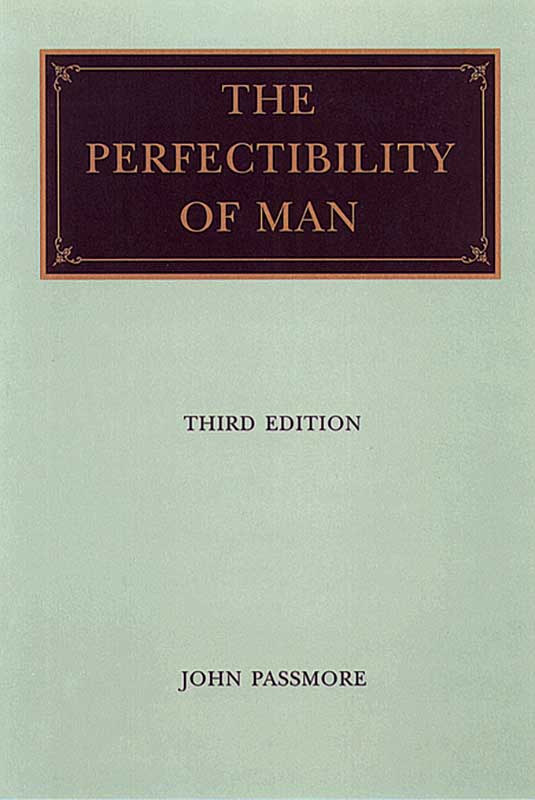
THIRTEEN: PERFECTION RENOUNCED: THE DYSTOPIANS - John Passmore, The Perfectibility of Man [1969]Edition used:The Perfectibility of Man (3rd ed.) (Indianapolis: Liberty Fund, 2000).
About Liberty Fund:Liberty Fund, Inc. is a private, educational foundation established to encourage the study of the ideal of a society of free and responsible individuals. Copyright information:The copyright to this edition, in both print and electronic forms, is held by Liberty Fund, Inc. Fair use statement:This material is put online to further the educational goals of Liberty Fund, Inc. Unless otherwise stated in the Copyright Information section above, this material may be used freely for educational and academic purposes. It may not be used in any way for profit.
THIRTEENPERFECTION RENOUNCED: THE DYSTOPIANSNo variety of perfectibilism has yet entirely vanished, killed outright by criticism or cast aside as obsolescent. Even the most fanciful extremes of Christian perfectibilist heresy still have their devotees; rashly to open one’s door to the missionaries of some twentieth-century sect is, as often as not, to be engulfed in perfectibilist prophecy, millennarian, Manichaean. Christian mysticism, in the eighteenth and nineteenth centuries somewhat suspiciously regarded by Roman Catholics and Protestants alike, has in our own century won new admirers; never before, perhaps, have Buddhist and Hindu mystical perfectibilism attracted so many Western disciples. There has been a notable revival, even, of nineteenth-century ready-mix mysticism, which looks to drug-taking rather than to purgation for its “enlargement of consciousness.” Secular perfectibilism, in all its forms, is no less persistent. Genetic manipulation is still extolled as man’s one chance of salvation from the ills of flesh and spirit; education and science and legislation are still warmly advocated as instruments of perfection. “I believe in the perfectibility of man,” defiantly announces that twentieth-century Enlightener Erich Fromm—even if he is careful to add that it is not inevitable, but only possible, for the “New Man,” at last perfected, to emerge as a fit inhabitant for the “One World” of the future.1 Anarchists have not ceased to hope that they can fertilize a new world with the ashes of the old. Combining the two perfectibilist threads, secular and religious, it is in our century, and in its middle decades, that Teilhard has produced his extraordinary amalgam of mystical and scientific perfectibilism. And no less extraordinary is the Freud-inspired perfectibilism of Norman Brown’s Life Against Death—a mysticism which seeks to find “a way out of the human neurosis into that simple health that animals enjoy, but not man.”2 Tempting as it is, then, to contrast in the sharpest possible way the scepticism and cynicism of the post-1939 world with the optimistic perfectibilism of the pre-1914 world, one can properly do so only with considerable reservations. That reservation applies even to the most optimistic form of perfectibilism, according to which the perfecting of man is guaranteed by the slow but sure operation of impersonal historical forces. “No reasonable person,” a contemporary political theorist is no doubt prepared to write, “can today believe in any ‘law’ of progress. In the age of two world wars, totalitarian dictatorship, and mass murder this faith can be regarded only as simple-minded, or even worse, as a contemptible form of complacency.”3 But neither Teilhard nor the Marxists would admit to irresponsibility or simple-mindedness or complacency. Wars, dictatorship and mass murders are, on their view, but passing phases in the ever onward and upward progress of mankind. All that can correctly be said is that liberally-minded Western intellectuals have for the most part lost their belief in the inevitability of progress. Liberally-minded Western intellectuals represent, however, only a segment of the modern world—in numerical terms a very small segment. On the other side, pre-1914 Europe was by no means unrelievedly optimistic. Although enthusiasm for progress was nowhere more marked than in France, the poet Baudelaire could still attack what he called the “infatuation” with progress as “a grotesque idea, flourishing on an earth made rotten by modern self-satisfaction” and the novelist Gautier could expostulate: “What a stupid thing it is, this pretended perfectibility of man they din into our ears.”4 Victor Hugo was by no means expressing the unanimous conviction of French intellectuals when in his Plein Ciel he composed a sonorous hymn to perfectibility. Poets and novelists can be expected to go their own way. But nineteenth-century politicians, too, and especially conservative politicians, were far from universally convinced that it was man’s destiny constantly to improve his condition. Lord Balfour, philosopher-statesman, chose the occasion of an address to undergraduates, delivered in 1891 in his capacity as Rector of Glasgow University, to express his doubts; his young audience, he fully realized, would listen to him with scepticism and impatience. There is no empirical evidence, he told them, to suggest that civilization—as Condorcet and after him Hegel had maintained—must always pass on from nation to nation; perhaps it will some day collapse, once and for all. The theory of evolution, he went on to say, does nothing to justify optimism about the future of mankind. Were the environment to alter, mankind might degenerate rather than improve. Art and Science, Balfour argued against the Fabians, would almost certainly decline in a society which runs more smoothly, which is less subject to conflict, than our own. As for the idea that man could be perfected by legislation, governmental action, he said, touches only the periphery of human conduct; its incidence is, even then, uncertain. “The future of the race,” so Balfour summed up, “is thus encompassed with darkness: no faculty of calculation that we possess, no instrument that we are likely to invent, will enable us to map out its course, or penetrate the secret of its destiny.”5 His fellow-statesman, Disraeli, had more succinctly summed up a not uncommon Conservative attitude when he wrote that “the European talks of progress because by the aid of a few scientific discoveries he has established a society which has mistaken comfort for civilization.”6 Water-closets and macadamized roads did not, that is to say, constitute moral progress. There were always those, in short, who were convinced that moral progress was largely an illusion, that human beings, and the civilizations they create, were unlikely in the future to be substantially better, at least from the point of view of moral perfection, than they had been in the past. To suppose otherwise, merely because nineteenth-century civilization, in certain limited respects, had reached a new high water mark, was, they agreed with Dean Inge, to “mistake the flowing tide for the river of eternity.”7 But Balfour and Disraeli, Baudelaire and Gautier, were consciously defying the “spirit of the age.” Like the defenders of progress in the seventeenth century, they were moved to write as warmly as they did because the opposite view was so strongly, and so widely, maintained. What particularly strikes us, indeed, is the unexpectedness of the pre-1914 writers who express their conviction that men not only could and should, but most certainly would, lift themselves to higher and higher stages of perfection. “Men,” wrote that arch-amorist or arch-liar Frank Harris in his My Life and Loves, “at least should grow in goodness and loving-kindness, should put an end, not only to war and pestilence, but also to poverty, destitution and disease, and so create for themselves a Paradise on this earth.” He went on to add, even more remarkably, that “man . . . must create not only a Heaven for men but for insects and plants, too, for all life, especially the so-called lower forms of it.”8 Man certainly need have no fear of his powers, if he can create an earth which will be at once a paradise for mosquitoes and a paradise for humanity. The prevailing mood was slightly less ecstatically expressed in Winwood Reade’s much-reprinted The Martyrdom of Man. First published in 1872, it illustrates very clearly the secular perfectibilism which then flourished, with its roots in the eighteenth century. “The Prince of Darkness,” Reade was willing to concede, “is still triumphant in many regions of the world; epidemics still rage, death is yet victorious.” But the God of Light—demythologized into science as the Prince of Darkness is demythologized into ignorance—is bound, Reade was fully confident, finally to conquer.* Science will convert earth into a paradise. Hunger, let alone starvation, will be unknown; “none will be rich, and none poor.” More than that; man will conquer his own nature. He will subdue not only “the forces of evil that are without” but, much more importantly, “the base instincts and propensities which he has inherited from the animals below.” The whole world, in consequence, will be “united by the same sentiment which united the primeval clan, and which made its members think, feel, and act as one.” What God had been in man’s imagination, man would become in reality. “Man then will be perfect; he will then be a creator; he will therefore be what the vulgar worship as a god.”9 As late as 1922, H. G. Wells, a great admirer of Reade, could end his widely-read A Short History of the World on a similarly optimistic note. Man, he said, relying on an analogy which is by now only too familiar, is still adolescent; his troubles arise out of his “increasing and still undisciplined strength,” not out of senility and exhaustion. “Can we doubt,” he rhetorically concluded, “that presently our race . . . will achieve unity and peace, that it will live, the children of our blood and lives will live, in a world made more splendid and lovely than any palace or garden that we know, going on from strength to strength in an ever widening circle of adventure and achievement?”10 Only too easily, many of Wells’s readers would now reply, can we doubt whether our children will live in a world more splendid and more lovely than any palace or garden that we now know. At best they will live in an air-conditioned box, at worst they will not live at all, or will live in a hovel in a devastated world. Wells himself, when in 1946 he revised his Short History of the World, expunged his optimistic predictions and added a new chapter, with a significant title: “Mind at the End of Its Tether.” “Homo sapiens,” he there wrote, “. . . is in his present form played out. The stars in their courses have turned against him and he has to give place to some other animal better adapted to face the fate that closes in more and more swiftly upon mankind.”11 By the standards of later generations, however, Wells was still an optimist. He did not plumb the full depths of modern pessimism, the fear that not only man but every living species might be totally destroyed by a nuclear explosion. The pessimism of modern liberals is by no means surprising: over the last half-century perfectibilists have experienced a long series of historical blows. To some former perfectibilists, as to Karl Barth, the First World War was enough to reveal how absurd it is to put any faith in men and, more particularly, in intellectuals, for the Enlightenment the great agents of perfection. At the first blast of the trumpets intellectuals, with few exceptions, had cast aside the cloak of internationalism and draped around their shoulders the national flag. Augustine, it will be recalled, was led by the Fall of Rome sharply to separate men’s hopes for salvation from their hopes for social progress. Writing in 1917, the theologian P. T. Forsyth reacted in precisely the same way to the First World War. “You have grown up,” he told his readers, “in an age that has not yet got over the delight of having discovered in evolution the key to creation. You saw the long expanding series broadening to the perfect day.” But now, he went on, “every aesthetic view of the world is blotted out by human wickedness and suffering.” Men must look to the Cross, so he concluded, to the symbol of salvation through suffering, not to evolution, to free them from their imperfection.12 For Sigmund Freud, the outbreak of the First World War was scarcely less significant. It is possible to read the early Freud—he has, indeed, often been read in this way—as essentially an Enlightenment perfectibilist according to whom man’s troubles derive, purely and simply, from his failure to realize the nature of his own impulses. Once bring into the clear light of consciousness what has so far been unconscious and, on this interpretation, all will be well. In a letter to his American disciple, James Putnam, Freud makes it perfectly clear that this is not in fact his view: “I do not agree with Socrates and Putnam that all our faults arise from confusion and ignorance.”13 But if Freud never fully shared those illusions about human beings which, so he argues in his Thoughts Concerning War and Death, were responsible, by way of reaction, for the widespread disillusionment provoked by the war, there can be no doubt that he, too, was profoundly shaken by it. “We are constrained to believe,” he wrote, “that never has any event been destructive of so much that is valuable in the common wealth of humanity, nor so misleading to so many of the clearest intelligences, nor so debasing to the highest that we know.”14 The dark note in Freud’s post-war writings, which not even the most casual reader could assimilate to the Enlightenment picture of man as a being free of all native impulses towards destruction, runs in important respects parallel to the Augustine-inspired pessimism of Karl Barth. There were some, no doubt, for whom the First World War had produced an outcome so precious as to demonstrate, once more, that out of darkness light emerges—the setting up of the Soviet Union. But the ruthlessness the Soviet Union displayed in agricultural collectivization, the purges of the ’thirties, the treacherous manoevres of the Communist Party in the Spanish Civil War, the German-Soviet Pact, the Hungarian invasions, the Czecho-Slovakian interventions—one or the other of these events has destroyed the Soviet Union as a symbol of hope in the breasts of all but a very few Western intellectuals. The Nazi régime was, for others, the death-blow of perfectibilism. As early as 1870, the French Socialist Blanqui, until that time an ardent proponent of the view that universal education would of itself destroy every trace of exploitation, had his faith in education shattered by the advance of well-educated but none the less brutal German troops into France.15 The Prussian invaders, however, were still relatively civilized. The peculiar primitiveness of the Nazi régime, the extent to which a people who had prided themselves on their education and their culture degenerated into the lowest forms of barbarism—no less in the Nuremberg Rallies than in the concentration camps—was more effective than the familiar horrors of invasion in shattering the belief that human society could be perfected by education and gradual social progress. The pessimism of the liberal intellectual in our times derives, then, from a variety of sources. Its intensity and its diversity are made particularly clear in what have come to be called the “dystopias,” most notoriously exemplified in Aldous Huxley’s Brave New World and George Orwell’s Nineteen Eighty-Four, but assuming an even more terrifying form, perhaps, in Zamiatin’s We—written in 1920 in the Soviet Union although, like so many great Russian works, published abroad. Dystopias, it is true, are not peculiar to our century; Mandeville’s Fable of the Bees is a notorious eighteenth-century example. Mandeville there depicts a society which sets out to base itself entirely on the ideal of moral perfection and, in the process, destroys its civilisation. Dystopias now flourish, however, as never before.16 The quotation from Nicolas Berdyaev which Huxley uses as an epigraph to Brave New World is particularly apposite to that work. “Utopias,” says Berdyaev, “now appear to be much more realizable than we had previously thought. We find ourselves nowadays confronted with a question agonizing in quite a different way: How can we avoid their final realization?—Perhaps a new century is beginning, a century when intellectuals and cultivated men will dream about methods of avoiding Utopia and returning to a society which is not Utopian, less ‘perfect’ and more free.”17 Berdyaev, that is, is rejecting perfection as an ideal; perfection and freedom, he is suggesting, are antagonists. That is the principal theme of Huxley’s and of Zamiatin’s dystopias. Classical Utopias, like Plato’s Republic, criticized existing societies by contrasting them with a theoretically realizable ideal society. The conventional criticism of such Utopias, from Aristophanes’ Ecclesiazusae onwards, has been that they are impracticable, inconsistent with human nature. Modern dystopias proceed quite differently: they criticize existing societies by constructing a nightmare society which, they suggest, is the inevitable outcome of existing social tendencies. The classical Utopians exhort men: “This is what you ought to try to bring about!”; the modern dystopians exhort men: “This is what you ought to try to stop!” Yet the fact remains that in content many of the modern dystopias are not so very different from the classical utopias: in essence, they are Plato’s Republic transformed by modern technology. It is a tribute to the quality of Plato’s imagination that his ideal society still so influences men’s minds, whether they contemplate it with delight or recoil from it with horror. Zamiatin and Huxley recoil from it with horror as a tyranny, the more dreadful for having been imposed out of good will and accepted without reservation by all but a very few of its victims. In a footnote to his Behaviorism, J. B. Watson remarks that “the behaviorist . . . would like to develop his world of people from birth on, so that their speech and their bodily behavior could equally well be exhibited freely everywhere without running afoul of group standards”—a state of affairs, which, in the main text, he entitles “behavioristic freedom.”18 Precisely such a “behavioristic freedom” is realized in Brave New World—a society in which everyone can say whatever he likes because nobody likes to say anything that will “run afoul of group standards.” “That is the secret of happiness and virtue,” observes Huxley’s Director, “liking what you’ve got to do. All conditioning aims at that—making people like their unescapable social destiny.”19 At the very end of Orwell’s Nineteen Eighty-Four the rebel Winston is finally conquered by the Party. The sign of its final victory is that now, in utter abasement, he sincerely loves Big Brother.20 The condition to which Winston is finally reduced is the dystopic equivalent of “Christian freedom” when that “freedom” is defined as loving submission to God’s will, just because it is God’s, and to whatever God commands—even if it be the command, as Abraham was commanded, to sacrifice one’s own son or, as Winston was commanded, to betray one’s beloved. Winwood Reade, it will be recalled, looked forward, like Fichte before him, to a time when “the whole world will be united by the same sentiment which united the primeval clan, and which made its members think, feel and act as one.” Such a society Huxley and Orwell and Zamiatin fear above all others. No doubt their dystopias differ greatly in character. One can easily enough imagine someone saying: “But I should like to live in Huxley’s brave new world.”* That is a world, for most of its inhabitants, of peace and stability, of sensuality and drug-induced contentment—like the book-burning world of Truffaut’s dystopian film Fahrenheit 451. It is much harder to imagine anyone confessing that he would like to live in Orwell’s dystopia—which is not to say that its blind worship of power, its violence, its mindless discipline, its Puritanical austerities, might not represent a great many secret dreams.† The inhabitants of Huxley’s and Zamiatin’s dystopias are, almost all of them, completely contented, and their society is technically perfect. This is certainly not true of Nineteen Eighty-Four, in which the shabbiness and bureaucratic incompetence of the twentieth-century Communist State are faithfully reflected. Orwell’s “proles,” furthermore, are not brought under full control; they are permitted to live under conditions of Dickensian squalor. The gloominess of Orwell’s dystopia, interestingly enough, is a reflection of the fact that his pessimism does not run as deep as Huxley’s or Zamiatin’s. He still believes that the Enlightenment ideals were realizable in an “earthly paradise”; such a paradise was not brought into being, on his view, only because power was seized by a “new aristocracy.”21 Huxley’s and Zamiatin’s criticism is much more far-reaching. They set out to show that the Enlightenment Paradise would, if realized, be a Hell.* Even Orwell, however, rejects as instruments of tyranny what had been, for the Enlighteners, agents of perfection. Thus, for example, whereas Enlightenment perfectibilists based their hopes for man on his malleability, in Nineteen Eighty-Four it is the arch-villain O’Brien who lays down the principle that “men are infinitely malleable.”22 That same assumption is the ruling factor of Huxley’s “brave new world” and Zamiatin’s “united state”: that men can be moulded into any desired shape by a combination of eugenic measures and training, both of them brought by modern technology to a level of efficiency which Helvetius could not envisage. Why is the malleability of man, in the eyes of the dystopians, a ground for despair rather than, as Hartley and Helvetius had assumed, for hope?* We have already noted that there is a yawning gap between the doctrine that man is malleable and the conclusion, so often immediately deduced from it, that man is perfectible. That gap the Enlighteners filled by presuming that social agencies can be set up which will perfect, rather than pervert, malleable man. There now exists, they thought, a class of men—the intellectuals—who, although themselves not yet perfect, have reached a level of development at which, once entrusted with power, they can set their fellow-men on the long uphill path towards perfection. By his very nature, they supposed, the intellectual is incorruptible, devoted to the public welfare, uninterested in power or in status for its own sake. “Scientists, historians, philosophers—,” so Denis Brogan has formulated this view, “they were supposed, on the one hand, to be above the mere party battle and, on the other, to be capable, because of their training, of distinguishing the true from the false without being blinded by political or religious passion.”23 Consider, in the light of this confidence, the composition of the ruling “Party” in Nineteen Eighty-Four: “bureaucrats, scientists, technicians, trade-union organizers, publicity experts, sociologists, teachers, journalists, and professional politicians.”24 Precisely the sort of people, that is, in whom the Enlighteners placed such faith—their own kind. Nor does this list reflect an eccentric Orwellian prejudice: there is nothing eccentric, nowadays, in blaming scientists and intellectuals, in an unholy alliance with bureaucrats, for all the ills of the world. “Let us build,” writes Aldous Huxley ironically in the foreword, dated 1946, to the 1950 reprint of Brave New World, “a Pantheon for professors. It should be located among the ruins of one of the gutted cities of Europe or Japan, and over the entrance to the ossuary I would inscribe, in letters six or seven feet high, the simple words: SACRED TO THE MEMORY OF THE WORLD’S EDUCATORS.”25 From Aristophanes onwards, conservatives have condemned intellectuals for introducing innovations, stirring up discontent, weakening the unity and stability of the social system. But now the accusation is very different. The typical intellectual, nowadays, is the scientist and scientists, the suggestion is, are heartless, inhuman. Professing to be disinterested, they are in fact uninterested—uninterested in human beings as such, except as statistical items in some grand experiment, some total plan. Pretending to absolute objectivity, they in fact seek to secure their own position in society; they will serve any government, acquiesce in any form of social arrangement, whether it be capitalism, communism or the Third Reich, provided only that it will provide them with the funds they need for their experiments. They disclaim all responsibility—like the Inquisition handing over heretics for burning to “the secular arm”—for applications which they know quite well to be inevitable.26 More than that, they are hungry for power and status, for public recognition, for influence. Mankind means less to them than a Nobel Prize. “As far as science is concerned,” Karl Popper has written, “there is no doubt whatsoever in my mind that to look upon it as a means for increasing one’s power is a sin against the Holy Ghost.”27 He is very conscious, however, that this sin is only too often committed. The Universities, so the contemporary indictment continues, have surrendered their ancient traditions of independent research and open publication to satisfy the insatiable demands of their scientists for new equipment, bigger research teams, higher status. In so far as the Universities have continued to educate—as distinct from serving as the research branch of government and industry—they now, so it is alleged, have no objective except to turn out, in order to satisfy the requirements of government and large corporations, an unfailing stream of docile, amenable, technically perfected, executives—“highly skilled, but politically and economically dumb ‘personnel.’”28 The dystopians, then, reflect a wider disquiet about the influence of intellectuals, not now as radical innovators, but rather as agents of the “industrial-military complex” and the governments that complex so powerfully influences. Even in the eighteenth century Kant had argued against Plato that intellectuals ought not to be rulers since, he maintained, “the possession of power inevitably corrupts the untrammelled judgement of reason.”29 The question, nowadays, is how far collaboration, as distinct from actual rule, has the same effect.* When young radicals of the more uncompromising kind refuse to accept the offer of well-meaning administrators to permit them a greater share in University government their elders are often genuinely puzzled. What the young fear, however, is that once they participate in the mechanism of power, they, too, will begin to think like bureaucrats, they will start looking at things from “a sensible point of view”: they will take over a standpoint, that is, according to which ease and efficiency of management, a smooth-running organization, is all important, even when the organization is no longer securing the objectives towards which it is ostensibly directed. In their own radical groups, such rebels fear above all else the emergence of hierarchical structure, leadership from above. Official leaders, they believe, “inevitably develop interests in maintaining the organization (or themselves) and lose touch with the immediate aspirations of the rank and file.”30 So much has been made apparent, they think, from the history of the Soviet Union. If the new radicals are right, if, that is, not only power but collaboration with power inevitably corrupts, that fact is highly germane to our theme: it is then quite ridiculous to suppose that men can ever be perfected from above, by legislation or by an education which is imposed upon them. But even if the extreme position of the new radicals is mistaken, even if power does not inevitably corrupt but, as Acton thought, only tends to corrupt, there is certainly nothing in our experience to suggest that whenever an intellectual rules, freedom, justice and equality must flourish. Lenin and Salazar are powerful enough evidence to the contrary—to say nothing of Oxford-bred African dictators. The Enlightenment attitude to the “mob” still persists among contemporary intellectuals.* Intellectuals in power can readily persuade themselves, therefore, that they “know what is good” for the population at large, what men “really want,” and how to protect them from the propaganda which, weak-minded as they are, might lead them to suspect the ever-virtuous intentions of their rulers. Only too easily do intellectuals—not all of them but enough of them to make the indictment plausible—come to share the sentiments of Ballas in Vaclav Havel’s play The Memorandum: “When the good of Man is at stake, nothing will make us sick.”31 Rule by intellectuals is not the only Enlightenment recipe for perfection on which the dystopians have cast doubt. One of the leading presumptions of the Enlighteners was that if once man could discover a perfect language his troubles would largely be over. The rulers in Orwell’s dystopia are in the process of constructing such a language, a language without ambiguity, which it is impossible to misunderstand, since “every concept that can ever be needed, will be expressed by exactly one word.” And this, it turns out, is one of the ways in which they tyrannically control the thoughts of men. “In the end,” says Orwell’s Syme, “we shall make thoughtcrime literally impossible, because there will be no words in which to express it.”32 There is a fuller treatment of the perfect language theme in Havel’s The Memorandum. The artificial language of that play, Ptydepe, is so constructed as “to guarantee to every statement . . . a degree of precision, reliability and lack of equivocation, quite unattainable in any natural language.”33 (In a manner only too characteristic of our age, this precision is in the interests neither, as for Leibniz, of religion, nor, as for Condorcet, of science, but of bureaucracy: Ptydepe is to be the language of interoffice memoranda.) In Havel’s eyes, the new language is a symbol of the totalitarian outlook, yet another way of ensuring that it will be at all times clear exactly what every human being is doing and saying. It destroys, in the process, the very possibility of irony, one of the few forms of freedom which a totalitarian ruler cannot be quite confident he has wholly brought under control. This brings out the fact that the “imperfections” of everyday language are precisely what permit it to be used as an instrument of human freedom, as a way of introducing new ideas, new attitudes—allowing Freud, for example, to speak of “unconscious mind” when “mind” had commonly been defined as consciousness, or Wittgenstein to describe as “senseless” sentences which, judged by ordinary criteria, certainly have a meaning.* Admittedly, these very same “imperfections” allow men to talk nonsense, to confuse, to deceive, to corrupt. It is quite easy to understand, in consequence, why well-intentioned men have been so attracted by the ideal of a perfect language. A society in which language can be used ambiguously, or to deceive, distort and illicitly influence, will never be a perfect society. So much the worse, the dystopians have concluded, for perfection. As for the closely connected Enlightenment doctrine that the mathematization of social relationships will be the salvation of mankind, this is bitterly satirized in Zamiatin’s We. Life in his dystopia is mathematically perfect.* The central character D-503—numbers have, of course, replaced personal names—sums up the faith the “United State” lives by thus: “there are no more fortunate and happy people than those who live according to the correct, eternal laws of the multiplication table.” (Compare the society depicted in François Truffaut’s Fahrenheit 451, where books are not only banned but burned. The time thus saved at school is devoted to teaching children the multiplication tables for high numbers.)34 Morality in the “United State” is now at last completely scientific—“based on adding, subtracting, multiplying, and dividing.”35 Music is composed by mathematically-designed machines. And the effect is the complete bureaucratization of all human relationships. In the popular mind, a mathematically-organized world has now come to be associated with a computerized world. For the “new radicals” the ultimate indignity is to “be an IBM card”—the modern equivalent to what used to be called, significantly enough, “being a cipher,” a number with no meaning outside mathematics. The computer, in the eyes of the new radicals, is the symbol of faceless power, the most terrifying of all those many modern devices which “break down communication and destroy community in the interests of efficiency.”36 And the computer does no more than express mechanically a mathematically simplified world. It is not only—though this, too, is feared—that the computer may replace men, may make their technical tasks superfluous. The fear of the computer goes deeper than this: that it will destroy human relationships. The mathematician and the computer expert will no doubt condemn these reactions as ill-informed and ridiculous. Mathematics, the mathematician will rightly point out, is not to be identified with practical calculating devices: it is one of the great imaginative constructions of the human mind. As for computers, they represent, their designers are confident, a triumph of the human intellect, the conquest of mere toil, opening up to man quite new prospects of alleviating his miseries. The dystopians, they would say, are responding in the manner only to be expected of panicky literary men, afraid of what they do not understand, and still responding as unthinkingly as they did as schoolboys to the intricacies of mathematics. Yet it is easy to understand why mathematics and computers are so feared. “Evil,” Sartre once wrote, “is the systematic substitution of the abstract for the concrete.”37 Mathematics, by its very nature, is abstract. Groups and relationships, not individuals, are its starting-point: in its statistical applications it is interested only in the behaviour of large numbers, not in individuals. No one has brought out the nature of a computer-run society more clearly than E. M. Forster, in a story “The Machine Stops” which he wrote as long ago as 1912, as a reply to Wells’s Utopias, although it was not published until 1928. He depicts a society entirely run by a centralized machine. Only through the machine do human beings communicate one with another, and the machine, like Havel’s ideal language, does not “transmit nuances of expression.” It is content to give a “general idea of people”—quite enough, so it is said, for ordinary purposes. One of the characters finds her bed too large for her tastes; it was useless to complain—beds were the same size all over the world and “to have had an alternative size would have involved vast alterations in the Machine.” Although scarcely anybody travels, there are still regular airlines; it was too troublesome to abolish them. In short, the whole society is ruled by one principle: what will it cost for the machine to alter its own programming?38 If this is perfection, Forster is suggesting, let us abandon the ideal of perfection, while there is still time. If their critique of the Enlightenment ideals of a perfect language and a perfectly mathematical society are readily intelligible, it is at first sight more surprising that the ideal of happiness, too, does not go unscathed in the dystopias. Adam and Eve, so R-13 suggests in Zamiatin’s We, had a choice: the choice between freedom and happiness. They chose freedom.* Now at last it has become clear, he continues, that Adam and Eve were wrong: the “United State” takes men back beyond the Fall, to a world of perfect happiness.39 At the culminating point of Zamiatin’s novel, the last remaining obstacle to man’s complete happiness is surgically removed: a compulsory operation cuts away man’s imagination, the source of all those anxieties which had so far proved irremediable. Huxley’s Brave New World has happiness always ready at hand, in the form of the drug soma: “one cubic centimetre cures ten gloomy sentiments.”40 Those major sources of human unhappiness, unsatisfied sexual desire and sexual possessiveness, are in the dystopias no problem. In Jean-Luc Godard’s film Alphaville, as in Mahomet’s heaven, sexually attractive women are at all times available; in Brave New World sexual relationships are so ordered as to reduce to a minimum the interval between “the consciousness of a desire and its fulfilment.”41 The more bureaucratic society of Zamiatin’s We is slightly more formal—one needs a pink ticket and sexual relationships are only permitted at certain hours—but they still involve, it is presumed, no element of frustration. As for Fahrenheit 451, the women in that film live in a perpetual state of narcissistic gratification. Truffaut’s book-burning firemen justify their book-burning in similar terms: books make people unhappy. And indeed when the rebel fireman reads aloud a passage from David Copperfield to a group of television-moulded wives this accusation is shown to be justified. One of them weeps, reminded of past sorrows. You can have your choice, the assumption is: literature or happiness, but not both. The controller of Brave New World makes a similar point. The literature of the new world, he admits, is intrinsically inferior to Shakespeare’s Othello. But a happy people will not be able to understand Othello: the envy, the jealousy, which is its motivating force will be totally unintelligible to them. Happiness or freedom, happiness or art, happiness or pure science—for pure science, as distinct from controlled technology, is forbidden in Brave New World—these, it is now suggested, are the choices before man. “People are happy”; the Controller is confident, “they get what they want, and they never want what they can’t get. They’re well off; they’re safe; they’re never ill; . . . they’re plagued with no mothers or fathers; they’ve got no wives, or children, or loves to feel strongly about; they’re so conditioned that they practically can’t help behaving as they ought to behave.” Why, he goes on to ask, should anyone throw all this away “in the name of liberty”?42 The Enlighteners, in contrast, presumed that art, science, freedom, justice, equality, happiness were not irreconcilable alternatives but different facets of human perfection. The dystopian criticism, it might therefore be argued—as Erich Fromm, for one, argues—has nothing to do with happiness, rightly understood. No doubt, the dystopias offer men freedom from suffering and the immediate gratification of impulses but this, according to Fromm, is not happiness. Drugs like soma can bring with them placid content, but happiness is very different from contentment. Man can be happy, Fromm somewhat portentously observes, only when he “has found the answer to the problem of human existence: the productive realization of his potentialities.”43 On this view, there can be no clash between freedom and happiness: freedom is a necessary condition for happiness. As for literature and science, they are special forms of happiness. There are no doubt, as Fromm is suggesting, definitions of happiness—e.g. as enjoyable activity—in which it is far from being incompatible with freedom. But the dystopians are not arbitrarily introducing a new use of the word “happiness”: happiness as they understand it is happiness as the Utilitarians understood it—the maximization of pleasure and the minimization of pain. And they are emphasizing that men might be free of pain and frustration in a society in which liberty is lost, art and science are dead, and love is abolished. The possibility of creating such a society has become less remote as medical science has proved itself able to relieve anxiety and depression by drugs. Freud thought that anxiety and depression could be alleviated only by the patient’s becoming free, by his overcoming what Freud significantly called “repression.” But now, it seems, men can be relieved of anxiety and depression not only without in the process becoming freer men but, in the sharpest possible contrast, by becoming drug-dependent. The dystopian attack on ideal languages, on mathematized social relationships and on the technological manipulation of human beings in the interests of their happiness, is directed, fundamentally, against the identification of perfection with technical perfection. And, what goes with that, against the conception of society as a great machine, perfect in virtue of its order, its stability, its harmony, a machine in which everyone has a place, everyone knows what that place is, and everyone keeps to that place—the old Platonic ideal. “We gave each man,” so Plato sums up the ideal society he sketched in the Republic, “one trade, that for which nature had fitted him. Nothing else was to occupy his time, but he was to spend his life working at that.”44 Plato’s ideal State won new admirers in the nineteenth century, especially amongst the disciples of the French socialist Saint-Simon, including Comte. A perfect society, according to Comte, would be one in which the “spiritual powers”—Comte’s substitute for Plato’s philosopher-kings—would allocate each person to the functions for which he is best suited. This is the social programme which J. S. Mill, not unjustly, described as “the completest system of spiritual and temporal despotism which ever yet emanated from a human brain.”45 Modern society, in the eyes of its critics, is steadily moving in the direction of precisely such a spiritual despotism, in the name of technical perfection. “Our civilization,” wrote Paul Valéry in 1925, “is taking on, or tending to take on, the structure and properties of a machine. . . . This machine will not tolerate less than world-wide rule; it will not allow a single human being to survive outside its control, uninvolved in its functioning.” In short, it is moving towards that unified “world-community” which Wells and Teilhard, in their own different ways, saw as the one hope of human perfection. Valéry goes on to describe this world-to-come in terms which even more clearly relate it to the world of the dystopians: “It cannot put up with ill-defined lives within its sphere of operation. Its precision, which is its essence, cannot endure vagueness or social caprice; irregular situations are incompatible with good running order. It cannot put up with anyone whose duties and circumstances are not precisely specified.” If it encounters such people, Valéry goes on to say, it tries either to eliminate them or to force them to undertake regular and specified tasks.46 Thus Plato’s—and Saint-Simon’s—dream is Valéry’s nightmare. The picture of the world he so grimly paints is precisely the world as the young rebels now see it becoming—a world in which the eccentric, the individual, is not allowed to exist, not even as a despised drop-out. Western civilization as we now know it is not, of course, the world which Valéry describes. It is far from being the case that the world is a single uniform community, it is far from being the case, even, that nobody in modern times can live “an ill-defined life,” that there are no longer any “irregular situations.” Were this true, indeed, such phenomena as the “hippie” communities could not for a moment survive. Specialization, too, is not complete; all men are still called upon to vote, to be soldiers, to be members of juries. But the preoccupation of so much contemporary literature with the “outsider,” the drop-out, with “ill-defined lives” and “irregular situations,” can only be understood as an attempt to stem what so many writers, especially, dread as an all but irresistible movement towards a tidy, specialized world. Not, of course, that the “outsider” is a new phenomenon, as the case of Rimbaud sufficiently reminds us. In modern society, however, “outsiders” create a peculiar unease—very similar, in many respects, to the unease created by the Brethren of the Free Spirit in Medieval Europe, whom the hippies resemble in so many ways. No one knows how to cope with them; they challenge the principle of order on which the society is constructed, the principle, in the modern case, that everybody should have a regular job, be a member of a small family group, and devote himself to his personal advancement through the technical perfecting of his special skills. Furthermore, it is only too easy to envisage, in the light of contemporary tendencies, a society in which even warfare and politics and judicial decisions are, all of them, left entirely to technicians. Freedom is then wholly subordinate to “perfection,” to individual perfection defined as technical expertness, to social perfection defined in classical aesthetic-metaphysical terms as permanence, stability, order, harmony. The dystopias present such a society as a realized fact. In Zamiatin’s We the ideal is to become “perfect like a machine”; in Brave New World, men are deliberately bred to fit them for a specific task. “Ninety-six identical twins working ninety-six identical machines! You really know where you are.” This is the means by which Huxley’s dystopia lives up to its great motto: “Community, Identity, Stability.”47 Confronted with the spectacle of ninety-six identical twins, the visiting primitive retreats behind a palm in order to vomit. The only possible comment, we may feel. But are we merely being sentimental, as Skinner accuses his critics of being sentimental?48 Human society has, in important respects, progressed as a result of the division of labour and, what is related to it, the careful choice of particular types of individuals for particular types of task.* Romanticists may continue to yearn for a simple, agricultural society, where everybody turns his hand to whatever task needs to be done; such a society, in which perfection is conceived of not as technical but as moral perfection, the practice of virtue, and technical perfection is dismissed as an unnecessary refinement, has been the stuff of a great many Utopias, ancient as well as modern. A patriarchical, rural society, however, is entirely devoid of what may fairly be regarded as the greatest of human achievements, in literature, in science and in philosophy. And the assumption that, by way of compensation, moral virtue flourishes in a patriarchal setting cannot survive the most casual reading of the Old Testament. Suppose, in contrast, it is possible to construct a society in which every person is engaged in a highly specific task, so chosen as to suit his capacities—a task he has been bred and trained to perform willingly and with the utmost efficiency. Suppose that in his leisure hours, he is supplied with entertainment which fully satisfies his wants. Suppose he is governed by experts who ensure that society runs smoothly, in an organized fashion, that men’s health is maintained at a high level, that their anxieties—in so far as they still have any—are instantly tranquillized. Everybody, that is, is technically perfect in the performance of a task, he is content, he lives in an orderly peaceful society. What more, one might ask, could anyone want? Such a society, the reply would often come, is “dehumanizing.” That is why Marx rejected it. The division of labour, Marx willingly conceded, was a necessary stage in the growth of human society; it made possible the development of towns, and in towns the emergence first of bourgeois culture and then of that industrial proletariat in whose hands, according to Marx, the future lies. But in a “real community,” he nevertheless maintains, each individual will “cultivate his talents in all directions.”49 Versatility, not specialization, will be the rule. And only in such a community, he says, will man be “truly human.” This same view—that there is something inhuman about specialization—is even more vigorously maintained by those twentieth-century French philosophers whom it is customary, against their will and as an ironic exemplification of exactly what they object to, to classify as “existentialists.” “Travelling on the Underground,” writes Gabriel Marcel, “I often wonder with a kind of dread what can be the inward reality of the life of this or that man employed on the railway—the man who opens the doors, for instance, or the one who punches the tickets. Surely everything both within him and outside him conspires to identify this man with his functions—meaning not only with his functions as worker, as trade-union member or as voter, but with his vital functions as well.”50 One ought certainly to regard with an initial suspicion such expressions as “truly human” and “dehumanizing.” The accusation that the technologically perfect society is dehumanizing is often levelled, but seldom made sufficiently precise. Often enough, such phrases as “truly human” are used quite illicitly, as polemical devices, to suggest that certain particular forms of human activity, those of which the writer approves, are somehow “in accordance with man’s nature,” or “truly human,” whereas other forms of human activity are, in some obscure way, not really human at all, for all that they are undoubtedly characteristic of many human beings. So in the present instance, some men are versatile, while others, by choice or necessity, concentrate all their attention on a single task, perhaps narrowly conceived, in the manner Plato advocated. To say of the specialist that he is not “truly human,” to lay it down that to be “truly human” one must be versatile, is, on the face of it, quite arbitrarily to pick out what is only one type of human being in order to proclaim him, and him alone, “truly human.” The same criticism can be applied more generally. Cruelty and envy are peculiarly human forms of behaviour; to assert of someone who is cruel or envious that he is not “truly human” is undeservedly to compliment the human species. It takes a human being to be a Marquis de Sade, to construct the concentration camps at Auschwitz, to wage war, to lie, to betray, to hate. Man is never less an animal than in the depths of his depravity. To describe a state of society as “dehumanizing” merely because it encourages men to deceive, to lie, to be cruel is, on the face of it, arbitrarily to admit as human only what is good. The word “humanize,” however, is ambiguous. It can mean not only “to make human”—as when cow’s milk is “humanized”—but also “to make humane.” And this latter also, like the Roman humanitas, in either of two senses: to make more sympathetic, kindly, considerate, or to make more civilized.51 In this latter sense, it is not uncommonly associated with a rather narrow conception of “civilization,” dating from a time when a civilized, humane man was one who devoted himself to the study of the Greek and Roman classics, presumed to be the sole repository of human achievement. But without too great a strain on the concept of the “humane,” we can extend it so as to include every form of imaginative civilized achievement, in science, in technology, in industry, as much as in the arts. Then we can argue thus: a form of society, an ideal, is “dehumanizing” if its effect is either to make men less considerate, less gentle, less sympathetic, or else to cut at the roots of civilized human achievements.* In order to demonstrate, then, that a society organized on the principle of technical perfection is “dehumanizing” we do not need to show that it somehow “destroys the essence of man” or is not “truly human” but only that it weakens the influence of, or destroys, a certain type of man—the type we call “humane,” the type we call “civilized.” This is substantially what is suggested in the dystopias of Zamiatin or Orwell and Huxley—and suggested, too, by critics of our own society who condemn it as dehumanizing because it is dominated by the principle of specialization and the associated ideal of technical perfection. Our own society, of course, has not been deliberately founded on the ideal of technical perfection, as Plato’s republic was. It has developed into a specialized society as a result of economic pressures; so far as it can be said to be dominated by an ideal it is the ideal of material prosperity, or economic growth, rather than an ideal of perfection. But in the interests of the ideal of maximum output, it has taken over as a sub-ideal the concept of technical perfection, of efficiency; it judges men by their fitness for jobs, not jobs by their fitness for men. And for that reason we can think of modern industrial civilization as exemplifying the dehumanizing effects of the ideal of technical perfection. By treating men as machines, whose perfection is to be equated with their technical perfection, it helps to destroy sympathy, compassion, kindliness. Such judgements as “he’s a nice chap”; “he is quite without malice and envy”; “he would never let you down” come to seem irrelevant; the sole question of importance becomes: “Is he efficient?” Sympathy, compassion, even friendliness are condemned as destructive weaknesses, destructive of efficiency; friendship generates loyalties which may cut across technical efficiency, limit mobility, reduce a man’s willingness to economize labour.52 If, then, when it is said that the ideal of a society founded on technical perfection is dehumanizing what is meant is that it weakens men’s “humaneness,” the accusation* seems to be thoroughly justified. It may be replied that industrial societies, even if they were once inhumane, have now given birth to the Welfare State. Before we condemn too fiercely the inhumanity of modern Western industrial societies, we have certainly to remember that they do not leave people to die of starvation in the streets. Those many critics of Western societies who accuse them of lacking “true humanity” but who themselves display the utmost callousness towards their own fellow-men remind us once more how accusations of “inhumanity” can serve as nothing more than expressions of prejudice; indeed, Western societies are sometimes described as cold and inhumane for no better reason than that their officials are not readily subject to bribery and corruption. Yet the fact remains, as the familiar simile “cold as charity” reminds us, that the distribution of alms, in however scientifically ordered a form, is no substitute for humane relationships in everyday life. The tendency of industrial society is to suppose that it is: pension schemes and the like are used to salve its conscience—to say nothing of their practical effects in reducing the mobility of labour. But pensions do not compensate for loneliness, and welfare benefits do not contribute to the development of humane relations when their recipients, as is all but inevitable, are regarded with watchful suspicion, as men and women who will quite certainly cheat the State if they can discover a method of doing so. Let us look now at the other side of the idea of “humanity,” in which it connotes “civilized achievement.” Such achievements depend, above all else, on man’s “perfectibility,” in Rousseau’s sense of the word, his ability to innovate, to react in novel ways to new situations. The innovator, however, must in the first place be discontented, he must doubt the value of what he is doing or question the accepted ways of doing it. And secondly, he must be prepared to take fresh paths, to venture into fields where he is by no means expert. This is true, at least, of major forms of innovation; they make it possible for other men to be expert, but are not themselves forms of expertise. Freud was not an expert psycho-analyst; before Freud wrote there was no such thing; he created the standards by which psycho-analysts are judged expert. Neither was Marx an expert in interpreting history in economic terms nor Darwin an expert in evolutionary biology. If a man is trained, purely and simply, to be expert and contented in a particular task he will not innovate; Freud would have remained an anatomist, Marx a philosopher, Darwin a field-naturalist. That is why classical Utopias, and the modern dystopias which ironically incorporate their ideals, are static. “The ideal . . . is to be found,” as the narrator remarks in Zamiatin’s We, “where nothing happens.”53 Innovations, as in Plato’s Republic, are discouraged, or permitted only when they tighten the grip of the State over the individual. The technically expert citizen is expert only in his allotted task; for him to think about the value of that task is for him to pass completely beyond the limits of what is permissible. In Utopias like Skinner’s Walden Two, the situation is rather different. Innovation is not only permitted, but encouraged. But it is left to experts. Experts alone are to determine what innovations are to be introduced, they will train, or re-train, men to cope with the new tasks which arise out of them. To accept this policy, however, is greatly to limit the sources of innovation. In our own society—although only in the last decades—there has emerged, admittedly, a class of professional innovators, dedicated to, and supposedly expert in, the discovery of innovations. But they are by no means the only source of innovation. Innovations result from public protests, from discontent with things as they are, from the ingenuity of workmen and amateurs. Often enough, too, they win recognition in spite of experts rather than with their encouragement, as the history of art, science and technology only too clearly reveal. Such innovations, it will no doubt be objected, are liable to be harmful; innovations, social or technological, should all of them, so the argument will then run, arise out of designed experiments and be introduced more widely only if the experiments are successful. At this point we are brought face to face with what is the leading presumption in the ideal of a perfect society based on technical perfection, namely that as well as experts in carpentry and experts in mathematics, there are experts in determining what-ought-to-be-done. Plato was convinced that there were such experts. His philosopher-kings, in virtue of their knowledge of the form of the good, know in detail what policy ought to be adopted, whether in relation to politics or the arts or science or industrial production. Suppose, however, we consider a particular issue, one which has constantly arisen in the history of perfectibilism: should men be permitted to marry for love? It is certainly true that psychological and sociological experiments are relevant in discussing this question. But it is quite another matter to say that there is some expert or class of experts whose investigation can finally decide the answer to it—in the sense in which they might decide, for example, whether men who marry for love are more or less likely than those whose marriages are arranged to have children whose intelligence quotient is higher than the average intelligence quotient of their parents. Yet unless all such questions are “matters for expert decision,” it at once becomes apparent that at the very heart of a “technically perfect” society—in its decision upon what functions shall be exercised and who shall exercise them—there lies not the technical perfection of an élite but the exercise of despotic power. And the effect of bowing to the commands of such an élite is to destroy such major forms of innovation as art, where the pretence that there are “technical experts” who can decide how, and what, the artist ought to be allowed to paint can only issue, as it has issued in the Soviet Union, in an art which is merely a display of expertise, not an opening up of new human horizons. “There can be a real literature,” Zamiatin once wrote, “only when it is produced by madmen, hermits, heretics, dreamers and skeptics and not by painstaking and well-meaning officials.”54 From Plato on, the setting up of a technically perfected State entails, indeed, that artistic innovation is simply not to be permitted. There are, then, good grounds for believing that a society which is entirely based on the ideal of technical perfection will be “dehumanizing.” But the phrase “entirely based on” is crucial. There is nothing “dehumanizing” in the ideal of technical perfection, or in specialization. Specialization is not “instinctive” with human beings, as it is with ants or bees. Men have learnt to specialize: this is one of their greatest achievements. At the opposite extreme from the fully-specialized dystopia lies the Arcadian ideal, the ideal of a society where there is no specialization, where everyone grows his own food, forges his own tools, makes his own clothes. It, too, has a perennial appeal. Marx, describing a communist society without specialization, depicts it as one in which man hunts in the morning, fishes in the afternoon, rears cattle in the evening, and exercises his critical powers at night.55 That is hard enough to envisage. But even more unimaginable is an ideal society in which a man would be a physicist in the morning, a painter in the afternoon, a biologist in the evening and a philosopher at night: the fact is that these forms of activity, taken at all seriously, inevitably preoccupy—they cannot be picked up and dropped at will. Many an intellectual, in search of Arcadia, has discovered, as did Nathaniel Hawthorne,56 by harsh personal experience how impossible it is to reconcile intellectual achievement with unremitting physical labour. The value of specialization is not to be underrated. In some ways, indeed, modern society is not specialized enough. It demands from its citizens a type of versatility which is incompatible with the highest sort of achievement, or even with the exercise of humane virtues; it expects everyone, however ill-fitted for such tasks, to drive a car, to care for his property, to be a good husband and a good parent. In many respects, too, there is in contemporary society too little competence, too little efficiency, too little urge for perfection in the conduct of a task. Not everybody who extols the virtues of efficiency is himself efficient, as the visitor to the United States is very rapidly made aware. To take a pride in doing one’s work as well as one can, whether it is the work of a philosopher or of a waiter, of a shoe-black or of a hotel keeper, is by no means dehumanizing. It is dehumanizing, however, for a man to be placed in a situation in which he has no opportunity of displaying any kind of enterprise in his work, as must be the case where the nature and conditions of that work are absolutely predetermined in detail. Specialization is dehumanizing, too, if it holds men rigidly to a particular task, preventing them from following an activity, or an argument, wherever it leads them because to do so is to move into “someone else’s field.” Or if it so structures men’s tasks that they are encouraged to think of their fellow-workers not as collaborators, but as rivals, rivals to be regarded with suspicion, hostility and envy. Or finally, if it governs a man’s whole life, as distinct from some section of it; if he simply becomes, in the manner of a machine, “that which performs a particular function.” Not specialization as such, but specialization in the interests of a total scheme based on the ideal of perfect social order, is the enemy to be feared. Galbraith has described in his Affluent Society the ways in which “practical heartlessness” has been justified as “serving the public good”—a “good” which, it is presumed, can be identified with maximum output, maximum technical efficiency. One can add that if the same ideal of maximum output is allowed to determine the policies of universities, of science, of the arts, it will destroy not only humane feelings but the highest achievements of civilization. When it—and the cognate idea of “technical perfection”—encroaches into universities the effect is that a scholar is judged by his output rather than by its quality, and by the technical expertness of what he produces rather than by its capacity to illuminate. But what is wrong, once more, is neither the ideal of technical perfection, nor even the ideal of scholarly productiveness. Rather, it is the total subordination to those ideals of other ideals which are very much more important, if less precisely definable. Considering, then, the criticisms which the dystopians have directed against both Enlightenment and Platonic ideals of perfection—ideals which converge at many points—we see that they consist, in general terms, in rejecting, as dehumanizing, the ideal of technical perfection and the connected ideal of “aesthetic” perfection through a total ordering of society. To attempt to perfect society through the application to it of a total plan in which everybody has his place, is, the dystopians argue, destructive both of personal relationships and of literary and scientific achievement. It must culminate, as the social tendencies of our own time clearly reveal, either in a society which is grim and grey, in which the ideal of perfection is but the disguise of power—this is Orwell’s Nineteen Eighty-Four and the Communist societies of Eastern Europe—or, alternatively, in a society in which men achieve contentment only because they are conditioned to be contented and are drugged or sensually gratified as a way of reinforcing that conditioning. This, some of its critics argue, is modern Western civilization. In either case, so the suggestion is, human relationships are subordinated to an alien ideal—to orderly perfection and the technical efficiency of a machine. [1. ]Erich Fromm: Beyond the Chains of Illusion: My Encounter with Marx and Freud (New York, 1962), pp. 177–82. [2. ]Norman Brown: Life Against Death (London, 1959; repr. 1960), Pt. VI, ch. xvi, p. 311. [3. ]Judith N. Shklar: After Utopia: The Decline of Political Faith (Princeton, 1957), Preface, p. vii. [4. ]C. Baudelaire: “Exposition universelle de 1855,” Curiosités esthétiques (Paris, 1923), p. 227 and T. Gautier: Mademoiselle de Maupin (Paris, 1927 ed.), Préface, p. 23, quoted in D. G. Charlton: Secular Religions in France, 1815–1870 (London, 1963), pp. 157–58. [5. ]Lord Balfour: A Fragment on Progress, Rectorial Address, University of Glasgow, 1891 (Edinburgh, 1892); included in his Essays and Addresses, 3rd ed. (Edinburgh, 1905), p. 279. [6. ]Quoted in W. R. Inge: “The Idea of Progress,” Romanes Lecture, 1920, included in Outspoken Essays, Second Series (London, 1922; repr. 1927), p. 179. [7. ]Ibid., p. 169. [8. ]My Life and Loves, orig. publ. Paris, 1922–27; ed. John F. Gallagher, 5 vols in 1 (London, 1964), Vol. IV, p. 843. [* ]Reade’s metaphors derive in the long run from Zoroaster. His is, indeed, an unusually explicit version of the secular Zoroastrianism so characteristic of nineteenth-century perfectibilists. History is conceived of as a great drama in which the forces of progress fight against—and will finally destroy, thanks to the Messiah, Science—the forces of reaction, as represented especially by religion. Such a secular Zoroastrianism, rather than the elaborate metaphysical constructions of a Hegel or the economic analyses of a Marx, is the faith which sustained much everyday nineteenth-century secular perfectibilism. It lent itself to pictorial illustration: science was symbolized by electricity—for the late nineteenth century the prime example of scientific achievement—and expelled the forces of darkness in a quite literal sense. The battle between Electricity and Darkness was, on the continent of Europe especially, the stock-theme of anti-clerical pageants, the secular counterblast to Christian dramas of salvation. Compare Belloc’s “The Benefits of the Electric Light” in Complete Verse (Duckworth, 1970), pp. 155–58. [9. ]The Martyrdom of Man, 9th ed. (London, 1884), pp. 512–15. [10. ]H. G. Wells: A Short History of the World (London, 1922), ch. LXVII. [11. ]Ibid., definitive rev. ed. (Harmondsworth, 1946; repr. 1949), ch. 71: “From 1940 to 1944: Mind at the End of Its Tether,” §2, p. 349. Wells also used the title Mind at the End of Its Tether for a short book which he published in 1945. [12. ]P. T. Forsyth: The Justification of God: Lectures for War-Time on a Christian Theodicy (orig. publ. 1917; repr. London 1948), p. 159, as quoted in John Hick: Evil and the God of Love, pp. 247–48. See Hick generally on this theme, especially pp. 242–50. [13. ]S. Freud: Letter to J. Putnam, July 7, 1915, quoted in Ernest Jones: The Life and Work of Sigmund Freud, ed. and abridged by Lionel Trilling and Steven Marcus (New York and London, 1961), Bk. 2, ch. 23, p. 342. [14. ]S. Freud: Thoughts for the Times on War and Death (1915), §1, in Collected Papers, Vol. IV (London, 1925; repr. 1948), p. 288. [15. ]A. B. Spitzer: The Revolutionary Theories of Louis Auguste Blanqui (New York, 1957), pp. 54–55. [16. ]See Chad Walsh: From Utopia to Nightmare (London, 1962). Sir Thomas More himself intended “Utopia” to be read as a pun on “Eutopia”—a “nowhere” that is also a “good place.” A “dystopia” is a bad place; that it is, or will be, nowhere, Orwell and Huxley are less confident. On More’s use of the word see M. I. Finley: “Utopianism Ancient and Modern” in K. H. Wolff and B. Moore, eds.: The Critical Spirit: Essays in Honor of Herbert Marcuse (Boston, 1967), p. 3. For earlier dystopias, see F. L. Polak: The Image of the Future, 2 vols (Leyden, 1961), ch. XVI, Vol. II, pp. 15–20. On the relations between Huxley, Orwell, Zamiatin and the early writings of H. G. Wells, see M. R. Hillegas: The Future as Nightmare—H. G. Wells and the Anti-Utopians (New York, 1967). [17. ]Nicholas Berdyaev: The End of Our Time (London, 1933; cheap ed., 1935), ch. IV, §11, p. 187. The translation, however, is my own. [18. ]J. B. Watson: Behaviorism, ed. cit., pp. 303–4. [19. ]Aldous Huxley: Brave New World (first publ. 1932; Penguin ed., Harmondsworth, 1955, repr. 1968), p. 24. [20. ]George Orwell: Nineteen Eighty-Four (first publ. 1949; Penguin ed., Harmondsworth, 1954, repr. 1968), p. 239. [* ]In his From Utopia to Nightmare Chad Walsh reports that an occasional college student has reacted in precisely this way (p. 25). The “Orgy-Porgy” scene in Brave New World is an extraordinary anticipation of the “participating theatre” of the 1960s or the Pop concerts which preceded it. Or perhaps not so extraordinary when one realizes that what Huxley has done is to use modern techniques of sound and light to recapture the spirit of a Dionysian ceremony. As usual, what represents itself as “advanced” is in fact primitive. It is interesting to observe that in Huxley’s own later writings—notably in Island, which he first published in 1962—Huxley takes over into what is now represented as a genuine Utopia much that in Brave New World he had described with horror, especially the use of drugs. [† ]Huxley remains convinced that he was right and that Orwell was wrong. Even the Soviet Union, he argues in his Brave New World Revisited (London, 1960), is gradually moving towards a situation in which it “manages” people rather than governs them by force. De Tocqueville long ago predicted that society would develop a new kind of servitude which “covers the surface of society with a network of small complicated rules; through which the most original minds and the most energetic characters cannot penetrate . . . it does not tyrannize but it compresses, enervates and stupefies a people, till each nation is reduced to nothing better than a flock of timid and industrious animals of which government is the shepherd” (Democracy in America, ch. xxxiv, p. 580). In other words, Benthamite or Fabian perfection made manifest. “It will be,” he says, “a society which tries to keep its citizens in ‘perpetual childhood’; it will seek to preserve their happiness but it chooses to be the sole agent and the only arbiter of that happiness” (p. 579). Compare F. A. Hayek: Studies in Philosophy, Politics and Economics (London, 1967), p. 225, where he quotes this passage from de Tocqueville along with a passage from an English social worker describing the “regulation-bound” lives of young English workers. Grateful as we are that we are still not living in a totalitarian state, we can easily overlook the degree to which we have lost freedoms which before 1914 were taken for granted, freedom to travel without passports, freedom from secret police, to take only two examples. [21. ]Compare the long document included by Orwell in Nineteen Eighty-Four, Pt. II, ch. 9. The phrases quoted are in ed. cit., p. 164. [* ]The dystopians do not have to go back to the eighteenth century to encounter the Enlightenment ideas they were attacking; these ideals had been reaffirmed by H. G. Wells, who influenced the dystopians in extremely complex ways. Wells was a disciple of T. H. Huxley; he began by arguing, in Huxley’s manner, that evolution was by no means on the side of “human progress,” that in the end it would discard man. And at the same time he suggested—especially in When a Sleeper Awakes (London, 1899)—that capitalism was evolving towards a state of society in which individual freedom would be entirely sacrificed to the needs of the machine. In many respects, these early writings anticipate the dystopias. (Zamiatin, it is worth noting, wrote a book on Wells.) From about 1905 on, however, Wells took up the other side of Huxley’s teachings; man could, by an exercise of will, impose his own ethical ideals on Nature. In a series of Utopias—orderly, tidy, élite-governed, mechanical—Wells set out to show what a society would be like in which those ideals were realized. He envisaged, without fear, a society in which every detail about every human being is known to a central authority: provided only that the government is a “good” one, he argues, no harm could possibly come of this, and it is a necessary prerequisite for a tidy, orderly, well-governed society. He has complete trust in government by intellectuals; in The Open Conspiracy: Blue Prints for a World Revolution (London, 1928) he reverts to the old dream of a social revolution which will unite enlightened businessmen and intellectuals. Wells was never to react against these ideals; what in the end he came to doubt was that men had enough “goodwill” to bring them into being. His last word to humanity is summed up in the 1941 preface to The War of the Worlds (London, 1898)—“I told you so, you damned fools.” It is astonishing to what a degree Wells anticipated the science-fiction to come, perfectibilist and anti-perfectibilist. Compare, for example, The Fate of Homo Sapiens (London, 1939), pp. 308–10 with Edgar Pangborn’s Davy (New York, 1964). On Wells himself see M. R. Hillegas: The Future as Nightmare along with David Lodge’s review of that book in “Utopia and Criticism,” Encounter, Vol. 32, No. 4, April, 1967, pp. 65–76. [22. ]Nineteen Eighty-Four, Pt. III, ch. 3; ed. cit. p. 216. [* ]I have nowhere faced head-on the question how far man is in fact malleable. There are a great many similar questions, extremely relevant to our theme, which I have only skirted, e.g. whether God exists. In each case for the same reason: the points at issue are so large that they would demand a book to themselves. It is enough to remark that even if man is malleable it does not follow that there is any prospect of perfecting him, and that even if God exists, it does not follow that he is in the least degree interested in perfecting men. But if it be true, as a great many recent writers have suggested, that man is by nature aggressive and that any society has to provide opportunities for that aggression—thought of as “a beast within”—to be satisfied, then certainly, neither individual man nor human society is perfectible. In order to establish a connexion between malleability and perfectibility it is necessary to argue not only that there are no true propositions of the form “All men are aggressive”—understood as meaning that however men are trained their aggression will demand some outlet—but, a much more difficult affair, that there are no true propositions of the form: “If men are trained in certain ways, certain consequences will inevitably follow,” e.g. if they are crowded closely together with their fellow-men, they will become aggressive. For if any propositions of the second sort are true, they limit what can be done with man, just as “if there is full employment, there will be inflation” limits the degree to which the economy can be controlled. There are two metaphors about the development of human beings which have dominated our thinking about them: the metaphor which looks upon the child as a blank sheet (malleability) and the metaphor which looks upon him as an acorn (natural ends: the realization of potentialities). Both metaphors ought, I should say, to be abandoned. The child is neither born entirely without a “programme,” in the sense of a set of ways of dealing with, and reacting to, the world, nor is he “programmed” to seek happiness or freedom or the vision of God or any other end. If he comes to be happy or free, this will be an achievement, an achievement resulting from the interplay between himself and his environment, and, as the Greeks were keenly conscious, a fragile and temporary achievement: it is no more “natural” for him to be free than it is natural—as Comte thought—for him to be servile and dogmatic. What sort of human being he becomes, free or servile, happy or unhappy, will depend, very largely, on the circumstances of his life, which vary enormously from man to man. That is the truth behind the malleability doctrine, in opposition to the view that there is a fixed “human nature.” But the “very largely” is an important addendum: it is a highly implausible view that it makes no difference whatsoever what kind of brain, or nervous system, or hormonal balance a man inherits. We know that the very same drug can act as a stimulant to persons of a particular constitution, as a depressant to others. On the face of it, something similar is true of any kind of training; in the most primitive, the most uniform, societies, there are occasional rebels. It would be very strange if, although in order to explain the behaviour of everything else we have to take account both of its own character and of its environment, in the case of a human being we need only take account of his environment. [23. ]Denis Brogan: “The Intellectual in Great Britain” in H. M. Macdonald, ed.: The Intellectual in Politics (Austin, Texas, 1966), p. 62. [24. ]Nineteen Eighty-Four, Pt. II, ch. 9; ed. cit., p. 164. [25. ]Brave New World, Foreword; ed. cit., p. 8. [26. ]See, on this theme, Edmund Leach: A Runaway World? (London, 1968), ch. 1. [27. ]Karl Popper: “The Moral Responsibility of the Scientist,” in Encounter, Vol. 32, No. 3, March, 1969, p. 56. [28. ]Paul Jacobs and Saul Landau: The New Radicals (New York, 1966; Pelican ed., Harmondsworth, 1967), p. 228. Most of the accusations summarized above can be found in this volume. [29. ]Kant: Perpetual Peace, Second Section, Second Supplement, as trans. L. W. Beck, ed. cit., p. 330. [* ]Collaboration is one of the most important moral problems of our century, but it has been singularly little discussed. Looking up “collaboration” in the Library of Congress subject index I found nothing but “collaborationist, see traitor.” That is far too simple-minded an attitude. The problem whether a man should collaborate, and how far he ought to collaborate, with an authority to which he is opposed, if there is no other means by which he can keep alive or foster the types of activity he cherishes, is not to be lightly dismissed. Undoubtedly, collaboration ties his hands; then, too, his association with it may lend respectability to a bad government; the activity he actually fosters may turn out to be very different from the activities he hoped to foster; he may acquire the habit of being silent when he ought to speak out, he may come to love the trappings of power. Yet, on the other side, there may be no other way in which he can exert any influence, or save his own people. The Jews faced this problem during the Roman Empire and, characteristically, sought to cope with it by laws. See D. Daube: Collaboration with Tyranny in Rabbinical Law (Oxford, 1965). Democracy depends on compromise; to refuse ever to work with people with whom one disagrees is fanaticism. “As soon as a man begins to treat of public affairs in public,” as de Tocqueville puts it, “he begins to perceive that he is not so independent of his fellow-men as he had at first imagined, and that, in order to obtain their support, he must often lend them his co-operation” (Democracy in America, 1835–40, Eng. trans. Henry Reed, of same dates; abridged version, London, 1946, ch. XXIV, p. 371). The question always is—and there is no rule by which the issue can be settled—how far can compromise and collaboration be safely carried? [30. ]Jacobs and Landau: The New Radicals, ed. cit., pp. 39–40, quoting Tom Hayden, past president of S.D.S. [* ]Compare H. G. Wells: Men like Gods (London, 1923), Bk. III, ch. 2, §6: “You have never seen a crowd, Crystal; and in all your happy life you never will”—the crowd he describes as a “detestable crawling mass of unfeatured, infected human beings” (p. 265). Huxley tells us that Brave New World began as a parody of Men like Gods. [31. ]Václav Havel: The Memorandum, trans. from the Czech by Vera Blackwell (London, 1967), p. 43. [32. ]Nineteen Eighty-Four, Pt. I, ch. 5; ed. cit., p. 45. [33. ]The Memorandum, ed. cit., p. 24. [* ]Interestingly enough, H. G. Wells recognized this: the inhabitants of his A Modern Utopia (London, 1905) speak an internationally comprehensible, but not a perfect, language. Their tongue is, indeed, an “animated system of imperfections” (ch. I, §5). The reason is that otherwise language would not adjust to new discoveries, changes of thought. Wells’s Utopia is not fixed and unchanging, as the dystopias set out to be. [* ]Zamiatin’s main line of attack had been anticipated as long ago as 1846 by that virulent critic of the Enlightenment, Dostoievsky. In his Letters from the Underworld Dostoievsky attacks the characteristic Enlightenment view that once men understand the laws which govern them, they will at once be enabled to manage their lives more adequately. He goes on satirically to contemplate the construction of a “calendar” in which “all human acts will . . . be mathematically computed” and, once computed, entered into a logarithmic table. By this means wrong-doing will be banished from the world. As for economic problems, they too will yield to mathematics. “In a flash all possible questions will come to an end, for the reason that to all possible questions there will have been compiled a store of all possible answers.” The ideal computer, in fact! See Feodor Dostoievsky: Letters from the Underworld, trans. C. J. Hogarth, Everyman’s Library (London, 1913, repr. 1929), pp. 29–30. [34. ]Truffaut’s film is based on the novel of the same name by Ray Bradbury. This detail, however, does not appear in the novel. [35. ]Eugene Zamiatin: We, trans. Gregory Zilboorg (New York, 1924; paperback ed. 1952), pp. 4, 64, 14. [36. ]Jacobs and Landau: The New Radicals, ed. cit., p. 14. [37. ]Quoted from Sartre’s Saint Genet in Susan Sontag: Against Interpretation, and Other Essays (New York, 1966), p. 97. [38. ]E. M. Forster: “The Machine Stops,” in The Collected Tales of E. M. Forster, Modern Library ed. (New York, 1968), pp. 148, 151, 155–56. [* ]The source of this doctrine, too, is Dostoievsky, in this case The Brothers Karamazov. “Men,” says Ivan, “were given paradise, they wanted freedom, and stole fire from heaven, though they knew they would become unhappy.” The “Grand Inquisitor” claims it as a merit for himself and his Church that “at last they have conquered freedom and made men happy” (trans. Constance Garnett, Pt. II, Bk. V, ch. IV, V). Dostoievsky’s “Grand Inquisitor” is “the love of humanity” personified. [39. ]We, Record Eleven; ed. cit., p. 59. [40. ]Brave New World, ed. cit., p. 53. [41. ]Ibid., p. 46. [42. ]Ibid., p. 173. [43. ]Man for Himself (London, 1949), p. 189. See the discussion of this whole issue in J. H. Schaar: Escape from Authority (New York, 1961), ch. 2, pp. 81–158. The variety of ways in which the concept of happiness has been employed is made evident in V. J. McGill: The Idea of Happiness (New York, 1967). [44. ]Republic, Bk. II. 374, as trans. Lindsay, p. 55. [45. ]Autobiography, ch. VI; ed. cit., p. 213. For the Saint-Simonians as a whole see G. G. Iggers: The Cult of Authority. [46. ]Paul Valéry: “Remarks on Intelligence” (1925) included in P. Valéry: The Outlook for Intelligence, trans. D. Folliot and J. Matthews, originally publ. as Vol. 10, Pt. 1 of The Collected Works of Paul Valéry, ed. J. Matthews, Bollingen Series XLV (New York, 1962; Harper Torchbook repr. 1963), p. 81. [47. ]Brave New World, ed. cit., p. 18. [48. ]B. F. Skinner: “Utopia and Human Behaviour” in Paul W. Kurtz, ed.: Moral Problems in Contemporary Society (Englewood Cliffs, N.J., 1969). [* ]The classical defence of specialization is in Emile Durkheim’s De la division du travail social (Paris, 1893: trans. George Simpson as The Division of Labour in Society, Glencoe, 1933). Durkheim begins (p. 42) by quoting from the Swiss philosopher, Charles Secrétan, a passage which expresses the ideal of technical perfection in an unusually uncompromising way: “To perfect oneself is to learn one’s role, to become capable of fulfilling one’s function.” The only alternative to specialization, Secrétan suggests, is an “affected dilettantism.” As a representative of the opposite extreme, Durkheim quotes de Tocqueville: “In so far as the principle of the division of labour receives a more complete application, the art progresses, the artisan retrogresses” (p. 44). In other words, technical perfection dehumanizes. In reply to de Tocqueville, Durkheim sets out to show that the division of labour, at least in its “normal” forms, is a socializing and moralizing agent, that, for example, human affection as we now know it depends upon the specialization of sexual roles, so that the destruction of specialization would actually be dehumanizing. The truth of the matter, I am suggesting, is that everything depends upon the extent to which specialization is pushed: it can be dehumanizing but so can the attempt to live one’s life without ever concentrating on particular forms of achievement. Both specialization and versatility can be forms of cowardice: in the former case, a fear of venturing beyond a narrow field in which one can comfortably think of oneself as an expert, in the latter case a fear of showing up one’s defects in capacity and judgement by venturing beyond superficiality. [49. ]“The German Ideology” in Writings of the Young Marx on Philosophy and Society, ed. Easton and Guddat, pp. 457–58. [50. ]Gabriel Marcel: “On the Ontological Mystery” (1933) in The Philosophy of Existence, trans. Manya Harari (London, 1948), p. 2. Compare J. A. Passmore: A Hundred Years of Philosophy, ed. cit., ch. XIX. [51. ]Compare the Shorter Oxford English Dictionary on “humanity.” [* ]There are other important ways of defining “dehumanizing”; a man is dehumanized, it might be said, when he is robbed of his freedom or when he is treated as a thing, rather than as a person. It will emerge, in what follows, that these are closely related to the criteria here suggested; to destroy f |

Titles (by Subject)