EconlibThe LibraryOther Sites |
Front Page Titles (by Subject) ELEVEN: PROGRESS BY NATURAL DEVELOPMENT: FROM JOACHIM TO MARX - The Perfectibility of Man
Return to Title Page for The Perfectibility of ManThe Online Library of LibertyA project of Liberty Fund, Inc.Search this Title:Also in the Library:
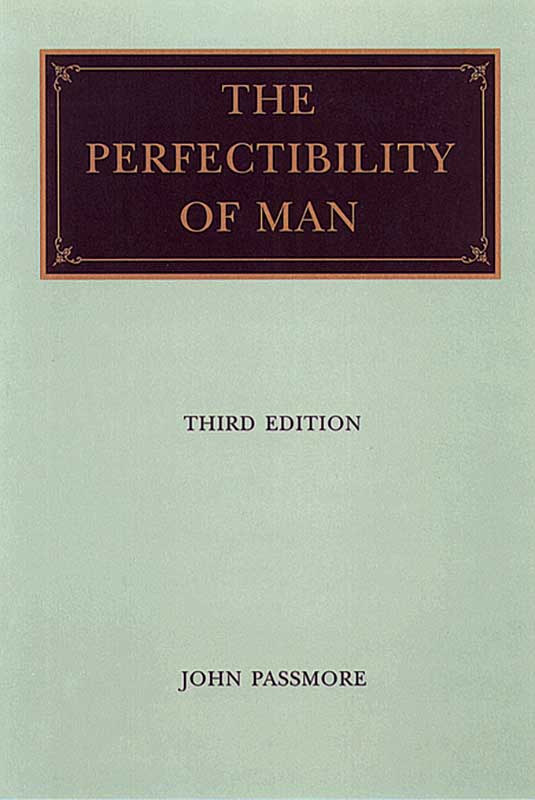
ELEVEN: PROGRESS BY NATURAL DEVELOPMENT: FROM JOACHIM TO MARX - John Passmore, The Perfectibility of Man [1969]Edition used:The Perfectibility of Man (3rd ed.) (Indianapolis: Liberty Fund, 2000).
About Liberty Fund:Liberty Fund, Inc. is a private, educational foundation established to encourage the study of the ideal of a society of free and responsible individuals. Copyright information:The copyright to this edition, in both print and electronic forms, is held by Liberty Fund, Inc. Fair use statement:This material is put online to further the educational goals of Liberty Fund, Inc. Unless otherwise stated in the Copyright Information section above, this material may be used freely for educational and academic purposes. It may not be used in any way for profit.
ELEVENPROGRESS BY NATURAL DEVELOPMENT: FROM JOACHIM TO MARXOf those many Christians, of varying degrees of heterodoxy, who have sought to make use of Biblical prophecies in order to predict the future course of human history, one was of exceptional importance: the twelfth-century monk Joachim of Flora. “The knowledge of things past,” he wrote, “is the key of things to come.”1 Only if they can find such a key can men be sure that in the long run they are bound to be perfected, by the mere onward flow of history. Although, in an age much given to numerology, the advent of the year ad 1000 had for a time revived men’s hopes that Christ’s advent was near, by the end of the twelfth century most Christians had ceased to believe that the Second Coming of Christ was imminent. Reading the prophetic books and the Gospel according to John, Joachim came to the conclusion that what was properly to be expected was not, immediately at least, the Second Coming of Christ but rather the Third Coming of God, the Coming of the Holy Ghost, sent by Christ just as the Father had sent Christ. The history of mankind, as Joachim saw it, falls into three main stages, each corresponding to a particular person of the Trinity.2 The Age of the Father was the kingdom of law; the Age of the Son was the kingdom of grace. Still to come—one of Joachim’s disciples, Gerard of Borgo, set the date more precisely, as ad 1260—was the age of the Holy Ghost, the kingdom of grace abounding. In the first two ages, so Joachim tells us, men have lived in servitude. In the kingdom of the Father they lived as slaves to the law, in the kingdom of the Son with “the servitude of sons.” Now the time has come at which they are to be freed, enabled to confront God, not in fear, as in the reign of the Father, not with faith, as in the age of the Son, but with love, as “friends to God.” The Church, Joachim was confident, would be reformed under the influence of a new élite, the spiritual monks—a role the Franciscans were only too willing to assume; the Bible would at last be fully comprehended, its symbols would be made plain and its message would conquer the world. Men would be granted spiritual understanding, perfection in holiness, and could thereby achieve, here on earth, the condition of angelic spirits. The importance of Joachim’s vision was that it encouraged men to anticipate the arrival of a long period of secular history, based on freedom and love, rather than a Last Judgement. Before Joachim, of course, there had been, as there still are, millennarians, convinced that Christ would come again and that after his advent the spiritual élite of all ages would be resurrected to rule with Christ over an earthly paradise. It was a novel view, however, that mankind as a whole was progressing towards a form of human society which would realize its ethical ideals. More important still, there is an internal logic in the teachings of Joachim, a suggestion of dynamic processes inherent in human history itself, which is conspicuously absent in his predecessors. It is not just that, as for the millennarians, there is to be another Coming: the society which will succeed that Coming is already in gestation. “If Almighty God,” Joachim writes, “wants to terminate the old to create the new, he allows persecution to arise within the Church. Then he abandons what he wants to terminate and protects that which he wants to live on. Thus we can say that the new and the good, which were hidden in the dark, can be brought to light when the opportunity arises.”3 Joachim tried to show in detail how one age prepares the way for another, not only by its virtues but, even more, by its defects. The corruption of the Church, for example, its lack of evangelical zeal, its avarice, were, on Joachim’s interpretation of history, essential prerequisites for the appearance of a new, more spiritual age; they could not have been avoided, if God’s plan was to be fulfilled. Only through struggle between the old and the new could the pattern of history be unfolded. It is not surprising, then, that philosophers so different from one another and from Joachim as Lessing in the eighteenth century and Schelling and Comte in the nineteenth century have paid homage to Joachim as their predecessor. Lessing’s three Revelations; Schelling’s Ages of Fate, of Nature, of Providence; Comte’s three stages of history—the religious stage, the metaphysical stage, the positive stage; Hitler’s first, second and third Reich, all echo the Joachist tripartition of history.4 Although Joachim himself, of course, took it for granted that the whole historical process was both God-governed and prophesied in Revelation, he at the same time left the way open for philosophies of history which, like Comte’s, were devoid of all reference to God or to Revelation. For the historical investigation of a particular age, if Joachim was right, could detect in that age the seeds of the future, and the processes by which those seeds would spring to life. The history of the Joachist movement foreshadowed problems which were to loom large in subsequent philosophies of history, controversies about the practical implications of historical prophecies. To Peter John Olivi, one of Joachim’s most ardent disciples, the situation was perfectly clear: Joachim had shown what must happen; men should now sit and wait until God chose to act in whatever way best suited his plans. “The revivification of the spirit of Christ and the reformation of the evangelical state,” he wrote, “is not a human matter; nor can it or should it be done by man, but only by Christ.”5 More revolutionary-minded Joachists, in contrast, saw in Joachim’s prophecies a blueprint for action. Indeed, it was not long before Joachim’s own writings came to be regarded as a Third Revelation, thus adding yet another to the triune antitheses of which Joachim was so fond: a Third Testament for the Third Age. The Joachist Anabaptist, Thomas Münzer, was not the sort of man to sit back and wait, in humility, for God’s plan to be unfolded. The new age was at hand; he was convinced that God meant him to help it along, not merely, as Joachim had done, to preach the joys to come. For God’s reign to be initiated, the existing authorities had first to be exterminated: that was God’s order. In a letter of May 12, 1525, addressed to Count Ernst von Mansfeld, Münzer informed the Count, his sovereign ruler, that God had ordered the Anabaptists to remove him from the throne. “For you are useless to Christendom. You are a pernicious scourge of the friends of God.”6 In the practical interpretation of Joachist teaching, then, a new set of problems broke out, provoking controversies which were more than reminiscent of the old Pelagian-Augustinian debate. The question now in dispute is to what extent men, by deliberate effort, can affect the course of history. If the new age must begin in ad 1260, then, on the face of it, they have little or no capacity to do so. Whatever they do the date is fixed and unalterable. One might call this the “purely evolutionary” view. And it carries with it the risk, of which Pelagius was so conscious, that men will then do nothing to improve themselves, sitting back to wait for that new age which must, independently of their actions, set them on the path to perfection. On a purely revolutionary, purely Pelagian, interpretation—which will have to abandon the idea of a fixed date, as it had to be abandoned, in any case, once the magic year had passed—Joachim had done no more than indicate the kind of perfect kingdom which men could, if they tried hard enough, construct by their own efforts. But on such an interpretation, there is no longer any guarantee that the third kingdom will in fact come about. It functions as a Utopia, as a reminder to men of what they might become; it serves as an inspiration to their efforts. But it is the success or failure of those efforts, whose success is by no means preordained, which alone can determine whether Utopia will be realized. (Just as the Pelagian, so Luther complained, has no guarantee that his efforts to secure salvation will be successful: at any point he may slip into sin and be damned.) Or, finally, it might be argued that although in the long run God guarantees that the perfect kingdom will come about, this will only be as a result of human efforts which, by the degree of their energy, are able to advance or retard the beginning of the new age—an interpretation which corresponds, very roughly, to a theory of “co-operative” grace. The revolutionary, on this view, fights with God on his side but can aid or hinder God’s plans. So, in the nineteenth century the anarchist P. J. Proudhon was to argue that even though “a revolution is a force against which no power, divine or human, can prevail” it may yet be “directed, moderated, delayed.”7 This, for obvious reasons, has been the most widely held of the three views, just as within Christianity the most widely-held view has been one which tries to incorporate free will and predestination into a single system of thought. But its difficulties are manifest. Joachim’s modern admirers, whatever view they took on this particular issue, were not prepared to found on Revelation their belief that history was the gradual unfolding of a divine plan. For the most part, they looked elsewhere for “the key to history,” to metaphysics rather than to Revelation, and more specifically to a developmental metaphysics, based on the presumption that every potentiality must eventually be actualized. Such a metaphysics was first sketched by Leibniz. Since every created thing must eventually actualize the perfections it potentially contains, it follows, according to Leibniz, that the universe as a whole must display a “perpetual and very free progress . . . such that it advances always to still greater improvement,” as one thing after another attains to its individual perfection.8 This does not imply, however, that the Universe will ever reach a static condition of absolute perfection. The Universe is infinitely complex; there is therefore no question of its ever realizing all its potentialities. Fresh perfections will always remain to be unfolded. And so, Leibniz concludes, progress will never come to an end. Men can look forward not only to a human history which constantly increases in perfection but, more than that, to a constantly perfected Universe. The progressive perfection of man, indeed, is a consequence of the progressive perfection of the Universe. There are problems, on which we have already touched, in understanding the Leibnizian view, problems which turn around his use of the word “perfection.” On the face of it, all Leibniz is saying is that every potentiality must at some time be actualized; granted this extremely large assumption, these potentialities might turn out to be, one would think, potentialities for evil as much as for good. Perhaps, even, the potentialities which have still to be unfolded are all of them potentialities for evil. Unless Leibniz’s view is coupled with another, even less plausible doctrine, viz. that evil is never “actual” but only the failure of a potentiality fully to be realized, it does not supply men with any real ground for optimism about their future.9 But this crucial point was almost universally overlooked. Indeed, for a time, the “dynamic” side of Leibniz’s philosophy exerted no influence—it must be remembered that much of Leibniz’s work remained for long unpublished. The emphasis, at the hands of such system-ridden Leibnizians as Wolff, was on the other, static, side of Leibniz’s teaching. Individuals, on this view, might progress, but the system of the Universe as a whole was fixed, in a way which necessitated the continued existence of evils. So Moses Mendelssohn, popularizing Wolff’s ideas, laid it down that progress is open only to the individual. “That all mankind should always progress with the passage of time and perfect itself,” he wrote, “this does not seem to me to have been the purpose of Providence.”10 Thus the standard Christian view was reinforced, in the name of a Leibnizian-style philosophy. In his brief, but historically pregnant, Idea of a Universal History from a Cosmopolitical Point of View11 Kant took over and developed the Leibnizian view that, in Kant’s words, “all the capacities implanted in a creature by nature, are destined to unfold themselves, completely and conformably to their end, in the course of time.”12 He felt the need, as Leibniz did not, of supporting this metaphysical presupposition by independent evidence. Leibniz, like so many of his predecessors, took for granted what Lovejoy has called “the principle of plenitude,” i.e. the principle that whatever can exist must somewhere actually exist, since otherwise the potential creativity of God would not be fully realized.13 In his first major publication—The General History of Nature—Kant had unreservedly accepted the principle of plenitude. “It would be absurd,” he there wrote, “to represent the Deity as bringing into action only an infinitely small part of his creative potency.”14 But after the destructive endeavours of his Critique of Pure Reason, Kant could no longer enunciate such metaphysical principles with the same confidence. In his Idea of a Universal History Kant relies on arguments of a different sort, partly empirical, partly moral. First, an argument from science: anatomy teaches us, Kant says, that there is a “contradiction” in the very idea of “an organ which is not to be used, or an arrangement which does not attain its end.” If that argument does not satisfy us—our minds turn, perhaps, to the human appendix—Kant has another at his disposal. To reject the idea of inevitable progress is to be forced back, he says, on the “cheerless gloom of chance” as opposed to the idea of a nature governed by law.15 If we still hesitate, doubting whether the “cheerfulness” of a doctrine is a good reason for accepting it, Kant appeals, in his more characteristic fashion, to our sense of duty: it is morally necessary, he says, that we should believe in the perfectibility of human society, since to believe otherwise would weaken our moral efforts. The perfectibility of society is a “regulative idea” which must govern our conduct. An obvious objection springs to mind. If all capacities are destined to unfold themselves, then the reason of every individual man must perfect itself; otherwise it does not “achieve its end.” And this is clearly not the case. Men die, prematurely, or their minds are affected by disease, or they never meet with the circumstances in which their potentialities could unfold. To understand how every perfection can, in the end, be achieved, we have to concentrate our attention, Kant replies, not on the development of individual men, but on the development of mankind—of man as a species. We have to suppose that although each man must do what he can to perfect himself, this is only as a means to the perfection of mankind. “It is to be the happy fate of only the latest generations,” Kant says, “to dwell in the building upon which the long series of their forefathers have laboured, without so much as intending it and yet with no possibility of participating in the happiness which they were preparing.”16 Christian millennarians had avoided this conclusion—why should later generations have all the luck?—by supposing that the élite would be resurrected to share in the rule of Christ on Earth. Kant held out no such expectation; individual men must, on his view, content themselves with the reflection that mankind, although not they themselves as individuals, will be perfected as a result of their efforts. For it is their moral duty thus to content themselves. It is one of the most important features of Kant’s essay that, like Pomponazzi, he thus shifts the emphasis from the perfectibility of the individual to the perfectibility of the human species. Scarcely less historically important is his suggestion that the outcome of men’s struggles will be a perfect State. “The highest purpose of Nature will be at last realized,” he writes of his ideal future, “in the establishment of a universal Cosmopolitical Institution, in the bosom of which all the original capacities and endowments of the human species will be unfolded.”17 The perfect “cosmopolitical” state, furthermore, will be a member of a Federation of States, a League of Nations.* For only within such a League can men achieve that “perpetual peace” which, to Kant, is an essential prerequisite of human perfection.18 Kant suggested, too, a particular mechanism of social change. “The means which Nature employs to bring about the development of all the capacities implanted in men,” he writes, “is their mutual antagonism in society, but only so far as this antagonism becomes at length the cause of an order among them that is regulated by law.”19 With the help of this Joachim-like doctrine Kant hoped to solve a problem which is of central importance to him: to reconcile Christian pessimism about the nature of man with Enlightenment optimism about man’s future. Although he rejected the orthodox Christian doctrine of original sin—describing it, indeed, as “the most inept” of all explanations of human evil—Kant is nevertheless at one with orthodoxy in maintaining that man’s nature contains a “radical evil” which reveals itself as soon as men are capable of willing.† Man is not born naturally good, or naturally innocent. Nor is it true to say, with the Stoics, that although he has propensities which will lead him astray if they are not controlled by reason, reason can entirely conquer them. Evil, at least in the form of frailty and impurity, lies deep in the heart of human nature. This conclusion might well have led Kant, as it led so many of his predecessors, to deny that man is capable of making moral or social progress, except perhaps for short periods of time. Moses Mendelssohn had suggested that “the human race . . . has never taken a few steps forwards without soon sliding back with double rapidity to its former state.”20 But Kant was too deeply attached to the aspirations of the Enlightenment to take that view. So what Kant rather argues is that the evil in man’s nature is precisely what leads him along the path towards social improvement. “Thanks be then to Nature,” he writes, “for this [man’s] unsociableness, for this envious jealousy and vanity, for this insatiable desire of possession, or even of power!” Were it not for them, so Kant suggests, “all the excellent capacities implanted in mankind by nature, would slumber eternally undeveloped”—man would be content to live the life of an Arcadian shepherd.21 It is only because men’s spirit of emulation arouses them from their natural desire for a peaceful life that they are led into the political struggles which give rise to strong national States—the essential prerequisite, on Kant’s view, for human progress. “One purpose,” Kant writes in his Perpetual Peace, “shines manifestly through all her [Nature’s] mechanical order: to use the discord of men for producing concord among them against their own will.”22 Men’s struggles, their conflicts, not their peace-loving nature, are what keep them bent on progress, and especially on progress towards that “perpetual peace” so dear to Kant’s heart. And their commercial instincts carry them in the same direction: the love of money, in itself deplorable, leads men inevitably to “honorable peace.”23 Mandeville’s “private vices, public benefits” found in Kant an historical application, foreshadowing that Fichtean dialectic which Hegel and Marx were to turn to their own purposes. Kant’s doctrine of man, however, confronts him in a particularly acute form with a familiar problem. If it is a necessary condition of man’s progress that he be controlled by a good ruler, where is that ruler to come from, given that all men have in their nature a radical evil? “The highest authority,” Kant writes, “has to be just in itself, and yet to be a man. This problem is, therefore, the most difficult of its kind; and, indeed, its perfect solution is impossible. Out of such crooked material as man is made of, nothing can be hammered quite straight.”24 Yet Kant is not prepared to conclude that the road to perfection must therefore be closed. He admits no more than this: that the choice of a legislator will be the last problem to be solved, since it needs for its solution great experience and much good will. This solution is by no means satisfactory; to depend on man’s good will is, in the light of Kant’s theory of human nature, to display an optimism there is no way of justifying. It is not surprising, then, that when Kant had directly to confront Mendelssohn’s denial that humanity makes progress, he fell back on his moral-pragmatic argument. He does not have to prove, Kant says, that man is actually progressing: he can take his stand on man’s “innate sense of duty.”25 However strongly the argument from history may seem to bear against his hopes, Kant continues, it does not demonstrate that, as Mendelssohn had contended, man’s progress can never be more than temporary. And so long as Mendelssohn’s conclusion cannot be demonstrated, men have a duty, Kant says, to believe that they can act now to improve mankind’s future. Kant did not admit that, in fact, mankind has made no progress; human progress, he confidently asserts, has been real, although limited and uneven. He has recourse, too, to the theological argument that unless men can some day advance beyond their present state it is impossible to “justify creation” for putting such a race of creatures in the world.26 But the moral-pragmatic argument came to be more and more central in his thought. For if man is radically evil, it is impossible to understand how his case can be cured merely by strengthening a State which will be ruled, inevitably, by a corrupt human being. This is only one of the difficulties which confront Kant’s prediction that men will someday find perfection in a perfect State. Perfection for Kant, as for the Christian tradition, implies much more than mere conformity to law. To be perfect men must not only do “the right thing,” they must act out of the right motive—on Kant’s view, out of respect for the moral law. And although a perfect State might be able to compel all men to conform to the law it is quite another matter to suggest that any form of State action could ensure that men will act out of the right motive. In his Idea of a Universal History Kant tried to solve this problem by suggesting that the State is not merely a coercive but an educative agent. Once it no longer has to waste its resources and its energies on fighting wars, it will be able wholly to devote itself to the moral education of its citizens. Kant does not doubt that with the help of education the State can develop “the right mental disposition” in its citizens.27 Nine years later, however, in his Religion Within the Limits of Reason Alone, Kant took a rather different view. He there distinguishes between that condition—he calls it “juridico-civil”—in which men are governed by coercive laws and that far superior “ethico-civil” condition in which they are united by “laws of virtue” in an “ethical commonwealth,” as contrasted with a merely “political commonwealth.”28 He still argues, no doubt, that an ethical commonwealth must rest on a political commonwealth; the two, however, are far from being identical. It is towards the coming into being of an ethical commonwealth, the suggestion now is, that men are morally bound to direct their efforts. Kant freely admits, however, that human effort does not suffice to create an ethical commonwealth. The ethical commonwealth is a Church, a “City of God,” not a State; it must be governed by God, and only God can bring it into being. This does not absolve men, Kant still argues, from acting as if everything depended on them; only by so acting can they hope that God will crown their efforts. To use the language of a later day, the ideal of an ethical commonwealth which men can bring about by their own strivings is a myth, but a myth by which men ought to govern their conduct.29 The commonwealth must finally come about, Kant is convinced, just because its coming into being does not depend on men’s “crooked wills,” or—unlike the ideal State—on their capacity to choose an ideal ruler, but on the grace of God, granted towards men who seek to bring about what he has willed. By shifting his emphasis from the ideal of a perfect State to the ideal of an ethical commonwealth Kant at once avoids the objection that men cannot be moralized by State action and the objection that in order to create an ideal State “radically evil” men would have to entrust their fortunes to a “radically evil” legislator. The cost of this shift, however, is the admission that men can perfect themselves only with the aid of infused divine grace, neither entirely by their own efforts nor as a result of the workings of impersonal, metaphysically necessitated, laws. Faced with a similar problem, the nineteenth-century followers of the French socialist Saint-Simon had recourse to mysticism rather than to Kant’s “rational theology.” The ruler of the ideal society, on their view, will be a genius who simply “reveals himself”; he will be recognizable by the fact that the people will unanimously accept his authority.30 Kant was no friend to this kind of mystical absolutism. But he raised in men the hope that they could attain to a perfect society without providing them with the mechanism for doing so. More secularly-minded perfectibilists, unable to believe that such a society can come about only by God’s grace, were tempted to find a substitute for God in an “inspired ruler.” Kant liked to draw attention to the way in which men’s bad intentions can work for good; in the fate of Kant’s own political philosophy we can see just as clearly the way in which men’s good intentions can work for evil. Kant’s Idea of a Universal History is no more than an outline; he looks forward to the appearance of, but does not himself profess to be, a “Newton of history” who would reduce history to a science just as Newton had reduced physics to a science. His former pupil, Herder, had already set out to be such a Newton.* The two men agreed on a great many issues. (It is pointless to try to establish priorities; they inherit a common legacy.) Herder, however, would have nothing to do with a Providential plan which culminates in, or rests upon, a State, an institution for which, to say the least, he displays no enthusiasm. Sometimes (to the horror of his Idealist successors), he writes about “the costly machines of state” almost in the manner of an anarchist.31 “The State,” he once wrote, “robs men of what is most important—themselves.”32 As for the view advocated by Helvetius and his followers, that nations can be civilized by a universally applicable “art of legislation” this was, to Herder, the height of absurdity; nations are civilized by strengthening their own “veins and sinews,” not by imposing upon them from outside an alien set of laws.33 Furthermore, Herder was dissatisfied with Kant’s view—Kant himself calls it a “mystery”—that men must be prepared wholly to sacrifice their present happiness in the interests of an ideal community which they will not live to see established. It must be possible, Herder thought, for men to achieve happiness and perfection in their own lifetime; to ask them to sacrifice everything to the future struck him as monstrous. What then, if not the setting-up of an ideal State, is God’s plan for man? Herder, so far like Kant, describes it in Leibnizian terms: God’s plan is that man shall fully realize, by his own efforts, his “humanity.” Unfortunately, however, the idea of “humanity” is as obscure in Herder’s thought as it is central. At one point Herder defines it as “reason and equity in all conditions and in all occupations of men.”34 That brings it fairly close to what Kant was later to call an “ethical commonwealth.” But elsewhere Herder defines it more widely as including “the noble conformation of man to reason and liberty, to finer senses and appetites, to the most delicate yet strong health, to the population and rule of the Earth.”35 In short, “humanity” is the realization of whatever forms of good man has it in himself to achieve. What a man can achieve at one time and in one place, however, is very different from what he can achieve at another time and in another place. That is a point which Herder particularly emphasized. It is ridiculous, he argues, to judge primitive Red Indians as if they were trying, and failing, to be eighteenth-century Europeans, let alone members of an Ideal State. Each nation has the task of bringing to perfection whatever, situated as it is, it is capable of perfecting, as the Romans perfected eloquence and the Red Indians perfected hunting.* The same is true of individuals. “What of Shakespeare?” Herder asks, “Had he no taste, no rules?” And he answers: “More than anyone else; but they were the taste of his time, the rules for that which he could accomplish.”36 To condemn Shakespeare for not conforming to “classical” standards is quite preposterous; he perfected his own kind of art. Mankind as a whole, on Herder’s view, progresses not by men’s setting before themselves as their objective the progress of mankind but by their perfecting a particular human potentiality. They can then hand over to mankind, as its possession for all time, that particular form of perfection. The history of humanity is like a snowball, to use Herder’s own metaphor, which as it rolls along gathers up all that individual men and individual societies have achieved. The mechanism by which this “gathering up” is accomplished is “education,” understood as the transmission of traditions from one generation to another. “The whole history of nations is to us a school, for instructing us in the course, by which we are to reach the lovely goal of humanity and worth.”37 When that goal is finally reached, after a long period of education, then at last, “wherever men dwell . . . will dwell men rational, just and happy.”38 What at any time they should seek, however, is not this absolute perfection but rather, as Tennant was later to argue, the relative perfection which their circumstances and the standards of their times permit—“Humanity and happiness, on this spot, in this degree, as this link, and no other, of the chain of improvement, that extends through the whole kind.”39 Thus it is that Herder tried to overcome the problem which had beset eighteenth-century perfectibilists, of reconciling their indignant horror at man’s past with their glowing hopes for his future. History was to them, as Gibbon put it, “a record of the crimes, the vices and the follies of mankind” or, as Voltaire no less trenchantly described it, “little else than a long succession of useless cruelties, . . . a collection of crimes, follies and misfortunes.”40 Herder himself had once felt the same way. Until he discovered the principles of his philosophy of history, history had appeared to him, he tells us, as “an abominable series of desolations on a sacred Earth.” But now no longer. He has come to see that “only amid storms can the noble plant flourish” and that although the work of good men may seem for a time to be lost, it will, when “irrigated with blood,” finally shoot forth “an unfading flower.” Revolutions, bloody as they may be, help to keep the world young: “the genius of humanity blooms in continually renovated youth, and is regenerated as it proceeds, in nations, generations, and families.”41 Progress, that is, is not a matter of a lineal succession from the bad to the good, to the better, to the perfect. The idea of a “general, progressive amelioration of the world” Herder dismisses as a mere fiction: “a quiet progress of the human spirit towards the improvement of the world is hardly anything more than a phantom of our minds, and never the working of God in nature.”42 Once a society has accomplished all that it can accomplish, it must be destroyed, and it may be replaced by a society inferior to it in many respects. Roman civilization is no doubt infinitely inferior to the civilization of Greece; the Middle Ages is certainly inferior to Rome. But to say this is not to deny, according to Herder, that there is a divine plan in history, by which men are linked in a “golden chain of improvement.”43 Greece achieved what it could achieve, Rome achieved what it could achieve, the Middle Ages achieved what they could achieve, each in a fashion determined by the needs of the place and the time. So every age demonstrates, in its own particular way, what man can accomplish. It is illuminating to compare Herder’s with what may fairly be described as the “conventional” eighteenth-century account of Providential government, which Kant had been content to modify. According to that conventional account, evils are necessary as a means to goodness. So although, for example, the Roman Empire had, in Herder’s phrase, “a bloody history,” it was a necessary stage in human progress because it served the ends of God by diffusing the Christian religion. Herder will have none of this. God, he argues, could have chosen other means; it still has to be explained why he chose bloodshed. The consequence, furthermore, of his using this particular means, if it is to be thought of as a means, was the birth of “a romish christian bastard . . . of which there are many who wish, that it had never been born.”44 The rise and fall of the Roman Empire, that is, cannot be justified if it is thought of as a means towards the diffusion of Christianity. But the fact is, Herder argues, that the Roman Empire had its own energies, its own intrinsic perfection, just as Christianity has. If we want to understand why Rome rose and fell, we must look, as Gibbon looked, to secular causes, not to “final causes,” not to ends to which its decline was a means—and Herder, Lutheran pastor though he was, is therefore ready to defend Gibbon against his clerical critics.45 But if we ask why Rome had to exist at all, then the answer is that it demonstrated what man was capable of in the way of fortitude, of poetry, and of eloquence. That is one reason why Herder rejected Kant’s view that it is men’s duty to work towards the Ideal State or even towards an ethical commonwealth. When men take the future as their objective, they are liable to overlook their duty to the present, and it is by performing that duty, Herder thought, that they will most effectively hasten mankind’s progress towards perfection. “To set goals beyond the grave harms rather than promotes the welfare of mankind.”46 Herder thus made of himself an apostle of the present, as opposed both to the view that all perfection lay in the past, in some remote golden age, or that perfection will come to pass only in the future, in some equally remote Utopia.47 Turgot worked out the “conventional” view in a way which brought him closer to Herder and yet which enables us to see in what the peculiarity of Herder’s theory of progress consists. This was as early as 1751, in an unpublished “Plan for Two Discourses on Universal History.” Turgot’s principal thesis is that evil brings forth good. Thus although, he says, the wars by which clans were transformed into nations had as their motives greed and ambition and were fought cruelly and destructively, they were none the less essential if men were ever to learn to speak a common language and to build up, in that language, a body of knowledge. So far Turgot is working with that means-end picture of Providential action to which Herder so strongly objects—although there are places in which he falls back on it. But Turgot goes on to make a rather different point. “No change has occurred,” he says, “which has not brought with it some advantage; for none has occurred that has not been fruitful of experience and without extending, or improving, or preparing the way for [man’s] education.”48 That is much more like Herder’s argument. In the end, however, Turgot finds it impossible completely to reconcile the actual events of history with the view that they are, in detail, providentially determined. The rise and spread of Mohammedanism, he writes, “opposes the wall of superstition to the natural progress towards perfection.”49 So, it seems, the actual course of history does not coincide with history’s “natural” progress towards perfection. Mohammedanism ought never to have been. Herder, in contrast, will not admit the possibility of any such conflict between the “natural” and the “actual.” Since Mohammedanism exists, it is wrong, on his view, to dismiss it simply as “a superstition,” although no doubt it is a superstition. There must be something to be learnt from it; in his chapter on “Effects of the Arabian Kingdoms” Herder tells us at some length, indeed, just what Europe has learnt from its Arabian teachers.50 The question still remains, however, what grounds there are for believing that man is bound to learn from history—not by imitating the past but by deriving from it his conception of what is humanly possible—and in this way to proceed towards perfection. Herder lays so much stress on the rise and fall of civilizations that we naturally become doubtful, as we turn the pages of his Ideas, whether there can be any rise without a fall. This is the more so as he gradually abandoned the Augustinian view, to which he had adhered in his Yet Another Philosophy of History—published in 1774, some ten years before the first volumes of Ideas—that mankind can properly be compared to an individual man with, like any such man, a childhood, a youth and a maturity. He argues, rather, that at any given time there exist on the surface of the earth societies which are at different “biological” stages. As he puts the point in his Letters for the Advancement of Humanity, “on our terrestrial globe, all the ages of humanity continue to live and to act.”51 So we are left, on the face of it, with no good reason for believing that “mankind,” as distinct from a particular man or a particular society, has any history at all, that it makes any sense to speak of mankind as moving towards perfection. Confronted with the difficulty of guaranteeing that mankind, in spite of its rises and falls, is in progress, Herder looked for laws. It should first be observed, however, that there was no reason, on his theory of providence, why evils should not disappear. He did not believe in original sin. Man is, on his view, free to choose what is good; he is not corrupted, as Kant thought he was, by a “radical evil.” In imitation of Pico della Mirandola, Herder describes man as “a god upon Earth” with his own fate in his own hands—even if he is also subject to “a wise Goodness” that “disposes the Fate of Mankind.”52 Nor does Herder suggest, as the conventional eighteenth-century doctrine of evil does, that evil must exist if good is to exhibit itself. That it had to exist, Herder admits, but not that it must continue to exist. By struggling to overcome evils, men learn how to perfect themselves, but once they have learnt how to act, what they have learnt can be passed on by education and the evil which gave birth to it allowed to disappear. So although, for example, “the pressure of the romish hierarchy was perhaps a necessary yoke, an indispensable bridle for the rude nations of the middle ages,” the “romish hierarchy” could safely be overthrown once the “rude nations” had been brought into order.53 The only question is whether there is any good reason for believing that such for-the-time-being-necessary evils must disappear. That is where Herder’s “laws” come into the picture. Of these “laws” the most important is that “all the destructive Powers in Nature must not only yield in the Course of Time to the maintaining Powers, but must ultimately be subservient to the Consummation of the Whole.”54 That such a “law” in fact operates can, so Herder argues, be clearly discerned through the study of history: “the progress of history shows, that, as true humanity has increased, the destructive demons of the human race have diminished in number; and this from the inherent natural laws of a self-enlightening reason and policy.”55 Note the phrase “a self-enlightening reason.” We are not now far from the Hegelian conception of history as a process by which Reason comes to consciousness of its own powers. Herder is not a consistent philosopher: two Herders struggle in a single breast—the Lutheran pastor and the philosopher.56 But of the two, it is Herder the philosopher who is of consequence in our story; that is the Herder we have emphasized. For it is he who suggests that each historical epoch, however un-Christian, has something to offer in enabling us to realize what man can become, and it is he who suggests that human history is governed by empirically-detectable laws. And thus it is that, whatever the feelings of Herder the Lutheran pastor, the way is opened up for theories of history which see no need for the supposition that these “laws” are the work of Providence, rather than laws which operate and can be seen to operate at a purely secular level in human history. And the way is opened up, too, for theories which carried Herder’s “historicism” to a point which would not permit Herder to exclaim as he does, with indignation, at, for example, the barbarities of the Roman Empire. Indeed, some of Herder’s German successors—the historian Meinecke, for example—condemn Herder’s emphasis in the Ideas on “humanity” as a retrogressive step. They greatly prefer the less mitigated historicism of Yet Another Philosophy of History.57 This is the kind of “historicism” against which, in the Inaugural Lecture he delivered at Cambridge in 1895, Lord Acton was moved to protest. “Opinions alter, manners change, creeds rise and fall,” Acton told his audience, “but the moral law is written on the tablets of eternity”58 —and it is by that moral law, on Acton’s view, that men, past and present, must be judged. Acton rejected out of hand the contention that “a murderer was no criminal if he followed local custom, if neighbours approved, if he was encouraged by official advisers or prompted by just authority, if he acted for the reason of state or the pure love of religion . . .”59 Acton was opposed to “historicism,” amongst other reasons, because it made nonsense of the idea of progress. “The golden chain of improvement” has to be an improvement by absolute standards if Herder is to avoid the objection that a later age, using different standards, may come to condemn as retrogression what he thinks of as progress. Herder attempted to protect himself against such objections by arguing that certain principles of equity and justice and rationality are engraved in the hearts of all men. Even the cannibal, Herder rather comically tells us, has a sense of justice: “for when he eats the flesh of others, he expects to be eaten in his turn.”60 So Herder felt entitled to condemn with moral fervour “the bloody history of Rome,”61 because Rome did not live up to standards it should have recognized, and did in fact recognize, to be morally binding upon it. But his historicist successors were not to be convinced that the “heart” has any moral principles engraved upon it. If the artistic quality of Shakespeare’s Macbeth is to be judged by the standards of Shakespeare’s time, not of ours, why should not the morality of Macbeth’s conduct, they asked, equally be judged by the standards of his bloodthirsty times? The same tension between relative and absolute standards of moral perfection recurs in Marxism; morality is at once determined by class-membership and yet supplies the Marxist with an absolute standard by which the bourgeoisie can be judged corrupt. Modern anthropologists find it no easier to reconcile their desire to “do justice” to primitive societies, to avoid any hint of patronage, with their inability not to think of, let us say, the life of a New Caledonian cannibal as a poor and miserable one.62 This much is certainly clear: even if the most barbarous ages may unwittingly contribute to the perfection of mankind, and even if they can be excused for their barbarity on the ground that they knew no better, there must be some absolute sense of perfection if it is to be meaningful to assert that, as an absolute fact, man is gradually perfecting himself. Ethical relativism cannot, without inconsistency, be associated with a belief in the reality of progress. In Herder’s philosophy of history a developmental philosophy of history is oddly conjoined with an appeal to historical influences of a wholly empirical sort. On the one side, the whole of history is the gradual realization by man of the potentialities inherent in him; on the other side, the manner of that realization is profoundly affected by geography, by climate, by the crops and the animals at man’s disposal, to say nothing of what, from a human point of view, Herder is prepared to describe as “chance.” Merely from a consideration of man’s nature, or a particular episode in his history, one could not hope, if Herder is right, to deduce the entire course of that history. One has to know not only man but geography in order to understand, let us say, the history of Athens. It is true that geography is not, according to Herder, related in a purely accidental way to the history of mankind. Providence, he says, deliberately disposed the mountains and rivers and seas in such a way as to facilitate communications between certain nations and to cut off others from one another. But the fact remains that although in order to understand history as a whole we need only know that it is an advance towards humanity, to understand why a particular advance occurred at a particular place and time the historian, Herder is willing to admit, has to rely upon his knowledge of quite specific and quite material historical factors. To Herder’s successors in the German Idealist tradition, Herder’s dependence on the empirical, the actual, the material, was intolerable. His suggestion, for example, that the character of human rationality was profoundly affected by man’s erect stature they condemned as the grossest form of materialism, not to be excused by the mere reflection that Providence bestowed that stature on man. One of his German critics, the Hegelian Eduard Gans, was to complain of Herder’s Ideas Towards a Philosophy of the History of Mankind that they “contradict their title by not only banishing all metaphysical categories, but moving in an element of positive hatred to metaphysics.”63 No doubt, it is hard to be metaphysical enough to satisfy a German philosopher. But Herder’s emphasis on man’s erect posture unpleasantly reminded even a more sympathetic Scottish Idealist of La Mettrie’s materialism.64 Kant, too, had tried to compromise. No doubt, history is, on his view, a priori in so far as its general nature and the objectives towards which it moves can be determined simply by considering what is implicit in the idea of “reason,” without any reference to the actual course of history. On the other hand, it is by no means his intention, he tells us, to discourage empirical work in history—although he would like, by providing for it a metaphysical frame, to reduce the amount of detail in which it is involved. Both for Herder and for Kant, one might say, to understand history as a whole is a task for philosophy, but to understand any particular slice of history is a task for the historian. The precise relationship between these two enterprises, however, is by no means apparent. For Fichte, in contrast, any science, and the “science of history” therefore, begins from a single principle and proceeds by unfolding that principle. Herder had already condemned “the German disease of deriving everything, whether it really follows or not, from purely formal propositions”;65 in Fichte and his successors that disease was to rage with unprecedented virulence. Empirical history, Fichte no doubt admits, can serve to illustrate or to exemplify the nature of historical processes. Essentially, however, a science of history will demonstrate what the course of history must be, taking as its starting-point the nature of human activity. “The philosopher,” so Fichte sums up, “must deduce from the unity of his presupposed principle all the possible phenomena of experience.” When the philosopher takes history as his subject, according to Fichte, he “follows the a priori course of the World-Plan, which is clear to him without the aid of History at all; and the use which he makes of History is not to prove anything by it, for his principles are already proved independently of History; but only to illustrate and make good in the actual world of History, that which is already understood without its aid.”66 What “the historical world-plan” is directed towards, Fichte agrees with Kant, is a life in which men govern all their relations freely but in accordance with reason. To reach this point, Man proceeds through five stages, each of which, Fichte tells us, is logically necessary.67 He must from the beginning have been rational since otherwise he could never have become rational. But his rationality, so Fichte argues, was at first instinctive; primitive man accepts the customs and tradition of his community, subordinates his individual interests to them, without apprehending their rationality. From this primitive condition he falls away, in an age of authority, into a condition in which he thinks of authority as something purely external to him; he obeys, but only out of “blind faith and unconditional obedience.” From such a condition of subservience he passes into a third stage, in which individualism is rampant and the claims of rational authority are wholly rejected—“the Age of absolute indifference towards all truth, and of entire and unrestrained licentiousness.” That, so Fichte thought, was the age through which mankind had just been passing—the Enlightenment. (Although it was an a priori truth that human history had to pass through such a stage, it is an empirical question, according to Fichte, at what point human history now stands; Fichte himself vacillated on this matter.) The age of individuality, Fichte suggests, was coming to its end. Man—under the guidance of German idealism—was about to enter a fourth stage, the age of “Reason as Knowledge,” in which reason, as exhibited in the State, should be consciously revered, in which men would freely place themselves at its disposal, as distinct from obeying it by instinct or out of fear. Beyond the age of conscious reason there lies a further stage still, conceived of in Joachim’s fashion as a kingdom of perfect freedom, in which the idea of authority would wither away as unnecessary and man would convert himself into the very image of reason.68 “If all men could be perfect, if all could attain their supreme final goal,” Fichte writes, “they would all be absolutely identical; they would be one, one subject.” Thus it is that “the final goal of society is the fusion of all, the unanimity of all the possible members.”69 This “final goal” is in many respects a reversion to the original state of man: humanity sets out to return to that condition of instinctive rationality into which it was created. But the journey is a necessary one; humanity has to learn not only how to be governed by reason but how consciously to participate in reason’s work.* We need no longer be perturbed that the history of man as it has so far progressed does not, on the face of it, encourage optimism about the history of man as it is yet to be. The past had to be torn asunder by conflicts; history proceeds “dialectically.” Recurrent conflicts between, for example, the “thesis” of individuality and its “antithesis,” authority, were essential to human progress. Only thus could society achieve a higher “synthesis,” in which, by man’s own free choice, authority and individuality will be at one. We need not worry, either, lest perhaps man never will be perfected: he is bound to be perfected, by the very logic of history. Granted only the original presupposition that history is the gradual self-revelation of mind, everything else, so we are given to understand, logically follows. (Like Condorcet before him, however, Fichte is constrained to admit that the “natural” course of history is sometimes disturbed by “external influences.”) If we ask what form this perfection will take, Fichte’s answer is that Nature will at last be conquered by spirit, or more accurately perhaps—Fichte’s metaphysics is extremely complex and obscure—spirit will eventually reveal itself fully in Nature. The earthquakes, the volcanoes, the hurricanes which at present disrupt human life are nothing more than “the last struggles of the rude mass against the law of regular, progressive, living, and systematic activity to which it is compelled to submit.”70 Nature, that is, like human history, is still in process. It has not yet realized its perfect form; it is not yet subject to wholly regular laws; it still resists man’s efforts. But it is destined in the end to provide him with a suitable dwelling place. Nature, then, will be completely controlled. It will also be fully understood, as men come to see in it the workings of spiritual laws. Work will cease to be a burden, as men learn how to reduce mechanical toil. What are now savages will develop into cultivated and virtuous men, since otherwise “it is impossible to conceive of a purpose in their existence.” All humanity will “unite itself into one single body, all the parts of which shall be thoroughly known to each other, and all possessed of similar culture.” If it must be admitted that mankind, in respect of individual works of art and philosophy, has still not passed beyond “the aesthetic and intellectual culture of the ancient world,” this is not, Fichte reassures us, because it is retrogressing, but because in its present stage what it has to do is to spread culture throughout the world. That once achieved, when “the existing culture of every age shall have been diffused over the whole inhabited globe,” then it is that “without further interruption, without halt or regress, . . . humanity shall move onward to a higher culture, of which we can at present form no conception.”71 Such a “higher culture,” for Fichte, is not merely a goal towards which all men ought to strive. Fichte is prepared to write of it that “it shall, it must be realized” since the very existence of rational beings is unintelligible unless this is their purpose. If it is never to come into being, according to Fichte, then all human life is merely a “theatrical display for the gratification of some malignant spirit,” and a rational man has but one course to pursue: to commit suicide. That “human life” might fall between these two extremes, as neither a stage on the way to absolute perfection nor yet “a mere theatrical display for the gratification of some malignant spirit,” is a possibility Fichte does not so much as contemplate.72 Such an all-or-nothing attitude to life is, indeed, characteristic of perfectibilists: they can endure the present—Fichte yields to nobody in denouncing his own times—only if they can think of it as a necessary stage on the way to the perfection of all men. It is not enough, for them, that life should continue to be a mixture of horror and exaltation, of pain and happiness. There is always a particular danger in developmental “logically necessary” theories of perfection, comparable to the danger inherent in theories which lay all the stress on divine grace—the danger that men will think of their own actions as impotent. Fichte fully recognizes, as Kant had done before him, what Hegel was to call “the cunning of history.” Good men, acting with virtuous intentions, may nevertheless work against the development of human society. “The most despicable passions of men, their vices and their crimes, often forward, more certainly, the good cause than the endeavours of the virtuous man, who will never do evil that good may come!”73 If, then, the attainment of an earthly paradise is “the whole object” of our existence, it looks as if, all the same, it is not something we can sensibly take as an end, for we can never know what will further and what will hinder its realization. “It seems that the Highest Good of the world pursues its course of increase and prosperity,” so Fichte sums up this line of reflection, “quite independently of all human virtues or vices, according to its own laws.”74 To Fichte, with his intense belief in the importance of moral effort, such a conclusion is intolerable. To avoid it, Fichte introduces the conception of a “transcendental” life over and above the “sensual” life—the equivalent of the Christian heaven but thought of, in a neo-Platonic manner, as a life in which a man can participate here and now. If man’s end were entirely to be found in everyday, terrestrial, sensual life, then his free will, his virtue, his good intentions would have no point; the only question would be whether what he did, from whatever motive, advances or retards the progress of mankind. But there is another, more glorious end, so Fichte suggests, which men will come to know only in another life, a life in which God will “set before me some other purpose wholly incomprehensible to me here.”75 (At this point, in the characteristic Lutheran manner, Fichte appeals to “faith.”) It is this life for which men prepare themselves when they follow their conscience, when they act as they ought to act, whatever the consequences of their action. And by this means they perfect themselves as distinct from perfecting human society. “I am immortal, imperishable, eternal, as soon as I form the resolution to obey the laws of reason; I do not need to become so.”76 As part of his argument to this conclusion, Fichte reinstates the older ideal of a final, absolute, perfection in contrast with the Enlightenment ideal of limitless perfectibility. “The generation which has once reached it,” he writes, “can do no more than abide there, steadfastly maintain its position, die, and leave behind it descendants who shall do the like.”77 Fichte makes use of this fact, indeed, to argue that such earthly perfection, “conceivable, attainable, and finite” cannot be man’s final end; by moving beyond it to a transcendental life Fichte hopes to avoid the conclusion that the progress of humanity eventually comes to a standstill. Thus it is that, with a great deal of help from Kant’s metaphysics, Fichte conjoins in a single system the secular aspirations—or certain of them—of modern perfectibilists and the godlike aspirations of the Platonic tradition; thus it is, too, that he tries to conjoin a belief in the logical inevitability of progress with a moral theory of the traditional sort, for which what counts morally is not the consequence of my act but its intention. It is every man’s moral duty, according to Fichte, to act in such a way as is most likely to advance the progress of humanity, but the moral value of his action, its contribution to his own perfection, is quite independent of its actual consequences. It is not surprising, of course, that the Fichtean variety of perfectibilism should be so different from the French variety, as illustrated, for example, in the writings of Condorcet. Fichte was a religious-minded professor of humble origin, living in a small community, with no developed middle class, and in a country where the Church was strictly under State control; Condorcet was a man of affairs, a marquis, a mathematician, in a powerful country where commerce, however restricted by feudal institutions, was rapidly expanding, and the Church proclaimed its independence of the State. For Fichte to have grounded his case for progress on the weakening of the Church’s power, or even on the weakening of existing State authorities, would have been, in the German context, ridiculous; so far as there had been progress in Germany it had come from above, from enlightened rulers, and so far as there could be further progress it depended on the unification of Germany, on that surrender by petty princelings of their powers and prerogatives which in his Addresses to the German Nation (1808) Fichte so warmly advocated. So Fichte envisaged progress as, in the first place, progress towards unification; only in a unified state, as he saw it, could men be free and rational. The French and English Enlighteners, in contrast, had already experienced unification: they looked forward to commercial expansion beyond national boundaries, a commercial expansion which would bring with it, they correctly believed, the development of science, widespread prosperity, a growing tolerance of intellectual differences. Progress, in their eyes, lay in the development of new forms of human activity, human enterprise, and to this there was no end. To a German idealist it lay in the development of a national spirit and the surrender of individual interests to that spirit; by its nature it converged into an ever increasing degree of unity. The old German mystical Christianity, with its emphasis on “union with God,” on self-sacrifice, on the abandonment of individual interests, was united with the typical Lutheran emphasis on “vocation,” so strong in Fichte, and called upon to sanctify the emergence of a national spirit. That, not the satisfaction of desires, was in Fichte’s eyes the path to perfection. And it had a terminal point: it converged towards an absolute unity, towards a complete identification of interests, whereas French perfectibilism fanned outwards, commerce and science generating new desires in the very process of satisfying old ones. In the philosophy of Hegel the idea of development is sharply separated off from the idea of infinite progress. Although Hegel, like Fichte, believed that what happens in history is a matter of logical necessity, he disclaimed all ability to predict the future condition of human society. The philosophy of history, on his view of the matter, consists in a “thoughtful consideration” of history as a “rational process” which is at the same time a revelation of “the wisdom of God” and the coming to “the consciousness of its own freedom on the part of Spirit.”78 That is the limit of the philosopher’s achievement. Of the perfectibilist aspirations which Fichte shared with Condorcet, there is in Hegel very little sign. It is true that in The Philosophy of History, Hegel accepts the doctrine of the perfectibility of man, if this is taken to mean what it meant for Rousseau, that man has within him the capacity to improve his position in the world. But this, he says, tells us nothing about the form which that improvement will take; the fundamental idea we need in order to understand history is development, not perfectibility. Hegel himself was more than satisfied with what had so far happened in history. Spirit had come to full consciousness of itself, he thought, at the political level in the Prussian State and at the intellectual level in his own philosophy. No doubt the “World Spirit” would go on working; indeed, Hegel went so far as to predict a great destiny for Russia and for the United States. “America,” he wrote, “is therefore the land of the future, where, in the ages that lie before us, the burden of the World’s History shall reveal itself.”79 But philosophy, on Hegel’s view, cannot determine in detail what Spirit will do next; it can do no more than help us to understand what Spirit has so far done. Hegel applied to philosophy Herder’s historicism, although in a way that Herder certainly did not intend. Herder had argued that men should seek the kind of perfection, the kind of happiness, possible to them in their own time and age. Hegel took a parallel view about philosophical understanding. “Whatever happens,” he writes, “every individual is a child of his time; so philosophy too is its own time apprehended in thoughts. It is just as absurd to fancy that a philosophy can transcend its contemporary world as it is to fancy that an individual can overleap his own age.” And the same applies to social projects: “if his theory really goes beyond the world as it is and builds an ideal one as it ought to be, that world exists indeed, but only in his opinions, an unsubstantial element where anything you please may, in fancy, be built.”80 We drew attention, in discussing Herder, to the extreme difficulty of persisting in an ethical relativism, firmly adhering to a decision “to judge every community by its own standards”: the very judgement that this is what we ought to do is an absolute, not a relative, one. Even more difficult is the attempt to maintain, as a timeless philosophical truth, that there are no timeless philosophical truths. Hegel, after all, is professing to show us something not merely about his own time but about the general forces in operation in history. It is not surprising that Hegel’s disciples formed themselves into two groups, right-wing and left-wing Hegelians, the first accepting, the second rejecting, the view that philosophy cannot look beyond the present to the future. Hegel’s more faithful, “right-wing,” disciples devoted themselves either to expounding his ideas or to detailed work in the history of philosophy. In politics they were conservative. And they took Hegel’s word for it that his philosophy was a defence of Christianity. The left-wing Hegelians, in contrast, were not to be persuaded either that the Prussian State was the ideal outcome of history, or that Christianity had at last been rationally defended. Hegel’s own attitude to religion had been by no means consistent; like Fichte he became more pious in his later years. He never ceased to criticize, however, the God of traditional theology. “Any one can see . . .”, he wrote in his Logic, “that this most real of beings, in which negation forms no part, is the very opposite of what it ought to be and of what understanding supposes it to be. Instead of being rich and full above all measure, it is so narrowly conceived that it is, on the contrary, extremely poor and altogether empty.”81 To be metaphysically perfect, on Hegel’s view, God must indeed be one, but in a manner which enables him to include within himself the diversity of Nature and of human history. He cannot be “relegated to another world beyond” but must be thought of as working in and through Nature. History is God—or Spirit—at work. Where historians would ordinarily say that this or that man had produced a certain historical effect, to Hegel the “true agent” was Spirit, using a human being as his vehicle. To argue thus, however, may suggest a possible reversal of the Hegelian position, a “standing of it on its head,” in Feuerbach’s phrase. If “John Smith did that” and “God did that” are two ways of describing precisely the same situation, why not conclude that the “true agent” is always man rather than that it is always God? This is what Feuerbach argued. Hegel’s philosophy, he suggested, is the last refuge of theology, the form which religion takes when it ceases to be superstitious and begins to reflect upon itself. But Hegel had not gone far enough. Further reflection shows that, properly understood, Christianity is no more than a confused way of talking about human beings and human social relationships: “God is nothing else than the nature of man purified from that which to the human individual appears, whether in feeling or thought, a limitation, an evil,” and “Christ is the love of mankind to itself embodied in an image.”82 Once more we hear the voice of Pindar. For Feuerbach’s object, he says, is to change “the friends of God into friends of man, believers into thinkers, worshippers into workers, candidates for the other world into students of this world, Christians, who on their own confession are half-animal and half-angel, into men—whole men.”83 But Feuerbach goes much further than Pindar. If men are to “think mortal thoughts,” this is because there are no other thoughts to think. No doubt men believe that it is their aspiration to be godlike, but in this they are simply mistaken: the aspiration which they thus describe is a human aspiration, the aspiration to live a life of “pure subjectivity,” to separate off their consciousness from its setting in Nature, to take a moral holiday, in William James’s phrase, from the demands that life makes upon them.84 The left-wing Hegelians, then, hoped wholly to destroy the supernatural and to describe man’s growth to perfection in purely secular terms. So far they were carrying to its extreme limits the spirit of the Enlightenment. At the same time, they sought to preserve, and to convert to their own purposes, that metaphysical theory of “natural development” the lack of which made it so difficult for Enlightenment thinkers to justify their belief in the inevitability of progress. The confluence of the two streams is very obvious in Engels. “We want to remove everything,” Engels writes, “that calls itself supernatural and superhuman and thus remove untruthfulness. For the pretences of the human and natural to become supernatural are the root of all lies.” So far this is a radical version of the Enlightenment. But Engels goes on to explain why God can be deposed even from his role as Providential guardian of history. “To see the glory of human nature, to understand the development of the human species in history and its irresistible evolution, to realize its always certain victory over the unreasonableness of the individual,” he tells us, “we do not have to call in the abstractions of a God to whom we attribute all that is beautiful, great, sublime and truly human.”85 The idea of an “irresistible development,” the idea that it consists in the victory of the “species” over “the unreasonableness of the individual” Engels took over from German Idealism, but in a manner which entirely divorces it—here Feuerbach’s influence was of the first importance—from its roots in the idea of a superintending Providence. As for perfectibility, Engels completely rejected the classical idea of perfection. “A perfect society, a perfect ‘state,’” he writes, “are things which can only exist in imagination.”86 It was Hegel’s great mistake to suppose that in his philosophy thought had found a final resting-place. “The Hegelian system, in itself,” so Engels maintains, “was a colossal miscarriage . . . suffering, in fact, from an internal and incurable contradiction.”87 This “contradiction” resides in the fact that on the one side Hegel described human history as a process of evolution which by its very nature cannot issue in the discovery of a so-called “absolute truth” and on the other side professed to have discovered “the very essence of absolute truth.” What Marx did, according to Engels, was to take over “the revolutionary side” of Hegel’s philosophy without its “idealist crotchets,” constructing thereby a picture of the world according to which “the progressive movement from the lower to the higher . . . asserts itself through all zigzag movements and temporary regressions.”88 But where Hegel had seen the driving force of history in the “self-realization of the Idea,” Marx saw it in class-struggles, arising at “particular historical phases in the development of production” and leading by way of “the dictatorship of the proletariat”—Marx’s version of the millennarian “rule of the saints”—to “the abolition of all classes and to a classless society.”89 In his earlier writings, Marx had expressed himself rather differently, in a way which links him more closely with the Leibnizian tradition. Man, Marx wrote in an early manuscript, “practically and theoretically makes his own species as well as that of other things his object.”90 Man concerns himself, that is, with “mankind” and with the development of mankind, with what Feuerbach had called “the human species.” But under capitalism he is alienated from his fellow-men, and in consequence from his “human essence.”91 Private property alienates him; in his work, he is not, as he should be, producing out of joy in his creative powers, his control over nature. “The worker does not affirm himself in his work but denies himself, feels miserable and unhappy, develops no free physical and mental energy but mortifies his flesh and ruins his mind.”92 Communism as “the complete and conscious restoration of man to himself” will free him from this alienation. “It is the true resolution of the conflict between existence and essence, objectification and self-affirmation, freedom and necessity, individual and species.”93 Marx is not advocating the sort of communism envisaged in Plato’s Republic, in which private property still exists, although as something possessed by the State and handed out to individuals; his is a communism in which the idea of private property is completely “overcome.” Only in such a society, he says, can man achieve “the complete and conscious restoration of man to himself within the total wealth of previous development, the restoration of man as a social, that is, human being.” With the abolition of private property, according to Marx, man can at last find himself as a social being, no longer in necessary conflict with his fellow-men. Then at last “the riddle of history [is] solved and knows itself as its solution.”94 So far, Marx can fairly be regarded as subscribing to the perfectibility of man, as the eighteenth century and, even more, as Fichte understood it—man will finally become what he has it in himself to be, not a superman but a “true” man, not a mere functionary, dedicated to the pursuit of technical perfection but an all-round human being, living in a society from which “the enslaving subordination of the individual to the division of labour, and therewith also the antithesis between mental and physical labour, has vanished.”95 Marx was, however, extremely reluctant to describe in detail what Oscar Wilde called “the soul of man under socialism.” He was contemptuous of Utopias, of any attempt to draw up a blue-print for the future. There is no trace in him of that Utopian insanity which led Fourier to predict a future when the seas would run with lemonade. And he was, of course, highly critical of “bourgeois” theories of progress, which identify it with the satisfaction of individual wants. It was, indeed, essential to his theory that we cannot predict, living as we do in a capitalist society, what new forms of culture, what kinds of “soul,” would come into being in a very different society. He is prepared to describe the progress towards such a society, nevertheless, in Rousseau- and Fichte-like terms, as a return to that “natural” community from which men were, inevitably, estranged by civilization but to which they could now return, enriched by the intervening course of human history—a community which was “natural” in the sense that it did not depend for its continuance upon the exercise of State power, on force and fraud. It will be, too, a free society. Negatively, it will be free of oppression; positively, it will be so organized that men can express their own nature in their labour and in their social relationships. “Men’s own social organization,” writes Engels, “which has hitherto stood in opposition to them as if arbitrarily decreed by Nature and history will then become the voluntary act of men themselves.” Historical progress is the ascent of man from the kingdom of necessity to the kingdom of freedom.96 Joachim’s ambition reappears: a society without servility, which to Marx was the worst of all vices. It is not surprising that the “Kingdom of Freedom” is left as vague as Joachim left his kingdom of the Holy Ghost. For what Marx and Engels bid us look forward to is a form of society which conjoins the creativity, the intellectual and artistic enterprise of classical Greece or modern Europe, with the absence of fundamental conflicts typical, or so they believed, of “primitive communism.” That such characteristics are in fact compatible, that the absence of social conflict will not bring with it, inevitably, a decline in the quality and extent of social creativity, Marx and Engels are called upon to show but never do show. To attempt to describe in detail a society which is at once unified and creative would have brought to light the fatal contradictions inherent in the whole enterprise. It is only occasionally, as in Trotsky’s Literature and Revolution, that a Marxist permits himself further speculations, allowing himself to assert positively, as Trotsky does, that “the average human type will rise to the heights of an Aristotle, a Goethe, or a Marx” and that “above this ridge new peaks will rise.”97 The general understanding, however, is that after Communism has once come into being the possibility of improvement is endless, even if the details are best left obscure. But it is by no means the sort of progress eighteenth-century perfectibilists envisaged, a gradual revision of already existing, already partly satisfactory, cultural and economic standards. For there is, according to Marx, “a fundamental flaw in the civilized world”: progress has so far not humanized but dehumanized men.98 The “civilized world”—bourgeois society—must be overthrown, it cannot be amended. If Marx and Engels, then, reject the classical ideal of a final perfection, they are still committed to the Phoenix myth, the myth of a fresh start, a “breaking through” which will carry men if not to perfection then at least to a condition which permits of unlimited improvement. It will by now be obvious that the doctrine of “natural development” can take a great variety of forms. In its earlier versions it is reinforced by religion: in Joachim by prophecy, in Herder by his belief in Providence. But its tendency is towards rejecting religion, substituting for the belief in Providence a belief in immanent “laws” which determine the course of man’s progress. The roots of this theory of immanent laws lie in Aristotle, or in Leibniz’s version of Aristotelianism; they are laws of an “unfolding” by which man, or Spirit, or the Idea, or God, gradually comes to a full realization of his nature, achieving complete rationality and freedom—which are, so it is supposed, inherent in that nature—in a form of society in which rationality and freedom can fully express themselves. The disagreement amongst developmentalists turns about the nature of the immanent laws and the form of society in which they will finally issue. But it is generally agreed that some form of “antagonism,” some kind of “dialectic,” is essential to man’s development, although not to his final condition. [1. ]Joachim of Flora: Expositio in Apocalipsim (1527), f. 3, cited by E. G. Gardner: “Joachim of Flora and the Everlasting Gospel” in Paul Sabatier et al.: Franciscan Essays, p. 58. [2. ]For further details see, apart from Gardner, F. E. Manuel: Shapes of Philosophical History (Stanford, 1965), pp. 35–45; Ernst Benz: Evolution and Christian Hope, trans. H. G. Frank (New York, 1966; reissued as Anchor Book, 1968), ch. III, pp. 35–48; and especially Gordon Leff: Heresy in the Later Middle Ages, Vol. 1, pp. 68–83. [3. ]Joachim of Flora: Tractatus super quatuor evangelia, publ. by E. Buonaiuti in Fonti per la storia d’Italia, Scrittori sec. XII (Rome, 1930), p. 43, 3 ff., as trans. in Benz: Evolution and Christian Hope, p. 47. [4. ]See Karl Löwith: Meaning in History (Chicago, 1949), Appendix I: “Modern Transfigurations of Joachim,” pp. 208–13. [5. ]Quoted in Leff: Heresy in the Later Middle Ages, Vol. 1, p. 138 from L. Oliger, ed.: “Petri Iohannis Olivi, De renuntiatione papae Coelestini V” in Archivum Franciscanum Historicum, 11 (1918), p. 370. [6. ]The whole letter, and comparable letters, can be read in Benz: Evolution and Christian Hope, p. 61. For Marxist accounts of Münzer see F. Engels: The Peasant War in Germany, trans. M. J. Olgin (London, 1927), ch. II and Karl Kautsky: Communism in Central Europe in the Time of the Reformation, trans. J. L. and E. G. Mulliken (London, 1897), pp. 106–54. [7. ]General Idea of the Revolution in the Nineteenth Century, trans. Robinson, p. 15. Proudhon fluctuated, cf. p. 184 above. [8. ]De rerum originatione radicali (1697) in Die philosophischen Schriften von G. W. Leibniz, hrsg. C. I. Gerhardt, 7 vols (Berlin, 1875–90), Vol. VII, pp. 302–8, as trans. in Leibniz: Selections, ed. Wiener, p. 354. [9. ]Compare Bertrand Russell: A Critical Exposition of the Philosophy of Leibniz, ed. cit., pp. 198–201. [10. ]Moses Mendelssohn: Jerusalem, quoted in Ernst Cassirer: The Philosophy of the Enlightenment, trans. F. C. A. Koelln and J. P. Pettegrove (Princeton, 1951), p. 195. [11. ]Kant: Idee zu einer allgemeinen Geschichte in weltbürgerlicher Absicht, in Kant’s gesammelte Schriften, hrsg. v.d.K. Preuss. Akad. d. Wiss., 1 Abt.: Werke, Bd. VIII (Berlin, 1923); trans. in Kant’s Principles of Politics, ed. and trans. W. Hastie (Edinburgh, 1891), pp. 1–29. [12. ]Idea of a Universal History, First Proposition. [13. ]A. O. Lovejoy: The Great Chain of Being, p. 52. [14. ]Kant: Allgemeine Naturgeschichte und Theorie des Himmels (1755), Pt. II, ch. VII, as trans. in A. O. Lovejoy: op. cit., p. 140. For the German text see Kant’s gesammelte Schriften, ed. cit., Bd. I (Berlin, 1910), pp. 221–368. The only complete Eng. trans. is in Kant’s Cosmogony, by W. Hastie (Glasgow, 1900). [15. ]Idea of a Universal History, First Proposition, as trans. Hastie, pp. 5–6. [16. ]Ibid., Third Proposition, as trans. Hastie, p. 9. [17. ]Ibid., Eighth Proposition, as trans. Hastie, pp. 24–25. [* ]As early as 1713 the Abbé de Saint-Pierre had published his Projet pour rendre la paix perpétuelle en Europe (3 vols, Utrecht, 1713–17) in which he set out a detailed plan for a league of European nations. Saint-Pierre was a typical product of the early Enlightenment: the inventor, so it is said, of the word bienfaisance and a perfervid exponent of the idea of progress. It was customary to laugh at Saint-Pierre as a visionary. But Kant respected his earnestness and his idealism and was extremely sympathetic towards his pacifist ideals. [18. ]Ibid., Seventh Proposition. See also Kant’s Zum ewigen Frieden (1795), trans. as Perpetual Peace by L. W. Beck in Kant’s Critique of Practical Reason and Other Writings in Moral Philosophy (Chicago, 1949). For the German text see Kant’s gesammelte Schriften, ed. cit., Bd. VIII, pp. 343–86. [19. ]Idea of a Universal History, Fourth Proposition, as trans. Hastie, pp. 9–10. [† ]There is a tendency to think of Kant as a somewhat dry and humourless man. That view can certainly not survive, to mention only one example, the delicious footnote in which Kant ironically describes the traditional interpretations of “original sin.” Kant’s own view is that if any of us had been Adam we would have behaved as Adam behaved, and in our everyday life we make that fact apparent. “Original sin” is nothing more than the “frailty” of human nature, which prevents us from willing what we should will, and its impurity, which prevents us from willing as we should will, an impurity which leads us to act out of inclination rather than out of respect for law. To say that man has a “radical evil” in his nature is just to draw attention to these defects in his will. See on this point Kant’s Die Religion innerhalb der Grenzen der blossen Vernunft (1792–93), Bk. I, Observations III and IV, trans. as Religion within the Limits of Reason Alone, by T. M. Greene and H. H. Hudson, rev. ed. (New York, 1960), pp. 27–39. [20. ]Moses Mendelssohn: Jerusalem, II. 44–47, quoted by Kant in On the Saying, That a Thing May Be Right in Theory, but Will Not Hold in Practice (1793), Section III, partly trans. by W. Hastie in Kant’s Principles of Politics, pp. 65–76. The complete German text may be found in Kant’s gesammelte Schriften, ed. cit., Bd. VIII, pp. 275–313. [21. ]Idea of a Universal History, Fourth Proposition, as trans. Hastie, p. 11. [22. ]Perpetual Peace, Second Section, First Supplement. At this point I follow the trans. in Gabriele Rabel: Kant (Oxford, 1963), p. 275. [23. ]Ibid., as trans. Beck, p. 329. [24. ]Idea of a Universal History, Sixth Proposition, as trans. Hastie, pp. 14–15. [25. ]On the Saying, That a Thing May Be Right in Theory, as trans. Hastie, p. 68. [26. ]Perpetual Peace, as trans. Beck, p. 340. [27. ]Compare, on this point, Perpetual Peace, Second Section, First Supplement, trans. Beck, pp. 322–29. [28. ]Religion Within the Limits of Reason Alone, Bk. III, Division I, §I; trans. Greene and Hudson, pp. 87–88. [29. ]Ibid., Bk. III, Division I, §II–IV; in trans. cited, pp. 88–93. [30. ]G. G. Iggers: The Cult of Authority (The Hague, 1958), p. 95. [* ]Herder’s relationship to Kant is more than a little complicated. As Kant’s pupil at Königsberg, Herder had been deeply influenced by him. At that time, however, Kant’s lectures had mainly been devoted to physical science. The first volume of Herder’s Ideas towards a Philosophy of the History of Man was published early in 1784; Kant’s brief essay on the Idea of a Universal History was published later in the same year. Kant may well have been stimulated to write it by the appearance of Herder’s work, which he reviewed, severely and not altogether fairly, in the following year. Herder, he thought, was altogether too optimistic in his estimation of man’s character; he did not recognize that man has a radical evil in his nature and that, in consequence, he “is an animal which needs a master.” Then, too, he placed altogether too much emphasis, for Kant’s taste, on happiness—to say nothing of his fondness for “poetical eloquence,” metaphors and allegories, when what is required is careful logical analysis. But even if Herder’s first volume appeared before Kant’s essay, the subsequent and more important volumes of Herder’s Ideas are directed against Kant’s Idea of a Universal History: that is the justification for discussing him after Kant, rather than, as is commonly done, as one of Kant’s predecessors. Kant’s review of Herder can be read in its entirety in Kant’s gesammelte Schriften, ed. cit., Bk. VIII, pp. 45–66. An extract is translated in Gabriele Rabel: Kant, pp. 143–46. [31. ]See F. M. Barnard: Herder’s Social and Political Thought (Oxford, 1965), ch. VI and, for a typical example, Herder’s Ideen zur Philosophie der Geschichte der Menschheit (1784–91), Bk. VIII, ch. V, pp. 223–24, from which the quoted phrase is taken. The trans. used throughout is that by T. Churchill: Outlines of a Philosophy of the History of Man (London, 1800; photo. repr. New York, 1966), but, as is usually done, I have used Ideas rather than Outlines as its short title. [32. ]Quoted in Isaiah Berlin: “Herder and the Enlightenment” in E. R. Wassermann, ed.: Aspects of the Eighteenth Century, p. 61, from J. G. Herder: Sämtliche Werke, ed. B. Suphan, 33 vols (Berlin, 1877–1913), Bd. XIII, p. 341. Berlin should be consulted generally on Herder’s relationship to the Enlightenment. [33. ]J. G. Herder: Auch eine Philosophie der Geschichte zur Bildung der Menschheit (1774), trans. as Yet Another Philosophy of History by F. M. Barnard in J. G. Herder on Social and Political Culture (Cambridge, 1969), pp. 202–3. [34. ]Herder: Ideas, Bk. XV, ch. III, p. 453. [35. ]Ibid., Bk. IV, ch. VI, p. 98. |

Titles (by Subject)