Econlib

The Library

Other Sites

Front Page arrow Titles (by Subject) arrow PREFACE - The Perfectibility of Man

Return to Title Page for The Perfectibility of Man

Search this Title:

Also in the Library:

Subject Area: History
Subject Area: Philosophy
Collection: Books Published by Liberty Fund
Topic: Progress
Order this book from Liberty Fund

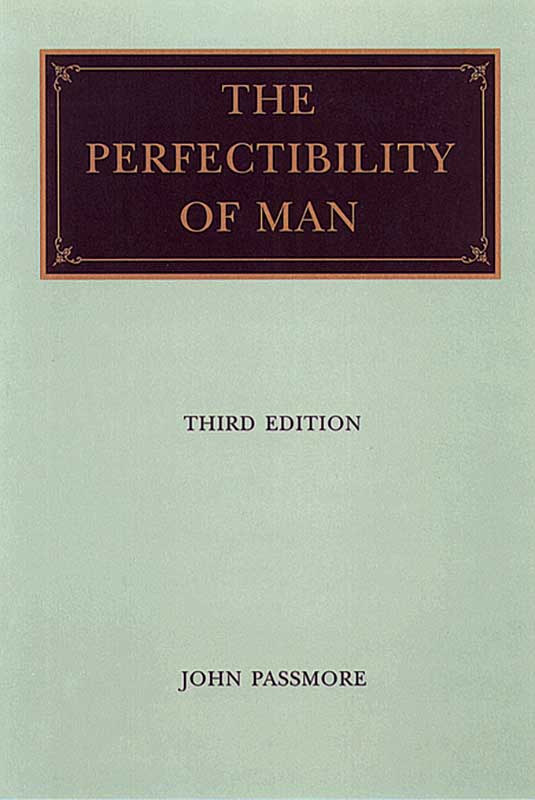
PREFACE - John Passmore, The Perfectibility of Man [1969]

Edition used:

The Perfectibility of Man (3rd ed.) (Indianapolis: Liberty Fund, 2000).

About Liberty Fund:

Liberty Fund, Inc. is a private, educational foundation established to encourage the study of the ideal of a society of free and responsible individuals.


John Passmore

The Perfectibility of Man! Ah heaven, what a dreary theme!

D. H. Lawrence

Mortal things suit mortals best.

Pindar

PREFACE

Like any other author I should like my readers to read every word I have written. But this is a somewhat unusual book, covering three thousand years and delving into philosophy, theology, religions—Eastern and Western—political and social ideals, even theatre. I can excuse readers who sometimes find themselves at a loss. This preface is meant to help them find their way, to discover what particularly interests them, to avoid swamps—swamps which other readers, with a different training, will recognize as solid ground.

When I began to work on this book I soon discovered that the words perfection and perfectibility were used in a variety of ways. I set about distinguishing them. That effort takes up the whole of the first chapter. Those who are bored by the making and relating of distinctions, which others may enjoy as an analytical exercise, will do best to turn to pages 25–28, where the results are set out. Or they may turn back to the first chapter, if in their later reading they may be troubled by a reference to a particular form of perfectibility.

Chapters 2 and 3 are essentially devoted to that creator of so many of our ideas, Greek philosophy. On pages 94–95 the outcome of these chapters is summarized, and some readers, not all, will find it preferable to read that summary before they read the chapters. If they feel the need for more background information, the books mentioned in numbered notes on pages 38–94 may be of help. The chapters are of central importance.

The early Greek writers would not allow even the gods to be perfect. Christianity took God to be perfect. But a battle ensued about human beings. Was perfection possible for them, or could they do no more than lower their level of imperfectibility? Chapters 4 through 7 are devoted to this theme. It is by no means dead. There are those who turn to Eastern religions in search of perfection. Some understanding of these past debates is essential not only for the understanding of historical debates, but also of present-day aspirations. These chapters are summarized on pages 223–25.

If some readers are mainly interested in these religious disputes, others may think that we have reached the heart of the book only when we embark upon secular means of reaching perfection, as in the attempt to assist the course of history understood to be by nature progressive. I do not think any guidance is necessary for the readers of these chapters, 8 through 12. Occasional names may be unfamiliar, but very few; it was not thought necessary to introduce chapter summaries.

There have been plenty of perfectionists and some of them have been very persistent—just a few years ago in Moscow a famous physicist told me that the Soviet Union was bound to become a perfect country with perfect people; this was just, he said, a matter of logic. But even before the 1914–18 war and the depression, which not long afterwards emerged on a great scale, dystopians made their presence felt. The chapter entitled “Perfection Renounced” is in essence a critical look at tendencies in the twentieth-century intellectual world. It needs no special guidance.

The same is true of the final chapter, “The New Mysticism,” but it introduces philosophical contrasts between play, games, and love that are, I think, vital to an understanding and critique of mysticism. It is perhaps worth noting that when this book first appeared in the United States a critic told the world that it would have been a good book if it had consisted only of the last three chapters. I hope that a new generation of readers will be conscious, as many earlier readers were, of the fact that our past is still alive in our present.

A final point. The extensive references are precisely that. They can be left alone, except by those who want to check what I have written or to engage in further reading.

John Passmore

  • Professor Emeritus
  • Australian National University
  • Canberra