Econlib

The Library

Other Sites

Front Page arrow Titles (by Subject) arrow Introduction - The American Republic: Primary Sources

Return to Title Page for The American Republic: Primary Sources

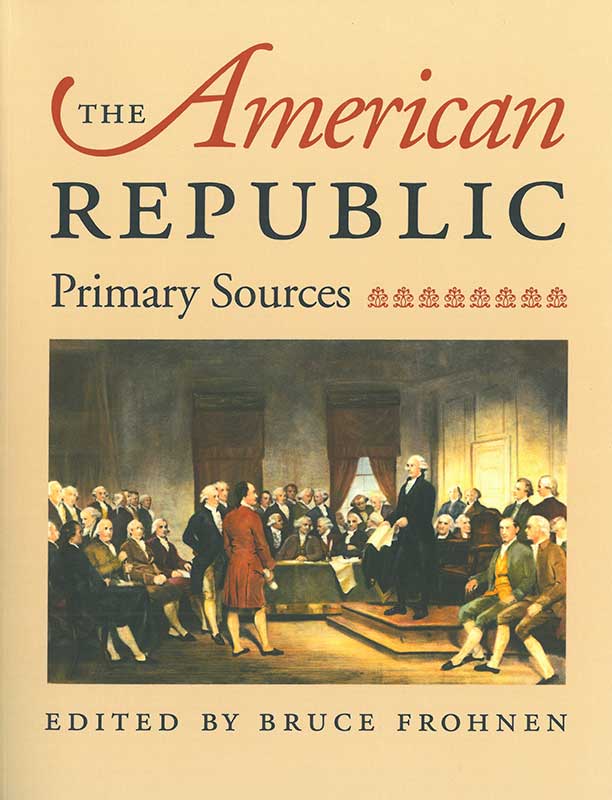
Introduction - Bruce Frohnen, The American Republic: Primary Sources [2002]

Edition used:

The American Republic: Primary Sources, ed. Bruce Frohnen (Indianapolis: Liberty Fund, 2002).

About Liberty Fund:

Liberty Fund, Inc. is a private, educational foundation established to encourage the study of the ideal of a society of free and responsible individuals.


Introduction

In the latter decades of the twentieth century scholars working in varioussubfields of American history brought a great deal of formerly neglectedmaterial to light. This material concerns issues ranging from the role ofreligious arguments and leaders in public life, to the breadth of historicalunderstanding characterizing public debate, to the specifically Britishmemories and sensibilities of Americans, to the importance of earlyconstitutional documents and Americans’ constitutional sophistication. Ineach of these areas the new material has made it possible for scholars toreexamine and reevaluate existing theories regarding the development ofAmerican politics. These new discoveries have opened vast new areas forfruitful research concerning the influences and concerns motivating those whohave helped shape the character of American politics and the American people.Unfortunately, very little of this material is available in a form suitable forclassroom use. This has left teachers to seek outhalf-measures—summarizing on their own or assigning works they know willnot be read—in attempting to present American history in somethingapproaching its true diversity and depth.

Collections by Belz; Hall, Leder, and Kammen; Hyneman and Lutz; Lutz;McDonald; Morgan; Sandoz; and White,1 among others; have allowed scholars increased access to constitutionaldocuments, declarations, sermons, and other public writings showing the factorsthat shaped public life in America, both before and after the War forIndependence. Without diminishing the role accorded specifically ideologicalconcerns and philosophical writings, these new materials have helped scholarsbetter evaluate the sources and meanings of public acts ranging from colonialsettlement to the War for Independence, to the Constitution, and to the CivilWar.

No single course, whether in high school, college, or even graduateschool, could deal adequately with all the important materials unearthed inrecent decades. However, by bringing together, in one manageable volume, keyoriginal documents and other writings that throw light on the cultural,religious, and historical concerns that have been raised, this volume aims toprovide the means by which students and teachers may begin examining thediversity of issues and influences that characterize American history.

We now have access to crucial materials attesting to the importance of thecontext in which Americans spoke of practices such as liberty and religiousfreedom. A hitherto neglected literature now can enable scholars and studentsto discuss the American drive for liberty, not merely as a political concept,but as a religious idea, a historical practice, and a constitutional concern tobe guaranteed and given substance through both national institutions and localcustoms.

The readings selected here represent opposite sides of important debatesconcerning, for example, American independence, religious establishment, andslavery. Conclusions regarding America’ nature and development as a nationand as a people will vary, not least because American history is one ofreligious, ideological, and cultural conflict. Such conflicts have pitted thedrive for community against the drive for individual autonomy, the call of Godagainst the call of a wild nature to be confronted in near isolation, thedesire for wealth against the desire to be held virtuous, and the demand forequality against respect for established authority. But exposure to theprincipal public acts and arguments engaged in these conflicts will provide adeeper and more nuanced understanding of their nature and sources—and oftheir influence on American history.

America’ history has been characterized by both continuity andchange. Even before the Civil War, at which point this volume leaves off,American traditions, with their roots deep in the histories of Great Britain,Rome, Greece, and Israel, had been markedly transformed by changes incircumstances and public understanding.2 Buteven traditions that have been transformed or weakened over time continue toinfluence public conduct, and with it the shape of both nations and peoples. Bypresenting readings from the perspectives of America’ varied traditions,this volume seeks to help students learn how they might judge the strengths andweaknesses of the conflicting visions that have shaped American history.

organization of the work

This work is in nine sections, each composed of selections of publicwritings intended to illustrate the major philosophical, cultural, and policypositions at issue during crucial eras of American political and culturaldevelopment.

The first section, “Colonial Settlements and Societies,” willprovide documentary evidence of the purposes behind European settlement and thenature of settlements in practice. The second section, “Religious Societyand Religious Liberty in Early America,” will provide materials showingthe pervasive public role of religion in early American public life as well asarguments concerning the importance of religious conscience and the limits thatconscience should place on government support for religious orthodoxy. Thethird section, “Defending the Charters,” will provide materialsshowing the American response to English acts—ranging from James II’revocation of colonial charters during the 1680s to parliamentary taxationduring the 1750s—which Americans interpreted as attacks on theirchartered, English liberties. The fourth section, “The War forIndependence,” will provide materials from all perspectives in the debateover independence—those centered on the chartered rights of Englishmen,those focusing on universal human rights, and those emphasizing loyalty andduty to Great Britain. The fifth section, “A New Constitution,”will provide materials showing the roots of American constitutionalism inearlier English and colonial codes and charters, as well as the Articles ofConfederation. In addition, it will provide important selections dealing withvarious “plans” or proposed constitutions, debates in theConstitutional Convention, and subsequent debates over ratification. The sixthsection, “The Bill of Rights,” will include Federalist andAnti-Federalist arguments concerning the need to protect common law rights aswell as the Anti-Federalist insistence that structural changes were needed inthe proposed Constitution. The seventh section, “State versus FederalAuthority,” will present materials from both sides of issues related tothe question of whether the states or the federal government held finalauthority in determining the course of public policy in America. The eighthsection, “Forging a Nation,” will provide materials regarding thedebate over internal improvements and other federal measures aimed at bindingthe nation more closely together, particularly in the area of commerce. Thefinal section, “Prelude to War,” will focus on the political,cultural, and legal issues underlying the sectional differences that led to theCivil War. Debates concerning the morality and necessity of slavery, as well asattempts to secure political compromise regarding the status of “thepeculiar institution,” will be highlighted; their character and relativeimportance will be further illuminated by selections focusing on the relativepower and position of various regions within the United States.

The volume ends with the prelude to the Civil War, stopping at that pointfor three interconnected reasons: (1) the need to produce a volume that doesnot reach an ungainly length, (2) the prevalence of courses on American historythat split that history into the pre–Civil War era and the era commencingwith the Civil War, and (3) recognition of the revolutionary changes wrought bythe Civil War, making that event the natural stopping point for courses andthis volume.

The placement of specific selections within this vol-ume is intended toanswer two pedagogical needs: that of chronological consistency and that ofissue focus, so that students may see particular topics of importance insufficient depth to give them serious examination. Consequently, while thesections into which the volume is divided generally follow a chronologicalorder, materials within them at times overlap. For example, most writingspresenting the Anti-Federalist critique of the Constitution are found in thesection on the Bill of Rights rather than that on the Constitution. This hasbeen done because the strongest Anti-Federalist arguments took the form ofcalls for revisions to the Constitution—revisions taken up under therubric of amendments intended to protect the rights of the people. Not allAnti-Federalist concerns were addressed by the first Congress as it considered these amendments. A key question in American history, however, concerns whetherAnti-Federalist fears were addressed at all in that Congress or by thoseamendments we now call the Bill of Rights. Lincoln’ relatively late“Address to the Wisconsin State Agricultural Society” also might beseen as coming at an “unchronological” place in the volume—inthis case in the section on “Forging a Nation,” before that on the“Prelude to War.” Again, the reasoning is thematic. In this addressLincoln lays out his vision of America and the cultural as well as the economicpromise of industrialization. Such issues are closely tied to debates overinternal improvements and other concerns separating American regions. Theseconcerns helped polarize the nation, but only after the slavery issue came tothe forefront and exacerbated regional polarizations did they help toprecipitate the Civil War.

Thanks are owed to the members of this volume’ advisory board. I alsothank James McClellan for important suggestions during the early development ofthis volume and Donald Livingston, Clyde Wilson, and Robert Waters for helpfulsuggestions. Any mistakes in judgment, selection, or performance are minealone. Finally, I owe a special debt of gratitude to my wife, Antonia, for herpatience and support.

[1. ]Belz, The Webster-Hayne Debate on the Nature of the Union; Hall,Leder, and Kammen, The Glorious Revolution in America; Hyneman and Lutz,American Political Writing during the Founding Era: 1760–1805; Lutz,Colonial Origins of the American Constitution; McDonald, Empire and Nation;Edmund Sears Morgan, ed., Prologue to Revolution: Sources and Documents on theStamp Act Crisis, 1764–1766 (Chapel Hill: University of North CarolinaPress, 1959); Sandoz, Political Sermons of the American Founding Era:1730–1805; and White, Democratick Editorials.

[2. ]The classic work dealing with America’ cultural inheritance isRussell Kirk, The Roots of American Order (Washington, 1991).