EconlibThe LibraryOther Sites |
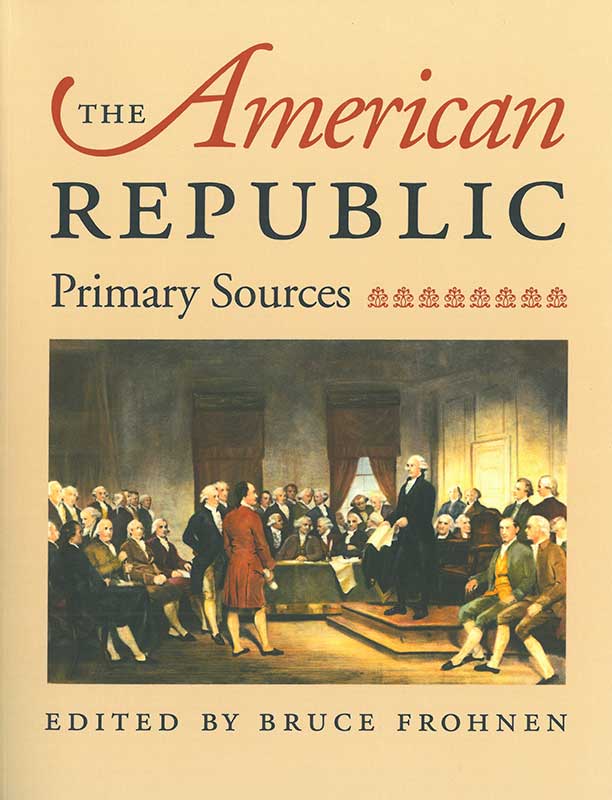
Front Page Titles (by Subject) part six: The Bill of Rights - The American Republic: Primary Sources
Return to Title Page for The American Republic: Primary SourcesThe Online Library of LibertyA project of Liberty Fund, Inc.Search this Title:Also in the Library:
part six: The Bill of Rights - Bruce Frohnen, The American Republic: Primary Sources [2002]Edition used:The American Republic: Primary Sources, ed. Bruce Frohnen (Indianapolis: Liberty Fund, 2002).
About Liberty Fund:Liberty Fund, Inc. is a private, educational foundation established to encourage the study of the ideal of a society of free and responsible individuals. Copyright information:The copyright to this edition, in both print and electronic forms, is held by Liberty Fund, Inc. Fair use statement:This material is put online to further the educational goals of Liberty Fund, Inc. Unless otherwise stated in the Copyright Information section above, this material may be used freely for educational and academic purposes. It may not be used in any way for profit.
part sixThe Bill of RightsThe Federalist, Papers 84 and 851787 No. 84Concerning several miscellaneous objectionsIn the course of the foregoing review of the constitution, I have endeavoured to answer most of the objections which have appeared against it. There remain, however, a few which either did not fall naturally under any particular head, or were forgotten in their proper places. These shall now be discussed: but as the subject has been drawn into great length, I shall so far consult brevity, as to comprise all my observations on these miscellaneous points in a single paper. The most considerable of the remaining objections is, that the plan of the convention contains no bill of rights. Among other answers given to this, it has been upon different occasions remarked, that the constitutions of several of the states are in a similar predicament. I add, that New York is of the number. And yet the persons who in this state oppose the new system, while they profess an unlimited admiration for our particular constitution, are among the most intemperate partizans of a bill of rights. To justify their zeal in this matter, they allege two things: one is, that though the constitution of New York has no bill of rights prefixed to it, yet it contains in the body of it, various provisions in favour of particular privileges and rights, which, in substance, amount to the same thing; the other is, that the constitution adopts, in their full extent, the common and statute law of Great Britain, by which many other rights, not expressed, are equally secured. To the first I answer, that the constitution offered by the convention contains, as well as the constitution of this state, a number of such provisions. Independent of those which relate to the structure of the government, we find the following: Article I, section 3, clause 7. “Judgment in cases of impeachment shall not extend further than to removal from office, and disqualification to hold and enjoy any office of honour, trust, or profit under the United States; but the party convicted shall, nevertheless, be liable and subject to indictment, trial, judgment, and punishment, according to law.” Section 9. of the same article, clause 2. “The privilege of the writ of habeas corpus shall not be suspended, unless when in cases of rebellion or invasion the public safety may require it.” Clause 3. “No bill of attainder or ex post facto law shall be passed.” Clause 7. “No title of nobility shall be granted by the United States; and no person holding any office of profit or trust under them, shall, without the consent of the congress, accept of any present, emolument, office, or title, of any kind whatever, from any king, prince, or foreign state.” Article II. section 2. clause 3. “The trial of all crimes, except in cases of impeachment, shall be by jury; and such trial shall be held in the state where the said crimes shall have been committed; but when not committed within any state, the trial shall be at such place or places as the congress may by law have directed.” Section 3. of the same article: “Treason against the United States shall consist only in levying war against them, or in adhering to their enemies, giving them aid and comfort. No person shall be convicted of treason, unless on the testimony of two witnesses to the same overt act, or on confession in open court.” And clause 3. of the same section: “The congress shall have power to declare the punishment of treason; but no attainder of treason shall work corruption of blood, or forfeiture, except during the life of the person attainted.” It may well be a question, whether these are not, upon the whole, of equal importance with any which are to be found in the constitution of this state. The establishment of the writ of habeas corpus, the prohibition of ex post facto laws, and of titles of nobility, to which we have no corresponding provisions in our constitution, are perhaps greater securities to liberty than any it contains. The creation of crimes after the commission of the fact, or, in other words, the subjecting of men to punishment for things which, when they were done, were breaches of no law; and the practice of arbitrary imprisonments have been, in all ages, the favourite and most formidable instruments of tyranny. The observations of the judicious Blackstone, in reference to the latter, are well worthy of recital: “To bereave a man of life (says he) or by violence to confiscate his estate, without accusation or trial, would be so gross and notorious an act of despotism, as must at once convey the alarm of tyranny throughout the whole nation; but confinement of the person, by secretly hurrying him to jail, where his sufferings are unknown or forgotten, is a less public, a less stricking, and therefore a more dangerous engine of arbitrary government.” And as a remedy for this fatal evil, he is every where peculiarly emphatical in his encomiums on the habeas corpus act, which in one place he calls “the bulwark of the British constitution.” Nothing need be said to illustrate the importance of the prohibition of titles of nobility. This may truly be denominated the corner stone of republican government for so long as they are excluded, there can never be serious danger that the government will be any other than that of the people. To the second, that is, to the pretended establishment of the common and statute law by the constitution, I answer, that they are expressly made subject “to such alterations and provisions as the legislature shall from time to time make concerning the same.” They are therefore at any moment liable to repeal by the ordinary legislative power, and of course have no constitutional sanction. The only use of the declaration was to recognize the ancient law, and to remove doubts which might have been occasioned by the revolution. This consequently can be considered as no part of a declaration of rights; which under our constitutions must be intended to limit the power of the government itself. It has been several times truly remarked, that bills of rights are, in their origin, stipulations between kings and their subjects, abridgments of prerogative in favour of privilege, reservations of rights not surrendered to the prince. Such as magna charta, obtained by the Barons, sword in hand, from king John. Such were the subsequent confirmations of that charter by succeeding princes. Such was the petition of right assented to by Charles the First, in the beginning of his reign. Such also, was the declaration of right presented by the lords and commons to the prince of Orange in 1688, and afterwards thrown into the form of an act of parliament, called the bill of rights. It is evident, therefore, that according to their primitive signification, they have no application to constitutions professedly founded upon the power of the people, and executed by their immediate representatives and servants. Here, in strictness, the people surrender nothing; and as they retain every thing, they have no need of particular reservations. “We the people of the United States, to secure the blessings of liberty to ourselves and our posterity, do ordain and establish this constitution for the United States of America:” this is a better recognition of popular rights, than volumes of those aphorisms, which make the principal figure in several of our state bills of rights, and which would sound much better in a treatise of ethics, than in a constitution of government. But a minute detail of particular rights, is certainly far less applicable to a constitution like that under consideration, which is merely intended to regulate the general political interests of the nation, than to one which has the regulation of every species of personal and private concerns. If therefore the loud clamours against the plan of convention, on this score, are well founded, no epithets of reprobation will be too strong for the constitution of this state. But the truth is, that both of them contain all which, in relation to their objects, is reasonably to be desired. I go further, and affirm, that bills of rights, in the sense and to the extent they are contended for, are not only unnecessary in the proposed constitution, but would even be dangerous. They would contain various exceptions to powers not granted; and on this very account, would afford a colourable pretext to claim more than were granted. For why declare that things shall not be done, which there is no power to do? Why, for instance, should it be said, that the liberty of the press shall not be restrained, when no power is given by which restrictions may be imposed? I will not contend that such a provision would confer a regulating power; but it is evident that it would furnish, to men disposed to usurp, a plausible pretence for claiming that power. They might urge with a semblance of reason, that the constitution ought not to be charged with the absurdity of providing against the abuse of an authority, which was not given, and that the provision against restraining the liberty of the press afforded a clear implication, that a right to prescribe proper regulations concerning it, was intended to be vested in the national government. This may serve as a specimen of the numerous handles which would be given to the doctrine of constructive powers, by the indulgence of an injudicious zeal for bills of rights. On the subject of the liberty of the press, as much has been said, I cannot forbear adding a remark or two: in the first place, I observe that there is not a syllable concerning it in the constitution of this state; in the next, I contend that whatever has been said about it in that of any other state, amounts to nothing. What signifies a declaration, that “the liberty of the press shall be inviolably preserved?” What is the liberty of the press? Who can give it any definition which would not leave the utmost latitude for evasion? I hold it to be impracticable; and from this I infer, that its security, whatever fine declarations may be inserted in any constitution respecting it, must altogether depend on public opinion, and on the general spirit of the people and of the government.* And here, after all, as intimated upon another occasion, must we seek for the only solid basis of all our rights. There remains but one other view of this matter to conclude the point. The truth is, after all the declamation we have heard, that the constitution is itself, in every rational sense, and to every useful purpose, a bill of rights. The several bills of rights, in Great Britain, form its constitution, and conversely the constitution of each state is its bill of rights. In like manner the proposed constitution, if adopted, will be the bill of rights of the union. Is it one object of a bill of rights to declare and specify the political privileges of the citizens in the structure and administration of the government? This is done in the most ample and precise manner in the plan of the convention; comprehending various precautions for the public security, which are not to be found in any of the state constitutions. Is another object of a bill of rights to define certain immunities and modes of proceeding, which are relative to personal and private concerns? This we have seen has also been attended to, in a variety of cases, in the same plan. Adverting therefore to the substantial meaning of a bill of rights, it is absurd to allege that it is not to be found in the work of the convention. It may be said that it does not go far enough, though it will not be easy to make this appear; but it can with no propriety be contended that there is no such thing. It certainly must be immaterial what mode is observed as to the order of declaring the rights of the citizens, if they are provided for in any part of the instrument which establishes the government. Whence it must be apparent, that much of what has been said on this subject rests merely on verbal and nominal distinctions, entirely foreign to the substance of the thing. Another objection, which, from the frequency of its repetition, may be presumed to be relied on, is of this nature: it is improper (say the objectors) to confer such large powers, as are proposed, upon the national government; because the seat of that government must of necessity be too remote from many of the states to admit of a proper knowledge on the part of the constituent, of the conduct of the representative body. This argument, if it proves any thing, proves that there ought to be no general government whatever. For the powers which, it seems to be agreed on all hands, ought to be vested in the union, cannot be safely intrusted to a body which is not under every requisite control. But there are satisfactory reasons to show, that the objection is, in reality, not well founded. There is in most of the arguments which relate to distance, a palpable illusion of the imagination. What are the sources of information, by which the people in any distant county must regulate their judgment of the conduct of their representatives in the state legislature? Of personal observation they can have no benefit. This is confined to the citizens on the spot. They must therefore depend on the information of intelligent men, in whom they confide: and how must these men obtain their information? Evidently from the complexion of public measures, from the public prints, from correspondences with their representatives, and with other persons who reside at the place of their deliberations. It is equally evident that the like sources of information would be open to the people, in relation to the conduct of their representatives in the general government: and the impediments to a prompt communication which distance may be supposed to create, will be overbalanced by the effects of the vigilance of the state governments. The executive and legislative bodies of each state will be so many sentinels over the persons employed in every department of the national administration; and as it will be in their power to adopt and pursue a regular and effectual system of intelligence, they can never be at a loss to know the behaviour of those who represent their constituents in the national councils, and can readily communicate the same knowledge to the people. Their disposition to apprize the community of whatever may prejudice its interests from another quarter, may be relied upon, if it were only from the rivalship of power. And we may conclude with the fullest assurance, that the people, through that channel, will be better informed of the conduct of their national representatives, than they can be by any means they now possess, of that of their state representatives. It ought also to be remembered, that the citizens who inhabit the country at and near the seat of government will, in all questions that affect the general liberty and prosperity, have the same interest with those who are at a distance; and that they will stand ready to sound the alarm when necessary, and to point out the actors in any pernicious project. The public papers will be expeditious messengers of intelligence to the most remote inhabitants of the union. Among the many curious objections which have appeared against the proposed constitution, the most extraordinary and the least colourable is derived from the want of some provision respecting the debts due to the United States. This has been represented as a tacit relinquishment of those debts, and as a wicked contrivance to screen public defaulters. The newspapers have teemed with the most inflammatory railings on this head; yet there is nothing clearer than that the suggestion is entirely void of foundation, the offspring of extreme ignorance or extreme dishonesty. In addition to the remarks I have made upon the subject in another place, I shall only observe, that as it is a plain dictate of common sense, so it is also an established doctrine of political law, that “states neither lose any of their rights, nor are discharged from any of their obligations, by a change in the form of their civil government.” The last objection of any consequence at present recollected, turns upon the article of expense. If it were even true, that the adoption of the proposed government would occasion a considerable increase of expense, it would be an objection that ought to have no weight against the plan. The great bulk of the citizens of America, are with reason convinced that union is the basis of their political happiness. Men of sense of all parties now, with few exceptions, agree that it cannot be preserved under the present system, nor without radical alterations; that new and extensive powers ought to be granted to the national head, and that these require a different organization of the federal government; a single body being an unsafe depository of such ample authorities. In conceding all this, the question of expense is given up; for it is impossible, with any degree of safety, to narrow the foundation upon which the system is to stand. The two branches of the legislature are, in the first instance, to consist of only sixty-five persons; the same number of which congress, under the existing confederation, may be composed. It is true that this number is intended to be increased; but this is to keep pace with the progress of the population and resources of the country. It is evident, that a less number would, even in the first instance, have been unsafe; and that a continuance of the present number would, in a more advanced stage of population, be a very inadequate representation of the people. Whence is the dreaded augmentation of expense to spring: One source indicated, is the multiplication of offices under the new government. Let us examine this a little. It is evident that the principal departments of the administration under the present government, are the same which will be required under the new. There are now a secretary at war, a secretary for foreign affairs, a board of treasury consisting of three persons, a treasurer, assistants, clerks, &c. These offices are indispensable under any system, and will suffice under the new, as well as the old. As to ambassadors and other ministers and agents in foreign countries, the proposed constitution can make no other difference, than to render their characters, where they reside, more respectable, and their services more useful. As to persons to be employed in the collection of the revenues, it is unquestionably true that these will form a very considerable addition to the number of federal officers; but it will not follow, that this will occasion an increase of public expense. It will be in most cases nothing more than an exchange of state for national officers. In the collection of all duties, for instance, the persons employed will be wholly of the latter description. The states individually, will stand in no need of any for this purpose. What difference can it make in point of expense, to pay officers of the customs appointed by the state, or by the United States. Where then are we to seek for those additional articles of expense, which are to swell the account to the enormous size that has been represented? The chief item which occurs to me, respects the support of the judges of the United States. I do not add the president, because there is now a president of congress, whose expenses may not be far, if any thing, short of those which will be incurred on account of the president of the United States. The support of the judges will clearly be an extra expense, but to what extent will depend on the particular plan which may be adopted in regard to this matter. But upon no reasonable plan can it amount to a sum which will be an object of material consequence. Let us now see what there is to counterbalance any extra expense that may attend the establishment of the proposed government. The first thing which presents itself is, that a great part of the business, that now keeps congress sitting through the year, will be transacted by the president. Even the management of foreign negotiations will naturally devolve upon him, according to general principles concerted with the senate, and subject to their final concurrence. Hence it is evident, that a portion of the year will suffice for the session of both the senate and the house of representatives: we may suppose about a fourth for the latter, and a third, or perhaps half, for the former. The extra business of treaties and appointments may give this extra occupation to the senate. From this circumstance we may infer, that until the house of representatives shall be increased greatly beyond its present number, there will be a considerable saving of expense from the difference between the constant session of the present, and the temporary session of the future congress. But there is another circumstance, of great importance in the view of economy, The business of the United States has hitherto occupied the state legislatures, as well as congress. The latter has made requisitions which the former have had to provide for. It has thence happened, that the sessions of the state legislatures have been protracted greatly beyond what was necessary for the execution of the mere local business. More than half their time has been frequently employed in matters which related to the United States. Now the members who compose the legislatures of the several states amount to two thousand and upwards; which number has hitherto performed what, under the new system, will be done in the first instance by sixty-five persons, and probably at no future period by above a fourth or a fifth of that number. The congress under the proposed government will do all the business of the United States themselves, without the intervention of the state legislatures, who thenceforth will have only to attend to the affairs of their particular states, and will not have to sit in any proportion as long as they have heretofore done. This difference, in the time of the sessions of the state legislatures, will be clear gain, and will alone form an article of saving, which may be regarded as an equivalent for any additional objects of expense that may be occasioned by the adoption of the new system. The result from these observations is, that the sources of additional expense from the establishment of the proposed constitution, are much fewer than may have been imagined; that they are counterbalanced by considerable objects of saving; that that, while it is questionable on which side of the scale will preponderate, it is certain that a government less expensive would be incompetent to the purposes of the union. publius No. 85ConclusionAccording to the formal division of the subject of these papers, announced in my first number, there would appear still to remain for discussion two points. . . . “the analogy of the proposed government to your own state constitution,” and “the additional security which its adoption will afford to republican government, to liberty, and to property.” But these heads have been so fully anticipated, and so completely exhausted in the progress of the work, that it would now scarcely be possible to do any thing more than repeat, in a more dilated form, which has been already said; which the advanced stage of the question, and the time already spent upon it, conspire to forbid. It is remarkable, that the resemblance of the plan of the convention to the act which organizes the government of this state, holds, not less with regard to many of the supposed defects, than to the real excellencies of the former. Among the pretended defects, are the re-eligibility of the executive; the want of a council; the omission of a formal bill of rights; the omission of a provision respecting the liberty of the press: these, and several others, which have been noted in the course of our inquiries, are as much chargeable on the existing constitution of this state, as on the one proposed for the union: and a man must have slender pretensions to consistency, who can rail at the latter for imperfections which he finds no difficulty in excusing in the former. Nor indeed can there be a better proof of the insincerity and affectation of some of the zealous adversaries of the plan of the convention, who profess to be devoted admirers of the government of this state, than the fury with which they have attacked that plan, for matters in regard to which our own constitution is equally, or perhaps more vulnerable. The additional securities to republican government, to liberty, and to property, to be derived from the adoption of the plan, consist chiefly in the restraints which the preservation of the union will impose upon local factions and insurrections, and upon the ambition of powerful individuals in single states, who might acquire credit and influence enough, from leaders and favourites, to become the despots of the people: in the diminution of the opportunities to foreign intrigue, which the dissolution of the confederacy would invite and facilitate; in the prevention of extensive military establishments, which could not fail to grow out of wars between the states in a disunited situation: in the express guarantee of a republican form of government to each; in the absolute and universal exclusion of titles of nobility; and in the precautions against the repetition of those practices on the part of the state governments, which have undermined the foundations of property and credit: have planted mutual distrust in the breasts of all classes of citizens: and have occasioned an almost universal prostration of morals. Thus have I, fellow citizens, executed the task I had assigned to myself; with what success your conduct must determine. I trust, at least, you will admit, that I have not failed in the assurance I gave you respecting the spirit with which my endeavours should be conducted. I have addressed myself purely to your judgments, and have studiously avoided those asperities which are too apt to disgrace political disputants of all parties, and which have been not a little provoked by the language and conduct of the opponents of the constitution. The charge of a conspiracy against the liberties of the people, which has been indiscriminately brought against the advocates of the plan, has something in it too wanton and too malignant not to excite the indignation of every man who feels in his own bosom a refutation of the calumny. The perpetual changes which have been rung upon the wealthy, the well born, and the great, are such as to inspire the disgust of all sensible men. And the unwarrantable concealments and misrepresentations, which have been in various ways practised to keep the truth from the public eye, are of a nature to demand the reprobation of all honest men. It is possible that these circumstances may have occasionally betrayed me into intemperances of expression which I did not intend: it is certain that I have frequently felt a struggle between sensibility and moderation; and if the former has in some instances prevailed, it must be my excuse, that it has been neither often nor much. Let us now pause, and ask ourselves whether, in the course of these papers, the proposed constitution has not been satisfactorily vindicated from the aspersions thrown upon it; and whether it has not been shown to be worthy of the public approbation, and necessary to the public safety and prosperity. Every man is bound to answer these questions to himself, according to the best of his conscience and understanding, and to act agreeably to the genuine and sober dictates of his judgment. This is a duty from which nothing can give him a dispensation. It is one that he is called upon, nay, constrained by all the obligations that form the bands on society, to discharge sincerely and honestly. No partial motive, no particular interest, no pride of opinion, no temporary passion or prejudice, will justify to himself, to his country, to his posterity, an improper election of the part he is to act. Let him beware of an obstinate adherence to party: let him reflect, that the object upon which he is to decide is not a particular interest of the community, but the very existence of the nation: and let him remember, that a majority of America has already given its sanction to the plan which he is to approve or reject. I shall not dissemble, that I feel an entire confidence in the arguments which recommend the proposed system to your adoption; and that I am unable to discern any real force in those by which it has been assailed. I am persuaded, that it is the best which our political situation, habits, and opinions will admit, and superior to any the revolution has produced. Concessions on the part of the friends of the plan, that it has not a claim to absolute perfection, have afforded matter of no small triumph to its enemies. Why, say they, should we adopt an imperfect thing? Why not amend it, and make it perfect before it is irrevocably established? This may be plausible, but it is plausible only. In the first place I remark, that the extent of these concessions has been greatly exaggerated. They have been stated as amounting to an admission, that the plan is radically defective; and that, without material alterations, the rights and the interests of the community cannot be safely confided to it. This, as far as I have understood the meaning of those who make the concessions, is an entire perversion of their sense. No advocate of the measure can be found, who will not declare as his sentiment, that the system, though it may not be perfect in every part, is, upon the whole, a good one; is the best that the present views and circumstances of the country will permit; and is such a one as promises every species of security which a reasonable people can desire. I answer in the next place, that I should esteem it the extreme of imprudence to prolong the precarious state of our national affairs, and to expose the union to the jeopardy of successive experiments, in the chimerical pursuit of a perfect plan. I never expect to see a perfect work from imperfect man. The result of the deliberations of all collective bodies, must necessarily be a compound as well of the errors and prejudices, as of the good sense and wisdom of the individuals of whom they are composed. The compacts which are to embrace thirteen distinct states, in a common bond of amity and union, must as necessarily be a compromise of as many dissimilar interests and inclinations. How can perfection spring from such materials? The reasons assigned in an excellent little pamphlet lately published in this city, unanswerably show the utter improbability of assembling a new convention, under circumstances in any degree so favourable to a happy issue, as those in which the late convention met, deliberated, and concluded. I will not repeat the arguments there used, as I presume the production itself has had an extensive circulation. It is certainly well worth the perusal of every friend to his country. There is however one point of light in which the subject of amendments still remains to be considered; and in which it has not yet been exhibited. I cannot resolve to conclude, without first taking a survey of it in this aspect. It appears to me susceptible of complete demonstration, that it will be far more easy to obtain subsequent than previous amendments to the constitution. The moment an alteration is made in the present plan, it becomes, to the purpose of adoption, a new one, and must undergo a new decision of each state. To its complete establishment throughout the union, it will therefore require the concurrence of thirteen states. If, on the contrary, the constitution should once be ratified by all the states as it stands, alterations in it may at any time be effected by nine states. In this view alone the chances are as thirteen to nine* in favour of subsequent amendments, rather than of the original adoption of an entire system. This is not all. Every constitution for the United States must inevitably consist of a great variety of particulars, in which thirteen independent states are to be accommodated in their interests or opinions of interest. We may of course expect to see, in any body of men charged with its original formation, very different combinations of the parts upon different points. Many of those who form the majority on one question, may become the minority on a second, and an association dissimilar to either, may constitute the majority on a third. Hence the necessity of moulding and arranging all the particulars which are to compose the whole, in such a manner, as to satisfy all the parties to the compact; and hence also an immense multiplication of difficulties and casualties in obtaining the collective assent to a final act. The degree of that multiplication must evidently be in a ratio to the number of particulars and the number of parties. But every amendment to the constitution, if once established, would be a single proposition, and might be brought forward singly. There would then be no necessity for management or compromise, in relation to any other point; no giving nor taking. The will of the requisite number, would at once bring the matter to a decisive issue. And consequently whenever nine, or rather ten states, were united in the desire of a particular amendment, that amendment must infallibly prevail. There can, therefore, be no comparison between the facility of affecting an amendment, and that of establishing in the first instance a complete constitution. In opposition to the probability of subsequent amendments it has been urged, that the persons delegated to the administration of the national government, will always be disinclined to yield up any portion of the authority of which they were once possessed. For my own part, I acknowledge a thorough conviction that any amendments which may, upon mature consideration, be thought useful, will be applicable to the organization of the government, not to the mass of its powers; and on this account alone, I think there is no weight in the observation just stated. I also think there is little force in it on another account. The intrinsic difficulty of governing thirteen states, independent of calculations upon an ordinary degree of public spirit and integrity, will, in my opinion, constantly impose on the national rulers, the necessity of a spirit of accommodation to the reasonable expectations of their constituents. But there is yet a further consideration, which proves beyond the possibility of doubt, that the observation is futile. It is this, that the national rulers, whenever nine states concur, will have no option upon the subject. By the fifth article of the plan the congress will be obliged, “on the application of the legislatures of two-thirds of the states, (which at present amount to nine) to call a convention for proposing amendments, which shall be valid to all intents and purposes as part of the constitution, when ratified by the legislatures of three-fourths of the states or by conventions in three-fourths thereof.” The words of this article are peremptory. The congress “shall call a convention.” Nothing in this particular is left to discretion. Of consequence all the declamation about the disinclination to a change, vanishes in air. Nor, however difficult it may be supposed to unite two-thirds, or three-fourths of the state legislatures, in amendments which may affect local interests, can there be any room to apprehend any such difficulty in a union on points which are merely relative to the general liberty or security of the people. We may safely rely on the disposition of the state legislatures to erect barriers against the encroachments of the national authority. If the foregoing argument be a fallacy, certain it is that I am myself deceived by it; for it is, in my conception, one of those rare instances in which a political truth can be brought to the test of mathematical demonstration. Those who see the matter in the same light, however zealous they may be for amendments, must agree in the propriety of a previous adoption, as the most direct road to their object. The zeal for attempts to amend, prior to the establishment of the constitution, must abate in every man, who is ready to accede to the truth of the following observations of a writer, equally solid and ingenious: “to balance a large state or society (says he) whether monarchical or republican, on general laws, is a work of so great difficulty, that no human genius, however comprehensive, is able by the mere dint of reason and reflection, to effect it. The judgments of many must unite in the work: experience must guide their labour: time must bring it to perfection: and the feeling of inconveniences must correct the mistakes which they inevitably fall into, in their first trials and experiments.” These judicious reflections contain a lesson of moderation to all the sincere lovers of the union, and ought to put them upon their guard against hazarding anarchy, civil war, a perpetual alienation of the states from each other, and perhaps the military despotism of a victorious demagogue, in the pursuit of what they are not likely to obtain, but from time and experience. It may be in me a defect of political fortitude, but I acknowledge that I cannot entertain an equal tranquillity with those who affect to treat the dangers of a longer continuance in our present situation as imaginary. A nation without a national government, is an awful spectacle. The establishment of a constitution, in time of profound peace, by the voluntary consent of a whole people, is a prodigy, to the completion of which I look forward with trembling anxiety. In so arduous an enterprise, I can reconcile it to no rules of prudence to let go the hold we now have, upon seven out of the thirteen states; and after having passed over so considerable a part of the ground, to re-commence the course. I dread the more the consequences of new attempts, because I know that powerful individuals, in this and in other states, are enemies to a general national government in every possible shape. publius Letter IOctober 1787 Letter ITo the Freemen of PennsylvaniaFriends, Countrymen and Fellow Citizens, Permit one of yourselves to put you in mind of certain liberties and privileges secured to you by the constitution of this commonwealth, and to beg your serious attention to his uninterested opinion upon the plan of federal government submitted to your consideration, before you surrender these great and valuable privileges up forever. Your present frame of government, secures to you a right to hold yourselves, houses, papers and possessions free from search and seizure, and therefore warrants granted without oaths or affirmations first made, affording sufficient foundation for them, whereby any officer or messenger may be commanded or required to search your houses or seize your persons or property, not particularly described in such warrant, shall not be granted. Your constitution further provides “that in controversies respecting property, and in suits between man and man, the parties have a right to trial by jury, which ought to be held sacred.” It also provides and declares, “that the people have a right offreedom of speech, and ofwritingandpublishingtheir sentiments, thereforethe freedom of the press ought not to be restrained.” The constitution of Pennsylvania is yet in existence, as yet you have the right to freedom of speech, and of publishing your sentiments. How long those rights will appertain to you, you yourselves are called upon to say, whether your houses shall continue to be your castles; whether your papers, your persons and your property, are to be held sacred and free from general warrants, you are now to determine. Whether the trial by jury is to continue as your birthright, the freemen of Pennsylvania, nay, of all America, are now called upon to declare. Without presuming upon my own judgement, I cannot think it an unwarrantable presumption to offer my private opinion, and call upon others for their’s; and if I use my pen with the boldness of a freeman, it is because I know that the liberty of the press yet remains unviolated, and juries yet are judges. The late Convention have submitted to your consideration on a plan of a new, federal government—The subject is highly interesting to your future welfare—Whether it be calculated to promote the great ends of civil society, viz. the happiness and prosperity of the community; it behoves you well to consider, uninfluenced by the authority of names. Instead of that frenzy of enthusiasm, that has actuated the citizens of Philadelphia, in their approbation of the proposed plan, before it was possible that it could be the result of a rational investigation into its principles; it ought to be dispassionately and deliberately examined, and its own intrinsic merit the only criterion of your patronage. If ever free and unbiassed discussion was proper or necessary, it is on such an occasion.—All the blessings of liberty and the dearest privileges of freemen, are now at stake and dependent on your present conduct. Those who are competent to the task of developing the principles of government, ought to be encouraged to come forward, and thereby the better enable the people to make a proper judgment; for the science of government is so abstruse, that few are able to judge for themselves; without such assistance the people are too apt to yield an implicit assent to the opinions of those characters, whose abilities are held in the highest esteem, and to those in whose integrity and patriotism they can confide; not considering that the love of domination is generally in proportion to talents, abilities, and superior acquirements; and that the men of the greatest purity of intention may be made instruments of despotism in the hands of the artful and designing. If it were not for the stability and attachment which time and habit gives to forms of government, it would be in the power of the enlightened and aspiring few, if they should combine, at any time to destroy the best establishments, and even make the people the instruments of their own subjugation. The late revolution having effaced in a great measure all former habits, and the present institutions are so recent, that there exists not that great reluctance to innovation, so remarkable in old communities, and which accords with reason, for the most comprehensive mind cannot foresee the full operation of material changes on civil polity; it is the genius of the common law to resist innovation. The wealthy and ambitious, who in every community think they have a right to lord it over their fellow creatures, have availed themselves, very successfully, of this favorable disposition; for the people thus unsettled in their sentiments, have been prepared to accede to any extreme of government; all the distresses and difficulties they experience, proceeding from various causes, have been ascribed to the impotency of the present confederation, and thence they have been led to expect full relief from the adoption of the proposed system of government; and in the other event, immediately ruin and annihilation as a nation. These characters flatter themselves that they have lulled all distrust and jealousy of their new plan, by gaining the concurrence of the two men in whom America has the highest confidence, and now triumphantly exult in the completion of their long meditated schemes of power and aggrandisement. I would be very far from insinuating that the two illustrious personages alluded to, have not the welfare of their country at heart; but that the unsuspecting goodness and zeal of the one, has been imposed on, in a subject of which he must be necessarily inexperienced, from his other arduous engagements; and that the weakness and indecision attendant on old age, has been practised on in the other. I am fearful that the principles of government inculcated in Mr. Adams’s treatise, and enforced in the numerous essays and paragraphs in the news-papers, have misled some well designing members of the late Convention.—But it will appear in the sequel, that the construction of the proposed plan of government is infinitely more extravagant. I have been anxiously expecting that some enlightened patriot would, ere this, have taken up the pen to expose the futility, and counteract the baneful tendency of such principles. Mr. Adams’s sine qua non of a good government is three balancing powers, whose repelling qualities are to produce an equilibrium of interests, and thereby promote the happiness of the whole community. He asserts that the administrators of every government, will ever be actuated by views of private interest and ambition, to the prejudice of the public good; that therefore the only effectual method to secure the rights of the people and promote their welfare, is to create an opposition of interests between the members of two distinct bodies, in the exercise of the powers of government, and balanced by those of a third. This hypothesis supposes human wisdom competent to the task of instituting three co-equal orders in government, and a corresponding weight in the community to enable them respectively to exercise their several parts, and whose views and interests should be so distinct as to prevent a coalition of any two of them for the destruction of the third. Mr. Adams, although he has traced the constitution of every form of government that ever existed, as far as history affords materials, has not been able to adduce a single instance of such a government; he indeed says that the British constitution is such in theory, but this is rather a confirmation that his principles are chimerical and not to be reduced to practice. If such an organization of power were practicable, how long would it continue? not a day—for there is so great a disparity in the talents, wisdom and industry of mankind, that the scale would presently preponderate to one or the other body, and with every accession of power the means of further increase would be greatly extended. The state of society in England is much more favorable to such a scheme of government than that of America. There they have a powerful hereditary nobility, and real distinctions of rank and interests; but even there, for want of that perfect equallity of power and distinction of interests, in the three orders of government, they exist but in name; the only operative and efficient check, upon the conduct of administration, is the sense of the people at large. Suppose a government could be formed and supported on such principles, would it answer the great purposes of civil society; If the administrators of every government are actuated by views of private interest and ambition, how is the welfare and happiness of the community to be the result of such jarring adverse interests? Therefore, as different orders in government will not produce the good of the whole, we must recur to other principles. I believe it will be found that the form of government, which holds those entrusted with power, in the greatest responsibility to their constituents, the best calculated for freemen. A republican, or free government, can only exist where the body of the people are virtuous, and where property is pretty equally divided, in such a government the people are the sovereign and their sense or opinion is the criterion of every public measure; for when this ceases to be the case, the nature of the government is changed, and an aristocracy, monarchy or despotism will rise on its ruin. The highest responsibility is to be attained, in a simple struction of government, for the great body of the people never steadily attend to the operations of government, and for want of due information are liable to be imposed on.—If you complicate the plan by various orders, the people will be perplexed and divided in their sentiments about the source of abuses or misconduct, some will impute it to the senate, others to the house of representatives, and so on, that the interposition of the people may be rendered imperfect or perhaps wholly abortive. But if, imitating the constitution of Pennsylvania, you vest all the legislative power in one body of men (separating the executive and judicial) elected for a short period, and necessarily excluded by rotation from permanency, and guarded from precipitancy and surprise by delays imposed on its proceedings, you will create the most perfect responsibility, for then, whenever the people feel a grievance they can-not mistake the authors, and will apply the remedy with certainty and effect, discarding them at the next election. This tie of responsibility will obviate all the dangers apprehended from a single legislature, and will the best secure the rights of the people. Having promised thus much, I shall now proceed to the examination of the proposed plan of government, and I trust, shall make it appear to the meanest capacity, that it has none of the essential requisites of a free government, that it is neither founded on those balancing restraining powers, recommended by Mr. Adams and attempted in the British constitution, or possessed of that responsibility to its constituents, which, in my opinion, is the only effectual security for the liberties and happiness of the people; but on the contrary, that it is a most daring attempt to establish a despotic aristocracy among freemen, that the world has ever witnessed. I shall previously consider the extent of the powers intended to be vested in Congress, before I examine the construction of the general government. It will not be controverted that the legislative is the highest delegated power in government, and that all others are subordinate to it. The celebrated Montesquieu establishes it as a maxim, that legislation necessarily follows the power of taxation. By sect. 8, of the first article of the proposed plan of government, “the Congress are to have power to lay and collect taxes, duties, imposts and excises, to pay the debts and provide for the common defence and general welfare of the United States; but all duties, imposts and excises, shall be uniform throughout the United States.” Now what can be more comprehensive than these words; not content by other sections of this plan, to grant all the great executive powers of a confederation, and a standing army in time of peace, that grand engine of oppression, and moreover the absolute controul over the commerce of the United States and all external objects of revenue, such as unlimited imposts upon imports, &c.—they are to be vested with every species of internal taxation;—whatever taxes, duties and excises that they may deem requisite for the general welfare, may be imposed on the citizens of these states, levied by the officers of Congress, distributed through every district in America; and the collection would be enforced by the standing army, however grievous or improper they may be. The Congress may construe every purpose for which the state legislatures now lay taxes, to be for the general welfare, and thereby seize upon every object of revenue. The judicial power by 1st sect. of article 3 [“]shall extend to all cases, in law and equity, arising under this constitution, the laws of the United States, and treaties made or which shall be made under their authority; to all cases affecting ambassadors, other public ministers and consuls; to all cases of admiralty and maritime jurisdiction, to controversies to which the United States shall be a party, to controversies between two or more states, between a state and citizens of another state, between citizens of different states, between citizens of the same state claiming lands under grants of different states, and between a state, or the citizens thereof, and foreign states, citizens or subjects.” The judicial power to be vested in one Supreme Court, and in such Inferior Courts as the Congress may from time to time ordain and establish. The objects of jurisdiction recited above, are so numerous, and the shades of distinction between civil causes are oftentimes so slight, that it is more than probable that the state judicatories would be wholly superceded, for in contests about jurisdiction, the federal court, as the most powerful, would ever prevail. Every person acquainted with the history of the courts in England, knows by what ingenious sophisms they have, at different periods, extended the sphere of their jurisdiction over objects out of the line of their institution, and contrary to their very nature; courts of a criminal jurisdiction obtaining cognizance in civil causes. To put the omnipotency of Congress over the state government and judicatories out of all doubt, the 6th article ordains that “this constitution and the laws of the United States which shall be made in pursuance thereof, and all treaties made, or which shall be made under the authority of the United States, shall be the Supreme law of the land, and the judges in every state shall be bound thereby, any thing in the constitution or laws of any state to the contrary notwithstanding.” By these sections the all prevailing power of taxation, and such extensive legislative and judicial powers are vested in the general government, as must in their operation, necessarily absorb the state legislatures and judicatories; and that such was in the contemplation of the framers of it, will appear from the provision made for such event, in another part of it; (but that, fearful of alarming the people by so great an innovation, they have suffered the forms of the separate governments to remain, as a blind). By sect. 4th of the 1st article, “the times, places and manner of holding elections for senators and representatives, shall be prescribed in each state by the legislature thereof; but the Congress may at any time, by law, make or alter such regulations, except as to the place of chusing senators.” The plain construction of which is, that when the state legislatures drop out of sight, from the necessary operation of this government, then Congress are to provide for the election and appointment of representatives and senators. If the foregoing be a just comment—if the United States are to be melted down into one empire, it becomes you to consider, whether such a government, however constructed, would be eligible in so extended a territory; and whether it would be practicable, consistent with freedom? It is the opinion of the greatest writers, that a very extensive country cannot be governed on democratical principles, on any other plan, than a confederation of a number of small republics, possessing all the powers of internal government, but united in the management of their foreign and general concerns. It would not be difficult to prove, that any thing short of despotism, could not bind so great a country under one government; and that whatever plan you might, at the first setting out, establish, it would issue in a despotism. If one general government could be instituted and maintained on principles of freedom, it would not be so competent to attend to the various local concerns and wants, of every particular district; as well as the peculiar governments, who are nearer the scene, and possessed of superior means of information, besides, if the business of the whole union is to be managed by one government, there would not be time. Do we not already see, that the inhabitants in a number of larger states, who are remote from the seat of government, are loudly complaining of the inconveniencies and disadvantages they are subjected to on this account, and that, to enjoy the comforts of local government, they are separating into smaller divisions. Having taken a review of the powers, I shall now examine the construction of the proposed general government. Art. 1 sect. 1. “All legislative powers herein granted shall be vested in a Congress of the United States, which shall consist of a senate and house of representatives.” By another section, the president (the principal executive officer) has a conditional controul over their proceedings. Sec. 2. “The house of representatives shall be composed of members chosen every second year, by the people of the several states. The number of representatives shall not exceed one for every 30,000 inhabitants.” The senate, the other constituent branch of the legislature, is formed by the legislature of each state appointing two senators, for the term of six years. The executive power by Art. 2, Sec. 1. is to be vested in a president of the United States of America, elected for four years: Sec. 2. gives him power, by and with the consent of the senate to make treaties, provided two thirds of the senators present concur; and he shall nominate, and by and with the advice and consent of the senate, shall appoint ambassadors, other public ministers and consuls, judges of the Supreme Court, and all other officers of the United States, whose appointments are not herein otherwise provided for, and which shall be established by law, &c. And by another section he has the absolute power of granting reprievs and pardons for treason and all other high crimes and misdemeanors, except in case of impeachment. The foregoing are the outlines of the plan. Thus we see, the house of representatives, are on the part of the people to balance the senate, who I suppose will be composed of the better sort, the well born, &c. The number of the representatives (being only one for every 30,000 inhabitants) appears to be too few, either to communicate the requisite information, of the wants, local circumstances and sentiments of so extensive an empire, or to prevent corruption and undue influence, in the exercise of such great powers; the term for which they are to be chosen, too long to preserve a due dependence and accountability to their constituents; and the mode and places of their election not sufficiently ascertained, for as Congress have the controul over both, they may govern the choice, by ordering the representatives of a whole state, to be elected in one place, and that too may be the most inconvenient. The senate, the great efficient body in this plan of government, is constituted on the most unequal principles. The smallest state in the union has equal weight with the great States of Virginia, Massachusetts, or Pennsylvania.—The Senate, besides its legislative functions, has a very considerable share in the Executive; none of the principal appointments to office can be made without its advice and consent. The term and mode of its appointment, will lead to permanency; the members are chosen for six years, the mode is under the controul of Congress, and as there is no exclusion by rotation, they may be continued for life, which, from their extensive means of influence, would follow of course. The President, who would be a mere pageant of state, unless he coincides with the views of the Senate, would either become the head of the aristocratic junto in that body, or its minion; besides, their influence being the most predominant, could the best secure his re election to office. And from his power of granting pardons, he might screen from punishment the most reasonable attempts on the liberties of the people, when instigated by the Senate. From this investigation into the organization of this government, it appears that it is devoid of all responsibility or accountability to the great body of the people, and that so far from being a regular balanced government, it would be in practice a permanentaristocracy. The framers of it; actuated by the true spirit of such a government, which ever abominates and suppresses all free enquiry and discussion, have made no provision for the liberty of the press, that grand palladium of freedom, and scourge of tyrants; but observed a total silence on that head. It is the opinion of some great writers, that if the liberty of the press, by an institution of religion, or otherwise, could be rendered sacred, even in Turkey, that despotism would fly before it. And it is worthy of remark, that there is no declaration of personal rights, premised in most free constitutions; and that trial by jury in civil cases is taken away; for what other construction can be put on the following, viz. Article III. Sect. 2d. “In all cases affecting ambassadors, other public ministers and consuls, and those in which a State shall be party, the Supreme Court shall have original jurisdiction. In all the other cases above mentioned, the Supreme Court shall have appellate jurisdiction, both as to law and fact?” It would be a novelty in jurisprudence, as well as evidently improper to allow an appeal from the verdict of a jury, on the matter of fact; therefore, it implies and allows of a dismission of the jury in civil cases, and especially when it is considered, that jury trial in criminal cases is expressly stipulated for, but not in civil cases. But our situation is represented to be so critically dreadful, that, however reprehensible and exceptionable the proposed plan of government may be, there is no alternative, between the adoption of it and absolute ruin.—My fellow citizens, things are not at that crisis, it is the argument of tyrants; the present distracted state of Europe secures us from injury on that quarter, and as to domestic dissentions, we have not so much to fear from them, as to precipitate us into this form of government; without it is a safe and a proper one. For remember, of all possible evils, that of despotism is the worst and the most to be dreaded. centinel Essay IOctober 1787 Essay ITo the Citizens of the State of New-YorkWhen the public is called to investigate and decide upon a question in which not only the present members of the community are deeply interested, but upon which the happiness and misery of generations yet unborn is in great measure suspended, the benevolent mind cannot help feeling itself peculiarly interested in the result. In this situation, I trust the feeble efforts of an individual, to lead the minds of the people to a wise and prudent determination, cannot fail of being acceptable to the candid and dispassionate part of the community. Encouraged by this consideration, I have been induced to offer my thoughts upon the present important crisis of our public affairs. Perhaps this country never saw so critical a period in their political concerns. We have felt the feebleness of the ties by which these United-States are held together, and the want of sufficient energy in our present confederation, to manage, in some instances, our general concerns. Various expedients have been proposed to remedy these evils, but none have succeeded. At length a Convention of the states has been assembled, they have formed a constitution which will now, probably, be submitted to the people to ratify or reject, who are the fountain of all power, to whom alone it of right belongs to make or unmake constitutions, or forms of government, at their pleasure. The most important question that was ever proposed to your decision, or to the decision of any people under heaven, is before you, and you are to decide upon it by men of your own election, [chosen] specially for this purpose. If the constitution, offered to [your acceptance], be a wise one, calculated to preserve the [invaluable blessings] of liberty, to secure the inestimable rights of mankind, and promote human happiness, then, if you accept it, you will lay a lasting foundation of happiness for millions yet unborn; generations to come will rise up and call you blessed. You may rejoice in the prospects of this vast extended continent becoming filled with freemen, who will assert the dignity of human nature. You may solace yourselves with the idea, that society, in this favoured land, will [full] advance to the highest point of perfection; the human mind will expand in knowledge and virtue, and the golden age be, in some measure, realised. But if, on the other hand, this form of government contains principles that will lead to the subversion of liberty—if it tends to establish a despotism, or, what is worse, a tyrannic aristocracy; then, if you adopt it, this only remaining assylum for liberty will be [shut] up, and posterity will execrate your memory. Momentous then is the question you have to determine, and you are called upon by every motive which should influence a noble and virtuous mind, to examine it well, and to make up a wise judgment. It is insisted, indeed, that this constitution must be received, be it ever so imperfect. If it has its defects, it is said, they can be best amended when they are experienced. But remember, when the people once part with power, they can seldom or never resume it again but by force. Many instances can be produced in which the people have voluntarily increased the powers of their rulers; but few, if any, in which rulers have willingly abridged their authority. This is a sufficient reason to induce you to be careful, in the first instance, how you deposit the powers of government. With these few introductory remarks I shall proceed to a consideration of this constitution. The first question that presents itself on the subject is, whether a confederated government be the best for the United States or not? Or in other words, whether the thirteen United States should be reduced to one great republic, governed by one legislature, and under the direction of one executive and judicial; or whether they should continue thirteen confederated republics, under the direction and controul of a supreme federal head for certain defined national purposes only? This enquiry is important, because, although the government reported by the convention does not go to a perfect and entire consolidation, yet it approaches so near to it, that it must, if executed, certainly and infallibly terminate in it. This government is to possess absolute and uncontroulable power, legislative, executive and judicial, with respect to every object to which it extend, for by, the last clause of section 8th, article 1st, it is declared “that the Congress shall have power to make all laws which shall be necessary and proper for carrying into execution the foregoing powers, and all other powers vested by this constitution, in the government of the United States; or in any department or office thereof.” And by the 6th article, it is declared “that this constitution, and the laws of the United States, which shall be made in pursuance thereof, and the treaties made, or which shall be made, under the authority of the United States, shall be the supreme law of the land; and the judges in every state shall be bound thereby, any thing in the constitution, or law of any state to the contrary notwithstanding.” It appears from these articles that there is no need of any intervention of the state governments, between the Congress and the people, to execute any one power vested in the general government, and that the constitution and laws of every state are nullified and declared void, so far as they are or shall be inconsistent with this constitution, or the laws made in pursuance of it, or with treaties made under the authority of the United States.—The government then, so far as it extends, is a complete one, and not a confederation. It is as much one complete government as that of New-York or Massachusetts, has as absolute and perfect powers to make and execute all laws, to appoint officers, institute courts, declare offences, and annex penalties, with respect to every object to which it extends, as any other in the world. So far therefore as its powers reach, all ideas of confederation are given up and lost. It is true this government is limited to certain objects, or to speak more properly, some small degree of power is still left to the states, but a little attention to the powers vested in the general government, will convince every candid man, that if it is capable of being executed, all that is reserved for the individual states [must] very soon be annihilated, except so far a [s they are] barely necessary to the organization of the general government. The powers of the general legislature extend to every case that is of the least importance—there is nothing valuable to human nature, nothing dear to freemen, but what is within its power. It has authority to make laws which will affect the lives, the liberty, and property of every man in the United States; nor can the constitution or laws of any state, in any way prevent or impede the full and complete execution of every power given. The legislative power is competent to lay taxes, duties, imposts, and excises;—there is no limitation to this power, unless it be said that the clause which directs the use to which those taxes, and duties shall be applied, may be said to be a limitation; but this is no restriction of the power at all, for by this clause they are to be applied to pay the debts and provide for the common defence and general welfare of the United States; but the legislature have authority to contract debts at their discretion; they are the sole judges of what is necessary to provide for the common defence, and they only are to determine what is for the general welfare: this power therefore is neither more nor less, than a power to lay and collect taxes, imposts, and excises, at their pleasure; not only the power to lay taxes unlimited, as to the amount they may require, but it is perfect and absolute to raise them in any mode they please. No state legislature, or any power in the state governments, have any more to do in carrying this into effect, than the authority of one state has to do with that of another. In the business therefore of laying and collecting taxes, the idea of confederation is totally lost, and that of one entire republic is embraced. It is proper here to remark, that the authority to lay and collect tax is the most important of any power that can be granted; it connects with it almost all other powers, or at least will in process of time draw all other after it; it is the great mean of protection, security, and defence, in a good government, and the great engine of oppression and tyranny in a bad one. This cannot fail of being the case, if we consider the contracted limits which are set by this constitution, to the late governments, on this article of raising money. No state can emit paper money—lay any duties, or imposts, on imports, or exports, but by consent of the Congress; and then the net produce shall be for the benefit of the United States. The only mean therefore left, for any state to support its government and discharge its debts, is by direct taxation; and the United States have also power to lay and collect taxes, in any way they please. Every one who has thought on the subject, must be convinced that but small sums of money can be collected in any country, by direct taxes, when the foederal government begins to exercise the right of taxation in all its parts, the legislatures of the several states shall find it impossible to raise monies to support their governments. Without money they cannot be supported, and they must dwindle away, and, as before observed, their powers absorbed in that of the general government. It might be here shown, that the power of the federal legislative, to raise and support armies at pleasure, as well in peace as in war, and their controul over the militia, tend, not only to a consolidation of the government, but the destruction of liberty.—I shall not, however, dwell upon these, as a few observations upon the judicial power of this government, in addition to the preceding, will fully evince the truth of the position. The judicial power of the United States is to be vested in a supreme court, and in such inferior courts as Congress may from time to time ordain and establish. The powers of these courts are very extensive; their jurisdiction comprehends all civil causes, except such as arise between citizens of the same state; and it extends to all cases in law and equity arising under the constitution. One inferior court must be established, I presume, in each state at least, with the necessary executive officers appendant thereto. It is easy to see, that in the common course of things, these courts will eclipse the dignity, and take away from the respectability, of the state courts. These courts will be, in themselves, totally independent of the states, deriving their authority from the United States, and receiving from them fixed salaries; and in the course of human events it is to be expected, that they will swallow up all the powers of the courts in the respective states. How far the clause in the 8th section of the 1st article may operate to do away all idea of confederated states, and to effect an entire consolidation of the whole into one general government, it is impossible to say. The powers given by this article are very general and comprehensive, and it may receive a construction to justify the passing almost any law. A power to make all laws, which shall be necessary and proper, for carrying into execution, all powers vested by the constitution in the government of the United States, or any department or officer thereof, is a power very comprehensive and definite, and may, for ought I know, be exercised in such manner as entirely to abolish the state legislatures. Suppose the legislature of a state should pass a law to raise money to support their government and pay the state debt, may the Congress repeal this law, because it may prevent the collection of a tax which they may think proper and necessary to lay, to provide for the general welfare of the United States? For all laws made, in pursuance of this constitution, are the supreme law of the land, and the judges in every state shall be bound thereby, any thing in the constitution or laws of the different states to the contrary notwithstanding.—By such a law, the government of a particular state might be overturned at one stroke, and thereby be deprived of every means of its support. It is not meant, by stating this case, to insinuate that the constitution would warrant a law of this kind; or unnecessarily to alarm the fears of the people, by suggesting, that the federal legislature would be more likely to pass the limits assigned them by the constitution, than that of an individual state, further than they are less responsible to the people. But what is meant is, that the legislature of the United States are vested with the great and uncontroulable powers, of laying and collecting taxes, duties, imposts, and excises; of regulating trade, raising and supporting armies, organizing, arming, and disciplining the militia, instituting courts, and other general powers. And are by this clause invested with the power of making all laws, proper and necessary, for carrying all these into execution; and they may so exercise this power as entirely to annihilate all the state governments, and reduce this country to one single government. And if they may do it, it is pretty certain they will; for it will be found that the power retained by individual states, small as it is, will be a clog upon the wheels of the government of the United States; the latter therefore will be naturally inclined to remove it out of the way. Besides, it is a truth confirmed by the unerring experience of ages, that every man, and every body of men, invested with power, are ever disposed to increase it, and to acquire a superiority over every thing that stands in their way. This disposition, which is implanted in human nature, will operate in the federal legislature to lessen and ultimately to subvert the state authority, and having such advantages, will most certainly succeed, if the federal government succeeds at all. It must be very evident then, that what this constitution wants of being a complete consolidation of the several parts of the union into one complete government, possessed of perfect legislative, judicial, and executive powers, to all intents and purposes, it will necessarily acquire in its exercise and operation. Let us now proceed to enquire, as I at first proposed, whether it be best the thirteen United States should be reduced to one great republic, or not? It is here taken for granted, that all agree in this, that whatever government we adopt, it ought to be a free one; that it should be so framed as to secure the liberty of the citizens of America, and such an one as to admit of a full, fair, and equal representation of the people. The question then will be, whether a government thus constituted, and founded on such principles, is practicable, and can be exercised over the whole United States, reduced into one state? If respect is to be paid to the opinion of the greatest and wisest men who have ever thought or wrote on the science of government, we shall be constrained to conclude, that a free republic cannot succeed over a country of such immense extent, containing such a number of inhabitants, and these encreasing in such rapid progression as that of the whole United States. Among the many illustrious authorities which might be produced to this point, I shall content myself with quoting only two. The one is the baron de Montesquieu, spirit of laws, chap. xvi. vol. 1. “It is natural to a republic to have only a small territory, otherwise it cannot long subsist. In a large republic there are men of large fortunes, and consequently of less moderation; there are trusts too great to be placed in any single subject; he has interest of his own; he soon begins to think that he may be happy, great and glorious, by oppressing his fellow citizens; and that he may raise himself to grandeur on the ruins of his country. In a large republic, the public good is sacrificed to a thousand views; it is subordinate to exceptions, and depends on accidents. In a small one, the interest of the public is easier perceived, better understood, and more within the reach of every citizen; abuses are of less extent, and of course are less protected.” Of the same opinion is the marquis Beccarari. History furnishes no example of a free republic, any thing like the extent of the United States. The Grecian republics were of small extent; so also was that of the Romans. Both of these, it is true, in process of time, extended their conquests over large territories of country; and the consequence was, that their governments were changed from that of free governments to those of the most tyrannical that ever existed in the world. Not only the opinion of the greatest men, and the experience of mankind, are against the idea of an extensive republic, but a variety of reasons may be drawn from the reason and nature of things, against it. In every government, the will of the sovereign is the law. In despotic governments, the supreme authority being lodged in one, his will is law, and can be as easily expressed to a large extensive territory as to a small one. In a pure democracy the people are the sovereign, and their will is declared by themselves; for this purpose they must all come together to deliberate, and decide. This kind of government cannot be exercised, therefore, over a country of any considerable extent; it must be confined to a single city, or at least limited to such bounds as that the people can conveniently assemble, be able to debate, understand the subject submitted to them, and declare their opinion concerning it. In a free republic, although all laws are derived from the consent of the people, yet the people do not declare their consent by themselves in person, but by representatives, chosen by them, who are supposed to know the minds of their constituents, and to be possessed of integrity to declare this mind. In every free government, the people must give their assent to the laws by which they are governed. This is the true criterion between a free government and an arbitrary one. The former are ruled by the will of the whole, expressed in any manner they may agree upon; the latter by the will of one, or a few. If the people are to give their assent to the laws, by persons chosen and appointed by them, the manner of the choice and the number chosen, must be such, as to possess, be disposed, and consequently qualified to declare the sentiments of the people; for if they do not know, or are not disposed to speak the sentiments of the people, the people do not govern, but the sovereignty is in a few. Now, in a large extended country, it is impossible to have a representation, possessing the sentiments, and of integrity, to declare the minds of the people, without having it so numerous and unwieldly, as to be subject in great measure to the inconveniency of a democratic government. The territory of the United States is of vast extent; it now contains near three millions of souls, and is capable of containing much more than ten times that number. Is it practicable for a country, so large and so numerous as they will soon become, to elect a representation, that will speak their sentiments, without their becoming so numerous as to be incapable of transacting public business? It certainly is not. In a republic, the manners, sentiments, and interests of the people should be similar. If this be not the case, there will be a constant clashing of opinions; and the representatives of one part will be continually striving against those of the other. This will retard the operations of government, and prevent such conclusions as will promote the public good. If we apply this remark to the condition of the United States, we shall be convinced that it forbids that we should be one government. The United States includes a variety of climates. The productions of the different parts of the union are very variant, and their interests, of consequence, diverse. Their manners and habits differ as much as their climates and productions; and their sentiments are by no means coincident. The laws and customs of the several states are, in many respects, very diverse, and in some opposite; each would be in favor of its own interests and customs, and, of consequence, a legislature, formed of representatives from the respective parts, would not only be too numerous to act with any care or decision, but would be composed of such heterogenous and discordant principles, as would constantly be contending with each other. The laws cannot be executed in a republic, of an extent equal to that of the United States, with promptitude. The magistrates in every government must be supported in the execution of the laws, either by an armed force, maintained at the public expence for that purpose; or by the people turning out to aid the magistrate upon his command, in case of resistance. In despotic governments, as well as in all the monarchies of Europe, standing armies are kept up to execute the commands of the prince or the magistrate, and are employed for this purpose when occasion requires: But they have always proved the destruction of liberty, and [as] abhorrent to the spirit of a free republic. In England, where they depend upon the parliament for their annual support, they have always been complained of as oppressive and unconstitutional, and are seldom employed in executing of the laws; never except on extraordinary occasions, and then under the direction of a civil magistrate. A free republic will never keep a standing army to execute its laws. It must depend upon the support of its citizens. But when a government is to receive its support from the aid of the citizens, it must be so constructed as to have the confidence, respect, and affection of the people. Men who, upon the call of the magistrate, offer themselves to execute the laws, are influenced to do it either by affection to the government, or from fear; where a standing army is at hand to punish offenders, every man is actuated by the latter principle, and therefore, when the magistrate casts, will obey: but, where this is not the case, the government must test for its support upon the confidence and respect which the people have for their government and laws. The body of the people being attached, the government will always be sufficient to support and execute its laws, and to operate upon the fears of any faction which may be opposed to it, not only to prevent an opposition to the execution of the laws themselves, but also to compel the most of them to aid the magistrate; but the people will not be likely to have such confidence in their rulers, in a republic so extensive as the United States, as necessary for these purposes. The confidence which the people have in their rulers, in a free republic, arises from their knowing them, from their being responsible to them for their conduct, and from the power they have of displacing them when they misbehave: but in a republic of the extent of this continent, the people in general would be acquainted with very few of their rulers: the people at large would know little of their proceedings, and it would be extremely difficult to change them. The people in Georgia and New-Hampshire would not know one another’s mind, and therefore could not act in concert to enable them to effect a general change of representatives. The different parts of so extensive a country could not possibly be made acquainted with the conduct of their representatives, nor be informed of the reasons upon which measures were founded. The consequence will be, they will have no confidence in their legislature, suspect them of ambitious views, be jealous of every measure they adopt, and will not support the laws they pass. Hence the government will be nerveless and inefficient, and no way will be left to render it otherwise, but by establishing an armed force to execute the laws at the point of the bayonet—a government of all others the most to be dreaded. In a republic of such vast extent as the United States, the legislature cannot attend to the various concerns and wants of its different parts. It cannot be sufficiently numerous to be acquainted with the local condition and wants of the different districts, and if it could, it is impossible it should have sufficient time to attend to and provide for all the variety of cases of this nature, that would be continually arising. In so extensive a republic, the great officers of government would soon become above the controul of the people, and abuse their power to the purpose of aggrandizing themselves, and oppressing them. The trust committed to the executive offices, in a country of the extent of the United States, must be various and of magnitude. The command of all the troops and navy of the republic, the appointment of officers, the power of pardoning offences, the collecting of all the public revenues, and the power of expending them, with a number of other powers, must be lodged and exercised in every state, in the hands of a few. When these are attended with great honor and emolument, as they always will be in large states, so as greatly to interest men to pursue them, and to be proper objects for ambitious and designing men, such men will be ever restless in their pursuit after them. They will use the power, when they have acquired it, to the purposes of gratifying their own interest and ambition, and it is scarcely possible, in a very large republic, to call them to account for their misconduct, or to prevent their abuse of power. These are some of the reasons by which it appears, that a free republic cannot long subsist over a country of the great extent |

Titles (by Subject)