EconlibThe LibraryOther Sites |
Front Page Titles (by Subject) The Federalist , Papers 1, 9, 10, 39, 47–51, 78 - The American Republic: Primary Sources
Return to Title Page for The American Republic: Primary SourcesThe Online Library of LibertyA project of Liberty Fund, Inc.Search this Title:Also in the Library:
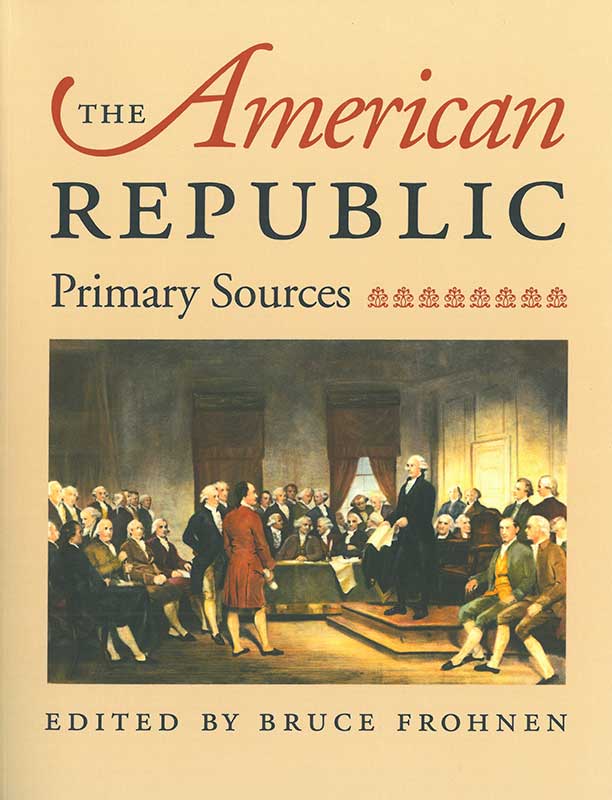
The Federalist , Papers 1, 9, 10, 39, 47–51, 78 - Bruce Frohnen, The American Republic: Primary Sources [2002]Edition used:The American Republic: Primary Sources, ed. Bruce Frohnen (Indianapolis: Liberty Fund, 2002).
About Liberty Fund:Liberty Fund, Inc. is a private, educational foundation established to encourage the study of the ideal of a society of free and responsible individuals. Copyright information:The copyright to this edition, in both print and electronic forms, is held by Liberty Fund, Inc. Fair use statement:This material is put online to further the educational goals of Liberty Fund, Inc. Unless otherwise stated in the Copyright Information section above, this material may be used freely for educational and academic purposes. It may not be used in any way for profit.
The Federalist, Papers 1, 9, 10, 39, 47–51, 781787 Alexander Hamilton, former aide to Gen. George Washington, member of the New York Assembly, and future secretary of the treasury, was particularly concerned about the Constitution’s prospects in his state, which had Anti-Federalist George Clinton for its governor. Hamilton sought to answer the charges be-ing levelled against the Constitution in numerous pamphlets—principally that it would set up a centralized government that would invade the liberties of the states and of the people. Hamilton recruited James Madison, leading architect of the Constitution, and the jurist and future Supreme Court justice John Jay to write a series of newspaper articles explaining and justifying the new form of government. Whether the ensuing articles, published under the pseudonym “Publius,” changed any votes is largely unknown, but the essays have become recognized as important statements of the principles of the Constitution and of republican government in general. No. 1IntroductionAfter full experience of the insufficiency of the existing federal government, you are invited to deliberate upon a New Constitution for the United States of America. The subject speaks its own importance; comprehending in its consequences, nothing less than the existence of the UNION, the safety and welfare of the parts of which it is composed, the fate of an empire, in many respects, the most interesting in the world. It has been frequently remarked, that it seems to have been reserved to the people of this country to decide, by their conduct and example, the important question, whether societies of men are really capable or not, of establishing good government from reflection and choice, or whether they are forever destined to depend, for their political constitutions, on accident and force. If there be any truth in the remark, the crisis at which we are arrived may, with propriety, be regarded as the period when that decision is to be made; and a wrong election of the part we shall act, may, in this view, deserve to be considered as the general misfortune of mankind. This idea, by adding the inducements of philanthropy to those of patriotism, will heighten the solicitude which all considerate and good men must feel for the event. Happy will it be if our choice should be directed by a judicious estimate of our true interests, uninfluenced by considerations foreign to the public good. But this is more ardently to be wished for, than seriously to be expected. The plan offered to our deliberations, affects too many particular interests, innovates upon too many local institutions, not to involve in its discussion a variety of objects extraneous to its merits, and of views, passions and prejudices little favourable to the discovery of truth. Among the most formidable of the obstacles which the new constitution will have to encounter, may readily be distinguished the obvious interest of a certain class of men in every state to resist all changes which may hazard a diminution of the power, emolument and consequence of the offices they hold under the state establishments . . . and the perverted ambition of another class of men, who will either hope to aggrandize themselves by the confusions of their country, or will flatter themselves with fairer prospects of elevation from the subdivision of the empire into several partial confederacies, than from its union under one government. It is not, however, my design to dwell upon observations of this nature. I am aware that it would be disingenuous to resolve indiscriminately the opposition of any set of men into interested or ambitious views, merely because their situations might subject them to suspicion. Candour will oblige us to admit, that even such men may be actuated by upright intentions; and it cannot be doubted, that much of the opposition, which has already shown itself, or that may hereafter make its appearance, will spring from sources blameless at least, if not respectable . . . the honest errors of minds led astray by preconceived jealousies and fears. So numerous indeed and so powerful are the causes which serve to give a false bias to the judgement, that we, upon many occasions, see wise and good men on the wrong as well as on the right side of questions, of the first magnitude to society. This circumstance, if duly attended to, would always furnish a lesson of moderation to those, who are engaged in any controversy, however well persuaded of being in the right. And a further reason for caution, in this respect, might be drawn from the reflection, that we are not always sure, that those who advocate the truth are actuated by purer principles than their antagonists. Ambition, avarice, personal animosity, party opposition, and many other motives, not more laudable than these, are apt to operate as well upon those who support, as upon those who oppose, the right side of a question. Were there not even these inducements to moderation, nothing could be more ill judged than that intolerant spirit, which has, at all times, characterized political parties. For, in politics as in religion, it is equally absurd to aim at making proselytes by fire and sword. Heresies in either can rarely be cured by persecution. And yet, just as these sentiments must appear to candid men, we have already sufficient indications, that it will happen in this, as in all former cases of great national discussion. A torrent of angry and malignant passions will be let loose. To judge from the conduct of the opposite parties, we shall be led to conclude, that they will mutually hope to evince the justness of their opinions, and to increase the number of their converts, by the loudness of their declamations, and by the bitterness of their invectives. An enlightened zeal for the energy and efficiency of government, will be stigmatized as the offspring of a temper fond of power, and hostile to the principles of liberty. An over scrupulous jealousy of danger to the rights of the people, which is more commonly the fault of the head than of the heart, will be represented as mere pretence and artifice . . . the stale bait for popularity at the expense of public good. It will be forgotten, on the one hand, that jealousy is the usual concomitant of violent love, and that the noble enthusiasm of liberty is too apt to be infected with a spirit of narrow and illiberal distrust. On the other hand, it will be equally forgotten, that the vigour of government is essential to the security of liberty; that, in the contemplation of a sound and well informed judgment, their interests can never be separated; and that a dangerous ambition more often lurks behind the specious mask of zeal for the rights of the people, than under the forbidding appearances of zeal for the firmness and efficiency of government. History will teach us, that the former has been found a much more certain road to the introduction of despotism, than the latter, and that of those men who have overturned the liberties of republics, the greatest number have begun their career, by paying an obsequious court to the people . . . commencing demagogues, and ending tyrants. In the course of the preceding observations it has been my aim, fellow citizens, to put you upon your guard against all attempts, from whatever quarter, to influence your decision in a matter of the utmost moment to your welfare, by any impressions, other than those which may result from the evidence of truth. You will, no doubt, at the same time, have collected from the general scope of them, that they proceed from a source not unfriendly to the new constitution. Yes, my countrymen, I own to you, that, after having given it an attentive consideration, I am clearly of opinion, it is your interest to adopt it. I am convinced, that this is the safest course for your liberty, your dignity, and your happiness. I affect not reserves, which I do not feel. I will not amuse you with an appearance of deliberation, when I have decided. I frankly acknowledge to you my convictions, and I will freely lay before you the reasons on which they are founded. The consciousness of good intentions disdains ambiguity. I shall not however multiply professions on this head. My motives must remain in the depository of my own breast: my arguments will be open to all, and may be judged of by all. They shall at least be offered in a spirit, which will not disgrace the cause of truth. I propose, in a series of papers, to discuss the following interesting particulars . . . The utility of the UNION to your political prosperity . . . The insufficiency of the present confederation to preserve that Union . . . The necessity of a government at least equally energetic with the one proposed, to the attainment of this object . . . The conformity of the proposed constitution to the true principles of republican government . . . Its analogy to your own state constitution . . . and lastly, The additional security, which its adoption will afford to the preservation of that species of government, to liberty and to property. In the progress of this discussion, I shall endeavour to give a satisfactory answer to all the objections which shall have made their appearance, that may seem to have any claim to attention. It may perhaps be thought superfluous to offer arguments to prove the utility of the UNION, a point, no doubt, deeply engraved on the hearts of the great body of the people in every state, and one which, it may be imagined, has no adversaries. But the fact is, that we already hear it whispered in the private circles of those who oppose the new constitution, that the Thirteen States are of too great extent for any general system, and that we must of necessity resort to separate confederacies of distinct portions of the whole. * This doctrine will, in all probability, be gradually propagated, till it has votaries enough to countenance its open avowal. For nothing can be more evident, to those who are able to take an enlarged view of the subject, than the alternative of an adoption of the constitution, or a dismemberment of the Union. It may, therefore, be essential to examine particularly the advantages of that Union, the certain evils, and the probable dangers, to which every state will be exposed from its dissolution. This shall accordingly be done. publius No. 9The Utility of the Union as a Safeguard against Domestic Faction and InsurrectionA firm union will be of the utmost moment to the peace and liberty of the states, as a barrier against domestic faction and insurrection. It is impossible to read the history of the petty repub-lics of Greece and Italy, without feeling sensations of horror and disgust at the distractions with which they were continually agitated, and at the rapid succession of revolutions, by which they were kept perpetually vibrating between the extremes of tyranny and anarchy. If they exhibit occasional calms, these only serve as short-lived contrasts to the furious storms that are to succeed. If now and then intervals of felicity open themselves to view, we behold them with a mixture of regret arising from the reflection, that the pleasing scenes before us are soon to be overwhelmed by the tempestuous waves of sedition and party rage. If momentary rays of glory break forth from the gloom, while they dazzle us with a transient and fleeting brilliancy, they at the same time admonish us to lament, that the vices of government should pervert the direction, and tarnish the lustre, of those bright talents and exalted endowments, for which the favoured soils that produced them have been so justly celebrated. From the disorders that disfigure the annals of those republics, the advocates of despotism have drawn arguments, not only against the forms of republican government, but against the very principles of civil liberty. They have decried all free government, as inconsistent with the order of society, and have indulged themselves in malicious exultation over its friends and partisans. Happily for mankind, stupendous fabrics reared on the basis of liberty, which have flourished for ages, have in a few glorious instances refuted their gloomy sophisms. And, I trust, America will be the broad and solid foundation of other edifices not less magnificent, which will be equally permanent monuments of their error. But it is not to be denied, that the portraits they have sketched of republican government, were too just copies of the originals from which they were taken. If it had been found impracticable to have devised models of a more perfect structure, the enlightened friends of liberty would have been obliged to abandon the cause of that species of government as indefensible. The science of politics, however, like most other sciences, has received great improvement. The efficacy of various principles is now well understood, which were either not known at all, or imperfectly known to the ancients. The regular distribution of power into distinct departments; the introduction of legislative balances and checks; the institution of courts composed of judges, holding their offices during good behaviour; the representation of the people in the legislature, by deputies of their own election; these are either wholly new discoveries, or have made their principal progress towards perfection in modern times. They are means, and powerful means, by which the excellencies of republican government may be retained, and its imperfections lessened or avoided. To this catalogue of circumstances, that tend to the amelioration of popular systems of civil government, I shall venture, however novel it may appear to some, to add one more, on a principle which has been made the foundation of an objection to the new constitution; I mean the enlargement of the orbit within which such systems are to revolve, either in respect to the dimensions of a single state, or to the consolidation of several smaller states into one great confederacy. The latter is that which immediately concerns the object under consideration. It will, however, be of use to examine the principle in its application to a single state, which shall be attended to in another place. The utility of a confederacy, as well to suppress faction, and to guard the internal tranquillity of states, as to increase their external force and security, is in reality not a new idea. It has been practised upon in different countries and ages, and has received the sanction of the most approved writers on the subjects of politics. The opponents of the plan proposed have with great assiduity cited and circulated the observations of Montesquieu on the necessity of a contracted territory for a republican government. But they seem not to have been apprised of the sentiments of that great man expressed in another part of his work, nor to have adverted to the consequences of the principle to which they subscribe with such ready acquiescence. When Montesquieu recommends a small extent for republics, the standards he had in view were of dimensions, far short of the limits of almost every one of these states. Neither Virginia, Massachusetts, Pennsylvania, New York, North Carolina, nor Georgia, can by any means be compared with the models from which he reasoned, and to which the terms of his description apply. If we therefore receive his ideas on this point, as the criterion of truth, we shall be driven to the alternative, either of taking refuge at once in the arms of monarchy, or of splitting ourselves into an infinity of little, jealous, clashing, tumultuous commonwealths, the wretched nurseries of unceasing discord, and the miserable objects of universal pity or contempt. Some of the writers, who have come forward on the other side of the question, seem to have been aware of the dilemma; and have even been bold enough to hint at the division of the larger states, as a desirable thing. Such an infatuated policy, such a desperate expedient, might, by the multiplication of petty offices, answer the views of men, who possess not qualifications to extend their influence beyond the narrow circles of personal intrigue; but it could never promote the greatness or happiness of the people of America. Referring the examination of the principle itself to another place, as has been already mentioned, it will be sufficient to remark here, that in the sense of the author who has been most emphatically quoted upon the occasion, it would only dictate a reduction of the size of the more considerable members of the union; but would not militate against their being all comprehended in one confederate government. And this is the true question, in the discussion of which we are at present interested. So far are the suggestions of Montesquieu from standing in opposition to a general union of the states, that he explicitly treats of a confederate republic as the expedient for extending the sphere of popular government, and reconciling the advantages of monarchy with those of republicanism. “It is very probable, says he, that mankind would have been obliged, at length, to live constantly under the government of a single person, had they not contrived a kind of constitution, that has all the internal advantages of a republican, together with the external force of a monarchical government. I mean a confederate republic. “This form of government is a convention by which several smaller states agree to become members of a larger one, which they intend to form. It is a kind of assemblage of societies, that constitute a new one, capable of increasing by means of new associations, till they arrive to such a degree of power as to be able to provide for the security of the united body. “A republic of this kind, able to withstand an exter-nal force, may support itself without any internal corruption. The form of this society prevents all manner of inconveniences. “If a single member should attempt to usurp the supreme authority, he could not be supposed to have an equal authority and credit in all the confederate states. Were he to have too great influence over one, this would alarm the rest. Were he to subdue a part, that which would still remain free might oppose him with forces, independent of those which he had usurped, and overpower him before he could be settled in his usurpation. “Should a popular insurrection happen in one of the confederate states, the others are able to quell it. Should abuses creep into one part, they are reformed by those that remain sound. The state may be destroyed on one side, and not on the other; the confederacy may be dissolved, and the confederates preserve their sovereignty. “As this government is composed of small republics, it enjoys the internal happiness of each, and with respect to its external situation, it is possessed, by means of the association, of all the advantages of large monarchies.” I have thought it proper to quote at length these interesting passages, because they contain a luminous abridgement of the principal arguments in favour of the union, and must effectually remove the false impressions, which a misapplication of the other parts of the work was calculated to produce. They have, at the same time, an intimate connexion with the more immediate design of this paper, which is to illustrate the tendency of the union to repress domestic faction and insurrection. A distinction, more subtle than accurate, has been raised between a confederacy and a consolidation of the states. The essential characteristic of the first, is said to be the restriction of its authority to the members in their collective capacities, without reaching to the individuals of whom they are composed. It is contended, that the national council ought to have no concern with any object of internal administration. An exact equality of suffrage between the members, has also been insisted upon as a leading feature of a confederate government. These positions are, in the main, arbitrary; they are supported neither by principle nor precedent. It has indeed happened, that governments of this kind have generally operated in the manner which the distinction taken notice of supposes to be inherent in their nature; but there have been in most of them extensive exceptions to the practice, which serve to prove, as far as example will go, that there is no absolute rule on the subject. And it will be clearly shown, in the course of this investigation, that, as far as the principle contended for has prevailed, it has been the cause of incurable disorder and imbecility in the government. The definition of a confederate republic seems simply to be, “an assemblage of societies,” or an association of two or more states into one state. The extent, modifications, and objects, of the federal authority, are mere matters of discretion. So long as the separate organization of the members be not abolished, so long as it exists by a constitutional necessity for local purposes, though it should be in perfect subordination to the general authority of the union, it would still be, in fact and in theory, an association of states, or a confederacy. The proposed constitution, so far from implying an abolition of the state governments, makes them constituent parts of the national sovereignty, by allowing them a direct representation in the senate, and leaves in their possession certain exclusive, and very important, portions of the sovereign power. This fully corresponds, in every rational import of the terms, with the idea of a federal government. In the Lycian confederacy, which consisted of twenty-three cities, or republics, the largest were entitled to three votes in the common council, those of the middle class to two, and the smallest to one. The common council had the appointment of all the judges and magistrates of the respective cities. This was certainly the most delicate species of interference in their internal administration; for if there be any thing that seems exclusively appropriated to the local jurisdictions, it is the appointment of their own officers. Yet Montesquieu, speaking of this association, says, “were I to give a model of an excellent confederate republic, it would be that of Lycia.” Thus we perceive, that the distinctions insisted upon, were not within the contemplation of this enlightened writer; and we shall be led to conclude, that they are the novel refinements of an erroneous theory. publius No. 10The same Subject continuedAmong the numerous advantages promised by a well constructed union, none deserves to be more accurately developed, than its tendency to break and control the violence of faction. The friend of popular governments, never finds himself so much alarmed for their character and fate, as when he contemplates their propensity to this dangerous vice. He will not fail, therefore, to set a due value on any plan which, without violating the principles to which he is attached, provides a proper cure for it. The instability, injustice, and confusion, introduced into the public councils, have, in truth, been the mortal diseases under which popular governments have every where perished; as they continue to be the favourite and fruitful topics from which the adversaries to liberty derive their most specious declamations. The valuable improvements made by the American constitutions on the popular models, both ancient and modern, cannot certainly be too much admired; but it would be an unwarrantable partiality, to contend that they have as effectually obviated the danger on this side, as was wished and expected. Complaints are every where heard from our most considerate and virtuous citizens, equally the friends of public and private faith, and of public and personal liberty, that our governments are too unstable; that the public good is disregarded in the conflicts of rival parties; and that measures are too often decided, not according to the rules of justice, and the rights of the minor party, but by the superior force of an interested and overbearing majority. However anxiously we may wish that these complaints had no foundation, the evidence of known facts will not permit us to deny that they are in some degree true. It will be found, indeed, on a candid review of our situation, that some of the distresses un-der which we labour, have been erroneously charged on the operation of our governments; but it will be found, at the same time, that other causes will not alone account for many of our heaviest misfortunes; and, particularly, for that prevailing and increasing distrust of public engagements, and alarm for private rights, which are echoed from one end of the continent to the other. These must be chiefly, if not wholly, effects of the unsteadiness and injustice, with which a factious spirit has tainted our public administrations. By a faction, I understand a number of citizens, whether amounting to a majority or minority of the whole, who are united and actuated by some common impulse of passion, or of interest, adverse to the rights of other citizens, or to the permanent and aggregate interests of the community. There are two methods of curing the mischiefs of faction: The one, by removing its causes; the other, by controling its effects. There are again two methods of removing the causes of faction: The one, by destroying the liberty which is essential to its existence; the other, by giving to every citizen the same opinions, the same passions, and the same interests. It could never be more truly said, than of the first remedy, that it is worse than the disease. Liberty is to faction, what air is to fire, an aliment, without which it instantly expires. But it could not be a less folly to abolish liberty, which is essential to political life, because it nourishes faction, than it would be to wish the annihilation of air, which is essential to animal life, because it imparts to fire its destructive agency. The second expedient is as impracticable, as the first would be unwise. As long as the reason of man continues fallible, and he is at liberty to exercise it, different opinions will be formed. As long as the connection subsists between his reason and his self-love, his opinions and his passions will have a reciprocal influence on each other; and the former will be objects to which the latter will attach themselves. The diversity in the faculties of men, from which the rights of property originate, is not less an insuperable obstacle to an uniformity of interests. The protection of these faculties, is the first object of government. From the protection of different and unequal faculties of acquir-ing property, the possession of different degrees and kinds of property immediately results; and from the influence of these on the sentiments and views of the respective proprietors, ensues a division of the society into different interests and parties. The latent causes of faction are thus sown in the nature of man; and we see them every where brought into different degrees of activity, according to the different circumstances of civil society. A zeal for different opinions concerning religion, concerning government, and many other points, as well of speculation as of practice; an attachment to different leaders, ambitiously contending for pre-eminence and power; or to persons of other descriptions, whose fortunes have been interesting to the human passions, have, in turn, divided mankind into parties, inflamed them with mutual animosity, and rendered them much more disposed to vex and oppress each other, than to co-operate for their common good. So strong is this propensity of mankind, to fall into mutual animosities, that where no substantial occasion presents itself, the most frivolous and fanciful distinctions have been sufficient to kindle their unfriendly passions, and excite their most violent conflicts. But the most common and durable source of factions, has been the various and unequal distribution of property. Those who hold, and those who are without property, have ever formed distinct interests in society. Those who are creditors, and those who are debtors, fall under a like discrimination. A landed interest, a manufacturing interest, a mercantile interest, a monied interest, with many lesser interests, grow up of necessity in civi-lized nations, and divide them into different classes, actuated by different sentiments and views. The regulation of these various and interfering interests, forms the principal task of modern legislation, and involves the spirit of party and faction in the necessary and ordinary operations of government. No man is allowed to be a judge in his own cause; because his interest would certainly bias his judgment, and, not improbably, corrupt his integrity. With equal, nay, with greater reason, a body of men are unfit to be both judges and parties, at the same time; yet, what are many of the most important acts of legislation, but so many judicial determinations, not indeed concerning the rights of single persons, but concerning the rights of large bodies of citizens? and what are the different classes of legislators, but advocates and parties to the causes which they determine? Is a law proposed concerning private debts? It is a question to which the creditors are parties on one side, and the debtors on the other. Justice ought to hold the balance between them. Yet the parties are, and must be, themselves the judges; and the most numerous party, or, in other words, the most powerful faction, must be expected to prevail. Shall domestic manufactures be encouraged, and in what degree, by restrictions on foreign manufactures? are questions which would be differently decided by the landed and the manufacturing classes; and probably by neither with a sole regard to justice and the public good. The apportionment of taxes, on the various descriptions of property, is an act which seems to require the most exact impartiality; yet there is, perhaps, no legislative act in which greater opportunity and temptation are given to a predominant party, to trample on the rules of justice. Every shilling with which they over-burden the inferior number, is a shilling saved to their own pockets. It is in vain to say, that enlightened statesmen will be able to adjust these clashing interests, and render them all subservient to the public good. Enlightened statesmen will not always be at the helm: nor, in many cases, can such an adjustment be made at all, without taking into view indirect and remote considerations, which will rarely pre-vail over the immediate interest which one party may find in disregarding the rights of another, or the good of the whole. The inference to which we are brought, is, that the causes of faction cannot be removed; and that relief is only to be sought in the means of controlling its effects. If a faction consists of less than a majority, relief is supplied by the republican principle, which enables the majority to defeat its sinister views, by regular vote. It may clog the administration, it may convulse the society; but it will be unable to execute and mask its violence under the forms of the constitution. When a majority is included in a faction, the form of popular government, on the other hand, enables it to sacrifice to its ruling passion or interest, both the public good and the rights of other citizens. To secure the public good, and private rights, against the danger of such a faction, and at the same time to preserve the spirit and the form of popular government, is then the great object to which our inquiries are directed. Let me add, that it is the great desideratum, by which alone this form of government can be rescued from the opprobrium under which it has so long laboured, and be recommended to the esteem and adoption of mankind. By what means is this object attainable? Evidently by one of two only. Either the existence of the same passion or interest in a majority, at the same time, must be prevented; or the majority, having such co-existent passion or interest, must be rendered, by their number and local situation, unable to concert and carry into effect schemes of oppression. If the impulse and the opportunity be suffered to coincide, we well know, that neither moral nor religious motives can be relied on as an adequate control. They are not found to be such on the injustice and violence of individuals, and lose their efficacy in proportion to the number combined together; that is, in proportion as their efficacy becomes needful. From this view of the subject, it may be concluded, that a pure democracy, by which I mean, a society consisting of a small number of citizens, who assemble and administer the government in person, can admit of no cure for the mischiefs of faction. A common passion or interest will, in almost every case, be felt by a majority of the whole; a communication and concert, results from the form of government itself; and there is nothing to check the inducements to sacrifice the weaker party, or an obnoxious individual. Hence it is, that such democracies have ever been spectacles of turbulence and contention; have ever been found incompatible with personal security, or the rights of property; and have, in general, been as short in their lives, as they have been violent in their deaths. Theoretic politicians, who have patronised this species of government, have erroneously supposed, that, by reducing mankind to a perfect equality in their political rights, they would, at the same time, be perfectly equalized and assimilated in their possessions, their opinions, and their passions. A republic, by which I mean a government in which the scheme of representation takes place, opens a different prospect, and promises the cure for which we are seeking. Let us examine the points in which it varies from pure democracy, and we shall comprehend both the nature of the cure and the efficacy which it must derive from the union. The two great points of difference, between a democracy and a republic, are, first, the delegation of the government, in the latter, to a small number of citizens elected by the rest; secondly, the greater number of citizens, and greater sphere of country, over which the latter may be extended. The effect of the first difference is, on the one hand, to refine and enlarge the public views, by passing them through the medium of a chosen body of citizens, whose wisdom may best discern the true interest of their country, and whose patriotism and love of justice, will be least likely to sacrifice it to temporary or partial considerations. Under such a regulation, it may well happen, that the public voice, pronounced by the representatives of the people, will be more consonant to the public good, than if pronounced by the people themselves, convened for the purpose. On the other hand, the effect may be inverted. Men of factious tempers, of local prejudices, or of sinister designs, may by intrigue, by corruption, or by other means, first obtain the suffrages, and then betray the interests of the people. The question resulting is, whether small or extensive republics are most favourable to the election of proper guardians of the public weal; and it is clearly decided in favour of the latter by two obvious considerations. In the first place, it is to be remarked, that however small the republic may be, the representatives must be raised to a certain number, in order to guard against the cabals of a few; and that, however large it may be, they must be limited to a certain number, in order to guard against the confusion of a multitude. Hence, the number of representatives in the two cases not being in proportion to that of the constituents, and being proportionally greatest in the small republic, it follows, that if the proportion of fit characters be not less in the large than in the small republic, the former will present a greater option, and consequently a greater probability of a fit choice. In the next place, as each representative will be chosen by a greater number of citizens in the large than in the small republic, it will be more difficult for unworthy candidates to practise with success the vicious arts, by which elections are too often carried; and the suffrages of the people being more free, will be more likely to centre in men who possess the most attractive merit, and the most diffusive and established characters. It must be confessed, that in this, as in most other cases, there is a mean, on both sides of which inconveniences will be found to lie. By enlarging too much the number of electors, you render the representative too little acquainted with all their local circumstances and lesser interests; as by reducing it too much, you render him unduly attached to these, and too little fit to comprehend and pursue great and national objects. The federal constitution forms a happy combination in this respect; the great and aggregate interests, being referred to the national, the local and particular to the state legislatures. The other point of difference is, the greater number of citizens, and extent of territory, which may be brought within the compass of republican, than of democratic government; and it is this circumstance principally which renders factious combinations less to be dreaded in the former, than in the latter. The smaller the society, the fewer probably will be the distinct parties and interests composing it; the fewer the distinct parties and interests, the more frequently will a majority be found of the same party; and the smaller the number of individuals composing a majority, and the smaller the compass within which they are placed, the more easily will they concert and execute their plans of oppression. Extend the sphere, and you take in a greater variety of parties and interests; you make it less probable that a majority of the whole will have a common motive to invade the rights of other citizens; or if such a common motive exists, it will be more difficult for all who feel it to discover their own strength, and to act in unison with each other. Besides other impediments, it may be remarked, that where there is a consciousness of unjust or dishonourable purposes, communication is always checked by distrust, in proportion to the number whose concurrence is necessary. Hence it clearly appears, that the same advantage, which a republic has over a democracy, in controling the effects of faction, is enjoyed by a large over a small republic . . . is enjoyed by the union over the states composing it. Does this advantage consist in the substitution of representatives, whose enlightened views and virtuous sentiments render them superior to local prejudices, and to schemes of injustice? It will not be denied, that the representation of the union will be most likely to possess these requisite endowments. Does it consist in the greater security afforded by a greater variety of parties, against the event of any one party being able to outnumber and oppress the rest? In an equal degree does the increased variety of parties, comprised within the union, increase this security. Does it, in fine, consist in the greater obstacles opposed to the concert and accomplishment of the secret wishes of an unjust and interested majority? Here, again, the extent of the union gives it the most palpable advantage. The influence of factious leaders may kindle a flame within their particular states, but will be unable to spread a general conflagration through the other states: a religious sect may degenerate into a political faction in a part of the confederacy; but the variety of sects dispersed over the entire face of it, must secure the national councils against any danger from that source: a rage for paper money, for an abolition of debts, for an equal division of property, or for any other improper or wicked project, will be less apt to pervade the whole body of the union, than a particular member of it; in the same proportion as such a malady is more likely to taint a particular county or district, than an entire state. In the extent and proper structure of the union, therefore, we behold a republican remedy for the diseases most incident to republican government. And according to the degree of pleasure and pride we feel in being republicans, ought to be our zeal in cherishing the spirit, and supporting the character of federalists. publius No. 39The conformity of the plan to republican principles: an objection in respect to the powers of the convention, examinedThe last paper having concluded the observations, which were meant to introduce a candid survey of the plan of government reported by the convention, we now proceed to the execution of that part of our undertaking. The first question that offers itself is, whether the general form and aspect of the government be strictly republican? It is evident that no other form would be reconcileable with the genius of the people of America; with the fundamental principles of the revolution; or with that honourable determination which animates every votary of freedom, to rest all our political experiments on the capacity of mankind for self-government. If the plan of the convention, therefore, be found to depart from the republi-can character, its advocates must abandon it as no longer defensible. What then are the distinctive characters of the republican form? Were an answer to this question to be sought, not by recurring to principles, but in the application of the term by political writers, to the constitutions of different states, no satisfactory one would ever be found. Holland, in which no particle of the supreme authority is derived from the people, has passed almost universally under the denomination of a republic. The same title has been bestowed on Venice, where absolute power over the great body of the people is exercised, in the most absolute manner, by a small body of hereditary nobles. Poland, which is a mixture of aristocracy and of monarchy in their worst forms, has been dignified with the same appellation. The government of England, which has one republican branch only, combined with a hereditary aristocracy and monarchy, has, with equal impropriety, been frequently placed on the list of republics. These examples, which are nearly as dissimilar to each other as to a genuine republic, show the extreme inaccuracy with which the term has been used in political disquisitions. If we resort for a criterion, to the different principles on which different forms of government are established, we may define a republic to be, or at least may bestow that name on, a government which derives all its powers directly or indirectly from the great body of the people; and is administered by persons holding their offices during pleasure, for a limited period, or during good behaviour. It is essential to such a government, that it be derived from the great body of the society, not from an inconsiderable proportion, or a favoured class of it; otherwise a handful of tyrannical nobles, exercising their oppressions by a delegation of their powers, might aspire to the rank of republicans, and claim for their government the honourable title of republic. It is sufficient for such a government, that the persons administering it be appointed, either directly or indirectly, by the people; and that they hold their appointments by either of the tenures just specified; otherwise every government in the United States, as well as every other popular government that has been, or can be well organized or well executed, would be degraded from the republican character. According to the constitution of every state in the union, some or other of the officers of government are appointed indirectly only by the people. According to most of them, the chief magistrate himself is so appointed. And according to one, this mode of appointment is extended to one of the co-ordinate branches of the legislature. According to all the constitutions also, the tenure of the highest offices is extended to a definite period, and in many instances, both within the legislative and executive departments, to a period of years. According to the provisions of most of the constitutions, again, as well as according to the most respectable and received opinions on the subject, the members of the judiciary department are to retain their offices by the firm tenure of good behaviour. On comparing the constitution planned by the convention, with the standard here fixed, we perceive at once, that it is, in the most rigid sense, conformable to it. The house of representatives, like that of one branch at least of all the state legislatures, is elected immediately by the great body of the people. The senate, like the present congress, and the senate of Maryland, derives its appointment indirectly from the people. The president is indirectly derived from the choice of the people, according to the example in most of the states. Even the judges, with all other officers of the union, will, as in the several states, be the choice, though a remote choice, of the people themselves. The duration of the appointments is equally conformable to the republican standard, and to the model of the state constitutions. The house of representatives is periodically elective, as in all the states; and for the period of two years, as in the state of South Carolina. The senate is elective, for the period of six years; which is but one year more than the period of the senate of Maryland; and but two more than that of the senates of New York and Virginia. The president is to continue in office for the period of four years; as in New York and Delaware, the chief magistrate is elected for three years, and in South Carolina for two years. In the other states the election is annual. In several of the states, however, no explicit provision is made for the impeachment of the chief magistrate. And in Delaware and Virginia, he is not impeachable till out of office. The president of the United States is impeachable at any time during his continuance in office. The tenure by which the judges are to hold their places, is, as it unquestionably ought to be, that of good behaviour. The tenure of the ministerial offices generally, will be a subject of legal regulation, conform-ably to the reason of the case, and the example of the state constitutions. Could any further proof be required of the republican complexion of this system, the most decisive one might be found in its absolute prohibition of titles of nobility, both under the federal and the state governments; and in its express guarantee of the republican form to each of the latter. But it was not sufficient, say the adversaries of the proposed constitution, for the convention to adhere to the republican form. They ought, with equal care, to have preserved the federal form, which regards the union as a confederacy of sovereign states; instead of which, they have framed a national government, which regards the union as a consolidation of the states. And it is asked, by what authority this bold and radical innovation was undertaken? The handle which has been made of this objection requires, that it should be examined with some precision. Without inquiring into the accuracy of the distinction on which the objection is founded, it will be necessary to a just estimate of its force, first, to ascertain the real character of the government in question; secondly, to inquire how far the convention were authorized to propose such a government: and thirdly, how far the duty they owed to their country, could supply any defect of regular authority. First. In order to ascertain the real character of the government, it may be considered in relation to the foundation on which it is to be established; to the sources from which its ordinary powers are to be drawn; to the operation of those powers; to the extent of them; and to the authority by which future changes in the government are to be introduced. On examining the first relation, it appears, on one hand, that the constitution is to be founded on the assent and ratification of the people of America, given by deputies elected for the special purpose; but on the other, that this assent and ratification is to be given by the people, not as individuals composing one entire nation, but as composing the distinct and independent states to which they respectively belong. It is to be the assent and ratification of the several states, derived from the supreme authority in each state . . . the authority of the people themselves. The act, therefore, establishing the constitution, will not be a national, but a federal act. That it will be a federal, and not a national act, as these terms are understood by the objectors, the act of the people, as forming so many independent states, not as forming one aggregate nation, is obvious from this single consideration, that it is to result neither from the decision of a majority of the people of the union, nor from that of a majority of the states. It must result from the unanimous assent of the several states that are parties to it, differing no otherwise from their ordinary assent than in its being expressed, not by the legislative authority, but by that of the people themselves. Were the people regarded in this transaction as forming one nation, the will of the majority of the whole people of the United States would bind the minority; in the same manner as the majority in each state must bind the minority; and the will of the majority must be determined either by a comparison of the individual votes, or by considering the will of the majority of the states, as evidence of the will of a majority of the people of the United States. Neither of these rules has been adopted. Each state, in ratifying the constitution, is considered as a sovereign body, independent of all others, and only to be bound by its own voluntary act. In this relation, then, the new constitution will, if established, be a federal, and not a national constitution. The next relation is, to the sources from which the ordinary powers of government are to be derived. The house of representatives will derive its powers from the people of America, and the people will be represented in the same proportion, and on the same principle, as they are in the legislature of a particular state. So far the government is national, not federal. The senate, on the other hand, will derive its powers from the states, as political and co-equal societies; and these will be represented on the principle of equality in the senate, as they now are in the existing congress. So far the government is federal, not national. The executive power will be derived from a very compound source. The immediate election of the president is to be made by the states in their political characters. The votes alloted to them are in a compound ratio, which considers them partly as distinct and co-equal societies; partly as unequal members of the same society. The eventual election, again, is to be made by that branch of the legislature which consists of the national representatives; but in this particular act, they are to be thrown into the form of individual delegations, from so many distinct and co-equal bodies politic. From this aspect of the government, it appears to be of a mixed character, presenting at least as many federal as national features. The difference between a federal and national government, as it relates to the operation of the government, is, by the adversaries of the plan of the convention, supposed to consist in this, that in the former, the powers operate on the political bodies composing the confederacy, in their political capacities; in the latter, on the individual citizens composing the nation, in their individual capacities. On trying the constitution by this criterion, it falls under the national, not the federal character; though perhaps not so completely as has been understood. In several cases, and particularly in the trial of controversies to which states may be parties, they must be viewed and proceeded against in their collective and political capacities only. But the operation of the government on the people in their individual capacities, in its ordinary and most essential proceedings, will, on the whole, in the sense of its opponents, designate it in this relation, a national government. But if the government be national, with regard to the operation of its powers, it changes its aspect again, when we contemplate it in relation to the extent of its powers. The idea of a national government involves in it, not only an authority over the individual citizens, but an indefinite supremacy over all persons and things, so far as they are objects of lawful government. Among a people consolidated into one nation, this supremacy is completely vested in the national legislature. Among communities united for particular purposes, it is vested partly in the general, and partly in the municipal legislatures. In the former case, all local authorities are subordinate to the supreme; and may be controled, directed, or abolished by it at pleasure. In the latter, the local or municipal authorities form distinct and independent portions of the supremacy, no more subject, within their respective spheres, to the general authority, than the general authority is subject to them within its own sphere. In this relation, then, the proposed government cannot be deemed a national one; since its jurisdiction extends to certain enumerated objects only, and leaves to the several states, a residuary and inviolable sovereignty over all other objects. It is true, that in controversies relating to the boundary between the two jurisdictions, the tribunal which is ultimately to decide, is to be established under the general government. But this does not change the principle of the case. The decision is to be impartially made, according to the rules of the constitution: and all the usual and most effectual precautions are taken to secure this impartiality. Some such tribunal is clearly essential to prevent an appeal to the sword, and a dissolution of the compact; and that it ought to be established under the general, rather than under the local governments; or, to speak more properly, that it could be safely established under the first alone, is a position not likely to be combated. If we try the constitution by its last relation, to the authority by which amendments are to be made, we find it neither wholly national, nor wholly federal. Were it wholly national, the supreme and ultimate authority would re-side in the majority of the people of the union; and this authority would be competent at all times, like that of a majority of every national society, to alter or abolish its established government. Were it wholly federal on the other hand, the concurrence of each state in the union would be essential to every alteration that would be binding on all. The mode provided by the plan of the convention, is not founded on either of these principles. In requiring more than a majority, and particularly, in computing the proportion by states, not by citizens, it departs from the national, and advances towards the federal character. In rendering the concurrence of less than the whole number of states sufficient, it loses again the federal, and partakes of the national character. The proposed constitution, therefore, even when tested by the rules laid down by its antagonists, is, in strictness, neither a national nor a federal constitution; but a composition of both. In its foundation it is federal, not national; in the sources from which the ordinary powers of the government are drawn, it is partly federal, and partly national; in the operation of these powers, it is national, not federal; in the extent of them again, it is federal, not national; and finally, in the authoritative mode of introducing amendments, it is neither wholly federal, nor wholly national. publius No. 47The meaning of the maxim, which requires a separation of the departments of power, examined and ascertainedHaving reviewed the general form of the proposed government, and the general mass of power allotted to it; I proceed to examine the particular structure of this government, and the distribution of this mass of power among its constituent parts. One of the principal objections inculcated by the more respectable adversaries to the constitution, is its supposed violation of the political maxim, that the legislative, executive, and judiciary departments, ought to be separate and distinct. In the structure of the federal government, no regard, it is said, seems to have been paid to this essential precaution in favour of liberty. The several departments of power are distributed and blended in such a manner, as at once to destroy all symmetry and beauty of form: and to expose some of the essential parts of the edifice to the danger of being crushed by the disproportionate weight of other parts. No political truth is certainly of greater intrinsic value, or is stamped with the authority of more enlightened patrons of liberty, than that on which the objection is founded. The accumulation of all powers, legislative, executive, and judiciary, in the same hands, whether of one, a few, or many, and whether hereditary, self-appointed, or elective, may justly be pronounced the very definition of tyranny. Were the federal constitution, therefore, really chargeable with this accumulation of power, or with a mixture of powers, having a dangerous tendency to such an accumulation, no further arguments would be necessary to inspire a universal reprobation of the system. I persuade myself, however, that it will be made apparent to every one, that the charge cannot be supported, and that the maxim on which it relies has been totally misconceived and misapplied. In order to form correct ideas on this important subject, it will be proper to investigate the sense in which the preservation of liberty requires, that the three great departments of power should be separate and distinct. The oracle who is always consulted and cited on this subject, is the celebrated Montesquieu. If he be not the author of this invaluable precept in the science of politics, he has the merit at least of displaying and recommend-ing it most effectually to the attention of mankind. Let us endeavour, in the first place, to ascertain his meaning on this point. The British constitution was to Montesquieu, what Homer has been to the didactic writers on epic poetry. As the latter have considered the work of the immortal bard, as the perfect model from which the principles and rules of the epic art were to be drawn, and by which all similar works were to be judged: so this great political critic appears to have viewed the constitution of England as the standard, or to use his own expression, as the mirror of political liberty; and to have delivered, in the form of elementary truths, the several characteristic principles of that particular system. That we may be sure then not to mistake his meaning in this case, let us recur to the source from which the maxim was drawn. On the slightest view of the British constitution, we must perceive, that the legislative, executive, and judiciary departments, are by no means totally separate and distinct from each other. The executive magistrate forms an integral part of the legislative authority. He alone has the prerogative of making treaties with foreign sovereigns, which, when made, have, under certain limitations, the force of legislative acts. All the members of the judiciary department are appointed by him; can be removed by him on the address of the two houses of parliament, and form, when he pleases to consult them, one of his constitutional councils. One branch of the legislative department, forms also a great constitutional council to the executive chief; as, on another hand, it is the sole depository of judicial power in cases of impeachment, and is invested with the supreme appellate jurisdiction in all other cases. The judges again are so far connected with the legislative department, as often to attend and participate in its deliberations, though not admitted to a legislative vote. From these facts, by which Montesquieu was guided, it may clearly be inferred, that in saying, “there can be no liberty, where the legislative and executive powers are united in the same person, or body of magistrates;” or, “if the power of judging, be not separated from the legislative and executive powers,” he did not mean that these departments ought to have no partial agency in, or no control over the acts of each other. His meaning, as his own words import, and still more conclusively as illustrated by the example in his eye, can amount to no more than this, that where the whole power of one department is exercised by the same hands which possess the whole power of another department, the fundamental principles of a free constitution are subverted. This would have been the case in the constitution examined by him, if the king, who is the sole executive magistrate, had possessed also the complete legislative power, or the supreme administration of justice; or if the entire legislative body had possessed the supreme judiciary, or the supreme executive authority. This, however, is not among the vices of that constitution. The magistrate, in whom the whole executive power resides, cannot of himself make a law, though he can put a negative on every law; nor administer justice in person, though he has the appointment of those who do administer it. The judges can exercise no executive prerogative, though they are shoots from the executive stock; nor any legislative function, though they may be advised with by the legislative councils. The entire legislature, can perform no judiciary act; though by the joint act of two of its branches, the judges may be removed from their offices; and though one of its branches is possessed of the judicial power in the last resort. The entire legislature again can exercise no executive prerogative, though one of its branches * constitutes the supreme executive magistracy; and another, on the impeachment of a third, can try and condemn all the subordinate officers in the executive department. The reasons on which Montesquieu grounds his maxim, are a further demonstration of his meaning. “When the legislative and executive powers are united in the same person or body,” says he, “there can be no liberty, because apprehensions may arise lest the same monarch or senate should enact tyrannical laws, to execute them in a tyrannical manner.” Again, “were the power of judging joined with the legislative, the life and liberty of the subject would be exposed to arbitrary control, for the judge would then be the legislator. Were it joined to the executive power, the judge might behave with all the violence of an oppressor.” Some of these reasons are more fully explained in other passages; but briefly stated as they are here, they sufficiently establish the meaning which we have put on this celebrated maxim of this celebrated author. If we look into the constitutions of the several states, we find that, notwithstanding the emphatical, and in some instances, the unqualified terms in which this axiom has been laid down, there is not a single instance in which the several departments of power have been kept absolutely separate and distinct. New Hampshire, whose constitution was the last formed, seems to have been fully aware of the impossibility and inexpediency of avoiding any mixture whatever of these departments; and has qualified the doctrine by declaring, “that the legislative, executive, and judiciary powers, ought to be kept as separate from, and independent of each other, as the nature of a free government will admit; or as is consistent with that chain of connexion, that binds the whole fabric of the constitution in one indissoluble bond of unity and amity.” Her constitution accordingly mixes these departments in several respects. The senate, which is a branch of the legislative department, is also a judicial tribunal for the trial of impeachments. The president, who is the head of the executive department, is the presiding member also of the senate; and besides an equal vote in all cases, has a casting vote in case of a tie. The executive head is himself eventually elective every year by the legislative department; and his council is every year chosen by and from the members of the same department. Several of the officers of state are also appointed by the legislature. And the members of the judiciary department are appointed by the executive department. The constitution of Massachusetts has observed a sufficient, though less pointed caution, in expressing this fundamental article of liberty. It declares, “that the legislative department shall never exercise the executive and judicial powers, or either of them: the executive shall never exercise the legislative and judicial powers, or either of them: the judicial shall never exercise the legislative and executive powers, or either of them.” This declaration corresponds precisely with the doctrine of Montesquieu, as it has been explained, and is not in a single point violated by the plan of the convention. It goes no farther than to prohibit any one of the entire departments from exercising the powers of another department. In the very constitution to which it is prefixed, a partial mixture of powers has been admitted. The executive magistrate has a qualified negative on the legislative body; and the senate, which is a part of the legislature, is a court of impeachment for members both of the executive and judiciary departments. The members of the judiciary department again, are appointable by the executive department, and removeable by the same authority, on the address of the two legislative branches. Lastly, a number of the officers of government, are annually appointed by the legislative department. As the appointment to offices, particularly executive offices, is in its nature an executive function, the compilers of the constitution have, in this last point at least, violated the rule established by themselves. I pass over the constitutions of Rhode Island and Connecticut, because they were formed prior to the revolution: and even before the principle under examination had become an object of political attention. The constitution of New York contains no declaration on this subject; but appears very clearly to have been framed with an eye to the danger of improperly blending the different departments. It gives, nevertheless, to the executive magistrate a partial control over the legislative department; and what is more, gives a like control to the judiciary department, and even blends the executive and judiciary departments in the exercise of this control. In its council of appointment, members of the legislative, are associated with the executive authority, in the appointment of officers, both executive and judiciary. And its court for the trial of impeachments and correction of errors, is to consist of one branch of the legislature and the principal members of the judiciary department. The constitution of New Jersey has blended the different powers of government more than any of the preced-ing. The governor, who is the executive magistrate, is appointed by the legislature; is chancellor, and ordinary, or surrogate of the state; is a member of the supreme court of appeals, and president with a casting vote of one of the legislative branches. The same legislative branch acts again as executive council of the governor, and with him constitutes the court of appeals. The members of the judiciary department are appointed by the legislative department, and removeable by one branch of it on the impeachment of the other. According to the constitution of Pennsylvania, * the president, who is head of the executive department, is annually elected by a vote in which the legislative department predominates. In conjunction with an executive council, he appoints the members of the judiciary department, and forms a court of impeachments for trial of all officers, judiciary as well as executive. The judges of the supreme court, and justices of the peace, seem also to be removeable by the legislature; and the executive power of pardoning in certain cases to be referred to the same department. The members of the executive council are made ex officio justices of peace throughout the state. In Delaware, * the chief executive magistrate is annually elected by the legislative department. The speakers of the two legislative branches are vice-presidents in the execu-tive department. The executive chief, with six others, appointed three by each of the legislative branches, constitute the supreme court of appeals: he is joined with the legislative department in the appointment of the other judges. Throughout the states, it appears that the members of the legislature may at the same time be justices of the peace. In this state, the members of one branch of it are ex officio justices of the peace; as are also the members of the executive council. The principal officers of the executive department are appointed by the legislative; and one branch of the latter forms a court of impeachments. All officers may be removed on address of the legislature. Maryland has adopted the maxim in the most unqualified terms; declaring that the legislative, executive, and judicial powers of government, ought to be for ever separate and distinct from each other. Her constitution, notwithstanding, makes the executive magistrate appointable by the legislative department; and the members of the judiciary, by the executive department. The language of Virginia is still more pointed on this subject. Her constitution declares, “that the legislative, executive, and judiciary departments, shall be separate and distinct; so that neither exercise the powers properly belonging to the other; nor shall any person exercise the powers of more than one of them at the same time; except that the justices of county courts shall be eligible to either house of assembly.” Yet we find not only this express exception, with respect to the members of the inferior courts; but that the chief magistrate, with his executive council, are appointable by the legislature; that two members of the latter, are triennially displaced at the pleasure of the legislature; and that all the principal officers, both executive and judiciary, are filled by the same department. The executive prerogative of pardoning, also, is in one case vested in the legislative department. The constitution of North Carolina, which declares, “that the legislative, executive, and supreme judicial powers of government, ought to be forever separate and distinct from each other,” refers at the same time to the legislative department, the appointment not only of the executive chief, but all the principal officers within both that and the judiciary department. In South Carolina, the constitution makes the executive magistracy eligible by the legislative department. It gives to the latter, also, the appointment of the members of the judiciary department, including even justices of the peace and sheriffs; and the appointment of officers in the executive department, down to captains in the army and navy of the state. In the constitution of Georgia, where it is declared, “that the legislative, executive, and judiciary departments, shall be separate and distinct, so that neither exercise the powers properly belonging to the other,” we find that the executive department is to be filled by appointments of the legislature; and the executive prerogative of pardoning, to be finally exercised by the same authority. Even justices of the peace are to be appointed by the legislature. In citing these cases in which the legislative, executive, and judiciary departments, have not been kept totally separate and distinct, I wish not to be regarded as an advocate for the particular organizations of the several state governments. I am fully aware, that among the many excellent principles which they exemplify, they carry strong marks of the haste, and still stronger of the inexperience, under which they were framed. It is but too obvious, that, in some instances, the fundamental principle under consideration, has been violated by too great a mixture, and even an actual consolidation of the different powers; and that in no instance has a competent provision been made for maintaining in practice the separation delineated on paper. What I have wished to evince is, that the charge brought against the proposed constitution, of violating a sacred maxim of free government, is warranted neither by the real meaning annexed to that maxim by its author, nor by the sense in which it has hitherto been understood in America. This interesting subject will be resumed in the ensuing paper. publius No. 48The same subject continued, with a view to the means of giving efficacy in practice to that maximIt was shown in the last paper, that the political apothegm there examined, does not require that the legislative, executive, and judiciary departments, should be wholly unconnected with each other. I shall undertake in the next place to show, that unless these departments be so far connected and blended, as to give to each a constitutional control over the others, the degree of separation which the maxim requires, as essential to a free government, can never in practice be duly maintained. It is agreed on all sides, that the powers properly belonging to one of the departments, ought not to be directly and completely administered by either of the other departments. It is equally evident, that neither of them ought to possess, directly or indirectly, an overruling influence over the others in the administration of their respective powers. It will not be denied, that power is of an encroaching nature, and that it ought to be effectually restrained from passing the limits assigned to it. After discriminating, therefore, in theory, the several classes of power, as they may in their nature be legislative, executive, or judiciary; the next, and most difficult task, is to provide some practical security for each, against the invasion of the others. What this security ought to be, is the great problem to be solved. Will it be sufficient to mark, with precision, the boundaries of these departments, in the constitution of the government, and to trust to these parchment barriers against the encroaching spirit of power? This is the security which appears to have been principally relied on by the compilers of most of the American constitutions. But experience assures us, that the efficacy of the provision has been greatly overrated; and that some more adequate defence is indispensably necessary for the more feeble, against the more powerful members of the government. The legislative department is every where extending the sphere of its activity, and drawing all power into its impetuous vortex. The founders of our republics have so much merit for the wisdom which they have displayed, that no task can be less pleasing than that of pointing out the errors into which they have fallen. A respect for truth, however, obliges us to remark, that they seem never for a moment to have turned their eyes from the danger to liberty, from the overgrown and all-grasping prerogative of an hereditary magistrate, supported and fortified by an hereditary branch of the legislative authority. They seem never to have recollected the danger from legislative usurpations, which, by assembling all power in the same hands, must lead to the same tyranny as is threatened by executive usurpations. In a government where numerous and extensive prerogatives are placed in the hands of a hereditary monarch, the executive department is very justly regarded as the source of danger, and watched with all the jealousy which a zeal for liberty ought to inspire. In a democracy, where a multitude of people exercise in person the legislative functions, and are continually exposed, by their incapacity for regular deliberation and concerted measures, to the ambitious intrigues of their executive magistrates, tyranny may well be apprehended, on some favourable emergency, to start up in the same quarter. But in a representative republic, where the executive magistracy is carefully limited, both in the extent and the duration of its power; and where the legislative power is exercised by an assembly, which is inspired by a supposed influence over the people, with an intrepid confidence in its own strength; which is sufficiently numerous to feel all the passions which actuate a multitude; yet not so numerous as to be incapable of pursuing the objects of its passions, by means which reason prescribes; it is against the enterprising ambition of this department, that the people ought to indulge all their jealousy, and exhaust all their precautions. The legislative department derives a superiority in our governments from other circumstances. Its constitutional powers being at once more extensive, and less susceptible of precise limits, it can, with the greater facility, mask under complicated and indirect measures, the encroachments which it makes on the co-ordinate departments. It is not unfrequently a question of real nicety in legislative bodies, whether the operation of a particular measure will, or will not extend beyond the legislative sphere. On the other side, the executive power being restrained within a narrower compass, and being more simple in its nature; and the judiciary being described by land-marks, still less uncertain, projects of usurpation by either of these departments, would immediately betray and defeat themselves. Nor is this all: as the legislative department alone has access to the pockets of the people, and has in some constitutions full discretion, and in all, a prevailing influence over the pecuniary rewards of those who fill the other departments; a dependence is thus created in the latter, which gives still greater facility to encroachments of the former. I have appealed to our own experience for the truth of what I advance on this subject. Were it necessary to verify this experience by particular proofs, they might be multiplied without end. I might collect vouchers in abundance from the records and archives of every state in the union. But as a more concise, and at the same time equally satisfactory evidence, I will refer to the example of two states, attested by two unexceptionable authorities. The first example is that of Virginia, a state which, as we have seen, has expressly declared in its constitution, that the three great departments ought not to be intermixed. The authority in support of it is Mr. Jefferson, who, besides his other advantages for remarking the operation of the government, was himself the chief magistrate of it. In order to convey fully the ideas with which his experience had impressed him on this subject, it will be necessary to quote a passage of some length from his very interesting “Notes on the state of Virginia,” (p. 195.) “All the powers of government, legislative, executive, and judiciary, result to the legislative body. The concentrating these in the same hands, is precisely the definition of despotic government. It will be no alleviation that these powers will be exercised by a plurality of hands, and not by a single one. One hundred and seventy-three despots would surely be as oppressive as one. Let those who doubt it, turn their eyes on the republic of Venice. As little will it avail us that they are chosen by ourselves. An elective despotism was not the government we fought for; but one which should not only be founded on free principles, but in which the powers of government should be so divided and balanced among several bodies of magistracy, as that no one could transcend their legal limits, without being effectually checked and restrained by the others. For this reason, that convention which passed the ordinance of government, laid its foundation on this basis, that the legislative, executive, and judiciary departments, should be separate and distinct, so that no person should exercise the powers of more than one of them at the same time. But no barrier was provided between these several powers. The judiciary and executive members were left dependent on the legislative for their subsistence in office, and some of them for their continuance in it. If, therefore, the legislature assumes executive and judiciary powers, no opposition is likely to be made; nor if made, can be effectual; because in that case, they may put their proceeding into the form of an act of assembly, which will render them obligatory on the other branches. They have accordingly, in many instances, decided rights which should have been left to judiciary controversy; and the direction of the executive, during the whole time of their session, is becoming habitual and familiar.” The other state which I shall take for an example, is Pennsylvania; and the other authority the council of censors which assembled in the years 1783 and 1784. A part of the duty of this body, as marked out by the constitution, was “to inquire whether the constitution had been preserved inviolate in every part; and whether the legislative and executive branches of government, had performed their duty as guardians of the people, or assumed to themselves, or exercised other or greater powers than they are entitled to by the constitution.” In the execution of this trust, the council were necessarily led to a comparison of both the legislative and executive proceedings, with the constitutional powers of these departments: and from the facts enumerated, and to the truth of most of which both sides in the council subscribed, it appears that the constitution had been flagrantly violated by the legislature in a variety of important instances. A great number of laws had been passed violating, without any apparent necessity, the rule requiring that all bills of a public nature shall be previously printed for the consideration of the people; although this is one of the precautions chiefly relied on by the constitution against improper acts of the legislature. The constitutional trial by jury had been violated; and powers assumed which had not been delegated by the constitution. Executive powers had been usurped. The salaries of the judges, which the constitution expressly requires to be fixed, had been occasionally varied; and cases belonging to the judiciary department, frequently drawn within legislative cognizance and determination. Those who wish to see the several particulars falling under each of these heads, may consult the journals of the council which are in print. Some of them, it will be found, may be imputable to peculiar circumstances connected with the war: but the greater part of them may be considered as the spontaneous shoots of an ill constituted government. It appears also, that the executive department had not been innocent of frequent breaches of the constitution. There are three observations, however, which ought to be made on this head. First. A great proportion of the instances, were either immediately produced by the necessities of the war, or recommended by congress or the commander in chief. Second. In most of the other instances, they conformed either to the declared or the known sentiments of the legislative department. Third. The executive department of Pennsylvania is distinguished from that of the other states, by the number of members composing it. In this respect it has as much affinity to a legislative assembly, as to an executive council. And being at once exempt from the restraint of an individual responsibility for the acts of the body, and deriving confidence from mutual example and joint influence; unauthorized measures would of course be more freely hazarded, than where the executive department is administered by a single hand, or by a few hands. The conclusion which I am warranted in drawing from these observations is, that a mere demarkation on parchment of the constitutional limits of the several departments, is not a sufficient guard against those encroach-ments which lead to a tyrannical concentration of all the powers of government in the same hands. publius No. 49The same subject continued, with the same viewThe author of the “Notes on the state of Virginia,” quoted in the last paper, has subjoined to that valuable work, the draught of a constitution, which had been prepared in order to be laid before a convention expected to be called in 1783, by the legislature, for the establishment of a constitution for that commonwealth. The plan, like every thing from the same pen, marks a turn of thinking original, comprehensive, and accurate; and is the more worthy of attention, as it equally displays a fervent attachment to republican government, and an enlightened view of the dangerous propensities against which it ought to be guarded. One of the precautions which he proposes, and on which he appears ultimately to rely as a palladium to the weaker departments of power, against the invasions of the stronger, is perhaps altogether his own, and as it immediately relates to the subject of our present inquiry, ought not to be overlooked. His proposition is, “that whenever any two of the three branches of government shall concur in opinion each by the voices of two thirds of their whole number, that a convention is necessary for altering the constitution, or correcting breaches of it, a convention shall be called for the purpose.” As the people are the only legitimate fountain of power, and it is from them that the constitutional charter, under which the several branches of government hold their power, is derived; it seems strictly consonant to the republican theory, to recur to the same original authority, not only whenever it may be necessary to enlarge, diminish, or new model the powers of government; but also whenever any one of the departments may commit encroachments on the chartered authorities of the others. The several departments being perfectly co-ordinate by the terms of their common commission, neither of them, it is evident, can pretend to an exclusive or superior right of settling the boundaries between their respective powers: and how are the encroachments of the stronger to be prevented, or the wrongs of the weaker to be redressed, without an appeal to the people themselves, who, as the grantors of the commission, can alone declare its true meaning, and enforce its observance? There is certainly great force in this reasoning, and it must be allowed to prove, that a constitutional road to the decision of the people ought to be marked out and kept open, for certain great and extraordinary occasions. But there appear to be insuperable objections against the pro |

Titles (by Subject)