|
|
Front Page Titles (by Subject) Editorial Board - The American Republic: Primary Sources
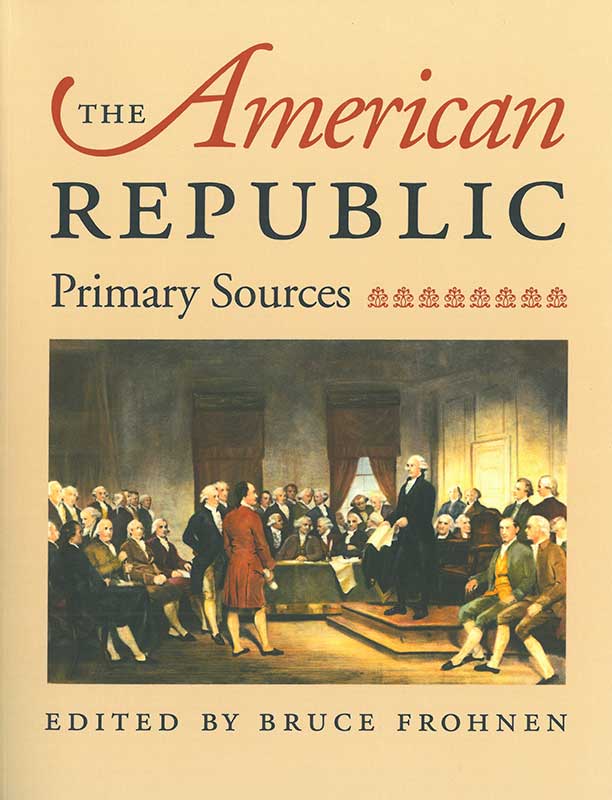
Editorial Board - Bruce Frohnen, The American Republic: Primary Sources [2002]Edition used:The American Republic: Primary Sources, ed. Bruce Frohnen (Indianapolis: Liberty Fund, 2002).
About Liberty Fund:Liberty Fund, Inc. is a private, educational foundation established to encourage the study of the ideal of a society of free and responsible individuals. Copyright information:The copyright to this edition, in both print and electronic forms, is held by Liberty Fund, Inc.
Fair use statement:
This material is put online to further the educational goals of Liberty Fund, Inc. Unless otherwise stated in the Copyright Information section above, this material may be used freely for educational and academic purposes. It may not be used in any way for profit.
- Editorial Board
- Alphabetical List of Authors
- Illustrations
- Introduction
- Note On the Texts
- Part One: Colonial Settlements and Societies
- Virginia Articles, Laws, and Orders I610–11
- The Mayflower Compact November 11, 1620
- Fundamental Orders of Connecticut January 14, 1639
- The Massachusetts Body of Liberties December 1641
- Charter of Liberties and Frame of Government of the Province of Pennsylvania In America May 5, 1682
- Dorchester Agreement October 8, 1633
- Maryland Act For Swearing Allegiance 1638, Plymouth Oath of Allegiance and Fidelity 1625
- Governor Winthrop’s Speech
- Copy of a Letter From Mr. Cotton to Lord Say and Seal
- Part Two: Religious Society and Religious Liberty In Early America
- The Bloody Tenent, of Persecution, For Cause of Conscience
- A Platform of Church Discipline
- Providence Agreement August 20, 1637
- Maryland Act For Church Liberties 1638
- Pennsylvania Act For Freedom of Conscience December 7, 1682
- Worcestriensis 1776
- Thanksgiving Proclamation and Letters to Religious Associations
- Thanksgiving Proclamation
- Farewell Address
- The Rights of Conscience Inalienable
- Letter to the Danbury Baptist Association
- Part Three: Defending the Charters
- Magna Charta 1215
- Petition of Right 1628
- An Account of the Late Revolution In New England and Boston Declaration of Grievances
- Boston Declaration of Grievances
- The English Bill of Rights 1689
- The Stamp Act March 22, 1765
- Braintree Instructions
- Resolutions of the Virginia House of Burgesses June 1765
- Declarations of the Stamp Act Congress October 24, 1765
- The Rights of the British Colonies Asserted and Proved
- The Act Repealing the Stamp Act March 18, 1766
- The Declaratory Act March 18, 1766
- Part Four: the War For Independence
- A Discourse At the Dedication of the Tree of Liberty
- Letters From a Farmer In Pennsylvania, Letters V and Ix
- Declaration and Resolves of the First Continental Congress October 14, 1774
- Virginia Bill of Rights June 12, 1776
- On Civil Liberty, Passive Obedience, and Non-resistance
- Common Sense
- The Declaration of Independence July 4, 1776
- Part Five: a New Constitution
- Thoughts On Government
- Articles of Confederation 1778
- The Essex Result April 29, 1778
- Northwest Ordinance 1787
- Albany Plan of Union July 10, 1754
- Virginia and New Jersey Plans 1787
- The Constitution of the United States of America 1787
- The Federalist , Papers 1, 9, 10, 39, 47–51, 78
- Address of the Minority of the Pennsylvania Convention December 12, 1787
- An Examination of the Leading Principles of the Federal Constitution
- Part Six: the Bill of Rights
- The Federalist , Papers 84 and 85
- Letter I
- Essay I
- Letter Iii
- Memorial and Remonstrance Against Religious Assessments
- Virginia Bill For Establishing Religious Freedom
- Speech Introducing Proposed Constitutional Amendments
- Debate Over First Amendment Language August 15, 1789
- The First Ten Amendments to the Constitution, Or the Bill of Rights 1789
- Commentaries On the Constitution of the United States
- The People V. Ruggles
- Marbury V. Madison
- Barron V. The Mayor and City Council of Baltimore
- Part Seven: State Versus Federal Authority
- Essay V: “brutus” 1787
- Chisholm V. Georgia
- U.s. Constitution, Eleventh Amendment 1787
- The Alien and Sedition Acts June 25, 1798
- Virginia Resolutions December 21, 1798
- Kentucky Resolutions November 10, 1798
- Counter-resolutions of Other States 1799
- Report of Virginia House of Delegates 1799
- The Duty of Americans, At the Present Crisis
- Report of the Hartford Convention 1815
- Commentaries On the Constitution of the United States
- A Familiar Exposition of the Constitution of the United States
- Part Eight: Forging a Nation
- Opinion Against the Constitutionality of a National Bank
- Opinion As to the Constitutionality of the Bank of the United States
- Veto Message
- Veto Message
- Commentaries On the Constitution of the United States
- Address to the Young Men’s Lyceum of Springfield, Illinois
- Address to the Wisconsin State Agricultural Society, Milwaukee, Wisconsin
- Newspaper Editorials
- Speech On Electioneering
- Speech Before the U.s. Senate
- Speech of Mr. Webster, of Massachusetts
- Fort Hill Address
- Part Nine: Prelude to War
- Laws Regulating Servants and Slaves, 1630–1852
- “slavery” “agriculture and the Militia”
- The Missouri Compromise 1820–21
- Newspaper Editorials
- Senate Speeches On the Compromise of 1850 Speech On the Slavery Question
- The Constitution and the Union
- Speech On the Slavery Question, Delivered In the Senate March 4th, 1850
- Second Fugitive Slave Law September 18, 1850
- The Relative Position and Treatment of the Negroes the Abolitionists—consistency of Their Labors
- What Is Slavery? Slavery Is Despotism
- Kansas-nebraska Act 1856
- Fifth Lincoln-douglas Debate October 7, 1858
- Bibliography
Editorial Board
Dr. George W. Carey is Professor of Government at Georgetown University.He is the author and editor of several works, including InDefense of the Constitution (Liberty Fund, 1995). Dr. Carey is also editorof the Political Science Reviewer, an annual review ofleading works in political science and related disciplines.
Dr. Danton P. Kostandarithes has served as chairman of the SocialStudies Department at the Bolles School in Jacksonville, Florida, since 1996.He earned his doctoral degree in American diplomatic history from TulaneUniversity in 1992. Dr. Kostandarithes currently teaches American history andadvanced placement U.S. history at the Bolles School.
Dr. Charles Reid is Research Associate in Law and Religion at the EmoryUniversity School of Law. He holds a Ph.D. in history from Cornell University,and law and canon law degrees from the Catholic University of America. Hisarticles have appeared in numerous law reviews and professional journals,including the Michigan Law Review, Boston College LawReview, and Studia Canonica.
Dr. Barry Alan Shain is an Associate Professor of Political Science atColgate University. He teaches courses in modern European and Americanpolitical thought. Dr. Shain is the author of The Myth ofAmerican Individualism: The Protestant Origins of American PoliticalThought, which is in its third printing by Princeton University Press.
Contents- Alphabetical Table of Contents
- Alphabetical List of Authors
- List of Illustrations
- Introduction
- Note on the Texts
I Colonial Settlements and Societies- Virginia Articles, Laws, and Orders, 1610–11
- The Mayflower Compact, 1620
- Fundamental Orders of Connecticut, 1639
- The Massachusetts Body of Liberties, 1641
- Charter of Liberties and Frame of Government of the Province of Pennsylvania in America, 1682
- Dorchester Agreement, 1633
- Maryland Act for Swearing Allegiance, 1638; Plymouth Oath of Allegiance and Fidelity, 1625
- “Little Speech on Liberty,” john winthrop, 1645 34
- “Copy of a Letter from Mr. Cotton to Lord Say and Seal,” john cotton, 1636
2 Religious Society and Religious Liberty in Early America- “The Bloody Tenent, of Persecution, for Cause of Conscience,” roger williams, 1644
- “A Platform of Church Discipline,” john cotton, richard mather, and ralph partridge, 1649
- Providence Agreement, 1637; Maryland Act for Church Liberties, 1638; Pennsylvania Act for Freedom of Conscience, 1682
- Worcestriensis, 1776
- “Thanksgiving Proclamation” and Letters to Religious Associations, george washington; 1789, 1790
- “Farewell Address,” george washington, 1796
- “The Rights of Conscience Inalienable,” john leland, 1791
- “Letter to the Danbury Baptist Association,” thomas jefferson, 1802
3 Defending the Charters- Magna Charta, 1215
- Petition of Right, 1628
- “An Account of the Late Revolution in New England” and “Boston Declaration of Grievances,” nathanael blyfield, 1689
- The English Bill of Rights, 1689
- The Stamp Act, 1765
- “Braintree Instructions,” john adams, 1765
- Resolutions of the Virginia House of Burgesses, 1765; Declarations of the Stamp Act Congress, 1765
- “The Rights of the British Colonies Asserted and Proved,” james otis, 1763
- The Act Repealing the Stamp Act, 1766; The Declaratory Act, 1766
4 The War for Independence- “A Discourse at the Dedication of the Tree of Liberty,” “a son of liberty” [silas downer], 1768
- “Letters from a Farmer in Pennsylvania,” Letters V and IX, john dickinson, 1767–68
- Declaration and Resolves of the First Continental Congress, 1774 154
- Virginia Bill of Rights, 1776
- “On Civil Liberty, Passive Obedience, and Non-resistance,” jonathan boucher, 1775
- Common Sense, thomas paine, 1776
- The Declaration of Independence, 1776
5 A New Constitution- “Thoughts on Government,” john adams, 1776
- Articles of Confederation, 1778
- The Essex Result, 1778
- Northwest Ordinance, 1787
- Albany Plan of Union, 1754
- Virginia and New Jersey Plans, 1787
- The Constitution of the United States of America, 1787
- The Federalist, Papers 1, 9, 10, 39, 47–51, 78; alexander hamilton, james madison, and john jay; 1787
- “Address of the Minority of the Pennsylvania Convention,” 1787
- “An Examination of the Leading Principles of the Federal Constitution,” noah webster, 1787
6 The Bill of Rights- The Federalist, Papers 84 and 85; alexander hamilton, james madison, and john jay; 1787
- “Letter I,” “centinel,” 1787
- “Essay I,” “brutus,” 1787
- “Letter III,” “the federal farmer,” 1787
- “Memorial and Remonstrance against Religious Assessments,” james madison, 1785; “Virginia Bill for Establishing Religious Freedom,” thomas jefferson, 1786
- “Speech Introducing Proposed Constitutional Amendments,” james madison, 1789; Debate over First Amendment Language, 1789; The First Ten Amendments to the Constitution, or the Bill of Rights, 1789
- Commentaries on the Constitution of the United States, joseph story, 1833
- The People v. Ruggles, james kent, 1811
- Marbury v. Madison, john marshall, 1803
- Barron v. the Mayor and City Council of Baltimore, john marshall, 1833
7 State versus Federal Authority- “Essay V,” “brutus,” 1787
- Chisholm v. Georgia, james wilson, 1793; U.S. Constitution, Eleventh Amendment, 1787
- The Alien and Sedition Acts, 1798; Virginia Resolutions, 1798; Kentucky Resolutions, 1798; Counter-resolutions of Other States, 1799; Report of Virginia House of Delegates, 1799
- “The Duty of Americans, at the Present Crisis,” timothy dwight, 1798
- Report of the Hartford Convention, 1815
- joseph story: Commentaries on the Constitution of the United States, 1833; A Familiar Exposition of the Constitution of the United States, 1840
8 Forging a Nation- “Opinion against the Constitutionality of a National Bank,” thomas jefferson, 1791; “Opinion as to the Constitutionality of the Bank of the United States,” alexander hamilton, 1791
- “Veto Message,” andrew jackson, 1832
- “Veto Message,” james madison, 1817
- Commentaries on the Constitution of the United States, joseph story, 1833
- abraham lincoln: “Address to the Young Men’s Lyceum of Springfield, Illinois,” 1838; “Address to the Wisconsin State Agricultural Society, Milwaukee, Wisconsin,” 1859
- william leggett: Newspaper Editorials on “Direct Taxation,” 1834; “Chief Justice Marshall,” 1835; “The Despotism of the Majority,” 1837; “Morals of Legislation,” 1837; and “The Morals of Politics,” 1837
- “Speech on Electioneering,” davy crockett, 1848
- “Speech before the U.S. Senate,” daniel webster, 1830; “Speech before the U.S. Senate,” robert y. hayne, 1830
- “Fort Hill Address,” john c. calhoun, 1831
9 Prelude to War- Laws Regulating Servants and Slaves, 1630–1852 582
- “Slavery” and “Agriculture and the Militia,” john taylor of caroline, 1818 589
- The Missouri Compromise, 1820–21
- william leggett: Newspaper Editorials on “Governor McDuffie’s Message,” 1835; “The Question of Slavery Narrowed to a Point,” 1837; and “‘Abolition Insolence,’” 1837
- Senate Speeches on the Compromise of 1850, john c. calhoun and daniel webster, 1850
- Second Fugitive Slave Law, 1850; Ableman v. Booth, roger taney, 1858
- Scott v. Sandford, roger taney, 1856 646
- “The Relative Position and Treatment of the Negroes” and “The Abolitionists—Consistency of Their Labors,” george s. sawyer, 1858
- “What Is Slavery?” and “Slavery Is Despotism,” harriet beecher stowe, 1853
- Kansas-Nebraska Act, 1856; Fifth Lincoln-Douglas Debate, 1858
- Bibliography
|