Econlib

The Library

Other Sites

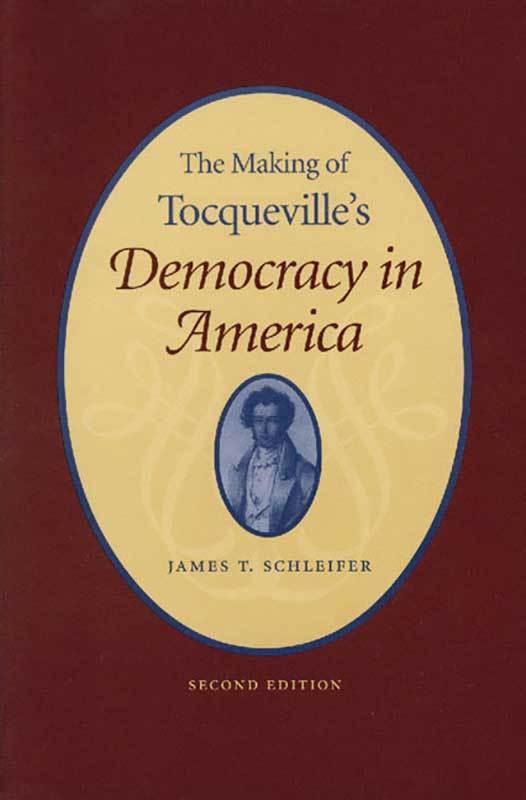
Front Page arrow Titles (by Subject) arrow CHAPTER 20: Tocqueville's Return to America - The Making of Tocqueville's Democracy in America

Return to Title Page for The Making of Tocqueville’s Democracy in America

Search this Title:

CHAPTER 20: Tocqueville’s Return to America - James T. Schleifer, The Making of Tocqueville’s Democracy in America [1980]

Edition used:

The Making of Tocqueville’s Democracy in America, Foreword by George W. Pierson (2nd edition) (Indianapolis: Liberty Fund, 2000).

About Liberty Fund:

Liberty Fund, Inc. is a private, educational foundation established to encourage the study of the ideal of a society of free and responsible individuals.


CHAPTER 20

Tocqueville’s Return to America

Our reconstruction of Alexis de Tocqueville’s long process of observation, reading, thinking, and writing the Democracy has offered the possibility of some new insights about Tocqueville’s famous book. First of all, we have reexamined many of Tocqueville’s sources and unearthed some new or almost new roots. As we have watched Tocqueville drawing in turn on his French, American, English, and then again on his French experiences, we have had a chance to reevaluate the contributions of many of his American, English, and French friends. Numerous additional specific echoes in Tocqueville’s volumes of statements by such key American acquaintances as Timothy Walker, Joel Poinsett, John Latrobe, Francis Gray, and Jared Sparks have been identified. The significance of comments by such Englishmen as Dr. Bowring and John Stuart Mill and the important impact of Beaumont, Tocqueville’s father, Louis de Kergolay, and other countrymen have been noted. Louis, in particular, helped immensely to shape the form and the content of the Democracy; especially after 1835, his influence rivaled even that of Beaumont.

Although specific connections between the Democracy and some of Tocqueville’s more far-ranging and profound readings during the 1830s are still obscure, new traces of his printed American sources, especially the books by William Darby, Isaac Goodwin, William Rawle, Joseph Story, and others have become apparent. The thoroughness and quality of Tocqueville’s research, especially in the fields of history, law, the American Constitution, and in the particular issues of the Jacksonian period, have been successfully tested once again.

Tocqueville’s papers have also disclosed a surprisingly extensive use of certain essays from the Federalist. He listened carefully to the opinions and arguments of Alexander Hamilton and especially James Madison, whose contributions to the Democracy were greater than most readers have realized. Our examination of the growth of the Democracy has shown Tocqueville often informed and stimulated, usually persuaded, and occasionally misled by “Publius.”

In addition Tocqueville echoed Montesquieu’s ideas on certain matters (like the relative nature of political institutions and the disadvantages of size) and questioned and revised his predecessor’s opinions on other issues (like the role of virtue in republics). On such themes as the danger of concentrated power, the value of local liberties, the need for associations and a free press, the rise of the middle classes, and the advance of “civilization,” Tocqueville also closely paralleled the writings of nineteenth-century French figures like Benjamin Constant, Pierre-Paul Royer-Collard, and François Guizot.

But the sources for Tocqueville and his book went beyond his voyages to America and England, his friends, and his readings. The Democracy in America also reflected the concerns of contemporary France. Many topics that appeared in Tocqueville’s pages were issues debated constantly in France throughout the early nineteenth century and were therefore familiar to his countrymen. Was France overly centralized? Should the communes be more free to regulate their own affairs? Were associations too subversive to be allowed? Should the institution of the jury be introduced more broadly? How much independence and prerogative were appropriate for judges? Should the press be more, or less free? Was the right of suffrage too narrowly extended? Such chronic questions shaped one of the purposes of the Democracy: Tocqueville desired to teach France and to present a specific political program that would appeal to a segment of French opinion broad enough to lead to reform.

Other contemporary problems also captured Tocqueville’s interest. After the revolution of 1830 and the disappointments of the July regime, many individuals like Kergolay or Eugène Stoffels had retreated into an internal exile, withdrawing from all public affairs. Others, like Tocqueville’s own Norman constituents, seemed increasingly absorbed in self-promotion and material interests, and more and more unable to approach public issues from the viewpoint of the common good. Such developments helped to stimulate Tocqueville’s thoughts about democratic materialism, égoïsme, and, eventually, individualisme. The growth of government involvement in French industry helped to alert Tocqueville to the connection between industrialization and centralization. So certain parts of the Democracy grew even more out of France than out of America. Sometimes, the immediacy of some of these concerns even made him almost forget about America.

French politics of the 1830s also had an effect on Tocqueville’s work. His desire for a reputation which would lead to a significant political role was another of the reasons for the writing of the Democracy; and by the late 1830s political campaigns and legislative duties helped to delay its completion. More broadly, Tocqueville’s ambivalent attitudes about the politics and politicians of his day entered into the tone of his book. His mixed feelings encouraged him to disassociate himself and his book from all particular parties or points of view and to assume a stance of lofty detachment. “I did not intend to serve or to combat any party; I have tried to see not differently but further than any party; while they are busy with tomorrow, I have wished to consider the whole future.”1

Still another influence on Tocqueville’s thinking was French history. We have noticed how knowledge of the Convention, for example, encouraged Tocqueville in 1835 to stress the dangers of legislative despotism, and how memories of Napoleon made him always suspicious about military leaders. Indeed, some events in the French past had too deep an impact on Tocqueville; they sometimes prevented him from perceiving new dangers.

Our step-by-step re-creation of the development of the Democracy has, in addition, disclosed many of the methods by which Tocqueville studied, wrote, and thought, including his early efforts to organize his materials and plan the task of composition and how and where he actually first set pen to page. Periodically he felt a need for the stimulation of “good instruments of conversation,” usually Beaumont and Kergolay, both of whom served as invaluable critics and intellectual companions. And sometimes Tocqueville shaped and pruned the Democracy with an eye on the scope of the works of others like Beaumont or Michel Chevalier.

He repeatedly sought, for one particular subject or another, to grasp some basic organizing principle, the idée-mère, or to expose some irreducible precondition, the point de départ. In order to resolve certain paradoxes inherent in the French situation during the early nineteenth century, he emphasized the concepts of époque de transition and esprit révolutionnaire. The latter idea grew quickly from a convenient mental tool which helped him to get over some theoretical difficulties into an important theme of the final portion of his work. He also occasionally resorted to “models” or “types” to clarify his thinking; démocratie and aristocratie are the most famous examples of his use of this technique, but the drafts of Tocqueville’s book have disclosed other instances of this method as well.

Tocqueville’s interest in presenting fresh viewpoints sometimes led him to stress the originality of his insights by calling for new names. With Madison, he dubbed the unique American federal system “an incomplete national government”; he urged a “new science of politics,” labeled a particular cluster of democratic traits individualisme (in 1840 a relatively new term which he thereafter helped to popularize), and warned against a new despotism.

Still another methodological trait vividly demonstrated by the successive drafts of the Democracy is Tocqueville’s sensitivity to style. For him, form could emphatically not be detached from content. He labored toward a high ideal of literary craftsmanship (and quite probably took Montesquieu as his standard); the qualities which he sought were clarity, directness, a sparseness or economy of language, and a certain detachment, in short, a style marked by elegant and precise restraint. To achieve this goal he solicited oral and written critiques from friends and family and relentlessly reworked his words, sentences, paragraphs, and chapters looking for the best possible use of words and order of ideas. It was this effort which produced his many memorable phrases as well.

With the attainment of a certain style in mind, he also took pains to excise passionate or exaggerated passages from his drafts and working manuscript. Much of the cool detachment of the Democracy arose rather naturally from the author’s own personality, but some also resulted from his determined efforts, on more than one occasion, to suppress the dogmatism and emotionalism which sometimes broke forth when he was immersed in the excitement of composition. His working papers reveal, for example, a softening of his strong pronouncements about Jefferson’s political legacy and the “certain” future of the Union, a calming of his excited alarms about the abilities of le peuple and the survival of European civilization, and a lightening of his dark pessimism about the future of liberty.

But Tocqueville’s compulsion to revision arose from more than stylistic considerations. He was extremely self-conscious about his book. The drafts and manuscripts of the Democracy are everywhere sprinkled with Tocqueville’s comments to himself. The margins abound with his own curious criticisms, questions, warnings, and especially with reminders to himself about major themes and larger purposes. As his book developed, there was a striking running attempt to keep fundamental motifs in view, and a constant measuring of what he wrote against the basic tasks he hoped to accomplish. A major difficulty was the multiplicity of his objectives. Was he attempting to describe the American republic to his countrymen? To trace the advance of démocratie and its effects? To save France by suggesting possible ways to reconcile liberty and equality? To publish a work which would assure a prominent future for Alexis de Tocqueville? The fact that he usually had several purposes simultaneously in view only complicated his efforts to pare away what might be irrelevant or harmful to his goals.

Even more fundamental than his striving for literary excellence is the characteristic style of logic or pattern of thought which emerges from our story of Tocqueville’s second voyage. Tocqueville repeatedly clarified and deepened his thought by means of comparisons and distinctions. He set, for example, Ohio against Kentucky, Quebec against New Orleans, and—most important—France against both America and England. He separated sudden from gradual death of the Union; governmental from administrative centralization; one variety of despotism from another; the specific (political and legal) from the general (moral and intellectual) tyranny of the majority; the cultural vulnerability of semicivilized peoples from the deeply rooted civilization of modern Europeans; the égoïsme of old from the individualisme of today; and démocratie defined politically from démocratie defined socially.

Such frequent use of comparisons and distinctions is related to a more general trait: Tocqueville’s tendency to think in terms of contraries or pairs in tension. In his analyses of the results of démocratie and of the relationship between the individual and society, for example, he was grappling with near paradoxes, with almost opposites. And occasionally he moved too boldly and fell into true contradiction. Sometimes he extricated himself; at other times he apparently failed even to recognize his predicament. So the making of the Democracy seems to reveal a mind marked by superb analytical powers and, beyond that, by a rarer facility for original insights and bold theoretical leaps. If this sometimes led Tocqueville into errors or caused him to overshoot the factual basis for some of his ideas, readers must consider whether his brilliant contributions to our understanding of society do not more than balance these flaws.

Yet another major feature of Tocqueville’s pattern of thought should be considered. The author of the Democracy never ceased turning and returning his ideas; his work is built out of a long accumulation of information, opinions, insights, and second thoughts. This unending process of reconsideration was not only in the mind but also on the page. Time itself became an important ingredient in the making of the Democracy. This gradual but relentless building up of ideas produced a book far longer and far wider in scope than Tocqueville had originally conceived.

Tocqueville’s commitment to ongoing reconsideration occasionally suggested a method of postponement when he was wrestling with particularly stubborn issues. He assumed that he would come back to such puzzles later; time would presumably produce the needed fresh insights. Sometimes this strategy had its rewards. But a few problems, like the definitions of circonstances or démocratie, proved insoluble even after long periods of rumination. In these instances, postponement lengthened into a kind of abandonment.

Tocqueville’s constant revolving of ideas (and the sheer passage of time) also help to explain many of his ambiguities and confusions. While concentrating on a newly perceived facet of some complex concept (like démocratie), Tocqueville could hardly fail, at times, to forget what he had previously discovered. It was almost impossible to keep so many notions in mind simultaneously.

So his determination to analyze each notion from as many viewpoints as possible, to discover all possible dimensions, was a vital part of his second journey. If this constant reconsideration must bear some blame for his recognized inability adequately to define some of his key concepts, it must also be credited with producing some of Tocqueville’s most perceptive ideas. Above all, his instinct for thoroughness should make us sufficiently wary of attempting to impose too much consistency on his thought. Such a straining after unity would also obscure the chronological dimensions of his ideas, and neither the slow maturation, nor the false starts, rapid reversals, and forgotten paths should be overlooked. So we must abandon any searches for the coherent system of a philosopher and concentrate instead on capturing the pluralism and diversity of Tocqueville’s mind. These are some of the essential qualities which continuously attract thoughtful people to his work.

The diverse and sometimes strange ways in which Tocqueville’s concepts developed have also been illuminated by our study of the Democracy. One or two of his ideas were never quite born (the impact of démocratie on education). Some withered early (the role of physical environment, the importance of internal improvements), and others matured late. Among the late bloomers, some had appeared (at least in germ) in the 1835 Democracy, but by 1840 had assumed far greater importance: the New Despotism, égoïsme/individualisme, the democratic threat to freedom of thought, the crowd or mass, and démocratie defined as le mouvement. Others had belatedly made first appearances in the working papers of the 1840 volumes, but had grown rapidly from then on: for example, the mutual reinforcement of démocratie and industry; and Tocqueville’s mental encounter with that powerful trio of forces, démocratie, industrialization, and revolution.

Some concepts slowly faded after an early blossoming in 1835 (legislative despotism, the image of a reborn tyranny of the Caesars, démocratie as le peuple), and others flourished increasingly throughout all stages of the making of the Democracy (the role of moeurs, the value of associations and other means to link the ideas and unite the actions of isolated citizens; and démocratie as equality of conditions). A few ideas were so fundamental that for nearly a decade they were almost unchanging: the inevitable advance of démocratie itself, the tendency toward centralization, the tension between the individual and the society as a whole, and Tocqueville’s concern for the freedom and dignity of each person.

Some notions were lost, among others: the personal repudiation of racial theories which Tocqueville developed during the 1830s, his condemnation of Jefferson’s administration, his stated preference for democratic monarchy, and especially his belief that industrialization ranked with démocratie as the two great features of modern Western history. Still others, first appearing before 1835 and then not reemerging until 1840, were lost temporarily: the rise of a new industrial aristocracy and the troublesome problem of the influence of démocratie on civilization, for instance.

Although some preconceptions were uprooted (the influence of géographie and the identity of the American pioneer), certain beliefs were too deeply imbedded to be shaken by any contradictory experience or testimony (the benefits of the jury, the advantages of independent localities, and the distrust of size).

Confusions and unresolved dilemmas also sometimes mark the Democracy. Was the republic an indivisible Union or a compact of states? Were the states more villains or benefactors for the American future? What about the ambiguities left by Tocqueville’s attempts to distinguish two centralizations and to identify various despotisms? How were his readers to reconcile his disclaimer that the majority actually abused its power in America and his declaration that intellectual liberty did not exist there? If démocratie encouraged a love of independence and a distrust of authority, how did it also lead so easily to the concentration of power? What finally did he mean by circonstances, or majorité, or individualisme, or démocratie?

Nor should we overlook the many paradoxes of his thought, some that Tocqueville recognized and presented for his readers to ponder, others that he never saw. He visited America, but thought of France. He disliked politics, but offered an agenda of reform and became an important political figure. He proposed to escape the evils of democracy by introducing more democracy and hoped to strengthen indépendance individuelle by combating individualisme.

His concept of démocratie caught him in yet another paradox which perhaps he never resolved. He spoke about the providential fact of democracy’s advance and seemed to understand the increasing equality of conditions as a divine and therefore inescapable necessity. Yet he also repeatedly denounced the fatalists, the prophets of necessity, the people like Gobineau who bound humanity to iron laws.2 He always insisted with some vehemence that human beings were free and therefore had the responsibility for moral choices. For him, humankind could never be merely a pawn to the fates, to the forces of environment, race, climate or whatever, or even to God. Perhaps the closest he ever came to reconciling this dilemma of inevitable equality and human choice was the final passage of the 1840 Democracy. “Providence did not make mankind entirely free or completely enslaved. Providence has, in truth, drawn a predestined circle around each man beyond which he cannot pass; but within those vast limits man is strong and free, and so are peoples.”3 Whether this resolved or simply sidestepped the issue each reader must judge for himself.

There is a common impression that Tocqueville was basically uninterested in and unacquainted with economic and technological matters. He is often criticized for missing perhaps the major developments of the nineteenth and twentieth centuries. Clearly his primary intellectual interests were elsewhere; his mind, like Montesquieu’s, inclined toward political theory as it related to broader social, cultural, intellectual, and moral questions. He conceived of the Democracy as primarily “un ouvrage philosophico-politique.” This did not mean, however, that he ignored or remained misinformed about economic developments. In the New World he was very much aware of many of the important economic and technological changes occurring around him. He grasped the scope and the significance of the physical transformation that Jacksonian America was undergoing. He put his finger on two crucial features of the American economy then just taking shape: the rise of the corporation and the development of a complex, pluralistic approach to economic activities that blended public (federal, state, and local) and private (individual and corporate) efforts in an amazing variety of ways. He also noticed the rage of Americans for the latest improvement and their peculiar philosophy of planned obsolescence. And if, in 1831 and 1832, he failed to appreciate the future importance of manufacturing in the United States, he did not by the late 1830s continue to make quite the same mistake (at least for Europe). By 1838 he was persuaded that industrialization and increasing equality were the two great forces of the times. He worried, as early as 1833 or 1834, about the rise of an industrial aristocracy, wrestled with the connection between decentralization and economic prosperity, and by the late 1830s, recognized and explored the ways in which industry, centralization, and démocratie strengthened one another and moved relentlessly ahead together.

The drafts, working manuscript, and “Rubish,” as well as the published text of the Democracy, thus demonstrate in many places that Tocqueville was aware of the various ways in which economic attitudes, institutions, and changes influenced society. So the Democracy’s relative lack of attention to economics and technology should not be exaggerated. Nor should it be primarily attributed to either gaps in knowledge or failures of insight. Tocqueville’s choices of emphasis arose from his determination to keep his book focused on his major subject, from his personal interests, from his beliefs about where he could make the most original contributions, and most important, from his moral assumptions about which areas of human activity were most truly fundamental.4

For some readers, Tocqueville’s warnings against an omnipresent central government and his unforgettable prophecies about the regime of the New Despotism unfortunately obscure his profound attachment to what he admired most about démocratie: its “liberal instincts.” The perennial lack of submissiveness, the anti-authoritarian bias, and the unquenchable discontent which democracy bred were delights for Tocqueville. He knew that a free society would not necessarily be one of order and tranquillity and observed in the 1840 Democracy that “I cannot forget that all nations have been enslaved by being kept in good order.... A nation that asks nothing of its government but the maintenance of order is already a slave at heart.”5 Liberty almost always had its loose ends, its confusions, its storms and upheavals.

To nurture these “liberal instincts” and thus to preserve freedom in democratic times, he championed greater freedom of assembly, association, speech, and press (as well as wider suffrage). In the context of his age he was something of a civil libertarian staunchly protecting the individual in the face of the pressures of the wider society. “Everything that in our times raises up the idea of the individual is healthy.... The doctrine of the realists, introduced to the political world ... is what facilitates despotism, centralization, contempt for individual rights, the doctrine of necessity, all the institutions and the doctrines which permit the social body to trample men underfoot and which make the nation everything and the citizens nothing.”6 If Tocqueville can be taken for some neoconservative carping about an active government, he can also be read as a civil libertarian rushing in wherever the individual seems in danger. But either view distorts a position that was at once original and highly complex.

One of the most intriguing characteristics of the Democracy, despite the extended period of its growth, is the essential harmony of the whole. Despite some errors which Tocqueville hoped to correct and some opinions which he wanted to revise, almost all significant changes in ideas between 1835 and 1840 resulted from the gradual maturation of Tocqueville’s thinking. During the 1830s he did not so much reverse judgments as flesh out earlier ideas. The number of times that a chapter or whole group of chapters from the last half of the Democracy may be traced directly back to germs in a sentence or paragraph of the first two volumes is remarkable.7 We should not exaggerate the concept of two Democracies, suggestive though it is in certain respects.8

This is not to deny that some of the differences between the first and second parts of Tocqueville’s book are significant. A process of broadening out, of always expanding dimensions, was crucial to the making of the Democracy. After 1835, Tocqueville’s readings were drawn from a much wider range of time and place. America faded more and more into the background. In 1835 Tocqueville’s journey was still fresh; his reflections were more or less grounded in specific conversations, experiences, impressions, and information. He was right when he described his first effort as somehow more tangible, more solid. But, by 1840, the whole American experience had become something of a recollection; by then it was intimately intermingled with new lessons of all sorts, and much of the immediacy was gone. Deeper knowledge of England as well as greater direct involvement in contemporary French public affairs also led him to ever more frequent consideration of those two nations. His comparisons became more often three-cornered. His attention was increasingly captured by developments other than the advance of démocratie. So his work not only became less American and more democratic, but it also outgrew the limits of one or even two nations and moved beyond démocratie to consider other major social forces as well. The second half of the Democracy, as Tocqueville himself suspected, turned out to be far more abstract, theoretical, and demanding.

Tocqueville’s tendency to wander over an ever-wider mental range, to move always farther from the specific, helped to produce both the strengths and weaknesses of the 1840 volumes. If the last part of the Democracy sometimes presented long and occasionally dubious series of deductions, if many readers felt terribly far from the reality of America, if generalizations sometimes overreached prudence, still the second portion of Tocqueville’s book displayed a thorough, profound, and marvelously stimulating analysis of his subject matter. His ambitious movement into ever wider spheres took him in some ways far from his 1835 work, but the rewards were worth the risks.

Our retelling of Tocqueville’s second voyage also makes clear his fascination with what he usually labeled “spirit” and what we might call the psychology, or the fundamental attitude or approach of people. Again and again, when he sought to penetrate to the core of an idea or issue, he thought and wrote about the “spirit” of locality, or liberty, or religion, or trade, or revolution; the sentiment de l’égalité, one fundamental meaning of démocratie, was another closely related example. This readily observable tendency is part of a more basic inclination. Whenever Tocqueville searched for the most profound causes, meanings, or influences, he went not to physical, economic, legal, or even to intellectual features, but to the elements of what he called moeurs: customs, attitudes, values, ways of life.9 It was almost always to the intangible motivations of human belief and behavior that he ultimately resorted. One of the lasting contributions of his book was the importance bestowed on moeurs; the Democracy was one of the earliest extended statements of their crucial role in society.

This sensitivity to “spirit” and more broadly to moeurs reflects the way in which Tocqueville’s personal moral beliefs also helped to shape the Democracy. Whether weighing the significance of race or choosing between moeurs or lois, whether calculating the chances for a future of liberty or deciding which sense of démocratie (social or political) was more basic, he fell back again and again to moral convictions. It was in the majority’s moral authority that he placed the ultimate power of the many; and it was also in moral limits that he found the best barrier to abuse of that power. When he considered the influence of some idea or institution, it was the potential moral benefit or harm which he usually weighed most heavily. Thus local liberties were praised especially for their moral advantages, and despotism condemned most harshly for the way it undermined self-esteem and brought men to despise themselves.

A strong case may therefore be made that Tocqueville’s most essential concern was the moral condition of mankind. He valued, above all, the freedom and dignity of the individual. What démocratie did to enhance these he applauded; what it did to endanger them he feared. As he wrote the Democracy, he remained always aware that to spur men to significant achievement it was necessary to allow them a circle of meaningful action, to think highly of their capacities, and to expect a great deal.

But was Tocqueville primarily concerned with moral issues or did he instead look most essentially to what would work? In democratic times, did he favor whatever would be useful for warding off the worst dangers? Was he a type of utilitarian rather than a type of moralist? Closely related to this question is the ambiguity of Tocqueville’s attitude toward démocratie. Did he secretly admire démocratie, sympathize with its advance, and even hope to hasten it by his own political program? Or did he go along with démocratie only out of necessity, resigned to making the best of a bad—or at least a dangerous—situation? Again, was he mostly thinking practically rather than morally?

We can offer a possible answer to this old puzzle. Tocqueville believed that, for more and more of his contemporaries, appeals to morality were no longer effective, no longer powerful enough to persuade or to change actions. Those still sensitive to moral considerations would hear and heed them, but, for all the others, appeals would now have to be cast in terms of utility or self-interest. Tocqueville would at times have to argue from points of view which were increasingly amoral if he hoped at all to engage most of his contemporaries.10

So what Tocqueville resurrected in new form in the Democracy was the famous wager of Pascal, with whom (at least for some periods during the mid-1830s) he had lived a bit every day. Some of Tocqueville’s most powerful arguments to open the eyes of his readers to the possible benefits and pitfalls of democracy and to move them toward securing the first and avoiding the second were, like the wager, part of a final effort to persuade especially the sophisticated, the knowledgeable, the intelligent, the “best”; to appeal effectively to their own self-interest; to argue convincingly on their own terms. Tocqueville hoped to bring these people, above all, to accept démocratie, not because it was good, but because all the alternatives were worse. Reasonable, dispassionate people, Tocqueville argued, should take a chance on making the best of démocratie. To work for that at least brought hope; to refuse would lead only to certain disaster. Tocqueville, like Pascal, had deeply moral sensibilities, yet understood his contemporaries well enough to cast a net beautifully appropriate to his age—and ours.

EPILOGUE

How Many Democracies?

[Reprinted from Liberty, Equality, Democracy, edited by Eduardo Nolla, by permission of the New York University Press.]

At least since the appearance in 1964 of Seymour Drescher’s brilliant article, “Tocqueville’s Two Démocraties,” scholars have debated how many Democracies Tocqueville wrote during the 1830s.1 Are the 1835 and 1840 halves of the Democracy essentially two parts of a single work or two quite distinct books which happen to share the same title? Note that this is not the same issue which has been so well raised by Robert Nisbet and others about the many changing perceptions or interpretations of the Democracy since its appearance over one hundred and fifty years ago.2 Of interpretations, there are many, especially when we recall the sustained international appreciation of Tocqueville’s book over the years. But of judgments about the unity or disunity of the Democracy, there are essentially only two, what Seymour Drescher has recently labeled the “lumpers” and the “splitters.”3 Each group has perhaps as many individual variations as there are serious readers. But the basic approach remains bipolar: one Democracy or two?

The question is not a trivial dispute or empty intellectual game. It concerns the identification and continuity or disjuncture of basic themes in Tocqueville’s work and involves answers to when and how some of his fundamental ideas emerged and developed.

All Tocqueville’s scholars and major interpretative works devoted to the Democracy recognize, of course, both common features and significant differences between the two parts of Tocqueville’s book. There are no absolutists in this debate. Divisions of opinion arise from distinctive answers to “which unities?” and “which diversities?” and from contending perceptions about why the Democracy changed between the early 1830s and 1840. How was Tocqueville’s book reshaped by new experiences after 1835: travels, readings, friendships, political involvements, innovations in methodology, additional time for reflection and reconsideration, or the emergence of different issues in contemporary France? Most essentially, the two groups divide on the matter of emphasis. Are the 1835 and 1840 Democracies more alike or more distinct?

Of the two basic approaches, the first, identified particularly with what Jean-Claude Lamberti called the “Yale School,” focuses on basic themes or concepts by tracing each from the late 1820s to 1840.4 This path to analysis recognizes Tocqueville’s background, readings, friendships and other intellectual influences, travel experiences, political involvements, his habits of thinking and writing, then follows the genesis and elaboration, the twisting and turning, of Tocqueville’s ideas, and ends by emphasizing the unity of the two halves of the Democracy, despite obvious attention to significant changes between 1835 and 1840.

The second approach also recounts the development of fundamental concepts. Its special strengths, however, are examination of Tocqueville’s broadening experiences after 1835 (especially lessons learned from England and from French political life) and careful comparison of the 1835 and 1840 Democracies. The two portions are set side by side to see what differences emerge in the author’s tone, methodology, ideas, emphases, and underlying concerns. This path ends by proposing a definitive shift between the halves of the Democracy despite the recognition that some fundamental threads are present throughout Tocqueville’s book.5

In his most recent formulation of this approach, Drescher carefully lists some of the major themes which link the 1835 and 1840 Democracies: the inevitability of democracy, the value placed on political liberty, and the effort to define the nature and future of democracy.6 And he notes that the same comparative methodology characterizes both the 1835 and 1840 portions.

But his essential point is that we should recognize two separate works. A sharp break occurred after 1835, first, because of a fundamental change in Tocqueville’s frame of reference, particularly “his extra-American experiences,”7 that is, his English journeys and French political involvements, and second, because of a drastic reversal in his expectations about the democratic future. Just as France eclipsed America as the leading example in Tocqueville’s writing, so too did doubt and pessimism replace hope and optimism.

Drescher then examines two concepts to demonstrate his approach: centralization and individualism. According to his argument, not until after the publication of the 1835 work did Tocqueville realize that democracy leads to centralization and that democracy and centralization were dangerously and inextricably linked in the modern world. In 1835, he writes, Tocqueville showed a lack of concern about administrative centralization totally at variance from his profound worries in 1840. By then, centralization had, for Tocqueville, come “close to achieving full parity with democracy” as a fact for his and our times.8

The second example concerns the pattern of behavior which Tocqueville associated with democracy. In 1835 he focused on what Drescher calls the “ ‘benign’ egoism of the participatory citizen,”9 or enlightened self-interest, modeled on the American example. By 1840 his attention had shifted to the “pathological egoism of retreat,”10 or individualism, exemplified by the narrow behavior of his own countrymen. Both the word and most of the content of the individualism of 1840 are missing earlier. This change again reflects both Tocqueville’s movement from America to France and the reversal of his prognosis for the democratic future. Drescher believes that there are “latent or overt contradictions”11 between the 1835 and the 1840 books and concludes that we have a “Tocqueville problem [which] lies within the confines of a single title.”12 In the end, he refers to “Tocqueville’s separate but equally perceptive studies,” the two Democracies.13

Despite heavy methodological debts to the Yale School, Lamberti, in his wonderful book, Tocqueville and the Two “Democracies,” also joins the splitters.14 He concludes his long study by asserting that Tocqueville’s book divides into two parts, but his version of the two Democracies is strikingly different from Drescher’s. For Lamberti, the first Democracy includes the 1835 portion and the first three books of the 1840; the second Democracy consists of the last book from 1840 which looks ahead to the Souvenirs and the Ancien Régime. He sees 1838, when Tocqueville discovered the significance of the revolutionary spirit and undertook a major revision of his manuscript, as the critical moment or shift. The first Democracy (1835 and most of 1840) attempts (without success) to distinguish between democracy and revolution (Democracy or Revolution, as Lamberti labels it); the second (the last quarter of 1840) recognizes that the revolutionary spirit has survived revolution, that it encourages centralization and will coexist with advancing democracy (Democracy and Revolution).

This rupture, Lamberti contends, is more significant than that noticed by Drescher. His two Democracies are, therefore, not the same pair which Drescher earlier identified. Yet Lamberti still parallels Drescher by making the idea of centralization a principal player in disjuncture; he asserts that only after 1838 did Tocqueville see centralization as “characteristic of democracy itself.”15

So we have the “lumpers,” emphasizing unity (amidst change), and the “splitters,” stressing division (amidst underlying ties). Perhaps a third basic approach, typified especially by the work of François Furet, should be added to our list. A key part of the more recent effort on the part of French scholars to recapture Tocqueville from the Americans and to remind us that Tocqueville was, after all, a French thinker who reflected the context of his own country, is Furet’s essay entitled “Naissance d’un paradigme.”16 There, we are told that before Tocqueville set foot in America or put pen to page, the essential elements of his doctrine were in place, including the concept of advancing democracy as a triumphant force in the modern world; the effort to explore the consequences of democracy and to develop a theory of democratic society; the concern for the preservation of liberty; the separation of the ideas of democracy and revolution; and the use of an ongoing tripartite comparison, France, England, and America.

This conceptual framework was shaped largely in response to the intellectual atmosphere in France during the 1820s. To earlier studies of Tocqueville’s American travels (1831–1832) and of his “second voyage” (the long process of the making of the Democracy, 1832–1840), Furet adds a third critical period: Tocqueville’s intellectual journey between 1828 and 1831. On the one hand, this approach supports the emphasis of the Yale School on the unity of the 1835 and 1840 Democracies, for if Tocqueville’s doctrine was set by 1831, surely the differences between the first and second halves of Tocqueville’s book pale in significance. On the other hand, this perspective of Furet and others entirely transcends the debate about unity or disjuncture. Both the divisions between 1835 and 1840, highlighted by Drescher and Lamberti, and the evolutionary development—the twists, turns, and variations which so fascinate the Yale School—recede into the background. What captures our attention is the marvel of a work derived from a conceptual framework already in place by 1831.

As we have noted, the three most significant themes cited by Drescher and Lamberti as fault lines between the 1835 and 1840 halves of the Democracy involve centralization, individualism, and revolution. Both men argue that Tocqueville did not perceive the intimate link between democracy and centralization until he was writing the 1840 portion of his work.17

In the 1835 text, however, while presenting the distinction between governmental and administrative centralization, Tocqueville declared:

I am also convinced that democratic nations are most likely to fall beneath the yoke of centralized administration, for several reasons, among which is the following. The constant tendency of these nations is to concentrate all the strength of the government in the hands of the only power that directly represents the people; because beyond the people nothing is to be perceived but a mass of equal individuals. But when the same power already has all the attributes of government, it can scarcely refrain from penetrating into the details of the administration.18

An earlier version in Tocqueville’s working manuscript added here the telling sentence: “So we often see democratic nations establish at the same time liberty and the instruments of despotism [that is, a centralized administration].”19

Tocqueville, let us not forget, clearly recognized by 1835 that the concentration of power constituted one of the great threats to liberty in democratic nations. His 1835 volumes catalogue the dangerous places where excessive power might be gathered, including the legislature, the majority, the hands of a tyrant, and a centralized administration.20 By 1840, it is true, power centralized in a pervasive and intrusive administration moved to the center of his anxieties. But in 1835 he had already perceived and written about the connection between advancing democracy and increasing administrative centralization as one focus of the consolidation of power. As he emphatically declared in a draft: “Moreover we must not be mistaken. It is democratic governments which arrive most rapidly at administrative centralization while losing their political liberty.”21 And as we shall see in a moment, he also offered in 1835 early sketches of his famous 1840 portrait of the soft, but suffocating despotism of the bureaucratic state.

The drafts of the 1835 Democracy even described the relentless European increase in administrative centralization which would become a significant theme in the final section of the 1840 volumes.

Among most of the states on the continent of Europe the central government is not only charged with acting in the name of the entire nation, but also with regulating all matters which are general in nature. So therefore, in Europe we see that governments, instead of limiting their actions to this immense sphere, constantly move beyond [these limits] to encroach more and more on the rights of localities and tend to seize control of the direction of all affairs.22

A closer examination of Tocqueville’s concept of individualism (what we might call privatism) and of his increasing fear of apathy and the decay of civic spirit also does not support the idea of disjuncture between 1835 and 1840. Although the word “individualism” does not appear in the 1835 Democracy, in both parts of his book Tocqueville was troubled by the possible collapse of public life.

At least two passages from the 1835 Democracy foreshadow Tocqueville’s 1840 discussions of individualism and of the type of despotism which democratic nations have to fear.23

[A central government when united to centralized administration] accustoms men to set their own will habitually and completely aside; to submit, not only for once, or upon one point, but in every respect, and at all times.... It affects their ordinary habits; it isolates them and then influences each separately.24

And in the middle of a discussion about the political advantages of decentralization, he wrote:

It profits me but little, after all, that a vigilant authority always protects the tranquillity of my pleasure and constantly averts all dangers from my path, without my care or concern, if this same authority is the absolute master of my liberty and my life, and if it so monopolizes movement and life that when it languishes, everything languishes around it, that when it sleeps, everything must sleep.25

In a draft he noted more succinctly that administrative centralization “brings about despotism and destroys civic spirit. People get used to living as strangers, as settlers in their own country, to saying: that doesn’t concern me. Let the government worry about it.”26

And in yet another draft, he declared:

For my part, what I most reproach despotism for are not its rigors. I would pardon it for tormenting men if only it didn’t corrupt them. Despotism creates in the soul of those who are submitted to it a blind passion for tranquillity, a type of depraved self-contempt, which ends by making them indifferent to their interests and enemies of their own rights. They are falsely persuaded that by losing all the privileges of a civilized man they have escaped from all his burdens and cast off all his duties. They then feel free and stand in society like a lackey in the house of his master, and think they have only to eat the bread given to them without worrying about the need to harvest. When a man has reached this point, I will call him, if you want, a peaceful inhabitant, an honest settler, a good family man. I am ready for anything, provided that you don’t force me to give him the name citizen.27

All of these portrayals of the dangers of administrative centralization and of the growing threat of selfishness and withdrawal from public participation date from 1833 to 1835 during the making of the first part of the Democracy.

Moreover, in both halves of his book, Tocqueville not only linked this danger of apathy and the death of public life with administrative centralization, but also offered his readers the same proposed solution: enlightened self-interest or self-interest properly understood, which he presented as an American contribution to social and political theory. He named and explained the concept in his travel diaries and early drafts, devoted a small subsection to the notion in the 1835 Democracy, and expanded his discussion significantly in several chapters in 1840.28

It must be conceded, however, that in 1835 Tocqueville identified the major cause of the civic diseases of selfishness and apathy as excessive administrative centralization. By 1840 he realized much more clearly that they were also democratic illnesses. No bureaucratic intermediary was needed for infection. Here Drescher’s sense of shift is correct.

Finally, the idea of revolution also fails to provide a persuasive example of a sharp rupture between the two Democracies as divided by Lamberti. Starting with the 1835 preface, Tocqueville combined the images of advancing democracy and revolution by describing the great social revolution under way in Europe for centuries. Elsewhere in the 1835 text, he recognized that democracy and revolution were occurring simultaneously and struggled to distinguish their effects.29

Furet notes that one of Tocqueville’s great originalities was precisely his recognition that democracy and revolution were separate phenomena too easily confused by his contemporaries.30 They were two forces, distinct yet loose together in the world, both separate and conjoined. Most important, they each had consequences which needed to be recognized and reckoned with. Throughout the making of the Democracy, Tocqueville wrestled with both Democracy or Revolution and Democracy and Revolution, trying at the same time to identify the distinctive features of these two great currents and to understand their intimate interconnections.

Even if these three major examples, proposed to illustrate disjuncture, do not work, we must recognize that, as clusters of ideas, the concepts of centralization, revolution, and individualism (and the collapse of civic spirit) do undergo important changes for Tocqueville between 1835 and 1840. By 1840, administrative centralization became the concentration of power which most troubled Tocqueville; by then, he named as the most distinctive (democratic) despotism, the centralization of the bureaucratic state, rather than the brutal excesses of a tyrant in the Roman model or tyranny of the majority. The 1840 portion contains Tocqueville’s discussion of “revolutionary spirit” and his more conscious effort to separate what was democratic from what was revolutionary. And only in the 1840 half did Tocqueville use the word “individualism” and declare that it was specifically a democratic phenomenon and danger; earlier sketches of withdrawal from public life were always linked to excessive administrative centralization.

Nonetheless, excerpts cited above from Tocqueville’s drafts or text illustrate a characteristic of the Democracy which contradicts efforts to identify some fundamental disjuncture, wherever located. To a striking degree, phrases, sentences, or paragraphs in the 1835 portion anticipate pages or even chapters in the 1840 Democracy. The germs of ideas often appear early in drafts or text and mature, over time and from constant reconsideration, into fully developed concepts. This is not to deny novelty, the appearance of new insights, unusual twists or reversals of opinion, or even the unexpected shrinking and disappearance of certain ideas. Yet Tocqueville’s thinking and writing during the 1830s do reveal a strong evolutionary feature.

An especially fascinating example of this process of growth and maturation involves Tocqueville’s understanding of the psychology, character, or mentality of Homo democraticus americanus. Here in particular, in the manuscripts and text of the 1835 Democracy, he scatters seeds of chapters which would appear five years later in 1840. In a draft about the future of American society, he mused:

Bonds of American society. Find out what ideas are common to Americans. Ideas of the future. Faith in human perfectibility, faith in civilization which they judge favorable in all its aspects. Faith in liberty! This is universal. Faith in the ultimate good sense and reason of the people. This is general, but not universal.... Philosophical and general ideas. That enlightened self-interest is sufficient for leading men to do the right thing. That each man has the faculty to govern himself. Good is relative and that there is continuous progress in society; that nothing is or should be finished forever. More specialized ideas, advantages of equality. Omnipotence, ultimate reason of the majority. Necessity of religion. Truth, utility and sublime nature of Christianity.31

For many of the sentences in this description, a corresponding chapter appears in 1840.32

Other examples from the 1835 drafts or text include the democratic desire for material well-being; the American dislike of general ideas and preference for practical rather than theoretical knowledge; the restlessness, envy, and anxiety fostered by equality; the existence in America of small private circles which served the wealthy as retreats from a relentless social equality; and even references to manufacturing aristocracy and to the ability (or inability) of democratic nations to conduct foreign policy and wage war. Each of these germs would also flower in the 1840 Democracy.33

Two other illustrations of particular interest should also be cited, for they are among Tocqueville’s most original insights. In an early draft of the introduction to the 1835 Democracy, Tocqueville declared: “I see that by a strange quirk of our nature the passion for equality, which should grow with the inequality of conditions, increases instead as conditions become more equal.”34 The desire for equality, Tocqueville realized, would not be satisfied; as the goal of equality came closer, even the smallest inequality became unbearable. The passion for equality was doomed to frustration.35

Very early, he also realized that among democratic nations the desire for equality surpassed the love of liberty. “The love of liberty is much greater and more complete feeling than the love of equality,” he wrote in a draft for the 1835 Democracy, then noted with regret: “Democracy more favorable to the spirit of equality than that of liberty.”36 Once again, in separate chapters of the 1840 Democracy, Tocqueville would elaborate these insights and explore how in democratic societies the passion for equality became both all-consuming and unquenchable.37

If one measure of the unity of the Democracy is the evolution of certain central ideas, another indication which deserves notice is the similarity of remedies to democratic dangers which Tocqueville offered in the 1835 and 1840 halves of his work. Even if, over time, Tocqueville modified his evaluation of which democratic dangers threatened most acutely, the political program of safeguards which he presented to his readers in both 1835 and 1840 remained largely unchanged. In 1840, his answers to the underlying democratic dilemma—how to preserve liberty in the face of advancing equality—mirrored those of 1835: decentralization (or local liberties), associations, respect for individual rights, freedom of the press, broader rights of political participation, and reawakened religion. The Democracy presents no disjuncture in solutions.

The last item—religion—bears emphasis. Throughout the Democracy Tocqueville tried to link the spirit of liberty and the spirit of religion. He believed that religion provided some of the moral and philosophical underpinnings which were essential to freedom in democratic ages. His role as a moral philosopher serves as another of the sustaining bonds between the two parts of his book.38

Even if several of the usual thematic examples of disjuncture between the 1835 and 1840 Democracies do not work, there is at least one difference—again brought to our attention especially by Drescher—which remains indisputable. The most compelling contrast between the halves of the Democracy is mood or sense of the future.39 The 1840 portion is somber, worried, full of foreboding about the democratic future—in sharp contrast to the more enthusiastic and hopeful tone of 1835. During the late 1830s, Tocqueville’s new involvements in the political arena as he wrote the 1840 Democracy profoundly influenced his thinking and writing. As Drescher points out, Tocqueville’s extra-American experiences, along with his wider readings and the longer period of reflection, led to a profound shift in perspective. The Democracy became less and less American. His book moved from the New World to France and to democratic nations in general. And as Tocqueville’s perspective changed, his confidence about the future faltered. As readers, we sense the disunity of tone.

In a draft of his 1840 Preface, Tocqueville wrote:

Point out—to myself as well—that I was led in the second work to take up once again some subjects already touched upon in the first, or to modify some opinions expressed there. Necessary result of so large a work done in two parts.40

Here Tocqueville bows in the direction of both “lumpers” and “splitters.” His reference to taking up once again subjects already touched upon supports the sense of evolution from germs of ideas—from phrases or sentences in 1835—into more fully matured concepts—in paragraphs or chapters in 1840. His recognition of modified opinions, on the other hand, supports the stress on a break between the 1835 and 1840 Democracies. That both these perspectives remain viable, fruitful, and defensible indicates something about the character and complexity of Tocqueville’s book. We as readers are able to pursue, over one hundred and fifty years later, the ongoing reexamination which characterized the making of Tocqueville’s work in the first place. And as we revolve the many facets of the Democracy, we repeatedly notice its striking unities and disunities.

Perhaps we should recall Tocqueville’s own debate about the title of his book. By the fall of 1839 he was ready to publish the second part of the Democracy under a separate name: “On the Influence of Equality on the Ideas and Sentiments of Men.” Why he considered this change, we do not know. Realization that issues of intellect, morals, and values had replaced political and institutional concerns? Admission of his distance from America? Recognition that the very definition of democracy was changing? In any case, the last half of his work finally appeared as Democracy in America, volumes three and four.41

In a conversation some years ago about the various titles of the Democracy and the relationship between the 1835 and 1840 portions, George Pierson quipped that perhaps the 1840 Democracy was captive to the triumph of the 1835 work and was published under the same title for two simple reasons. Everyone expected a sequel, and the success of the earlier Democracy would guarantee a good reception for another work bearing the same name.

With this thought in mind, we should also note that for us as readers the 1835 part is captive to the 1840. This happens in two ways. First, we notice insights which Tocqueville touches on and slides over in sentences of the 1835 volumes and which we know will assume great importance in the 1840 volumes. We read knowing what will become of certain concepts, aware in advance of the fate of Tocqueville’s ideas. This influences our perspective and our reading. Tocqueville’s first readers didn’t have this difficulty or advantage. Second, this reading with the second half of the Democracy in mind, as a background, becomes more problematic as the reputation and significance of the 1840 portion grows. The 1835 volumes can begin to fade from view; they can become almost irrelevant, too American, too specific, not “grand” enough in depth and sweep as the 1840 part assumes greater prestige as a study of modern society. We are presented with the irony of a reversal of a different sort. At the end of the twentieth century we tend to read and judge the two halves of Tocqueville’s book precisely opposite to how they were read and judged in the nineteenth century.

Probably all readers recognize that the 1835 and 1840 Democracies are somehow profoundly different, most acutely in mood. Whether two parts of the same book or two nearly separate works, the Democracy was written by a man fascinated over time by the same set of ideas and questions. The book remains the personal reflection of someone who attempted to come to grips with fundamental issues which he believed faced his society and times.

Many scholars have attempted to define Tocqueville’s essential thought, doctrine, convictions, fundamental idea, question, or ideal type.42 What are the implications of this ongoing search, other than the elusiveness of the quarry? We apparently sense that behind the many uniformities and divisions which mark the Democracy there are certain themes which bind the two halves of Tocqueville’s work irrevocably together.

Selected Bibliography

PRIMARY MATERIALS

The largest collection of materials relating to the American experiences and writings of Alexis de Tocqueville and Gustave de Beaumont is the Yale Tocqueville Manuscripts Collection, begun by Paul Lambert White and J. M. S. Allison, sustained and enlarged since the 1930s by the energies of George Wilson Pierson, and presently housed in the Beinecke Rare Book and Manuscript Library at Yale University.

The Yale collection—based on the premise that the lives of Tocqueville and Beaumont are inseparable—contains materials on the backgrounds, educations, and careers of both men, as well as numerous manuscripts relating to their joint endeavor, Du système pénitentiaire, and to Beaumont’s two books, Marie and L’Irelande. But most important—from the viewpoint of this study—are Yale’s holdings of letters, travel notes, drafts, working manuscript, and other papers concerning the genesis and growth of the Democracy.

“Appendix E: Bibliography” in George Wilson Pierson’s Tocqueville and Beaumont in America provides a good history of the Yale collection. Pierson has updated this account in the “Bibliographical Note” of the abridged edition of his work, Tocqueville in America, 1959. Also consult the “Yale Tocqueville Manuscripts Catalogue—Revised” (1974), compiled by George Wilson Pierson. A copy is kept at the Beinecke Library with the collection.

For additional detailed descriptions of some of the specific papers, see chapters 1 and 2 above. Concerning, in particular, the Original Working Manuscript of the Democracy, also see George Wilson Pierson, “The Manuscript of Tocqueville’s De la Démocratie en Amérique,” Yale University Library Gazette 29 (January 1955): 115–25.

The greatest single depository of Tocqueville materials, presently at the Bibliothèque de l’Institut in Paris, is under the supervision of the Commission nationale pour l’édition des oeuvres d’Alexis de Tocqueville. Many of the papers which have been inventoried by André Jardin, Secretary of the Commission, are gradually being published as work progresses on the Oeuvres, papiers et correspondances d’Alexis de Tocqueville [Oeuvres complètes], Edition définitive sous la direction de J.-P. Mayer et sous le patronage de la Commission nationale.

Concerning the publication plans of the Commission nationale, see Charles Pouthas, “Plan et programme des ‘Oeuvres, papiers, et correspondances d’Alexis de Tocqueville,’ ” from Alexis de Tocqueville: Livre du centenaire, 1859–1959, Paris: Editions du Centre nationale de la recherche scientifique, 1960. The following volumes of the Oeuvres complètes have appeared to date:

  • Tome I. De la Démocratie en Amérique. With an introduction by Harold Laski. 2 vols. Paris: Gallimard, 1951.
  • Tome II. vol. I. L’Ancien Régime et la Révolution. Introduction by Georges Lefebvre. Paris: Gallimard, 1953.
  • vol. II. L’Ancien Régime et la Révolution: Fragments et notes inédites sur la Révolution. Edited and annotated by André Jardin. Paris: Gallimard, 1953.
  • Tome III. Ecrits et discours politiques. Introduction by Jean-Jacques Chevallier and André Jardin. Paris: Gallimard, 1962. (A second volume is planned.)
  • Tome V. vol. I. Voyages en Sicile et aux Etats-Unis. Introduced, edited, and annotated by J.-P. Mayer. Paris: Gallimard, 1957.
  • vol. II. Voyages en Angleterre, Irelande, Suisse et Algérie. Edited and annotated by J.-P. Mayer and André Jardin. Paris: Gallimard, 1958.
  • Tome VI. Correspondance anglaise: Correspondance d’Alexis de Tocqueville avec Henry Reeve et John Stuart Mill. Introduction by J.-P. Mayer. Edited and annotated by J.-P. Mayer and Gustave Rudler. Paris: Gallimard, 1954. (A second volume is planned.)
  • Tome VIII. Correspondance d’Alexis de Tocqueville et de Gustave de Beaumont. Introduced, edited, and annotated by André Jardin. 3 vols. Paris: Gallimard, 1967.
  • Tome IX. Correspondance d’Alexis de Tocqueville et d’Arthur de Gobineau. Introduction by J.-J. Chevallier. Edited and annotated by Maurice Degros. Paris: Gallimard, 1959.
  • Tome XI. Correspondance d’Alexis de Tocqueville avec P.-P. Royer-Collard et avec J.-J. Ampère. Introduced, edited, and annotated by André Jardin. Paris: Gallimard, 1970.
  • Tome XII. Souvenirs. Introduced, edited, and annotated by Luc Monnier. Paris: Gallimard, 1964.
  • Tome XIII. Correspondance d’Alexis de Tocqueville et de Louis de Kergolay. 2 vols. Text established by André Jardin. Introduced and annotated by Jean-Alain Lesourd. Paris: Gallimard, 1977.

Several volumes of the Edition définitive have been translated and are now available in English:

  • Democracy in America. Translated by George Lawrence and edited by J.-P. Mayer and Max Lerner. New York: Harper and Row, 1966. (A paperback edition of this work, somewhat revised, has also been published: Garden City, New York: Doubleday, Anchor Books, 1969.)
  • Journey to America. Translated by George Lawrence and edited by J.-P. Mayer. New Haven: Yale University Press, 1960.
  • Journeys to England and Ireland. Translated by George Lawrence and J.-P. Mayer and edited by J.-P. Mayer. London: Faber and Faber, and New Haven: Yale University Press, 1958. (Also available in paper: Garden City, New York: Doubleday, Anchor Books, 1968).
  • Recollections. Translated by George Lawrence and edited by J.-P. Mayer and A. P. Kerr. Garden City, New York: Doubleday, 1970. (Also available in paper: Garden City, New York: Doubleday, Anchor Books, 1971.)

The Edition définitive will ultimately largely supersede the older Oeuvres complètes d’Alexis de Tocqueville, 9 vols., Paris: Michel Lévy, 1861–66, edited by Gustave de Beaumont. Beaumont, as editor, took considerable liberties with Tocqueville’s papers. Even so, his final tribute to the thought and career of his friend, when read with a healthy skepticism and when checked, as possible, against the new Edition définitive of the Commission nationale, still remains immensely valuable.

Of the following additional published works by Tocqueville and Beaumont, several have been superseded by the new Edition définitive.

Tocqueville

  • Adams, Herbert Baxter. “Jared Sparks and Alexis de Tocqueville.” Johns Hopkins University Studies in Historical and Political Science 16 (December 1898): 563–611. Presents Sparks’s essay on town government in New England and correspondence between the two men.
  • Engel-Janosi, Friedrich. “New Tocqueville Material from the Johns Hopkins University Collections.” Johns Hopkins University Studies in Historical and Political Science 71 (1955): 121–42.
  • Hawkins, R. L. “Unpublished Letters of Alexis de Tocqueville.” Romantic Review 19 (July–September 1928): 192–217; and 20 (October–December 1929): 351–56.
  • Lanzac de Laborie, L. de. “L’Amitié de Tocqueville et de Royer-Collard: D’après une correspondance inédite.” Revue des deux mondes 58 (15 August 1930): 876–911. Contains extracts from correspondence with commentary.
  • Lukacs, John. Alexis de Tocqueville: The European Revolution and Correspondence with Gobineau. Translations of parts of the Ancien régime and of the Tocqueville–Gobineau correspondence. New York: Doubleday, 1959.
  • Mayer, J.-P. “Alexis de Tocqueville: Sur la démocratie en Amérique. Fragments inédites.” Nouvelle revue française 76 (April 1959): 761–68.
  • —. “De Tocqueville: Unpublished Fragments.” Encounter 12 (April 1959): 17–22.
  • —. “Sur la démocratie en Amérique.” Revue internationale de philosophie 13 (1959): 300–12.
  • Pierson, George Wilson. “Alexis de Tocqueville in New Orleans, January 1–3, 1832.” Franco-American Review 1 (June 1936): 25–42.
  • Schleifer, James T. “Alexis de Tocqueville Describes the American Character: Two Previously Unpublished Portraits.” The South Atlantic Quarterly 74 (Spring 1975): 244–58.
  • —. “How Democracy Influences Preaching: A Previously Unpublished Fragment from Tocqueville’s Democracy in America.The Yale University Library Gazette 52 (October 1977): 75–79.
  • Simpson, M. C. M. Correspondence and Conversations of Alexis de Tocqueville with Nassau William Senior. 2 vols. London: Henry S. King, 1872.
  • Tocqueville, Alexis de. Democracy in America. Edited by Phillips Bradley. Based on the Henry Reeve translation as revised by Francis Bowen. 2 vols. New York: Alfred A. Knopf, 1945. The standard English translation until the recent publication of the Lawrence-Mayer edition. Bradley’s notes and bibliography are especially informative; see, for example, his list of editions of the Democracy. (A paperback version is available: New York: Random House, Vintage Books, 1945.)
  • —. Democracy in America. With an introduction by Daniel C. Gilman. The Henry Reeve translation as revised by Francis Bowen. 2 vols. New York: Century, 1898. Gilman’s excellent introduction and his extensive index to the Democracy distinguish this edition.
  • —. De la Démocratie en Amérique. 4 vols. Paris: Gosselin, 1835–40. The first edition.
  • —. The Old Regime and the French Revolution. Translated by Stuart Gilbert. Garden City, New York: Doubleday, Anchor Books, 1955.
  • —. “Political and Social Condition of France.” London and Westminster Review 3 and 25 (April 1836): 137–69.

Beaumont

  • Beaumont, Gustave de. L’Irelande sociale, politique et religieuse. 2 vols. Paris: Gosselin, 1839.
  • —. Lettres d’Amérique: 1831–1832. Text established and annotated by A. Jardin and G. W. Pierson. Paris: Presses Universitaires de France, 1973.
  • —. Marie, ou l’esclavage aux Etats-Unis: Tableau des moeurs américaines. 2 vols. Paris: Gosselin, 1835.
  • —. Marie, or Slavery in the United States: A Novel of Jacksonian America. Translated by Barbara Chapman. Introduced by Alvis Tinnin. Stanford: Stanford University Press, 1958.

Joint Works

  • Drescher, Seymour, translator and editor. Tocqueville and Beaumont on Social Reform. New York: Harper and Row, Harper Torchbooks, 1968. A selection of writings on social questions. Note especially Drescher’s appendix: “Tocqueville and Beaumont: A Rationale for Collective Study.”
  • Tocqueville, Alexis de, and Gustave de Beaumont. On the Penitentiary System in the United States and Its Application in France. Introduction by Thorsten Sellin. Foreword by Herman R. Lantz. Translated by Francis Lieber. Carbondale and Edwardsville, Illinois: Southern Illinois University Press, 1964.

Tocqueville’s Own Printed Sources

For an extensive catalogue of books consulted by Tocqueville (based upon notes in the Democracy, Reading Lists in the Yale collection, and Alexis’s own library), see pages 727–30 of Pierson’s Tocqueville and Beaumont in America. Pierson lists approximately one hundred entries under the following headings: Description, Indians, History, Legal Commentary, Documents Legal and Political, Other Documents and Statistics, and Miscellaneous.

For the themes presented in this book, each of the following of Tocqueville’s own printed sources has been closely examined. (For further commentary on certain works, consult descriptions in relevant chapters above.)

  • The American’s Guide: Comprising the Declaration of Independence; the Articles of Confederation; the Constitution of the United States, and the Constitutions of the Several States Composing the Union. Philadelphia: Towar and Hogan, 1830. On the spine, this work is called American Constitutions, and that is the title which appears in Tocqueville’s notes.
  • Blunt, Joseph. A Historical Sketch of the Formation of the Confederacy, Particularly with Reference to the Provincial Limits and the Jurisdiction of the General Government over the Indian Tribes and the Public Territory. New York: George and Charles Carvill, 1825.
  • Conseil, L. P. Mélanges politiques et philosophiques extraits des mémoires et de la correspondance de Thomas Jefferson. 2 vols. Paris: Paulin, 1833.
  • Darby, William. View of the United States Historical, Geographical, and Statistical.... Philadelphia: H. S. Tanner, 1828.
  • Darby, William, and Theodore Dwight, Jr. A New Gazetteer of the United States. Hartford: E. Hopkins, 1833. Not used by Tocqueville; a missed opportunity.
  • Duer, William Alexander. Outlines of the Constitutional Jurisprudence of the United States. New York: Collins and Hannay, 1833.
  • Force, Peter, comp. National Calendar and Annals of the United States. Vols. 10, 11, and 12. Washington, D.C., 1832, 1833, and 1834.
  • Goodwin, Isaac. Town Officer; Or, Laws of Massachusetts Relating to the Duties of Municipal Officers. Worcester: Dorr and Howland, 1825. A second revised edition appeared in 1829.
  • Guizot, François. Cours d’histoire moderne: Histoire de la civilisation en France depuis la chute de l’empire romain jusqu’en 1789. 5 vols. Paris: Pichon et Didier, 1829–32. Contains the lectures attended by Tocqueville and Beaumont in 1829 and 1830.
  • Hamilton, Alexander, James Madison, and John Jay. The Federalist on the Constitution Written in the Year 1788. Washington, D.C.: Thompson and Homans, 1831. The edition which Tocqueville read and used in the writing of the Democracy.
  • —. The Federalist Papers. With an introduction, table of contents, and index of ideas by Clinton Rossiter. A Mentor Book. New York: The New American Library, 1961.
  • James, Edwin. Account of an Expedition from Pittsburgh to the Rocky Mountains. [Under the command of Major Stephen H. Long.] 2 vols. Philadelphia: H. C. Carey and I. Lea, 1823.
  • Jefferson, Thomas. Notes on the State of Virginia. Introduced by Thomas Perkins Abernethy. New York: Harper and Row, Harper Torchbooks, 1964.
  • Keating, William H. Narrative of an Expedition to the Source of St. Peter’s River. [Under the command of Major Stephen H. Long.] 2 vols. Philadelphia: H. C. Carey and I. Lea, 1824.
  • Malte-Brun, Conrad, ed. Annales de voyages, de la géographie et de l’histoire. ... 24 vols. Paris: Brunet, 1808–14.
  • Montesquieu, Charles-Louis de Secondat, Baron de. De l’esprit des lois. Edited and introduced by Gonzague Truc. 2 vols. Paris: Garnier, 1961.
  • Pitkin, Timothy. A Political and Civil History of the United States of America, 1763–1797. 2 vols. New Haven: H. Howe, Durrie, and Peck, 1828.
  • —. A Statistical View of the Commerce of the United States. Hartford: C. Hosmer, 1816.
  • Randolph, Thomas Jefferson, ed. Memoir, Correspondence, and Miscellanies from the Papers of Thomas Jefferson. 4 vols. Charlottesville: F. Carr, 1829.
  • Rawle, William. A View of the Constitution of the United States of America. Philadelphia: H. C. Carey and I. Lea, 1825.
  • Scheffer, Arnold. Histoire des Etats-Unis de l’Amérique septentrionale. Paris: Raymond, 1825.
  • Sergeant, Thomas. Constitutional Law; Being a View of the Practice and Jurisdiction of the Courts of the United States and of the Constitutional Points Decided. Second revised edition. Philadelphia: P. H. Nicklin and T. Johnson, 1830.
  • Story, Joseph. Commentaries on the Constitution of the United States. One-volume abridgment. Boston: Hilliard, Gray; Cambridge, Mass.: Brown, Shattuck, 1833. (A complete three-volume work was published at the same time, but Tocqueville used the shorter version.)
  • —. The Public and General Statutes Passed by the Congress of the United States of America from 1789–1827 Inclusive. 3 vols. Boston: Wells and Lilly, 1828. (Two additional volumes were published in 1837 and 1847.)
  • Villeneuve-Bargemont, Alban de. Economie politique chrétienne, ou recherches sur la nature et les causes du paupérisme en France et en Europe. 3 vols. Paris: Paulin, 1834.
  • Volney, C. F. Tableau du climat et du sol des Etats-Unis d’Amérique. 2 vols. Paris: Courcier, 1803.
  • Warden, D. B. Description statistique, historique et politiques des Etats-Unis de l’Amérique septentrionale. 5 vols. Paris: Rey et Gravier, 1820.
  • Worcester, J. E., comp. American Almanac. Boston: Gray and Bowen, 1831, 1832, and 1834.

Also the following newspapers and journals:

  • National Intelligencer, 1832–34.
  • Niles Weekly Register, 1833–34.
  • North American Review, 1830–35. Not used by Tocqueville, but valuable nonetheless.

The following three works also proved particularly helpful in unraveling some of the problems posed by Tocqueville’s printed sources on America:

  • Bauer, Elizabeth Kelly. Commentaries on the Constitution, 1790–1860. New York: Columbia University Press, 1952.
  • Ford, Paul Leicester. A List of Editions of the Federalist. Brooklyn, 1886.
  • Lipscomb, A. A., and A. E. Bergh, eds. The Writings of Thomas Jefferson. 20 vols. Under the auspices of the Thomas Jefferson Memorial Association. Washington, D.C., 1904. This Memorial Edition will, of course, eventually be entirely superseded by The Papers of Thomas Jefferson. Julian P. Boyd, editor; Lyman H. Butterfield and Mina R. Bryan, associate editors. 19 vols. (to date). Princeton, N.J.: Princeton University Press, 1950– . This new edition has not yet reached the materials that I have quoted, so I have relied on the earlier work.

SECONDARY MATERIALS

In recent years the number of books and essays on Tocqueville’s work and thought has grown rapidly; the renaissance of interest that began in the 1930s continues unabated. The following is a selection of works that have been of particular value in the preparation of this volume.

  • Alexis de Tocqueville: Livre du Centenaire, 1859–1959. Paris: Editions du Centre national de la recherche scientifique, 1960.
  • Aron, Raymond. Les Etapes de la pensée sociologique. Montesquieu. Comte. Marx. Tocqueville. Durkheim. Pareto. Weber. Paris: Gallimard, 1967.
  • Artz, Frederick B. France under the Bourbon Restoration, 1814–1830. Cambridge, Mass.: Harvard University Press, 1931.
  • Bagge, Dominique. Le Conflit des idées politiques en France sous la Restauration. Paris, 1952.
  • Barth, Niklas Peter. Die Idee der Freiheit und der Demokratie bei Alexis de Tocqueville. Aarau: Eugen Kaller, 1953.
  • Bastid, Paul. Les Institutions politiques de la monarchie parlementaire française (1814–1848). Paris: Editions du recueil Sirey, 1954.
  • Benson, Lee. Turner and Beard: American Historical Writing Reconsidered. Glencoe, Illinois: Free Press, 1960.
  • Blau, Joseph L., ed. Social Theories of Jacksonian America. New York: Liberal Arts Press, 1954.
  • Blumenthal, Henry. American and French Culture, 1800–1900: Interchanges in Art, Science, Literature and Society. Baton Rouge: Louisiana State University Press, 1975.
  • Brinton, Crane. English Political Thought in the Nineteenth Century. New York: Harper and Row, Harper Torchbooks, 1962.
  • Brogan, Hugh. Tocqueville. Fontana: Collins, 1973.
  • Brunius, Teddy. Alexis de Tocqueville: The Sociological Aesthetician. Uppsala, 1960.
  • Bryce, James. The American Commonwealth. 2 vols. 3rd edition revised. New York: Macmillan, 1894.
  • Charléty, S. La Monarchie de juillet, 1830–1848. Vol. 5 of Histoire de France contemporaine depuis la révolution jusqu’à la paix de 1919. Edited by Ernest Lavisse. 10 vols. Paris: Hachette, 1921.
  • —. La Restauration, 1815–1830. Vol. 4 of Histoire de France contemporaine. ... Edited by Ernest Lavisse. 10 vols. Paris: Hachette, 1921.
  • Chevalier, Michel. Society, Manners, and Politics in the United States. Edited by John William Ward. Ithaca, New York: Cornell University Press, 1961.
  • Chevallier, J. J. Les Grandes Oeuvres politiques de Machiavel à nos jours. Paris: Armand Colin, 1949.
  • —. Histoire des institutions et des régimes politiques de la France moderne, 1789–1958. 3rd revised edition. Paris: Librairie Dalloz, 1967.
  • Chinard, Gilbert. Saint Beuve: Thomas Jefferson et Tocqueville, avec une introduction. Institut français de Washington. Princeton: Princeton University Press, 1943.
  • Cobban, Alfred. A History of Modern France. Vol. 2: From the First Empire to the Second Empire, 1799–1871. 2nd edition. Pelican. Harmondsworth, Middlesex, England: Penguin Books, 1965.
  • Commager, Henry Steele. Majority Rule and Minority Rights. New York: Oxford University Press, 1943.
  • Conkin, Paul K. Self-Evident Truths: Being a Discourse on the Origins andDevelopment of the First Principles of American Government—Popular Sovereignty, Natural Rights and Balance and Separation of Powers. Bloomington: Indiana University Press, 1974.
  • Cooper, James Fenimore. The American Democrat, or Hints on the Social and Civic Relations of the United States of America. New York: Vintage, 1956.
  • Dahl, Robert A. A Preface to Democratic Theory. Chicago: The University of Chicago Press, 1956.
  • Dahl, Robert A., and Edward R. Tufte. Size and Democracy. Stanford: Stanford University Press, 1973.
  • Drescher, Seymour. Dilemmas of Democracy: Tocqueville and Modernization. Pittsburgh: University of Pittsburgh Press, 1968.
  • —. Tocqueville and England. Cambridge, Mass.: Harvard University Press, 1964.
  • Eichtal, E. d’. Alexis de Tocqueville et la démocratie libérale. Paris: C. Lévy, 1897.
  • Fabian, Bernhard. Alexis de Tocquevilles Amerikabild. Heidelberg: Carl Winter, 1957.
  • Freehling, William W., ed. The Nullification Era: A Documentary Record. New York: Harper and Row, Harper Torchbooks, 1967.
  • Gargan, Edward T. Alexis de Tocqueville: The Critical Years, 1848–1851. Washington, D.C.: Catholic University of America Press, 1955.
  • —. De Tocqueville. New York: Hillary House, 1965.
  • Gobineau, Arthur de. Essai sur l’inégalité des races humaines. Paris: P. Belfond, 1967.
  • Goldstein, Doris. Trial of Faith: Religion and Politics in Tocqueville’s Thought. New York: Elsevier, 1975.
  • Graebner, Norman A., ed. Freedom in America: A 200-Year Perspective. University Park: The Pennsylvania State University Press, 1977.
  • Grund, Francis J. Aristocracy in America: From the Sketch-Book of a German Nobleman. Introduced by George E. Probst. New York: Harper and Row, Harper Torchbooks, 1959.
  • Guizot, François. Historical Essays and Lectures. Edited and introduced by Stanley Mellon. Chicago: University of Chicago Press, 1972.
  • Hartz, Louis. The Liberal Tradition in America. New York: Harcourt, Brace and Co., 1955.
  • Herr, Richard. Tocqueville and the Old Regime. Princeton: Princeton University Press, 1962.
  • Jardin, Andre. Alexis de Tocqueville, 1805–1859. Paris: Hachette, 1984.
  • Laboulaye, Edouard. L’Etat et ses limites. Paris: Charpentier, 1863.
  • Lamberti, Jean-Claude. La Notion d’individualisme chez Tocqueville. Preface by Jean-Jacques Chevallier. Paris: Presses Universitaires de France, 1970.
  • —. Tocqueville et les deux “Démocraties.” Paris: Presses Universitaires de France, 1983.
  • Laski, Harold J. The Rise of European Liberalism: An Essay in Interpretation. London: Allen and Unwin, 1936.
  • Lawlor, Sister Mary. Alexis de Tocqueville in the Chamber of Deputies: His Views on Foreign and Colonial Policy. Washington, D.C.: Catholic University of America Press, 1959.
  • Lerner, Max. Tocqueville and American Civilization. New York: Harper and Row, Harper Colophon Books, 1969. Originally published as the “Introduction” to the new George Lawrence translation of Democracy in America, edited by J. P. Mayer and Max Lerner.
  • Leroy, Maxime. Histoire des idées sociales en France. Vol. 2: De Babeuf à Tocqueville. Paris: Gallimard, 1962.
  • Lively, Jack. The Social and Political Thought of Alexis de Tocqueville. Oxford: Clarendon Press, 1962.
  • Mahieu, Robert G. Les Enquêteurs français aux Etats-Unis de 1830 à 1837. L’Influence américaine sur l’évolution démocratique en France. Paris: Honoré Champion, 1934.
  • Marcel, R. Pierre. Essai politique sur Alexis de Tocqueville avec un grand nombre de documents inédits. Paris: Félix Alcan, 1910.
  • Mayer, J.-P. Political Thought in France from the Revolution to the Fourth Republic. Revised edition. London: Routledge and Paul, 1949.
  • —. Prophet of the Mass Age: A Study of Alexis de Tocqueville. London: J. M. Dent and Sons, 1939. The American edition carried a different title: Alexis de Tocqueville: A Biographical Essay in Political Science. New York: Viking Press, 1940. (The latter was revised as a new edition with a new essay, “Tocqueville after a Century,” New York: Harper and Row, Harper Torchbooks, 1960.)
  • Mellon, Stanley. The Political Uses of History: A Study of Historians in the French Restoration. Stanford: Stanford University Press, 1958.
  • Mélonio, Françoise, ed. Tocqueville. Paris: Bouquins, 1986.
  • Merriman, John M., ed. 1830 in France. New York: New Viewpoints, 1975.
  • Meyers, Marvin. The Jacksonian Persuasion: Politics and Belief. Stanford: Stanford University Press, 1957.
  • Miller, Perry, ed. The Legal Mind in America: From Independence to the Civil War. Garden City, New York: Doubleday, Anchor Books, 1962.
  • —. The Life of the Mind in America: From the Revolution to the Civil War. New York: Harcourt, Brace and World, 1965.
  • Mueller, Iris W. John Stuart Mill and French Thought. Urbana, Illinois: University of Illinois Press, 1956.
  • Nagel, Paul C. One Nation Indivisible, the Union in American Thought, 1776–1861. New York: Oxford University Press, 1964.
  • Nantet, Jacques. Tocqueville. Paris: Seghers, 1971.
  • Pessen, Edward. Jacksonian America: Society, Personality and Politics. Homewood, Ill.: Dorsey Press, 1969.
  • —. Riches, Class, and Power before the Civil War. Lexington, Mass.: D.= C. Heath and Co., 1973.
  • —, ed. Three Centuries of Social Mobility in America. Lexington, Mass.: D. C. Heath and Co., 1974.
  • Pierson, George Wilson. Tocqueville and Beaumont in America. New York: Oxford University Press, 1938. An abridged edition, entitled Tocqueville in America, was prepared by Dudley C. Lunt in paper and hardback versions; paper: New York: Doubleday, Anchor Books, 1959; cloth: Gloucester, Mass.: Peter Smith, 1969.
  • Pinkney, David H. The French Revolution of 1830. Princeton: Princeton University Press, 1972.
  • Pole, J. R. The Pursuit of Equality in American History. Berkeley: University of California Press, 1978.
  • Ponteil, Félix. Les Institutions de la France de 1814 à 1870. Paris: Presses Universitaires de France, 1966.
  • —. La Monarchie parlementaire: 1815–1848. 3rd edition revised. Paris: Armand Colin, 1949.
  • Potter, David M. People of Plenty: Economic Abundance and the American Character. Chicago: University of Chicago Press, 1954.
  • Poussin, Guillaume-Tell. Chemins de fer américains. Paris: Carilian-Goeury, 1836.
  • Probst, George E., ed. The Happy Republic: A Reader in Tocqueville’s America. New York: Harper and Brothers, Harper Torchbooks, 1962.
  • Redier, Antoine. Comme disait M. de Tocqueville. ... Paris: Perrin, 1925.
  • Remini, Robert V. Andrew Jackson. New York: Harper and Row, 1969.
  • Rémond, René. Les Etats-Unis devant l’opinion française, 1815–1852. 2 vols. Paris: Armand Colin, 1962.
  • —. The Right Wing in France from 1815 to de Gaulle. Translated by James M. Laux. 2nd revised edition. Philadelphia: University of Pennsylvania Press, 1966.
  • Rozwenc, Edwin C., ed. Ideology and Power in the Age of Jackson. Garden City, New York: Doubleday, Anchor Books, 1964.
  • Ruggiero, Guido de. History of European Liberalism. Translated by R. G. Collingwood. Boston: Beacon Press, Beacon Paperback, 1959.
  • Sauvigny, Guillaume de Bertier de. The Bourbon Restoration. Translated by Lynn M. Case. Philadelphia: University of Pennsylvania Press, 1966.
  • Schatz, Albert. L’Individualisme économique et social: ses origines—son évolution—ses formes contemporaines. Paris: Armand Colin, 1907.
  • Schlaerth, William J., S.J., ed. A Symposium on Alexis de Tocqueville’s Democracy in America. Burke Society Series. New York: Fordham University Press, 1945.
  • Schlesinger, Arthur M., Jr. The Age of Jackson. Boston: Little, Brown, 1945.
  • Soltau, Roger. French Political Thought in the Nineteenth Century. New Haven: Yale University Press, 1931.
  • Songy, Benedict Gaston, O.S.B. “Alexis de Tocqueville and Slavery: Judgments and Predictions.” Ph.D. dissertation, St. Louis University, 1969. Available from University Microfilms, Ann Arbor, Michigan.
  • Starzinger, Vincent E. Middlingness, Juste Milieu Political Theory in France and England, 1815–1848. Charlottesville: University Press of Virginia, 1965.
  • Sumner, William Graham. Folkways: A Study of the Sociological Importance of Usages, Manners, Customs, Mores, and Morals. Boston: Ginn & Co., 1907.
  • Taylor, George R. The Transportation Revolution: 1815–1860. Vol. 4 of The Economic History of the United States. 10 vols. Edited by Henry David et al. New York: Harper and Row, Harper Torchbooks, 1968.
  • Vail, Eugène. De la littérature et des hommes de lettres des Etats-Unis d’Amérique. Paris, 1841.
  • Van Deusen, Glyndon G. The Jacksonian Era, 1828–1848. New York: Harper and Row, Harper Torchbooks, 1963.
  • Ward, John William. Red, White and Blue: Men, Books, and Ideas in American Culture. New York: Oxford University Press, 1969.
  • White, Leonard D. The Jacksonians: A Study in Administrative History, 1829–1861. New York: Macmillan, 1954.
  • Zeitlin, Irving M. Liberty, Equality and Revolution in Alexis de Tocqueville. Boston: Little, Brown, 1971.
  • Zetterbaum, Marvin. Tocqueville and the Problem of Democracy. Stanford: Stanford University Press, 1967.

Articles

  • Adair, Douglass. “The Authorship of the Disputed Federalist Papers.William and Mary Quarterly, 3rd ser., 1 (1944): 97–122, 235–64.
  • —. “The Tenth Federalist Revisited.” William and Mary Quarterly, 3rd ser., 8 (January 1951): 48–67.
  • —. “That Politics May Be Reduced to a Science.” Huntington Library Quarterly 20 (August 1957): 343–60.
  • Aron, Raymond. “Idées politiques et vision historique de Tocqueville.” Revue française de science politique 10 (September 1960): 509–26.
  • Boisdettre, P. de. “Tocqueville et Gobineau.” Revue de Paris 66 (August 1959): 138–42.
  • Bourke, Paul F. “The Pluralist Reading of James Madison’s Tenth Federalist.Perspectives in American History 9 (1975): 271–95.
  • Bourricaud, François. “Les ‘convictions’ de M. de Tocqueville.” The Tocqueville Review 7 (1985–86): 105–15.
  • Bryce, James. “The Predictions of Hamilton and de Tocqueville.” Johns Hopkins University Studies in Historical and Political Science 5 (September 1887): 329–81.
  • —. “The United States Constitution as Seen in the Past.” Studies in History and Jurisprudence 1 (1901): 311–58.
  • Chevallier, Jean-Jacques. “De la distinction des sociétés aristocratiques et des sociétés démocratiques, en tant que fondement de la pensée politique d’Alexis de Tocqueville.” Communication à l’Académie des sciences morales et politiques. 1955.
  • Colwell, James L. “ ‘The Calamities Which They Apprehend’: Tocqueville on Race in America.” Western Humanities Review 21 (Spring 1967): 93–100.
  • Diamond, Martin. “The Ends of Federalism.” Publius: The Journal of Federalism 3 (Fall 1973): 129–52.
  • Drescher, Seymour. “More Than America: Comparison and Synthesis in Democracy in America.” In Reconsidering Tocqueville’s “Democracy in America,” edited by Abraham S. Eisenstadt, 77–93. New Brunswick, N.J.: Rutgers University Press, 1988.
  • —. “Tocqueville’s Two Démocraties.Journal of the History of Ideas 25 (April–June 1964): 201–16.
  • Furet, François. “The Intellectual Origins of Tocqueville’s Thought.” The Tocqueville Review 7 (1985–86): 117–29.
  • —. “Naissance d’un paradigme: Tocqueville et le voyage en Amérique (1825–1831).” Annales 39:2 (March–April 1984): 225–39.
  • Gargan, Edward T. “The Formation of Tocqueville’s Historical Thought.” Review of Politics 24 (January 1962): 48–61.
  • —. “Some Problems in Tocqueville Scholarship.” Mid-America 41 (January 1959): 3–26.
  • —. “Tocqueville and the Problem of Historical Prognosis.” American Historical Review 68 (January 1963): 332–45.
  • George, W. H. “Montesquieu and de Tocqueville and Corporative Individualism.” American Political Science Review 16 (February 1922): 10–21.
  • Gershman, Sally. “Alexis de Tocqueville and Slavery.” French Historical Studies 9 (Spring 1976): 467–83.
  • Gilman, Daniel C. “Alexis de Tocqueville and His Book on America—Sixty Years After.” The Century Illustrated Monthly Magazine 56 (May–October 1898): 703–15.
  • Goldstein, Doris S. “Alexis de Tocqueville’s Concept of Citizenship.” American Philosophical Society Proceedings 108 (February 1964): 39–53.
  • —. “The Religious Beliefs of Alexis de Tocqueville.” French Historical Studies 1 (Fall 1960): 379–93.
  • Hamburger, Joseph. “Mill and Tocqueville on Liberty.” From John M. Robson and M. Laine, eds., James and John Stuart Mill. Papers of the Centenary Conference. Toronto: University of Toronto Press, 1976.
  • Heilprin, M. “De Tocqueville in the United States.” Nation 1 (24 August 1865): 247–49.
  • Horwitz, J. Morton. “Tocqueville and the Tyranny of the Majority.” The Review of Politics 28 (July 1966): 293–307.
  • Jardin, André. “Tocqueville et l’Algérie.” Revue des travaux de l’Académie des sciences morales et politiques 115 (1962): 61–74.
  • —. “Tocqueville et la décentralisation.” “La Décentralisation”: Sixth colloquium on history organized by the faculty of letters and human sciences of Aix-en-