EconlibThe LibraryOther Sites |
Front Page Titles (by Subject) PART V: Democracy, the Individual, and the Masses - The Making of Tocqueville's Democracy in America
Return to Title Page for The Making of Tocqueville’s Democracy in AmericaThe Online Library of LibertyA project of Liberty Fund, Inc.Search this Title:Also in the Library:
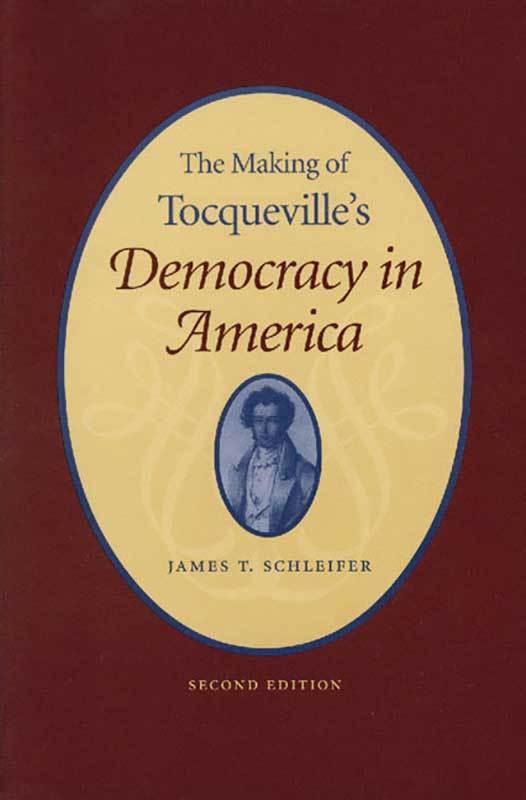
PART V: Democracy, the Individual, and the Masses - James T. Schleifer, The Making of Tocqueville’s Democracy in America [1980]Edition used:The Making of Tocqueville’s Democracy in America, Foreword by George W. Pierson (2nd edition) (Indianapolis: Liberty Fund, 2000).
About Liberty Fund:Liberty Fund, Inc. is a private, educational foundation established to encourage the study of the ideal of a society of free and responsible individuals. Copyright information:The copyright to this edition, in both print and electronic forms, is held by Liberty Fund, Inc. Fair use statement:This material is put online to further the educational goals of Liberty Fund, Inc. Unless otherwise stated in the Copyright Information section above, this material may be used freely for educational and academic purposes. It may not be used in any way for profit.
PART VDemocracy, the Individual, and the MassesCHAPTER 14The Tyranny of the MajorityAs his ongoing analysis of centralization and despotism demonstrates, Tocqueville focused, at times, largely on the saving of political liberty in democratic times. Later his emphasis shifted somewhat, and he concentrated instead on intellectual liberty. These two freedoms are not unrelated; both are connected to what was always central to Tocqueville’s understanding of liberty: the dignity and responsibility of the individual. But freedom for the development and expression of new and/or uncommon ideas was increasingly important to Tocqueville. He sought more and more, in the face of democracy’s advance, to preserve the individual who dared to think differently. He wanted neither sheep for the bureaucratic shepherd nor identical pieces of a democratic mass. Between 1831 and 1840 Tocqueville considered at least four major democratic despotisms. One, legislative omnipotence, had a prominent place in 1835, but declined rapidly in importance after that. Another, tyranny d’un seul, also had a key part in 1835, enjoyed a second flurry of interest in 1836 and 1837 in the guise of the military dictator, and then went, as well, into eclipse. A third, administrative despotism, made a brief, relatively unheralded appearance in 1835; this modest beginning was followed by a steady increase in importance until, by 1840, Tocqueville’s image of the oppressive bureaucratic state dominated the last section of the Democracy. The fourth variety played a major role in 1835 and then, in more subtle form, entered almost as significantly into the 1840 volumes. This final vision remains perhaps the best known of Tocqueville’s concepts of democratic despotism: the tyranny of the majority. Among the first entries in Tocqueville’s American diaries was a conversation with Albert Gallatin. While discussing the legal profession Gallatin made several points about the political roles of American judges and the influence of public opinion. “The judges ... are held in very high esteem. Being entirely dependent on public opinion, they need to make continual efforts to keep this esteem.... I look on the judges ... as the regulators of the irregular movements of our democracy, and as those who maintain the equilibrium of the system.”1 After talking of reasons for bicameralism, John Canfield Spencer of Canandaigua, New York, also focused on the connection between public opinion and American judges, but his comments were somewhat more critical. “They are a little too fond of flattering the people, and ... they will not fight courageously against a view that they believe is shared by the masses. We have seen some examples of that in cases with a political side to them.”2 In September, Jared Sparks put the whole matter into a broader context. “The political dogma of the country is that the majority is always right. By and large we are very well satisfied to have adopted it, but one can not deny that experience often gives the lie to the principle. (He quoted several examples of this.) Sometimes the majority has wished to oppress the minority.”3 This was the first mention of an idea that would become one of the fundamental themes of the Democracy. The next day, in response to these remarks, Tocqueville fixed a new intellectual guidepost in one of his pocket notebooks. One of “two great social principles which seem to me to rule American society and to which one must always return to find the reason for all the laws and habits which govern it” was that “the majority may be mistaken on some points, but finally it is always right and there is no moral power above it.... A completely democratic government,” he continued, recalling Gallatin, Spencer, Sparks, and others, “is so dangerous an instrument that, even in America, men have been obliged to take a host of precautions against the errors and passions of Democracy. The establishment of two chambers, the governor’s veto, and above all the establishment of the judges.”4 Soon, as though to test Sparks’s observation, Tocqueville began to record specific instances of the dangers of democracy and of the majority’s occasional desire “to oppress the minority.” “The people is always right,” that is the dogma of the republic just as, “the king can do no wrong,” is the religion of monarchic states. It is a great question to decide whether the one is more false than the other: but what is very sure is that neither the one nor the other is true. Mr. Washington Smith told me yesterday that almost all the crimes in America were due to the abuse of alcoholic drinks. “But,” said I, “why do you not put a duty on brandy?” “Our legislators have often thought about it,” he answered. “But are afraid of a revolt, and besides the members who voted a law like that would be very sure of not being re-elected, the drinkers being in a majority and temperance unpopular.” Yesterday also another Mr. Smith, a very respected Quaker, told me: “The Negroes have the right to vote at elections, but they cannot go to the Poll without being ill treated.” “And why,” said I, “is the law not carried out on their behalf?” He answered me: “The laws have no force with us when public opinion does not support them. Now the people is imbued with very strong prejudices against the Negroes, and the magistrates feel that they have not the strength to enforce laws which are favorable to the latter.”5 The Pennsylvanians’ examples demonstrated that the majority could oppress not only by pressuring judges or other officials or by legislating unjust measures, but also by refusing either to enact or to enforce laws which countered popular prejudices. Particularly when racial minorities were involved, sovereignty of the people or majority rule sometimes led directly to great injustice. In 1835 Tocqueville would combine this information with two other examples and conclude: “The people, surrounded by flatterers, find it hard to master themselves. Whenever anyone tries to persuade them to accept a privation or a discomfort, even for an aim that their reason approves, they always begin by refusing. The Americans rightly boast of their obedience to the laws. But one must add that in America legislation is made by the people and for the people. Therefore law in the United States patently favors those who everywhere else have the greatest interest in violating it. It is therefore fair to suppose that an irksome law of which the majority did not see the immediate utility either would not be passed or would not be obeyed.”6 On 1 November 1831, Tocqueville spoke with Mr. Stewart, “a distinguished Baltimore doctor,” and heard that public opinion had even more subtle influences. The physician described the immense power of religion in America and the pressures on men like himself to be known as “believers.” “Does not such a state of affairs,” Tocqueville interjected, “make for many hypocrites?” “Yes, but especially it keeps them from speaking. Public opinion does with us what the Inquisition could never do.... I have known a lot of young people who ... thought they had discovered that the Christian religion was not true; carried away by the ardor of youth they have started loudly proclaiming this opinion.... What then! Some have been forced to leave the country or to vegetate miserably there. Others, feeling the struggle unequal, have been constrained to an external religious conformity, or have at least kept quiet. The number who have thus been suppressed by public opinion is very considerable. Anti-Christian books are never published here, or at least that is very rare.”7 Tocqueville realized that what Mr. Stewart described was a different sort of democratic despotism: an almost irresistible pressure on individuals to conform to the ideas of the many. By 1835 this awesome power of public opinion would become the most disturbing and original feature of his portrait of the tyranny of the majority. Still another episode related to Tocqueville in Baltimore demonstrated how the majority sometimes enforced conformity by violent actions which were, in turn, sanctioned or even encouraged by other popular institutions, such as the militia and jury. “Mr. Cruse, a very talented man and editor of one of the principal newspapers in Baltimore, told me today: With us there is no power external to the people; whatever it wants, one must submit. The militia itself is the people, and is of no avail when it shares or excuses the passions of the majority. We saw a terrible instance of this twenty years ago. It was the time of the war against England, a war which was very popular in the South. A journalist ventured violently to attack war feeling. The people assembled, broke his presses, and attacked the houses where he and his friends (belonging to the first families of the town) had shut themselves up. An attempt was made to call out the militia; they refused to march against the rioters, and did not answer the call. The municipal authorities could only save the journalist and his friends by sending them to prison. The people did not feel itself satisfied. That night it assembled and marched against the prison. Again one tried to assemble the militia, but without being able to do so. The prison was taken by storm; one of the prisoners was killed on the spot and the rest left for dead; one wanted to make prosecutions, but the juries acquitted the offenders.”8 This story was a particularly troubling example of the power of the people. How apt some earlier jottings on the jury now seemed. “The jury is the most powerful and the most direct application of the sovereignty of the people. Because the jury is nothing but the people made judge of what is allowed and of what it is forbidden to do against society.”9 Leading citizens of Ohio repeatedly told Tocqueville in December about alarming democratic excesses in their state. There democracy seemed at flood level, and still rising. “At the moment we are making the experiment of a democracy without limits.”10 The result was mediocre leadership, impulsive legislation, poor administration, and, most alarming, growing judicial dependency.11 When Tocqueville asked if it were not dangerous to entrust to the legislature the powers to appoint and to limit the tenure of judges, Salmon P. Chase agreed that it was. “The judges in America are there to hold the balance between all parties, and their function is particularly to oppose the impetuosity and mistakes of democracy. [How closely he echoed Gallatin.] Sprung from it, depending on it for the future, they cannot have that independence.”12 A first reading of James Kent’s Commentaries at the end of the month underscored these concerns. The Chancellor particularly stressed the desirability of judicial independence. “It is ... salutary in protecting the constitution and laws from the encroachments and tyranny of factions.”13 The legislators, he implied, also needed a certain insulation from the immediate desires of the people. It especially disturbed Tocqueville to learn from Kent that “in several constitutions in the United States, the right of the electors to force their representatives to vote in a certain way has been recognized. The principle is contested by the best minds. If it was generally adopted, it would deal a deadly blow at the representative system, that great discovery of modern times, which seems destined to exercise so great an influence over the fate of humanity. It would then be the people itself that acted, the deputies becoming its mere passive agents.”14 So, in some states, the mandate was a significant additional means to enforce the will of the majority. Not long afterward, another American reviewed some basic flaws in the government of Alabama and “all the new States in the South-West.” “The erroneous opinion,” he summarized, “is spreading daily more and more among us ... that the people can do everything and is capable of ruling almost directly.”15 Tocqueville’s journey in the New World had enabled him to compile a formidable list of ways in which the many in America wielded their extraordinary and apparently growing power. The majority exercised more and more direct control over legislatures, which in turn increasingly dominated the executive and judicial branches. It spoke through juries and acted (or failed to act) through the militia. Sometimes it even coerced minorities by violence or threats of violence.16 Perhaps most noteworthy was the overwhelming authority which public opinion in America had not only over judges, legislators, and other public officials, but also over minorities and private nonconforming individuals. It was this subtle but irresistible moral pressure which the majority could bring to bear, rather than any political, legal, or even physical coercion, which most troubled the visiting Frenchmen. By the time Tocqueville finally gathered his materials in Paris and began to write, he had apparently already decided that an analysis of this worrisome trend toward popular omnipotence would be a significant part of his book. In his compilation of sources he used as one organizing theme: “Sovereignty of the people. Tyranny of the majority. Democracy, irresistible march of Democracy.—... Tyrannical power over speech. Power without counterweight.—Generating principles of American constitutions.”17 Here apparently was Tocqueville’s first written use of the phrase which would become so familiar, tyranny of the majority. As the task of composition proceeded, Tocqueville also continued to develop a catalogue of possible checks on the power of the majority in the United States; “On What Tends to Moderate the Omnipotence of the Majority in America”: “In America there are a thousand natural causes which, so to speak, by themselves work together to moderate the omnipotence of the majority. The absence of ranks,18 the extreme harmony of interests which reigns among all in the United States, the material prosperity of the country, the diffusion of enlightenment (lumières), and the mildness of moeurs, which is the result of the progress of civilization, greatly favor the mildness of the government. I have already indicated the different causes; the time has come to examine what barriers the institutions themselves have taken care to raise against the power from which they come.”19 During the journey, Tocqueville had received a strongly negative impression of the authority of American state and national executives. In his drafts he now declared: “In America the executive power is nothing and can do nothing. All of the force of the government is confided to the society itself organized under the most democratic form that has ever existed. In America all danger comes from the people; it is never born outside of them.”20 After further reading and reflection he finally concluded that, as a result of this general executive debility, “The veto of the governor is not a barrier to the democracy; the governor proceeds entirely from it.”21 On this point, at least, Tocqueville had changed his mind, and Jared Sparks had been judged wrong. The significance which Sparks, the Ohioans, Kent, Story, the writers of the Federalist, and others placed on the maintenance of judicial independence and the high opinion that they all had of the American judiciary made it unlikely that Tocqueville would ever similarly deemphasize the “establishment of the judges” as a check on the majority’s power.22 The drafts of the 1835 Democracy continued to declare that “the judicial power in the United States is a barrier raised by design against the omnipotence of the majority. We can consider it as the only powerful or real obstacle that American laws have placed before the steps of the people.”23 In a fragment, Tocqueville presented a thumbnail sketch of the independent judge who, armed with the power to declare laws unconstitutional, worked to maintain the balance of the system and to preserve liberty. Influence Exercised by the Judicial Power on the Power of the Majority. When political society in the United States is examined, at first glance one notices only a single principle which seems to bind all the parts strongly together: the people appear as the only power. Nothing seems able to oppose their will nor to thwart their plans. But there is a man who presents himself as, in some sense, above the people; he does not hold his mandate from them; he has nothing to fear, so to speak, from their anger, nor anything to hope from their favor. However, he is clothed with more power than any of the representatives of the people; for by a single blow, he can strike with sterility the work which issued from the common will.24 But would judges in America remain truly independent? From Alexander Hamilton, Tocqueville learned that the judicial branch was by its very nature feeble. “Importance of the judicial power as barrier to Democracy; its weakness. See Federalist, p. 332.”25 In Paper Number 78, Hamilton argued: “The judiciary is beyond comparison the weakest of the three departments of power.... from the natural feebleness of the judiciary, it is in continual jeopardy of being overpowered, awed, or influenced by its co-ordinate branches; ... as nothing can contribute so much to its firmness and independence as permanency in office, this quality may therefore be justly regarded as an indispensable ingredient in its constitution, and, in a great measure, as the citadel of the public justice and the public security.”26 Yet the Frenchman knew from conversations and other readings that judicial independence was at that very time under attack in America. Justice Story’s book, for example, warned him once again of the growing trend to submit judges to popular election.27 Pushed on the one hand to argue how necessary and potent a barrier the judiciary was to popular passions, and on the other to recognize the inherent weakness of the courts and the growing tendency toward judicial dependence, Tocqueville was caught between contrary lessons. He finally resolved the dilemma by concluding in a draft: “So the high prerogatives granted to American magistrates never place them out of the reach of the majority, and their independence is not such that a single dominating power always exists at the heart of the society to which all must definitively submit. The judicial power retards the people, it can not stop them.”28 In the New World Tocqueville had also heard repeatedly that the states were the primary arena for popular excesses. Works by Kent and Story, read or reread in Paris, now repeated this message. He also discovered in the Federalist Papers that Madison, on more than one occasion, severely criticized the states for serious flaws in their governments. According to Madison, the proposed Constitution would be a superior frame of government precisely because it guarded against many of the weaknesses inherent in most of the state constitutions: submissive executives, dependent judges, and unchecked legislatures.29 When Tocqueville came to consider the threat of tyranny of the majority, he argued in a draft: “So in the democratic republics [of America] the majority forms a genuine power.... Yet this power of the majority can be moderated in its exercise by the efforts of the law-maker. The authors of the federal Constitution worked in this sense. They sought to hobble the march of the majority. In the individual states, on the contrary, men strove to render it more rapid and more irresistible.”30 He wrote even more strongly elsewhere: “The Union can not present a tyrannical majority. Each state would be able to do so.... Two causes: 1. The division of sovereignty [federalism]; 2. The splitting up of administration [administrative decentralization].” So like other democratic despotisms, tyranny of the majority might be checked, in part, by decentralization. “Since the national majority is thus thwarted in its designs by the majority of the inhabitants of a city or locality, the tyranny which can be very great at several points cannot become general.... And since these two majorities may find themselves opposed in their designs, liberty always finds some sanctuary and the despotism which can be exerted irresistibly at several points of the territory, cannot however become general.”31 The words of the 1835 Democracy would not be so absolute, but Tocqueville would remark that “however far the national majority may be carried away by its passions in its ardor for its projects, it cannot make all the citizens everywhere bow to its will in the same way and at the same time.”32 He would also mention in a footnote: “There is no need to remind the reader that here, and throughout this chapter [“The Omnipotence of the Majority in the United States and Its Effects”], I am speaking not of the federal government but of the governments of each state, where a despotic majority is in control.”33 On the basis of observations and readings Tocqueville was therefore at times inclined to accept the efficacy of American federalism and administrative decentralization as barriers to the tyranny of the majority on the national level.34 Apparently the people could not abuse the power of the central government as easily as they sometimes did that of the states. (Decentralization even tended to blunt the possibility of majoritarian despotism on the state level.) So at times, for Tocqueville, the tyranny of the majority—at least in its more concrete political and legal manifestations—was largely a danger within the states. But by 1835 Tocqueville would make an important distinction which significantly qualified this positive evaluation of decentralization and the federal Constitution as barriers to popular oppression. There were dangers beyond those which threatened in the states. In America the majority actually wielded two different powers: legal and political control (“une immense puissance de fait”) and authority over opinion and thought (“une puissance d’opinion presque aussi grande”).35 The first was exercised largely through the branches of government (particularly through the legislature, the special instrument of majority), the jury system, the force publique (militia and police), and other institutions. It was this power which state constitutions had artificially enhanced and which could so easily degenerate into tyranny. The second and more original portion of Tocqueville’s vision of majoritarian despotism resulted from the more subtle influences suggested by the narrative of Mr. Stewart. In 1835 he would observe: It is when one comes to look into the use made of thought in America that one most clearly sees how far the power of the majority goes beyond all powers known to us in Europe. Thought is an invisible power and one almost impossible to lay hands on, which makes sport of all tyrannies. In our day the most absolute sovereigns in Europe cannot prevent certain thoughts hostile to their power from silently circulating in their states and even in their own courts. It is not like that in America; while the majority is in doubt, one talks; but when it has irrevocably pronounced, everyone is silent, and friends and enemies alike seem to make for its bandwagon.... I know no country in which, generally speaking, there is less independence of mind and true freedom of discussion than in America.36 ... In America the majority has enclosed thought within a formidable fence. A writer is free inside that area, but woe to the man who goes beyond it. Not that he stands in fear of an auto-da-fé, but he must face all kinds of unpleasantness and everyday persecution.... Formerly tyranny used the clumsy weapons of chains and hangmen; nowadays even despotism, though it seemed to have nothing more to learn, has been perfected by civilization. Princes made violence a physical thing, but our contemporary democratic republics have turned it into something as intellectual as the human will it is intended to constrain.... Absolute monarchies brought despotism into dishonor; we must beware lest democratic republics rehabilitate it, and while they make it more oppressive toward some, they do not rid it of its detestable and degrading character in the eyes of the greatest number.37 In his drafts, Tocqueville attempted to explain his conclusions. “That tyranny in America acts directly on the soul and does not torment the body results from two causes: 1. that it [tyranny] is exercised by a majority and not by a man. A man, never being able to obtain the voluntary support of the mass, can not inflict on his enemy this moral punishment which arises from isolation and public contempt. He is obliged to act directly in order to get at him. 2. that, in effect, moeurs have become milder and people have perfected and intellectualized despotism.”38 In some unpublished paragraphs from the working manuscript of his chapter on the press in America, Tocqueville also pointedly declared that, on certain issues, the power of the majority over thought had effectively destroyed freedom of the press and imposed a unique and highly effective type of censorship. “When liberty of the press, as often happens, combines with the sovereignty of the people, one sometimes sees the majority pronounce clearly in favor of one opinion; then the opposing opinion no longer finds a means of being heard.... Certain thoughts seem to disappear all of a sudden from the memory of men. Liberty of the press then exists in name, but in fact censorship reigns and a censorship a thousand times more powerful than that exercised by any power. Note: I do not know a country where on certain questions liberty of the press exists less than in America. There are few despotic countries where the censor does not lean more on the form than on the content of thought. But in America, there are subjects that cannot be touched upon in any way whatsoever.”39 The majority’s almost unlimited power over ideas and opinions thus opened the door to a frightening tyranny of a new and deceptively mild sort. Despite Tocqueville’s repeated assurances that majoritarian despotism was primarily something to fear in the states, the implications of his discussion of this other power of the majority made intellectual tyranny a national and present danger. “There is no freedom of the mind (liberté d’esprit) in America.”40 Nearly a half-century later, in The American Commonwealth (1888), James Bryce criticized Tocqueville’s “tyranny of the majority” on the grounds that the Frenchman’s theory exaggerated the dangers of active oppression of a minority by the majority and slighted the real threat: a pressure so subtle that it would paralyze the will of most dissenters and, almost without their being aware, convert them to the majority’s opinion. The very desire to be different would be undermined and what Bryce called the “fatalism of the multitude” would result.41 But Bryce, it seems, missed the richness of Tocqueville’s concept. Tocqueville did indeed worry about specific acts of oppression which a majority might commit against minorities or dissenting individuals. He also recognized, however, the quiet pressure, the benign but inescapable influence, of the moral authority of the many. In 1835 and increasingly afterward, this passive and deceptively mild side of the tyranny of the majority, this weakening of the individual’s will to stand apart from the crowd, this extremely subtle restriction on the freedom of thought and opinion were what disturbed Tocqueville most. Tocqueville believed that in addition to barriers erected by circumstance, national character, or governmental structure, there were also limitations of an ideal or moral nature on majoritarian power. Most of the time, the republicans of the New World seemed to recognize this. In a draft he wrote: “What one calls the Republic in the United States is the tranquil reign of the majority. The majority, after it has had the time to get to know itself and to verify its existence, is the source of all powers. But the majority itself is not all-powerful; above it in the moral realm is humanity and reason.... The majority in its omnipotence recognizes these two barriers and if it has sometimes overturned them, [it is because,] like the men who compose it, the majority has yielded to passions and felt itself carried by them beyond its rights.”42 The 1835 Democracy would declare that the highest limitation on the rule of the majority was justice. “There is one law which has been made, or at least adopted, not by the majority of this or that people, but by the majority of all men. That law is justice. “Justice therefore forms the boundary to each people’s right. “A nation is like a jury entrusted to represent universal society and to apply the justice which is its law. Should the jury representing society have greater power than that very society whose laws it applies? “Consequently, when I refuse to obey an unjust law, I by no means deny the majority’s right to give orders; I only appeal from the sovereignty of the people to the sovereignty of the human race.”43 Even if these ideals did not effectively check the pretensions of the many, they at least provided a rationale for questioning the presumed moral authority of any majority—especially an oppressive one. Humanity, reason, and justice were thus for Tocqueville significant moral safeguards for any minority or individual. Tocqueville now summarized the major obstacles to the tyranny of the majority in America. A brief outline from his working manuscript mentioned: Omnipotence of the majority. Its tyrannical effects.... Its counterweight in the laws—Judicial power. Lack of administrative centralization. In the moeurs. And in the local circumstances. Jury.44 But his 1835 text would finally narrow this list and stress instead the three major institutional barriers to the despotism of the many: administrative decentralization, the legal corps (with its esprit légiste), and the jury. Most other items on his list would be transferred to the more general discussion of what helped to maintain the democratic republic in America.45 In 1835 Tocqueville would begin his textual discussion of the power of the majority with the axiom that democratic government meant rule by the majority. “The very essence of democratic government consists in the absolute sovereignty of the majority (l’empire de la majorité).”46 In America, however, attachment to the idea of the sovereignty of the people had led to the artificial heightening of majority rule in the states; only the framers of the federal Constitution had possessed the wisdom to erect barriers to the majority’s will. According to the first part of the Democracy the key to the power of the majority was its moral authority (“l’empire moral de la majorité”),47 an authority especially strengthened in the United States by the wide acceptance of the doctrine of equality and the prevailing harmony of interests. Americans assumed that the combined intellects and judgments of the many were superior to those of the few and that the interests of the greater number were naturally to be preferred to the interests of the minority. In addition, the New World republic was not divided into great irreconcilable interest groups. So the privileges and rights of the present majority were recognized without serious quarrel. Tocqueville would describe several familiar but important results that followed from this overwhelming power. The legislature, as the voice of the majority, became the dominant branch of government and, at the same time, closely mirrored the changing desires of the many. Projects were launched with zeal and energy when the people were stirred, but languished when popular interest waned, as often quickly happened. There was, in short, a chronic instability in the laws and administration wherever the majority reigned so unhampered. Furthermore, since American officials were armed with the moral authority of the majority which had placed them in office, they often enjoyed shockingly arbitrary powers within their own restricted spheres of responsibility. The omnipotence of the majority, Tocqueville would observe, even more profoundly influenced the American national character. The many had constantly to be flattered and reinforced in its assumption of superiority. The demagogue, the man of little principle, the crowd-praiser, was the more politically viable figure in America; consequently, a low standard of leadership prevailed. Since the majority resisted criticism of its attitudes and actions from either its own leaders or the members of minorities, a currying of favor pervaded the society. Few were willing to speak out; a smug conformity reigned. So unlimited was the power of the majority in the United States that tyranny threatened; the 1835 text would argue that the strength of the many became “not only predominant but irresistible.”48 “Omnipotence in itself seems a bad and dangerous thing.... So when I see the right and capacity to do all given to any authority whatsoever, whether it be called people or king, democracy or aristocracy, and whether the scene of action is a monarchy or a republic, I say: the germ of tyranny is there, and I will go look for other laws under which to live.”49 The American states, Tocqueville would insist, provided almost no real guarantees against the abuse by the many of its authority and the oppression of an individual or a minority. “When a man or a party suffers an injustice in the United States, to whom can he turn? To public opinion? That is what forms the majority. To the legislative body? It represents the majority and obeys it blindly. To the executive power? It is appointed by the majority and serves as its passive instrument. To the police (la force publique)? They are nothing but the majority under arms. A jury? The jury is the majority vested with the right to pronounce judgment; even the judges in certain states are elected by the majority. So, however iniquitous or unreasonable the measure which hurts you, you must submit.”50 He would carefully add, however, that the majority in America did not yet habitually abuse its strength. “I am not asserting that at the present time in America there are frequent acts of tyranny. I do say that one can find no guarantee against it.”51 The omnipotence of the majority did not necessarily mean the tyranny of the majority. The common and despotic misuse of power was still primarily a potentiality and something to fear in America’s future. Tocqueville left unresolved the contradiction between this conclusion and his insistence that intellectual liberty did not exist in America. Between 1835 and 1840, as work on the final volumes of his book went forward, Tocqueville worried increasingly about the fragility of intellectual freedom in democratic times. His attention began to focus more and more on what he had called in the first half of his book the puissance d’opinion or the power which the majority in America had over thought, rather than on the majority’s legal and political control (puissance de fait). The last part of the Democracy would therefore reflect a growing sensitivity to the overwhelming intellectual authority of the crowd, and other facets of his theory of the omnipotence and possible tyranny of the majority would largely recede from view. By 1840 the dangerous power of the majority over ideas and opinions would also be closely linked with the larger relationship between the individual and the mass in democratic societies. What he had previously almost always described as the omnipotence (l’omnipotence) or authority of the majority (l’empire de la majorité) or of the greatest number (le plus grand nombre), or the power of public opinion (opinion publique), he would now frequently call the influence of the crowd, the mass, or the public (la foule, la masse, le public).52 Among the many significant consequences of the isolation and weakness of the individual which Tocqueville would emphasize in 1840, for example, would be the tendency of the solitary person to defer intellectually to the views of his fellows. “As equality spreads and men individually become less strong, they ever increasingly let themselves glide with the stream of the crowd and find it hard to maintain alone an opinion abandoned by the rest.”53 In the chapter entitled “Concerning the Principal Source of Beliefs among Democratic Peoples,” he would identify the influence of the many as a major cause “which must in the long run hold the independence of individual thought within fixed, indeed sometimes narrow, bounds.”54 The nearer men are to a common level of uniformity, the less are they inclined to believe blindly in any man or any class. But they are readier to trust the mass, and public opinion becomes more and more mistress of the world. Not only is public opinion the only guide left to aid private judgment, but its power is infinitely greater in democracies than elsewhere.... The citizen of a democracy comparing himself with the others feels proud of his equality with each. But when he compares himself with all his fellows and measures himself against this vast entity, he is overwhelmed by a sense of his insignificance and weakness.... So in democracies public opinion has a strange power of which aristocratic nations can form no conception. It uses no persuasion to forward its beliefs, but by some mighty pressure of the mind of all upon the intelligence of each it imposes its ideas and makes them penetrate men’s very souls.55 Tocqueville would then proceed to revive the distinction which he had originally made in 1835. He would distinguish between the omnipotence politique de la majorité (augmented by various laws) and the empire ... sur l’intelligence and then argue that, although in the United States the former enhanced the strength and danger of the latter, the intellectual authority of the majority did not necessarily need the support of excessively democratic institutions. Basic democratic social conditions, rather than particular political forms, were the most fundamental causes of the dominance which the mass exercised over thought and opinion.56 Tocqueville would conclude his chapter with a description of the possible tyranny of the majority which would almost exclusively stress the intellectual, rather than any legal or political, consequences of such despotism. “Thus it might happen that, having broken down all the bonds which classes or men formerly imposed on it, the human mind (esprit) might bind itself in tight fetters to the general will of the greatest number. “If democratic peoples substituted the absolute power of a majority for all the various powers that used excessively to impede or hold back the upsurge of individual thought, the evil itself would only have changed its form. Men would by no means have found the way to live in independence; they would only have succeeded in the difficult task of giving slavery a new face. There is matter for deep reflection there. I cannot say this too often for all those who see freedom of the mind as something sacred and who hate not only despots but also despotism. For myself, if I feel the hand of power heavy on my brow, I am little concerned to know who it is that oppresses me; I am no better inclined to pass my head under the yoke because a million men hold it for me.”57 These and other ideas also appeared in an earlier draft of the second chapter of the 1840 Democracy.58 Previously unpublished, the manuscript, entitled “Concerning the Particular Causes Which Might Be Harmful in America to the Free Development and to the Generalization of Thought,” was a substantially different version that more emphatically stressed the ominous power of the majority over thought. It also revealed more of Tocqueville’s personal reactions to and remedies for this democratic threat to intellectual freedom. He began in the margin with an outline of the particular causes which worked against theoretical and innovative thinking in America. Religion (I have already discussed it). Examine the equality of conditions. Maintained by the material condition of the country. Despotism of the majority. Exclusively commercial and industrial character of the country. People direct their efforts only toward certain things. No memory of another social and political state. Origin of the middle classes. I demonstrated in the preceding chapter how dogmatic and traditional opinions maintained in religious matters restricted the innovating mind of the Americans on several sides, so to speak. There is another cause, less powerful, but more general, which threatens to stop and which already slows the free development of thought in the United States. This cause, which I have already indicated in another part of this work, is nothing other than the ... 59 power exercised by the majority in America. A religion is also a power; but its movements are set in advance and move in a known sphere; and many persons believe that in this sphere its effects are beneficial, and that a dogmatic religion goes further toward obtaining the desired results than one which is rational. The majority is a ... 60 power which, in a way, goes at random and can successively extend to all things. Religion is the law; the omnipotence of the majority is arbitrary. Religion inclines the human mind to stop by itself and to offer obedience, the free choice of a moral and independent being. The majority compels the human mind to stop, despite what it may want, and by constantly forcing it to obey, ends by taking away even the desire to be free, to act for itself. In the United States, the pernicious influence exercised on thought by the omnipotence of the majority is noticeable above all in political life. It is principally in governmental matters, on political questions that the majority’s opinion has been formed up to now; but American laws are such that, whatever direction it decides to take, the majority will make its omnipotence equally felt. So its limits are in its own will and not in the constitution of the country. One cannot conceal the fact that the Americans have let themselves be carried in the direction common to democratic peoples. In democracies, whatever one thinks, the majority and the power that represents it are always provided with a rough strength. And even if the laws in the smallest degree favor rather than combat this tendency, it is nearly impossible to say where the limits of tyranny will be. It could happen that in democracies people would escape from the domination of class, family, or national attitudes in order to submit to those of the majority. One cannot hide the fact that this is the natural tendency in democracies. It must be combated, not only by those who do not want political tyranny, but also by those who desire the general freedom of the human mind.61 ... Among aristocratic peoples the interests of class forbid men to see anything other than what exists under their eyes and prevent them from noticing new roads which could lead to truth. It is probable that, once submitted to the omnipotence of the majority, men would not even seek to discover these new paths or would not follow them after they were found.62 The prejudices of all types which are born and maintained in the heart of an aristocracy limit the human mind in certain ways and prevent it from developing along these lines; but it does not attack intellectual freedom in principle and in an absolute manner. In democracies constituted in the way that I mentioned above, the majority in a way oversees the human mind; it compresses its whole scope in a permanent and general manner; and to bend men to its will, it ends by taking away from each of them the habit and the taste of thinking for himself.... ... I expect people to serve the cause of democracy, but I want them to do so as moral and independent beings who, while pledging their support, retain the use of their liberty; that people see in the majority the most tolerable of all powers, I understand; but I would like them to be its counselors and not its courtiers.... I say that among democratic peoples, I clearly notice two contrary tendencies. One carries men toward new and general thoughts. The other could reduce them, so to speak, to not thinking at all.63 So if I found myself suddenly charged with giving laws to a democratic people, I would seek clearly to distinguish these two tendencies and to make it so that they did not cancel one another out, or at least that the second did not become preponderant. In this design, I would try not to destroy the authority (l’empire) of the majority, but to moderate its use. And I would do my utmost to assure that after it had overthrown all rival powers, it would limit itself. This is why—to furnish not a complete picture, but an example—if I lived among a democratic people, I would prefer to see them adopt a monarchical constitution rather than a republican form. I would like it better if they instituted two legislative assemblies rather than one, an immovable judiciary rather than elected judges, provincial powers rather than a centralized administration. For all of these institutions can be combined with democracy without altering its essence.64 As the social state became more democratic, I would put more of a price on obtaining all or some of these things. And while proceeding thus, I would have in view not only saving political liberty, as I have said in another part of this work, but also protecting the general progress of the human mind. If you should say that such maxims are not popular, I will try to console myself with the hope that they are true.65 This draft chapter explained how natural groupings in aristocratic society tended to restrain freedom of thought and how démocratie both liberated men from these older limitations and carried the potential for new and more fearful restrictions. It also briefly contrasted the different ways in which religion and a democratic majority encircled intellectual exploration and development; and it implied that Tocqueville could much more easily concede some benefit to religious limitations on free inquiry. What was newer about this earlier deleted variation, however, was his statement that, so far, American conformity of opinion was greatest in basic governmental and political attitudes. This explicit observation occurred solely in this draft. Also noteworthy was the program of remedies that concluded the chapter. Once again, as he did in other drafts and would in both 1835 and 1840, Tocqueville stressed decentralization and an independent judiciary. But here he also declared his preference for a democratic monarchy rather than a democratic republic. This idea too would never appear in the text of his Democracy. Finally and most important, this variant clearly demonstrated that Tocqueville feared not only the silencing of individual and minority ideas and the resulting conformity of opinion; he also dreaded the further possibility that in democratic times new ideas might be denied a hearing and that the advance of civilization might therefore come to a halt. By 1840, these intellectual dangers had apparently become, for Tocqueville, the primary meaning of tyranny of the majority and a major focus of personal anxiety.66 CHAPTER 15The Tyranny of the Majority: Some ParadoxesFrom James Madison, among others, Tocqueville had learned about the nature and inherent structural weaknesses of the Union, the tendency of legislatures to accumulate power, and the danger to liberty which came from excessive centralization. Madison had also helped to teach the Frenchman how the states (because of federalism) and the counties and municipalities (because of the division of administrative authority) served both to help maintain a large republic and to lessen the potentially despotic pressure of public opinion. But, as we have seen, the republican statesman had not been able to persuade Tocqueville that size itself was an advantage to free societies. The Democracy persisted in praising small rather than large nations as the natural sanctuaries of liberty. And in his analysis of the causes and cures of the tyranny of the majority Tocqueville continued to place great hopes in independent and responsible localities as essential centers of freedom during democratic times. These beliefs led him into a few strange paradoxes, not the least of which was his ranking of the jury as one of the great barriers to majoritarian despotism.1 In 1835 he praised the jury for teaching respect for law, awareness of rights, and a sense of civic responsibility, and for forming the judgment and augmenting the practical knowledge of the people.2 Yet on more than one occasion he had been told that the jury sometimes served as a legal stamp of approval for local excesses and prejudices rather than as a check upon them. “The jury,” he had once declared, “is nothing but the people made judge of what is allowed and of what it is forbidden to do against society.”3 Mr. Cruse had recounted for him the story of a jury during the War of 1812 which had acquitted members of a mob which had pursued and beaten an antiwar journalist and his friends. The crowd had even murdered one opponent of the war.4 In January 1832, Tocqueville had heard another example as well from the lawyer who had discussed Alabama’s reputation for violence and the frequent resorts to knife or gun to settle quarrels there. “But,” Tocqueville had asked, “when a man is killed like that, is his assassin not punished?” “He is always brought to trial, and always acquitted by the jury, unless there are greatly aggravating circumstances.... The violence has become accepted. Each juror feels that he might, on leaving the court, find himself in the same position as the accused, and he acquits.... So it is the people that judges itself, and its prejudices in this matter stand in the way of its good sense.” After hearing this surprising commentary, Tocqueville could not refrain from asking his acquaintance what he thought of the jury system in general. “One of the disadvantages of our juries,” the American replied, “is that they are drawn from too small areas (the counties). The jurors know about the matter before it is argued. It is judged before it is heard and judged in a tavern.”5 So both Mr. Cruse and the lawyer from Alabama had hinted that juries had a critical failing: they would not convict a man for actions—however heinous—which a local majority applauded. The lawyer claimed, moreover, that too often jurors merely reflected regional prejudices and legitimized verdicts previously reached in neighborhood taphouses. A third incident, fictional but perhaps suggested by something which Gustave and Alexis had witnessed while attending a trial in America,6 was dramatically described in Marie; Or, Slavery in the United States, Beaumont’s companion piece to the 1835 Democracy. “One day in New York,” Gustave’s hero, Ludovic, related, “I attended a session in court. Among those awaiting trial sat a young mulatto accused by an American of acts of violence. ‘A white man beaten by a colored man! What an outrage! What viciousness!’ voices cried out everywhere. The public, the jurors themselves were indignant at the accused man, without knowing whether he was guilty. I do not know how to tell you how distressing was my impression as he came to trial—each time the poor mulatto wished to speak, his voice was drowned out, either by the judge or by the noise of the crowd. All the witnesses damned him.... The friends of the plaintiff had good memories; those to whom the defendant appealed remembered nothing. He was found guilty without any deliberation on the part of the jury. A quiver of joy went through the crowd: a murmur a thousand times more cruel to the heart of the unhappy man than the judge’s sentence; for the judge was paid for his task, while the hate of the people was gratuitous. Perhaps he was guilty; but, innocent, would he not have suffered the same fate?”7 Beaumont’s tale echoed the remarks of the two American critics and again exposed a basic flaw in the jury system. That institution could be no more dispassionate, no more just, no more impartial than the public which supplied the jurors. For better or for worse, it was simply a mirror of public opinion and, as such, a potential instrument of tyranny. So Tocqueville’s extremely positive attitude toward the jury was somewhat puzzling. Although he once observed that the jury was merely “the majority vested with the right to pronounce judgment,”8 he largely failed in his book to recognize or to warn his readers that the jury could also be one of the more fearful tools of an oppressive majority. The 1835 Democracy presented instead an essentially one-sided view of the jury as a major check on majoritarian despotism. But Tocqueville’s evaluation of the jury—an eminently local institution—was only part of a greater paradox: his stress on the value of the “spirit of locality.” On the one hand, a major antidote that Tocqueville recommended for majoritarian tyranny was administrative decentralization. On the other hand, he seemed to recognize on several occasions that tyranny of the majority was more likely and, if it occurred, more virulent within localities. On one occasion, for instance, he wrote in a draft that the ardor of local passions once kindled could only be compared to intense fraternal hatreds.9 And all of his specific examples of tyranny of the majority took place in the towns and cities of America. It was there that dissenting individuals or minorities found themselves most at the mercy of popular institutions such as the police or the jury, most vulnerable to mob violence, and most exposed to the other more subtle pressures and intimidations of local majorities. Several times the 1835 Democracy seemed to indicate Tocqueville’s awareness of this melancholy truth. At the beginning of his book he described with some amazement the moral and religious regulations of the Puritans of Massachusetts and Connecticut and could only partially excuse their “bizarre or tyrannical laws” by noting that in those early New England communities of the “like-minded” such measures were voted by the people themselves.10 While comparing large and small nations, he again carefully exposed the potential dangers of the city-state. “In small nations the watchfulness of society penetrates everywhere.... When tyranny is established in a small nation, it is more galling than elsewhere because, operating within a comparatively restricted sphere, it affects everything within that sphere. Unable to engage in any great design, it turns to a multitude of little ones; it is both violent and petty. From the political world which is properly its domain, it penetrates into private life. After actions, it aspires to regiment tastes; after the state, it wants to rule families.”11 What better possible portrait of the public interest in private attitudes and behavior, of the pettiness, and of the pressurized conformity which often prevailed in the small town or locality? Finally, Tocqueville’s concern about the arbitrary power of public officials in America also reflected, in part, his recognition of the possibility of local oppression.12 After studying the Town Officer he had written to Jared Sparks in December 1831, asking incredulously if the selectmen still had the right to denounce immoral persons publicly and if the constables and tythingmen also still possessed the power to search out and act against blasphemers and others who failed to respect the Sabbath. Tocqueville could not quite believe that local elected officials might actually have such authority to meddle and to censor. In reply Sparks tried to assuage the Frenchman’s sense of shock by assuring him that specific actions were taken only rarely and in particularly flagrant cases. But he did reiterate and reaffirm the basic proposition which had apparently so troubled Tocqueville: local officials did indeed still have the duty to “watch over the morals ... of the inhabitants.”13 Thus the very local control which he applauded as an alternative to administrative centralization and as a major barrier to the tyranny of the majority also facilitated the oppression of individuals and minorities by local majorities. Tocqueville had now come upon a fundamental democratic paradox. Vigorous local government, he insisted, was a necessary counterweight to the democratic trend toward centralization. But it was the local majority that was potentially most oppressive. The locality was, after all, the very heart of the majority’s physical, moral, and psychological power. The normal homogeneity and lack of privacy which marked the town made being different there much more difficult and dangerous. And the more independent the locality, the fewer were the possible restraints on the will of the local majority. A flourishing “spirit of locality” meant that one path to democratic despotism—via administrative centralization—was blocked, but another—via tyranny of the local majority—was opened wide. Yet Tocqueville never saw this basic dilemma about local freedom which he himself had posed.14 We can suggest a few possible reasons for Tocqueville’s effusive praise for local self-government and his failure adequately to acknowledge the enhanced likelihood, given decentralization, for tyranny on the local level. Probably one of the most important explanations was that, while in America, he had obviously been more impressed by the benefits of town government than by its disadvantages. Theoretically, a town of enlightened and politically experienced citizens, such as those in New England, significantly diminished the probability of abuses by a local majority. But Tocqueville might also have deliberately refrained from any serious critique of local control because of his larger commitment to a program of administrative decentralization in France. He was almost certainly aware that the ignorance and deeply rooted prejudices of the inhabitants of the communes were major arguments cited by the proponents of centralization in response to reformers like Tocqueville who suggested a partial dismantling of the French administrative machine. Why needlessly strengthen the position of your opponents? It is also possible that his high opinion of local self-government reflected his own good experiences in the department of La Manche. In his first campaign in the region he had been greeted by cries of “No more nobles!” The spirit of 1789 had seemed very much alive. But within little over one year, Tocqueville had been heard, accepted, and elected; and until Louis Napoleon’s coup d’état the citizens of La Manche would continue to send him to Paris as their representative. So the people in localities could apparently be “educated,” “elevated,” and “molded.” Perhaps the standards of the New England town were not so impossible after all.15 Another peculiar feature of Tocqueville’s discussion of majoritarian tyranny was the way in which he thought of the majority. Tocqueville apparently understood majorité primarily as an abstract, singular, and essentially fixed entity. In his mind, the majority usually involved not tangible and temporary interests, but basic attitudes of social consensus or public opinion. For Tocqueville, the majority in its most essential guise was a commanding moral authority.16 Such a view was in sharp contrast to the concept—first explored by Madison—of majorities as shifting coalitions of interests temporarily formed over particular public issues. In Madison’s scheme, majorities were fluid and pluralistic. Since a member of a majority on one day might easily find himself in the minority on the next, no one’s long-term interests and security would be furthered by the majority’s abuse of power. Enduring (and potentially despotic) majorities would not form except on principles general or innocuous enough to threaten no minority group.17 During 1841, in letters written in criticism of the Democracy, Jared Sparks twice isolated the distinctive features of Tocqueville’s analysis and raised what became common objections. A first epistle declared that “in what he says of the tyranny of the majority, I think he is entirely mistaken.... M. de Tocqueville’s theory can only be true where the majority is an unchangeable body, and where it acts exclusively on the minority, as distinct from itself.” A few months later a second letter added: “I think too much confidence is placed in M. de Tocqueville’s ideas of the ‘tyranny of the majority.’ On this subject his imagination leads him far astray. In practice we perceive no such consequence as he supposes. If the majority were large and always consisted of the same individuals, such a thing might be possible; but with us, as in all free governments,... a man who is in the majority at one time is likely to find himself in the minority a few months afterwards. What inducement has a majority thus constituted to be oppressive? Moreover, M. de Tocqueville often confounds the majority with public opinion.”18 If Tocqueville’s theory of the tyranny of the majority is one of his most famous ideas, it is also one of his most disputed. Others since Sparks have also insisted that Tocqueville’s concept of the majority was too abstract and too rigid, and that his theory was therefore inappropriate to the American political system of compromise, shifting coalitions, and countervailing powers. Some have also objected that his “majority” is really “public opinion” which rules all societies, democratic or otherwise. One commentator has even argued that Tocqueville’s “majority” simply does not exist and that his fear of majoritarian despotism is pure fantasy.19 But in at least one critical instance, Tocqueville’s analysis brilliantly described American reality. In various states of the Union, Tocqueville had noticed the second-class status of free Negroes. Particularly in states where slavery had been abolished, prejudice and injustice severely burdened the Negro population.20 In Massachusetts, for example, “the prejudice is so strong against them that their children cannot be received in the schools.”21 And the white majority in Maryland, Tocqueville had learned, sharply restricted the political rights of free Negroes and created special codes of law to supervise their behavior. Mr. Latrobe of Baltimore had even confessed that he was “very much afraid that the incoming Legislature may pass unjust and oppressive laws against the Blacks. People want to make it intolerable for them to remain in Maryland.”22 In Ohio, too, Mr. Walker had admitted, “We try and discourage [free Negroes] in every possible way. Not only have we made laws allowing them to be expelled at will, but we hamper them in a thousand ways. A Negro has no political rights; he cannot be a juror; he cannot give evidence against a white. That last law sometimes leads to revolting injustices.”23 Apparently the white majority in many states exercised (and therefore abused) its power in order to give legitimacy to its prejudices. The 1835 Democracy summarized these injustices and concluded: Race prejudice seems stronger in those states that have abolished slavery than in those where it still exists, and nowhere is it more intolerant than in those states where slavery was never known. It is true that in the North of the Union the law allows legal marriage between Negroes and whites, but public opinion would regard a white man married to a Negro woman as disgraced, and it would be very difficult to quote an example of such an event. In almost all the states where slavery has been abolished the Negroes have been given electoral rights, but they would come forward to vote at the risk of their lives. When oppressed, they can bring an action at law, but they will find only white men among their judges. It is true that the laws make them eligible as jurors, but prejudice wards them off. The Negro’s son is excluded from the school to which the European’s child goes. In the theaters he cannot for good money buy the right to sit by his former master’s side; in the hospitals he lies apart. He is allowed to worship the same God as the white man but must not pray at the same altars. He has his own clergy and churches. The gates of heaven are not closed against him, but his inequality stops only just short of the boundaries of the other world. When the Negro is no more, his bones are cast aside, and some difference in condition is found even in the equality of death. So the Negro is free, but he cannot share the rights, pleasures, labors, griefs, or even the tomb of him whose equal he has been declared; there is nowhere where he can meet him, neither in life nor in death.24 Even more instructive about the abuses which the permanent nature of the white majority in America invited was a passage from Marie. In a society where everyone suffers equal misery, a general feeling grows up which leads to revolt, and sometimes liberty emerges from excessive oppression. But in a country where only a fraction of society is oppressed, while the rest is quite comfortable, the majority manages to live at ease at the expense of the smaller number; everything is in order and well-regulated: well-being on the one hand, abject suffering on the other. The unfortunate may complain, but they are not feared, and the disease, however revolting it may be, is not cured because it only grows deeper without spreading. The misery of the black people oppressed in American society cannot be compared with that of any of the unfortunate classes among other peoples. Everywhere there exists hostility between the rich and the proletariat; however, the two classes are not separated by any insurmountable barrier: the poor become rich, the rich, poor; that is enough to temper the oppression of the one by the other. But when the American crushes the black population with such contempt, he knows that he need never fear to experience the fate reserved for the Negro.25 In a society where all instruments of power—public opinion, legislature, executive, police and militia, jury, even judges in some states—responded to the pressures of an absolute majority, what recourse remained for the oppressed minority? Tocqueville rejected the common opinion that democracies would perish through weakness and disorder, and with Madison argued instead that the real danger was the misuse of concentrated power. While musing on the issue of the omnipotence of the majority, he wrote in a draft: “Like all other authorities (empires), the moral sway (l’empire moral) of the majority is lost by abuse. Tyranny of the majority brings appeals by the minorities to physical force. From there, confusion, anarchy, and the despotism of an individual (d’un seul). The American republics, far from raising the fear of anarchy at the present time, raise only the fear of despotism of the majority; anarchy will come only as a consequence of this tyranny.... “In America the sway (empire) of the majority will not be overthrown because it lacks force, but wisdom. The government is centralized in such a way that the majority which governs is all-powerful. It will lack not physical force, but moral force.”26 His 1835 work prophesied: “I do not think a lack of strength or resources is part of the nature of democratic authority; on the contrary, I believe that it is almost always the abuse of that strength and the ill use of those resources which bring it down.... If ever freedom is lost in America, that will be due to the omnipotence of the majority driving the minorities to desperation and forcing them to appeal to physical force. We may then see anarchy, but it will come as the result of despotism.”27 Five years later, Tocqueville’s message was even clearer and more specific. “If ever America undergoes great revolutions, they will be brought about by the presence of the black race on the soil of the United States; that is to say, they will owe their origin, not to the equality, but to the inequality of condition.”28 Yet in his chapters on the power of the majority Tocqueville did not draw special attention to racial divisions in America. He did not even seem to recognize the Negro/white situation as a particularly pertinent example of the tyranny of the majority. Instead, he repeatedly insisted that the United States was uniquely fortunate in not having severe conflicts of interests, or bitter, unyielding divisions within the society.29 Why? He may once again have shied away from an elaborate application of his ideas to the racial issue in America because of an unwillingness to tread upon Beaumont’s territory. Considering both the focus of Gustave’s work and Alexis’s obvious awareness of the plight of the Negro minority in America, that explanation is at least a possibility. But, as some readers have suggested, a more likely reason was that Tocqueville’s thoughts during the making of most of the Democracy were primarily focused on white Americans and even more narrowly on what he frequently called the Anglo-Americans. Was he thinking mostly about white majorities and white minorities while he pondered the danger of majoritarian despotism? If so, the restricted scope of his reflections cost him one of the best possible illustrations of his concept. The racial situation in America might easily have been a model for the type of majority/minority relationship which Tocqueville envisioned when he discussed the omnipotence and possible tyranny of the majority. In any case, Tocqueville had here put his finger on yet another of the dilemmas of democracy. Given a government that truly reflected the will of the people, how were individuals or minorities to be protected from measures or institutions that made popular errors and prejudices legitimate? When the people ruled what would prevent them from enacting their own worst impulses? Were not the new laws against free Negroes in Jacksonian America a superb example of this danger? We should also recall that while Tocqueville mused about the “majority” and the possible consequences of its power in America, his attention was drawn increasingly to what he saw as the most disturbing feature of any despotism of the many: the deceptively mild, but highly effective repression of uncommon or original ideas. One of the consistent concerns of the Democracy was the freedom, in times of equality, for the individual or small group to hold and to express views which were new and/or not shared by the larger community.30 But most important, his definition of majority primarily emphasized the basic moral authority of the majority; he focused on the fundamental consensus necessary for any society. Tocqueville’s majority was, therefore, unitary and (relatively) permanent, and what he feared more than any specific legal, political, or administrative oppression (which one of Madison’s temporary coalitions might perpetrate) was the most subtle and profound tyranny over ideas, values, and opinions which the many might establish. Here perhaps was the most significant reason for both Tocqueville’s failure to present racial oppression in terms of majoritarian tyranny and his inability either to hear or to accept Madison’s argument that size—through diversity—lessened the chances for oppression by a majority. Two general lessons of American history are that the majority does sometimes abuse its power, especially to oppress racial and ethnic minorities and to still dissenting opinions, and that majoritarian tyranny has occurred more often and more easily on the local, state, or regional levels than on the federal level. Especially in the twentieth century, it has, by and large, been the branches of the federal government which—in opposition to local, state, or regional inertia—have taken the initiative in enacting measures to help assure social justice, minority rights, and civil liberties.31 So the serious misuse of power by the many, especially in the localities and states, was not a figment of Tocqueville’s imagination. He was perceptive enough both to recognize the danger of the tyranny of the majority and to realize that this potential oppression was more threatening in the states. What he failed either to see or to admit was the possibility that administrative decentralization, by freeing especially the localities from most restrictions by federal (or state) government, would not only stimulate practical political experience and a sense of civic responsibility, but would also deliver the towns and counties over to the local majorities. The more independent the locality, the more unrestrained the majority to impose its own values and opinions by means of the agencies of government, or public pressure, or the jury, or even violence. So Tocqueville’s recommendations for local self-government involved one of those difficult choices, one of those ambiguous issues of delicate balance which he was usually so quick to notice about democratic society. His remedy would paradoxically hinder the rise of administrative despotism but at the same time open the door even wider to tyranny of the majority precisely where it was most absolute—in the locality. In this case he apparently did not see the dilemma which he had posed for himself. Also Tocqueville felt a strange ambivalence toward the states. If they were essential elements in American federalism and administrative decentralization (and therefore involved in all of the benefits conjured up in Tocqueville’s mind by those structural traits), they were also the major villains in his reflections about the Union’s destiny. (Their relentless jealousy and aggression toward the central government was a major reason for Tocqueville’s inclination to predict the ultimate dissolution of the Union.) But, as we have now seen, his contradictory attitude went even further. Although he sometimes praised the states as valuable barriers to any possible national sweep by destructive political passions, he more frequently condemned them for the inadequacies of their constitutions and for the openings which they gave to democratic excesses of all sorts. The existence of the states helped to insulate the nation from many democratic despotisms, but it was precisely on the state level, the 1835 Democracy insisted paradoxically, that such tyrannies were most likely to flourish. Finally, as various critics have observed, Tocqueville erred as he developed his notion of the despotism of the majority by largely overlooking the chance of oppression by some minority.32 Once again his intense temporary focus on a single concept made him lose sight of (or in this case entirely overlook) another equally significant idea. His belief that “in America tyranny can only come from the majority”33 failed to allow for the possibility of domination by some small group with political, social, intellectual, or economic privilege. In twentieth-century America, at least, the machinations of the few have often seemed more of a threat to democratic liberty than any abuses of power by the majority. CHAPTER 16Would Démocratie Usher in a New Dark Ages?Particularly after 1835, Tocqueville’s concern about the tyranny of the majority reflected a growing interest in intellectual liberty. He worried that one probable result of advancing equality would be massive pressure on individuals to conform in matters of thought and opinion to the views of the many. A related, but even more serious possible consequence, he feared, would be the suppression of innovative thinking altogether. Without new ideas or the freedom to express them, what would then become of cultural progress? For Tocqueville, even the possibility of such a disastrous development evoked some troubling questions for the future. When describing the results of the New Despotism, of equality without liberty, Tocqueville usually wrote of men falling “below the level of humanity” (au-dessous du niveau de l’humanité) or of “barbarism” (la barbarie).1 But from a very early period in the making of the Democracy, he also worried about another sort of “barbarism.” In November 1831, after reflecting for several months on the many effects of America’s pervasive equality, he asked in one of his travel notebooks: “Why, as civilisation spreads, do outstanding men become fewer? Why, when attainments are the lot of all, do great intellectual talents become rarer? Why, when there are no longer lower classes, are there no more upper classes? ... America clearly poses these questions. But who can answer them?”2 Such doubts were not unusual. Tocqueville probably knew even before going to the New World that, in the opinion of many of his contemporaries, democracy was incompatible with civilization.3 The queries of November 1831 reveal that, even then, he too suspected that democracy might usher in an era of intellectual and cultural stagnation. Between 1832 and 1835, Tocqueville’s fears about democracy’s threat to civilization resurfaced in several of his drafts. He titled one page, for example, “Influence of Démocratie on moeurs and ideas,” and wrote beneath: “Influence of the progress of equality on human intelligence. Disappearance of intellectual classes, of theoretical talents; possible return toward barbarism by this path.”4 His concern even led him to compare the irresistible march of democracy to the barbarian invasions of Rome. “What new order will come out of the debris of that which is falling? Who can say? The men of the fourth century, witnesses of the invasions of the Barbarians, gave themselves over, like us, to a thousand conjectures; but no one had the idea to foresee the universal erection of the feudal system which, in all of Europe, was the result of this invasion.”5 Pursuing his analogy, he explained: “I spoke above of the men who were present at the ruin of the Roman empire. Let us fear that a similar fate awaits6 us. But this time the Barbarians will not come out of the frozen lands of the North; they will rise up in the hearts of our fields and in the very midst of our cities.”7 Although the potential barbarians of the nineteenth century differed from their predecessors of the fourth, they too threatened to plunge the West into a Dark Age. In an unusually emotional peroration, Tocqueville begged his compatriots: “Let us save ourselves from a new invasion of Barbarians. The Barbarians are already at our gates and we amuse ourselves with discoursing. They are all around us ... There is that to fear.”8 In 1835, however, none of these fragments would appear, and the first half of the Democracy would consequently largely fail to disclose Tocqueville’s grave doubts about the survival of Western culture in the face of democracy’s advance. He would candidly concede that America possessed neither individuals dedicated to higher intellectual pursuits nor classes interested in supporting such endeavors.9 He would note that the enormous power exercised in America by majority opinion inhibited freedom of thought and particularly literary genius,10 and he would even admit that démocratie retarded the development of certain branches of knowledge. “So democracy ... harms the progress of the art of government ... Moreover, this does not apply only to the science of administration. Democratic government ... always assumes the existence of a very civilized and knowledgeable society.”11 But the work would contain no indication that these flaws had serious implications for the future of Western civilization as a whole. One ironic comment in the working manuscript would even argue that Europeans should be relieved to find no commanding intellects in America: “So in America we come upon none of those great intellectual centers which shoot forth heat and light at the same time. I do not know if perhaps we should not thank Heaven; America already carries an immense weight in the destinies of the world; and perhaps only great writers are lacking for her to overthrow violently all the old societies of Europe.”12 By stressing the singularity of the American nation, Tocqueville would also find a way in 1835 partially to excuse the cultural deficiencies of the United States. The first colonists had come not as ignorant savages, he would remind his readers, but as intelligent men firmly grounded in European learning, and, if necessary, the men of the New World could always borrow ideas and techniques from the Old. Furthermore, and most important, although the American republic lacked outstanding men of the arts and sciences, the citizenry as a whole exhibited an uncommonly high level of education, experience, and intelligence.13 So in 1835, by scrupulously maintaining his focus on the United States and its unique situation,14 Tocqueville would largely avoid the difficult task of generalizing about the effects of démocratie on cultural progress. Unable to soothe his own anxiety and unwilling once again to offer unnecessary support to the enemies of democracy, he apparently chose temporarily to conceal his doubts. There was yet another possible reason for his silence. Beaumont had already decided to include a lengthy discussion of “Literature and Fine Arts” in his novel, Marie.15 Perhaps Tocqueville, though willing to offer some isolated observations about intellectual and cultural life in America, felt reluctant in 1835 to compete with Gustave’s work by presenting a fully developed analysis of his own. Once again Beaumont’s book may have inhibited Tocqueville as he established the dimensions of the 1835 Democracy. Between 1835 and 1840, while drafting the second half of the Democracy, Tocqueville continued his musings about the probable effects of démocratie on civilization. One possible way out of his quandary would have been to unearth and present to his readers a flourishing American cultural life; the threat to civilization would have been considerably less cogent if even the world’s most democratic society stimulated artistic and literary activities. In fact, such a demonstration would not have been especially difficult. Even before the late 1830s some European commentators had made a reasonable case for American cultural vigor, based largely on the works of Washington Irving and especially James Fenimore Cooper,16 writers whose names and achievements were familiar to both Tocqueville and Beaumont.17 Developments in New England as Tocqueville drafted the last two volumes of his work would have strengthened the argument considerably if he had been adequately aware of them.18 But evidently he, like Beaumont, felt that mention of Cooper, or Irving, or Channing, or any other literary figure would not really satisfy his doubts.19 Such men were too much the exceptions in American society. Instead, he chose once again to couple an admission of American poverty in arts and letters with a denial that the United States proved anything in general about the effects of democracy on culture. “Thus the Americans are in [a wholly] exceptional situation.”20 Having dismissed America as unique, he finally turned to a broader examination of the cultural influence of democracy. In an unenlightened society, he declared, the rise of démocratie would indeed be a condemnation to continued darkness. An unpublished essay drafted during the writing of the 1840 Democracy explained the reasons for his conclusion: Equality does not suit barbaric peoples; it prevents them from enlightening and civilizing themselves. Idea to introduce perhaps in the chapters on literature or the sciences....21 ... I have never thought that equality of conditions suited the infancy of societies. When men are uncivilized as well as equal, each among them feels himself too weak and too limited to seek knowledge (la lumière) separately; and it is almost impossible that, by a common accord, all will exert themselves at the same time to discover it. Nothing is so difficult to take as the first step out of barbarism.22 I do not doubt that it requires more effort23 for a savage to discover the art of writing than for a civilized man to penetrate the general laws which regulate the world. But it is unbelievable that men can ever imagine the necessity of a similar effort without its being clearly shown to them, or that they will subject themselves to doing it without grasping the result in advance. In a society of barbarians equal among themselves, the attention of each man is equally absorbed by the first needs and the grossest interests24 of life, so the idea of intellectual progress can only with difficulty occur to the mind of any of them; and if by chance it came to the point of appearing, it would soon be sort of suffocated in the midst of the nearly instinctive thoughts that the poorly satisfied needs of the body25 always bring forth. The savage lacks all at the same time: the idea of study and the possibility of giving himself over to it. I do not believe that history presents a single example of a democratic people who raised themselves, by themselves and gradually, toward knowledge (la lumière); and that is easily understood. We have seen that among nations where equality26 and barbarism reign at the same time it was difficult for an individual to develop his intelligence27 in isolation. But if it happens by extraordinary circumstances that he does, the superiority of his knowledge28 suddenly gives him so great a preponderance over all who surround him29 that he is not slow to desire to benefit from his new advantages by ending equality to his profit. If peoples30 remain democratic, civilization can not then be born in their midst; and if it happens by chance to penetrate there, they cease to be democratic. I am persuaded that humanity owes its enlightenment (lumières) to such chances and31 that it is under an aristocracy or under a prince that men still half-savage gathered the diverse notions which later must have permitted them to live enlightened, equal, and free.32 So among the semicivilized démocratie and culture were incompatible; a society composed of barbarians would be either democratic and perpetually ignorant or aristocratic and progressively civilized. But what about nations already enlightened? “It is very necessary,” Tocqueville cautioned, “to guard against confusing a democratic people, enlightened and free, with another which would be ignorant and enslaved.” |

Titles (by Subject)