5
Thoughts on French Affairs
December 1791
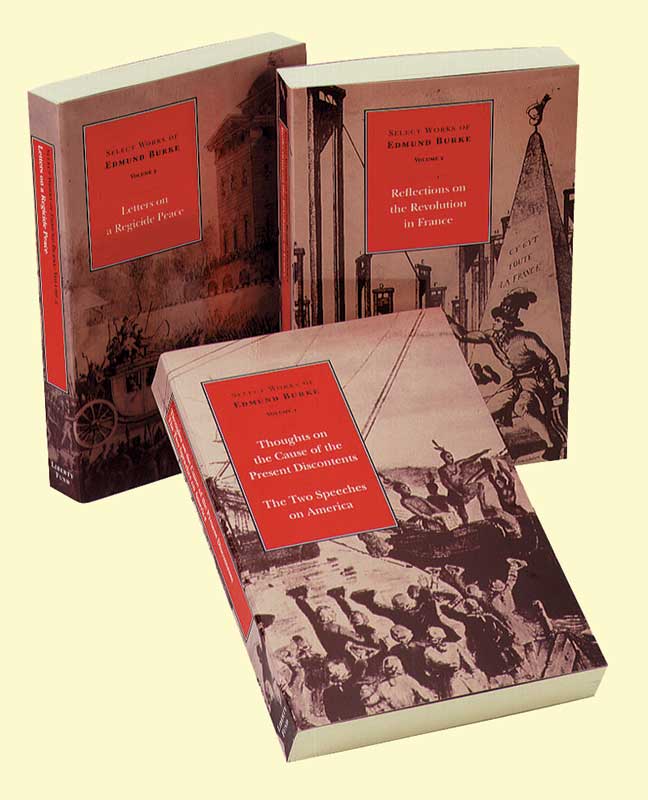
After the breach with Fox and the leadership of the Whig party in May 1791, Burke’s independence gave him more freedom to influence opinion, as he saw fit, among Tory ministers and disenchanted Whigs. Between 1791 and 1793 he wrote three works— Thoughts on French Affairs, Heads for Consideration on the Present State of Affairs (1792), and Remarks on the Policy of the Allies (1793)—“with one single principle to guide me,” he said in 1794, “namely that the extinction of Jacobinism in France was the sole worthy object of Arms and politicks of this time” (Corr. Copeland 7:517–518).
Since the work is a private communication intended for the small audience of Whig and Tory leaders he still hoped to sway, Burke’s style here is quite different from that of the other works in this volume: There are no classical allusions, far fewer appeals to the terrible sublimity of the Revolution, and no sustained portraits of historical personages such as one finds in each of the longer works. Still, Burke makes some of his most insightful comments on the psychology of those who make their living by talking about ideas—the “knowledge class” or “new class.”
Burke’s hopes for an international coalition of the monarchies against France had been forwarded by the Declaration of Pillnitz, signed in August 1791 by Frederick William II (1744–1797, ruled 1786–1797) of Prussia, and Marie Antoinette’s brother, Leopold II (1747–1792, ruled 1790–1792) of Austria. These two German powers had long been competitors in the areas of modern Belgium (the Austrian Netherlands, which Burke sometimes calls the Belgic provinces) and the Netherlands (which Burke sometimes calls Holland): The Austrian Netherlands had returned to the emperor’s control under Leopold’s predecessor and brother, Joseph II (1741–1790, ruled 1765–1790), while to the north, Holland’s Stadtholder, William V, Prince of Orange, had married Frederick William’s sister. To further complicate matters, Prussia and Russia found it difficult to cooperate on French affairs when their real desire was to carve up Poland between them. The German heads of state declared at Pillnitz that “they regard the present position of [Louis XVI] as a matter of common concern to all the sovereigns of Europe.” They made any military intervention contingent on the cooperation of the other European sovereigns. Under the circumstances, however, Britain was very unlikely to participate. The opening paragraphs of Thoughts allude to a letter from the French Foreign Minister, Armand-Marc, Comte de Montmorin de Saint-Hérem, telling French ambassadors to inform Europe’s heads of state of Louis XVI’s acceptance of the French constitution. The letter was dated April 1791, just two months before the King disavowed his compliance with the Revolution and attempted to flee the country.
Thoughts on French Affairs consists primarily of a survey of revolutionary sentiment in the various European countries, arguing that the absence of a credible, counter-revolutionary movement in France would force Britain and the other European monarchies to eliminate Jacobinism militarily.
Thoughts on French Affairs
December 1791
In all our transactions with France, and at all periods, we have treated with that State on the footing of a Monarchy. Monarchy was considered in all the external relations of that kingdom with every Power in Europe as it’s legal and constitutional Government, and that in which alone it’s federal capacity was vested.
Montmorin’s Letter.It is not yet a year since Monsieur de Montmorin, formally, and with as little respect as can be imagined, to the King, and to all crowned heads, announced a total revolution in that country. He has informed the British Ministry that it’s frame of Government is wholly altered; that he is one of the Ministers of the new system; and in effect, that the King is no longer his master (nor does he even call him such) but the “ first ofthe Ministers ” in the new system.
Acceptance of the Constitution ratified.The second notification was that of the King’s acceptance of the new Constitution; accompanied with fanfaronades in the modern style of the French bureaus, things which have much more the air and character of the saucy declamations of their clubs, than the tone of regular office.
It has not been very usual to notify to foreign Courts, any thing concerning the internal arrangements of any State. In the present case, the circumstance of these two notifications, with the observations with which they are attended, does not leave it in the choice of the Sovereigns of Christendom to appear ignorant either of this French Revolution, or (what is more important) of it’s principles.
We know that very soon after this Manifesto of Monsieur de Montmorin, the King of France, in whose name it was made, found himself obliged to fly, with his whole family; leaving behind him a Declaration, in which he disavows and annuls that Constitution, as having been the effect of force on his person and usurpation on his authority. It is equally notorious that this unfortunate Prince was, with many circumstances of insult and outrage, brought back prisoner, by a deputation of the pretended National Assembly, and afterwards suspended by their authority, from his Government. Under equally notorious constraint, and under menaces of total deposition, he has been compelled to accept what they call a Constitution, and to agree to whatever else the usurped power which holds him in confinement, thinks proper to impose.
His next brother, who had fled with him, and his third brother, who had fled before him, all the Princes of his blood, who remained faithful to him, and the flower of his Magistracy, his Clergy, and his Nobility, continue in foreign countries, protesting against all acts done by him in his present situation, on the grounds upon which he had himself protested against them at the time of his flight; with this addition, that they deny his very competence (as on good grounds they may), to abrogate the Royalty, or the ancient constitutional Orders of the Kingdom. In this protest they are joined by three hundred of the late Assembly itself, and in effect, by a great part of the French Nation. The new Government (so far as the people dare to disclose their sentiments) is disdained, I am persuaded, by the greater number; who as M. de la Fayette complains, and as the truth is, have declined to take any share in the new elections to the National Assembly, either as candidates or electors.
In this state of things (that is in the case of a divided kingdom) by the law of nations, Great Britain, like every other Power, is free to take any part she pleases. She may decline, with more or less formality, according to her discretion, to acknowledge this new system; or she may recognize it as a Government de facto, setting aside all discussion of it’s original legality, and considering the ancient Monarchy as at an end. The law of nations leaves our Court open to it’s choice. We have no direction but what is found in the well-understood policy of the King and kingdom.
This Declaration of a new species of Government, on new principles (such it professes itself to be) is a real crisis in the politicks of Europe. The conduct which prudence ought to dictate to Great-Britain, will not depend (as hitherto our connexion or quarrel with other States has for some time depended) upon merely external relations; but, in a great measure also upon the system which we may think it right to adopt for the internal government of our own country.
If it be our policy to assimilate our Government to that of France, we ought to prepare for this change, by encouraging the schemes of authority established there. We ought to wink at the captivity and deposition of a Prince, with whom, if not in close alliance, we were in friendship. We ought to fall in with the ideas of Mons. Montmorin’s circular Manifesto; and to do business of course with the functionaries who act under the new power, by which that King to whom his Majesty’s Minister has been sent to reside, has been deposed and imprisoned. On that idea we ought also to with-hold all sorts of direct or indirect countenance from those who are treating in Germany for the re-establishment of the French Monarchy and the ancient Orders of that State. This conduct is suitable to this policy.
The question is, whether this policy be suitable to the interests of the Crown and subjects of Great Britain. Let us therefore a little consider the true nature and probable effects of the Revolution which, in such a very unusual manner, has been twice diplomatically announced to his Majesty.
Difference between this Revolution and others.There have been many internal revolutions in the Government of countries, both as to persons and forms, in which the neighbouring States have had little or no concern. Whatever the Government might be with respect to those persons and those forms, the stationary interests of the nation concerned, have most commonly influenced the new Governments in the same manner in which they influenced the old; and the Revolution, turning on matter of local grievance or of local accommodation, did not extend beyond it’s territory.
Nature of the French Revolution.The present Revolution in France seems to me to be quite of another character and description; and to bear little resemblance or analogy to any of those which have been brought about in Europe, upon principles merely political. It is a Revolution of doctrine and theoretick dogma. It has a much greater resemblance to those changes which have been made upon religious grounds, in which a spirit of proselytism makes an essential part.
The last Revolution of doctrine and theory which has happened in Europe, is the Reformation. It is not for my purpose to take any notice here of the merits of that Revolution, but to state one only of it’s effects.
It’s effects.That effect was to introduce other interests into all countries, than those which arose from their locality and natural circumstances. The principle of the Reformation was such, as by it’s essence, could not be local or confined to the country in which it had it’s origin. For instance, the doctrine of “Justification by Faith or by Works,” which was the original basis of the Reformation, could not have one of it’s alternatives true as to Germany, and false as to every other country. Neither are questions of theoretick truth and falsehood governed by circumstances any more than by places. On that occasion, therefore, the spirit of proselytism expanded itself with great elasticity upon all sides; and great divisions were every where the result.
These divisions however, in appearance merely dogmatick, soon became mixed with the political; and their effects were rendered much more intense from this combination. Europe was for a long time divided into two great factions, under the name of Catholick and Protestant, which not only often alienated State from State, but also divided almost every State within itself. The warm parties in each State were more affectionately attached to those of their own doctrinal interest in some other country than to their fellow citizens, or to their natural Government, when they or either of them happened to be of a different persuasion. These factions, wherever they prevailed, if they did not absolutely destroy, at least weakened and distracted the locality of patriotism. The publick affections came to have other motives and other ties.
It would be to repeat the history of the two last centuries to exemplify the effects of this Revolution.
Although the principles to which it gave rise, did not operate with a perfect regularity and constancy, they never wholly ceased to operate. Few wars were made, and few treaties were entered into in which they did not come in for some part. They gave a colour, a character, and direction to all the politicks of Europe.
New system of Politicks.These principles of internal, as well as external division and coalition, are but just now extinguished. But they who will examine into the true character and genius of some late events, must be satisfied that other sources of faction, combining parties among the inhabitants of different countries into one connexion, are opened, and that from these sources are likely to arise effects full as important as those which had formerly arisen from the jarring interests of the religious sects. The intention of the several actors in the change in France, is not a matter of doubt. It is very openly professed.
In the modern world, before this time, there has been no instance of this spirit of general political faction, separated from religion, pervading several countries, and forming a principle of union between the partizans in each. But the thing is not less in human nature. The antient world has furnished a strong and striking instance of such a ground for faction, full as powerful and full as mischievous as our spirit of religious system had ever been, exciting in all the States of Greece (European and Asiatick) the most violent animosities, and the most cruel and bloody persecutions and proscriptions. These ancient factions in each commonwealth of Greece, connected themselves with those of the same description in some other States; and secret cabals and publick alliances were carried on and made, not upon a conformity of general political interests, but for the support and aggrandizement of the two leading States which headed the Aristocratick and Democratick Factions. For, as in later times, the King of Spain was at the head of a Catholick, and the King of Sweden of a Protestant interest, France (though Catholick, acting subordinately to the latter), in the like manner the Lacedemonians were every where at the head of the Aristocratick interests, and the Athenians of the Democratick. The two leading Powers kept alive a constant cabal and conspiracy in every State, and the political dogmas concerning the constitution of a Republick, were the great instruments by which these leading States chose to aggrandize themselves. Their choice was not unwise; because the interest in opinions (merely as opinions, and without any experimental reference to their effects) when once they take strong hold of the mind, become the most operative of all interests and indeed very often supercede every other.
I might further exemplify the possibility of a political sentiment running through various states and combining factions in them, from the history of the middle ages in the Guelfs and Ghibellines. These were political factions originally in favour of the Emperor and the Pope, with no mixture of religious dogmas; or if any thing religiously doctrinal they had in them originally, it very soon disappeared; as their first political objects disappeared also, though the spirit remained. They became no more than names to distinguish factions; but they were not the less powerful in their operation, when they had no direct point of doctrine, either religious or civil, to assert. For a long time, however, those factions gave no small degree of influence to the foreign Chiefs in every commonwealth in which they existed. I do not mean to pursue further the track of these parties. I allude to this part of history only, as it furnishes an instance of that species of faction which broke the locality of publick affections, and united descriptions of citizens more with strangers than with their countrymen of different opinions.
French fundamental principle.The political dogma, which upon the new French system, is to unite the factions of different nations, is this, “That the majority told, by the head, of the taxable people in every country, is the perpetual, natural, unceasing, indefeasible sovereign; that this majority is perfectly master of the form, as well as the administration of the state, and that the magistrates, under whatever names they are called, are only functionaries to obey the orders (general as laws or particular as decrees), which that majority may make; that this is the only natural government; that all others are tyranny and usurpation.”
Practical project.In order to reduce this dogma into practice, the Republicans in France, and their associates in other countries, make it always their business, and often their publick profession, to destroy all traces of antient establishments, and to form a new commonwealth in each country, upon the basis of the French Rights of Men. On the principle of these rights, they mean to institute in every country, and as it were, the germe of the whole, parochial governments, for the purpose of what they call equal representation. From them is to grow, by some media, a general council and representative of all the parochial governments. In that representative is to be vested the whole national power; totally abolishing hereditary name and office, levelling all conditions of men (except where money must make a difference), breaking all connexion between territory and dignity, and abolishing every species of nobility, gentry, and church establishments; all their priests, and all their magistrates being only creatures of election, and pensioners at will.
Knowing how opposite a permanent landed interest is to that scheme, they have resolved, and it is the great drift of all their regulations, to reduce that description of men to a mere peasantry, for the sustenance of the towns, and to place the true effective government in cities, among the tradesmen, bankers, and voluntary clubs of bold, presuming young persons; advocates, attornies, notaries, managers of newspapers, and those cabals of literary men, called academies. Their Republick is to have a first functionary (as they call him), under the name of King, or not, as they think fit. This officer, when such an officer is permitted, is however, neither in fact nor name, to be considered as sovereign, nor the people as his subjects. The very use of these appellations is offensive to their ears.
Partizans of the French system.This system, as it has first been realized, dogmatically as well as practically, in France, makes France the natural head of all factions formed on a similar principle, wherever they may prevail, as much as Athens was the head and settled ally of all democratick factions, wherever they existed. The other system has no head.
This system has very many partizans in every country in Europe, but particularly in England, where they are already formed into a body, comprehending most of the dissenters of the three leading denominations; to these are readily aggregated all who are dissenters in character, temper, and disposition, though not belonging to any of their congregations—that is, all the restless people who resemble them, of all ranks and all parties—Whigs, and even Tories—the whole race of half-bred speculators; all the Atheists, Deists, and Socinians; all those who hate the Clergy, and envy the Nobility, a good many among the monied people; the East Indians almost to a man, who cannot bear to find that their present importance does not bear a proportion to their wealth. These latter have united themselves into one great, and in my opinion, formidable Club, which, though now quiet, may be brought into action with considerable unanimity and force.
Formerly few, except the ambitious great, or the desperate and indigent, were to be feared as instruments in revolutions. What has happened in France teaches us, with many other things, that there are more causes than have commonly been taken into our consideration, by which Government may be subverted. The monied men, merchants, principal tradesmen, and men of letters (hitherto generally thought the peaceable and even timid part of society) are the chief actors in the French Revolution. But the fact is, that as money increases and circulates, and as the circulation of news, in politicks and letters, becomes more and more diffused, the persons who diffuse this money, and this intelligence, become more and more important. This was not long undiscovered. Views of ambition were in France, for the first time, presented to these classes of men. Objects in the State, in the Army, in the system of civil offices of every kind. Their eyes were dazzled with this new prospect. They were, as it were, electrified and made to lose the natural spirit of their situation. A bribe, great without example in the history of the world, was held out to them—the whole government of a very large kingdom.
Grounds of security supposed for England.There are several who are persuaded that the same thing cannot happen in England, because here (they say), the occupations of merchants, tradesmen, and manufacturers, are not held as degrading situations. I once thought that the low estimation in which commerce was held in France, might be reckoned among the causes of the late revolution; and I am still of opinion, that the exclusive spirit of the French nobility, did irritate the wealthy of other classes. But I found long since, that persons in trade and business were by no means despised in France in the manner I had been taught to believe. As to men of letters, they were so far from being despised or neglected, that there was no country perhaps in the universe, in which they were so highly esteemed, courted, caressed, and even feared; tradesmen naturally were not so much sought in society (as not furnishing so largely to the fund of conversation as they do to the revenues of the state) but the latter description got forward every day.Literary interest.M. Bailly, who made himself the popular Mayor on the rebellion of the Bastile, and is a principal actor in the revolt, before the change possessed a pension or office under the Crown, of six hundred pound English, a year, for that country, no contemptible provision: And this he obtained solely as a man of letters, and on no other title.Monied interest.As to the monied men—whilst the Monarchy continued, there is no doubt, that merely as such, they did not enjoy the privileges of nobility, but nobility was of so easy an acquisition, that it was the fault or neglect of all of that description, who did not obtain it’s privileges, for their lives at least, in virtue of office. It attached under the royal government to an innumerable multitude of places, real and nominal, that were vendible; and such nobility were as capable of every thing as their degree of influence or interest could make them, that is, as nobility of no considerable rank or consequence. M. Necker, so far from being a French gentleman, was not so much as a Frenchman born, and yet we all know the rank in which he stood on the day of the meeting of the States.
Mercantile interest.As to the mere matter of estimation of the mercantile or any other class, this is regulated by opinion and prejudice. In England a security against the envy of men in these classes, is not so very complete as we may imagine. We must not impose upon ourselves. What institutions and manners together had done in France, manners alone do here. It is the natural operation of things where there exists a Crown, a Court, splendid Orders of Knighthood, and an Hereditary Nobility; where there exists a fixed, permanent, landed Gentry, continued in greatness and opulence by the law of primogeniture, and by a protection given to family settlements; where there exists a standing Army and Navy; where there exists a Church Establishment, which bestows on learning and parts an interest combined with that of Religion and the State; in a country where such things exist, wealth, new in it’s acquisition, and precarious in it’s duration, can never rank first, or even near the first; though wealth has it’s natural weight, further, than as it is balanced and even preponderated amongst us as amongst other nations, by artificial institutions and opinions growing out of them. At no period in the history of England have so few Peers been taken out of trade or from families newly created by commerce. In no period has so small a number of noble families entered into the counting-house. I can call to mind but one in all England, and his is of near fifty years standing. Be that as it may, it appears plain to me from my best observation, that envy and ambition may by art, management and disposition, be as much excited amongst these descriptions of men in England, as in any other country; and that they are just as capable of acting a part in any great change.
Progress of the French Spirit. It’s course.What direction the French spirit of proselytism is likely to take, and in what order it is likely to prevail in the several parts of Europe, it is not easy to determine. The seeds are sown almost every where, chiefly by newspaper circulations, infinitely more efficacious and extensive than ever they were. And they are a more important instrument than generally is imagined. They are a part of the reading of all, they are the whole of the reading of the far greater number. There are thirty of them in Paris alone. The language diffuses them more widely than the English, though the English too are much read. The writers of these papers indeed, for the greater part, are either unknown or in contempt, but they are like a battery in which the stroke of any one ball produces no great effect, but the amount of continual repetition is decisive. Let us only suffer any person to tell us his story, morning and evening, but for one twelvemonth, and he will become our master.
All those countries in which several States are comprehended under some general geographical description, and loosely united by some federal constitution; countries of which the members are small, and greatly diversified in their forms of government, and in the titles by which they are held—these countries, as it might be well expected, are the principal objects of their hopes and machinations. Of these, the chief are Germany and Switzerland: after them, Italy has it’s place as in circumstances somewhat similar.
Germany.As to Germany (in which from their relation to the Emperor, I comprehend the Belgick provinces) it appears to me to be from several circumstances, internal and external, in a very critical situation, and the laws and liberties of the Empire are by no means secure from the contagion of the French doctrines and the effect of French intrigues; or from the use which two of the greater German powers may make of a general derangement, to the general detriment. I do not say that the French do not mean to bestow on these Germany States, liberties and laws too, after their mode; but those are not what have hitherto been understood as the laws and liberties of the Empire. These exist and have always existed under the principles of feodal tenure and succession, under Imperial constitutions, grants and concessions of Sovereigns, family compacts and publick treaties, made under the sanction, and some of them guaranteed by the Sovereign Powers of other nations, and particularly the old Government of France, the author and natural support of the treaty of Westphalia.
In short, the Germanick body is a vast mass of heterogeneous States, held together by that heterogeneous body of old principles which formed the publick law positive and doctrinal. The modern laws and liberties which the new power in France proposes to introduce into Germany, and to support with all it’s force, of intrigue and of arms, is of a very different nature, utterly irreconcileable with the first, and indeed fundamentally the reverse of it: I mean the Rights and Liberties of the Man, the Droit de l’Homme. That this doctrine has made an amazing progress in Germany, there cannot be a shadow of doubt. They are infected by it along the whole course of the Rhine, the Maese, the Moselle, and in the greater part of Suabia and Franconia.Ecclesiastical State.It is particularly prevalent amongst all the lower people, churchmen and laity, in the dominions of the Ecclesiastical Electors. It is not easy to find or to conceive Governments more mild and indulgent than these Church Sovereignties; but good government is as nothing when the Rights of Man take possession of the mind. Indeed the loose rein held over the people in these provinces, must be considered as one cause of the facility with which they lend themselves to any schemes of innovation, by inducing them to think lightly of their governments, and to judge of grievances not by feeling, but by imagination.
Balance of Germany.It is in these Electorates that the first impressions of France are likely to be made, and if they succeed, it is over with the Germanick body as it stands at present. A great revolution is preparing in Germany; and a revolution, in my opinion, likely to be more decisive upon the general fate of nations than that of France itself; other than as in France is to be found the first source of all the principles which are in any way likely to distinguish the troubles and convulsions of our age. If Europe does not conceive the independence, and the equilibrium of the Empire to be in the very essence of the system of balanced power in Europe, and if the scheme of publick law, or mass of laws upon which that independence and equilibrium are founded, be of no leading consequence as they are preserved or destroyed, all the politicks of Europe for more than two Centuries have been miserably erroneous.
Prussia and Emperor.If the two great leading Powers of Germany do not regard this danger (as apparently they do not) in the light in which it presents itself so naturally, it is because they are powers too great to have a social interest. That sort of interest belongs only to those, whose state of weakness or mediocrity is such, as to give them greater cause of apprehension from what may destroy them, than of hope from any thing by which they may be aggrandized.
As long as those two Princes are at variance, so long the liberties of Germany are safe. But if ever they should so far understand one another as to be persuaded that they have a more direct and more certainly defined interest in a proportioned mutual aggrandizement than in a reciprocal reduction, that is, if they come to think that they are more likely to be enriched by a division of spoil, than to be rendered secure by keeping to the old policy of preventing others from being spoiled by either of them, from that moment the liberties of Germany are no more.
That a junction of two in such a scheme is neither impossible nor improbable, is evident from the partition of Poland in 1773, which was effected by such a junction as made the interposition of other nations to prevent it, not easy. Their circumstances at that time hindered any other three States, or indeed any two, from taking measures in common to prevent it, though France was at that time an existing power, and had not yet learned to act upon a system of politicks of her own invention. The geographical position of Poland was a great obstacle to any movements of France in opposition to this, at that time unparalleled league. To my certain knowledge, if Great Britain had at that time been willing to concur in preventing the execution of a project so dangerous in the example, even exhausted as France then was by the preceding war, and under a lazy and unenterprizing Prince, she would have at every risque taken an active part in this business. But a languor with regard to so remote an interest, and the principles and passions which were then strongly at work at home, were the causes why Great Britain would not give France any encouragement in such an enterprize. At that time, however, and with regard to that object, in my opinion, Great Britain and France had a common interest.
But the position of Germany is not like that of Poland, with regard to France, either for good or for evil.Possible project of the Emperor and K. of Prussia.If a conjunction between Prussia and the Emperor should be formed for the purpose of secularising and rendering hereditary the Ecclesiastical Electorates and the Bishoprick of Munster, for settling two of them on the children of the Emperor, and uniting Cologne and Munster to the dominions of the King of Prussia on the Rhine, or if any other project of mutual aggrandizement should be in prospect, and that to facilitate such a scheme, the modern French should be permitted and encouraged to shake the internal and external security of these Ecclesiastical Electorates, Great Britain is so situated that she could not with any effect set herself in opposition to such a design. Her principal arm, her marine, could here be of no sort of use.
To be resisted only by France.France, the author of the treaty of Westphalia, is the natural guardian of the independence and balance of Germany. Great Britain (to say nothing of the King’s concern as one of that august body) has a serious interest in preserving it; but, except through the power of France, acting upon the common old principles of State policy, in the case we have supposed, she has no sort of means of supporting that interest. It is always the interest of Great Britain that the power of France should be kept within the bounds of moderation. It is not her interest that that power should be wholly annihilated in the system of Europe. Though at one time through France the independence of Europe was endangered, it is and ever was through her alone that the common liberty of Germany can be secured against the single or the combined ambition of any other power. In truth, within this century the aggrandizement of other Sovereign Houses has been such that there has been a great change in the whole state of Europe, and other nations as well as France may become objects of jealousy and apprehension.
New principles of alliance.In this state of things, a new principle of alliances and wars is opened. The treaty of Westphalia is, with France, an antiquated fable. The rights and liberties she was bound to maintain are now a system of wrong and tyranny which she is bound to destroy. Her good and ill dispositions are shewn by the same means. To communicate peaceably the rights of men is the true mode of her shewing her friendship; to force Sovereigns to submit to those rights is her mode of hostility. So that either as friend or foe her whole scheme has been and is, to throw the Empire into confusion: and those Statesmen, who follow the old routine of politicks, may see in this general confusion, and in the danger of the lesser Princes, an occasion as protectors or enemies, of connecting their territories to one or the other of the two great German Powers. They do not take into consideration that the means which they encourage, as leading to the event they desire, will with certainty not only ravage and destroy the Empire, but if they should for a moment seem to aggrandize the two great houses, will also establish principles, and confirm tempers amongst the people, which will preclude the two Sovereigns from the possibility of holding what they acquire, or even the dominions which they have inherited. It is on the side of the Ecclesiastical Electorates that the dykes, raised to support the German liberty, first will give way.
The French have begun their general operations by seizing upon those territories of the Pope, the situation of which was the most inviting to the enterprize. Their method of doing it was by exciting sedition and spreading massacre and desolation thro’ these unfortunate places, and then under an idea of kindness and protection, bringing forward an antiquated title of the Crown of France and annexing Avignon and the two cities of the Comtat with their territory to the French Republick.Geneva.They have made an attempt on Geneva, in which they very narrowly failed of success.Savoy.It is known that they hold out from time to time the idea of uniting all the other provinces of which Gaul was antiently composed, including Savoy on the other side, and on this side bounding themselves by the Rhine.
Switzerland.As to Switzerland, it is a country whose long union rather than it’s possible division, is the matter of wonder. Here I know they entertain very sanguine hopes. The aggregation to France of the Democratick Swiss Republicks appears to them to be a work half done by their very form; and it might seem to them rather an encrease of importance to these little Commonwealths, than a derogation from their independency, or a change in the manner of their Government. Upon any quarrel amongst the Cantons nothing is more likely than such an event. As to the Aristocratick Republicks, the general clamour and hatred which the French excite against the very name (and with more facility and success than against Monarchs), and the utter impossibility of their Government making any sort of resistance against an insurrection, where they have no troops, and the people are all armed and trained, render their hopes in that quarter, far indeed from unfounded. It is certain that the Republick of Berne thinks itself obliged to a vigilance next to hostile, and to imprison or expel all the French whom they find in their territories. But indeed those Aristocracies which comprehend whatever is considerable, wealthy, and valuable in Switzerland, do now so wholly depend upon opinion, and the humour of their multitude, that the lightest puff of wind is sufficient to blow them down.Old French maxims the security of its independence.If France, under it’s antient regimen, and upon the antient principles of policy, was the support of the Germanick Constitution, it was much more so of that of Switzerland, which almost from the very origin of that confederacy rested upon the closeness of it’s connexion with France, on which the Swiss Cantons wholly reposed themselves for the preservation of the parts of their body in their respective rights and permanent forms, as well as for the maintenance of all in their general independency.
Switzerland and Germany are the first objects of the new French politicians. When I contemplate what they have done at home, which is in effect little less than an amazing conquest wrought by a change of opinion, in a great part (to be sure far from altogether) very sudden, I cannot help letting my thoughts run along with their designs, and without attending to geographical order, to consider the other States of Europe so far as they may be any way affected by this astonishing Revolution. If early steps are not taken in some way or other to prevent the spreading of this influence, I scarcely think any of them perfectly secure.
Italy.Italy is divided, as Germany and Switzerland are, into many smaller States, and with some considerable diversity as to forms of Government; but as these divisions and varieties in Italy are not so considerable, so neither do I think the danger altogether so imminent there as in Germany and Switzerland. Savoy I know that the French consider as in a very hopeful way, and I believe not at all without reason. They view it as an old member of the Kingdom of France which may be easily re-united in the manner, and on the principles of the reunion of Avignon.Lombardy.This country communicates with Piedmont; and as the King of Sardinia’s dominions were long the key of Italy, and as such long regarded by France, whilst France acted on her old maxims, and with views on Italy; so in this new French empire of sedition, if once she gets that key into her hands, she can easily lay open the barrier which hinders the entrance of her present politicks into that inviting region. Milan, I am sure, nourishes great disquiets—and if Milan should stir, no part of Lombardy is secure to the present possessors—whether the Venetian or the Austrian. Genoa is closely connected with France.
Bourbon Princes in Italy.The first Prince of the House of Bourbon has been obliged to give himself up entirely to the new system, and to pretend even to propagate it with all zeal; at least that Club of intriguers who assemble at the Feuillans, and whose cabinet meets at Madame Stahl’s, and makes and directs all the Ministers, is the real Executive Government of France. The Emperor is perfectly in concert, and they will not long suffer any Prince of the House of Bourbon, to keep by force the French emissaries out of their dominions; nor whilst France has a commerce with them, especially thro’ Marseilles (the hottest focus of sedition in France), will it be long possible to prevent the intercourse or the effects.
Naples has an old inveterate disposition to Republicanism, and (however for some time past quiet) is as liable to explosion as it’s own Vesuvius. Sicily I think has these dispositions in full as strong a degree. In neither of these countries exists any thing which very well deserves the name of Government or exact police.
Ecclesiastical state.In the Estates of the Church, notwithstanding their strictness in banishing the French out of that country, there are not wanting the seeds of a revolution. The spirit of Nepotism prevails there nearly as strong as ever. Every Pope of course is to give origin or restoration to a great family, by the means of large donations. The foreign revenues have long been gradually on the decline, and seem now in a manner dried up. To supply this defect the resource of vexatious and impolitick jobbing at home, if any thing, is rather encreased than lessened. Various, well intended but ill understood practices, some of them existing, in their spirit at least, from the time of the old Roman empire, still prevail; and that Government is as blindly attached to old abusive customs, as others are wildly disposed to all sorts of innovations and experiments. These abuses were less felt whilst the Pontificate drew riches from abroad, which in some measure counterbalanced the evils of their remiss and jobbish Government at home. But now it can subsist only on the resources of domestick management; and abuses in that management of course will be more intimately and more severely felt.
In the midst of the apparently torpid languor of the Ecclesiastical State, those who have had opportunity of a near observation, have seen a little rippling in that smooth water, which indicates something alive under it. There is in the Ecclesiastical State, a personage who seems capable of acting (but with more force and steadiness) the part of the Tribune Rienzi. The people once inflamed will not be destitute of a leader. They have such an one already in the Cardinal or Archbishop Buon Campagna. He is, of all men, if I am not ill informed, the most turbulent, seditious, intriguing, bold, and desperate. He is not at all made for a Roman of the present day. I think he lately held the first office of their State, that of Great Chamberlain, which is equivalent to High Treasurer. At present he is out of employment, and in disgrace. If he should be elected Pope, or even come to have any weight with a new Pope, he will infallibly conjure up a democratick spirit in that country. He may indeed be able to effect it without these advantages. The next interregnum will probably shew more of him. There may be others of the same character, who have not come to my knowledge. This much is certain, that the Roman people, if once the blind reverence they bear to the sanctity of the Pope, which is their only bridle, should relax, are naturally turbulent, ferocious, and headlong, whilst the police is defective, and the Government feeble and resourceless beyond all imagination.
Spain.As to Spain, it is a nerveless country. It does not possess the use, it only suffers the abuse of a nobility. For some time, and even before the settlement of the Bourbon Dynasty, that body has been systematically lowered, and rendered incapable by exclusion, and for incapacity excluded from affairs. In this circle the body is in a manner annihilated—and so little means have they of any weighty exertion either to controul or to support the crown, that if they at all interfere, it is only by abetting desperate and mobbish insurrections like that at Madrid which drove Squillace from his place. Florida Blanca is a creature of office, and has little connexion, and no sympathy with that body.
As to the Clergy, they are the only thing in Spain that looks like an independent order, and they are kept in some respect by the Inquisition, the sole but unhappy resource of publick tranquillity and order now remaining in Spain. As in Venice, it is become mostly an engine of State, which indeed to a degree it has always been in Spain. It wars no longer with Jews and Hereticks: It has no such war to carry on. It’s great object is to keep atheistick and republican doctrines from making their way in that kingdom. No French book upon any subject can enter there which does not contain such matter. In Spain, the clergy are of moment from their influence, but at the same time with the envy and jealousy that attend great riches and power. Though the Crown has by management with the Pope got a very great share of the ecclesiastical revenues into it’s own hands, much still remains to them. There will always be about that Court those who look out to a farther division of the Church property as a resource, and to be obtained by shorter methods than those of negotiations with the Clergy and their Chief. But at present I think it likely that they will stop, lest the business should be taken out of their hands; and lest that body in which remains the only life that exists in Spain, and is not a fever, may with their property lose all the influence necessary to preserve the Monarchy, or being poor and desperate, may employ whatever influence remains to them as active agents in it’s destruction.
Castile different from Catalonia & Arragon.The Castilians have still remaining a good deal of their old character, their Gravidad, Lealdad, and il Timor de Dios; but that character neither is, or ever was exactly true, except of the Castilians only. The several kingdoms which compose Spain, have perhaps some features which run through the whole; but they are in many particulars as different as nations who go by different names; the Catalans, for instance, and the Arragonians too, in a good measure have the spirit of the Miquelets, and much more of republicanism than of an attachment to royalty. They are more in the way of trade and intercourse with France; and upon the least internal movement, will disclose and probably let loose a spirit that may throw the whole Spanish Monarchy into convulsions.
It is a melancholy reflection that the spirit of melioration which has been going on in that part of Europe, more or less during this century, and the various schemes very lately on foot for further advancement are all put a stop to at once. Reformation certainly is nearly connected with innovation—and where that latter comes in for too large a share, those who undertake to improve their country may risque their own safety. In times where the correction, which includes the confession of an abuse, is turned to criminate the authority which has long suffered it, rather than to honour those who would amend it (which is the spirit of this malignant French distemper) every step out of the common course becomes critical, and renders it a task full of peril for Princes of moderate talents to engage in great undertakings. At present the only safety of Spain is the old national hatred to the French. How far that can be depended upon, if any great ferments should be excited, it is impossible to say.
As to Portugal, she is out of the high road of these politicks—I shall, therefore, not divert my thoughts that way; but return again to the North of Europe, which at present seems the part most interested, and there it appears to me that the French speculation on the northern countries, may be valued in the following, or some such manner.
Denmark.Denmark and Norway do not appear to furnish any of the materials of a democratick revolution, or the dispositions to it. Denmark can only be consequentially affected by any thing done in France; but of Sweden I think quite otherwise.Sweden.The present power in Sweden is too new a system, and too green and too sore from it’s late Revolution, to be considered as perfectly assured. The King by his astonishing activity, his boldness, his decision, his ready versatility, and by rouzing and employing the old military spirit of Sweden, keeps up the top with continual agitation and lashing. The moment it ceases to spin, the Royalty is a dead bit of box. Whenever Sweden is quiet externally for some time, there is great danger that all the republican elements she contains will be animated by the new French spirit, and of this I believe the King is very sensible.
Russia.The Russian Government is of all others the most liable to be subverted by military seditions, by Court conspiracies, and sometimes by headlong rebellions of the people, such as the turbinating movement of Pugatchef. It is not quite so probable that in any of these changes the spirit of system may mingle in the manner it has done in France. The Muscovites are no great speculators—But I should not much rely on their uninquisitive disposition, if any of their ordinary motives to sedition should arise. The little catechism of the Rights of Men is soon learned; and the inferences are in the passions.
Poland.Poland, from one cause or another, is always unquiet. The new Constitution only serves to supply that restless people with new means, at least new modes, of cherishing their turbulent disposition. The bottom of the character is the same.Saxony.It is a great question, whether the joining that Crown with the Electorate of Saxony, will contribute most to strengthen the Royal authority of Poland, or to shake the Ducal in Saxony. The Elector is a Catholick; the people of Saxony are, six sevenths at the very least, Protestants. He must continue a Catholick according to the Polish law, if he accepts that Crown. The pride of the Saxons, formerly flattered by having a Crown in the House of their Prince, though an honour which cost them dear; the German probity, fidelity and loyalty; the weight of the Constitution of the Empire under the Treaty of Westphalia; the good temper and good nature of the Princes of the House of Saxony; had formerly removed from the people all apprehension with regard to their religion, and kept them perfectly quiet, obedient, and even affectionate. The seven years war made some change in the minds of the Saxons. They did not, I believe, regret the loss of what might be considered almost as the succession to the Crown of Poland, the possession of which, by annexing them to a foreign interest, had often obliged them to act an arduous part, towards the support of which that foreign interest afforded no proportionable strength. In this very delicate situation of their political interests, the speculations of the French and German Oeconomists, and the cabals, and the secret, as well as public doctrines of the Illuminatenordens and Free Masons, have made a considerable progress in that country; and a turbulent spirit under colour of religion, but in reality arising from the French Rights of Man, has already shewn itself, and is ready on every occasion to blaze out.
The present Elector is a Prince of a safe and quiet temper, of great prudence, and goodness. He knows that in the actual state of things, not the power and respect belonging to Sovereigns, but their very existence depends on a reasonable frugality. It is very certain that not one Sovereign in Europe can either promise for the continuance of his authority in a state of indigence and insolvency, or dares to venture on a new imposition to relieve himself. Without abandoning wholly the ancient magnificence of his Court, the Elector has conducted his affairs with infinitely more oeconomy than any of his predecessors, so as to restore his finances beyond what was thought possible from the state in which the seven years war had left Saxony. Saxony during the whole of that dreadful period having been in the hands of an exasperated enemy, rigorous by resentment, by nature and by necessity, was obliged to bear in a manner the whole burthen of the war; in the intervals when their allies prevailed, the inhabitants of that country were not better treated.
The moderation and prudence of the present Elector, in my opinion, rather perhaps respites the troubles than secures the peace of the Electorate. The offer of the succession to the Crown of Poland is truly critical, whether he accepts, or whether he declines it. If the States will consent to his acceptance, it will add to the difficulties, already great, of his situation between the King of Prussia and the Emperor. But these thoughts lead me too far, when I mean to speak only of the interior condition of these Princes. It has always however some necessary connexion with their foreign politicks.
Holland.With regard to Holland and the ruling party there, I do not think it at all tainted, or likely to be so except by fear; or that it is likely to be misled unless indirectly and circuitously. But the predominant party in Holland is not Holland. The suppressed faction, though suppressed, exists. Under the ashes, the embers of the late commotion are still warm. This Anti-Orange party has from the day of it’s origin been French, though alienated in some degree for some time, through the pride and folly of Louis the Fourteenth. It will ever hanker after a French connexion; and now that the internal Government in France has been assimilated in so considerable a degree to that which the immoderate Republicans began so very lately to introduce into Holland, their connexion, as still more natural, will be more desired. I do not well understand the present exterior politicks of the Stadtholder, nor the Treaty into which the newspapers say he has entered for the States with the Emperor. But the Emperor’s own politicks with regard to the Netherlands seem to me to be exactly calculated to answer the purpose of the French Revolutionists. He endeavours to crush the Aristocratick party—and to nourish one in avowed connexion with the most furious Democratists in France.
These Provinces in which the French game is so well played, they consider as part of the Old French Empire: certainly they were amongst the oldest parts of it. These they think very well situated, as their party is well-disposed to a re-union. As to the greater nations, they do not aim at making a direct conquest of them, but by disturbing them through a propagation of their principles, they hope to weaken, as they will weaken them, and to keep them in perpetual alarm and agitation, and thus render all their efforts against them utterly impracticable, whilst they extend the dominion of their sovereign anarchy on all sides.
England.As to England, there may be some apprehension from vicinity, from constant communication, and from the very name of Liberty, which, as it ought to be very dear to us, in it’s worst abuses carries something seductive. It is the abuse of the first and best of the objects which we cherish. I know that many who sufficiently dislike the system of France, have yet no apprehensions of it’s prevalence here. I say nothing to the ground of this security in the attachment of the people to their Constitution, and their satisfaction in the discreet portion of liberty which it measures out to them. Upon this I have said all I have to say, in the Appeal I have published. That security is something, and not inconsiderable. But if a storm arises I should not much rely upon it.
There are other views of things which may be used to give us a perfect (though in my opinion a delusive) assurance of our own security.Objection to the stability of the French system.The first of these is from the weakness and ricketty nature of the new system in the place of it’s first formation. It is thought that the monster of a Commonwealth cannot possibly live—that at any rate the ill contrivance of their fabrick will make it fall in pieces of itself—that the Assembly must be bankrupt, and that this bankruptcy will totally destroy that system, from the contagion of which apprehensions are entertained.
For my part I have long thought that one great cause of the stability of this wretched scheme of things in France was an opinion that it could not stand; and, therefore, that all external measures to destroy it were wholly useless.
Bankruptcy.As to the bankruptcy, that event has happened long ago, as much as it is ever likely to happen. So soon as a nation compels a creditor to take paper currency in discharge of his debt, there is a bankruptcy. The compulsory paper has in some degree answered; not because there was a surplus from Church lands, but because faith has not been kept with the Clergy. As to the holders of the old funds, to them the payments will be dilatory, but they will be made, and whatever may be the discount on paper, whilst paper is taken, paper will be issued.
Resources.As to the rest, they have shot out three branches of revenue to supply all those which they have destroyed, that is, theUniversal Register of all Transactions, the heavy and universal Stamp Duty, and the new Territorial Impost, levied chiefly on the reduced estates of the gentlemen. These branches of the revenue, especially as they take assignats in payment, answer their purpose in a considerable degree, and keep up the credit of their paper; for as they receive it in their treasury, it is in reality funded upon all their taxes and future resources of all kinds, as well as upon the church estates. As this paper is become in a manner the only visible maintenance of the whole people, the dread of a bankruptcy is more apparently connected with the delay of a counter-revolution, than with the duration of this Republick; because the interest of the new Republick manifestly leans upon it; and in my opinion, the counter-revolution cannot exist along with it. The above three projects ruined some Ministers under the old Government, merely for having conceived them. They are the salvation of the present Rulers.
As the Assembly has laid a most unsparing and cruel hand on all men who have lived by the bounty, the justice, or the abuses of the old Government, they have lessened many expences. The royal establishment, though excessively and ridiculously great for their scheme of things, is reduced at least one half; the estates of the King’s Brothers, which under the ancient Government had been in truth royal revenues, go to the general stock of the confiscation; and as to the crown lands, though under the Monarchy they never yielded two hundred and fifty thousand a year, by many they are thought at least worth three times as much.
As to the ecclesiastical charge, whether as a compensation for losses, or a provision for religion, of which they made at first a great parade, and entered into a solemn engagement in favour of it, it was estimated at a much larger sum than they could expect from the church property, moveable or immoveable: they are completely bankrupt as to that article. It is just what they wish; and it is not productive of any serious inconvenience. The non-payment produces discontent and occasional sedition; but is only by fits and spasms, and amongst the country people who are of no consequence. These seditions furnish new pretexts for non-payment to the church establishment, and help the Assembly wholly to get rid of the Clergy, and indeed of any form of religion, which is not only their real, but avowed object.
They are embarrassed indeed in the highest degree, but not wholly resourceless. They are without the species of money.Want of Money how supplied.Circulation of money is a great convenience, but a substitute for it may be found. Whilst the great objects of production and consumption, corn, cattle, wine, and the like, exist in a country, the means of giving them circulation with more or less convenience, cannot be wholly wanting. The great confiscation of the church and of the crown lands, and of the appenages of the princes, for the purchase of all which their paper is always received at par, gives means of continually destroying and continually creating, and this perpetual destruction and renovation feeds the speculative market, and prevents, and will prevent, till that fund of confiscation begins to fail, a total depreciation.
Monied Interest not necessary to them.But all consideration of public credit in France is of little avail at present. The action indeed of the monied interest was of absolute necessity at the beginning of this Revolution; but the French Republicks can stand without any assistance from that description of men, which, as things are now circumstanced, rather stands in need of assistance itself from the power which alone substantially exists in France; I mean the several districts and municipal republicks, and the several clubs which direct all their affairs and appoint their magistrates. This is the power now paramount to every thing, even to the Assembly itself called National, and that to which tribunals, priesthood, laws, finances, and both descriptions of military power, are wholly subservient, so far as the military power of either description yields obedience to any name of authority.
The world of contingency and political combination is much larger than we are apt to imagine. We never can say what may, or may not happen, without a view to all the actual circumstances. Experience upon other data than those, is of all things the most delusive. Prudence in new cases can do nothing on grounds of retrospect. A constant vigilance and attention to the train of things as they successively emerge, and to act on what they direct, are the only sure courses. The physician that let blood, and by blood-letting cured one kind of plague, in the next added to it’s ravages. That power goes with property is not universally true, and the idea that the operation of it is certain and invariable, may mislead us very fatally.
Power separated from Property.Whoever will take an accurate view of the state of those Republicks, and of the composition of the present Assembly deputed by them (in which Assembly there are not quite fifty persons possessed of an income amounting to 100l. sterling yearly) must discern clearly, that the political and civil power of France is wholly separated from it’s property of every description; and of course that neither the landed nor the monied interest possesses the smallest weight or consideration in the direction of any publick concern. The whole kingdom is directed by the refuse of it’s chicane, with the aid of the bustling, presumptuous young clerks of counting-houses and shops, and some intermixture of young gentlemen of the same character in the several towns. The rich peasants are bribed with church lands; and the poorer of that description are, and can be, counted for nothing. They may rise in ferocious, ill-directed tumults—but they can only disgrace themselves and signalize the triumph of their adversaries.
The truly active citizens, that is, the above descriptions, are all concerned in intrigue respecting the various objects in their local or their general government.Effect of the Rota.The rota which the French have established for their National Assembly, holds out the highest objects of ambition to such vast multitudes as, in an unexampled measure, to widen the bottom of a new species of interest merely political, and wholly unconnected with birth or property. This scheme of a rota, though it enfeebles the state, considered as one solid body, and indeed wholly disables it from acting as such, gives a great, an equal, and a diffusive strength to the democratick scheme. Seven hundred and fifty people, every two years raised to the supreme power, has already produced at least fifteen hundred bold, acting politicians; a great number for even so great a country as France. These men never will quietly settle in ordinary occupations, nor submit to any scheme which must reduce them to an entirely private condition, or to the exercise of a steady, peaceful, but obscure and unimportant industry. Whilst they sit in the Assembly they are denied offices of trust and profit—but their short duration makes this no restraint—during their probation and apprenticeship they are all salaried with an income to the greatest part of them immense; and after they have passed the novitiate, those who take any sort of lead are placed in very lucrative offices, according to their influence and credit, or appoint those who divide their profits with them.
This supply of recruits to the corps of the highest civil ambition, goes on with a regular progression. In very few years it must amount to many thousands. These, however, will be as nothing in comparison to the multitude of municipal officers, and officers of district and department, of all sorts, who have tasted of power and profit, and who hunger for the periodical return of the meal. To these needy agitators, the glory of the state, the general wealth and prosperity of the nation, and the rise or fall of publick credit, are as dreams; nor have arguments deduced from these topicks any sort of weight with them. The indifference with which the Assembly regards the state of their Colonies, the only valuable part of the French commerce, is a full proof how little they are likely to be affected by any thing but the selfish game of their own ambition, now universally diffused.
It is true, amidst all these turbulent means of security to their system, very great discontents every where prevail.Impracticability of Resistance.But they only produce misery to those who nurse them at home, or exile, beggary, and in the end, confiscation, to those who are so impatient as to remove from them. Each Municipal Republick has a Committee, or something in the nature of a Committee of Research. In these petty Republicks the tyranny is so near it’s object, that it becomes instantly acquainted with every act of every man. It stifles conspiracy in it’s very first movements. Their power is absolute and uncontroulable. No stand can be made against it. These Republicks are besides so disconnected, that very little intelligence of what happens in them is to be obtained, beyond their own bounds, except by the means of their clubs, who keep up a constant correspondence, and who give what colour they please to such facts as they choose to communicate out of the track of their correspondence. They all have some sort of communication, just as much or as little as they please, with the center. By this confinement of all communication to the ruling faction, any combination grounded on the abuses and discontents in one, scarcely can reach the other. There is not one man, in any one place, to head them. The old Government had so much abstracted the Nobility from the cultivation of provincial interest, that no man in France exists, whose power, credit or consequence extends to two districts, or who is capable of uniting them in any design, even if any man could assemble ten men together, without being sure of a speedy lodging in a prison. One must not judge of the state of France by what has been observed elsewhere. It does not in the least resemble any other country. Analogical reasoning from history or from recent experience in other places is wholly delusive.
In my opinion there never was seen so strong a government internally as that of the French Municipalities. If ever any rebellion can arise against the present system, it must begin, where the Revolution which gave birth to it did, at the Capital. Paris is the only place in which there is the least freedom of intercourse. But even there, so many servants as any man has, so many spies, and irreconcileable domestick enemies.
But that place being the chief seat of the power and intelligence of the ruling faction, and the place of occasional resort for their fiercest spirits, even there a revolution is not likely to have any thing to feed it.Gentlemen are Fugitives.The leaders of the aristocratick party have been drawn out of the kingdom by order of the Princes, on the hopes held out by the Emperor and the King of Prussia at Pilnitz; and as to the democratick factions in Paris, amongst them there are no leaders possessed of an influence for any other purpose but that of maintaining the present state of things. The moment they are seen to warp, they are reduced to nothing. They have no attached army—no party that is at all personal.
It is not to be imagined because a political system is, under certain aspects, very unwise in it’s contrivance, and very mischievous in it’s effects, that it therefore can have no long duration. It’s very defects may tend to it’s stability, because they are agreeable to it’s nature. The very faults in the constitution of Poland made it last; the veto which destroyed all it’s energy preserved it’s life. What can be conceived so monstrous as the Republick of Algiers? and that no less strange Republick of the Mammalukes in Egypt? They are of the worst form imaginable, and exercised in the worst manner, yet they have existed as a nuisance on the earth for several hundred years.
Conclusions.From all these considerations, and many more, that croud upon me, three conclusions have long since arisen in my mind—
First, that no counter-revolution is to be expected in France from internal causes solely.
Secondly, that the longer the present system exists, the greater will be it’s strength; the greater it’s power to destroy discontents at home, and to resist all foreign attempts in favour of these discontents.
Thirdly, that as long as it exists in France, it will be the interest of the managers there, and it is in the very essence of their plan, to disturb and distract all other governments, and their endless succession of restless politicians will continually stimulate them to new attempts.
Proceedings of Princes; Defensive Plans.Princes are generally sensible that this is their common cause; and two of them have made a publick declaration of their opinion to this effect. Against this common danger, some of them, such as the King of Spain, the King of Sardinia, and the Republick of Berne, are very diligent in using defensive measures.
If they were to guard against an invasion from France, the merits of this plan of a merely defensive resistance might be supported by plausible topicks; but as the attack does not operate against these countries externally, but by an internal corruption (a sort of dry rot); they who pursue this merely defensive plan, against a danger which the plan itself supposes to be serious, cannot possibly escape it. For it is in the nature of all defensive measures to be sharp and vigorous under the impressions of the first alarm, and to relax by degrees; until at length the danger, by not operating instantly, comes to appear as a false alarm; so much so that the next menacing appearance will look less formidable, and will be less provided against. But to those who are on the offensive it is not necessary to be always alert. Possibly it is more their interest not to be so. For their unforeseen attacks contribute to their success.
The French Party how composed.In the mean time a system of French conspiracy is gaining ground in every country. This system happening to be founded on principles the most delusive indeed, but the most flattering to the natural propensities of the unthinking multitude, and to the speculations of all those who think, without thinking very profoundly, must daily extend it’s influence. A predominant inclination towards it appears in all those who have no religion, when otherwise their disposition leads them to be advocates even for despotism. Hence Hume, though I cannot say that he does not throw out some expressions of disapprobation on the proceedings of the levellers in the reign of Richard the Second, yet affirms that the doctrines of John Ball were “conformable to the ideas of primitive equality, which are engraven in the hearts of all men.”
Boldness formerly was not the character of Atheists as such. They were even of a character nearly the reverse; they were formerly like the old Epicureans, rather an unenterprizing race. But of late they are grown active, designing, turbulent and seditious. They are sworn enemies to Kings, Nobility and Priesthood. We have seen all the Academicians at Paris, with Condorcet, the friend and correspondent of Priestley, at their head, the most furious of the extravagant Republicans.
Condorcet.The late Assembly, after the last captivity of the King, had actually chosen this Condorcet by a majority on the ballot, for Preceptor to the Dauphin, who was to be taken out of the hands and direction of his parents, and to be delivered over to this fanatick Atheist, and furious democratick Republican. His untractability to these leaders, and his figure in the Club of Jacobins, which at that time they wished to bring under, alone prevented that part of the arrangement, and others in the same style, from being carried into execution. Whilst he was candidate for this office, he produced his title to it by promulgating the following ideas of the title of his royal pupil to the crown. In a paper written by him, and published with his name, against the re-establishment, even of the appearance of monarchy under any qualifications, He says,
Doctrine of the French.Jusqu’à ce moment ils [l’Assemblée Nationale] n’ont rien préjugé encore. En se reservant de nommer un Gouverneur au Dauphin, ils n’ont pas prononcé que cet enfant dût regner; mais seulement quil étoit possible que la Constitution l’y destinât; ils ont voulu que l’éducation, effaçant tout ce que les prestiges du Trône ont pu lui inspirer de préjugés sur les droits prétendus de sa naissance, qu’elle lui fit connoître de bonne heure, et l’Egalité naturelle des Hommes, et la Souveraineté du peuple; qu’elle lui apprit à ne pas oublier que c’est du peuple qu’il tiendra le tître de Roi, et que le peuple n’a pas même le droit de renoncer à celui de l’en depouiller.
Ils ont voulu que cette éducation le rendit également digne, par ses lumières, et ses vertus, de recevoir avec resignation, le fardeau dangereux d’une couronne, ou de la déposer avec joie entre les mains de ces frères, qu’il sentit que le devoir, et la gloire du Roi d’un peuple libre, est de hâter le moment de n’être plus qu’un citoyen ordinaire.
Ils ont voulu que l’inutilité d’un Roi, la nécessité de chercher les moyens de remplacer un pouvoir fondé sur les illusions, fut une des premières vérités offertes à sa raison; l’obligation d’y concourir lui même un des premières devoirs de sa morale; et le desir, de n’être plus affranchi du joug de la loi, par une injurieuse inviolabilité, le premier sentiment de son coeur. Ils n’ignorent pas que dans ce moment il s’agit bien moins de former un Roi que de lui apprendre à savoir, à vouloir ne plus l’être.
Such are the sentiments of the man who has occasionally filled the chair of the National Assembly, who is their perpetual secretary, their only standing officer, and the most important by far. He leads them to peace or war. He is the great theme of the Republican faction in England. These ideas of M. Condorcet, are the principles of those to whom Kings are to entrust their successors, and the interests of their succession. This man would be ready to plunge the poignard in the heart of his pupil, or to whet the axe for his neck. Of all men, the most dangerous is a warm, hot-headed, zealous Atheist. This sort of man aims at dominion, and his means are, the words he always has in his mouth, “L’égalité naturelle des Hommes, et la Souverainté du Peuple.”
All former attempts grounded on these Rights of Men, had proved unfortunate. The success of this last makes a mighty difference in the effect of the doctrine. Here is a principle of a nature, to the multitude, the most seductive, always existing before their eyes, as a thing feasible in practice. After so many failures, such an enterprize previous to the French experiment, carried ruin to the contrivers, on the face of it; and if any enthusiast was so wild as to wish to engage in a scheme of that nature, it was not easy for him to find followers: Now there is a party almost in all countries, ready made, animated with success, with a sure Ally in the very center of Europe. There is no cabal so obscure in any place, that they do not protect, cherish, foster, and endeavour to raise it into importance at home and abroad. From the lowest, this intrigue will creep up to the highest. Ambition, as well as enthusiasm, may find it’s account in the party and in the principle.
Character of Ministers.The Ministers of other Kings, like those of the King of France (not one of whom was perfectly free from this guilt, and some of whom were very deep in it) may themselves be the persons to foment such a disposition and such a faction. Hertzberg, the King of Prussia’s late Minister, is so much of what is called a philosopher, that he was of a faction with that sort of politicians in every thing, and in every place. Even when he defends himself from the imputation of giving extravagantly into these principles, he still considers the revolution of France as a great publick good, by giving credit to their fraudulent declaration of their universal benevolence, and love of peace. Nor are his Prussian Majesty’s present ministers at all disinclined to the same system. Their ostentatious preamble to certain late edicts, demonstrates (if their actions had not been sufficiently explanatory of their cast of mind) that they are deeply infected with the same distemper of dangerous, because plausible, though trivial, and shallow speculation.
Ministers turning their backs on the reputation which properly belongs to them, aspire at the glory of being speculative writers. The duties of these two situations are, in general, directly opposite to each other. Speculators ought to be neutral. A Minister cannot be so. He is to support the interest of the publick as connected with that of his master. He is his master’s trustee, advocate, attorney, and steward—and he is not to indulge in any speculation which contradicts that character or even detracts from its efficacy. Necker had an extreme thirst for this sort of glory; so had others; and this pursuit of a misplaced and misunderstood reputation, was one of the causes of the ruin of these ministers, and of their unhappy master. The Prussian ministers in foreign courts, have (at least not long since) talked the most democratick language with regard to France, and in the most unmanaged terms.
Corps diplomatique.The whole corps diplomatique, with very few exceptions, leans that way. What cause produces in them a turn of mind, which at first one would think unnatural to their situation, it is not impossible to explain. The discussion would however be somewhat long and somewhat invidious. The fact itself is indisputable, however they may disguise it to their several courts. This disposition is gone to so very great a length in that corps, in itself so important, and so important as furnishing the intelligence which sways all cabinets, that if Princes and States do not very speedily attend with a vigorous controul to that source of direction and information, very serious evils are likely to befal them.
Sovereigns—their dispositions.But indeed Kings are to guard against the same sort of dispositions in themselves. They are very easily alienated from all the higher orders of their subjects, whether civil or military, laick or ecclesiastical. It is with persons of condition that Sovereigns chiefly come into contact. It is from them that they generally experience opposition to their will. It is with their pride and impracticability, that Princes are most hurt; it is with their servility and baseness, that they are most commonly disgusted; it is from their humours and cabals, that they find their affairs most frequently troubled and distracted. But of the common people in pure monarchical governments, Kings know little or nothing; and therefore being unacquainted with their faults (which are as many as those of the great, and much more decisive in their effects when accompanied with power) Kings generally regard them with tenderness and favour, and turn their eyes towards that description of their subjects, particularly when hurt by opposition from the higher orders. It was thus that the King of France (a perpetual example to all sovereigns) was ruined. I have it from very sure information (and it was indeed obvious enough from the measures which were taken previous to the assembly of the States and afterwards) that the King’s counsellors had filled him with a strong dislike to his nobility, his clergy, and the corps of his magistracy. They represented to him, that he had tried them all severally, in several ways, and found them all untractable. That he had twice called an Assembly (the Notables) composed of the first men of the clergy, the nobility, and the magistrates; that he had himself named every one member in those assemblies, and that though so picked out, he had not, in this their collective state, found them more disposed to a compliance with his will than they had been separately. That there remained for him, with the least prospect of advantage to his authority in the States General, which were to be composed of the same sorts of men, but not chosen by him, only the Tiers Etat. In this alone he could repose any hope of extricating himself from his difficulties, and of settling him in a clear and permanent authority. They represented (these are the words of one of my informants) “That the Royal Authority compressed with the weight of these aristocratick bodies, full of ambition, and of faction, when once unloaded, would rise of itself, and occupy it’s natural place without disturbance or controul”: That the common people would protect, cherish, and support, instead of crushing it. “The people,” (it was said) “could entertain no objects of ambition”; they were out of the road of intrigue and cabal; and could possibly have no other view than the support of the mild and parental authority by which they were invested, for the first time collectively with real importance in the State, and protected in their peaceable and useful employments.
King of France.This unfortunate King (not without a large share of blame to himself) was deluded to his ruin by a desire to humble and reduce his Nobility, Clergy, and his corporate Magistracy; not that I suppose he meant wholly to eradicate these bodies, in the manner since effected by the Democratick power: I rather believe that even Necker’s designs did not go to that extent. With his own hand, however, Louis the XVIth pulled down the pillars which upheld his throne; and this he did, because he could not bear the inconveniences which are attached to every thing human; because he found himself cooped up, and in durance by those limits which nature prescribes to desire and imagination; and was taught to consider as low and degrading, that mutual dependance which Providence has ordained that all men should have on one another. He is not at this minute perhaps cured of the dread of the power and credit like to be acquired by those who would save and rescue him. He leaves those who suffer in his cause to their fate; and hopes by various mean delusive intrigues in which I am afraid he is encouraged from abroad, to regain, among Traitors and Regicides, the power he has joined to take from his own family, whom he quietly sees proscribed before his eyes, and called to answer to the lowest of his rebels, as the vilest of all criminals.
Emperor.It is to be hoped that the Emperor may be taught better things by this fatal example. But it is sure that he has advisers who endeavour to fill him with the ideas which have brought his brother-in-law to his present situation. Joseph the Second was far gone in this philosophy, and some, if not most who serve the Emperor, would kindly initiate him into all the mysteries of this free-masonry. They would persuade him to look on the National Assembly not with the hatred of an enemy, but the jealousy of a rival. They would make him desirous of doing, in his own dominions, by a Royal despotism, what has been done in France by a Democratick. Rather than abandon such enterprises, they would persuade him to a strange alliance between those extremes. Their grand object being now, as in his brother’s time, at any rate to destroy the higher orders, they think he cannot compass this end, as certainly he cannot, without elevating the lower. By depressing the one and by raising the other, they hope in the first place to encrease his treasures and his army; and with these common instruments of Royal Power they flatter him that the Democracy which they help, in his name, to create, will give him but little trouble. In defiance of the freshest experience, which might shew him that old impossibilities are become modern probabilities, and that the extent to which evil principles may go, when left to their own operation, is beyond the power of calculation, they will endeavour to persuade him that such a Democracy is a thing which cannot subsist by itself; that in whosever hands the military command is placed, he must be in the necessary course of affairs, sooner or later the master; and that being the master of various unconnected countries, he may keep them all in order by employing a military force, which to each of them is foreign. This maxim too, however formerly plausible, will not now hold water. This scheme is full of intricacy, and may cause him every where to lose the hearts of his people. These Counsellors forget that a corrupted army was the very cause of the ruin of his brother-in-law; and that he is himself far from secure from a similar corruption.
Brabant.Instead of reconciling himself heartily and bona fide according to the most obvious rules of policy to the States of Brabant as they are constituted, and who in the present state of things stand on the same foundation with the Monarchy itself, and who might have been gained with the greatest facility, they have advised him to the most unkingly proceeding which, either in a good or in a bad light, has ever been attempted. Under a pretext taken from the spirit of the lowest chicane, they have counselled him wholly to break the publick faith, to annul the amnesty, as well as the other conditions through which he obtained an entrance into the Provinces of the Netherlands, under the guarantee of Great Britain and Prussia. He is made to declare his adherence to the indemnity in a criminal sense, but he is to keep alive in his own name, and to encourage in others a civil process in the nature of an action of damages for what has been suffered during the troubles. Whilst he keeps up this hopeful law-suit in view of the damages he may recover against individuals, he loses the hearts of a whole people, and the vast subsidies which his ancestors had been used to receive from them.
Emperor’s conduct with regard to France.This design once admitted, unriddles the mystery of the whole conduct of the Emperor’s Ministers with regard to France. As soon as they saw the life of the King and Queen of France no longer as they thought in danger, they entirely changed their plan with regard to the French nation. I believe that the chiefs of the Revolution (those who led the Constituting Assembly) have contrived as far as they can do it, to give the Emperor satisfaction on this head. He keeps a continual tone and posture of menace to secure this his only point. But it must be observed, that he all along grounds his departure from the engagement at Pilnitz to the Princes, on the will and actions of the King and the majority of the people, without any regard to the natural and constitutional orders of the State, or to the opinions of the whole House of Bourbon. Though it is manifestly under the constraint of imprisonment and the fear of death, that this unhappy man has been guilty of all those humilities which have astonished mankind, the advisers of the Emperor will consider nothing but the physical person of Louis, which, even in his present degraded and infamous state, they regard as of sufficient authority to give a compleat sanction to the persecution and utter ruin of all his family, and of every person who has shewn any degree of attachment or fidelity to him, or to his cause; as well as competent to destroy the whole antient constitution and frame of the French monarchy.
The present policy therefore of the Austrian politicians, is to recover despotism through democracy; or at least, at any expence, every where to ruin the description of men who are every where the objects of their settled and systematick aversion, but more especially in the Netherlands. Compare this with the Emperor’s refusing at first all intercourse with the present powers in France, with his endeavouring to excite all Europe against them, and then his not only withdrawing all assistance and all countenance from the fugitives who had been drawn by his declarations from their houses, situations, and military commissions, many even from the means of their very existence, but treating them with every species of insult and outrage.
Combining this unexampled conduct in the Emperor’s advisers, with the timidity (operating as perfidy) of the King of France, a fatal example is held out to all subjects, tending to shew what little support, or even countenance they are to expect from those for whom their principle of fidelity may induce them to risque life and fortune. The Emperor’s advisers would not for the world rescind one of the acts of this or of the late French Assembly; nor do they wish any thing better at present for their master’s brother of France, than that he should really be, as he is nominally, at the head of the system of persecution of religion and good order, and of all descriptions of dignity, natural and instituted; they only wish all this done with a little more respect to the King’s person, and with more appearance of consideration for his new subordinate office; in hopes that yielding himself for the present, to the persons who have effected these changes, he may be able to game for the rest hereafter. On no other principles than these, can the conduct of the Court of Vienna be accounted for. The subordinate Court of Brussels talks the language of a club of Feuillans and Jacobins.
In this state of general rottenness among subjects, and of delusion and false politicks in Princes, comes a new experiment. The King of France is in the hands of the Chiefs of the Regicide Faction, the Barnaves, Lameths, Fayettes, Perigords, Duports, Robespierre’s, Camus’s, &c. &c. &c. They who had imprisoned, suspended, and conditionally deposed him, are his confidential counsellors.Moderate party.The next desperate of the desperate rebels, call themselves the Moderate Party. They are the Chiefs of the first Assembly, who are confederated to support their power during their suspension from the present, and to govern the existent body with as sovereign a sway as they had done the last. They have, for the greater part, succeeded; and they have many advantages towards procuring their success in future. Just before the close of their regular power, they bestowed some appearance of prerogatives on the King, which in their first plans they had refused to him; particularly the mischievous, and in his situation, dreadful prerogative of a Veto. This prerogative (which they hold as their bit in the mouth of the National Assembly for the time being) without the direct assistance of their Club, it was impossible for the King to shew even the desire of exerting with the smallest effect, or even with safety to his person. However, by playing through this Veto, the Assembly against the King, and the King against the Assembly, they have made themselves masters of both. In this situation, having destroyed the old Government by their sedition, they would preserve as much of order as is necessary for the support of their own usurpation.
French Ambassador.It is believed that this, by far the worst party of the miscreants of France, has received direct encouragement from the counsellors who betray the Emperor. Thus strengthened by the possession of the captive King (now captive in his mind as well as in body) and by a good hope of the Emperor, they intend to send their Ministers to every Court in Europe; having sent before them such a denunciation of terror and superiority to every nation without exception, as has no example in the diplomatick world. Hitherto the Ministers to foreign Courts had been of the appointment of the Sovereign of France previous to the Revolution; and either from inclination, duty or decorum, most of them were contented with a merely passive obedience to the new power. At present the King being entirely in the hands of his jailors, and his mind broken to his situation, can send none but the enthusiasts of the system—men framed by the secret Committee of the Feuillans, who meet in the house of Madame de Stahl, Mr. Necker’s daughter. Such is every man whom they have talked of sending hither. These Ministers will be so many spies and incendiaries; so many active emissaries of Democracy. Their houses will become places of rendezvous here, as every where else, and centers of cabal for whatever is mischievous and malignant in this country, particularly among those of rank and fashion. As the Minister of the National Assembly will be admitted at this Court, at least with his usual rank, and as entertainments will be naturally given and received by the King’s own Ministers, any attempt to discountenance the resort of other people to that Minister would be ineffectual, and indeed absurd, and full of contradiction. The women who come with these Ambassadors will assist in fomenting factions amongst ours, which cannot fail of extending the evil. Some of them I hear are already arrived. There is no doubt they will do as much mischief as they can.
Connexion of Clubs.Whilst the publick Ministers are received under the general law of the communication between nations, the correspondences between the factious clubs in France and ours, will be, as they now are, kept up: but this pretended embassy will be a closer, more steady and more effectual link between the partizans of the new system on both sides of the water. I do not mean that these Anglo Gallick clubs in London, Manchester, &c. are not dangerous in a high degree. The appointment of festive anniversaries has ever in the sense of mankind been held the best method of keeping alive the spirit of any institution. We have one settled in London; and at the last of them, that of the 14th of July, the strong discountenance of Government, the unfavourable time of the year, and the then uncertainty of the disposition of foreign Powers, did not hinder the meeting of at least nine hundred people, with good coats on their backs, who could afford to pay half a guinea a head to shew their zeal for the new principles. They were with great difficulty, and all possible address, hindered from inviting the French Ambassador. His real indisposition, besides the fear of offending any party, sent him out of town. But when our Court shall have recognized a Government in France, founded on the principles announced in Montmorin’s Letter, how can the French Ambassador be frowned upon for an attendance on those meetings wherein the establishment of the Government he represents is celebrated? An event happened a few days ago, which in many particulars was very ridiculous; yet even from the ridicule and absurdity of the proceedings, it marks the more strongly the spirit of the French Assembly. I mean the reception they have given to the Frith-Street Alliance. This, though the delirium of a low, drunken alehouse-club, they have publicly announced as a formal alliance with the people of England, as such ordered it to be presented to their King, and to be published in every province in France. This leads more directly and with much greater force than any proceeding with a regular and rational appearance, to two very material considerations. First, it shews that they are of opinion that the current opinions of the English have the greatest influence on the minds of the people in France, and indeed of all the people in Europe, since they catch with such astonishing eagerness at every the most trifling shew of such opinions in their favour. Next, and what appears to me to be full as important, it shews that they are willing publickly to countenance and even to adopt every factious conspiracy that can be formed in this nation, however low and base in itself, in order to excite in the most miserable wretches here, an idea of their own sovereign importance, and to encourage them to look up to France, whenever they may be matured into something of more force, for assistance in the subversion of their domestick Government. This address of the alehouse-club was actually proposed and accepted by the Assembly as an alliance. The procedure was in my opinion a high misdemeanor in those who acted thus in England, if they were not so very low and so very base, that no acts of theirs can be called high, even as a description of criminality; and the Assembly in accepting, proclaiming and publishing this forged alliance, has been guilty of a plain aggression, which would justify our Court in demanding a direct disavowal, if our policy should not lead us to wink at it.
Whilst I look over this paper to have it copied, I see a Manifesto of the Assembly, as a preliminary to a declaration of war against the German Princes on the Rhine. This Manifesto contains the whole substance of the French politicks with regard to foreign States. They have ordered it to be circulated amongst the people in every country of Europe—even previously to it’s acceptance by the King and his new Privy Council, the club of the Feuillans. Therefore, as a summary of their policy avowed by themselves, let us consider some of the circumstances attending that piece, as well as the spirit and temper of the piece itself.
Declaration against the Emperor.It was preceded by a speech from Brissot, full of unexampled insolence towards all the Sovereign States of Germany, if not of Europe. The Assembly, to express their satisfaction in the sentiments which it contained, ordered it to be printed. This Brissot had been in the lowest and basest employ under the deposed Monarchy; a sort of thieftaker, or spy of police, in which character he acted after the manner of persons in that description. He had been employed by his master, the Lieutenant de Police, for a considerable time in London, in the same or some such honourable occupation. The Revolution which has brought forward all merit of that kind, raised him, with others of a similar class and disposition, to fame and eminence. On the Revolution he became a publisher of an infamous newspaper, which he still continues. He is charged, and I believe justly, as the first mover of the troubles in Hispaniola. There is no wickedness, if I am rightly informed, in which he is not versed, and of which he is not perfectly capable. His quality of news-writer, now an employment of the first dignity in France, and his practices and principles, procured his election into the Assembly, where he is one of the leading members. Mr. Condorcet produced on the same day a draft of a Declaration to the King, which the Assembly published before it was presented.
Condorcet (though no Marquis, as he styled himself before the Revolution) is a man of another sort of birth, fashion, and occupation from Brissot; but in every principle, and in every disposition to the lowest as well as the highest and most determined villainies, fully his equal. He seconds Brissot in the Assembly, and is at once his coadjutor and his rival in a newspaper, which in his own name and as successor to Mr. Garat, a Member also of the Assembly, he has just set up in that Empire of Gazettes. Condorcet was chosen to draw the first Declaration presented by the Assembly to the King, as a threat to the Elector of Treves, and the other Princes on the Rhine. In that piece, in which both Feuillans and Jacobins concurred, they declared publickly, and most proudly and insolently, the principle on which they mean to proceed in their future disputes with any of the Sovereigns of Europe, for they say, “That it is not with fire and sword they mean to attack their territories, but by what will be more dreadful to them, the introduction of liberty.” I have not the paper by me to give the exact words—but I believe they are nearly as I state them. Dreadful indeed will be their hostility, if they should be able to carry it on according to the example of their modes of introducing liberty. They have shewn a perfect model of their whole design, very complete, though in little. This gang of murderers and savages have wholly laid waste and utterly ruined the beautiful and happy country of the Comtat Venaissin and the city of Avignon. This cruel and treacherous outrage the Sovereigns of Europe, in my opinion, with a great mistake of their honour and interest, have permitted even without a remonstrance to be carried to the desired point, on the principles on which they are now themselves threatened in their own States; and this, because, according to the poor and narrow spirit now in fashion, their brother Sovereign, whose subjects have been thus traiterously and inhumanly treated in violation of the law of nature and of nations, has a name somewhat different from theirs, and instead of being styled King or Duke, or Landgrave, is usually called Pope.
State of the Empire.The Electors of Treves and Mentz were frightened with the menace of a similar mode of war. The Assembly, however, not thinking that the Electors of Treves and Mentz had done enough under their first terror, have again brought forward Condorcet, preceded by Brissot, as I have just stated. The Declaration which they have ordered now to be circulated in all countries, is in substance the same as the first, but still more insolent, because more full of detail. There they have the impudence to state that they aim at no conquest; insinuating that all the old lawful Powers of the World had each made a constant open profession of a design of subduing his neighbours. They add, that if they are provoked, their war will be directed only against those who assume to be Masters. But to the People they will bring peace, law, liberty, &c. &c. There is not the least hint that they consider those whom they call persons “ assuming to be Masters,” to be the lawful Government of their country, or persons to be treated with the least management or respect. They regard them as usurpers and enslavers of the people. If I do not mistake they are described by the name of tyrants in Condorcet’s first draft. I am sure they are so in Brissot’s speech, ordered by the Assembly to be printed at the same time and for the same purposes. The whole is in the same strain, full of false philosophy and false rhetorick, both however calculated to captivate and influence the vulgar mind, and to excite sedition in the countries in which it is ordered to be circulated. Indeed it is such, that if any of the lawful acknowledged Sovereigns of Europe had publickly ordered such a manifesto to be circulated in the dominions of another, the Ambassador of that power would instantly be ordered to quit every Court without an audience.
Effect of Fear on the Sovereign Powers.The powers of Europe have a pretext for concealing their fears, by saying that this language is not used by the King; though they well know that there is in effect no such person, that the Assembly is in reality, and by that King is acknowledged to be the Master, that what he does is but matter of formality, and that he can neither cause nor hinder, accelerate or retard any measure whatsoever, nor add to or soften the manifesto which the Assembly has directed to be published, with the declared purpose of exciting mutiny and rebellion in the several countries governed by these powers. By the generality also of the menaces contained in this paper (though infinitely aggravating the outrage) they hope to remove from each power separately the idea of a distinct affront. The persons first pointed at by the menace are certainly the Princes of Germany, who harbour the persecuted house of Bourbon and the Nobility of France; the declaration, however, is general, and goes to every state with which they may have a cause of quarrel. But the terror of France has fallen upon all nations. A few months since all Sovereigns seemed disposed to unite against her, at present they all seem to combine in her favour. At no period has the power of France ever appeared with so formidable an aspect. In particular the liberties of the Empire can have nothing more than an existence the most tottering and precarious, whilst France exists with a great power of fomenting rebellion, and the greatest in the weakest; but with neither power nor disposition to support the smaller states in their independence against the attempts of the more powerful.
I wind up all in a full conviction within my own breast, and the substance of which I must repeat over and over again, that the state of France is the first consideration in the politicks of Europe, and of each state, externally as well as internally considered.
Most of the topicks I have used are drawn from fear and apprehension. Topicks derived from fear or addressed to it, are, I well know, of doubtful appearance. To be sure, hope is in general the incitement to action. Alarm some men—you do not drive them to provide for their security; you put them to a stand; you induce them not to take measures to prevent the approach of danger, but to remove so unpleasant an idea from their minds; you persuade them to remain as they are, from a new fear that their activity may bring on the apprehended mischief before it’s time. I confess freely that this evil sometimes happens from an overdone precaution; but it is when the measures are rash, ill chosen, or ill combined, and the effects rather of blin