EconlibThe LibraryOther Sites |
Front Page Titles (by Subject) CHAPTER XI: the death of the body politic - The Social Contract and Discourses
Return to Title Page for The Social Contract and DiscoursesThe Online Library of LibertyA project of Liberty Fund, Inc.Search this Title:Also in the Library:
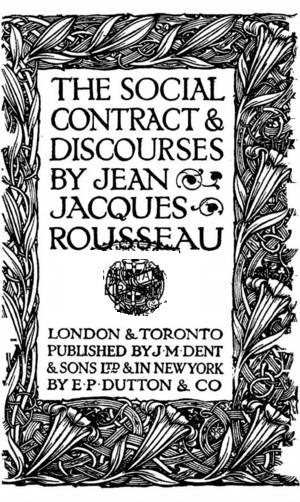
CHAPTER XI: the death of the body politic - Jean-Jacques Rousseau, The Social Contract and Discourses [1761]Edition used:The Social Contract and Discourses by Jean-Jacques Rousseau, translated with an Introduction by G.D. H. Cole (London and Toronto: J.M. Dent and Sons, 1923).
About Liberty Fund:Liberty Fund, Inc. is a private, educational foundation established to encourage the study of the ideal of a society of free and responsible individuals. Copyright information:The text is in the public domain. Fair use statement:This material is put online to further the educational goals of Liberty Fund, Inc. Unless otherwise stated in the Copyright Information section above, this material may be used freely for educational and academic purposes. It may not be used in any way for profit.
CHAPTER XIthe death of the body politicSuch is the natural and inevitable tendency of the best constituted governments. If Sparta and Rome perished, what State can hope to endure for ever? If we would set up a long-lived form of government, let us not even dream of making it eternal. If we are to succeed, we must not attempt the impossible, or flatter ourselves that we are endowing the work of man with a stability of which human conditions do not permit. The body politic, as well as the human body, begins to die as soon as it is born, and carries in itself the causes of its destruction. But both may have a constitution that is more or less robust and suited to preserve them a longer or a shorter time. The constitution of man is the work of nature; that of the State the work of art. It is not in men’s power to prolong their own lives; but it is for them to prolong as much as possible the life of the State, by giving it the best possible constitution. The best constituted State will have an end; but it will end later than any other, unless some unforeseen accident brings about its untimely destruction. The life-principle of the body politic lies in the sovereign authority. The legislative power is the heart of the State; the executive power is its brain, which causes the movement of all the parts. The brain may become paralysed and the individual still live. A man may remain an imbecile and live; but as soon as the heart ceases to perform its functions, the animal is dead. The State subsists by means not of the laws, but of the legislative power. Yesterday’s law is not binding to-day; but silence is taken for tacit consent, and the Sovereign is held to confirm incessantly the laws it does not abrogate as it might. All that it has once declared itself to will it wills always, unless it revokes its declaration. Why then is so much respect paid to old laws? For this very reason. We must believe that nothing but the excellence of old acts of will can have preserved them so long: if the Sovereign had not recognised them as throughout salutary, it would have revoked them a thousand times. This is why, so far from growing weak, the laws continually gain new strength in any well constituted State; the precedent of antiquity makes them daily more venerable: while wherever the laws grow weak as they become old, this proves that there is no longer a legislative power, and that the State is dead. |

Titles (by Subject)