EconlibThe LibraryOther Sites |
Front Page Titles (by Subject) 6: The Independence of the Judiciary; A Controversy Between William Brattle and John Adams - Revolutionary Writings
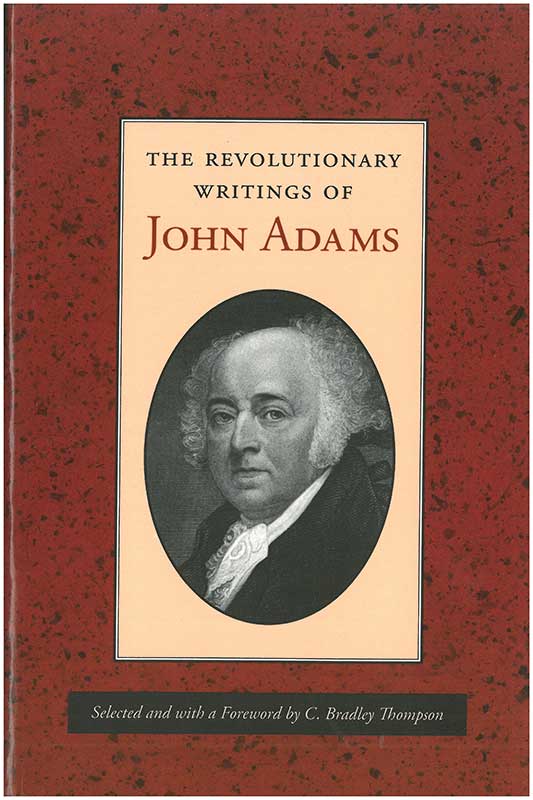
Return to Title Page for Revolutionary WritingsThe Online Library of LibertyA project of Liberty Fund, Inc.Search this Title:Also in the Library:6: The Independence of the Judiciary; A Controversy Between William Brattle and John Adams - John Adams, Revolutionary Writings [1763]Edition used:The Revolutionary Writings of John Adams, Selected and with a Foreword by C. Bradley Thompson (Indianapolis: Liberty Fund, 2000).
About Liberty Fund:Liberty Fund, Inc. is a private, educational foundation established to encourage the study of the ideal of a society of free and responsible individuals. Copyright information:The copyright to this edition, in both print and electronic forms, is held by Liberty Fund, Inc. Fair use statement:This material is put online to further the educational goals of Liberty Fund, Inc. Unless otherwise stated in the Copyright Information section above, this material may be used freely for educational and academic purposes. It may not be used in any way for profit.
6The Independence of the Judiciary;
In the summer of 1772, Massachusetts Governor Thomas Hutchinson announced that he and all superior court judges would no longer need or accept the payment of their salaries from the Massachusetts legislature because the Crown would henceforth assume payment drawn from customs revenues. The following December, spurred on by Boston radicals, the town of Cambridge condemned the attempt to make the judges’ salaries payable by the royal exchequer as a violation of their ancient liberties and practices. At the Cambridge meeting, however, General William Brattle defended the crown’s assumption of the judges’ salaries and issued a challenge to all patriots and, more particularly, to John Adams by name, to debate him on the subject. In brief, Brattle argued that Massachusetts judges were de facto appointed for life, and therefore the assumption of their salaries by the Crown would little threaten their independence. In a dazzling and relentless display of historical and legal research, Adams demonstrated in seven essays that the so-called “independence” of English judges was an eighteenth-century innovation that did not extend to the colonies. The tenure of colonial judges was, Adams argued, dependent on the pleasure of the Crown. The implications for Massachusetts were massive. A judiciary dependent on the Crown for appointment and salary would be entirely beholden to its patron. Adams wrote therefore to alert the people of Massachusetts to the danger of Brattle’s myth and to the need for truly independent judiciary. 11 January, 1773 To the printersGeneral Brattle, by his rank, station, and character, is entitled to politeness and respect even when he condescends to harangue in town meeting or to write in a newspaper; but the same causes require that his sentiments, when erroneous and of dangerous tendency, should be considered with entire freedom, and the examination be made as public as the error. He cannot, therefore, take offence at any gentleman for offering his thoughts to the public with decency and candor, though they may differ from his own. In this confidence I have presumed to publish a few observations which have occurred to me upon reading his narration of the proceedings of the late town meeting at Cambridge. It is not my intention to remark upon all things in that publication which I think exceptionable, but only on a few which I think the most so. The General is pleased to say, “That no man in the province could say whether the salaries granted to the judges were durante beneplacito, or quamdiu bene se gesserint, as the judges of England have their salaries granted them. I supposed the latter, though these words are not expressed, but necessarily implied.” This is said upon the supposition that salaries are granted by the crown to the judges. Now it is not easy to conceive how the General or any man in the province could be at a loss to say, upon supposition that salaries are granted, whether they are granted in the one way or the other. If salaries are granted by the crown, they must be granted in such a manner as the crown has power to grant them. Now it is utterly denied that the crown has power to grant them in any other manner than durante beneplacito. The power of the crown to grant salaries to any judges in America is derived solely from the late act of parliament, and that gives no power to grant salaries for life or during good behavior. But not to enlarge upon this at present. The General proceeds,—“I was very far from thinking there was any necessity of having quamdiu bene se gesserint in their commissions; for they have their commissions now by that tenure as truly as if said words were in.” It is the wish of almost all good men that this was good law. This country would be forever obliged to any gentleman who would prove this point from good authorities to the conviction of all concerned in the administration of government here and at home. But I must confess that my veneration for General Brattle’s authority by no means prevails with me to give credit to this doctrine; nor do his reasons in support of it weigh with me even so much as his authority. He says, “What right, what estate vests in them, (that is, the judges,) in consequence of their nomination and appointment, the common law of England, the birthright of every man here as well as at home, determines, and that is an estate for life, provided they behave well.” I must confess I read these words with surprise and grief; and the more I have reflected upon them, the more these sentiments have increased in my mind. The common law of England is so far from determining that the judges have an estate for life in their offices, that it has determined the direct contrary; the proofs of this are innumerable and irresistible. My Lord Coke, in his fourth Institute, 74, says, “Before the reign of Edward I. the chief justice of this court was created by letters-patent, and the form thereof (taking one example for all) was in these words:— “Rex, &c., archiepiscopis, episcopis, abbatibus, prioribus, comitibus, baronibus, vice-comitibus, forestariis, et omnibus aliis fidelibus regni Angliae, salutem. Cum pro conservatione nostrâ, et tranquillitatis regni nostri, et ad justitiam universis et singulis de regno nostro exhibendam constituerimus dilectum et fidelem nostrum Philippum Basset justiciarium Angliae quamdiu nobis placuerit capitalem, &c.” And my Lord Coke says afterwards in the same page,—“King Edward I. being a wise and prudent prince, knowing that, cui plus licet quam par est, plus vult quam licet, (as most of these summi justiciarii did) made three alterations. 1. By limitation of his authority. 2. By changing summus justiciarius to capitalis justiciarius. 3. By a new kind of creation, namely, by writ, lest, if he had continued his former manner of creation, he might have had a desire of his former authority; which three do expressly appear by the writ yet in use, namely,—Rex, &c. E. C. militi salutem. Sciatis quod constituimus vos justiciarium nostrum capitalem ad placita coram nobis tenenda, durante beneplacito nostro. Teste, &c.” Afterwards, in the same page, Lord Coke observes, “It is a rule in law, that ancient offices must be granted in such forms and in such manner as they have used to be, unless the alteration were by authority of parliament. And continual experience approveth, that for many successions of ages without intermission, they have been, and yet are called by the said writ.” His lordship informs us also in the same page that “the rest of the judges of the king’s bench have their offices by letters-patent in these words,—Rex omnibus ad quos presentes literae pervenerint salutem. Sciatis quod constituimus dilectum et fidelem Johannem Doderidge militem unum justiciariorum ad placita coram nobis tenenda durante beneplacito nostro. Teste, &c.” His lordship says, indeed, that these judges are called perpetui by Bracton, because “they ought not to be removed without just cause.” But the question is not what the crown ought to do, but what it had legal power to do. The next reason given by the General, in support of his opinion, is that “these points of law have been settled and determined by the greatest sages of the law, formerly and more lately.” This is so entirely without foundation, that the General might, both with safety and decency, be challenged to produce the name of any one sage of the law, ancient or modern, by whom it has been so settled and determined, and the book in which such determination appears. The General adds, “It is so notorious that it becomes the common learning of the law.” I believe he may decently and safely be challenged again to produce one lawyer in this country who ever before entertained such an opinion or heard such a doctrine. I would not be misunderstood. There are respectable lawyers who maintain that the judges here hold their offices during good behavior; but it is upon other principles, not upon the common law of England. “My Lord Chief Justice Holt settled it so, not long before the statute of William and Mary, that enacts that the words quamdiu bene se gesserint shall be in the judges’ commissions;” and afterwards he says, that the commissions, as he apprehends, were without these words inserted in them during the reigns of King William, Queen Mary, and Queen Anne. This, I presume, must have been conjectured from a few words of Lord Holt, in the case of Harcourt against Fox, which I think are these. I repeat them from memory, having not the book before me at present. “Our places as judges are so settled, determinable only upon misbehavior.” Now from these words I should draw an opposite conclusion from the General, and should think that the influence of that interest in the nation, which brought King William to the throne, prevailed upon him to grant the commissions to the judges expressly during good behavior. I say this is the most natural construction, because it is certain their places were not at that time, namely, 5 William and Mary, determined, by an act of parliament, to be determinable only upon misbehavior; and it is as certain, from Lord Coke and from all history, that they were not so settled by the common law of England. However, we need not rest upon this reasoning because we happen to be furnished with the most explicit and decisive evidence that my conclusion is just, from my Lord Raymond. In the beginning of his second volume of Reports, his lordship has given us a list of the chief officers in the law at the time of the death of King William III., 8 March, 1701–2. And he says in these words, that “Sir John Holt, Knight, chief justice of the king’s bench, holding his office by writ, though it was quamdiu se bene gesserit, held it to be determined by the demise of the king, notwithstanding the act of 12 and 13 William III. And, therefore, the queen in council gave orders that he should have a new writ, which he received accordingly, and was sworn before the lord keeper of the great seal the Saturday following, namely, the 14th of March, chief justice of king’s bench.” From this several things appear: 1. That General Brattle is mistaken in apprehending that the judges’ commissions were without the clause, quamdiu bene se gesserint, in the reign of King William and Queen Mary, and most probably also in the reign of Queen Anne; because it is not likely that Lord Holt would have accepted a commission from the queen during pleasure, when he had before had one from King William during good behavior; and because if Queen Anne had made such an alteration in the commission, it is most likely Lord Raymond would have taken notice of it. 2. That Lord Holt’s opinion was, that by common law he had not an estate for life in his office; for, if he had, it could not expire on the demise of the king. 3. That Lord Holt did not think the clause in the statute of 12 and 13 William III. to be a declaration of what was common law before, nor in affirmance of what was law before, but a new law, and a total alteration of the tenure of the judges’ commissions established by parliament, and not to take place till after the death of the Princess Anne. 4. That in Lord Holt’s opinion it was not in the power of the crown to alter the tenure of the judges’ commissions, and make them a tenure for life, determinable only upon misbehavior, even by inserting that express clause in them, quamdiu se bene gesserint. I have many more things to say upon this subject, which may possibly appear some other time. Meanwhile, I am, Messrs. Printers, Your humble servant,John Adams 18 January, 1773 To the printersIt has been said already that the common law of England has not determined the judges to have an estate for life in their offices, provided they behaved well. The authorities of Lord Coke and Lord Holt have been produced relative to the judges of the king’s bench; and, indeed, authorities still more ancient than Coke might have been adduced. For example, the learned Chancellor Fortescue, in his book in praise of the laws of England, chap. 51, says, “When any one judge of the king’s bench dies, resigns, or is superseded, the king, with the advice of his council, makes choice of one of the sergeants-at-law, whom he constitutes a judge by his letters-patents in the room of the judge so deceased, resigning, or superseded.” And afterwards he says, “It is no degree in law, but only an office and a branch of magistracy determinable on the king’s good pleasure.” I have quoted a translation in this place, as I choose to do whenever I can obtain one; but I do not venture to translate passages myself, lest I should be charged with doing it unfairly. The original words of Fortescue are unusual and emphatical: “Ad regis nutum duratura.” The judges of the court of common pleas held their offices by a tenure as precarious. “The chief justice of the common pleas is created by letters-patents,—Rex, &c. Sciatis quod constituimus dilectum et fidelem E. C. militem, capitalem justiciarium de communi banco. Habendum quamdiu nobis placuerit, cum vadiis et feodis ab antiquo debitis et consuetis. In cujus rei testimonium has literas nostras fieri fecimus patentes. Teste, &c. And each of the justices of this court hath letters-patents. Sciatis quod constituimus dilectum et fidelem P. W., militem, unum justiciariorum nostrorum de communi banco,”* &c.; and this &c. implies the habendum quamdiu nobis placuerit, as in the patent of the chief justice. It is true that in the same Fourth Institute, 117, we read, that “the chief baron” (that is, of the exchequer) “is created by letters-patents, and the office is granted to him quamdiu se bene gesserit, wherein he hath a more fixed estate (it being an estate for life) than the justices of either bench, who have their offices but at will. And quamdiu se bene gesserit must be intended in matters concerning his office, and is no more than the law would have implied if the office had been granted for life. And in like manner are the rest of the barons of the exchequer constituted; and the patents of the attorney-general and solicitor are also quamdiu se bene gesserit.” It is also true, that by the law of this province a superior court of judicature, court of assize, and general jail delivery is constituted over this whole province, to be held and “kept by one chief justice and four other justices to be appointed and commissionated for the same; who shall have cognizance of all pleas, real, personal, or mixed, as well all pleas of the crown, &c.; and generally of all other matters, as fully and amply to all intents and purposes whatsoever, as the courts of king’s bench, common pleas, and exchequer, within his majesty’s kingdom of England, have, or ought to have,” &c. Will it be said that this law, giving our judges cognizance of all matters of which the court of exchequer has cognizance, gives them the same estate in their offices which the barons of exchequer had? or will it be said that by “the judges,” General Brattle meant the barons of the exchequer? The passages already cited will afford us great light in considering the case of Harcourt and Fox. Sir Thomas Powis, who was of counsel in that case for the plaintiff, indeed says, “I take it, by the common law and the ancient constitution of the kingdom, all officers of courts of justice, and immediately relating to the execution of justice, were in for their lives, only removable for misbehavior in their offices. Not only my lords the judges of the courts in Westminster Hall were anciently as they now are, since the revolution, quamdiu se bene gesserint, but all the officers of note in the several courts under them were so, and most of them continue so to this day, as the clerks of the crown in this court, and in the chancery, the chief clerk on the civil side in this court, the prothonotaries in the common pleas, the master of the office of pleas in the exchequer, and many others. I think, speaking generally, they were all in for their lives by the common law, and are so still to this day.” “And in this particular the wisdom of the law is very great; for it was an encouragement to men to fit and prepare themselves for the execution and performance of those offices, that when by such a capacity they had obtained them, they might act in them safely, without fear or dependence upon favor. And when they had served in them faithfully and honestly, and done their duty, they should not be removable at pleasure. And on the other side, the people were safe; for injustice, corruption, or other misdemeanors in an office were sufficient causes for removal and displacing the offender.” And Sergeant Levinz says, “If any judicial or ministerial office be granted to any man to hold, so long as he behaves himself well in the office, that is an estate for life, unless he lose it for misbehavior. So was Sir John Waller’s case, as to the office of chief baron of the exchequer; and so was Justice Archer’s case in the time of King Charles the Second. He was made a judge of the common pleas quamdiu se bene gesserit; and though he was displaced as far as they could, yet he continued judge of that court to the time of his death; and his name was used in all the fines, and other records of the court; and so it is in all cases of grants from the king, or from any other person.” And afterwards,—“It is a grievance that runs through the whole common law, as to ministerial offices; for all the offices in this court, in the chancery, in the exchequer, in the common pleas, and generally all over the kingdom, relating to the administration of justice, and even the judges themselves, are officers for life; and why there should be more of a grievance in this case than in theirs, I do not see. In general, they are all for life, though some few particular ones may be excepted indeed.” I have repeated at length these sayings of Sir Thomas Powis and Sergeant Levinz, because they are music in my ears; and I sincerely wish they were well supported; and because I suspect that General Brattle derived much of his learning relative to the judges’ offices from them. But, alas! so far as they make for his purpose, the whole stream of law and history is against them. And, indeed, Mr. Hawles, who was of counsel for Mr. Fox, seems to have given a true and sufficient answer to them in these words:—“Whatsoever the common law was as to offices that were so ancient, is no rule in this matter; though it is we know, that, as our books tell us, some offices were for life. And the office of chancellor of England, my Lord Coke says, could not be granted to any one for life. And why? Because it never was so granted. Custom and nothing else prevails, and governs in all those cases; of those offices that were usually granted for life, a grant of such an office for life was good, and of those that were not usually granted for life, a grant of such an office for life was void.” The judges, indeed, did not expressly deny any of those sayings of Sir Thomas Powis, or of Sergeant Levinz, who spoke after him on the same side; but the reason of this is plain; because it was quite unnecessary, in that case, to determine what was common law; for both the office of custos rotulorum, and that of clerk of the peace, were created by statute, not erected by common law, as was clearly agreed both on the bench and at the bar. Nevertheless, my Lord Holt seems to have expressed his opinion when he said, “I compare it to the case which my Lord Chief Justice Hobart puts of himself in his book, 153, Colt and Glover’s case. Saith he, ‘I cannot grant the offices of my gift as chief justice for less time than for life;’ and he puts the case there of a man’s assigning a rent for dower out of the lands dowable, that it must be for no less estate than life; for the estate was by custom, and it cannot be granted for a lesser estate than what the custom appoints; and in that case of the chief justice, in granting offices in his gift, all that he had to do was to point out the person that should have the office, the custom settled his estate in it.” Thus, we see that the sentiments of Lord Coke and of Lord Holt concur with those of Mr. Hawles, that the custom was the criterion, and that alone. So that, if the king should constitute a baron of the exchequer during pleasure, he would have an estate for life in his office, or the grant would be void. Why? Because the custom had so settled it. If the king should constitute a judge of the king’s bench, or common bench, during good behavior, he would have only an estate at will of the grantor. Why? Because the custom hath determined it so. And that custom could not be annulled or altered but by act of parliament. But I go on with my delightful work of quotation. “In order to maintain both the dignity and independency of the judges in the superior courts, it is enacted by the stat. 13 W. III. c. 2, that their commissions shall be made, not, as formerly, durante beneplacito, but quamdiu se bene gesserint, and their salaries ascertained and established; but that it may be lawful to remove them on the address of both houses of parliament. And now, by the noble improvements of that law in the statute of 1 G. III. c. 23, enacted at the earnest recommendation of the king himself from the throne, the judges are continued in their offices during their good behavior, notwithstanding any demise of the crown, which was formerly held (see Lord Raym. 747) immediately to vacate their seats; and their full salaries are absolutely secured to them during the continuance of their commissions,—his majesty having been pleased to declare, that he looked upon the independence and uprightness of the judges as essential to the impartial administration of justice; as one of the best securities of the rights and liberties of his subjects; and as most conducive to the honor of the crown.”* It would be endless to run over all the passages in English history relating to this subject, and the examples of judges displaced by kings. It may not be amiss to turn our attention to a very few, however. The oracle himself was silenced by this power in the crown. “Upon the 18th November, this term, Sir Henry Montague was made chief justice of the king’s bench, in the place of Sir Edward Coke, the late chief justice, who, being in the king’s displeasure, was removed from his place by a writ from the king, reciting that whereas he had appointed him by writ to that place, that he had now amoved him, and appointed him to desist from the further execution thereof. And now this day, Egerton, lord chancellor, came into the king’s bench; and Sir Henry Montague, one of the king’s sergeants, being accompanied with Sergeant Hutten and Sergeant Francis Moore, came to the middle of the bar; and then the lord chancellor delivered unto him the king’s pleasure, to make choice of him to that place.”* There is a passage in Hume’s History of England which I cannot forbear transcribing. “The Queen’s (Elizabeth’s) menace,” says he, “of trying and punishing Hayward for treason, could easily have been executed, let his book have been ever so innocent. While so many terrors hung over the people, no jury durst have acquitted a man when the court was resolved to have him condemned. And, indeed, there scarcely occurs an instance during all these reigns, that the sovereign or the ministers were ever disappointed in the issue of a prosecution. Timid juries, and judges who held their offices during pleasure, never failed to second all the views of the crown.” Sergeant Levinz, in the argument of Harcourt against Fox, speaking of the first parliament under King William, says,—“The parliament might observe, that some years before there had been great changing of offices that usually were for life into offices quamdiu placuerit. This is very well known in Westminster Hall; and I did know some of them myself, particularly the judges of the courts of common law; for I myself (among others) lost my judge’s place by it,” &c. Mr. Hume, in the reign of James the Second, says,—“The people had entertained such violent prepossessions against the use which James here made of his prerogative, that he was obliged, before he brought on Hales’s cause, to displace four of the judges, Jones, Montague, Charlton, and Nevil.” There is not in history a more terrible example of judges perishing at the royal nod than this, nor a stronger evidence that the power and prerogative of removing judges at pleasure were allowed to be, by law, in the crown. It was loudly complained of as a grievance, no doubt, and an arbitrary exertion of prerogative; but it was allowed to be a legal prerogative still. And it cannot be doubted, that the legality of it would have been denied everywhere, if the sense of the nation, as well as the body of the law, had not been otherwise, when the circumstances of that case of Sir Edward Hales are considered. And they ought to be remembered, and well considered by every well-wisher to the public; because they show the tendency of a precarious, dependent tenure of the judges’ offices. Sir Edward Hales was a papist; yet the king gave him a commission as a colonel of foot; and he refused to receive the sacrament, and to take the oaths and test, within the time prescribed by an act of parliament, 25 Car. II. c. 2, by which refusal, and that statute, he forfeited five hundred pounds. By concert between King James and Sir Edward, his coachman was employed to bring an action against him upon that statute, for the penalty. Sir Edward appears, and pleads a dispensation under the broad seal, to act non obstante that statute. To this the plaintiff demurs. When this action was to be brought to trial, the judges were secretly closeted by the king, and asked their opinions. Such as had scruples about judging as the court directed, were plainly told by the king himself, that he would have twelve judges of his own opinion, and turned out of their offices. The judges mentioned by Hume were thus displaced, to their lasting honor; and one of them, Jones, had the fortitude and integrity to tell the king to his face, that he might possibly make twelve judges, but he would scarcely find twelve lawyers of his opinion. Bedingfield, Atkins, Lutwyche, and Heath, to their disgrace and infamy, were created judges. And Westminster Hall thus garbled became the sanctuary of despotism and injustice. All the judges excepting one gave their opinions for the king, and made it a general rule in law,—“1. That the laws of England are the king’s laws. 2. That, therefore, it is an incident, inseparable prerogative of the kings of England, as of all other sovereign princes, to dispense with all penal laws in particular cases, and upon particular, necessary reasons. 3. That of these reasons and necessities the king is the sole judge. Consequently, 4. That this is not a trust invested in and granted to the king, but the ancient remains of the sovereign power of the kings of England, which never was yet taken from them, nor can be.” In consequence of this decision, the papists, with the king’s permission, set up everywhere in the kingdom in the free and open exercise of their religion. To enumerate all the struggles of the people, the petitions and addresses to kings, praying that the judges’ commissions might be granted during good behavior, the bills which were actually brought into one or the other house of parliament for that purpose, which failed of success until the final establishment in the 12 & 13 William III., would be too tedious;* and, indeed, I anxiously fear I have been so already. I also fear the proofs that the common law of England has not determined the judges to have estates for life in their offices, appear to be very numerous, and quite irresistible. I very heartily wish General Brattle success in his researches after evidence of the contrary position; and while he is thus engaged, if I should find neither business more profitable nor amusement more inviting, I shall be preparing for your press a few other observations on his first publication. John Adams 25 January, 1773 To the printersAnother observation which occurred to me upon reading General Brattle’s first publication was upon these words:—“That by the charter and common law of England, there is no necessity of having any commission at all; a nomination and appointment recorded is enough; nomination and appointment are the words of the charter, a commission for them not so much as mentioned in it. Their commission is only declarative of their nomination and appointment.” Two questions arise upon this paragraph; and the first is, what provision is made by our charter? and the next is, what was necessary to the creation of a judge at common law? As to our charter. The king thereby grants and ordains,—“That it shall and may be lawful for the said governor, with the advice and consent of the council or assistants, from time to time to nominate and appoint judges, commissioners of oyer and terminer, sheriffs, provosts, marshals, justices of the peace, and other officers to our council and courts of justice belonging.” It is obvious from this, that there is no superior court of judicature, court of assize and general jail delivery, nor any inferior court of common pleas, or any court of exchequer, expressly erected by the charter. Commissioners of oyer and terminer, the governor, with the advice and consent of the council, is empowered to nominate and appoint; but it will not follow from hence that a nomination and appointment will alone constitute and empower commissioners of oyer and terminer. For the judges, whom the governor with the advice of council is empowered to nominate and appoint, are not vested with any powers at all by the charter; but by another clause in it, the great and general court or assembly “shall forever have full power and authority to erect and constitute judicatories and courts of record, or other courts, to be held in the name of us, our heirs and successors, for the hearing, trying, and determining of all manner of crimes, offences, pleas, processes, plaints, actions, matters, causes, and things, whatsoever, arising or happening within our said province or territory, or between persons inhabiting and residing there, whether the same be criminal or civil, and whether the said crimes be capital or not capital, and whether the said pleas be real, personal, or mixt, and for the awarding and making out execution thereupon.” In pursuance of this authority, our legislature, in 1699, by a law, 2 William III. c. 3, have established “a superior court of judicature, court of assize, and general jail delivery within this province, to be held by one chief justice and four other justices, to be appointed and commissionated for the same,” &c. Is not General Brattle, then, greatly mistaken when he says, that “a nomination and appointment recorded is enough?” Enough for what? Enough to constitute judges of our superior court, for they alone can be meant by the General, because the General himself determines his own meaning to be, “they who have the same powers with the king’s bench, common bench, and exchequer;” and no other judges have those powers but the judges of our superior court, &c., and they have them, not by charter, but by the law of the province. If the governor should nominate and appoint, with advice and consent, &c. A to be a judge, or A, B, and C to be judges, in the words of the charter, what powers would this nomination and appointment convey? None at all. It would be nugatory and void; for, according to Lord Coke,* a “new court cannot be erected but by act of parliament. And when a new court is erected, it is necessary that the jurisdiction and authority of the court be certainly set down. And that the court can have no other jurisdiction than is expressed in the erection.” And he there mentions the case of a letter-patent granted by Edward IV. in these words: “We will and ordain that Richard Beauchampe, &c., should have it (that is, the office of the chancellor of the garter) for his life, and after his decease, that his successors should have it forever”; and “it was resolved unanimously that this grant was void; for that a new office was erected, and it was not defined what jurisdiction or authority the officer should have; and, therefore, for the uncertainty, it was void.” Let us next inquire whether, by the common law of England, there is or is not a necessity of the judges having any commissions at all. The authorities cited before seem to show very plainly that the judges, either of the king’s bench, common bench, or exchequer, can be created only by writ, or by letters-patent; and although these may be said not to be commissions, yet they are surely something more than nomination and appointment. However, writs and letters-patent are commissions, I presume; and should never have doubted it, if I had never read a newspaper. But if I had doubted, I might easily have resolved the doubt; for we read† that “all judges must derive their authority from the crown by some commission warranted by law. The judges of Westminster are (all except the chief justice of the king’s bench, who is created by writ) appointed by patent, and formerly held their places only during the king’s pleasure, &c.”‡ And Lord Coke observes, that “the creation of the office of chief justice was first by writ, and afterwards by letters-patents.” “As all judges must derive their authority from the crown by some commission warranted by law, they must also exercise it in a legal manner.”* In order to see whether writs and letters-patent are not commissions, let us look into any common dictionary or interpreter of law terms. “Commission, commissio,” (says Cowell, and after him, in the same words, Cunningham,) “is for the most part, in the understanding of the law, as much as delegatio with the civilians,† and is taken for the warrant, or letters-patent, that all men exercising jurisdiction, either ordinary or extraordinary, have for their power to hear or determine any cause or action.” Thus it seems to be very clear that, by the common law of England, a commission was absolutely necessary for all the judges known at common law; and as to others, erected by statute, let the statute speak. By 27 H. 8, c. 24, it is enacted: “That no person or persons, of what estate, degree, or condition soever they be, shall have any power or authority to make any justices of eyre, justices of assize, justices of peace, or justices of jail delivery; but that all such officers and ministers shall be made by letters-patent, under the king’s great seal, in the name and by the authority of the king’s highness, in all shires, counties palatine, Wales, &c., or any other his dominions, &c., any grants, usages, allowance, or act of parliament to the contrary notwith standing.” I shall add no more upon this point but this. We find in Jenkin’s Centuries, 123, this question determined by all the judges of England in the exchequer chamber: “A writ of admittas in association is directed to the justices of assize; A. shows this writ of admittas in association to them, but does not show the patent by which he is made justice. In this case, both ought to be shown to the justices of assize. By all the Judges in the Exchequer Chamber. The judges of the king’s bench and common pleas, and the barons of the exchequer are made by patent, in which the word constituimus is used. The chief justice of the king’s bench is constituted only by writ.” John Adams 1 February, 1773 One thing at one time.—De WittTo the printersThe question is, in the present state of the controversy, according to my apprehension of it, whether, by the common law of England, the judges of the king’s bench and common bench had estates for life in their offices, determinable on misbehavior, and determinable also on the demise of the crown. General Brattle still thinks they had; I cannot yet find reason to think so. And as whether they had or had not is the true question between us, I will endeavor to confine myself to it without wandering. Now, in order to pursue my inquiry regularly, it is necessary to determine with some degree of precision what is to be understood by the terms “common law.” Out of the Mercian laws, the laws of the West Saxons, and the Danish law, King Edward the Confessor extracted one uniform digest of laws, to be observed throughout the whole kingdom, which seems to have been no more than a fresh promulgation of Alfred’s code, or Dome Book, with such improvements as the experience of a century and a half had suggested, which is now unhappily lost. This collection is of higher antiquity than memory or history can reach; they have been used time out of mind, or for a time whereof the memory of man runneth not to the contrary. General customs, which are the universal rule of the whole kingdom, form the common law in its stricter and more usual signification. This is that law which determines that there shall be four superior courts of record, the chancery, the king’s bench, the common pleas, and the exchequer, among a multitude of other doctrines, that are not set down in any written statute or ordinance, but depend merely upon immemorial usage, that is, upon common law, for their support. Judicial decisions are the principal and most authoritative evidence that can be given of the existence of such a custom as shall form a part of the common law. The law and the opinion of the judge are not always convertible terms; though it is a general rule, that the decisions of courts of justice are the evidence of what is common law.* I have endeavored to ascertain what is meant by the common law of England, and the method of determining all questions concerning it, from Blackstone. Let us now see what is said upon the same subject, by Justice Fortescue Aland, in the preface to his Reports. “Our judges,” says he, “do not determine according to their princes, or their own arbitrary will and pleasure; but according to the settled and established rules and ancient customs of the nation, approved for many successions of ages. … … King Alfred, who began his reign in 871, magnus juris Anglicani conditor, the great founder of the laws of England, with the advice of his wise men, collected out of the laws of Ina, Offa, and Aethelbert, such as were the best, and made them to extend equally to the whole nation, and therefore very properly called them the common law of England, because those laws were now first of all made common to the whole English nation. This jus commune, jus publicum, or folcright, that is, the people’s right, set down in one code, was probably the same with the Doom-Book, or liber judicialis, which is referred to in all the subsequent laws of the Saxon kings, and was the book that they determined causes by. And in the next reign, that of Edward the elder, the king commands all his judges to give judgment to all the people of England according to the Doom-Book. And it is from this origin that our common law judges fetch that excellent usage of determining causes, according to the settled and established rules of law, and that they have acted up to this rule for above eight hundred years together, and continue to do so to this very day. Edward the Confessor was afterwards but the restorer of the common law founded by Alfred, and William the Conqueror confirms and proclaims these to be the laws of England, to be kept and observed under grievous penalties, and took an oath to keep them inviolable himself. King Henry I. promised to observe them; King Stephen, King Henry II., and Richard I. confirmed them; King John swore to restore them; King Henry III. confirmed them; Magna Charta was founded on them, and King Edward I. in parliament, confirmed them.” Now I apprehend General Brattle’s opinion to be, that the common law of England, the birthright of every subject, or, in the language of the Saxons, the folkright, determines the judges of the king’s bench and common pleas to have estates for life in their offices, determinable only on misbehavior, or the demise of the crown. And this, I suppose, was the meaning of Sir Thomas Powis, when he said, “I take it, by the common law and the ancient constitution of the kingdom, all officers of courts of justice, &c., were in for their lives, &c.; not only my lords the judges of the courts in Westminster Hall were anciently, as they now are since this revolution, quamdiu se bene gesserint.” I have never expressed any disrespect to the character of Sir Thomas Powis, and I have no disposition to harbor any; it is enough for me to say, that these expressions were used by him when arguing a cause for his client at the bar, not when he was determining a cause as a judge; that they were entirely unnecessary for the support of his cause, which was a very good one, let these expressions be true or otherwise,—that is, whether the judges were anciently in for their lives, or only at pleasure; that they depend wholly upon his affirmation, or rather his opinion, without the color or pretence of an authority to support them; and that I really believe them to be untrue. And I must add, it appears to me extraordinary, that a gentleman educated under that great Gamaliel, Mr. Read, should ever adduce the simple dictum of a counsel at the bar, uttered arguendo, and as an ornament to his discourse too, rather than any pertinent branch of his reasoning, as evidence of a point “settled and determined by the greatest sages of the law formerly and more lately.” Does Sir Thomas Powis produce the Dome-Book itself in support of his doctrine? That was irrecoverably lost for ages before he had a being. Does he produce any judicial decision, ancient or modern, to prove this opinion? No such thing pretended. Does he produce any legal authority, a Hengham, Britton, Fleta, Fortescue, Coke; or any antiquarian, Matthew Paris, Dugdale, Lambard, or any other; or even the single opinion of one historian, to give a color to his doctrine? No such matter. Nay, I must inquire further, can General Brattle draw from any of these sources a single iota to support this opinion? But, in order to show, for the present, the improbability that any such authority will be found, let us look a little into history. Mr. Rapin, in his Dissertation on the Government of the Anglo-Saxons, says, “One of the most considerable of the king’s prerogatives was the power of appointing the earls, viscounts, judges, and other officers, as well civil as military. Very probably it was in the king’s power to change these officers, according to his pleasure, of which we meet with several instances in history.” By this it appears to have been Mr. Rapin’s opinion, that very probably the kings, under the ancient Saxon constitution, had power to change the judges according to their pleasure. I would not be understood, however, to lay any great stress on the opinions of historians and compilers of antiquities, because it must be confessed that the Saxon constitution is involved in much obscurity, and that the monarchical and democratic factions in England, by their opposite endeavors to make the Saxon constitutions swear for their respective systems, have much increased the difficulty of determining, to the satisfaction of the world, what that constitution, in many important particulars, was. Yet Mr. Rapin certainly was not of that monarchical faction; his bias, if he had any, was the other way; and therefore his concession makes the more in my favor. Mr. Hume, in his Feudal and Anglo-Norman Government and Manners,* says: “The business of the court was wholly managed by the chief justiciary and the law-barons, who were men appointed by the king, and wholly at his disposal.” And since I am now upon Hume, it may be proper to mention the case of Hubert de Burgh, who, “while he enjoyed his authority, had an entire ascendant over Henry III., and was loaded with honors and favors beyond any other subject, … and, by an unusual concession, was made chief justiciary of England for life.”* Upon this I reason thus: If his being made justiciary for life was an “unusual concession,” it could not be by the immemorial, uninterrupted usage and custom, which is the criterion of common law. And the very next words of Hume show how valid and effectual this grant of the office for life was then esteemed. “Yet Henry, in a sudden caprice, threw off this faithful minister;” which implies that he was discarded and displaced in both his capacities, because the summus justiciarius or chief justiciary, was in those reigns supreme regent of the kingdom, and first minister of state, as well as of the law; and this seems to show that the grant for life was void, and not binding on the king, in the sense of those times, ancient as they were (1231). This summus justiciarius is the officer whose original commission I gave the public from Lord Coke, in my first paper, which was expressly during pleasure. And my Lord Coke’s account of the change of the chief justice’s commission and authority may receive some additional light from Lord Gilbert’s Historical View of the Court of Exchequer. Towards the latter end of the Norman period, the power of the justiciar was broken, so that the aula regis, which was before one great court, only distinguished by several offices, and all ambulatory with the king before Magna Charta, was divided into four distinct courts,—chancery, exchequer, king’s bench, and common pleas. The justiciary was laid aside, lest he should get into the throne, as Capet and Pepin, who were justiciars in France, had done there.† Now, from the exorbitant powers and authority of these justiciaries arises a proof, from the frame of the government and the balance of the estates, that the office in those ages was always considered as dependent on the pleasure of the king, because the jealousy between the kings and nobles, or between the monarchical and aristocratical factions, during the whole Norman period, was incessant and unremitted; and therefore it may be depended on, that kings never would have come into the method of granting such an office usually for life. For such a grant, if it had been made, and been valid, must have cost the grantor his throne, as it made the justiciar independent of the king, and a much more powerful man than himself. And if, during the whole Norman period, and quite down to the death of Sir Edward Coke, a course of almost six hundred years, the offices of judges were held during pleasure, what becomes of the title to them for life, which General Brattle sets up, by immemorial, uninterrupted usage, or common law? Sir Thomas Powis, however, has not determined whether, by the ancient constitution of the kingdom, he meant under the Norman or the Saxon period; and in order to show the improbability that the judges held their offices during good behavior, in either of those periods, I must beg the pardon of your readers if I lead them into ages, manners, and government more ancient and barbarous than any mentioned before. Our Saxon ancestors were one of those enterprising northern nations, who made inroads upon the provinces of the Roman empire, and carried with them, wherever they went, the customs, maxims, and manners of the feudal system; and although, when they intermingled with the ancient Britons, they shook off some part of the feudal fetters, yet they never disengaged themselves from the whole. They retained a vast variety of the regalia principis of the feudal system, from whence most branches of the present prerogatives of our kings are derived; and, among other regalia, the creation and annihilation of judges was an important branch. For evidence of this, we must look into the feudal law. It was in consequence of this prerogative that the courts were usually held in the aula regis, and often in the king’s presence, who often heard and determined causes in person; and in those ages the justiciary was only a substitute or deputy to the king, whose authority ceased entirely in the king’s presence. This part of the prerogative has a long time ago been divested from the crown, and it has been determined that the king has delegated all his authority to his judges. The power of the king in the Saxon period was absolute enough, however, and he sometimes treated them with very little ceremony. Alfred himself is said, in the Mirror of Justices, to have hanged up forty-four of his judges in one year for misdemeanors. To some of these facts and principles Bracton is a witness. “Dictum est,” (says he,) “de ordinaria jurisdictione, quae pertinet ad regem, consequenter dicendum est de jurisdictione delegata, ubi quis ex se ipso nullam habet auctoritatem, sed ab alio sibi commissam, cum ipse qui delegat non sufficiat per se omnes causas sive jurisdictiones terminare. Et si ipse dominus rex ad singulas causas terminandas non sufficiat, ut levior sit illi labor, in plures personas partito onere, eligere debet de regno suo viros sapientes et timentes Deum … Item justiciariorum, quidam sunt capitales, generales, perpetui et majores a latere regis residentes, qui omnium aliorum corrigere tenentur injurias et errores. Sunt etiam alii perpetui, certo loco residentes, sicut in banco, … qui omnes jurisdictionem habere incipiunt praestito sacramento … Et quamvis quidam eorum perpetui sunt, ut videtur, finitur tamen eorum jurisdictio multis modis, s. mortuo eo qui delegavit, &c. Item cum delegans revocaverit jurisdictionem,” &c. Bracton, chap. 10, lib. 3. Sergeant Levinz says, “If any judicial or ministerial office be granted to any man to hold, so long as he behaves himself well in the office, that is an estate for life, unless he lose it for misbehavior. So was Sir John Waller’s case, as to the office of chief baron of the exchequer.” To all this I agree, provided it is an office that by custom, that is, immemorial usage, or common law, (as that of the chief baron of the exchequer was,) or by an express act of parliament, (as that of clerk of the peace, in the case of Harcourt against Fox, was,) has been granted in that manner, but not otherwise; and therefore these words have no operation at all against me. But the Sergeant goes on: “And so was Justice Archer’s case, in the time of King Charles II. He was made a judge of the common pleas quamdiu se bene gesserit; and though he was displaced as far as they could, yet he continued judge of that court to the time of his death; and his name was used in all the fines and other records of the court.” General Brattle thinks these words are full in his favor; and he cannot reconcile this patent to Judge Archer with the history of Charles II.’s reign, &c. We shall presently see if a way to reconcile it cannot be discovered: but before I come to this attempt, as it is my desire to lay before the public every thing I know of, which favors General Brattle’s hypothesis, and to assist his argument to the utmost of my power, I will help him to some other authorities, which seem to corroborate Sergeant Levinz’s saying; and the first is Justice Fortescue Aland:* “Justice Archer was removed from the common pleas; but his patent being quamdiu se bene gesserit, he refused to surrender his patent without a scire facias, and continued justice, though prohibited to sit there; and in his place Sir William Ellis was sworn.” The next is Sir Thomas Raymond, 217: “This last vacation, Justice Archer was amoved from sitting in the court of common pleas, pro quibusdam causis mihi incognitis; but the judge having his patent to be judge quamdiu se bene gesserit, refused to surrender his patent without a scire facias, and continued justice of that court, though prohibited to sit there; and in his place Sir William Ellis, Knight, was sworn.” But will any man from these authorities conclude that King Charles II. had power by the common law to grant Judge Archer an estate for life in his office? If he had, how could he be prohibited to sit? how came Justice Ellis to be sworn in his stead? Was not the admission of Ellis by his brother judges an acknowledgment of the king’s authority? Will any man conclude from these authorities that it had before been the custom, time out of mind, for kings to grant patents to the judges, quamdiu se bene gesserint? If we look into Rushworth, 1366, we shall find some part of this mystery unriddled: “After the passing of these votes against the judges, and transmitting of them unto the house of peers, and their concurring with the house of commons therein, an address was made unto the king shortly after, that his majesty for the future would not make any judge by patent during pleasure, but that they may hold their places hereafter quamdiu se bene gesserint, and his majesty did readily grant the same, and in his speech to both houses of parliament, at the time of giving his royal assent to two bills, one to take away the high commission court, and the other the court of star-chamber, and regulating the power of the council table, he hath this passage,—‘If you consider what I have done this parliament, discontents will not sit in your hearts; for I hope you remember that I have granted that the judges hereafter shall hold their places, quamdiu se bene gesserint.’ And likewise his gracious majesty, King Charles II. observed the same rule and method in granting patents to judges, quamdiu se bene gesserint, as appears upon record in the rolls, namely,—to Sergeant Hyde, to be lord chief justice of the king’s bench, Sir Orlando Bridgeman to be lord chief baron, and afterwards lord chief justice of the common pleas, to Sir Robert Foster, and others. Mr. Sergeant Archer, now living, (notwithstanding his removal,) still enjoys his patent, being quamdiu se bene gesserit, and receives a share in the profits of that court, as to fines and other proceedings, by virtue of his said patent, and his name is used in those fines &c. as a judge of that court.” This address of the two houses of parliament which was in 1640, was made in consequence of a general jealousy conceived of the judges, and the general odium which had fallen upon them, for the opinion they gave in the case of ship money and other cases, and because there had been, not long before, changes and removals in the benches. To mention only one: “Sir Randolph Crew, not showing so much zeal for the advancement of the loan as the king was desirous he should, was removed from his place of lord chief justice, and Sir Nicholas Hyde succeeded in his room.” And King Charles, in 1640, began to believe the discontents of his subjects to be a serious affair, and think it necessary to do something to appease them.* But will it do to say that he had power to give away the prerogative of the crown, that had been established in his ancestors for eight hundred years, and no man can say how many centuries longer, without an act of parliament, against the express words of Lord Coke, which the General thanks me for quoting? “It is a rule in law that ancient offices must be granted in such forms and in such manner as they have used to be, unless the alteration was by authority of parliament.” As to King Charles II. his character is known to have been that of a man of pleasure and dissipation, who left most kinds of business to his ministers, and particularly in the beginning of his reign, to my Lord Clarendon, who had, perhaps, a large share in procuring that concession from Charles I., and therefore chose to continue it under the Second. But notwithstanding all this, Charles II. soon discovered that by law his father’s concession and his own had not divested him of the power of removing judges, even those to whom he had given patents quamdiu se bene gesserint, and he actually reassumed his prerogative, displaced Judge Archer and many others in the latter end of his reign, and so did his successor.* These examples show that those kings did not consider these concessions as legally binding on them; they also show that the judges in Westminster Hall were of the same mind, otherwise they would not have admitted the new judges in the room of those displaced; and it seems that even the judges themselves who were then displaced, Judge Archer himself, did not venture to demand his place, which he might have done if he had an estate for life in his office. Nay, it may be affirmed that the house of commons themselves were of the same mind; for in the year 1680, in the reign of Charles II. after the removal of Archer and many other judges, the commons brought in a bill to make the office of judge during good behavior.† Now I think they would not have taken this course if they had thought Archer had an estate for life in his office, but would have voted his removal illegal, and would have impeached the other judges for admitting another in his room. Archer “continuing judge,” and “receiving fees for fines,” and “his name being used in the fines,” I conjecture are to be accounted for in this manner. He refused to surrender his patent without a scire facias. The king would not have a scire facias brought, because that would occasion a solemn hearing, and much speculation, clamor, and heat, which he chose to avoid; and as his patent remained unsurrendered and uncancelled, and as by law there might be more judges of the common pleas than four, and therefore the appointment of another judge might not be a supersedeas to Archer, they might think it safest to join his name in the fines, and give him a share in the fees. And no doubt this might be done in some instances to keep up the appearance of a claim to the place, and with a design to provoke the king’s servants and friends to bring a scire facias, and so occasion an odium on the administration, and hasten a revolution. I have hazarded these conjectures unnecessarily, for it is incumbent upon General Brattle to show from good authorities, for the affirmative side of the issue is with him, that by common law the judges had estates for life in their offices. In order to do this, he ought to show that the king at common law, that is, from time immemorial, granted patents to these judges during good behavior, or that he, the king, had his election to grant them either durante beneplacito, or quamdiu se bene gesserint, as he pleased. Nay, it is incumbent on him to show that a patent without either of these clauses conveys an estate for life. None of these things has he done, or can he do. It was never denied nor doubted by me, that a grant made in pursuance of immemorial custom, or of an act of parliament, to a man to hold, so long as he should behave himself well, would give him an estate for life. The unanimous judgment of the court in that case of Harcourt against Fox proves this. But then, in that case, an express act of parliament empowered the custos rotulorum to constitute a clerk of the peace for so long time as he should behave himself well. Nor have I any doubt that the patents to the barons of the exchequer, which are by immemorial usage, quamdiu se bene gesserint, convey to them an estate for life; but my difficulty lies here; no custom, no immemorial usage, no act of parliament, enabled the king to grant patents to the judges of king’s bench, and common pleas, expressly quamdiu se bene gesserint; and therefore, if Lord Coke’s rule is right, “that ancient offices must be granted in such forms and in such manner as they have used to be, unless the alteration be by authority of parliament,” the king’s grant at common law, to a judge of king’s bench or common pleas, of his office, for life in terms, or during good behavior, which is tantamount, would have been void—void, I mean quoad an estate for life or good behavior, but good, as an estate at will; and I conceive, when we read that the king cannot make a lord chancellor for life, but that such a grant would be void, the meaning is, that the habendum for life or good behavior shall be void; but that this shall not vitiate the other parts of the patents, but that they shall convey such estate, and such estate only, as the king had power by custom or by statute to grant. I do not suppose that the writ to Lord Holt, or the patents to his brothers in the reign of King William were void, but I fear that, had the king seen fit to have removed them by writ, it would have been legally in his power, notwithstanding that clause in their commissions. John Adams 8 February, 1773 To the printersTwo or three anecdotes were omitted in my last for want of room, which may be here inserted, in order to show that General Brattle’s “rule of the common law of England” originated in the reign of King Charles I. I say originated, because the example of Hubert de Burgh is so ancient and so uncertain that it is even doubted by Baron Gilbert whether he was ever chief justiciary or not. In 1641, King Charles I. finding his affairs in a desperate condition, was obliged to consent to an act of the Scottish parliament, that no member of the privy council, no officer of state, none of the judges, should be appointed but by advice and approbation of parliament; and all the officers of state were to hold their places quamdiu se bene gesserint. Four of the present judges, who had been active on the side of prerogative, were displaced. In 1642, the parliament of England transmitted to the king, at York, nineteen propositions, in order for an accommodation of the differences then subsisting, the twelfth of which was, that the judges should hold their places quamdiu se bene gesserint.* This was but about two years after the king had given orders, at the instance of parliament, and his royal promise in his public speech, that the judges’ commissions should for the future be granted quamdiu se bene gesserint. And it proves incontestably one of these things, either that the parliament thought the king’s promise was void, as being what he had not power by law to promise; or that the grants so made would be void, at least as to the habendum during good behavior; or, at least, that the crown had its election by law to make judges, at pleasure or at will, as it should see fit. Now, if either of these apprehensions was just, it could not be true that at common law the judges had their commissions quamdiu se bene gesserint, nor could it be true that by common law the judges had estates for life in their offices, whether quamdiu se bene gesserint was in their commissions or not. I believe enough has been said concerning these dark sayings of Powis and Levinz. Let us now proceed to consider what was said by Lord Holt. And I must think, the General has discovered a degree of art in managing his lordship’s words that is very remarkable; and I beg the reader’s patience while I develop in some detail this complicated mystery. In order to this, I must state the case of Harcourt against Fox; for this will show that the decision of that case is no proof of any thing that I have ever denied, and that General Brattle has unaccountably misinterpreted Lord Holt’s words. The act of parliament made in the first year of William and Mary, says “the custos rotulorum, or other, having right to nominate a clerk of the peace, shall nominate and appoint a fit person for the same, for so long time only as such clerk of the peace shall demean himself well in his office.” The earl of Clare is made custos according to that statute. By his deed, he constituted the plaintiff, Harcourt, to be clerk of the peace, “to have and execute that office so long as he did well behave himself in it.” After this the earl of Clare was removed, and my lord of Bedford was made custos; and he, by his deed, appointed Fox, the defendant, to be clerk of the peace for so long time as he should continue custos, if the said Fox did behave himself well in the office. And the question, as stated by Lord Holt, was “whether or no by the motion of my lord of Clare from the office of custos, Harcourt ceased to be clerk of the peace; for then, the law was for the defendant; otherwise, it was for the plaintiff.” Lord Holt concurred with his brothers, that judgment should be for the plaintiff, and that he was still clerk of the peace; and, after explaining his reasons at great length, and with great learning and perspicuity, he hath these words,— “All that the custos hath to do in reference to this office of clerk of the peace, is to point out the person that should have it; and as the other” (that is, the officer appointed by the chief justice) “is in by custom, so here he is in by act of parliament; the custos, when he hath named him, he hath executed his authority, and cannot qualify the interest which passeth by the act. I am the more inclined to be of this opinion, because I knew the temper and inclination of the parliament at the time when this act was made; their design was, that men should have places not to hold precariously or determinable upon will and pleasure, but have a certain, durable estate, that they might act in them without fear of losing them; we all know it, and our places as judges are so settled, only determinable upon misbehavior.” Now, I would ask any impartial person, to what those words, “we all know it,” refer? We all know it; know what?—that such was the temper and inclination of that parliament, and that such was their design. Can it be said that these words refer to words that follow? We all know it; know what?— that our places as judges are so settled! Some new kind of grammar, logic, and common sense, must be invented, and applied to this paragraph, before this construction can be adopted. I will now repeat the words of General Brattle:—“It is manifest to every one that doth not depend upon their memory, that Lord Chief Justice Holt, one of the sages of the law, apprehended that for the judges’ commissions being during good behavior, was upon the rule of the common law. He says, after a cause had been argued upon a special verdict, after Sir T. Powis and Sergeant Levinz had most positively affirmed that this was the rule of the common law, not denied by the counsel for the other side, but rather conceded to, that, in giving his opinion upon the whole matter. ‘We all know it,’ says that great lawyer, ‘and our places as judges are so settled, only determinable by mis behavior.’ ” Now, I will ask the same impartial person, to what those words, “we all know it,” appear to refer, in the foregoing words of General Brattle. We all know it;—know what? That this was the rule of the common law, as Powis and Levinz had most positively affirmed. In Lord Holt’s own mouth, they referred to the temper, inclination, and design, of parliament; in General Brattle’s writings, they are made to refer, seemingly, if not necessarily, to the sayings of Powis and Levinz, and to the rule of the common law. I hope this was the effect of haste, inadvertence, any thing rather than design in the General. I must entreat every gentleman to look into that case of Harcourt and Fox, which is reported in Shower, at great length, and he must be convinced that, taken all together, it makes against General Brattle rather than for him. It was determined in that case, as it had been long before, that to hold an office during good behavior was to hold it for life, determinable upon misbehavior. This was never, and will never be, denied by me. But it was not determined that the judges’ offices were held so, or that the king had power to grant them so. What was said by Lord Holt concerning the judges’ offices had no direct relation to the point then in judgment before him, which concerned only the office of clerk of the peace. It was only said incidentally, and not explained. It might, and probably did, mean no more than it was so settled by King William in the patents he had given the judges, so far as it was in his power to settle it, and that it was the inclination and design of the parliament, and the then governing interest in the nation, that it should be so settled by act of parliament, as soon as it would bear. For it should be here observed, that although the friends of King William were most numerous and powerful, yet James had friends too, many and powerful friends, and the government was then weak; the revolution was so recent that they all had their fears. And the most sagacious of King William’s friends might not choose to have this matter settled very suddenly; they might choose that the judges should remain subject to a revocation of their patents if they should fail in supporting King William; although they chose to have their patents granted quamdiu bene se gesserint, that they might have some hold of the royal word and honor, in order to obtain in due time a settlement of it by act of parliament. Let me subjoin to this the authority of a very modern, though a very able and upright judge; I mean Sir Michael Foster: “The king, (Richard II.) and his ministers, soon after the dissolution of the parliament, entered into measures for defeating this commission. One expedient was to take the opinion of the judges upon the whole proceeding; a refuge constantly open to a corrupt administration, though—be it spoken to the honor of the profession—not always a sure one, even while the judges’ commissions were determinable at the pleasure of the crown.” And in page 396, we find the eighth question propounded by the king to those judges was this:—“Since the king can, whenever he pleaseth, remove any of his judges and officers, and justify or punish them for their offences, whether the lords and commons can, without the will of the king, impeach in parliament any of the said judges or officers for any of their offences?” to which the judges answered unanimously, that “they cannot; and if any one should do so, he is to be punished as a traitor.”* It was said in a former paper, that the supreme jurisdiction in all causes, and the power of creating and annihilating magistrates, was an important branch of the jura regalia principis of the feudal law. These regalia were distributed into two principal divisions, the regalia majora and minora. The majora were those “quae personam et dignitatem principis et administrationem reipublicae concernunt, ut collatio dignitatum regalium, et jurisdictio summa in causis ecclesiasticis et secularibus, as well as the jus belli et pacis &c.; et haec alias jura majestatis dicuntur.† Supreme, sovereign jurisdiction, therefore, in all causes temporal and spiritual, was one of the greater royalties, or sublimest prerogatives of the feudal princes, was inseparable from the feudal majesty, and could not be granted away by the prince to any subject, so as to be irrevocable. And the feudal law says expressly, if an infeudation of these regalia majora should be made, “majestas divisionem non recipiat, nec jura ab ea separari possint; distinguendum est inter ipsum jus, et exercitium hujus juris;—hoc alteri concedi potest, ut eodem utatur, dependenter: illud, vero, penes principem remanet.”‡ That this was one of the regalia majora, see the Consuetudines Feudorum, tit. 56: “Quae sint Regalia. Potestas constituendorum magistratuum ad justitiam expediendam.” It was this old feudal idea that such prerogatives were inseparable from majesty, and so incident and essential to the kingly office, that not even an act of parliament could divest it of them, which puzzled the heads of the two Jameses and the two Charleses, and cost them and the nations they governed very dear. It was this which was intended by Sir Edward Herbert and his brothers, who determined for Sir Edward Hales’s case, mentioned in a former paper, and gave their opinions, and made it a general rule in law, that the dispensing power was an incident, inseparable prerogative of the kings of England, as of all other sovereign princes; and that this was not a trust invested in and granted to the king, but the ancient remains of the sovereign power of the kings of England, which was never yet taken from them, nor can be. The way is now prepared for the most important question of all. General Brattle declares his opinion in very strong terms, “that the governor and council cannot legally or constitutionally remove a justice of the superior court, as the commissions now are, unless there is a fair hearing and trial, and then a judgment that he hath behaved ill.” This I am content to make a question, after premising that we ought, in such inquiries, always to obtain precise ideas, and to give exact definitions of the terms we use, in order to arrive at truth. The question, then, appears to me to be different from what it would be, if we were to ask whether a justice of that court can be constitutionally removed, without a trial and judgment. Many people receive different ideas from the words legally and constitutionally. The law has certainly established in the crown many prerogatives, by the bare exertion of which, in their utmost extent, the nation might be undone. The prerogatives of war and peace, and of pardon, for examples, among many others. Yet it would be absurd to say that the crown can constitutionally ruin the nation, and overturn the constitution. The British constitution is a fine, a nice, a delicate machine; and the perfection of it depends upon such complicated movements, that it is as easily disordered as the human body; and in order to act constitutionally, every one must do his duty. If the king should suffer no parliament to sit for twelve years, by reason of continual prorogations, this would be an unconstitutional exercise of prerogative. If the commons should grant no supplies for twelve years, this would be an unconstitutional exertion of their privilege. Yet the king has power legally to do one, and the commons to do the other. I therefore shall not contend with General Brattle what the governor and council can constitutionally do, about removing justices, nor what they can do in honor, integrity, conscience, or Christianity: these things I shall leave to the internal sentiments of future governors and councils, and shall confine myself to the question, whether they can legally remove a judge. And it is with great reluctance that I frankly say, I have not been able hitherto to find sufficient reason to convince me that the governor and council have not, as the law now stands, power to remove a judge, as the commissions now are, without a trial and judgment for ill behavior. I believe it to be true that the judges in all King William’s reign had their commissions quamdiu se bene gesserint. Our charter and our province law, erecting the superior court, were made in that reign. In the charter, the king grants power to the governor, with advice and consent of council, to nominate judges, &c., and to the general court to erect judicatories, &c.; “and that all and every of the subjects of us, our heirs and successors, which shall go to and inhabit within our said province and territory, and every of their children which shall happen to be born there, or on the seas in going thither or returning from thence, shall have and enjoy all liberties and immunities of free and natural subjects, within any of the dominions of us, our heirs and successors, to all intents, constructions, and purposes whatsoever, as if they and every of them were born within this our realm of England.” Now, admitting, for argument’s sake, that the judges in England in that reign held their offices legally for life, determinable upon misbehavior, and that it was by law, in that reign, a liberty of free and natural subjects, born within the realms, that the judges should hold such an estate in their offices, what will be the consequence? Will it not be, that the governor and council have power, by charter and by law, to grant their commissions quamdiu se bene gesserint? and that, if the governor and council should grant their commissions in that manner, the judges would have estates for life in their offices? But will it follow that they have such estates, if the governor and council do not grant them in that manner? Here, then, if these principles are all just, let the just consequence be drawn. Let the governor and council—I speak with humble deference and submission—issue the commissions to the judges, quamdiu se bene gesserint; and if that is declined, let the province— I speak with all possible respect again—make their humble supplications to his majesty, that his governor may be permitted, or instructed, if you will, to grant them in that manner. I fear there is too much reason to think, as no judicature can be created but by the legislature, and the jurisdiction must appear in the erection, and as no judge at common law, or by the law of the province, can hold an office but by commission, that the duration of the judge’s office or estate must appear in the commission itself. However, all this reasoning in favor of an estate for life in our judges, is built upon the principle that Lord Holt, and the judges in England under King William, had estates for life, by law, in their offices. And this principle implies that the crown, at common law, had authority to make judges to hold for life or at will, at its pleasure; which is a problematical doctrine, at least. Some of the passages of law and history which I have quoted in former papers, seem to be evidence that, at some times, the houses of parliament and some of the ministers of the law had such an apprehension; but a multitude of others, produced in the same papers, betray an apprehension of the contrary; but I do not recollect a single circumstance, in law or history, that favors the opinion that a judge there had an estate for life, without the words quamdiu se bene gesserit in his commission. General Brattle took the right way of establishing the independency of our judges, by affirming that they had estates for life by their nomination and appointment, and by common law, whether their commissions expressed quamdiu se bene gesserint or not, or whether they had any commissions at all or not; and if he could have proved these allegations, he would have got his cause. But he has been extremely unfortunate in having Bracton, Fortescue, Coke, Foster, Hume, Rapin, and Rushworth directly against him, and nothing in his favor but the say of a lawyer in arguing a cause for his client, and that say by no means so extensive as the General’s assertions; for Powis himself does not say the judges at common law were in for their lives, without the clause quamdiu se bene gesserint in their commissions. The questions that have been considered are liberal, and of much importance. I have done little more than labor in the mines of ore and the quarries of stones. The materials are at the service of the public; and I leave them to the jeweller and lapidary, to refine, fabricate, and polish them. John Adams 15 February, 1773 To the printersWe are now upon the commissions of our own judges; and we ought to examine well the tenure by which they are holden. It may be depended on, that all the commissions of judges throughout America are without the words quamdiu se bene gesserint in them; and, consequently, that this horrid fragment of the feudal despotism hangs over the heads of the best of them to this hour. If this is the case, it is a common and a serious concern to the whole continent, and the several provinces will take such measures as they shall think fit to obtain a better security of their lives, liberties, and properties. One would think there never could happen a more favorable opportunity to procure a stable tenure of the judges’ offices than the present reign, which was begun with his majesty’s most gracious declaration from the throne, “that the independency and uprightness of the judges were essential to the impartial administration of justice.” However, let us return and confine ourselves to this province. Our judges’ commissions have neither the clause quamdiu se bene gesserit, nor the clause durante beneplacito in them. By what authority, and for what reasons, both these clauses were omitted, when the commission was first formed and digested, I know not; but the fact is certain, that they are not in it. But will it follow that, because both clauses are omitted, therefore the judges are in for life? Why should it not as well follow that they are in only at pleasure? Will it be said that the liberty of the subject and the independency of the judges are to be favored, and therefore, as there is no express clause to determine it otherwise, it must be presumed to be intended for life? If this is said, I answer that, by all rules, common law is to be favored; and, therefore, whatever was the rule at common law must be favored in this case; and if the judges at common law were in only at pleasure, it will follow that ours are so too, without express words; for there is no rule more established than this, that the prerogative is not to be taken away without express words, and that the king’s grant is to be construed most favorably for the king, when it has not the clause ex mero motu, speciali gratia, et certa scientia, in it, as these commissions have not. Why should the omission of both clauses make the commissions during good behavior, in the case of a superior judge, any more than in the case of a justice of the peace? The commission of a justice of the peace here is without both clauses, as much as the commission of a judge; yet it never was pretended here that a justice of peace might not be removed at pleasure by the governor and council, and without a hearing and judgment that he had misbehaved. And I suppose it to be clearly settled so in England. By the form of the commission of the peace in England,* we find that both these clauses are omitted out of that commission, which was settled and reformed as it there stands by Sir Christopher Wray, Chief Justice of England, and all the other judges of England, in the 32 and 33 Elizabeth, upon perusal of the former commission of the peace, and upon conference within themselves. Yet these commissions are determinable at pleasure.† “These commissioners of the peace, their authority doth determine by divers means, yet more usually by three means: 1. By the death of the king, or by his resignation of his crown; for by the commission he maketh them justiciarios nostros; so that, he being once dead, or having given over his crown, they are no more his justices, and the justices of the next prince they cannot be, unless it shall please him afterwards so to make them. 2. At the king’s pleasure, and that in two sorts. 1. Either by the king’s pleasure, expressed, (as the king by express words may discharge them by his writ under the great seal,) or by supersedeas; but the supersedeas doth but suspend their authority, which may be revived by a procedendo. 2. Or by implication; as by making other commissioners of the same kind, and within the same limits, leaving out the ancient commissioners’ names.” Thus, the argument arising from the omission of the clause in our judges’ commissions, of durante beneplacito, seems to have no weight in it, because the same clause is omitted from the commission of the peace both at home and here, and yet the commission has been settled at home to be determinable at the pleasure of the king, and here, at the pleasure of the governor and council, particularly in a late instance, which General Brattle may possibly remember. Let us now proceed to consider with more particular attention the principle upon which all colorable pretension of establishing the independency of our judges is founded. The principle is this, that Lord Holt and his brothers, under King William, had legal estates for life in their offices, determinable only on misbehavior and the demise of the crown; though, I apprehend, that even this principle will not serve the purpose. It is true that, if this principle is admitted, it will follow, that the governor and council here have power to issue the commissions quamdiu se bene gesserint; but it will not follow, that by law they are bound to do that, because King William was not bound by law to do it in England. If King William had his election to grant commissions quamdiu se bene gesserint, or durante beneplacito, then the natural subjects, born within the realm, had not a right to have the judges’ patents granted quamdiu se bene gesserint, unless the king pleased. It is true, upon this supposition, that they had a right to have them granted so, if they were happy enough to persuade the crown to grant them so, not otherwise. The same right and liberty will belong to the subject in this province. Not a right absolutely to have the judges’ commissions granted quamdiu se bene gesserint; but to have them granted so, if the governor and council saw fit, and could be prevailed on to do it. And, on the other hand, if King William had power to grant the commissions either way as he pleased, it will follow, that the governor and council have power to grant them either way. And if this is true, it is to be hoped General Brattle will have influence enough to prevail that the commissions, for the future, may be granted expressly quamdiu se bene gesserint; but until that is done, even upon these principles, our judges hold their places only at will. However, we must examine yet further, whether the crown, in King William’s time, or any other, ever had its election to grant the patents either way. Lord Coke’s authority has been quoted before several times, and it seems to be very explicit, that a grant of a judicial office for life, which had usually been granted at will, is void. “Nay, it is said by some, that the king is so far restrained by the ancient forms, in all cases of this nature, that his grant of a judicial office for life, which has been accustomed to be granted only at will, is void.” “And the law is so jealous of any kind of innovation, in a matter so highly concerning the safety of the subject, as not to endure any the least deviation from the old known stated forms, however immaterial it may seem, as will be more fully shown, c. 5, s. 1.”* I have not been able to find any direct adjudication of any of the courts of common law, or any absolute determination of all the judges in the exchequer chamber, that a grant to a judge of king’s bench or common bench, quamdiu se bene gesserit, is void; but, besides what is before cited, from Coke and Hawkins, it is certain that, whenever such a grant has been made, the king who made it considered it as void. King Henry thought it was void, when he threw off his faithful Hubert de Burgh. Charles I. thought it void, and so did his parliament, in 1642, as appears by the twelfth article transmitted by them to the king at York; and Charles II. and James II. thought it void, as appears many ways,—by their displacing Judge Archer and others; and it appears also by King Charles’s displacing the Earl of Clarendon; for there is no reason why a grant of the office of chancellor for life should be void, as Lord Coke says expressly that it is, and a grant of the office of chief justice, in the same manner, be good. “Note, that this vacation, Sir Edward Hyde, Earl of Clarendon and Lord Chancellor of England, was deposed by the king from being chancellor, although he had a patent for his life, because the taking away of the seal is a determination of the office, as 4 Inst.”† Here the grant for life is considered as void, and Lord Coke’s authority is quoted for it, I suppose where he says, a grant of the office of chancellor for life is void, because it never was so granted, that is, as I understand it, never was customarily so granted; for it is not literally true that it never was so granted. It has been granted for life almost if not quite as often as the judges’ offices ever were before the revolution. It may be proper to show this. Thomas, Lord Ellesmere, in his Observations concerning the office of the lord chancellor, says: “The election or creation of chancellors and keepers, &c. was of more than one sort. Sometimes, and for the most part, the chancellor was elected by the king, durante beneplacito, and put in power of his office by the delivery of the seal; and sometimes the chancellor was made by patent to hold that place or office during his life, as Walter Grey, Bishop of Chester, in the time of King John, and others; some, and the most part, elected by the king only; some had patents of the king, and were confirmed chancellors by consent of the three estates, as were Ralph Nevil, Bishop of Chester, in the time of King Henry III., with whom the prince being offended, as reports Matthew Paris, and demanding the seal at his hands, he refused to yield the same unto him, affirming that, as he had received it by the common consent of the nobility, so he would not, without like warrant, resign the same; and in the days of the same king, it was told him by all the lords, spiritual and temporal, that of ancient time the election and disposition of the chief justice, chancellor, and treasurer belonged to the parliament; and, although the king in displeasure did take the seal from him, and deliver the same to the custody of others, yet did the aforesaid Nevil remain chancellor notwithstanding, and received the profits thereof, to whom the king would have restored the seal, but he refused to receive it.” Here, let me observe, that I have a long time expected from General Brattle some such authority as this; for I believe it was in the mind of Sir Thomas Powis, when he said, by the ancient constitution my lords the judges were in for their lives. But let it be considered, that there is no remaining record that the lords spiritual and temporal told the king so, nor any legal authority to prove it, nor any other authority for it but Matthew Paris, whose writings are not sufficient evidence of this; let it also be considered, that this King Henry would probably have been obliged to insert a clause in his Magna Charta to secure this privilege, if the claim of it had been then thought to be well founded; and, as this was not done, it is most likely (admitting Matthew Paris’s fact to be true) that the lords spiritual and temporal meant no more than this, that some king of ancient time had, in some few instances, condescended to take the advice of his wittenagemote, or assembly of wise men, concerning the appointment and removal of such officers. But a few particular examples of royal condescension could form no established rule, and according to the notions of those feudal ages, could never alienate from the prince any of his regalia majora. Lord Ellesmere goes on: “And let us note, by the way, three several patents were granted unto this Ralph Nevil, two whereby he is ordained to be chancellor, and the third for the custody of the seal, all remaining among the records of the tower in haec verba: “Henricus Rex, &c. Archiepiscopis, &c. Sciatis, nos dedisse, concessisse, et hac charta nostra confirmasse, venerabili Randolpho cicestrensi episcopo cancellariam nostram habendam et tenendam toto tempore vitae suae, cum omnibus pertinentibus, &c.” His second patent was of this form:—“Henricus, &c. Archiepiscopis, &c. Sciatis nos concessisse, et hac charta nostra confirmasse, pro nobis et haeredibus nostris venerabili Randolpho cicestrensi episcopo, cancellario nostro, cancellariam Angliae, toto tempore vitae suae, cum omnibus pertinentibus, &c. Quare volumus et firmiter praecipimus pro nobis, et haeredibus nostris, quod praedictus episcopus habeat ipsam cancellariam, toto tempore vitae suae, &c.” This is the transcript of his third patent, the same day and year:— “Henricus, &c. Archiepiscopis, &c. Sciatis nos concessisse, et hac charta nostra confirmasse venerabili patri Randolpho cicestrensi episcopo cancellario nostro, custodiam sigilli nostri toto tempore vitae suae, cum omnibus, &c. ita quod sigillum portat et custodiat, in propria persona sua, quamdiu valuerit.” And in page 18, Lord Ellesmere says: “Sometimes the chancellors of England were elected by the nobility, as Nicolas of Eli was made chancellor by the barons, but this seemed a usurpation by them, for they were afterwards, the most of them, most sharply chastised, and the said Nicolas deprived by Henry III., disdaining to have officers of that estate appointed him by his subjects.” Thus we see that a few examples of appointments for life to the office of chancellor, have not been sufficient to establish the power of the crown to grant it in that manner, but it is often said in our books to be void, and in the case of Lord Clarendon was presumed to be so. Why, then, should a few examples of judges constituted quamdiu se bene gesserint, in the reigns of Charles I. and II., and King William, determine them to be good? I think it has been determined by all the judges in England that time of memory should be limited to the reign of King Richard I.; and every rule of common law must be beyond the time of memory, that is, as ancient as the reign of that king, and continued down generally until it is altered by authority of parliament. Sir James Dyer, at the end of his Reports, has given us the names of all the chief justices of the king’s bench, from the twenty-second year of Edward III. to the sixteenth year of Queen Elizabeth, namely,—Thorpe, Shareshull, Greene, Knyvett and Cavendish, under Edward III.; Tresilian and Clopton under Richard II.; Gascoigne under Henry IV.; Hankford under Henry V.; Cheyne, Ivyn, and Fortescue, under Henry VI.; Markham and Billing under Edward IV.; Hussey under Richard III.; Fineux under Henry VII.; Montague, Lyster, and Cholmley, under Henry VIII.; Bromley, Portmore, and Saunders under Queen Mary; Catlyne and Wray under Elizabeth. And also the names of all the chief justices of the common pleas from the year 1399, namely,—the last year of the reign of Richard II. to the twenty-fourth of Queen Elizabeth, namely,—Thirninge under Henry IV.; Norton under Henry V.; Ivyn, Cottesmore, Newton, and Prisot, under Henry VI.; Danby and Brian, under Edward IV.; Woode, Frowicke and Rede, under Henry VII.; Erneley, Brudnell, Norwiche, Baldwin, Montague, under Henry VIII.; Morgan, Brooke and Browne, under Philip and Mary; Dyer and Anderson, under Elizabeth. The writs or patents of all these chief justices remain enrolled in the courts of king’s bench and common pleas, and also enrolled in chancery, and every one of them is durante beneplacito, as I conclude, because Dyer has given us the tenure of his own commission: “Ego, Jac. Dyer, constitutus fui unus justiciariorum ad placita coram rege et regina tenenda, per L. patentes gerentes datum apud Greenwich, 23 die Aprilis, durante beneplacito Regi, &c.”; and because the foregoing lists, and the records from whence they were taken, were familiarly known to Sir Edward Coke; and he says, that form had been used and approved without any variation for many successions of ages, even from the time of Edward I. and long before. It may, therefore, be safely affirmed, that there is no record of any justiciary or chief justice of king’s bench or common pleas whose writ or patent was not durante beneplacito, quite down to the year 1640, in the reign of Charles I. I say there is no record of any, because the story of Hubert de Burgh has no record extant to prove it, and rests upon no better evidence than Matthew Paris, which, in our present view of the matter, is no evidence at all, because he is no legal authority. If there is no record, therefore, extant to warrant the crown in granting patents to the judges quamdiu se bene gesserint, anterior to 1640, it is in vain to look for any adjudged case, that a patent so granted is good anterior to that period, and I am equally confident to say there has been none since. There is a case in the Year-Books, which was quoted by the attorney-general, in the argument of the case of Harcourt against Fox, to prove that a grant quamdiu se bene gesserit conveyed a frank tenement. But common sense, without a judicial decision, would be sufficient to determine that. It is but the necessary, natural import of the words. If a man has a lease of a house as long as he behaves well, if he behaves well as long as he lives, he must hold the house as long as he lives. That case is in 3 Ass. 4. pl. 9. That part of it which is to our present purpose is no more than this: “Note, that a grant of rent to be paid to another, as long as he wills or pleases, is a freehold clearly enough. Sicut dominus rex concessit alicui aliquam ballivam vel hujusmodi, donec bene et fideliter se gesserit in officio illo.” It is easy to see that this is no adjudication that the king’s grant to a judge of king’s bench or common pleas quamdiu se bene gesserit is good and valid, and I believe it may be depended on, that there never was such a judgment in Westminster Hall. I have heretofore mentioned several instances of great, wise, and honest judges falling victims at the royal nod, and giving place to others, much their inferiors in all respects. To these let me add the case of the learned, firm, and upright Chief Justice Pemberton, who, in the thirty-fourth year of Charles II., was obliged to descend from the chief seat in the king’s bench into the common pleas, to make way for the cunning chicanery of Saunders, who was elevated to his place in order to carry some court-points; and in the next year that great and honest man was deposed from his place in the common pleas, and after having been chief justice of both benches, was necessitated to take a place again at the bar, and to bear the sneers and railleries of young mooting barristers, who thought to recommend themselves at court by insul |

Titles (by Subject)