EconlibThe LibraryOther Sites |
Front Page Titles (by Subject) No. iii - Revolutionary Writings
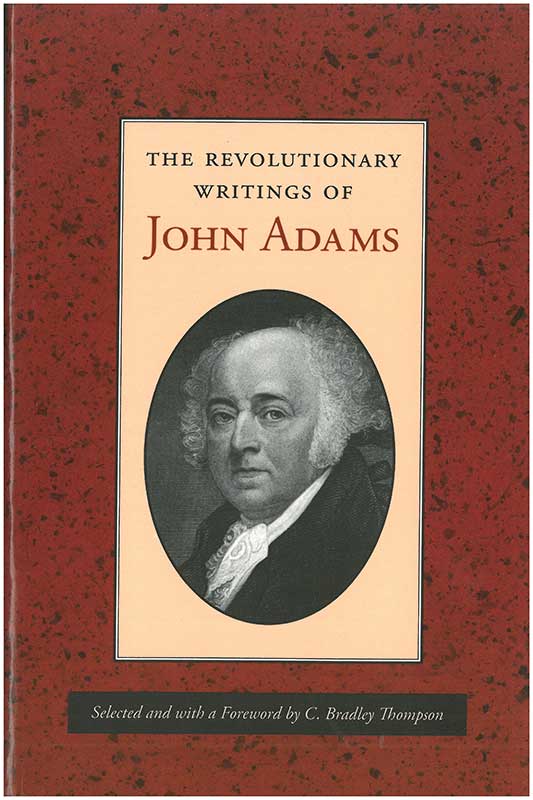
Return to Title Page for Revolutionary WritingsThe Online Library of LibertyA project of Liberty Fund, Inc.Search this Title:Also in the Library:No. iii - John Adams, Revolutionary Writings [1763]Edition used:The Revolutionary Writings of John Adams, Selected and with a Foreword by C. Bradley Thompson (Indianapolis: Liberty Fund, 2000).
About Liberty Fund:Liberty Fund, Inc. is a private, educational foundation established to encourage the study of the ideal of a society of free and responsible individuals. Copyright information:The copyright to this edition, in both print and electronic forms, is held by Liberty Fund, Inc. Fair use statement:This material is put online to further the educational goals of Liberty Fund, Inc. Unless otherwise stated in the Copyright Information section above, this material may be used freely for educational and academic purposes. It may not be used in any way for profit.
No. iiiSir,—You are pleased to charge the colonists with ignorance of the British constitution; but let me tell you there is not ever a son of liberty among them who has not manifested a deeper knowledge of it, and a warmer attachment to it, than appears in any of your late writings; they know the true constitution and all the resources of liberty in it, as well as in the law of nature, which is one principal foundation of it, and in the temper and character of the people much better than you, if we judge by your late impudent pieces, or than your patron and master, if we judge by his late conduct. The people in America have discovered the most accurate judgment about the real constitution, I say, by their whole behavior, excepting the excesses of a few, who took advantage of the general enthusiasm to perpetrate their ill designs; though there has been great inquiry and some apparent puzzle among them about a formal, logical, technical definition of it. Some have defined it to be the practice of parliament; others, the judgments and precedents of the king’s courts; but either of these definitions would make it a constitution of wind and weather, because the parliaments have sometimes voted the king absolute, and the judges have sometimes adjudged him to be so. Some have called it custom, but this is as fluctuating and variable as the other. Some have called it the most perfect combination of human powers in society which finite wisdom has yet contrived and reduced to practice for the preservation of liberty and the production of happiness. This is rather a character of the constitution and a just observation concerning it, than a regular definition of it, and leaves us still to dispute what it is. Some have said that the whole body of the laws, others that king, lords, and commons, make the constitution. There has also been much inquiry and dispute about the essentials and fundamentals of the constitution, and many definitions and descriptions have been attempted; but there seems to be nothing satisfactory to a rational mind in any of these definitions; yet I cannot say that I am at a loss about any man’s meaning when he speaks of the British constitution or the essentials and fundamentals of it. What do we mean when we talk of the constitution of the human body? what by a strong and robust, or a weak and feeble constitution? Do we not mean certain contextures of the nerves, fibres, and muscles, or certain qualities of the blood and juices, as sizy or watery, phlegmatic or fiery, acid or alkaline? We can never judge of any constitution without considering the end of it; and no judgment can be formed of the human constitution without considering it as productive of life or health or strength. The physician shall tell one man that certain kinds of exercise or diet or medicine are not adapted to his constitution, that is, not compatible with his health, which he would readily agree are the most productive of health in another. The patient’s habit abounds with acid and acrimonious juices. Will the doctor order vinegar, lemon juice, barberries, and cranberries, to work a cure? These would be unconstitutional remedies, calculated to increase the evil which arose from the want of a balance between the acid and alkaline ingredients in his composition. If the patient’s nerves are overbraced, will the doctor advise to jesuits’-bark? There is a certain quantity of exercise, diet, and medicine, best adapted to every man’s constitution, which will keep him in the best health and spirits, and contribute the most to the prolongation of his life. These determinate quantities are not perhaps known to him or any other person; but here lies the proper province of the physician, to study his constitution and give him the best advice what and how much he may eat and drink; when and how long he shall sleep; how far he may walk or ride in a day; what air and weather he may improve for this purpose; when he shall take physic, and of what sort it shall be, in order to preserve and perfect his health and prolong his life. But there are certain other parts of the body which the physician can, in no case, have any authority to destroy or deprave; which may properly be called stamina vitae, or essentials and fundamentals of the constitution; parts, without which, life itself cannot be preserved a moment. Annihilate the heart, lungs, brain, animal spirits, blood, any one of these, and life will depart at once. These may be strictly called fundamentals of the human constitution. Though the limbs may be all amputated, the eyes put out, and many other mutilations practised to impair the strength, activity, and other attributes of the man, and yet the essentials of life may remain unimpaired many years. Similar observations may be made, with equal propriety, concerning every kind of machinery. A clock has also a constitution, that is a certain combination of weights, wheels, and levers, calculated for a certain use and end, the mensuration of time. Now, the constitution of a clock does not imply such a perfect constructure of movement as shall never go too fast or too slow, as shall never gain nor lose a second of time in a year or century. This is the proper business of Quare, Tomlinson, and Graham, to execute the workmanship like artists, and come as near to perfection, that is, as near to a perfect mensuration of time, as the human eye and finger will allow. But yet there are certain parts of a clock, without which it will not go at all, and you can have from it no better account of the time of day than from the ore of gold, silver, brass, and iron, out of which it was wrought. These parts, therefore, are the essentials and fundamentals of a clock. Let us now inquire whether the same reasoning is not applicable in all its parts to government. For government is a frame, a scheme, a system, a combination of powers for a certain end, namely,—the good of the whole community. The public good, the salus populi, is the professed end of all government, the most despotic as well as the most free. I shall enter into no examination which kind of government, whether either of the forms of the schools, or any mixture of them, is best calculated for this end. This is the proper inquiry of the founders of empires. I shall take for granted, what I am sure no Briton will controvert, namely,—that liberty is essential to the public good, the salus populi. And here lies the difference between the British constitution and other forms of government, namely, that liberty is its end, its use, its designation, drift, and scope, as much as grinding corn is the use of a mill, the transportation of burdens the end of a ship, the mensuration of time the scope of a watch, or life and health the designation of the human body. Were I to define the British constitution, therefore, I should say, it is a limited monarchy, or a mixture of the three forms of government commonly known in the schools, reserving as much of the monarchical splendor, the aristocratical independency, and the democratical freedom, as are necessary that each of these powers may have a control, both in legislation and execution, over the other two, for the preservation of the subject’s liberty. According to this definition, the first grand division of constitutional powers is into those of legislation and those of execution. In the power of legislation, the king, lords, commons, and people are to be considered as essential and fundamental parts of the constitution. I distinguish between the house of commons and the people who depute them; because there is in nature and fact a real difference, and these last have as important a department in the constitution as the former—I mean the power of election. The constitution is not grounded on “the enormous faith of millions made for one.” It stands not on the supposition, that kings are the favorites of heaven, that their power is more divine than the power of the people, and unlimited but by their own will and discretion. It is not built on the doctrine, that a few nobles or rich commons have a right to inherit the earth, and all the blessings and pleasures of it; and that the multitude, the million, the populace, the vulgar, the mob, the herd, and the rabble, as the great always delight to call them, have no rights at all, and were made only for their use, to be robbed and butchered at their pleasure. No, it stands upon this principle, that the meanest and lowest of the people are by the unalterable, indefeasible laws of God and nature, as well entitled to the benefit of the air to breathe, light to see, food to eat, and clothes to wear, as the nobles or the king. All men are born equal; and the drift of the British constitution is to preserve as much of this equality as is compatible with the people’s security against foreign invasions and domestic usurpation. It is upon these fundamental principles that popular power was placed, as essential, in the constitution of the legislature; and the constitution would be as complete without a kingly as without a popular power. This popular power, however, when the numbers grew large, became impracticable to be exercised by the universal and immediate suffrage of the people; and this impracticability has introduced from the feudal system an expedient which we call representation. This expedient is only an equivalent for the suffrage of the whole people in the common management of public concerns. It is in reality nothing more than this, the people choose attorneys to vote for them in the great council of the nation, reserving always the fundamentals of the government, reserving also a right to give their attorneys instructions how to vote, and a right at certain, stated intervals, of choosing a-new; discarding an old attorney, and choosing a wiser and better. And it is this reservation of fundamentals, of the right of giving instructions, and of new elections, which creates a popular check upon the whole government which alone secures the constitution from becoming an aristocracy, or a mixture of monarchy and aristocracy only. The other grand division of power is that of execution. And here the king is, by the constitution, supreme executor of the laws, and is always present, in person or by his judges, in his courts, distributing justice among the people. But the executive branch of the constitution, as far as respects the administration of justice, has in it a mixture of popular power too. The judges answer to questions of fact as well as law; being few, they might be easily corrupted; being commonly rich and great, they might learn to despise the common people, and forget the feelings of humanity, and then the subject’s liberty and security would be lost. But by the British constitution, ad quaestionem facti respondent juratores,—the jurors answer to the question of fact. In this manner, the subject is guarded in the execution of the laws. The people choose a grand jury, to make inquiry and presentment of crimes. Twelve of these must agree in finding the bill. And the petit jury must try the same fact over again, and find the person guilty, before he can be punished. Innocence, therefore, is so well protected in this wise constitution, that no man can be punished till twenty-four of his neighbors have said upon oath that he is guilty. So it is also in the trial of causes between party and party. No man’s property or liberty can be taken from him till twelve men in his neighborhood have said upon oath, that by laws of his own making it ought to be taken away, that is, that the facts are such as to fall within such laws. Thus, it seems to appear, that two branches of popular power, voting for members of the house of commons, and trials by juries, the one in the legislative and the other in the executive part of the constitution, are as essential and fundamental to the great end of it, the preservation of the subject’s liberty, to preserve the balance and mixture of the government, and to prevent its running into an oligarchy or aristocracy, as the lords and commons are to prevent its becoming an absolute monarchy. These two popular powers, therefore, are the heart and lungs, the mainspring and the centre wheel, and without them the body must die, the watch must run down, the government must become arbitrary, and this our law books have settled to be the death of the laws and constitution. In these two powers consist wholly the liberty and security of the people. They have no other fortification against wanton, cruel power; no other indemnification against being ridden like horses, fleeced like sheep, worked like cattle, and fed and clothed like swine and hounds; no other defence against fines, imprisonments, whipping-posts, gibbets, bastinadoes, and racks. This is that constitution which has prevailed in Britain from an immense antiquity. It prevailed, and the house of commons and trials by jury made a part of it, in Saxon times, as may be abundantly proved by many monuments still remaining in the Saxon language. That constitution which has been for so long a time the envy and admiration of surrounding nations; which has been no less than five and fifty times since the Norman conquest, attacked in parliament, and attempted to be altered, but without success; which has been so often defended by the people of England, at the expense of oceans of their blood; and which, coöperating with the invincible spirit of liberty inspired by it into the people, has never failed to work the ruin of the authors of all settled attempts to destroy it. What a fine reflection and consolation is it for a man, that he can be subjected to no laws which he does not make himself, or constitute some of his friends to make for him,—his father, brother, neighbor, friend, a man of his own rank, nearly of his own education, fortune, habits, passions, prejudices, one whose life and fortune and liberty are to be affected, like those of his constituents, by the laws he shall consent to for himself and them! What a satisfaction is it to reflect, that he can lie under the imputation of no guilt, be subjected to no punishment, lose none of his property, or the necessaries, conveniences, or ornaments of life, which indulgent Providence has showered around him, but by the judgment of his peers, his equals, his neighbors, men who know him and to whom he is known, who have no end to serve by punishing him, who wish to find him innocent, if charged with a crime, and are indifferent on which side the truth lies, if he disputes with his neighbor! Your writings, Mr. Pym, have lately furnished abundant proofs that the infernal regions have taken from you all your shame, sense, conscience, and humanity; otherwise I would appeal to them, who has discovered the most ignorance of the British constitution,—you who are for exploding the whole system of popular power with regard to the Americans, or they who are determined to stand by it, in both its branches, with their lives and fortunes. Clarendon 5Governor Winthrop to Governor BradfordIn the winter of 1766–77, Adams’s old friend, Jonathan Sewell, published a series of articles under the pseudonym Philanthrop. Sewell wrote to defend Governor Bernard from recent attacks alleging, among other things, that Bernard had violated the rights of the Massachusetts House of Representatives to judge the qualifications of its members by refusing to administer the oath to two newly elected representatives from Newbury. In his “Govenor Winthrop to Governor Bradford” essays, Adams once again returned to a favorite literary device: a fictional correspondence between two great statesmen of the seventeenth century. Invoking the memory of New England’s two founding fathers—John Winthrop of Massachusetts Bay and William Bradford of Plymouth—Adams devotes these letters to examining the authority of the Governor to interfere with the privileges of the House and to drawing a parallel between the tyrannical actions of James I and the political principles of Philanthrop. More importantly, Adams wrote these letters to counteract what he saw as a political and moral lethargy descending upon the people of Massachusetts in the months after the repeal of the Stamp Act. In a diary entry at the time, Adams feared that the people of Massachusetts had fallen as “quiet and submissive to Government, as any People under the sun.” By calling to life these venerable statesmen, Adams hoped to remind his fellow citizens that the price of liberty is eternal vigilance. In doing so, he hoped also to resurrect the ancient “spirit of liberty” that had inspired Winthrop and Bradford a century before and which had more recently animated the colonies in their fight against parliamentary taxation. 26 January, 1767 |

Titles (by Subject)