Econlib

The Library

Other Sites

Front Page arrow Titles (by Subject) arrow The Sphere and Duties of Government (The Limits of State Action) (1854 ed.)

Search this Title:

Also in the Library:

Subject Area: Political Theory
Collection: Classics of Liberty

Wilhelm von Humboldt, The Sphere and Duties of Government (The Limits of State Action) (1854 ed.) [1792]

Edition used:

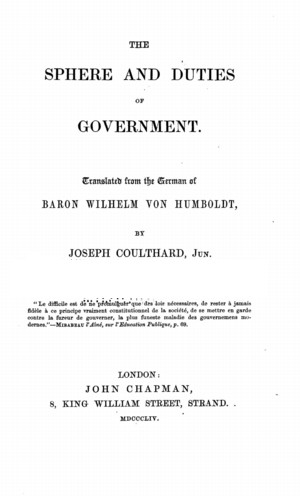
The Sphere and Duties of Government. Translated from the German of Baron Wilhelm von Humboldt, by Joseph Coulthard, Jun. (London: John Chapman, 1854).


This Title Is Available In The Following Formats:

HTML441.43 KBThis version has been converted from the original text. Every effort has been taken to translate the unique features of the printed book into the HTML medium.
HTML by Chapter(varies)View this title one chapter at a time.
Facsimile PDF14.16 MB

This is a facsimile or image-based PDF made from scans of the original book.

Facsimile PDF small6.43 MB

This is a compressed facsimile or image-based PDF made from scans of the original book.

EBook PDF1.04 MB

This text-based PDF or EBook was created from an earlier HTML version of this book and is part of the Portable Library of Liberty.

0053_TP
About this title:

A mid-19th century translation of this work. “The grand, leading principle, towards which every argument … unfolded in these pages directly converges, is the absolute and essential importance of human development in its richest diversity.” This description by Wilhelm von Humboldt of his purpose in writing The Limits of State Action animates John Stuart Mill’s On Liberty and serves as its famous epigraph. Seldom has a book spoken so dramatically to another writer. Many commentators even believe that Humboldt’s discussion of issues of freedom and individual responsibility possesses greater clarity and directness than Mill’s. The Limits of State Action, by “Germany’s greatest philosopher of freedom,” as F. A. Hayek called him, has an exuberance and attention to principle that make it a valuable introduction to classical liberal political thought. It is also crucial for an understanding of liberalism as it developed in Europe at the turn of the nineteenth century. Humboldt explores the role that liberty plays in individual development, discusses criteria for permitting the state to limit individual actions, and suggests ways of confining the state to its proper bounds. In so doing, he uniquely combines the ancient concern for human excellence and the modern concern for what has come to be known as negative liberty.

About Liberty Fund:

Liberty Fund, Inc. is a private, educational foundation established to encourage the study of the ideal of a society of free and responsible individuals.


0053_ToC