EconlibThe LibraryOther Sites |
Front Page Titles (by Subject) PART III.: of a CHRISTIAN COMMONWEALTH. - The English Works, vol. III (Leviathan)
Return to Title Page for The English Works, vol. III (Leviathan)The Online Library of LibertyA project of Liberty Fund, Inc.Search this Title:Also in the Library:
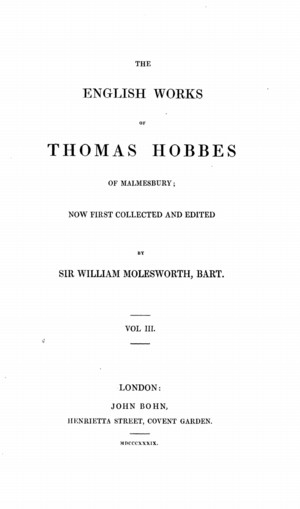
PART III.: of a CHRISTIAN COMMONWEALTH. - Thomas Hobbes, The English Works, vol. III (Leviathan) [1651]Edition used:The English Works of Thomas Hobbes of Malmesbury; Now First Collected and Edited by Sir William Molesworth, Bart., (London: Bohn, 1839-45). 11 vols. Vol. 3.
Part of: The English Works of Thomas Hobbes, 11 vols.About Liberty Fund:Liberty Fund, Inc. is a private, educational foundation established to encourage the study of the ideal of a society of free and responsible individuals. Copyright information:The text is in the public domain. Fair use statement:This material is put online to further the educational goals of Liberty Fund, Inc. Unless otherwise stated in the Copyright Information section above, this material may be used freely for educational and academic purposes. It may not be used in any way for profit.
PART III.of a CHRISTIAN COMMONWEALTH.CHAPTER XXXII.of the principles of christian politics.The word of God delivered by prophets is the main principle of Christian politics. I have derived the rights of sovereign power, and the duty of subjects, hitherto from the principles of nature only; such as experience has found true, or consent concerning the use of words has made so; that is to say, from the nature of men, known to us by experience, and from definitions of such words as are essential to all political reasoning, universally agreed on. But in that I am next to handle, which is the nature and rights of a Christian Commonwealth, whereof there dependeth much upon supernatural revelations of the will of God; the ground of my discourse must be, not only the natural word of God, but also the prophetical. Yet is not natural reason to be renounced. Nevertheless, we are not to renounce our senses, and experience; nor, that which is the undoubted word of God, our natural reason. For they are the talents which he hath put into our hands to negotiate, till the coming again of our blessed Saviour; and therefore not to be folded up in the napkin of an implicit faith, but employed in the purchase of justice, peace, and true religion. For though there be many things in God’s word above reason; that it is to say, which cannot by natural reason be either demonstrated, or confuted; yet there is nothing contrary to it; but when it seemeth so, the fault is either in our unskilful interpretation, or erroneous ratiocination. Therefore, when anything therein written is too hard for our examination, we are bidden to captivate our understanding to the words; and not to labour in sifting out a philosophical truth by logic, of such mysteries as are not comprehensible, nor fall under any rule of natural science. For it is with the mysteries of our religion, as with wholesome pills for the sick; which swallowed whole, have the virtue to cure; but chewed, are for the most part cast up again without effect. What it is to captivate the understanding. But by the captivity of our understanding, is not meant a submission of the intellectual faculty to the opinion of any other man; but of the will to obedience, where obedience is due. For sense, memory, understanding, reason, and opinion are not in our power to change; but always, and necessarily such, as the things we see, hear, and consider suggest unto us; and therefore are not effects of our will, but our will of them. We then captivate our understanding and reason, when we forbear contradiction; when we so speak, as by lawful authority we are commanded; and when we live accordingly; which, in sum, is trust and faith reposed in him that speaketh, though the mind be incapable of any notion at all from the words spoken. How God speaketh to men. When God speaketh to man, it must be either immediately; or by mediation of another man, to whom he had formerly spoken by himself immediately. How God speaketh to a man immediately, may be understood by those well enough, to whom he hath so spoken; but how the same should be understood by another, is hard, if not impossible to know. For if a man pretend to me, that God hath spoken to him supernaturally and immediately, and I make doubt of it, I cannot easily perceive what argument he can produce, to oblige me to believe it. It is true, that if he be my sovereign, he may oblige me to obedience, so, as not by act or word to declare I believe him not; but not to think any otherwise than my reason persuades me. But if one that hath not such authority over me, should pretend the same, there is nothing that exacteth either belief, or obedience. For to say that God hath spoken to him in the Holy Scripture, is not to say God hath spoken to him immediately, but by mediation of the prophets, or of the apostles, or of the church, in such manner as he speaks to all other Christian men. To say he hath spoken to him in a dream, is no more than to say he dreamed that God spake to him; which is not of force to win belief from any man, that knows dreams are for the most part natural, and may proceed from former thoughts; and such dreams as that, from self-conceit, and foolish arrogance, and false opinion of a man’s own godliness, or other virtue, by which he thinks he hath merited the favour of extraordinary revelation. To say he hath seen a vision, or heard a voice, is to say, that he hath dreamed between sleeping and waking: for in such manner a man doth many times naturally take his dream for a vision, as not having well observed his own slumbering. To say he speaks by supernatural inspiration, is to say he finds an ardent desire to speak, or some strong opinion, of himself, for which he can allege no natural and sufficient reason. So that though God Almighty can speak to a man by dreams, visions, voice, and inspiration; yet he obliges no man to believe he hath so done to him that pretends it; who, being a man, may err, and, which is more, may lie. By what marks prophets are known. How then can he, to whom God hath never revealed his will immediately, saving by the way of natural reason, know when he is to obey, or not to obey his word, delivered by him that says he is a prophet? Of four hundred prophets, of whom the king of Israel asked counsel, concerning the war he made against Ramoth Gilead, (1 Kings, xxii.) only Micaiah was a true one. The prophet that was sent to prophecy against the altar set up by Jeroboam, (1 Kings, xiii.) though a true prophet, and that by two miracles done in his presence, appears to be a prophet sent from God, was yet deceived by another old prophet, that persuaded him as from the mouth of God, to eat and drink with him. If one prophet deceive another, what certainty is there of knowing the will of God, by other way than that of reason? To which I answer out of the Holy Scripture, that there be two marks, by which together, not asunder, a true prophet is to be known. One is the doing of miracles; the other is the not teaching any other religion than that which is already established. Asunder, I say, neither of these is sufficient. If a prophet rise amongst you, or a dreamer of dreams, and shall pretend the doing of a miracle, and the miracle come to pass; if he say, Let us follow strange Gods, which thou hast not known, thou shalt not hearken to him, &c. But that prophet and dreamer of dreams shall be put to death, because he hath spoken to you to revolt from the Lord your God. (Deut. xiii. 1-5.) In which words two things are to be observed; first, that God will not have miracles alone serve for arguments, to approve the prophet’s calling; but, as it is in the third verse, for an experiment of the constancy of our adherence to himself. For the works of the Egyptian sorcerers, though not so great as those of Moses, yet were great miracles. Secondly, that how great soever the miracle be, yet if it tend to stir up revolt against the king, or him that governeth by the king’s authority, he that doth such miracle, is not to be considered otherwise than as sent to make trial of their allegiance. For these words, revolt from the Lord your God, are in this place equivalent to revolt from your king. For they had made God their king by pact at the foot of Mount Sinai; who ruled them by Moses only; for he only spake with God, and from time to time declared God’s commandments to the people. In like manner, after our Saviour Christ had made his disciples acknowledge him for the Messiah, (that is to say, for God’s anointed, whom the nation of the Jews daily expected for their king, but refused when he came,) he omitted not to advertise them of the danger of miracles. There shall arise, saith he, false Christs, and false prophets, and shall do great wonders and miracles,even to the seducing, if it were possible, of the very elect. (Matt. xxiv. 24.) By which it appears, that false prophets may have the power of miracles; yet are we not to take their doctrine for God’s word. St. Paul says farther to the Galatians, (Gal. i. 8.) that if himself, or an angel from heaven preach another gospel to them, than he had preached, let him be accursed. That gospel was, that Christ was King; so that all preaching against the power of the king received, in consequence to these words, is by St. Paul accursed. For his speech is addressed to those, who by his preaching had already received Jesus for the Christ, that is to say, for King of the Jews. The marks of a prophet in the old law, miracles, and doctrine comformable to the law. And as miracles, without preaching that doctrine which God hath established; so preaching the true doctrine, without the doing of miracles, is an insufficient argument of immediate revelation. For if a man that teacheth not false doctrine, should pretend to be a prophet without showing any miracle, he is never the more to be regarded for his pretence, as is evident by Deut. xviii. v. 21, 22, If thou say in thy heart, How shall we know that the word (of the prophet) is not that which the Lord hath spoken? when the prophet shall have spoken in the name of the Lord, that which shall not come to pass, that is the word which the Lord hath not spoken, but the prophet has spoken it out of the pride of his own heart, fear him not. But a man may here again ask, when the prophet hath foretold a thing, how shall we know whether it will come to pass or not? For he may foretell it as a thing to arrive after a certain long time, longer than the time of man’s life; or indefinitely, that it will come to pass one time or other: in which case this mark of a prophet is unuseful; and therefore the miracles that oblige us to believe a prophet, ought to be confirmed by an immediate, or a not long deferred event. So that it is manifest, that the teaching of the religion which God hath established, and the showing of a present miracle, joined together, were the only marks whereby the Scripture would have a true prophet, that is to say, immediate revelation, to be acknowledged; neither of them being singly sufficient to oblige any other man to regard what he saith. Miracles ceasing, prophets cease, and the Scripture supplies their place Seeing therefore miracles now cease, we have no sign left, whereby to acknowledge the pretended revelations or inspirations of any private man; nor obligation to give ear to any doctrine, farther than it is conformable to the Holy Scriptures, which since the time of our Saviour, supply the place, and sufficiently recompense the want of all other prophecy; and from which, by wise and learned interpretation, and careful ratiocination, all rules and precepts necessary to the knowledge of our duty both to God and man, without enthusiasm or supernatural inspiration, may easily be deduced. And this Scripture is it, out of which I am to take the principles of my discourse, concerning the rights of those that are the supreme governors on earth of Christian commonwealths; and of the duty of Christian subjects towards their sovereigns. And to that end, I shall speak in the next chapter, of the books, writers, scope and authority of the Bible. CHAPTER XXXIII.of the number, antiquity, scope, authority and interpreters of the books of holy scripture.Of the books of HolyScripture. By the Books of Holy Scripture, are understood those, which ought to be the canon, that is to say, the rules of Christian life. And because all rules of life, which men are in conscience bound to observe, are laws; the question of the Scripture, is the question of what is law throughout all Christendom, both natural and civil. For though it be not determined in Scripture, what laws every Christian king shall constitute in his own dominions; yet it is determined what laws he shall not constitute. Seeing therefore I have already proved, that sovereigns in their own dominions are the sole legislators; those books only are canonical, that is, law, in every nation, which are established for such by the sovereign authority. It is true, that God is the sovereign of all sovereigns; and therefore, when he speaks to any subject, he ought to be obeyed, whatsoever any earthly potentate command to the contrary. But the question is not of obedience to God, but of when and what God hath said; which to subjects that have no supernatural revelation, cannot be known, but by that natural reason, which guideth them, for the obtaining of peace and justice, to obey the authority of their several commonwealths, that is to say, of their lawful sovereigns. According to this obligation, I can acknowledge no other books of the Old Testament, to be Holy Scripture, but those which have been commanded to be acknowledged for such, by the authority of the Church of England. What books these are, is sufficiently known, without a catalogue of them here; and they are the same that are acknowledged by St. Jerome, who holdeth the rest, namely, the Wisdom of Solomon, Ecclesiasticus, Judith, Tobias, the first and the second of Maccabees, (though he had seen the first in Hebrew,) and the third and fourth of Esdras, for Apocrypha. Of the canonical, Josephus, a learned Jew, that wrote in the time of the emperor Domitian, reckoneth twenty-two, making the number agree with the Hebrew alphabet. St. Jerome does the same, though they reckon them in different manner. For Josephus numbers five Books of Moses, thirteen of Prophets that writ the history of their own times, (which how it agrees with the prophets’ writings contained in the Bible we shall see hereafter,) and four of hymns and moral precepts. But St. Jerome reckons five books of Moses, eight of Prophets, and nine of other Holy Writ, which he calls of ἁγιόγρ̧αϕα. The Septuagint, who were seventy learned men of the Jews, sent for by Ptolemy, king of Egypt, to translate the Jewish law out of the Hebrew into the Greek, have left us no other for Holy Scripture in the Greek tongue, but the same that are received in the Church of England. As for the Books of the New Testament, they are equally acknowledged for canon by all Christian churches, and by all sects of Christians, that admit any books at all for canonical. Their antiquity Who were the original writers of the several Books of Holy Scripture, has not been made evident by any sufficient testimony of other history, which is the only proof of matter of fact; nor can be, by any arguments of natural reason: for reason serves only to convince the truth, not of fact, but, of consequence. The light therefore that must guide us in this question, must be that which is held out unto us from the books themselves: and this light, though it show us not the writer of every book, yet it is not unuseful to give us knowledge of the time, wherein they were written. The Pentateuch not written by Moses. And first, for the Pentateuch, it is not argument enough that they were written by Moses, because they are called the five Books of Moses; no more than these titles, the Book of Joshua, the Book of Judges, the Book of Ruth, and the Books of the Kings, are arguments sufficient to prove, that they were written by Joshua, by the Judges, by Ruth, and by the Kings. For in titles of books, the subject is marked, as often as the writer. The history of Livy, denotes the writer; but the history of Scanderberg, is denominated from the subject. We read in the last chapter of Deuteronomy, verse 6th, concerning the sepulchre of Moses, that no man knoweth of his sepulchre to this day, that is, to to the day wherein those words were written. It is therefore manifest, that those words were written after his interment. For it were a strange interpretation, to say Moses spake of his own sepulchre, though by prophecy, that it was not found to that day, wherein he was yet living. But it may perhaps be alleged, that the last chapter only, not the whole Pentateuch, was written by some other man, but the rest not. Let us therefore consider that which we find in the book of Genesis, (xii. 6.) And Abraham passed through the land to theplace of Sichem, unto the plain of Moreh, and the Canaanite was then in the land; which must needs be the words of one that wrote when the Canaanite was not in the land; and consequently, not of Moses, who died before he came into it. Likewise Numbers, xxi. 14, the writer citeth another more ancient book, entitled, The Book of the Wars of the Lord, wherein were registered the acts of Moses, at the Red Sea, and at the brook of Arnon. It is therefore sufficiently evident, that the five Books of Moses were written after his time, though how long after it be not so manifest. But though Moses did not compile those books entirely, and in the form we have them; yet he wrote all that which he is there said to have written: as for example, the Volume of the Law, which is contained, as it seemeth, in the xith. of Deuteronomy, and the following chapters to the xxviith. which was also commanded to be written on stones, in their entry into the land of Canaan. And this also did Moses himself write, (Deut. xxxi. 9, 10) and delivered to the priests and elders of Israel, to be read every seventh year to all Israel, at their assembling in the Feast of Tabernacles. And this is that law which God commanded, that their kings, when they should have established that form of government, should take a copy of from the priests and Levites: and which Moses commanded the priests and Levites to lay in the side of the ark, (Deut. xxxi. 26); and the same which having been lost, was long time after found again by Hilkiah, and sent to king Josias (2 Kings xxii. 8) who causing it to be read to the people, (2 Kings xxiii. 1, 2, 3) renewed the covenant between God and them. The book of Joshua written after his time. That the book of Joshua was also written long after the time of Joshua, may be gathered out of many places of the book itself. Joshua had set up twelve stones in the midst of Jordan, for a monument of their passage; of which the writer saith thus, They are there unto this day (Josh. iv. 9); for unto this day, is a phrase that signifieth a time past, beyond the memory of man. In like manner, upon the saying of the Lord, that he had rolled off from the people the reproach of Egypt, the writer saith, The place is called Gilgal unto this day (Josh. v. 9); which to have said in the time of Joshua had been improper. So also the name of the valley of Achor, from the trouble that Achan raised in the camp, the writer saith, remaineth unto this day (Josh. vii. 26); which must needs be therefore long after the time of Joshua. Arguments of this kind there be many other; as Josh. viii. 29, xiii. 13, xiv. 14, xv. 63. The books of Judges and Ruth written long after the captivity. The same is manifest by like arguments of the book of Judges, chap. i. 21, 26, vi. 24, x. 4, xv. 19, xvii. 6, and Ruth i. 1; but especially Judg. xviii. 30, where it is said, that Jonathan and his sons were priests to the tribe of Dan, until the day of the captivity of the land. The like of the books of Samuel. That the books of Samuel were also written after his own time, there are the like arguments, 1 Sam. v. 5, vii. 13, 15; xxvii, 6, and xxx. 25, where, after David had adjudged equal part of the spoils, to them that guarded the ammunition, with them that fought, the writer saith, He made it a statute and an ordinance to Israel to this day. Again, when David, displeased, that the Lord had slain Uzzah, for putting out his hand to sustain the ark, called the place Perez-Uzzah, the writer saith, (2 Sam. vi. 8) it is called so to this day: the time therefore of the writing of that book, must be long after the time of the fact; that is, long after the time of David. The books of the Kings, and the Chronicles. As for the two books of the Kings, and the two books of the Chronicles, besides the places which mention such monuments, as the writer saith, remained till his own days; such as are 1 Kings ix. 13, ix. 21, x. 12, xii. 19. 2 Kings ii. 22, viii. 22, x. 27, xiv. 7, xvi. 6, xvii. 23, xvii. 34, xvii. 41, and 1 Chron. iv. 41, v. 26: it is argument sufficient they were written after the captivity in Babylon, that the history of them is continued till that time. For the facts registered are always more ancient than the register; and much more ancient than such books as make mention of, and quote the register; as these books do in divers places, referring the reader to the Chronicles of the Kings of Judah, to the Chronicles of the Kings of Israel, to the Books of the prophet Samuel, of the prophet Nathan, of the prophet Ahijah; to the Vision of Jehdo, to the books of the prophet Serveiah, and of the prophet Addo. Ezra and Nehemiah. The books of Ezra and Nehemiah were written certainly after their return from captivity; because their return, the re-edification of the walls and houses of Jerusalem, the renovation of the covenant, and ordination of their policy, are therein contained. Esther. The history of Queen Esther is of the time of the captivity; and therefore the writer must have been of the same time, or after it. Job. The book of Job hath no mark in it of the time wherein it was written; and though it appear sufficiently (Ezekiel xiv. 14, and James v. 11) that he was no feigned person; yet the book itself seemeth not to be a history, but a treatise concerning a question in ancient time much disputed, why wicked men have often prospered in this world, and good men have been afflicted; and this is the more probable, because from the beginning, to the third verse of the third chapter, where the complaint of Job beginneth, the Hebrew is, as St. Jerome testifies, in prose; and from thence to the sixth verse of the last chapter, in hexameter verses; and the rest of that chapter again in prose. So that the dispute is all in verse; and the prose is added, but as a preface in the beginning, and an epilogue in the end. But verse is no usual style of such, as either are themselves in great pain, as Job; or of such as come to comfort them, as his friends; but in philosophy, especially moral philosophy, in ancient time frequent. The Psalter. The Psalms were written the most part by David, for the use of the quire. To these are added some songs of Moses, and other holy men; and some of them after the return from the captivity, as the 137th and the 126th, whereby it is manifest that the Psalter was compiled, and put into the form it now hath, after the return of the Jews from Babylon. The Proverbs. The Proverbs, being a collection of wise and godly sayings, partly of Solomon, partly of Agur, the son of Jakeh, and partly of the mother of king Lemuel, cannot probably be thought to have been collected by Solomon, rather than by Agur, or the mother of Lemuel; and that, though the sentences be theirs, yet the collection or compiling them into this one book, was the work of some other godly man, that lived after them all. Ecclesiastes and the Canticles. The books of Ecclesiastes and the Canticles have nothing that was not Solomon’s, except it be the titles, or inscriptions. For The Words of the Preacher, the son of David, king in Jerusalem; and, The Song of Songs, which is Solomon’s, seem to have been made for distinction’s sake, then, when the Books of Scripture were gathered into one body of the law; to the end, that not the doctrine only, but the authors also might be extant. The Prophets. Of the prophets, the most ancient, are Zephaniah, Jonah, Amos, Hosea, Isaiah, and Michah, who lived in the time of Amaziah and Azariah, otherwise Ozias, kings of Judah. But the book of Jonah is not properly a register of his prophecy; for that is contained in these few words, Forty days and Niniveh shall be destroyed; but a history or narration of his frowardness and disputing God’s commandments; so that there is small probability he should be the author, seeing he is the subject of it. But the book of Amos is his prophecy. Jeremiah, Obadiah, Nahum, and Habakkuk prophecied in the time of Josiah. Ezekiel, Daniel, Haggai, and Zechariah, in the captivity. When Joel and Malachi prophecied, is not evident by their writings. But considering the inscriptions, or titles of their books, it is manifest enough, that the whole Scripture of the Old Testament, was set forth in the form we have it, after the return of the Jews from their captivity in Babylon, and before the time of Ptolomæus Philadelphus, that caused it to be translated into Greek by seventy men, which were sent him out of Judea for that purpose. And if the books of Apocrypha, which are recommended to us by the church, though not for canonical, yet for profitable books for our instruction, may in this point be credited, the Scripture was set forth in the form we have it in, by Esdras: as may appear by that which he himself saith, in the second book, (chapter xiv. verse 21, 22, &c.) where speaking to God, he saith thus, Thy law is burnt; therefore no man knoweth the things which thou hast done, or the works that are to begin. But if I have found grace before thee, send down the holy spirit into me, and I shall write all that hath been done in the world, since the beginning, which were written in thy law, that men may find thy path, and that they which will live in the latter day, may live. And verse 45: And it came to pass when the forty days were fulfilled, that the highest spake, saying, The first that thou hast written, publish openly, that the worthy and unworthy may read it; but keep the seventy last, that thou mayest deliver them only to such as be wise among the people. And thus much concerning the time of the writing of the books of the Old Testament. The New Testament.Their scope. The writers of the New Testament lived all in less than an age after Christ’s ascension, and had all of them seen our Saviour, or been his disciples, except St. Paul, and St. Luke; and consequently whatsoever was written by them, is as ancient as the time of the apostles. But the time wherein the books of the New Testament were received, and acknowledged by the church to be of their writing, is not altogether so ancient. For, as the books of the Old Testament are derived to us, from no other time than that of Esdras, who by the direction of God’s spirit retrieved them, when they were lost: those of the New Testament, of which the copies were not many, nor could easily be all in any one private man’s hand, cannot be derived from a higher time, than that wherein the governors of the church collected, approved, and recommended them to us, as the writings of those apostles and disciples, under whose names they go. The first enumeration of all the books, both of the Old and New Testament, is in the canons of the apostles, supposed to be collected by Clement, the first (after St. Peter) bishop of Rome. But because that is but supposed, and by many questioned, the Council of Laodicea is the first we know, that recommended the Bible to the then Christian churches, for the writings of the prophets and apostles: and this Council was held in the 364th year after Christ. At which time, though ambition had so far prevailed on the great doctors of the church, as no more to esteem emperors, though Christian, for the shepherds of the people, but for sheep; and emperors not Christian, for wolves; and endeavoured to pass their doctrine, not for counsel and information, as preachers; but for laws, as absolute governors; and thought such frauds as tended to make the people the more obedient to Christian doctrine, to be pious; yet I am persuaded they did not therefore falsify the Scriptures, though the copies of the books of the New Testament, were in the hands only of the ecclesiastics; because if they had had an intention so to do, they would surely have made them more favourable to their power over Christian princes, and civil sovereignty, than they are. I see not therefore any reason to doubt but that the Old and New Testament, as we have them now, are the true registers of those things, which were done and said by the prophets and apostles. And so perhaps are some of those books which are called apocrypha, and left out of the canon, not for inconformity of doctrine with the rest, but only because they are not found in the Hebrew. For after the conquest of Asia by Alexander the Great, there were few learned Jews, that were not perfect in the Greek tongue. For the seventy interpreters that converted the Bible into Greek, were all of them Hebrews; and we have extant the works of Philo and Josephus, both Jews, written by them eloquently in Greek. But it is not the writer, but the authority of the church, that maketh the book canonical. And although these books were written by divers men, yet it is manifest the writers were all indued with one and the same spirit, in that they conspire to one and the same end, which is setting forth of the rights of the kingdom of God, the Father, Son, and Holy Ghost. For the book of Genesis, deriveth the genealogy of God’s people, from the creation of the world, to the going into Egypt: the other four books of Moses contain the election of God for their king, and the laws which he prescribed for their government: the books of Joshua, Judges, Ruth, and Samuel, to the time of Saul, describe the acts of God’s people, till the time they cast off God’s yoke, and called for a king, after the manner of their neighbour nations. The rest of the history of the Old Testament derives the succession of the line of David, to the captivity, out of which line was to spring the restorer of the kingdom of God, even our blessed Saviour God the Son, whose coming was foretold in the books of the prophets, after whom the Evangelists write his life, and actions, and his claim to the kingdom, whilst he lived on earth: and lastly, the Acts, and Epistles of the Apostles, declare the coming of God the Holy Ghost, and the authority he left with them and their successors, for the direction of the Jews, and for the invitation of the Gentiles. In sum, the histories and the prophecies of the Old Testament, and the gospels and epistles of the New Testament, have had one and the same scope, to convert men to the obedience of God; I., in Moses, and the Priests; II., in the man Christ; and III., in the Apostles and the successors to apostolical power. For these three at several times did represent the person of God: Moses, and his successors the High Priests, and Kings of Judah, in the Old Testament: Christ himself, in the time he lived on earth: and the Apostles, and their successors, from the day of Pentecost, when the Holy Ghost descended on them, to this day. The question of the authority of the Scriptures stated. It is a question much disputed between the divers sects of Christian religion, from whence the Scriptures derive their authority; which question is also propounded sometimes in other terms, as, how we know them to be the word of God, or, why we believe them to be so: and the difficulty of resolving it, ariseth chiefly from the improperness of the words wherein the question itself is couched. For it is believed on all hands, that the first and original author of them is God; and consequently the question disputed, is not that. Again, it is manifest, that none can know they are God’s word, (though all true Christians believe it,) but those to whom God himself hath revealed it supernaturally; and therefore the question is not rightly moved, of our knowledge of it. Lastly, when the question is propounded of our belief; because some are moved to believe for one, and others for other reasons; there can be rendered no one general answer for them all. The question truly stated is, by what authority they are made law. Their authority and interpretation. As far as they differ not from the laws of nature, there is no doubt, but they are the law of God, and carry their authority with them, legible to all men that have the use of natural reason: but this is no other authority, than that of all other moral doctrine consonant to reason; the dictates whereof are laws, not made, but eternal. If they be made law by God himself, they are of the nature of written law, which are laws to them only to whom God hath so sufficiently published them, as no man can excuse himself, by saying, he knew not they were his. He therefore to whom God hath not supernaturally revealed that they are his, nor that those that published them, were sent by him, is not obliged to obey them, by any authority, but his, whose commands have already the force of laws; that is to say, by any other authority, than that of the commonwealth, residing in the sovereign, who only has the legislative power. Again, if it be not the legislative authority of the commonwealth, that giveth them the force of laws, it must be some other authority derived from God, either private, or public: if private, it obliges only him, to whom in particular God hath been pleased to reveal it. For if every man should be obliged, to take for God’s law, what particular men, on pretence of private inspiration, or revelation, should obtrude upon him, in such a number of men, that out of pride and ignorance, take their own dreams, and extravagant fancies, and madness, for testimonies of God’s spirit; or out of ambition, pretend to such divine testimonies, falsely, and contrary to their own consciences, it were impossible that any divine law should be acknowledged. If public, it is the authority of the commonwealth, or of the church. But the church, if it be one person, is the same thing with a commonwealth of Christians; called a commonwealth, because it consisteth of men united in one person, their sovereign; and a church, because it consisteth in Christian men, united in one Christian sovereign. But if the church be not one person, then it hath no authority at all: it can neither command, nor do any action at all; nor is capable of having any power, or right to anything: nor has any will, reason nor voice; for all these qualities are personal. Now if the whole number of Christians be not contained in one commonwealth, they are not one person; nor is there an universal church that hath any authority over them; and therefore the Scriptures are not made laws, by the universal church: or if it be one commonwealth, then all Christian monarchs and states are private persons, and subject to be judged, deposed, and punished by an universal sovereign of all Christendom. So that the question of the authority of the Scriptures, is reduced to this, whether Christian kings, and the sovereign assemblies in Christian commonwealths, be absolute in their own territories, immediately under God; or subject to one vicar of Christ, constituted of the universal church; to be judged, condemned, deposed, and put to death, as he shall think expedient, or necessary for the common good. Which question cannot be resolved, without a more particular consideration of the Kingdom of God; from whence also, we are to judge of the authority of interpreting the Scripture. For, whosoever hath a lawful power over any writing, to make it law, hath the power also to approve, or disapprove the interpretation of the same. CHAPTER XXXIV.of the signification of spirit, angel, and inspiration in the books of holy scripture.Body and spirit how taken in the Scripture. Seeing the foundation of all true ratiocination, is the constant signification of words; which in the doctrine following, dependeth not, as in natural science, on the will of the writer, nor, as in common conversation, on vulgar use, but on the sense they carry in the Scripture; it is necessary, before I proceed any further, to determine, out of the Bible, the meaning of such words, as by their ambiguity, may render what I am to infer upon them, obscure, or disputable. I will begin with the words body and spirit, which in the language of the Schools are termed, substances, corporeal, and incorporeal. The word body, in the most general acceptation, signifieth that which filleth, or occupieth some certain room, or imagined place; and dependeth not on the imagination, but is a real part of that we call the universe. For the universe, being the aggregate of all bodies, there is no real part thereof that is not also body; nor any thing properly a body, that is not also part of that aggregate of all bodies, the universe. The same also, because bodies are subject to change, that is to say, to variety of apparence to the sense of living creatures, is called substance, that is to say, subject to various accidents: as sometimes to be moved; sometimes to stand still; and to seem to our senses sometimes hot, sometimes cold, sometimes of one colour, smell, taste, or sound, sometimes of another. And this diversity of seeming, produced by the diversity of the operation of bodies on the organs of our sense, we attribute to alterations of the bodies that operate, and call them accidents of those bodies. And according to this acceptation of the word, substance and body signify the same thing; and therefore substance incorporeal are words, which when they are joined together, destroy one another, as if a man should say, an incorporeal body. But in the sense of common people, not all the universe is called body, but only such parts thereof as they can discern by the sense of feeling, to resist their force, or by the sense of their eyes, to hinder them from a farther prospect. Therefore in the common language of men, air, and aerial substances, use not to be taken for bodies, but (as often as men are sensible of their effects) are called wind, or breath, or (because the same are called in the Latin spiritus) spirits; as when they call that aerial substance, which in the body of any living creature gives it life and motion, vital and animal spirits. But for those idols of the brain, which represent bodies to us, where they are not, as in a looking-glass, in a dream, or to a distempered brain waking, they are, as the apostle saith generally of all idols, nothing; nothing at all, I say, there where they seem to be; and in the brain itself, nothing but tumult, proceeding either from the action of the objects, or from the disorderly agitation of the organs of our sense. And men, that are otherwise employed, than to search into their causes, know not of themselves, what to call them; and may therefore easily be persuaded, by those whose knowledge they much reverence, some to call them bodies, and think them made of air compacted by a power supernatural, because the sight judges them corporeal; and some to call them spirits, because the sense of touch discerneth nothing in the place where they appear, to resist their fingers: so that the proper signification of spirit in common speech, is either a subtle, fluid, and invisible body, or a ghost, or other idol or phantasm of the imagination. But for metaphorical significations, there be many: for sometimes it is taken for disposition or inclination of the mind; as when for the disposition to controul the sayings of other men, we say, a spirit of contradiction; for a disposition to uncleanness, an unclean spirit; for perverseness, a froward spirit; for sullenness, a dumb spirit; and for inclination to godliness and God’s service, the Spirit of God: sometimes for any eminent ability or extraordinary passion, or disease of the mind, as when great wisdom is called the spirit of wisdom; and madmen are said to be possessed with a spirit. Other signification of spirit I find nowhere any; and where none of these can satisfy the sense of that word in Scripture, the place falleth not under human understanding; and our faith therein consisteth not in our opinion, but in our submission; as in all places where God is said to be a Spirit; or where by the Spirit of God, is meant God himself. For the nature of God is incomprehensible; that is to say, we understand nothing of what he is, but only that he is; and therefore the attributes we give him, are not to tell one another, what he is, nor to signify our opinion of his nature, but our desire to honour him with such names as we conceive most honourable amongst ourselves. The spirit of God taken in the Scripture sometimes for a wind, or breath. Gen. i. 2. The Spirit of God moved upon the face of the waters. Here if by the Spirit of God be meant God himself, then is motion attributed to God, and consequently place, which are intelligible only of bodies, and not of substances incorporeal; and so the place is above our understanding, that can conceive nothing moved that changes not place, or that has not dimension; and whatsoever has dimension, is body. But the meaning of those words is best understood by the like place, (Gen. viii. 1.) where when the earth was covered with waters, as in the beginning, God intending to abate them, and again to discover the dry land, useth the like words, I will bring my Spirit upon the earth, and the waters shall be diminished: in which place, by Spirit is understood a wind, that is an air or spirit moved, which might be called, as in the former place, the Spirit of God, because it was God’s work. Secondly, for extraordinary gifts of the understanding. Gen. xli. 38, Pharoah calleth the Wisdom of Joseph, the Spirit of God. For Joseph having advised him to look out a wise and discreet man, and to set him over the land of Egypt, he saith thus, Can we find such a man as this is, in whom is the Spirit of God? And Exod. xxviii. 3, Thou shalt speak, saith God, to all the wise hearted, whom I have filled with the spirit of wisdom, to make Aaron garments, to consecrate him: where extraordinary understanding, though but in making garments, as being the gift of God, is called the Spirit of God. The same is found again, Exod. xxxi. 3, 4, 5, 6, and xxxv. 31. And Isaiah xi. 2, 3, where the prophet speaking of the Messiah, saith, the Spirit of the Lord shall abide upon him, the spirit of wisdom and understanding, the spirit of counsel and fortitude, and the spirit of the fear of the Lord. Where manifestly is meant, not so many ghosts, but so many eminent graces that God would give him. Thirdly, for extraordinary affections. In the book of Judges, an extraordinary zeal and courage in the defence of God’s people, is called the Spirit of God; as when it excited Othniel, Gideon, Jephtha, and Sampson to deliver them from servitude, Judges, iii. 10, vi. 34, xi. 29, xiii. 25, xiv. 6, 19. And of Saul, upon the news of the insolence of the Ammonites towards the men of Jabesh Gilead, it is said, (1 Sam. xi. 6) that the Spirit of God came upon Saul, and his anger, (or, as it is in the Latin, his fury), was kindled greatly. Where it is not probable was meant a ghost, but an extraordinary zeal to punish the cruelty of the Ammonites. In like manner by the Spirit of God, that came upon Saul, when he was amongst the prophets that praised God in songs and music, (1 Sam. xix. 23), is to be understood, not a ghost, but an unexpected and sudden zeal to join with them in their devotion. Fourthly, for the gift of prediction by dreams and visions. The false prophet Zedekiah saith to Micaiah (1 Kings xxii. 24), which way went the Spirit of the Lord from me to speak to thee? Which can not be understood of a ghost; for Micaiah declared before the kings of Israel and Judah, the event of the battle, as from a vision, and not as from a spirit speaking in him. In the same manner it appeareth in the books of the Prophets, that though they spake by the spirit of God, that is to say, by a special grace of prediction; yet their knowledge of the future, was not by a ghost within them, but by some supernatural dream or vision. Fifthly, for life. Gen. ii. 7, it is said, God made man of the dust of the earth, and breathed into his nostrils (spiraculum vitæ) the breath of life, and man was made a living soul. There the breath of life inpired by God, signifies no more, but that God gave him life; and (Job xxvii. 3) as long as the Spirit of God is in my nostrils, is no more than to say, as long as I live. So in Ezek. i. 20, the spirit of life was in the wheels, is equivalent to, the wheels were alive. And, (Ezek. ii. 2) the Spirit entered into me, and set me on my feet, that is, I recovered my vital strength; not that any ghost or incorporeal substance entered into, and possessed his body. Sixthly, for a subordination to authority. In the xith chap. of Numbers, v. 17, I will take, saith God, of the Spirit, which is upon thee, andwill put it upon them, and they shall bear the burthen of the people with thee; that is, upon the seventy elders: whereupon two of the seventy are said to prophecy in the camp; of whom some complained, and Joshua desired Moses to forbid them; which Moses would not do. Whereby it appears, that Joshua knew not that they had received authority so to do, and prophecied according to the mind of Moses, that is to say, by a spirit, or authority subordinate to his own. In the like sense we read, (Deut. xxxiv. 9) that Joshua was full of the spirit of wisdom, because Moses had laid his hands upon him: that is because he was ordained by Moses, to prosecute the work he had himself begun, namely the bringing of God’s people into the promised land, but prevented by death, could not finish. In the like sense it is said, (Rom. viii. 9) If any man have not the Spirit of Christ, he is none of his: not meaning thereby the ghost of Christ, but a submission to his doctrine. As also, (1 John iv. 2) Hereby you shall know the Spirit of God; every spirit that confesseth that Jesus Christ is come in the flesh, is of God; by which is meant the spirit of unfeigned Christianity, or submission to that main article of Christian faith, that Jesus is the Christ; which cannot be interpreted of a ghost. Likewise these words, (Luke iv.1) And Jesus full of the Holy Ghost, (that is, as it is expressed, Matt. iv. 1, and Mark i. 12, of the Holy Spirit,) may be understood, for zeal to do the work for which he was sent by God the Father: but to interpret it of a ghost, is to say, that God himself, for so our Saviour was, was filled with God; which is very improper and insignificant. How we came to translate spirits, by the word ghosts, which signifieth nothing, neither in heaven, nor earth, but the imaginary inhabitants of man’s brain, I examine not: but this I say, the word spirit in the text signifieth no such thing; but either properly a real substance, or metaphorically, some extraordinary ability or affection of the mind, or of the body. Seventhly, for aerial bodies. The disciples of Christ, seeing him walking upon the sea, (Matt .xiv. 26, and Mark vi. 49) supposed him to be a Spirit, meaning thereby an aerial body, and not a phantasm; for it is said, they all saw him; which cannot be understood of the delusions of the brain, (which are not common to many at once, as visible bodies are; but singular, because of the differences of fancies,) but of bodies only. In like manner, where he was taken for a spirit, by the same apostles, (Luke xxiv. 37): so also (Acts xii. 15) when St. Peter was delivered out of prison, it would not be believed; but when the maid said he was at the door, they said it was his angel; by which must be meant a corporeal substance, or we must say, the disciples themselves did follow the common opinion of both Jews and Gentiles, that some such apparitions were not imaginary, but real, and such as needed not the fancy of man for their existence. These the Jews called spirits, and angels, good or bad; as the Greeks called the same by the name of demons. And some such apparitions may be real, and substantial; that is to say, subtle bodies, which God can form by the same power, by which he formed all things, and make use of, as of ministers, and messengers, that is to say, angels, to declare his will, and execute the same when he pleaseth, in extraordinary and supernatural manner. But when he hath so formed them, they are substances, endued with dimensions, and take up room, and can be moved from place to place, which is peculiar to bodies; and therefore are not ghosts incorporeal, that is to say, ghosts that are in no place; that is to say, that are no where; that is to say, that seeming to be somewhat, are nothing. But if corporeal be taken in the most vulgar manner, for such substances as are perceptible by our external senses; then is substance incorporeal, a thing not imaginary, but real; namely, a thin substance invisible, but that hath the same dimensions that are in grosser bodies. Angel, what. By the name of angel, is signified generally, a messenger; and most often, a messenger of God; and by a messenger of God, is signified, any thing that makes known his extraordinary presence; that is to say, the extraordinary manifestation of his power, especially by a dream or vision. Concerning the creation of angels, there is nothing delivered in the Scriptures. That they are spirits, is often repeated: but by the name of spirit, is signified both in Scripture, and vulgarly, both amongst Jews and Gentiles, sometimes thin bodies: as the air, the wind, the spirits vital and animal of living creatures; and sometimes the images that rise in the fancy in dreams and visions; which are not real substances, nor last any longer than the dream, or vision they appear in; which apparitions, though no real substances, but accidents of the brain; yet when God raiseth them supernaturally, to signify his will, they are not improperly termed God’s messengers, that is to say, his angels. And as the Gentiles did vulgarly conceive the imagery of the brain, for things really subsistent without them, and not dependent on the fancy; and out of them framed their opinions of demons, good and evil; which because they seemed to subsist really, they called substances; and, because they could not feel them with their hands, incorporeal: so also the Jews, upon the same ground, without any thing in the Old Testament that constrained them thereunto, had generally an opinion, except the sect of the Sadducees, that those apparitions, which it pleased God sometimes to produce in the fancy of men, for his own service, and therefore called them his angels, were substances, not dependent on the fancy, but permanent creatures of God; whereof those which they thought were good to them, they esteemed the angels of God, and those they thought would hurt them, they called evil angels, or evil spirits; such as was the spirit of Python, and the spirits of madmen, of lunatics and epileptics: for they esteemed such as were troubled with such diseases, demoniacs. But if we consider the places of the Old Testament where angels are mentioned, we shall find, that in most of them, there can nothing else be understood by the word angel, but some image raised, supernaturally, in the fancy, to signify the presence of God in the execution of some supernatural work; and therefore in the rest, where their nature is not expressed, it may be understood in the same manner. For we read, (Gen. xvi.) that the same apparition is called, not only an angel, but God; where that which (verse 7) is called the angel of the Lord, in the tenth verse, saith to Agar, I will multiply thyseed exceedingly; that is, speaketh in the person of God. Neither was this apparition a fancy figured, but a voice. By which it is manifest, that angel signifieth there, nothing but God himself, that caused Agar supernaturally to apprehend a voice from heaven; or rather, nothing else but a voice supernatural, testifying God’s special presence there. Why therefore may not the angels that appeared to Lot, and are called (Gen. xix. 12) men; and to whom, though they were two, Lot speaketh (verse 18) as but to one, and that one, as God, (for the words are, Lot said unto them, Oh not so my Lord), be understood of images of men, supernaturally formed in the fancy; as well as before by angel was understood a fancied voice? When the angel called to Abraham out of heaven, to stay his hand (Gen. xxii. 11) from slaying Isaac, there was no apparition, but a voice; which nevertheless was called properly enough a messenger or angel of God, because it declared God’s will supernaturally, and saves the labour of supposing any permanent ghosts. The angels which Jacob saw on the ladder of Heaven, (Gen. xxviii. 12) were a vision of his sleep; therefore only fancy, and a dream; yet being supernatural, and signs of God’s special presence, those apparitions are not improperly called angels. The same is to be understood, (Gen. xxxi. 11) where Jacob saith thus, The Angel of the Lord appeared to me in my sleep. For an apparition made to a man in his sleep, is that which all men call a dream, whether such dream be natural, or supernatural: and that which there Jacob calleth an angel, was God himself; for the same angel saith, verse 13, I am the God of Bethel. Also (Exod. xiv. 19) the angel that went before the army of Israel to the Red Sea, and then came behind it, is, (verse 24) the Lord himself; and he appeared, not in the form of a beautiful man, but in form, (Exod. xiii. 21) by day, of a pillar of cloud, and, by night, in form of a pillar of fire; and yet this pillar was all the apparition and angel promised to Moses, (Exod. xxxiii. 2) for the army’s guide: for this cloudy pillar (Exod. xxxiii. 9) is said to have descended, and stood at the door of the Tabernacle, and to have talked with Moses. There you see motion and speech, which are commonly attributed to angels, attributed to a cloud, because the cloud served as a sign of God’s presence; and was no less an angel, than if it had had the form of a man, or child of never so great beauty; or wings, as usually they are painted, for the false instruction of common people. For it is not the shape; but their use that makes them angels. But their use is to be significations of God’s presence in supernatural operations; as when Moses (Exod. xxxiii. 14) had desired God to go along with the camp, as he had done always before the making of the golden calf, God did not answer, I will go, nor, I will send an angel in my stead; but thus, My presence shall go with thee. To mention all the places of the Old Testament where the name of angel is found, would be too long. Therefore to comprehend them all at once, I say, there is no text in that part of the Old Testament, which the Church of England holdeth for canonical, from which we can conclude, there is, or hath been created, any permanent thing, understood by the name of spirit or angel, that hath not quantity; and that may not be by the understanding divided; that is to say, considered by parts; so as one part may be in one place, and the next part in the next place to it; and, in sum, which is not (taking body for that, which is somewhat or some where,) corporeal; but in every place, the sense will bear the interpretation of angel, for messenger; as John Baptist is called an angel, and Christ the Angel of the Covenant; and as, according to the same analogy, the dove and the fiery tongues, in that they were signs of God’s special presence, might also be called angels. Though we find in Daniel two names of angels, Gabriel and Michael; yet it is clear out of the text itself, (Dan. xii. 1) that by Michael is meant Christ, not as an angel, but as a prince: and that Gabriel, as the like apparitions made to other holy men in their sleep, was nothing but a supernatural phantasm, by which it seemed to Daniel, in his dream, that two saints being in talk, one of them said to the other, Gabriel, Let us make this man understand his vision: for God needeth not to distinguish his celestial servants by names, which are useful only to the short memories of mortals. Nor in the New Testament is there any place, out of which it can be proved, that angels, except when they are put for such men as God hath made the messengers and ministers of his word or works, are things permanent, and withal incorporeal. That they are permanent, may be gathered from the words of our Saviour himself, (Matt. xxv. 41) where he saith, it shall be said to the wicked in the last day, Go ye cursed into everlasting fire prepared for the Devil and his angels: which place is manifest for the permanence of evil angels, (unless we might think the name of Devil and his angels may be understood of the Church’s adversaries and their ministers); but then it is repugnant to their immateriality; because everlasting fire is no punishment to impatible substances, such as are all things incorporeal. Angels therefore are not thence proved to be incorporeal. In like manner where St. Paul says, (1 Cor. vi. 3) Know ye not that we shall judge the angels? and 2 Pet. ii. 4, For if God spared not the angels that sinned, but cast them down into hell: and (Jude i. 6) And the angels that kept not their first estate, but left their own habitation, he hath reserved in everlasting chains under darkness unto the judgment of the last day: though it prove the permanence of angelical nature, it confirmeth also their materiality. And (Matt. xxii. 30) In the resurrection men do neither marry nor give in marriage, but are as the angels of God in heaven: but in the resurrection men shall be permanent, and not incorporeal; so therefore also are the angels. There be divers other places out of which may be drawn the like conclusion. To men that understand the signification of these words, substance, and incorporeal; as incorporeal is taken, not for subtle body, but for not body; they imply a contradiction: insomuch as to say, an angel or spirit is in that sense an incorporeal substance, is to say in effect, there is no angel nor spirit at all. Considering therefore the signification of the word angel in the Old Testament, and the nature of dreams and visions that happen to men by the ordinary way of nature; I was inclined to this opinion, that angels were nothing but supernatural apparitions of the fancy, raised by the special and extraordinary operation of God, thereby to make his presence and commandments known to mankind, and chiefly to his own people. But the many places of the New Testament, and our Saviour’s own words, and in such texts, wherein is no suspicion of corruption of the Scripture, have extorted from my feeble reason, an acknowledgment and belief, that there be also angels substantial, and permanent. But to believe they be in no place, that is to say, no where, that is to say, nothing, as they, though indirectly, say, that will have them incorporeal, cannot by Scripture be evinced. Inspiration, what, On the signification of the word spirit, dependeth that of the word inspiration; which must either be taken properly; and then it is nothing but the blowing into a man some thin and subtle air or wind, in such manner as a man filleth a bladder with his breath; or if spirits be not corporeal, but have their existence only in the fancy, it is nothing but the blowing in of a phantasm; which is improper to say, and impossible; for phantasms are not, but only seem to be, somewhat. That word therefore is used in the Scripture metaphorically only: as (Gen. ii. 7) where it is said that God inspired into man the breath of life, no more is meant, than that God gave unto him vital motion. For we are not to think that God made first a living breath and then blew it into Adam after he was made, whether that breath were real, or seeming; but only as it is, (Acts xvii. 25) that he gave him life, and breath; that is, made him a living creature. And where it is said, (2 Tim. iii. 16) all Scripture is given by inspiration from God, speaking there of the Scripture of the Old Testament, it is an easy metaphor, to signify, that God inclined the spirit or mind of those writers, to write that which should be useful, in teaching, reproving, correcting, and instructing men in the way of righteous living. But where St. Peter, (2 Pet. i. 21) saith, that Prophecy came not in old time by the will of man, but the holy men of God spake as they were moved by the Holy Spirit, by the Holy Spirit is meant the voice of God in a dream or vision supernatural, which is not inspiration. Nor, when our Saviour breathing on his disciples, said, Receive the Holy Spirit, was that breath the Spirit, but a sign of the spiritual graces he gave unto them. And though it be said of many, and of our Saviour himself, that he was full of the Holy Spirit; yet that fulness is not to be understood for infusion of the substance of God, but for accumulation of his gifts, such as are the gift of sanctity of life, of tongues, and the like, whether attained supernaturally, or by study and industry; for in all cases they are the gifts of God. So likewise where God says (Joel ii. 28) I will pour out my Spirit upon all flesh, and your sons and your daughters shall prophecy, your old men shall dream dreams, and your young men shall see visions, we are not to understand it in the proper sense, as if his Spirit were like water, subject to effusion or infusion; but as if God had promised to give them prophetical dreams, and visions. For the proper use of the word infused, in speaking of the graces of God, is an abuse of it; for those graces are virtues, not bodies to be carried hither and thither, and to be poured into men as into barrels. of the signification in scripture of kingdom of god, of holy, sacred, and sacrament.The kingdom of God taken by divines metaphorically, but in the Scriptures properly. TheKingdom of God in the writings of divines, and specially in sermons and treatises of devotion, is taken most commonly for eternal felicity, after this life, in the highest heaven, which they also call the kingdom of glory; and sometimes for the earnest of that felicity, sanctification, which they term the kingdom of grace; but never for the monarchy, that is to say, the sovereign power of God over any subjects acquired by their own consent, which is the proper signification of kingdom. To the contrary, I find the kingdom of God to signify, in most places of Scripture, a kingdomproperly so named, constituted by the votes of the people of Israel in peculiar manner; wherein they chose God for their king by covenant made with him, upon God’s promising them the possession of the land of Canaan; and but seldom metaphorically; and then it is taken for dominion over sin; (and only in the New Testament;) because such a dominion as that, every subject shall have in the kingdom of God, and without prejudice to the sovereign. From the very creation, God not only reigned over all men naturally by his might; but also had peculiar subjects, whom he commanded by a voice, as one man speaketh to another. In which manner he reigned over Adam, and gave him commandment to abstain from the tree of cognizance of good and evil; which when he obeyed not, but tasting thereof, took upon him to be as God, judging between good and evil, not by his creator’s commandment, but by his own sense, his punishment was a privation of the estate of eternal life, wherein God had at first created him: and afterwards God punished his posterity for their vices, all but eight persons, with an universal deluge; and in these eight did consist the then kingdom of God. The original of the kingdom of God. After this it pleased God to speak to Abraham, and (Gen. xvii. 7, 8) to make a covenant with him in these words, I will establish my covenant between me, and thee, and thy seed after thee in their generations, for an everlasting covenant, to be a God to thee, and to thy seed after thee; and I will give unto thee, and to thy seed after thee, the land wherein thou art a stranger, all the land of Canaan for an everlasting possession. In this covenant Abraham promiseth for himself and his posterity, to obey as God, the Lord that spake to him; and God on his part promiseth to Abraham the land of Canaan for an everlasting possession. And for a memorial, and a token of this covenant, he ordaineth (Gen. xvii. 11) the sacrament of circumcision. This is it which is called the old covenant or testament; and containeth a contract between God and Abraham; by which Abraham obligeth himself, and his posterity, in a peculiar manner to be subject to God’s positive law; for to the law moral he was obliged before, as by an oath of allegiance. And though the name of King be not yet given to God, nor of kingdom to Abraham and his seed; yet the thing is the same; namely, an institution by pact, of God’s peculiar sovereignty over the seed of Abraham; which in the renewing of the same covenant by Moses, at Mount Sinai, is expressly called a peculiar kingdom of God over the Jews: and it is of Abraham, not of Moses, St. Paul saith (Rom. iv. 11) that he is the father of the faithful; that is, of those that are loyal, and do not violate their allegiance sworn to God, then by circumcision, and afterwards in the new covenant by baptism. That the kingdom of God is properly his civil sovereignty over a peculiar people by pact. This covenant, at the foot of Mount Sinai, was renewed by Moses, (Exod. xix. 5) where the Lord commandeth Moses to speak to the people in this manner, If you will obey my voice indeed, and keep my covenant, then ye shall be a peculiar people to me, for all the earth is mine; and ye shall be unto me a sacerdotal kingdom, and an holy nation. For a peculiar people, the vulgar Latin hath peculium de cunctis populis: the English translation, made in the beginning of the reign of King James, hath a peculiar treasure unto me above all nations; and the Geneva French, the most precious jewel of all nations. But the truest translation is the first, because it is confirmed by St. Paul himself (Tit. ii. 14) where he saith, alluding to that place, that our blessed Saviour gave himself for us, that he might purify us to himself, a peculiar, that is, an extraordinary, people: for the word is in the Greek περ̧ιούσιοϛ, which is opposed commonly to the word ἐπιούσιοϛ: and as this signifieth ordinary, quotidian, or, as in the Lord’s Prayer, of daily use; so the other signifieth that which is overplus, and stored up, and enjoyed in a special manner; which the Latins call peculium: and this meaning of the place is confirmed by the reason God rendereth of it, which followeth immediately, in that he addeth, For all the earth is mine, as if he should say, All the nations of the world are mine; but it is not so that you are mine, but in a special manner: for they are all mine, by reason of my power; but you shall be mine, by your own consent, and covenant; which is an addition to his ordinary title, to all nations. The same is again confirmed in express words in the same text, Ye shall be to me a sacerdotal kingdom, and an holy nation. The vulgar Latin hath it, regnum sacerdotale, to which agreeth the translation of that place (1 Pet. ii. 9) Sacerdotium regale, a regal priesthood; as also the institution itself, by which no man might enter into the Sanctum Sanctorum, that is to say, no man might enquire God’s will immediately of God himself, but only the high-priest. The English translation before mentioned, following that of Geneva, has, a kingdom of priests; which is either meant of the succession of one high-priest after another, or else it accordeth not with St. Peter, nor with the exercise of the high-priesthood: for there was never any but the high-priest only, that was to inform the people of God’s will; nor any convocation of priests ever allowed to enter into the Sanctum Sanctorum. Again, the title of a holy nation confirms the same: for holy signifies, that which is God’s by special, not by general right. All the earth, as is said in the text, is God’s; but all the earth is not called holy, but that only which is set apart for his especial service, as was the nation of the Jews. It is therefore manifest enough by this one place, that by the kingdom of God, is properly meant a commonwealth, instituted, by the consent of those which were to be subject thereto, for their civil government, and the regulating of their behaviour, not only towards God their king, but also towards one another in point of justice, and towards other nations both in peace and war; which properly was a kingdom wherein God was king, and the high-priest was to be, after the death of Moses, his sole viceroy or lieutenant. But there be many other places that clearly prove the same. As first (1 Samuel, viii. 7) when the Elders of Israel, grieved with the corruption of the sons of Samuel, demanded a king, Samuel displeased therewith, prayed unto the Lord, and the Lord answering said unto him, Hearken unto the voice of the people, for they have not rejected thee, but they have rejected me, that I should notreign over them. Out of which it is evident, that God himself was then their king; and Samuel did not command the people, but only delivered to them that which God from time to time appointed him. Again, (1 Sam. xii. 12) where Samuel saith to the people, When ye saw that Nahash, king of the children of Ammon, came against you, ye said unto me, Nay, but a king shall reign over us; when the Lord your God was your king. It is manifest that God was their king, and governed the civil state of their commonwealth. And after the Israelites had rejected God, the prophets did foretell his restitution; as (Isaiah, xxiv. 23) Then the moon shall be confounded, and the sun ashamed, when the Lord of hosts shall reign in Mount Zion, and in Jerusalem; where he speaketh expressly of his reign in Zion and Jerusalem; that is, on earth. And (Micah, iv. 7) And the Lord shall reign over them in Mount Zion: this Mount Zion is in Jerusalem, upon the earth. And (Ezek. xx. 33) As I live, saith the Lord God, surely with a mighty hand, and a stretched out arm, and with fury poured out, I will rule over you; and (verse 37) I will cause you to pass under the rod, and I will bring you into the bond of the covenant; that is, I will reign over you, and make you to stand to that covenant which you made with me by Moses, and brake in your rebellion against me in the days of Samuel, and in your election of another king. And in the New Testament, the angel Gabriel saith of our Saviour (Luke i. 32, 33) He shall be great, and be called the Son of the most High,and the Lord shall give unto him the throne of his father David; and he shall reign over the house of Jacob for ever; and of his kingdom there shall be no end. This is also a kingdom upon earth; for the claim whereof, as an enemy to Cæsar, he was put to death; the title of his cross, was, Jesus of Nazareth, King of the Jews; he was crowned in scorn with a crown of thorns; and for the proclaiming of him, it is said of the disciples (Acts xvii. 7) That they did all of them contrary to the decrees of Cæsar, saying there was another king, one Jesus. The kingdom therefore of God is a real, not a metaphorical kingdom; and so taken, not only in the Old Testament, but in the New; when we say, For thine is the kingdom, the power, and glory, it is to be understood of God’s kingdom, by force of our covenant, not by the right of God’s power; for such a kingdom God always hath; so that it were superfluous to say in our prayer, Thy kingdom come, unless it be meant of the restoration of that kingdom of God by Christ, which by revolt of the Israelites had been interrupted in the election of Saul. Nor had it been proper to say, The kingdom of heaven is at hand; or to pray, Thy kingdom come, if it had still continued. There be so many other places that confirm this interpretation, that it were a wonder there is no greater notice taken of it, but that it gives too much light to Christian kings to see their right of ecclesiastical government. This they have observed, that instead of a sacerdotal kingdom, translate, a kingdom of priests; for they may as well translate a royal priesthood, as it is in St. Peter, into a priesthood of kings. And whereas, for a peculiar people, they put a precious jewel, or treasure, a man might as well call the special regiment, or company of a general, the general’s precious jewel, or his treasure. In short, the kingdom of God is a civil kingdom; which consisted, first, in the obligation of the people of Israel to those laws, which Moses should bring unto them from Mount Sinai; and which afterwards the high-priest for the time being, should deliver to them from before the cherubims in the sanctum sanctorum; and which kingdom having been cast off in the election of Saul, the prophets foretold, should be restored by Christ; and the restoration whereof we daily pray for, when we say in the Lord’s Prayer, Thy kingdom come; and the right whereof we acknowledge, when we add, For thine is the kingdom, the power, and glory, for ever and ever, Amen; and the proclaiming whereof, was the preaching of the apostles; and to which men are prepared, by the teachers of the Gospel; to embrace which Gospel, that is to say, to promise obedience to God’s government, is to be in the kingdom of grace, because God hath gratis given to such the power to be the subjects, that is children, of God hereafter, when Christ shall come in majesty to judge the world, and actually to govern his own people, which is called the kingdom of glory. If the kingdom of God, called also the kingdom of heaven, from the gloriousness and admirable height of that throne, were not a kingdom which God by his lieutenants, or vicars, who deliver his commandments to the people, did exercise on earth; there would not have been so much contention, and war, about who it is, by whom God speaketh to us; neither would many priests have troubled themselves with spiritual jurisdiction, nor any king have denied it them. Holy, what. Out of this literal interpretation of the kingdom of God, ariseth also the true interpretation of the word Holy. For it is a word, which in God’s kingdom answereth to that, which men in their kingdoms use to call public, or the king’s. The king of any country is the public person, or representative of all his own subjects. And God the king of Israel was the Holy One of Israel. The nation which is subject to one earthly sovereign, is the nation of that sovereign, that is, of the public person. So the Jews, who were God’s nation, were called (Exod. xix. 6) a holy nation. For by holy, is always understood either God himself, or that which is God’s in propriety; as by public is always meant, either the person of the commonwealth itself, or something that is so the commonwealth’s, as no private person can claim any propriety therein. Therefore the Sabbath, God’s day, is a holy day; the temple, God’s house, a holy house; sacrifices, tithes, and offerings, God’s tribute, holy duties; priests, prophets, and anointed kings, under Christ, God’s ministers, holy men; the celestial ministering spirits, God’s messengers, holy angels; and the like: and wheresoever the word holy is taken properly, there is still something signified of propriety, gotten by consent. In saying, Hollowed be thy name, we do but pray to God for grace to keep the first commandment, of having no other Gods but him. Mankind is God’s nation in propriety: but the Jews only were a holy nation. Why, but because they became his propriety by covenant? Sacred, what. And the word profane, is usually taken in the Scripture for the same with common; and consequently their contraries, holy and proper, in the kingdom of God, must be the same also. But figuratively, those men also are called holy, that led such godly lives, as if they had forsaken all worldly designs, and wholly devoted and given themselves to God. In the proper sense, that which is made holy by God’s appropriating or separating it to his own use, is said to be sanctified by God, as the seventh day in the fourth commandment; and as the elect in the New Testament were said to be sanctified, when they were endued with the spirit of godliness. And that which is made holy by the dedication of men, and given to God, so as to be used only in his public service, is called also sacred, and said to be consecrated, as temples, and other houses of public prayer, and their utensils, priests, and ministers, victims, offerings, and the external matter of sacraments. Degrees of sanctity. Of holiness there be degrees: for of those things that are set apart for the service of God, there may be some set apart again, for a nearer and more especial service. The whole nation of the Israelites were a people holy to God; yet the tribe of Levi was amongst the Israelites a holy tribe; and amongst the Levites, the priests were yet more holy; and amongst the priests, the high-priest was the most holy. So the land of Judea was the Holy Land; but the holy city wherein God was to be worshipped, was more holy; and again the Temple more holy than the city, and the sanctum sanctorum more holy than the rest of the Temple. Sacrament: A sacrament, is a separation of some visible thing from common use; and a consecration of it to God’s service, for a sign either of our admission into the kingdom of God, to be of the number of his peculiar people, or for a commemoration of the same. In the Old Testament, the sign of admission was circumcision; in the New Testament, baptism. The commemoration of it in the Old Testament, was the eating, at a certain time which was anniversary, of the Paschal Lamb; by which they were put in mind of the night wherein they were delivered out of their bondage in Egypt; and in the New Testament, the celebrating of the Lord’s Supper; by which, we are put in mind of our deliverance from the bondage of sin, by our blessed Saviour’s death upon the cross. The sacraments of admission, are but once to be used, because there needs but one admission; but because we have need of being often put in mind of our deliverance, and of our allegiance, the sacraments of commemoration have need to be reiterated. And these are the principal sacraments, and as it were the solemn oaths we make of our allegiance. There be also other consecrations, that may be called sacraments, as the word implieth only consecration to God’s service; but as it implies an oath, or promise of allegiance to God, there were no other in the Old Testament, but circumcision, and the passover; nor are there any other in the New Testament, but baptism and the Lord’s Supper. CHAPTER XXXVI.of the word of god, and of prophets.Word, what. When there is mention of the word of God, or of man, it doth not signify a part of speech, such as grammarians call a noun, or a verb, or any simple voice, without a contexture with other words to make it significative; but a perfect speech or discourse, whereby the speaker affirmeth, denieth, commandeth, promiseth, threateneth, wisheth, or interrogateth. In which sense it is not vocabulum, that signifies a word; but sermo, (in Greek λόγοϛ) that is, some speech, discourse, or saying. The words spoken by God, and concerning God, both are called God’s word in Scripture. Again, if we say the word of God, or of man, it may be understood sometimes of the speaker: as the words that God hath spoken, or that a man hath spoken; in which sense, when we say, the Gospel of St. Matthew, we understand St. Matthew to be the writer of it: and sometimes of the subject; in which sense, when we read in the Bible, the words of the days of the kings of Israel, or Judah, it is meant, that the acts that were done in those days, were the subject of those words; and in the Greek, which, in the Scripture, retaineth many Hebraisms, by the word of God is oftentimes meant, not that which is spoken by God, but concerning God, and his government; that is to say, the doctrine of religion: insomuch, as it is all one, to say λόγοϛ Θεοῦ, and theologia; which is, that doctrine which we usually call divinity, as is manifest by the places following, (Acts, xiii. 46) Then Paul and Barnabas waxed bold, and said, it was necessary that the word of God should first have been spoken to you, but seeing you put it from you, and judge yourselves unworthy of everlasting life, lo, we turn to the Gentiles. That which is here called the word of God, was the doctrine of Christian religion; as it appears evidently by that which goes before. And (Acts v. 20) where it is said to the apostles by an angel, Go stand and speak in the Temple, all the words of this life; by the words of this life, is meant, the doctrine of the Gospel; as is evident by what they did in the Temple, and is expressed in the last verse of the same chapter, Daily in the Temple, and in every house they ceased not to teach and preach Christ Jesus: in which place it is manifest, that Jesus Christ was the subject of this word of life; or, which is all one, the subject of the words of this life eternal, that our Saviour offered them. So (Acts xv. 7) the word of God, is called the word of the Gospel, because it containeth the doctrine of the kingdom of Christ; and the same word (Rom. x. 8, 9) is called the word of faith; that is, as is there expressed, the doctrine of Christ come, and raised from the dead. Also (Matth. xiii. 19) When any one heareth the word of the kingdom; that is, the doctrine of the kingdom taught by Christ. Again, the same word, is said (Acts xii. 24) to grow and to be multiplied; which to understand of the evangelical doctrine is easy, but of the voice or speech of God, hard and strange. In the same sense (1 Tim. iv. 1) the doctrine of devils signifieth not the words of any devil, but the doctrine of heathen men concerning demons, and those phantasms which they worshipped as gods. The word of God metaphorically used, first, for the decrees and power of God. Considering these two significations of the word of God, as it is taken in Scripture, it is manifest in this latter sense, where it is taken for the doctrine of Christian religion, that the whole Scripture is the word of God: but in the former sense, not so. For example, though these words, I am the Lord thy God, &c. to the end of the Ten Commandments, were spoken by God to Moses; yet the preface, God spake these words and said, is to be understood for the words of him that wrote the holy history. The word of God, as it is taken for that which he hath spoken, is understood sometimes properly, sometimes metaphorically. Properly, as the words he hath spoken to his prophets: metaphorically, for his wisdom, power, and eternal decree, in making the world; in which sense, those fiats, Let there be light, Let there be a firmament, Let us make man, &c. (Gen. i.) are the word of God. And in the same sense it is said (John i. 3) All things were made by it, and without it was nothing made that was made: and (Heb. i. 3) He upholdeth all things by the word of his power; that is, by the power of his word; that is, by his power: and (Heb. xi. 3) The worlds were framed by the word of God; and many other places to the same sense: as also amongst the Latins, the name of fate, which signifieth properly the word spoken, is taken in the same sense. Secondly, for the effect of his word. Secondly, for the effect of his word; that is to say, for the thing itself, which by his word is affirmed, commanded, threatened, or promised; as (Psalm cv. 19) where Joseph is said to have been kept in prison, till his word was come; that is, till that was come to pass which he had foretold to Pharaoh’s butler (Gen. xl. 13) concerning his being restored to his office: for there, by his word was come, is meant, the thing itself was come to pass. So also (1 Kings xviii. 36) Elijah saith to God, I have done all these thy words, instead of I have done all these things at thy word, or commandment; and (Jer. xvii. 15) Where is the word of the Lord, is put for, Where is the evil he threatened. And (Ezek. xii. 28) There shall none of my words be prolonged any more: by words are understood those things, which God promised to his people. And in the New Testament (Matth. xxiv. 35) heaven and earth shall pass away, but my words shall not pass away; that is, there is nothing that I have promised or foretold, that shall not come to pass. And in this sense it is, that St. John the Evangelist, and, I think, St. John only, calleth our Saviour himself as in the flesh the word of God, as (John i. 14) the word was made flesh; that is to say, the word, or promise that Christ should come into the world; who in the beginning was with God; that is to say, it was in the purpose of God the Father, to send God the Son into the world, to enlighten men in the way of eternal life; but it was not till then put in execution, and actually incarnate. So that our Saviour is there called the word, not because he was the promise, but the thing promised. They that taking occasion from this place, do commonly call him the verb of God, do but render the text more obscure. They might as well term him the noun of God: for as by noun, so also by verb, men understand nothing but a part of speech, a voice, a sound, that neither affirms, nor denies, nor commands, nor promiseth, nor is any substance corporeal, or spiritual; and therefore it cannot be said to be either God, or man; whereas our Saviour is both. And this word, which St. John in his gospel saith was with God, is (in his first Epistle, verse 1) called the word of life; and (verse 2) the eternal life, which was with the Father. So that he can be in no other sense called the word, than in that, wherein he is called eternal life; that is, he that hath procured us eternal life, by his coming in the flesh. So also (Apocalypse xix. 13) the apostle speaking of Christ, clothed in a garment dipped in blood, saith, his name is the word of God; which is to be understood, as if he had said his name had been, He that was come according to the purpose of God from the beginning, and according to his word and promises delivered by the prophets. So that there is nothing here of the incarnation of a word, but of the incarnation of God the Son, therefore called the word, because his incarnation was the performance of the promise; in like manner as the Holy Ghost is called (Acts i. 4; Luke xxiv. 49) the promise. Thirdly, for the words of reason and equity. There are also places of the Scripture, where, by the word of God, is signified such words as are consonant to reason and equity, though spoken sometimes neither by prophet, nor by a holy man. For Pharaoh-Necho was an idolater; yet his words to the good king Josiah, in which he advised him by messengers, not to oppose him in his march against Charchemish, are said to have proceeded from the mouth of God; and that Josiah, not hearkening to them, was slain in the battle; as is to be read (2 Chron. xxxv. 21, 22, 23.) It is true, that as the same history is related in the first book of Esdras, not Pharaoh, but Jeremiah, spake these words to Josiah, from the mouth of the Lord. But we are to give credit to the canonical Scripture, whatsoever be written in the Apocrypha. The word of God, is then also to be taken for the dictates of reason and equity, when the same is said in the Scriptures to be written in man’s heart; as Psalm xxxvii. 31; Jer. xxxi. 33; Deut. xxx. 11, 14, and many other like places. Divers acceptions of the word prophet. The name of prophet signifieth in Scripture, sometimes prolocutor; that is, he that speaketh from God to man, or from man to God: and sometimes predictor, or a foreteller of things to come: and sometimes one that speaketh incoherently, as men that are distracted. It is most frequently used in the sense of speaking from God to the people. So Moses, Samuel, Elijah, Isaiah, Jeremiah, and others were prophets. And in this sense the high-priest was a prophet, for he only went into the sanctum sanctorum, to enquire of God; and was to declare his answer to the people. And therefore when Caiphas said, it was expedient that one man should die for the people, St. John saith (chapter xi. 51) that He spake not this of himself, but being high-priest that year, he prophesied that one man should die for the nation. Also they that in Christian congregations taught the people, (1 Cor. xiv. 3) are said to prophecy. In the like sense it is, that God saith to Moses (Exod. iv. 16) concerning Aaron, He shall be thy spokesman tothe people; and he shall be to thee a mouth, and thou shalt be to him instead of God: that which here is spokesman, is (Exod. vii. 1) interpreted prophet; See, saith God, I have made thee a God to Pharaoh, and Aaron thy brother shall be thy prophet. In the sense of speaking from man to God, Abraham is called a prophet (Gen. xx. 7) where God in a dream speaketh to Abimelech in this manner, Now therefore restore the man his wife, for he is a prophet, and shall pray for thee; whereby may be also gathered, that the name of prophet may be given, not unproperly, to them that in Christian churches, have a calling to say public prayers for the congregation. In the same sense, the prophets that came down from the high place, or hill of God, with a psaltery, and a tabret, and a pipe, and a harp (1 Sam. x. 5, 6, and 10), Saul amongst them, are said to prophecy, in that they praised God in that manner publicly. In the like sense, is Miriam (Exod. xv. 20) called a prophetess. So is it also to be taken (1 Cor. xi. 4, 5), where St. Paul saith, Every man that prayeth or prophecieth with his head covered, &c., and every woman that prayeth or prophecieth with her head uncovered: for prophecy, in that place, signifieth no more, but praising God in psalms and holy songs; which women might do in the church, though it were not lawful for them to speak to the congregation. And in this signification it is, that the poets of the heathen, that composed hymns and other sorts of poems in the honour of their gods, were called vates, prophets; as is well enough known by all that are versed in the books of the Gentiles, and as is evident (Tit. i. 12), where St. Paul saith of the Cretians, that a prophet of their own said, they were liars; not that St. Paul held their poets for prophets, but acknowledgeth that the word prophet was commonly used to signify them that celebrated the honour of God in verse. Prediction of future contingents, not always prophecy. When by prophecy is meant prediction, or foretelling of future contingents; not only they were prophets, who were God’s spokesmen, and foretold those things to others, which God had foretold to them; but also all those impostors, that pretend, by help of familiar spirits, or by superstitious divination of events past, from false causes, to foretel the like events in time to come: of which, as I have declared already in the twelfth chapter of this discourse, there be many kinds, who gain in the opinion of the common sort of men, a greater reputation of prophecy, by one casual event that may be but wrested to their purpose, than can be lost again by never so many failings. Prophecy is not an art, nor, when it is taken for prediction, a constant vocation; but an extraordinary, and temporary employment from God, most often of good men, but sometimes also of the wicked. The woman of Endor, who is said to have had a familiar spirit, and thereby to have raised a phantasm of Samuel, and foretold Saul his death, was not therefore a prophetess; for neither had she any science, whereby she could raise such a phantasm; nor does it appear that God commanded the raising of it; but only guided that imposture to be a means of Saul’s terror and discouragement, and by consequent, of the discomfiture by which he fell. And for incoherent speech, it was amongst the Gentiles taken for one sort of prophecy, because the prophets of their oracles, intoxicated with a spirit or vapour from the cave of the Pythian oracle at Delphi, were for the time really mad, and spake like madmen; of whose loose words a sense might be made to fit any event, in such sort, as all bodies are said to be made of materia prima. In Scripture I find it also so taken (1 Sam. xviii. 10) in these words, And the evil spirit came upon Saul, and he prophecied in the midst of the house. The manner how God hath spoken to the prophets. And although there be so many significations in Scripture of the word prophet; yet is that the most frequent, in which it is taken for him, to whom God speaketh immediately that which the prophet is to say from him, to some other man, or to the people. And hereupon a question may be asked, in what manner God speaketh to such a prophet. Can it, may some say, be properly said, that God hath voice and language, when it cannot be properly said, he hath a tongue, or other organs, as a man? The prophet David argueth thus, (Psalm xciv.9) Shall he that made the eye, not see? or he that made the ear, not hear? But this may be spoken, not as usually, to signify God’s nature, but to signify our intention to honour him. For to see, and hear, are honourable attributes, and may be given to God, to declare, as far as our capacity can conceive, his almighty power. But if it were to be taken in the strict and proper sense, one might argue from his making of all other parts of man’s body, that he had also the same use of them which we have; which would be many of them so uncomely, as it would be the greatest contumely in the world to ascribe them to him. Therefore we are to interpret God’s speaking to men immediately, for that way, whatsoever it be, by which God makes them understand his will. And the ways whereby he doth this, are many, and to be sought only in the Holy Scripture: where though many times it be said, that God spake to this, and that person, without declaring in what manner; yet there be again many places, that deliver also the signs by which they were to acknowledge his presence, and commandment; and by these may be understood, how he spake to many of the rest. To the extraordinary prophets of the Old, Testament he spake by dreams, or visions. In what manner God spake to Adam, and Eve, and Cain, and Noah, is not expressed; nor how he spake to Abraham, till such time as he came out of his own country to Sichem in the land of Canaan; and then (Gen. xii. 7) God |

Titles (by Subject)