EconlibThe LibraryOther Sites |
Front Page Titles (by Subject) PART II.: OF COMMONWEALTH. - The English Works, vol. III (Leviathan)
Return to Title Page for The English Works, vol. III (Leviathan)The Online Library of LibertyA project of Liberty Fund, Inc.Search this Title:Also in the Library:
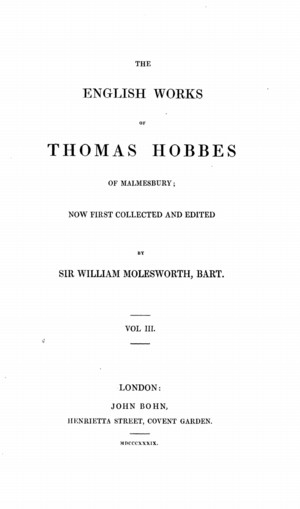
PART II.: OF COMMONWEALTH. - Thomas Hobbes, The English Works, vol. III (Leviathan) [1651]Edition used:The English Works of Thomas Hobbes of Malmesbury; Now First Collected and Edited by Sir William Molesworth, Bart., (London: Bohn, 1839-45). 11 vols. Vol. 3.
Part of: The English Works of Thomas Hobbes, 11 vols.About Liberty Fund:Liberty Fund, Inc. is a private, educational foundation established to encourage the study of the ideal of a society of free and responsible individuals. Copyright information:The text is in the public domain. Fair use statement:This material is put online to further the educational goals of Liberty Fund, Inc. Unless otherwise stated in the Copyright Information section above, this material may be used freely for educational and academic purposes. It may not be used in any way for profit.
PART II.OF COMMONWEALTH.CHAPTER XVII.of the causes, generation, and definition of a commonwealth.The end of commonwealth, particular security: The final cause, end, or design of men, who naturally love liberty, and dominion over others, in the introduction of that restraint upon themselves, in which we see them live in commonwealths, is the foresight of their own preservation, and of a more contented life thereby; that is to say, of getting themselves out from that miserable condition of war, which is necessarily consequent, as hath been shown in chapter XIII, to the natural passions of men, when there is no visible power to keep them in awe, and tie them by fear of punishment to the performance of their covenants, and observation of those laws of nature set down in the fourteenth and fifteenth chapters. Which is not to be had from the law of nature: For the laws of nature, as justice, equity, modesty, mercy, and, in sum, doing to others, as we would be done to, of themselves, without the terror of some power, to cause them to be observed, are contrary to our natural passions, that carry us to partiality, pride, revenge, and the like. And covenants, without the sword, are but words, and of no strength to secure a man at all. Therefore notwithstanding the laws of nature, which every one hath then kept, when he has the will to keep them, when he can do it safely, if there be no power erected, or not great enough for our security; every man will, and may lawfully rely on his own strength and art, for caution against all other men. And in all places, where men have lived by small families, to rob and spoil one another, has been a trade, and so far from being reputed against the law of nature, that the greater spoils they gained, the greater was their honour; and men observed no other laws therein, but the laws of honour; that is, to abstain from cruelty, leaving to men their lives, and instruments of husbandry. And as small families did then; so now do cities and kingdoms which are but greater families, for their own security, enlarge their dominions, upon all pretences of danger, and fear of invasion, or assistance that may be given to invaders, and endeavour as much as they can, to subdue, or weaken their neighbours, by open force, and secret arts, for want of other caution, justly; and are remembered for it in after ages with honour. Nor from the conjunction of a few men or families: Nor is it the joining together of a small number of men, that gives them this security; because in small numbers, small additions on the one side or the other, make the advantage of strength so great, as is sufficient to carry the victory; and therefore gives encouragement to an invasion. The multitude sufficient to confide in for our security, is not determined by any certain number, but by comparison with the enemy we fear; and is then sufficient, when the odds of the enemy is not of so visible and conspicuous moment, to determine the event of war, as to move him to attempt. Nor from a great multitude, unless directed by one judgment: And be there never so great a multitude; yet if their actions be directed according to their particular judgments, and particular appetites, they can expect thereby no defence, nor protection, neither against a common enemy, nor against the injuries of one another. For being distracted in opinions concerning the best use and application of their strength, they do not help but hinder one another; and reduce their strength by mutual opposition to nothing: whereby they are easily, not only subdued by a very few that agree together; but also when there is no common enemy, they make war upon each other, for their particular interests. For if we could suppose a great multitude of men to consent in the observation of justice, and other laws of nature, without a common power to keep them all in awe; we might as well suppose all mankind to do the same; and then there neither would be, nor need to be any civil government, or commonwealth at all; because there would be peace without subjection. And that continually. Nor is it enough for the security, which men desire should last all the time of their life, that they be governed, and directed by one judgment, for a limited time; as in one battle, or one war. For though they obtain a victory by their unanimous endeavour against a foreign enemy; yet afterwards, when either they have no common enemy, or he that by one part is held for an enemy, is by another part held for a friend, they must needs by the difference of their interests dissolve, and fall again into a war amongst themselves. Why certain creatures without reason, or speech, do nevertheless live in society, without any coercive power. It is true, that certain living creatures, as bees, and ants, live sociably one with another, which are therefore by Aristotle numbered amongst political creatures; and yet have no other direction, than their particular judgments and appetites; nor speech, whereby one of them can signify to another, what he thinks expedient for the common benefit: and therefore some man may perhaps desire to know, why mankind cannot do the same. To which I answer, First, that men are continually in competition for honour and dignity, which these creatures are not; and consequently amongst men there ariseth on that ground, envy and hatred, and finally war; but amongst these not so. Secondly, that amongst these creatures, the common good differeth not from the private; and being by nature inclined to their private, they procure thereby the common benefit. But man, whose joy consisteth in comparing himself with other men, can relish nothing but what is eminent. Thirdly, that these creatures, having not, as man, the use of reason, do not see, nor think they see any fault, in the administration of their common business; whereas amongst men, there are very many, that think themselves wiser, and abler to govern the public, better than the rest; and these strive to reform and innovate, one this way, another that way; and thereby bring it into distraction and civil war. Fourthly, that these creatures, though they have some use of voice, in making known to one another their desires, and other affections; yet they want that art of words, by which some men can represent to others, that which is good, in the likeness of evil; and evil, in the likeness of good; and augment, or diminish the apparent greatness of good and evil; discontenting men, and troubling their peace at their pleasure. Fifthly, irrational creatures cannot distinguish between injury, and damage; and therefore as long as they be at ease, they are not offended with their fellows: whereas man is then most troublesome, when he is most at ease: for then it is that he loves to shew his wisdom, and control the actions of them that govern the commonwealth. Lastly, the agreement of these creatures is natural; that of men, is by covenant only, which is artificial: and therefore it is no wonder if there be somewhat else required, besides covenant, to make their agreement constant and lasting; which is a common power, to keep them in awe, and to direct their actions to the common benefit. The generation of a commonwealth.The definition of a commonwealth. The only way to erect such a common power, as may be able to defend them from the invasion of foreigners, and the injuries of one another, and thereby to secure them in such sort, as that by their own industry, and by the fruits of the earth, they may nourish themselves and live contentedly; is, to confer all their power and strength upon one man, or upon one assembly of men, that may reduce all their wills, by plurality of voices, unto one will: which is as much as to say, to appoint one man, or assembly of men, to bear their person; and every one to own, and acknowledge himself to be author of whatsoever he that so beareth their person, shall act, or cause to be acted, in those things which concern the common peace and safety; and therein to submit their wills, every one to his will, and their judgments, to his judgment. This is more than consent, or concord; it is a real unity of them all, in one and the same person, made by covenant of every man with every man, in such manner, as if every man should say to every man, I authorise and give up my right of governing myself, to this man, or to this assembly of men, on this condition, that thou give up thy right to him, and authorize all his actions in like manner. This done, the multitude so united in one person, is called a commonwealth, in Latin civitas. This is the generation of that great leviathan, or rather, to speak more reverently, of that mortal god, to which we owe under the immortal God, our peace and defence. For by this authority, given him by every particular man in the commonwealth, he hath the use of so much power and strength conferred on him, that by terror thereof, he is enabled to perform the wills of them all, to peace at home, and mutual aid against their enemies abroad. And in him consisteth the essence of the commonwealth; which, to define it, is one person, of whose acts a great multitude, by mutual covenants one with another, have made themselves every one the author, to the end he may use the strength and means of them all, as he shall think expedient, for their peace and common defence. Sovereign, and subject, what. And he that carrieth this person, is called sovereign, and said to have sovereign power; and every one besides, his subject. The attaining to this sovereign power, is by two ways. One, by natural force; as when a man maketh his children, to submit themselves, and their children to his government, as being able to destroy them if they refuse; or by war subdueth his enemies to his will, giving them their lives on that condition. The other, is when men agree amongst themselves, to submit to some man, or assembly of men, voluntarily, on confidence to be protected by him against all others. This latter, may be called a political commonwealth, or commonwealth by institution; and the former, a commonwealth by acquisition. And first, I shall speak of a commonwealth by institution. CHAPTER XVIII.of the rights of sovereigns by institution.The act of instituting a commonwealth, what. A commonwealth is said to be instituted, when a multitude of men do agree, and covenant, every one, with every one, that to whatsoever man, or assembly of men, shall be given by the major part, the right to present the person of them all, that is to say, to be their representative; every one, as well he that voted for it, as he that voted against it, shall authorize all the actions and judgments, of that man, or assembly of men, in the same manner, as if they were his own, to the end, to live peaceably amongst themselves, and be protected against other men. The consequences to such institution, are. From this institution of a commonwealth are derived all the rights, and faculties of him, or them, on whom sovereign power is conferred by the consent of the people assembled. 1. The subjects cannot change the form of government. First, because they covenant, it is to be understood, they are not obliged by former covenant to anything repugnant hereunto. And consequently they that have already instituted a commonwealth, being thereby bound by covenant, to own the actions, and judgments of one, cannot lawfully make a new covenant, amongst themselves, to be obedient to any other, in any thing whatsoever, without his permission. And therefore, they that are subjects to a monarch, cannot without his leave cast off monarchy, and return to the confusion of a disunited multitude; nor transfer their person from him that beareth it, to another man, or other assembly of men: for they are bound, every man to every man, to own, and be reputed author of all, that he that already is their sovereign, shall do, and judge fit to be done: so that any one man dissenting, all the rest should break their covenant made to that man, which is injustice: and they have also every man given the sovereignty to him that beareth their person; and therefore if they depose him, they take from him that which is his own, and so again it is injustice. Besides, if he that attempteth to depose his sovereign, be killed, or punished by him for such attempt, he is author of his own punishment, as being by the institution, author of all his sovereign shall do: and because it is injustice for a man to do anything, for which he may be punished by his own authority, he is also upon that title, unjust. And whereas some men have pretended for their disobedience to their sovereign, a new covenant, made, not with men, but with God; this also is unjust: for there is no covenant with God, but by mediation of somebody that representeth God’s person; which none doth but God’s lieutenant, who hath the sovereignty under God. But this pretence of covenant with God, is so evident a lie, even in the pretenders’ own consciences, that it is not only an act of an unjust, but also of a vile, and unmanly disposition. 2. Sovereign power cannot be forfeited. Secondly, because the right of bearing the person of them all, is given to him they make sovereign, by covenant only of one to another, and not of him to any of them; there can happen no breach of covenant on the part of the sovereign; and consequently none of his subjects, by any pretence of forfeiture, can be freed from his subjection. That he which is made sovereign maketh no covenant with his subjects beforehand, is manifest; because either he must make it with the whole multitude, as one party to the covenant; or he must make a several covenant with every man. With the whole, as one party, it is impossible; because as yet they are not one person: and if he make so many several covenants as there be men, those covenants after he hath the sovereignty are void; because what act soever can be pretended by any one of them for breach thereof,is the act both of himself, and of all the rest, because done in the person, and by the right of every one of them in particular. Besides, if any one, or more of them, pretend a breach of the covenant made by the sovereign at his institution; and others, or one other of his subjects, or himself alone, pretend there was no such breach, there is in this case, no judge to decide the controversy; it returns therefore to the sword again; and every man recovereth the right of protecting himself by his own strength, contrary to the design they had in the institution. It is therefore in vain to grant sovereignty by way of precedent covenant. The opinion that any monarch receiveth his power by covenant, that is to say, on condition, proceedeth from want of understanding this easy truth, that covenants being but words and breath, have no force to oblige, contain, constrain, or protect any man, but what it has from the public sword; that is, from the untied hands of that man, or assembly of men that hath the sovereignty, and whose actions are avouched by them all, and performed by the strength of them all, in him united. But when an assembly of men is made sovereign; then no man imagineth any such covenant to have passed in the institution; for no man is so dull as to say, for example, the people of Rome made a covenant with the Romans, to hold the sovereignty on such or such conditions; which not performed, the Romans might lawfully depose the Roman people. That men see not the reason to be alike in a monarchy, and in a popular government, proceedeth from the ambition of some, that are kinder to the government of an assembly, whereof they may hope to participate, than of monarchy, which they despair to enjoy. 3. No man can without injustice protest against the institution of the sovereign declared by the major part. Thirdly, because the major part hath by consenting voices declared a sovereign; he that dissented must now consent with the rest; that is, becontented to avow all the actions he shall do, or else justly be destroyed by the rest. For if he voluntarily entered into the congregation of them that were assembled, he sufficiently declared thereby his will, and therefore tacitly covenanted, to stand to what the major part should ordain: and therefore if he refuse to stand thereto, or make protestation against any of their decrees, he does contrary to his covenant, and therefore unjustly. And whether he be of the congregation, or not; and whether his consent be asked, or not, he must either submit to their decrees, or be left in the condition of war he was in before; wherein he might without injustice be destroyed by any man whatsoever. 4. The sovereign’s actions cannot be justly accused by the subject. Fourthly, because every subject is by this institution author of all the actions, and judgments of the sovereign instituted; it follows, that whatsoever he doth, it can be no injury to any of his subjects; nor ought he to be by any of them accused of injustice. For he that doth anything by authority from another, doth therein no injury to him by whose authority he acteth: but by this institution of a commonwealth, every particular man is author of all the sovereign doth: and consequently he that complaineth of injury from his sovereign, complaineth of that whereof he himself is author; and therefore ought not to accuse any man but himself; no nor himself of injury; because to do injury to one’s self, is impossible. It is true that they that have sovereign power may commit iniquity; but not injustice, or injury in the proper signification. 5. Whatsoever the sovereign doth is unpunishable by the subject. Fifthly, and consequently to that which was said last, no man that hath sovereign power can justly be put to death, or otherwise in any manner by his subjects punished. For seeing every subject is author of the actions of his sovereign; he punisheth another for the actions committed by himself. 6. The sovereign is judge of what is necessary for the peace and defence of his subjects. And because the end of this institution, is the peace and defence of them all; and whosoever has right to the end, has right to the means; it belongeth of right, to whatsoever man, or assembly that hath the sovereignty, to be judge both of the means of peace and defence, and also of the hindrances, and disturbances of the same; and to do whatsoever he shall think necessary to be done, both beforehand, for the preserving of peace and security, by prevention of discord at home, and hostility from abroad; and, when peace and security are lost, for the recovery of the same. And therefore, And judge of what doctrines are fit to be taught them. Sixthly, it is annexed to the sovereignty, to be judge of what opinions and doctrines are averse, and what conducing to peace; and consequently, on what occasions, how far, and what men are to be trusted withal, in speaking to multitudes of people; and who shall examine the doctrines of all books before they be published. For the actions of men proceed from their opinions; and in the well-governing of opinions, consisteth the well-governing of men’s actions, in order to their peace, and concord. And though in matter of doctrine, nothing ought to be regarded but the truth; yet this is not repugnant to regulating the same by peace. For doctrine repugnant to peace, can no more be true, than peace and concord can be against the law of nature. It is true, that in a commonwealth, where by the negligence, or unskilfulness of governors, and teachers, false doctrines are by time generally received; the contrary truths may be generally offensive. Yet the most sudden, and rough bursting in of a new truth, that can be, does never break the peace, but only sometimes awake the war. For those men that are so remissly governed, that they dare take up arms to defend, or introduce an opinion, are still in war; and their condition not peace, but only a cessation of arms for fear of one another; and they live, as it were, in the precincts of battle continually. It belongeth therefore to him that hath the sovereign power, to be judge, or constitute all judges of opinions and doctrines, as a thing necessary to peace; thereby to prevent discord and civil war. 7. The right of making rules; whereby the subjects may every man know what is so his own, as no other subject can without injustice take it from him. Seventhly, is annexed to the sovereignty, the whole power of prescribing the rules, whereby every man may know, what goods he may enjoy, and what actions he may do, without being molested by any of his fellow-subjects; and this is it men call propriety. For before constitution of sovereign power, as hath already been shown, all men had right to all things; which necessarily causeth war: and therefore this propriety, being necessary to peace, and depending on sovereign power, is the act of that power, in order to the public peace. These rules of propriety, or meum and tuum, and of good, evil, lawful, and unlawful in the actions of subjects, are the civil laws; that is to say, the laws of each commonwealth in particular; though the name of civil law be now restrained to the ancient civil laws of the city of Rome; which being the head of a great part of the world, her laws at that time were in these parts the civil law. 8. To him also belongeth the right of judicature and decision of controversy. Eightly, is annexed to the sovereignty, the right of judicature; that is to say, of hearing and deciding all controversies, which may arise concerning law, either civil, or natural; or concerning fact. For without the decision of controversies, there is no protection of one subject, against the injuries of another; the laws concerning meum and tuum are in vain; and to every man remaineth, from the natural and necessary appetite of his own conservation, the right of protecting himself by his private strength, which is the condition of war, and contrary to the end for which every commonwealth is instituted. 9. And of making war, and peace, as he shall think best. Ninthly, is annexed to the sovereignty, the right of making war and peace with other nations, and commonwealths; that is to say, of judging when it is for the public good, and how great forces are to be assembled, armed, and paid for that end; and to levy money upon the subjects, to defray the expenses thereof. For the power by which the people are to be defended, consisteth in their armies; and the strength of an army, in the union of their strength under one command; which command the sovereign instituted, therefore hath; because the command of the militia, without other institution, maketh him that hath it sovereign. And therefore whosoever is made general of an army, he that hath the sovereign power is always generalissimo. 10. And of choosing all counsellors and ministers, both of peace & war. Tenthly, is annexed to the sovereignty, the choosing of all counsellors, ministers, magistrates, and officers, both in peace, and war. For seeing the sovereign is charged with the end, which is the common peace and defence, he is understood to have power to use such means, as he shall think most fit for his discharge. 11. And of rewarding and punishing, and that (where no former law hath determined the measure of it) arbitrarily. Eleventhly, to the sovereign is committed the power of rewarding with riches, or honour, and of punishing with corporal or pecuniary punishment, or with ignominy, every subject according to the law he hath formerly made; or if there be no law made, according as he shall judge most to conduce to the encouraging of men to serve the commonwealth, or deterring of them from doing disservice to the same. 12. And of honour and order. Lastly, considering what value men are naturally apt to set upon themselves; what respect they look for from others; and how little they value other men; from whence continually arise amongst them, emulation, quarrels, factions, and at last war, to the destroying of one another, and diminution of their strength against a common enemy; it is necessary that there be laws of honour, and a public rate of the worth of such men as have deserved, or are able to deserve well of the commonwealth; and that there be force in the hands of some or other, to put those laws in execution. But it hath already been shown, that not only the whole militia, or forces of the commonwealth; but also the judicature of all controversies, is annexed to the sovereignty. To the sovereign therefore it belongeth also to give titles of honour; and to appoint what order of place, and dignity, each man shall hold; and what signs of respect, in public or private meetings, they shall give to one another. These rights are indivisible. These are the rights, which make the essence of sovereignty; and which are the marks, whereby a man may discern in what man, or assembly of men, the sovereign power is placed, and resideth. For these are incommunicable, and inseparable. The power to coin money; to dispose of the estate and persons of infant heirs; to have præemption in markets; and all other statute prerogatives, may be transferred by the sovereign; and yet the power to protect his subjects be retained. But if he transfer the militia, he retains the judicature in vain, for want of execution of the laws: or if he grant away the power of raising money; the militia is in vain; or if he give away the government of doctrines, men will be frighted into rebellion with the fear of spirits. And so if we consider any one of the said rights, we shall presently see, that the holding of all the rest will produce no effect, in the conservation of peace and justice, the end for which all commonwealths are instituted. And this division is it, whereof it is said, a kingdom divided in itself cannot stand: for unless this division precede, division into opposite armies can never happen. If there had not first been an opinion received of the greatest part of England, that these powers were divided between the King, and the Lords, and the House of Commons, the people had never been divided and fallen into this civil war; first between those that disagreed in politics; and after between the dissenters about the liberty of religion; which have so instructed men in this point of sovereign right, that there be few now in England that do not see, that these rights are inseparable, and will be so generally acknowledged at the next return of peace; and so continue, till their miseries are forgotten; and no longer, except the vulgar be better taught than they have hitherto been. And can by no grant pass away without direct renouncing of the sovereign power. And because they are essential and inseparable rights, it follows necessarily, that in whatsoever words any of them seem to be granted away, yet if the sovereign power itself be not in direct terms renounced, and the name of sovereign no more given by the grantees to him that grants them, the grant is void: for when he has granted all he can, if we grant back the sovereignty, all is restored, as inseparably annexed thereunto. The power and honour of subjects vanisheth in the presence of the power sovereign. This great authority being indivisible, and inseparably annexed to the sovereignty, there is little ground for the opinion of them, that say of sovereign kings, though they be singulis majores, of greater power than every one of their subjects, yet they be universis minores, of less power than them all together. For if by all together, they mean not the collective body as one person, then all together, and every one, signify the same; and the speech is absurd. But if by all together, they understand them as one person, which person the sovereign bears, then the power of all together, is the same with the sovereign’s power; and so again the speech is absurd: which absurdity they see well enough, when the sovereignty is in an assembly of the people; but in a monarch they see it not; and yet the power of sovereignty is the same in whomsoever it be placed. And as the power, so also the honour of the sovereign, ought to be greater, than that of any, or all the subjects. For in the sovereignty is the fountain of honour. The dignities of lord, earl, duke, and prince are his creatures. As in the presence of the master, the servants are equal, and without any honour at all; so are the subjects, in the presence of the sovereign. And though they shine some more, some less, when they are out of his sight; yet in his presence, they shine no more than the stars in the presence of the sun. Sovereign power not so hurtful as the want of it, and the hurt proceeds for the greatest part from not submitting readily to a less. But a man may here object, that the condition of subjects is very miserable; as being obnoxious to the lusts, and other irregular passions of him, or them that have so unlimited a power in their hands. And commonly they that live under a monarch, think it the fault of monarchy; and they that live under the government of democracy, or other sovereign assembly, attribute all the inconvenience to that form of commonwealth; whereas the power in all forms, if they be perfect enough to protect them, is the same: not considering that the state of man can never be without some incommodity or other; and that the greatest, that in any form of government can possibly happen to the people in general, is scarce sensible, in respect of the miseries, and horrible calamities, that accompany a civil war, or that dissolute condition of masterless men, without subjection to laws, and a coercive power to tie their hands from rapine and revenge: nor considering that the greatest pressure of sovereign governors, proceedeth not from any delight, or profit they can expect in the damage or weakening of their subjects, in whose vigour, consisteth their own strength and glory; but in the restiveness of themselves, that unwillingly contributing to their own defence, make it necessary for their governors to draw from them what they can in time of peace, that they may have means on any emergent occasion, or sudden need, to resist, or take advantage on their enemies. For all men are by nature provided of notable multiplying glasses, that is their passions and self-love, through which, every little payment appeareth a great grievance; but are destitute of those prospective glasses, namely moral and civil science, to see afar off the miseries that hang over them, and cannot without such payments be avoided. CHAPTER XIX.of the several kinds of commonwealth by institution, and of succession to the sovereign power.The different forms of commonwealths but three. The difference of commonwealths, consisteth in the difference of the sovereign, or the person representative of all and every one of the multitude. And because the sovereignty is either in one man, or in an assembly of more than one; and into that assembly either every man hath right to enter, or not every one, but certain men distinguished from the rest; it is manifest, there can be but three kinds of commonwealth. For the representative must needs be one man, or more: and if more, then it is the assembly of all, or but of a part. When the representative is one man, then is the commonwealth a monarchy: when an assembly of all that will come together, then it is a democracy, or popular commonwealth: when an assembly of a a part only, then it is called an aristocracy. Other kind of commonwealth there can be none: for either one, or more, or all, must have the sovereign power, which I have shown to be indivisible, entire. Tyranny and oligarchy, but different names of monarchy, and aristocracy There be other names of government, in the histories, and books of policy; as tyranny, and oligarchy: but they are not the names of other forms of government, but of the same forms misliked. For they that are discontented under monarchy, call it tyranny; and they that are displeased with aristocracy, call it oligarchy: so also, they which find themselves grieved under a democracy, call it anarchy, which signifies want of government; and yet I think no man believes, that want of government, is any new kind of government: nor by the same reason ought they to believe, that the government is of one kind, when they like it, and another, when they mislike it, or are oppressed by the governors. Subordinate representatives dangerous. It is manifest, that men who are in absolute liberty, may, if they please, give authority to one man, to represent them every one; as well as give such authority to any assembly of men whatsoever; and consequently may subject themselves, if they think good, to a monarch, as absolutely, as to any other representative. Therefore, where there is already erected a sovereign power, there can be no other representative of the same people, but only to certain particular ends, by the sovereign limited. For that were to erect two sovereigns; and every man to have his person represented by two actors, that by opposing one another, must needs divide that power, which, if men will live in peace, is indivisible; and thereby reduce the multitude into the condition of war, contrary to the end for which all sovereignty is instituted. And therefore as it is absurd, to think that a sovereign assembly, inviting the people of their dominion, to send up their deputies, with power to make known their advice, or desires, should therefore hold such deputies, rather than themselves, for the absolute representatives of the people: so it is absurd also, to think the same in a monarchy. And I know not how this so manifest a truth, should of late be so little observed; that in a monarchy, he that had the sovereignty from a descent of six hundred years, was alone called sovereign, had the title of Majesty from every one of his subjects, and was unquestionably taken by them for their king, was notwithstanding never considered as their representative; the name without contradiction passing for the title of those men, which at his command were sent up by the people to carry their petitions, and give him, if he permitted it, their advice. Which may serve as an admonition, for those that are the true, and absolute representative of a people, to instruct men in the nature of that office, and to take heed how they admit of any other general representation upon any occasion whatsoever, if they mean to discharge the trust committed to them. Comparison of monarchy, with sovereign assemblies. The difference between these three kinds of commonwealth, consisteth not in the difference of power; but in the difference of convenience, or aptitude to produce the peace, and security of the people; for which end they were instituted. And to compare monarchy with the other two, we may observe; first, that whosoever beareth the person of the people, or is one of that assembly that bears it, beareth also his own natural person. And though he be careful in his politic person to procure the common interest; yet he is more, or no less careful to procure the private good of himself, his family, kindred and friends; and for the most part, if the public interest chance to cross the private, he prefers the private: for the passions of men, are commonly more potent than their reason. From whence it follows, that where the public and private interest are most closely united, there is the public most advanced. Now in monarchy, the private interest is the same with the public. The riches, power, and honour of a monarch arise only from the riches, strength and reputation of his subjects. For no king can be rich, nor glorious, nor secure, whose subjects are either poor, or contemptible, or too weak through want or dissention, to maintain a war against their enemies: whereas in a democracy, or aristocracy, the public prosperity confers not so much to the private fortune of one that is corrupt, or ambitious, as doth many times a perfidious advice, a treacherous action, or a civil war. Secondly, that a monarch receiveth counsel of whom, when, and where he pleaseth; and consequently may hear the opinion of men versed in the matter about which he deliberates, of what rank or quality soever, and as long before the time of action, and with as much secrecy, as he will. But when a sovereign assembly has need of counsel, none are admitted but such as have a right thereto from the beginning; which for the most part are of those who have been versed more in the acquisition of wealth than of knowledge; and are to give their advice in long discourses, which may, and do commonly excite men to action, but not govern them in it. For the understanding is by the flame of the passions, never enlightened, but dazzled. Nor is there any place, or time, wherein an assembly can receive counsel with secrecy, because of their own multitude. Thirdly, that the resolutions of a monarch, are subject to no other inconstancy, than that of human nature; but in assemblies, besides that of nature, there ariseth an inconstancy from the number. For the absence of a few, that would have the resolution once taken, continue firm, which may happen by security, negligence, or private impediments, or the diligent appearance of a few of the contrary opinion, undoes to-day, all that was concluded yesterday. Fourthly, that a monarch cannot disagree with himself, out of envy, or interest; but an assembly may; and that to such a height, as may produce a civil war. Fifthly, that in monarchy there is this inconvenience; that any subject, by the power of one man, for the enriching of a favourite or flatterer, may be deprived of all he possesseth; which I confess is a great and inevitable inconvenience. But the same may as well happen, where the sovereign power is in an assembly: for their power is the same; and they are as subject to evil counsel, and to be seduced by orators, as a monarch by flatterers; and becoming one another’s flatterers, serve one another’s covetousness and ambition by turns. And whereas the favourites of monarchs, are few, and they have none else to advance but their own kindred; the favourites of an assembly, are many; and the kindred much more numerous, than of any monarch. Besides, there is no favourite of a monarch, which cannot as well succour his friends, as hurt his enemies: but orators, that is to say, favourites of sovereign assemblies, though they have great power to hurt, have little to save. For to accuse, requires less eloquence, such is man’s nature, than to excuse; and condemnation, than absolution more resembles justice. Sixthly, that it is an inconvenience in monarchy, that the sovereignty may descend upon an infant, or one that cannot discern between good and evil: and consisteth in this, that the use of his power, must be in the hand of another man, or of some assembly of men, which are to govern by his right, and in his name; as curators, and protectors of his person, and authority. But to say there is inconvenience, in putting the use of the sovereign power, into the hand of a man, or an assembly of men; is to say that all government is more inconvenient, than confusion, and civil war. And therefore all the danger that can be pretended, must arise from the contention of those, that for an office of so great honour, and profit, may become competitors. To make it appear, that this inconvenience, proceedeth not from that form of government we call monarchy, we are to consider, that the precedent monarch hath appointed who shall have the tuition of his infant successor, either expressly by testament, or tacitly, by not controlling the custom in that case received: and then such inconvenience, if it happen, is to be attributed, not to the monarchy, but to the ambition, and injustice of the subjects; which in all kinds of government, where the people are not well instructed in their duty, and the rights of sovereignty, is the same. Or else the precedent monarch hath not at all taken order for such tuition; and then the law of nature hath provided this sufficient rule, that the tuition shall be in him, that hath by nature most interest in the preservation of the authority of the infant, and to whom least benefit can accrue by his death, or diminution. For seeing every man by nature seeketh his own benefit, and promotion; to put an infant into the power of those, that can promote themselves by his destruction, or damage, is not tuition, but treachery. So that sufficient provision being taken, against all just quarrel, about the government under a child, if any contention arise to the disturbance of the public peace, it is not to be attributed to the form of monarchy, but to the ambition of subjects, and ignorance of their duty. On the other side, there is no great commonwealth, the sovereignty whereof is in a great assembly, which is not, as to consultations of peace, and war, and making of laws, in the same condition, as if the government were in a child. For as a child wants the judgment to dissent from counsel given him, and is thereby necessitated to take the advice of them, or him, to whom he is committed: so an assembly wanteth the liberty, to dissent from the counsel of the major part, be it good, or bad. And as a child has need of a tutor, or protector, to preserve his person and authority: so also, in great commonwealths, the sovereign assembly, in all great dangers and troubles, have need of custodes libertatis; that is of dictators, or protectors of their authority; which are as much as temporary monarchs, to whom for a time, they may commit the entire exercise of their power; and have, at the end of that time, been oftener deprived thereof, than infant kings, by their protectors, regents, or any other tutors. Definition of monarchy, and other forms. Though the kinds of sovereignty be, as I have now shown, but three; that is to say, monarchy, where one man has it; or democracy, where the general assembly of subjects hath it; or aristocracy, where it is in an assembly of certain persons nominated, or otherwise distinguished from the rest: yet he that shall consider the particular commonwealths that have been, and are in the world, will not perhaps easily reduce them to three, and may thereby be inclined to think there be other forms, arising from these mingled together. As for example, elective kingdoms; where kings have the sovereign power put into their hands for a time; or kingdoms, wherein the king hath a power limited: which governments, are nevertheless by most writers called monarchy. Likewise if a popular, or aristocratical commonwealth, subdue an enemy’s country, and govern the same, by a president, procurator, or other magistrate; this may seem perhaps at first sight, to be a democratical, or aristocratical government. But it is not so. For elective kings, are not sovereigns, but ministers of the sovereign; nor limited kings, sovereigns, but ministers of them that have the sovereign power: nor are those provinces which are in subjection to a democracy, or aristrocracy of another commonwealth, democratically or aristocratically governed, but monarchically. Definition of monarchy, &c. And first, concerning an elective king, whose power is limited to his life, as it is in many places of Christendom at this day; or to certain years or months, as the dictator’s power amongst the Romans; if he have right to appoint his successor, he is no more elective but hereditary. But if he have no power to elect his successor, then there is some other man, or assembly known, which after his decease may elect anew, or else the commonwealth dieth, and dissolveth with him, and returneth to the condition of war. If it be known who have the power to give the sovereignty after his death, it is known also that the sovereignty was in them before: for none have right to give that which they have not right to possess, and keep to themselves, if they think good. But if there be none that can give the sovereignty, after the decease of him that was first elected; then has he power, nay he is obliged by the law of nature, to provide, by establishing his successor, to keep those that had trusted him with the government, from relapsing into the miserable condition of civil war. And consequently he was, when elected, a sovereign absolute. Secondly, that king whose power is limited, is not superior to him, or them that have the power to limit it; and he that is not superior, is not supreme; that is to say not sovereign. The sovereignty therefore was always in that assembly which had the right to limit him; and by consequence the government not monarchy, but either democracy, or aristocracy; as of old time in Sparta; where the kings had a privilege to lead their armies; but the sovereignty was in the Ephori. Thirdly, whereas heretofore the Roman people governed the land of Judea, for example, by a president; yet was not Judea therefore a democracy; because they were not governed by any assembly, into the which, any of them, had right to enter; nor an aristocracy; because they were not governed by any assembly, into which, any man could enter by their election: but they were governed by one person, which, though as to the people of Rome, was an assembly of the people, or democracy; yet as to the people of Judea, which had no right at all of participating in the government, was a monarch. For though where the people are governed by an assembly, chosen by themselves out of their own number, the government is called a democracy, or aristocracy; yet when they are governed by an assembly, not of their own choosing, it is a monarchy; not of one man, over another man; but of one people, over another people. Of the right of succession. Of all these forms of government, the matter being mortal, so that not only monarchs, but also whole assemblies die, it is necessary for the conservation of the peace of men, that as there was order taken for an artificial man, so there be order also taken, for an artificial eternity of life; without which, men that are governed by an assembly, should return into the condition of war in every age; and they that are governed by one man, as soon as their governor dieth. This artificial eternity, is that which men call the right of succession. There is no perfect form of government, where the disposing of the succession is not in the present sovereign. For if it be in any other particular man, or private assembly, it is in a person subject, and may be assumed by the sovereign at his pleasure; and consequently the right is in himself. And if it be in no particular man, but left to a new choice; then is the commonwealth dissolved; and the right is in him that can get it; contrary to the intention of them that did institute the commonwealth, for their perpetual, and not temporary security. In a democracy, the whole assembly cannot fail, unless the multitude that are to be governed fail. And therefore questions of the right of succession, have in that form of government no place at all. In an aristocracy, when any of the assembly dieth, the election of another into his room belongeth to the assembly, as the sovereign, to whom belongeth the choosing of all counsellors and officers. For that which the representative doth, as actor, every one of the subjects doth, as author. And though the sovereign assembly may give power to others, to elect new men, for supply of their court; yet it is still by their authority, that the election is made; and by the same it may, when the public shall require it, be recalled. The present monarch hath right to dispose of the succession. The greatest difficulty about the right of succession, is in monarchy: and the difficulty ariseth from this, that at first sight, it is not manifest who is to appoint the successor; nor many times, who it is whom he hath appointed. For in both these cases, there is required a more exact ratiocination, than every man is accustomed to use. As to the question, who shall appoint the successor, of a monarch that hath the sovereign authority; that is to say, who shall determine of the right of inheritance, (for elective kings and princes have not the sovereign power in propriety, but in use only), we are to consider, that either he that is in possession, has right to dispose of the succession, or else that right is again in the dissolved multitude. For the death of him that hath the sovereign power in propriety, leaves the multitude without any sovereign at all; that is, without any representative in whom they should be united, and be capable of doing any one action at all: and therefore they are incapable of election of any new monarch; every man having equal right to submit himself to such as he thinks best able to protect him; or if he can, protect himself by his own sword; which is a return to confusion, and to the condition of a war of every man against every man, contrary to the end for which monarchy had its first institution. Therefore it is manifest, that by the institution of monarchy, the disposing of the successor, is always left to the judgment and will of the present possessor. And for the question, which may arise sometimes, who it is that the monarch in possession, hath designed to the succession and inheritance of his power; it is determined by his express words, and testament; or by other tacit signs sufficient. Succession passeth by express words; By express words, or testament, when it is declared by him in his lifetime, viva voce, or by writing; as the first emperors of Rome declared who should be their heirs. For the word heir does not of itself imply the children, or nearest kindred of a man; but whomsoever a man shall any way declare, he would have to succeed him in his estate. If therefore a monarch declare expressly, that such a man shall be his heir, either by word or writing, then is that man immediately after the decease of his predecessor, invested in the right of being monarch. Or, by not controlling a custom; But where testament, and express words are wanting, other natural signs of the will are to be followed: whereof the one is custom. And therefore where the custom is, that the next of kindred absolutely succeedeth, there also the next of kindred hath right to the succession; for that, if the will of him that was in possession had been otherwise, he might easily have declared the same in his life-time. And likewise where the custom is, that the next of the male kindred succeedeth, there also the right of succession is in the next of the kindred male, for the same reason. And so it is if the custom were to advance the female. For whatsoever custom a man may by a word control, and does not, it is a natural sign he would have that custom stand. Or, by presumption of natural affection. But where neither custom, nor testament hath preceded, there it is to be understood, first, that a monarch’s will is, that the government remain monarchical; because he hath approved that government in himself. Secondly, that a child of his own, male, or female, be preferred before any other; because men are presumed to be more inclined by nature, to advance their own children, than the children of other men; and of their own, rather a male than a female; because men, are naturally fitter than women, for actions of labour and danger. Thirdly, where his own issue faileth, rather a brother than a stranger; and so still the nearer in blood, rather than the more remote; because it is always presumed that the nearer of kin, is the nearer in affection; and it is evident that a man receives always, by reflection, the most honour from the greatness of his nearest kindred. To dispose of the succession, though to a king of another nation, not unlawful. But if it be lawful for a monarch to dispose of the succession by words of contract, or testament, men may perhaps object a great inconvenience: for he may sell, or give his right of governing to a stranger; which, because strangers, that is, men not used to live under the same government, nor speaking the same language, do commonly undervalue one another, may turn to the oppression of his subjects; which is indeed a great inconvenience: but it proceedeth not necessarily from the subjection to a stranger’s government, but from the unskilfulness of the governors, ignorant of the true rules of politics. And therefore the Romans when they had subdued many nations, to make their government digestible, were wont to take away that grievance, as much as they thought necessary, by giving sometimes to whole nations, and sometimes to principal men of every nation they conquered, not only the privileges, but also the name of Romans; and took many of them into the senate, and offices of charge, even in the Roman city. And this was it our most wise king, king James, aimed at, in endeavouring the union of his two realms of England and Scotland. Which if he could have obtained, had in all likelihood prevented the civil wars, which make both those kingdoms, at this present, miserable. It is not therefore any injury to the people, for a monarch to dispose of the succession by will; though by the fault of many princes, it hath been sometimes found inconvenient. Of the lawfulness of it, this also is an argument, that whatsoever inconvenience can arrive by giving a kingdom to a stranger, may arrive also by so marrying with strangers, as the right of succession may descend upon them: yet this by all men is accounted lawful. CHAPTER XX.of dominion paternal, and despotical.A commonwealth by acquisition. A commonwealthby acquisition, is that, where the sovereign power is acquired by force; and it is acquired by force, when men singly, or many together by plurality of voices, for fear of death, or bonds, do authorize all the actions of that man, or assembly, that hath their lives and liberty in his power. Wherein different from a commonwealth by institution. And this kind of dominion, or sovereignty, differeth from sovereignty by institution, only in this, that men who choose their sovereign, do it for fear of one another, and not of him whom they institute: but in this case, they subject themselves, to him they are afraid of. In both cases they do it for fear: which is to be noted by them, that hold all such covenants, as proceed from fear of death or violence, void: which if it were true, no man, in any kind of commonwealth, could be obliged to obedience. It is true, that in a commonwealth once instituted, or acquired, promises proceeding from fear of death or violence, are no covenants, nor obliging, when the thing promised is contrary to the laws; but the reason is not, because it was made upon fear, but because he that promiseth, hath no right in the thing promised. Also, when he may lawfully perform, and doth not, it is not the invalidity of the covenant, that absolveth him, but the sentence of the sovereign. Otherwise, whensoever a man lawfully promiseth, he unlawfully breaketh: but when the sovereign, who is the actor, acquitteth him, then he is acquitted by him that extorted the promise, as by the author of such absolution. The rights of sovereignty the same in both. But the rights, and consequences of sovereignty, are the same in both. His power cannot, without his consent, be transferred to another: he cannot forfeit it: he cannot be accused by any of his subjects, of injury: he cannot be punished by them: he is judge of what is necessary for peace; and judge of doctrines: he is sole legislator; and supreme judge of controversies; and of the times, and occasions of war, and peace: to him it belongeth to choose magistrates, counsellors, commanders, and all other officers, and ministers; and to determine of rewards, and punishments, honour, and order. The reasons whereof, are the same which are alleged in the precedent chapter, for the same rights, and consequences of sovereignty by institution. Dominion paternal how attained.Not by generation, but by contract; Dominion is acquired two ways; by generation, and by conquest. The right of dominion by generation, is that, which the parent hath over his children; and is called paternal. And is not so derived from the generation, as if therefore the parent had dominion over his child because he begat him; but from the child’s consent, either express, or by other sufficient arguments declared. For as to the generation, God hath ordained to man a helper; and there be always two that are equally parents: the dominion therefore over the child, should belong equally to both; and he be equally subject to both, which is impossible; for no man can obey two masters. And whereas some have attributed the dominion to the man only, as being of the more excellent sex; they misreckon in it. For there is not always that difference of strength, or prudence between the man and the woman, as that the right can be determined without war. In commonwealths, this controversy is decided by the civil law; and for the most part, but not always, the sentence is in favour of the father; because for the most part commonwealths have been erected by the fathers, not by the mothers of families. But the question lieth now in the state of mere nature; where there are supposed no laws of matrimony; no laws for the education of children; but the law of nature, and the natural inclination of the sexes, one to another, and to their children. In this condition of mere nature, either the parents between themselves dispose of the dominion over the child by contract; or do not dispose thereof at all. If they dispose thereof, the right passeth according to the contract. We find in history that the Amazons contracted with the men of the neighbouring countries, to whom they had recourse for issue, that the issue male should be sent back, but the female remain with themselves: so that the dominion of the females was in the mother. Or education; If there be no contract, the dominion is in the mother. For in the condition of mere nature, where there are no matrimonial laws, it cannot be known who is the father, unless it be declared by the mother: and therefore the right of dominion over the child dependeth on her will, and is consequently hers. Again, seeing the infant is first in the power of the mother, so as she may either nourish, or expose it; if she nourish it, it oweth its life to the mother; and is therefore obliged to obey her, rather than any other; and by consequence the dominion over it is hers. But if she expose it, and another find and nourish it, the dominion is in him that nourisheth it. For it ought to obey him by whom it is preserved; because preservation of life being the end, for which one man becomes subject to another, every man is supposed to promise obedience, to him, in whose power it is to save, or destroy him. Or precedent subjection of one of the parents to the other. If the mother be the father’s subject, the child, is in the father’s power: and if the father be the mother’s subject, as when a sovereign queen marrieth one of her subjects, the child is subject to the mother; because the father also is her subject. If a man and woman, monarchs of two several kingdoms, have a child, and contract concerning who shall have the dominion of him, the right of the dominion passeth by the contract. If they contract not, the dominion followeth the dominion of the place of his residence. For the sovereign of each country hath dominion over all that reside therein. He that hath the dominion over the child, hath dominion also over the children of the child; and over their children’s children. For he that hath dominion over the person of a man, hath dominion over all that is his; without which, dominion were but a title, without the effect. The right of succession followeth the rules of the right of possession. The right of succession to paternal dominion, proceedeth in the same manner, as doth the right of succession of monarchy; of which I have already sufficiently spoken in the precedent chapter. Despotical dominion attained. Dominion acquired by conquest, or victory in war, is that which some writers call despotical, from Δεσπότηϛ, which signifieth a lord, or master; and is the dominion of the master over his servant. And this dominion is then acquired to the victor, when the vanquished, to avoid the present stroke of death, covenanteth either in express words, or by other sufficient signs of the will, that so long as his life, and the liberty of his body is allowed him, the victor shall have the use thereof, at his pleasure. And after such covenant made, the vanquished is a servant, and not before: for by the word servant, whether it be derived from servire, to serve, or from servare, to save, which I leave to grammarians to dispute, is not meant a captive, which is kept in prison, or bonds, till the owner of him that took him, or bought him of one that did, shall consider what to do with him: for such men, commonly called slaves, have no obligation at all; but may break their bonds, or the prison; and kill, or carry away captive their master, justly: but one, that being taken, hath corporal liberty allowed him; and upon promise not to run away, nor to do violence to his master, is trusted by him. Not by the victory, but by the consent of the vanquished. It is not therefore the victory, that giveth the right of dominion over the vanquished, but his own covenant. Nor is he obliged because he is conquered; that is to say, beaten, and taken, or put to flight; but because he cometh in, and submitteth to the victor; nor is the victor obliged by an enemy’s rendering himself, without promise of life, to spare him for this his yielding to discretion; which obliges not the victor longer, than in his own discretion he shall think fit. And that which men do, when they demand, as it is now called, quarter, which the Greeks called Ζωγρ̧ία, taking alive, is to evade the present fury of the victor, by submission, and to compound for their life, with ransom, or service: and therefore he that hath quarter, hath not his life given, but deferred till farther deliberation; for it is not a yielding on condition of life, but to discretion. And then only is his life in security, and his service due, when the victor hath trusted him with his corporal liberty. For slaves that work in prisons; or fetters, do it not of duty, but to avoid the cruelty of their task-masters. The master of the servant, is master also of all he hath: and may exact the use thereof; that is to say, of his goods, of his labour, of his servants, and of his children, as often as he shall think fit. For he holdeth his life of his master, by the covenant of obedience; that is, of owning, and authorizing whatsoever the master shall do. And in case the master, if he refuse, kill him, or cast him into bonds, or otherwise punish him for his disobedience, he is himself the author of the same; and cannot accuse him of injury. In sum, the rights and consequences of both paternal and despotical dominion, are the very same with those of a sovereign by institution; and for the same reasons: which reasons are set down in the precedent chapter. So that for a man that is monarch of divers nations, whereof he hath, in one the sovereignty by institution of the people assembled, and in another by conquest, that is by the submission of each particular, to avoid death or bonds; to demand of one nation more than of the other, from the title of conquest, as being a conquered nation, is an act of ignorance of the rights of sovereignty; for the sovereign is absolute over both alike; or else there is no sovereignty at all; and so every man may lawfully protect himself, if he can, with his own sword, which is the condition of war. Difference between a family and a kingdom. By this it appears; that a great family, if it be not part of some commonwealth, is of itself, as to the rights of sovereignty, a little monarchy: whether that family consist of a man and his children; or of a man and his servants; or of a man, and his children, and servants together: wherein the father or master is the sovereign. But yet a family is not properly a commonwealth; unless it be of that power by its own number, or by other opportunities, as not to be subdued without the hazard of war. for where a number of men are manifestly too weak to defend themselves united, every one may use his own reason in time of danger, to save his own life, either by flight, or by submission to the enemy, as he shall think best; in the same manner as a very small company of soldiers, surprised by an army, may cast down their arms, and demand quarter, or run away, rather than be put to the sword. And thus much shall suffice, concerning what I find by speculation, and deduction, of sovereign rights, from the nature, need, and designs of men, in erecting of commonwealths, and putting themselves under monarchs, or assemblies, entrusted with power enough for their protection. The rights of monarchy from Scripture. Let us now consider what the Scripture teacheth in the same point. To Moses, the children of Israel say thus: Speak thou to us, and we will hear thee; but let not God speak to us, lest we die. (Exod. xx. 19.) This is absolute obedience to Moses. Concerning the right of kings, God himself by the mouth of Samuel, saith, (1 Sam. viii. 11, 12, &c.) This shall be the right of the king you will have to reign over you. He shall take your sons, and set them to drive his chariots, and to be his horsemen, and to run before his chariots; and gather in his harvest; and to make his engines of war, and instruments of his chariots; and shall take your daughters to make perfumes, to be his cooks, and bakers. He shall take your fields, your vine-yards, and your olive-yards, and give them to his servants. He shall take the tithe of your corn and wine, and give it to the men of his chamber, and to his other servants. He shall take your man-servants, and your maid-servants, and the choice of your youth, and employ them in his business. He shall take the tithe of your flocks; and you shall be his servants. This is absolute power, and summed up in the last words, you shall be his servants. Again, when the people heard what power their king was to have, yet they consented thereto, and say thus, (verse 10) we will be as all other nations, and our king shall judge our causes, and go before us, to conduct our wars. Here is confirmed the right that sovereigns have, both to the militia, and to all judicature; in which is contained as absolute power, as one man can possibly transfer to another. Again, the prayer of king Solomon to God, was this (1 Kings, iii. 9): Give to thy servant understanding, to judge thy people, and to discern between good and evil. It belongeth therefore to the sovereign to be judge, and to prescribe the rules of discerning good and evil: which rules are laws; and therefore in him is the legislative power. Saul sought the life of David; yet when it was in his power to slay Saul, and his servants would have done it, David forbad them, saying, (1 Sam. xxiv. 6) God forbid I should do such an act against my Lord, the anointed of God. For obedience of servants St. Paul saith; (Col. iii. 22) Servants obey your masters in all things; and, (Col. iii. 20) children obey your parents in all things. There is simple obedience in those that are subject to paternal, or despotical dominion. Again, (Matt. xxiii. 2, 3) The Scribes and Pharisees sit in Moses’ chair, and therefore all that they shall bid you observe, that observe and do. There again is simple obedience. And St. Paul, (Titus iii. 2) Warn them that they subject themselves to princes, and to those that are in authority, and obey them. This obedience is also simple. Lastly, our Saviour himself acknowledges, that men ought to pay such taxes as are by kings imposed, where he says, give to Cæsar that which is Cæsar’s; and paid such taxes himself. And that the king’s word, is sufficient to take anything from any subject, when there is need; and that the king is judge of that need: for he himself, as king of the Jews, commanded his disciples to take the ass, and ass’s colt to carry him into Jerusalem, saying, (Matth. xxi. 2, 3) Go into the village over against you, and you shall find a she ass tied, and her colt with her, untie them, and bring them to me. And if any man ask you, what you mean by it, say the Lord hath need of them: and they will let them go. They will not ask whether his necessity be a sufficient title; nor whether he be judge of that necessity; but acquiesce in the will of the Lord. To these places may be added also that of Genesis, (iii. 5) Ye shall be as gods, knowing good and evil. And (verse 11) Who told thee that thou wast naked? hast thou eaten of the tree, of which I commanded thee thou shouldest not eat? For the cognizance or judicature of good and evil, being forbidden by the name of the fruit of the tree of knowledge, as a trial of Adam’s obedience; the devil to inflame the ambition of the woman, to whom that fruit already seemed beautiful, told her that by tasting it, they should be as gods, knowing good and evil. Whereupon having both eaten, they did indeed take upon them God’s office, which is judicature of good and evil; but acquired no new ability to distinguish between them aright. And whereas it is said, that having eaten, they saw they were naked; no man hath so interpreted that place, as if they had been formerly blind, and saw not their own skins: the meaning is plain, that it was then they first judged their nakedness, wherein it was God’s will to create them, to be uncomely; and by being ashamed, did tacitly censure God himself. And thereupon God saith; Hast thou eaten, &c. as if he should say, doest thou that owest me obedience, take upon thee to judge of my commandments? Whereby it is clearly, though allegorically, signified, that the commands of them that have the right to command, are not by their subjects to be censured, nor disputed. Sovereign power ought in all commonwealths to be absolute. So that it appeareth plainly, to my understanding, both from reason, and Scripture, that the sovereign power, whether placed in one man, as in monarchy, or in one assembly of men, as in popular, and aristocratical commonwealths, is as great, as possibly men can be imagined to make it. And though of so unlimited a power, men may fancy many evil consequences, yet the consequences of the want of it, which is perpetual war of every man against his neighbour, are much worse. The condition of man in this life shall never be without inconveniences; but there happeneth in no commonwealth any great inconvenience, but what proceeds from the subject’s disobedience, and breach of those covenants, from which the commonwealth hath its being. And whosoever thinking sovereign power too great, will seek to make it less, must subject himself, to the power, that can limit it; that is to say, to a greater. The greatest objection is, that of the practice; when men ask, where, and when, such power has by subjects been acknowledged. But one may ask them again, when, or where has there been a kingdom long free from sedition and civil war. In those nations, whose commonwealths have been long-lived, and not been destroyed but by foreign war, the subjects never did dispute of the sovereign power. But howsoever, an argument from the practice of men, that have not sifted to the bottom, and with exact reason weighed the causes, and nature of commonwealths, and suffer daily those miseries, that proceed from the ignorance thereof, is invalid. For though in all places of the world, men should lay the foundation of their houses on the sand, it could not thence be inferred, that so it ought to be. The skill of making, and maintaining commonwealths, consisteth in certain rules, as doth arithmetic and geometry; not, as tennis-play, on practice only: which rules, neither poor men have the leisure, nor men that have had the leisure, have hitherto had the curiosity, or the method to find out. CHAPTER XXI.of the liberty of subjects.Liberty what. Liberty, or freedom, signifieth, properly, the absence of opposition; by opposition, I mean external impediments of motion; and may be applied no less to irrational, and inanimate creatures, than to rational. For whatsoever is so tied, or environed, as it cannot move but within a certain space, which space is determined by the opposition of some external body, we say it hath not liberty to go further. And so of all living creatures, whilst they are imprisoned, or restrained, with walls, or chains; and of the water whilst it is kept in by banks, or vessels, that otherwise would spread itself into a larger space, we use to say, they are not at liberty, to move in such manner, as without those external impediments they would. But when the impediment of motion, is in the constitution of the thing itself, we use not to say; it wants the liberty; but the power to move; as when a stone lieth still, or a man is fastened to his bed by sickness. What it is to be free. And according to this proper, and generally received meaning of the word, a freeman,is he, that in those things, which by his strength and wit he is able to do, is not hindered to do what hehas a will to. But when the words free, and liberty, are applied to any thing but bodies, they are abused; for that which is not subject to motion, is not subject to impediment: and therefore, when it is said, for example, the way is free, no liberty of the way is signified, but of those that walk in it without stop. And when we say a gift is free, there is not meant any liberty of the gift, but of the giver, that was not bound by any law or covenant to give it. So when we speak freely, it is not the liberty of voice, or pronunciation, but of the man, whom no law hath obliged to speak otherwise than he did. Lastly, from the use of the word free-will, no liberty can be inferred of the will, desire, or inclination, but the liberty of the man; which consisteth in this, that he finds no stop, in doing what he has the will, desire, or inclination to do. Fear and liberty are consistent. Fear and liberty are consistent; as when a man throweth his goods into the sea for fear the ship should sink, he doth it nevertheless very willingly, and may refuse to do it if he will: it is therefore the action of one that was free: so a man sometimes pays his debt, only for fear of imprisonment, which because nobody hindered him from detaining, was the action of a man at liberty. And generally all actions which men do in commonwealths, for fear of the law, are actions, which the doers had liberty to omit. Liberty and necessity consistent. Liberty, and necessity are consistent: as in the water, that hath not only liberty, but a necessity of descending by the channel; so likewise in the actions which men voluntarily do: which, because they proceed from their will, proceed from liberty; and yet, because every act of man’s will, and every desire, and inclination proceedeth from some cause, and that from another cause, in a continual chain, whose first link is in the hand of God the first of all causes, proceed from necessity. So that to him that could see the connexion of those causes, the necessity of all men’s voluntary actions, would appear manifest. And therefore God, that seeth, and disposeth all things, seeth also that the liberty of man in doing what he will, is accompanied with the necessity of doing that which God will, and no more, nor less. For though men may do many things, which God does not command, nor is therefore author of them; yet they can have no passion, nor appetite to anything, of which appetite God’s will is not the cause. And did not his will assure the necessity of man’s will, and consequently of all that on man’s will dependeth, the liberty of men would be a contradiction, and impediment to the omnipotence and liberty of God. And this shall suffice, as to the matter in hand, of that natural liberty, which only is properly called liberty. Artificial bonds, or covenants. But as men, for the attaining of peace, and conservation of themselves thereby, have made an artificial man, which we call a commonwealth; so also have they made artificial chains, called civil laws, which they themselves, by mutual covenants, have fastened at one end, to the lips of that man, or assembly, to whom they have given the sovereign power; and at the other end to their own ears. These bonds, in their own nature but weak, may nevertheless be made to hold, by the danger, though not by the difficulty of breaking them. Liberty of subjects consisteth in liberty from covenants. In relation to these bonds only it is, that I am to speak now, of the liberty of subjects. For seeing there is no commonwealth in the world, wherein there be rules enough set down, for the regulating of all the actions, and words of men; as being a thing impossible: it followeth necessarily, that in all kinds of actions by the laws prætermitted, men have the liberty, of doing what their own reasons shall suggest, for the most profitable to themselves. For if we take liberty in the proper sense, for corporal liberty; that is to say, freedom from chains and prison; it were very absurd for men to clamour as they do, for the liberty they so manifestly enjoy. Again, if we take liberty, for an exemption from laws, it is it no less absurd, for men to demand as they do, that liberty, by which all other men may be masters of their lives. And yet, as absurd as it is, this is it they demand; not knowing that the laws are of no power to protect them, without a sword in the hands of a man, or men, to cause those laws to be put in execution. The liberty of a subject, lieth therefore only in those things, which in regulating their actions, the sovereign hath prætermitted: such as is the liberty to buy, and sell, and otherwise contract with one another; to choose their own abode, their own diet, their own trade of life, and institute their children as they themselves think fit; and the like. Liberty of the subject consistent with the unlimited power of the sovereign. Nevertheless we are not to understand, that by such liberty, the sovereign power of life and death, is either abolished, or limited. For it has been already shown, that nothing the sovereign representative can do to a subject, on what pretence soever, can properly be called injustice, or injury; because every subject is author of every act the sovereign doth; so that he never wanteth right to anything, otherwise, than as he himself is the subject of God, and bound thereby to observe the laws of nature. And therefore it may, and doth often happen in commonwealths, that a subject may be put to death, by the command of the sovereign power; and yet neither do the other wrong: as when Jephtha caused his daughter to be sacrificed: in which, and the like cases, he that so dieth, had liberty to do the action, for which he is nevertheless, without injury put to death. And the same holdeth also in a sovereign prince, that putteth to death an innocent subject. For though the action be against the law of nature, as being contrary to equity, as was the killing of Uriah, by David; yet it was not an injury to Uriah, but to God. Not to Uriah, because the right to do what he pleased was given him by Uriah himself: and yet to God, because David was God’s subject, and prohibited all iniquity by the law of nature: which distinction, David himself, when he repented the fact, evidently confirmed, saying, To thee only have I sinned. In the same manner, the people of Athens, when they banished the most potent of their commonwealth for ten years, thought they committed no injustice; and yet they never questioned what crime he had done; but what hurt he would do: nay they commanded the banishment of they knew not whom; and every citizen bringing his oystershell into the market place, written with the name of him he desired should be banished, without actually accusing him, sometimes banished an Aristides, for his reputation of justice; and sometimes a scurrilous jester, as Hyperbolus, to make a jest of it. And yet a man cannot say, the sovereign people of Athens wanted right to banish them; or an Athenian the liberty to jest, or to be just. The liberty which writers praise, is the liberty of sovereigns; not of private men. The liberty, whereof there is so frequent and honourable mention, in the histories, and philosophy of the ancient Greeks, and Romans, and in the writings, and discourse of those that from them have received all their learning in the politics, is not the liberty of particular men; but the liberty of the commonwealth: which is the same with that which every man then should have, if there were no civil laws, nor commonwealth at all. And the effects of it also be the same. For as amongst masterless men, there is perpetual war, of every man against his neighbour; no inheritance, to transmit to the son, nor to expect from the father; no propriety of goods, or lands; no security; but a full and absolute liberty in every particular man: so in states, and commonwealths not dependent on one another, every commonwealth, not every man, has an absolute liberty, to do what it shall judge, that is to say, what that man, or assembly that representeth it, shall judge most conducing to their benefit. But withal, they live in the condition of a perpetual war, and upon the confines of battle, with their frontiers armed, and cannons planted against their neighbours round about. The Athenians, and Romans were free; that is, free commonwealths: not that any particular men had the liberty to resist their own representative; but that their representative had the liberty to resist, or invade other people. There is written on the turrets of the city of Lucca in great characters at this day, the word libertas; yet no man can thence infer, that a particular man has more liberty, or immunity from the service of the commonwealth there, than in Constantinople. Whether a commonwealth be monarchical, or popular, the freedom is still the same. But it is an easy thing, for men to be deceived, by the specious name of liberty; and for want of judgment to distinguish, mistake that for their private inheritance, and birth-right, which is the right of the public only. And when the same error is confirmed by the authority of men in reputation for their writings on this subject, it is no wonder if it produce sedition, and change of government. In these western parts of the world, we are made to receive our opinions concerning the institution, and rights of commonwealths, from Aristotle, Cicero, and other men, Greeks and Romans, that living under popular states, derived those rights, not from the principles of nature, but transcribed them into their books, out of the practice of their own commonwealths, which were popular; as the grammarians describe the rules of language, out of the practice of the time; or the rules of poetry, out of the poems of Homer and Virgil. And because the Athenians were taught, to keep them from desire of changing their government, that they were freemen, and all that lived under monarchy were slaves; therefore Aristotle puts it down in his Politics, (lib. 6. cap. ii.) In democracy,libertyis to be supposed: for it is commonly held, that no man isfreein any other government. And as Aristotle; so Cicero, and other writers have grounded their civil doctrine, on the opinions of the Romans, who were taught to hate monarchy, at first, by them that having deposed their sovereign, shared amongst them the sovereignty of Rome; and afterwards by their successors. And by reading of these Greek, and Latin authors, men from their childhood have gotten a habit, under a false show of liberty, of favouring tumults, and of licentious controlling the actions of their sovereigns, and again of controlling those controllers; with the effusion of so much blood, as I think I may truly say, there was never any thing so dearly bought, as these western parts have bought the learning of the Greek and Latin tongues. Liberty of subjects how to be measured. To come now to the particulars of the true liberty of a subject; that is to say, what are the things, which though commanded by the sovereign, he may nevertheless, without injustice, refuse to do; we are to consider, what rights we pass away, when we make a commonwealth; or, which is all one, what liberty we deny ourselves, by owning all the actions, without exception, of the man, or assembly we make our sovereign. For in the act of our submission, consisteth both our obligation, and our liberty; which must therefore be inferred by arguments taken from thence; there being no obligation on any man, which ariseth not from some act of his own; for all men equally, are by nature free. And because such arguments, must either be drawn from the express words, I authorize all his actions, or from the intention of him that submitteth himself to his power, which intention is to be understood by the end for which he so submitteth; the obligation, and liberty of the subject, is to be derived, either from those words, or others equivalent; or else from the end of the institution of sovereignty, namely, the peace of the subjects within themselves, and their defence against a common enemy. Subjects have liberty to defend their own bodies, even against them that lawfully invade them. First therefore, seeing sovereignty by institution, is by covenant of every one to every one; and sovereignty by acquisition, by covenants of the vanquished to the victor, or child to the parent; it is manifest, that every subject has liberty in all those things, the right whereof cannot by covenant be transferred. I have shewn before in the 14th chapter, that covenants, not to defend a man’s own body, are void. Therefore, Are not bound to hurt themselves. If the sovereign command a man, though justly condemned, to kill, wound, or maim himself; or not to resist those that assault him; or to abstain from the use of food, air, medicine, or any other thing, without which he cannot live; yet hath that man the liberty to disobey. If a man be interrogated by the sovereign, or his authority, concerning a crime done by himself, he is not bound, without assurance of pardon, to confess it; because no man, as I have shown in the same chapter, can be obliged by covenant to accuse himself. Again, the consent of a subject to sovereign power, is contained in these words, I authorize, or take upon me, all his actions; in which there is no restriction at all, of his own former natural liberty: for by allowing him to kill me, I am not bound to kill myself when he commands me. It is one thing to say, kill me, or my fellow, if you please; another thing to say, I will kill myself, or my fellow. It followeth therefore, that No man is bound by the words themselves, either to kill himself, or any other man; and consequently, that the obligation a man may sometimes have, upon the command of the sovereign to execute any dangerous, or dishonourable office, dependeth not on the words of our submission; but on the intention, which is to be understood by the end thereof. When therefore our refusal to obey, frustrates the end for which the sovereignty was ordained; then there is no liberty to refuse: otherwise there is. Nor to warfare, unless they voluntarily undertake it. Upon this ground, a man that is commanded as a soldier to fight against the enemy, though his sovereign have right enough to punish his refusal with death, may nevertheless in many cases refuse, without injustice; as when he substituteth a sufficient soldier in his place: for in this case he deserteth not the service of the commonwealth. And there is allowance to be made for natural timorousness; not only to women, of whom no such dangerous duty is expected, but also to men of feminine courage. When armies fight, there is on one side, or both, a running away; yet when they do it not out of treachery, but fear, they are not esteemed to do it unjustly, but dishonourably. For the same reason, to avoid battle, is not injustice, but cowardice. But he that inrolleth himself a soldier, or taketh imprest money, taketh away the excuse of a timorous nature; and is obliged, not only to go to the battle, but also not to run from it, without his captain’s leave. And when the defence of the commonwealth, requireth at once the help of all that are able to bear arms, every one is obliged; because otherwise the institution of the commonwealth, which they have not the purpose, or courage to preserve, was in vain. To resist the sword of the commonwealth, in defence of another man, guilty, or innocent, no man hath liberty; because such liberty, takes away from the sovereign, the means of protecting us; and is therefore destructive of the very essence of government. But in case a great many men together, have already resisted the sovereign power unjustly, or committed some capital crime, for which every one of them expecteth death, whether have they not the liberty then to join together, and assist, and defend one another? Certainly they have: for they but defend their lives, which the guilty man may as well do, as the innocent. There was indeed injustice in the first breach of their duty; their bearing of arms subsequent to it, though it be to maintain what they have done, is no new unjust act. And if it be only to defend their persons, it is not unjust at all. But the offer of pardon taketh from them, to whom it is offered, the plea of self-defence, and maketh their perseverance in assisting, or defending the rest, unlawful. The greatest liberty of subjects, dependeth on the silence of the law. As for other liberties, they depend on the silence of the law. In cases where the sovereign has prescribed no rule, there the subject hath the liberty to do, or forbear, according to his own discretion. And therefore such liberty is in some places more, and in some less; and in some times more, in other times less, according as they that have the sovereignty shall think most convenient. As for example, there was a time, when in England a man might enter into his own land, and dispossess such as wrongfully possessed it, by force. But in aftertimes, that liberty of forcible entry, was taken away by a statute made, by the king, in parliament. And in some places of the world, men have the liberty of many wives: in other places, such liberty is not allowed. If a subject have a controversy with his sovereign, of debt, or of right of possession of lands or goods, or concerning any service required at his hands, or concerning any penalty, corporal, or pecuniary, grounded on a precedent law; he hath the same liberty to sue for his right, as if it were against a subject; and before such judges, as are appointed by the sovereign. For seeing the sovereign demandeth by force of a former law, and not by virtue of his power; he declareth thereby, that he requireth no more, than shall appear to be due by that law. The suit therefore is not contrary to the will of the sovereign; and consequently the subject hath the liberty to demand the hearing of his cause; and sentence, according to that law. But if he demand, or take anything by pretence of his power; there lieth, in that case, no action of law; for all that is done by him in virtue of his power, is done by the authority of every subject, and consequently he that brings an action against the sovereign, brings it against himself. If a monarch, or sovereign assembly, grant a liberty to all, or any of his subjects, which grant standing, he is disabled to provide for their safety, the grant is void; unless he directly renounce, or transfer the sovereignty to another. For in that he might openly, if it had been his will, and in plain terms, have renounced, or transferred it, and did not; it is to be understood it was not his will, but that the grant proceeded from ignorance of the repugnancy between such a liberty and the sovereign power; and therefore the sovereignty is still retained; and consequently all those powers, which are necessary to the exercising thereof; such as are the power of war, and peace, of judicature, of appointing officers, and councillors, of levying money, and the rest named in the 18th chapter. In what cases subjects are absolved of their obedience to their sovereign. The obligation of subjects to the sovereign, is understood to last as long, and no longer, than the power lasteth, by which he is able to protect them. For the right men have by nature to protect themselves, when none else can protect them, can by no covenant be relinquished. The sovereignty is the soul of the commonwealth; which once departed from the body, the members do no more receive their motion from it. The end of obedience is protection; which, wheresoever a man seeth it, either in his own, or in another’s sword, nature applieth his obedience to it, and his endeavour to maintain it. And though sovereignty, in the intention of them that make it, be immortal; yet is it in its own nature, not only subject to violent death, by foreign war; but also through the ignorance, and passions of men, it hath in it, from the very institution, many seeds of a natural mortality, by intestine discord. In case of captivity. If a subject be taken prisoner in war; or his person, or his means of life be within the guards of the enemy, and hath his life and corporal liberty given him, on condition to be subject to the victor, he hath liberty to accept the condition; and having accepted it, is the subject of him that took him; because he had no other way to preserve himself. The case is the same, if he be detained on the same terms, in a foreign country. But if a man be held in prison, or bonds, or is not trusted with the liberty of his body; he cannot be understood to be bound by covenant to subjection; and therefore may, if he can, make his escape by any means whatsoever. In case the sovereign cast off the government from himself and his heirs. If a monarch shall relinquish the sovereignty, both for himself, and his heirs; his subjects return to the absolute liberty of nature; because, though nature may declare who are his sons, and who are the nearest of his kin; yet it dependeth on his own will, as hath been said in the precedent chapter, who shall be his heir. If therefore he will have no heir, there is no sovereignty, nor subjection. The case is the same, if he die without known kindred, and without declaration of his heir. For then there can no heir be known, and consequently no subjection be due. In case of banishment. If the sovereign banish his subject; during the banishment, he is not subject. But he that is sent on a message, or hath leave to travel, is still subject; but it is, by contract between sovereigns, not by virtue of the covenant of subjection. For whosoever entereth into another’s dominion, is subject to all the laws thereof; unless he have a privilege by the amity of the sovereigns, or by special licence. In case the sovereign render himself subject to another. If a monarch subdued by war, render himself subject to the victor; his subjects are delivered from their for |

Titles (by Subject)