EconlibThe LibraryOther Sites |
Front Page Titles (by Subject) THE POLITICS. - The Politics vol. 1
Return to Title Page for The Politics vol. 1The Online Library of LibertyA project of Liberty Fund, Inc.Search this Title:Also in the Library:
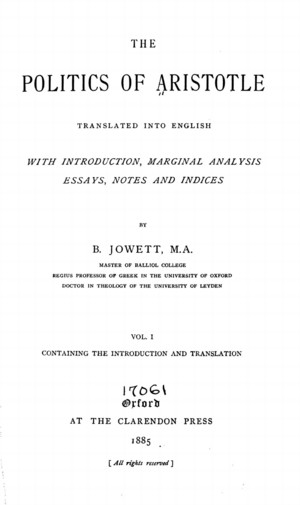
THE POLITICS. - Aristotle, The Politics vol. 1 [320 BC]Edition used:The Politics of Aristotle, trans. into English with introduction, marginal analysis, essays, notes and indices by B. Jowett. Oxford, Clarendon Press, 1885. 2 vols. Vol. 1.
Part of: The Politics 2 vols.About Liberty Fund:Liberty Fund, Inc. is a private, educational foundation established to encourage the study of the ideal of a society of free and responsible individuals. Copyright information:The text is in the public domain. Fair use statement:This material is put online to further the educational goals of Liberty Fund, Inc. Unless otherwise stated in the Copyright Information section above, this material may be used freely for educational and academic purposes. It may not be used in any way for profit.
THE POLITICS.BOOK I.Ed. Bekker, 1252 a.The state being the highest community aims at the highest good. Every state is a community of some kind, and every community is established with a view to some good; for mankind always act in order to obtain that which they think good. But, if all communities aim at some good, the state or political community, which is the highest of all, and which embraces all the rest, aims, and in a greater degree than any other, at the highest good. Plato treated the difference between household, royal, and political rule as a difference only of degree. Now there is an erroneous opiniona that a statesman, king, householder, and master are the same, and that they differ, not in kind, but only in the number of their subjects. For example, the ruler over a few is called a master; over more, the manager of a household; over a still larger number, a statesman or king, as if there were no difference between a great household and a small state. The distinction which is made between the king and the statesman is as follows: When the government is personal, the ruler is a king; when, according to the principles of the political science, the citizens rule and are ruled in turn, then he is called a statesman. But it is really a difference in kind, as will be clear if we resolve the state into its elements. But all this is a mistake; for governments differ in kind, as will be evident to any one who considers the matter according to the methodb which has hitherto guided us. As in other departments of science, so in politics, the compound should always be resolved into the simple elements or least parts of the whole. We must therefore look at the elements of which the state is composed, in order that we may see ain what they differ from one another, and whether any scientific distinction can be drawn between the different kinds of rulea . (1) Union of male and female.(2) Of ruler and subject.1252 b. He who thus considers things in their first growth and origin, whether a state or anything else, will obtain the clearest view of them. In the first place (1) there must be a union of those who cannot exist without each other; for example, of male and female, that the race may continue; and this is a union which is formed, not of deliberate purpose, but because, in common with other animals and with plants, mankind have a natural desire to leave behind them an image of themselves. And (2) there must be a union of natural ruler and subject, that both may be preserved. For he who can foresee with his mind is by nature intended to be lord and master, and he who can work with his body is a subject, and by nature a slave; hence master and slave have the same interest. Nature, however, has distinguished between the female and the slave. For she is not niggardly, like the smith who fashions the Delphian knife for many uses; she makes each thing for a single use, and every instrument is best made when intended for one and not for many uses. But among barbarians no distinction is made between women and slaves, because there is no natural ruler among them: they are a community of slaves, male and female. Wherefore the poets say,— ‘It is meet that Hellenes should rule over barbariansb ;’ as if they thought that the barbarian and the slave were by nature one. The family the first stage of society. Out of these two relationships between man and woman, master and slave, the family first arises, and Hesiod is right when he says,— ‘First house and wife and an ox for the ploughc ,’ The village the next. for the ox is the poor man’s slave. The family is the association established by nature for the supply of men’s every day wants, and the members of it are called by Charondas ‘companions of the cupboard’ [ὁμοσιπύους], and by Epimenides the Cretan, ‘acompanions of the mangera ’ [ὁμοκάπους]. But when several families are united, and the association aims at something more than the supply of daily needs, then comes into existence the village. And the most natural form of the village appears to be that of a colony from the family, composed of the children and grandchildren, who are said to be ‘suckled with the same milk.’ And this is the reason why Hellenic states were originally governed by kings; because the Hellenes were under royal rule before they came together, as the barbarians still are. Every family is ruled by the eldest, and therefore in the colonies of the family the kingly form of government prevailed because they were of the same blood. As Homer says [of the Cyclopes]:— ‘Each one gives law to his children and to his wivesb .’ For they lived dispersedly, as was the manner in ancient times. Wherefore men say that the Gods have a king, because they themselves either are or were in ancient times under the rule of a king. For they imagine, not only the forms of the Gods, but their ways of life to be like their own. The city or state the third and highest.1253 a. When several villages are united in a single community, perfect and large enough to be nearly or quite self-sufficing, the state comes into existence, originating in the bare needs of life, and continuing in existence for the sake of a good life. And therefore, if the earlier forms of society are natural, so is the state, for it is the end of them, and the [completed] nature is the end. For what each thing is when fully developed, we call its nature, whether we are speaking of a man, a horse, or a family. Besides, the final cause and end of a thing is the best, and to be self-sufficing is the end and the best. The state exists by nature. Hence it is evident that the state is a creation of nature, and that man is by nature a political animal. And he who by nature and not by mere accident is without a state, is either above humanity, or below it; he is the ‘Tribeless, lawless, hearthless one,’ whom Homera denounces—the outcast who is a lover of war; he may be compared to a bird which flies alone. Man, having the gift of speech and the sense of right and wrong, is by nature a political animal. Now the reason why man is more of a political animal than bees or any other gregarious animals is evident. Nature, as we often say, makes nothing in vainb , and man is the only animal whom she has endowed with the gift of speechc . And whereas mere sound is but an indication of pleasure or pain, and is therefore found in other animals (for their nature attains to the perception of pleasure and pain and the intimation of them to one another, and no further), the power of speech is intended to set forth the expedient and inexpedient, and likewise the just and the unjust. And it is a characteristic of man that he alone has any sense of good and evil, of just and unjust, and the association of living beings who have this sense makes a family and a state. The whole is prior to the part, the state to the family and individual. Thus the state is by nature clearly prior to the family and to the individual, since the whole is of necessity prior to the part; for example, if the whole body be destroyed, there will be no foot or hand, except in an equivocal sense, as we might speak of a stone hand; for when destroyed the hand will be no better. But things are defined by their working and power; and we ought not to say that they are the same when they are no longer the same, but only that they have the same name. The proof that the state is a creation of nature and prior to the individual is that the individual, when isolated, is not self-sufficing; and therefore he is like a part in relation to the whole. But he who is unable to live in society, or who has no need because he is sufficient for himself, must be either a beast or a god: he is no part of a state. A social instinct is implanted in all men by nature, and yet he who first founded the state was the greatest of benefactors. For man, when perfected, is the best of animals, but, when separated from law and justice, he is the worst of all; since armed injustice is the more dangerous, and he is equipped at birth with the arms of intelligence and with moral qualities which he may use for the worst ends. Wherefore, if he have not virtue, he is the most unholy and the most savage of animals, and the most full of lust and gluttony. But justice is the bond of men in states, and the administration of justice, which is the determination of what is justa , is the principle of order in political society. 1253 b.The family or household. Its parts. Seeing then that the state is made up of households, before speaking of the state, we must speak of the bmanagement of the householdb . The parts of the household are the persons who compose it, and a complete household consists of slaves and freemen. Now we should begin by examining everything in its least elements; and the first and least parts of a family are master and slave, husband and wife, father and children. We have therefore to consider what each of these three relations is and ought to be:—I mean the relation of master and servant, of husband and wife, and thirdly of parent and child. [I say γαμική and τεκνοποιητική, there being no words for the two latter notions which adequately represent them.] And there is another element of a household, the so-called art of money-making, which, according to some, is identical with household management, according to others, a principal part of it; the nature of this art will also have to be considered by us. Master and slave. Let us first speak of master and slave, looking to the needs of practical life and also seeking to attain some better theory of their relation than exists at present. For some are of opinion that the rule of a master is a science, and that the management of a household, and the mastership of slaves, and the political and royal rule, as I was saying at the outseta , are all the same. Others affirm that the rule of a master over slaves is contrary to nature, and that the distinction between slave and freeman exists by law only, and not by nature; and being an interference with nature is therefore unjust. Property includes instruments lifeless and living.The slave is a living instrument. Property is a part of the household, and therefore the art of acquiring property is a part of the art of managing the household; for no man can live well, or indeed live at all, unless he be provided with necessaries. And as in the arts which have a definite sphere the workers must have their own proper instruments for the accomplishment of their work, so it is in the management of a household. Now, instruments are of various sorts; some are living, others lifeless; in the rudder, the pilot of a ship has a lifeless, in the look-out man, a living instrument; for in the arts the servant is a kind of instrument. Thus, too, a possession is an instrument for maintaining life. And so, in the arrangement of the family, a slave is a living possession, and property a number of such instruments; and the servant is himself an instrument, which takes precedence of all other instruments. For if every instrument could accomplish its own work, obeying or anticipating the will of others, like the statues of Daedalus, or the tripods of Hephaestus, which, says the poetb , ‘of their own accord entered the assembly of the Gods;’ 1254 a.His master’s life is a life of action, to which he ministers.Who is the slave by nature? if, in like manner, the shuttle would weave and the plectrum touch the lyre without a hand to guide them, chief workmen would not want servants, nor masters slaves. Here, however, another distinction must be drawn: the instruments commonly so called are instruments of production, whilst a possession is an instrument of action. The shuttle, for example, is not only of use; but something else is made by it, whereas of a garment or of a bed there is only the use. Further, as production and action are different in kind, and both require instruments, the instruments which they employ must likewise differ in kind. But life is action and not production, and therefore the slave is the minister of action [for he ministers to his master’s life]. Again, a possession is spoken of as a part is spoken of; for the part is not only a part of something else, but wholly belongs to it; and this is also true of a possession. The master is only the master of the slave; he does not belong to him, whereas the slave is not only the slave of his master, but wholly belongs to him. Hence we see what is the nature and office of a slave; he who is by nature not his own but another’s and yet a man, is by nature a slave; and he may be said to belong to another who, being a human being, is also a possession. And a possession may be defined as an instrument of action, separable from the possessor. Is there a slave by nature? But is there any one thus intended by nature to be a slave, and for whom such a condition is expedient and right, or rather is not all slavery a violation of nature? There is no difficulty in answering this question, on grounds both of reason and of fact. For that some should rule, and others be ruled is a thing, not only necessary, but expedient; from the hour of their birth, some are marked out for subjection, others for rule. Everywhere in nature there is the distinction of higher and lower, of ruler and ruled.1254 b.1255 a.There are slaves by nature and freemen by nature, but the difference is not always marked. And whereas there are many kinds both of rulers and subjects, that rule is the better which is exercised over better subjects—for example, to rule over men is better than to rule over wild beasts. The work is better which is executed by better workmen; and where one man rules and another is ruled, they may be said to have a work. In all things which form a composite whole and which are made up of parts, whether continuous or discrete, a distinction between the ruling and the subject element comes to light. Such a duality exists in living creatures, but not in them only; it originates in the constitution of the universe; even in things which have no life, there is a ruling principle, as ain musical harmonya . But we are wandering from the subject. We will, therefore, restrict ourselves to the living creature which, in the first place, consists of soul and body: and of these two, the one is by nature the ruler, and the other the subject. But then we must look for the intentions of nature in things which retain their nature, and not in things which are corrupted. And therefore we must study the man who is in the most perfect state both of body and soul, for in him we shall see the true relation of the two; although in bad or corrupted natures the body will often appear to rule over the soul, because they are in an evil and unnatural condition. First then we may observe in living creatures both a despotical and a constitutional rule; for the soul rules the body with a despotical rule, whereas the intellect rules the appetites with a constitutional and royal rule. And it is clear that the rule of the soul over the body, and of the mind and the rational element over the passionate is natural and expedient; whereas the equality of the two or the rule of the inferior is always hurtful. The same holds good of animals as well as of men; for tame animals have a better nature than wild, and all tame animals are better off when they are ruled by man; for then they are preserved. Again, the male is by nature superior, and the female inferior; and the one rules, and the other is ruled; this principle, of necessity, extends to all mankind. Where then there is such a difference as that between soul and body, or between men and animals (as in the case of those whose business is to use their body, and who can do nothing better), the lower sort are by nature slaves, and it is better for them as for all inferiors that they should be under the rule of a master. For he who can be, and therefore is another’s, and he who participates in reason enough to apprehend, but not to have, reason, is a slave by nature. Whereas the lower animals cannot even apprehend reason; they obey their instincts. And indeed the use made of slaves and of tame animals is not very different; for both with their bodies minister to the needs of life. Nature would like to distinguish between the bodies of freemen and slaves, making the one strong for servile labour, the other upright, and although useless for such services, useful for political life in the arts both of war and peace. But this does not hold universally: for some slaves have the souls and others have the bodies of freemen. And doubtless if men differed from one another in the mere forms of their bodies as much as the statues of the Gods do from men, all would acknowledge that the inferior class should be slaves of the superior. And if there is a difference in the body, how much more in the soul? but the beauty of the body is seen, whereas the beauty of the soul is not seen. It is clear, then, that some men are by nature free, and others slaves, and that for these latter slavery is both expedient and right. The view that slavery is contrary to nature examined.Might and right, how related.Slavery of captives taken in war.Greek and barbarian. But that those who take the opposite view have in a certain way right on their side, may be easily seen. For the words slavery and slave are used in two senses. There is a slave or slavery by law as well as by nature. The law of which I speak is a sort of convention, according to which whatever is taken in war is supposed to belong to the victors. But this right many jurists impeach, as they would an orator who brought forward an unconstitutional measure: they detest the notion that, because one man has the power of doing violence and is superior in brute strength, another shall be his slave and subject. Even among philosophers there is a difference of opinion. The origin of the dispute, and the reason why the arguments cross, is as follows: Virtue, when furnished with means, may be deemed to have the greatest power of doing violence: and as superior power is only found where there is superior excellence of some kind, power is thought to imply virtue. But does it likewise imply justice? — that is the question. And, in order to make a distinction between them, some assert that justice is benevolence: to which others reply that justice is nothing more than the rule of a superior. If the two views are regarded as antagonistic and exclusive [i. e. if the notion that justice is benevolence excludes the idea of a just rule of a superior], the alternative [viz. that no one should rule over othersa ] has no force or plausibility, because it implies that not even the superior in virtue ought to rule, or be master. Some, clinging, as they think, to a principle of justice (for law and custom are a sort of justice), assume that slavery in war is justified by law, but they are not consistent. For what if the cause of the war be unjust? No one would ever say that he is a slave who is unworthy to be a slave. Were this the case, men of the highest rank would be slaves and the children of slaves if they or their parents chance to have been taken captive and sold. Wherefore Hellenes do not like to call themselves slaves, but confine the term to barbarians. Yet, in using this language, they really mean the natural slave of whom we spoke at first; for it must be admitted that some are slaves everywhere, others nowhere. The same principle applies to nobility. Hellenes regard themselves as noble everywhere, and not only in their own country, but they deem the barbarians noble only when at home, thereby implying that there are two sorts of nobility and freedom, the one absolute, the other relative. The Helen of Theodectes says:— ‘Who would presume to call me servant who am on both sides sprung from the stem of the Gods?’ 1255 b. What does this mean but that they distinguish freedom and slavery, noble and humble birth, by the two principles of good and evil? They think that as men and animals beget men and animals, so from good men a good man springs. But this is what nature, though she may intend it, cannot always accomplish. We see then that there is some foundation for this difference of opinion, and that all are not either slaves by nature or freemen by nature, and also that there is in some cases a marked distinction between the two classes, rendering it expedient and right for the one to be slaves and the others to be masters: the one practising obedience, the others exercising the authority which nature intended them to have. The abuse of this authority is injurious to both; for the interests of part and wholea , of body and soul, are the same, and the slave is a part of the master, a living but separated part of his bodily frame. Where the relation between them is natural they are friends and have a common interest, but where it rests merely on law and force the reverse is true. The rule of the household is not a science, though two rather inferior sciences enter into it.(1) The science of the slave.(2) The science of the master. The previous remarks are quite enough to show that the rule of a master is not a constitutional rule, and therefore that all the different kinds of rule are not, as some affirm, the same with each otherb . For there is one rule exercised over subjects who are by nature free, another over subjects who are by nature slaves. The rule of a household is a monarchy, for every house is under one head: whereas constitutional rule is a government of freemen and equals. The master is not called a master because he has science, but because he is of a certain character, and the same remark applies to the slave and the freeman. Still there may be a science for the master and a science for the slave. The science of the slave would be such as the man of Syracuse taught, who made money by instructing slaves in their ordinary duties. And such a knowledge may be carried further, so as to include cookery and similar menial arts. For some duties are of the more necessary, others of the more honourable sort; as the proverb says, ‘slave before slave, master before master.’ But all such branches of knowledge are servile. There is likewise a science of the master, which teaches the use of slaves; for the master as such is concerned, not with the acquisition, but with the use of them. Yet this so-called science is not anything great or wonderful; for the master need only know how to order that which the slave must know how to execute. Hence those who are in a position which places them above toil, have stewards who attend to their households while they occupy themselves with philosophy or with politics. But the art of acquiring slaves, I mean of justly acquiring them, differs both from the art of the master and the art of the slave, being a species of hunting or wara . Enough of the distinction between master and slave. Chrematistic, or the art of money-making. How related to the art of managing a household?1256 a.1256 b.Why men lead different kinds of lives.Nomadic life.Hunting.Agriculture.Nature’s provision for the maintenance of life. Let us now inquire into property generally, and into the art of money-making, in accordance with our usual method [of resolving a whole into its partsb ], for a slave has been shown to be a part of property. The first question is whether the art of money-making is the same with the art of managing a household or a part of it, or instrumental to it; and if the last, whether in the way that the art of making shuttles is instrumental to the art of weaving, or in the way that the casting of bronze is instrumental to the art of the statuary, for they are not instrumental in the same way, but the one provides tools and the other material; and by material I mean the substratum out of which any work is made; thus wool is the material of the weaver, bronze of the statuary. Now it is easy to see that the art of household management is not identical with the art of money-making, for the one uses the material which the other provides. And the art which uses household stores can be no other than the art of household management. There is, however, a doubt whether the art of money-making is a part of household management or a distinct art. [They appear to be connected]; for the money-maker has to consider whence money and property can be procured; but there are many sorts of property and wealth:—there is husbandry and the care and provision of food in general; are these parts of the money-making art or distinct arts? Again, there are many sorts of food, and therefore there are many kinds of lives both of animals and men; they must all have food, and the differences in their food have made differences in their ways of life. For of beasts, some are gregarious, others are solitary; they live in the way which is best adapted to sustain them, accordingly as they are carnivorous or herbivorous or omnivorous: and their habits are determined for them by nature in such a manner that they may obtain with greater facility the food of their choice. But, as different individuals have different tastes, the same things are not naturally pleasant to all of them; and therefore the lives of carnivorous or herbivorous animals further differ among themselves. In the lives of men too there is a great difference. The laziest are shepherds, who lead an idle life, and get their subsistence without trouble from tame animals; their flocks having to wander from place to place in search of pasture, they are compelled to follow them, cultivating a sort of living farm. Others support themselves by hunting, which is of different kinds. Some, for example, are pirates, others, who dwell near lakes or marshes or rivers or a sea in which there are fish, are fishermen, and others live by the pursuit of birds or wild beasts. The greater number obtain a living from the fruits of the soil. Such are the modes of subsistence which prevail among those awhose industry is employed immediately upon the products of naturea , and whose food is not acquired by exchange and retail trade—there is the shepherd, the husbandman, the pirate, the fisherman, the hunter. Some gain a comfortable maintenance out of two employments, eking out the deficiencies of one of them by another: thus the life of a shephered may be combined with that of a brigand, the life of a farmer with that of a hunter. Other modes of life are similarly combined in any way which the needs of men may require. Property, in the sense of a bare livelihood, seems to be given by nature herself to all, both when they are first born, and when they are grown up. For some animals bring forth, together with their offspring, so much food as will last until they are able to supply themselves; of this the vermiparous or oviparous animals are an instance; and the viviparous animals have up to a certain time a supply of food for their young in themselves, which is called milk. In like manner we may infer that, after the birth of animals, plants exist for their sake, and that the other animals exist for the sake of man, the tame for use and food, the wild, if not all, at least the greater part of them, for food, and for the provision of clothing and various instruments. Now if nature makes nothing incomplete, and nothing in vain, the inference must be that she has made all animals and plants for the sake of man. And so, in one point of view, the art of war is a natural art of acquisition, for it includes hunting, an art which we ought to practise against wild beasts, and against men who, though intended by nature to be governed, will not submit; for war of such a kind is naturally justa . The natural mode of acquiring property. Of the art of acquisition then there is one kindb which is natural and is a part of the management of a householdb . Either we must suppose the necessaries of life to exist previously, or the art of household management must provide a store of them for the common use of the family or state. They are the elements of true wealth; for the amount of property which is needed for a good life is not unlimited, although Solon in one of his poems says that ‘No bound to riches has been fixed for manc .’ But there is a boundary fixed, just as there is in the arts; for the instruments of any art are never unlimited, either in number or size, and wealth may be defined as a number of instruments to be used in a household or in a state. And so we see that there is a natural art of acquisition which is practised by managers of households and by statesmen, and what is the reason of this. 1257 a.The non-natural mode, or money-making. There is another variety of the art of acquisition which is commonly and rightly called the art of making money, and has in fact suggested the notion that wealth and property have no limit. Being nearly connected with the preceding, it is often identified with it. But though they are not very different, neither are they the same. The kind already described is given by nature, the other is gained by experience and art. Let us begin our discussion of the question with the following considerations:— Value in use and value in exchange.Invention of moneyand of coin. Of everything which we possess there are two uses: both belong to the thing as such, but not in the same manner, for one is the proper, and the other the improper or secondary use of it. For example, a shoe is used for wear, and is used for exchange; both are uses of the shoe. He who gives a shoe in exchange for money or food to him who wants one, does indeed use the shoe as a shoe, but this is not its proper or primary purpose, for a shoe is not made to be an object of barter. The same may be said of all possessions, for the art of exchange extends to all of them, and it arises at first in a natural manner from the circumstance that some have too little, others too much. Hence we may infer that retail trade is not a natural part of the art of money-making; had it been so, men would have ceased to exchange when they had enough. And in the first community, which is the family, this art is obviously of no use, but only begins to be useful when the society increases. For the members of the family originally had all things in common; in a more divided state of society theya still shared in many things, but they were different thingsa which they had to give in exchange for what they wanted, a kind of barter which is still practised among barbarous nations who exchange with one another the necessaries of life and nothing more; giving and receiving wine, for example, in exchange for corn and the like. This sort of barter is not part of the money-making art and is not contrary to nature, but is needed for the satisfaction of men’s natural wants. The other or more complex form of exchange grew out of the simpler. When the inhabitants of one country became more dependent on those of another, and they imported what they needed, and exported the surplus, money necessarily came into use. For the various necessaries of life are not easily carried about, and hence men agreed to employ in their dealings with each other something which was intrinsically useful and easily applicable to the purposes of life, for example, iron, silver, and the like. Of this the value was at first measured by size and weight, but in process of time they put a stamp upon it, to save the trouble of weighing and to mark the value. Retail trade.Two views about money.1257 b. When the use of coin had once been discovered, out of the barter of necessary articles arose the other art of money-making, namely, retail trade; which was at first probably a simple matter, but became more complicated as soon as men learned by experience whence and by what exchanges the greatest profit might be made. Originating in the use of coin, the art of money-making is generally thought to be chiefly concerned with it, and to be the art which produces wealth and money; having to consider how they may be accumulated. Indeed, wealth is assumed by many to be only a quantity of coin, because the art of money-making and retail trade are concerned with coin. Others maintain that coined money is a mere sham, a thing not natural, but conventional only, which would have no value or use for any of the purposes of daily life if another commodity were substituted by the users. And, indeed, he who is rich in coin may often be in want of necessary food. But how can that be wealth of which a man may have a great abundance and yet perish with hunger, like Midas in the fable, whose insatiable prayer turned everything that was set before him into gold? Distinction between natural wealth and the mere acquisition of coin.In the arts the means are limited by the end, the end is unlimited: so in money-making, but not in household management.Error of those who make wealth an end.1258 a. Men seek after a better notion of wealth and of the art of making money than the mere acquisition of coin, and they are right. For natural wealth and the natural art of money-making are a different thing; in their true form they are part of the management of a household; whereas retail trade is the art of producing wealth, not in every way, but by exchange. And it seems to be concerned with coin; for coin is the beginning of exchange and the measure or limit of it. And there is no bound to the wealth which springs from this art of money-makinga . As in the art of medicine there is no limit to the pursuit of health, and as in the other arts there is no limit to the pursuit of their several ends, for they aim at accomplishing their ends to the uttermost; (but of the means there is a limit, for the end is always the limit), so, too, in this art of money-making there is no limit of the end, which is wealth of the spurious kind, and the acquisition of money. But the art of household management has a limit; the unlimited acquisition of money is not its business. And, therefore, in one point of view, all wealth must have a limit; nevertheless, as a matter of fact, we find the opposite to be the case; for all money-makers increase their hoard of coin without limit. The source of the confusion is the near connexion between the two kinds of money-making; in either, the instrument [i.e. wealth] is the same, although the use is different, and so they pass into one another; for each is a use of the same propertyb , but with a difference: accumulation is the end in the one case, but there is a further end in the other. Hence some persons are led to believe that making money is the object of household management, and the whole idea of their lives is that they ought either to increase their money without limit, or at any rate not to lose it. The origin of this disposition in men is that they are intent upon living only, and not upon living well; and, as their desires are unlimited, they also desire that the means of gratifying them should be without limit. Even those who aim at a good life seek the means of obtaining bodily pleasures; and, since the enjoyment of these appears to depend on property, they are absorbed in making money: and so there arises the second species of money-making. For, as their enjoyment is in excess, they seek an art which produces the excess of enjoyment; and, if they are not able to supply their pleasures by the art of money-making, they try other arts, using in turn every faculty in a manner contrary to nature. The quality of courage, for example, is not intended to make money, but to inspire confidence; neither is this the aim of the general’s or of the physician’s art; but the one aims at victory and the other at health. Nevertheless, some men turn every quality or art into a means of making money; this they conceive to be the end, and to the promotion of the end all things must contribute. Thus, then, we have considered the art of money-making, which is unnecessary, and why men want it; and also the necessary art of money-making, which we have seen to be different from the other, and to be a natural part of the art of managing a household, concerned with the provision of food, not, however, like the former kind, unlimited, but having a limit. Relation of money-making to the art of household management. And we have found the answer to our original questiona , Whether the art of money-making is the business of the manager of a household and of the statesman or not their business?—viz. that it is an art which is presupposed by them. For political science does not make men, but takes them from nature and uses them; and nature provides them with food from the element of earth, air, or sea. At this stage begins the duty of the manager of a household, who has to order the things which nature supplies;—he may be compared to the weaver who has not to make but to use wool, and to know what sort of wool is good and serviceable or bad and unserviceable. Were this otherwise, it would be difficult to see why the art of money-making is a part of the management of a household and the art of medicine not; for surely the members of a household must have health just as they must have life or any other necessary. And as from one point of view the master of the house and the ruler of the state have to consider about health, from another point of view not they but the physician; so in one way the art of household management, in another way the subordinate art, has to consider about money. But, strictly speaking, as I have already said, the means of life must be provided beforehand by nature; for the business of nature is to furnish food to that which is born, and the food of the offspring always remains over in the parenta . Wherefore the art of making money out of fruits and animals is always natural. 1258 b.Retail trade.Usury the breeding of money from money. Of the two sorts of money-making one, as I have just said, is a part of household management, the other is retail trade: the former necessary and honourable, the latter a kind of exchange which is justly censured; for it is unnatural, and a mode by which men gain from one another. The most hated sort, and with the greatest reason, is usury, which makes a gain out of money itself, and not from the natural use of it. For money was intended to be used in exchange, but not to increase at interest. And this term usury [τόκος], which means the birth of money from money, is applied to the breeding of money because the offspring resembles the parent. Wherefore of all modes of making money this is the most unnatural. Practical classification of money-making.(1) The natural kind.(2) Exchange.(3) The intermediate kind. Enough has been said about the theory of money-making; we will now proceed to the practical part. aThe discussion of such matters is not unworthy of philosophy, but to be engaged in them practically is illiberal and irksomea . The useful parts of money-making are, first, the knowledge of live-stock,—which are most profitable, and where, and how,—as, for example, what sort of horses or sheep or oxen or any other animals are most likely to give a return. A man ought to know which of these pay better than others, and which pay best in particular places, for some do better in one place and some in another. Secondly, husbandry, which may be either tillage or planting, and the keeping of bees and of fish, or fowl, or of any animals which may be useful to man. These are the divisions of the true or proper art of money-making and come first. Of the other, which consists in exchange, the first and most important division is commerce (of which there are three kinds — commerce by sea, commerce by land, selling in shops—these again differing as they are safer or more profitable), the second is usury, the third, service for hire—of this, one kind is employed in the mechanical arts, the other in unskilled and bodily labour. There is still a third sort of money-making intermediate between this and the first or natural mode which is partly natural, but is also concerned with exchange of the fruits and other products of the earth. Some of these latter, although they bear no fruit, are nevertheless profitable; for example, wood and minerals. The art of mining, by which minerals are obtained, has many branches, for there are various kinds of things dug out of the earth. Of the several divisions of money-making I now speak generally; a minute consideration of them might be useful in practice, but it would be tiresome to dwell upon them at greater length now. Those occupations are most truly arts in which there is the least element of chance; they are the meanest in which the body is most deteriorated, the most servile in which there is the greatest use of the body, and the most illiberal in which there is the least need of excellence. 1259 a.Works on economic subjects.Story about Thales. How a philosopher once made a fortune.Monopoly. Works have been written upon these subjects by various persons; for example, by Chares the Parian, and Apollodorus the Lemnian, who have treated of Tillage and Planting, while others have treated of other branches; any one who cares for such matters may refer to their writings. It would be well also to collect the scattered stories of the ways in which individuals have succeeded in amassing a fortune; for all this is useful to persons who value the art of making money. There is the anecdote of Thales the Milesian and his financial device, which involves a principle of universal application, but is attributed to him on account of his reputation for wisdom. He was reproached for his poverty, which was supposed to show that philosophy was of no use. According to the story, he knew by his skill in the stars while it was yet winter that there would be a great harvest of olives in the coming year; so, having a little money, he gave deposits for the use of all the olive-presses in Chios and Miletus, which he hired at a low price because no one bid against him. When the harvest-time came, and many wanted them all at once and of a sudden, he let them out at any rate which he pleased, and made a quantity of money. Thus he showed the world that philosophers can easily be rich if they like, but that their ambition is of another sort. He is supposed to have given a striking proof of his wisdom, but, as I was saying, his device for getting money is of universal application, and is nothing but the creation of a monopoly. It is an art often practised by cities when they are in want of money; they make a monopoly of provisions. Story about a man of Sicily.Monopoly applied to finance. There was a man of Sicily, who, having money deposited with him, bought up all the iron from the iron mines; afterwards, when the merchants from their various markets came to buy, he was the only seller, and without much increasing the price he gained 200 per cent. Which when Dionysius heard, he told him that he might take away his money, but that he must not remain at Syracuse, for he thought that the man had discovered a way of making money which was injurious to his own interests. He had the same ideaa as Thales; they both contrived to create a monopoly for themselves. And statesmen ought to know these things; for a state is often as much in want of money and of such devices for obtaining it as a household, or even more so; hence some public men devote themselves entirely to finance. Different kinds of rule within the household: (1) rule of master over slaves; (2) of father over children; (3) of husband over wife.1259 b. Of household management we have seenb that there are three parts—one is the rule of a master over slaves, which has been discussed alreadyc , another of a father, and the third of a husband. A husband and father rules over wife and children, both free, but the rule differs, the rule over his children being a royal, over his wife a constitutional rule. For although there may be exceptions to the order of nature, the male is by nature fitter for command than the female, just as the elder and full-grown is superior to the younger and more immature. But in most constitutional states the citizens rule and are ruled by turns, for the idea of a constitutional state implies that the natures of the citizens are equal, and do not differ at alld . Nevertheless, when one rules and the other is ruled we endeavour to create a difference of outward forms and names and titles of respect, which may be illustrated by the saying of Amasis about his foot-pane . The relation of the male to the female is of this kind, but there the inequality is permanent. The rule of a father over his children is royal, for he receives both love and the respect due to age, exercising a kind of royal power. And therefore Homer has appropriately called Zeus ‘father of Gods and men,’ because he is the king of them all. For a king is the natural superior of his subjects, but he should be of the same kin or kind with them, and such is the relation of elder and younger, of father and son. 1260 a.Has a slave virtue?How far have women and children virtues?The virtues of ruler and subject different.Psychological parallel.Different degrees of virtue.Plato criticised. Thus it is clear that household management attends more to men than to the acquisition of inanimate things, and to human excellence more than to the excellence of property which we call wealth, and to the virtue of freemen more than to the virtue of slaves. A question may indeed be raised, whether there is any excellence at all in a slave beyond merely instrumental and ministerial qualities — whether he can have the virtues of temperance, courage, justice, and the like; or whether slaves possess only bodily and ministerial qualities. And, whichever way we answer the question, a difficulty arises; for, if they have virtue, in what will they differ from freemen? On the other hand, since they are men and share in reason, it seems absurd to say that they have no virtue. A similar question may be raised about women and children, whether they too have virtues: ought a woman to be temperate and brave and just, and is a child to be called temperate, and intemperate, or not? So in general we may ask about the natural ruler, and the natural subject, whether they have the same or different virtues. For a noble nature is equally required in both, but if so, why should one of them always rule, and the other always be ruled? Nor can we say that this is a question of degree, for the difference between ruler and subject is a difference of kind, and therefore not of degree; yet how strange is the supposition that the one ought, and that the other ought not, to have virtue! For if the ruler is intemperate and unjust, how can he rule well? if the subject, how can he obey well? If he be licentious and cowardly, he will certainly not do his duty. It is evident, therefore, that both of them must have a share of virtue, but varying according to their various natures. And this is at once indicated by the soul, in which one part naturally rules, and the other is subject, and the virtue of the ruler we maintain to be different from that of the subject; — the one being the virtue of the rational, and the other of the irrational part. Now, it is obvious that the same principle applies generally, and therefore almost all things rule and are ruled according to nature. But the kind of rule differs; — the freeman rules over the slave after another manner from that in which the male rules over the female, or the man over the child; although the parts of the soul are present in all of them, they are present in different degrees. For the slave has no deliberative faculty at all; the woman has, but it is awithout authoritya , and the child has, but it is immature. So it must necessarily be with the moral virtues also; all may be supposed to partake of them, but only in such manner and degree as is required by each for the fulfilment of his duty. Hence the ruler ought to have moral virtue in perfection, for his duty is entirely that of a master artificer, and the master artificer is reason; the subjects, on the other hand, require only that measure of virtue which is proper to each of them. Clearly, then, moral virtue belongs to all of them; but the temperance of a man and of a woman, or the courage and justice of a man and of a woman, are not, as Socrates maintainedb, the same; the courage of a man is shown in commanding, of a woman in obeying. And this holds of all other virtues, as will be more clearly seen if we look at them in detail, for those who say generally that virtue consists in a good disposition of the soul, or in doing rightly, or the like, only deceive themselves. Far better than such definitions is their mode of speaking, who, like Gorgiasb , enumerate the virtues. All classes must be deemed to have their special attributes; as the poet says of women, ‘Silence is a woman’s gloryc ,’ 1260 b.Has the artisan virtue?Mechanic and slave.Plato criticised. but this is not equally the glory of man. The child is imperfect, and therefore obviously his virtue is not relative to himself alone, but to the perfect man and to his teachera , and in like manner the virtue of the slave is relative to a master. Now we determined that a slave is useful for the wants of life, and therefore he will obviously require only so much virtue as will prevent him from failing in his duty through cowardice and intemperance. Some one will ask whether, if what we are saying is true, virtue will not be required also in the artisans, for they often fail in their work through misconduct? But is there not a great difference in the two cases? For the slave shares in his master’s life; the artisan is less closely connected with him, and only attains excellence in proportion as he becomes a slave, [i. e. is under the direction of a master]. The meaner sort of mechanic has a special and separate slavery; and whereas the slave exists by nature, not so the shoemaker or other artisan. It is manifest, then, that the master ought to be the source of excellence in the slave; but not merely because he possesses the art which trains him in his dutiesb . Wherefore they are mistaken who forbid us to converse with slaves and say that we should employ command onlyc , for slaves stand even more in need of admonition than children. Virtues in the family relations. The relations of husband and wife, parent and child, their several virtues, what in their intercourse with one another is good, and what is evil, and how we may pursue the good and escape the evil, will have to be discussed when we speak of the different forms of government. For, inasmuch as every family is a part of a state, and these relationships are the parts of a family, the virtue of the part must have regard to the virtue of the whole. And therefore women and children must be trained by education with an eye to the stated , if the virtues of either of them are supposed to make any difference in the virtues of the state. And they must make a difference: for the children grow up to be citizens, and half the free persons in a state are womena . Of these matters, enough has been said; of what remains, let us speak at another time. Regarding, then, our present enquiry as complete, we will make a new beginning. And, first, let us examine the various theories of a perfect state. BOOK II.Reasons for examining model forms of government actual or ideal. Our purpose is to consider what form of political community is best of all for those who are most able to realise their ideal of life. We must therefore examine not only this but other constitutions, both such as actually exist in well-governed states, and any theoretical forms which are held in esteem; that what is good and useful may be brought to light. And let no one suppose that in seeking for something beyond them awe at all want to philosophise at the expense of trutha ; we only undertake this enquiry because all the constitutions with which we are acquainted are faulty. 1261 a.What should be common in a state? The logical alternatives.The communism of Plato. We will begin with the natural beginning of the subject. Three alternatives are conceivable: The members of a state must either have (1) all things or (2) nothing in common, or (3) some things in common and some not. That they should have nothing in common is clearly impossible, for the state is a community, and must at any rate have a common place—one city will be in one place, and the citizens are those who share in that one city. But should a well-ordered state have all things, as far as may be, in common, or some only and not others? For the citizens might conceivably have wives and children and property in common, as Socrates proposes in the Republic of Platob . Which is better, our present condition, or the proposed new order of society? The community of women.(1) Plato is wrong in making the greatest unity the end of the state.The state is a unity in difference. There are many difficulties in the community of women. And the principle on which Socrates rests the necessity of such an institution does not appear to be established by his arguments. The end which he ascribes to the state, taken literally, is impossible, and how weare to interpret it is nowhere precisely stated. I am speaking of the premiss from which the argument of Socrates proceeds, ‘that the greater the unity of the state the better.’ Is it not obvious that a state may at length attain such a degree of unity as to be no longer a state?—since the nature of a state is to be a plurality, and in tending to greater unity, from being a state, it becomes a family, and from being a family, an individual; for the family may be said to be more one than the state, and the individual than the family. So that we ought not to attain this greatest unity even if we could, for it would be the destruction of the state. Again, a state is not made up only of so many men, but of different kinds of men; for similars do not constitute a state. It is not like a military alliance, of which the usefulness depends upon its quantity even where there is no difference in quality. For in that mutual protection is the end aimed at; and the question is the same as about the scales of a balance: which is the heavier? A state, unlike a nation, is composed of different elements;and freedom is preserved by the interchange of them.1261 b.Excessive unity would ruin the state. In like manner, a state differs from a nation; for in a nation the people are not adistributed into villages, but live scattered about, like the Arcadiansa ; whereas in a state the elements out of which the unity is to be formed differ in kind. Wherefore the principle of compensationb , as I have already remarked in the Ethicsc , is the salvation of states. And among freemen and equals this is a principle which must be maintained, for they cannot all rule together, but must change at the end of a year or some other period of time or in some order of succession. The result is that upon this plan they all govern; [but the manner of government is] just as if shoemakers and carpenters were to exchange their occupations, and the same persons did not always continue shoemakers and carpenters. And it is clearly better that, as in business, so also in politics there should be continuance of the same persons where this is possible. But where this is not possible by reason of the natural equality of the citizens, and it would be unjust that any one should be excluded from the government (whether to govern be a good thing or a bada ), then it is better, instead of all holding power, to adopt a principle of rotation, equals giving place to equals, as the original rulers gave place to themb . Thus the one party rule and the others are ruled in turn, as if they were no longer the same persons. In like manner there is a variety in the offices held by them. Hence it is evident that a city is not by nature one in that sense which some persons affirm; and that what is said to be the greatest good of cities is in reality their destruction; but surely the good of things must be that which preserves themc . Again, in another point of view, this extreme unification of the state is clearly not good; for a family is more self-sufficing than an individual, and a city than a family, and a city only comes into being when the community is large enough to be self-sufficing. If then self-sufficiency is to be desired, the lesser degree of unity is more desirable than the greater. (2) Communism will not be the means by which unity is to be attained.Fallacy in the word ‘all.’What is common least cared for.Present arrangements better.1262 a.The real relationship will often be discovered. But, even supposing that it were best for the community to have the greatest degree of unity, this unity is by no means proved to follow from the fact ‘of all men saying “mine” and “not mine” at the same instant of time,’ which, according to Socratesd , is the sign of perfect unity in a state. For the word ‘all’ is ambiguous. If the meaning be that every individual says ‘mine’ and ‘not mine’ at the same time, then perhaps the result at which Socrates aims may be in some degree accomplished; each man will call the same person his own son and his own wife, and so of his property and of all that belongs to him. This, however, is not the way in which people would speak who had their wives and children in common; they would say ‘all’ but not ‘each.’ In like manner their property would be described as belonging to them, not severally but collectively. There is an obvious fallacy in the term ‘all’: like some other words, ‘both,’ ‘odd,’ ‘even,’ it is ambiguous, and in argument becomes a source of logical puzzles. That all persons call the same thing mine in the sense in which each does so may be a fine thing, but it is impracticable; or if the words are taken in the other sense [i.e. the sense which distinguishes ‘all’ from ‘each’], such an unity in no way conduces to harmony. And there is another objection to the proposal. For that which is common to the greatest number has the least care bestowed upon it. Every one thinks chiefly of his own, hardly at all of the common interest; and only when he is himself concerned as an individual. For besides other considerations, everybody is more inclined to neglect the duty which he expects another to fulfil; as in families many attendants are often less useful than a few. Each citizen will have a thousand sons who will not be his sons individually, but anybody will be equally the son of anybody, and will therefore be neglected by all alike. Further, upon this principle, every one will call another ‘mine’ or ‘not mine’ according as he is prosperous or the reverse;—however small a fraction he may be of the whole number, he will say of every individual of the thousand, or whatever be the number of the city, ‘such an one is mine,’ ‘such an one his’; and even about this he will not be positive; for it is impossible to know who chanced to have a child, or whether, if one came into existence, it has survived. But which is better—to be able to say ‘mine’ about every one of the two thousand or the ten thousand citizens, or to use the word ‘mine’ in the ordinary and more restricted sense? For usually the same person is called by one man his son whom another calls his brother or cousin or kinsman or blood-relation or connexion by marriage either of himself or of some relation of his, and these relationships he distinguishes from the tie which binds him to his tribe or ward; and how much better is it to be the real cousin of somebody than to be a son after Plato’s fashion! Nor is there any way of preventing brothers and children and fathers and mothers from sometimes recognizing one another; for children are born like their parents, and they will necessarily be finding indications of their relationship to one another. Geographers declare such to be the fact; they say that in Upper Libya, where the women are common, nevertheless the children who are born are assigned to their respective fathers on the ground of their likenessa . And some women, like the females of other animals — for example mares and cows — have a strong tendency to produce offspring resembling their parents, as was the case with the Pharsalian mare called Dicaea (the Just)b . Evils of concealment. Other evils, against which it is not easy for the authors of such a community to guard, will be assaults and homicides, voluntary as well as involuntary, quarrels and slanders, all which are most unholy acts when committed against fathers and mothers and near relations, but not equally unholy when there is no relationship. Moreover, they are much more likely to occur if the relationship is unknown, and, when they have occurred, the customary expiations of them cannot be made. Again, how strange it is that Socrates, after having made the children common, should hinder lovers from carnal intercourse only, but should permit familiarities between father and son or between brother and brother, than which nothing can be more unseemly, since even without them, love of this sort is improper. How strange, too, to forbid intercourse for no other reason than the violence of the pleasure, as though the relationship of father and son or of brothers with one another made no difference. 1262 b.Communism a source of weakness.Instead of self-destroying unitythere will be watery friendship. This community of wives and children seems better suited to the husbandmen than to the guardians, for if they have wives and children in common, they will be bound to one another by weaker ties, as a subject class should be, and they will remain obedient and not rebela . In a word, the result of such a law would be just the opposite of that which good laws ought to have, and the intention of Socrates in making these regulations about women and children would defeat itself. For friendship we believe to be the greatest good of statesb and the preservative of them against revolutions; neither is there anything which Socrates so greatly lauds as the unity of the state which he and all the world declare to be created by friendship. But the unity which he commendsc would be like that of the lovers in the Symposiumd , who, as Aristophanes says, desire to grow together in the excess of their affection, and from being two to become one, in which case one or both would certainly perish. Whereas [the very opposite will really happen;] in a state having women and children common, love will be watery; and the father will certainly not say ‘my son,’ or the son ‘my fathere .’ As a little sweet wine mingled with a great deal of water is imperceptible in the mixture, so, in this sort of community, the idea of relationship which is based upon these names will be lost; there is no reason why the so-called father should care about the son, or the son about the father, or brothers about one another. Of the two qualities which chiefly inspire regard and affection—that a thing is your own and that you love it—neither can exist in such a state as this. Difficulties in the transfer of children from one rank to another. Again, the transfer of children as soon as they are born from the rank of husbandmen or of artisans to that of guardians, and from the rank of guardians into a lower rankf , will be very difficult to arrange; the givers or transferrers cannot but know whom they are giving and transferring, and to whom. And the previously mentioned evils, such as assaults, unlawful loves, homicides, will happen more often amongst those who are transferred to the lower classes, or who have a place assigned to them among the guardians; for they will no longer call the members of any other class brothers, and children, and fathers, and mothers, and will not, therefore, be afraid of committing any crimes by reason of consanguinity. Touching the community of wives and children, let this be our conclusion. 1263 a.Should property be common?Possible modes of common property. Next let us consider what should be our arrangements about property: should the citizens of the perfect state have their possessions in common or not? This question may be discussed separately from the enactments about women and children. Even supposing that the women and children belong to individuals, according to the custom which is at present universal, may there not be an advantage in having and using possessions in common? Three cases are possible: (1) the soil may be appropriated, but the produce may be thrown for consumption into the common stock; and this is the practice of some nations. Or (2), the soil may be common, and may be cultivated in common, but the produce divided among individuals for their private use; this is a form of common property which is said to exist among certain barbarians. Or (3), the soil and the produce may be alike common. Difficulties. When the husbandmen are not the owners, the case will be different and easier to deal with; but when they till the ground themselves the question of ownership will give a world of trouble. If they do not share equally in enjoyments and toils, those who labour much and get little will necessarily complain of those who labour little and receive or consume much. There is always a difficulty in men living together and having things in common, but especially in their having common property. The partnerships of fellow-travellers are an example to the point; for they generally fall out by the way and quarrel about any trifle which turns up. So with servants: we are most liable to take offence at those with whom we most frequently come into contact in daily life. Better private possession and friendly use.Illustration from Sparta.The magic of property.Communism destroys the two virtues of liberality and of temperance.1263 b. These are only some of the disadvantages which attend the community of property; the present arrangement, if improved as it might be by good customs and laws, would be far better, and would have the advantages of both systems. Property should be in a certain sense common, but, as a general rule, private; for, when every one has a distinct interesta , men will not complain of one another, and they will make more progress, because every one will be attending to his own business. And yet among the good, and in respect of use, ‘Friends,’ as the proverb says, ‘will have all things commonb .’ Even now there are traces of such a principle, showing that it is not impracticable, but, in well-ordered states, exists already to a certain extent and may be carried further. For, although every man has his own property, some things he will place at the disposal of his friends, while of others he shares the use with them. The Lacedaemonians, for example, use one another’s slaves, and horses, and dogs, as if they were their own; and when they happen to be in the country, they appropriate in the fields whatever provisions they want. It is clearly better that property should be private, but the use of it common; and the special business of the legislator is to create in men this benevolent disposition. Again, how immeasurably greater is the pleasure, when a man feels a thing to be his own; for the love of selfc is a feeling implanted by nature and not given in vain, although selfishness is rightly censured; this, however, is not the mere love of self, but the love of self in excess, like the miser’s love of money; for all, or almost all, men love money, and other such objects in a measure. And further, there is the greatest pleasure in doing a kindness or service to friends or guests or companions, which can only be rendered when a man has private property. The advantage is lost by the excessive unification of the state. Two virtues are annihilated in such a state: first, temperance towards women (for it is an honourable action to abstain from another’s wife for temperance sake); secondly, liberality in the matter of property. No one, when men have all things in common, will any longer set an example of liberality or do any liberal action; for liberality consists in the use which is made of propertya . The speciousness of universal friendship.The real cause of existing evils, not private property, but the wickedness of men. Such legislation may have a specious appearance of benevolence; men readily listen to it, and are easily induced to believe that in some wonderful manner everybody will become everybody’s friend, especially when some oneb is heard denouncing the evils now existing in states, suits about contracts, convictions for perjury, flatteries of rich men and the like, which are said to arise out of the possession of private property. These evils, however, are due to a very different cause—the wickedness of human nature. Indeed, we see that there is much more quarrelling among those who have all things in common, though there are not many of them when compared with the vast numbers who have private property. 1264 a.Plato’s false ideal of unity.The true unity can only be given by education.All experience against men. Again, we ought to reckon, not only the evils from which the citizens will be saved, but also the advantages which they will lose. The life which they are to lead appears to be quite impracticable. The error of Socrates must be attributed to the false notion of unity from which he starts. Unity there should be, both of the family and of the state, but in some respects only. For there is a point at which a state may attain such a degree of unity as to be no longer a state, or at which, without actually ceasing to exist, it will become an inferior state, like harmony passing into unison, or rhythm which has been reduced to a single foot. The state, as I was saying, is a pluralityc , which should be united and made into a community by education; and it is strange that the author of a system of education which he thinks will make the state virtuous, should expect to improve his citizens by regulations of this sort, and not by philosophy or by customs and laws, like those which prevail at Sparta and Crete respecting common meals, whereby the legislator has [to a certain degree] made property common. Let us remember that we should not disregard the experience of ages; in the multitude of years these things, if they were good, would certainly not have been unknown; for almost everything has been found out, although sometimes they are not put together; in other cases men do not use the knowledge which they have. Great light would be thrown on this subject if we could see such a form of government in the actual process of construction; for the legislator could not form a state at all without distributing and dividing the citizens into associations for common meals, and into phratries and tribes. But all this legislation ends only in forbidding agriculture to the guardians, a prohibition which the Lacedaemonians try to enforce already. Difficulties.How about the dependent classes? are they to be educated and to have wives in common?If not, there will be two states in one.Omissions. Again, Socrates has not said, nor is it easy to decide, what in such a community will be the general form of the state. The citizens who are not guardians are the majority, and about them nothing has been determined: are the husbandmen, too, to have their property in common? Or, besides the common land which he tills, is each individual to have his own? and are their wives and children to be individual or common? If, like the guardians, they are to have all things in common, in what do they differ from them, or what will they gain by submitting to their government? Or, upon what principle would they submit, unless indeed the governing class adopt the ingenious policy of the Cretans, who give their slaves the same institutions as their own, but forbid them gymnastic exercises and the possession of arms. If, on the other hand, the inferior classes are to be like other cities in respect of marriage and property, what will be the form of the community? Must it not contain two states in onea , each hostile to the other? b One class will consist of the guardians, who are a sort of watchmen; another, of the husbandmen, and there will be the artisans and the other citizensb . But [if so] the suits and quarrels, and all the evils which Socrates affirmsa to exist in other states, will exist equally among them. He says indeed that, having so good an education, the citizens will not need many laws, for example laws about the city or about the marketsb ; but then he confines his education to the guardians. Again, he makes the husbandmen owners of the land upon condition of their paying a tributec . But in that case they are likely to be much more unmanageable and conceited than the Helots, or Penestae, or slaves in generald . And whether community of wives and property be necessary for the lower equally with the higher class or not, and the questions akin to this, what will be the education, form of government, laws of the lower class, Socrates has nowhere determined: neither is it easy, though very important, to discover what should be the character of the inferior classes, if the common life of the guardians is to be maintained. 1264 b.More difficulties.Who will look after the house?Danger from the rulers being always the same.How can the whole state be happy if happiness is denied to the guardians? Again, if Socrates makes the women common, aand retains private property, the men will see to the fields, but who will see to the house?e And what will happen if the agricultural class have both their property and their wives in commone ? Once more; it is absurd to argue, from the analogy of the animals, that men and women should follow the same pursuitsf ; for animals have not to manage a household. The government, too, as constituted by Socrates, contains elements of danger; for he makes the same persons always rule. And if this is often a cause of disturbance among the meaner sort, how much more among high-spirited warriors? But that the persons whom he makes rulers must be the same is evident; for the gold which the God mingles in the souls of men is not at one time given to one, at another time to another, but always to the same: as he says, ‘God mingles gold in some, and silver in others, from their very birth; but brass and iron in those who are meant to be artisans and husbandmena .’ Again, he deprives the guardians of happiness, and says that the legislator ought to make the whole state happyb . But the whole cannot be happy unless most, or all, or some of its parts enjoy happinessc . In this respect happiness is not like the even principle in numbers, which may exist only in the whole, but in none of the parts; not so happiness. And if the guardians are not happy, who are? Surely not the artisans, or the common people. The Republic of which Socrates discourses has all these difficulties, and others quite as great. The Laws a later work.Brief summary of questions not settled in the Republic,and they are not settled in the Laws, which1265 a.begins with a more ordinary type of constitution, but soon reverts to the ideal. The same, or nearly the same, objections apply to Plato’s later work, the Laws, and therefore we had better examine briefly the constitution which is therein described. In the Republic, Socrates has definitely settled in all a few questions only; such as the community of women and children, the community of property, and the constitution of the state. The population is divided into two classes—one of husbandmen, and the other of warriors; from this latter is taken a third class of counsellors and rulers of the state. But Socrates has not determined whether the husbandmen and artisans are to have a share in the government, and whether they, too, are to carry arms and share in military service, or not. He certainly thinks that the women ought to share in the education of the guardians, and to fight by their side. The remainder of the work is filled up with digressions foreign to the main subject, and with discussions about the education of the guardians. In the Laws there is hardly anything but laws; not much is said about the constitution. This, which he had intended to make more of the ordinary type, he gradually brings round to the other or ideal form. For with the exception of the community of women and property, he supposes everything to be the same in both states; there is to be the same education; the citizens of both are to live free from servile occupations, and there are to be common meals in both. The only difference is that in the Laws, the common meals are extended to womena , and the warriors number about 5000b , but in the Republic only 1000c . Plato, with all his genius, has sinned against probability in creating so large a state. The discourses of Socrates are never commonplace; they always exhibit grace and originality and thought; but perfection in everything can hardly be expected. We must not overlook the fact that the number of 5000 citizens, just now mentioned, will require a territory as large as Babylonia, or some other huge country, if so many persons are to be supported in idleness, together with their women and attendants, who will be a multitude many times as great. [In framing an ideal] we may assume what we wish, but should avoid impossibilitiesd . Foreign relations neglected. It is said [in the Laws] that the legislator ought to have his eye directed to two points,—the people and the countrye . But neighbouring countries also must not be forgotten by himf , if the state for which he legislates is to have a true political lifeg . For a state must have such a military force as will be serviceable against her neighbours, and not merely useful at home. Even if the life of action is not admitted to be the best, either for individuals or statesh , still a city should be formidable to enemies, whether invading or retreating. How much property should a citizen hold?So much as will enable a man to live temperately andalso liberally.Necessity of a limit to population.1265 b. There is another point: Should not the amount of property be defined in some clearer way? For Socrates says that a man should have so much property as will enable him to live temperatelyi , which is only a way of saying ‘to live well;’ this would be the higher or more general conception. But a man may live temperately and yet miserably. A better definition would be that a man must have so much property as will enable him to live not only temperately but liberallyj ; if the two are parted, liberality will combine with luxury; toil will be associated with temperance. For liberality and temperance are the only virtuesa which have to do with the use of property. A man cannot use property with mildness or courage, but temperately and liberally he may; and therefore the practice of these virtues is inseparable from property. There is an inconsistency, too, in equalizing the property and not regulating the number of the citizensb ; the population is to remain unlimited, and he thinks that it will be sufficiently equalized by a certain number of marriages being unfruitful, however many are born to others, because he finds this to be the case in existing states. But [in Plato’s imaginary state] greater care will be required than now; for among ourselves, whatever may be the number of citizens, the property is always distributed among them, and therefore no one is in want; but, if the property were incapable of division [as in the Laws], the supernumeraries, whether few or many, would get nothing. One would have thought that it was even more necessary to limit population than property; and that the limit should be fixed by calculating the chances of mortality in the children, and of sterility in married persons. The neglect of this subject, which in existing states is so common, is a never-failing cause of poverty among the citizens; and poverty is the parent of revolution and crime. Pheidon the Corinthian, who was one of the most ancient legislators, thought that the families and the number of citizens ought to remain the same, although originally all the lots may have been of different sizes; but in the Laws, the opposite principle is maintained. What in our opinion is the right arrangement will have to be explained hereafterc . How do the rulers differ from their subjects?The two households. There is another omission in the Laws; Socrates does not tell us how the rulers differ from their subjects; he only says that they should be related as the warp and the woof, which are made out of different woolsa . He allows that a man’s whole property may be increased five-foldb , but why should not his land also increase to a certain extent? Again, will the good management of a household be promoted by his arrangement of homesteads? for he assigns to each individual two homesteads in separate placesc , and it is difficult to live in two houses. 1266 a.The constitution a mixture of democracy and oilgarchy.Sparta, also a mixture, is praised and blamed.The best constitution is said to be that which includes most elements.Election of magistrates.Election to the Council.Danger in double election. The whole system of government tends to be neither democracy nor oligarchy, but something in a mean between them, which is usually called a polity, and is composed of the heavy armed soldiers. Now, if he intended to frame a constitution which would suit the greatest number of states, he was very likely right, but not if he meant to say that this constitutional form came nearest to his first or ideal state; for many would prefer the Lacedaemonian, or, possibly, some other more aristocratic government. Some, indeed, say that the best constitution is a combination of all existing forms, and they praise the Lacedaemoniand because it is made up of oligarchy, monarchy, and democracy, the king forming the monarchy, and the council of elders the oligarchy, while the democratic element is represented by the Ephors; for the Ephors are selected from the people. Others, however, declare the Ephoralty to be a tyranny, and find the element of democracy in the common meals and in the habits of daily life. In the Lawse , it is maintained that the best state is made up of democracy and tyranny, which are either not constitutions at all, or are the worst of all. But they are nearer the truth who combine many forms; for the state is better which is made up of more numerous elements. The constitution proposed in the Laws has no element of monarchy at all; it is nothing but oligarchy and democracy, leaning rather to oligarchy. This is seen in the mode of appointing magistratesa ; for although the appointment of them by lot from among those who have been already selected combines both elements, the way in which the rich are compelled by law to attend the assemblyb and vote for magistrates or discharge other political duties, while the rest may do as they like, and the endeavour to have the greater number of the magistrates appointed out of the richest classes and the highest officers selected from those who have the greatest incomes, both these are oligarchical features. The oligarchical principle prevails also in the choice of the councilc ; for all are compelled to choose, but the compulsion extends only to the choice out of the first class, and of an equal number out of the second class and out of the third class, but not in this latter case to all the voters of the third and fourth class; and the selection of candidates out of the fourth classd is only compulsory on the first and second. Then, he says that there ought to be an equal number of each class selected. Thus a preponderance will be given to the better sort of people, who have the larger incomes, because many of the lower classes, not being compelled, will not vote. These considerations, and others which will be adduced when the time comes for examining similar polities, tend to show that states like Plato’s should not be composed of democracy and monarchy. There is also a danger in electing the magistrates out of a body who are themselves elected; for, if but a small number choose to combine, the elections will always go as they desire. Such is the constitution which is described in the Laws. 1266 b.Phaleas first proposed the equalization of property. Other constitutions have been proposed; some by private persons, others by philosophers and statesmen, which all come nearer to established or existing ones than either of Plato’s. No one else has introduced such novelties as the community of women and children, or public tables for women: other legislators begin with what is necessary. In the opinion of some, the regulation of property is the chief point of all, that being the question upon which all revolutions turn. This danger was recognized by Phaleas of Chalcedon, who was the first to affirm that the citizens of a state ought to have equal possessions. He thought that in a new colony the equalization might be accomplished without difficulty, not so easily when a state was already established; and that then the shortest way of compassing the desired end would be for the rich to give and not to receive marriage portions, and for the poor not to give but to receive them. But population must be equalized as well as property.The acquisition or sale of land should be limited.Evils arise not merely from inequality of property but from inequality of honour1267 a. Plato in the Laws was of opinion that, to a certain extent, accumulation should be allowed, forbidding, as I have already observeda , any citizen to possess more than five times the minimum qualification. But those who make such laws should remember what they are apt to forget,—that the legislator who fixes the amount of property should also fix the number of children; for, if the children are too many for the property, the law must be broken. And, besides the violation of the law, it is a bad thing that many from being rich should become poor; for men of ruined fortunes are sure to stir up revolutions. That the equalization of property exercises an influence on political society was clearly understood even by some of the old legislators. Laws were made by Solon and others prohibiting an individual from possessing as much land as he pleased; and there are other laws in states which forbid the sale of property: among the Locrians, for example, there is a law that a man is not to sell his property unless he can prove unmistakably that some misfortune has befallen him. Again, there have been laws which enjoin the preservation of the original lots. Such a law existed in the island of Leucas, and the abrogation of it made the constitution too democratic, for the rulers no longer had the prescribed qualification. Again, where there is equality of property, the amount may be either too large or too small, and the possessor may be living either in luxury or penury. Clearly, then, the legislator ought not only to aim at the equalization of properties, but at moderation in their amount. And yet, if he prescribe this moderate amount equally to all, he will be no nearer the mark; for it is not the possessions but the desires of mankind which require to be equalizeda , and this is impossible, unless a sufficient education is provided by the state. But Phaleas will probably reply that this is precisely what he means; and that, in his opinion, there ought to be in states, not only equal property, but equal education. Still he should tell us what will be the character of his education; there is no use in having one and the same for all, if it is of a sort that predisposes men to avarice, or ambition, or both. Moreover, civil troubles arise, not only out of the inequality of property, but out of the inequality of honour, though in opposite ways. For the common people quarrel about the inequality of property, the higher class about the equality of honour; as the poet says,— ‘The bad and good alike in honour shareb .’ and from the desires of men. There are crimes of which the motive is want; and for these Phaleas expects to find a cure in the equalization of property, which will take away from a man the temptation to be a highwayman, because he is hungry or cold. But want is not the sole incentive to crime; men desire to gratify some passion which preys upon them, or they are eager to enjoy the pleasures which are unaccompanied with pain, and therefore they commit crimes. The real cure moral. Now what is the cure of these three disorders? Of the first, moderate possessions and occupation; of the second, habits of temperance; as to the third, if any desire pleasures which depend on themselves, they will find the satisfaction of their desires nowhere but in philosophy; for all other pleasures we are dependent on others. The fact is that the greatest crimes are caused by excess and not by necessity. Men do not become tyrants in order that they may not suffer cold; and hence great is the honour bestowed, not on him who kills a thief, but on him who kills a tyrant. Thus we see that the institutions of Phaleas avail only against petty crimes. Foreign relations not considered. There is another objection to them. They are chiefly designed to promote the internal welfare of the state. But the legislator should consider also its relation to neighbouring nations, and to all who are outside of ita . The government must be organized with a view to military strength; and of this he has said not a word. And so with respect to property: there should not only be enough to supply the internal wants of the state, but also to meet dangers coming from without. The property of the state should not be so large that more powerful neighbours may be tempted by it, while the owners are unable to repel the invaders; nor yet so small that the state is unable to maintain a war even against states of equal power, and of the same character. Phaleas has not laid down any rule; and we should bear in mindb that a certain amount of wealthb is an advantage. The best limit will probably be, not so much as will tempt a more powerful neighbour, or make it his interest to go to war with you. There is a story that Eubulus, when Autophradates was going to besiege Atarneus, told him to consider how long the operation would take, and then reckon up the cost which would be incurred in the time. ‘For,’ said he, ‘I am willing for a smaller sum than that to leave Atarneus at once.’ These words of Eubulus made an impression on Autophradates, and he desisted from the siege. Equal property has some advantages, but they are not great.1267 b. One advantage gained by the equalization of property is that it prevents the citizens from quarrelling. Not that the gain in this direction is very great. For the nobles will be dissatisfied because they do not receive the honours which they think their due; and this is often found to be a cause of sedition and revolutiona . And the avarice of mankind is insatiable; at one time two obols was pay enough; but now, when this sum has become customary, men always want more and more without end; for it is of the nature of desire not to be satisfied, and most men live only for the gratification of it. bbThe beginning of reformb is not so much to equalize property as to train the nobler sort of natures not to desire more, and to prevent the lower from getting more; that is to say, they must be kept down, but not ill-treated. Besides, the equalization proposed by Phaleas is imperfect; for he only equalizes land, whereas a man may be rich also in slaves, and cattle, and money, and in the abundance of what are called his moveables. Now either all these things must be equalized, or some limit must be imposed on them, or they must all be let alone. It would appear that Phaleas is legislating for a small city only, if, as he supposes, all the artisans are to be public slaves and not to form a part of the population of the city. But if there is a law that artisans are to be public slaves, it should only apply to those engaged on public worksc , as at Epidamnus, or at Athens on the plan which Diophantus once introduced. From these observations any one may judge how far Phaleas was wrong or right in his ideas. Hippodamus the first political philosopher. Hippodamus, the son of Euryphon, a native of Miletus, the same who invented the art of planning cities |

Titles (by Subject)