EconlibThe LibraryOther Sites |
Front Page Titles (by Subject) INTRODUCTION. - The Politics vol. 1
Return to Title Page for The Politics vol. 1The Online Library of LibertyA project of Liberty Fund, Inc.Search this Title:Also in the Library:
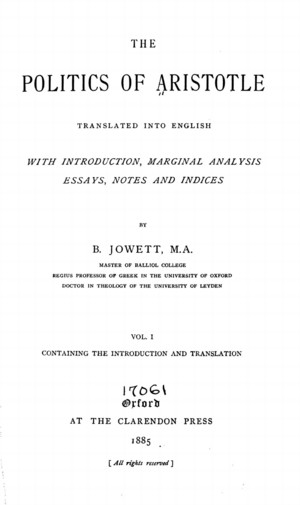
INTRODUCTION. - Aristotle, The Politics vol. 1 [320 BC]Edition used:The Politics of Aristotle, trans. into English with introduction, marginal analysis, essays, notes and indices by B. Jowett. Oxford, Clarendon Press, 1885. 2 vols. Vol. 1.
Part of: The Politics 2 vols.About Liberty Fund:Liberty Fund, Inc. is a private, educational foundation established to encourage the study of the ideal of a society of free and responsible individuals. Copyright information:The text is in the public domain. Fair use statement:This material is put online to further the educational goals of Liberty Fund, Inc. Unless otherwise stated in the Copyright Information section above, this material may be used freely for educational and academic purposes. It may not be used in any way for profit.
INTRODUCTION.The writings of Aristotle are almost entirely wanting in the charm of style, and several of them cannot even be said to have the merit of clearness. In the Politics we are often unable to follow the drift of the argument; the frequent digressions and conflicting points of view which arise are troublesome and perplexing to us. We do not understand why the writer should again and again have repeated himself; why he should have made promises which he never fulfills; why he should be always referring to what has preceded, or to what follows. He sometimes crosses over from his own line of argument to that of his opponent; and then returns again without indicating that he has made a change of front. There are words and clauses which seem to be out of place; or at any rate not to be duly subordinated to the rest of the passage. No other work of genius is so irregular in structure as some of the Aristotelian writings. And yet this defect of form has not prevented their exercising the greatest influence on philosophy and literature; the half-understood words of Aristotle have become laws of thought to other ages. With the causes of these peculiarities we are not at present concerned. The style of Aristotle runs up into the more general question of the manner in which his writings were compiled or have been transmitted to us. Are they the work of one or of many? Do they proceed from the hand or mind of a single writer, or are they the accumulations of the Peripatetic school? This is a question, like the controversy about the Homeric poems, which cannot be precisely answered. The original form of some of the Aristotelian writings will never be restored. We can hardly tell how or where they came into existence: how much is to be attributed to Aristotle, how much to his editors or followers,—whether his first followers, such as Eudemus, or later editors, such as the Alexandrians, or Andronicus of Rhodes, or Tyrannion, the friend of Cicero. We cannot by the transposition of sentences make them clearer, nor by verbal conjecture remove small flaws in the reasoning, or inconsistencies in the use of words. The best manuscripts of the Ethics and Politics, though not of first-rate authority, are not much worse than the primary manuscripts of other Greek authors. The disease, if it is to be so regarded, lies deeper, and enters into the constitution of the work. The existing form of the Aristotelian writings is at least as old as the first or second century b. c.; it is in the main the Aristotle of Cicero, though he was also acquainted with other works passing under the name of Aristotle, such as the Dialogues, which are preserved to us only in fragments. If we go back in thought from that date to the time when they were first written down by the hand of Aristotle, or at which they passed from being a tradition of the school into a roll or book, we are unable to say in what manner or out of what elements, written or oral, they grew up or were compiled. We only know that several of them are unlike any other Greek book which has come down to us from antiquity. The long list of works attributed to Aristotle in the Catalogues also shows that the Aristotelian literature in the Alexandrian age was of an indefinite character, and admitted of being added to and altered. But although we cannot rehabilitate or restore to their original state the Politics or the Nicomachean Ethics or the Metaphysics, we may throw them into a form which will make them easier and more intelligible to the modern reader. We may 1) present the argument stripped of digressions and additions; 2) we may bring out the important and throw into the background the unimportant points; 3) we may distinguish the two sides of the discussion, where they are not distinguished by the author; 4) we may supply missing links, and omit clumsy insertions; 5) we may take the general meaning without insisting too minutely on the connection. We cannot presume to say how Aristotle should or might have written; nor can we dream of reconstructing an original text which probably had no existence. But we may leave out the interlineations; we may make a difficult book easier; we may give the impression of the whole in a smaller compass. We may be allowed, without violating any principle of criticism, to imagine how Aristotle would have rewritten or rearranged his subject, had our modern copies of the Politics fallen into his hands. Many things become clearer to us when we are familiar with them. A sense of unity and power will often arise in the mind after long study of a writing which at first seemed poor and disappointing. Through the distinctions and other mannerisms of his school, the original thinker shines forth to any one who is capable of recognising him. Great ideas or forms of thought indicate a mind superior in power to the average understanding of the commentator or interpreter. We cannot be sure that any single sentence of the Politics proceeded from the pen of Aristotle, but this is no reason for doubting the genuineness of his works, if we take the term in a somewhat wider sense; for they all bear the impress of his personality. That which distinguishes him from Plato and the Neo-Platonists, from Isocrates and the rhetoricians, from the Stoics and Epicureans, from all Scholiasts and Commentators, is not the less certain because his writings have come down to us in a somewhat questionable shape. Even if they are the traditions of a school, the mind of the founder is reflected in them. The aim of the interpreter should be to simplify, to disentangle, to find the thought in the imperfect expression of it; as far as possible, to separate the earlier from the later elements, the true from the false Aristotle. The last, however, is a work of great nicety, in which we can only proceed on grounds of internal evidence and therefore cannot hope to attain any precise result. There may be said to be a petitio principii even in making the attempt, for we can only judge of the genuine Aristotle from writings of which the genuineness is assumed. Any mere translation of Aristotle’s Politics will be, in many passages, necessarily obscure, because the connexion of ideas is not adequately represented by the sequence of words. If it were possible to present the course of thought in a perfectly smooth and continuous form, such an attempt would be too great a departure from the Greek. It is hoped that the Analysis or short paraphrase which follows may assist the student in grasping the general meaning before he enters on a minute study of the text; and that the reflections which are interspersed may enable him to read Aristotle in the light of recent criticism and history, and to take a modern interest in it, without confusing the ancient and modern worlds of thought. (Compare, in vol. ii, Essays on the Style of Aristotle, and on the Structure of certain of the Aristotelian writings.) BOOK I.A criticism on Plato,—the origin of the household, village, state,—the nature of property and more especially of property in slaves,—the art of household management, and its relation to the art of money-making,—literature of the subject,—some further questions concerning the relations of master and slave, husband and wife, parent and child. The great charm of the writings of Plato and Aristotle is that they are original. They contain the first thoughts of men respecting problems which will always continue to interest them. Their thoughts have become a part of our thoughts, and enter imperceptibly into the speculations of modern writers on the same subjects, but with a difference. The Ionian and Eleatic philosophers who preceded them were eclipsed in the brightness of their successors; they had not yet reached the stage of ethics or politics, and were little known to the ancients themselves. The ethical teaching of Socrates has been preserved and not been preserved; that is to say, it does not exist in any definite form or system. To us, therefore, Plato and Aristotle are the beginnings of philosophy. In reading them the reflection is often forced upon us: ‘How little have we added except what has been gained by a greater experience of history!’ Some things have come down to us with ‘Better opinion, better confirmation:’ they have acquired authority from age and use. But there are other truths of ancient political philosophy which we have forgotten, or which have degenerated into truisms. Like the memories of childhood they are easily revived, and there is no form in which they so naturally come back to us as that in which they were first presented to mankind. For example, during the last century enlightened philosophers have been fond of repeating that the state is only a machine for the protection of life and property. But the ancients taught a nobler lesson, that ethics and politics are inseparable; that we must not do evil in order to gain power; and that the justice of the state and the justice of the individual are the same. The older lesson has survived; the newer is seen to have only a partial and relative truth. So for the liberty, equality, and fraternity of the French revolution we are beginning to substitute the idea of law and order; we acknowledge that the best form of government is that which is most permanent, and that the freedom of the individual when carried to an extreme is suicidal. But these are truths which may be found in Aristotle’s Politics. Thus to the old we revert for some of our latest political lessons. The idealism of Plato is always returning upon us, as a dream of the future; the Politics of Aristotle continue to have a practical relation to our own times. But while we are struck with the general similarity, we are almost equally struck by the different mode in which the thoughts of ancient and modern times are expressed. To go no further than the first book of the Politics, the method of Aristotle in his enquiry into the origin of the state is analytical rather than historical; that is to say, he builds up the state out of its elements, but does not enquire what history or pre-historic monuments tell about primitive man. He is very much under the influence of logical forms, such as means and ends, final causes, categories of quantity and quality, the antithesis of custom and nature, and other verbal oppositions, which not only express, but also dominate his meaning. The antagonism to Plato is constantly reappearing, and may be traced where the name of Plato is not mentioned; the rivalry of the two schools never dies out. The sciences are not yet accurately divided; and hence some questions, which present no difficulty to us, such as the relation of the art of household management to the art of money-making, are discussed at great length, and after all not clearly explained. Some good guesses are made about the nature of money, and some obvious fallacies remain undetected. The lending of money at a fair rate of interest is not distinguished from the usury which is so severely condemned. The universal custom of slavery presents a difficulty which Aristotle is unable to resolve on any clear or consistent principle. The tendency to pass from the absolute to the relative, or from a wider to a narrower point of view, as in the discussion respecting the slave and the artizan, the good citizen and the good man, the art of money-making, the perfect state,—is another element of confusion. The connection is often tortuous and unnatural. It would seem as if notes had been parenthetically inserted in the rough draft of the argument; and here and there considerable dislocations of the text may be suspected. There are favourite topics to which Aristotle is always returning; such, for example, as the Lacedaemonian constitution, which, like the constitution of Great Britain or of the United States, was a powerful idea, and exercised a great influence on the speculations of philosophers, as well as on the laws and customs of cities and peoples. In the Politics as well as in Aristotle’s other works, there are many indications that he was writing in an age of controversy, and surrounded by a voluminous literature. Had all the books which were written come down to us they would not have been scanned with the same minuteness, and they might perhaps have been studied in a larger and more liberal spirit. The excessive value set upon a small portion of them, and the fragmentary form in which they have been preserved, has given an extraordinary stimulus to the art of interpretation and criticism. Had there been more of them we should have seen them in truer proportions. We should not have spent so much time in deciphering them, and possibly they might not have exerted an equal influence over us. For the study of the classics has become inseparable from the critical method, which enters so largely into the mind of the nineteenth century. But this is a part of a great subject, which it would be out of place here to discuss further. Every community aims at some good, and the state, which is the highest community, at the highest good. But of communities there are many kinds. And they who [like Plato and Xenophon] suppose that the king and householder differ only in the number of their subjects, or that a statesman is only a king taking his turn of rule, are mistaken. The difference is one of kind and not of degree, as we shall more clearly see, if, following our accustomed method, we resolve the whole into its parts or elements. For in order to understand the nature of things, we must inquire into their origin. Now the state is founded upon two relations; 1) that of male and female; 2) that of master and servant; the first necessary for the continuance of the race; the second for the preservation of the inferior class or of both classes. From these two relations there arises, in the first place, the household, intended by nature for the supply of men’s daily wants; secondly, the village, which is an aggregate of households; and finally, the state. The parent or elder was the king of the family, and so when families were combined in the village, the patriarchal or kingly form of government continued. The village was a larger family. When several villages were united, the state came into existence. Like the family or household, it originated in necessity, but went beyond them and was the end and fulfilment of them. For nature makes nothing in vain; and to man alone among the animals she has given the faculty of speech, that he may discourse with his fellows of the expedient and the just; and these are the ideas which lie at the basis of the state. In the order of time, the state is later than the family or the individual, but in the order of nature, prior to them; for the whole is prior to the part. As there could be no foot or hand without the body, so there could be no family or man, in the proper sense of the words, without the state. For when separated from his fellows, man is no longer man; he is either a god or a beast. There is a social instinct in all of us, but it requires to be developed; and he who by the help of this instinct organized the state, was the greatest of benefactors. For man, when perfected by law and justice, is the best,—when estranged from them, the worst of animals. But before we enquire into the state, we must enquire into the household. In a complete household there are three relations:— 1) that of the master to the slave; 2) of the husband to the wife; 3) of the parent to the child:—What is and ought to be the character of each of these? There is also another element which we shall have to consider, the art of money-making, which is sometimes identified with household management. [But this is an error.] Concerning the relation of master and slave, two views are entertained: 1) there is the doctrine [of Plato] that the rule of a master is a science [and therefore natural]; and that all kinds of rule are essentially the same: and there is the other doctrine, 2) that slavery is contrary to nature; and that the distinction between freemen and slaves is made by law only and not by nature, and is therefore unjust. [Before determining the questions which thus arise we must enquire into the nature of the slave.] The art of acquiring property is a part of the art of managing a household, and like other arts requires instruments; property is a collection of such instruments, living or lifeless. The slave is a living instrument, and the lifeless instruments are used by him; he is the first of a series. He is an instrument of action, not of production, for he does not produce; he only lives and serves his master, and life is action. But he is also a possession [and therefore the agent of another]; for he is intended by nature to belong to his master, though separable from him. He may be defined, ‘a human being who is a possession and likewise an instrument of action.’ But is there a slave by nature? There is: from the hour of their birth some are intended to command, others to obey; they work together, and the better the workman, the better the work. A ruling principle runs through the whole of nature and is discernible even in things without life, for example, in musical harmony. And in man there is a despotic rule which the soul exercises over the body, and a constitutional rule which the intellect exercises over the appetites. The higher principle has dominion whenever the soul and body are in their best state; the intention of nature is then fulfilled. The male rules and the female is ruled, for the good of both; and animals subjugated by man are better and better off than wild ones. For this rule of the superior by nature is the preservation of the subject or inferior. And the same principle applies to slaves, but there is a difference: for the animal is only guided by instinct, whereas the slave, though he does not partake of reason, can apprehend reason. Where, then, one class of men presents a marked inferiority to another, there slavery is justified. And nature probably intended to make a visible distinction between freeman and slave, but she has not always succeeded, for some slaves have the souls or bodies of freemen, and some freemen the souls or bodies of slaves. On the other hand it has been argued that there is a slave by law as well as by nature. But this doctrine is indignantly denied by many jurists, who contend that to make the captive taken in war the slave of the victor is an act of great injustice. The question runs up into the wider question: ‘What is justice?’ Some say that virtue when furnished with external goods is power, and that justice is only the rule of a superior; while others distinguish between justice and virtue, and assert justice to be benevolence. If these two propositions are simply opposed, the result is an absurdity. For the truth of a third proposition [which combines them], viz. that the benevolent rule of a superior in virtue is just, can hardly be contested. Others again appeal to custom, which they identify with justice; but this is a view which cannot be consistently maintained. For a war which is justified by custom may nevertheless be an unjust war, or the person enslaved may be unworthy to be made a slave. ‘Hellenes never can be slaves;’ they are noble everywhere, even when taken in war; but the barbarians are noble only in their own country. Does not this use of language clearly imply that there are two classes of men, the slave by nature, and the freeman by nature? And where there is a marked superiority in one class and a marked inferiority in another, there the relation of master and slave springs up; and this relation, when arising naturally and not resting merely on law and force, is a kindly and beneficent one. [In slavery then the rule of the superior is combined with benevolence; and therefore on both grounds it is justice.] The question respecting the different kinds of rule on which we touched before is now set at rest. The master has been shown to exercise an absolute rule over his slaves, unlike the constitutional rule which the statesman exercises over his fellow-citizens. And master and slave receive their name, not from any science or art which is possessed by either of them [as Plato imagined], but because they are of a certain character. (There might indeed be a science of another sort, which would teach the master how to give his orders and the slave how to execute them; this science would include cookery and other menial arts. And there might also be a science or art of slave-hunting, which would be a kind of war.—But enough of this subject.) In the opening of the Politics there are many indications of the strife of opinion and uncertainty of language which prevailed in the time of Aristotle. In the first page the writer strikes a note of hostility against Plato, which is repeated at intervals throughout the treatise. Yet the views of Aristotle and Plato respecting the kinds or degrees of governments are not essentially different; the opposition between them was exaggerated, if not invented, by their respective followers. From this almost verbal controversy, he passes on to consider the intentions of nature in the creation of society. But the word nature was ambiguous in ancient no less than in modern times, and was variously used to signify 1) the undeveloped or inchoate, 2) the final or perfect nature. The state and the family are both said to exist by nature; but the state in a higher sense than the family. . . . The distinction between men and animals is seen to be the gift of language by which the sphere of human nature is enlarged and rendered capable of good and evil. This distinction is here limited by Aristotle to that part of language which is concerned with our moral ideas. We should rather say that through language man attains to the expression of general and universal conceptions not only in morals, but in all things (cp. Met. 1. 6. § 2). The true method of enquiry, according to Aristotle, is the analysis of the whole into its parts; but he does not see that the whole is more than the sum of the parts, and that the parts are changed by their relation to one another. As well might we suppose that we could analyse life into the chemical elements which are the conditions of life, or detect the mind in the nerves which are its instruments, as imagine that the state was only a compound of families and villages. Yet there is likewise in Aristotle’s Politics a consciousness that the whole is prior to the parts, and that the synthetical method must be combined with the analytical. Though imperfectly expressed, the perfect image of the state in which ‘every means is an end, and the end the sum of the means,’ is already present to his mind. The two aspects of the truth are placed side by side, but they are not yet harmonised or brought into relation with one another. Aristotle is thought to have been the first who based knowledge on experience, but ever and anon the ideal or poetical image which was always latent in Greek philosophy, though clothed in an unpoetical dress, and reduced to a skeleton, returns upon him. It would have been a surprise to himself, and still more to his school, if he could have recognised how nearly he approached in reality to some of those conceptions on which he was making war. For example, when he speaks of a whole prior to the parts, what does this mean but the idea of the state prior to the existence of it in fact? The conception of the perfect man whose single virtue exceeds that of all other men put together, and who therefore has a natural right to rule, is even more extravagant than the rule of philosophers in the Republic of Plato. The ‘accustomed’ method of dividing the whole into its parts is logical rather than historical: that is to say, they are the parts into which it can be dissected, not the elements out of which it has grown. ‘It is like the carving of some noble victim, according to the natural formation, where the joint is, not breaking any part, as a bad carver might.’ (Phaedrus, 265 E.) But it is not the historical method which resolves institutions and facts into their antecedent elements. Aristotle does not investigate the origins of states, but only divides a genus into species or a larger whole or form into the lesser parts or unities of which it is made up, or shows how an existing state may be preserved or destroyed. We must not expect him to give an analysis of primitive society, such as would be found in a modern writer on anthropology. His observation and experience were almost confined to Hellas. The earliest forms of property and society were unknown to him. He does not appear to have heard of ‘marriage by capture,’ and does not distinguish ‘endogamy’ and ‘exogamy.’ The horror naturalis, which forbids marriage within near degrees of relationship, was to him an established fact. He seems to have supposed that there existed from the first some rude form of the family, like that of the Homeric Cyclops, in which the individual savage gave the law to his own household. But he does not examine how this lowest form of human society passed into the village and the village into the state. Nor does he seriously attempt to gather the ancient customs of Hellas from the usages of the contemporary barbarians, although he occasionally lights upon this path of enquiry, which had been already indicated both by Thucydides and Plato. Nor does it occur to him that the ties of family or caste may be so strong, that the growth of the state is stunted by them; nor, on the other hand, that the life of cities may be so intense as to make any larger political unity impossible. He tries to distinguish between instruments of production and action, and almost in successive sentences he implies that the slave is and is not both. There is a similar confusion in the opposition which he attempts to make between the artisan and the slave. Nor is the distinction between the slave who can only apprehend reason and the freeman who partakes of reason anything more than a verbal quibble. Both partake of reason in different degrees. He argues, again, that the slave being a possession and belonging to another is necessarily the minister of action. But the notion that a possession is a minister of action rather than of production is a fancy of his own; and he appears to forget at the moment that the artisan, who, if any one, may be termed a minister of production, was often a slave. Here, as in c. 13, he is contrasting the slave and the artisan on the ground that the true slave, not the artisan, derives an inspiration from his master. Such confusions we must admit to have existed in the mind of Aristotle, if we would attain any degree of clearness in the interpretation of his writings. Respecting slavery, Aristotle arrives at a definite conclusion which, though unsatisfactory to us, satisfies himself. But he has not clearly separated his own view from that of his opponents. His conclusion is that slavery is right when intended by nature; and the manifest inferiority of certain races is regarded by him as the proof that nature intended them to be slaves. But the captive taken in war, unless he were of inferior race, was only accidentally a slave. The slavery of Barbarian to Greek was natural; the slavery of Greek to Greek was arbitrary and cruel. He implies, though his meaning is obscurely expressed, that the two opposite views, ‘justice is benevolence,’ ‘justice is the rule of a superior,’ must be combined. We are interested to remark that in the age of Aristotle there were some Greeks who would have maintained that slave-hunting was a lawful employment, and that there were also anti-slavery philosophers or sophists in the days before the Stoics, who asserted freedom to be the birthright of all mankind. Either of these extreme views was repudiated by him; his sense of justice revolted from the former, and he probably regarded the latter as too much at variance with the actual condition of the world. How could the 400,000 Athenian slaves ever be emancipated? How could the Greek enjoy cultivated leisure, which was a necessity to him, when deprived of them? How could the barbarians of Illyria and Scythia be transformed into civilized beings? (‘If at all,’ he would perhaps have replied, ‘by subjection to the superior reason of an Hellenic master.’) The question which has been asked in modern times, whether society could exist without domestic service?—may illustrate the manner in which a moderate thinker of the school of Aristotle would have regarded the existence of slavery in ancient Hellas. The difficulties which existed in the management of slaves at Lacedaemon were sufficient to show that they were a dangerous element in the state, a ‘troublesome sort of cattle,’ as Plato calls them. It is however remarkable that neither at Athens nor at Corinth, notwithstanding their enormous numbers and their constant employment in naval and other warfare, do we find any attempt at organised revolt among them, nor does any mention occur of their ill-treatment by the state. It may be further noted that Aristotle, in the Seventh Book, proposes the emancipation of individual slaves as the reward of good conduct—the door of hope was never to be closed—this is a first principle to be always observed in the management of them. The attempt to open a career to slaves, whether practicable or not, is in advance of most modern countries in which slavery is or has been maintained, and may be compared with the principle upheld, not by the primitive, but by the mediaeval church, which led to the emancipation of the serfs. [See note in loco and Essay on Aristotle as a Political Philosopher.] Having discussed the relation of master and slave, we will now proceed to the other question: How is the art of money-making related to household management? Is it the same with it, or a part of it, or subordinate to it? Clearly subordinate, because instrumental; and not the same; for household management uses the material which the art of money-making provides. How then are they to be distinguished? We reply that the acquisition of food is natural to man, and that when limited to natural needs this art of acquisition is a part of household management, which takes many forms; for nature has given many sorts of plants and animals for the use of man; and the differences, both in men and animals, are dependent on their food. Hence arise many employments which may be pursued either to a limited or to an unlimited extent. There are shepherds, husbandmen, fishermen, hunters, and the like. When limited these employments are natural and necessary; for the master of the household must store up the means of life, if they do not exist already. But when unlimited they are bad, and should not be included in household management, which, like the arts, has a natural limit. The other sort of acquisition is the art of making money, or retail trade, which does not exist in the household but grows up with the increase of the community. Now all things have two uses, the one proper, the other improper; in other words, they may be either used or exchanged. Retail trade is the improper use of them for the sake of exchange only, and is not natural because it goes beyond the wants of nature and therefore has no place in the household. It grew out of simple barter, and was innocent enough until coin was invented. After the invention of coin it developed into money-making, and riches have been identified with a hoard of coin, a notion against which mankind rightly rebel. For money is a conventional thing and may often be useless. A man might be able to turn the dishes which were set before him into gold, like Midas in the fable, and yet perish with hunger. True wealth is a means and not an end, and is limited by the wants of the household; but the spurious wealth has no limit and is pursued for its own sake. The legitimate art of money-making, which corresponds to the first of these, is a part of household management; the art which creates wealth by exchange is illegitimate. The two have been often confused, because the same instrument, wealth, is common to both; and the desires of men being without limit, they are apt to think that the means to gratify them should also be unlimited. The whole question may be summed up as follows:—There is an art of money-making which uses the means provided by nature for the supply of the household; there is another art which exchanges and trades. The first is honourable and natural; the second is dishonourable and unnatural. The worst form of the latter sort is usury, or the breeding of money from money, which makes a gain not only out of other men, but out of the ‘barren metal.’ The last of the difficulties which are discussed by Aristotle in the First Book is the relation of money-making to household management. The sciences or subjects of knowledge which are concerned with man run into one another; and in the age of Aristotle were not easily distinguished. As we say that Political Economy is not the whole of Politics, so Aristotle says that money-making [χρηματιστική] is not the whole of household management [οἰκονομική] or of family life. But in either case there is a difficulty in separating them. Aristotle perceives that the art of money-making is both narrower and wider than household management; he would like to establish its purely subordinate relation. He does not consider that the property of individuals becomes in time of need the wealth of the state; or that one of his favourite virtues, magnificence, depends on the accumulation of wealth; or that Athens could not have been the home of the arts ‘unless the fruits of the whole earth had flowed in upon her,’ and unless gold and silver treasure had been stored up in the Parthenon. And although he constantly insists that leisure is necessary to a cultivated class, he does not observe that a certain amount of accumulated wealth is a condition of leisure. The art of household management has to decide what is enough for the wants of a family. Happiness is not boundless accumulation, but the life of virtue having a sufficiency of external goods. The art of money-making goes further; for it seeks to make money without limit. According to Aristotle the excess begins at the point where coined money is introduced: with the barter of uncivilised races, with the wild life of the hunter, with the lazy existence of the shepherd, or the state of mankind generally before cities came into existence, he has no fault to find. He does not perceive that money is only a convenient means of exchange which may be used in small quantities, or in large; which may be employed in trade, or put out at interest; and that the greater the saving of time in production, the greater will also be the opportunities of leisure and cultivation. The real difference between the true and the false art of money-making is one of degree; and the evil is not the thing itself, but the manner of obtaining it,—when men heap up money at the cost of every other good;—and also the use of it,—when it is wasted in luxury and ostentation, and adds nothing to the higher purposes of life. Something of the prejudice against retail trade seems to enter into the whole discussion. Another prejudice is observable in the fanciful argument against usury, to which Aristotle objects, not on the ground that the usurer may become a tyrant, but because the money which is produced out of usury is a sort of unnatural birth. . . . Once more, he falls unconsciously into the error of preferring an uncivilised to a civilised state of society. The beauty of primitive life—that fair abstraction of religion and philosophy—was beginning to exercise a fascination over the Greeks in the days of Aristotle and Plato, as it afterwards did over the mind of modern Europe when it was again made attractive by the genius of Sir Thomas More and of Rousseau. But now leaving the theory, let us consider the practice of money-making, which has many branches; the knowledge of live-stock, tillage, planting, the keeping of bees, fish, poultry—all these are legitimate. The illegitimate are 1) commerce, of which there are three subdivisions, commerce by land, commerce by sea, and selling in shops; 2) usury; 3) service for hire, skilled and unskilled. There are also arts in which products of the earth, such as wood and minerals, are exchanged for money; these are an intermediate kind. The lowest are the arts in which there is least precision, the greatest use of the body, and the least need of excellence. But not to go further into details, he who is interested in such subjects may consult economical writers, or collect the stories about the ways in which Thales and others made fortunes. He will find that these stories usually turn upon the same point, the creation of a monopoly; which is also a favourite device of statesmen when they want to increase the revenue. Enough has been said of master and slave. There remain the two other relations which exist in a family, that of husband and wife, and of parent and child. The master rules over the slave despotically, the husband over the wife constitutionally, but in neither case do they take turns of ruling and being ruled after the manner of constitutional states, because the difference between them is permanent. On the other hand, the rule of the father or elder over the child is like that of the king over his subjects. The master of a house has to do with persons rather than with things, with human excellence and not with wealth, and with the virtue of freemen rather than with the virtue of slaves. For in the slave as well as in the freeman there resides a virtue which enables him to perform his duty. Whether he has any higher excellence is doubtful:—If he has, in what will he differ from a freeman? Yet he is a man and therefore a rational being. And a noble disposition is required in the natural subject as well as in the natural ruler. But, on the other hand, we say that the difference between them is one of kind and not of degree. What is the conclusion? That the virtue of the slave is the same with that of his master, or different? Not the same, nor yet altogether different, but relative to the nature of each, like the virtues of the soul and of the body, like the rule of the male over the female, who both partake of the same virtues but in different degrees. [Plato] was wrong in trying to comprehend all the virtues under a single definition; [Gorgias] was right in distinguishing them. The artisan should not be confounded with the slave. He does not exist by nature, and is not linked to a master; whereas the slave is a part of his master, and receives from him the impress of his character. The relations of husband and wife, of parent and child, will be more fully considered when we speak of the constitutions of states. For the family is a part of the state, and the virtue of the part must be relative to the virtue of the whole. The two last chapters of the First Book seem to be a summary of the subjects which have preceded. Yet the writer, as if not wholly satisfied with his previous analysis of the relations of slave and master, and desirous of having one more ‘fling’ at Plato, returns to the discussion, which he illustrates by a new and not very accurate distinction between the slave and the artisan. The artisan is inferior to the slave, because he is not subjected to the civilising or inspiring influence of a master, nor does he stand in any natural relation to the person from whom he learns his art. The distinction, which is untenable (for many artisans were slaves), seems to be an afterthought and comes in out of place. Aristotle has already in view the education of the citizens, and he intends that it shall be relative to the state of which they are members. He concludes with an unfulfilled promise, one of the many which occur in the course of the work. The promise is, that he will discuss the virtues of husband and wife, parent and child, when he treats of the different forms of government. Whether he meant to compare particular relations of family life with particular forms of government, e. g. the relation of husband and wife to a constitutional government, and that of father and son to a monarchy; or only to say generally that the organisation of the family must correspond to that of the state, is left unexplained. His views of the state and the family are mutually influenced by each other; and he sees fanciful as well as real analogies subsisting between them. Yet at the beginning of his work he has expressly distinguished between them, and it is hard to say how a particular form of government can be supposed to depend upon the family. There are many glimpses of higher truths presented to us in the First Book of the Politics: such, for example, as the remarks 1) that the state is prior to the individual; 2) that the lower is intended by nature to lead up to the higher, i. e. that the state is implicitly contained in the family and the village; 3) that in all men there is a social instinct which is matured by the wisdom of legislators, who are the great benefactors of mankind; 4) that there is a principle of government or law even in inanimate things; 5) that wealth is not the true end of human life; 6) that the virtue of the individual must exist in the state. These are noble thoughts, which, though entangled in some paradoxes and errors incidental to the age of Aristotle, may be regarded as the true lights of political philosophy in all ages. The individual, the family, the state, are all parts of a larger whole on which is impressed a final cause, dimly seen to be the harmony of the world. The first half of the second book of the Politics is devoted to the controversy with Plato, who is criticised by Aristotle from an adverse point of view. His criticisms are not those of an admiring pupil who seeks to enter into the spirit of his master, but of a teacher who has revolted against his authority. The clouds and dreams of the Republic have many heavy blows dealt against them by the weapons of common sense, but like ‘the air invulnerable’ they come together again and are unharmed by the spear of criticism. For they can never be brought down to earth, and while remaining in their own element they are beyond the reach of attack. In the criticisms of Aristotle on the Republic there is one leading thought:—the state, like the human frame, has many parts or members, but Plato reduces it to an unmeaning and colourless unity. He makes it into a large family in which there are unreal relationships and no bond, either political or social, holding them together. The unmeaningness of the conception becomes evident as soon as we attempt to realise it. If the ideal state were divided into tribes and phratries, hardly anything would remain of it. In Plato the correlation of the parts and the whole is lost sight of; and society, instead of being held together by a multitude of ‘little invisible pegs’ or threads, becomes thin and transparent. The argument of chap. 4 is difficult to follow, because Aristotle, without making any regular transition, attacks Plato from different points of view in successive sentences. First of all he complains that the unity of the Platonic state is too great, and even suicidal. Then, again, he urges that this unity or friendship is really imaginary. For it has no organisation, and, like a drop of honey in water, is dissipated or lost in the mass through which it is diffused. The arguments which Aristotle employs against communism are for the most part the same which may be found in modern writers. Though not a communist, he is of opinion that existing laws or usages are capable of improvement. Men cannot have all things in common, but they may have many more than at present. The instinct of ownership is a kind of self-love implanted by nature, not blameable, but it should be tempered by liberality and benevolence. The Spartan freedom of taking and using a neighbour’s goods is commended by Aristotle, and he thinks that such a custom might be carried further. The legislator should seek to inspire the ‘love which is the fulfilling of the law’; he should not by enactments take away the grace and freedom of virtuous actions. The sentiment might be thrown into a modern form:—More good will be done by awakening in rich men a sense of the duties of property, than by the violation of its rights. Aristotle is dissatisfied with the vagueness of Plato. He wants to know more about the inferior classes: what is to be their education, and in what relation do they stand to the guardians? Are they to have wives and children in common? As if in a work of imagination which was intended to shadow forth great principles every particular must be consistent, or every detail filled up. Neither has Aristotle himself given any sufficient answer to the question, ‘What should be the position of the subject-class in a Greek state?’ Nor is it strictly accurate to say that the rulers in the Republic are always the same. For the ‘high-spirited warriors’ when they are qualified by age all take their turn of ruling: see Essay on Aristotle as a Critic of Plato in vol. ii. BOOK II.A criticism on the Republic and on the Laws of Plato; the constitutions of Phaleas and Hippodamus; the states of Lacedaemon, Crete, and Carthage,—their similarities and differences; scattered remarks on Solon and other legislators. Before entering on the search after a perfect state, we must pass in review those constitutions, whether ideal or actual, which are the most in repute. In seeking for something beyond them, we are animated by the love of truth, not by the desire of display. Let us examine the nature of the social union. The members of a state must either have all things in common or nothing in common, or some things in common and some not. They must have some things in common, for they live in the same place. But should they have all things in common, as in the Republic of Plato, or some things only and others not? Which is better—the communism of the Republic, or the prevailing custom? Plato believed that the community of women would promote the unity of the state. But 1) unity may be carried to such an extent that the state is no longer a state, and, in tending to greater unity, becomes first a family, and then an individual; such an unity as this would be the ruin of the state, and therefore the reverse of beneficial to it. 2) Moreover, a state must be large enough to be self-sufficing, and a family is more self-sufficing than an individual, and a state than a family. 3) A state is not a mere aggregate of individuals, like a military alliance of which the usefulness may depend on quantity only; nor yet a nation, which is a host of men ‘numero tantum differentes,’ like the Arcadians; the elements of a state differ in kind. Where the citizens are all free and equal, they rule and are ruled in turns; and this principle of compensation is the salvation of states. It might be better from one point of view that there should be a permanent division of labour and that the same persons should always rule. But where there is a natural equality and not enough offices for all the citizens, the continuance of one set of persons in office is found to be impossible; and so they hold office by turns, and upon the same principle pass from one office to another. 4) Even assuming the greatest unity to be desirable, it would not be attained, as Plato supposes, when all men say ‘mine’ and ‘not mine’ of the same thing or person at the same moment. For the word ‘all’ has two senses, a collective and a distributive; taken collectively it is unmeaning—all the world cannot have one wife or house; taken distributively it implies that every man’s wife or house will be the wife or house of every other man; but this arrangement will not conduce to the harmony of a family. The state is an unity in plurality; and the unity without the plurality, or the plurality without the unity, is absurd. Again, 5) that which is common to many is apt to be neglected. The children will belong to everybody and to nobody. They will have an infinitesimal share of parental affection:—moreover, when they were born many of their supposed fathers may have had no sons or daughters, or they may not have lived to grow up. Better to have a cousin in the ordinary sense of the word than a thousand sons in the Republic of Plato. 6) The children will often resemble their fathers or mothers, and inferences will be drawn about their parentage. There will be other evils:—7) Unholy acts done against fathers and mothers are more likely to be committed if the relationship is unknown. And who will make atonement for them? 8) It was inconsistent of Plato to forbid intercourse between lovers because of the intensity of the pleasure, and yet allow familiarities between relations which are far more discreditable; for all the citizens will be relations. 9) The true effect of communism is disorganisation. It might therefore be allowed among the subject-class whom the legislator wants to keep down, but not among the rulers. 10) Such legislation is suicidal; while pretending to make men friends all round and to preserve them from revolutions, it really weakens the ties which bind them to one another; instead of unity so complete as to be self-destroying, there will be a watery friendship among them. 11) The transference from one class to another will be impossible; for how can secrecy be maintained? 12) And the citizens who are transferred will be restrained by no ties of relationship from committing crimes against their nearest relations. Whether the citizens of the perfect state should have their property in common or not is another question. Three modes of tenure are possible:—1) private ownership of the soil and common use; 2) common ownership and private use; 3) ownership and use alike common. If the cultivators are the owners, they will quarrel about the division of the produce [‘chacun produit selon sa capacité’ et consomme selon ses besoins’], but if they are not their own masters the difficulty will be diminished. There is always an awkwardness in persons living together and having things in common. Fellow-travellers are often said to fall out by the way, and we are apt to take offence at our servants because they are always with us. The present system, if humanised and liberalised, would be far better. There might be private possession and common use among friends, such as exists already to a certain extent among the Lacedaemonians, who borrow one another’s slaves and horses and dogs, and take in the fields the provisions which they want. To Plato we reply:—1) When men have distinct interests, they will not be so likely to quarrel; and 2) they will make more progress, because every one will be attending to his own business. 3) There is a natural pride of ownership; and also 4) a pleasure in doing a kindness to others;—these will be destroyed by communism. 5) The virtues of continence and liberality will no longer exist. 6) When Plato attributes all the ills which states endure to private property, he overlooks the real cause of them, which is the wickedness of human nature. 7) He has a false conception of unity. The state should be united by philosophy, by a common education and common meals, not by community of property. 8) The experience of ages is against him: his theory, if true, would have been discovered long ago. 9) If his scheme were ever realised, he would be compelled to break up the state into tribes and phratries and other associations. And then, what would be left of the original idea? Nothing but the prohibition of agriculture to the guardians. 10) The plan is not worked out—even the general form of the community is indistinct. He says nothing about the lower classes who are the majority of the citizens. The husbandmen, if they have all things in common, do not differ from the guardians; but if they have wives and property of their own, they will form a state within a state, and the old evils arising out of property will reappear. Education is his panacea which is to take the place of law; but he has confined education to the guardians. 11) Or if the husbandmen own the land on payment of a tribute, is this desirable? will they not be even more unmanageable than the Helots? 12) If the wives of the citizens are common and the land private, who will see to the house? 13) And what will happen if the husbandmen have both lands and wives in common? 14) Once more, it is absurd to argue for the community of women from the analogy of the animals; for animals have not to manage a household. 15) There is a danger in the fixedness of the rulers, who are said to be made of the same gold always. For high-spirited warriors will want to have a turn of ruling as well as of being ruled. 16) The guardians are deprived of happiness, and yet the whole state is supposed to be happy: but how can the whole be happy unless the parts are happy? Many of these objections apply to Plato’s later work, the ‘Laws,’ in which he intended to delineate a constitution more of the ordinary type; but he gradually reverts to his ideal state. The only differences are, that the women share in the common meals, that the number of the warriors is increased from 1000 to 5000; and that the community of women and property is abandoned. But 1) he has exceeded the bounds of possibility in making so large a state. 2) He has neglected foreign relations; yet a city must be provided against her enemies. 3) He has not defined the amount of property which his citizens may possess. He says a man should have ‘enough to live temperately’—meaning ‘to live well.’ Yet a man may live temperately but miserably. He should have said ‘enough to live temperately and liberally.’ 4) If he equalises property, he should limit population; he fancies that the fruitfulness of some marriages would be balanced by the barrenness of others, and so the number of citizens would remain about the same as in existing states. But if the lots are absolutely divided they could not be redistributed. There would then be supernumeraries, who would stir up revolution. 5) He does not say how the rulers are distinguished from the subjects. 6) If other property may be increased five-fold, why not land? 7) His two homesteads, one in the city and one on the border, will be very inconvenient. 8) The citizens are to be heavy-armed soldiers who will form a polity. This constitution, though it may be suited to the greatest number of states, is not the nearest to his ideal. There are persons who think that all the elements of the state ought to share in the government, and these would prefer the more complex constitution of Sparta, which is made up of king, elders, and ephors. According to Plato the best state is a combination of democracy and tyranny; but both of these are bad and can hardly be called constitutions at all; and the constitution which is actually proposed is nothing but an union of democracy and oligarchy, inclining rather to the latter, as may be seen from the mode of choosing the magistrates and the council, and the enforcement on the rich of attendance at the assembly. 9) He contrives the council in such a manner as always to give the predominance to the higher or richer classes. 10) The double election will tend to throw the power of choosing into the hands of a clique or cabal. Most of the arguments which Aristotle employs against communism are the same which are employed among ourselves: he expresses in them the common sense of mankind. But some are peculiar to him, or characteristic of his age and country. For example, 1) the notion that the lower classes will be more easily retained in subjection if they have wives and children in common; which may be compared with the desire to suppress education and family life among slaves in some slaveholding countries of modern times; 2) the impossibility of expiating crimes committed against relations when relationships are unknown; 3) the supposed necessity of breaking up the state into tribes and phratries, which is maintained from the point of view, not of Plato, but of an Athenian citizen; 4) the remark that there is much more quarrelling among those who have all things in common than among the owners of private property; which probably refers to partnerships in business. Several of Aristotle’s arguments are unsatisfactory to us. First the attempt to show that the population in ordinary states is kept equal by the compensation of sterile and fertile unions, but that this compensation will not occur under the constitution of the Laws; whereas enactments are expressly made to preserve the equality of families; secondly, the assertion that, according to Plato, the best state is composed of democracy and tyranny: a statement which is nowhere to be found either in the Republic or Laws, though something like it occurs in Laws, vi. 756 E. Again, it is not true to say that Plato has not considered the question of population; for he has treated of it in Laws, v. 740, and provides against the difficulty by ‘preventive checks,’ by laws of marriage and adoption, and by colonisation. The relation of the ‘Laws’ to the Republic is not such as it is represented by Aristotle. The words, that ‘Plato, having intended to adapt the “Laws” to an ordinary state, gradually returns to the ideal form,’ are not justified by anything found in the book of the Laws which has come down to us, and there is no trace of any other form of the work. He always intended that the constitution of the Laws should be that of a second-rate state, and the distinction, though only once explicitly noted (Laws, v. 739, 740), is present to his mind throughout. The point of which Aristotle makes light, when he says that the only difference between the Republic and the Laws is the community of wives and property, is really essential. He has omitted to mention the other difference, which, in Plato’s estimation, was even greater, the government of philosophers. There is little or nothing ideal or peculiar in what remains; for nearly all the other institutions contained in the Laws have their parallel in Sparta or some other Greek state. It can hardly be said that the Lacedaemonian constitution comes nearer than that of the Laws to the ideal state; nor is this remark of Aristotle consistent with his previous remark that the constitution of the Laws gradually reverts to the ideal state. For this whole subject see the Essay in vol. ii. on the Criticisms of Aristotle upon Plato. Oncken (Staatslehre des Aristoteles, vol. i. p. 194 foll.) is of opinion that the Laws of Plato which were known to Aristotle were not the same with the extant work. He argues from the silence of Aristotle on many points, and from his misrepresentation of others. But Aristotle’s treatment of Plato in the Laws is not different from his treatment of him in the Ethics and Metaphysics. The hypothesis of Oncken is highly improbable. There is no example of corruption or interpolation on such a scale in a work of such excellence anywhere in the compass of ancient literature. An hypothesis against which so fatal an objection may be urged, would have to be supported by the strongest proofs, and not merely by a weak inference from the statement that Philippus of Opus copied the Laws from the original tablets. (See Introduction to the Laws; Translation of the Dialogues of Plato, vol. v.) Yet the Plato or the theses of Plato which Aristotle or the diorthotes of the Politics had in his mind in an age when manuscripts were scarce and were not yet divided into books and chapters, may have been very different from the Plato which is known to us. Such a view is confirmed by an examination of Aristotle’s references not only to the Laws, but to Plato’s other writings, and by the general character of the citations in early Greek literature. The anti-Platonic theses of the Peripatetic school may often have had little foundation in the actual writings of Plato. The arts of interpretation and controversy were in their infancy. This is a more reasonable explanation of the want of correspondence between Plato and Aristotle than to suppose the wholesale corruption or interpolation of an ancient writer. No constitution is so novel and singular as that of Plato; no one else has introduced the community of women and children, or the public tables for women. Other legislators have made the regulation of property their chief aim, deeming that to be the point on which all revolutions turn. Phaleas of Chalcedon saw this danger and was the first to affirm that the citizens of a state ought to have equal possessions. In a new colony he would have started with an equal distribution of property; in an old-established one he would gradually have attained the same end by an arrangement of marriage portions:—the rich were to give and not receive them, and the poor to receive and not to give them. 1) But if a limit of property is to be fixed, there should also be a limit of population; otherwise the law will be broken, and those who have nothing will stir up revolution. 2) And even where a limit of property is fixed, the amount should not be so great as to encourage luxury, or so small as to allow of poverty. 3) The desires of mankind must be limited as well as their possessions. 4) The equality of honour among unequals and the inequality of honour among equals are as dangerous as the equality or inequality of property. There are three motives to crime, a) want, b) ambition, c) the love of pleasure without pain. But want is far from being the strongest of these incentives, and therefore equalisation of property would only banish the lesser sort of crimes. The true remedy for want is to have a competency and something to do; for ambition, self-control; for the love of pleasure, philosophy. Phaleas probably intended to give equal education as well as property to all his citizens, and thereby to equalise their desires; but he has not told us what will be the character of his education. 5) He has regarded only domestic, and not foreign relations, into which the consideration of property likewise enters; for a state should have enough wealth to resist, but not enough to attract invaders [§§ 18-21 are partly a repetition of what has preceded, § 9 foll.]. 6) The greater evils which flow from ambition are not diminished by an equalisation of property, but by training the nobler dispositions of men to contentment, and by putting down discontent among the lower sort. 7) Phaleas should have equalised, not merely land, but moveables. 8) He wants to make all the artisans slaves, which would only be possible in a small city. This and the following chapters show us how fertile was the genius of Hellas in devising forms of government. Already there were many treatises in existence, probably a large literature, relating to the subject of Politics. Yet we are also struck with the meagreness of Aristotle’s information and the feebleness of some of his judgments. Of Sparta he knows very little, of Crete even less, and his ideas respecting Carthage are fragmentary and also contradictory. Not having before us the writings of Phaleas or Hippodamus, we cannot say how far he misunderstood or misrepresented them: he may not have done them greater justice than he appears to have done to Plato. The reflections of Aristotle on Phaleas and Hippodamus, like so many of his criticisms, are made in the dialectical manner of the age; but we have reached a further point of view, and can judge in a more comprehensive spirit. It was impossible for him to do justice to his predecessors; he can only try them by formulas of his own and by the more advanced standard of his own time. But we know that the first steps in political philosophy, feeble and inconsistent as they may have been, are really the greatest; and the highest achievement of modern criticism is the power of appreciating such new and original thoughts in all their greatness. It is no real objection to Phaleas that in treating of the equalisation of property he has said nothing of equality of population; he might have replied that the support of surplus numbers is not more difficult where there is equality than where there is inequality of property. Nor can he be blamed for neglecting to speak of foreign relations, except on the ground which is hardly tenable that every political treatise should be complete in every part. The subject was impressed on the mind of Aristotle by the history of Hellas; but it might not equally have occurred to an earlier writer on politics. In ancient times men did not easily analyse the forms of government under which they lived. In reflections of this kind Polybius, who lived a century and a half later, though not a genius of the highest order, has made an advance upon Aristotle. His sketch of the Roman Republic is fuller and clearer than any of the constitutions described in the Politics. Yet even he, truthful as he was in the main, cannot be acquitted of partiality. His predecessor Timaeus is a bête noire to him, whom he is always attacking, but, as we should be inclined to infer from his virulence, not always with justice. The first person, not a statesman, who framed a constitution was Hippodamus, the architect of the Peiraeus, a man affected in his dress and eccentric in his way of life, who was a political philosopher as well as an enquirer into nature. 1) His state consisted of 10,000 citizens who were distributed in three classes, husbandmen, artisans, warriors. 2) He divided the land into three parts, a sacred, a public, and a private part, the first for the maintenance of religion, the second for the support of the warriors, the third to be owned by the husbandmen. 3) He classified laws under three heads, insult, injury, homicide. 4) He instituted a court of appeal formed of elders chosen for the purpose. 5) He was of opinion that in the courts of justice the judges should use, not a pebble but a tablet, and in doubtful cases, instead of a simple acquittal or condemnation, they should write down on the tablet the degree of guilt which they attributed to the defendant. Unless they were allowed to draw distinctions, they must often commit perjury. 6) He enacted that rewards should be conferred on public benefactors. 7) He provided that the children of citizens slain in battle should be maintained by the state, as is customary at Athens; and 8) he had all the magistrates chosen by the people. These proposals are open to many objections. 1) The artisans, the husbandmen, and the warriors are supposed to have an equal share in the government. But the first two will be the slaves of the last, for they have no arms; and for the same reason they are not fit to be magistrates: on the other hand, if excluded from the government, how can they be loyal citizens? And if the warriors are the stronger, why should the two other classes have any share in the government at all? The artisans have a natural place in the state, and the husbandmen, if they provided the warriors with food, might have a claim. The anomaly is that they have land of their own. Now if they cultivate the land of the warriors as well as their own, they will have too much to do: and the warriors, if they are engaged in cultivating their own lands, will become husbandmen; or if there are yet other cultivators, these will be a fourth class in the state for which no place is allowed. 2) The qualified verdict would turn the judges into arbitrators; it would cause confusion, and is unnecessary. If the charge is properly drawn, the dicast can always say ‘yes’ or ‘no’ without committing perjury. 3) The proposal to reward discoveries or improvements in the laws would encourage informers. But should laws be improved?—that is a controverted question. The example of the arts and the general experience of mankind is in favour of improvement. Men in general desire good and not merely what their fathers had. On the other hand, the authority of laws is derived from custom, and the habit of lightly altering them impairs their force. There must sometimes be changes, but great caution should be observed; else the evil of change may outweigh the gain of reform. The analogy of the arts is misleading. Aristotle regards Phaleas and Hippodamus as he regards Plato, from the point of view of an adversary: he is their critic, after the manner of his age, and tells us, not what he approves, but what he disapproves in their writings. Yet it is evident that some of their political ideas had great merit. Phaleas attempted to deal with the evils of property, which he thought could most easily be remedied in an old country by a clever arrangement of dowries: we should say, probably, by restricting the power of settlement or bequest. A difficulty which pressed upon ancient legislators more than ourselves owing to the stationary character of the arts of production was the increase of population; of this difficulty Aristotle is very sensible. When men begin to feel the struggle for existence they are apt to be discontented with the government under which they live. Yet mere equality of property, even if it could be maintained, would not always content them. For all men cannot be reduced to the same dead level, even if there were enough for all. The ambitious will still commit crimes on a great scale; the possession of a competence takes away only the temptation to petty larceny. Nor can it be denied that great inequalities of property by giving a stimulus to increased production may give a larger share of the goods of life to the poor than could be obtained by any system of distribution however just. It is an interesting question which Aristotle raises in his criticism of Phaleas. What amount of wealth may with advantage be possessed by a state? To which we may reply, That the value of wealth in a state depends not on the amount, but on the use and distribution of it. Men may talk about the meannesses and miseries which are caused by a highly artificial state of society. They may seek to throw off the restraints of law. But
This is the spirit which Aristotle here expresses, though an opposite thesis might be maintained with equal truth. For the miseries which arise from bad, and the blessings of good government, in which the blessings of peace are generally included, can hardly be exaggerated. He also expresses the feeling which is familiar to us in modern times, that want of morality, which is in fact weakness, lies at the root of the corruption in a state. Men are always crying out, Give, give, and are for dividing and subdividing the property of the rich. But while Aristotle acknowledges the inequalities of society to be natural and necessary, he insists on justice being done to the lower classes. Foreign relations are ever present to his mind. They could hardly be otherwise, since in the fourth and fifth centuries before Christ nearly every state in Hellas had become the friend and enemy of every other several times over. The number 3 exercises a great influence on the constitution of Hippodamus. He built the streets of cities at right angles, and also gave an arithmetical or mathematical form to the fabric of his ideal state. Number and figure naturally became in his age guiding principles of the human mind. Yet he was also an original thinker, and already before the time of Plato had treated of a best or perfect state. His classification of offences, his institution of a court of appeal and a qualified verdict (for he was apparently the first author of them), are great legal inventions. The court of appeal was probably intended to amend the decisions of the popular assembly or of the ordinary law courts by the judgment of a court of elders. Whether Aristotle approved of the proposal or not, he does not say. The argument of Hippodamus against the unqualified verdict is really untenable. The difficulty is inherent in the nature of the case, and cannot be removed by the several jurors or judges giving their verdicts in different forms. Other objections of Aristotle’s appear to us rather trivial; for example, the argument that the husbandmen cannot be a fourth class, seemingly because a fourth class is contrary to the genius of the state, or, his notion that the artisans have a place in the state, but not the husbandmen unless they are entirely devoted to the service of the military class. We are also surprised at his digressing from the Laws of Hippodamus to the general question whether laws should or should not be changed. The commonplaces of conservative and reformer are arrayed against one another for the first time in the Politics. Aristotle anticipates by his great power of reflection the lessons which the experience of ages has taught the modern world. All governments may be criticised from two points of view: their relation 1) to the perfect state, 2) to the intention of the lawgiver. Under these two aspects we will now examine, first the Lacedaemonian, secondly the Cretan state. [N. B. This symmetrical plan is immediately forgotten.] 1) In a well-ordered state the citizens must have leisure, and therefore others must provide for their daily wants. But slaves are apt to rebel: the Spartan Helots and the Thessalian Penestae have constantly risen against their masters, though the Cretans have succeeded better in the management of their slaves, because they are islanders, and because when at war with one another, all having slaves, they do not encourage them to revolt. 2) The influence of the Spartan women is fatal to good order. They are half the city, and the other half has fallen under their dominion; in the language of mythology, Ares has been overcome by Aphrodite. They are disorderly and cowardly; in the Theban invasion they were utterly useless and caused more confusion than the enemy. Their way of life tends also to foster avarice in their husbands. The evil is of old standing. Lycurgus long ago wanted to control them, but they were too much for him. He found them more impracticable than the men, who had been schooled into obedience by their long wars against their neighbours, and he gave up the attempt. To their resistance this defect in the constitution is to be attributed. 3) Another evil is the inequality of property. This inequality is caused by the unlimited right of bequest, and is aggravated by the practice of giving large dowries; two-fifths of the land has passed into the hands of women. And so the population has diminished. The country was once capable of maintaining 1500 knights and 30,000 heavy-armed troops, and although at one time the Spartans themselves were as many as 10,000, the total number has now fallen below 1000. 4) The legislator ought to have kept the number of lots equal to the number of the people; but instead of equalising them, he encouraged large families, so that they have become more unequal and disproportionate. [Yet he did not succeed in increasing the number of his citizens.] 5) The high office of the Ephoralty has many defects. a) The Ephors are chosen out of all, and the office is often held by very poor men, who, being ill off, are open to bribes; b) their powers are so extravagant that the balance of the constitution has been disturbed by them; c) they are elected in a manner which is perfectly ridiculous; d) they are quite ordinary men, and are therefore unfit to decide great causes on their own judgment; they should be controlled by written laws; e) the laxity of their life contrasts with the severity of the ordinary Spartan régime. On the other hand, the office is popular; the common people are pleased because they share in it. 6) The Council of Elders, again, is ill-constituted:—a) they are judges for life and irresponsible; or at least only controlled by the Ephors, who are not fit for their high office: b) they are very corrupt; the legislator himself shows that he cannot trust them, for he places them under the control of the Ephoralty: c) the manner of their election is as ridiculous as that of the Ephors: d) the practice of canvassing, which the law encourages, should be forbidden. 7) The Kings should not be hereditary, but should be elected for merit. 8) The common meals, which are intended to be a popular institution, should be provided at the public cost, as in Crete; but they are not, and consequently the poor are excluded from them, and lose the rights of citizenship. 9) The office of Admiral sets up a rival to the Kings. 10) The state, as Plato truly says, is framed with a view to a part of virtue only, the virtue of the soldier, which gives victory in war, but in time of peace is useless or injurious. 11) The Spartans conceive than the goods of life are to be obtained by virtue, but are mistaken in preferring them to virtue. They have a right idea of the means, but a wrong idea of the end. 12) Lastly, their revenues are ill-managed. The citizens are impatient of taxation, and the greater part of the land being in their own hands, they allow one another to cheat. Instead of the citizens being poor and the state rich, the citizens are too fond of money, and the state is impoverished. The constitutions of Sparta, Crete, and Carthage are said by Aristotle to be excellent, but against each of the three he brings rather a heavy indictment. Of all three the accounts are warped by the desire to compare them, and are not always consistent with themselves. The Lacedaemonian government did not aim at the best end, and did not succeed in attaining the end at which it aimed. The Spartans had not found out the secret of managing their slaves; the men were hardy and temperate; but they fell under the influence of their women, who were licentious and disorderly. Equality had been the aim of the legislator, but inequality had been the result. Their administration of justice, their common meals, their finances were ill-managed. Their great magistrates received bribes from foreign states; the Ephors were very ordinary men invested with tyrannical powers; the elders were corrupt and often superannuated. The spirit of suspicion and distrust reigned in their government; they regarded virtue as a means only and not as the great end of life. The inefficiency of the Spartan government, in almost every particular, is severely commented upon by Aristotle. To what form of government the Spartan constitution is to be referred is a question which greatly exercises ancient writers; Aristotle inclines to think that it is three in one, a combination of royalty, aristocracy, and democracy. (For a fuller consideration of the criticism of Sparta in the Politics, see vol. ii, Essay on the Spartans and their Institutions.) The Cretan constitution resembles the Spartan, and in some respects is quite as good, but being older, it is less perfect in form. Lycurgus is said to have taken it as his model. The Cretan town of Lyctus is a Lacedaemonian colony, and he appears to have been attracted to Crete by the connection between the two countries. The situation of the island between Asia Minor and Hellas was favourable to the growth of a maritime power; and hence Minos acquired the dominion of the sea. There are many similarities in the Cretan and Lacedaemonian constitutions. The Cretan Perioeci correspond to the Helots, and like the Spartans, the Cretans have common meals; the ten Cosmi answer to the five Ephors. There is a council of Elders which corresponds to the Lacedaemonian; and the Cretans formerly had kings. There is also an assembly, but it can only ratify the decrees of the Cosmi and of the Elders [as at Lacedaemon]. 1) The Cretan common meals are supported out of the public revenues, so that no citizen is excluded from them; in this respect they are an improvement upon the Lacedaemonian. There is a common stock, in which the women and children share. The legislator has many ingenious ways of preventing his citizens from eating and drinking too much; and in order to check the increase of population, he separates men from women, lest there should be too many mouths to feed. 2) The Cosmi are like the Ephors, but they are even a worse form of magistracy; for they are elected out of certain families and not out of the whole people. The institution is not unpopular: but it has great evils, and the remedy for them is as bad. For the mischief can only be cured by a revolution among the nobles, or the violent expulsion of the Cosmi from office. And so the Cretan government, while possessing some constitutional elements, really becomes a close oligarchy. 3) The Council is formed of ex-Cosmi. The members of it, like the Spartan Council of Elders, are appointed for life, and judge by unwritten laws. Crete has the good fortune to be an island, or the incessant factions would long ago have destroyed the state. Aristotle compares the Cretan to the Spartan constitution—in some respects to the advantage of the former. Among the desirable aims which the Cretan legislator proposed to himself, he notices moderation in eating, the good arrangement of the Syssitia, the suppression of population. But the whole machinery of government was very rude and imperfect; although their insular situation preserved the Cretans from servile wars, they could correct political evils only by a periodical revolution. This anarchy of Crete contrasted with the stability of Lacedaemon. The Syssitia, called Andria by the Cretans, were provided out of a public fund. They were not therefore exclusive, like the common meals of the Spartans. They would rather help to relieve the poverty of some of the citizens. The good principle which Aristotle praises among the Spartans of having some things in common was carried further by the Cretans. They all had a dinner at the expense of the state. Women and children also shared in the public stock, although it is not said by Aristotle that they partook of the common meals. And Aristotle himself observes that the presence of women at the common meals was a novelty first proposed by Plato. He also intimates that the intention of the legislator was to separate the sexes and not to bring them together. The similarity which Aristotle supposes to exist in the three states, Sparta, Crete, Carthage, is slenderly, if at all, confirmed by facts. It is an old remark that mankind observe similarities sooner than differences, and some general similarities may be expected to be found in all governments which are similarly circumstanced. The ancients, having a very limited knowledge of the world, were apt to regard these general similarities as proofs of a common origin. (Thus Herodotus, wherever he goes among his friends the priests, is apt to discover resemblances between the Greek and Egyptian religions.) In his criticism on the institutions of Crete Aristotle is expecting to find a similarity with Lacedaemon, derived from a common origin; but in the course of his enquiry he discovers more differences than points of resemblance. The one real similarity is the Syssitia, which may naturally have arisen out of the military necessities of a conquering race, and would easily lead to the invention of the various legends by which Crete is connected with Lacedaemon. The Cretan institutions had no revival, and the tradition of them had not the same hold on the mind of Hellas as the tradition of Lycurgus. The Cretans never attained to the power and importance in Hellas for which the situation of the great island seemed to intend them. There was not in their nature the capacity of adapting themselves to the changing circumstances of the Greek world. They did not exclude foreigners, but they were seldom visited by them. They remained in the background of the history of Hellas, and did not ever become a considerable maritime power. They were renowned as archers, but not as heavy-armed troops. Their naval fame was legendary, going back to the times of Minos, the sea king, who put down the pirates. In later legend he is also called the lawgiver, who received laws from Zeus as Lycurgus did from Apollo. No historical king of Crete is mentioned in antiquity: the office was not retained as at Sparta, but shared the downfall of the other kingships of Hellas in the age when the oligarchies grew powerful. The Carthaginian constitution resembles the Spartan and Cretan: all three are like one another, but unlike any others. The Carthaginian, though containing an element of democracy, has lasted well, and has never degenerated into a tyranny. At Carthage there are clubs which have common tables: these answer to the Spartan pheiditia. There is also a magistracy of 104, which answers to the Ephoralty, but unlike the Ephors, the Carthaginian magistrates are elected for merit. Like the Spartans they have Kings and a Council of Elders, but, unlike the Spartan, their Kings are elected for merit, and are not always of the same family. The deviations of Carthage from the perfect state are the same as in most other states. The deviations from aristocracy and polity incline both to democracy and to oligarchy. For instance, the people discuss and determine any matter which has been brought before them by the Kings and Elders (this is not the case at Sparta and Crete); and when the Kings and Elders are not unanimous, the people may decide whether the matter shall be brought forward or not. These are democratical features. But the election of the magistrates by co-optation and their great power after they have ceased to hold office are oligarchical features. The inclination to oligarchy is further shown in the regard which is paid in all elections, to wealth. (On this point however the majority of mankind would agree with the Carthaginians.) Once more, the appointment to offices without salary, the election by vote and not by lot, and the practice of having all suits tried by certain magistrates, and not some by one and some by another, are characteristic of aristocracy. The constitution of Carthage therefore is neither a pure aristocracy nor an oligarchy, but a third form which includes both, and has regard both to merit and wealth. 1) The over-estimation of wealth leads to the sale of offices, which is a great evil. True, the rulers must have the leisure which wealth alone can supply, but office should be the reward of merit, and therefore the legislator should find some other way of making a provision for the ruling class. The sale of offices is a gross abuse, and is a bad example to the people, who always imitate their rulers. 2) It is not a good principle that one man should hold several offices. In a large state they should be distributed as much as possible. 3) The Carthaginians remedy the evils of their government by sending out colonies. The accident of their wealth and position enables them to avail themselves of this outlet; but the safety of the state should not depend upon accidents. Of the Carthaginian constitution Aristotle knows less than of Crete or Sparta. Though he is inclined to praise, his statements hardly justify his panegyric; nor does he make good the resemblance which he assumes to exist between the Spartan and Carthaginian constitutions. The purchase of the highest offices which prevailed among the Carthaginians, and their pluralism, are corruptions, which, as far as we know, existed nowhere in Hellas. These offices were without salary, and therefore those who bought them must have repaid themselves in other ways (§ 12). The permanence of the Carthaginian government is to Aristotle the most striking feature of it. To Carthage, as to England, emigration was the great safeguard against political dangers. Aristotle seems to think that such a remedy is an evasion of the duties of the legislator. He strongly insists that there should be a constitutional or legal method of reforming abuses; this did not exist either in Crete or Carthage. As in some modern European states, revolution or assassination was the only remedy for them. The defect of knowledge derived from other sources renders it difficult to form a judgement upon Aristotle’s account of Carthage or even to reconcile him with himself. We cannot venture to connect his statements with the later but still scanty accounts of Carthage which have been preserved by the Romans. Nor can we correct the inaccurate statements of later writers by comparing them with one another. We do not know of whom the assembly was composed at Carthage, nor whether the council of 100 is or is not the same as the council of 104, or in what sense Carthage had or had not an exemption from revolution, or how far the club dinners may have corresponded to the Syssitia of Sparta, or whether offices were put up for sale to the highest bidder absolutely without regard to his fitness for office. To raise conjectures about these and similar uncertainties, to say what may have been or might have been, in an unknown age or country, to find reasons ‘plentiful as blackberries’ for one hypothesis or another, is not to make a contribution to history, and tends rather to impair the clearness of the critical vision. Political writers have been either private individuals or lawgivers. Of lawgivers some have framed constitutions, others have only made laws. Lycurgus and Solon did both. Of the Lacedaemonian constitution I have already spoken. There have been various opinions concerning the legislation of Solon. 1) He is thought to have produced a mixed constitution, but he did not—the addition of dicasteries appointed out of the whole people does not make the constitution mixed, and this was the only element due to Solon, for the Areopagus and the elected magistracies existed before his time. 2) He is thought to have created the democracy; but he did nothing of the kind. The power of the people began to increase after the Persian war, and was extended by Ephialtes and Pericles, who paid the jurors and curtailed the power of the Areopagus, as well as by other demagogues who succeeded them. Incidentally the institution of the law-courts led to the creation of the democracy. But Solon neither intended nor foresaw this result. He only gave the people a voice in the election and control of the magistrates, who continued to be taken from the three higher classes of citizens. Zaleucus and Charondas were only legislators. Zaleucus legislated for the Italian Locrians, Charondas for the Chalcidian cities of Italy and Sicily. The latter was the first who instituted actions for perjury; he is very precise in the form of his laws. Onomacritus is thought to have been even older than these; and to have been contemporary with Thales, of whom Lycurgus and Zaleucus are supposed to have been disciples; but all this is an anachronism. Philolaus, a Corinthian, who settled at Thebes, enacted ‘Laws of Adoption;’ Phaleas would have equalised property. Some peculiarities of Plato’s legislation are the community of women and property, the common meals of women, the law that the sober should be rulers of the feast, and the training of soldiers to acquire equal skill with both hands. Draco’s laws are proverbial for severity. Pittacus was merciless to drunkards. Androdamas of Rhegium legislated for the Thracian Chalcidians. The fragmentary chapter which concludes the Book and which is in part a repetition of what has preceded, contains an interesting criticism on Solon and Pericles. Aristotle (?) defends Solon against the charge of having introduced democracy. Although he admits that there was a seed of democracy in some of the institutions of Solon, he attributes the real growth of it to the course of events, especially to the increased power deservedly gained by the people after the great sacrifices which they made in the Persian War. Ephialtes, Pericles, and other demagogues, for in this class by implication he places them, gave too much encouragement to the democratic spirit, until Athens became what it was in later Greek history. (See also note on Text, p. 100.) It may be observed that the writer is not quite consistent in his account of Solon; for he says, first of all, that he only introduced the dicasteries, and in a subsequent sentence that ‘he only gave the people power to elect and control their magistrates.’ How are these two statements to be reconciled with one another? He denies that Pericles [directly] created the democracy, but he admits that he did so indirectly by appointing the courts of law from all the citizens. It may be remarked also that he recapitulates what he had said about Phaleas without alluding to the previous discussion of him. There is little or nothing in this chapter which need make us doubt its genuineness, that is to say, the degree of genuineness which we attribute to the rest of the Politics. The writer seems rather strangely to suppose that in these few chapters he has told all that was worth telling either about the theories of philosophers or about ancient legislators. There are many matters of interest concerning which he is silent. But the beginnings of ancient criticism are fragmentary and always fall short of our wishes and expectations. The question ‘whether the virtue of the good citizen is the same as that of the good man’ with which the third Book opens, is Aristotle’s way of discussing what is the relation of Ethics to Politics. The modern aspect of the question will be further considered in an Essay (Vol. II) on Aristotle as a Political Philosopher. (See also Note at end of Book III.) A science which is not yet fully established must proceed tentatively in the use of words. It has to take them from poetry or common life and to set a new stamp upon them. A special meaning has to be elicited from a generic word or a new idea to be expressed through the medium of an outward object. Figures of speech are brought into use which gradually cease to be figurative. Abstract ideas have often to be explained by the concrete terms which correspond to them. It is easier to answer the question ‘Who is a man?’ than ‘What is the true idea of human nature?’ But these again, however familiar they may be, are perplexing when we attempt to define them. The specific use of words easily returns into the generic; the good sense passes into the neutral, or even into the bad; and what ought to be is confounded with what is. Many meanings grow out of the one (e.g. πολιτεία). Even the material substance and the idea associated with it are not always distinguished. Such variations in the use of words often occur in the same page. Hence we are not surprised that Aristotle, before enquiring into the nature of the state, should begin by asking, ‘Who is a citizen?’ or that the first and popular use of the words ‘citizen’ or ‘office’ should require to be modified under different forms of government: or that the term ‘polity’ should in the same paragraph or sentence be used to signify ‘a constitution’ both in the more general and the more precise sense, or that the word ‘city’ should mean a ‘town’ and also a ‘state.’ In ancient philosophy as well as in modern, and in the beginning quite as much as in the decline of either, there arose casuistical questions which often did not admit of a precise answer, although the attempt to solve them may have contributed to the growth of ethical and political science. ‘Is a citizen de facto also a citizen de jure?’ ‘What constitutes a state?’ ‘Should obligations incurred by one government be discharged by another?’ ‘Is the one best man to be a king or an exile?’ Aristotle is fond of raising such questions, which he sometimes cuts short by common sense and sometimes leaves without an answer. He exaggerates conflicting points of view, and also reconciles them. The art of dialectic had not yet attained to a system, but moved forward with irregular steps. Yet by the raising of objections and the contrast of opposites a real progress was made, and a higher stage of truth attained. BOOK III.The definition of a citizen and of a state: several casuistical questions, of which the most important is, Whether the virtue of the good citizen is the same as that of the good man: the definition of a polity: true forms of polity and their perversions: should the few or the many or the virtuous be supreme? recapitulation: the five species of kingship. ‘What is a state?’ is the first question which the political philosopher has to determine. But a state is composed of citizens, and therefore we must further ask, ‘Who is a citizen?’—Not he who lives in a particular spot, or who has the privilege of suing and being sued (for these rights are not confined to citizens); nor yet one who is either too young or too old for office, or who is disfranchised, or an exile, or a metic; but he who actually shares in the administration of justice and in offices of state. And whereas offices are either limited by time, like special magistracies, or unlimited, like the office of dicast and ecclesiast, we are here speaking of the latter only, and we want to find some common term under which both dicast and ecclesiast are included. Such a term is a holder of ‘indefinite or unlimited office:’—those who share in office unlimited by time are citizens. But since governments differ in kind and have a different place in the order of thought (for true forms are prior to perversions), the definition of the citizen will likewise differ in different states; and the definition which we have just given, strictly speaking, is suited only to a democracy. In aristocratic states like Lacedaemon and Carthage, which have no regular meetings of the ecclesia, the chief power is in the hands of the magistrates who decide all causes; and they are holders not of indefinite, but of definite offices. The words of our definition therefore, if they are to include aristocracies as well as democracies, will have to be amended: and we must say, That he is a citizen who shares in the judicial or deliberative administration of a state. In practice, a citizen is defined to be one of whom both the parents, or, as others say, the grandparents or great grandparents were citizens. But here the difficulty is only carried a step or two further back. For who were the first citizens? As Gorgias said of the Larissaeans, They were an article manufactured by the magistrates. And what are we to think of those who hold office unjustly or after a revolution? The point is, not whether they are, but whether they ought to be citizens. We answer that they are included in our definition: the defect of right does not alter the fact. They hold office; and this is our criterion of citizenship. The question suggests another question: when is an act the act of the state? In times of revolution persons refuse to fulfil their obligations: they say that they were contracted, not to the state, but to the governing body which has been deposed, and that the acts of the previous government, not having been established for the common good, were unlawful. But they should remember that their argument applies to all forms of government alike:—to a democracy which is founded on violence, quite as much as to an oligarchy or tyranny. We are therefore driven to consider the question in a more general form: When is a state the same, and when different? It is not enough that the place and the inhabitants continue, or that a particular spot is surrounded by a wall. Nor does the city alter because successive generations of men come and go. The real identity is the identity of the constitution; not of the place, nor of the inhabitants. (This is true; but we must not go on to infer, that a state need not fulfil her engagements when the form of government changes.) Connected with the question ‘Who is a citizen?’ there is a further question, ‘Whether the virtue of the good citizen is also the virtue of the good man?’ Before entering on this question, we must first ascertain what is the virtue of the citizen. Now different citizens have different functions, like sailors on board ship; but they have a common end, which, in the case of the sailors, is the safety of the ship, in the case of the citizens, the salvation of the state. And since forms of government differ, and the virtues of the citizens are relative to them, they cannot all have the perfect and absolute virtue of the good man. Even in the perfect state, though the members of it must all be good citizens, we cannot suppose them to be all good men unless we suppose them to be all alike. Again, the state, like the living being, has higher and lower elements, and the virtue of all of them cannot be the same. But is there no case in which the virtue of the good man and of the good citizen coincide? There is; for the good and wise ruler is a good and wise man. (The rule of which I am speaking, is not the rule of the master over the slave, but the constitutional rule of freemen and equals.) Therefore, in some cases, though not in all, the good citizen coincides with the good man. And if the virtue of the good man is that which rules, and the virtue of the citizen includes both ruling and obeying, from one point of view the good citizen is not only the equal, but the superior of the good man. For every citizen in a free state should learn how to become a statesman by being first a simple citizen, just as he would learn the duties of a general by being under the orders of a general. Yet the two are not the same; the justice of the ruler differs in kind, or at any rate in degree from that of the subject. And there is another difference—the ruler has knowledge, but the subject true opinion only. One more question:—Is the mechanic to be included among the citizens? No; for he holds no office and therefore cannot have the double virtue of ruling and obeying which makes the citizen. He can only obey and do his work: that is all. Therefore, he cannot be a citizen. But if not, what place has he in the state? The answer is, that like a slave or a freedman, he may live in the state and he may be necessary to the existence of the state, and yet not form part of it. In ancient times, the artisan class were not admitted to citizenship, and in well-ordered states they are still excluded. If they are admitted, our definition of the virtue of a citizen must be restricted to those who do not work with their hands. [For if they do, they cannot have leisure for the performance of their duties as citizens.] The manner of treating the artisan and labouring class differs in different states. In an aristocracy, or government of the best, if such there be, they are excluded, for they are too busy to practise virtue: into an oligarchy, where only a money-qualification is required, the mechanic may often find his way, for many of them become rich; but not the labourer, who remains poor. In democracies, not only mechanics and labourers, but, when there is a dearth of population, even aliens and persons of illegitimate birth attain the rights of citizens. Thus we see that there are different kinds of citizens, and that the virtue of the good citizen is not always the same with that of the good man, but only the virtue of the statesman [and this only in the perfect state]. [Having defined and discussed the citizen], we will proceed to consider constitutions or forms of government. The constitution is in fact the government; and governments vary as the governors are one, the few, or the many, and have ends higher or lower. Men are political animals, and they meet together in cities, not only because they need one another’s help, but with a view to mutual improvement and well-being. And even for the sake of mere life, in which there is an element of nobility and sweetness, they still continue to maintain the political bond until the evil is too much for the good. There are many kinds of authority:—first, that which a master exercises over his slaves. He has in view primarily his own interests, among which is accidentally included an interest in the life and health of his slave. In household management the common good of the family is primarily considered, and only secondarily the good of the ruler or head. The case is like that of the pilot or trainer, who while he takes care of those entrusted to him also incidentally takes care of himself. And so in politics; [there is a common as well as a private interest], and in all forms of government when they are false the animating principle is the interest of the individual, when they are true, the public good. [In a constitutional government] the citizens rule and are ruled in turn; they come into office and see to the affairs of others for a time, and when they go out the others come in and see to theirs. This was the original intention. But now-a-days all men are seeking for wealth to which they make office a stepping-stone. They go hunting after places as if their lives depended upon them. . . . . . . Some of the perplexities of language which beset the infancy of philosophy are the use of a generic term in its specific sense, or of a neutral term in a good sense and conversely, or the necessity of attributing to the same word a passive, active, and neuter sense. In the discussion which follows, the term πολιτεία is used of states in general and also of the state par excellence which, according to Aristotle, is the true form of a constitution. So in English the terms ‘constitution’ and ‘constitutional’ are used without a qualifying epithet to signify a moderate form of constitution. And in the Nicomachean Ethics, the want of a more copious vocabulary compels Aristotle in like manner to employ the word δικαιοσύνη in two or perhaps three senses for justice, honesty, and also for righteousness. The use of the term ‘justice’ applied to the performance of a right or to the punishment of a wrong action affords an instance of the perverse influence which cognate or paronymous words are liable to exercise upon thought. (Cp. N. E. v. 9. § 2.) The various meanings of words are generally settled by custom, and their use in each particular case determined by the context. But to the contemporaries of Aristotle the multiplicity in the meaning of words was often a source of fallacy and confusion which required to be cleared up. The imperfection of logic in the time of Aristotle is likewise illustrated by the discussion of the question, What constitutes a state? To which the political philosopher, after rejecting the explanation of sameness of place or race, replies ‘sameness of government.’ But surely the sameness of a state consists in many things, and is consistent with many changes of government as well as of race or place. No one would deny that England and Sweden are the same nations or countries which existed 800 years ago; about France, Italy, Germany, or Poland, the answer would be more doubtful. The elements which constitute national identity may perhaps be reckoned in the following order, sameness of race, sameness of language, sameness of place, sameness of religion, sameness of government, sameness of character. But we must remember that the idea of sameness is relative, and in reality can never be equally applicable to the state and to the individual. An analogous question not unconsidered by Aristotle has often been raised in modern times, Where in case of a revolution does lawful authority reside? To which we may reply that what is ordinarily a difference in kind has become a difference of degree, and that in a state of change we must not expect either to have an unchanging authority, or to pass by a jump from one government to another. Or we may say that society is being resolved into its elements, and that for a short time the sacredness of authority is overpowered by force. Or, that to whichever side in the conflict power distinctly inclines, there authority begins to exist. Such difficulties were answered in English writers of the seventeenth and eighteenth centuries by asserting a divine and unchangeable right of kings or of government and a corresponding duty of passive obedience; or on the other hand by an imaginary compact which, according to Hobbes, was made once for all in the beginning of society and was therefore unchangeable,—but according to Locke and others, might at any time be altered or reversed. Such a compact was a convenient figure of speech adapted to the understanding and wants of the age, just as the divine right of kings was once a convenient symbol of the sacredness of authority. In the writings of Aristotle incongruous notions are often brought together by the accident of a common word. The rule of a king or statesman has to be distinguished from the rule of a master over his slaves. The position of the artisan, who has already caused us a good deal of trouble, is generally assumed to be outside the pale of political society. Yet we are surprised to find that there are some oligarchies, in which even the artisan, if he acquires property, may become a member of the state. And we end where we might have begun, with what to us appears to be rather a commonplace conclusion, that under different forms of government there are various kinds of citizens. The question whether democracy and oligarchy derive their character respectively from wealth and poverty or from the fewness and multitude of the citizens, would hardly have occurred to a modern political writer. The majority, as at Colophon, or to take modern instances, in Australia or America, may be well-to-do, the poor may be a minority. Yet such a state will be a democracy, for every citizen equally shares in the government. But it might be argued that even in a Greek Republic, as in the United States, the real character of democracy would be greatly modified by the prosperity of the people. Aristotle has stated the possible combinations of the different elements; but in this passage he has not fairly balanced them with one another. It might with equal truth be affirmed that democracy was the government of the many or of the poor, oligarchy of the few or of the rich. But it would be truer still to say that in a democracy are commonly included the many and the poor, in an oligarchy the few and the wealthy; and this is in fact Aristotle’s own conclusion in the Fourth Book (c. 4. § 4), where he returns to the subject. Oligarchy and democracy may also be regarded as relative terms; and there i |

Titles (by Subject)