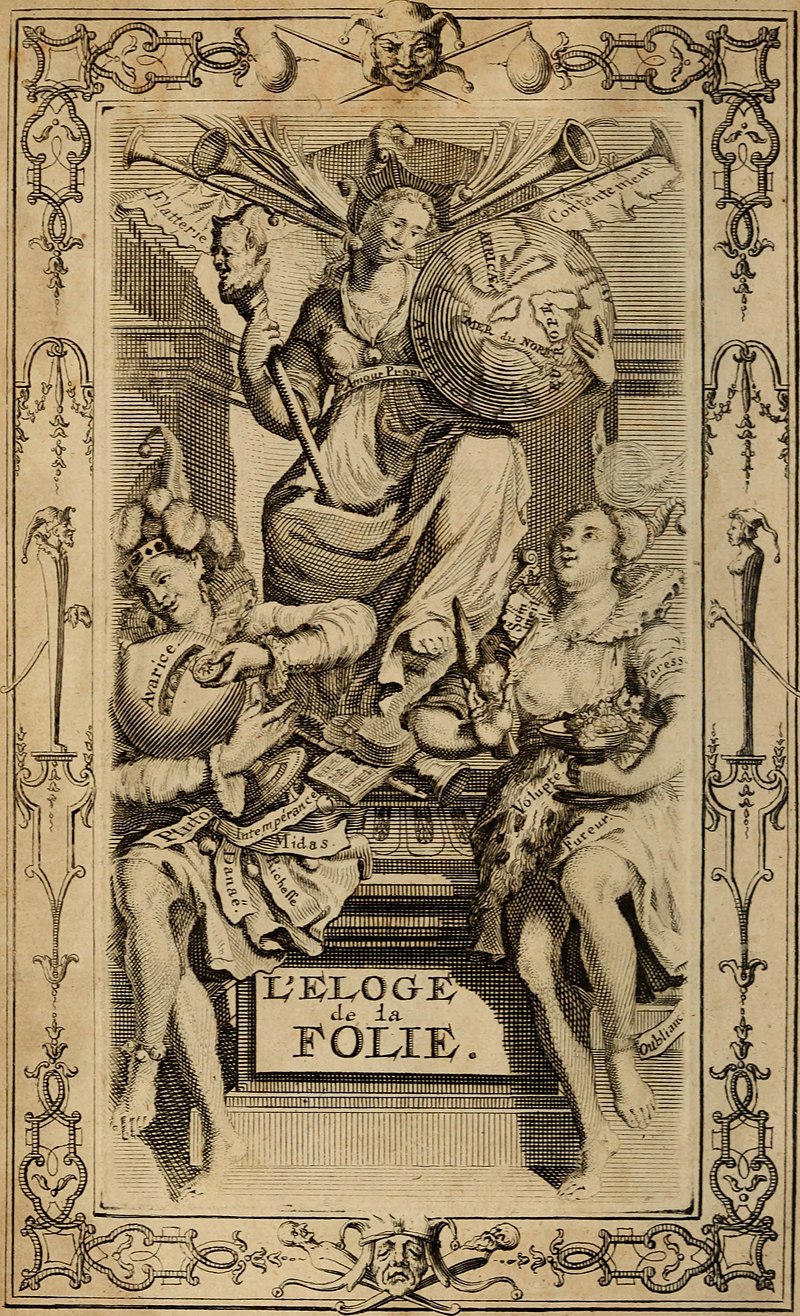
ERASMUS’s Praise of FOLLY.
An oration, of feigned matter, spoken byFollyin her own person.
HOW slightly soever I am esteemed in the common vogue of the world, (for I well know how disingenuously Folly is decried, even by those who are themselves the greatest fools,) yet it is from my influence alone that the whole universe receives her ferment of mirth and jollity: of which this may be urged as a convincing argument, in that as soon as I appeared to speak before this numerous assembly all their countenances were gilded over with a lively sparkling pleasantness: you soon welcomed me with so encouraging a look, you spurred me on with so cheerful a hum, that truly in all appearance, you seem now flushed with a good dose of reviving nectar, when as just before you sate drowsy and melancholy, as if you were lately come out of some hermit’s cell. But as it is usual, that as soon as the sun peeps from her eastern bed, and draws back the curtains of the darksome night; or as when, after a hard winter, the restorative spring breathes a more enlivening air, nature forthwith changes her apparel, and all things seem to renew their age; so at the first sight of me you all unmask, and appear in more lively colours. That therefore which expert orators can scarce effect by all their little artifice of eloquence, to wit, a raising the attentions of their auditors to a composedness of thought, this a bare look from me has commanded. The reason why I appear in this odd kind of garb, you shall soon be informed of, if for so short a while you will have but the patience to lend me an ear; yet not such a one as you are wont to hearken with to your reverend preachers, but as you listen withal to mountebanks, buffoons, and merry-andrews; in short, such as formerly were fastened to Midas, as a punishment for his affront to the god Pan. For I am now in a humour to act awhile the sophist, yet not of that sort who undertake the drudgery of tyrannizing over school boys, and teach a more than womanish knack of brawling; but in imitation of those ancient ones, who to avoid the scandalous epithet of wise, preferred this title of sophists; the task of these was to celebrate the worth of gods and heroes. Prepare therefore to be entertained with a panegyrick, yet not upon Hercules, Solon, or any other grandee, but on myself, that is, upon Folly.
And here I value not their censure that pretend it is foppish and affected for any person to praise himself: yet let it be as silly as they please, if they will but allow it needful: and indeed what is more befitting than that Folly should be the trumpet of her own praise, and dance after her own pipe? for who can set me forth better than myself? or who can pretend to be so well acquainted with my condition?
And yet farther, I may safely urge, that all this is no more than the same with what is done by several seemingly great and wise men, who with a new-fashioned modesty employ some paltry orator or scribbling poet, whom they bribe to flatter them with some high-flown character, that shall consist of mere lies and shams; and yet the persons thus extolled shall bristle up, and, peacock-like, bespread their plumes, while the impudent parasite magnifies the poor wretch to the skies, and proposes him as a complete pattern of all virtues, from each of which he is yet as far distant as heaven itself from hell: what is all this in the mean while, but the tricking up a daw in stolen feathers; a labouring to change the black-a-moor’s hue, and the drawing on a pigmy’s frock over the shoulders of a giant.
Lastly, I verify the old observation, that allows him a right of praising himself, who has nobody else to do it for him: for really, I cannot but admire at that ingratitude, shall I term it, or blockishness of mankind, who when they all willingly pay to me their utmost devoir, and freely acknowledge their respective obligations; that notwithstanding this, there should have been none so grateful or complaisant as to have bestowed on me a commendatory oration, especially when there have not been wanting such as at a great expense of sweat, and loss of sleep, have in elaborate speeches, given high encomiums to tyrants, agues, flies, baldness, and such like trumperies.
I shall entertain you with a hasty and unpremeditated, but so much the more natural discourse. My venting it ex tempore, I would not have you think proceeds from any principles of vain glory by which ordinary orators square their attempts, who (as it is easy to observe) when they are delivered of a speech that has been thirty years a conceiving, nay, perhaps at last, none of their own, yet they will swear they wrote it in a great hurry, and upon very short warning: whereas the reason of my not being provided beforehand is only because it was always my humour constantly to speak that which lies uppermost. Next, let no one be so fond as to imagine, that I should so far stint my invention to the method of other pleaders, as first to define, and then divide my subject, i.e., myself. For it is equally hazardous to attempt the crowding her within the narrow limits of a definition, whose nature is of so diffusive an extent, or to mangle and disjoin that, to the adoration whereof all nations unitedly concur. Beside, to what purpose is it to lay down a definition for a faint resemblance, and mere shadow of me, while appearing here personally, you may view me at a more certain light? And if your eye-sight fail not, you may at first blush discern me to be her whom the Greeks term Μωρία, the Latins stultitia.
But why need I have been so impertinent as to have told you this, as if my very looks did not sufficiently betray what I am; or supposing any be so credulous as to take me for some sage matron or goddess of wisdom, as if a single glance from me would not immediately correct their mistake, while my visage, the exact reflex of my soul, would supply and supersede the trouble of any other confessions: for I appear always in my natural colours, and an unartificial dress, and never let my face pretend one thing, and my heart conceal another; nay, and in all things I am so true to my principles, that I cannot be so much as counterfeited, even by those who challenge the name of wits, yet indeed are no better than jackanapes tricked up in gawdy clothes, and asses strutting in lions’ skins; and how cunningly soever they carry it, their long ears appear, and betray what they are. These in troth are very rude and disingenuous, for while they apparently belong to my party, yet among the vulgar they are so ashamed of my relation, as to cast it in others’ dish for a shame and reproach: wherefore since they are so eager to be accounted wise, when in truth they are extremely silly, what, if to give them their due, I dub them with the title of wise fools: and herein they copy after the example of some modern orators, who swell to that proportion of conceitedness, as to vaunt themselves for so many giants of eloquence, if with a double-tongued fluency they can plead indifferently for either side, and deem it a very doughty exploit if they can but interlard a Latin sentence with some Greek word, which for seeming garnish they crowd in at a venture; and rather than be at a stand for some cramp words, they will furnish up a long scroll of old obsolete terms out of some musty author, and foist them in, to amuse the reader with, that those who understand them may be tickled with the happiness of being acquainted with them: and those who understand them not, the less they know the more they may admire; whereas it has been always a custom to those of our side to contemn and undervalue whatever is strange and unusual, while those that are better conceited of themselves will nod and smile, and prick up their ears, that they may be thought easily to apprehend that, of which perhaps they do not understand one word. And so much for this; pardon the digression, now I return.
Of my name I have informed you, Sirs; what additional epithet to give you I know not, except you will be content with that of most foolish; for under what more proper appellation can the goddess Folly greet her devotees? But since there are few acquainted with my family and original, I will now give you some account of my extraction.
First then, my father was neither the chaos, nor hell, nor Saturn, nor Jupiter, nor any of those old, worn out, grandsire gods, but Plutus, the very same that, maugre Homer, Hesiod, nay, in spite of Jove himself, was the primary father of the universe; at whose alone beck, for all ages, religion and civil policy, have been successively undermined and re-established; by whose powerful influence war, peace, empire, debates, justice, magistracy, marriage, leagues, compacts, laws, arts, (I have almost run myself out of breath, but) in a word, all affairs of church and state, and business of private concern, are severally ordered and administered; without whose assistance all the Poets’ gang of deities, nay, I may be so bold as to say the very majordomos of heaven, would either dwindle into nothing, or at least be confined to their respective homes without any ceremonies of devotional address: whoever he combats with as an enemy, nothing can be armour-proof against his assaults; and whosoever he sides with as a friend, may grapple at even hand with Jove, and all his bolts. Of such a father I may well brag; and he begot me, not of his brain, as Jupiter did the hag Pallas, but of a pretty young nymph, famed for wit no less than beauty: and this feat was not done amidst the embraces of dull nauseous wedlock, but what gave a greater gust to the pleasure, it was done at a stolen bout, as we may modestly phrase it. But to prevent your mistaking me, I would have you understand that my father was not that Plutus in Aristophanes, old, dry, withered, sapless and blind; but the same in his younger and brisker days, and when his veins were more impregnated, and the heat of his youth somewhat higher inflamed by a chirping cup of nectar, which for a whet to his lust he had just before drank very freely of at a merry-meeting of the gods. And now presuming you may be inquisitive after my birth-place (the quality of the place we are born in, being now looked upon as a main ingredient of gentility), I was born neither in the floating Delo’s, nor on the frothy sea, nor in any of these privacies, where too forward mothers are wont to retire for an undiscovered delivery; but in the fortune islands, where all things grow without the toil of husbandry, wherein there is no drudgery, no distempers, no old age, where in the fields grow no daffodills, mallows, onions, pease, beans, or such kind of trash, but there give equal divertisement to our sight and smelling, rue, all-heal, bugloss, marjoram, herb of life, roses, violets, hyacinth, and such like fragrances as perfume the gardens of Adonis. And being born amongst these delights, I did not, like other infants, come crying into the world, but perked up, and laughed immediately in my mother’s face. And there is no reason I should envy Jove for having a she-goat to his nurse, since I was more creditably suckled by two jolly nymphs; the name of the first drunkenness, one of Bacchus’s offspring, the other ignorance, the daughter of Pan; both which you may here behold among several others of my train and attendants, whose particular names, if you would fain know, I will give you in short. This, who goes with a mincing gait, and holds up her head so high, is Self-Love. She that looks so spruce, and makes such a noise and bustle, is Flattery. That other, which sits hum-drum, as if she were half asleep, is called Forgetfulness. She that leans on her elbow, and sometimes yawningly stretches out her arms, is Laziness. This, that wears a plighted garland of flowers, and smells so perfumed, is Pleasure. The other, which appears in so smooth a skin, and pampered-up flesh, is Sensuality. She that stares so wildly, and rolls about her eyes, is Madness. As to those two gods whom you see playing among the lasses the name of the one is Intemperance, the other Sound Sleep. By the help and service of this retinue I bring all things under the verge of my power, lording it over the greatest kings and potentates.
You have now heard of my descent, my education, and my attendance; that I may not be taxed as presumptuous in borrowing the title of a goddess, I come now in the next place to acquaint you what obliging favours I everywhere bestow, and how largely my jurisdiction extends: for if, as one has ingenuously noted, to be a god is no other than to be a benefactor to mankind; and if they have been thought deservedly deified who have invented the use of wine, corn, or any other convenience for the well-being of mortals, why may not I justly bear the van among the whole troop of gods, who in all, and toward all, exert an unparalleled bounty and beneficence?
For instance, in the first place, what can be more dear and precious than life itself? and yet for this are none beholden, save to me alone. For it is neither the spear of throughly-begotten Pallas, nor the buckler of cloud-gathering Jove, that multiplies and propagates mankind: but that prime father of the universe, who at a displeasing nod makes heaven itself to tremble, he (I say) must lay aside his frightful ensigns of majesty, and put away that grim aspect wherewith he makes the other gods to quake, and, stage player-like, must lay aside his usual character, if he would do that, the doing whereof he cannot refrain from, i.e., getting of children. The next place to the gods is challenged by the Stoicks; but give me one as stoical as ill-nature can make him, and if I do not prevail on him to part with his beard, that bush of wisdom, (though no other ornament than what nature in more ample manner has given to goats,) yet at least he shall lay by his gravity, smooth up his brow, relinquish his rigid tenets, and in despite of prejudice become sensible of some passion in wanton sport and dallying. In a word, this dictator of wisdom shall be glad to take Folly for his diversion, if ever he would arrive to the honour of a father. And why should I not tell my story out? To proceed then: is it the head, the face, the breasts, the hands, the ears, or other more comely parts, that serve for instruments of generation? I trow not, but it is that member of our body which is so odd and uncouth as can scarce be mentioned without a smile. This part, I say, is that fountain of life, from which originally spring all things in a truer sense than from the elemental seminary. Add to this, what man would be so silly as to run his head into the collar of a matrimonial noose, if (as wise men are wont to do) he had before-hand duly considered the inconveniences of a wedded life? Or indeed what woman would open her arms to receive the embraces of a husband, if she did but forecast the pangs of child-birth, and the plague of being a nurse? Since then you owe your birth to the bride-bed, and (what was preparatory to that) the solemnizing of marriage to my waiting-woman Madness, you cannot but acknowledge how much you are indebted to me. Beside, those who had once dearly bought the experience of their folly, would never re-engage themselves in the same entanglement by a second match, if it were not occasioned by the forgetfulness of past dangers. And Venus herself (whatever Lucretius pretends to the contrary), cannot deny, but that without my assistance, her procreative power would prove weak and ineffectual. It was from my sportive and tickling recreation that proceeded the old crabbed philosophers, and those who now supply their stead, the mortified monks and friars; as also kings, priests, and popes, nay, the whole tribe of poetic gods, who are at last grown so numerous, as in the camp of heaven (though ne’er so spacious), to jostle for elbow room. But it is not sufficient to have made it appear that I am the source and original of all life, except I likewise shew that all the benefits of life are equally at my disposal. And what are such? Why, can any one be said properly to live to whom pleasure is denied? You will give me your assent; for there is none I know among you so wise shall I say, or so silly, as to be of a contrary opinion. The Stoics indeed contemn, and pretend to banish pleasure; but this is only a dissembling trick, and a putting the vulgar out of conceit with it, that they may more quietly engross it to themselves: but I dare them now to confess what one stage of life is not melancholy, dull, tiresome, tedious, and uneasy, unless we spice it with pleasure, that hautgoust of Folly. Of the truth whereof the never enough to be commended Sophocles is sufficient authority, who gives me the highest character in that sentence of his,
To know nothing is the sweetest life.
Yet abating from this, let us examine the case more narrowly. Who knows not that the first scene of infancy is far the most pleasant and delightsome? What then is it in children that makes us so kiss, hug, and play with them, and that the bloodiest enemy can scarce have the heart to hurt them; but their ingredients of innocence and Folly, of which nature out of providence did purposely compound and blend their tender infancy, that by a frank return of pleasure they might make some sort of amends for their parents’ trouble, and give in caution as it were for the discharge of a future education; the next advance from childhood is youth, and how favourably is this dealt with; how kind, courteous, and respectful are all to it? and how ready to become serviceable upon all occasions? And whence reaps it this happiness? Whence indeed, but from me only, by whose procurement it is furnished with little of wisdom, and so with the less of disquiet? And when once lads begin to grow up, and attempt to write man, their prettiness does then soon decay, their briskness flags, their humours stagnate, their jollity ceases, and their blood grows cold; and the farther they proceed in years, the more they grow backward in the enjoyment of themselves, till waspish old age comes on, a burden to itself as well as others, and that so heavy and oppressive, as none would bear the weight of, unless out of pity to their sufferings. I again intervene, and lend a helping-hand, assisting them at a dead lift, in the same method the poets feign their gods to succour dying men, by transforming them into new creatures, which I do by bringing them back, after they have one foot in the grave, to their infancy again; so as there is a great deal of truth couched in that old proverb, Once an old man, and twice a child. Now if any one be curious to understand what course I take to effect this alteration, my method is this: I bring them to my well of forgetfulness, (the fountain whereof is in the Fortunate Islands, and the river Lethe in hell but a small stream of it), and when they have there filled their bellies full, and washed down care, by the virtue and operation whereof they become young again. Ay, but (say you) they merely dote, and play the fool: why yes, this is what I mean by growing young again: for what else is it to be a child than to be a fool and an idiot? It is the being such that makes that age so acceptable: for who does not esteem it somewhat ominous to see a boy endowed with the discretion of a man, and therefore for the curbing of too forward parts we have a disparaging proverb, Soon ripe, soon rotten? And farther, who would keep company or have any thing to do with such an old blade, as, after the wear and harrowing of so many years should yet continue of as clear a head and sound a judgment as he had at any time been in his middle-age; and therefore it is great kindness of me that old men grow fools, since it is hereby only that they are freed from such vexations as would torment them if they were more wise; they can drink briskly, bear up stoutly, and lightly pass over such infirmities, as a far stronger constitution could scarce master. Sometime, with the old fellow in Plautus, they are brought back to their horn-book again, to learn to spell their fortune in love. Most wretched would they needs be if they had but wit enough to be sensible of their hard condition; but by my assistance, they carry off all well, and to their respective friends approve themselves good, sociable, jolly companions. Thus Homer makes aged Nestor famed for a smooth oily-tongued orator, while the delivery of Achilles was but rough, harsh, and hesitant; and the same poet elsewhere tells us of old men that sate on the walls, and spake with a great deal of flourish and elegance. And in this point indeed they surpass and outgo children, who are pretty forward in a softly, innocent prattle, but otherwise are too much tongue-tied, and want the other’s most acceptable embellishment of a perpetual talkativeness. Add to this, that old men love to be playing with children, and children delight as much in them, to verify the proverb, that Birds of a feather flock together. And indeed what difference can be discerned between them, but that the one is more furrowed with wrinkles, and has seen a little more of the world than the other? For otherwise their whitish hair, their want of teeth, their smallness of stature, their milk diet, their bald crowns, their prattling, their playing, their short memory, their heedlessness, and all their other endowments, exactly agree; and the more they advance in years, the nearer they come back to their cradle, till like children indeed, at last they depart the world, without any remorse at the loss of life, or sense of the pangs of death.
And now let any one compare the excellency of my metamorphosing power to that which Ovid attributes to the gods; their strange feats in some drunken passions we will omit for their credit sake, and instance only in such persons as they pretend great kindness for; these they transformed into trees, birds, insects, and sometimes serpents; but alas, their very change into somewhat else argues the destruction of what they were before; whereas I can restore the same numerical man to his pristine state of youth, health and strength; yea, what is more, if men would but so far consult their own interest, as to discard all thoughts of wisdom, and entirely resign themselves to my guidance and conduct, old age should be a paradox, and each man’s years a perpetual spring. For look how your hard plodding students, by a close sedentary confinement to their books, grow mopish, pale, and meagre, as if, by a continual wrack of brains, and torture of invention, their veins were pumped dry, and their whole body squeezed sapless; whereas my followers are smooth, plump, and bucksome, and altogether as lusty as so many bacon-hogs, or sucking calves; never in their career of pleasure be arrested with old age, if they could but keep themselves untainted from the contagiousness of wisdom, with the leprosy whereof, if at any time they are infected, it is only for prevention, lest they should otherwise have been too happy.
For a more ample confirmation of the truth of what foregoes, it is on all sides confessed, that Folly is the best preservative of youth, and the most effectual antidote against age. And it is a never-failing observation made of the people of Brabant, that, contrary to the proverb of Older and wiser, the more ancient they grow, the more fools they are; and there is not any one country, whose inhabitants enjoy themselves better, and rub through the world with more ease and quiet. To these are nearly related, as well by affinity of customs, as of neighbourhood, my friends the Hollanders: mine I may well call them, for they stick so close and lovingly to me, that they are styled fools to a proverb, and yet scorn to be ashamed of their name. Well, let fond mortals go now in a needless quest of some Medea, Circe, Venus, or some enchanted fountain, for a restorative of age, whereas the accurate performance of this feat lies only within the ability of my art and skill.
It is I only who have the receipt of making that liquor wherewith Memnon’s daughter lengthened out her grandfather’s declining days: it is I that am that Venus, who so far restored the languishing Phaon, as to make Sappho fall deeply in love with his beauty. Mine are those herbs, mine those charms, that not only lure back swift time, when past and gone, but what is more to be admired, clip its wings, and prevent all farther flight. So then, if you will all agree to my verdict, that nothing is more desirable than the being young, nor any thing more loathed than contemptible old age, you must needs acknowledge it as an unrequitable obligation from me, for fencing off the one, and perpetuating the other.
But why should I confine my discourse to the narrow subject of mankind only? View the whole heaven itself, and then tell me what one of that divine tribe would not be mean and despicable, if my name did not lend him some respect and authority. Why is Bacchus always painted as a young man, but only because he is freakish, drunk, and mad; and spending his time in toping, dancing, masking, and revelling, seems to have nothing in the least to do with wisdom? Nay, so far is he from the affectation of being accounted wise, that he is content, all the rights of devotion which are paid unto him should consist of apishness and drollery. Farther, what scoffs and jeers did not the old comedians throw upon him? O swinish punch-gut god, say they, that smells rank of the sty he was sowed up in, and so on. But prithee, who in this case, always merry, youthful, soaked in wine, and drowned in pleasure, who, I say, in such a case, would change conditions, either with the lofty menace-looking Jove, the grave, yet timorous Pan, the stately Pallas, or indeed any one other of heaven’s landlords? Why is Cupid feigned as a boy, but only because he is an under-witted whipster, that neither acts nor thinks any thing with discretion? Why is Venus adored for the mirror of beauty, but only because she and I claim kindred, she being of the same complexion with my father Plutus, and therefore called by Homer the Golden Goddess? Beside, she imitates me in being always a laughing, if either we believe the poets, or their near kinsmen the painters, the first mentioning, the other drawing her constantly in that posture. Add farther, to what deity did the Romans pay a more ceremonial respect than to Flora, that bawd of obscenity? And if any one search the poets for an historical account of the gods, he shall find them all famous for lewd pranks and debaucheries. It is needless to insist upon the miscarriages of others, when the lecherous intrigues of Jove himself are so notorious, and when the pretendedly chaste Diana so oft uncloaked her modesty to run a hunting after her beloved Endimion. But I will say no more, for I had rather they should be told of their faults by Momus, who was want formerly to sting them with some close reflections, till nettled by his abusive raillery, they kicked him out of heaven for his sauciness of daring to reprove such as were beyond correction: and now in his banishment from heaven he finds but cold entertainment here on earth, nay, is denied all admittance into the court of princes, where notwithstanding my handmaid Flattery finds a most encouraging welcome: but this petulant monitor being thrust out of doors, the gods can now more freely rant and revel, and take their whole swinge of pleasure. Now the beastly Priapus may recreate himself without contradiction in lust and filthiness; now the sly Mercury may, without discovery, go on in his thieveries, and nimble-fingered juggles; the sooty Vulcan may now renew his wonted custom of making the other gods laugh by his hopping so limpingly, and coming off with so many dry jokes, and biting repartees. Silenus, the old doting lover, to shew his activity, may now dance a frisking jig, and the nymphs be at the same sport naked. The goatish satyrs may make up a merry ball, and Pan, the blind harper may put up his bagpipes, and sing bawdy catches, to which the gods, especially when they are almost drunk, shall give a most profound attention. But why would I any farther rip open and expose the weakness of the gods, a weakness so childish and absurd, that no man can at the same time keep his countenance, and make a relation of it? Now therefore, like Homer’s wandering muse, I will take my leave of heaven, and come down again here below, where we shall find nothing happy, nay, nothing tolerable, without my presence and assistance. And in the first place consider how providently nature has took care that in all her works there should be some piquant smack and relish of Folly: for since the Stoics define wisdom to be conducted by reason, and folly nothing else but the being hurried by passion, lest our life should otherwise have been too dull and inactive, that creator, who out of clay first tempered and made us up, put into the composition of our humanity more than a pound of passions to an ounce of reason; and reason he confined within the narrow cells of the brain, whereas he left passions the whole body to range in. Farther, he set up two sturdy champions to stand perpetually on the guard, that reason might make no assault, surprise, nor in-road: anger, which keeps its station in the fortress of the heart; and lust, which like the signs Virgo and Scorpio, rules the belly and secret members. Against the forces of these two warriors how unable is reason to bear up and withstand, every day’s experience does abundantly witness; while let reason be never so importunate in urging and reinforcing her admonitions to virtue, yet the passions bear all before them, and by the least offer of curb or restraint grow but more imperious, till reason itself, for quietness sake, is forced to desist from all further remonstrance.
But because it seemed expedient that man, who was born for the transaction of business, should have so much wisdom as should fit and capacitate him for the discharge of his duty herein, and yet lest such a measure as is requisite for this purpose might prove too dangerous and fatal, I was advised with for an antidote, who prescribed this infallible receipt of taking a wife, a creature so harmless and silly, and yet so useful and convenient, as might mollify and make pliable the stiffness and morose humour of man. Now that which made Plato doubt under what genus to rank woman, whether among brutes or rational creatures, was only meant to denote the extreme stupidness and Folly of that sex, a sex so unalterably simple, that for any of them to thrust forward, and reach at the name of wise, is but to make themselves the more remarkable fools, such an endeavour, being but a swimming against the stream, nay, the turning the course of nature, the bare attempting whereof is as extravagant as the effecting of it is impossible: for as it is a trite proverb, That an ape will be an ape, though clad in purple; so a woman will be a woman, i.e., a fool, whatever disguise she takes up. And yet there is no reason women should take it amiss to be thus charged; for if they do but rightly consider they will find it is to Folly they are beholden for those endowments, wherein they so far surpass and excel man; as first, for their unparalleled beauty, by the charm whereof they tyrannize over the greatest tyrants; for what is it but too great a smatch of wisdom that makes men so tawny and thick-skinned, so rough and prickly-bearded, like an emblem of winter or old age, while women have such dainty smooth cheeks, such a low gentle voice, and so pure a complexion, as if nature had drawn them for a standing pattern of all symmetry and comeliness? Beside, what greater or juster aim and ambition have they than to please their husbands? In order where-unto they garnish themselves with paint, washes, curls, perfumes, and all other mysteries of ornament; yet after all they become acceptable to them only for their Folly. Wives are always allowed their humour, yet it is only in exchange for titillation and pleasure, which indeed are but other names for Folly; as none can deny, who consider how a man must hug, and dandle, and kittle, and play a hundred little tricks with his bed-fellow when he is disposed to make that use of her that nature designed her for. Well, then, you see whence that greatest pleasure (to which modesty scarce allows a name), springs and proceeds.
But now some blood-chilled old men, that are more for wine than wenching, will pretend, that in their opinion the greatest happiness consists in feasting and drinking. Grant it be so; yet certainly in the most luxurious entertainments it is Folly must give the sauce and relish to the daintiest cates and delicacies; so that if there be no one of the guests naturally fool enough to be played upon by the rest, they must procure some comical buffoon, that by his jokes, and flouts, and blunders shall make the whole company split themselves with laughing: for to what purpose were it to be stuffed and crammed with so many dainty bits, savoury dishes, and toothsome rarities, if after all this epicurism of the belly, the eyes, the ears, and the whole mind of man, were not as well foistred and relieved with laughing, jesting, and such like divertisements, which like second courses serve for the promoting of digestion? And as to all those shooing horns of drunkenness, the keeping every one his man, the throwing hey-jinks, the filling of bumpers, the drinking two in a hand, the beginning of mistress’ healths; and then the roaring out of drunken catches, the calling in a fiddler, the leading out every one his lady to dance, and such like riotous pastimes, these were not taught or dictated by any of the wise men of Greece, but of Gotham rather, being my invention, and by me prescribed as the best preservative of health: each of which, the more ridiculous it is, the more welcome it finds. And indeed to jog sleepingly through the world, in a dumpish melancholy posture cannot properly be said to live, but to be wound up as it were in a windingsheet before we are dead, and so to be shuffled quick into a grave, and buried alive.
But there are yet others perhaps that have no gust in this sort of pleasure, but place their greatest content in the enjoyment of friends, telling us that true friendship is to be preferred before all other acquirements; that it is a thing so useful and necessary, as the very elements could not long subsist without a natural combination; so pleasant that it affords as warm an influence as the sun itself; so honest, (if honesty in this case deserve any consideration), that the very philosophers have not stuck to place this as one among the rest of their different sentiments of the chiefest good. But what if I make it appear that I also am the main spring and original of this endearment? Yes, I can easily demonstrate it, and that not by crabbed syllogisms, or a crooked and unintelligible way of arguing, but can make it (as the proverb goes) As plain as the nose on your face. Well then, to scratch and curry one another, to wink at a friend’s faults; nay, to cry up some failings for virtuous and commendable, is not this the next door to the being a fool? When one looking stedfastly in his mistress’s face, admires a mole as much as a beauty spot; when another swears his lady’s stinking breath is a most redolent perfume; and at another time the fond parent hugs the squint-eyed child, and pretends it is rather a becoming glance and winning aspect than any blemish of the eye-sight, what is all this but the very height of Folly? Folly (I say) that both makes friends and keeps them so. I speak of mortal men only, among whom there are none but have some small faults; he is most happy that has fewest. If we pass to the gods, we shall find that they have so much of wisdom, as they have very little of friendship; nay, nothing of that which is true and hearty. The reason why men make a greater improvement in this virtue, is only because they are more credulous and easy natured; for friends must be of the same humour and inclinations too, or else the league of amity, though made with never so many protestations, will be soon broke. Thus grave and morose men seldom prove fast friends; they are too captious and censorious, and will not bear with one another’s infirmities; they are as eagle sighted as may be in the espial of others’ faults, while they wink upon themselves, and never mind the beam in their own eyes. In short, man being by nature so prone to frailties, so humoursome and cross-grained, and guilty of so many slips and miscarriages, there could be no firm friendship contracted, except there be such an allowance made for each other’s defaults, which the Greeks term Ἐυήθεια, and we may construe good nature, which is but another word for Folly. And what? Is not Cupid, that first father of all relation, is not he stark blind, that as he cannot himself distinguish of colours, so he would make us as mope-eyed in judging falsely of all love concerns, and wheedle us into a thinking that we are always in the right? Thus every Jack sticks to his own Jill; every tinker esteems his own trull; and the hob-nailed suiter prefers Joan the milk-maid before any of my lady’s daughters. These things are true, and are ordinarily laughed at, and yet, however ridiculous they seem, it is hence only that all societies receive their cement and consolidation.
The same which has been said of friendship is much more applicable to a state of marriage, which is but the highest advance and improvement of friendship in the closest bond of union. Good God! What frequent divorces, or worse mischief, would oft sadly happen, except man and wife, were so discreet as to pass over light occasions of quarrel with laughing, jesting, dissembling, and such like playing the fool? Nay, how few matches would go forward, if the hasty lover did but first know how many little tricks of lust and wantonness (and perhaps more gross failings) his coy and seemingly bashful mistress had oft before been guilty of? And how fewer marriages, when consummated, would continue happy, if the husband were not either sottishly insensible of, or did not purposely wink at and pass over the lightness and forwardness of his good-natured wife? This peace and quietness is owing to my management, for there would otherwise be continual jars, and broils, and mad doings, if want of wit only did not at the same time make a contented cuckold and a still house; if the cuckoo sing at the back door, the unthinking cornute takes no notice of the unlucky omen of others’ eggs being laid in his own nest, but laughs it over, kisses his dear spouse, and all is well. And indeed it is much better patiently to be such a hen-pecked frigot, than always to be wracked and tortured with the grating surmises of suspicion and jealousy. In fine, there is no one society, no one relation men stand in, would be comfortable, or indeed tolerable, without my assistance; there could be no right understanding betwixt prince and people, lord and servant, tutor and pupil, friend and friend, man and wife, buyer and seller, or any persons however otherwise related, if they did not cowardly put up small abuses, sneakingly cringe and submit, or after all fawningly scratch and flatter each other. This you will say is much, but you shall yet hear what is more; tell me then, can any one love another that first hates himself? Is it likely any one should agree with a friend that is first fallen out with his own judgment? Or is it probable he should be any way pleasing to another, who is a perpetual plague and trouble to himself? This is such a paradox that none can be so mad as to maintain. Well, but if I am excluded and barred out, every man would be so far from being able to bear with others, that he would be burthensome to himself, and consequently incapable of any ease or satisfaction. Nature, that toward some of her products plays the step-mother rather than the indulgent parent, has endowed some men with that unhappy peevishness of disposition, as to nauseate and dislike whatever is their own, and much admire what belongs to other persons, so as they cannot in any wise enjoy what their birth or fortunes have bestowed upon them: for what grace is there in the greatest beauty, if it be always clouded with frowns and sulliness? Or what vigour in youth, if it be harassed with a pettish, dogged, waspish, ill humour? None, sure. Nor indeed can there be any creditable acquirement of ourselves in any one station of life, but we should sink without rescue into misery and despair, if we were not buoyed up and supported by self-love, which is but the elder sister (as it were) of Folly, and her own constant friend and assistant. For what is or can be more silly than to be lovers and admirers of ourselves? And yet if it were not so there will be no relish to any of our words or actions. Take away this one property of a fool, and the orator shall become as dumb and silent as the pulpit he stands in; the musician shall hang up his untouched instruments on the wall; the completest actors shall be hissed off the stage; the poet shall be burlesqued with his own doggrel rhymes; the painter shall himself vanish into an imaginary landscape; and the physician shall want food more than his patients do physic. In short, without self-love, instead of beautiful, you shall think yourself an old beldam of fourscore; instead of youthful, you shall seem just dropping into the grave; instead of eloquent, a mere stammerer; and in lieu of gentle and complaisant, you shall appear like a downright country clown; it being so necessary that every one should think well of himself before he can expect the good opinion of others. Finally, when it is the main and essential part of happiness to desire to be no other than what we already are; this expedient is again wholly owing to self-love, which so flushes men with a good conceit of their own, that no one repents of his shape, of his wit, of his education, or of his country; so as the dirty half-drowned Hollander would not remove into the pleasant plains of Italy, the rude Thracian would not change his boggy soil for the best seat in Athens, nor the brutish Scythian quit his thorny deserts to become an inhabitant of the Fortunate Islands. And oh the incomparable contrivance of nature, who has ordered all things in so even a method that wherever she has been less bountiful in her gifts, there she makes it up with a larger dose of self-love, which supplies the former defects, and makes all even. To enlarge farther, I may well presume to aver, that there are no considerable exploits performed, no useful arts invented, but what I am the respective author and manager of: as first, what is more lofty and heroical than war? and yet, what is more foolish than for some petty, trivial affront, to take such a revenge as both sides shall be sure to be losers, and where the quarrel must be decided at the price of so many limbs and lives? And when they come to an engagement, what service can be done by such pale-faced students, as by drudging at the oars of wisdom, have spent all their strength and activity? No, the only use is of blunt sturdy fellows that have little of wit, and so the more of resolution; except you would make a soldier of such another Demosthenes as threw down his arms when he came within sight of the enemy, and lost that credit in the camp which he gained in the pulpit. But counsel, deliberation, and advice (say you), are very necessary for the management of war: very true, but not such counsel as shall be prescribed by the strict rules of wisdom and justice; for a battle shall be more successfully fought by serving-men, porters, bailiffs, padders, rogues, gaol-birds, and such like tag-rags of mankind, than by the most accomplished philosophers; which last, how unhappy they are in the management of such concerns, Socrates (by the oracle adjudged to be the wisest of mortals) is a notable example; who when he appeared in the attempt of some public performance before the people, he faltered in the first onset, and could never recover himself, but was hooted and hissed home again: yet this philosopher was the less a fool, for refusing the appellation of wise, and not accepting the oracle’s compliment; as also for advising that no philosophers should have any hand in the government of the commonwealth; he should have likewise at the same time, added, that they should be banished all human society. And what made this great man poison himself to prevent the malice of his accusers? What made him the instrument of his own death, but only his excessiveness of wisdom? whereby, while he was searching into the nature of clouds, while he was plodding and contemplating upon ideas, while he was exercising his geometry upon the measure of a flea, and diving into the recesses of nature, for an account how little insects, when they were so small, could make so great a buzz and hum; while he was intent upon these fooleries he minded nothing of the world, or its ordinary concerns.
Next to Socrates comes his scholar Plato, a famous orator indeed, that could be so dashed out of countenance by an illiterate rabble, as to demur, and hawk, and hesitate, before he could get to the end of one short sentence. Theophrastus was such another coward, who beginning to make an oration, was presently struck down with fear, as if he had seen some ghost, or hobgoblin. Isocrates was so bashful and timorous, that though he taught rhetoric, yet he could never have the confidence to speak in public. Cicero, the master of Roman eloquence, was wont to begin his speeches with a low, quivering voice, just like a school-boy, afraid of not saying his lesson perfect enough to escape whipping: and yet Fabius commends this property of Tully as an argument of a considerate orator, sensible of the difficulty of acquitting himself with credit: but what hereby does he do more than plainly confess that wisdom is but a rub and impediment to the well management of any affair? How would these heroes crouch, and shrink into nothing, at the sight of drawn swords, that are thus quashed and stunned at the delivery of bare words?
Now then let Plato’s fine sentence be cried up, that “happy are those commonwealths where either philosophers are elected kings, or kings turn philosophers.” Alas, this is so far from being true, that if we consult all historians for an account of past ages, we shall find no princes more weak, nor any people more slavish and wretched, than where the administrations of affairs fell on the shoulders of some learned bookish governor. Of the truth whereof, the two Catos are exemplary instances: the first of which embroiled the city, and tired out the senate by his tedious harangues of defending himself, and accusing others; the younger was an unhappy occasion of the loss of the peoples’ liberty, while by improper methods he pretended to maintain it. To these may be added Brutus, Cassius, the two Gracchi, and Cicero himself, who was no less fatal to Rome, than his parallel Demosthenes was to Athens: as likewise Marcus Antoninus, whom we may allow to have been a good emperor, yet the less such for his being a philosopher; and certainly he did not do half that kindness to his empire by his own prudent management of affairs, as he did mischief by leaving such a degenerate successor as his son Commodus proved to be; but it is a common observation, that A wise father has many times a foolish son, nature so contriving it, lest the taint of wisdom, like hereditary distempers, should otherwise descend by propagation. Thus Tully’s son Marcus, though bred at Athens, proved but a dull, insipid soul; and Socrates his children had (as one ingeniously expresses it) “more of the mother than the father,” a phrase for their being fools. However, it were the more excusable, though wise men are so awkward and unhandy in the ordering of public affairs, if they were not so bad, or worse in the management of their ordinary and domestic concerns; but alas, here they are much to seek: for place a formal wise man at a feast, and he shall, either by his morose silence put the whole table out of humour, or by his frivolous questions disoblige and tire out all that sit near him. Call him out to dance, and he shall move no more nimbly than a camel: invite him to any public performance, and by his very looks he shall damp the mirth of all the spectators, and at last be forced, like Cato, to leave the theatre, because he cannot unstarch his gravity, nor put on a more pleasant countenance. If he engage in any discourse, he either breaks off abruptly, or tires out the patience of the whole company, if he goes on: if he have any contract, sale, or purchase to make, or any other worldly business to transact, he behaves himself more like a senseless stock than a rational man; so as he can be of no use nor advantage to himself, to his friends, or to his country; because he knows nothing how the world goes, and is wholly unacquainted with the humour of the vulgar, who cannot but hate a person so disagreeing in temper from themselves.
And indeed the whole proceedings of the world are nothing but one continued scene of Folly, all the actors being equally fools and madmen; and therefore if any be so pragmatically wise as to be singular, he must even turn a second Timon, or man-hater, and by retiring into some unfrequented desert, become a recluse from all mankind.
But to return to what I first proposed, what was it in the infancy of the world that made men, naturally savage, unite into civil societies, but only flattery, one of my chiefest virtues? For there is nothing else meant by the fables of Amphion and Orpheus with their harps; the first making the stones jump into a well-built wall, the other inducing the trees to pull their legs out of the ground, and dance the morrice after him. What was it that quieted and appeased the Roman people, when they brake out into a riot for the redress of grievances? Was it any sinewy starched oration? No, alas, it was only a silly, ridiculous story, told by Menenius Agrippa, how the other members of the body quarrelled with the belly, resolving no longer to continue her drudging caterers, till by the penance they thought thus in revenge to impose, they soon found their own strength so far diminished, that paying the cost of experiencing a mistake, they willingly returned to their respective duties. Thus when the rabble of Athens murmured at the exaction of the magistrates, Themistocles satisfied them with such another tale of the fox and the hedge-hog; the first whereof being stuck fast in a miry bog, the flies came swarming about him, and almost sucked out all his blood, the latter officiously offers his service to drive them away; no, says the fox, if these which are almost glutted be frighted off, there will come a new hungry set that will be ten times more greedy and devouring: the moral of this he meant applicable to the people, who if they had such magistrates removed as they complained of for extortion, yet their successors would certainly be worse.
With what highest advances of policy could Sertorius have kept the Barbarians so well in awe, as by a white hart, which he pretended was presented to him by Diana, and brought him intelligence of all his enemies’ designs? What was Lycurgus his grand argument for demonstrating the force of education, but only the bringing out two whelps of the same bitch, differently brought up, and placing before them a dish, and a live hare; the one, that had been bred to hunting, ran after the game; while the other, whose kennel had been a kitchen, presently fell a licking the platter. Thus the before-mentioned Sertorius made his soldiers sensible that wit and contrivance would do more than bare strength, by setting a couple of men to the plucking off two horses’ tails; the first pulling at all in one handful, tugged in vain; while the other, though much the weaker, snatching off one by one, soon performed his appointed task.
Instances of like nature are Minos and king Numa, both which fooled the people into obedience by a mere cheat and juggle; the first by pretending he was advised by Jupiter, the latter by making the vulgar believe he had the goddess Ægeria assistant to him in all debates and transactions. And indeed it is by such wheedles that the common people are best gulled and imposed upon.
For farther, what city would ever submit to the rigorous laws of Plato, to the severe injunctions of Aristotle? or the more unpracticable tenets of Socrates? No, these would have been too straight and galling, there not being allowance enough made for the infirmities of the people.
To pass to another head, what was it made the Decii so forward to offer themselves up as a sacrifice for an atonement to the angry gods, to rescue and stipulate for their indebted country? What made Curtius, on a like occasion, so desperately to throw away his life, but only vainglory, that is condemned, and unanimously voted for a main branch of Folly by all wise men? What is more unreasonable and foppish (say they) than for any man, out of ambition to some office, to bow, to scrape and cringe to the gaping rabble, to purchase their favour by bribes and donatives, to have their names cried up in the streets, to be carried about as it were for a fine sight upon the shoulders of the crowd, to have their effigies carved in brass, and put up in the market place for a monument of their popularity? Add to this, the affectation of new titles and distinctive badges of honour; nay, the very deifying of such as were the most bloody tyrants. These are so extremely ridiculous, that there is need of more than one Democritus to laugh at them. And yet hence only have been occasioned those memorable achievements of heroes, that have so much employed the pens of many laborious writers.
It is Folly that, in a several dress, governs cities, appoints magistrates, and supports judicatures; and, in short, makes the whole course of man’s life a mere children’s play, and worse than push-pin diversion. The invention of all arts and sciences are likewise owing to the same cause: for what sedentary, thoughtful men would have beat their brains in the search of new and unheard-of-mysteries, if not egged on by the bubbling hopes of credit and reputation? They think a little glittering flash of vain-glory is a sufficient reward for all their sweat, and toil, and tedious drudgery, while they that are supposedly more foolish, reap advantage of the others’ labours.
And now since I have made good my title to valour and industry, what if I challenge an equal share of wisdom? How! this (you will say) is absurd and contradictory; the east and west may as soon shake hands as Folly and Wisdom be reconciled. Well, but have a little patience and I will warrant you I will make out my claim. First then, if wisdom (as must be confessed) is no more than a readiness of doing good, and an expedite method of becoming serviceable to the world, to whom does this virtue more properly belong? To the wise man, who partly out of modesty, partly out of cowardice, can proceed resolutely in no attempt; or to the fool, that goes hand over head, leaps before he looks, and so ventures through the most hazardous undertaking without any sense or prospect of danger? In the undertaking any enterprize the wise man shall run to consult with his books, and daze himself with poring upon musty authors, while the dispatchful fool shall rush bluntly on, and have done the business, while the other is thinking of it. For the two greatest lets and impediments to the issue of any performance are modesty, which casts a mist before men’s eyes; and fear, which makes them shrink back, and recede from any proposal: both these are banished and cashiered by Folly, and in their stead such a habit of fool-hardiness introduced, as mightily contributes to the success of all enterprizes. Farther, if you will have wisdom taken in the other sense, of being a right judgment of things, you shall see how short wise men fall of it in this acceptation.
First, then, it is certain that all things, like so many Janus’s, carry a double face, or rather bear a false aspect, most things being really in themselves far different from what they are in appearance to others: so as that which at first blush proves alive, is in truth dead; and that again which appears as dead, at a nearer view proves to be alive: beautiful seems ugly, wealthy poor, scandalous is thought creditable, prosperous passes for unlucky, friendly for what is most opposite, and innocent for what is hurtful and pernicious. In short, if we change the tables, all things are found placed in a quite different posture from what just before they appeared to stand in.
If this seem too darkly and unintelligibly expressed, I will explain it by the familiar instance of some great king or prince, whom every one shall suppose to swim in a luxury of wealth, and to be a powerful lord and master; when, alas, on the one hand he has poverty of spirit enough to make him a mere beggar, and on the other side he is worse than a galley-slave to his own lusts and passions.
If I had a mind farther to expatiate, I could enlarge upon several instances of like nature, but this one may at present suffice.
Well, but what is the meaning (will some say) of all this? Why, observe the application. If any one in a play-house be so impertinent and rude as to rifle the actors of their borrowed clothes, make them lay down the character assumed, and force them to return to their naked selves, would not such a one wholly discompose and spoil the entertainment? And would he not deserve to be hissed and thrown stones at till the pragmatical fool could learn better manners? For by such a disturbance the whole scene will be altered: such as acted the men will perhaps appear to be women: he that was dressed up for a young brisk lover, will be found a rough old fellow; and he that represented a king, will remain but a mean ordinary servingman. The laying things thus open is marring all the sport, which consists only in counterfeit and disguise. Now the world is nothing else but such another comedy, where every one in the tire-room is first habited suitably to the part he is to act; and as it is successively their turn, out they come on the stage, where he that now personates a prince, shall in another part of the same play alter his dress, and become a beggar, all things being in a mask and particular disguise, or otherwise the play could never be presented. Now if there should arise any starched, formal don, that would point at the several actors, and tell how this, that seems a petty god, is in truth worse than a brute, being made captive to the tyranny of passion; that the other, who bears the character of a king, is indeed the most slavish of serving-men, in being subject to the mastership of lust and sensuality; that a third, who vaunts so much of his pedigree, is no better than a bastard for degenerating from virtue, which ought to be of greatest consideration in heraldry, and so shall go on in exposing all the rest; would not any one think such a person quite frantic, and ripe for bedlam? For as nothing is more silly than preposterous wisdom, so is there nothing more indiscreet than an unreasonable reproof. And therefore he is to be hooted out of all society that will not be pliable, conformable, and willing to suit his humour with other men’s, remembering the law of clubs and meetings, that he who will not do as the rest must get him out of the company. And it is certainly one great degree of wisdom for every one to consider that he is but a man, and therefore he should not pitch his soaring thoughts beyond the level of mortality, but imp the wings of his towering ambition, and obligingly submit and condescend to the weakness of others, it being many times a piece of complaisance to go out of the road for company’s sake. No (say you), this is a grand piece of Folly: true, but yet all our living is no more than such kind of fooling: which though it may seem harsh to assert, yet it is not so strange as true.
For the better making it out it might perhaps be requisite to invoke the aid of the muses, to whom the poets devoutly apply themselves upon far more slender occasions. Come then and assist, ye Heliconian lasses, while I attempt to prove that there is no method for an arrival at wisdom, and consequently no track to the goal of happiness, without the instructions and directions of Folly.
And here, in the first place it has been already acknowledged, that all the passions are listed under my regiment, since this is resolved to be the only distinction betwixt a wise man and a fool, that this latter is governed by passion, the other guided by reason: and therefore the Stoics look upon passions no other than as the infection and malady of the soul that disorders the constitution of the whole man, and by putting the spirits into a feverish ferment many times occasion some mortal distemper. And yet these, however decried, are not only our tutors to instruct us towards the attainment of wisdom, but even bolden us likewise, and spur us on to a quicker dispatch of all our undertakings. This, I suppose, will be stomached by the stoical Seneca, who pretends that the only emblem of wisdom is the man without passion; whereas the supposing any person to be so, is perfectly to unman him, or else transforming him into some fabulous deity that never was, nor ever will be; nay, to speak more plain, it is but the making him a mere statue, immoveable, senseless, and altogether inactive. And if this be their wise man, let them take him to themselves, and remove him into Plato’s commonwealth, the new Atlantis, or some other-like fairy land. For who would not hate and avoid such a person as should be deaf to all the dictates of common sense? that should have no more power of love or pity than a block or stone, that remains heedless of all dangers? that thinks he can never mistake, but can foresee all contingencies at the greatest distance, and make provision for the worst presages? that feeds upon himself and his own thoughts, that monopolises health, wealth, power, dignity, and all to himself? that loves no man, nor is beloved of any? that has the impudence to tax even divine providence of ill contrivance, and proudly grudges, nay, tramples under foot all other men’s reputation; and this is he that is the Stoic’s complete wise man. But prithee what city would choose such a magistrate? what army would be willing to serve under such a commander? or what woman would be content with such a do-little husband? who would invite such a guest? or what servant would be retained by such a master? The most illiterate mechanic would in all respects be a more acceptable man, who would be frolicsome with his wife, free with his friends, jovial at a feast, pliable in converse, and obliging to all company. But I am tired out with this part of my subject, and so must pass to some other topics.
And now were any one placed on that tower, from whence Jove is fancied by the poets to survey the world, he would all around discern how many grievances and calamities our whole life is on every side encompassed with: how unclean our birth, how troublesome our tendance in the cradle, how liable our childhood is to a thousand misfortunes, how toilsome and full of drudgery our riper years, how heavy and uncomfortable our old age, and lastly, how unwelcome the unavoidableness of death. Farther, in every course of life how many wracks there may be of torturing diseases, how many unhappy accidents may casually occur, how many unexpected disasters may arise, and what strange alterations may one moment produce? Not to mention such miseries as men are mutually the cause of, as poverty, imprisonment, slander, reproach, revenge, treachery, malice, cousenage, deceit, and so many more, as to reckon them all would be as puzzling arithmetic as the numbering of the sands.
How mankind became environed with such hard circumstances, or what deity imposed these plagues, as a penance on rebellious mortals, I am not now at leisure to enquire: but whoever seriously takes them into consideration must needs commend the valour of the Milesian virgins, who voluntarily killed themselves to get rid of a troublesome world: and how many wise men have taken the same course of becoming their own executioners; among whom, not to mention Diogenes, Xenocrates, Cato, Cassius, Brutus, and other heroes, the self-denying Chiron is never enough to be commended; who, when he was offered by Apollo the privilege of being exempted from death, and living on to the world’s end, he refused the enticing proposal, as deservedly thinking it a punishment rather than a reward.
But if all were thus wise you see how soon the world would be unpeopled, and what need there would be of a second Prometheus, to plaister up the decayed image of mankind. I therefore come and stand in this gap of danger, and prevent farther mischief; partly by ignorance, partly by inadvertence; by the oblivion of whatever would be grating to remember, and the hopes of whatever may be grateful to expect, together palliating all griefs with an intermixture of pleasure; whereby I make men so far from being weary of their lives, that when their thread is spun to its full length, they are yet unwilling to die, and mighty hardly brought to take their last farewell of their friends. Thus some decrepit old fellows, that look as hollow as the grave into which they are falling, that rattle in the throat at every word they speak, that can eat no meat but what is tender enough to suck, that have more hair on their beard than they have on their head, and go stooping toward the dust they must shortly return to; whose skin seems already drest into parchment, and their bones already dried to a skeleton; these shadows of men shall be wonderful ambitious of living longer, and therefore fence off the attacks of death with all imaginable sleights and impostures; one shall new dye his grey hairs, for fear their colour should betray his age; another shall spruce himself up in a light periwig; a third shall repair the loss of his teeth with an ivory set; and a fourth perhaps shall fall deeply in love with a young girl, and accordingly court her with as much of gaiety and briskness as the liveliest spark in the whole town: and we cannot but know, that for an old man to marry a young wife without a portion, to be a cooler to other men’s lust, is grown so common, that it is become the a-la-mode of the times. And what is yet more comical, you shall have some wrinkled old women, whose very looks are a sufficient antidote to lechery, that shall be canting out, Ah, life is a sweet thing, and so run a caterwauling, and hire some strong-backed stallions to recover their almost lost sense of feeling; and to set themselves off the better, they shall paint and daub their faces, always stand a tricking up themselves at their looking-glass, go naked-necked, bare-breasted, be tickled at a smutty jest, dance among the young girls, write love-letters, and do all the other little knacks of decoying hotblooded suitors; and in the meanwhile, however they are laughed at, they enjoy themselves to the full, live up to their hearts’ desire, and want for nothing that may complete their happiness. As for those that think them herein so ridiculous, I would have them give an ingenuous answer to this one query, whether if folly or hanging were left to their choice, they had not much rather live like fools, than die like dogs? But what matter is it if these things are resented by the vulgar? Their ill word is no injury to fools, who are either altogether insensible of any affront, or at least lay it not much to heart. If they were knocked on the head, or had their brains dashed out, they would have some cause to complain; but alas, slander, calumny, and disgrace, are no other way injurious than as they are interpreted; nor otherwise evil, than as they are thought to be so: what harm is it then if all persons deride and scoff you, if you bear but up in your own thoughts, and be yourself thoroughly conceited of your deserts? And prithee, why should it be thought any scandal to be a fool, since the being so is one part of our nature and essence; and as so, our not being wise can no more reasonably be imputed as a fault, than it would be proper to laugh at a man because he cannot fly in the air like birds and fowls; because he goes not on all four as beasts of the field; because he does not wear a pair of visible horns as a crest on his forehead, like bulls or stags: by the same figure we may call a horse unhappy, because he was never taught his grammar; and an ox miserable, for that he never learnt to fence: but sure as a horse for not knowing a letter is nevertheless valuable, so a man, for being a fool, is never the more unfortunate, it being by nature and providence so ordained for each.
Ay, but (say our patrons of wisdom) the knowledge of arts and sciences is purposely attainable by men, that the defect of natural parts may be supplied by the help of acquired: as if it were probable that nature, which had been so exact and curious in the mechanism of flowers, herbs, and flies, should have bungled most in her masterpiece, and made man as it were by halves, to be afterward polished and refined by his own industry, in the attainment of such sciences as the Egyptians feigned were invented by their god Theuth, as a sure plague and punishment to mankind, being so far from augmenting their happiness, that they do not answer that end they were first designed for, which was the improvement of memory, as Plato in his Phædrus does wittily observe.
In the first golden age of the world there was no need of these perplexities; there was then no other sort of learning but what was naturally collected from every man’s common sense, improved by an easy experience. What use could there have been of grammar, when all men spoke the same mother-tongue, and aimed at no higher pitch of oratory, than barely to be understood by each other? What need of logic, when they were too wise to enter into any dispute? Or what occasion for rhetoric, where no difference arose to require any laborious decision? And as little reason had they to be tied up by any laws, since the dictates of nature and common morality were restraint and obligation sufficient: and as to all the mysteries of providence, they made them rather the object of their wonder, than their curiosity; and therefore were not so presumptuous as to dive into the depths of nature, to labour for the solving all phenomena in astronomy, or to wrack their brains in the splitting of entities, and unfolding the nicest speculations, judging it a crime for any man to aim at what is put beyond the reach of his shallow apprehension.
Thus was ignorance, in the infancy of the world, as much the parent of happiness as it has been since of devotion: but as soon as the golden age began by degrees to degenerate into more drossy metals, then were arts likewise invented; yet at first but few in number, and those rarely understood, till in farther process of time the superstition of the Chaldeans, and the curiosity of the Grecians, spawned so many subtleties, that now it is scarce the work of an age to be thoroughly acquainted with all the criticisms in grammar only. And among all the several Arts, those are proportionably most esteemed that come nearest to weakness and folly. For thus divines may bite their nails, and naturalists may blow their fingers, astrologers may know their own fortune is to be poor, and the logician may shut his fist and grasp the wind.
- While all these hard-named fellows cannot make
- So great a figure as a single quack.
And in this profession, those that have most confidence, though the least skill, shall be sure of the greatest custom; and indeed this whole art as it is now practised, is but one incorporated compound of craft and imposture.
Next to the physician comes (he, who perhaps will commence a suit with me for not being placed before him, I mean) the lawyer, who is so silly as to be ignoramus to a proverb, and yet by such are all difficulties resolved, all controversies determined, and all affairs managed so much to their own advantage, that they get those estates to themselves which they are employed to recover for their clients: while the poor divine in the mean time shall have the lice crawl upon his thread-bare gown, before, by all his sweat and drudgery, he can get money enough to purchase a new one. As those arts therefore are most advantageous to their respective professors which are farthest distant from wisdom, so are those persons incomparably most happy that have least to do with any at all, but jog on in the common road of nature, which will never mislead us, except we voluntarily leap over those boundaries which she has cautiously set to our finite beings. Nature glitters most in her own plain, homely garb, and then gives the greatest lustre when she is unsullied from all artificial garnish.
Thus if we enquire into the state of all dumb creatures, we shall find those fare best that are left to nature’s conduct: as to instance in bees, what is more to be admired than the industry and contrivance of these little animals? What architect could ever form so curious a structure as they give a model of in their inimitable combs? What kingdom can be governed with better discipline than they exactly observe in their respective hives? While the horse, by turning a rebel to nature, and becoming a slave to man, undergoes the worst of tyranny: he is sometimes spurred on to battle so long till he draw his guts after him for trapping, and at last falls down, and bites the ground instead of grass; not to mention the penalty of his jaws being curbed, his tail docked, his back wrung, his sides spur-galled, his close imprisonment in a stable, his rapshin and fetters when he runs a grass, and a great many other plagues, which he might have avoided, if he had kept to that first station of freedom which nature placed him in. How much more desirable is the unconfined range of flies and birds, who living by instinct, would want nothing to complete their happiness, if some well-employed Domitian would not persecute the former, nor the sly fowler lay snares and gins for the entrapping of the other? And if young birds, before their unfledged wings can carry them from their nests, are caught, and pent up in a cage, for the being taught to sing, or whistle, all their new tunes make not half so sweet music as their wild notes, and natural melody: so much does that which is but rough-drawn by nature surpass and excel all the additional paint and varnish of art. And we cannot sure but commend and admire that Pythagorean cock, which (as Lucian relates) had been successively a man, a woman, a prince, a subject, a fish, a horse, and a frog; after all his experience, he summed up his judgment in this censure, that man was the most wretched and deplorable of all creatures, all other patiently grazing within the enclosures of nature, while man only broke out, and strayed beyond those safer limits, which he was justly confined to. And Gryllus is to be adjudged wiser than the much counselling Ulysses, in as much as when by the enchantment of Circe he had been turned into a hog, he would not lay down his swinishness, nor forsake his beloved sty, to run the peril of a hazardous voyage. For a farther confirmation whereof I have the authority of Homer, that captain of all poetry, who, as he gives to mankind in general, the epithet of wretched and unhappy, so he bestows in particular upon Ulysses the title of miserable, which he never attributes to Paris, Ajax, Achilles, or any other of the commanders; and that for this reason, because Ulysses was more crafty, cautious, and wise, than any of the rest.
As those therefore fall shortest of happiness that reach highest at wisdom, meeting with the greater repulse for soaring beyond the boundaries of their nature, and without remembering themselves to be but men, like the fallen angels, daring them to vie with Omnipotence, and giant-like scale heaven with the engines of their own brain; so are those most exalted in the road of bliss that degenerate nearest into brutes, and quietly divest themselves of all use and exercise of reason.
And this we can prove by a familiar instance. As namely, can there be any one sort of men that enjoy themselves better than those which we call idiots, changelings, fools and naturals? It may perhaps sound harsh, but upon due consideration it will be found abundantly true, that these persons in all circumstances fare best, and live most comfortably; as first, they are void of all fear, which is a very great privilege to be exempted from; they are troubled with no remorse, nor pricks of conscience; they are not frighted with any bugbear stories of another world; they startle not at the fancied appearance of ghosts, or apparitions; they are not wracked with the dread of impending mischiefs, nor bandied with the hopes of any expected enjoyments: in short, they are unassaulted by all those legions of cares that war against the quiet of rational souls; they are ashamed of nothing, fear no man, banish the uneasiness of ambition, envy, and love; and to add the reversion of a future happiness to the enjoyment of a present one, they have no sin neither to answer for; divines unanimously maintaining, that a gross and unavoidable ignorance does not only extenuate and abate from the aggravation, but wholly expiate the guilt of any immorality.
Come now then as many of you as challenge the respect of being accounted wise, ingenuously confess how many insurrections of rebellious thoughts, and pangs of a labouring mind, ye are perpetually thrown and tortured with; reckon up all those inconveniences that you are unavoidably subject to, and then tell me whether fools, by being exempted from all these embroilments, are not infinitely more free and happy than yourselves? Add to this, that fools do not barely laugh, and sing, and play the good-fellow alone to themselves: but as it is the nature of good to be communicative, so they impart their mirth to others, by making sport for the whole company they are at any time engaged in, as if providence purposely designed them for an antidote to melancholy: whereby they make all persons so fond of their society, that they are welcomed to all places, hugged, caressed, and defended, a liberty given them of saying or doing anything; so well beloved, that none dares to offer them the least injury; nay, the most ravenous beasts of prey will pass them by untouched, as if by instinct they were warned that such innocence ought to receive no hurt. Farther, their converse is so acceptable in the court of princes, that few kings will banquet, walk, or take any other diversion, without their attendance; nay, and had much rather have their company, than that of their gravest counsellors, whom they maintain more for fashion-sake than good-will; nor is it so strange that these fools should be preferred before graver politicians, since these last, by their harsh, sour advice, and ill-timing the truth, are fit only to put a prince out of the humour, while the others laugh, and talk, and joke, without any danger of disobliging.
It is one farther very commendable property of fools, that they always speak the truth, than which there is nothing more noble and heroical. For so, though Plato relate it as a sentence of Alcibiades, that in the sea of drunkenness truth swims uppermost, and so wine is the only teller of truth, yet this character may more justly be assumed by me, as I can make good from the authority of Euripides, who lays down this as an axiom μωρὰ μωρός λέγει, Children and fools always speak the truth. Whatever the fool has in his heart he betrays it in his face; or what is more notifying, discovers it by his words: while the wise man, as Euripides observes, carries a double tongue; the one to speak what may be said, the other what ought to be; the one what truth, the other what the time requires: whereby he can in a trice so alter his judgment, as to prove that to be now white, which he had just before swore to be black; like the satyr at his porridge, blowing hot and cold at the same breath; in his lips professing one thing, when in his heart he means another.
Furthermore, princes in their greatest splendour seem upon this account unhappy, in that they miss the advantage of being told the truth, and are shammed off by a parcel of insinuating courtiers, that acquit themselves as flatterers more than as friends. But some will perchance object, that princes do not love to hear the truth, and therefore wise men must be very cautious how they behave themselves before them, lest they should take too great a liberty in speaking what is true, rather than what is acceptable. This must be confessed, truth indeed is seldom palatable to the ears of kings; yet fools have so great a privilege as to have free leave, not only to speak bare truths, but the most bitter ones too; so as the same reproof, which had it come from the mouth of a wise man would have cost him his head, being blurted out by a fool, is not only pardoned, but well taken, and rewarded. For truth has naturally a mixture of pleasure, if it carry with it nothing of offence to the person whom it is applied to; and the happy knack of ordering it so is bestowed only on fools. ’Tis for the same reason that this sort of men are more fondly beloved by women, who like their tumbling them about, and playing with them, though never so boisterously; pretending to take that only in jest, which they would have to be meant in earnest, as that sex is very ingenious in palliating, and dissembling the bent of their wanton inclinations.
But to return. An additional happiness of these fools appears farther in this, that when they have run merrily on to their last stage of life, they neither find any fear nor feel any pain to die, but march contentedly to the other world, where their company sure must be as acceptable as it was here upon earth.
Let us draw now a comparison between the condition of a fool and that of a wise man, and see how infinitely the one outweighs the other.
Give me any instance then of a man as wise as you can fancy him possible to be, that has spent all his younger years in poring upon books, and trudging after learning, in the pursuit whereof he squanders away the pleasantest time of his life in watching, sweat, and fasting; and in his latter days he never tastes one mouthful of delight, but is always stingy, poor, dejected, melancholy, burthensome to himself, and unwelcome to others, pale, lean, thin-jawed, sickly, contracting by his sedentariness such hurtful distempers as bring him to an untimely death, like roses plucked before they shatter. Thus have you the draught of a wise man’s happiness, more the object of a commiserating pity, than of an ambitioning envy.
But now again come the croaking Stoics, and tell me in mood and figure, that nothing is more miserable than the being mad: but the being a fool is the being mad, therefore there is nothing more miserable than the being a fool. Alas, this is but a fallacy, the discovery whereof solves the force of the whole syllogism. Well then, they argue subtlely, ’tis true; but as Socrates in Plato makes two Venuses and two Cupids, and shews how their actions and properties ought not to be confounded; so these disputants, if they had not been mad themselves, should have distinguished between a double madness in others: and there is certainly a great difference in the nature as well as in the degrees of them, and they are not both equally scandalous: for Horace seems to take delight in one sort, when he says:—
Does welcome frenzy make me thus mistake?
And Plato in his Phædon ranks the madness of poets, of prophets, and of lovers among those properties which conduce to a happy life. And Virgil, in the sixth Æneid, gives this epithet to his industrious Æneas:—
If you will proceed to these your mad attempts.
And indeed there is a two-fold sort of madness; the one that which the furies bring from hell; those that are herewith possessed are hurried on to wars and contentions, by an inexhaustible thirst of power and riches, inflamed to some infamous and unlawful lust, enraged to act the parricide, seduced to become guilty of incest, sacrilege, or some other of those crimson-dyed crimes; or, finally, to be so pricked in conscience as to be lashed and stung with the whips and snakes of grief and remorse. But there is another sort of madness that proceeds from Folly, so far from being any way injurious or distasteful that it is thoroughly good and desirable; and this happens when by a harmless mistake in the judgment of things the mind is freed from those cares which would otherwise gratingly afflict it, and smoothed over with a content and satisfaction it could not under other circumstances so happily enjoy. And this is that comfortable apathy or insensibleness which Cicero, in an epistle to his friend Atticus, wishes himself master of, that he might the less take to heart those insufferable outrages committed by the tyrannizing triumvirate, Lepidus, Antonius, and Augustus. That Grecian likewise had a happy time of it, who was so frantic as to sit a whole day in the empty theatre laughing, shouting, and clapping his hands, as if he had really seen some pathetic tragedy acted to the life, when indeed all was no more than the strength of imagination, and the efforts of delusion, while in all other respects the same person behaved himself very discreetly was,
- Sweet to his friends, to his wife, obliging, kind,
- And so averse from a revengeful mind,
- That had his men unsealed his bottled wine,
- He would not fret, nor doggedly repine.
And when by a course of physic he was recovered from this frenzy, he looked upon his cure so far from a kindness, that he thus reasons the case with his friends:
- This remedy, my friends, is worse i’ th’ main
- Than the disease, the cure augments the pain;
- My only hope is a relapse again.
And certainly they were the more mad of the two who endeavoured to bereave him of so pleasing a delirium, and recall all the aches of his head by dispelling the mists of his brain.
I have not yet determined whether it be proper to include all the defects of sense and understanding under the common genius of madness. For if anyone be so short-sighted as to take a mule for an ass, or so shallowpated as to admire a paltry ballad for an elegant poem, he is not thereupon immediately censured as mad. But if anyone let not only his senses but his judgment be imposed upon in the most ordinary common concerns, he shall come under the scandal of being thought next door to a madman. As suppose any one should hear an ass bray, and should take it for ravishing music; or if any one, born a beggar, should fancy himself as great as a prince, or the like. But this sort of madness, if (as is most usual) it be accompanied with pleasure, brings a great satisfaction both to those who are possessed with it themselves, and those who deride it in others, though they are not both equally frantic. And this species of madness is of larger extent than the world commonly imagines. Thus the whole tribe of madmen make sport among themselves, while one laughs at another; he that is more mad many times jeering him that is less so. But indeed the greater each man’s madness is, the greater is his happiness, if it be but such a sort as proceeds from an excess of folly, which is so epidemical a distemper that it is hard to find any one man so uninfected as not to have sometimes a fit or two of some sort of frenzy. There is only this difference between the several patients, he that shall take a broom-stick for a strait-bodied woman is without more ado sentenced for a madman, because this is so strange a blunder as very seldom happens; whereas he whose wife is a common jilt, that keeps a warehouse free for all customers, and yet swears she is as chaste as an untouched virgin, and hugs himself in his contented mistake, is scarce taken notice of, because he fares no worse than a great many more of his goodnatured neighbours. Among these are to be ranked such as take an immoderate delight in hunting, and think no music comparable to the sounding of horns and the yelping of beagles; and were they to take physic, would no question think the most sovereign virtues to be in the album Græcum of a dog’s turd. When they have run down their game, what strange pleasure they take in cutting of it up! Cows and sheep may be slaughtered by common butchers, but what is killed in hunting must be broke up by none under a gentleman, who shall throw down his hat, fall devoutly on his knees, and drawing out a slashing hanger (for a common knife is not good enough), after several ceremonies shall dissect all the parts as artificially as the best skilled anatomist, while all that stand round shall look very intently, and seem to be mightily surprised with the novelty, though they have seen the same an hundred times before; and he that can but dip his finger, and taste of the blood, shall think his own bettered by it: and though the constant feeding on such diet does but assimilate them to the nature of those beasts they eat of, yet they will swear that venison is meat for princes, and that their living upon it makes them as great as emperors.
Near a kin to these are such as take a great fancy for building: they raise up, pull down, begin anew, alter the model, and never rest till they run themselves out of their whole estate, taking up such a compass for buildings, till they leave themselves not one foot of land to live upon, nor one poor cottage to shelter themselves from cold and hunger: and yet all the while are mighty proud of their contrivances, and sing a sweet requiem to their own happiness.
To these are to be added those plodding virtuosos, that plunder the most inward recesses of nature for the pillage of a new invention, and rake over sea and land for the turning up some hitherto latent mystery; and are so continually tickled with the hopes of success, that they spare for no cost nor pains, but trudge on, and upon a defeat in one attempt, courageously tack about to another, and fall upon new experiments, never giving over till they have calcined their whole estate to ashes, and have not money enough left unmelted to purchase one crucible or limbeck. And yet after all, they are not so much discouraged, but that they dream fine things still, and animate others what they can to the like undertakings; nay, when their hopes come to the last gasp, after all their disappointments, they have yet one salvo for their credit, that:—
In great exploits our bare attempts suffice.
And so inveigh against the shortness of their life, which allows them not time enough to bring their designs to maturity and perfection.
Whether dice-players may be so favourably dealt with as to be admitted among the rest is scarce yet resolved upon: but sure it is hugely vain and ridiculous, when we see some persons so devoutly addicted to this diversion, that at the first rattle of the box their heart shakes within them, and keeps consort with the motion of the dice: they are egg’d on so long with the hopes of always winning, till at last, in a literal sense, they have thrown away their whole estate, and made shipwreck of all they have, scarce escaping to shore with their own clothes to their backs; thinking it in the meanwhile a great piece of religion to be just in the payment of their stakes, and will cheat any creditor sooner than him who trusts them in play: and that poring old men, that cannot tell their cast without the help of spectacles, should be sweating at the same sport; nay, that such decrepit blades, as by the gout have lost the use of their fingers, should look over, and hire others to throw for them. This indeed is prodigiously extravagant; but the consequence of it ends so oft in downright madness, that it seems rather to belong to the furies than to folly.
The next to be placed among the regiment of fools are such as make a trade of telling or inquiring after incredible stories of miracles and prodigies: never doubting that a lie will choke them, they will muster up a thousand several strange relations of spirits, ghosts, apparitions, raising of the devil, and such like bugbears of superstition, which the farther they are from being probably true, the more greedily they are swallowed, and the more devoutly believed. And these absurdities do not only bring an empty pleasure, and cheap divertisement, but they are a good trade, and procure a comfortable income to such priests and friars as by this craft get their gain. To these again are nearly related such others as attribute strange virtues to the shrines and images of saints and martyrs, and so would make their credulous proselytes believe, that if they pay their devotion to St. Christopher in the morning, they shall be guarded and secured the day following from all dangers and misfortunes: if soldiers, when they first take arms, shall come and mumble over such a set prayer before the picture of St. Barbara, they shall return safe from all engagements: or if any pray to Erasmus on such particular holidays, with the ceremony of wax candles, and other fopperies, he shall in a short time be rewarded with a plentiful increase of wealth and riches. The Christians have now their gigantic St. George, as well as the pagans had their Hercules; they paint the saint on horseback, and drawing the horse in splendid trappings, very gloriously accoutred, they scarce refrain in a literal sense from worshipping the very beast.
What shall I say of such as cry up and maintain the cheat of pardons and indulgences? that by these compute the time of each soul’s residence in purgatory, and assign them a longer or shorter continuance, according as they purchase more or fewer of these paltry pardons, and saleable exemptions? Or what can be said bad enough of others, who pretend that by the force of such magical charms, or by the fumbling over their beads in the rehearsal of such and such petitions (which some religious impostors invented, either for diversion, or what is more likely for advantage), they shall procure riches, honour, pleasure, health, long life, a lusty old age, nay, after death a sitting at the right hand of our Saviour in His kingdom; though as to this last part of their happiness, they care not how long it be deferred, having scarce any appetite toward a tasting the joys of heaven, till they are surfeited, glutted with, and can no longer relish their enjoyments on earth. By this easy way of purchasing pardons, any notorious highwayman, any plundering soldier, or any bribe-taking judge, shall disburse some part of their unjust gains, and so think all their grossest impieties sufficiently atoned for; so many perjuries, lusts, drunkenness, quarrels, bloodsheds, cheats, treacheries, and all sorts of debaucheries, shall all be, as it were, struck a bargain for, and such a contract made, as if they had paid off all arrears, and might now begin upon a new score.
And what can be more ridiculous, than for some others to be confident of going to heaven by repeating daily those seven verses out of the Psalms, which the devil taught St. Bernard, thinking thereby to have put a trick upon him, but that he was over-reached in his cunning.
Several of these fooleries, which are so gross and absurd, as I myself am even ashamed to own, are practised and admired, not only by the vulgar, but by such proficients in religion as one might well expect should have more wit.
From the same principles of folly proceeds the custom of each country’s challenging their particular guardian-saint; nay, each saint has his distinct office allotted to him, and is accordingly addressed to upon the respective occasions: as one for the tooth-ache, a second to grant an easy delivery in child-birth, a third to help persons to lost goods, another to protect seamen in a long voyage, a fifth to guard the farmer’s cows and sheep, and so on; for to rehearse all instances would be extremely tedious.
There are some more catholic saints petitioned to upon all occasions, as more especially the Virgin Mary, whose blind devotees think it manners now to place the mother before the Son.
And of all the prayers and intercessions that are made to these respective saints the substance of them is no more than downright Folly. Among all the trophies that for tokens of gratitude are hung upon the walls and ceilings of churches, you shall find no relics presented as a memorandum of any that were ever cured of Folly, or had been made one dram the wiser. One perhaps after shipwreck got safe to shore; another recovered when he had been run through by an enemy; one, when all his fellow-soldiers were killed upon the spot, as cunningly perhaps as cowardly, made his escape from the field; another, while he was a hanging, the rope broke, and so he saved his neck, and renewed his licence for practising his old trade of thieving; another broke gaol, and got loose; a patient, against his physician’s will, recovered of a dangerous fever; another drank poison, which putting him into a violent looseness, did his body more good than hurt, to the great grief of his wife, who hoped upon this occasion to have become a joyful widow; another had his waggon overturned, and yet none of his horses lamed; another had caught a grievous fall, and yet recovered from the bruise; another had been tampering with his neighbour’s wife, and escaped very narrowly from being caught by the enraged cuckold in the very act. After all these acknowledgments of escapes from such singular dangers, there is none (as I have before intimated) that return thanks for being freed from Folly; Folly being so sweet and luscious, that it is rather sued for as a happiness, than deprecated as a punishment. But why should I launch out into so wide a sea of superstitions?
- Had I as many tongues as Argus eyes,
- Briareus hands, they all would not suffice
- Folly in all her shapes t’epitomize.
Almost all Christians being wretchedly enslaved to blindness and ignorance, which the priests are so far from preventing or removing, that they blacken the darkness, and promote the delusion; wisely foreseeing that the people (like cows, which never give down their milk so well as when they are gently stroked), would part with less if they knew more, their bounty proceeding only from a mistake of charity. Now if any grave wise man should stand up, and unseasonably speak the truth, telling every one that a pious life is the only way of securing a happy death; that the best title to a pardon of our sins is purchased by a hearty abhorrence of our guilt, and sincere resolutions of amendment; that the best devotion which can be paid to any saints is to imitate them in their exemplary life: if he should proceed thus to inform them of their several mistakes, there would be quite another estimate put upon tears, watchings, masses, fastings, and other severities, which before were so much prized, as persons will now be vexed to lose that satisfaction they formerly found in them.
In the same predicament of fools are to be ranked such, as while they are yet living, and in good health, take so great a care how they shall be buried when they die, that they solemnly appoint how many torches, how many escutcheons, how many gloves to be given, and how many mourners they will have at their funeral; as if they thought they themselves in their coffins could be sensible of what respect was paid to their corpse; or as if they doubted they should rest a whit the less quiet in the grave if they were with less state and pomp interred.
Now though I am in so great haste, as I would not willingly be stopped or detained, yet I cannot pass by without bestowing some remarks upon another sort of fools; who, though their first descent was perhaps no better than from a tapster or tinker, yet highly value themselves upon their birth and parentage. One fetches his pedigree from Æneas, another from Brute, a third from king Arthur: they hang up their ancestors’ worm-eaten pictures as records of antiquity, and keep a long list of their predecessors, with an account of all their offices and titles, while they themselves are but transcripts of their forefathers’ dumb statues, and degenerate even into those very beasts which they carry in their coat of arms as ensigns of their nobility: and yet by a strong presumption of their birth and quality, they live not only the most pleasant and unconcerned themselves, but there are not wanting others too who cry up these brutes almost equal to the gods. But why should I dwell upon one or two instances of Folly, when there are so many of like nature. Conceitedness and self-love making many by strength of Fancy believe themselves happy, when otherwise they are really wretched and despicable. Thus the most ape-faced, ugliest fellow in the whole town, shall think himself a mirror of beauty: another shall be so proud of his parts, that if he can but mark out a triangle with a pair of compasses, he thinks he has mastered all the difficulties of geometry, and could outdo Euclid himself. A third shall admire himself for a ravishing musician, though he have no more skill in the handling of any instrument than a pig playing on the organs: and another that rattles in the throat as hoarse as a cock crows, shall be proud of his voice, and think he sings like a nightingale.
There is another very pleasant sort of madness, whereby persons assume to themselves whatever of accomplishment they discern in others. Thus the happy rich churl in Seneca, who had so short a memory, as he could not tell the least story without a servant standing by to prompt him, and was at the same time so weak that he could scarce go upright, yet he thought he might adventure to accept a challenge to a duel, because he kept at home some lusty, sturdy fellows, whose strength he relied upon instead of his own.
It is almost needless to insist upon the several professors of arts and sciences, who are all so egregiously conceited, that they would sooner give up their title to an estate in lands, than part with the reversion of their wits: among these, more especially stage-players, musicians, orators, and poets, each of which, the more of duncery they have, and the more of pride, the greater is their ambition: and how notoriously soever dull they be, they meet with their admirers; nay, the more silly they are the higher they are extolled; Folly (as we have before intimated) never failing of respect and esteem. If therefore every one, the more ignorant he is, the greater satisfaction he is to himself, and the more commended by others, to what purpose is it to sweat and toil in the pursuit of true learning, which shall cost so many gripes and pangs of the brain to acquire, and when obtained, shall only make the laborious student more uneasy to himself, and less acceptable to others?
As nature in her dispensation of conceitedness has dealt with private persons, so has she given a particular smatch of self-love to each country and nation. Upon this account it is that the English challenge the prerogative of having the most handsome women, of the being most accomplished in the skill of music, and of keeping the best tables: the Scotch brag of their gentility, and pretend the genius of their native soil inclines them to be good disputants: the French think themselves remarkable for complaisance and good breeding: the Sorbonists of Paris pretend before any others to have made the greatest proficiency in polemic divinity: the Italians value themselves for learning and eloquence; and, like the Grecians of old, account all the world barbarians in respect of themselves; to which piece of vanity the inhabitants of Rome are more especially addicted, pretending themselves to be owners of all those heroic virtues, which their city so many ages since was deservedly famous for. The Venetians stand upon their birth and pedigree. The Grecians pride themselves in having been the first inventors of most arts, and in their country being famed for the product of so many eminent philosophers. The Turks, and all the other refuse of Mahometism, pretend they profess the only true religion, and laugh at all Christians for superstitious, narrow-souled fools. The Jews to this day expect their Messias as devoutly as they believe in their first prophet Moses. The Spaniards challenge the repute of being accounted good soldiers. And the Germans are noted for their tall, proper stature, and for their skill in magick. But not to mention any more, I suppose you are already convinced how great an improvement and addition to the happiness of human life is occasioned by self-love: next step to which is flattery; for as self-love is nothing but the coaxing up of ourselves, so the same currying and humouring of others is termed flattery.
Flattery, it is true, is now looked upon as a scandalous name, but it is by such only as mind words more than things. They are prejudiced against it upon this account, because they suppose it justles out all truth and sincerity? whereas indeed its property is quite contrary, as appears from the examples of several brute creatures. What is more fawning than a spaniel? And yet what is more faithful to his master? What is more fond and loving than a tame squirrel? And yet what is more sporting and inoffensive? This little frisking creature is kept up in a cage to play withal, while lions, tigers, leopards, and such other savage emblems of rapine and cruelty are shewn only for state and rarity, and otherwise yield no pleasure to their respective keepers.
There is indeed a pernicious destructive sort of flattery wherewith rookers and sharks work their several ends upon such as they can make a prey of, by decoying them into traps and snares beyond recovery: but that which is the effect of folly is of a much different nature; it proceeds from a softness of spirit, and a flexibleness of good humour, and comes far nearer to virtue than that other extreme of friendship, namely, a stiff, sour, dogged moroseness: it refreshes our minds when tired, enlivens them when melancholy, reinforces them when languishing, invigorates them when heavy, recovers them when sick, and pacifies them when rebellious: it puts us in a method how to procure friends, and how to keep them; it entices children to swallow the bitter rudiments of learning; it gives a new ferment to the almost stagnated souls of old men; it both reproves and instructs principles without offence under the mask of commendation: in short, it makes every man fond and indulgent of himself, which is indeed no small part of each man’s happiness, and at the same time renders him obliging and complaisant in all company, where it is pleasant to see how the asses rub and scratch one another.
This again is a great accomplishment to an orator, a greater to a physician, and the only one to a poet: in fine, it is the best sweetener to all afflictions, and gives a true relish to the otherwise insipid enjoyments of our whole life. Ay, but (say you) to flatter is to deceive; and to deceive is very harsh and hurtful: no, rather just contrary; nothing is more welcome and bewitching than the being deceived. They are much to be blamed for an undistinguishing head, that make a judgment of things according to what they are in themselves, when their whole nature consists barely in the opinions that are had of them. For all sublunary matters are enveloped in such a cloud of obscurity, that the short-sightedness of human understanding, cannot pry through and arrive to any co